
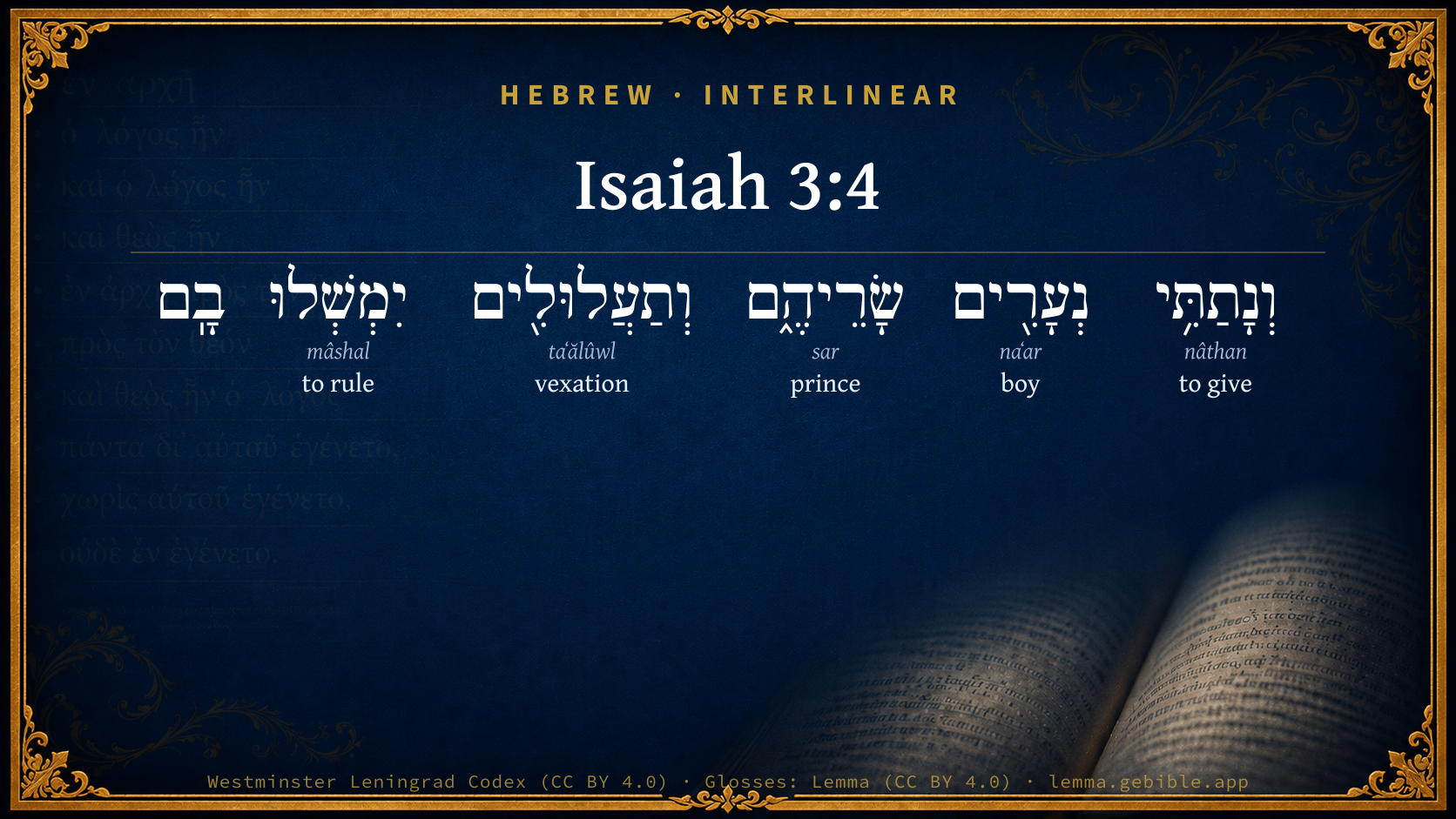
Isaiah 3:4

Hebrew (Westminster Leningrad Codex) Isaiah 3:4 appears in the Hebrew Old Testament. The text above is from the Westminster Leningrad Codex. Each word links to its Strong’s number, a concise gloss, and parsing drawn from the Open Scriptures Hebrew Bible morphology. Click any word for its full Brown-Driver-Briggs (BDB) entry.
Download image
Cite this verse

Isaiah 3:4 (World English Bible). Public Domain. Lemma interlinear Bible study tool, https://lemma.gebible.app/v/isaiah/3/4.

Show BibTeX & RIS
BibTeX
RIS
English Translation
I will give boys to be their princes, And children shall rule over them.
World English Bible · Public Domain
Highlights
  • 1 first appearance in the Hebrew Bible
Full analysis ↓
Download a study sheet

One document with this verse’s original text, its word-by-word gloss line, the meaning frame, cross-references with their text, attributed commentary, and full source and license credits — printable, and it pastes into notes with its structure intact.

This verse Autodidact and up

Study sheet (.html) Plain text (.txt)

A passage Seminary Student

Up to 50 verses in one chapter. A passage sheet keeps up to 6 commentary sources and 12 cross-references per verse, in the order this page ranks them, and says so on the sheet whenever that leaves anything out. Ask for a single verse and you get the Autodidact verse sheet above.

Everything on this page stays free to read, with no account — the sheet is a download of what is already on screen, not access to it.

Want to remove ads? Support Godless Engineer
Compare translations 3

The same verse in 3 English versions, stacked beneath the original-language interlinear above. Click any original word for its lexicon entry.

Each is an independent rendering of the whole verse — the interlinear is not word-aligned to these translations.

Highlighted words mark where these versions differ — a whole-verse word diff, not a word-by-word alignment.

  • World English Bible Public Domain
    I will give boys to be their princes, And children shall rule over them.
  • King James Version Public Domain
    And I will give children to be their princes, and babes shall rule over them.
  • unfoldingWord Literal Text CC BY-SA 4.0
    And I will make youths their princes, and children will rule over them.

unfoldingWord Literal Text — © unfoldingWord, licensed CC BY-SA 4.0. Word-aligned USFM3 via Door43 (git.door43.org/unfoldingWord/en_ult).

Versions to compare (up to 4)

3 of 4 selected

Show all 18 translations

Every available English version of this verse, each an independent rendering of the whole verse.

  • World English Bible Public Domain
    I will give boys to be their princes, And children shall rule over them.
  • Berean Standard Bible Public Domain
    “I will make mere lads their leaders, and children will rule over them.”
  • Majority Standard Bible Public Domain
    “I will make mere lads their leaders, and children will rule over them.”
  • King James Version Public Domain
    And I will give children to be their princes, and babes shall rule over them.
  • American Standard Version (1901) Public Domain
    And I will give children to be their princes, and babes shall rule over them.
  • Revised Version (1885) Public Domain
    And I will give children to be their princes, and babes shall rule over them.
  • Geneva Bible (1599) Public Domain
    And I will appoint children to bee their princes, and babes shall rule ouer them.
  • Douay-Rheims (1899) Public Domain
    And I will give children to be their princes, and the effeminate shall rule over them.
  • Young's Literal Translation Public Domain
    And I have made youths their heads, And sucklings rule over them.
  • Literal Standard Version CC BY-SA 4.0
    And I have made youths their heads, || And sucklings rule over them.
  • Unlocked Literal Bible CC BY-SA 4.0
    “I will place mere youths as their leaders, and the young will rule over them.
  • unfoldingWord Literal Text CC BY-SA 4.0
    And I will make youths their princes, and children will rule over them.
  • Darby Bible Public Domain
    And I will appoint youths as their princes, and children shall rule over them.
  • World Messianic Bible Public Domain
    I will give boys to be their princes, and children shall rule over them.
  • Webster's Bible Public Domain
    And I will give children to be their princes, and babes shall rule over them.
  • Free Bible Version CC BY-SA 4.0
    I will give them boys as their leaders who will rule over them in childish ways.
  • Bible in Basic English Public Domain
    And I will make children their chiefs, and foolish ones will have rule over them.
  • JPS Tanakh (1917) Public Domain
    And I will give children to be their princes, and babes shall rule over them.

Literal Standard Version (2020), Covenant Press — licensed CC BY-SA 4.0. Text via the HelloAO Bible API (eBible.org). Unlocked Literal Bible (unfoldingWord) — licensed CC BY-SA 4.0. Text via the HelloAO Bible API (eBible.org). unfoldingWord Literal Text — © unfoldingWord, licensed CC BY-SA 4.0. Word-aligned USFM3 via Door43 (git.door43.org/unfoldingWord/en_ult). Free Bible Version, Dr. Jonathan Gallagher — licensed CC BY-SA 4.0. Text via the HelloAO Bible API (eBible.org).

Word by word

More ways to search: Search by grammar → Find every occurrence → Compare this word →

Practice this passage: Drill this verse → Learn its vocabulary →

About this verse

These counts appear in no published source. They are computed here, from the morphology-tagged text and Lemma’s own curated glosses. What Lemma adds →

6
words
5
distinct lemmas
Prophets
section

Notable vocabulary

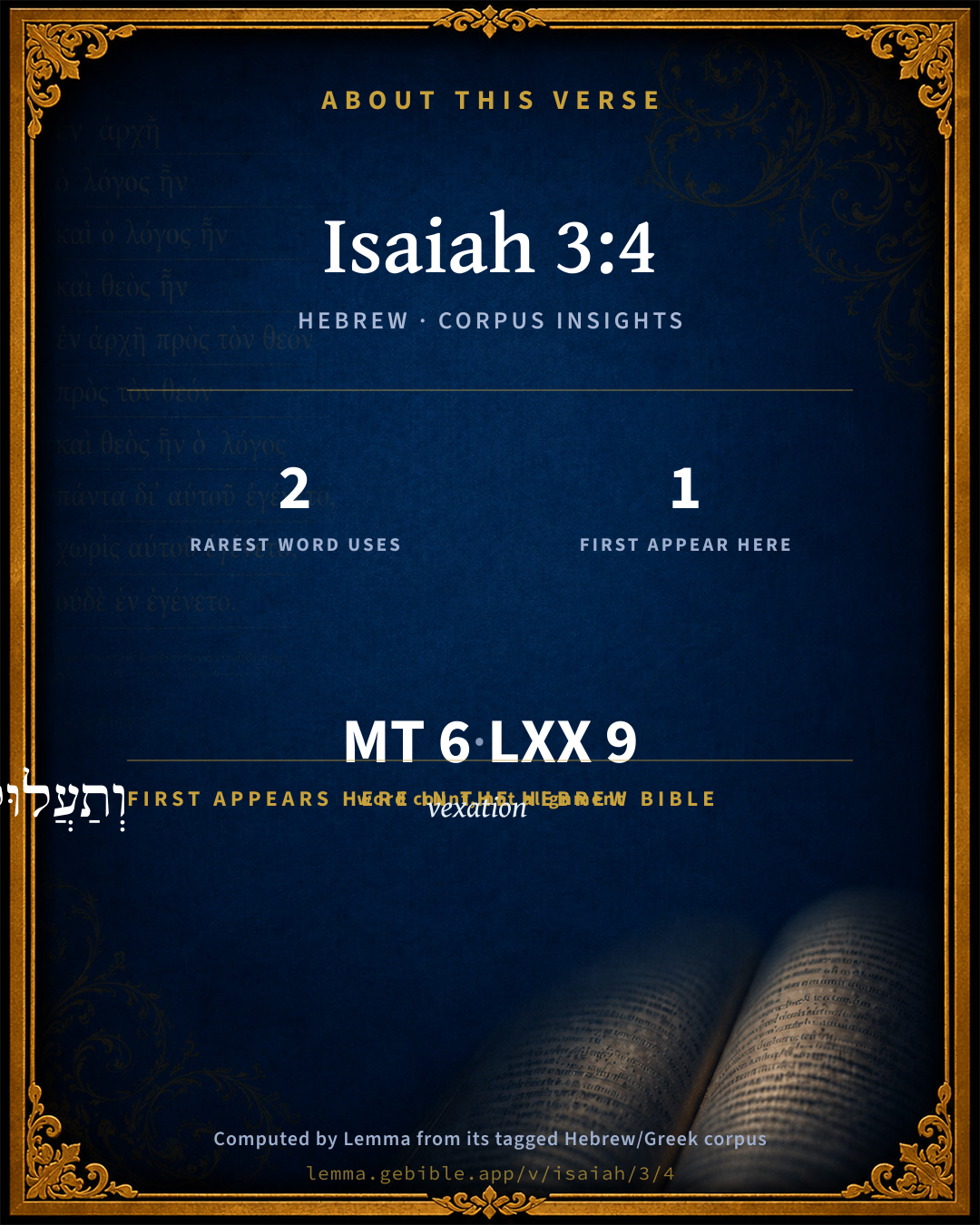
The rarest word here is וְתַעֲלוּלִ֖ים vexation H8586 — appearing just 2 times in the whole Hebrew Bible.

First appearance in Scripture

This word makes its first canonical appearance in the Hebrew Bible here:

  • וְתַעֲלוּלִ֖ים vexation H8586

Shared distinctive vocabulary

וְתַעֲלוּלִ֖ים vexation H8586 occurs in 2 verses of the Hebrew Bible. Also found in:

Grammatical profile

  • 2 verbs
  • 3 nouns
  • 1 preposition

Verb forms

  • וְנָתַתִּ֥י Qal · Sequential Perfect
  • יִמְשְׁלוּ Qal · Imperfect

Hebrew & Septuagint length

In English translation the verse runs 14 words from the Hebrew and 14 from the Septuagint (LXX English) — the same length.

A rough comparison of the two English renderings, which tokenize alike — not a word-level alignment.

Word counts can differ between the Hebrew and the Greek without any difference in meaning — e.g. the Hebrew direct-object marker אֵת has no separate Greek word, and Greek often adds the article ὁ.

In the original languages it is 6 Hebrew tokens and 9 Greek tokens — but the two are counted differently (Hebrew bundles its prefixes and suffixes into one token; the Greek is in lemma form), so that isn’t a like-for-like length.

Cross-references

8

Topical passages linked to Isaiah 3:4 in the Treasury of Scripture Knowledge — connected by theme and wording, ordered by reader-vote popularity; previews shown in the World English Bible.

  • Ecclesiastes 10:16 Woe to you, land, when your king is a child, And your princes eat in the morning!
  • 1 Kings 3:7–9 Now, Yahweh my God, you have made your servant king instead of David my father: and I am but a little child; I don't know how to go out or come in.
  • 2 Chronicles 33:1 Manasseh was twelve years old when he began to reign; and he reigned fifty-five years in Jerusalem.
  • 2 Chronicles 36:5 Jehoiakim was Twenty-five years old when he began to reign; and he reigned eleven years in Jerusalem: and he did that which was evil in the sight of Yahweh his God.
  • 2 Chronicles 36:9 Jehoiachin was eight years old when he began to reign; and he reigned three months and ten days in Jerusalem: and he did that which was evil in the sight of Yahweh.
  • 2 Chronicles 34:1 Josiah was eight years old when he began to reign; and he reigned thirty-one years in Jerusalem.
  • 2 Chronicles 36:2 Joahaz was twenty-three years old when he began to reign; and he reigned three months in Jerusalem.
  • 2 Chronicles 36:11 Zedekiah was twenty-one years old when he began to reign; and he reigned eleven years in Jerusalem:

Cross-references courtesy of OpenBible.info (CC BY 4.0).

Hebrew and Greek witnesses Masoretic Hebrew ↔ Greek Septuagint

The same verse in the two great witnesses to the Old Testament, shown verse-for-verse.

These are two independent witnesses, not word-aligned to each other, and the Septuagint is shown in lemma (dictionary) form.

Hebrew Isaiah 3:4 Masoretic · Westminster Leningrad Codex

וְנָתַתִּ֥י נְעָרִ֖ים שָׂרֵיהֶ֑ם וְתַעֲלוּלִ֖ים יִמְשְׁלוּ בָֽם

I will give boys to be their princes, And children shall rule over them.

World English Bible · Public Domain

Greek LXX Isaiah 3:4 Septuagint · lemma form

καί ἐπιἵστημι νεανίσκος ἄρχων αὐτός καί ἐμπαίκτης κυριεύω αὐτός

And I will make youths their princes, and mockers shall have dominion over them.

LXX2012 (modern English Septuagint) · Public Domain

On this verse, John Gill's Exposition discusses the Septuagint’s reading. Read the note in Commentary ↓

Hebrew: Westminster Leningrad Codex (CC BY 4.0). Greek: Septuagint (public domain); English from LXX2012 (modern English Septuagint) (Public Domain). How the Septuagint differs from the Hebrew →

Targum (Aramaic paraphrase)

1

The Targum is the ancient Jewish Aramaic paraphrase of the Hebrew Scriptures — an interpretive translation, not the Hebrew text itself. Onkelos (literal) and Pseudo-Jonathan (expansive) render the Torah, and Jonathan the Prophets. Coverage is partial: where no permissively-licensed English translation exists for a verse, only the Aramaic is shown. This is verse-level text, not a word-by-word alignment to the Hebrew.

  1. Targum Jonathan Prophets (Joshua–Malachi)
    וַאֲמַנֵי יַנְקַיָא פַּרְנָסֵיהוֹן וְחַלָשַׁיָא יִשְׁלְטוּן בְּהוֹן:

    And I will appoint sucklings to be their governors, and the weak shall rule over them.

    Targum Jonathan — Aramaic: “Mikraot Gedolot” (public domain). English: “Sefaria Community Translation” (CC0 1.0 (public-domain dedication)); “London "Chaldee Paraphrase," 1871” (public domain). Text via Sefaria.

Commentary

Notes on Isaiah 3:4 from classic Christian and Jewish commentators (each source and its license shown beneath its notes). The classic Christian expositions comment on the surrounding passage and are grouped to its opening verse, so a note may address several verses; the Jewish commentaries on the Tanakh (Rashi and others) are per-verse, so they appear only where the commentator wrote on this verse.

Lemma curates 59 commentaries, every one of them public domain or Creative Commons licensed, each selected and text-cleaned for this edition rather than reprinted as found. About our sources →

Trapp's Complete Commentary

John Trapp

Isa 3:4 And I will give children [to be] their princes, and babes shall rule over them.

Ver. 4. And I will give children to be their princes.] Si non annis, at animis; If not with years but with life, such as were Ahaz, Manasseh, the four last kings of Judah, the calamity of that kingdom. {a} Princes that are witless, wilful, weak, or wicked, are the people’s woe; {Ecc 10:16} this childhood of theirs is the maturity of their subjects’ misery. {Job 34:30}

And babes shall rule over them.] Sept., Mockers; some render it foxes, others effeminate persons, but babes is best. Such a one was Rehoboam, and Honorius the Emperor, who when he heard that his city of Rome was taken by Alarichus, grieved most of all for the loss of a certain bird which was there kept for him, and by him called "Rome." Indignum sane, Regem aves praeferre urbibus, saith the historian.

{a} Dii avertant principes pueros. - Vopis.

John Trapp, A Commentary or Exposition upon All the Books of the Old and New Testament (1647–1656) — public domain. Text from a community e-Sword module.

The Biblical Illustrator

Joseph S. Exell

Isa_3:4-8

I will give children to be their princes

Puerile government

Probably an abstract term used for a concrete--puerilities or childishnesses for childish persons.

(J. A. Alexander.)

Juvenile government a curse

If it is in itself generally a misfortune when the king of a country is a lad (Ecc_10:16), it is doubly so when the princes or magnates surrounding end advising him are also youths or youngsters in the bad sense of the term . . . Varying humour, utterly unregulated and unrestrained, rules supreme. (F. Delitzsch.)

A foolish ruler: Justinian II (of Constantinople)

The name of a triumphant lawgiver was dishonoured by the vices of a boy, who imitated his namesake only in the expensive luxury of building. His passions were strong; his understanding was feeble; and he was intoxicated with a foolish pride that his birth had given him the command of millions, of whom the smallest community would not have chosen him for their local magistrate. His favourite ministers were two beings the least susceptible of human sympathy, a eunuch and a monk; the one he abandoned the palace, to the other the finances; the former corrected the emperors mother with a scourge, the latter suspended the insolvent tributaries, with their heads downward, over a slow and smoky fire. (Gibbons Rome.)

The Biblical Illustrator, edited by Joseph S. Exell (c. 1880s–1900s) — public domain. Text from a community e-Sword module.

Joseph Benson's Commentary

Isa 3:4-5. And I will give children to be their princes — Either, 1st, Children in age, whose minority corrupt ministers of state commonly abuse, to the producing of much evil: or, 2d, In understanding and experience. When all the eminent persons, mentioned Isa 3:2-3, were removed, the necessary consequence must be, that persons of no qualifications for government must succeed in their places. This also was fully accomplished in the succession of weak and wicked princes, from the death of Josiah to the destruction of the city and temple. And the people shall be oppressed — By the command or permission of such childish rulers. The child shall behave himself proudly, &c. — The child in understanding, or the young and inexperienced; and the base against the honourable — “The usual effects,” says Lowth, “of a weak and unsettled government, where faction grows too hard for justice, and seditious men become so bold as openly to insult those that are in authority.”

Joseph Benson's Commentary on the Old and New Testaments (1811–1818) — public domain. Text from a community e-Sword module.

Tyndale Open Study Notes

Tyndale Open Resources

3:4 Conditions would be so severe that boys and toddlers would qualify as candidates for office. By this, Isaiah either meant that adult leaders would be so decimated that only children would be left alive to assume the role or simply that the new leaders would be as immature, unwise, strong willed, and inexperienced as children.

Tyndale Open Study Notes — © Tyndale Open Resources, licensed CC BY-SA 4.0. Text via the HelloAO Bible API.

Geneva Bible (1599)

Geneva Bible translators

Not only in age: but in wit, manners, knowledge and strength.

Geneva Bible (1599) marginal notes — public domain. Text via Bolls.life.

Jamieson, Fausset & Brown

Robert Jamieson, A. R. Fausset & David Brown

children--in ability for governing; antithesis to the "ancient" (see Isa 3:12; Ecc 10:16).

babes--in warlike might; antithesis to "the mighty" and "man of war."

Jamieson, Fausset & Brown — Commentary Critical and Explanatory on the Whole Bible (1871) — public domain (CC PDM 1.0). Text via the HelloAO Bible API.

Adam Clarke's Commentary

Verse 4. I will give children to be their princes - "I will make boys their princes"] This also was fully accomplished in the succession of weak and wicked princes, from the death of Josiah to the destruction of the city and temple, and the taking of Zedekiah, the last of them, by Nebuchadnezzar.

Babes shall rule over them.] Dymennysche men schul lordschopen to hem. - Old MS. Bible.

Adam Clarke's Commentary on the Bible (1810–1826) — public domain. Text from a community e-Sword/MySword module.

Ellicott's Commentary for English Readers

(4) I will give children to be their princes.—Better, youths. The words may point obliquely to Ahaz, who had ascended the throne at the age of twenty (2Ch_28:1). Manasseh was but twelve when he became king; Josiah but eight (2Ch_33:1; 2Ch_34:1). In an Eastern monarchy the rule of a young king, rash and without experience, guided by counsellors like himself, was naturally regarded as the greatest of evils, and the history of Rehoboam had impressed this truth on the mind of every Israelite. (Comp. Ecc_10:16.)

A Bible Commentary for English Readers, edited by Charles John Ellicott (1878–1897) — public domain. Text from a community e-Sword module.

The Cambridge Bible for Schools and Colleges

gen. ed. J. J. S. Perowne

4. The supreme power passing into the hands of weaklings, a Reign of Terror ensues among the people. The sudden change of speaker is very striking.

and babes …] Rather, and Outrage shall rule over them. The word rendered “babes” is really an abstract noun, occurring again only in ch. Isa_66:4 (A.V. “delusions”). It is derived from a verb meaning “to outrage” or “to insult” (see Jdg_19:25; 1Sa_31:4; Jer_38:19; Num_22:29), and seems here to denote those personal affronts and outrages which invariably accompany social confusions. The rendering “capriciousness,” preferred by many, does not suit Isa_66:4. Some take the word as adverbial acc. (see R.V. marg. “with childishness shall they rule”), others think the abstract is used for the concrete (“capricious youths”). But the translation given is perhaps the most forcible,—Outrage instead of Justice.

The Cambridge Bible for Schools and Colleges (gen. ed. J. J. S. Perowne; Cambridge University Press, 1878–1918) — public domain. Text from a community e-Sword module.

John Gill's Exposition

And I will give children to be their princes,.... Either in age, or in understanding, who are really so, or act like such; and in either sense, when this is the case, it is an unhappiness to a nation, Ecc 10:16,

and babes shall rule over them; which is the same as before. The Targum is,

"the weak shall rule over them;''

such who are weak in their intellectuals, or are of mean pusillanimous spirits, "effeminate", as the Vulgate Latin version renders it; and so as "children" are opposed to the "ancient", that should be taken away, these are opposed to "men of might" and courage, who would now be wanting: or "men of illusions", as in the margin; such as were subtle as foxes, and should deceive them, and impose upon them, and were audacious and impudent, and would mock at them, and despise them. So Jarchi and Abarbinel; and according to this sense of the word the Septuagint, Syriac, and Arabic versions, render it, "mockers shall rule over them".

John Gill's Exposition of the Whole Bible (1746–1763) — public domain (CC PDM 1.0). Text via the HelloAO Bible API.

Albert Barnes' Notes on the Bible

And I will give children - Not children in respect to age so much as in regard to talent for governing. I will commit the land to the government of weak and imbecile princes. This would naturally occur when the wise and great were removed; compare Ecc 10:16 : ‘Wo to thee, O land, when thy king is a child;’ compare Isa 3:12.

And babes shall rule ... - That is, babes in experience and knowledge. This was fully accomplished in the succession of weak and wicked princes that succeeded Isaiah, until the time of Zedekiah, the last of them, when the temple was taken by Nebuchadnezzar. - “Lowth.”

Albert Barnes' Notes on the Bible (1834–1885) — public domain. Text from a community e-Sword/MySword module.

Haydock's Catholic Bible Commentary

Effeminate. Hebrew, "babes." Septuagint, "scoffers." Aquila, &c., "changers," (Calmet) who give way to unnatural excesses, Romans i. 27. (Haydock) --- Some manifest a prudence beyond their years: but the last kings of Juda did not, 2 Paralipomenon xxxvi. 1., and Ecclesiastes x. 16.

George Leo Haydock (1774–1849), Haydock's Catholic Family Bible and Commentary, 1859 edition — public domain. Excludes Psalms (Douay-Rheims chapter numbering differs from Protestant) and Deuterocanonical books (Catholic canon only).

Matthew Poole's English Annotations

Children; either,

1. In age, whose minority corrupt ministers of state commonly abuse to great mischiefs; or,

2. In understanding, experience, and manners; foolish, froward, unteachable, &c.

Matthew Poole's English Annotations on the Holy Bible (1683–1685) — public domain. Text from a community e-Sword/MySword module.

Whedon's Commentary on the Bible

Daniel D. Whedon

4, 5. Children to be their princes — A phrase descriptive of the evil condition of a state deprived of wise rulers. See conduct of Rehoboam, 1 Kings 12.

Babes — Ignorant and incompetent persons. Did the prophet here look forth one hundred years, and describe what is stated as history in 2 Kings 22-25? Grotius well calls this a state of anarchy; to the Hebrew tone of life a state intensely revolting.

Daniel D. Whedon (gen. ed.), Commentary on the Old and New Testaments (1874–1909) — public domain. Text from a community e-Sword module.

The Pulpit Commentary

I will give children to be their princes; rather, youths than "children." The extreme youth of the later kings of Judah at the date of their accession is very remarkable. After Hezekiah, only one was as much as twenty-five years old when he came to the throne. Jehoahaz was twenty; (2Ki_23:31) Amon, twenty-two; (2Ki_21:19) Zedekiah twenty-one; (2Ki_24:18) Jehoiachin, eighteen; (2Ki_24:8) Manasseh, twelve; (2Ki_21:1) and Josiah eight. (2Ki_22:1) Thus this prophecy was fulfilled to the letter. And babes shall rule over them; literally, puerilities shall rule over them; i.e. the youths shall behave in a childish way.

The evil of childish rulers.

"Babes shall rule over them." No greater calamity can come on a nation than the succession of mere children to the throne, and government by regency and party. Ahaz ascended the throne at the age of twenty. (2Ch_28:1) Manasseh at age of twelve; Josiah at age of eight. (2Ch_33:1 2Ch_34:1) The evil was, of course, exaggerated in Eastern countries, where kings are irresponsible despots. "In an Eastern monarchy the rule of a young king, rash and without experience, guided by counselors like himself, was naturally regarded as the greatest of evils, and the history of Rehoboam had impressed this truth on the mind of every Israelite." "Woe to thee, O land, when thy king is a child". (Ecc_10:16) When the strong men and wise men are removed by disease and calamity, weaklings get into office and place of authority, and surely create fresh evils by their incapacity.

I THE EVIL OF RULERS WHO ARE CHILDREN IN AGE. Such, being unable to decide and act for themselves, are dependent on court advisers; so there is every opportunity for court intrigue, rivalry of parties, and the sacrifice of national interests to party advantage. Under weak governments class is set against class. Illustrate the petulance of boys in the exercise of assumed authority. It comes out even in their play. In old times young kings were under the supreme influence of the queen-mother, and she might be a Jezebel or an Athaliah. The most anxious times of English history are times of regency.

II THE EVIL OF RULERS WHO ARE CHILDREN IN UNDERSTANDING. Such as Rehoboam. The evil is qualified in constitutional countries; but even in them the king gives tone to society. It has often been a consequence of war that a land has been left to the government of the incompetent. Corruption at court has sometimes led the best men to retire from the government. Under such inefficient rule, in an Eastern kingdom, all is chaotic and anarchic; there is a condition which can only be fittingly represented by the Turkey or Egypt of our own times. Apply to the small kingdoms of

(1) society,

(2) friendship,

(3) families, and urge the importance, to the well-being of a nation, of manly men, and manly, strong, wisely ruling fathers. R.T.

The Pulpit Commentary (1880–1919), ed. H.D.M. Spence-Jones & Joseph S. Exell — public domain. Text from a community e-Sword module.

Keil & Delitzsch

C. F. Keil & F. Delitzsch

Thus robbed of its support, and torn out of its proper groove, the kingdom of Judah would fall a prey to the most shameless despotism: "And I give them boys for princes, and caprices shall rule over them." The revived "Solomonian" glory is followed, as before, by the times of Rehoboam. The king is not expressly named. This was intentional. He had sunk into the mere shadow of a king: it was not he who ruled, but the aristocratic party that surrounded him, who led him about in leading strings as unum inter pares. Now, if it is a misfortune in most cases for a king to be a child (na'ar, Ecc 10:16), the misfortune is twice as great when the princes or magnates who surround and advise him are youngsters (ne'ârim, i.e., young lords) in a bad sense. It produces a government of tâlulim. None of the nouns in this form have a personal signification. According to the primary meaning of the verbal stem, the word might signify childishnesses, equivalent to little children (the abstract for the concrete, like τἀπαιδικά amasius), as Ewald supposes; or puppets, fantocci, poltroons, or men without heart or brain, as Luzzatto maintains. But the latter has no support in the general usage of the language, and the verb yimshelu (shall rule) does not necessarily require a personal subject (cf., Psa 19:14; Psa 103:19). The word tâlulim is formed from the reflective verb hithallel, which means to meddle, to gratify one's self, to indulge one's caprice. Accordingly tâlulim itself might be rendered vexationes (Isa 66:4). Jerome, who translates the word effeminati, appears to have thought of התעלּל in an erotic sense. The Sept. rendering, ἐμπαῖκται is better, though ἐμπαίγματα would be more exact. When used, as the word is here, along with ne'arim, it signifies outbursts of youthful caprice, which do injury to others, whether in joke or earnest. Neither law nor justice would rule, but the very opposite of justice: a course of conduct which would make subjects, like slaves, the helpless victims at one time of their lust (Jdg 19:25), and at another of their cruelty. They would be governed by lawless and bloodstained caprice, of the most despotic character and varied forms. And the people would resemble their rulers: their passions would be let loose, and all restraints of modesty and decorum be snapt asunder.

Keil & Delitzsch — Biblical Commentary on the Old Testament (1861–1891) — public domain (CC PDM 1.0). Text via the HelloAO Bible API. (Old Testament only.)

J. A. Alexander on Isaiah

Joseph Addison Alexander

The natural consequence of the removal of the leading men must be the rise of incompetent successors, persons without capacity, experience, or principle, a change which is here ascribed to God’s retributive justice. “And I will give children, to be their rulers, and childish things shall govern therein.” Some apply this, in a strict sense, to the weak and wicked reign of Ahaz; others in a wider sense to the series of weak kings after Isaiah. But there is no need of restricting it to kings at all. The most probable opinion is that the incompetent rulers are called boys or children not in respect to age but character.

Joseph Addison Alexander, The Prophecies of Isaiah (1846–1847; New York: Scribner, 1870–1878) — public domain. Text from a community e-Sword module.

unfoldingWord translationNotes

Door43 World Missions Community

I will place mere youths as their leaders, and the young will rule over them

These phrases mean basically the same thing. Possible meanings are 1) "I will place young people as their leaders, and those young people will rule over them" or 2) "youths" is a metaphor for simple and foolish men. AT: "I will place over them leaders who are immature, like young people, and those bad leaders will rule over them" (See: Parallelism and Metaphor)

I will place

Here the word "I" refers to Yahweh. This can also be stated clearly. AT: "Yahweh says, 'I will place" (See: Assumed Knowledge and Implicit Information)

The people will be oppressed, every one by another, and every one by his neighbor

This can be stated in active form. AT: "Everyone will be cruel to others and will mistreat his neighbor" (See: Active or Passive)

the degraded

"the people who are without honor" or "the people whom no one respects"

the honorable

"the people with honor" or "the people whom everyone respects"

translationWords

people group

neighbor

children

honor

unfoldingWord translationNotes — © Distant Shores Media and the Door43 World Missions Community, licensed CC BY-SA 4.0. Source: git.door43.org/Door43/en_tn.

Rashi

Rabbi Shlomo Yitzchaki (Rashi)

And I will appoint youths as their princes These are people devoid of any observance of the commandments.

and scorners will rule over them Heb. וְתַעֲלוּלִים [related to the Aramaic תַּעֲלֵי] foxes, [i.e.,] weak people. But I say that according to the simple meaning, תַּעֲלוּלִים means scornful people, people who mock them, as (Job 16:15): “I soiled (וְעוֹלַלְתִּי) my radiance in the dust,” and (Exod. 10: 2): “how I mocked (הִתְעַלַּלְתִּי) the Egyptians.”

Rashi on the Tanakh — English translations: “The Judaica Press complete Tanach with Rashi, translated by A. J. Rosenberg” (CC BY 4.0); “Pentateuch with Rashi's commentary by M. Rosenbaum and A.M. Silbermann, 1929-1934” (public domain); “The Metsudah Tanach series, Lakewood, N.J” (CC BY 4.0); and “The Book of Joshua, Metsudah Publications, 1997” (CC BY 4.0). Text via Sefaria.

Ibn Ezra

Rabbi Abraham ibn Ezra

תעלולים Babes. The ת is not a radical letter; root עול to be young. Comp. עולל child (Jer. 6:11). העלולים is here an adjective, they that are young, החכם the wise האיש החכם═, The wise man; העלולים, Young תעלולים אנשים═, Young men. More correctly this word may be explained as an abstract noun, which is used instead of the concrete; childishness═children. but in chap. 66:4, it is a noun, childishness, delusions.

Ibn Ezra on the Tanakh — English translations: “Sefaria Community Translation” (CC0 1.0 (public-domain dedication)); “Yalkut, Sifsei Chachomim Chumash, Metsudah Publications, 2009” (CC BY 4.0); and “Commentary of Ibn Ezra on Isaiah - trans. by M. Friedlander, 1873” (public domain). Text via Sefaria.

Lesson kit

Teaching starters — assembled from the data on this page, not authored interpretation. Every prompt links to the verse data it draws on. Edit before teaching.

Isaiah, in the Prophets, opens this verse with 6 words (5 distinct Hebrew lemmas). Its most distinctive word is taʻălûwl (“vexation”). A historical commentator’s framing appears above. Read the whole chapter for the surrounding context.

Discussion questions

  1. The word taʻălûwl carries the sense “vexation.” How does it shape the verse?
  2. The word “vexation” first appears here in Scripture. What is being introduced at this debut?
  3. Isaiah 66:4 shares the word «vexation» with this verse. How do the two illuminate each other?
  4. These translations render this verse differently; the difference is in the English rendering, not the original. What questions does that raise?
  5. The verb «וְנָתַתִּ֥י» is Qal Sequential Perfect. How does its form color the action?
  6. Reading how Trapp's Complete Commentary and The Biblical Illustrator read this verse, where do the two commentators agree and where do they part?

Things to notice

Reading settings

Reading text

Shown beneath each verse's original-language words.

Old Testament
Old Testament edition

Read the OT as the Masoretic Hebrew (MT) or the Greek Septuagint (LXX).

English shown for the Greek Septuagint (in the Hebrew ↔ Greek comparison).

Comparing translations? Open the Compare panel on any verse page to stack up to four side by side.