
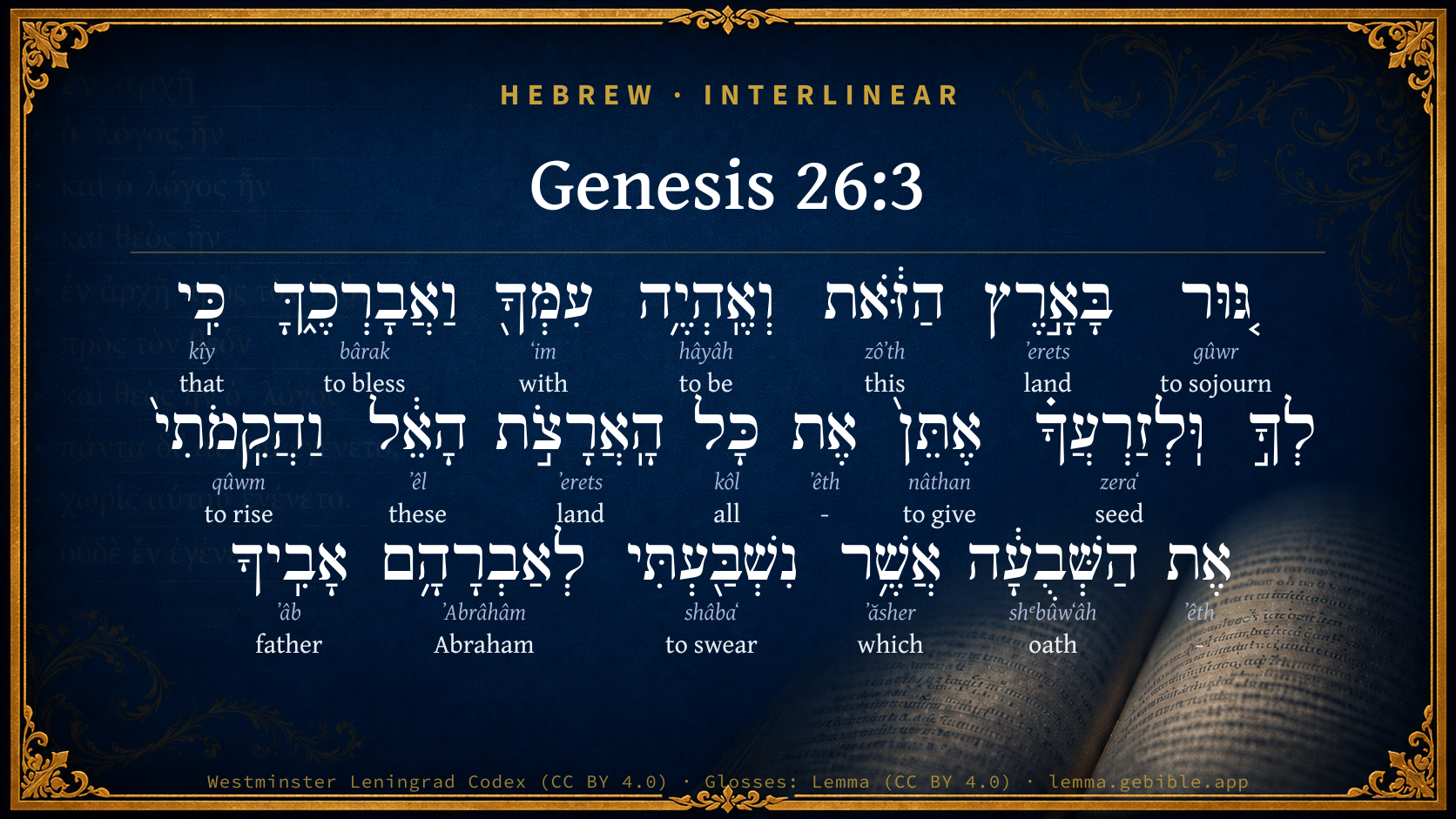
Genesis 26:3

Hebrew (Westminster Leningrad Codex) Genesis 26:3 appears in the Hebrew Old Testament. The text above is from the Westminster Leningrad Codex. Each word links to its Strong’s number, a concise gloss, and parsing drawn from the Open Scriptures Hebrew Bible morphology. Click any word for its full Brown-Driver-Briggs (BDB) entry.
Download image
Cite this verse

Genesis 26:3 (World English Bible). Public Domain. Lemma interlinear Bible study tool, https://lemma.gebible.app/v/genesis/26/3.

Show BibTeX & RIS
BibTeX
RIS
English Translation
Sojourn in this land, and I will be with you, and will bless you. For to you, and to your seed, I will give all these lands, and I will establish the oath which I swore to Abraham your father.
World English Bible · Public Domain
Download a study sheet

One document with this verse’s original text, its word-by-word gloss line, the meaning frame, cross-references with their text, attributed commentary, and full source and license credits — printable, and it pastes into notes with its structure intact.

This verse Autodidact and up

Study sheet (.html) Plain text (.txt)

A passage Seminary Student

Up to 50 verses in one chapter. A passage sheet keeps up to 6 commentary sources and 12 cross-references per verse, in the order this page ranks them, and says so on the sheet whenever that leaves anything out. Ask for a single verse and you get the Autodidact verse sheet above.

Everything on this page stays free to read, with no account — the sheet is a download of what is already on screen, not access to it.

Want to remove ads? Support Godless Engineer
Compare translations 3

The same verse in 3 English versions, stacked beneath the original-language interlinear above. Click any original word for its lexicon entry.

Each is an independent rendering of the whole verse — the interlinear is not word-aligned to these translations.

Highlighted words mark where these versions differ — a whole-verse word diff, not a word-by-word alignment.

  • World English Bible Public Domain
    Sojourn in this land, and I will be with you, and will bless you. For to you, and to your seed, I will give all these lands, and I will establish the oath which I swore to Abraham your father.
  • King James Version Public Domain
    Sojourn in this land, and I will be with thee, and will bless thee; for unto thee, and unto thy seed, I will give all these countries, and I will perform the oath which I sware unto Abraham thy father;
  • unfoldingWord Literal Text CC BY-SA 4.0
    Sojourn in this land, and I will be with you and bless you. For to you and to your offspring I will give all these lands, and I will confirm the oath that I swore to Abraham your father.

unfoldingWord Literal Text — © unfoldingWord, licensed CC BY-SA 4.0. Word-aligned USFM3 via Door43 (git.door43.org/unfoldingWord/en_ult).

Versions to compare (up to 4)

3 of 4 selected

Show all 18 translations

Every available English version of this verse, each an independent rendering of the whole verse.

  • World English Bible Public Domain
    Sojourn in this land, and I will be with you, and will bless you. For to you, and to your seed, I will give all these lands, and I will establish the oath which I swore to Abraham your father.
  • Berean Standard Bible Public Domain
    Stay in this land as a foreigner, and I will be with you and bless you. For I will give all these lands to you and your offspring, and I will confirm the oath that I swore to your father Abraham.
  • Majority Standard Bible Public Domain
    Stay in this land as a foreigner, and I will be with you and bless you. For I will give all these lands to you and your offspring, and I will confirm the oath that I swore to your father Abraham.
  • King James Version Public Domain
    Sojourn in this land, and I will be with thee, and will bless thee; for unto thee, and unto thy seed, I will give all these countries, and I will perform the oath which I sware unto Abraham thy father;
  • American Standard Version (1901) Public Domain
    Sojourn in this land, and I will be with thee, and will bless thee. For unto thee, and unto thy seed, I will give all these lands, and I will establish the oath which I sware unto Abraham thy father.
  • Revised Version (1885) Public Domain
    sojourn in this land, and I will be with thee, and will bless thee; for unto thee, and unto thy seed, I will give all these lands, and I will establish the oath which I sware unto Abraham thy father;
  • Geneva Bible (1599) Public Domain
    Dwell in this lande, and I will be with thee, and will blesse thee: for to thee, and to thy seede I will giue all these countreys: and I will performe the othe which I sware vnto Abraham thy father.
  • Douay-Rheims (1899) Public Domain
    And sojourn in it, and I will be with thee, and will bless thee: for to thee and to thy seed I will give all these countries, to fulfill the oath which I swore to Abraham thy father.
  • Young's Literal Translation Public Domain
    sojourn in this land, and I am with thee, and bless thee, for to thee and to thy seed I give all these lands, and I have established the oath which I have sworn to Abraham thy father;
  • Literal Standard Version CC BY-SA 4.0
    sojourn in this land, and I am with you, and bless you, for to you and to your seed I give all these lands, and I have established the oath which I have sworn to your father Abraham;
  • Unlocked Literal Bible CC BY-SA 4.0
    Stay in this very land, and I will be with you and will bless you; for to you and to your descendants, I will give all these lands, and I will fulfill the oath that I swore to Abraham your father.
  • unfoldingWord Literal Text CC BY-SA 4.0
    Sojourn in this land, and I will be with you and bless you. For to you and to your offspring I will give all these lands, and I will confirm the oath that I swore to Abraham your father.
  • Darby Bible Public Domain
    Sojourn in this land; and I will be with thee and bless thee; for unto thee, and unto thy seed, I will give all these countries; and I will perform the oath which I swore unto Abraham thy father.
  • World Messianic Bible Public Domain
    Live in this land, and I will be with you, and will bless you. For I will give to you, and to your offspring, all these lands, and I will establish the oath which I swore to Abraham your father.
  • Webster's Bible Public Domain
    Sojourn in this land, and I will be with thee, and will bless thee: for to thee, and to thy seed I will give all these countries, and I will perform the oath which I swore to Abraham thy father;
  • Free Bible Version CC BY-SA 4.0
    Stay here in this country. I will be with you and I will bless you, because I'm going to give you and your descendants all these lands. I will keep the solemn promise that I swore to Abraham your father.
  • Bible in Basic English Public Domain
    Keep in this land, and I will be with you and give you my blessing; for to you and to your seed will I give all these lands, giving effect to the oath which I made to your father Abraham;
  • JPS Tanakh (1917) Public Domain
    Sojourn in this land, and I will be with thee, and will bless thee; for unto thee, and unto thy seed, I will give all these lands, and I will establish the oath which I swore unto Abraham thy father;

Literal Standard Version (2020), Covenant Press — licensed CC BY-SA 4.0. Text via the HelloAO Bible API (eBible.org). Unlocked Literal Bible (unfoldingWord) — licensed CC BY-SA 4.0. Text via the HelloAO Bible API (eBible.org). unfoldingWord Literal Text — © unfoldingWord, licensed CC BY-SA 4.0. Word-aligned USFM3 via Door43 (git.door43.org/unfoldingWord/en_ult). Free Bible Version, Dr. Jonathan Gallagher — licensed CC BY-SA 4.0. Text via the HelloAO Bible API (eBible.org).

Word by word

More ways to search: Search by grammar → Find every occurrence → Compare this word →

Practice this passage: Drill this verse → Learn its vocabulary →

הָאֵ֔ל
ʼêl
H411
“the · these”
Particle, Definite Article + Pronoun, Demonstrative, Common, Plural
Part of Speech
Particle + Pronoun
Type
Demonstrative
Gender
Common
Number
Plural
Full BDB Definition

Origin: a demonstrative particle (only in a plural sense)

TWOT: 92

these, those
  1. גּ֚וּר gûwr H1481 “sojourn” Verb, Qal, Imperative, 2nd Person, Masculine, Singular
  2. בָּאָ֣רֶץ ʼerets H776 “in/at the · land” Preposition, Determined + Noun, Common, Both, Singular, Absolute
  3. הַזֹּ֔את zôʼth H2063 “the · this” Particle, Definite Article + Pronoun, Demonstrative, Feminine, Singular
  4. וְאֶֽהְיֶ֥ה hâyâh H1961 “and · to be” Conjunction + Verb, Qal, Imperfect, 1st Person, Common, Singular
  5. עִמְּךָ֖ ʻim H5973 “with · you” Preposition + Suffix, Personal, 2nd Person, Masculine, Singular
  6. וַאֲבָרְכֶ֑ךָּ bârak H1288 “and · to bless · you” Conjunction + Verb, Piel, Imperfect, 1st Person, Common, Singular + Suffix, Personal, 2nd Person, Masculine, Singular
  7. כִּֽי kîy H3588 “that” Conjunction
  8. וּֽלְזַרְעֲךָ֗ zeraʻ H2233 “and · to/for · seed · your” Conjunction + Preposition + Noun, Common, Masculine, Singular, Construct + Suffix, Personal, 2nd Person, Masculine, Singular
  9. אֶתֵּן֙ nâthan H5414 “to give” Verb, Qal, Imperfect, 1st Person, Common, Singular
  10. אֶת ʼêth H853 “-” Particle, Direct Object
  11. כָּל kôl H3605 “all of” Noun, Common, Masculine, Singular, Construct
  12. הָֽאֲרָצֹ֣ת ʼerets H776 “the · lands” Particle, Definite Article + Noun, Common, Both, Plural, Absolute
  13. וַהֲקִֽמֹתִי֙ qûwm H6965 “and · to rise” Conjunction + Verb, Hiphil, Sequential Perfect, 1st Person, Common, Singular
  14. אֶת ʼêth H853 “-” Particle, Direct Object
  15. הַשְּׁבֻעָ֔ה shᵉbûwʻâh H7621 “the · oath” Particle, Definite Article + Noun, Common, Feminine, Singular, Absolute
  16. אֲשֶׁ֥ר ʼăsher H834 “which” Particle, Relative
  17. נִשְׁבַּ֖עְתִּי shâbaʻ H7650 “to swear” Verb, Niphal, Perfect, 1st Person, Common, Singular
  18. לְאַבְרָהָ֥ם ʼAbrâhâm H85 “to/for · Abraham” Preposition + Noun, Proper
  19. אָבִֽיךָ ʼâb H1 “father · your” Noun, Common, Masculine, Singular, Construct + Suffix, Personal, 2nd Person, Masculine, Singular

About this verse

These counts appear in no published source. They are computed here, from the morphology-tagged text and Lemma’s own curated glosses. What Lemma adds →

21
words
18
distinct lemmas
Pentateuch
section

Notable vocabulary

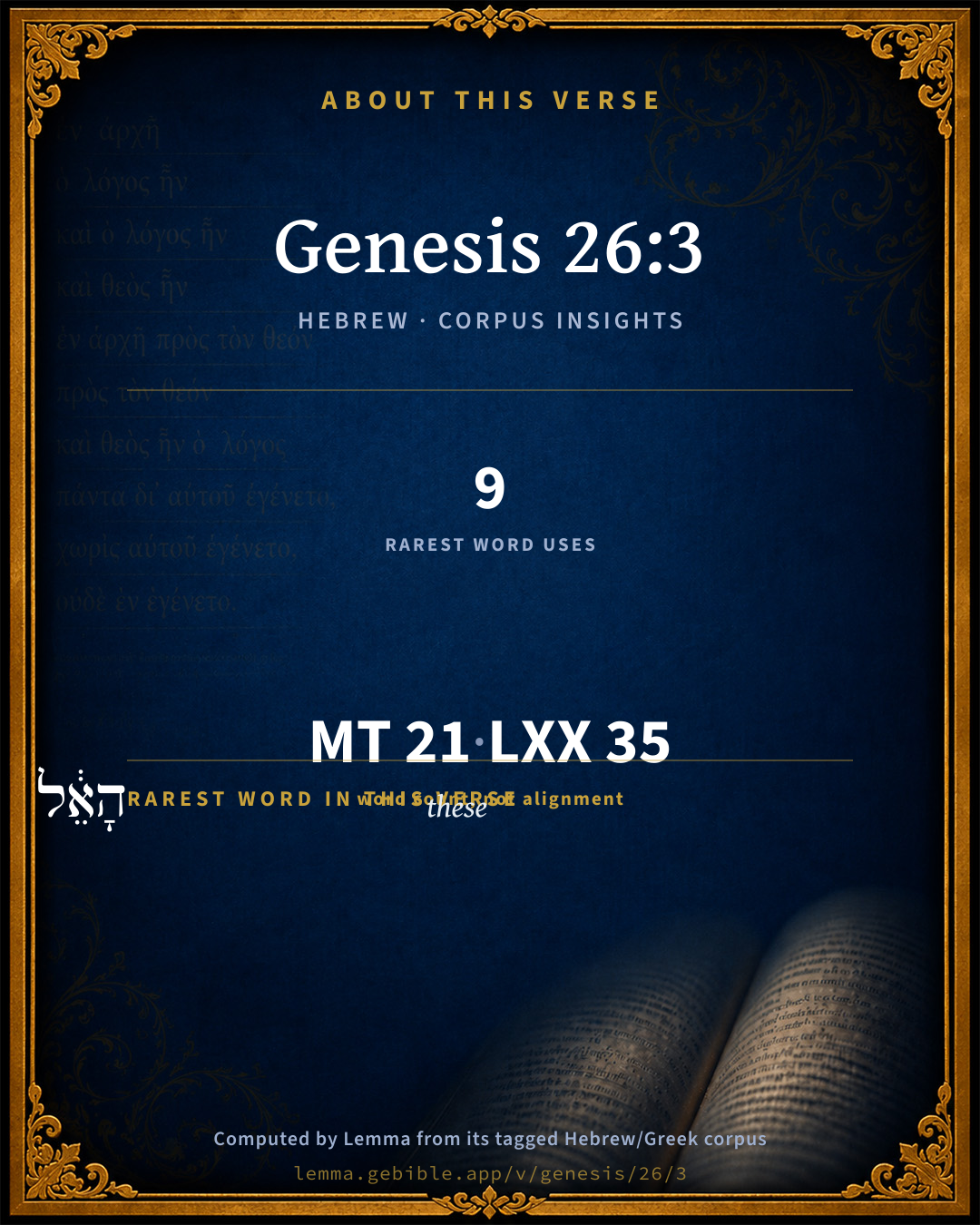
The rarest word here is הָאֵ֔ל these H411 — appearing just 9 times in the whole Hebrew Bible.

Shared distinctive vocabulary

הָאֵ֔ל these H411 occurs in 9 verses of the Hebrew Bible. Also found in:

Grammatical profile

  • 6 verbs
  • 7 nouns
  • 2 pronouns
  • 2 prepositions
  • 1 conjunction
  • 3 particles

Verb forms

  • גּ֚וּר Qal · Imperative
  • וְאֶֽהְיֶ֥ה Qal · Imperfect
  • וַאֲבָרְכֶ֑ךָּ Piel · Imperfect
  • אֶתֵּן֙ Qal · Imperfect
  • וַהֲקִֽמֹתִי֙ Hiphil · Sequential Perfect
  • נִשְׁבַּ֖עְתִּי Niphal · Perfect

Repetition

A word recurs within this verse — often emphatic in Hebrew:

  • בָּאָ֣רֶץ land H776 ×2

Hebrew & Septuagint length

In English translation the verse runs 40 words from the Hebrew and 40 from the Septuagint (LXX English) — the same length.

A rough comparison of the two English renderings, which tokenize alike — not a word-level alignment.

Word counts can differ between the Hebrew and the Greek without any difference in meaning — e.g. the Hebrew direct-object marker אֵת has no separate Greek word, and Greek often adds the article ὁ.

In the original languages it is 21 Hebrew tokens and 35 Greek tokens — but the two are counted differently (Hebrew bundles its prefixes and suffixes into one token; the Greek is in lemma form), so that isn’t a like-for-like length.

Cross-references

24

Topical passages linked to Genesis 26:3 in the Treasury of Scripture Knowledge — connected by theme and wording, ordered by reader-vote popularity; previews shown in the World English Bible.

  • Genesis 28:15 Behold, I am with you, and will keep you, wherever you go, and will bring you again into this land. For I will not leave you, until I have done that which I have spoken of to you."
  • Psalms 105:9 The covenant which he made with Abraham, His oath to Isaac,
  • Genesis 13:15 for all the land which you see, I will give to you, and to your offspring forever.
  • Genesis 22:16–18 and said, "I have sworn by myself, says Yahweh, because you have done this thing, and have not withheld your son, your only son,
  • Genesis 12:7 Yahweh appeared to Abram, and said, "I will give this land to your seed." He built an altar there to Yahweh, who appeared to him.
  • Genesis 17:8 I will give to you, and to your seed after you, the land where you are traveling, all the land of Canaan, for an everlasting possession. I will be their God."
  • Genesis 20:1 Abraham traveled from there toward the land of the South, and lived between Kadesh and Shur. He lived as a foriegner in Gerar.
  • Hebrews 11:9 By faith, he lived as an alien in the land of promise, as in a land not his own, dwelling in tents, with Isaac and Jacob, the heirs with him of the same promise.
  • Genesis 13:17 Arise, walk through the land in the length of it and in the breadth of it; for I will give it to you."
  • Genesis 15:18 In that day Yahweh made a covenant with Abram, saying, "To your seed have I given this land, from the river of Egypt to the great river, the river Euphrates:
  • Genesis 26:12 Isaac sowed in that land, and reaped in the same year one hundred times what he planted. Yahweh blessed him.
  • Genesis 26:14 He had possessions of flocks, possessions of herds, and a great household. The Philistines envied him.
  • Genesis 39:2 Yahweh was with Joseph, and he was a prosperous man. He was in the house of his master the Egyptian.
  • Psalms 32:8 I will instruct you and teach you in the way which you shall go. I will counsel you with my eye on you.
  • Psalms 39:12 "Hear my prayer, Yahweh, and give ear to my cry. Don't be silent at my tears. For I am a stranger with you, A foreigner, as all my fathers were.
  • Philippians 4:9 The things which you learned, received, heard, and saw in me: do these things, and the God of peace will be with you.
  • Hebrews 11:13–16 These all died in faith, not having received the promises, but having seen them and embraced them from afar, and having confessed that they were strangers and pilgrims on the earth.
  • Genesis 39:21 But Yahweh was with Joseph, and showed kindness to him, and gave him favor in the sight of the keeper of the prison.
  • Isaiah 43:2 When you pass through the waters, I will be with you; and through the rivers, they shall not overflow you: when you walk through the fire, you shall not be burned, neither shall the flame kindle on you.
  • Isaiah 43:5 Don't be afraid; for I am with you: I will bring your seed from the east, and gather you from the west;
  • Micah 7:20 You will give truth to Jacob, and mercy to Abraham, As you have sworn to our fathers from the days of old.
  • Hebrews 6:17 In this way God, being determined to show more abundantly to the heirs of the promise the immutability of his counsel, interposed with an oath;
  • Genesis 12:1–2 Now Yahweh said to Abram, "Get out of your country, and from your relatives, and from your father's house, to the land that I will show you.
  • Psalms 37:1–6 Don't fret because of evil-doers, Neither be envious against those who work unrighteousness.

Cross-references courtesy of OpenBible.info (CC BY 4.0).

Hebrew and Greek witnesses Masoretic Hebrew ↔ Greek Septuagint

The same verse in the two great witnesses to the Old Testament, shown verse-for-verse.

These are two independent witnesses, not word-aligned to each other, and the Septuagint is shown in lemma (dictionary) form.

Hebrew Genesis 26:3 Masoretic · Westminster Leningrad Codex

גּ֚וּר בָּאָ֣רֶץ הַזֹּ֔את וְאֶֽהְיֶ֥ה עִמְּךָ֖ וַאֲבָרְכֶ֑ךָּ כִּֽי לְךָ֣ וּֽלְזַרְעֲךָ֗ אֶתֵּן֙ אֶת כָּל הָֽאֲרָצֹ֣ת הָאֵ֔ל וַהֲקִֽמֹתִי֙ אֶת הַשְּׁבֻעָ֔ה אֲשֶׁ֥ר נִשְׁבַּ֖עְתִּי לְאַבְרָהָ֥ם אָבִֽיךָ

Sojourn in this land, and I will be with you, and will bless you. For to you, and to your seed, I will give all these lands, and I will establish the oath which I swore to Abraham your father.

World English Bible · Public Domain

Greek LXX Genesis 26:3 Septuagint · lemma form

καί παραοἰκέω ἐν ὁ γῆ οὗτος καί εἰμί μετά σύ καί εὐλογέω σύ σύ γάρ καί ὁ σπέρμα σύ δίδωμι πᾶς ὁ γῆ οὗτος καί ἵστημι ὁ ὅρκος ἐγώ ὅς ὄμνυμι αβρααμ ὁ πατήρ σύ

And sojourn in this land; and I will be with you, and bless you, for I will give to you and to your seed all this land; and I will establish my oath which I swore to your father Abraam.

LXX2012 (modern English Septuagint) · Public Domain

On this verse, The Cambridge Bible for Schools and Colleges discusses the Septuagint’s reading. Read the note in Commentary ↓

Hebrew: Westminster Leningrad Codex (CC BY 4.0). Greek: Septuagint (public domain); English from LXX2012 (modern English Septuagint) (Public Domain). How the Septuagint differs from the Hebrew →

Targum (Aramaic paraphrase)

2

The Targum is the ancient Jewish Aramaic paraphrase of the Hebrew Scriptures — an interpretive translation, not the Hebrew text itself. Onkelos (literal) and Pseudo-Jonathan (expansive) render the Torah, and Jonathan the Prophets. Coverage is partial: where no permissively-licensed English translation exists for a verse, only the Aramaic is shown. This is verse-level text, not a word-by-word alignment to the Hebrew.

  1. Targum Onkelos Torah (Genesis–Deuteronomy)
    דּוּר בְּאַרְעָא הָדָא וִיהֵי מֵימְרִי בְסַעְדָךְ וְאֵבָרְכִנָךְ אֲרֵי לָךְ וְלִבְנָיךְ אֶתֵּן יָת כָּל אַרְעָתָא הָאִלֵּין וְאָקֵם יָת קְיָמָא דִּי קַיֵּמִית לְאַבְרָהָם אֲבוּךְ

    (no public-domain English translation for this verse)

    Targum Onkelos — Aramaic: “Onkelos Genesis” (public domain); “Onkelos Exodus” (public domain); “Onkelos Leviticus” (public domain); “Onkelos Numbers” (public domain); “Onkelos Deuteronomy” (public domain). English: “Sefaria Community Translation” (CC0 1.0 (public-domain dedication)); “J.W. Etheridge. The Targums of Onkelos and Jonathan Ben Uzziel on the Pentateuch. London: Longmans, Green, 1862” (public domain). Text via Sefaria.

  2. Targum Pseudo-Jonathan Torah (Genesis–Deuteronomy)
    דוּר בְּאַרְעָא הֲדָא וִיהֵי מֵימְרִי בְּסַעֲדָךְ וַאֲבָרֵיכִנָךְ אֲרוּם לָךְ וְלִבְנָךְ אֶתֵּן יַת כָּל אַרְעָתָא הָאִלֵין וַאֲקַיֵים יַת קְיָימָא דְקַיֵימִית לְאַבְרָהָם אָבוּךְ

    sojourn in the land, and My Word shall be for thy help, and I will bless thee; for to the end to thy sons will I give all these lands, and I will establish the covenant which I have covenanted with Abraham thy father.

    Targum Pseudo-Jonathan — Aramaic: “Targum Jonathan on Genesis” (public domain); “Targum Jonathan on Exodus” (public domain); “Targum Jonathan on Leviticus” (public domain); “Targum Jonathan on Numbers” (public domain); “Targum Jonathan on Deuteronomy” (public domain). English: “The Targum of Jonathan ben Uzziel, trans. J. W. Etheridge, London, 1862” (public domain). Text via Sefaria.

Commentary

Notes on Genesis 26:3 from classic Christian and Jewish commentators (each source and its license shown beneath its notes). The classic Christian expositions comment on the surrounding passage and are grouped to its opening verse, so a note may address several verses; the Jewish commentaries on the Tanakh (Rashi and others) are per-verse, so they appear only where the commentator wrote on this verse.

Lemma curates 59 commentaries, every one of them public domain or Creative Commons licensed, each selected and text-cleaned for this edition rather than reprinted as found. About our sources →

Trapp's Complete Commentary

John Trapp

Gen 26:3 Sojourn in this land, and I will be with thee, and will bless thee; for unto thee, and unto thy seed, I will give all these countries, and I will perform the oath which I sware unto Abraham thy father;

Ver. 3. Sojourn in this land.] Though it lay under the common lash; that he might see God’s power in providing for him amidst greatest straits and difficulties. Poena duplicem habet ordinationem: unam ad culpam quae praecedit, alteram, ad gloriam Dei quam praecedit. {a}

{a} Alex. Alesius [Hayles], p. 3, q. 5, m. 1.

John Trapp, A Commentary or Exposition upon All the Books of the Old and New Testament (1647–1656) — public domain. Text from a community e-Sword module.

Adam Clarke's Commentary

Verse 3. Sojourn in this land] In Gerar, whither he had gone, Ge 26:1, and where we find he settled, Ge 26:6, though the land of Canaan in general might be here intended. That there were serious and important reasons why Isaac should not go to Egypt, we may be fully assured, though they be not assigned here; it is probable that even Isaac himself was not informed why he should not go down to Egypt. I have already supposed that God saw trials in his way which he might not have been able to bear. While a man acknowledges God in all his ways, he will direct all his steps, though he may not choose to give him the reasons of the workings of his providence. Abraham might go safely to Egypt, Isaac might not; in firmness and decision of character there was a wide difference between the two men.

Adam Clarke's Commentary on the Bible (1810–1826) — public domain. Text from a community e-Sword/MySword module.

Ellicott's Commentary for English Readers

(3, 4) These countries.—On the archaic form of the pronoun these, see Note on Gen_19:8. The countries are enumerated in Gen_15:19-21. For the “oath,” see Gen_22:16; and for the metaphor, “as the stars,” see Gen_15:5.

A Bible Commentary for English Readers, edited by Charles John Ellicott (1878–1897) — public domain. Text from a community e-Sword module.

The Cambridge Bible for Schools and Colleges

gen. ed. J. J. S. Perowne

3. sojourn … land] The temporary dwelling of one who as a stranger had none of the rights of a native inhabitant; so LXX παροίκει; Lat. peregrinare. See note on Gen_23:4, and cf. Heb_11:9.

I will be with thee] See Gen_26:24, Gen_21:20, Gen_28:15. God’s Presence is the pledge of man’s blessing.

unto thee, &c.] The promises made to Abraham are here renewed to Isaac; see note on Gen_13:14-17.

these lands] The plural is uncommon. Lat. universas regiones has.

the oath … sware] See Gen_22:16-18.

The Cambridge Bible for Schools and Colleges (gen. ed. J. J. S. Perowne; Cambridge University Press, 1878–1918) — public domain. Text from a community e-Sword module.

John Gill's Exposition

Sojourn in this land,.... The land of Canaan, where he now was; either in Gerar, which though in the land of the Philistines was a part of Canaan, the place of his present residence; or in any other part of it he should be directed to: however, by this it appears it was the pleasure of God that he should not go out of that land, and which Abraham his father was careful of, that he should not while he lived; see Gen 24:6,

and I will be with thee, and I will bless thee; with his presence; with protection from all enemies; with a supply of all the necessaries of life; and with all spiritual blessings, and with eternal life and happiness:

for unto thee, and to thy seed, will I give these countries; inhabited at that time by the Philistines, Canaanites, and the several tribes of them:

and I will perform the oath which I sware unto Abraham thy father; concerning the promise of the Messiah from him and his seed, the gift of the land of Canaan to them, and the multiplication of them, Gen 22:16.

John Gill's Exposition of the Whole Bible (1746–1763) — public domain (CC PDM 1.0). Text via the HelloAO Bible API.

Matthew Poole's English Annotations

Unto thee, and unto thy seed; to thee to enjoy for thy present comfort, and to them to possess as an inheritance. See Poole on "Gen 13:15", see Poole on "Gen 15:18".

I will perform the oath, i.e. the promises confirmed by oath, Gen 22:16, &c.

Matthew Poole's English Annotations on the Holy Bible (1683–1685) — public domain. Text from a community e-Sword/MySword module.

The Pulpit Commentary

Sojourn in this land, viz., Philistia (Murphy, Alford), though otherwise regarded as Canaan (Lange, Keil, Calvin)and I will be with thee, and will bless thee. Of this comprehensive promise, the first part was enjoyed by, while the second was distinctly stated to, Abraham. (Gen_12:2) God s presence with Isaac of higher significance than his presence with Ishmael. (Gen_21:20) For unto thee, and unto thy seed, will I give all these lah an archaism for hLaeh (cf. Gen_19:8, Gen_19:25) countries (i.e. Canaan and the surrounding lands), and I will perform the oath (vide Gen_22:16) which I aware unto Abraham thy father.

The Pulpit Commentary (1880–1919), ed. H.D.M. Spence-Jones & Joseph S. Exell — public domain. Text from a community e-Sword module.

Rashi

Rabbi Shlomo Yitzchaki (Rashi)

האל is the same as האלה THESE.

Rashi on the Tanakh — English translations: “The Judaica Press complete Tanach with Rashi, translated by A. J. Rosenberg” (CC BY 4.0); “Pentateuch with Rashi's commentary by M. Rosenbaum and A.M. Silbermann, 1929-1934” (public domain); “The Metsudah Tanach series, Lakewood, N.J” (CC BY 4.0); and “The Book of Joshua, Metsudah Publications, 1997” (CC BY 4.0). Text via Sefaria.

Ramban (Nachmanides)

Rabbi Moshe ben Nachman (Ramban / Nachmanides)

AND I WILL FULFILL THE OATH WHICH I SWORE UNTO ABRAHAM THY FATHER. There is no need for the Holy One, blessed be He, to assure Isaac that He will not violate the oath which He swore to his father, for He is not a man, that He should repent. Abraham had no other seed upon whom a covenant had been established with G-d except Isaac. The oath, moreover, was not given on condition. In the case of Jacob,. it was necessary that he be given such assurance on account of his brother Esau. He was thus saying that in him [Jacob] and his seed will the covenant be fulfilled, not in Esau. [But in the case of Isaac, why was it necessary that he be given such a promise?]It would appear then that this expression, Vehakimothi eth hashevuah, is itself an oath.. This is now found in most English translations. It is for this reason that the Torah always says, The land which I swore unto Abraham, unto Isaac, and unto Jacob; Remember Abraham, Isaac, and Israel, Thy servants, to whom Thou didst swear by Thine own self. For we find no source for an oath having been given to Isaac except this verse.Now it was the desire of the Holy One, blessed be He, to swear to each one of the patriarchs to let it be known that each one was worthy of the covenant being made with him alone, and that the merit of each one stands before Him together with their seed. Even though the previous one suffices, it is an additional merit and honor to them. It is for this reason He said, Then will I remember My covenant with Jacob, and also My covenant with Isaac, and also My covenant with Abraham will I remember; and I will remember the land, since all of them had the distinction of G-d having made a covenant with them.It is possible that He promised something additional to Isaac through this oath, namely, that He will fulfill in him himself, the oath He had sworn to Abraham his father, i.e., that he [Isaac] will be a blessing among the nations, even as He said to Abraham his father, And all the nations of the earth shall bless themselves with thy seed. The explanation of the verse before us will thus be: “And I will fulfill in thee the oath which I swore unto Abraham thy father since you will be a blessing among the nations.” Similarly, He also says in the case of Jacob, And in thee and in thy seed shall all of the families of the earth be blessed.

Ramban (Nachmanides) on the Tanakh — English translation: “Commentary on the Torah by Ramban (Nachmanides). Translated and annotated by Charles B. Chavel. New York, Shilo Pub. House, 1971-1976” (CC BY 4.0). Text via Sefaria.

Radak

Rabbi David Kimhi (Radak)

גור...לך ולזרעך, I have already explained this in connection with the previous verse.

Radak on the Tanakh — English translations: “Sefaria Community Translation” (CC0 1.0 (public-domain dedication)); “Eliyahu Munk, HaChut Hameshulash” (CC BY 4.0); “Rabbi Mike Feuer, Jerusalem Anthology” (CC BY 4.0); and “R. David Kimhi on the first book of Psalms, Translated by R.G. Finch, London, 1919” (public domain). Text via Sefaria.

Lesson kit

Teaching starters — assembled from the data on this page, not authored interpretation. Every prompt links to the verse data it draws on. Edit before teaching.

Genesis, in the Pentateuch, opens this verse with 21 words (18 distinct Hebrew lemmas). Its most distinctive word is ʼêl (“these”). A historical commentator’s framing appears above. Read the whole chapter for the surrounding context.

Discussion questions

  1. What does “these” (ʼêl) contribute to the verse as a whole?
  2. How does Genesis 19:8, which shares the word «these», read alongside this verse?
  3. What does the repetition of “land” (2× in this one verse) do in this verse?
  4. These translations render this verse differently; the difference is in the English rendering, not the original. What questions does that raise?
  5. «גּ֚וּר» is a Qal Imperative verb. How does that grammatical form shape the action described?
  6. Compare how Trapp's Complete Commentary and Adam Clarke's Commentary read this verse. Where do they agree or differ?

Things to notice

Reading settings

Reading text

Shown beneath each verse's original-language words.

Old Testament
Old Testament edition

Read the OT as the Masoretic Hebrew (MT) or the Greek Septuagint (LXX).

English shown for the Greek Septuagint (in the Hebrew ↔ Greek comparison).

Comparing translations? Open the Compare panel on any verse page to stack up to four side by side.