
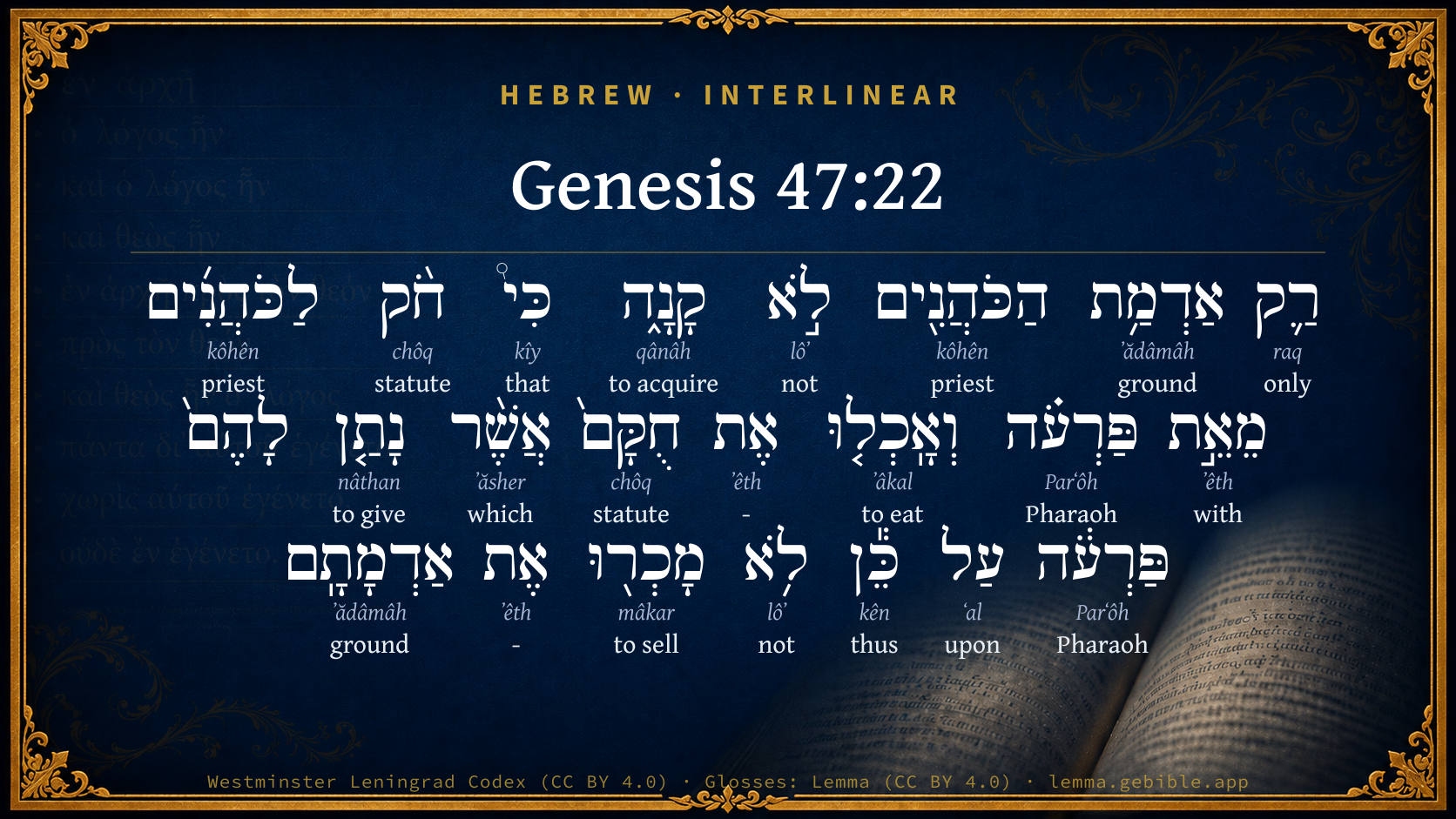
Genesis 47:22

Hebrew (Westminster Leningrad Codex) Genesis 47:22 appears in the Hebrew Old Testament. The text above is from the Westminster Leningrad Codex. Each word links to its Strong’s number, a concise gloss, and parsing drawn from the Open Scriptures Hebrew Bible morphology. Click any word for its full Brown-Driver-Briggs (BDB) entry.
Download image
Cite this verse

Genesis 47:22 (World English Bible). Public Domain. Lemma interlinear Bible study tool, https://lemma.gebible.app/v/genesis/47/22.

Show BibTeX & RIS
BibTeX
RIS
English Translation
Only he didn't buy the land of the priests, for the priests had a portion from Pharaoh, and ate their portion which Pharaoh gave them. That is why they didn't sell their land.
World English Bible · Public Domain
Highlights
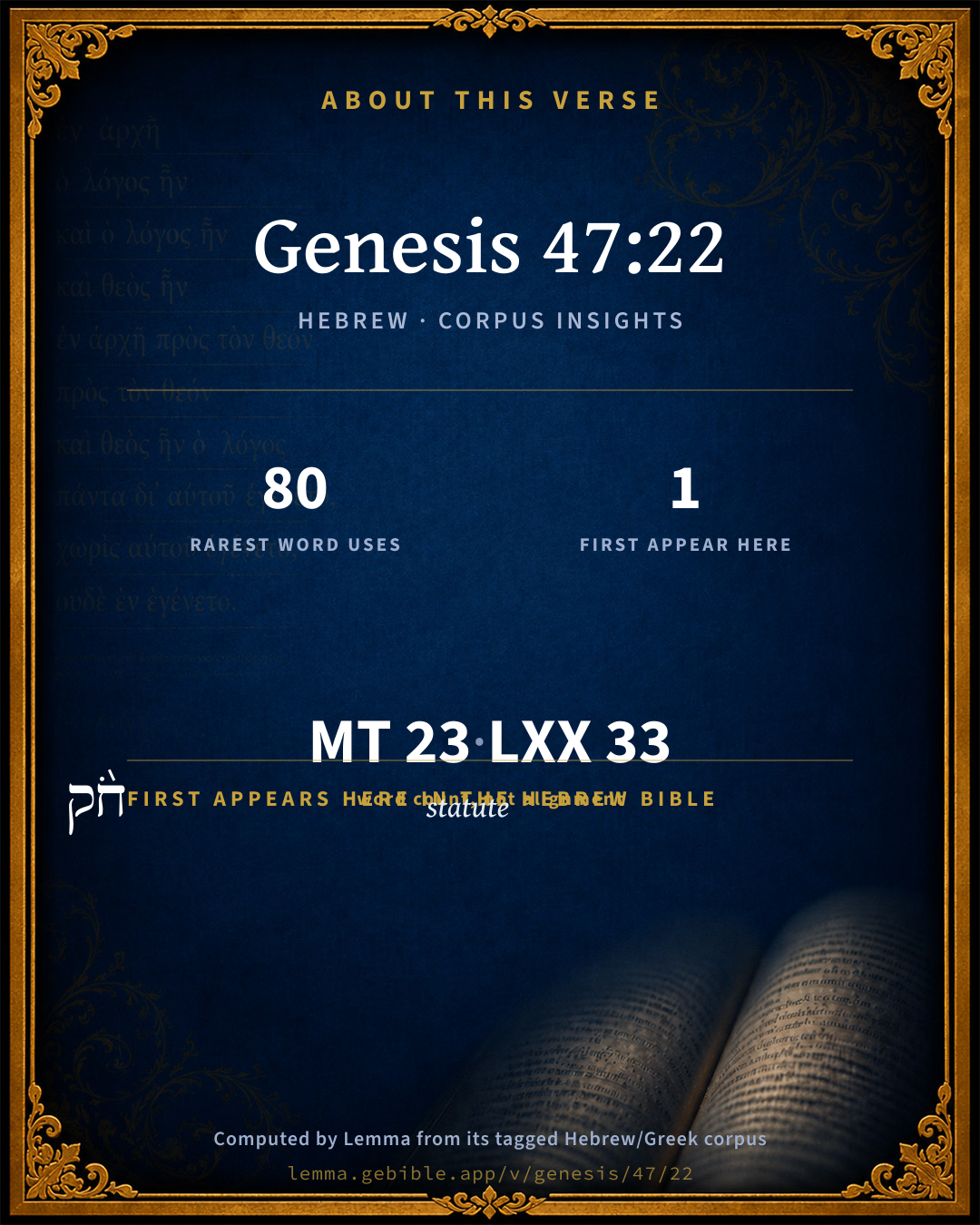
  • 1 first appearance in the Hebrew Bible
Full analysis ↓
Download a study sheet

One document with this verse’s original text, its word-by-word gloss line, the meaning frame, cross-references with their text, attributed commentary, and full source and license credits — printable, and it pastes into notes with its structure intact.

This verse Autodidact and up

Study sheet (.html) Plain text (.txt)

A passage Seminary Student

Up to 50 verses in one chapter. A passage sheet keeps up to 6 commentary sources and 12 cross-references per verse, in the order this page ranks them, and says so on the sheet whenever that leaves anything out. Ask for a single verse and you get the Autodidact verse sheet above.

Everything on this page stays free to read, with no account — the sheet is a download of what is already on screen, not access to it.

Want to remove ads? Support Godless Engineer
Compare translations 3

The same verse in 3 English versions, stacked beneath the original-language interlinear above. Click any original word for its lexicon entry.

Each is an independent rendering of the whole verse — the interlinear is not word-aligned to these translations.

Highlighted words mark where these versions differ — a whole-verse word diff, not a word-by-word alignment.

  • World English Bible Public Domain
    Only he didn't buy the land of the priests, for the priests had a portion from Pharaoh, and ate their portion which Pharaoh gave them. That is why they didn't sell their land.
  • King James Version Public Domain
    Only the land of the priests bought he not; for the priests had a portion assigned them of Pharaoh, and did eat their portion which Pharaoh gave them: wherefore they sold not their lands.
  • unfoldingWord Literal Text CC BY-SA 4.0
    Only the land of the priests he did not buy, because an allotment for the priests from Pharaoh, and they ate their allotment that Pharaoh gave to them. For that they did not sell their land.

unfoldingWord Literal Text — © unfoldingWord, licensed CC BY-SA 4.0. Word-aligned USFM3 via Door43 (git.door43.org/unfoldingWord/en_ult).

Versions to compare (up to 4)

3 of 4 selected

Show all 18 translations

Every available English version of this verse, each an independent rendering of the whole verse.

  • World English Bible Public Domain
    Only he didn't buy the land of the priests, for the priests had a portion from Pharaoh, and ate their portion which Pharaoh gave them. That is why they didn't sell their land.
  • Berean Standard Bible Public Domain
    However, he did not acquire the priests’ portion of the land, for it had been given to them by Pharaoh. They ate the rations that Pharaoh supplied; so they did not sell their land.
  • Majority Standard Bible Public Domain
    However, he did not acquire the priests’ portion of the land, for it had been given to them by Pharaoh. They ate the rations that Pharaoh supplied; so they did not sell their land.
  • King James Version Public Domain
    Only the land of the priests bought he not; for the priests had a portion assigned them of Pharaoh, and did eat their portion which Pharaoh gave them: wherefore they sold not their lands.
  • American Standard Version (1901) Public Domain
    Only the land of the priests bought he not: for the priests had a portion from Pharaoh, and did eat their portion which Pharaoh gave them; wherefore they sold not their land.
  • Revised Version (1885) Public Domain
    Only the land of the priests bought he not: for the priests had a portion from Pharaoh, and did eat their portion which Pharaoh gave them; wherefore they sold not their land.
  • Geneva Bible (1599) Public Domain
    Onely the lande of the Priestes bought he not: for the Priestes had an ordinarie of Pharaoh, and they did eate their ordinarie, which Pharaoh gaue them: wherefore they solde not their grounde.
  • Douay-Rheims (1899) Public Domain
    Except the land of the priests, which had been given them by the king: to whom also a certain allowance of food was given out of the public stores, and therefore they were not forced to sell their possessions.
  • Young's Literal Translation Public Domain
    Only the ground of the priests he hath not bought, for the priests have a portion from Pharaoh, and they have eaten their portion which Pharaoh hath given to them, therefore they have not sold their ground.
  • Literal Standard Version CC BY-SA 4.0
    Only the ground of the priests he has not bought, for the priests have a portion from Pharaoh, and they have eaten their portion which Pharaoh has given to them, therefore they have not sold their ground.
  • Unlocked Literal Bible CC BY-SA 4.0
    It was only the land of the priests that Joseph did not buy, because the priests were given an allowance. They ate from the allotment which Pharaoh gave them. Therefore they did not sell their land.
  • unfoldingWord Literal Text CC BY-SA 4.0
    Only the land of the priests he did not buy, because an allotment for the priests from Pharaoh, and they ate their allotment that Pharaoh gave to them. For that they did not sell their land.
  • Darby Bible Public Domain
    Only the land of the priests he did not buy; for the priests had an assigned portion from Pharaoh, and ate their assigned portion which Pharaoh had given them; so they did not sell their land.
  • World Messianic Bible Public Domain
    Only he didn’t buy the land of the priests, for the priests had a portion from Pharaoh, and ate their portion which Pharaoh gave them. That is why they didn’t sell their land.
  • Webster's Bible Public Domain
    Only the land of the priests bought he not; for the priests had a portion assigned them by Pharaoh, and ate their portion which Pharaoh gave them: wherefore they sold not their lands.
  • Free Bible Version CC BY-SA 4.0
    The only land he didn't buy belonged to the priests because they had a food allowance provided to them by Pharaoh, so they didn't have to sell their land.
  • Bible in Basic English Public Domain
    Only he did not take the land of the priests, for the priests had their food given them by Pharaoh, and having what Pharaoh gave them, they had no need to give up their land.
  • JPS Tanakh (1917) Public Domain
    Only the land of the priests bought he not, for the priests had a portion from Pharaoh, and did eat their portion which Pharaoh gave them; wherefore they sold not their land.

Literal Standard Version (2020), Covenant Press — licensed CC BY-SA 4.0. Text via the HelloAO Bible API (eBible.org). Unlocked Literal Bible (unfoldingWord) — licensed CC BY-SA 4.0. Text via the HelloAO Bible API (eBible.org). unfoldingWord Literal Text — © unfoldingWord, licensed CC BY-SA 4.0. Word-aligned USFM3 via Door43 (git.door43.org/unfoldingWord/en_ult). Free Bible Version, Dr. Jonathan Gallagher — licensed CC BY-SA 4.0. Text via the HelloAO Bible API (eBible.org).

Word by word

More ways to search: Search by grammar → Find every occurrence → Compare this word →

Practice this passage: Drill this verse → Learn its vocabulary →

מָכְר֖וּ
mâkar
H4376
“to sell”
Verb, Qal, Perfect, 3rd Person, Common, Plural
Part of Speech
Verb
Stem
Qal
Form
Perfect
Person
3rd Person
Gender
Common
Number
Plural
Full BDB Definition

Origin: a primitive root

TWOT: 1194

to sell - (Qal) - to sell - seller (participle) - (Niphal) - to be sold - to sell oneself - to be given over to death - (Hithpael) to sell oneself
  1. רַ֛ק raq H7535 “only” Particle, Accusative
  2. אַדְמַ֥ת ʼădâmâh H127 “ground of” Noun, Common, Feminine, Singular, Construct
  3. הַכֹּהֲנִ֖ים kôhên H3548 “the · priests” Particle, Definite Article + Noun, Common, Masculine, Plural, Absolute
  4. לֹ֣א lôʼ H3808 “not” Particle, Negative
  5. קָנָ֑ה qânâh H7069 “to acquire” Verb, Qal, Perfect, 3rd Person, Masculine, Singular
  6. כִּי֩ kîy H3588 “that” Conjunction
  7. חֹ֨ק chôq H2706 “statute” Noun, Common, Masculine, Singular, Absolute
  8. לַכֹּהֲנִ֜ים kôhên H3548 “to/for the · priests” Preposition, Determined + Noun, Common, Masculine, Plural, Absolute
  9. מֵאֵ֣ת ʼêth H854 “from · with” Preposition + Preposition
  10. פַּרְעֹ֗ה Parʻôh H6547 “Pharaoh” Noun, Proper
  11. וְאָֽכְל֤וּ ʼâkal H398 “and · to eat” Conjunction + Verb, Qal, Perfect, 3rd Person, Common, Plural
  12. אֶת ʼêth H853 “-” Particle, Direct Object
  13. חֻקָּם֙ chôq H2706 “statute · their” Noun, Common, Masculine, Singular, Construct + Suffix, Personal, 3rd Person, Masculine, Plural
  14. אֲשֶׁ֨ר ʼăsher H834 “which” Particle, Relative
  15. נָתַ֤ן nâthan H5414 “to give” Verb, Qal, Perfect, 3rd Person, Masculine, Singular
  16. פַּרְעֹ֔ה Parʻôh H6547 “Pharaoh” Noun, Proper
  17. עַל ʻal H5921 “upon” Preposition
  18. כֵּ֕ן kên H3651 “thus” Particle, Demonstrative
  19. לֹ֥א lôʼ H3808 “not” Particle, Negative
  20. אֶת ʼêth H853 “-” Particle, Direct Object
  21. אַדְמָתָֽם ʼădâmâh H127 “ground · their” Noun, Common, Feminine, Singular, Construct + Suffix, Personal, 3rd Person, Masculine, Plural

About this verse

These counts appear in no published source. They are computed here, from the morphology-tagged text and Lemma’s own curated glosses. What Lemma adds →

23
words
16
distinct lemmas
Pentateuch
section

First appearance in Scripture

This word makes its first canonical appearance in the Hebrew Bible here:

Grammatical profile

  • 4 verbs
  • 8 nouns
  • 3 prepositions
  • 1 conjunction
  • 7 particles

Verb forms

  • קָנָ֑ה Qal · Perfect
  • וְאָֽכְל֤וּ Qal · Perfect
  • נָתַ֤ן Qal · Perfect
  • מָכְר֖וּ Qal · Perfect

Repetition

Words recur within this verse — often emphatic in Hebrew:

  • אַדְמַ֥ת ground H127 ×2
  • הַכֹּהֲנִ֖ים priest H3548 ×2
  • חֹ֨ק statute H2706 ×2
  • פַּרְעֹ֗ה Pharaoh H6547 ×2
  • לֹ֣א not H3808 ×2

Hebrew & Septuagint length

In English translation the verse runs 33 words from the Hebrew and 39 from the Septuagint (LXX English) — closely comparable.

A rough comparison of the two English renderings, which tokenize alike — not a word-level alignment.

Word counts can differ between the Hebrew and the Greek without any difference in meaning — e.g. the Hebrew direct-object marker אֵת has no separate Greek word, and Greek often adds the article ὁ.

In the original languages it is 23 Hebrew tokens and 33 Greek tokens — but the two are counted differently (Hebrew bundles its prefixes and suffixes into one token; the Greek is in lemma form), so that isn’t a like-for-like length.

Cross-references

13

Topical passages linked to Genesis 47:22 in the Treasury of Scripture Knowledge — connected by theme and wording, ordered by reader-vote popularity; previews shown in the World English Bible.

  • Ezra 7:24 Also we inform you, that touching any of the priests and Levites, the singers, porters, Nethinim, or servants of this house of God, it shall not be lawful to impose tribute, custom, or toll, on them.
  • Genesis 14:18 Melchizedek king of Salem brought forth bread and wine: and he was priest of God Most High.
  • Genesis 41:45 Pharaoh called Joseph's name Zaphenath-paneah; and he gave him Asenath, the daughter of Potiphera priest of On as a wife. Joseph went out over the land of Egypt.
  • Genesis 41:50 To Joseph were born two sons before the year of famine came, whom Asenath, the daughter of Potiphera priest of On, bore to him.
  • Deuteronomy 12:19 Take heed to yourself that you don't forsake the Levite as long as you live in your land.
  • Joshua 21:1–45 Then came near the heads of fathers' [houses] of the Levites to Eleazar the priest, and to Joshua the son of Nun, and to the heads of fathers' [houses] of the tribes of the children of Israel;
  • 2 Samuel 8:18 and Benaiah the son of Jehoiada [was over] the Cherethites and the Pelethites; and David's sons were chief ministers.
  • Nehemiah 13:10 I perceived that the portions of the Levites had not been given them; so that the Levites and the singers, who did the work, were fled everyone to his field.
  • Matthew 10:10 Take no bag for your journey, neither two coats, nor shoes, nor staff: for the laborer is worthy of his food.
  • 1 Corinthians 9:13 Don't you know that those who serve around sacred things eat from the things of the temple, and those who wait on the altar have their portion with the altar?
  • Galatians 6:6 But let him who is taught in the word share all good things with him who teaches.
  • 2 Thessalonians 3:10 For even when we were with you, we commanded you this: "If anyone will not work, neither let him eat."
  • 1 Timothy 5:17 Let the elders who rule well be counted worthy of double honor, especially those who labor in the word and in teaching.

Cross-references courtesy of OpenBible.info (CC BY 4.0).

Hebrew and Greek witnesses Masoretic Hebrew ↔ Greek Septuagint

The same verse in the two great witnesses to the Old Testament, shown verse-for-verse.

These are two independent witnesses, not word-aligned to each other, and the Septuagint is shown in lemma (dictionary) form.

Hebrew Genesis 47:22 Masoretic · Westminster Leningrad Codex

רַ֛ק אַדְמַ֥ת הַכֹּהֲנִ֖ים לֹ֣א קָנָ֑ה כִּי֩ חֹ֨ק לַכֹּהֲנִ֜ים מֵאֵ֣ת פַּרְעֹ֗ה וְאָֽכְל֤וּ אֶת חֻקָּם֙ אֲשֶׁ֨ר נָתַ֤ן לָהֶם֙ פַּרְעֹ֔ה עַל כֵּ֕ן לֹ֥א מָכְר֖וּ אֶת אַדְמָתָֽם

Only he didn't buy the land of the priests, for the priests had a portion from Pharaoh, and ate their portion which Pharaoh gave them. That is why they didn't sell their land.

World English Bible · Public Domain

Greek LXX Genesis 47:22 Septuagint · lemma form

χωρίς ὁ γῆ ὁ ἱερεύς μόνον οὐ κτάομαι οὗτος ιωσηφ ἐν δόσις γάρ δίδωμι δόμα ὁ ἱερεύς φαραώ καί ἐσθίω ὁ δόσις ὅς δίδωμι αὐτός φαραώ διά οὗτος οὐ ἀποδίδωμι ὁ γῆ αὐτός

except only the land of the priests; Joseph bought not this, for Pharao gave a portion in the way of gift to the priests; and they ate their portion which Pharao gave them; therefore they sold not their land.

LXX2012 (modern English Septuagint) · Public Domain

On this verse, The Pulpit Commentary discusses the Septuagint’s reading. Read the note in Commentary ↓

Hebrew: Westminster Leningrad Codex (CC BY 4.0). Greek: Septuagint (public domain); English from LXX2012 (modern English Septuagint) (Public Domain). How the Septuagint differs from the Hebrew →

Targum (Aramaic paraphrase)

2

The Targum is the ancient Jewish Aramaic paraphrase of the Hebrew Scriptures — an interpretive translation, not the Hebrew text itself. Onkelos (literal) and Pseudo-Jonathan (expansive) render the Torah, and Jonathan the Prophets. Coverage is partial: where no permissively-licensed English translation exists for a verse, only the Aramaic is shown. This is verse-level text, not a word-by-word alignment to the Hebrew.

  1. Targum Onkelos Torah (Genesis–Deuteronomy)
    לְחוֹד אַרְעָא דְכֻמָּרַיָּא לָא זַבִּין אֲרֵי חֳלָקָא לְכֻמָּרַיָּא מִלְּוַת פַּרְעֹה וְאָכְלִין יָת חֳלָקְהוֹן דִּי יְהַב לְהוֹן פַּרְעֹה עַל כֵּן לָא זַבִּינוּ יָת אַרְעֲהוֹן

    (no public-domain English translation for this verse)

    Targum Onkelos — Aramaic: “Onkelos Genesis” (public domain); “Onkelos Exodus” (public domain); “Onkelos Leviticus” (public domain); “Onkelos Numbers” (public domain); “Onkelos Deuteronomy” (public domain). English: “Sefaria Community Translation” (CC0 1.0 (public-domain dedication)); “J.W. Etheridge. The Targums of Onkelos and Jonathan Ben Uzziel on the Pentateuch. London: Longmans, Green, 1862” (public domain). Text via Sefaria.

  2. Targum Pseudo-Jonathan Torah (Genesis–Deuteronomy)
    לְחוֹד אַרְעָא דְכוּמְרְנַיָא לָא זַבָּן מִן בִּגְלַל דְחָמוּן לֵיהּ זְכוּתָא בִּזְמַן דִבְעָא רִבּוֹנֵיהּ לְמִקְטְלֵיהּ וְשֵׁיזְבוּהִי מִן דִין קְטוֹל וּבְרַם אֲרוּם חוּלְקָא אָמַר לְמִיתְיַהֲבָא לְהוֹם מִלְוַות פַּרְעה וְאָכְלִין יַת חוּלַקְהוֹן דִיהַב לְהוֹן פַּרְעה בְּגִין כֵּן לָא זַבִּינוּ יַת אַרְעֲהוֹן

    Only the land of the priests he bought not because they had considered him innocent at the time when his master was seeking to put him to death, and they had delivered him from the judgment of death: and besides he had said that a portion should be given them from Pharoh. So they ate the portion which Pharoh gave them, and sold not their land.

    Targum Pseudo-Jonathan — Aramaic: “Targum Jonathan on Genesis” (public domain); “Targum Jonathan on Exodus” (public domain); “Targum Jonathan on Leviticus” (public domain); “Targum Jonathan on Numbers” (public domain); “Targum Jonathan on Deuteronomy” (public domain). English: “The Targum of Jonathan ben Uzziel, trans. J. W. Etheridge, London, 1862” (public domain). Text via Sefaria.

Commentary

Notes on Genesis 47:22 from classic Christian and Jewish commentators (each source and its license shown beneath its notes). The classic Christian expositions comment on the surrounding passage and are grouped to its opening verse, so a note may address several verses; the Jewish commentaries on the Tanakh (Rashi and others) are per-verse, so they appear only where the commentator wrote on this verse.

Lemma curates 59 commentaries, every one of them public domain or Creative Commons licensed, each selected and text-cleaned for this edition rather than reprinted as found. About our sources →

Trapp's Complete Commentary

John Trapp

Gen 47:22 Only the land of the priests bought he not; for the priests had a portion [assigned them] of Pharaoh, and did eat their portion which Pharaoh gave them: wherefore they sold not their lands.

Ver. 22. Only the land of the priests bought he not.] Ministers’ maintenance, we see, is of the law of nature. Jezebel provided for her priests; Micah for his Levite. "Do ye not know," saith that great apostle, "that they which minister about holy things, live of the things of the temple? and they which wait at the altar, are partakers with the altar?" {1Co 9:13} Where, by "holy things," St Ambrose understands the law of the Gentiles by "the altar," the law of the Jews. Before them both, Melchizedek, δεδεκατωκε, tithed Abraham; by the same right, whereby he blessed him. {Heb 7:6} As after them, the apostle rightly infers, "Even so hath the Lord ordained, that they which preach the gospel should live of the gospel." {1Co 9:14} But where hath the Lord ordained it? "The workman is worthy of his meat," saith Matthew; {Mat 10:10} "of his hire," saith Luke: {Luk 10:7} of both, no doubt; as the labourers in harvest, who have better fare provided than ordinary, and larger wages. See Nehemiah’s zeal for church maintenance, Neh 13:10; Neh 13:14. He knew well that a scant offering makes a cold altar; and that, ad tenuitatem beneficiorum necessario sequitur ignorantia sacerdotum; as in Ireland, where, in former time, some of the bishops had no more revenue than the pasture of two milk cows, &c. In the whole province of Connaught the stipend of the incumbent is not above forty shillings; in some places but sixteen shillings. {a} Melancthon {b} complains of his Germany, that the ministers for most part were ready to say with him in Plautus: Ego non servio libenter: herus meus me non habet libenter, tamen utitur me ut lippls oculis. Such use Micah made of his Levite; more fit to have made a Gibeonite, to cleave wood, than to divide the word; and yet he maintained him; and doubted not, thereupon, to promise himself God’s blessing. He is a niggard to himself, that scants his beneficence to a prophet; {Mat 10:41} whose very cold water shall not go unrewarded. Many rich refuse to give anything to the minister’s maintenance; {c} because they cannot be tithed. But "be not deceived; God is not mocked," saith the apostle in this very case. "Let him that is taught in the word, communicate unto him that teacheth in all his goods." {Gal 6:6-7} Such tribes as had more cities in their inheritance were to part with more to the priests: such as had fewer, with less. {Num 35:8} The equity of which proportion is still in force. The Jews, {d} at this day, though not in their own country, nor having a Levitical priesthood, yet those who will be reputed religious among them do distribute, in lieu of tithes, the tenth of their increase unto the poor: being persuaded that God doth bless their increase the more; according to that proverb of theirs, Tithe and be rich. But how is both the word and the world now altered among us? All is thought by the most to be well saved that is kept from the minister; whom to deceive is held neither sin nor pity. Fisco potius apud multos consulitur quam Christo, ac tonsioni potius gregis quam attentioni; as one complaineth, {e} Covetous patrons care not to sauce their meat with the blood of souls; while by them, et succus pecori, lac et subducitur agnis, {f} Besides, they bestow their benefices, non ubi optima, sed ubi quaestuosissime; being herein worse than these Egyptians, shall I say? nay, than the traitor Judas. He sold the head, they the members: he the shepherd, they the sheep; he but the body, they the souls; like that Romish strumpet, {Rev 18:13} of whom they have learned it. But let them look to it, lest they ruin their wages of wickedness, with Judas. In the meanwhile, let them give us a just commentary upon that in Pro 20:25, and tell us who hath authority to take that, from a church, shall I say? nay, from God, that hath been once given him? We can tell them a sad story, of five servants of Cardinal Wolsey’s, employed by him, in tot piorum hominum donariis intervertendis, saith the annalist, {g} and came all to fearful ends. Two of them disagreed; and, challenging the field, one killed the other, and was hanged for it. A third drowned himself in a well. The fourth, from great riches, fell to extreme beggary and was starved with hunger. The last, one Dr Alan, being Archbishop of Dublin, was there cruelly murdered by his enemies. Now, if divine justice so severely and exemplarily pursued and punished these that converted those abused goods of the Church to better uses without question, though they looked not at that, but at the satisfying of their own greedy lusts, what will be the end of such sacrilegious persons as enrich themselves with that which should be their minister’s maintenance? Sacrum, sacrove commendatum qui clepserit rapseritque, parricida esto, said the Roman law. {h} It is not only sacrilege, but parricide, to rob the Church.

{a} Panormitan. Heyl., Geog., p. 524.

{b} Manlii, loc. com., 472.

{c} Perstringit tenaces. - Pareus.

{d} Godw., Heb. Antiq., 277.

{e} Episc. Winton.

{f} Virgil.

{g} Scultet., Annal., p. 332.

{h} Ex duod. tab. - Neand. Chron.

John Trapp, A Commentary or Exposition upon All the Books of the Old and New Testament (1647–1656) — public domain. Text from a community e-Sword module.

Jamieson, Fausset & Brown

Robert Jamieson, A. R. Fausset & David Brown

Only the land of the priests bought he not--These lands were inalienable, being endowments by which the temples were supported. The priests for themselves received an annual allowance of provision from the state, and it would evidently have been the height of cruelty to withhold that allowance when their lands were incapable of being tilled.

Jamieson, Fausset & Brown — Commentary Critical and Explanatory on the Whole Bible (1871) — public domain (CC PDM 1.0). Text via the HelloAO Bible API.

Adam Clarke's Commentary

Verse 22. The land of the priests bought he not] From this verse it is natural to infer that whatever the religion of Egypt was, it was established by law and supported by the state. Hence when Joseph bought all the lands of the Egyptians for Pharaoh, he bought not the land of the priests, for that was a portion assigned them by Pharaoh; and they did eat - did live on, that portion. This is the earliest account we have of an established religion supported by the state.

Adam Clarke's Commentary on the Bible (1810–1826) — public domain. Text from a community e-Sword/MySword module.

John Calvin's Commentaries

22. Only the land of the priests. The priests were exempted from the common law, because the king granted them a maintenance. It is, indeed, doubtful, whether this was a supply for their present necessity, or whether he was accustomed to nourish them at his own expense. But seeing that Moses makes mention of their lands, I rattler incline to the conjecture, that, whereas they had before been rich, and this dearth had deprived them of their income, the king conferred this privilege upon them; and hence it arose that their lands remained unto them free. The ancient historians, however, injudiciously invent many fables concerning the state of that land. I know not whether the statement that the farmers, content with small wages, sow and reap for the king and the priests, is to be traced to this regulation of Joseph or not. But, passing by these things, it is more to the purpose to observe, what Moses wished distinctly to testify; namely, that a heathen king paid particular attention to Divine worship, in supporting the priests gratuitously, for the purpose of sparing their lands and their property. Truly this is placed before our eyes, as a mirror, in which we may discern that a sentiment of piety which they cannot wholly efface, is implanted in the minds of men. It was the part of foolish, as well as of wicked superstition, that Pharaoh nourished such priests as these, who infatuated the people by their impostures: yet this was, in itself, a design worthy of commendation, that he did not suffer the worship of God to fall into decay; which, in a short time, must have happened, if the priests had perished in the famine. Whence we infer how sedulously we ought to be on our guard, that we undertake nothing with an indiscreet zeal; because nothing is more easy, in so great a corruption of human nature, than for religion to degenerate into frivolous trifles. Nevertheless, because this inconsiderate devotion (as it may be called) flowed from a right principle, what should be the conduct of our princes, who desire to be deemed Christians? If Pharaoh was so solicitous about his priests, that he nourished them to his own destruction, and that of his whole kingdom, in order that he might not be guilty of impiety against false gods; what sacrilege is it, in Christian princes, that the lawful and sincere ministers of holy things should be neglected, whose work they know to be approved by God, and salutary to themselves? But it may be asked, whether it was lawful for holy Joseph to undertake this office, for by so doing, he employed his labor in cherishing impious superstitions? But though I can readily grant that in such great, and arduous, and manifold offices of trust, it was easy for him to slide into various faults; yet I dare not absolutely condemn this act; nor can I, however, deny that he may have erred, in not resisting these superstitions with sufficient boldness. But since he was required by no law, to destroy the priests by hunger, and was not altogether allowed to dispense the king’s corn at his own pleasure; if the king wished that food should be gratuitously supplied to the priests, he was no more at liberty to deny it to them than to the nobles at court. Therefore, though he did not willingly take charge of such dependents, yet when the king imposed the duty upon him, he could not refuse it, though he knew them to be unworthy to be fed on the dirt of oxen.

John Calvin's Commentaries (1540-1563) — public domain. Text from the Calvin Translation Society English edition (1840s-50s) via the Christian Classics Ethereal Library (ccel.org). Calvin's coverage is partial (roughly two-thirds of the Bible); uncommented books and verses are honest gaps, never fabricated. The 19th-century editor's footnotes and remarks are omitted so the notes are faithfully Calvin's own voice.

Ellicott's Commentary for English Readers

(22) The priests had a portion assigned to them of Pharaoh.—Herodotus (ii. 37) mentions that it was still the custom in Egypt for the priests to have a daily allowance of’ cooked food. Very probably this usage began in Joseph’s time; but it is not here ascribed to him, but to the king himself. Being thus supplied with food, they did not sell their lands; and with this, again, the Greek accounts tally, as they represent the king, the priests, and the warriors as the only landholders in Egypt. The last class, however, held their land from the king.

A Bible Commentary for English Readers, edited by Charles John Ellicott (1878–1897) — public domain. Text from a community e-Sword module.

The Cambridge Bible for Schools and Colleges

gen. ed. J. J. S. Perowne

22. Only the land of the priests] The priests of Egypt enjoyed special privileges. They were greatly enriched by the kings of the 18th Dynasty (b.c. 1587–1328). It is doubtful whether their position was so favourable under the Hyksos (see Appendix E). But they were not under the necessity of selling their land. Erman quotes an inscription from which it appears that 185,000 sacks of corn were given annually by Rameses III (b.c. 1202–1171) to the Egyptian temples (Life in Ancient Egypt, p. 129).

a portion] Cf. the use of this word in the sense of a fixed rate or “due,” Lev_10:13; Pro_30:8 (marg.).

The Cambridge Bible for Schools and Colleges (gen. ed. J. J. S. Perowne; Cambridge University Press, 1878–1918) — public domain. Text from a community e-Sword module.

John Gill's Exposition

Then Joseph said unto the people,.... After he had bought their land, and before the removal of them to distant parts:

behold, I have bought you this day, and your land, for Pharaoh: which he observes to them, that they might take notice of it, and confirm it, or object if they had anything to say to the contrary:

lo, here is seed for you, and ye shall sow the land: by which it should seem that they were not removed from the spot where they lived, but retained their own land under Pharaoh, and had seed given them to sow it with, which may seem contrary to Gen 47:21; wherefore that must be understood of a purpose and proposal to remove them, and not that it was actually done; or, as Musculus gives the sense, Joseph by a public edict called all the people from the extreme parts of Egypt to the cities nearest to them, and there proclaimed the subjection of them, and their lands to Pharaoh, but continued them to them as tenants of his; unless it should be said, that in those distant parts to which they were sent, land was put into their hands to till and manure for the king, and have seed given them to sow it with; but this seems to be said to them at the same time the bargain was made.

John Gill's Exposition of the Whole Bible (1746–1763) — public domain (CC PDM 1.0). Text via the HelloAO Bible API.

Haydock's Catholic Bible Commentary

Priests. This was done by the king’s direction, as they were probably idolaters. (Menochius) --- The immunities of the sacred ministers have been respected both by Pagans, Jews, and Christians; by all who have had any sentiments of religion. Reason dictates that they should live by the altar. They have to labour for the truest interests of the people, and consequently are worthy of their hire. --- Which had been given, &c. Inasmuch as their wants were supplied, and the king forebore to claim their land. Hebrew, "only the land of the priests he, Joseph, bought not." (Haydock) --- If infidels did so much for their priests, ought we to do less for those of God? (St. Chrysostom, hom. 65.) (Worthington)

George Leo Haydock (1774–1849), Haydock's Catholic Family Bible and Commentary, 1859 edition — public domain. Excludes Psalms (Douay-Rheims chapter numbering differs from Protestant) and Deuterocanonical books (Catholic canon only).

Matthew Poole's English Annotations

The priests: under this name he understands chiefly those who administered the worship of the gods or idols of Egypt, and withal those who applied themselves to the study of the arts and virtues, called their wise men and magicians; though some understand it of the princes (as that word sometimes signifies) or officers of Pharaoh, who were nourished out of the king’s treasures. And possibly the same Hebrew word may here comprehend both, viz. the ministers of the king, and of their idols too, for both enjoyed the same privileges, as Diodorus Siculus relates. And that the priests are included, if not mainly intended here, will be evident enough to any one that considers the state of Egypt, how mad that people universally were upon their idols, how numerous their priests were, and in how great honour and veneration both with prince and people: besides, reason of state obliged Pharaoh to engage and secure to himself that sort of men, which bore so great sway with the old inhabitants of their several places, and were likely to have the same authority with the new inhabitants, to quiet and satisfy them at their first change, which must needs be very ungrateful to them.

Of this immunity of the priests, that ancient writer Diodorus Siculus makes mention. But this is not to be ascribed to Joseph’s will or choice; for he who abhorred their idolatry, could not have a kindness for, nor would have given encouragement to, the great upholders and promoters of it; but in this he was overruled either by Pharaoh’s express command, (it being not probable that so great an interest as that of the priests should not have friends at court, or that their friends should not plead for them, or that their pleas and desires should not be granted by an idolatrous king,) or by the laws of Egypt, or by their customs and usages in things of a like nature, which would have the force of a law among them.

Matthew Poole's English Annotations on the Holy Bible (1683–1685) — public domain. Text from a community e-Sword/MySword module.

Whedon's Commentary on the Bible

Daniel D. Whedon

22. Land of the priests bought he not — Pharaoh’s reverence for the ministers of religion would not allow an alienation of their land from them.

Their portion which Pharaoh gave them — During the years of famine he ordered them to be supplied from the public treasury, without money and without price. This is represented as Pharaoh’s act rather than Joseph’s. The latter, of course, would not interfere. He had married the daughter of one of the priests. But the sacred writer clearly intimates that the reverence shown to the Egyptian priesthood by this measure was for Pharaoh’s sake, not for his own.

Daniel D. Whedon (gen. ed.), Commentary on the Old and New Testaments (1874–1909) — public domain. Text from a community e-Sword module.

The Pulpit Commentary

Only the land of the priests (so the LXX, Vulgate, and Chaldee render cohen, which, however, sometimes signifies a prince) bought he not; for the priests had a portion not of land (Lange, Kalisch), but of food (Keil, Murphy) assigned them of Pharaoh (not of Joseph, who must not, therefore, be charged with the sin of extending a State allowance to an idolatrous priesthood), and did eat their portion which Pharaoh gave them: wherefore they sold not their lands, that is, in consequence of the State aliment which they enjoyed (during the period of the famine) they did not require to alienate their lands.

The Pulpit Commentary (1880–1919), ed. H.D.M. Spence-Jones & Joseph S. Exell — public domain. Text from a community e-Sword module.

Rashi

Rabbi Shlomo Yitzchaki (Rashi)

הכהנים mean THE PRIESTS. The term כהן always means one who ministers to Deity except in those cases where it denotes one of high rank, e.g. (Exodus 2:16) “Jethro the chief of (כהן) Midian” and (Genesis 41:45) “the chief of (כהן) On”).

חק לכהנים [FOR] THE PRIESTS HAD A PORTION — an assigned portion of a definite quantity of bread daily.

Rashi on the Tanakh — English translations: “The Judaica Press complete Tanach with Rashi, translated by A. J. Rosenberg” (CC BY 4.0); “Pentateuch with Rashi's commentary by M. Rosenbaum and A.M. Silbermann, 1929-1934” (public domain); “The Metsudah Tanach series, Lakewood, N.J” (CC BY 4.0); and “The Book of Joshua, Metsudah Publications, 1997” (CC BY 4.0). Text via Sefaria.

Radak

Rabbi David Kimhi (Radak)

הכהנים, the officials in charge of the myriad of altars in the country.

Radak on the Tanakh — English translations: “Sefaria Community Translation” (CC0 1.0 (public-domain dedication)); “Eliyahu Munk, HaChut Hameshulash” (CC BY 4.0); “Rabbi Mike Feuer, Jerusalem Anthology” (CC BY 4.0); and “R. David Kimhi on the first book of Psalms, Translated by R.G. Finch, London, 1919” (public domain). Text via Sefaria.

Lesson kit

Teaching starters — assembled from the data on this page, not authored interpretation. Every prompt links to the verse data it draws on. Edit before teaching.

Genesis, in the Pentateuch, opens this verse with 23 words (16 distinct Hebrew lemmas). Its most distinctive word is mâkar (“to sell”). A historical commentator’s framing appears above. Read the whole chapter for the surrounding context.

Discussion questions

  1. What does “to sell” (mâkar) contribute to the verse as a whole?
  2. This is the first place “statute” appears in Scripture (first appears here). What does its debut here establish?
  3. How does Ezra 7:24, which shares this passage’s theme, read alongside this verse?
  4. What does the repetition of “ground” (2× in this one verse) do in this verse?
  5. The translations on this page render this verse differently — a whole-verse word diff, not a word-by-word alignment. What might account for the different wordings?
  6. «קָנָ֑ה» is a Qal Perfect verb. How does that grammatical form shape the action described?
  7. Compare how Trapp's Complete Commentary and Jamieson, Fausset & Brown read this verse. Where do they agree or differ?

Things to notice

Reading settings

Reading text

Shown beneath each verse's original-language words.

Old Testament
Old Testament edition

Read the OT as the Masoretic Hebrew (MT) or the Greek Septuagint (LXX).

English shown for the Greek Septuagint (in the Hebrew ↔ Greek comparison).

Comparing translations? Open the Compare panel on any verse page to stack up to four side by side.