
Deuteronomy 2:36

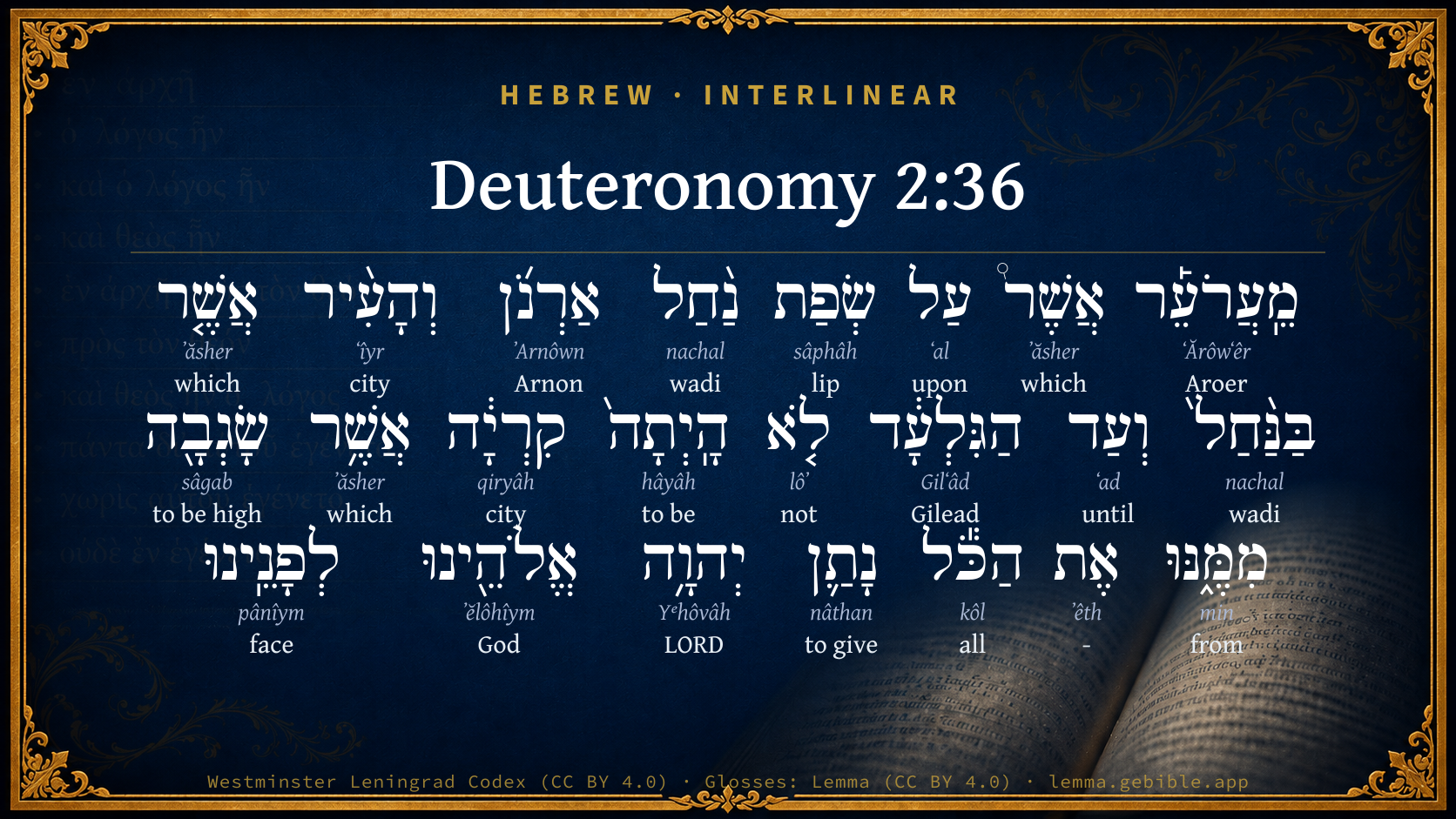
Hebrew (Westminster Leningrad Codex) Deuteronomy 2:36 appears in the Hebrew Old Testament. The text above is from the Westminster Leningrad Codex. Each word links to its Strong’s number, a concise gloss, and parsing drawn from the Open Scriptures Hebrew Bible morphology. Click any word for its full Brown-Driver-Briggs (BDB) entry.
Download image
Cite this verse

Deuteronomy 2:36 (World English Bible). Public Domain. Lemma interlinear Bible study tool, https://lemma.gebible.app/v/deuteronomy/2/36.

Show BibTeX & RIS
BibTeX
RIS
English Translation
From Aroer, which is on the edge of the valley of the Arnon, and [from] the city that is in the valley, even to Gilead, there was not a city too high for us; Yahweh our God delivered up all before us:
World English Bible · Public Domain
Highlights
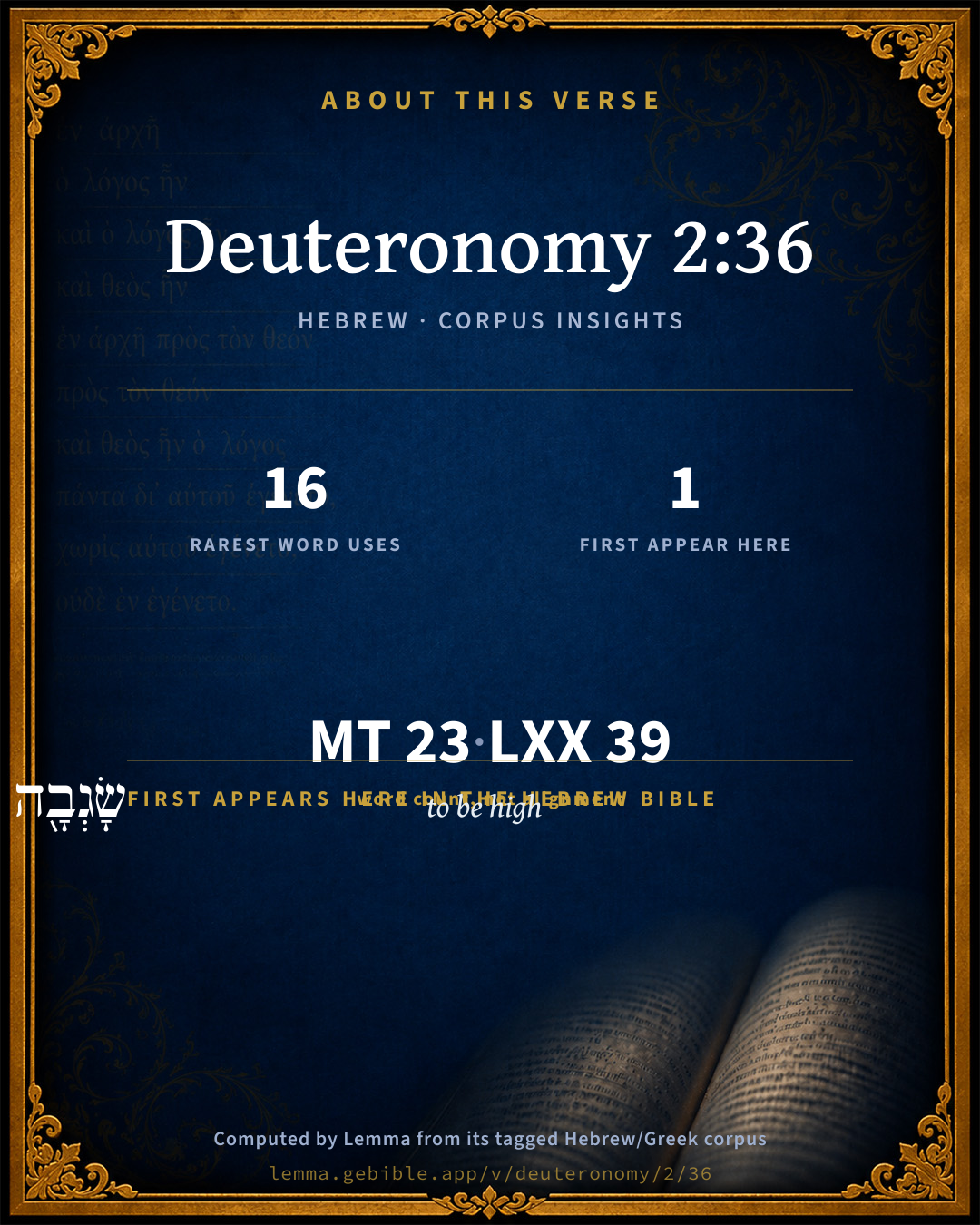
  • 1 first appearance in the Hebrew Bible
Full analysis ↓
Download a study sheet

One document with this verse’s original text, its word-by-word gloss line, the meaning frame, cross-references with their text, attributed commentary, and full source and license credits — printable, and it pastes into notes with its structure intact.

This verse Autodidact and up

Study sheet (.html) Plain text (.txt)

A passage Seminary Student

Up to 50 verses in one chapter. A passage sheet keeps up to 6 commentary sources and 12 cross-references per verse, in the order this page ranks them, and says so on the sheet whenever that leaves anything out. Ask for a single verse and you get the Autodidact verse sheet above.

Everything on this page stays free to read, with no account — the sheet is a download of what is already on screen, not access to it.

Want to remove ads? Support Godless Engineer
Compare translations 3

The same verse in 3 English versions, stacked beneath the original-language interlinear above. Click any original word for its lexicon entry.

Each is an independent rendering of the whole verse — the interlinear is not word-aligned to these translations.

Highlighted words mark where these versions differ — a whole-verse word diff, not a word-by-word alignment.

  • World English Bible Public Domain
    From Aroer, which is on the edge of the valley of the Arnon, and [from] the city that is in the valley, even to Gilead, there was not a city too high for us; Yahweh our God delivered up all before us:
  • King James Version Public Domain
    From Aroer, which is by the brink of the river of Arnon, and from the city that is by the river, even unto Gilead, there was not one city too strong for us: the LORD our God delivered all unto us:
  • unfoldingWord Literal Text CC BY-SA 4.0
    From Aroer, which on the lip of the wadi of Arnon, and the city that in the valley, and as far as Gilead, there was not a city that too high for us. Yahweh our God gave the whole to our faces.

unfoldingWord Literal Text — © unfoldingWord, licensed CC BY-SA 4.0. Word-aligned USFM3 via Door43 (git.door43.org/unfoldingWord/en_ult).

Versions to compare (up to 4)

3 of 4 selected

Show all 18 translations

Every available English version of this verse, each an independent rendering of the whole verse.

  • World English Bible Public Domain
    From Aroer, which is on the edge of the valley of the Arnon, and [from] the city that is in the valley, even to Gilead, there was not a city too high for us; Yahweh our God delivered up all before us:
  • Berean Standard Bible Public Domain
    From Aroer on the rim of the Arnon Valley, along with the city in the valley, even as far as Gilead, not one city had walls too high for us. The LORD our God gave us all of them.
  • Majority Standard Bible Public Domain
    From Aroer on the rim of the Arnon Valley, along with the city in the valley, even as far as Gilead, not one city had walls too high for us. The LORD our God gave us all of them.
  • King James Version Public Domain
    From Aroer, which is by the brink of the river of Arnon, and from the city that is by the river, even unto Gilead, there was not one city too strong for us: the LORD our God delivered all unto us:
  • American Standard Version (1901) Public Domain
    From Aroer, which is on the edge of the valley of the Arnon, and `from' the city that is in the valley, even unto Gilead, there was not a city too high for us; Jehovah our God delivered up all before us:
  • Revised Version (1885) Public Domain
    From Aroer, which is on the edge of the valley of Arnon, and from the city that is in the valley, even unto Gilead, there was not a city too high for us: the LORD our God delivered up all before us:
  • Geneva Bible (1599) Public Domain
    From Aroer, which is by the banke of the riuer of Arnon, and from the citie that is vpon the riuer, euen vnto Gilead: there was not one citie that escaped vs: for the Lord our God deliuered vp all before vs.
  • Douay-Rheims (1899) Public Domain
    From Aroer, which is upon the bank of the torrent Amen, a town that is situate in a valley, as far as Galaad. There was not a village or city, that escaped our hands: the Lord our God delivered all unto us:
  • Young's Literal Translation Public Domain
    `From Aroer, which `is' by the edge of the brook Arnon, and the city which `is' by the brook, even unto Gilead there hath not been a city which `is' too high for us; the whole hath Jehovah our God given before us.
  • Literal Standard Version CC BY-SA 4.0
    From Aroer, which [is] by the edge of the Brook of Arnon, and the city which [is] by the brook, even to Gilead, there has not been a city which [is] too high for us; our God YHWH has given the whole before our faces.
  • Unlocked Literal Bible CC BY-SA 4.0
    From Aroer, which is on the edge of the Valley of the Arnon, and from the city that is in the valley, all the way to Gilead, there was not a city too high for us. Yahweh our God gave them into our hands.
  • unfoldingWord Literal Text CC BY-SA 4.0
    From Aroer, which on the lip of the wadi of Arnon, and the city that in the valley, and as far as Gilead, there was not a city that too high for us. Yahweh our God gave the whole to our faces.
  • Darby Bible Public Domain
    From Aroer, which is on the bank of the river Arnon, and the city that is in the ravine even to Gilead, there was not one city too strong for us: Jehovah our God delivered all before us.
  • World Messianic Bible Public Domain
    From Aroer, which is on the edge of the valley of the Arnon, and the city that is in the valley, even to Gilead, there was not a city too high for us. The LORD our God delivered up all before us.
  • Webster's Bible Public Domain
    From Aroer, which is by the brink of the river of Arnon, and from the city that is by the river, even to Gilead, there was not one city too strong for us: the LORD our God delivered all to us:
  • Free Bible Version CC BY-SA 4.0
    No town had walls too high for us to conquer—from Aroer on the edge of the Arnon Valley, the town in the valley, all the way to Gilead. The Lord our God handed them all over to us.
  • Bible in Basic English Public Domain
    From Aroer on the edge of the valley of the Arnon and from the town in the valley as far as Gilead, no town was strong enough to keep us out; the Lord our God gave them all into our hands:
  • JPS Tanakh (1917) Public Domain
    From Aroer, which is on the edge of the valley of Arnon, and from the city that is in the valley, even unto Gilead, there was not a city too high for us: the LORD our God delivered up all before us.

Literal Standard Version (2020), Covenant Press — licensed CC BY-SA 4.0. Text via the HelloAO Bible API (eBible.org). Unlocked Literal Bible (unfoldingWord) — licensed CC BY-SA 4.0. Text via the HelloAO Bible API (eBible.org). unfoldingWord Literal Text — © unfoldingWord, licensed CC BY-SA 4.0. Word-aligned USFM3 via Door43 (git.door43.org/unfoldingWord/en_ult). Free Bible Version, Dr. Jonathan Gallagher — licensed CC BY-SA 4.0. Text via the HelloAO Bible API (eBible.org).

Word by word

More ways to search: Search by grammar → Find every occurrence → Compare this word →

Practice this passage: Drill this verse → Learn its vocabulary →

מֵֽעֲרֹעֵ֡ר
ʻĂrôwʻêr
H6177
“from · Aroer”
Preposition + Noun, Proper
Part of Speech
Preposition + Noun
Type
Proper
Full BDB Definition

Origin: the same as H6176

TWOT: None

Aroer = "ruins" - a city on the north bank of the river Arnon, the southern point of the territory of Sihon the king of the Amorites and later of Reuben; modern 'Arair' - a city in Ammon near the Jabbok belonging to Gad - a town in southern Judah
  1. אֲשֶׁר֩ ʼăsher H834 “which” Particle, Relative
  2. עַל ʻal H5921 “upon” Preposition
  3. שְׂפַת sâphâh H8193 “lip of” Noun, Common, Feminine, Singular, Construct
  4. נַ֨חַל nachal H5158 “wadi of” Noun, Common, Masculine, Singular, Construct
  5. אַרְנֹ֜ן ʼArnôwn H769 “Arnon” Noun, Proper
  6. וְהָעִ֨יר ʻîyr H5892 “and · the · city” Conjunction + Particle, Definite Article + Noun, Common, Feminine, Singular, Absolute
  7. אֲשֶׁ֤ר ʼăsher H834 “which” Particle, Relative
  8. בַּנַּ֨חַל֙ nachal H5158 “in/at the · wadi” Preposition, Determined + Noun, Common, Masculine, Singular, Absolute
  9. וְעַד ʻad H5704 “and · until” Conjunction + Preposition
  10. הַגִּלְעָ֔ד Gilʻâd H1568 “the · Gilead” Particle, Definite Article + Noun, Proper
  11. לֹ֤א lôʼ H3808 “not” Particle, Negative
  12. הָֽיְתָה֙ hâyâh H1961 “to be” Verb, Qal, Perfect, 3rd Person, Feminine, Singular
  13. קִרְיָ֔ה qiryâh H7151 “city” Noun, Common, Feminine, Singular, Absolute
  14. אֲשֶׁ֥ר ʼăsher H834 “which” Particle, Relative
  15. שָׂגְבָ֖ה sâgab H7682 “to be high” Verb, Qal, Perfect, 3rd Person, Feminine, Singular
  16. מִמֶּ֑נּוּ min H4480 “from · us” Preposition + Suffix, Personal, 1st Person, Common, Plural
  17. אֶת ʼêth H853 “-” Particle, Direct Object
  18. הַכֹּ֕ל kôl H3605 “the · all” Particle, Definite Article + Noun, Common, Masculine, Singular, Absolute
  19. נָתַ֛ן nâthan H5414 “to give” Verb, Qal, Perfect, 3rd Person, Masculine, Singular
  20. יְהוָ֥ה Yᵉhôvâh H3068 “LORD” Noun, Proper
  21. אֱלֹהֵ֖ינוּ ʼĕlôhîym H430 “God(s) · our” Noun, Common, Masculine, Plural, Construct + Suffix, Personal, 1st Person, Common, Plural
  22. לְפָנֵֽינוּ pânîym H6440 “to/for · face(s) · our” Preposition + Noun, Common, Both, Plural, Construct + Suffix, Personal, 1st Person, Common, Plural

About this verse

These counts appear in no published source. They are computed here, from the morphology-tagged text and Lemma’s own curated glosses. What Lemma adds →

23
words
20
distinct lemmas
Pentateuch
section

Notable vocabulary

The rarest word here is מֵֽעֲרֹעֵ֡ר Aroer H6177 — appearing just 16 times in the whole Hebrew Bible.

First appearance in Scripture

This word makes its first canonical appearance in the Hebrew Bible here:

  • שָׂגְבָ֖ה to be high H7682

Shared distinctive vocabulary

מֵֽעֲרֹעֵ֡ר Aroer H6177 occurs in 16 verses of the Hebrew Bible. Also found in:

Grammatical profile

  • 3 verbs
  • 12 nouns
  • 3 prepositions
  • 5 particles

Verb forms

  • הָֽיְתָה֙ Qal · Perfect
  • שָׂגְבָ֖ה Qal · Perfect
  • נָתַ֛ן Qal · Perfect

Repetition

Words recur within this verse — often emphatic in Hebrew:

  • נַ֨חַל wadi H5158 ×2
  • אֲשֶׁר֩ which H834 ×3

Hebrew & Septuagint length

In English translation the verse runs 42 words from the Hebrew and 47 from the Septuagint (LXX English) — closely comparable.

A rough comparison of the two English renderings, which tokenize alike — not a word-level alignment.

Word counts can differ between the Hebrew and the Greek without any difference in meaning — e.g. the Hebrew direct-object marker אֵת has no separate Greek word, and Greek often adds the article ὁ.

In the original languages it is 23 Hebrew tokens and 39 Greek tokens — but the two are counted differently (Hebrew bundles its prefixes and suffixes into one token; the Greek is in lemma form), so that isn’t a like-for-like length.

Cross-references

11

Topical passages linked to Deuteronomy 2:36 in the Treasury of Scripture Knowledge — connected by theme and wording, ordered by reader-vote popularity; previews shown in the World English Bible.

  • Joshua 13:9 from Aroer, that is on the edge of the valley of the Arnon, and the city that is in the middle of the valley, and all the plain of Medeba to Dibon;
  • Deuteronomy 3:12 This land we took in possession at that time: from Aroer, which is by the valley of the Arnon, and half the hill-country of Gilead, and the cities of it, gave I to the Reubenites and to the Gadites:
  • Deuteronomy 4:48 from Aroer, which is on the edge of the valley of the Arnon, even to Mount Sion (the same is Hermon),
  • Psalms 44:3 For they didn't get the land in possession by their own sword, Neither did their own arm save them; But your right hand, and your arm, and the light of your face, Because you were favorable to them.
  • Joshua 1:5 There shall not any man be able to stand before you all the days of your life. As I was with Moses, so I will be with you; I will not fail you, nor forsake you.
  • Joshua 12:2 Sihon king of the Amorites, who lived in Heshbon, and ruled from Aroer, which is on the edge of the valley of the Arnon, and [the city that is in] the middle of the valley, and half Gilead, even to the river Jabbok, the border of the children of Ammon;
  • Joshua 13:16 Their border was from Aroer, that is on the edge of the valley of the Arnon, and the city that is in the middle of the valley, and all the plain by Medeba;
  • Isaiah 17:2 The cities of Aroer are forsaken; they shall be for flocks, which shall lie down, and none shall make them afraid.
  • Isaiah 41:15–16 Behold, I have made you [to be] a new sharp threshing instrument having teeth; you shall thresh the mountains, and beat them small, and shall make the hills as chaff.
  • Jeremiah 48:19 Inhabitant of Aroer, stand by the way, and watch: ask him who flees, and her who escapes; say, What has been done?
  • Romans 8:31 What then shall we say about these things? If God is for us, who can be against us?

Cross-references courtesy of OpenBible.info (CC BY 4.0).

Hebrew and Greek witnesses Masoretic Hebrew ↔ Greek Septuagint

The same verse in the two great witnesses to the Old Testament, shown verse-for-verse.

These are two independent witnesses, not word-aligned to each other, and the Septuagint is shown in lemma (dictionary) form.

Hebrew Deuteronomy 2:36 Masoretic · Westminster Leningrad Codex

מֵֽעֲרֹעֵ֡ר אֲשֶׁר֩ עַל שְׂפַת נַ֨חַל אַרְנֹ֜ן וְהָעִ֨יר אֲשֶׁ֤ר בַּנַּ֨חַל֙ וְעַד הַגִּלְעָ֔ד לֹ֤א הָֽיְתָה֙ קִרְיָ֔ה אֲשֶׁ֥ר שָׂגְבָ֖ה מִמֶּ֑נּוּ אֶת הַכֹּ֕ל נָתַ֛ן יְהוָ֥ה אֱלֹהֵ֖ינוּ לְפָנֵֽינוּ

From Aroer, which is on the edge of the valley of the Arnon, and [from] the city that is in the valley, even to Gilead, there was not a city too high for us; Yahweh our God delivered up all before us:

World English Bible · Public Domain

Greek LXX Deuteronomy 2:36 Septuagint · lemma form

ἐκ αροηρ ὅς εἰμί παρά ὁ χεῖλος χειμάρρους αρνων καί ὁ πόλις ὁ εἰμί ἐν ὁ φάραγξ καί ἕως ὄρος ὁ γαλαάδ οὐ γίγνομαι πόλις ὅστις διαφεύγω ἐγώ ὁ πᾶς παραδίδωμι κύριος ὁ θεός ἐγώ εἰς ὁ χείρ ἐγώ

From Aroer, which is by the brink of the brook of Arnon, and the city which is in the valley, and as far as the mount of Galaad; there was not a city which escaped us: the Lord our God delivered all of them into our hands.

LXX2012 (modern English Septuagint) · Public Domain

On this verse, The Cambridge Bible for Schools and Colleges discusses the Septuagint’s reading. Read the note in Commentary ↓

Hebrew: Westminster Leningrad Codex (CC BY 4.0). Greek: Septuagint (public domain); English from LXX2012 (modern English Septuagint) (Public Domain). How the Septuagint differs from the Hebrew →

Targum (Aramaic paraphrase)

2

The Targum is the ancient Jewish Aramaic paraphrase of the Hebrew Scriptures — an interpretive translation, not the Hebrew text itself. Onkelos (literal) and Pseudo-Jonathan (expansive) render the Torah, and Jonathan the Prophets. Coverage is partial: where no permissively-licensed English translation exists for a verse, only the Aramaic is shown. This is verse-level text, not a word-by-word alignment to the Hebrew.

  1. Targum Onkelos Torah (Genesis–Deuteronomy)
    מֵעֲרֹעֵר דִי עַל כֵּיף נַחֲלָא דְאַרְנֹן וְקַרְתָּא דִי בְנַחֲלָא וְעַד גִלְעָד לָא הֲוַת קַרְתָּא דִי תְקֵפַת מִנָנָא יָת כֹּלָא מְסַר יְיָ אֱלָהָנָא קֳדָמָנָא

    (no public-domain English translation for this verse)

    Targum Onkelos — Aramaic: “Onkelos Genesis” (public domain); “Onkelos Exodus” (public domain); “Onkelos Leviticus” (public domain); “Onkelos Numbers” (public domain); “Onkelos Deuteronomy” (public domain). English: “Sefaria Community Translation” (CC0 1.0 (public-domain dedication)); “J.W. Etheridge. The Targums of Onkelos and Jonathan Ben Uzziel on the Pentateuch. London: Longmans, Green, 1862” (public domain). Text via Sefaria.

  2. Targum Pseudo-Jonathan Torah (Genesis–Deuteronomy)
    מֵעֲרוֹעֵר דְּעַל גֵּיף נַחֲלָא דְאַרְנוֹנָא וְקַרְתָּא דְמִתְבַּנְיָא בִּמְצִיעוֹת נַחֲלָא עַד גִּלְעָד לָא הֲוַת קַרְתָּא דִתְקִיפַת מִינָנָא יַת כֻּלְהוֹן מְסַר יְיָ אֱלָהָנָא קֳדָמָנָא

    From Aroer, on the bank of the river Arnona, and the city which is built in the midst of the river, even unto Gilead, there was no city too strong for us, the Lord our God gave all of them up before us.

    Targum Pseudo-Jonathan — Aramaic: “Targum Jonathan on Genesis” (public domain); “Targum Jonathan on Exodus” (public domain); “Targum Jonathan on Leviticus” (public domain); “Targum Jonathan on Numbers” (public domain); “Targum Jonathan on Deuteronomy” (public domain). English: “The Targum of Jonathan ben Uzziel, trans. J. W. Etheridge, London, 1862” (public domain). Text via Sefaria.

Commentary

Notes on Deuteronomy 2:36 from classic Christian and Jewish commentators (each source and its license shown beneath its notes). The classic Christian expositions comment on the surrounding passage and are grouped to its opening verse, so a note may address several verses; the Jewish commentaries on the Tanakh (Rashi and others) are per-verse, so they appear only where the commentator wrote on this verse.

Lemma curates 59 commentaries, every one of them public domain or Creative Commons licensed, each selected and text-cleaned for this edition rather than reprinted as found. About our sources →

Tyndale Open Study Notes

Tyndale Open Resources

2:36 Aroer, on the north rim of the Arnon Gorge three miles from Dibon, marked the southernmost extent of the Amorite kingdom (3:12; 4:48; Josh 12:2; 13:9, 16, 25). • The identity of the town in the gorge is uncertain. • Gilead, famous for its balm and other aromatic spices (Jer 8:22; 46:11), lay north of the Jabbok River, the northernmost border of the Amorites under Sihon.

Tyndale Open Study Notes — © Tyndale Open Resources, licensed CC BY-SA 4.0. Text via the HelloAO Bible API.

Geneva Bible (1599)

Geneva Bible translators

Or, into our hand.

Geneva Bible (1599) marginal notes — public domain. Text via Bolls.life.

Adam Clarke's Commentary

Verse 36. From Aroer - by the brink of the river of Arnon] See Clarke on Nu 21:13, &c.

Adam Clarke's Commentary on the Bible (1810–1826) — public domain. Text from a community e-Sword/MySword module.

Ellicott's Commentary for English Readers

(36) Aroer.—According to Conder, “the ruin ‘Ar ‘Air, on the north bank of Wâdy Môjib.” (But he makes the Aroer of Num_32:34 a different place, and marks it as unknown. Why?)

The city that is by the river.—The description suggests Rabbath-ammon, but this cannot be referred to here.

A Bible Commentary for English Readers, edited by Charles John Ellicott (1878–1897) — public domain. Text from a community e-Sword module.

The Cambridge Bible for Schools and Colleges

gen. ed. J. J. S. Perowne

36. From Aroer, which is on the edge of the valley of Arnon] The Naḥal ’Arnon = Wâdy Môjeb, see above Deu_2:24. Edge, Heb. lip. ‘Arô‘er is frequently given in the O.T. as a S. limit:—e.g. of the territory taken by Israel from Sîḥôn (here, and Deu_3:12, Deu_4:48, Jos_12:2; Jos_13:9; Jos_13:16); of the kingdom of Israel (2Sa_24:5 emended after LXX; 2Ki_10:33). ‘I built,’ says Mesha (Moabite Stone, 27), ‘‘Arô‘er and made the high-way by the ’Arnon.’ Jer_48:19 connects ‘Arô‘er with a high-road. Eusebius describes it as above ’Arnon, ‘on the eyebrow of the hill.’ To-day the Khirbet ‘Arâ‘er, ruins of a walled town on the N. edge of the W. Môjeb, here nearly 2000 feet deep, with an ancient zig-zag road down the precipitous slopes to the bed of the Wâdy (Tristram, Moab, 125 ff.; Musil, Moab, 331, with plan and views). It lies nearly 2 miles E. of the Roman road, the present high road across ’Arnon, and must not be confounded with the ruins called ‘Aḳraba close to the latter (cp. Brünnow, Provincia Arabia, i. 31; and the present writer, PEFQ, 1905, 41); an error into which several travellers have fallen.

the city that is in the valley] The valley or naḥal is, of course, the ’Arnon or Wâdy Môjeb, the S. frontier of Sîḥôn’s kingdom. The site of the unnamed city is uncertain. Its frequent association with ‘Arô‘er as on a S. frontier (e.g. here, Jos_13:9; Jos_13:16, 2Sa_24:5) may imply that it lay close under ‘Arô‘er on the stream; where to-day ruins stand with the name Khreibet ‘Ajam1[113]; in which case the city has been added to ‘Arô‘er in order to define the exact border as the stream, and its namelessness is explicable by its having been a mere suburb or the toll-town of ‘Arô‘er. Or else, since ‘Arô‘er lay towards the W. end of the S. frontier of Sîḥôn’s kingdom formed by the ’Arnon, the city in the valley lay further up the ’Arnon and so defined the E. extremity of the S. border. Musil suggests Medeyyneh on the upper stretch of ’Arnon, now the W. Sa‘ideh or Sa‘îdeh (Moab, 328 ff.). It lies on a projection of the plateau into the Wâdy, and might well be described as the city in, or in the midst of, the naḥal. This is the same site as Musil proposes for ‘Ar or ‘Ir of Mo‘ab, also given as a limit (see on Deu_2:18); the identification of which had already been made on Biblical data alone (Dillm. in loco).

[113] There are other ruins a little further E. up the stream at its confluence with that from the S. and these Grove (Smith’s D.B. 1st ed.) takes as the city in question.

even unto Gilead] E, Num_21:24, defines more exactly unto the Jabboḳ, the next great natural frontier N. of Arnon. Gile‘ad lay on both sides of Jabboḳ, which divided it into halves.

too high for us] The Heb. phrase is found in prose only here, and elsewhere in the O.T. only in Job_5:11. Further see Deu_1:28.

before us] Sam. LXX: into our hands.

The Cambridge Bible for Schools and Colleges (gen. ed. J. J. S. Perowne; Cambridge University Press, 1878–1918) — public domain. Text from a community e-Sword module.

John Gill's Exposition

From Aroer, which is by the brink of the river Arnon.... Upon the border of Moab, and the principal city of it; see Jer 48:19.

and from the city that is by the river; or even the city that is in the midst of the river, the city Aroer, which seems to be meant; see Jos 12:2. This river is afterwards called the river of Gad, Sa2 24:5 in the midst of it Aroer was, perhaps because it was possessed by the tribe of Gad:

even unto Gilead; Mount Gilead and the country adjacent to it, which belonged to Og king of Bashan:

there was not one city too strong for us; that could hold out against them, when attacked and besieged by them, but presently surrendered:

the Lord our God delivered all unto us; Moses ascribes all the victories and success they had unto the Lord, not to their own might and power, but to the power of God with them, and his blessing on them.

John Gill's Exposition of the Whole Bible (1746–1763) — public domain (CC PDM 1.0). Text via the HelloAO Bible API.

Albert Barnes' Notes on the Bible

Aroer, which is by the brink of the river of Arnon - Aroer stood on the north bank of the river, and was assigned Jos 13:9, Jos 13:16 to the tribe of Reuben, of which it formed the most southerly city. The valley of the Arnon is here deep, and the descent to it abrupt. In Roman times it was spanned by a viaduct, the ruins of which still remain, and which was probably built on the lines of the original structure of Mesha 2Ki 3:5. Aroer here must not be confounded with “Aroer, which is before Rabbah” Jos 13:25. This latter place was “built,” “i. e.” rebuilt, by the Gadites Num 32:34; it belonged to that tribe, and was consequently far to the north of the Arnon. A third Aroer in the tribe of Judah is mentioned in 1Sa 30:28.

“The city that is by the river,” literally, “in the midst of the river” (compare Jos 13:9, Jos 13:16) is Ar Moab (compare Num 21:15 note).

Albert Barnes' Notes on the Bible (1834–1885) — public domain. Text from a community e-Sword/MySword module.

Matthew Poole's English Annotations

Aroer was in the border of Moab, but now in the hands of the Amorites.

By the river, Heb. in the river, wherewith it was encompassed, Num 21:15,28; Jos 12:2; 13:9. He speaks exclusively, for this was Ar, which now was in the Moabites’ jurisdiction, above, Deu 2:9.

Matthew Poole's English Annotations on the Holy Bible (1683–1685) — public domain. Text from a community e-Sword/MySword module.

Whedon's Commentary on the Bible

Daniel D. Whedon

36. From Aroer — This city was on the north bank of the Arnon, and was given to the tribe of Reuben. Joshua 13. On the Moabite Stone Mesha states: “I built Aroer and I made the road across the Arnon.” Burckhardt found ruins with the name Ara’ar on the edge of the north bank of the Arnon.

The city that is by the river — Rather, the city which is in the valley. This refers to Ar or Areopolis. See Num_21:15.

Daniel D. Whedon (gen. ed.), Commentary on the Old and New Testaments (1874–1909) — public domain. Text from a community e-Sword module.

The Pulpit Commentary

Aroer, one of the Amorite cities, on the right bank of the river Arnon (cf. Jos_12:2 Jos_13:16) On the Moabite Stone, King Mesha says, "I built Aroer;" but this can only mean that, after some temporary condition of decay or ruin, he rebuilt it. On the borders of the northern side of the Wady Mojeb, there are heaps of ruins bearing the name of Ara"ir, which probably mark the site of this ancient town. There was another Aroer, belonging at a later period to the tribe of Gad, and opposite to Rabba, the chief city of the Ammonites (Jos_13:25; 2Sa_24:5) and still another in the south of Judah, (1Sa_30:28) probably in what is now known as the Wady A"rarah. The city that is by the river; properly, in the river or wady; i.e. At, the capital of Moab, which was in the valley of the Arnon, and which is mentioned here as marking the exclusive limit of the country that was captured. The word rendered "river" (ljn) is used of the valley or ravine (Arabic, wady) through which a stream flows, as well as of the stream itself (cf. Gen_26:19; Num_24:6, etc.) Ar is elsewhere called Ar of. (Isa_15:1) Even unto Gilead, i.e. Mount Gilead, which rises to the north of the Jabbok (hod. Zerka).

The Pulpit Commentary (1880–1919), ed. H.D.M. Spence-Jones & Joseph S. Exell — public domain. Text from a community e-Sword module.

unfoldingWord translationNotes

Door43 World Missions Community

Aroer

This is the name of a city on the north bank of the Arnon River. (See: How to Translate Names)

Valley of the Arnon

"Arnon" is the name of a river. See how you translated this in Deuteronomy 2:24. (See: How to Translate Names)

there was not a city too high for us

This negative statement is used to emphasize their success in battle. This can be stated in a positive form. AT: "we were able to defeat the people of every city even if the city had high walls around it" (See: Litotes)

you did not go

Moses speaks to the Israelites as if they were one man, so "you" is singular. (See: Forms of You)

Jabbok River

This is the name of a river that created the border between Sihon's land and the land of the Ammonites. (See: How to Translate Names)

translationWords

Gilead

Yahweh

God

Ammon

unfoldingWord translationNotes — © Distant Shores Media and the Door43 World Missions Community, licensed CC BY-SA 4.0. Source: git.door43.org/Door43/en_tn.

Lesson kit

Teaching starters — assembled from the data on this page, not authored interpretation. Every prompt links to the verse data it draws on. Edit before teaching.

Deuteronomy, in the Pentateuch, opens this verse with 23 words (20 distinct Hebrew lemmas). Its most distinctive word is ʻĂrôwʻêr (“Aroer”). A historical commentator’s framing appears above. Read the whole chapter for the surrounding context.

Discussion questions

  1. The word ʻĂrôwʻêr carries the sense “Aroer.” How does it shape the verse?
  2. The word “to be high” first appears here in Scripture. What is being introduced at this debut?
  3. Numbers 32:34 shares the word «Aroer» with this verse. How do the two illuminate each other?
  4. “wadi” occurs 2× in this one verse. What is the effect of the repetition?
  5. These translations render this verse differently. What is at stake in choosing one wording over another?
  6. The verb «הָֽיְתָה֙» is Qal Perfect. How does its form color the action?
  7. Reading how Tyndale Open Study Notes and Geneva Bible (1599) read this verse, where do the two commentators agree and where do they part?

Things to notice

Reading settings

Reading text

Shown beneath each verse's original-language words.

Old Testament
Old Testament edition

Read the OT as the Masoretic Hebrew (MT) or the Greek Septuagint (LXX).

English shown for the Greek Septuagint (in the Hebrew ↔ Greek comparison).

Comparing translations? Open the Compare panel on any verse page to stack up to four side by side.