
Exodus 7:4

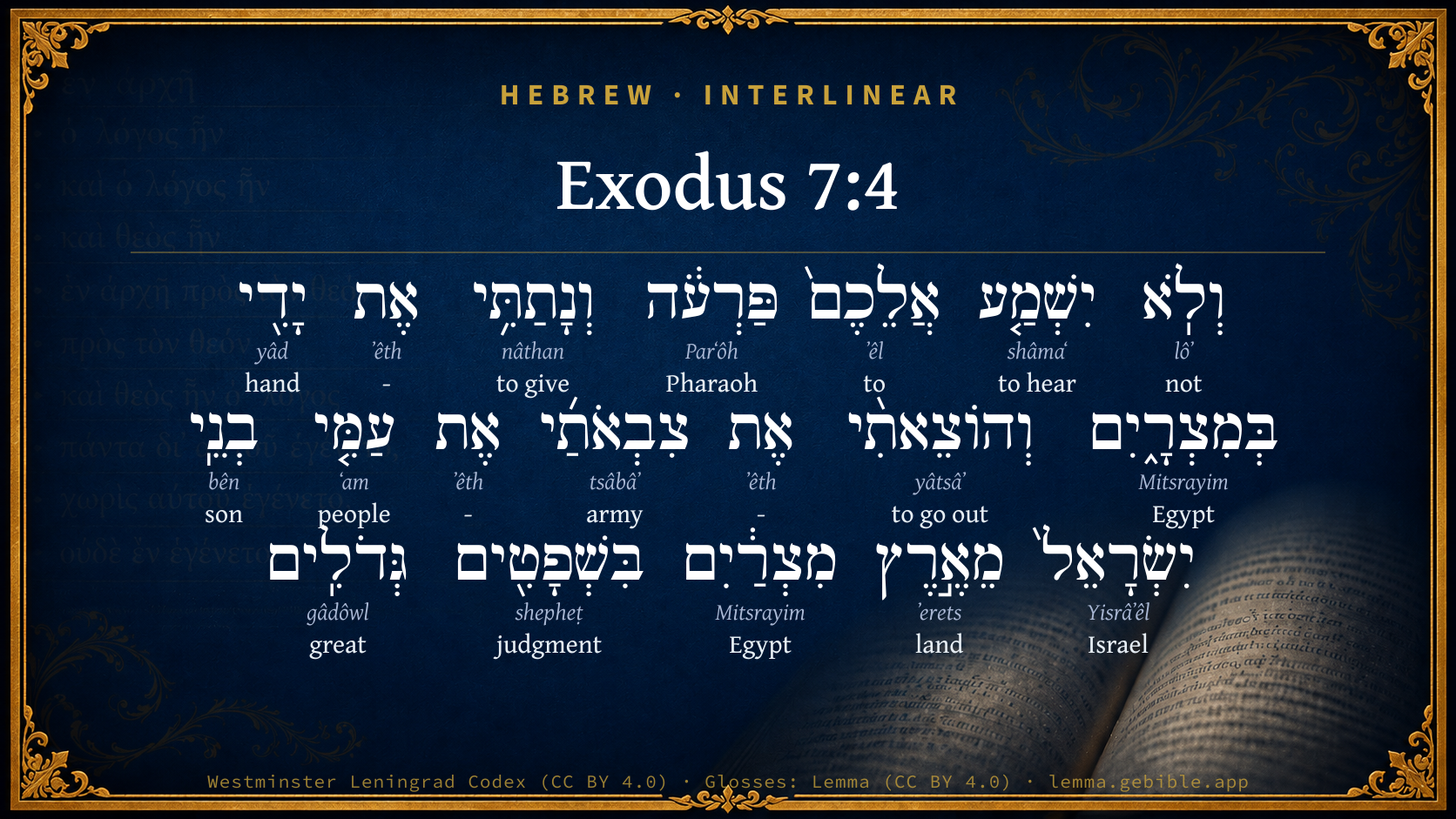
Hebrew (Westminster Leningrad Codex) Exodus 7:4 appears in the Hebrew Old Testament. The text above is from the Westminster Leningrad Codex. Each word links to its Strong’s number, a concise gloss, and parsing drawn from the Open Scriptures Hebrew Bible morphology. Click any word for its full Brown-Driver-Briggs (BDB) entry.
Download image
Cite this verse

Exodus 7:4 (World English Bible). Public Domain. Lemma interlinear Bible study tool, https://lemma.gebible.app/v/exodus/7/4.

Show BibTeX & RIS
BibTeX
RIS
English Translation
But Pharaoh will not listen to you, and I will lay my hand on Egypt, and bring forth my hosts, my people the children of Israel, out of the land of Egypt by great judgments.
World English Bible · Public Domain
Download a study sheet

One document with this verse’s original text, its word-by-word gloss line, the meaning frame, cross-references with their text, attributed commentary, and full source and license credits — printable, and it pastes into notes with its structure intact.

This verse Autodidact and up

Study sheet (.html) Plain text (.txt)

A passage Seminary Student

Up to 50 verses in one chapter. A passage sheet keeps up to 6 commentary sources and 12 cross-references per verse, in the order this page ranks them, and says so on the sheet whenever that leaves anything out. Ask for a single verse and you get the Autodidact verse sheet above.

Everything on this page stays free to read, with no account — the sheet is a download of what is already on screen, not access to it.

Want to remove ads? Support Godless Engineer
Compare translations 3

The same verse in 3 English versions, stacked beneath the original-language interlinear above. Click any original word for its lexicon entry.

Each is an independent rendering of the whole verse — the interlinear is not word-aligned to these translations.

Highlighted words mark where these versions differ — a whole-verse word diff, not a word-by-word alignment.

  • World English Bible Public Domain
    But Pharaoh will not listen to you, and I will lay my hand on Egypt, and bring forth my hosts, my people the children of Israel, out of the land of Egypt by great judgments.
  • King James Version Public Domain
    But Pharaoh shall not hearken unto you, that I may lay my hand upon Egypt, and bring forth mine armies, and my people the children of Israel, out of the land of Egypt by great judgments.
  • unfoldingWord Literal Text CC BY-SA 4.0
    And Pharaoh will not listen to you, so I will put my hand on Egypt and will bring out my armies, my people, the sons of Israel, from the land of Egypt with great judgments.

unfoldingWord Literal Text — © unfoldingWord, licensed CC BY-SA 4.0. Word-aligned USFM3 via Door43 (git.door43.org/unfoldingWord/en_ult).

Versions to compare (up to 4)

3 of 4 selected

Show all 18 translations

Every available English version of this verse, each an independent rendering of the whole verse.

  • World English Bible Public Domain
    But Pharaoh will not listen to you, and I will lay my hand on Egypt, and bring forth my hosts, my people the children of Israel, out of the land of Egypt by great judgments.
  • Berean Standard Bible Public Domain
    Pharaoh will not listen to you. Then I will lay My hand on Egypt, and by mighty acts of judgment I will bring the divisions of My people the Israelites out of the land of Egypt.
  • Majority Standard Bible Public Domain
    Pharaoh will not listen to you. Then I will lay My hand on Egypt, and by mighty acts of judgment I will bring the divisions of My people the Israelites out of the land of Egypt.
  • King James Version Public Domain
    But Pharaoh shall not hearken unto you, that I may lay my hand upon Egypt, and bring forth mine armies, and my people the children of Israel, out of the land of Egypt by great judgments.
  • American Standard Version (1901) Public Domain
    But Pharaoh will not hearken unto you, and I will lay my hand upon Egypt, and bring forth my hosts, my people the children of Israel, out of the land of Egypt by great judgments.
  • Revised Version (1885) Public Domain
    But Pharaoh will not hearken unto you, and I will lay my hand upon Egypt, and bring forth my hosts, my people the children of Israel, out of the land of Egypt by great judgments.
  • Geneva Bible (1599) Public Domain
    And Pharaoh shall not hearken vnto you, that I may lay mine hand vpon Egypt, and bring out myne armies, euen my people, the children of Israel out of the land of Egypt, by great iudgements.
  • Douay-Rheims (1899) Public Domain
    And he will not hear you: and I will lay my hand upon Egypt, and will bring forth my army and my people the children of Israel out of the land of Egypt, by very great judgments.
  • Young's Literal Translation Public Domain
    and Pharaoh doth not hearken, and I have put My hand on Egypt, and have brought out My hosts, My people, the sons of Israel, from the land of Egypt by great judgments;
  • Literal Standard Version CC BY-SA 4.0
    and Pharaoh does not listen, and I have put My hand on Egypt, and have brought out My hosts, My people, the sons of Israel, from the land of Egypt by great judgments;
  • Unlocked Literal Bible CC BY-SA 4.0
    But Pharaoh will not listen to you, so I will put my hand on Egypt and bring out my groups of fighting men, my people, the descendants of Israel, out of the land of Egypt by great acts of punishment.
  • unfoldingWord Literal Text CC BY-SA 4.0
    And Pharaoh will not listen to you, so I will put my hand on Egypt and will bring out my armies, my people, the sons of Israel, from the land of Egypt with great judgments.
  • Darby Bible Public Domain
    And Pharaoh will not hearken unto you; and I will lay my hand upon Egypt, and bring forth my hosts, my people, the children of Israel, out of the land of Egypt by great judgments.
  • World Messianic Bible Public Domain
    But Pharaoh will not listen to you, so I will lay my hand on Egypt, and bring out my armies, my people the children of Israel, out of the land of Egypt by great judgments.
  • Webster's Bible Public Domain
    But Pharaoh shall not hearken to you, that I may lay my hand upon Egypt, and bring forth my armies, my people the children of Israel, out of the land of Egypt, by great judgments.
  • Free Bible Version CC BY-SA 4.0
    Then I will attack Egypt, imposing heavy punishments on them, and I will lead out by their tribes my people the Israelites.
  • Bible in Basic English Public Domain
    But Pharaoh will not give ear to you, and I will put my hand on Egypt, and take my armies, my people, the children of Israel, out of Egypt, after great punishments.
  • JPS Tanakh (1917) Public Domain
    But Pharaoh will not hearken unto you, and I will lay My hand upon Egypt, and bring forth My hosts, My people the children of Israel, out of the land of Egypt, by great judgments.

Literal Standard Version (2020), Covenant Press — licensed CC BY-SA 4.0. Text via the HelloAO Bible API (eBible.org). Unlocked Literal Bible (unfoldingWord) — licensed CC BY-SA 4.0. Text via the HelloAO Bible API (eBible.org). unfoldingWord Literal Text — © unfoldingWord, licensed CC BY-SA 4.0. Word-aligned USFM3 via Door43 (git.door43.org/unfoldingWord/en_ult). Free Bible Version, Dr. Jonathan Gallagher — licensed CC BY-SA 4.0. Text via the HelloAO Bible API (eBible.org).

Word by word

More ways to search: Search by grammar → Find every occurrence → Compare this word →

Practice this passage: Drill this verse → Learn its vocabulary →

בִּשְׁפָטִ֖ים
shepheṭ
H8201
“in/at · judgments”
Preposition + Noun, Common, Masculine, Plural, Absolute
Part of Speech
Preposition + Noun
Type
Common
Gender
Masculine
Number
Plural
State
Absolute
Full BDB Definition

Origin: from H8199

TWOT: 2443a

judgment, act of judgment
  1. וְלֹֽא lôʼ H3808 “and · not” Conjunction + Particle, Negative
  2. יִשְׁמַ֤ע shâmaʻ H8085 “to hear” Verb, Qal, Imperfect, 3rd Person, Masculine, Singular
  3. אֲלֵכֶם֙ ʼêl H413 “to · you” Preposition + Suffix, Personal, 2nd Person, Masculine, Plural
  4. פַּרְעֹ֔ה Parʻôh H6547 “Pharaoh” Noun, Proper
  5. וְנָתַתִּ֥י nâthan H5414 “and · to give” Conjunction + Verb, Qal, Sequential Perfect, 1st Person, Common, Singular
  6. אֶת ʼêth H853 “-” Particle, Direct Object
  7. יָדִ֖י yâd H3027 “hand · my” Noun, Common, Both, Singular, Construct + Suffix, Personal, 1st Person, Common, Singular
  8. בְּמִצְרָ֑יִם Mitsrayim H4714 “in/at · Egypt” Preposition + Noun, Proper
  9. וְהוֹצֵאתִ֨י yâtsâʼ H3318 “and · to go out” Conjunction + Verb, Hiphil, Sequential Perfect, 1st Person, Common, Singular
  10. אֶת ʼêth H853 “-” Particle, Direct Object
  11. צִבְאֹתַ֜י tsâbâʼ H6635 “armies · my” Noun, Common, Both, Plural, Construct + Suffix, Personal, 1st Person, Common, Singular
  12. אֶת ʼêth H853 “-” Particle, Direct Object
  13. עַמִּ֤י ʻam H5971 “people · my” Noun, Common, Masculine, Singular, Construct + Suffix, Personal, 1st Person, Common, Singular
  14. בְנֵֽי bên H1121 “sons of” Noun, Common, Masculine, Plural, Construct
  15. יִשְׂרָאֵל֙ Yisrâʼêl H3478 “Israel” Noun, Proper
  16. מֵאֶ֣רֶץ ʼerets H776 “from · land of” Preposition + Noun, Common, Both, Singular, Construct
  17. מִצְרַ֔יִם Mitsrayim H4714 “Egypt” Noun, Proper
  18. גְּדֹלִֽים gâdôwl H1419 “great” Adjective, Adjective, Masculine, Plural, Absolute

About this verse

These counts appear in no published source. They are computed here, from the morphology-tagged text and Lemma’s own curated glosses. What Lemma adds →

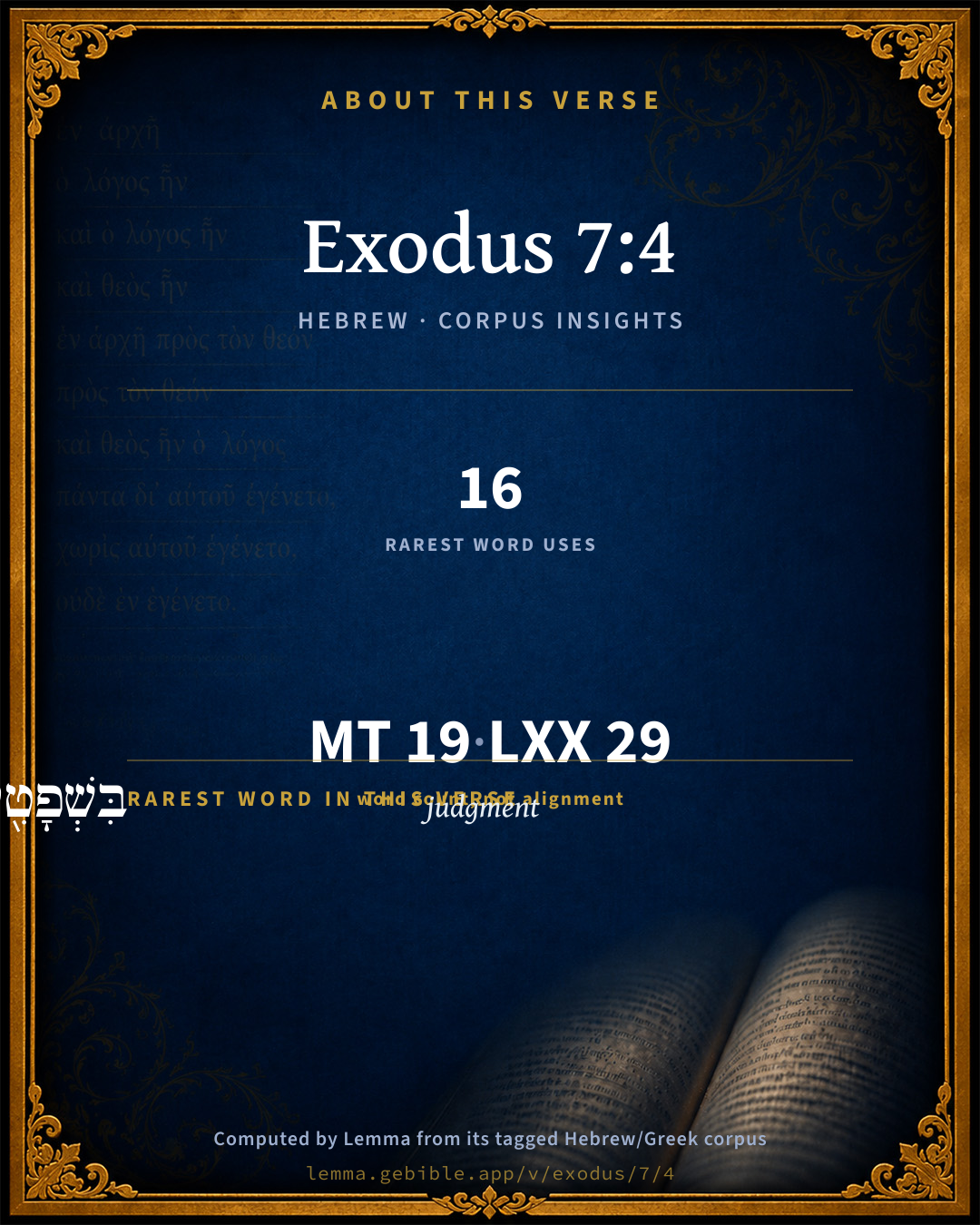
19
words
16
distinct lemmas
Pentateuch
section

Notable vocabulary

The rarest word here is בִּשְׁפָטִ֖ים judgment H8201 — appearing just 16 times in the whole Hebrew Bible.

Shared distinctive vocabulary

בִּשְׁפָטִ֖ים judgment H8201 occurs in 16 verses of the Hebrew Bible. Also found in:

Grammatical profile

  • 3 verbs
  • 10 nouns
  • 1 adjective
  • 1 preposition
  • 4 particles

Verb forms

  • יִשְׁמַ֤ע Qal · Imperfect
  • וְנָתַתִּ֥י Qal · Sequential Perfect
  • וְהוֹצֵאתִ֨י Hiphil · Sequential Perfect

Repetition

A word recurs within this verse — often emphatic in Hebrew:

  • בְּמִצְרָ֑יִם Egypt H4714 ×2

Hebrew & Septuagint length

In English translation the verse runs 35 words from the Hebrew and 37 from the Septuagint (LXX English) — closely comparable.

A rough comparison of the two English renderings, which tokenize alike — not a word-level alignment.

Word counts can differ between the Hebrew and the Greek without any difference in meaning — e.g. the Hebrew direct-object marker אֵת has no separate Greek word, and Greek often adds the article ὁ.

In the original languages it is 19 Hebrew tokens and 29 Greek tokens — but the two are counted differently (Hebrew bundles its prefixes and suffixes into one token; the Greek is in lemma form), so that isn’t a like-for-like length.

Cross-references

18

Topical passages linked to Exodus 7:4 in the Treasury of Scripture Knowledge — connected by theme and wording, ordered by reader-vote popularity; previews shown in the World English Bible.

  • Exodus 6:6 Therefore tell the children of Israel, 'I am Yahweh, and I will bring you out from under the burdens of the Egyptians, and I will rid you out of their bondage, and I will redeem you with an outstretched arm, and with great judgments:
  • Exodus 11:9 Yahweh said to Moses, "Pharaoh won't listen to you, that my wonders may be multiplied in the land of Egypt."
  • Exodus 12:51 It happened the same day, that Yahweh brought the children of Israel out of the land of Egypt by their hosts.
  • Exodus 3:20 I will put forth my hand and strike Egypt with all my wonders which I will do in the midst of it, and after that he will let you go.
  • Exodus 6:26 These are that Aaron and Moses, to whom Yahweh said, "Bring out the children of Israel from the land of Egypt according to their hosts."
  • Exodus 9:3 behold, the hand of Yahweh is on your cattle which are in the field, on the horses, on the donkeys, on the camels, on the herds, and on the flocks with a very grievous pestilence.
  • Exodus 10:1 Yahweh said to Moses, "Go in to Pharaoh, for I have hardened his heart, and the heart of his servants, that I may show these my signs in the midst of them,
  • Judges 2:15 Wherever they went out, the hand of Yahweh was against them for evil, as Yahweh had spoken, and as Yahweh had sworn to them: and they were sore distressed.
  • Proverbs 19:29 Penalties are prepared for scoffers, And beatings for the backs of fools.
  • Isaiah 26:9 With my soul have I desired you in the night; yes, with my spirit within me will I seek you earnestly: for when your judgments are in the earth, the inhabitants of the world learn righteousness.
  • Lamentations 3:3 Surely against me he turns his hand again and again all the day.
  • Ezekiel 14:21 For thus says the Lord Yahweh: How much more when I send my four sore judgments on Jerusalem, the sword, and the famine, and the evil animals, and the pestilence, to cut off from it man and animal!
  • Ezekiel 25:11 and I will execute judgments on Moab; and they shall know that I am Yahweh.
  • Ezekiel 30:14 I will make Pathros desolate, and will set a fire in Zoan, and will execute judgments on No.
  • Ezekiel 30:19 Thus will I execute judgments on Egypt; and they shall know that I am Yahweh.
  • Revelation 15:4 Who wouldn't fear you, Lord, And glorify your name? For you only are holy. For all the nations will come and worship before you. For your righteous acts have been revealed."
  • Revelation 16:7 I heard the altar saying, "Yes, Lord God, the Almighty, true and righteous are your judgments."
  • Revelation 19:2 for true and righteous are his judgments. For he has judged the great prostitute, who corrupted the earth with her sexual immorality, and he has avenged the blood of his servants at her hand."

Cross-references courtesy of OpenBible.info (CC BY 4.0).

Hebrew and Greek witnesses Masoretic Hebrew ↔ Greek Septuagint

The same verse in the two great witnesses to the Old Testament, shown verse-for-verse.

These are two independent witnesses, not word-aligned to each other, and the Septuagint is shown in lemma (dictionary) form.

Hebrew Exodus 7:4 Masoretic · Westminster Leningrad Codex

וְלֹֽא יִשְׁמַ֤ע אֲלֵכֶם֙ פַּרְעֹ֔ה וְנָתַתִּ֥י אֶת יָדִ֖י בְּמִצְרָ֑יִם וְהוֹצֵאתִ֨י אֶת צִבְאֹתַ֜י אֶת עַמִּ֤י בְנֵֽי יִשְׂרָאֵל֙ מֵאֶ֣רֶץ מִצְרַ֔יִם בִּשְׁפָטִ֖ים גְּדֹלִֽים

But Pharaoh will not listen to you, and I will lay my hand on Egypt, and bring forth my hosts, my people the children of Israel, out of the land of Egypt by great judgments.

World English Bible · Public Domain

Greek LXX Exodus 7:4 Septuagint · lemma form

καί οὐ εἰςἀκούω σύ φαραώ καί ἐπιβάλλω ὁ χείρ ἐγώ ἐπί αἴγυπτος καί ἐκἄγω σύν δύναμις ἐγώ ὁ λαός ἐγώ ὁ υἱός ἰσραήλ ἐκ γῆ αἴγυπτος σύν ἐκδικέω μέγας

And Pharao will not listen to you, and I will lay my hand upon Egypt; and will bring out my people the children of Israel with my power out of the land of Egypt with great vengeance.

LXX2012 (modern English Septuagint) · Public Domain

Hebrew: Westminster Leningrad Codex (CC BY 4.0). Greek: Septuagint (public domain); English from LXX2012 (modern English Septuagint) (Public Domain). How the Septuagint differs from the Hebrew →

Targum (Aramaic paraphrase)

2

The Targum is the ancient Jewish Aramaic paraphrase of the Hebrew Scriptures — an interpretive translation, not the Hebrew text itself. Onkelos (literal) and Pseudo-Jonathan (expansive) render the Torah, and Jonathan the Prophets. Coverage is partial: where no permissively-licensed English translation exists for a verse, only the Aramaic is shown. This is verse-level text, not a word-by-word alignment to the Hebrew.

  1. Targum Onkelos Torah (Genesis–Deuteronomy)
    וְלָא יְקַבֵּל מִנְכוֹן פַּרְעֹה וְאֶתֵּן יָת מָחַת גְבֻרְתִּי בְּמִצְרָיִם וְאַפֵּיק יָת חֵילִי יָת עַמִי בְנֵי יִשְׂרָאֵל מֵאַרְעָא דְמִצְרַיִם בְּדִינִין רַבְרְבִין:

    (no public-domain English translation for this verse)

    Targum Onkelos — Aramaic: “Onkelos Genesis” (public domain); “Onkelos Exodus” (public domain); “Onkelos Leviticus” (public domain); “Onkelos Numbers” (public domain); “Onkelos Deuteronomy” (public domain). English: “Sefaria Community Translation” (CC0 1.0 (public-domain dedication)); “J.W. Etheridge. The Targums of Onkelos and Jonathan Ben Uzziel on the Pentateuch. London: Longmans, Green, 1862” (public domain). Text via Sefaria.

  2. Targum Pseudo-Jonathan Torah (Genesis–Deuteronomy)
    וְלָא יְקַבֵּל מִנְכוֹן פַּרְעה וְאִיגָרֵי בְּהוֹן גִירִין דִקְטוֹל וְאֶתֵּן מְחַת גְבוּרַת יְדִי בְּמִצְרָיִם וְאַפֵּיק יַת עַמִי בְּנֵי יִשְרָאֵל פְּרִיקִין מֵאַרְעָא דְמִצְרַיִם בְּדִינִין רַבְרְבִין

    Nor will Pharoh hearken to you. But I will shoot among them the arrows of death, and inflict the plagues of My mighty hand upon Mizraim, and will bring out the sons of Israel free from among them.

    Targum Pseudo-Jonathan — Aramaic: “Targum Jonathan on Genesis” (public domain); “Targum Jonathan on Exodus” (public domain); “Targum Jonathan on Leviticus” (public domain); “Targum Jonathan on Numbers” (public domain); “Targum Jonathan on Deuteronomy” (public domain). English: “The Targum of Jonathan ben Uzziel, trans. J. W. Etheridge, London, 1862” (public domain). Text via Sefaria.

Commentary

Notes on Exodus 7:4 from classic Christian and Jewish commentators (each source and its license shown beneath its notes). The classic Christian expositions comment on the surrounding passage and are grouped to its opening verse, so a note may address several verses; the Jewish commentaries on the Tanakh (Rashi and others) are per-verse, so they appear only where the commentator wrote on this verse.

Lemma curates 59 commentaries, every one of them public domain or Creative Commons licensed, each selected and text-cleaned for this edition rather than reprinted as found. About our sources →

Trapp's Complete Commentary

John Trapp

Exo 7:4 But Pharaoh shall not hearken unto you, that I may lay my hand upon Egypt, and bring forth mine armies, [and] my people the children of Israel, out of the land of Egypt by great judgments.

Ver. 4. And Pharaoh shall not hearken.] This judgment God layeth upon many of our hearers at this day of whom, after much painstaking, we may well complain, as the herdsman did in the poet: -

“Heu mihi! quam pingui macer est mihi taurus in arvo.”

John Trapp, A Commentary or Exposition upon All the Books of the Old and New Testament (1647–1656) — public domain. Text from a community e-Sword module.

Geneva Bible (1599)

Geneva Bible translators

To strengthen Moses’ faith, God promiseth again to punish most sharply the oppression of his Church.

Geneva Bible (1599) marginal notes — public domain. Text via Bolls.life.

Jamieson, Fausset & Brown

Robert Jamieson, A. R. Fausset & David Brown

I may lay mine hand upon Egypt, &c.--The succession of terrible judgments with which the country was about to be scourged would fully demonstrate the supremacy of Israel's God.

Jamieson, Fausset & Brown — Commentary Critical and Explanatory on the Whole Bible (1871) — public domain (CC PDM 1.0). Text via the HelloAO Bible API.

Ellicott's Commentary for English Readers

(4) Pharaoh shall not hearken unto you, that I may lay.—Heb., Pharaoh will not hearken unto you, and I will lay. No relation of effect and cause is here asserted as existing between the two clauses, which are co-ordinate.

Mine armies, and my people. Rather, my armies, my people. The two expressions are in apposition—the second exegetical of the first.

Great judgments.—See the comment on Exo_6:6.

A Bible Commentary for English Readers, edited by Charles John Ellicott (1878–1897) — public domain. Text from a community e-Sword module.

The Cambridge Bible for Schools and Colleges

gen. ed. J. J. S. Perowne

4. lay my hand] severely, to inflict the great ‘judgements’ (see on Exo_6:6; and cf. Exo_12:12), which ultimately effected Israel’s deliverance.

my hosts] See on Exo_6:26.

The Cambridge Bible for Schools and Colleges (gen. ed. J. J. S. Perowne; Cambridge University Press, 1878–1918) — public domain. Text from a community e-Sword module.

John Gill's Exposition

But Pharaoh shall not hearken unto you,.... Regard not what they said, nor answer the demand they made, or obey the command of God delivered by them to him: this the Lord apprised them of, that they might not be discouraged, and conclude their labour would be in vain, their attempts fruitless, and they should never gain their point, but spend their time, and expose themselves to danger to no purpose:

that I may lay mine hand upon Egypt; the inhabitants of Egypt, smiting them with one plague after another, and particularly with the last, slaying their firstborn; every plague was a stroke of his hand, and an effect of his mighty power and vengeance, and more especially that:

and bring forth mine armies; the children of Israel consisting of 600,000 men, besides women and children, Exo 12:37 which, divided into twelve tribes, made twelve fine armies, 50,000 men in a tribe or army upon an average:

and my people the children of Israel out of the land of Egypt; the word "and" need not be supplied; if any supplement is necessary, the word "even" would be better, since this clause is added by way of explanation, showing who are meant by the armies of the Lord, his people to be brought out:

by great judgments; inflicted upon the Egyptians.

John Gill's Exposition of the Whole Bible (1746–1763) — public domain (CC PDM 1.0). Text via the HelloAO Bible API.

Whedon's Commentary on the Bible

Daniel D. Whedon

4. But Pharaoh shall not hearken — There is nothing imperative or determinative in the use of the verb here; it is a simple future, and the verbs following are to be translated as futures, thus: But Pharaoh will not hearken… and I will lay my hand upon Egypt, and will bring forth mine armies… and the Egyptians will know.

Daniel D. Whedon (gen. ed.), Commentary on the Old and New Testaments (1874–1909) — public domain. Text from a community e-Sword module.

The Pulpit Commentary

That I may lay my hand on Egypt. Pharaoh"s obstinacy was foreseen and foreknown. He was allowed to set his will against God"s, in order that there might be a great display of Almighty power, such as would attract the attention both of the Egyptians generally and of all the surrounding nations. God"s glory would be thereby promoted, and there would be a general dread of interfering with his people. (see Exo_15:14-16; Deu_2:25 Deu_11:25, etc.) Bring forth my armies. See the comment on Exo_6:26. Great judgments. See above, Exo_6:6.

The Pulpit Commentary (1880–1919), ed. H.D.M. Spence-Jones & Joseph S. Exell — public domain. Text from a community e-Sword module.

Keil & Delitzsch

C. F. Keil & F. Delitzsch

את־ידי ונתתּי: "I will lay My hand on Egypt," i.e., smite Egypt, "and bring out My armies, My people, the children of Israel." צבאות (armies) is used of Israel, with reference to its leaving Egypt equipped (Exo 13:18) and organized as an army according to the tribes (cf. Exo 6:26 and Exo 12:51 with Num 1 and 2), to contend for the cause of the Lord, and fight the battles of Jehovah. In this respect the Israelites were called the hosts of Jehovah. The calling of Moses and Aaron was now concluded. Exo 7:6 and Exo 7:7 pave the way for the account of their performance of the duties consequent upon their call.

Keil & Delitzsch — Biblical Commentary on the Old Testament (1861–1891) — public domain (CC PDM 1.0). Text via the HelloAO Bible API. (Old Testament only.)

Rashi

Rabbi Shlomo Yitzchaki (Rashi)

את ידי this must be translated literally, “hand”, (not “power”) I will lay My hand upon Egypt to smite them.

Rashi on the Tanakh — English translations: “The Judaica Press complete Tanach with Rashi, translated by A. J. Rosenberg” (CC BY 4.0); “Pentateuch with Rashi's commentary by M. Rosenbaum and A.M. Silbermann, 1929-1934” (public domain); “The Metsudah Tanach series, Lakewood, N.J” (CC BY 4.0); and “The Book of Joshua, Metsudah Publications, 1997” (CC BY 4.0). Text via Sefaria.

Lesson kit

Teaching starters — assembled from the data on this page, not authored interpretation. Every prompt links to the verse data it draws on. Edit before teaching.

Exodus, in the Pentateuch, opens this verse with 19 words (16 distinct Hebrew lemmas). Its most distinctive word is shepheṭ (“judgment”). A historical commentator’s framing appears above. Read the whole chapter for the surrounding context.

Discussion questions

  1. The word shepheṭ carries the sense “judgment.” How does it shape the verse?
  2. How does Exodus 6:6, which shares the word «judgment», read alongside this verse?
  3. What does the repetition of “Egypt” (2× in this one verse) do in this verse?
  4. These translations render this verse differently; the difference is in the English rendering, not the original. What questions does that raise?
  5. «יִשְׁמַ֤ע» is a Qal Imperfect verb. How does that grammatical form shape the action described?
  6. Compare how Trapp's Complete Commentary and Geneva Bible (1599) read this verse. Where do they agree or differ?

Things to notice

Reading settings

Reading text

Shown beneath each verse's original-language words.

Old Testament
Old Testament edition

Read the OT as the Masoretic Hebrew (MT) or the Greek Septuagint (LXX).

English shown for the Greek Septuagint (in the Hebrew ↔ Greek comparison).

Comparing translations? Open the Compare panel on any verse page to stack up to four side by side.