
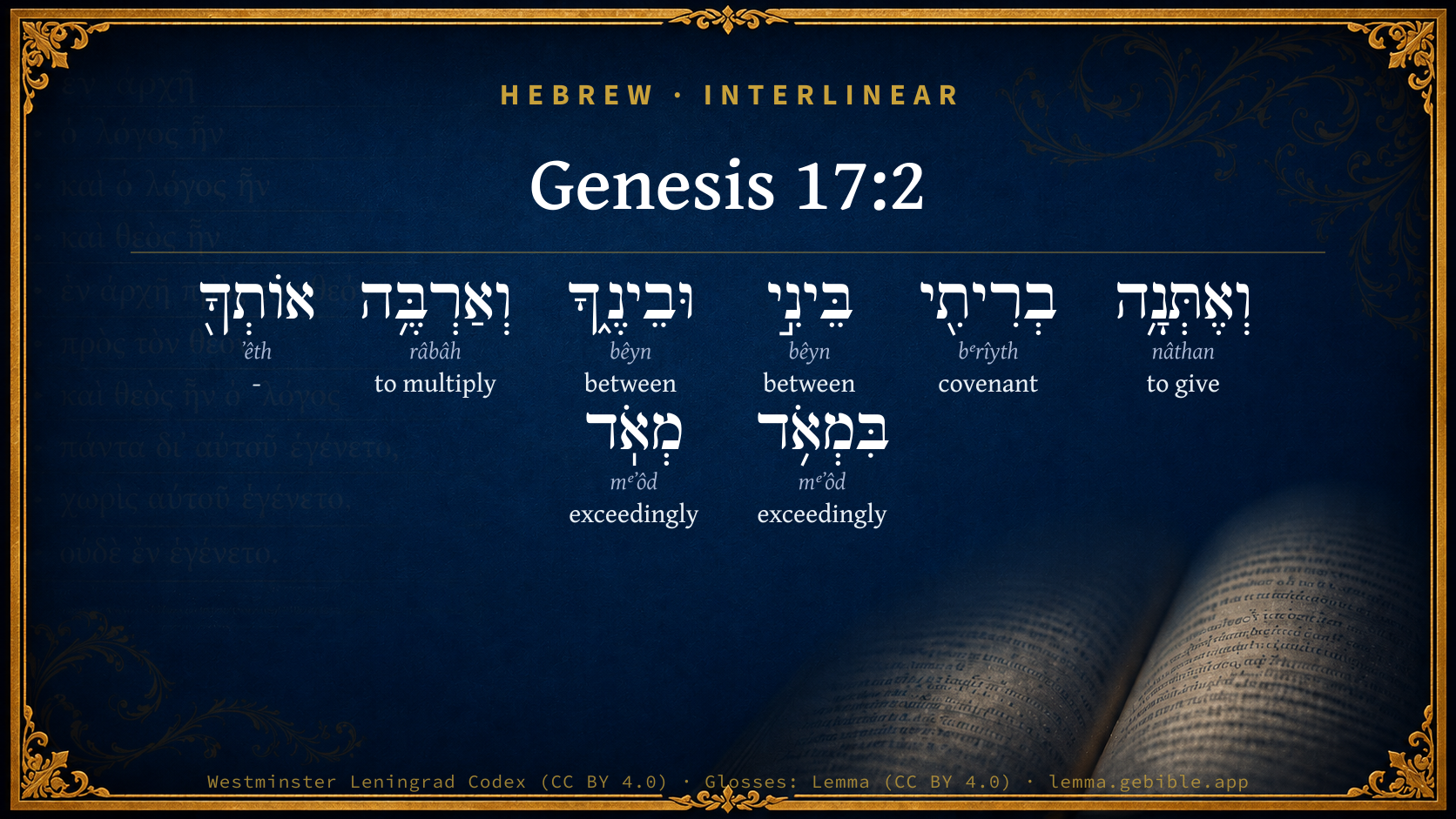
Genesis 17:2

Hebrew (Westminster Leningrad Codex) Genesis 17:2 appears in the Hebrew Old Testament. The text above is from the Westminster Leningrad Codex. Each word links to its Strong’s number, a concise gloss, and parsing drawn from the Open Scriptures Hebrew Bible morphology. Click any word for its full Brown-Driver-Briggs (BDB) entry.
Download image
Cite this verse

Genesis 17:2 (World English Bible). Public Domain. Lemma interlinear Bible study tool, https://lemma.gebible.app/v/genesis/17/2.

Show BibTeX & RIS
BibTeX
RIS
English Translation
I will make my covenant between me and you, and will multiply you exceedingly."
World English Bible · Public Domain
Download a study sheet

One document with this verse’s original text, its word-by-word gloss line, the meaning frame, cross-references with their text, attributed commentary, and full source and license credits — printable, and it pastes into notes with its structure intact.

This verse Autodidact and up

Study sheet (.html) Plain text (.txt)

A passage Seminary Student

Up to 50 verses in one chapter. A passage sheet keeps up to 6 commentary sources and 12 cross-references per verse, in the order this page ranks them, and says so on the sheet whenever that leaves anything out. Ask for a single verse and you get the Autodidact verse sheet above.

Everything on this page stays free to read, with no account — the sheet is a download of what is already on screen, not access to it.

Want to remove ads? Support Godless Engineer
Compare translations 3

The same verse in 3 English versions, stacked beneath the original-language interlinear above. Click any original word for its lexicon entry.

Each is an independent rendering of the whole verse — the interlinear is not word-aligned to these translations.

Highlighted words mark where these versions differ — a whole-verse word diff, not a word-by-word alignment.

  • World English Bible Public Domain
    I will make my covenant between me and you, and will multiply you exceedingly."
  • King James Version Public Domain
    And I will make my covenant between me and thee, and will multiply thee exceedingly.
  • unfoldingWord Literal Text CC BY-SA 4.0
    And I will make my covenant between me and you, and I will multiply you very greatly.”

unfoldingWord Literal Text — © unfoldingWord, licensed CC BY-SA 4.0. Word-aligned USFM3 via Door43 (git.door43.org/unfoldingWord/en_ult).

Versions to compare (up to 4)

3 of 4 selected

Show all 18 translations

Every available English version of this verse, each an independent rendering of the whole verse.

  • World English Bible Public Domain
    I will make my covenant between me and you, and will multiply you exceedingly."
  • Berean Standard Bible Public Domain
    I will establish My covenant between Me and you, and I will multiply you exceedingly.”
  • Majority Standard Bible Public Domain
    I will establish My covenant between Me and you, and I will multiply you exceedingly.”
  • King James Version Public Domain
    And I will make my covenant between me and thee, and will multiply thee exceedingly.
  • American Standard Version (1901) Public Domain
    And I will make my covenant between me and thee, and will multiply thee exceedingly.
  • Revised Version (1885) Public Domain
    And I will make my covenant between me and thee, and will multiply thee exceedingly.
  • Geneva Bible (1599) Public Domain
    And I will make my couenant betweene me and thee, and I will multiplie thee exceedingly.
  • Douay-Rheims (1899) Public Domain
    And I will make my covenant between me and thee: and I will multiply thee exceedingly.
  • Young's Literal Translation Public Domain
    and I give My covenant between Me and thee, and multiply thee very exceedingly.'
  • Literal Standard Version CC BY-SA 4.0
    and I give My covenant between Me and you, and multiply you very exceedingly.”
  • Unlocked Literal Bible CC BY-SA 4.0
    Then I will confirm my covenant between me and you, and will multiply you exceedingly.”
  • unfoldingWord Literal Text CC BY-SA 4.0
    And I will make my covenant between me and you, and I will multiply you very greatly.”
  • Darby Bible Public Domain
    And I will set my covenant between me and thee, and will very greatly multiply thee.
  • World Messianic Bible Public Domain
    I will make my covenant between me and you, and will multiply you exceedingly.”
  • Webster's Bible Public Domain
    And I will make my covenant between me and thee, and will multiply thee exceedingly.
  • Free Bible Version CC BY-SA 4.0
    I will make my agreement between me and you, and I will give you many, many descendants.”
  • Bible in Basic English Public Domain
    And I will make an agreement between you and me, and your offspring will be greatly increased.
  • JPS Tanakh (1917) Public Domain
    And I will make My covenant between Me and thee, and will multiply thee exceedingly.'

Literal Standard Version (2020), Covenant Press — licensed CC BY-SA 4.0. Text via the HelloAO Bible API (eBible.org). Unlocked Literal Bible (unfoldingWord) — licensed CC BY-SA 4.0. Text via the HelloAO Bible API (eBible.org). unfoldingWord Literal Text — © unfoldingWord, licensed CC BY-SA 4.0. Word-aligned USFM3 via Door43 (git.door43.org/unfoldingWord/en_ult). Free Bible Version, Dr. Jonathan Gallagher — licensed CC BY-SA 4.0. Text via the HelloAO Bible API (eBible.org).

Word by word

More ways to search: Search by grammar → Find every occurrence → Compare this word →

Practice this passage: Drill this verse → Learn its vocabulary →

וְאַרְבֶּ֥ה
râbâh
H7235
“and · to multiply”
Conjunction + Verb, Hiphil, Cohortative, 1st Person, Common, Singular
Part of Speech
Conjunction + Verb
Stem
Hiphil
Form
Cohortative
Person
1st Person
Gender
Common
Number
Singular
Full BDB Definition

Origin: a primitive root

TWOT: 2103 , 2104

be or become great, be or become many, be or become much, be or become numerous - (Qal) - to become many, become numerous, multiply (of people, animals, things) - to be or grow great - (Piel) to make large, enlarge, increase, become many - (Hiphil) - to make much, make many, have many - to multiply, increase - to make much to do, do much in respect of, transgress greatly - to increase greatly or exceedingly - to make great, enlarge, do much - (Qal) to shoot
  1. וְאֶתְּנָ֥ה nâthan H5414 “and · to give” Conjunction + Verb, Qal, Cohortative, 1st Person, Common, Singular
  2. בְרִיתִ֖י bᵉrîyth H1285 “covenant · my” Noun, Common, Feminine, Singular, Construct + Suffix, Personal, 1st Person, Common, Singular
  3. בֵּינִ֣י bêyn H996 “between · me” Preposition + Suffix, Personal, 1st Person, Common, Singular
  4. וּבֵינֶ֑ךָ bêyn H996 “and · between · you” Conjunction + Preposition + Suffix, Personal, 2nd Person, Masculine, Singular
  5. אוֹתְךָ֖ ʼêth H853 “- · you” Particle, Direct Object + Suffix, Personal, 2nd Person, Masculine, Singular
  6. בִּמְאֹ֥ד mᵉʼôd H3966 “in/at · exceedingly” Preposition + Adverb
  7. מְאֹֽד mᵉʼôd H3966 “exceedingly” Adverb

About this verse

These counts appear in no published source. They are computed here, from the morphology-tagged text and Lemma’s own curated glosses. What Lemma adds →

8
words
6
distinct lemmas
Pentateuch
section

Grammatical profile

  • 2 verbs
  • 1 noun
  • 2 prepositions
  • 2 adverbs
  • 1 particle

Verb forms

  • וְאֶתְּנָ֥ה Qal · Cohortative
  • וְאַרְבֶּ֥ה Hiphil · Cohortative

Repetition

Words recur within this verse — often emphatic in Hebrew:

  • בֵּינִ֣י between H996 ×2
  • בִּמְאֹ֥ד exceedingly H3966 ×2

Hebrew & Septuagint length

In English translation the verse runs 14 words from the Hebrew and 16 from the Septuagint (LXX English) — closely comparable.

A rough comparison of the two English renderings, which tokenize alike — not a word-level alignment.

Word counts can differ between the Hebrew and the Greek without any difference in meaning — e.g. the Hebrew direct-object marker אֵת has no separate Greek word, and Greek often adds the article ὁ.

Cross-references

8

Topical passages linked to Genesis 17:2 in the Treasury of Scripture Knowledge — connected by theme and wording, ordered by reader-vote popularity; previews shown in the World English Bible.

  • Genesis 17:4–6 "As for me, behold, my covenant is with you. You will be the father of a multitude of nations.
  • Genesis 12:2 I will make of you a great nation. I will bless you, and make your name great. You will be a blessing.
  • Genesis 13:16 I will make your offspring as the dust of the earth, so that if a man can number the dust of the earth, then your seed may also be numbered.
  • Genesis 15:18 In that day Yahweh made a covenant with Abram, saying, "To your seed have I given this land, from the river of Egypt to the great river, the river Euphrates:
  • Psalms 105:8–11 He has remembered his covenant forever, The word which he commanded to a thousand generations,
  • Genesis 22:17 that in blessing I will bless you, and in multiplying I will multiply your seed as the stars of the heavens, and as the sand which is on the seashore. Your seed will possess the gate of his enemies.
  • Galatians 3:17–18 Now I say this. A covenant confirmed beforehand by God in Christ, the law, which came four hundred thirty years after, does not annul, so as to make the promise of no effect.
  • Genesis 9:9 "As for me, behold, I establish my covenant with you, and with your offspring after you,

Cross-references courtesy of OpenBible.info (CC BY 4.0).

Hebrew and Greek witnesses Masoretic Hebrew ↔ Greek Septuagint

The same verse in the two great witnesses to the Old Testament, shown verse-for-verse.

These are two independent witnesses, not word-aligned to each other, and the Septuagint is shown in lemma (dictionary) form.

Hebrew Genesis 17:2 Masoretic · Westminster Leningrad Codex

וְאֶתְּנָ֥ה בְרִיתִ֖י בֵּינִ֣י וּבֵינֶ֑ךָ וְאַרְבֶּ֥ה אוֹתְךָ֖ בִּמְאֹ֥ד מְאֹֽד

I will make my covenant between me and you, and will multiply you exceedingly."

World English Bible · Public Domain

Greek LXX Genesis 17:2 Septuagint · lemma form

καί τίθημι ὁ διαθήκη ἐγώ ἀνά μέσος ἐγώ καί ἀνά μέσος σύ καί πληθύνω σύ σφόδρα

And I will establish my covenant between me and you, and I will multiply you exceedingly.

LXX2012 (modern English Septuagint) · Public Domain

Hebrew: Westminster Leningrad Codex (CC BY 4.0). Greek: Septuagint (public domain); English from LXX2012 (modern English Septuagint) (Public Domain). How the Septuagint differs from the Hebrew →

Targum (Aramaic paraphrase)

2

The Targum is the ancient Jewish Aramaic paraphrase of the Hebrew Scriptures — an interpretive translation, not the Hebrew text itself. Onkelos (literal) and Pseudo-Jonathan (expansive) render the Torah, and Jonathan the Prophets. Coverage is partial: where no permissively-licensed English translation exists for a verse, only the Aramaic is shown. This is verse-level text, not a word-by-word alignment to the Hebrew.

  1. Targum Onkelos Torah (Genesis–Deuteronomy)
    וְאֶתֵּן קְיָמִי בֵּין מֵימְרִי וּבֵינָךְ וְאַסְגֵי יָתָךְ לַחֲדָא לַחֲדָא

    (no public-domain English translation for this verse)

    Targum Onkelos — Aramaic: “Onkelos Genesis” (public domain); “Onkelos Exodus” (public domain); “Onkelos Leviticus” (public domain); “Onkelos Numbers” (public domain); “Onkelos Deuteronomy” (public domain). English: “Sefaria Community Translation” (CC0 1.0 (public-domain dedication)); “J.W. Etheridge. The Targums of Onkelos and Jonathan Ben Uzziel on the Pentateuch. London: Longmans, Green, 1862” (public domain). Text via Sefaria.

  2. Targum Pseudo-Jonathan Torah (Genesis–Deuteronomy)
    וְאֶתֵּן קְיָימִי בֵּין מֵימְרִי וּבֵינָךְ וְאַסְגֵי יָתָךְ לַחֲדָא לַחֲדָא

    And I will set My covenant between My Word and thee, and will multiply thee very greatly.

    Targum Pseudo-Jonathan — Aramaic: “Targum Jonathan on Genesis” (public domain); “Targum Jonathan on Exodus” (public domain); “Targum Jonathan on Leviticus” (public domain); “Targum Jonathan on Numbers” (public domain); “Targum Jonathan on Deuteronomy” (public domain). English: “The Targum of Jonathan ben Uzziel, trans. J. W. Etheridge, London, 1862” (public domain). Text via Sefaria.

Commentary

Notes on Genesis 17:2 from classic Christian and Jewish commentators (each source and its license shown beneath its notes). The classic Christian expositions comment on the surrounding passage and are grouped to its opening verse, so a note may address several verses; the Jewish commentaries on the Tanakh (Rashi and others) are per-verse, so they appear only where the commentator wrote on this verse.

Lemma curates 59 commentaries, every one of them public domain or Creative Commons licensed, each selected and text-cleaned for this edition rather than reprinted as found. About our sources →

Trapp's Complete Commentary

John Trapp

Gen 17:2 And I will make my covenant between me and thee, and will multiply thee exceedingly.

Ver. 2. And I will make my covenant.] This is now the fifth confirmation of the Covenant; which shows that it is the alpha and omega, the first, second, and third of our salvation; and it is fit we should be well studied in it, and assured of our interest. For as the mercy seat was no larger than the ark, {Exo 25:10-17} so neither is the grace of God than the covenant. And as the ark and mercy seat were never separated; so neither is his mercy from his people.

John Trapp, A Commentary or Exposition upon All the Books of the Old and New Testament (1647–1656) — public domain. Text from a community e-Sword module.

John Calvin's Commentaries

2. And I will make my covenant He now begins more fully and abundantly to explain what he had before alluded to briefly. We have said that the covenant of God with Abram had two parts. The first was a declaration of gratuitous love; to which was annexed the promise of a happy life. But the other was an exhortation to the sincere endeavor to cultivate uprightness, since God had given, in a single word only, a slight taste of his grace; and then immediately had descended to the design of miscalling; namely, that Abram should be upright. He now subjoins a more ample declaration of his grace, in order that Abram may endeavor more willingly to form his mind and his life, both to reverence towards God, and to the cultivation of uprightness; as if God had said ‘See how kindly I indulge thee: for I do not require integrity from thee simply on account of my authority, which I might justly do; but whereas I owe thee nothing, I condescend graciously to engage in a mutual covenant.’ He does not, however, speak of this as of a new thing: but he recalls the memory of the covenant which he had before made, and now fully confirms and establishes its certainty. For God is not wont to utter new oracles, which may destroy the credit, or obscure the light, or weaken the efficacy of those which preceded; but he continues, as in one perpetual tenor, those promises which he has once given. Wherefore, by these words, he intends nothing else than that the covenant, of which Abram had heard before should be established and ratified: but he expressly introduces that principal point, concerning the multiplication of seed, which he afterwards frequently repeats.

John Calvin's Commentaries (1540-1563) — public domain. Text from the Calvin Translation Society English edition (1840s-50s) via the Christian Classics Ethereal Library (ccel.org). Calvin's coverage is partial (roughly two-thirds of the Bible); uncommented books and verses are honest gaps, never fabricated. The 19th-century editor's footnotes and remarks are omitted so the notes are faithfully Calvin's own voice.

Ellicott's Commentary for English Readers

(2) I will make my covenant.—In Gen_15:18 the Heb. word for “make” is cut, and refers to the severing of the victims; here it is “give,” “place,” and implies that it was an act of grace on God’s part (comp. Note on Gen_9:9). Abram had now waited twenty-five years after leaving Ur-Chasdim, and fourteen or fifteen years since the ratification of the solemn covenant between him and Jehovah (Gen_15:17); but the time had at length arrived for the fulfilment of the promise, and in token thereof Abram and Sarai were to change their names, and all the males be brought near to God by a solemn sacrament.

A Bible Commentary for English Readers, edited by Charles John Ellicott (1878–1897) — public domain. Text from a community e-Sword module.

The Cambridge Bible for Schools and Colleges

gen. ed. J. J. S. Perowne

2. And I will make my covenant] See note on Gen_15:9; Gen_15:18. The words of this verse imply no knowledge of the covenant described in chap. 15. The covenant has yet to be made. P’s account of the covenant is different from that of J; and, the two traditions being distinct, there is no allusion here to the previous narrative.

fell on his face] The prostration of humility and reverence, as in Gen_17:17. Cf. Num_14:5.

The Cambridge Bible for Schools and Colleges (gen. ed. J. J. S. Perowne; Cambridge University Press, 1878–1918) — public domain. Text from a community e-Sword module.

John Gill's Exposition

And I will make my covenant between me and thee,.... The covenant of circumcision, so called from the token of it, which God is said to make or give (e), being his own constitution, and depended on his sovereign will and pleasure, see Act 7:8,

and will multiply thee exceedingly; as he had before promised at several times, and now renews it, lest be should think that Ishmael was the promised seed; for though Hagar's seed is promised to be multiplied, yet here Abram's seed by Sarai is intended, which should be exceeding exceedingly, or in great abundance multiplied; and especially as this may include both his natural seed by her, and his spiritual seed among all nations, who are of the same faith with him, see Gen 12:2.

(e) "dabo", Pagninus, Montanus, Schmidt.

John Gill's Exposition of the Whole Bible (1746–1763) — public domain (CC PDM 1.0). Text via the HelloAO Bible API.

Matthew Poole's English Annotations

I am come to renew, establish, and enlarge that covenant which I formerly made with thee.

Matthew Poole's English Annotations on the Holy Bible (1683–1685) — public domain. Text from a community e-Sword/MySword module.

Whedon's Commentary on the Bible

Daniel D. Whedon

2. I will make my covenant — The formal and symbolical cutting of the covenant was described in chap. xv; here Jehovah gives Abram the sign and seal of the covenant. Accordingly we note that in chap. 15:18, the Hebrew expression is cut (כרת) a covenant; here it is give (נתן) a covenant. “The freedom of the covenant of promise is expressed in this latter phrase. It was a gift from a superior, rather than a bargain between equals; and as it was accompanied by the rite of circumcision, it was typical of the freedom of that covenant made afterwards to Christians, and sealed to them in the sacred rite of baptism.” — Speaker’s Commentary.

Daniel D. Whedon (gen. ed.), Commentary on the Old and New Testaments (1874–1909) — public domain. Text from a community e-Sword module.

The Pulpit Commentary

And I will make my covenant between me and thee. Literally, I will give (cf. Gen_9:9, Gen_9:11, Gen_9:12) Neither an additional covenant to that described in Genesis 15. (Rosenm nor a different traditional account of the transaction contained in Genesis 15. (Tuch, Bleek), nor the original Elohistic narrative of which that in Genesis 15. was a later imitation (Knobel); but an intimation that the covenant already concluded was about to be carried into execution, and the promise of a son to be more specifically determined as the offspring of Sarai (Keil). And will multiply thee exceedingly. (vide Gen_12:2 Gen_13:16 Gen_15:5)

The Pulpit Commentary (1880–1919), ed. H.D.M. Spence-Jones & Joseph S. Exell — public domain. Text from a community e-Sword module.

MacLaren's Expositions of Holy Scripture

Alexander MacLaren

Genesis

WAITING FAITH REWARDED AND STRENGTHENED BY NEW REVELATIONS

Gen 17:1 - Gen 17:9.

Abram was seventy-five years old when he left Haran. He was ninety-nine when God appeared to him, as recorded in this chapter. There had been three divine communications in these twenty-five years-one at Bethel on entering the land, one after the hiving off of Lot, and one after the battle with the Eastern kings. The last-named vision had taken place before Ishmael’s birth, and therefore more than thirteen years prior to the date of the lesson.

We are apt to think of Abraham’s life as being crowded with supernatural revelations. We forget the foreshortening necessary in so brief a sketch of so long a career, which brings distant points close together. Revelations were really but thinly sown in Abram’s life. For something over thirteen years he had been left to walk by faith, and, no doubt, had felt the pressure of things seen, silently pushing the unseen out of his life.

Especially would this be the case as Ishmael grew up, and his father’s heart began to cling to him. The promise was beginning to grow dimmer, as years passed without the birth of the promised heir. As Gen 17:18 of this chapter shows, Abram’s thoughts were turning to Ishmael as a possible substitute. His wavering confidence was steadied and quickened by this new revelation. We, too, are often tempted to think that, in the highest matters, ‘a bird in the hand is worth two in the bush,’ and to wish that God would be content with our Ishmaels, which satisfy us, and would not withdraw us from possessed good, to make us live by hope of good unseen. We need to reflect on this vision when we are thus tempted.

1. Note the revelation of God’s character, and of our consequent duty, which preceded the repetition of the covenant. ‘I am the Almighty God.’ The aspect of the divine nature, made prominent in each revelation of Himself, stands in close connection with the circumstances or mental state of the recipient. So when God appeared to Abram after the slaughter of the kings, He revealed Himself as ‘thy Shield’ with reference to the danger of renewed attack from the formidable powers which He had bearded and beaten. In the present case the stress is laid on God’s omnipotence, which points to doubts whispering in Abram’s heart, by reason of God’s delay in fulfilling His word, and of his own advancing years and failing strength. Paul brings out the meaning of the revelation when he glorifies the faith which it kindled anew in Abram, ‘being fully assured that, what He had promised, He was able also to perform’ {Rom 4:21}. Whenever our ‘faith has fallen asleep’ and we are ready to let go our hold of God’s ideal and settle down on the low levels of the actual, or to be somewhat ashamed of our aspirations after what seems so slow of realisation, or to elevate prudent calculations of probability above the daring enthusiasms of Christian hope, the ancient word, that breathed itself into Abram’s hushed heart, should speak new vigour into ours. ‘I am the Almighty God-take My power into all thy calculations, and reckon certainties with it for the chief factor. The one impossibility is that any word of Mine should fail. The one imprudence is to doubt My word.’

What follows in regard to our duty from that revelation? ‘Walk before Me, and be thou perfect.’ Enoch walked with God; that is, his whole active life was passed in communion with Him. The idea conveyed by ‘walking before God’ is not precisely the same. It is rather that of an active life, spent in continual consciousness of being ‘naked and opened before the eyes of Him to whom we have to give account.’ That thrilling consciousness will not paralyse nor terrify, if we feel that we are not only ‘ever in the great Task-Master’s eye,’ but that God’s omniscience is all-knowing love, and is brought closer to our hearts and clothed in gracious tenderness in Christ whose ‘eyes were as a flame of fire,’ but whose love is more ardent still, who knows us altogether, and pities and loves as perfectly as He knows.

What sort of life will spring from the double realisation of God’s almightiness, and of our being ever before Him? ‘Be thou perfect.’ Nothing short of immaculate conformity with His will can satisfy His gaze. His desire for us should be our aim and desire for ourselves. The standard of aspiration and effort cannot be lowered to meet weakness. This is nobility of life-to aim at the unattainable, and to be ever approximating towards our aim. It is more blessed to be smitten with the longing to win the unwon than to stagnate in ignoble contentment with partial attainments. Better to climb, with faces turned upwards to the inaccessible peak, than to lie at ease in the fat valleys! It is the salt of life to have our aims set fixedly towards ideal perfection, and to say, ‘I count not myself to have apprehended: but . . .I press toward the mark.’ Toward that mark is better than to any lower. Our moral perfection is, as it were, the reflection in humanity of the divine almightiness.

The wide landscape may be mirrored in an inch of glass. Infinity may be, in some manner, presented in miniature in finite natures. Our power cannot represent God’s omnipotence, but our moral perfection may, especially since that omnipotence is pledged to make us perfect if we will walk before Him.

2. Note the sign of the renewed covenant. Compliance with these injunctions is clearly laid down as the human condition of the divine fulfilment of it. ‘Be thou perfect’ comes first; ‘My covenant is with thee’ follows. There was contingency recognised from the beginning. If Israel broke the covenant, God was not unfaithful if He should not adhere to it. But the present point is that a new confirmation is given before the terms are repeated. The main purpose, then, of this revelation, did not lie in that repetition, but in the seal given to Abram by the change of name.

Another sign was also given, which had a wider reference. The change of name was God’s seal to His part. Circumcision was the seal of the other party, by which Abram, his family, and afterwards the nation, took on themselves the obligations of the compact.

The name bestowed is taken to mean ‘Father of a Multitude.’ It was the condensation into a word, of the divine promise. What a trial of Abram’s faith it was to bid him take a name which would sound in men’s ears liker irony than promise! He, close on a hundred years old, with but one child, who was known not to be the heir, to be called the father of many! How often Canaanites and his own household would smile as they used it! What a piece of senile presumption it would seem to them! How often Abram himself would be tempted to think his new name a farce rather than a sign! But he took it humbly from God, and he wore it, whether it brought ridicule from others or assurance in his own heart. It takes some courage for any of us to call ourselves by names which rest on God’s promise and seem to have little vindication in present facts. The world is fond of laughing at ‘saints,’ but Christians should familiarise themselves with the lofty designations which God gives His children, and see in them not only a summons to life corresponding, but a pledge and prophecy of the final possession of all which these imply. God calls ‘things that are not, as though they were’; and it is wisdom, faith, and humility-not presumption-which accepts the names as omens of what shall one day be.

The substance of the covenant is mainly identical with previous revelations. The land is to belong to Abram’s seed. That seed is to be very numerous. But there is new emphasis placed on God’s relation to Abram’s descendants. God promises to be ‘a God unto thee, and to thy seed after thee,’ and, again, ‘I will be their God’ {Gen 17:7 - Gen 17:8}. That article of the old covenant is repeated in the new {Jer 31:33}, with the addition, ‘And they shall be My people,’ which is really involved in it. We do not read later more spiritual ideas into the words, when we find in them here, at the very beginning of Hebrew monotheism, an insight into the deep truth of the reciprocal possession of God by us, and of us by God. What a glimpse into the depths of that divine heart is given, when we see that we are His possession, precious to Him above all the riches of earth and the magnificences of heaven! What a lesson as to the inmost blessedness of religion, when we learn that it takes God for its very own, and is rich in possessing Him, whatever else may be owned or lacking!

To possess God is only possible on condition of yielding ourselves to Him. When we give ourselves up, in heart, mind, and will, to be His, He is ours. When we cease to be our own, we get God for ours. The self-centred man is poor; he neither owns himself nor anything besides, in any deep sense. When we lose ourselves in God, we find ourselves, and being content to have nothing, and not even to be our own masters or owners, we possess ourselves more truly than ever, and have God for our portion, and in Him ‘all things are ours.’

Alexander MacLaren, Expositions of Holy Scripture (1904–1910) — public domain. Text from a community e-Sword module.

Rashi

Rabbi Shlomo Yitzchaki (Rashi)

ואתנה בריתי AND I WILL MAKE MY COVENANT — a covenant of love and a covenant regarding the land — to give it to you as an inheritance through your observance of this precept.

Rashi on the Tanakh — English translations: “The Judaica Press complete Tanach with Rashi, translated by A. J. Rosenberg” (CC BY 4.0); “Pentateuch with Rashi's commentary by M. Rosenbaum and A.M. Silbermann, 1929-1934” (public domain); “The Metsudah Tanach series, Lakewood, N.J” (CC BY 4.0); and “The Book of Joshua, Metsudah Publications, 1997” (CC BY 4.0). Text via Sefaria.

Radak

Rabbi David Kimhi (Radak)

ואתנה... וארבה אותך, you should not think that on account of the circumcision your future descendants will be fewer because your reproductive organ has become weakened by the removal of the foreskin. On the contrary, I will multiply your seed. במאד מאד, an expression designed to express the unusual extent of what is about to happen. The word מאד always refers to some form of multiplicity.

Radak on the Tanakh — English translations: “Sefaria Community Translation” (CC0 1.0 (public-domain dedication)); “Eliyahu Munk, HaChut Hameshulash” (CC BY 4.0); “Rabbi Mike Feuer, Jerusalem Anthology” (CC BY 4.0); and “R. David Kimhi on the first book of Psalms, Translated by R.G. Finch, London, 1919” (public domain). Text via Sefaria.

Lesson kit

Teaching starters — assembled from the data on this page, not authored interpretation. Every prompt links to the verse data it draws on. Edit before teaching.

Genesis, in the Pentateuch, opens this verse with 8 words (6 distinct Hebrew lemmas). Its most distinctive word is râbâh (“to multiply”). A historical commentator’s framing appears above. Read the whole chapter for the surrounding context.

Discussion questions

  1. The word râbâh carries the sense “to multiply.” How does it shape the verse?
  2. Genesis 17:4–6 shares this passage’s theme. How do the two illuminate each other?
  3. “between” occurs 2× in this one verse. What is the effect of the repetition?
  4. These translations render this verse differently; the difference is in the English rendering, not the original. What questions does that raise?
  5. The verb «וְאֶתְּנָ֥ה» is Qal Cohortative. How does its form color the action?
  6. Reading how Trapp's Complete Commentary and John Calvin's Commentaries read this verse, where do the two commentators agree and where do they part?

Things to notice

  • These translations choose different wording for 4 words in this verse.
  • “between” occurs 2× in this single verse.
  • 6 distinct Hebrew lemmas span 8 words in this verse.

Reading settings

Reading text

Shown beneath each verse's original-language words.

Old Testament
Old Testament edition

Read the OT as the Masoretic Hebrew (MT) or the Greek Septuagint (LXX).

English shown for the Greek Septuagint (in the Hebrew ↔ Greek comparison).

Comparing translations? Open the Compare panel on any verse page to stack up to four side by side.