
Genesis 20:6

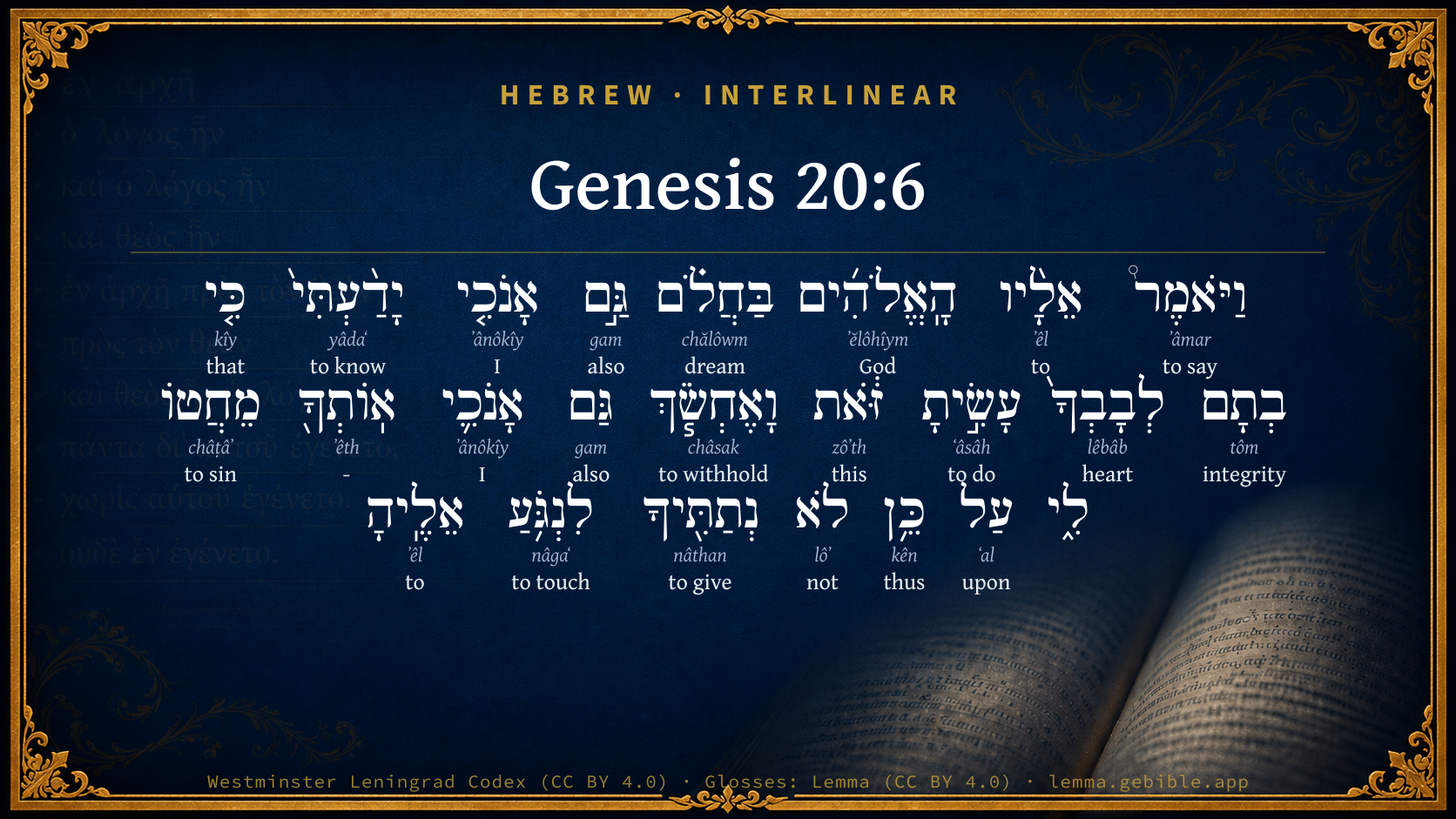
Hebrew (Westminster Leningrad Codex) Genesis 20:6 appears in the Hebrew Old Testament. The text above is from the Westminster Leningrad Codex. Each word links to its Strong’s number, a concise gloss, and parsing drawn from the Open Scriptures Hebrew Bible morphology. Click any word for its full Brown-Driver-Briggs (BDB) entry.
Download image
Cite this verse

Genesis 20:6 (World English Bible). Public Domain. Lemma interlinear Bible study tool, https://lemma.gebible.app/v/genesis/20/6.

Show BibTeX & RIS
BibTeX
RIS
English Translation
God said to him in the dream, "Yes, I know that in the integrity of your heart you have done this, and I also withheld you from sinning against me. Therefore I didn't allow you to touch her.
World English Bible · Public Domain
Highlights
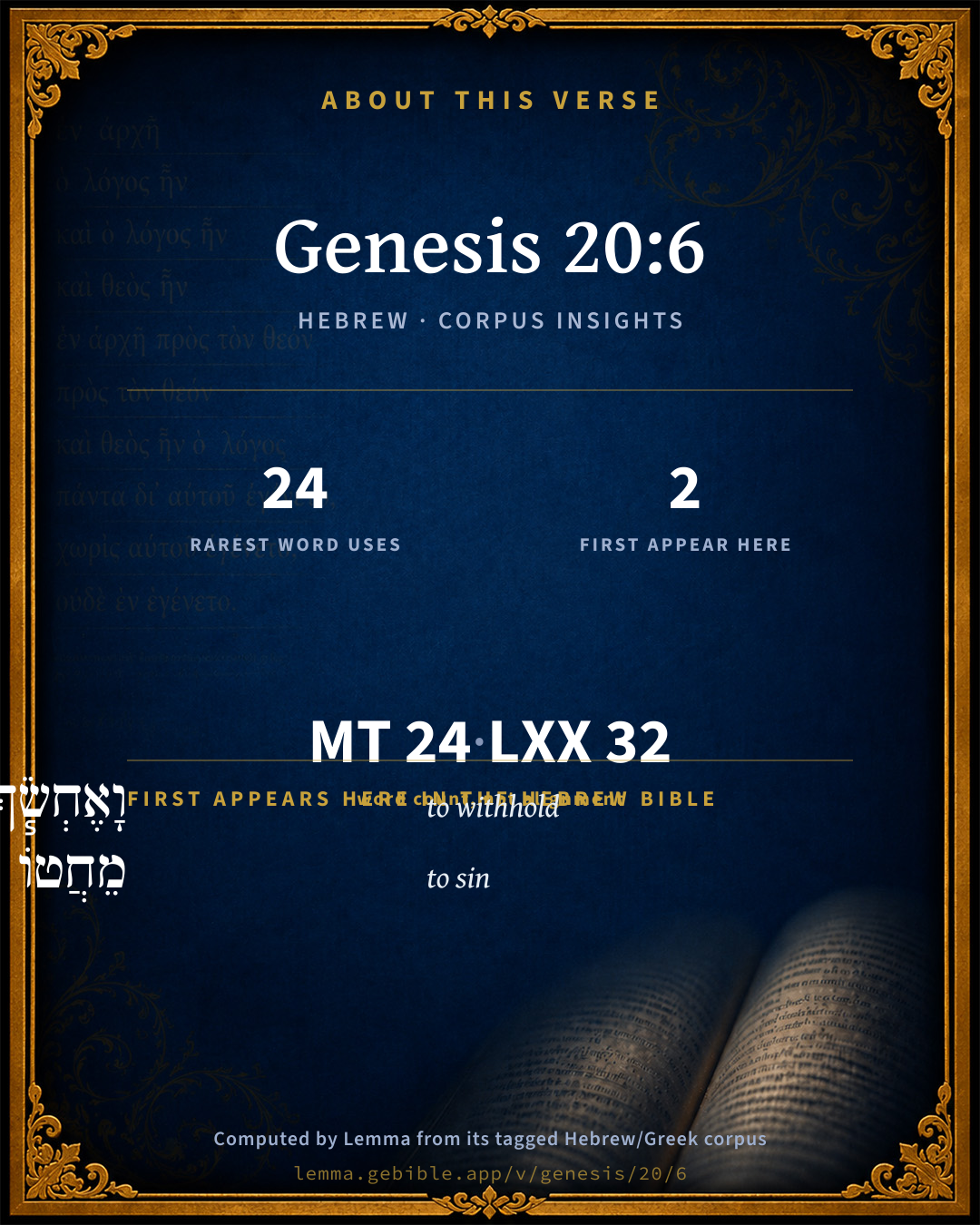
  • 2 first appearances in the Hebrew Bible
Full analysis ↓
Download a study sheet

One document with this verse’s original text, its word-by-word gloss line, the meaning frame, cross-references with their text, attributed commentary, and full source and license credits — printable, and it pastes into notes with its structure intact.

This verse Autodidact and up

Study sheet (.html) Plain text (.txt)

A passage Seminary Student

Up to 50 verses in one chapter. A passage sheet keeps up to 6 commentary sources and 12 cross-references per verse, in the order this page ranks them, and says so on the sheet whenever that leaves anything out. Ask for a single verse and you get the Autodidact verse sheet above.

Everything on this page stays free to read, with no account — the sheet is a download of what is already on screen, not access to it.

Want to remove ads? Support Godless Engineer
Compare translations 3

The same verse in 3 English versions, stacked beneath the original-language interlinear above. Click any original word for its lexicon entry.

Each is an independent rendering of the whole verse — the interlinear is not word-aligned to these translations.

Highlighted words mark where these versions differ — a whole-verse word diff, not a word-by-word alignment.

  • World English Bible Public Domain
    God said to him in the dream, "Yes, I know that in the integrity of your heart you have done this, and I also withheld you from sinning against me. Therefore I didn't allow you to touch her.
  • King James Version Public Domain
    And God said unto him in a dream, Yea, I know that thou didst this in the integrity of thy heart; for I also withheld thee from sinning against me: therefore suffered I thee not to touch her.
  • unfoldingWord Literal Text CC BY-SA 4.0
    Then God said to him in the dream, “Yes, I know that in the integrity of your heart you did this, and indeed I kept you from sinning against me. For that I did not allow you to touch her.

unfoldingWord Literal Text — © unfoldingWord, licensed CC BY-SA 4.0. Word-aligned USFM3 via Door43 (git.door43.org/unfoldingWord/en_ult).

Versions to compare (up to 4)

3 of 4 selected

Show all 18 translations

Every available English version of this verse, each an independent rendering of the whole verse.

  • World English Bible Public Domain
    God said to him in the dream, "Yes, I know that in the integrity of your heart you have done this, and I also withheld you from sinning against me. Therefore I didn't allow you to touch her.
  • Berean Standard Bible Public Domain
    Then God said to Abimelech in the dream, “Yes, I know that you did this with a clear conscience, and so I have kept you from sinning against Me. That is why I did not let you touch her.
  • Majority Standard Bible Public Domain
    Then God said to Abimelech in the dream, “Yes, I know that you did this with a clear conscience, and so I have kept you from sinning against Me. That is why I did not let you touch her.
  • King James Version Public Domain
    And God said unto him in a dream, Yea, I know that thou didst this in the integrity of thy heart; for I also withheld thee from sinning against me: therefore suffered I thee not to touch her.
  • American Standard Version (1901) Public Domain
    And God said unto him in the dream, Yea, I know that in the integrity of thy heart thou has done this, and I also withheld thee from sinning against me. Therefore suffered I thee not to touch her.
  • Revised Version (1885) Public Domain
    And God said unto him in the dream, Yea, I know that in the integrity of thy heart thou hast done this, and I also withheld thee from sinning against me: therefore suffered I thee not to touch her.
  • Geneva Bible (1599) Public Domain
    And God saide vnto him by a dreame, I knowe that thou diddest this euen with an vpright minde, and I kept thee also that thou shouldest not sinne against me: therefore suffered I thee not to touche her.
  • Douay-Rheims (1899) Public Domain
    And God said to him: And I know that thou didst it with a sincere heart: and therefore I withheld thee from sinning against me, and I suffered thee not to touch her.
  • Young's Literal Translation Public Domain
    And God saith unto him in the dream, `Yea, I -- I have known that in the integrity of thy heart thou hast done this, and I withhold thee, even I, from sinning against Me, therefore I have not suffered thee to come against her;
  • Literal Standard Version CC BY-SA 4.0
    And God says to him in the dream, “Indeed, I have known that in the integrity of your heart you have done this, and I withhold you, even I, from sinning against Me, therefore I have not permitted you to come against her;
  • Unlocked Literal Bible CC BY-SA 4.0
    Then God said to him in the dream, “Yes, I also know that in the integrity of your heart you did this, and I also kept you from sinning against me. Therefore I did not allow you to touch her.
  • unfoldingWord Literal Text CC BY-SA 4.0
    Then God said to him in the dream, “Yes, I know that in the integrity of your heart you did this, and indeed I kept you from sinning against me. For that I did not allow you to touch her.
  • Darby Bible Public Domain
    And God said to him in a dream, I also knew that thou didst this in the integrity of thy heart, and I, too, have withheld thee from sinning against me: therefore have I not suffered thee to touch her.
  • World Messianic Bible Public Domain
    God said to him in the dream, “Yes, I know that in the integrity of your heart you have done this, and I also withheld you from sinning against me. Therefore I didn’t allow you to touch her.
  • Webster's Bible Public Domain
    And God said to him in a dream, Yea, I know that thou didst this in the integrity of thy heart; for I also withheld thee from sinning against me: therefore I suffered thee not to touch her.
  • Free Bible Version CC BY-SA 4.0
    God told him in the dream, “Yes, I know you did this in all innocence, so I prevented you from sinning against me. That's why I didn't let you touch her.
  • Bible in Basic English Public Domain
    And God said to him in the dream, I see that you have done this with an upright heart, and I have kept you from sinning against me: for this reason I did not let you come near her.
  • JPS Tanakh (1917) Public Domain
    And God said unto him in the dream: 'Yea, I know that in the simplicity of thy heart thou hast done this, and I also withheld thee from sinning against Me. Therefore suffered I thee not to touch her.

Literal Standard Version (2020), Covenant Press — licensed CC BY-SA 4.0. Text via the HelloAO Bible API (eBible.org). Unlocked Literal Bible (unfoldingWord) — licensed CC BY-SA 4.0. Text via the HelloAO Bible API (eBible.org). unfoldingWord Literal Text — © unfoldingWord, licensed CC BY-SA 4.0. Word-aligned USFM3 via Door43 (git.door43.org/unfoldingWord/en_ult). Free Bible Version, Dr. Jonathan Gallagher — licensed CC BY-SA 4.0. Text via the HelloAO Bible API (eBible.org).

Word by word

More ways to search: Search by grammar → Find every occurrence → Compare this word →

Practice this passage: Drill this verse → Learn its vocabulary →

בְתָם
tôm
H8537
“in/at · integrity of”
Preposition + Noun, Common, Masculine, Singular, Construct
Part of Speech
Preposition + Noun
Type
Common
Gender
Masculine
Number
Singular
State
Construct
Full BDB Definition

Origin: from H8552

TWOT: 2522a

integrity, completeness - completeness, fulness - innocence, simplicity - integrity
  1. וַיֹּאמֶר֩ ʼâmar H559 “and · to say” Conjunction + Verb, Qal, Sequential Imperfect, 3rd Person, Masculine, Singular
  2. אֵלָ֨יו ʼêl H413 “to · him” Preposition + Suffix, Personal, 3rd Person, Masculine, Singular
  3. הָֽאֱלֹהִ֜ים ʼĕlôhîym H430 “the · God(s)” Particle, Definite Article + Noun, Common, Masculine, Plural, Absolute
  4. בַּחֲלֹ֗ם chălôwm H2472 “in/at · dream” Preposition + Noun, Common, Masculine, Singular, Absolute
  5. גַּ֣ם gam H1571 “also” Particle, Accusative
  6. אָנֹכִ֤י ʼânôkîy H595 “I” Pronoun, Personal, 1st Person, Common, Singular
  7. יָדַ֨עְתִּי֙ yâdaʻ H3045 “to know” Verb, Qal, Perfect, 1st Person, Common, Singular
  8. כִּ֤י kîy H3588 “that” Conjunction
  9. לְבָבְךָ֙ lêbâb H3824 “heart · your” Noun, Common, Masculine, Singular, Construct + Suffix, Personal, 2nd Person, Masculine, Singular
  10. עָשִׂ֣יתָ ʻâsâh H6213 “to do” Verb, Qal, Perfect, 2nd Person, Masculine, Singular
  11. זֹּ֔את zôʼth H2063 “this” Pronoun, Demonstrative, Feminine, Singular
  12. וָאֶחְשֹׂ֧ךְ châsak H2820 “and · to withhold” Conjunction + Verb, Qal, Sequential Imperfect, 1st Person, Common, Singular
  13. גַּם gam H1571 “also” Particle, Accusative
  14. אָנֹכִ֛י ʼânôkîy H595 “I” Pronoun, Personal, 1st Person, Common, Singular
  15. אֽוֹתְךָ֖ ʼêth H853 “- · you” Particle, Direct Object + Suffix, Personal, 2nd Person, Masculine, Singular
  16. מֵחֲטוֹ châṭâʼ H2398 “from · to sin” Preposition + Verb, Qal, Infinitive Construct
  17. עַל ʻal H5921 “upon” Preposition
  18. כֵּ֥ן kên H3651 “thus” Particle, Demonstrative
  19. לֹא lôʼ H3808 “not” Particle, Negative
  20. נְתַתִּ֖יךָ nâthan H5414 “to give · you” Verb, Qal, Perfect, 1st Person, Common, Singular + Suffix, Personal, 2nd Person, Masculine, Singular
  21. לִנְגֹּ֥עַ nâgaʻ H5060 “to touch” Preposition + Verb, Qal, Infinitive Construct
  22. אֵלֶֽיהָ ʼêl H413 “to · her” Preposition + Suffix, Personal, 3rd Person, Feminine, Singular

About this verse

These counts appear in no published source. They are computed here, from the morphology-tagged text and Lemma’s own curated glosses. What Lemma adds →

24
words
20
distinct lemmas
Pentateuch
section

Notable vocabulary

The rarest word here is בְתָם integrity H8537 — appearing just 24 times in the whole Hebrew Bible.

First appearance in Scripture

These words make their first canonical appearance in the Hebrew Bible here:

  • וָאֶחְשֹׂ֧ךְ to withhold H2820
  • מֵחֲטוֹ to sin H2398

Shared distinctive vocabulary

בְתָם integrity H8537 occurs in 24 verses of the Hebrew Bible. Also found in:

Grammatical profile

  • 7 verbs
  • 4 nouns
  • 3 pronouns
  • 4 prepositions
  • 1 conjunction
  • 5 particles

Verb forms

  • וַיֹּאמֶר֩ Qal · Sequential Imperfect
  • יָדַ֨עְתִּי֙ Qal · Perfect
  • עָשִׂ֣יתָ Qal · Perfect
  • וָאֶחְשֹׂ֧ךְ Qal · Sequential Imperfect
  • מֵחֲטוֹ Qal · Infinitive Construct
  • נְתַתִּ֖יךָ Qal · Perfect
  • לִנְגֹּ֥עַ Qal · Infinitive Construct

Repetition

Words recur within this verse — often emphatic in Hebrew:

  • גַּ֣ם also H1571 ×2
  • אֵלָ֨יו to H413 ×2
  • אָנֹכִ֤י I H595 ×2

Hebrew & Septuagint length

In English translation the verse runs 38 words from the Hebrew and 38 from the Septuagint (LXX English) — the same length.

A rough comparison of the two English renderings, which tokenize alike — not a word-level alignment.

Word counts can differ between the Hebrew and the Greek without any difference in meaning — e.g. the Hebrew direct-object marker אֵת has no separate Greek word, and Greek often adds the article ὁ.

In the original languages it is 24 Hebrew tokens and 32 Greek tokens — but the two are counted differently (Hebrew bundles its prefixes and suffixes into one token; the Greek is in lemma form), so that isn’t a like-for-like length.

Cross-references

19

Topical passages linked to Genesis 20:6 in the Treasury of Scripture Knowledge — connected by theme and wording, ordered by reader-vote popularity; previews shown in the World English Bible.

  • 1 Samuel 25:34 For in very deed, as Yahweh, the God of Israel, lives, who has withheld me from hurting you, except you had hurried and come to meet me, surely there wouldn't have been left to Nabal by the morning light so much as one man-child.
  • 1 Samuel 25:26 Now therefore, my lord, as Yahweh lives, and as your soul lives, seeing Yahweh has withheld you from blood guiltiness, and from avenging yourself with your own hand, now therefore let your enemies, and those who seek evil to my lord, be as Nabal.
  • Proverbs 21:1 The king's heart is in Yahweh's hand like the watercourses. He turns it wherever he desires.
  • Genesis 31:7 Your father has deceived me, and changed my wages ten times, but God didn't allow him to hurt me.
  • Genesis 35:5 They traveled: and a terror of God was on the cities that were round about them, and they didn't pursue the sons of Jacob.
  • Exodus 34:24 For I will drive out nations before you and enlarge your borders; neither shall any man desire your land when you go up to appear before Yahweh, your God, three times in the year.
  • Psalms 84:11 For Yahweh God is a sun and a shield. Yahweh will give grace and glory. He withholds no good thing from those who walk blamelessly.
  • 2 Thessalonians 2:7 For the mystery of lawlessness already works. Only there is one who restrains now, until he is taken out of the way.
  • Genesis 20:18 For Yahweh had closed up tight all the wombs of the house of Abimelech, because of Sarah, Abraham's wife.
  • Genesis 39:9 He isn't greater in this house than I, neither has he kept back anything from me but you, because you are his wife. How then can I do this great wickedness, and sin against God?"
  • Psalms 51:4 Against you, and you only, have I sinned, And done that which is evil in your sight; That you may be proved right when you speak, And justified when you judge.
  • Psalms 81:12 So I let them go after the stubbornness of their hearts, That they might walk in their own counsels.
  • 2 Corinthians 6:17 Therefore, "'Come out from among them, And be separate,' says the Lord, 'Touch no unclean thing. I will receive you.
  • Leviticus 6:2 "If anyone sins, and commits a trespass against Yahweh, and deals falsely with his neighbor in a matter of deposit, or of bargain, or of robbery, or has oppressed his neighbor,
  • Hosea 2:6–7 Therefore, behold, I will hedge up your way with thorns, And I will build a wall against her, That she can't find her way.
  • 1 Corinthians 7:1 Now concerning the things about which you wrote to me: it is good for a man not to touch a woman.
  • 2 Thessalonians 2:11 Because of this, God sends them a working of error, that they should believe a lie;
  • Genesis 3:3 but of the fruit of the tree which is in the midst of the garden, God has said, 'You shall not eat of it, neither shall you touch it, lest you die.'"
  • Genesis 26:11 Abimelech charged all the people, saying, "He who touches this man or his wife will surely be put to death."

Cross-references courtesy of OpenBible.info (CC BY 4.0).

Hebrew and Greek witnesses Masoretic Hebrew ↔ Greek Septuagint

The same verse in the two great witnesses to the Old Testament, shown verse-for-verse.

These are two independent witnesses, not word-aligned to each other, and the Septuagint is shown in lemma (dictionary) form.

Hebrew Genesis 20:6 Masoretic · Westminster Leningrad Codex

וַיֹּאמֶר֩ אֵלָ֨יו הָֽאֱלֹהִ֜ים בַּחֲלֹ֗ם גַּ֣ם אָנֹכִ֤י יָדַ֨עְתִּי֙ כִּ֤י בְתָם לְבָבְךָ֙ עָשִׂ֣יתָ זֹּ֔את וָאֶחְשֹׂ֧ךְ גַּם אָנֹכִ֛י אֽוֹתְךָ֖ מֵחֲטוֹ לִ֑י עַל כֵּ֥ן לֹא נְתַתִּ֖יךָ לִנְגֹּ֥עַ אֵלֶֽיהָ

God said to him in the dream, "Yes, I know that in the integrity of your heart you have done this, and I also withheld you from sinning against me. Therefore I didn't allow you to touch her.

World English Bible · Public Domain

Greek LXX Genesis 20:6 Septuagint · lemma form

εἶπον δέ αὐτός ὁ θεός κατά ὕπνος καΐἐγώ γιγνώσκω ὅτι ἐν καθαρός καρδία ποιέω οὗτος καί φείδομαι ἐγώ σύ ὁ μή ἁμαρτάνω σύ εἰς ἐγώ ἕνεκεν οὗτος οὐ ἀποἵημι σύ ἅπτομαι αὐτός

And God said to him in sleep, Yes, I knew that you did this with a pure heart, and I spared you, so that you should not sin against me, therefore I suffered you not to touch her.

LXX2012 (modern English Septuagint) · Public Domain

Hebrew: Westminster Leningrad Codex (CC BY 4.0). Greek: Septuagint (public domain); English from LXX2012 (modern English Septuagint) (Public Domain). How the Septuagint differs from the Hebrew →

Targum (Aramaic paraphrase)

2

The Targum is the ancient Jewish Aramaic paraphrase of the Hebrew Scriptures — an interpretive translation, not the Hebrew text itself. Onkelos (literal) and Pseudo-Jonathan (expansive) render the Torah, and Jonathan the Prophets. Coverage is partial: where no permissively-licensed English translation exists for a verse, only the Aramaic is shown. This is verse-level text, not a word-by-word alignment to the Hebrew.

  1. Targum Onkelos Torah (Genesis–Deuteronomy)
    וַאֲמַר לֵהּ מֵימַר מִן קֳדָם יְיָ בְּחֶלְמָא אַף קֳדָמַי גְּלִי אֲרֵי בְּקַשִּׁיטוּת לִבָּךְ עֲבַדְתָּ דָּא וּמְנָעִית אַף אֲנָא יָתָךְ מִלְּמֶחְטֵי קֳדָמָי עַל כֵּן לָא שְׁבָקְתָּךְ לְמִקְרַב לְוָתַהּ

    (no public-domain English translation for this verse)

    Targum Onkelos — Aramaic: “Onkelos Genesis” (public domain); “Onkelos Exodus” (public domain); “Onkelos Leviticus” (public domain); “Onkelos Numbers” (public domain); “Onkelos Deuteronomy” (public domain). English: “Sefaria Community Translation” (CC0 1.0 (public-domain dedication)); “J.W. Etheridge. The Targums of Onkelos and Jonathan Ben Uzziel on the Pentateuch. London: Longmans, Green, 1862” (public domain). Text via Sefaria.

  2. Targum Pseudo-Jonathan Torah (Genesis–Deuteronomy)
    וַאֲמַר לֵיהּ מֵימְרָא דַיְיָ בְּחֵילְמָא אוּף קֳדָמַי גְלֵי אֲרוּם בְּקַשִׁיטוּת לְבָבֵךְ עָבַדְתְּ דָא וּמְנָעִית אוּף אֲנָא מִלְמֶחֱטֵי קֳדָמַי בְּגִין כֵּן לָא שְׁבַקְתִּיךְ לְמִקְרַב לְגַבָּהּ

    And the Word of the Lord said to him in a dream, Before Me also it is manifest that in the truthfulness of thy heart thou didst this, and so restrained I thee from sinning before Me; therefore I would not permit thee to come near her.

    Targum Pseudo-Jonathan — Aramaic: “Targum Jonathan on Genesis” (public domain); “Targum Jonathan on Exodus” (public domain); “Targum Jonathan on Leviticus” (public domain); “Targum Jonathan on Numbers” (public domain); “Targum Jonathan on Deuteronomy” (public domain). English: “The Targum of Jonathan ben Uzziel, trans. J. W. Etheridge, London, 1862” (public domain). Text via Sefaria.

Commentary

Notes on Genesis 20:6 from classic Christian and Jewish commentators (each source and its license shown beneath its notes). The classic Christian expositions comment on the surrounding passage and are grouped to its opening verse, so a note may address several verses; the Jewish commentaries on the Tanakh (Rashi and others) are per-verse, so they appear only where the commentator wrote on this verse.

Lemma curates 59 commentaries, every one of them public domain or Creative Commons licensed, each selected and text-cleaned for this edition rather than reprinted as found. About our sources →

Trapp's Complete Commentary

John Trapp

Gen 20:6 And God said unto him in a dream, Yea, I know that thou didst this in the integrity of thy heart; for I also withheld thee from sinning against me: therefore suffered I thee not to touch her.

Ver. 6. Yea, I know that thou didst this, &c.] God takes his excuse, and yet chastiseth him; to teach us, saith Calvin (in loco), Non prorsus vacare culpa qui humano modo puri sunt . He can find flaws in that for which we may look for thanks. This makes Nehemiah crave pardon of his zealous reformations; and David cries out, "Enter not into judgment," &c. {Psa 143:2} Sordet in conspectu iudicis, quod fulget in conspectu operantis , saith Gregory. "Ye are they that justify yourselves before men," saith Christ to the Pharisees; "but God knoweth your hearts: for that which is highly esteemed among men is abomination in the sight of God". {Luk 16:15} A thing which I see in the night may shine, and that shining proceed from nothing but rottenness. "But be not deceived," or if ye be, yet "God is not mocked". {Gal 6:7} When he comes to turn the bottom of the bag upwards - as the steward did Benjamin’s - all our secret thefts will out, all our collusions come to light {a} His law is a law of fire; {Deu 33:2} His tribunal, of fire; {Eze 1:27} His pleading with sinners, in flames of fire. {Isa 66:15-16} The trial of our work shall be by fire; {1Co 3:15} and before God, who is a consuming fire. {Heb 12:29} Happy are they that are here purged by that spirit of judgment, and burning. {Isa 4:4} These shall stand in judgment, yea, dwell with everlasting burnings. {Isa 33:14}

For I also withheld thee.] Either by sickness, as aforesaid, or by a spirit of restraint, "a gift" that God gives "to men, yea, to the rebellious also, that the Lord God might dwell among them" {Psa 68:18} in his religion and worshippers; which else the wicked would never suffer. Thus God chained up Laban, and made Saul to melt over David, &c. Now many take this poor counter (that is, I am not as some others are, so bad as the worst) and set it down for a thousand pounds. Our Saviour indeed is said to have "looked upon" the young Pharisee, and to have "loved him," {Mar 10:21} because he saw him to be a tame man, free from foul crimes, and fit to live in a commonwealth: but no otherwise than as we love pictures, which are pretty things to look on, and that is all they are good for. A better nature, if rested in, is but a beautiful abomination, a smooth way to hell. And yet, say what we can, this kind of men grow crooked and aged with good opinions of themselves, and can seldom or never be set straight again. They will trust in Moses; {Joh 5:45} and when they have sick fits, and qualms of conscience, lick themselves whole by their repentance, and so rest in it: which made Austin say, that repentance damneth more than sin. They seek not to be saved by the righteousness of faith neither see they any necessity of growing from faith to faith. No, they are set, they are as good as ever they mean to be; they that outstrip them are too forward, they that fall short of them are deeply censured.

{a} Sacco soluto apparuit argentum . - Ambrose.

John Trapp, A Commentary or Exposition upon All the Books of the Old and New Testament (1647–1656) — public domain. Text from a community e-Sword module.

Joseph Benson's Commentary

Gen 20:6. I withheld thee, &c. — It is God that restrains men from doing the ill they would do; it is not from him that there is sin, but it is from him that there is not more sin, either by his influence on men’s minds, checking their inclination to sin, or by his providence, taking away the opportunity of committing it. It is a great mercy to be hindered from sinning, which God must have the glory of, whoever is the instrument.

Joseph Benson's Commentary on the Old and New Testaments (1811–1818) — public domain. Text from a community e-Sword module.

Tyndale Open Study Notes

Tyndale Open Resources

20:6 Because Abimelech acted with a clear conscience, God kept him from sinning. God will graciously help those who try to do what is right. When people act with reverence toward God, God gives them more revelation and draws them into more specific faith (see Acts 10).

Tyndale Open Study Notes — © Tyndale Open Resources, licensed CC BY-SA 4.0. Text via the HelloAO Bible API.

Geneva Bible (1599)

Geneva Bible translators

God by his holy Spirit retaineth them that offend by ignorance, that they fall not into greater inconvenience.

Geneva Bible (1599) marginal notes — public domain. Text via Bolls.life.

John Calvin's Commentaries

6. Yea, I know that thou didst this in the integrity of thy heart. We infer from this answer of God, (as I have lately remarked,) that Abimelech did not testify falsely concerning his own integrity. Yet, while God allows that his excuse is true, He nevertheless chastises him. Let us hence learn, that even they who are pure, according to human judgment, are not entirely free from blame. For no error may be deemed so excusable, as to be without some deteriorating admixture. Wherefores it is not for any one to absolve himself by his own judgment; rather let us learn to bring all our conduct to the standard of God. For Solomon does not say in vain, that

‘the ways of men seem right to themselves, but the Lord pondereth the hearts,’ (Proverbs 21:2.)

But if even they who are unconscious to themselves of any evil, do not escape censure; what will be our condition, if we are held inwardly bound by our own conscience?

I also withheld thee. This declaration implies that God had respect, not only to Abraham, but also to the king. For because he had no intention of defiling another man’s wife, God had compassion on him. And it frequently happens, that the Spirit restrains, by his bridle, those who are gliding into error; just as, on the other hand, he drives those headlong, by infatuations and a spirit of stupor, who, with depraved affections and lusts, knowingly transgress. And as God brought to the heathen king, who had not been guilty of deliberate wickedness, a timely remedy, in order that his guilt should not be increased; so He proves himself daily to be the faithful guardian of his own people, to prevent them from rushing forward, from lighter faults to desperate crimes.

John Calvin's Commentaries (1540-1563) — public domain. Text from the Calvin Translation Society English edition (1840s-50s) via the Christian Classics Ethereal Library (ccel.org). Calvin's coverage is partial (roughly two-thirds of the Bible); uncommented books and verses are honest gaps, never fabricated. The 19th-century editor's footnotes and remarks are omitted so the notes are faithfully Calvin's own voice.

The Cambridge Bible for Schools and Colleges

gen. ed. J. J. S. Perowne

6. from sinning against me] The violation of moral law is sin against God.

suffered I thee not] The explanation of this sentence is supplied in Gen_20:17.

The Cambridge Bible for Schools and Colleges (gen. ed. J. J. S. Perowne; Cambridge University Press, 1878–1918) — public domain. Text from a community e-Sword module.

John Gill's Exposition

And God said unto him in a dream,.... The same dream continued:

yea, or "also"

I know that thou didst this in the integrity of thy heart; not only thou knowest, but I, who know all things, know and acknowledge that this was so done by thee. Abimelech's plea is admitted, and a very great testimony borne to his integrity in this matter; and throughout the whole account he appears to be a man of great honour and uprightness, especially in this affair, if not a good man:

for I also withheld thee from sinning against me; for had he committed adultery with her, it had been not only a sin against her, and against her husband, but against God being contrary to his will revealed in the minds of men by the law and light of nature, before the law of Moses was given: and indeed all sin against the neighbour is ultimately against God, see Psa 51:4; and now from the commission of this sin God restrained Abimelech, either by some impulse upon his mind not to take her to be his wife as yet, or by throwing some thing or other in the way of it, in his providence, or by inflicting some disease upon him, which rendered him incapable of it, Gen 20:17,

therefore suffered I thee not to touch her; that is, to have carnal knowledge of her, see Co1 7:1; as there is nothing done but what is done by divine permission, so many more evils would be committed than there are, were it not that men are restrained from them by the power and providence of God, not suffering them to do them; and in particular this sin was prevented, that it might not in any respect be a doubtful point whether Isaac, whom Sarah had now conceived, was a legitimate son of Abraham; and these expressions of Abimelech not coming near her, Gen 20:4; and not touching her as here, are used for that purpose.

John Gill's Exposition of the Whole Bible (1746–1763) — public domain (CC PDM 1.0). Text via the HelloAO Bible API.

Haydock's Catholic Bible Commentary

Sincere heart, abhorring adultery, but not altogether innocent. (Menochius)

George Leo Haydock (1774–1849), Haydock's Catholic Family Bible and Commentary, 1859 edition — public domain. Excludes Psalms (Douay-Rheims chapter numbering differs from Protestant) and Deuterocanonical books (Catholic canon only).

Matthew Poole's English Annotations

I know that thou didst not this knowingly and maliciously, but imprudently and inconsiderately, which is indeed an extenuation of thy sin, though not a total excuse. Compare 1Ki 9:4; 1Ch 29:1.

I also withheld thee, partly by my restraining grace, and partly by my powerful providence, and the plague mentioned Gen 20:17. Which plainly shows that ignorance is not always an excuse for sin. See Luk 12:48. This sin, though directly committed against Abraham and Sarah only, is said to be against God, as other such sins are, Gen 39:9; Psa 51:4, because it was against God’s command written in men’s minds, though not yet published by express word or writing; and against God’s honour; and that here in a particular manner, because it would have rendered Isaac’s original, and thereby God’s promise, doubtful.

Matthew Poole's English Annotations on the Holy Bible (1683–1685) — public domain. Text from a community e-Sword/MySword module.

Whedon's Commentary on the Bible

Daniel D. Whedon

6. In a dream — Repeated again from Gen_20:3. It would seem as if the dream had been broken by the emotion of Abimelech, and after a period of wakefulness he dreamed again, and God again revealed himself. “The prophetic dream of the night is generally closely connected with the moral reflections and longings of the day. It is in full agreement with the nature of dreams that the communication should be made in several acts, not in a single one. See chaps. 37 and 41, and Matthew 2.” — Lange.

Yea, I know — Or, I have known. Abimelech has not been without the knowledge and care of the true God, (האלהים, the Elohim,) who now accepts his plea, and adds:

I also withheld thee from sinning against me — God had overruled the whole matter. Comp. Gen_20:3-4; Gen_20:17-18, notes.

Daniel D. Whedon (gen. ed.), Commentary on the Old and New Testaments (1874–1909) — public domain. Text from a community e-Sword module.

The Pulpit Commentary

And God said unto him in a dream, is in full agreement with the nature of dreams that the communication should be made in several, and not in one single act; cf. Ge 37, and Ge 41; Mt 2." (Lange)Yea, I know that thou didst this in the integrity of thy hearti.e. judged from thy moral standpoint. The words do not imply a Divine acquittal as to the essential guiltiness of the act, which is clearly involved in the instruction to seek the mediation of God"s prophet (Ver. 7).

For I also withheld thee from sinning against me: therefore suffered I thee not to touch her (vide on Ver. 4).

The Pulpit Commentary (1880–1919), ed. H.D.M. Spence-Jones & Joseph S. Exell — public domain. Text from a community e-Sword module.

John Wesley's Explanatory Notes

I withheld thee from sinning against me - It is God that restrains men from doing the ill they would do; it is not from him that there is sin, but it is from him that there is not more sin, either by his influence on mens minds checking their inclination to sin, or by his providence taking away the opportunity. It is a great mercy to be hindered from committing sin, which God must have the glory of whoever is the instrument.

John Wesley, Explanatory Notes Upon the Whole Bible (1754–1765) — public domain. Text via the GEBible commentary corpus.

unfoldingWord translationNotes

Door43 World Missions Community

God said to him

"God said to Abimelech"

in the integrity of your heart you did this

Here "heart" stands for his thoughts or intentions. AT: "you did this with good intentions" or "you did this without evil intentions" (See: Metonymy)

to touch her

This is a euphemism for having sex with Sarah. AT: "to sleep with her" (See: Euphemism)

the man's wife

"Abraham's wife"

you will live

"I will let you live"

all who are yours

"all of your people"

translationWords

God

dream

heart

sin

prophet

pray

restore

unfoldingWord translationNotes — © Distant Shores Media and the Door43 World Missions Community, licensed CC BY-SA 4.0. Source: git.door43.org/Door43/en_tn.

Rashi

Rabbi Shlomo Yitzchaki (Rashi)

'ידעתי כי בתם לבבך וגו I KNOW THAT IN THE INTEGRITY OF THY HEART etc. — It is true that at first you had no intention of sinning, but you cannot claim innocency of hands (Genesis Rabbah 52:6) —

because לא נתתיך I PERMITTED THEE NOT — It was not of your own will that you did not touch her, but it was “I” who withheld you from sinning, and “I” did not permit you the possibility to touch her (Genesis Rabbah 52:7). Similar examples of נתן in sense of permitting are, (31:7) “God permitted him not (לא נתנו)” and (Judges 15:1) “But her father did not permit him (ולא נתנו) to go in”.

Rashi on the Tanakh — English translations: “The Judaica Press complete Tanach with Rashi, translated by A. J. Rosenberg” (CC BY 4.0); “Pentateuch with Rashi's commentary by M. Rosenbaum and A.M. Silbermann, 1929-1934” (public domain); “The Metsudah Tanach series, Lakewood, N.J” (CC BY 4.0); and “The Book of Joshua, Metsudah Publications, 1997” (CC BY 4.0). Text via Sefaria.

Radak

Rabbi David Kimhi (Radak)

ויאמר...בתם לבבךsignificantly, G’d did not add the words ובנקיון כפיך when acknowledging part of Avimelech’s complaint. The fact that Avimelech had not touched Sarah was evident, could be proved, whereas Avimelech’s intentions were private, could not be proved. Only G’d Himself would know if he spoke the truth.

מחטו לי, the sin would have been directed against G’d only if he had transgressed the laws not to sleep with someone else’s wife, a command issued to all the descendants of Noach. Even if G’d had not issued a specific command in this regard, common sense would dictate such a law in a civilised society. The One Who had provided man with intelligence certainly expects that we use our intelligence to legislate such basic laws without which life on earth would become intolerable, anarchic. We must view our common sense as a messenger from G’d, an instrument that acts as a protection against man experiencing all kinds of harm and problems in his life on earth. When man commits violence against his fellow man this reflects an absence of common sense, i.e. a failure to use one’s common sense, seeing that the end result will be the termination of life on earth. If this is the result of violence perpetrated in order to secure land or chattels, how much more so would such a process of civilisation’s disintegration be accelerated if everyone would go assaulting people physically and raping his neighbour’s wife?

מחטו, the letter ו instead of the letter א in this word substitutes for the letter ל in the requisite mode of the verb.

על כן לא נתתיך, as we explained already, this is a reference to G’d having made Avimelech impotent. By doing this, G’d had done Avimelech a great favour. The reason why G’d extended Himself on his behalf was because He knew that Avimelech had indeed believed that Sarah was unattached. G’d did not want that Avimelech would become a sinner in regard to the wife of the prophet Avraham. Even though, granted that in the final analysis G’d intervened due to Avraham and Sarah being the potential victims, He could have saved Sarah from Avimelech’s clutches by a variety of other means. Seeing that Pharaoh’s thoughts at the time when Sarah was under his control were quite different from those of Avimelech, G’d had subjected Pharaoh and his household to a number of painful physical afflictions instead of appearing to him in a dream. The inhibitions G’d imposed on the entourage of Avimelech were temporary and left no permanent negative effect.

לנגע אליה, even touching her without engaging in sexual intercourse. G’d had removed any desire from Avimelech to have physical contact with Sarah.

Radak on the Tanakh — English translations: “Sefaria Community Translation” (CC0 1.0 (public-domain dedication)); “Eliyahu Munk, HaChut Hameshulash” (CC BY 4.0); “Rabbi Mike Feuer, Jerusalem Anthology” (CC BY 4.0); and “R. David Kimhi on the first book of Psalms, Translated by R.G. Finch, London, 1919” (public domain). Text via Sefaria.

Lesson kit

Teaching starters — assembled from the data on this page, not authored interpretation. Every prompt links to the verse data it draws on. Edit before teaching.

Genesis, in the Pentateuch, opens this verse with 24 words (20 distinct Hebrew lemmas). Its most distinctive word is tôm (“integrity”). A historical commentator’s framing appears above. Read the whole chapter for the surrounding context.

Discussion questions

  1. How does “integrity” (tôm) shape what this verse is saying?
  2. 2 words here appear for the first time in Scripture. What is being introduced at this debut?
  3. Genesis 20:5 shares the word «integrity» with this verse. How do the two illuminate each other?
  4. “also” occurs 2× in this one verse. What is the effect of the repetition?
  5. The translations on this page render this verse differently — a whole-verse word diff, not a word-by-word alignment. What might account for the different wordings?
  6. The verb «וַיֹּאמֶר֩» is Qal Sequential Imperfect. How does its form color the action?
  7. Reading how Trapp's Complete Commentary and Joseph Benson's Commentary read this verse, where do the two commentators agree and where do they part?

Things to notice

Reading settings

Reading text

Shown beneath each verse's original-language words.

Old Testament
Old Testament edition

Read the OT as the Masoretic Hebrew (MT) or the Greek Septuagint (LXX).

English shown for the Greek Septuagint (in the Hebrew ↔ Greek comparison).

Comparing translations? Open the Compare panel on any verse page to stack up to four side by side.