
Esther 6:8

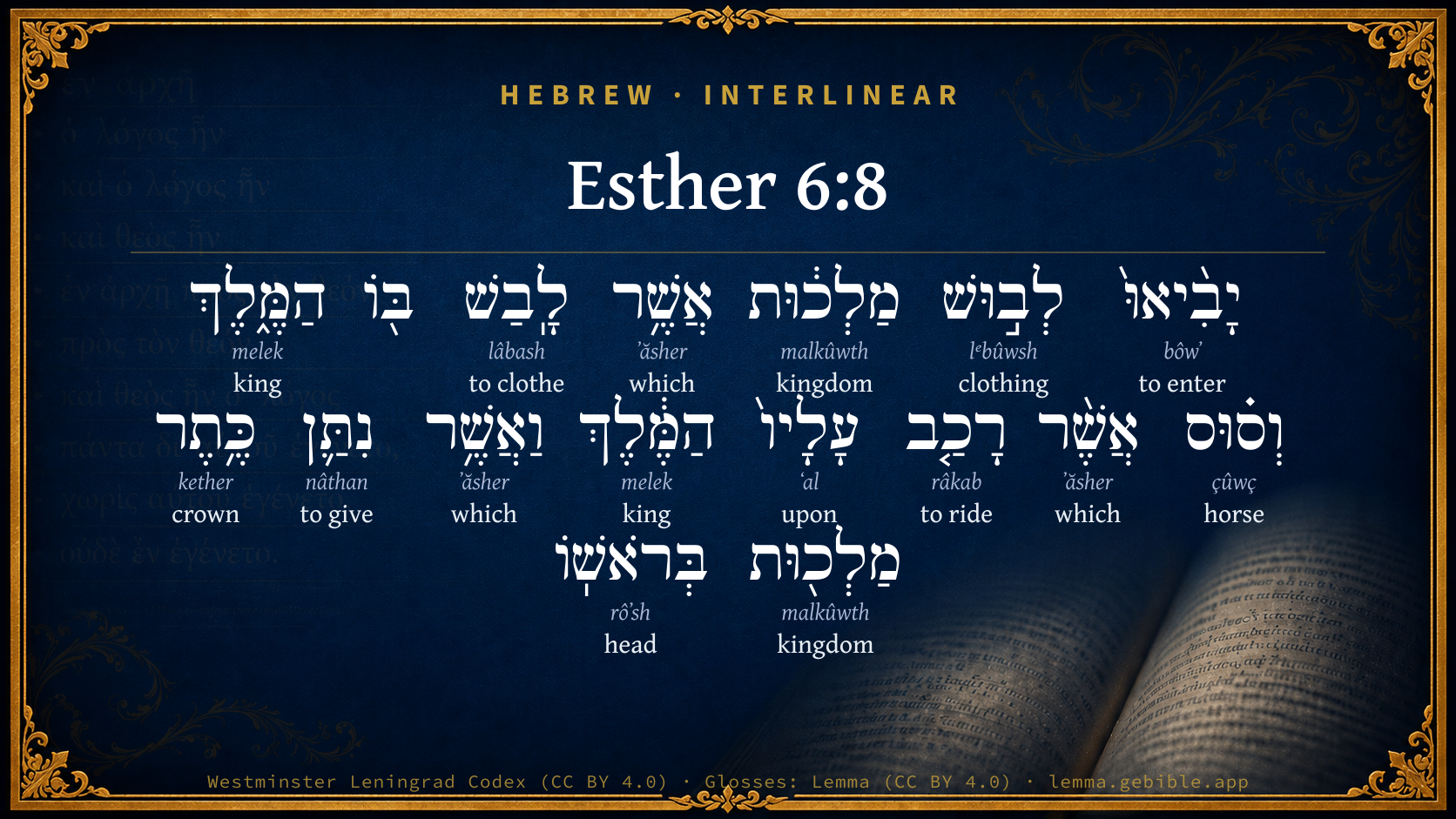
Hebrew (Westminster Leningrad Codex) Esther 6:8 appears in the Hebrew Old Testament. The text above is from the Westminster Leningrad Codex. Each word links to its Strong’s number, a concise gloss, and parsing drawn from the Open Scriptures Hebrew Bible morphology. Click any word for its full Brown-Driver-Briggs (BDB) entry.
Download image
Cite this verse

Esther 6:8 (World English Bible). Public Domain. Lemma interlinear Bible study tool, https://lemma.gebible.app/v/esther/6/8.

Show BibTeX & RIS
BibTeX
RIS
English Translation
let royal clothing be brought which the king uses to wear, and the horse that the king rides on, and on the head of which a crown royal is set:
World English Bible · Public Domain
Download a study sheet

One document with this verse’s original text, its word-by-word gloss line, the meaning frame, cross-references with their text, attributed commentary, and full source and license credits — printable, and it pastes into notes with its structure intact.

This verse Autodidact and up

Study sheet (.html) Plain text (.txt)

A passage Seminary Student

Up to 50 verses in one chapter. A passage sheet keeps up to 6 commentary sources and 12 cross-references per verse, in the order this page ranks them, and says so on the sheet whenever that leaves anything out. Ask for a single verse and you get the Autodidact verse sheet above.

Everything on this page stays free to read, with no account — the sheet is a download of what is already on screen, not access to it.

Want to remove ads? Support Godless Engineer
Compare translations 3

The same verse in 3 English versions, stacked beneath the original-language interlinear above. Click any original word for its lexicon entry.

Each is an independent rendering of the whole verse — the interlinear is not word-aligned to these translations.

Highlighted words mark where these versions differ — a whole-verse word diff, not a word-by-word alignment.

  • World English Bible Public Domain
    let royal clothing be brought which the king uses to wear, and the horse that the king rides on, and on the head of which a crown royal is set:
  • King James Version Public Domain
    Let the royal apparel be brought which the king useth to wear, and the horse that the king rideth upon, and the crown royal which is set upon his head:
  • unfoldingWord Literal Text CC BY-SA 4.0
    let them bring a garment of royalty with which the king has clothed himself, and a horse on which the king has ridden and which has been given a crown of royalty for its head.

unfoldingWord Literal Text — © unfoldingWord, licensed CC BY-SA 4.0. Word-aligned USFM3 via Door43 (git.door43.org/unfoldingWord/en_ult).

Versions to compare (up to 4)

3 of 4 selected

Show all 18 translations

Every available English version of this verse, each an independent rendering of the whole verse.

  • World English Bible Public Domain
    let royal clothing be brought which the king uses to wear, and the horse that the king rides on, and on the head of which a crown royal is set:
  • Berean Standard Bible Public Domain
    have them bring a royal robe that the king himself has worn and a horse on which the king himself has ridden—one with a royal crest placed on its head.
  • Majority Standard Bible Public Domain
    have them bring a royal robe that the king himself has worn and a horse on which the king himself has ridden—one with a royal crest placed on its head.
  • King James Version Public Domain
    Let the royal apparel be brought which the king useth to wear, and the horse that the king rideth upon, and the crown royal which is set upon his head:
  • American Standard Version (1901) Public Domain
    let royal apparel be brought which the king useth to wear, and the horse that the king rideth upon, and on the head of which a crown royal is set:
  • Revised Version (1885) Public Domain
    let royal apparel be brought which the king useth to wear, and the horse that the king rideth upon, and on the head of which a crown royal is set:
  • Geneva Bible (1599) Public Domain
    Let them bring for him royall apparell, which the King vseth to weare, and the horse that the King rideth vpon, and that the crowne royall may be set vpon his head.
  • Douay-Rheims (1899) Public Domain
    Ought to be clothed with the king's apparel, and to be set upon the horse that the king rideth upon, and to have the royal crown upon his head,
  • Young's Literal Translation Public Domain
    let them bring in royal clothing that the king hath put on himself, and a horse on which the king hath ridden, and that the royal crown be put on his head,
  • Literal Standard Version CC BY-SA 4.0
    let them bring in royal clothing that the king has put on himself, and a horse on which the king has ridden, and that the royal crown be put on his head,
  • Unlocked Literal Bible CC BY-SA 4.0
    let royal robes be brought, robes that the king has worn, and a horse that the king has ridden and on whose head is the royal crest.
  • unfoldingWord Literal Text CC BY-SA 4.0
    let them bring a garment of royalty with which the king has clothed himself, and a horse on which the king has ridden and which has been given a crown of royalty for its head.
  • Darby Bible Public Domain
    let the royal apparel be brought with which the king arrays himself, and the horse that the king rides upon, and on the head of which the royal crown is set;
  • World Messianic Bible Public Domain
    let royal clothing be brought which the king uses to wear, and the horse that the king rides on, and on the head of which a royal crown is set.
  • Webster's Bible Public Domain
    Let the royal apparel be brought which the king useth to wear, and the horse that the king rideth upon, and the crown royal which is set upon his head:
  • Free Bible Version CC BY-SA 4.0
    should be brought royal robes the king has worn, a horse the king has ridden and which has a royal headdress on its head.
  • Bible in Basic English Public Domain
    Let them take the robes which the king generally puts on, and the horse on which the king goes, and the crown which is on his head:
  • JPS Tanakh (1917) Public Domain
    let royal apparel be brought which the king useth to wear, and the horse that the king rideth upon, and on whose head a crown royal is set;

Literal Standard Version (2020), Covenant Press — licensed CC BY-SA 4.0. Text via the HelloAO Bible API (eBible.org). Unlocked Literal Bible (unfoldingWord) — licensed CC BY-SA 4.0. Text via the HelloAO Bible API (eBible.org). unfoldingWord Literal Text — © unfoldingWord, licensed CC BY-SA 4.0. Word-aligned USFM3 via Door43 (git.door43.org/unfoldingWord/en_ult). Free Bible Version, Dr. Jonathan Gallagher — licensed CC BY-SA 4.0. Text via the HelloAO Bible API (eBible.org).

Word by word

More ways to search: Search by grammar → Find every occurrence → Compare this word →

Practice this passage: Drill this verse → Learn its vocabulary →

כֶּ֥תֶר
kether
H3804
“crown of”
Noun, Common, Masculine, Singular, Construct
Part of Speech
Noun
Type
Common
Gender
Masculine
Number
Singular
State
Construct
Full BDB Definition

Origin: from H3803

TWOT: 1060a

crown
  1. יָבִ֨יאוּ֙ bôwʼ H935 “to enter” Verb, Hiphil, Imperfect, 3rd Person, Masculine, Plural
  2. לְב֣וּשׁ lᵉbûwsh H3830 “clothing of” Noun, Common, Masculine, Singular, Construct
  3. מַלְכ֔וּת malkûwth H4438 “kingdom” Noun, Common, Feminine, Singular, Absolute
  4. אֲשֶׁ֥ר ʼăsher H834 “which” Particle, Relative
  5. לָֽבַשׁ lâbash H3847 “to clothe” Verb, Qal, Perfect, 3rd Person, Masculine, Singular
  6. הַמֶּ֑לֶךְ melek H4428 “the · king” Particle, Definite Article + Noun, Common, Masculine, Singular, Absolute
  7. וְס֗וּס çûwç H5483 “and · horse” Conjunction + Noun, Common, Masculine, Singular, Absolute
  8. אֲשֶׁ֨ר ʼăsher H834 “which” Particle, Relative
  9. רָכַ֤ב râkab H7392 “to ride” Verb, Qal, Perfect, 3rd Person, Masculine, Singular
  10. עָלָיו֙ ʻal H5921 “upon · him” Preposition + Suffix, Personal, 3rd Person, Masculine, Singular
  11. הַמֶּ֔לֶךְ melek H4428 “the · king” Particle, Definite Article + Noun, Common, Masculine, Singular, Absolute
  12. וַאֲשֶׁ֥ר ʼăsher H834 “and · which” Conjunction + Particle, Relative
  13. נִתַּ֛ן nâthan H5414 “to give” Verb, Niphal, Perfect, 3rd Person, Masculine, Singular
  14. מַלְכ֖וּת malkûwth H4438 “kingdom” Noun, Common, Feminine, Singular, Absolute
  15. בְּרֹאשֽׁוֹ rôʼsh H7218 “in/at · head · his” Preposition + Noun, Common, Masculine, Singular, Construct + Suffix, Personal, 3rd Person, Masculine, Singular

About this verse

These counts appear in no published source. They are computed here, from the morphology-tagged text and Lemma’s own curated glosses. What Lemma adds →

17
words
12
distinct lemmas
Historical
section

Notable vocabulary

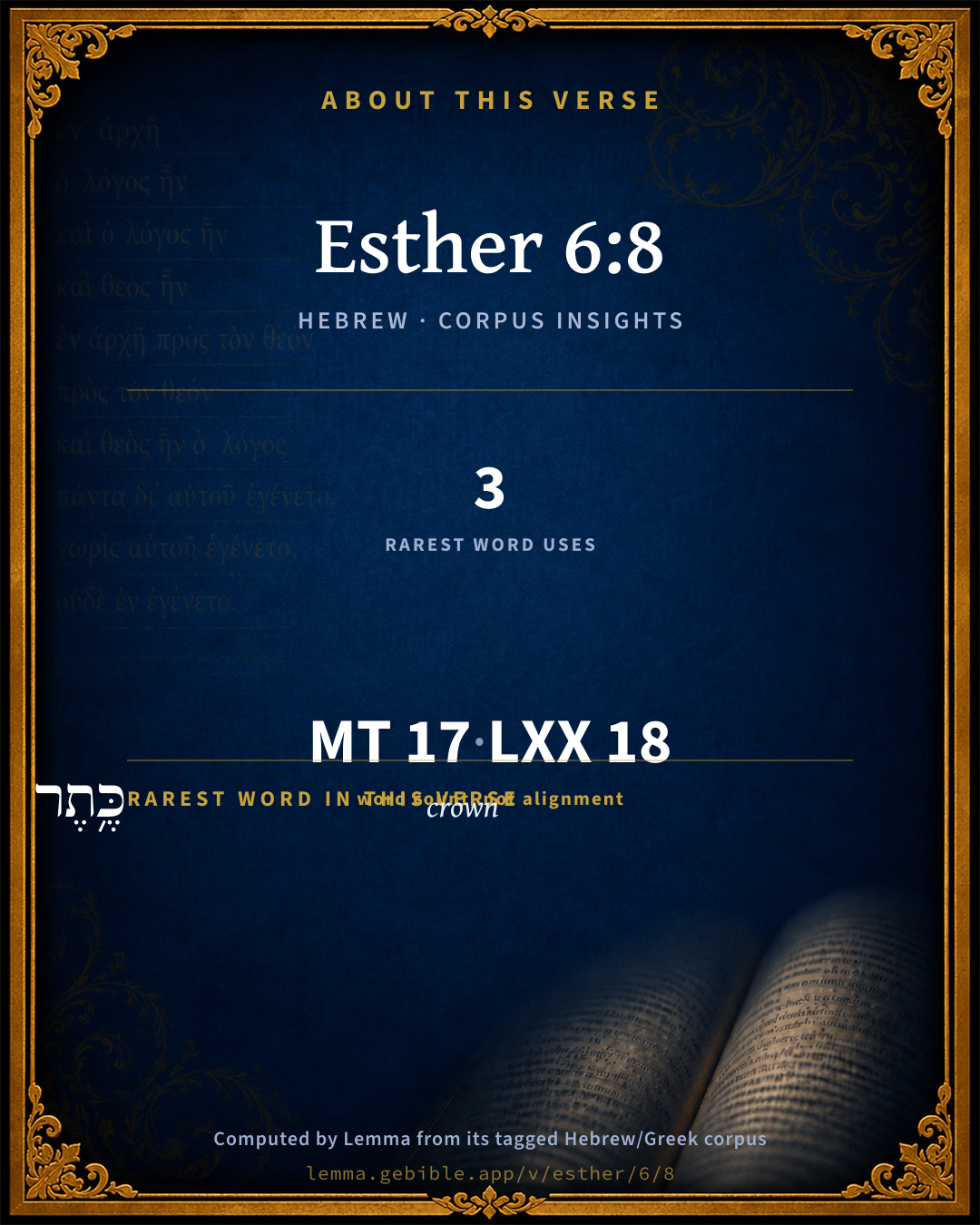
The rarest word here is כֶּ֥תֶר crown H3804 — appearing just 3 times in the whole Hebrew Bible.

Shared distinctive vocabulary

כֶּ֥תֶר crown H3804 occurs in 3 verses of the Hebrew Bible. Also found in:

Grammatical profile

  • 4 verbs
  • 8 nouns
  • 2 prepositions
  • 3 particles

Verb forms

  • יָבִ֨יאוּ֙ Hiphil · Imperfect
  • לָֽבַשׁ Qal · Perfect
  • רָכַ֤ב Qal · Perfect
  • נִתַּ֛ן Niphal · Perfect

Repetition

Words recur within this verse — often emphatic in Hebrew:

  • מַלְכ֔וּת kingdom H4438 ×2
  • הַמֶּ֑לֶךְ king H4428 ×2
  • אֲשֶׁ֥ר which H834 ×3

Hebrew & Septuagint length

In English translation the verse runs 30 words from the Hebrew and 23 from the Septuagint (LXX English) — closely comparable.

A rough comparison of the two English renderings, which tokenize alike — not a word-level alignment.

Word counts can differ between the Hebrew and the Greek without any difference in meaning — e.g. the Hebrew direct-object marker אֵת has no separate Greek word, and Greek often adds the article ὁ.

In the original languages it is 17 Hebrew tokens and 18 Greek tokens — but the two are counted differently (Hebrew bundles its prefixes and suffixes into one token; the Greek is in lemma form), so that isn’t a like-for-like length.

Cross-references

5

Topical passages linked to Esther 6:8 in the Treasury of Scripture Knowledge — connected by theme and wording, ordered by reader-vote popularity; previews shown in the World English Bible.

  • 1 Kings 1:33 The king said to them, Take with you the servants of your lord, and cause Solomon my son to ride on my own mule, and bring him down to Gihon:
  • 1 Samuel 18:4 Jonathan stripped himself of the robe that was on him, and gave it to David, and his clothing, even to his sword, and to his bow, and to his sash.
  • Esther 1:11 to bring Vashti the queen before the king with the crown royal, to show the peoples and the princes her beauty; for she was beautiful to look on.
  • Esther 2:17 The king loved Esther above all the women, and she obtained favor and kindness in his sight more than all the virgins; so that he set the royal crown on her head, and made her queen instead of Vashti.
  • Luke 15:22 "But the father said to his servants, 'Bring out the best robe, and put it on him. Put a ring on his hand, and shoes on his feet.

Cross-references courtesy of OpenBible.info (CC BY 4.0).

Hebrew and Greek witnesses Masoretic Hebrew ↔ Greek Septuagint

The same verse in the two great witnesses to the Old Testament, shown verse-for-verse.

These are two independent witnesses, not word-aligned to each other, and the Septuagint is shown in lemma (dictionary) form.

Hebrew Esther 6:8 Masoretic · Westminster Leningrad Codex

יָבִ֨יאוּ֙ לְב֣וּשׁ מַלְכ֔וּת אֲשֶׁ֥ר לָֽבַשׁ בּ֖וֹ הַמֶּ֑לֶךְ וְס֗וּס אֲשֶׁ֨ר רָכַ֤ב עָלָיו֙ הַמֶּ֔לֶךְ וַאֲשֶׁ֥ר נִתַּ֛ן כֶּ֥תֶר מַלְכ֖וּת בְּרֹאשֽׁוֹ

let royal clothing be brought which the king uses to wear, and the horse that the king rides on, and on the head of which a crown royal is set:

World English Bible · Public Domain

Greek LXX Esther 6:8 Septuagint · lemma form

φέρω ὁ παῖς ὁ βασιλεύς στολή βύσσινος ὅς ὁ βασιλεύς περιβάλλω καί ἵππος ἐπί ὅς ὁ βασιλεύς ἐπιβαίνω

let the king's servants bring the robe of fine linen which the king puts on, and the horse on which the king rides,

LXX2012 (modern English Septuagint) · Public Domain

Hebrew: Westminster Leningrad Codex (CC BY 4.0). Greek: Septuagint (public domain); English from LXX2012 (modern English Septuagint) (Public Domain). How the Septuagint differs from the Hebrew →

Commentary

Notes on Esther 6:8 from classic Christian and Jewish commentators (each source and its license shown beneath its notes). The classic Christian expositions comment on the surrounding passage and are grouped to its opening verse, so a note may address several verses; the Jewish commentaries on the Tanakh (Rashi and others) are per-verse, so they appear only where the commentator wrote on this verse.

Lemma curates 59 commentaries, every one of them public domain or Creative Commons licensed, each selected and text-cleaned for this edition rather than reprinted as found. About our sources →

Trapp's Complete Commentary

John Trapp

Est 6:8 Let the royal apparel be brought which the king [useth] to wear, and the horse that the king rideth upon, and the crown royal which is set upon his head:

Ver. 8. Let the royal apparel be brought, &c.] This was very glorious and gorgeous; as is to be seen in Xenophon, Plutarch, Lucian, Dion, Chrysostom, and other good authors. The Persian kings wore on their heads an upright tiara or turban very sumptuous; a diadem also made of white and purple colour. On their bodies a rich purple stole, or robe of state, reaching down to the heels; this Curtius calleth pallam Persicam, a Persian pall, beset with gold and precious stones great store, and the pictures of wild creatures and fowls of the air. Curtius, describing Xerxes’s royal apparel, saith that golden hawks, encountering one another with their beaks, adorned his robe made of cloth of gold. Besides, they wore a rich cassock (called candy) bound to them with a golden belt, breeches also of scarlet, reaching to their knees; called therefore by the Greeks Pερισκελης, as Jerome testifieth (Ep. ad Fabiol.).

And the horse that the king rideth upon] The king of Persia did always ride, either on horseback or in a chariot, and had one special horse proper to himself, as had also David, 1Ki 1:33, Alexander, Julius Caesar, &c. At this day the better sort in Persia fight, buy, sell, confer, and do all on horseback. The difference between the gentleman and the peasant is, that the peasant never rides, the gentleman never goes on foot.

And the crown royal which is set upon his head] This was monstrous ambition; appoint him the kingdom also, might Ahasuerus have said. Lyra noteth here, that Haman aspired to the kingdom, because none but the king could have the crown royal set upon his head; wherefore the king also in answering to the things propounded by him, saith, Take the robe and the horse, as thou hast said, but of the crown he maketh no mention. Some of the Hebrews by head here understand the horse’s head; Nam apud Persas solebat equus deferre diadema regni, the king’s horse was wont to carry the royal crown. Vatablus thinks this sense not unlikely, because the crown is not mentioned, Est 6:11; and this might also peradventure be the custom and fashion of Persia, saith Diodati. Merlin noteth here, that Haman maketh no mention of rewards or gifts to be conferred upon him, because he had wealth enough already, and desired only more honours, instancing the uttermost that could be done to any subject, in seeking whereof he miserably failed.

John Trapp, A Commentary or Exposition upon All the Books of the Old and New Testament (1647–1656) — public domain. Text from a community e-Sword module.

Geneva Bible (1599)

Geneva Bible translators

Meaning hereby that the king should make him next unto himself, as Joseph hereby was known to be next to Pharaoh, Gen. 41:41.

Geneva Bible (1599) marginal notes — public domain. Text via Bolls.life.

Jamieson, Fausset & Brown

Robert Jamieson, A. R. Fausset & David Brown

the royal apparel . . . which the king useth to wear--A coat which has been on the back of a king or prince is reckoned a most honorable gift, and is given with great ceremony.

the horse that the king rideth upon--Persia was a country of horses, and the highbred charger that the king rode upon acquired, in the eyes of his venal subjects, a sort of sacredness from that circumstance.

and the crown royal which is set upon his head--either the royal turban, or it may be a tiara, with which, on state processions, the horse's head was adorned.

Jamieson, Fausset & Brown — Commentary Critical and Explanatory on the Whole Bible (1871) — public domain (CC PDM 1.0). Text via the HelloAO Bible API.

Adam Clarke's Commentary

Verse 8. Let the royal apparel be brought] Pride and folly ever go hand in hand. What he asked would have been in any ordinary case against his own life: but he wished to reach the pinnacle of honour: never reflecting that the higher he rose, the more terrible would be his fall. The royal apparel was never worn but by the king: even when the king had lain them aside, it was death to put them on. The Targum has purple robes.

And the horse - and the crown royal] Interpreters are greatly divided whether what is called here the crown royal be not rather an ornament worn on the head of the horse, than what may be called the royal crown. The original may be understood both ways; and our version seems to favour the former opinion; but I think it more likely that the royal crown is meant; for why mention the ordinary trappings of the royal steed?

Adam Clarke's Commentary on the Bible (1810–1826) — public domain. Text from a community e-Sword/MySword module.

Ellicott's Commentary for English Readers

(8) Let the royal apparel be brought . . .—These exceedingly great distinctions Haman suggests, thinking with unaccountable vanity (for nothing is said or implied as to any service rendered by him to the king) that the king must necessarily have been referring to him, and in a moment he is irretrievably committed. Whether Hainan’s character had at its best estate much discretion, or whether he rose to his high position, not by the qualities that should commend a statesman to a king, but, like many another Eastern Vizier, had by flattery and base arts gained the royal favour, we cannot say; here he shows the lack of the most ordinary discretion, his vanity is so inordinate that he cannot see the possibility of any one’s merits save his own. The request which Haman made may be illustrated by the permission granted by Xerxes to his uncle Artabanus to put on the royal robes and sleep in the royal bed at Susa (Herod, vii. 15-17).

The horse that the king rideth upon.—Thus Pharaoh, desiring-to honour Joseph, made him ride in his own chariot (Gen_41:43): David, wishing to show that Solomon had really become king in his father’s lifetime, commands that he should ride on the king’s mule (1Ki_1:33; 1Ki_1:44).

And the crown royal which is set upon his head.—If we take the Hebrew here quite literally, the meaning must be and on whose (i.e., the horse’s) head a royal crown is set. The only objection to this view is, that there appears to be no evidence of such a custom among the Persians. Some render, and that a (or the: the Hebrew is necessarily ambiguous in such a case) royal crown be set, but this we consider does violence to the Hebrew. It must be noted that both the king in his reply, and the writer in describing what actually took place, make no mention of a crown as worn by Mordecai, nor does Haman in the following verse.

A Bible Commentary for English Readers, edited by Charles John Ellicott (1878–1897) — public domain. Text from a community e-Sword module.

The Cambridge Bible for Schools and Colleges

gen. ed. J. J. S. Perowne

8. royal apparel] The extent of the honour which Haman sought is illustrated by the story in Plutarch’s Lives (Artaxerxes, 5), where we are told that Tiribazus made a similar request; but in that case, though the king granted him a royal robe, he forbade him to wear it. Other instances of the bestowal of garments upon another in token of favour or amity are to be found in Gen_41:42; 1Sa_18:4; and so with regard to armour in Homer (Il. vi. 230, of Glaucus and Diomede).

the horse that the king rideth upon] Cp. David’s direction as to Solomon in 1Ki_1:33.

and on the head of which a crown royal is set] Assyrian monuments represent the king’s horse as wearing a kind of head ornament resembling a crown. We can easily understand therefore that the same custom may have existed at the Persian court. Josephus (Ant. xi. 6. 10) adds—the thought being perhaps suggested by the story of Joseph (see above)—that a chain was to be placed about the favoured person’s neck.

The rendering of the A.V. ‘and the crown royal which is set upon his head,’ though retained in the marg. of the R.V., is impossible.

The Cambridge Bible for Schools and Colleges (gen. ed. J. J. S. Perowne; Cambridge University Press, 1878–1918) — public domain. Text from a community e-Sword module.

John Gill's Exposition

Let the royal apparel be brought which the king useth to wear,.... Not a whole suit of clothes, but a single garment; the purple robe, as both the Targums, such as kings wore; that which Cyrus appeared in public in was half purple, and half white, and no other person besides might wear such an one (p); it was a capital crime with the Persians to wear any of the king's apparel; Trebazus, an intimate of Artaxerxes, having begged an old gown of him, it was granted, on condition that he would not wear it, it being contrary to the laws of Persia; but he, regardless of the order, appeared in it at court; which affront to the king was so resented by the Persians, that they were for punishing him rigorously, according to the law, had not Artaxerxes declared, that he had ordered him to appear in that dress as his fool (q); hence Artabanus, though uncle to Xerxes, was very unwilling to obey his orders, to put on his royal robes, sit on his throne, and sleep on his bed (r); so that this was a daring proposal in Haman, which he would never have ventured to have made, had it not been for the great confidence he had in the king's favour:

and the horse that the king rideth upon: the kings of Persia, as Herodotus (s) relates, had horses peculiar to them, and those were Nisaean horses, which were brought from Armenia, as Strabo says (t), and were remarkable for their beauty (u); and if the same law obtained in Persia as did in Judea, no man might ride on the king's horse any more than sit on his throne, or hold his sceptre (w) and perhaps this horse here was not proposed for the person to ride on, but to be led in state before him; and though it is afterwards said that Mordecai rode on horseback, yet it might not be on the king's horse, which might be only led; and what follows seems to confirm it:

and the crown royal which is set upon his head; or, "let it be set", &c. not the head of the man, but on the head of the horse; and so Aben Ezra; and which sense is countenanced by the Targum, and by the Syriac version, and is approved of by Vatablus and De Dieu; and which the order of the words requires, the horse being the immediate antecedent; and no mention is made of the crown afterwards, as set on the head of Mordecai; nor would Haman have dared to advise to that, nor could it be granted; but this was what was wont to be done, to put the royal crown on the head of a horse led in state; and this we are assured was a custom in Persia (x), as it is with the Ethiopians to this day (y); and so, with the Romans, horses drawing triumphal chariots were crowned (z) which Tertullian calls (a) public horses with their crowns.

(p) Xenophon Cyropaedia, l. 8. c. 23. (q) Plutarch. in Artaxerxe. (r) Herodot. Polymnia, sive, l. 7. c. 15, 16. (s) Clio, sive, l. 1. c. 192. (t) Geograph. l. 11. p. 365. (u) Julian. Opera, par. 1. Orat. 2. p. 94. (w) Misn. Sanhedrin, c. 2. sect. 5. (x) Brisson. apud Castell. Lexic. col. 4008. (y) Alvarez Hist. Ethiop. c. 105. apud ib. col. 3869. (z) Paschal. de Coronis, l. 8. c. 5. p. 536. (a) De Corona Militis, c. 13.

John Gill's Exposition of the Whole Bible (1746–1763) — public domain (CC PDM 1.0). Text via the HelloAO Bible API.

Albert Barnes' Notes on the Bible

The honors here proposed by Haman were such as Persian monarchs rarely allowed to subjects. Each act would have been a capital offence if done without permission. Still, we find Persian monarchs allowing their subjects in these or similar acts under certain circumstances.

Albert Barnes' Notes on the Bible (1834–1885) — public domain. Text from a community e-Sword/MySword module.

Haydock's Catholic Bible Commentary

Apparel. Greek, "of byssus," which was very superb, chap. xv. 9. The king alone could wear the tiara upright. The nobles wore it hanging backwards. Cyrus allowed his nobility to appear in purple, but he would have only his own robes striped with white. (Cyrop. viii.; Curtius iii.) --- The kings often made presents of garments, &c., to ambassadors, and to those who were styled "their relations." --- Horse: 200 such appeared in the train of Cyrus, with golden bits, which none were permitted to use without special leave. --- Head. Greek seems to refer this to the horse, which might indeed have a sort of crown. But the golden one was more probably worn by the person honoured, chap. viii. 15.

George Leo Haydock (1774–1849), Haydock's Catholic Family Bible and Commentary, 1859 edition — public domain. Excludes Psalms (Douay-Rheims chapter numbering differs from Protestant) and Deuterocanonical books (Catholic canon only).

Matthew Poole's English Annotations

The royal apparel; his outward garment, which was made of purple, interwoven with gold, as Justin and Curtius relate. The horse that the king rideth upon usually; which was well known, both by his excellency, and especially by his peculiar trappings and ornaments: compare 1Ki 1:33.

Upon his head; either,

1. Upon the king’s head; or,

2. Upon the horse’s head; which seems best to agree,

1. With that ancient Chaldee interpreter, and other Jews, who take it thus.

2. With the signification and order of the Hebrew words.

3. With the following verses, in which there is no further mention of this crown, but only of the apparel, and of the horse, to which the crown belonged, as one of his ornaments.

4. With the custom of the Persians, which some affirm to have been this, to put the crown upon the head of that horse upon which the king rode.

Matthew Poole's English Annotations on the Holy Bible (1683–1685) — public domain. Text from a community e-Sword/MySword module.

Whedon's Commentary on the Bible

Daniel D. Whedon

8. Royal apparel… horse… the crown royal — This was a rare honour to be bestowed on any subject, even on a royal benefactor. Haman would hardly have proposed it had he not thought that he himself would be the favoured one. But Xerxes was just the man to bestow honour’s which would have been treasonable if self-assumed on the part of the subject. This same monarch, according to Herodotus, (vii, 17,) once ordered Artabanus, his uncle, to put on the royal apparel, sit on the royal throne, and then sleep in the royal bed.

The crown royal… upon his head — That is, upon the horse’s head; for this is clearly the import of the Hebrew text. We translate literally: And a horse on which the king is wont to ride, and on whose head is set a royal crown. Most readers would naturally suppose that the crown would be placed on the head of the rider, not of the horse; but Est_6:10-11, which make special mention of Mordecai’s array, say nothing of a crown. “We do not, indeed, find among the classical writers any testimony to such an adornment of the royal steed; but the circumstance is not at all improbable, and seems to be corroborated by ancient remains, certain Assyrian and ancient Persian sculptures representing the horses of the king, and apparently those of princes, with ornaments on their heads, terminating in three points, which may be regarded as a kind of crown.” — Keil.

Daniel D. Whedon (gen. ed.), Commentary on the Old and New Testaments (1874–1909) — public domain. Text from a community e-Sword module.

The Pulpit Commentary

Let the royal apparel be brought. To wear a dress previously worn by the king was, under ordinary circumstances, a breach of Persian law (Plut., "Vit. Artax.," 5); but the king might allow it (Herod., 7:17) or condone it (Plut., 1. s.c.). The horse that the king rideth upon. Rather, "a horse that the king hath ridden." And the crown royal which is set upon his head. Rather, "and that hath a crown royal set on his head." Some peculiar ornament by which the royal steed was made conspicuous is intended, not his own crown, which even Xerxes would scarcely have allowed another to wear. See vers. 9 and 11, where the dress and the horse are referred to, but the crown, as an adjunct of the horse, not particularised.

The Pulpit Commentary (1880–1919), ed. H.D.M. Spence-Jones & Joseph S. Exell — public domain. Text from a community e-Sword module.

John Wesley's Explanatory Notes

Royal apparel - His outward garment, which was made of purple, interwoven with gold, as Justin and Cartius relate.

John Wesley, Explanatory Notes Upon the Whole Bible (1754–1765) — public domain. Text via the GEBible commentary corpus.

Lesson kit

Teaching starters — assembled from the data on this page, not authored interpretation. Every prompt links to the verse data it draws on. Edit before teaching.

Esther, in the Historical, opens this verse with 17 words (12 distinct Hebrew lemmas). Its most distinctive word is kether (“crown”). A historical commentator’s framing appears above. Read the whole chapter for the surrounding context.

Discussion questions

  1. How does “crown” (kether) shape what this verse is saying?
  2. How does Esther 1:11, which shares the word «crown», read alongside this verse?
  3. What does the repetition of “kingdom” (2× in this one verse) do in this verse?
  4. These translations render this verse differently; the difference is in the English rendering, not the original. What questions does that raise?
  5. «יָבִ֨יאוּ֙» is a Hiphil Imperfect verb. How does that grammatical form shape the action described?
  6. Compare how Trapp's Complete Commentary and Geneva Bible (1599) read this verse. Where do they agree or differ?

Things to notice

Reading settings

Reading text

Shown beneath each verse's original-language words.

Old Testament
Old Testament edition

Read the OT as the Masoretic Hebrew (MT) or the Greek Septuagint (LXX).

English shown for the Greek Septuagint (in the Hebrew ↔ Greek comparison).

Comparing translations? Open the Compare panel on any verse page to stack up to four side by side.