
Exodus 21:22

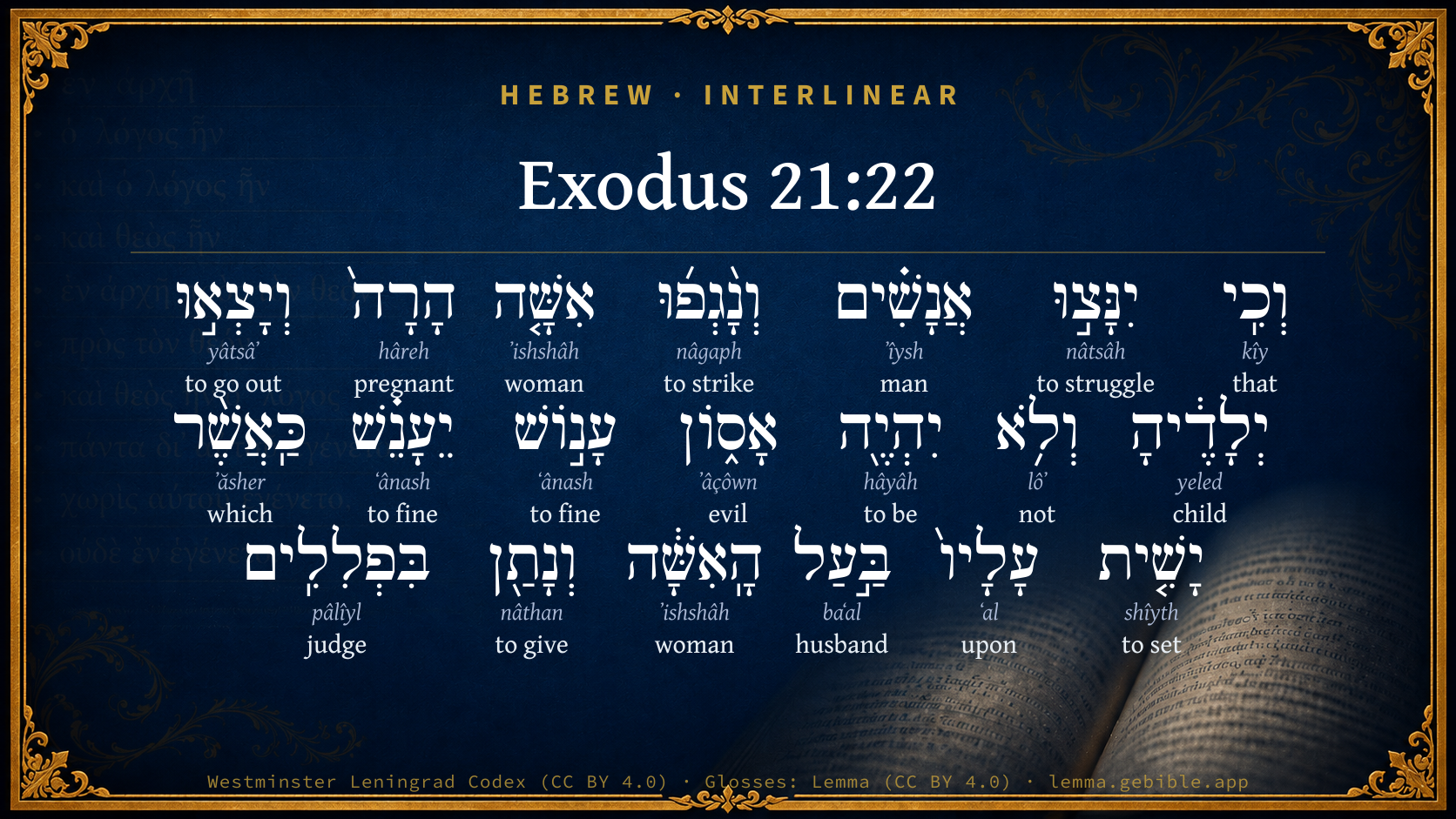
Hebrew (Westminster Leningrad Codex) Exodus 21:22 appears in the Hebrew Old Testament. The text above is from the Westminster Leningrad Codex. Each word links to its Strong’s number, a concise gloss, and parsing drawn from the Open Scriptures Hebrew Bible morphology. Click any word for its full Brown-Driver-Briggs (BDB) entry.
Download image
Cite this verse

Exodus 21:22 (World English Bible). Public Domain. Lemma interlinear Bible study tool, https://lemma.gebible.app/v/exodus/21/22.

Show BibTeX & RIS
BibTeX
RIS
English Translation
"If men fight and hurt a pregnant woman so that she gives birth prematurely, and yet no harm follows, he shall be surely fined as much as the woman's husband demands and the judges allow.
World English Bible · Public Domain
Highlights
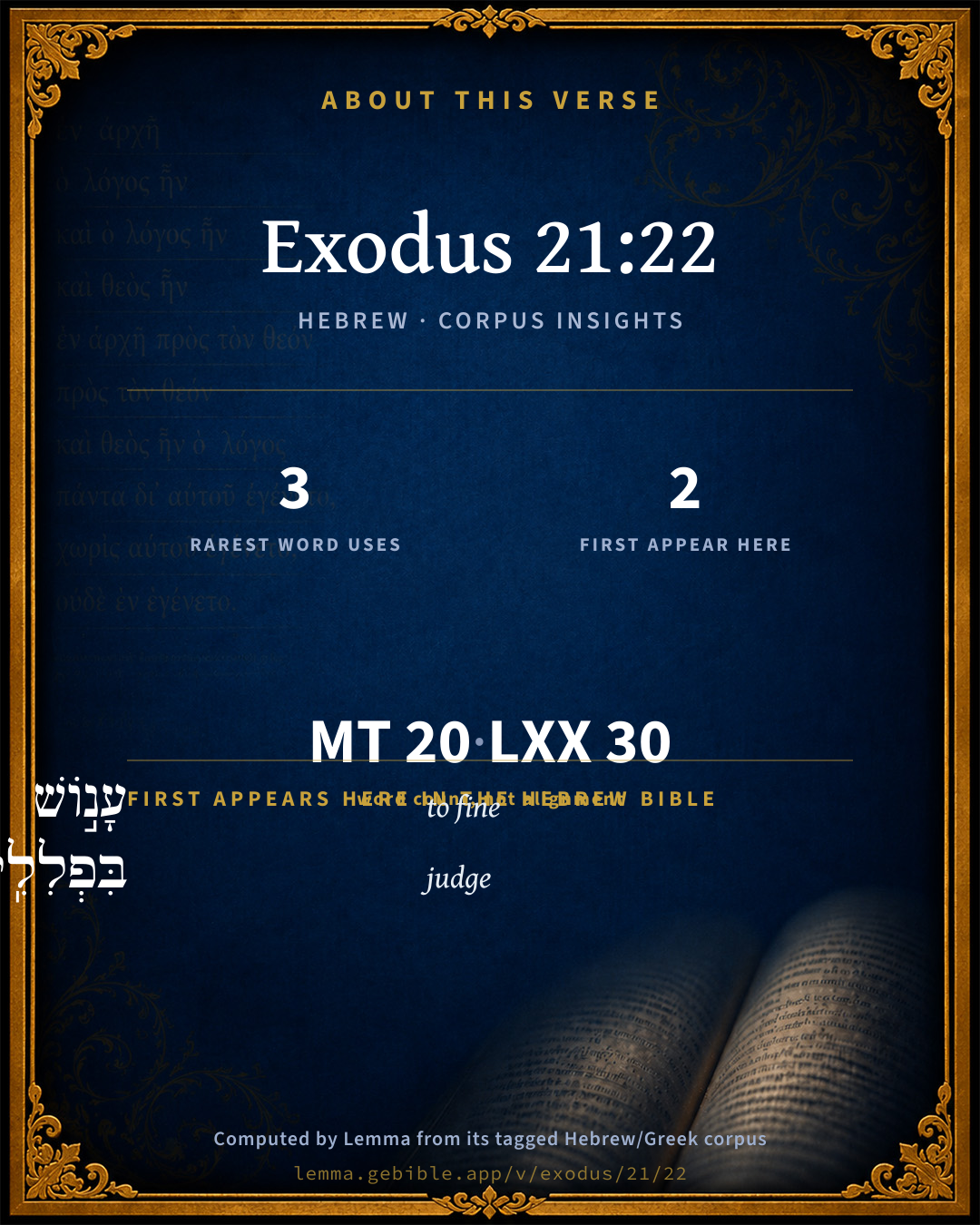
  • 2 first appearances in the Hebrew Bible
Full analysis ↓
Download a study sheet

One document with this verse’s original text, its word-by-word gloss line, the meaning frame, cross-references with their text, attributed commentary, and full source and license credits — printable, and it pastes into notes with its structure intact.

This verse Autodidact and up

Study sheet (.html) Plain text (.txt)

A passage Seminary Student

Up to 50 verses in one chapter. A passage sheet keeps up to 6 commentary sources and 12 cross-references per verse, in the order this page ranks them, and says so on the sheet whenever that leaves anything out. Ask for a single verse and you get the Autodidact verse sheet above.

Everything on this page stays free to read, with no account — the sheet is a download of what is already on screen, not access to it.

Want to remove ads? Support Godless Engineer
Compare translations 3

The same verse in 3 English versions, stacked beneath the original-language interlinear above. Click any original word for its lexicon entry.

Each is an independent rendering of the whole verse — the interlinear is not word-aligned to these translations.

Highlighted words mark where these versions differ — a whole-verse word diff, not a word-by-word alignment.

  • World English Bible Public Domain
    "If men fight and hurt a pregnant woman so that she gives birth prematurely, and yet no harm follows, he shall be surely fined as much as the woman's husband demands and the judges allow.
  • King James Version Public Domain
    If men strive, and hurt a woman with child, so that her fruit depart from her, and yet no mischief follow: he shall be surely punished, according as the woman's husband will lay upon him; and he shall pay as the judges determine.
  • unfoldingWord Literal Text CC BY-SA 4.0
    And if men fight together and strike a pregnant woman and her children come out, but there is no serious injury, then he shall surely be fined as the husband of the woman puts on him, and he shall give according to the judges.

unfoldingWord Literal Text — © unfoldingWord, licensed CC BY-SA 4.0. Word-aligned USFM3 via Door43 (git.door43.org/unfoldingWord/en_ult).

Versions to compare (up to 4)

3 of 4 selected

Show all 18 translations

Every available English version of this verse, each an independent rendering of the whole verse.

  • World English Bible Public Domain
    "If men fight and hurt a pregnant woman so that she gives birth prematurely, and yet no harm follows, he shall be surely fined as much as the woman's husband demands and the judges allow.
  • Berean Standard Bible Public Domain
    If men who are fighting strike a pregnant woman and her child is born prematurely, but there is no further injury, he shall surely be fined as the woman’s husband demands and as the court allows.
  • Majority Standard Bible Public Domain
    If men who are fighting strike a pregnant woman and her child is born prematurely, but there is no further injury, he shall surely be fined as the woman’s husband demands and as the court allows.
  • King James Version Public Domain
    If men strive, and hurt a woman with child, so that her fruit depart from her, and yet no mischief follow: he shall be surely punished, according as the woman's husband will lay upon him; and he shall pay as the judges determine.
  • American Standard Version (1901) Public Domain
    And if men strive together, and hurt a woman with child, so that her fruit depart, and yet no harm follow; he shall be surely fined, according as the woman's husband shall lay upon him; and he shall pay as the judges determine.
  • Revised Version (1885) Public Domain
    And if men strive together, and hurt a woman with child, so that her fruit depart, and yet no mischief follow: he shall be surely fined, according as the woman’s husband shall lay upon him; and he shall pay as the judges determine.
  • Geneva Bible (1599) Public Domain
    Also if men striue and hurt a woman with childe, so that her childe depart from her, and death follow not, hee shall bee surely punished according as the womans husband shall appoynt him, or he shall pay as the Iudges determine.
  • Douay-Rheims (1899) Public Domain
    If men quarrel, and one strike a woman with child, and she miscarry indeed, but live herself: he shall be answerable for so much damage as the woman's husband shall require, and as arbiters shall award.
  • Young's Literal Translation Public Domain
    `And when men strive, and have smitten a pregnant woman, and her children have come out, and there is no mischief, he is certainly fined, as the husband of the woman doth lay upon him, and he hath given through the judges;
  • Literal Standard Version CC BY-SA 4.0
    And when men strive, and have struck a pregnant woman, and her children have come out, and there is no harm [to them], he is certainly fined as the husband of the woman lays on him, and he has given through the judges;
  • Unlocked Literal Bible CC BY-SA 4.0
    If men fight together and hurt a pregnant woman so that she miscarries, but there is no other injury to her, then the guilty man must surely be fined as the woman's husband demands it from him, and he must pay as the judges determine.
  • unfoldingWord Literal Text CC BY-SA 4.0
    And if men fight together and strike a pregnant woman and her children come out, but there is no serious injury, then he shall surely be fined as the husband of the woman puts on him, and he shall give according to the judges.
  • Darby Bible Public Domain
    And if men strive together, and strike a woman with child, so that she be delivered, and no mischief happen, he shall in any case be fined, according as the woman's husband shall impose on him, and shall give it as the judges estimate.
  • World Messianic Bible Public Domain
    “If men fight and hurt a pregnant woman so that she gives birth prematurely, and yet no harm follows, he shall be surely fined as much as the woman’s husband demands and the judges allow.
  • Webster's Bible Public Domain
    If men shall contend, and hurt a woman with child, so that her fruit shall depart from her, and yet no mischief follow: he shall be surely punished, according as the woman's husband will lay upon him; and he shall pay as the judges determine.
  • Free Bible Version CC BY-SA 4.0
    If men who are fighting happen to hit a pregnant woman so she gives birth prematurely, but no serious injury occurs, he must be fined whatever amount the woman's husband demands and as permitted by the judges.
  • Bible in Basic English Public Domain
    If men, while fighting, do damage to a woman with child, causing the loss of the child, but no other evil comes to her, the man will have to make payment up to the amount fixed by her husband, in agreement with the decision of the judges.
  • JPS Tanakh (1917) Public Domain
    And if men strive together, and hurt a woman with child, so that her fruit depart, and yet no harm follow, he shall be surely fined, according as the woman's husband shall lay upon him; and he shall pay as the judges determine.

Literal Standard Version (2020), Covenant Press — licensed CC BY-SA 4.0. Text via the HelloAO Bible API (eBible.org). Unlocked Literal Bible (unfoldingWord) — licensed CC BY-SA 4.0. Text via the HelloAO Bible API (eBible.org). unfoldingWord Literal Text — © unfoldingWord, licensed CC BY-SA 4.0. Word-aligned USFM3 via Door43 (git.door43.org/unfoldingWord/en_ult). Free Bible Version, Dr. Jonathan Gallagher — licensed CC BY-SA 4.0. Text via the HelloAO Bible API (eBible.org).

Word by word

More ways to search: Search by grammar → Find every occurrence → Compare this word →

Practice this passage: Drill this verse → Learn its vocabulary →

בִּפְלִלִֽים
pâlîyl
H6414
“in/at · judges”
Preposition + Noun, Common, Masculine, Plural, Absolute
Part of Speech
Preposition + Noun
Type
Common
Gender
Masculine
Number
Plural
State
Absolute
Full BDB Definition

Origin: from H6419

TWOT: 1776b

judge, assessment, estimate
  1. וְכִֽי kîy H3588 “and · that” Conjunction + Conjunction
  2. יִנָּצ֣וּ nâtsâh H5327 “to struggle” Verb, Niphal, Imperfect, 3rd Person, Masculine, Plural
  3. אֲנָשִׁ֗ים ʼîysh H376 “men” Noun, Common, Masculine, Plural, Absolute
  4. וְנָ֨גְפ֜וּ nâgaph H5062 “and · to strike” Conjunction + Verb, Qal, Sequential Perfect, 3rd Person, Common, Plural
  5. אִשָּׁ֤ה ʼishshâh H802 “woman” Noun, Common, Feminine, Singular, Absolute
  6. הָרָה֙ hâreh H2030 “pregnant” Adjective, Adjective, Feminine, Singular, Absolute
  7. וְיָצְא֣וּ yâtsâʼ H3318 “and · to go out” Conjunction + Verb, Qal, Sequential Perfect, 3rd Person, Common, Plural
  8. יְלָדֶ֔יהָ yeled H3206 “children · her” Noun, Common, Masculine, Plural, Construct + Suffix, Personal, 3rd Person, Feminine, Singular
  9. וְלֹ֥א lôʼ H3808 “and · not” Conjunction + Particle, Negative
  10. יִהְיֶ֖ה hâyâh H1961 “to be” Verb, Qal, Imperfect, 3rd Person, Masculine, Singular
  11. אָס֑וֹן ʼâçôwn H611 “evil” Noun, Common, Masculine, Singular, Absolute
  12. עָנ֣וֹשׁ ʻânash H6064 “to fine” Verb, Qal, Infinitive Absolute
  13. יֵעָנֵ֗שׁ ʻânash H6064 “to fine” Verb, Niphal, Imperfect, 3rd Person, Masculine, Singular
  14. כַּֽאֲשֶׁ֨ר ʼăsher H834 “like/as · which” Preposition + Particle, Relative
  15. יָשִׁ֤ית shîyth H7896 “to set” Verb, Qal, Imperfect, 3rd Person, Masculine, Singular
  16. עָלָיו֙ ʻal H5921 “upon · him” Preposition + Suffix, Personal, 3rd Person, Masculine, Singular
  17. בַּ֣עַל baʻal H1167 “husband of” Noun, Common, Masculine, Singular, Construct
  18. הָֽאִשָּׁ֔ה ʼishshâh H802 “the · woman” Particle, Definite Article + Noun, Common, Feminine, Singular, Absolute
  19. וְנָתַ֖ן nâthan H5414 “and · to give” Conjunction + Verb, Qal, Sequential Perfect, 3rd Person, Masculine, Singular

About this verse

These counts appear in no published source. They are computed here, from the morphology-tagged text and Lemma’s own curated glosses. What Lemma adds →

20
words
18
distinct lemmas
Pentateuch
section

Notable vocabulary

The rarest word here is בִּפְלִלִֽים judge H6414 — appearing just 3 times in the whole Hebrew Bible.

First appearance in Scripture

These words make their first canonical appearance in the Hebrew Bible here:

  • עָנ֣וֹשׁ to fine H6064
  • בִּפְלִלִֽים judge H6414

Shared distinctive vocabulary

בִּפְלִלִֽים judge H6414 occurs in 3 verses of the Hebrew Bible. Also found in:

Grammatical profile

  • 8 verbs
  • 7 nouns
  • 1 adjective
  • 1 preposition
  • 1 conjunction
  • 2 particles

Verb forms

  • יִנָּצ֣וּ Niphal · Imperfect
  • וְנָ֨גְפ֜וּ Qal · Sequential Perfect
  • וְיָצְא֣וּ Qal · Sequential Perfect
  • יִהְיֶ֖ה Qal · Imperfect
  • עָנ֣וֹשׁ Qal · Infinitive Absolute
  • יֵעָנֵ֗שׁ Niphal · Imperfect
  • יָשִׁ֤ית Qal · Imperfect
  • וְנָתַ֖ן Qal · Sequential Perfect

Repetition

Words recur within this verse — often emphatic in Hebrew:

  • אִשָּׁ֤ה woman H802 ×2
  • עָנ֣וֹשׁ to fine H6064 ×2

Hebrew & Septuagint length

In English translation the verse runs 35 words from the Hebrew and 40 from the Septuagint (LXX English) — closely comparable.

A rough comparison of the two English renderings, which tokenize alike — not a word-level alignment.

Word counts can differ between the Hebrew and the Greek without any difference in meaning — e.g. the Hebrew direct-object marker אֵת has no separate Greek word, and Greek often adds the article ὁ.

In the original languages it is 20 Hebrew tokens and 30 Greek tokens — but the two are counted differently (Hebrew bundles its prefixes and suffixes into one token; the Greek is in lemma form), so that isn’t a like-for-like length.

Cross-references

3

Topical passages linked to Exodus 21:22 in the Treasury of Scripture Knowledge — connected by theme and wording, ordered by reader-vote popularity; previews shown in the World English Bible.

  • Deuteronomy 22:18–19 The elders of that city shall take the man and chastise him;
  • Exodus 21:30 If a ransom is laid on him, then he shall give for the redemption of his life whatever is laid on him.
  • Deuteronomy 16:18 Judges and officers shall you make you in all your gates, which Yahweh your God gives you, according to your tribes; and they shall judge the people with righteous judgment.

Cross-references courtesy of OpenBible.info (CC BY 4.0).

Hebrew and Greek witnesses Masoretic Hebrew ↔ Greek Septuagint

The same verse in the two great witnesses to the Old Testament, shown verse-for-verse.

These are two independent witnesses, not word-aligned to each other, and the Septuagint is shown in lemma (dictionary) form.

Hebrew Exodus 21:22 Masoretic · Westminster Leningrad Codex

וְכִֽי יִנָּצ֣וּ אֲנָשִׁ֗ים וְנָ֨גְפ֜וּ אִשָּׁ֤ה הָרָה֙ וְיָצְא֣וּ יְלָדֶ֔יהָ וְלֹ֥א יִהְיֶ֖ה אָס֑וֹן עָנ֣וֹשׁ יֵעָנֵ֗שׁ כַּֽאֲשֶׁ֨ר יָשִׁ֤ית עָלָיו֙ בַּ֣עַל הָֽאִשָּׁ֔ה וְנָתַ֖ן בִּפְלִלִֽים

"If men fight and hurt a pregnant woman so that she gives birth prematurely, and yet no harm follows, he shall be surely fined as much as the woman's husband demands and the judges allow.

World English Bible · Public Domain

Greek LXX Exodus 21:22 Septuagint · lemma form

ἐάν δέ μάχομαι δύο ἀνήρ καί πατάσσω γυνή ἐν γαστήρ ἔχω καί ἐκἔρχομαι ὁ παιδίον αὐτός μή ἐκεἰκονίζω ἐπιζήμιον ζημιόω καθότι ἄν ἐπιβάλλω ὁ ἀνήρ ὁ γυνή δίδωμι μετά ἀξίωμα

And if two men strive and strike a woman with child, and her child be born imperfectly formed, he shall be forced to pay a penalty: as the woman's husband may lay upon him, he shall pay with a valuation.

LXX2012 (modern English Septuagint) · Public Domain

On this verse, Haydock's Catholic Bible Commentary discusses the Septuagint’s reading. Read the note in Commentary ↓

Hebrew: Westminster Leningrad Codex (CC BY 4.0). Greek: Septuagint (public domain); English from LXX2012 (modern English Septuagint) (Public Domain). How the Septuagint differs from the Hebrew →

Targum (Aramaic paraphrase)

2

The Targum is the ancient Jewish Aramaic paraphrase of the Hebrew Scriptures — an interpretive translation, not the Hebrew text itself. Onkelos (literal) and Pseudo-Jonathan (expansive) render the Torah, and Jonathan the Prophets. Coverage is partial: where no permissively-licensed English translation exists for a verse, only the Aramaic is shown. This is verse-level text, not a word-by-word alignment to the Hebrew.

  1. Targum Onkelos Torah (Genesis–Deuteronomy)
    וַאֲרֵי יִנְצוּן גֻבְרִין וְיִמְחוּן אִתְּתָא מַעַדְיָא וְיִפְּקוּן וַלְדָהָא וְלָא יְהֵי מוֹתָא אִתְגְבָאָה יִתְגְבֵי כְּמָא דִי יְשַׁוִי עֲלוֹהִי בַּעֲלַהּ דְאִתְּתָא וְיִתֵּן עַל מֵימַר דַיָנַיָא:

    (no public-domain English translation for this verse)

    Targum Onkelos — Aramaic: “Onkelos Genesis” (public domain); “Onkelos Exodus” (public domain); “Onkelos Leviticus” (public domain); “Onkelos Numbers” (public domain); “Onkelos Deuteronomy” (public domain). English: “Sefaria Community Translation” (CC0 1.0 (public-domain dedication)); “J.W. Etheridge. The Targums of Onkelos and Jonathan Ben Uzziel on the Pentateuch. London: Longmans, Green, 1862” (public domain). Text via Sefaria.

  2. Targum Pseudo-Jonathan Torah (Genesis–Deuteronomy)
    וַאֲרוּם יִנְצוּן גַּבְרִין וְיִמְחוּן אִתְּתָא מְעַבְּרָא וְאַפִּילַת יַת וַולְדָהָא וְלָא יְהֵי בָהּ מוֹתָא מִתְקַנְסָא יִתְקְנֵיס דְּמֵי וַולְדָא הֵיכְמָא דִמְשַׁוֵי עֲלֵיהּ בַּעֲלֵיהּ דְּאִינְתְּתָא וְיִתֵּן עַל מֵימַר דַּיָינַיָא

    If men when striving strike a woman with child, and cause her to miscarry, but not to lose her life, the fine on account of the infant which the husband of the woman shall lay upon him, he shall pay according to the sentence of the judges.

    Targum Pseudo-Jonathan — Aramaic: “Targum Jonathan on Genesis” (public domain); “Targum Jonathan on Exodus” (public domain); “Targum Jonathan on Leviticus” (public domain); “Targum Jonathan on Numbers” (public domain); “Targum Jonathan on Deuteronomy” (public domain). English: “The Targum of Jonathan ben Uzziel, trans. J. W. Etheridge, London, 1862” (public domain). Text via Sefaria.

Commentary

Notes on Exodus 21:22 from classic Christian and Jewish commentators (each source and its license shown beneath its notes). The classic Christian expositions comment on the surrounding passage and are grouped to its opening verse, so a note may address several verses; the Jewish commentaries on the Tanakh (Rashi and others) are per-verse, so they appear only where the commentator wrote on this verse.

Lemma curates 59 commentaries, every one of them public domain or Creative Commons licensed, each selected and text-cleaned for this edition rather than reprinted as found. About our sources →

Matthew Henry's Commentary

Observe here,

I. The particular care which the law took of women with child, that no hurt should be done them which might occasion their mis-carrying. The law of nature obliges us to be very tender in that case, lest the tree and fruit be destroyed together, Exo 21:22, Exo 21:23. Women with child, who are thus taken under the special protection of the law of God, if they live in his fear, may still believe themselves under the special protection of the providence of God, and hope that they shall be saved in child-bearing. On this occasion comes in that general law of retaliation which our Saviour refers to, Mat 5:38, An eye for an eye. Now, 1. The execution of this law is not hereby put into the hands of private persons, as if every man might avenge himself, which would introduce universal confusion, and make men like the fishes of the sea. The tradition of the elders seems to have put this corrupt gloss upon it, in opposition to which our Saviour commands us to forgive injuries, and not to meditate revenge, Mat 5:39. 2. God often executes it in the course of his providence, making the punishment, in many cases, to answer to the sin, as Jdg 1:7; Isa 33:1; Hab 2:13; Mat 26:52. 3. Magistrates ought to have an eye to this rule in punishing offenders, and doing right to those that are injured. Consideration must be had of the nature, quality, and degree of the wrong done, that reparation may be made to the party injured, and others deterred from doing the like; either an eye shall go for an eye, or the forfeited eye shall be redeemed by a sum of money. Note, He that does wrong must expect one way or other to receive according to the wrong he has done, Col 3:25. God sometimes brings men's violent dealings upon their own heads (Psa 7:16); and magistrates are in this the ministers of the justice, that they are avengers (Rom 13:4), and they shall not bear the sword in vain.

II. The care God took of servants. If their masters maimed them, though it was only striking out a tooth, that should be their discharge, Exo 21:26, Exo 21:27. This was intended, 1. To prevent their being abused; masters would be careful not to offer them any violence, lest they should lose their service. 2. To comfort them if they were abused; the loss of a limb should be the gaining of their liberty, which would do something towards balancing both the pain and disgrace they underwent. Nay,

III. Does God take care for oxen? Yes, it appears by the following laws in this chapter that he does, for our sakes, Co1 9:9, Co1 9:10. The Israelites are here directed what to do,

1. In case of hurt done by oxen, or any other brute-creature; for the law, doubtless, was designed to extend to all parallel cases. (1.) As an instance of God's care of the life of man (though forfeited a thousand times into the hands of divine justice), and in token of his detestation of the sin of murder. If an ox killed any man, woman, or child, the ox was to be stoned (Exo 21:28); and, because the greatest honour of the inferior creatures is to be serviceable to man, the criminal is denied that honour: his flesh shall not be eaten. Thus God would keep up in the minds of his people a rooted abhorrence of the sin of murder and every thing that was barbarous. (2.) To make men careful that none of their cattle might do hurt, but that, by all means possible, mischief might be prevented. If the owner of the beast knew that he was mischievous, he must answer for the hurt done, and, according as the circumstances of the case proved him to be more or less accessory, he must either be put to death or ransom his life with a sum of money, Exo 21:29-32. Some of our ancient books make this felony, by the common law of England, and give this reason, "The owner, by suffering his beast to go at liberty when he knew it to be mischievous, shows that he was very willing that hurt should be done." Note, It is not enough for us not to do mischief ourselves, but we must take care that no mischief be done by those whom it is in our power to restrain, whether man or beast.

2. In case of hurt done to oxen, or other cattle. (1.) If they fall into a pit, and perish there, he that opened the pit must make good the loss, Exo 21:33, Exo 21:34. Note, We must take heed not only of doing that which will be hurtful, but of doing that which may be so. It is not enough not to design and devise mischief, but we must contrive to prevent mischief, else we become accessory to our neighbours' damage. Mischief done in malice is the great transgression; but mischief done through negligence, and for want of due care and consideration, is not without fault, but ought to be reflected upon with great regret, according as the degree of the mischief is: especially we must be careful that we do nothing to make ourselves accessory to the sins of others, by laying an occasion of offence in our brother's way, Rom 14:13. (2.) If cattle fight, and one kill another, the owners shall equally share in the loss, Exo 21:35. Only if the beast that had done the harm was known to the owner to have been mischievous he shall answer for the damage, because he ought either to have killed him or kept him up, Exo 21:36. The determinations of these cases carry with them the evidence of their own equity, and give such rules of justice as were then, and are still, in use, for the decision of similar controversies that arise between man and man. But I conjecture that these cases might be specified, rather than others (though some of them seem minute), because they were then cases in fact actually depending before Moses; for in the wilderness where they lay closely encamped, and had their flocks and herds among them, such mischiefs as these last mentioned were likely enough to occur. That which we are taught by these laws is that we should be very careful to do no wrong, either directly or indirectly; and that, if we have done wrong, we must be very willing to make satisfaction, and desirous that nobody may lose by us.

Matthew Henry's Commentary on the Whole Bible (1708–1710) — public domain (CC PDM 1.0). Text via the HelloAO Bible API.

Ellicott's Commentary for English Readers

(22) If men strive, and hurt a woman with child.—It is assumed that this hurt would probably take place through the interference of a pregnant wife in some strife wherein her husband was engaged. It would almost certainly be accidental.

And yet no mischief follow—i.e., no further mischief—nothing beyond the loss of the child.

(22, 23) Life for life, eye for eye.—It is a reasonable conjecture that the law of retaliation was much older than Moses, and accepted by him as tolerable rather than devised as rightful. The law itself was very widely spread. Traces of it are found in India, in Egypt, among the Greeks, and in the laws of the Twelve Tables. Aristotle says that the Pythagoreans approved it, and that it was believed to be the rule by which Rhadamanthus administered justice in the other world. There is, primâ facie, a semblance of exact rectitude and equality about it which captivates rude minds, and causes the adoption of the rule generally in an early condition of society. Theoretically, retaliation is the exactest and strictest justice; but in practice difficulties arise. How is the force of a blow to be measured? How are exactly similar burns and wounds to be inflicted? Is eye to be given for eye when the injurer is a one-eyed man? And, again, is it expedient for law to multiply the number of mutilated citizens in a community? Considerations of these kinds cause the rule to be discarded as soon as civilisation reaches a certain point, and tend generally to the substitution of a money compensation, to be paid to the injured party by the injurer. The present passage sanctioned the law of retaliation in principle, but authorised its enforcement in a single case only. In a later part of the Mosaic code the application was made universal (Lev_24:17-21; Deu_19:21).

(22-25) A personal injury peculiar to women—a hurt producing miscarriage—is here considered. The miscarriage might cost the woman her life, in which case the man who caused it was to suffer death (Exo_21:23); or it might have no further ill result than the loss of the child. In this latter case the penalty was to be a fine, assessed by the husband with the consent of the judge (Exo_21:22). The death penalty, where the woman died, is clearly excessive, and probably belongs to the pre-Mosaic legislation, which required “life for life” in every case.

A Bible Commentary for English Readers, edited by Charles John Ellicott (1878–1897) — public domain. Text from a community e-Sword module.

Trapp's Complete Commentary

John Trapp

Exo 21:22 If men strive, and hurt a woman with child, so that her fruit depart [from her], and yet no mischief follow: he shall be surely punished, according as the woman’s husband will lay upon him; and he shall pay as the judges [determine].

Ver. 22. And yet no mischief follow,] i.e., No life be lost. There is a time, then, when the embryo is not alive; therefore the soul is not begotten, but infused after a time by God. Infundendo creatur, et creando infnnditur, saith Augustine, who at first doubted, till overcome by Jerome’s arguments.

John Trapp, A Commentary or Exposition upon All the Books of the Old and New Testament (1647–1656) — public domain. Text from a community e-Sword module.

The Biblical Illustrator

Joseph S. Exell

Exo_21:22-25

Life for life.

The criminal law: was it written in blood

The only sense in which retaliation was authorized was as a maxim of law, which helped to fix the measure of punishment for crime. It was the mode of punishment which was at once the simplest, the most natural, and the most easily administered. Indeed, in many cases it was the only mode possible. How would our modern reformers punish such offences? By putting the malefactor in prison? But where was the prison in the desert? In the desert the only possible penalty was one which could be inflicted on the person of the offender, and here the principle of strict retaliation for the crime committed, rigid as it may seem, was perfectly just. It was right that he who inflicted a wound upon his neighbour should feel himself how sharp and keen a wound may be; that he who ferociously tore his brothers eye from its socket should forfeit his own. The law against murder followed the same inexorable rule--life for life; a law in which there was no element of pardon or pity. But Moses did not create it; it had been the law of the desert long before he was born. When that old bearded sheik of all the Bedaween of Sinai, sitting under the shadow of a great rock in the desert, explained to us the operation of the lex talionis in his tribe, he set before us not only that which now is, but that which has been from the very beginning of time. It was somewhat startling, indeed, to find that laws and customs which we had supposed to belong only to an extreme antiquity still lingered among these mountains and deserts. The avenger of blood might follow with swift foot upon the murderers track, and if he overtook him and put him to death the law held him free. But at the same time it gave the criminal a chance for his life. In the cities of refuge the manslayer was safe until he could have a fair trial . . . Perhaps nothing shows more the spirit of a law than the modes of execution for those who are to suffer its extreme penalty. It is not two hundred years since torture was laid aside by European nations. James the Second himself witnessed the wrenching of the boot as a favourite diversion. The assassin who struck Henry the Fourth was torn limb from limb by horses, under the eye of ladies of the court. The Inquisition stretched its victims on the rack. Other modes of execution, such as burning alive, sawing asunder, and breaking on the wheel, were common in Europe until a late period. The Turks impaled men, or flayed them alive; and tied women in sacks with serpents, and threw them into the Bosphorus. Among the ancients, punishments were still more excruciating. The Roman people, so famous for the justice of their laws, inflicted the supreme agony of crucifixion, in which the victim lingered dying for hours, or even days. After the capture of Jerusalem, Titus ordered two thousand Jews to be crucified. How does this act of the imperial Romans compare with the criminal law of a semi-savage race? Under the Hebrew code all these atrocities were unknown. Moses prescribed but two modes of capital punishment--the sword and stoning . . . And is this the law that was written in blood ? No, not in blood, but in tears; for through the sternness of the lawgiver is continually breaking the heart of man. Behind the coat of mail that covers the breast of the warrior is sometimes found the heart of a woman. This union of gentleness with strength is one of the most infallible signs of a truly great nature. It is this mingling of the tender and the terrible that gives to the Hebrew law a character so unique--a majesty that awes with a gentleness that savours more of parental affection than of severity. Crime and its punishment is not in itself a pleasing subject to dwell on; but when on this dark background is thrown the light of such provisions for the poor and the weak, the effect is like the glow of sunset on the red granite of the Sinai mountains. Even the peaks that were hard and cold, look warm in the flood of sunlight which is poured over them all. Thus uniting the character of the supporter of weakness and protector of innocence with that of the punisher of crime, Moses appears almost as the divinity of his nation--as not only the founder of the Hebrew state, but as its guardian genius through all the periods of its history. When he went up into Mount Nebo, and stretched out his arm toward the Promised Land, he gave to that land the inestimable blessings of laws founded in eternal justice; and not only in justice, but in which humanity was embodied almost as much as in the precepts of religion. Nor was that law given for the Israelites alone. It was an inheritance for all ages and generations. That mighty arm was to protect the oppressed so long as human governments endure. Moses was the king of legislators, and to the code which he left rulers of all times have turned for instruction. (H. M. Field, D. D.)

Lessons

1. God supposeth the cruel smitings of masters, but alloweth them not.

2. God foreseeth the sufferings of poor slaves, and provides in His law against it.

3. The perishing of the least member of servants, even of a tooth, God will require of superiors (verse 26).

4. God by His law depriveth those men of lordship, who abuse their power cruelly over servants.

5. Bond and free are equally considered by God in His law without respect of persons. He makes the oppressed free (verses 26, 27). (G. Hughes, B. D.)

Stripe for stripe

A boy was one day sitting on the steps of a door. He had a broom in one hand, and in the other a large piece of bread-and-butter, which somebody had kindly given him. While he was eating it, and merrily humming a tune, he saw a poor little dog quietly sleeping not far from him. He called out to him: Come here, poor fellow! The dog, hearing himself kindly spoken to, rose, pricked up his ears, and wagged his tail. Seeing the boy eating, he came near him. The boy held out to him a piece of his bread-and-butter. As the dog stretched out his head to take it, the boy hastily drew back his hand, and hit him a hard rap on the nose. The poor dog ran away, howling most dreadfully, while the cruel boy sat laughing at the mischief he had done. A gentleman who was looking from a window on the other side of the street, saw what the wicked boy had done. Opening the street door, he called to him to cross over, at the same time holding up a sixpence between his finger and thumb. Would you like this? said the gentleman. Yes, if you please, sir, said the boy, smiling; and he hastily ran over to seize the money. Just at the moment that he stretched out his hand, he got so severe a rap on the knuckles from a cane which the gentleman had behind him, that he roared out like a bull. What did you do that for? said he, making a very long face, and rubbing his hand. I didnt hurt you, nor ask you for the sixpence. What did you hurt that poor dog for just now? said the gentleman. He didnt hurt you, nor ask you for your bread-and-butter. As you served him, I have served you. Now, remember dogs can feel as well as boys, and learn to behave kindly towards dumb animals in future. (Great Thoughts.)

Life for life

Herbert was yet of tender age when his father, the huntsman of Farmstein, was, in the heart of the forest, shot down by an unknown poacher. His mother brought up her fatherless boy as well as she could, and at the age of twenty, when he has become a skilful forester, he obtained his fathers situation. It happened that one day, when Herbert was hunting in the forest with many hunters, he shot at a large stag, and missed it. Presently a voice exclaimed piteously in the copse, Oh, heaven! I am shot. Herbert moved forward, and found an old man who was uttering loud groans, as he lay covered with blood. The whole company of hunters gathered around the dying man. Herbert, however, knelt down beside him and begged his forgiveness, protesting that he had not seen him. The dying man, however, said, I have nothing to forgive you, for that which has hitherto been concealed from all the world shall now come to light. I am the poacher who shot your father just here, under this old oak. The very ground where we now are was dyed with his blood; and it has evidently been destined that you, the son of the murdered man, should on this precise spot, without any thought or intention of such a thing, avenge the act on me. God is just! he exclaimed, and presently expired.

Equitable Judgment

A Teuton made a little fortune here not long ago in the milk business, and decided to return to Germany and enjoy it in his old home. In the ship that was bearing him homeward was a mischievous monkey. The monkey, prying around one day, found a heavy bag and ran up to the masthead with it. The German clasped his hands in despair at seeing the bag; it was his money, all in gold. The monkey in a leisurely way pulled out a piece and flung it down to the deck, when the ex-milkman gathered it up. Then the beast tossed a second piece into the sea. Thus alternately the pieces went, one into the ocean and the next into the distracted mans pocket. Ah, said the ex-milkman, as he pocketed just half of what he had started with, it is just. One-half of that milk I have sold was milk, and the money for it comes back; the other half was water, and half goes back to water.

The Biblical Illustrator, edited by Joseph S. Exell (c. 1880s–1900s) — public domain. Text from a community e-Sword module.

Joseph Benson's Commentary

Exo 21:22-23. And yet no mischief follow — That is, if the woman die not, as appears from the next verse, or the child was not formed and alive in the womb; he shall be surely punished — The woman’s husband shall impose the fine, and if it be unreasonable, the judges shall have a power to moderate it. If any mischief follow — If the woman die, or if the child was formed and alive, the offender was to be punished with death. Thou shalt give life for life — By the judgment of the magistrate.

Joseph Benson's Commentary on the Old and New Testaments (1811–1818) — public domain. Text from a community e-Sword module.

Tyndale Open Study Notes

Tyndale Open Resources

21:22-25 so she gives birth prematurely: It appears that if a child’s birth was caused prematurely and the child died (i.e., there was further injury), the penalty for murder was to be enacted. The law of retaliation (the lex talionis) called for a penalty that matched the injury inflicted on a victim. But this law also served to limit the punishment so it was not more severe than the original injury. Cp. Matt 5:38-39.

Tyndale Open Study Notes — © Tyndale Open Resources, licensed CC BY-SA 4.0. Text via the HelloAO Bible API.

Geneva Bible (1599)

Geneva Bible translators

Of the mother or child.

Or, arbiters.

Geneva Bible (1599) marginal notes — public domain. Text via Bolls.life.

Adam Clarke's Commentary

Verse 22. And hurt a woman with child] As a posterity among the Jews was among the peculiar promises of their covenant, and as every man had some reason to think that the Messiah should spring from his family, therefore any injury done to a woman with child, by which the fruit of her womb might be destroyed, was considered a very heavy offence; and as the crime was committed principally against the husband, the degree of punishment was left to his discretion. But if mischief followed, that is, if the child had been fully formed, and was killed by this means, or the woman lost her life in consequence, then the punishment was as in other cases of murder - the person was put to death; Ex 21:23.

Adam Clarke's Commentary on the Bible (1810–1826) — public domain. Text from a community e-Sword/MySword module.

The Cambridge Bible for Schools and Colleges

gen. ed. J. J. S. Perowne

22. Injury arising to a pregnant woman out of an affray.

And if men strive together] i.e. quarrel and fight, ch. Exo_2:13, 2Sa_14:6, Psalms 60 title. The same words in Deu_25:2. Not the verb used in v. 18 (which means only to dispute in words).

hurt] properly, smite or strike (ch. Exo_8:2; Isa_19:22): so v. 35. Probably the woman is to be thought of (as in Deu_25:11) as intervening to separate the combatants.

her fruit depart] Heb. her children (a generic plural) come forth (Gen_25:25; Gen_38:28).

but no (other) mischief happen] i.e. no permanent injury from the miscarriage. ‘Mischief’ (’âsôn, v. 23, Gen_42:4; Gen_42:38; Gen_44:29 †) means some serious, or even (cf. v. 23) fatal, bodily injury.

fined] viz. for the loss of the child, which would have been the parents’ property. Holzinger cites for parallels, among the Arabs, W.R. Smith, ZATW. 1892, p. 163, and among the Kirghissians, in Turkestan, Radloff, Aus Sibirien (1884), p. 524; here, if a pregnant woman is injured so that her child is born dead, the penalty is a horse or a camel according to its age (the penalty for killing a free man being a fine of 100 horses, and for killing a woman or slave, 50 horses).

he shall pay (lit. give) with (the approval of) arbitrators] If the text is correct, the meaning apparently is that the amount of the fine, fixed in the first instance by the woman’s husband, had, before payment, to be submitted to arbitrators, and approved by them. But the word for arbitrators is rare and poetical (Deu_32:31, Job_31:11 †), the use of the prep. ב is strange, the mention of arbitration is unexpected after the unconditional discretion just given to the husband, nor are any arbitrators mentioned in the similar enactment of v. 30. Under these circumstances the clever suggestion of Budde, בנפלים for בפלילים deserves consideration, he shall pay it for the untimely birth (Job_3:16, Psa_58:9),—the plural being required on account of the plural ‘children,’ just before (concealed in EVV. by the rend. fruit: the ב pretii, as Deu_19:21). Cf. Ḥamm. §§ 209–214; Cook, p. 253 f.

The Cambridge Bible for Schools and Colleges (gen. ed. J. J. S. Perowne; Cambridge University Press, 1878–1918) — public domain. Text from a community e-Sword module.

John Gill's Exposition

If men strive,.... Quarrel and fight with one another, which is to be understood of Hebrews, as Aben Ezra observes:

and hurt a woman with child; who being the wife of one of them, and also an Israelitish woman, interposes to part them, or help her husband; but the other, instead of striking his antagonist as he intended, gives her a blow:

so that her fruit depart from her; or, "her children go forth" (z), out of her womb, as she may have more than one; through the fright of the quarrel, and fear of her husband being hurt, and the blow she received by interposing, might miscarry, or, falling into labour, come before her time, and bring forth her offspring sooner than expected:

and yet no mischief follow: to her, as the Targum of Jonathan, and so Jarchi and Aben Ezra restrain it to the woman; and which mischief they interpret of death, as does also the Targum of Onkelos; but it may refer both to the woman and her offspring, and not only to the death of them, but to any hurt or damage to either of them: now though there was none of any sort:

he shall surely be punished; that is, be fined or mulcted for striking the woman, and hastening the childbirth:

according as the woman's husband will lay upon him; and he shall pay as the judges determine; the husband might propose what fine should be paid, and might ask it in court; and if the smiter agreed to it, well and good, but if he judged it an exorbitant demand, he might appeal to the judges; for the husband might not lay what fine he pleased: this, if disputed, was to be decided by the judges, and as they determined it, it was paid; of which Maimonides (a) gives this account:"he that strikes a woman, and her fruit depart, though he did not intend it, is obliged to pay the price of the birth to the husband, and for hurt and pain to the woman; how do they estimate the price of the birth? they consider the woman how well she was before she brought forth, and how well she is after she has brought forth, and they give it to the husband; if the husband be dead, they give it to the heirs; if she is stricken after the death of her husband, they give the price of the birth to the woman.''

(z) "et egressi fuerint nati ejus", Pagninus, Montanus, Vatablus, Drusius. (a) Hilchot Chobel Umazzik, c. 4. sect. 1. 2.

John Gill's Exposition of the Whole Bible (1746–1763) — public domain (CC PDM 1.0). Text via the HelloAO Bible API.

Albert Barnes' Notes on the Bible

The rule would seem to refer to a case in which the wife of a man interfered in a quarrel. This law, “the jus talionis,” is elsewhere repeated in substance, compare the marginal references. and Gen 9:6. It has its root in a simple conception of justice, and is found in the laws of many ancient nations. It serves in this place as a maxim for the magistrate in awarding the amount of compensation to be paid for the infliction of personal injury. The sum was to be as nearly as possible the worth in money of the power lost by the injured person. Our Lord quotes Exo 21:24 as representing the form of the law, in order to illustrate the distinction between the letter and the spirit Mat 5:38. The tendency of the teaching of the Scribes and Pharisees was to confound the obligations of the conscience with the external requirements of the law. The law, in its place, was still to be “holy and just and good,” Rom 7:12, but its direct purpose was to protect the community, not to guide the heart of the believer, who was not to exact eye for eye, tooth for tooth, but to love his enemies, and to forgive all injuries.

Albert Barnes' Notes on the Bible (1834–1885) — public domain. Text from a community e-Sword/MySword module.

Haydock's Catholic Bible Commentary

But live herself. So Josephus also reads, Antiquities iv. 8. But Philo and the Septuagint have, "of a child unformed;" and ver. 23, "But if the child be formed, (exeikonismenon, animated and organized) he shall give soul for soul;" as if all were referred to the child, which the Vulgate explains of the mother. To destroy the life of either was punished with death. "She who first taught the art of expelling the tender fœtus, deserved to perish by his own malice." (Ovid) (Calmet) --- The precise time when the soul begins to animate the body is so very uncertain, that, after conception, the person who should cause a miscarriage wilfully, would expose himself to incur the guilt of murder. Josephus, contra Apion ii., shews how the Jews abhorred such wickedness. The Romans punished it with death. (Haydock) --- Homicidii festinatio est prohibere nasci. (Tertullian, apol.) Onkelos says, that "if the mother should not die of the stroke, the offender was to satisfy the husband by paying a fine, to be awarded by the husband, or by the judges: but in case the mother died, he should render life for life:" (Calmet) in which decision he agrees with the Vulgate. (Haydock) --- The Hebrew is ambiguous, "If death ensue not." (Calmet)

George Leo Haydock (1774–1849), Haydock's Catholic Family Bible and Commentary, 1859 edition — public domain. Excludes Psalms (Douay-Rheims chapter numbering differs from Protestant) and Deuterocanonical books (Catholic canon only).

Matthew Poole's English Annotations

A woman with child, to wit, the wife of the other person, who interposed herself to succour her husband.

No mischief follow, neither to the woman nor child; for it is generally so as to reach both, in case the abortive had life in it.

The husband shall impose the fine, and if it be unreasonable, the judges shall have a power to moderate it.

Matthew Poole's English Annotations on the Holy Bible (1683–1685) — public domain. Text from a community e-Sword/MySword module.

Whedon's Commentary on the Bible

Daniel D. Whedon

22-25. As the woman’s husband will lay upon him — The Hebrews threw every possible safeguard about the fruit of the womb, and an injury of the kind here specified was treated as a very grave offence. If death resulted it was punished as a capital crime, and life for life was demanded. If, however, other and less serious damage followed, the punishment was to be proportioned, according to a rigorous law of retaliation, (lex talionis.)

The woman might be injured in eye, tooth, hand, or foot, or by means of burning, (branding by a hot iron,) or some other wound or stripe, purposely or accidentally given, or the unborn offspring might be harmed in some of these ways, and a corresponding injury was accordingly to be inflicted upon the offender. The lex talionis, or law of retaliation, which appears in this passage and in Lev_24:19-20; Deu_19:21, is one of the most simple and ancient conceptions of righteous retribution. It has often been condemned as barbarous, but it is grounded in the intuitions of justice, and asserted itself in the legislation of many ancient nations, as the Romans, Greeks, and Indians. “It would seem,” says Michaelis, “that Moses retained the law of retaliation from a more ancient, and a very natural, law of usage.” It would naturally tend to prevent personal injuries, and all must see and acknowledge that when a man speedily receives in his own person the same damage he wilfully inflicted on another, he but receives his deserts and has no ground to complain. But, like the law which authorized the nearest kinsman of a murdered man to avenge his death, this law was liable to be abused. It gave too much room for the gratification of personal bitterness and hatred, and hence, mainly, the reason of our Lord’s words in Mat_5:38-39. The New Testament teaching, as has been so often explained, does not condemn the Mosaic law as unjust, but warns against the feeling of personal bitterness and revenge which is so likely to arise from a sense of injury. That should rather be crucified by a doing good for evil where the public welfare will not suffer thereby.

Daniel D. Whedon (gen. ed.), Commentary on the Old and New Testaments (1874–1909) — public domain. Text from a community e-Sword module.

The Pulpit Commentary

Ver. 22-25. Assault producing miscarriage. Retaliation. Women in all countries are apt to interfere in the quarrels of men, and run the risk of suffering injuries which proceed from accident rather than design, one such injury being of a peculiar character, to which there is nothing correspondent among the injuries which may be done to man. This is abortion, or miscarriage. The Mosaic legislation sought to protect pregnant women from suffering this injury by providing, first, that if death resulted the offender should suffer death (ver. 23); and, secondly, that if there were no further ill-result than the miscarriage itself, still a fine should be paid, to be assessed by the husband of the injured woman with the consent of the judges (ver. 22). The mention of "life for life," in ver. 23, is followed by an enunciation of the general "law of retaliation," applied here (it would seem) to the special case in hand, but elsewhere (Lev_24:19, Lev_24:20) extended so as to be a fundamental law, applicable to all cases of personal injury.

If men strive and hurt a woman. A chance hurt is clearly intended, not one done on purpose. So that her fruit depart from her. So that she be prematurely delivered of a dead child. And no mischief follow. "Mischief" here means "death," as in Gen_42:4, 38 45:2-9. He shall pay as the judges determine. He was not to be wholly at the mercy of the injured father. If he thought the sum demanded was excessive, there was to be an appeal to a tribunal.

Vers. 22-25. The requirement of strict equivalents in making compensation for injuries.

The particular illustration here is confessedly obscure; but there can hardly be a mistake as to the principle illustrated, viz., that when injury is inflicted on the person, the very best should be done that can be done to make an adequate compensation. When property is taken it can often be restored or things put practically as they were before; but when the person is seriously injured, there is then no possibility of exact restoration. Hence the injurer might be inclined to say that because he could not do everything by way of compensation he was at liberty to do nothing. But the requirement comes in to stop him from such easy-going reflections. Eve for eye is wanted. You must do your best to restore what you have destroyed. Obviously the purpose of the regulation is, not to justify or aid in anything like revenge, but to make men be contented with the best they can get in substitution for the injury that has been done. The regulation of course was never meant to be interpreted literally, any more than our Lord"s counsel that he who had been smitten on the right cheek, should turn the other to the smiter. What good would it do literally to render an eye for an eye? That would be great loss to the person injuring and not the slightest gain to the person injured. Persistent requirement of compensation is to be distinguished from a passionate seeking for revenge. And be it noted that this requirement of compensation is not to be omitted under any erroneous notions of what weakness and self-denial may compel from us as Christians. We must keep to the principle underlying the regulation here, as well as to that other glorious and beautiful principle which our Lord aid down in quoting this regulation. (Mat_5:39) He spoke to stop revenge. But surely he would have been the first to say, on needful occasion, that reckless men must not be suffered to inflict injury on the supposition that Christians would not resent it. Certainly we are not to seek compensation for injuries or punishment of those who injure simply to gratify private feelings, or get a private advantage. But if conscience is clear as to its being for the public good, we must be very urgent and pertinacious in demanding compensation. We may be sure our Master would ever have us contend with all meekness and gentleness, but also with all bravery and stedfastness for all that is right. But the thing of most importance to be learnt from this regulation is, that the most precious things attainable by us are beyond human malice or carelessness to spoil in the slightest degree. The treasures God loves to make the peculiar possession of his children are such as eye has not seen. The eye may be lost, and yet the enjoyment of these treasures remain nay more, the very loss of the natural may increase the susceptibility of the spiritual in us. The very crippling of the body may help us to make wonderful advances towards the perfect man in Christ Jesus. Y.

The Pulpit Commentary (1880–1919), ed. H.D.M. Spence-Jones & Joseph S. Exell — public domain. Text from a community e-Sword module.

unfoldingWord translationNotes

Door43 World Missions Community

she miscarries

"her baby dies in her womb" or "her baby is born too soon and dies"

the guilty man must surely be fined

This can be stated in active form. AT: "you must certainly fine the guilty man" or "the guilty man must pay a fine" (See: Active or Passive)

as the judges determine

"what the judges decide"

you must give a life for a life, an eye for an eye

This means that if she is hurt, the person who hurt her must be hurt in the same way. AT: "he must give his life for her life, his eye for her eye" (See: Assumed Knowledge and Implicit Information)

translationWords

guilt

judge, judges

unfoldingWord translationNotes — © Distant Shores Media and the Door43 World Missions Community, licensed CC BY-SA 4.0. Source: git.door43.org/Door43/en_tn.

Rashi

Rabbi Shlomo Yitzchaki (Rashi)

וכי ינצו אנשים IF MEN STRIVE with each other and one intended to strike the other and inadvertently struck the woman (Sanhedrin 79b).

ונגפו AND HURT [A WOMAN WITH CHILD] — The root נגף always signifies “dashing against” and “striking”. Examples are: (Psalms 91:15) “lest thou dash (תגוף) thy foot against a stone”; (Jeremiah 13:16) “and before your feet dash (יתנגפו)”; (Isaiah 8:14) “but for a stone of dashing (נגף).

ולא יהיה אסון AND YET THERE BE NO MISCHIEF — no further mischief with the woman (Sanhedrin 79b).

ענוש יענש HE SHALL SURELY BE AMERCED to pay the value of the offspring to the husband. We estimate her value according to what she is worth if she were sold as a slave in the market giving her a higher value on account of her being with child (Bava Kamma 49a).

ענוש יענש (lit., he shall surely be punished) — It means that they shall exact money from him. ענוש is used here in the same sense as in, (Deuteronomy 22:19) “And they shall amerce (וענשו) him an hundred shekel of silver”.

כאשר ישית עליו וגו׳ means, when the husband will summons him before the Court that they should place upon him a fine for this (cf. Mekhilta),

ונתן THEN HE SHALL GIVE — i. e. the man that struck the woman shall give the value of the offspring.

בפללים ACCORDING TO THE DECISION OF THE JUDGES (Mekhilta).

Rashi on the Tanakh — English translations: “The Judaica Press complete Tanach with Rashi, translated by A. J. Rosenberg” (CC BY 4.0); “Pentateuch with Rashi's commentary by M. Rosenbaum and A.M. Silbermann, 1929-1934” (public domain); “The Metsudah Tanach series, Lakewood, N.J” (CC BY 4.0); and “The Book of Joshua, Metsudah Publications, 1997” (CC BY 4.0). Text via Sefaria.

Ramban (Nachmanides)

Rabbi Moshe ben Nachman (Ramban / Nachmanides)

AND IF MEN STRIVE TOGETHER, AND HURT A WOMAN WITH CHILD, SO THAT HER FRUIT DEPART, AND YET NO HARM FOLLOW, HE SHALL BE SURELY FINED, ‘KA’ASHER’ THE WOMAN’S HUSBAND SHALL LAY UPON HIM. “This means: ‘when’ in the word ka’asher not in the sense of “as,” indicating degree or extent (“according as”), but in the sense of “when” — when the woman’s husband takes him to court. the husband will summon him before the court in order that they put a fine on him for it.” Thus far Rashi’s language. And it is correct [to interpret here the letter kaf in the word ka’asher as meaning “when”, and not “as”]. A similar case is the expression, ‘ka’asher’ (when) it shall be well with thee, and there are many other such cases. And the intention of the verse is that the assailant has to pay compensation for the miscarriage when the husband takes him to court, not when the woman does so, as the compensation is not hers. Onkelos, however, translated: “according to the amount [that the woman’s husband] shall lay upon him.”Rabbi Abraham ibn Ezra explained the verse as follows: according as the woman’s husband shall lay upon him, or, which is generally translated “and he shall pay” — as the judges determine, Ibn Ezra interprets to mean “or he shall pay,” and the purport thereof is as explained in the text. he shall pay as the judges determine, as if to say that the assailant should come to agreement with the husband on a fixed sum, or he should pay compensation as the court will assess him. This is not correct, for what reason is there to mention this? In my opinion, since the damage done is one that is not discernible in the unborn children themselves — for who could know their fortune — therefore Scripture said, that although he cannot be made to pay a precise monetary compensation, he should nonetheless be fined as a sort of penalty in the form of a sum of money which others [i.e., the judges] shall impose upon him. A similar usage [of the term onesh — punishment] is also found in these verses: and he put the land to ‘onesh’ (a fine); they drink the wine of them that have been ‘anushim’ (fined). Scripture is thus stating that the punishment be entirely as the woman’s husband shall lay upon him, because he desires his children and they are important to him, but he [i.e., the husband] should fix the sum through the judges, in order that he should not impose upon him an exorbitant sum. In the words of the Mechilta:, “According as the woman’s husband shall lay upon him. I might think this to mean, whatever he pleases; Scripture therefore says, and he shall pay as the ‘pelilim’ determine, and pelilim always means judges.”

Ramban (Nachmanides) on the Tanakh — English translation: “Commentary on the Torah by Ramban (Nachmanides). Translated and annotated by Charles B. Chavel. New York, Shilo Pub. House, 1971-1976” (CC BY 4.0). Text via Sefaria.

Lesson kit

Teaching starters — assembled from the data on this page, not authored interpretation. Every prompt links to the verse data it draws on. Edit before teaching.

Exodus, in the Pentateuch, opens this verse with 20 words (18 distinct Hebrew lemmas). Its most distinctive word is pâlîyl (“judge”). A historical commentator’s framing appears above. Read the whole chapter for the surrounding context.

Discussion questions

  1. What does “judge” (pâlîyl) contribute to the verse as a whole?
  2. 2 words make their first appearance in Scripture here. What does this debut establish?
  3. How does Deuteronomy 32:31, which shares the word «judge», read alongside this verse?
  4. What does the repetition of “woman” (2× in this one verse) do in this verse?
  5. These translations render this verse differently; the difference is in the English rendering, not the original. What questions does that raise?
  6. «יִנָּצ֣וּ» is a Niphal Imperfect verb. How does that grammatical form shape the action described?
  7. Compare how Matthew Henry's Commentary and Ellicott's Commentary for English Readers read this verse. Where do they agree or differ?

Things to notice

Reading settings

Reading text

Shown beneath each verse's original-language words.

Old Testament
Old Testament edition

Read the OT as the Masoretic Hebrew (MT) or the Greek Septuagint (LXX).

English shown for the Greek Septuagint (in the Hebrew ↔ Greek comparison).

Comparing translations? Open the Compare panel on any verse page to stack up to four side by side.