Daniel 9:10

Hebrew (Westminster Leningrad Codex) Daniel 9:10 appears in the Hebrew Old Testament. The text above is from the Westminster Leningrad Codex. Each word links to its Strong’s number, a concise gloss, and parsing drawn from the Open Scriptures Hebrew Bible morphology. Click any word for its full Brown-Driver-Briggs (BDB) entry.
Download image
Cite this verse

Daniel 9:10 (World English Bible). Public Domain. Lemma interlinear Bible study tool, https://lemma.gebible.app/v/daniel/9/10.

Show BibTeX & RIS
BibTeX
RIS
English Translation
neither have we obeyed the voice of Yahweh our God, to walk in his laws, which he set before us by his servants the prophets.
World English Bible · Public Domain
Download a study sheet

One document with this verse’s original text, its word-by-word gloss line, the meaning frame, cross-references with their text, attributed commentary, and full source and license credits — printable, and it pastes into notes with its structure intact.

This verse Autodidact and up

Study sheet (.html) Plain text (.txt)

A passage Seminary Student

Up to 50 verses in one chapter. A passage sheet keeps up to 6 commentary sources and 12 cross-references per verse, in the order this page ranks them, and says so on the sheet whenever that leaves anything out. Ask for a single verse and you get the Autodidact verse sheet above.

Everything on this page stays free to read, with no account — the sheet is a download of what is already on screen, not access to it.

Want to remove ads? Support Godless Engineer
Compare translations 3

The same verse in 3 English versions, stacked beneath the original-language interlinear above. Click any original word for its lexicon entry.

Each is an independent rendering of the whole verse — the interlinear is not word-aligned to these translations.

Highlighted words mark where these versions differ — a whole-verse word diff, not a word-by-word alignment.

  • World English Bible Public Domain
    neither have we obeyed the voice of Yahweh our God, to walk in his laws, which he set before us by his servants the prophets.
  • King James Version Public Domain
    Neither have we obeyed the voice of the LORD our God, to walk in his laws, which he set before us by his servants the prophets.
  • unfoldingWord Literal Text CC BY-SA 4.0
    and have not obeyed the voice of Yahweh our God by walking in his laws which he set before us through his servants the prophets.

unfoldingWord Literal Text — © unfoldingWord, licensed CC BY-SA 4.0. Word-aligned USFM3 via Door43 (git.door43.org/unfoldingWord/en_ult).

Versions to compare (up to 4)

3 of 4 selected

Show all 18 translations

Every available English version of this verse, each an independent rendering of the whole verse.

  • World English Bible Public Domain
    neither have we obeyed the voice of Yahweh our God, to walk in his laws, which he set before us by his servants the prophets.
  • Berean Standard Bible Public Domain
    and have not obeyed the voice of the LORD our God to walk in His laws, which He set before us through His servants the prophets.
  • Majority Standard Bible Public Domain
    and have not obeyed the voice of the LORD our God to walk in His laws, which He set before us through His servants the prophets.
  • King James Version Public Domain
    Neither have we obeyed the voice of the LORD our God, to walk in his laws, which he set before us by his servants the prophets.
  • American Standard Version (1901) Public Domain
    neither have we obeyed the voice of Jehovah our God, to walk in his laws, which he set before us by his servants the prophets.
  • Revised Version (1885) Public Domain
    neither have we obeyed the voice of the LORD our God, to walk in his laws, which he set before us by his servants the prophets.
  • Geneva Bible (1599) Public Domain
    For we haue not obeyed the voyce of the Lord our God, to walke in his lawes, which he had laide before vs by the ministerie of his seruants the Prophets.
  • Douay-Rheims (1899) Public Domain
    And we have not hearkened to the voice of the Lord our God, to walk in his law, which he set before us by his servants the prophets.
  • Young's Literal Translation Public Domain
    and have not hearkened to the voice of Jehovah our God, to walk in His laws, that He hath set before us by the hand of His servants the prophets;
  • Literal Standard Version CC BY-SA 4.0
    and have not listened to the voice of our God YHWH, to walk in His laws, that He has set before us by the hand of His servants the prophets;
  • Unlocked Literal Bible CC BY-SA 4.0
    We have not obeyed the voice of Yahweh our God by walking in his laws he gave us through his servants the prophets.
  • unfoldingWord Literal Text CC BY-SA 4.0
    and have not obeyed the voice of Yahweh our God by walking in his laws which he set before us through his servants the prophets.
  • Darby Bible Public Domain
    and we have not hearkened unto the voice of Jehovah our God, to walk in his laws, which he set before us through his servants the prophets.
  • World Messianic Bible Public Domain
    We haven’t obeyed the LORD our God’s voice, to walk in his laws, which he set before us by his servants the prophets.
  • Webster's Bible Public Domain
    Neither have we obeyed the voice of the LORD our God, to walk in his laws, which he set before us by his servants the prophets.
  • Free Bible Version CC BY-SA 4.0
    We have not obeyed what you, the Lord God, have told us. We have not followed your law that you gave us through your servants the prophets.
  • Bible in Basic English Public Domain
    And have not given ear to the voice of the Lord our God to go in the way of his laws which he put before us by the mouth of his servants the prophets.
  • JPS Tanakh (1917) Public Domain
    neither have we hearkened to the voice of the LORD our God, to walk in His laws, which He set before us by His servants the prophets.

Literal Standard Version (2020), Covenant Press — licensed CC BY-SA 4.0. Text via the HelloAO Bible API (eBible.org). Unlocked Literal Bible (unfoldingWord) — licensed CC BY-SA 4.0. Text via the HelloAO Bible API (eBible.org). unfoldingWord Literal Text — © unfoldingWord, licensed CC BY-SA 4.0. Word-aligned USFM3 via Door43 (git.door43.org/unfoldingWord/en_ult). Free Bible Version, Dr. Jonathan Gallagher — licensed CC BY-SA 4.0. Text via the HelloAO Bible API (eBible.org).

Word by word

More ways to search: Search by grammar → Find every occurrence → Compare this word →

Practice this passage: Drill this verse → Learn its vocabulary →

בְּתֽוֹרֹתָיו֙
tôwrâh
H8451
“in/at · laws · his”
Preposition + Noun, Common, Feminine, Plural, Construct + Suffix, Personal, 3rd Person, Masculine, Singular
Part of Speech
Preposition + Noun
Type
Common
Gender
Feminine
Number
Plural
State
Construct
Full BDB Definition

Origin: from H3384

TWOT: 910d

law, direction, instruction - instruction, direction (human or divine) - body of prophetic teaching - instruction in Messianic age - body of priestly direction or instruction - body of legal directives - law - law of the burnt offering - of special law, codes of law - custom, manner - the Deuteronomic or Mosaic Law
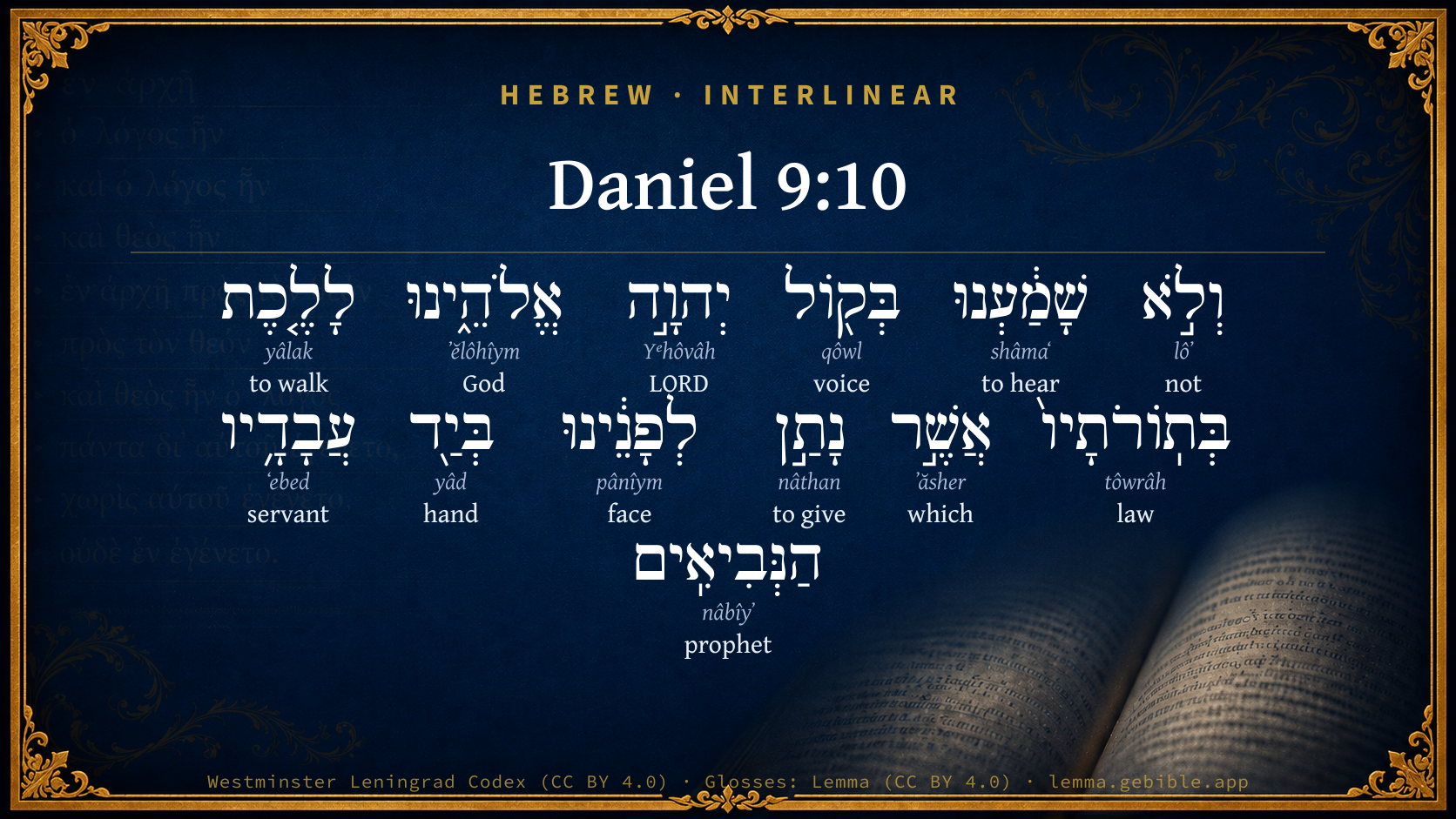
  1. וְלֹ֣א lôʼ H3808 “and · not” Conjunction + Particle, Negative
  2. שָׁמַ֔עְנוּ shâmaʻ H8085 “to hear” Verb, Qal, Perfect, 1st Person, Common, Plural
  3. בְּק֖וֹל qôwl H6963 “in/at · voice of” Preposition + Noun, Common, Masculine, Singular, Construct
  4. יְהוָ֣ה Yᵉhôvâh H3068 “LORD” Noun, Proper
  5. אֱלֹהֵ֑ינוּ ʼĕlôhîym H430 “God(s) · our” Noun, Common, Masculine, Plural, Construct + Suffix, Personal, 1st Person, Common, Plural
  6. לָלֶ֤כֶת yâlak H3212 “to walk” Preposition + Verb, Qal, Infinitive Construct
  7. אֲשֶׁ֣ר ʼăsher H834 “which” Particle, Relative
  8. נָתַ֣ן nâthan H5414 “to give” Verb, Qal, Perfect, 3rd Person, Masculine, Singular
  9. לְפָנֵ֔ינוּ pânîym H6440 “to/for · face(s) · our” Preposition + Noun, Common, Both, Plural, Construct + Suffix, Personal, 1st Person, Common, Plural
  10. בְּיַ֖ד yâd H3027 “in/at · hand of” Preposition + Noun, Common, Both, Singular, Construct
  11. עֲבָדָ֥יו ʻebed H5650 “servants · his” Noun, Common, Masculine, Plural, Construct + Suffix, Personal, 3rd Person, Masculine, Singular
  12. הַנְּבִיאִֽים nâbîyʼ H5030 “the · prophets” Particle, Definite Article + Noun, Common, Masculine, Plural, Absolute

About this verse

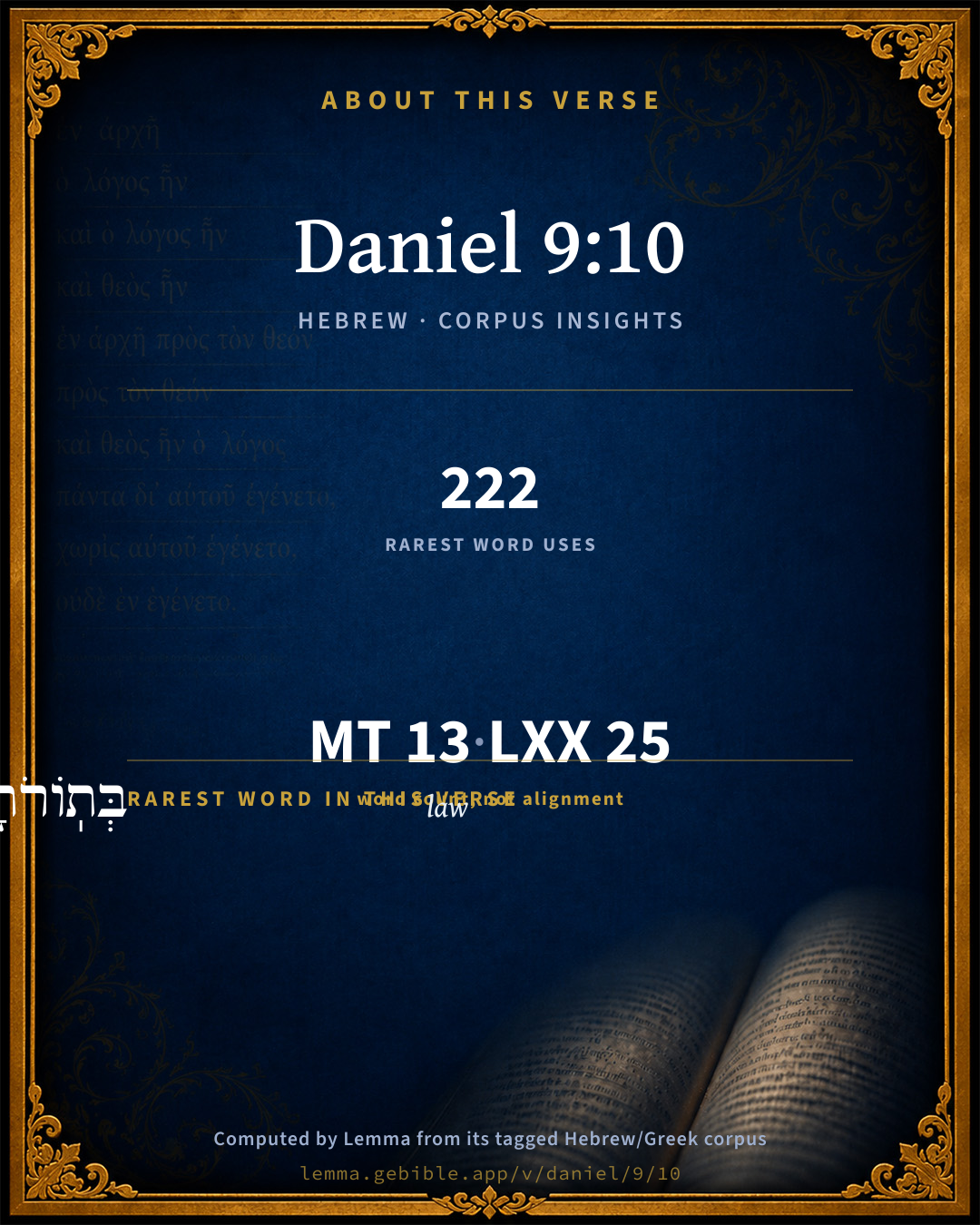
These counts appear in no published source. They are computed here, from the morphology-tagged text and Lemma’s own curated glosses. What Lemma adds →

13
words
13
distinct lemmas
Prophets
section

Grammatical profile

  • 3 verbs
  • 8 nouns
  • 2 particles

Verb forms

  • שָׁמַ֔עְנוּ Qal · Perfect
  • לָלֶ֤כֶת Qal · Infinitive Construct
  • נָתַ֣ן Qal · Perfect

Hebrew & Septuagint length

In English translation the verse runs 25 words from the Hebrew and 30 from the Septuagint (LXX English) — closely comparable.

A rough comparison of the two English renderings, which tokenize alike — not a word-level alignment.

Word counts can differ between the Hebrew and the Greek without any difference in meaning — e.g. the Hebrew direct-object marker אֵת has no separate Greek word, and Greek often adds the article ὁ.

In the original languages it is 13 Hebrew tokens and 25 Greek tokens — but the two are counted differently (Hebrew bundles its prefixes and suffixes into one token; the Greek is in lemma form), so that isn’t a like-for-like length.

Cross-references

6

Topical passages linked to Daniel 9:10 in the Treasury of Scripture Knowledge — connected by theme and wording, ordered by reader-vote popularity; previews shown in the World English Bible.

  • Daniel 9:6 neither have we listened to your servants the prophets, who spoke in your name to our kings, our princes, and our fathers, and to all the people of the land.
  • 2 Kings 18:12 because they didn't obey the voice of Yahweh their God, but transgressed his covenant, even all that Moses the servant of Yahweh commanded, and would not hear it, nor do it.
  • Nehemiah 9:13–17 You came down also on Mount Sinai, and spoke with them from heaven, and gave them right ordinances and true laws, good statutes and commandments,
  • 2 Kings 17:13–15 Yet Yahweh testified to Israel, and to Judah, by every prophet, and every seer, saying, Turn you from your evil ways, and keep my commandments and my statutes, according to all the law which I commanded your fathers, and which I sent to you by my servants the prophets.
  • Hebrews 1:1 God, having in the past spoken to the fathers through the prophets at many times and in various ways,
  • Ezra 9:10–11 Now, our God, what shall we say after this? for we have forsaken your commandments,

Cross-references courtesy of OpenBible.info (CC BY 4.0).

Hebrew and Greek witnesses Masoretic Hebrew ↔ Greek Septuagint

The same verse in the two great witnesses to the Old Testament, shown verse-for-verse.

These are two independent witnesses, not word-aligned to each other, and the Septuagint is shown in lemma (dictionary) form.

Hebrew Daniel 9:10 Masoretic · Westminster Leningrad Codex

וְלֹ֣א שָׁמַ֔עְנוּ בְּק֖וֹל יְהוָ֣ה אֱלֹהֵ֑ינוּ לָלֶ֤כֶת בְּתֽוֹרֹתָיו֙ אֲשֶׁ֣ר נָתַ֣ן לְפָנֵ֔ינוּ בְּיַ֖ד עֲבָדָ֥יו הַנְּבִיאִֽים

neither have we obeyed the voice of Yahweh our God, to walk in his laws, which he set before us by his servants the prophets.

World English Bible · Public Domain

Greek LXX Daniel 9:10 Septuagint · lemma form

καί οὐ ἀκούω ὁ φωνή κύριος ὁ θεός ἐγώ καταἀκολουθέω ὁ νόμος σύ ὅς δίδωμι ἐνώπιον μωσῆς καί ἐγώ διά ὁ παῖς σύ ὁ προφήτης

neither have we listened to the voice of the Lord our God, to walk in his laws, which he set before us by the hands of his servants the prophets.

LXX2012 (modern English Septuagint) · Public Domain

Hebrew: Westminster Leningrad Codex (CC BY 4.0). Greek: Septuagint (public domain); English from LXX2012 (modern English Septuagint) (Public Domain). How the Septuagint differs from the Hebrew →

Commentary

Notes on Daniel 9:10 from classic Christian and Jewish commentators (each source and its license shown beneath its notes). The classic Christian expositions comment on the surrounding passage and are grouped to its opening verse, so a note may address several verses; the Jewish commentaries on the Tanakh (Rashi and others) are per-verse, so they appear only where the commentator wrote on this verse.

Lemma curates 59 commentaries, every one of them public domain or Creative Commons licensed, each selected and text-cleaned for this edition rather than reprinted as found. About our sources →

Trapp's Complete Commentary

John Trapp

Dan 9:10 Neither have we obeyed the voice of the LORD our God, to walk in his laws, which he set before us by his servants the prophets.

Ver. 10. Neither have we obeyed.] See on Dan 9:6.

The voice of the Lord our God] It is the Lord who speaketh in and by his ministers. This because men either know not or weigh not, they run another way when God calleth to them, as young Samuel did. {1Sa 3:5}

John Trapp, A Commentary or Exposition upon All the Books of the Old and New Testament (1647–1656) — public domain. Text from a community e-Sword module.

Geneva Bible (1599)

Geneva Bible translators

He showeth that they rebel against God, which serve him not according to his commandment and word.

Geneva Bible (1599) marginal notes — public domain. Text via Bolls.life.

Jamieson, Fausset & Brown

Robert Jamieson, A. R. Fausset & David Brown

set before us--not ambiguously, but plainly, so that we were without excuse.

Jamieson, Fausset & Brown — Commentary Critical and Explanatory on the Whole Bible (1871) — public domain (CC PDM 1.0). Text via the HelloAO Bible API.

John Calvin's Commentaries

Here, again, Daniel shews how the Israelites provoked God’s anger against them by the wickedness of their conduct. He points out one special kind of sin and method of acting wickedly, namely, despising the teaching which proceeded from God as its author, and was expounded to them by his prophets. We must diligently notice this, as we have previously advised; for although no one is excusable before God by the pretext of ignorance, yet we perceive how our wickedness is aggravated when we knowingly and willfully make a point of rejecting what God commands and teaches. Daniel, therefore, enlarges upon the people’s crime by adding the circumstance, they would not hear the prophets Everything which would have been a fault in the Chaldeans or Assyrians was the most grievous wickedness in the elect people. Their obstinacy was the more provoking, because while God had pointed out the way by his prophets, they had turned their backs upon him. We have not heard Clearly enough this verse is added by way of explanation, as Daniel might express the reason for their wickedness. Therefore he calls the laws of God “doctrine,” which consists of many parts; for it is certain that nothing was omitted by God which was useful to be known, and thus he had embraced the whole perfection of justice in his discourse. He is treating here not only the law of Moses, but the teaching of the prophets, as the words clearly point out; and the noun תורה torah, “law,” is to be taken for “doctrine.” It is just as if Daniel had said, God was rejected when he wished to rule his people by his prophets. But the plural number seems to denote what I have staffed, namely, that the perfection of doctrine was comprehended in the prophets; for God omitted nothing while he completed the revelation of whatever was needful for the guidance of the life. Yet this was rendered entirely useless by the perverseness of the people’s nature, apparent in their rejection of all God’s laws.

Daniel confirms this sentiment by adding, Those laws were set before the people This shews how everything was supplied to the people, since God had familiarly delivered to them whatever was needful for the utmost degree of piety and justice. For this phrase, to put anything before one’s face, means to deliver all useful knowledge openly, perspicuously, and lucidly, and with great familiarity and skillfulness. Thus nothing is left doubtful or complicated, nothing remains obscure, unconnected, or confused. As, therefore, God had unfolded the whole scope of righteousness by his law, the people’s impiety was the more severe and detestable, because they would not receive benefit from such familiar instruction. The Prophet intends by these words to shew how such willful sinners were worthy of double punishment. They are first convicted of contumacy because they had no pretext for their ignorance; they made an open and furious assault upon God, for although the way was pointed out to them, yet they turned aside in all directions, and threw themselves headlong. We must remember what I have previously touched upon, namely, the value of an external ministry, because we are aware how the ancient people, when rebellious against the prophets, were accustomed to pretend that they did not really despise God. As, therefore, hypocrites think their sins are concealed by a covering of this kind, Daniel clearly expresses that God is despised in his prophets, although he neither descends from heaven nor sends down his angels. And this is the meaning of the expression, the prophets were the servants of God; it declares how they taught nothing either rashly or in their own name or by their own impulse, but faithfully executed the Almighty’s commands. It follows: —

John Calvin's Commentaries (1540-1563) — public domain. Text from the Calvin Translation Society English edition (1840s-50s) via the Christian Classics Ethereal Library (ccel.org). Calvin's coverage is partial (roughly two-thirds of the Bible); uncommented books and verses are honest gaps, never fabricated. The 19th-century editor's footnotes and remarks are omitted so the notes are faithfully Calvin's own voice.

The Cambridge Bible for Schools and Colleges

gen. ed. J. J. S. Perowne

10. obeyed (lit. hearkened to) the voice, &c.] So Exo_15:26; Exo_19:5; and especially in Deut. (as Deu_4:30, Deu_9:23, Deu_28:1-2; Deu_28:15), and Jer. (as Jer_3:13, Jer_9:13, Jer_44:23). Cf. with this verse Bar_1:18; Bar_2:10.

to walk in his laws] Cf. Jer_26:4; Jer_32:23; Jer_44:10; Jer_44:23.

which he set before us] See Deu_4:8; Deu_11:32; Jer_9:13; Jer_44:10, and esp. Jer_26:4 (cf. the last clause).

The Cambridge Bible for Schools and Colleges (gen. ed. J. J. S. Perowne; Cambridge University Press, 1878–1918) — public domain. Text from a community e-Sword module.

John Gill's Exposition

Neither have we obeyed the voice of the Lord our God,.... Speaking in the law, and by his prophets; for what was spoken there, and by them, should have been considered, not as the word of man, but as the word of God, and should have been attended to and obeyed; for despising that and them was interpreted as despising the Lord, and refusing to hearken to him, and obey his voice; which was a sin highly provoking to him, and resented by him:

to walk in his laws, which he set before us by his servants the prophets; by Moses and others; for it seems to include the system of laws which were delivered by Moses, and were many; and the doctrines of the prophets, which were explications and enforcements of them: and these the Lord set before them by both, as a rule to walk by, and a path to walk in; and not to do this was very sinful in them, and greatly displeasing to him.

John Gill's Exposition of the Whole Bible (1746–1763) — public domain (CC PDM 1.0). Text via the HelloAO Bible API.

Albert Barnes' Notes on the Bible

Neither have we obeyed the voice of the Lord - The commands of God as made known by the prophets, Dan 9:6.

Albert Barnes' Notes on the Bible (1834–1885) — public domain. Text from a community e-Sword/MySword module.

Matthew Poole's English Annotations

To be large in,

1. Confession of sin, especially in a day of humiliation, is no vain repetition, for we offend commonly in being slight and perfunctory in our confessions; and God will have all out, and make us own it.

2. It was God’s mercy not only to give his people a law, which he did solemnly by Moses, but set it plainly and powerfully before them, and set it home upon them by the expositions and applications of all the prophets, for this was their work.

Matthew Poole's English Annotations on the Holy Bible (1683–1685) — public domain. Text from a community e-Sword/MySword module.

Whedon's Commentary on the Bible

Daniel D. Whedon

10, 11. Having disobeyed persistently the written law, the penalty of disobedience, which God had confirmed by an oath, had to be inflicted. (See Lev_26:14-39; Deu_28:15-68; Deu_29:14; Deu_29:19-28; Deu_30:17-19.)

Daniel D. Whedon (gen. ed.), Commentary on the Old and New Testaments (1874–1909) — public domain. Text from a community e-Sword module.

Lesson kit

Teaching starters — assembled from the data on this page, not authored interpretation. Every prompt links to the verse data it draws on. Edit before teaching.

Daniel, in the Prophets, opens this verse with 13 words (13 distinct Hebrew lemmas). Its most distinctive word is tôwrâh (“law”). A historical commentator’s framing appears above. Read the whole chapter for the surrounding context.

Discussion questions

  1. How does “law” (tôwrâh) shape what this verse is saying?
  2. How does Daniel 9:6, which shares this passage’s theme, read alongside this verse?
  3. These translations render this verse differently. What is at stake in choosing one wording over another?
  4. «שָׁמַ֔עְנוּ» is a Qal Perfect verb. How does that grammatical form shape the action described?
  5. Compare how Trapp's Complete Commentary and Geneva Bible (1599) read this verse. Where do they agree or differ?

Things to notice

Reading settings

Reading text

Shown beneath each verse's original-language words.

Old Testament
Old Testament edition

Read the OT as the Masoretic Hebrew (MT) or the Greek Septuagint (LXX).

English shown for the Greek Septuagint (in the Hebrew ↔ Greek comparison).

Comparing translations? Open the Compare panel on any verse page to stack up to four side by side.