Genesis 24:36

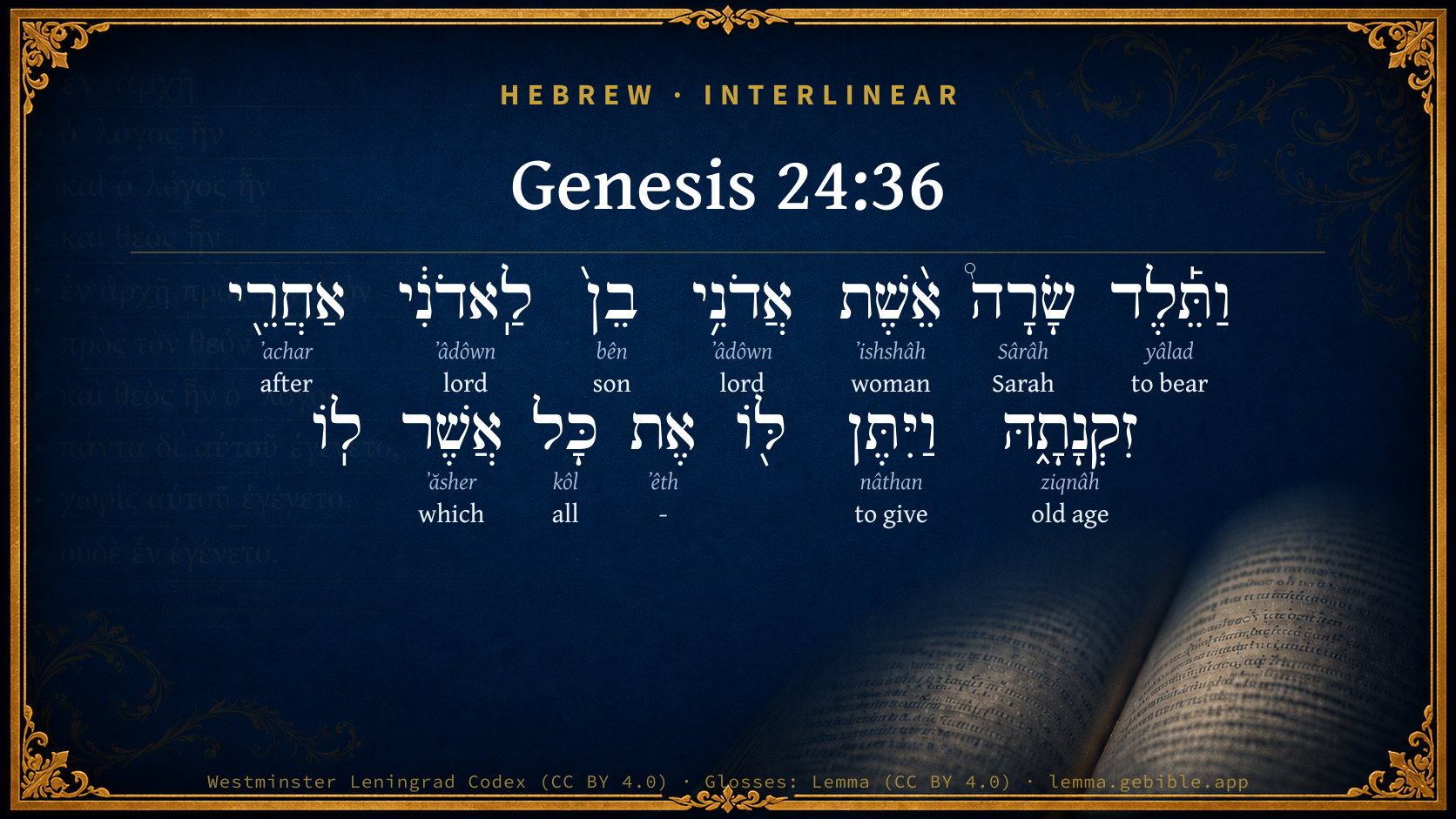
Hebrew (Westminster Leningrad Codex) Genesis 24:36 appears in the Hebrew Old Testament. The text above is from the Westminster Leningrad Codex. Each word links to its Strong’s number, a concise gloss, and parsing drawn from the Open Scriptures Hebrew Bible morphology. Click any word for its full Brown-Driver-Briggs (BDB) entry.
Download image
Cite this verse

Genesis 24:36 (World English Bible). Public Domain. Lemma interlinear Bible study tool, https://lemma.gebible.app/v/genesis/24/36.

Show BibTeX & RIS
BibTeX
RIS
English Translation
Sarah, my master's wife, bore a son to my master when she was old. He has given all that he has to him.
World English Bible · Public Domain
Highlights
  • 1 first appearance in the Hebrew Bible
Full analysis ↓
Download a study sheet

One document with this verse’s original text, its word-by-word gloss line, the meaning frame, cross-references with their text, attributed commentary, and full source and license credits — printable, and it pastes into notes with its structure intact.

This verse Autodidact and up

Study sheet (.html) Plain text (.txt)

A passage Seminary Student

Up to 50 verses in one chapter. A passage sheet keeps up to 6 commentary sources and 12 cross-references per verse, in the order this page ranks them, and says so on the sheet whenever that leaves anything out. Ask for a single verse and you get the Autodidact verse sheet above.

Everything on this page stays free to read, with no account — the sheet is a download of what is already on screen, not access to it.

Want to remove ads? Support Godless Engineer
Compare translations 3

The same verse in 3 English versions, stacked beneath the original-language interlinear above. Click any original word for its lexicon entry.

Each is an independent rendering of the whole verse — the interlinear is not word-aligned to these translations.

Highlighted words mark where these versions differ — a whole-verse word diff, not a word-by-word alignment.

  • World English Bible Public Domain
    Sarah, my master's wife, bore a son to my master when she was old. He has given all that he has to him.
  • King James Version Public Domain
    And Sarah my master's wife bare a son to my master when she was old: and unto him hath he given all that he hath.
  • unfoldingWord Literal Text CC BY-SA 4.0
    And Sarah, the wife of my master, bore a son for my master after her old age, and he has given to him everything that to him.

unfoldingWord Literal Text — © unfoldingWord, licensed CC BY-SA 4.0. Word-aligned USFM3 via Door43 (git.door43.org/unfoldingWord/en_ult).

Versions to compare (up to 4)

3 of 4 selected

Show all 18 translations

Every available English version of this verse, each an independent rendering of the whole verse.

  • World English Bible Public Domain
    Sarah, my master's wife, bore a son to my master when she was old. He has given all that he has to him.
  • Berean Standard Bible Public Domain
    My master’s wife Sarah has borne him a son in her old age, and my master has given him everything he owns.
  • Majority Standard Bible Public Domain
    My master’s wife Sarah has borne him a son in her old age, and my master has given him everything he owns.
  • King James Version Public Domain
    And Sarah my master's wife bare a son to my master when she was old: and unto him hath he given all that he hath.
  • American Standard Version (1901) Public Domain
    And Sarah my master's wife bare a son to my master when she was old. And unto him hath he given all that he hath.
  • Revised Version (1885) Public Domain
    And Sarah my master’s wife bare a son to my master when she was old: and unto him hath he given all that he hath.
  • Geneva Bible (1599) Public Domain
    And Sarah my masters wife hath borne a sonne to my master, when she was olde, and vnto him hath he giuen all that he hath.
  • Douay-Rheims (1899) Public Domain
    And Sara my master's wife hath borne my master a son in her old age, and he hath given him all that he had.
  • Young's Literal Translation Public Domain
    and Sarah, my lord's wife, beareth a son to my lord, after she hath been aged, and he giveth to him all that he hath.
  • Literal Standard Version CC BY-SA 4.0
    and Sarah, my lord’s wife, bears a son to my lord, after she has been aged, and he gives to him all that he has.
  • Unlocked Literal Bible CC BY-SA 4.0
    Sarah, my master's wife, bore a son to my master when she was old, and he has given everything that he owns to him.
  • unfoldingWord Literal Text CC BY-SA 4.0
    And Sarah, the wife of my master, bore a son for my master after her old age, and he has given to him everything that to him.
  • Darby Bible Public Domain
    And Sarah, my master's wife, bore a son to my master after she had grown old; and unto him has he given all that he has.
  • World Messianic Bible Public Domain
    Sarah, my master’s wife, bore a son to my master when she was old. He has given all that he has to him.
  • Webster's Bible Public Domain
    And Sarah, my master's wife, bore a son to my master when she was old: and to him hath he given all that he hath.
  • Free Bible Version CC BY-SA 4.0
    His wife Sarah has had a son for my master even in her old age, and my master has given him everything he owns.
  • Bible in Basic English Public Domain
    And when Sarah, my master's wife, was old, she gave birth to a son, to whom he has given all he has.
  • JPS Tanakh (1917) Public Domain
    And Sarah my master's wife bore a son to my master when she was old; and unto him hath he given all that he hath.

Literal Standard Version (2020), Covenant Press — licensed CC BY-SA 4.0. Text via the HelloAO Bible API (eBible.org). Unlocked Literal Bible (unfoldingWord) — licensed CC BY-SA 4.0. Text via the HelloAO Bible API (eBible.org). unfoldingWord Literal Text — © unfoldingWord, licensed CC BY-SA 4.0. Word-aligned USFM3 via Door43 (git.door43.org/unfoldingWord/en_ult). Free Bible Version, Dr. Jonathan Gallagher — licensed CC BY-SA 4.0. Text via the HelloAO Bible API (eBible.org).

Word by word

More ways to search: Search by grammar → Find every occurrence → Compare this word →

Practice this passage: Drill this verse → Learn its vocabulary →

זִקְנָתָ֑הּ
ziqnâh
H2209
“old age · her”
Noun, Common, Feminine, Singular, Construct + Suffix, Personal, 3rd Person, Feminine, Singular
Part of Speech
Noun
Type
Common
Gender
Feminine
Number
Singular
State
Construct
Full BDB Definition

Origin: from H2205

TWOT: 574d

old age
  1. וַתֵּ֡לֶד yâlad H3205 “and · to bear” Conjunction + Verb, Qal, Sequential Imperfect, 3rd Person, Feminine, Singular
  2. שָׂרָה֩ Sârâh H8283 “Sarah” Noun, Proper
  3. אֵ֨שֶׁת ʼishshâh H802 “woman of” Noun, Common, Feminine, Singular, Construct
  4. אֲדֹנִ֥י ʼâdôwn H113 “lord · my” Noun, Common, Masculine, Singular, Construct + Suffix, Personal, 1st Person, Common, Singular
  5. בֵן֙ bên H1121 “son” Noun, Common, Masculine, Singular, Absolute
  6. לַֽאדֹנִ֔י ʼâdôwn H113 “to/for · lord · my” Preposition + Noun, Common, Masculine, Singular, Construct + Suffix, Personal, 1st Person, Common, Singular
  7. אַחֲרֵ֖י ʼachar H310 “after” Preposition
  8. וַיִּתֶּן nâthan H5414 “and · to give” Conjunction + Verb, Qal, Sequential Imperfect, 3rd Person, Masculine, Singular
  9. אֶת ʼêth H853 “-” Particle, Direct Object
  10. כָּל kôl H3605 “all of” Noun, Common, Masculine, Singular, Construct
  11. אֲשֶׁר ʼăsher H834 “which” Particle, Relative

About this verse

These counts appear in no published source. They are computed here, from the morphology-tagged text and Lemma’s own curated glosses. What Lemma adds →

14
words
11
distinct lemmas
Pentateuch
section

Notable vocabulary

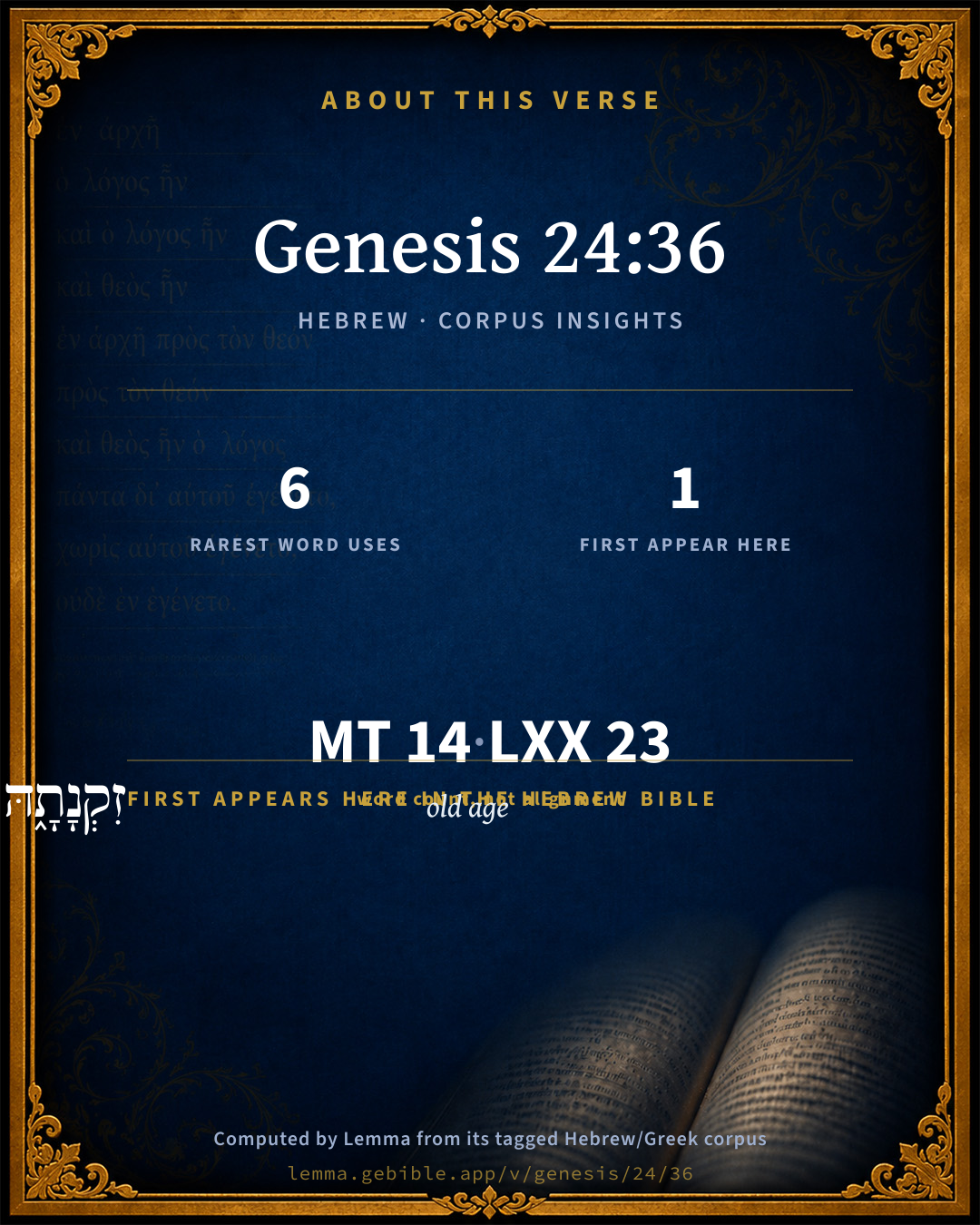
The rarest word here is זִקְנָתָ֑הּ old age H2209 — appearing just 6 times in the whole Hebrew Bible.

First appearance in Scripture

This word makes its first canonical appearance in the Hebrew Bible here:

  • זִקְנָתָ֑הּ old age H2209

Shared distinctive vocabulary

זִקְנָתָ֑הּ old age H2209 occurs in 6 verses of the Hebrew Bible. Also found in:

Grammatical profile

  • 2 verbs
  • 7 nouns
  • 3 prepositions
  • 2 particles

Verb forms

  • וַתֵּ֡לֶד Qal · Sequential Imperfect
  • וַיִּתֶּן Qal · Sequential Imperfect

Repetition

A word recurs within this verse — often emphatic in Hebrew:

  • אֲדֹנִ֥י lord H113 ×2

Hebrew & Septuagint length

In English translation the verse runs 23 words from the Hebrew and 23 from the Septuagint (LXX English) — the same length.

A rough comparison of the two English renderings, which tokenize alike — not a word-level alignment.

Word counts can differ between the Hebrew and the Greek without any difference in meaning — e.g. the Hebrew direct-object marker אֵת has no separate Greek word, and Greek often adds the article ὁ.

In the original languages it is 14 Hebrew tokens and 23 Greek tokens — but the two are counted differently (Hebrew bundles its prefixes and suffixes into one token; the Greek is in lemma form), so that isn’t a like-for-like length.

Cross-references

7

Topical passages linked to Genesis 24:36 in the Treasury of Scripture Knowledge — connected by theme and wording, ordered by reader-vote popularity; previews shown in the World English Bible.

  • Genesis 25:5 Abraham gave all that he had to Isaac,
  • Genesis 21:10 Therefore she said to Abraham, "Cast out this handmaid and her son! For the son of this handmaid will not be heir with my son, even with Isaac."
  • Genesis 21:1–7 Yahweh visited Sarah as he had said, and Yahweh did to Sarah as he had spoken.
  • Genesis 17:15–19 God said to Abraham, "As for Sarai your wife, you shall not call her name Sarai, but her name will be Sarah.
  • Genesis 18:10–14 He said, "I will certainly return to you when the season comes round. Behold, Sarah your wife will have a son." Sarah heard in the tent door, which was behind him.
  • Romans 4:19 Without being weakened in faith, he didn't consider his own body, already having been worn out, (he being about a hundred years old), and the deadness of Sarah's womb.
  • Genesis 11:29–30 Abram and Nahor took wives. The name of Abram's wife was Sarai, and the name of Nahor's wife, Milcah, the daughter of Haran who was also the father of Iscah.

Cross-references courtesy of OpenBible.info (CC BY 4.0).

Hebrew and Greek witnesses Masoretic Hebrew ↔ Greek Septuagint

The same verse in the two great witnesses to the Old Testament, shown verse-for-verse.

These are two independent witnesses, not word-aligned to each other, and the Septuagint is shown in lemma (dictionary) form.

Hebrew Genesis 24:36 Masoretic · Westminster Leningrad Codex

וַתֵּ֡לֶד שָׂרָה֩ אֵ֨שֶׁת אֲדֹנִ֥י בֵן֙ לַֽאדֹנִ֔י אַחֲרֵ֖י זִקְנָתָ֑הּ וַיִּתֶּן לּ֖וֹ אֶת כָּל אֲשֶׁר לֽוֹ

Sarah, my master's wife, bore a son to my master when she was old. He has given all that he has to him.

World English Bible · Public Domain

Greek LXX Genesis 24:36 Septuagint · lemma form

καί τίκτω σαρρα ὁ γυνή ὁ κύριος ἐγώ υἱός εἷς ὁ κύριος ἐγώ μετά ὁ γηράω αὐτός καί δίδωμι αὐτός ὅσος εἰμί αὐτός

And Sarrha my master's wife bore one son to my master after he had grown old; and he gave him whatever he had.

LXX2012 (modern English Septuagint) · Public Domain

Hebrew: Westminster Leningrad Codex (CC BY 4.0). Greek: Septuagint (public domain); English from LXX2012 (modern English Septuagint) (Public Domain). How the Septuagint differs from the Hebrew →

Targum (Aramaic paraphrase)

2

The Targum is the ancient Jewish Aramaic paraphrase of the Hebrew Scriptures — an interpretive translation, not the Hebrew text itself. Onkelos (literal) and Pseudo-Jonathan (expansive) render the Torah, and Jonathan the Prophets. Coverage is partial: where no permissively-licensed English translation exists for a verse, only the Aramaic is shown. This is verse-level text, not a word-by-word alignment to the Hebrew.

  1. Targum Onkelos Torah (Genesis–Deuteronomy)
    וִילֵידַת שָׂרָה אִתַּת רִבּוֹנִי בַר לְרִבּוֹנִי בָּתַר דְּסֵיבָת וִיהַב לֵהּ יָת כָּל דִּילֵהּ

    (no public-domain English translation for this verse)

    Targum Onkelos — Aramaic: “Onkelos Genesis” (public domain); “Onkelos Exodus” (public domain); “Onkelos Leviticus” (public domain); “Onkelos Numbers” (public domain); “Onkelos Deuteronomy” (public domain). English: “Sefaria Community Translation” (CC0 1.0 (public-domain dedication)); “J.W. Etheridge. The Targums of Onkelos and Jonathan Ben Uzziel on the Pentateuch. London: Longmans, Green, 1862” (public domain). Text via Sefaria.

  2. Targum Pseudo-Jonathan Torah (Genesis–Deuteronomy)
    וִילֵדַת שָרָה אִיתַּת רִבּוֹנִי בַּר לְרִבּוֹנִי בָּתַר דְסֵיבַת וִיהַב לֵיהּ יַת כָּל דִילֵיהּ

    And Sarah; my master's wife, bare a son after she was old, and he hath given to him all that he hath.

    Targum Pseudo-Jonathan — Aramaic: “Targum Jonathan on Genesis” (public domain); “Targum Jonathan on Exodus” (public domain); “Targum Jonathan on Leviticus” (public domain); “Targum Jonathan on Numbers” (public domain); “Targum Jonathan on Deuteronomy” (public domain). English: “The Targum of Jonathan ben Uzziel, trans. J. W. Etheridge, London, 1862” (public domain). Text via Sefaria.

Commentary

Notes on Genesis 24:36 from classic Christian and Jewish commentators (each source and its license shown beneath its notes). The classic Christian expositions comment on the surrounding passage and are grouped to its opening verse, so a note may address several verses; the Jewish commentaries on the Tanakh (Rashi and others) are per-verse, so they appear only where the commentator wrote on this verse.

Lemma curates 59 commentaries, every one of them public domain or Creative Commons licensed, each selected and text-cleaned for this edition rather than reprinted as found. About our sources →

Trapp's Complete Commentary

John Trapp

Gen 24:36 And Sarah my master’s wife bare a son to my master when she was old: and unto him hath he given all that he hath.

Ver. 36. Unto him hath he given all that he hath.] This he knew would take well with them. What hath he? is a main question. In suites both of law and of love, money weighs and sways much. R. Solomon here addeth to the text (but not well) these words, - And lo the conveyance, or deed of gift is here in mine hand.

John Trapp, A Commentary or Exposition upon All the Books of the Old and New Testament (1647–1656) — public domain. Text from a community e-Sword module.

Adam Clarke's Commentary

Verse 36. Unto him hath he given all that he hath.] He has made Isaac his sole heir. These things appear to be spoken to show the relatives of Rebekah that his master's son was a proper match for her; for even in those primitive times there was regard had to the suitableness of station and rank in life, as well as of education, in order to render a match comfortable. Persons of dissimilar habits, as well as of dissimilar religious principles, are never likely to be very happy in a married life. Even the poor and the rich may better meet together in matrimonial alliances than the religious and the profane, the well-bred and the vulgar. A person may be unequally yoked in a great variety of ways: Bear ye one another's burdens is the command of God; but where there is unsuitableness in the dispositions, education, mental capacity, &c., of the persons, then one side is obliged to bear the whole burden, and endless dissatisfaction is the result. See at the end. "See Clarke's note at Ge 24:67".

Adam Clarke's Commentary on the Bible (1810–1826) — public domain. Text from a community e-Sword/MySword module.

The Cambridge Bible for Schools and Colleges

gen. ed. J. J. S. Perowne

36. unto him hath he given] The servant here states that Abraham has already made over to Isaac the great bulk of his wealth, as is stated in Gen_25:5. Those who suppose that the mention of Abraham’s death originally occurred after Gen_24:9, regard this sentence as indicating Abraham’s final disposition of his property.

The Cambridge Bible for Schools and Colleges (gen. ed. J. J. S. Perowne; Cambridge University Press, 1878–1918) — public domain. Text from a community e-Sword module.

John Gill's Exposition

And my master made me swear,.... See Gill on Gen 24:3. In Gen 24:37, the servant relates the oath his master made him take, and the charge he gave him, much in the same language as in Gen 24:3.

.

Genesis 24:38

gen 24:38

gen 24:38

gen 24:38But thou shalt go unto my father's house, and to my kindred,

and take a wife unto my son. See Gill on Gen 24:4.

John Gill's Exposition of the Whole Bible (1746–1763) — public domain (CC PDM 1.0). Text via the HelloAO Bible API.

Matthew Poole's English Annotations

i.e. Hath purposed and promised, and doth by me engage that he will give. Things are oft said to be done, in Scripture language, when they will certainly and shortly be done.

Matthew Poole's English Annotations on the Holy Bible (1683–1685) — public domain. Text from a community e-Sword/MySword module.

unfoldingWord translationNotes

Door43 World Missions Community

General Information:

Abraham's servant continues speaking to Rebekah's family.

bore a son to my master

"gave birth to a son"

he has given ... to him

"my master has given ... to his son"

My master made me swear, saying

"My master made me swear that I would do what he told me to do. He said"

from the daughters of the Canaanites

This refers to Canaanite females. AT: "from the Canaanite women" or "from the Canaanites"

in whose land I make my home

"among whom I live." Here, "I" stands for Abraham and all of his family and servants. AT: "among whom we live" (See: Synecdoche)

to my relatives

"to my own clan"

translationWords

Sarah

oath

Canaan

unfoldingWord translationNotes — © Distant Shores Media and the Door43 World Missions Community, licensed CC BY-SA 4.0. Source: git.door43.org/Door43/en_tn.

Rashi

Rabbi Shlomo Yitzchaki (Rashi)

ויתן לו את כל אשר לו AND HE HATH GIVEN TO HIM ALL THAT HE HATH — he showed them the deed of gift.

Rashi on the Tanakh — English translations: “The Judaica Press complete Tanach with Rashi, translated by A. J. Rosenberg” (CC BY 4.0); “Pentateuch with Rashi's commentary by M. Rosenbaum and A.M. Silbermann, 1929-1934” (public domain); “The Metsudah Tanach series, Lakewood, N.J” (CC BY 4.0); and “The Book of Joshua, Metsudah Publications, 1997” (CC BY 4.0). Text via Sefaria.

Radak

Rabbi David Kimhi (Radak)

ותלד, even though he had a son from another woman. Seeing that he loved Sarah so much, and she was such an intimate soul-mate of his, and seeing that he loved Yitzchok the son of his old age, ונתן לו את כל אשר לו, so that Yitzchok is wealthy and greatly honoured in his own right.

Radak on the Tanakh — English translations: “Sefaria Community Translation” (CC0 1.0 (public-domain dedication)); “Eliyahu Munk, HaChut Hameshulash” (CC BY 4.0); “Rabbi Mike Feuer, Jerusalem Anthology” (CC BY 4.0); and “R. David Kimhi on the first book of Psalms, Translated by R.G. Finch, London, 1919” (public domain). Text via Sefaria.

Lesson kit

Teaching starters — assembled from the data on this page, not authored interpretation. Every prompt links to the verse data it draws on. Edit before teaching.

Genesis, in the Pentateuch, opens this verse with 14 words (11 distinct Hebrew lemmas). Its most distinctive word is ziqnâh (“old age”). A historical commentator’s framing appears above. Read the whole chapter for the surrounding context.

Discussion questions

  1. The word ziqnâh carries the sense “old age.” How does it shape the verse?
  2. This is the first place “old age” appears in Scripture (first appears here). What does its debut here establish?
  3. How does 1 Kings 11:4, which shares the word «old age», read alongside this verse?
  4. What does the repetition of “lord” (2× in this one verse) do in this verse?
  5. These translations render this verse differently; the difference is in the English rendering, not the original. What questions does that raise?
  6. «וַתֵּ֡לֶד» is a Qal Sequential Imperfect verb. How does that grammatical form shape the action described?
  7. Compare how Trapp's Complete Commentary and Adam Clarke's Commentary read this verse. Where do they agree or differ?

Things to notice

Reading settings

Reading text

Shown beneath each verse's original-language words.

Old Testament
Old Testament edition

Read the OT as the Masoretic Hebrew (MT) or the Greek Septuagint (LXX).

English shown for the Greek Septuagint (in the Hebrew ↔ Greek comparison).

Comparing translations? Open the Compare panel on any verse page to stack up to four side by side.