Genesis 34:11

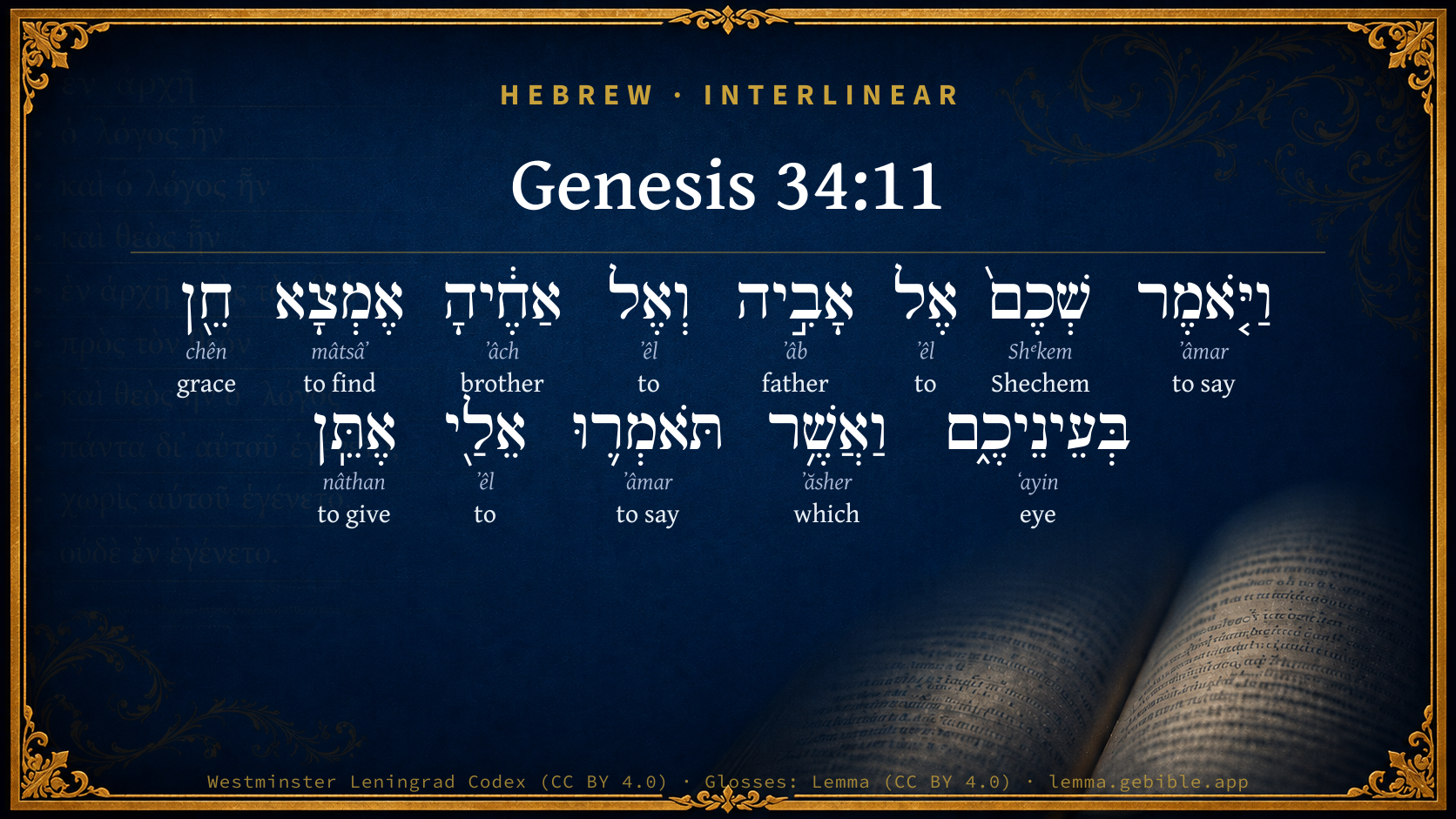
Hebrew (Westminster Leningrad Codex) Genesis 34:11 appears in the Hebrew Old Testament. The text above is from the Westminster Leningrad Codex. Each word links to its Strong’s number, a concise gloss, and parsing drawn from the Open Scriptures Hebrew Bible morphology. Click any word for its full Brown-Driver-Briggs (BDB) entry.
Download image
Cite this verse

Genesis 34:11 (World English Bible). Public Domain. Lemma interlinear Bible study tool, https://lemma.gebible.app/v/genesis/34/11.

Show BibTeX & RIS
BibTeX
RIS
English Translation
Shechem said to her father and to her brothers, "Let me find favor in your eyes, and whatever you will tell me I will give.
World English Bible · Public Domain
Download a study sheet

One document with this verse’s original text, its word-by-word gloss line, the meaning frame, cross-references with their text, attributed commentary, and full source and license credits — printable, and it pastes into notes with its structure intact.

This verse Autodidact and up

Study sheet (.html) Plain text (.txt)

A passage Seminary Student

Up to 50 verses in one chapter. A passage sheet keeps up to 6 commentary sources and 12 cross-references per verse, in the order this page ranks them, and says so on the sheet whenever that leaves anything out. Ask for a single verse and you get the Autodidact verse sheet above.

Everything on this page stays free to read, with no account — the sheet is a download of what is already on screen, not access to it.

Want to remove ads? Support Godless Engineer
Compare translations 3

The same verse in 3 English versions, stacked beneath the original-language interlinear above. Click any original word for its lexicon entry.

Each is an independent rendering of the whole verse — the interlinear is not word-aligned to these translations.

Highlighted words mark where these versions differ — a whole-verse word diff, not a word-by-word alignment.

  • World English Bible Public Domain
    Shechem said to her father and to her brothers, "Let me find favor in your eyes, and whatever you will tell me I will give.
  • King James Version Public Domain
    And Shechem said unto her father and unto her brethren, Let me find grace in your eyes, and what ye shall say unto me I will give.
  • unfoldingWord Literal Text CC BY-SA 4.0
    Then Shechem said to her father and to her brothers, “Let me find favor in your eyes, and what you say to me I will give.

unfoldingWord Literal Text — © unfoldingWord, licensed CC BY-SA 4.0. Word-aligned USFM3 via Door43 (git.door43.org/unfoldingWord/en_ult).

Versions to compare (up to 4)

3 of 4 selected

Show all 18 translations

Every available English version of this verse, each an independent rendering of the whole verse.

  • World English Bible Public Domain
    Shechem said to her father and to her brothers, "Let me find favor in your eyes, and whatever you will tell me I will give.
  • Berean Standard Bible Public Domain
    Then Shechem said to Dinah’s father and brothers, “Grant me this favor, and I will give you whatever you ask.
  • Majority Standard Bible Public Domain
    Then Shechem said to Dinah’s father and brothers, “Grant me this favor, and I will give you whatever you ask.
  • King James Version Public Domain
    And Shechem said unto her father and unto her brethren, Let me find grace in your eyes, and what ye shall say unto me I will give.
  • American Standard Version (1901) Public Domain
    And Shechem said unto her father and unto her brethren, Let me find favor in your eyes, and what ye shall say unto me I will give.
  • Revised Version (1885) Public Domain
    And Shechem said unto her father and unto her brethren, Let me find grace in your eyes, and what ye shall say unto me I will give.
  • Geneva Bible (1599) Public Domain
    Shechem also said vnto her father and vnto her brethren, Let me finde fauour in your eyes, and I will giue whatsoeuer ye shall appoint me.
  • Douay-Rheims (1899) Public Domain
    Sichem also said to her father and to her brethren: Let me find favor in your sight: and whatsoever you shall appoint I will give.
  • Young's Literal Translation Public Domain
    And Shechem saith unto her father, and unto her brethren, `Let me find grace in your eyes, and that which ye say unto me, I give;
  • Literal Standard Version CC BY-SA 4.0
    And Shechem says to her father and to her brothers, “Let me find grace in your eyes, and that which you say to me, I give;
  • Unlocked Literal Bible CC BY-SA 4.0
    Shechem said to her father and to her brothers, “Let me find favor in your eyes, and whatever you tell me I will give.
  • unfoldingWord Literal Text CC BY-SA 4.0
    Then Shechem said to her father and to her brothers, “Let me find favor in your eyes, and what you say to me I will give.
  • Darby Bible Public Domain
    And Shechem said to her father and to her brethren, Let me find favour in your eyes; and what ye shall say to me I will give.
  • World Messianic Bible Public Domain
    Shechem said to her father and to her brothers, “Let me find favor in your eyes, and whatever you will tell me I will give.
  • Webster's Bible Public Domain
    And Shechem said to her father, and to her brethren, Let me find favor in your eyes, and what ye shall say to me, I will give.
  • Free Bible Version CC BY-SA 4.0
    Then Shechem himself spoke up, and said to Dinah's father and brothers, “Please accept me and my proposal, and I'll do whatever you ask.
  • Bible in Basic English Public Domain
    And Shechem said to her father and her brothers, If you will give ear to my request, whatever you say I will give to you.
  • JPS Tanakh (1917) Public Domain
    And Shechem said unto her father and unto her brethren: 'Let me find favour in your eyes, and what ye shall say unto me I will give.

Literal Standard Version (2020), Covenant Press — licensed CC BY-SA 4.0. Text via the HelloAO Bible API (eBible.org). Unlocked Literal Bible (unfoldingWord) — licensed CC BY-SA 4.0. Text via the HelloAO Bible API (eBible.org). unfoldingWord Literal Text — © unfoldingWord, licensed CC BY-SA 4.0. Word-aligned USFM3 via Door43 (git.door43.org/unfoldingWord/en_ult). Free Bible Version, Dr. Jonathan Gallagher — licensed CC BY-SA 4.0. Text via the HelloAO Bible API (eBible.org).

Word by word

More ways to search: Search by grammar → Find every occurrence → Compare this word →

Practice this passage: Drill this verse → Learn its vocabulary →

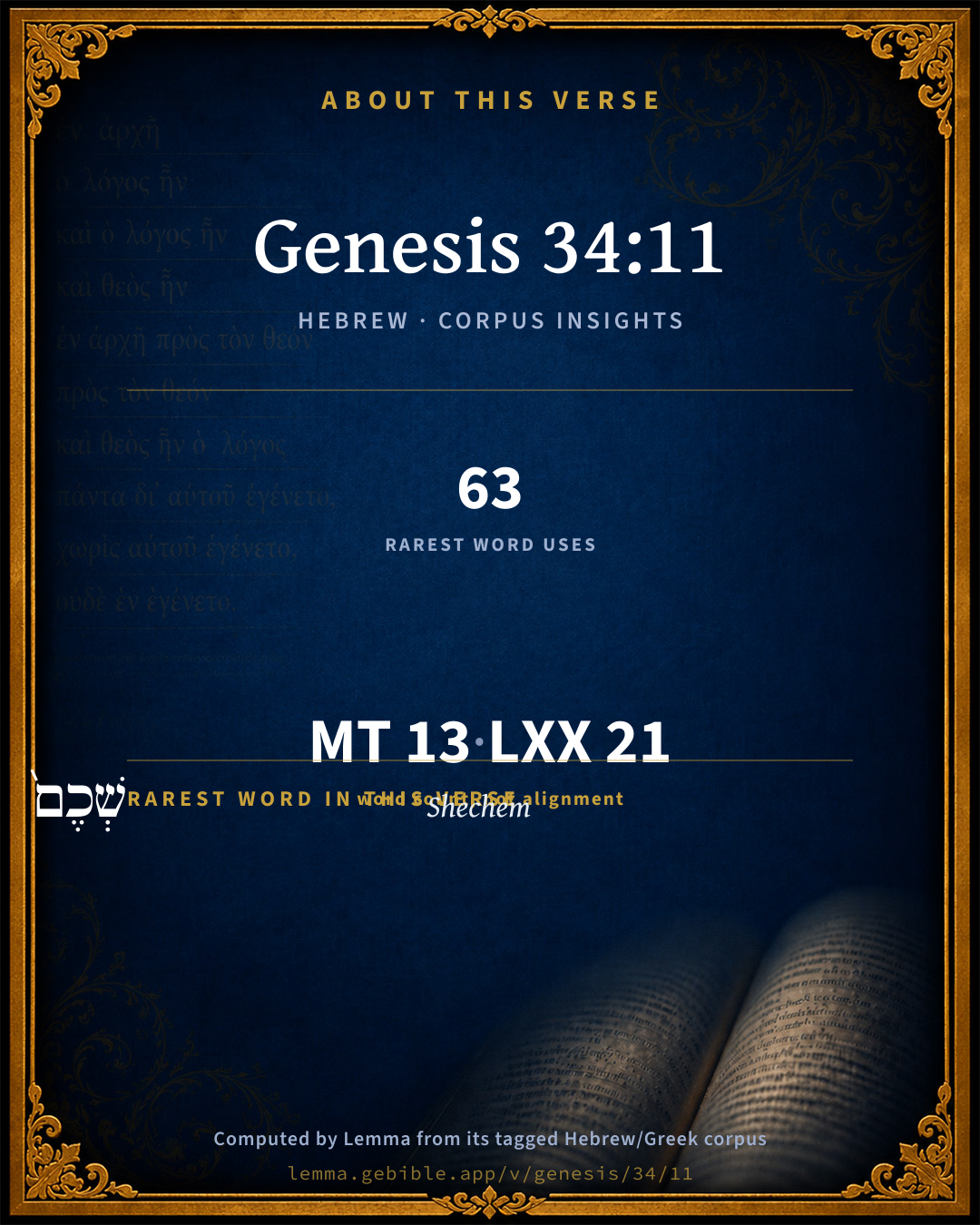
שְׁכֶם֙
Shᵉkem
H7927
“Shechem”
Noun, Proper
Part of Speech
Noun
Type
Proper
Full BDB Definition

Origin: the same as H7926

TWOT: 2386b

Shechem = "back" or " shoulder" - son of Hamor, the chieftain of the Hivites at Shechem at the time of Jacob's arrival (noun proper masculine) - a city in Manasseh; located in a valley between Mount Ebal and Mount Gerizim, 34 miles (54 kilometers) north of Jerusalem and 7 miles (noun proper locative)
  1. וַיֹּ֤אמֶר ʼâmar H559 “and · to say” Conjunction + Verb, Qal, Sequential Imperfect, 3rd Person, Masculine, Singular
  2. אֶל ʼêl H413 “to” Preposition
  3. אָבִ֣יה ʼâb H1 “father · her” Noun, Common, Masculine, Singular, Construct + Suffix, Personal, 3rd Person, Feminine, Singular
  4. וְאֶל ʼêl H413 “and · to” Conjunction + Preposition
  5. אַחֶ֔יהָ ʼâch H251 “brothers · her” Noun, Common, Masculine, Plural, Construct + Suffix, Personal, 3rd Person, Feminine, Singular
  6. אֶמְצָא mâtsâʼ H4672 “to find” Verb, Qal, Imperfect, 1st Person, Common, Singular
  7. חֵ֖ן chên H2580 “grace” Noun, Common, Masculine, Singular, Absolute
  8. בְּעֵינֵיכֶ֑ם ʻayin H5869 “in/at · eyes · your” Preposition + Noun, Common, Both, Dual, Construct + Suffix, Personal, 2nd Person, Masculine, Plural
  9. וַאֲשֶׁ֥ר ʼăsher H834 “and · which” Conjunction + Particle, Relative
  10. תֹּאמְר֛וּ ʼâmar H559 “to say” Verb, Qal, Imperfect, 2nd Person, Masculine, Plural
  11. אֵלַ֖י ʼêl H413 “to · me” Preposition + Suffix, Personal, 1st Person, Common, Singular
  12. אֶתֵּֽן nâthan H5414 “to give” Verb, Qal, Imperfect, 1st Person, Common, Singular

About this verse

These counts appear in no published source. They are computed here, from the morphology-tagged text and Lemma’s own curated glosses. What Lemma adds →

13
words
10
distinct lemmas
Pentateuch
section

Grammatical profile

  • 4 verbs
  • 5 nouns
  • 3 prepositions
  • 1 particle

Verb forms

  • וַיֹּ֤אמֶר Qal · Sequential Imperfect
  • אֶמְצָא Qal · Imperfect
  • תֹּאמְר֛וּ Qal · Imperfect
  • אֶתֵּֽן Qal · Imperfect

Repetition

Words recur within this verse — often emphatic in Hebrew:

  • וַיֹּ֤אמֶר to say H559 ×2
  • אֶל to H413 ×3

Hebrew & Septuagint length

In English translation the verse runs 25 words from the Hebrew and 24 from the Septuagint (LXX English) — closely comparable.

A rough comparison of the two English renderings, which tokenize alike — not a word-level alignment.

Word counts can differ between the Hebrew and the Greek without any difference in meaning — e.g. the Hebrew direct-object marker אֵת has no separate Greek word, and Greek often adds the article ὁ.

In the original languages it is 13 Hebrew tokens and 21 Greek tokens — but the two are counted differently (Hebrew bundles its prefixes and suffixes into one token; the Greek is in lemma form), so that isn’t a like-for-like length.

Cross-references

2

Topical passages linked to Genesis 34:11 in the Treasury of Scripture Knowledge — connected by theme and wording, ordered by reader-vote popularity; previews shown in the World English Bible.

  • Genesis 33:15 Esau said, "Let me now leave with you some of the folk who are with me." He said, "Why? Let me find favor in the sight of my lord."
  • Genesis 18:3 and said, "My lord, if now I have found favor in your sight, please don't go away from your servant.

Cross-references courtesy of OpenBible.info (CC BY 4.0).

Hebrew and Greek witnesses Masoretic Hebrew ↔ Greek Septuagint

The same verse in the two great witnesses to the Old Testament, shown verse-for-verse.

These are two independent witnesses, not word-aligned to each other, and the Septuagint is shown in lemma (dictionary) form.

Hebrew Genesis 34:11 Masoretic · Westminster Leningrad Codex

וַיֹּ֤אמֶר שְׁכֶם֙ אֶל אָבִ֣יה וְאֶל אַחֶ֔יהָ אֶמְצָא חֵ֖ן בְּעֵינֵיכֶ֑ם וַאֲשֶׁ֥ר תֹּאמְר֛וּ אֵלַ֖י אֶתֵּֽן

Shechem said to her father and to her brothers, "Let me find favor in your eyes, and whatever you will tell me I will give.

World English Bible · Public Domain

Greek LXX Genesis 34:11 Septuagint · lemma form

εἶπον δέ συχεμ πρός ὁ πατήρ αὐτός καί πρός ὁ ἀδελφός αὐτός εὑρίσκω χάρις ἐναντίον σύ καί ὅς ἐάν εἶπον δίδωμι

And Sychem said to her father and to her brothers, I would find grace before you, and we will give whatever you⌃ shall name.

LXX2012 (modern English Septuagint) · Public Domain

Hebrew: Westminster Leningrad Codex (CC BY 4.0). Greek: Septuagint (public domain); English from LXX2012 (modern English Septuagint) (Public Domain). How the Septuagint differs from the Hebrew →

Targum (Aramaic paraphrase)

2

The Targum is the ancient Jewish Aramaic paraphrase of the Hebrew Scriptures — an interpretive translation, not the Hebrew text itself. Onkelos (literal) and Pseudo-Jonathan (expansive) render the Torah, and Jonathan the Prophets. Coverage is partial: where no permissively-licensed English translation exists for a verse, only the Aramaic is shown. This is verse-level text, not a word-by-word alignment to the Hebrew.

  1. Targum Onkelos Torah (Genesis–Deuteronomy)
    וַאֲמַר שְׁכֶם לַאֲבוּהָא וּלְאַחָהָא אַשְׁכַּח רַחֲמִין בְּעֵינֵיכוֹן וְדִי תֵימְרוּן לִי אֶתֵּן

    (no public-domain English translation for this verse)

    Targum Onkelos — Aramaic: “Onkelos Genesis” (public domain); “Onkelos Exodus” (public domain); “Onkelos Leviticus” (public domain); “Onkelos Numbers” (public domain); “Onkelos Deuteronomy” (public domain). English: “Sefaria Community Translation” (CC0 1.0 (public-domain dedication)); “J.W. Etheridge. The Targums of Onkelos and Jonathan Ben Uzziel on the Pentateuch. London: Longmans, Green, 1862” (public domain). Text via Sefaria.

  2. Targum Pseudo-Jonathan Torah (Genesis–Deuteronomy)
    וַאֲמַר שְׁכֶם לְאָבוּהָא וּלְאָחָהָא אַשְׁכַּח רַחֲמִין בְּעֵינֵיכוֹן וּדְתֵימְרוּן לִי אִתֵּין

    And Shekem said to her father and to her brethren, Let me find grace in your sight, and what you shall tell me I will give.

    Targum Pseudo-Jonathan — Aramaic: “Targum Jonathan on Genesis” (public domain); “Targum Jonathan on Exodus” (public domain); “Targum Jonathan on Leviticus” (public domain); “Targum Jonathan on Numbers” (public domain); “Targum Jonathan on Deuteronomy” (public domain). English: “The Targum of Jonathan ben Uzziel, trans. J. W. Etheridge, London, 1862” (public domain). Text via Sefaria.

Commentary

Notes on Genesis 34:11 from classic Christian and Jewish commentators (each source and its license shown beneath its notes). The classic Christian expositions comment on the surrounding passage and are grouped to its opening verse, so a note may address several verses; the Jewish commentaries on the Tanakh (Rashi and others) are per-verse, so they appear only where the commentator wrote on this verse.

Lemma curates 59 commentaries, every one of them public domain or Creative Commons licensed, each selected and text-cleaned for this edition rather than reprinted as found. About our sources →

Trapp's Complete Commentary

John Trapp

Gen 34:11 And Shechem said unto her father and unto her brethren, Let me find grace in your eyes, and what ye shall say unto me I will give.

Ver. 11, 12. Ask me never so much dowry.] Heb., Multiply ye upon me, vehemently. Unbridled affection spares for no cost, so it may be satisfied. Judah parted with his signet, bracelets, and staff to the harlot. {Gen 38:18} Herod, that old fornicator, bids the dancing damsel ask what she will, to the half of his kingdom. {Mat 16:7} One there was that would not buy repentance so dear as the harlot demanded. {a} But those miscreants in Micah will give anything for a dispensation to live in sin; they offer "thousands of rams, and ten thousands of rivers of oil; yea, the sons of their body, for the sins of their souls." {Mic 6:7}

{a} Demosth.

John Trapp, A Commentary or Exposition upon All the Books of the Old and New Testament (1647–1656) — public domain. Text from a community e-Sword module.

Geneva Bible (1599)

Geneva Bible translators

Or, grant my request.

Geneva Bible (1599) marginal notes — public domain. Text via Bolls.life.

Jamieson, Fausset & Brown

Robert Jamieson, A. R. Fausset & David Brown

Shechem said unto her father . . . and brethren--The consideration of the proposal for marriage belonged to Jacob, and he certainly showed great weakness in yielding so much to the fiery impetuosity of his sons. The sequel shows the unhappy consequences of that concession.

Jamieson, Fausset & Brown — Commentary Critical and Explanatory on the Whole Bible (1871) — public domain (CC PDM 1.0). Text via the HelloAO Bible API.

The Cambridge Bible for Schools and Colleges

gen. ed. J. J. S. Perowne

11. And Shechem] Here, and in Gen_34:12, Shechem makes his own) overtures to Jacob and his sons. In Gen_34:6; Gen_34:8-10, Hamor has been negotiating on behalf of Shechem.

The Cambridge Bible for Schools and Colleges (gen. ed. J. J. S. Perowne; Cambridge University Press, 1878–1918) — public domain. Text from a community e-Sword module.

John Gill's Exposition

And Shechem said unto her father and unto her brethren,.... To the father and brethren of Dinah; he addressed them after his father Hamor had done speaking:

let me find grace in your eyes; forgive the offence committed, the injury done to Dinah, and grant the request of her marriage, and it will be considered as a great favour:

and what ye shall say unto me, I will give; to her, to her parents, to her brethren and relations; let what will be fixed, shall be given; which showed great affection for her, and that he was willing to do any thing to make amends for the injury done; he cared not what it was that might be demanded of him, so be it that she became his wife.

John Gill's Exposition of the Whole Bible (1746–1763) — public domain (CC PDM 1.0). Text via the HelloAO Bible API.

The Pulpit Commentary

Vers. 11, 12. And Shechem said unto her father and unto her brethren (speaking with becoming deference and earnestness, and manifestly prompted by fervent and sincere love), Let me find grace in your eyes, i.e. let my suit be accepted (vide Gen_33:15) and what ye shall say unto me I will give. Ask me never so much dowry and gift, literally, multiply upon me exceedingly dowry and gift; the dowry (mohar) being the price paid for a wife to her parents (cf. Exo_22:16; 1Sa_18:25) and the gift (mathan) the presents given to the bride (Gesenius, Furst, Rosenm Gerlach, Alford); or the dowry being the bride"s present, and the gift the wife s price (Michaelis, Keil, Murphy); or the dowry being given to the parents, and the gift to the kindred (Patrick); or the two being the same thing, vie., the compensation offered to the relatives of the bride (Lange)and I will give according as ye shall say unto me: but give (or, and ye will give) me the damsel to wife.

The Pulpit Commentary (1880–1919), ed. H.D.M. Spence-Jones & Joseph S. Exell — public domain. Text from a community e-Sword module.

unfoldingWord translationNotes

Door43 World Missions Community

Shechem said to her father

"Shechem said to Dinah's father Jacob"

Let me find favor in your eyes, and whatever you tell me I will give

The phrase "find favor" is an idiom which means to be approved of by someone. Also, the eyes represent seeing, and seeing represents thoughts or judgment. AT: "If you will approve of me, then I will give you whatever you ask" (See: Idiom and Metaphor)

bride price

In some cultures, it is customary for a man to give money, property, cattle, and other gifts to the bride's family at the time of marriage.

The sons of Jacob answered Shechem and Hamor his father with deceit

The abstract noun "deceit" can be stated as the verb "lied." AT: "But the sons of Jacob lied to Shechem and Hamor when they answered them" (See: Abstract Nouns)

Shechem had defiled Dinah

This means that Shechem had greatly dishonored and disgraced Dinah by forcing her to sleep with him. See how you translated "defiled" in Genesis 34:5.

translationWords

Shechem

Jacob

deceive

defile

unfoldingWord translationNotes — © Distant Shores Media and the Door43 World Missions Community, licensed CC BY-SA 4.0. Source: git.door43.org/Door43/en_tn.

Lesson kit

Teaching starters — assembled from the data on this page, not authored interpretation. Every prompt links to the verse data it draws on. Edit before teaching.

Genesis, in the Pentateuch, opens this verse with 13 words (10 distinct Hebrew lemmas). Its most distinctive word is Shᵉkem (“Shechem”). A historical commentator’s framing appears above. Read the whole chapter for the surrounding context.

Discussion questions

  1. How does “Shechem” (Shᵉkem) shape what this verse is saying?
  2. How does Genesis 33:15, which shares this passage’s theme, read alongside this verse?
  3. What does the repetition of “to say” (2× in this one verse) do in this verse?
  4. These translations render this verse differently. What is at stake in choosing one wording over another?
  5. «וַיֹּ֤אמֶר» is a Qal Sequential Imperfect verb. How does that grammatical form shape the action described?
  6. Compare how Trapp's Complete Commentary and Geneva Bible (1599) read this verse. Where do they agree or differ?

Things to notice

Reading settings

Reading text

Shown beneath each verse's original-language words.

Old Testament
Old Testament edition

Read the OT as the Masoretic Hebrew (MT) or the Greek Septuagint (LXX).

English shown for the Greek Septuagint (in the Hebrew ↔ Greek comparison).

Comparing translations? Open the Compare panel on any verse page to stack up to four side by side.