
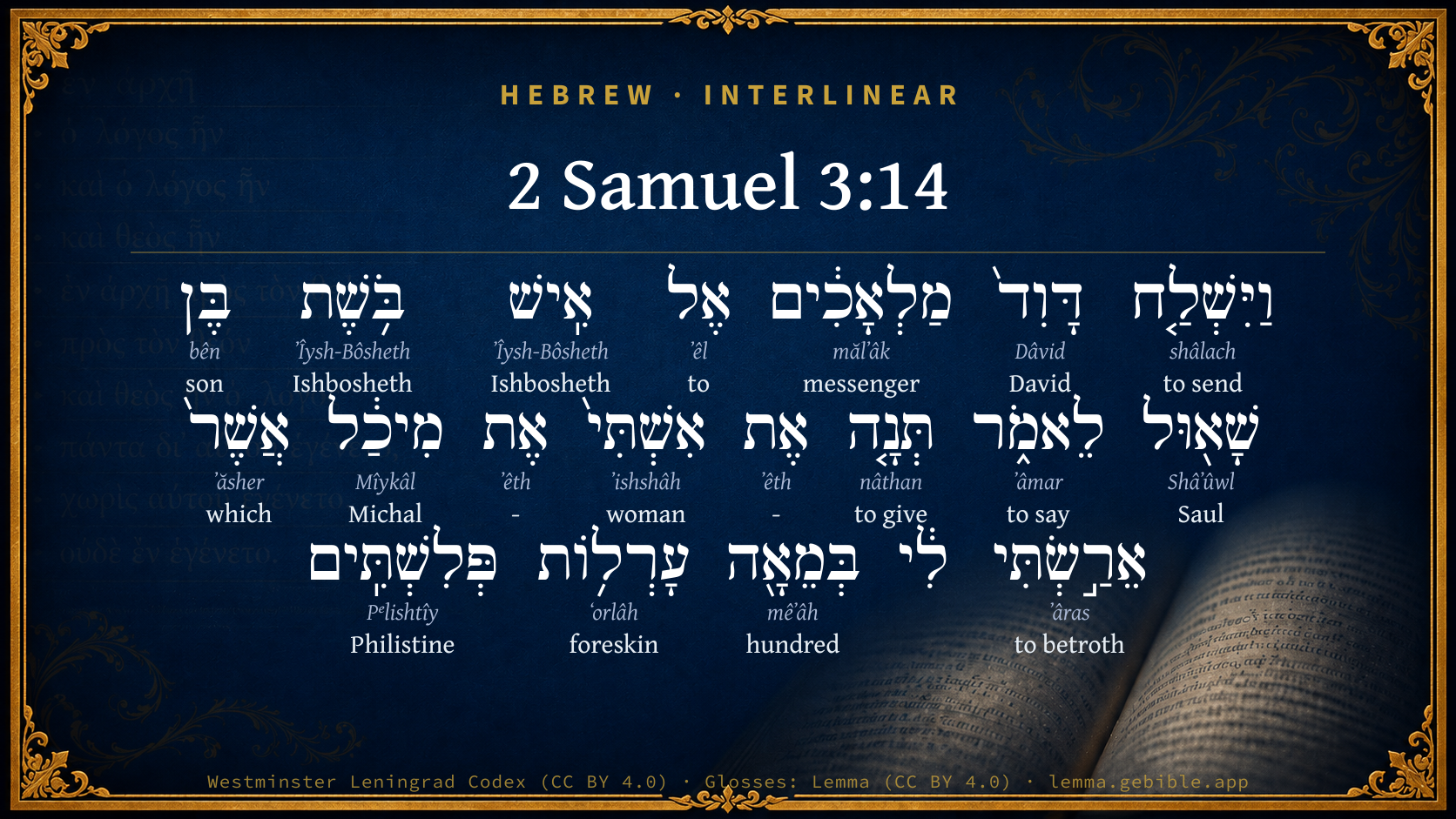
2 Samuel 3:14

Hebrew (Westminster Leningrad Codex) 2 Samuel 3:14 appears in the Hebrew Old Testament. The text above is from the Westminster Leningrad Codex. Each word links to its Strong’s number, a concise gloss, and parsing drawn from the Open Scriptures Hebrew Bible morphology. Click any word for its full Brown-Driver-Briggs (BDB) entry.
Download image
Cite this verse

2 Samuel 3:14 (World English Bible). Public Domain. Lemma interlinear Bible study tool, https://lemma.gebible.app/v/2-samuel/3/14.

Show BibTeX & RIS
BibTeX
RIS
English Translation
David sent messengers to Ish-bosheth, Saul's son, saying, Deliver me my wife Michal, whom I pledged to be married to me for one hundred foreskins of the Philistines.
World English Bible · Public Domain
Download a study sheet

One document with this verse’s original text, its word-by-word gloss line, the meaning frame, cross-references with their text, attributed commentary, and full source and license credits — printable, and it pastes into notes with its structure intact.

This verse Autodidact and up

Study sheet (.html) Plain text (.txt)

A passage Seminary Student

Up to 50 verses in one chapter. A passage sheet keeps up to 6 commentary sources and 12 cross-references per verse, in the order this page ranks them, and says so on the sheet whenever that leaves anything out. Ask for a single verse and you get the Autodidact verse sheet above.

Everything on this page stays free to read, with no account — the sheet is a download of what is already on screen, not access to it.

Want to remove ads? Support Godless Engineer
Compare translations 3

The same verse in 3 English versions, stacked beneath the original-language interlinear above. Click any original word for its lexicon entry.

Each is an independent rendering of the whole verse — the interlinear is not word-aligned to these translations.

Highlighted words mark where these versions differ — a whole-verse word diff, not a word-by-word alignment.

  • World English Bible Public Domain
    David sent messengers to Ish-bosheth, Saul's son, saying, Deliver me my wife Michal, whom I pledged to be married to me for one hundred foreskins of the Philistines.
  • King James Version Public Domain
    And David sent messengers to Ishbosheth Saul's son, saying, Deliver me my wife Michal, which I espoused to me for an hundred foreskins of the Philistines.
  • unfoldingWord Literal Text CC BY-SA 4.0
    And David sent messengers to Ish Bosheth, the son of Saul, saying, “Give my wife Michal, whom I betrothed to myself with 100 foreskins of Philistines.”

unfoldingWord Literal Text — © unfoldingWord, licensed CC BY-SA 4.0. Word-aligned USFM3 via Door43 (git.door43.org/unfoldingWord/en_ult).

Versions to compare (up to 4)

3 of 4 selected

Show all 18 translations

Every available English version of this verse, each an independent rendering of the whole verse.

  • World English Bible Public Domain
    David sent messengers to Ish-bosheth, Saul's son, saying, Deliver me my wife Michal, whom I pledged to be married to me for one hundred foreskins of the Philistines.
  • Berean Standard Bible Public Domain
    Then David sent messengers to say to Ish-bosheth son of Saul, “Give me back my wife, Michal, whom I betrothed to myself for a hundred Philistine foreskins.”
  • Majority Standard Bible Public Domain
    Then David sent messengers to say to Ish-bosheth son of Saul, “Give me back my wife, Michal, whom I betrothed to myself for a hundred Philistine foreskins.”
  • King James Version Public Domain
    And David sent messengers to Ishbosheth Saul's son, saying, Deliver me my wife Michal, which I espoused to me for an hundred foreskins of the Philistines.
  • American Standard Version (1901) Public Domain
    And David sent messengers to Ish-bosheth, Saul's son, saying, Deliver me my wife Michal, whom I betrothed to me for a hundred foreskins of the Philistines.
  • Revised Version (1885) Public Domain
    And David sent messengers to Ish-bosheth Saul’s son, saying, Deliver me my wife Michal, whom I betrothed to me for an hundred foreskins of the Philistines.
  • Geneva Bible (1599) Public Domain
    Then Dauid sent messengers to Ish-bosheth Sauls sonne, saying, Deliuer me my wife Michal, which I marryed for an hundreth foreskinnes of the Philistims.
  • Douay-Rheims (1899) Public Domain
    And David sent messengers to Isboseth the son of Saul, saying: Restore my wife Michol, whom I espoused to me for a hundred foreskins of the Philistines.
  • Young's Literal Translation Public Domain
    And David sendeth messengers unto Ish-Bosheth son of Saul, saying, `Give up my wife Michal, whom I betrothed to myself with a hundred foreskins of the Philistines.'
  • Literal Standard Version CC BY-SA 4.0
    And David sends messengers to Ish-Bosheth son of Saul, saying, “Give up my wife Michal, whom I betrothed to myself with one hundred foreskins of the Philistines.”
  • Unlocked Literal Bible CC BY-SA 4.0
    Then David sent messengers to Ishbosheth, Saul's son, saying, “Give me my wife Michal, for whom I paid a price of one hundred Philistine foreskins.”
  • unfoldingWord Literal Text CC BY-SA 4.0
    And David sent messengers to Ish Bosheth, the son of Saul, saying, “Give my wife Michal, whom I betrothed to myself with 100 foreskins of Philistines.”
  • Darby Bible Public Domain
    And David sent messengers to Ishbosheth Saul's son, saying, Deliver me my wife Michal, whom I espoused to me for a hundred foreskins of the Philistines.
  • World Messianic Bible Public Domain
    David sent messengers to Ishbosheth, Saul’s son, saying, “Deliver me my wife Michal, whom I was given to marry for one hundred foreskins of the Philistines.”
  • Webster's Bible Public Domain
    And David sent messengers to Ish-bosheth, Saul's son, saying, Deliver to me my wife Michal, whom I espoused to me for a hundred foreskins of the Philistines.
  • Free Bible Version CC BY-SA 4.0
    Then David sent messengers to tell Ishbosheth, son of Saul, “Give me back my wife Michal—I paid a dowry for her of one hundred Philistine foreskins.”
  • Bible in Basic English Public Domain
    And David sent men to Saul's son Ish-bosheth, saying, Give me back Michal, my wife, whom I made mine for the price of the private parts of a hundred Philistines.
  • JPS Tanakh (1917) Public Domain
    And David sent messengers to Ish-bosheth Saul's son, saying: 'Deliver me my wife Michal, whom I betrothed to me for a hundred foreskins of the Philistines.'

Literal Standard Version (2020), Covenant Press — licensed CC BY-SA 4.0. Text via the HelloAO Bible API (eBible.org). Unlocked Literal Bible (unfoldingWord) — licensed CC BY-SA 4.0. Text via the HelloAO Bible API (eBible.org). unfoldingWord Literal Text — © unfoldingWord, licensed CC BY-SA 4.0. Word-aligned USFM3 via Door43 (git.door43.org/unfoldingWord/en_ult). Free Bible Version, Dr. Jonathan Gallagher — licensed CC BY-SA 4.0. Text via the HelloAO Bible API (eBible.org).

Word by word

More ways to search: Search by grammar → Find every occurrence → Compare this word →

Practice this passage: Drill this verse → Learn its vocabulary →

אֵרַ֣שְׂתִּי
ʼâras
H781
“to betroth”
Verb, Piel, Perfect, 1st Person, Common, Singular
Part of Speech
Verb
Stem
Piel
Form
Perfect
Person
1st Person
Gender
Common
Number
Singular
Full BDB Definition

Origin: a primitive root

TWOT: 170

to betroth, engage - (Piel) to betroth (man or woman) - (Pual) to be betrothed
  1. וַיִּשְׁלַ֤ח shâlach H7971 “and · to send” Conjunction + Verb, Qal, Sequential Imperfect, 3rd Person, Masculine, Singular
  2. דָּוִד֙ Dâvid H1732 “David” Noun, Proper
  3. מַלְאָכִ֔ים mălʼâk H4397 “messengers” Noun, Common, Masculine, Plural, Absolute
  4. אֶל ʼêl H413 “to” Preposition
  5. אִֽישׁ ʼÎysh-Bôsheth H378 “Ishbosheth” Noun, Proper
  6. בֹּ֥שֶׁת ʼÎysh-Bôsheth H378 “Ishbosheth” Noun, Proper
  7. בֶּן bên H1121 “son of” Noun, Common, Masculine, Singular, Construct
  8. שָׁא֖וּל Shâʼûwl H7586 “Saul” Noun, Proper
  9. לֵאמֹ֑ר ʼâmar H559 “to say” Preposition + Verb, Qal, Infinitive Construct
  10. תְּנָ֤ה nâthan H5414 “give” Verb, Qal, Imperative, 2nd Person, Masculine, Singular + Suffix, h
  11. אֶת ʼêth H853 “-” Particle, Direct Object
  12. אִשְׁתִּי֙ ʼishshâh H802 “woman · my” Noun, Common, Feminine, Singular, Construct + Suffix, Personal, 1st Person, Common, Singular
  13. אֶת ʼêth H853 “-” Particle, Direct Object
  14. מִיכַ֔ל Mîykâl H4324 “Michal” Noun, Proper
  15. אֲשֶׁר֙ ʼăsher H834 “which” Particle, Relative
  16. בְּמֵאָ֖ה mêʼâh H3967 “in/at · hundred” Preposition + Adjective, Cardinal number, Both, Singular, Absolute
  17. עָרְל֥וֹת ʻorlâh H6190 “foreskins of” Noun, Common, Feminine, Plural, Construct
  18. פְּלִשְׁתִּֽים Pᵉlishtîy H6430 “Philistines” Noun, Gentilic, Masculine, Plural, Absolute

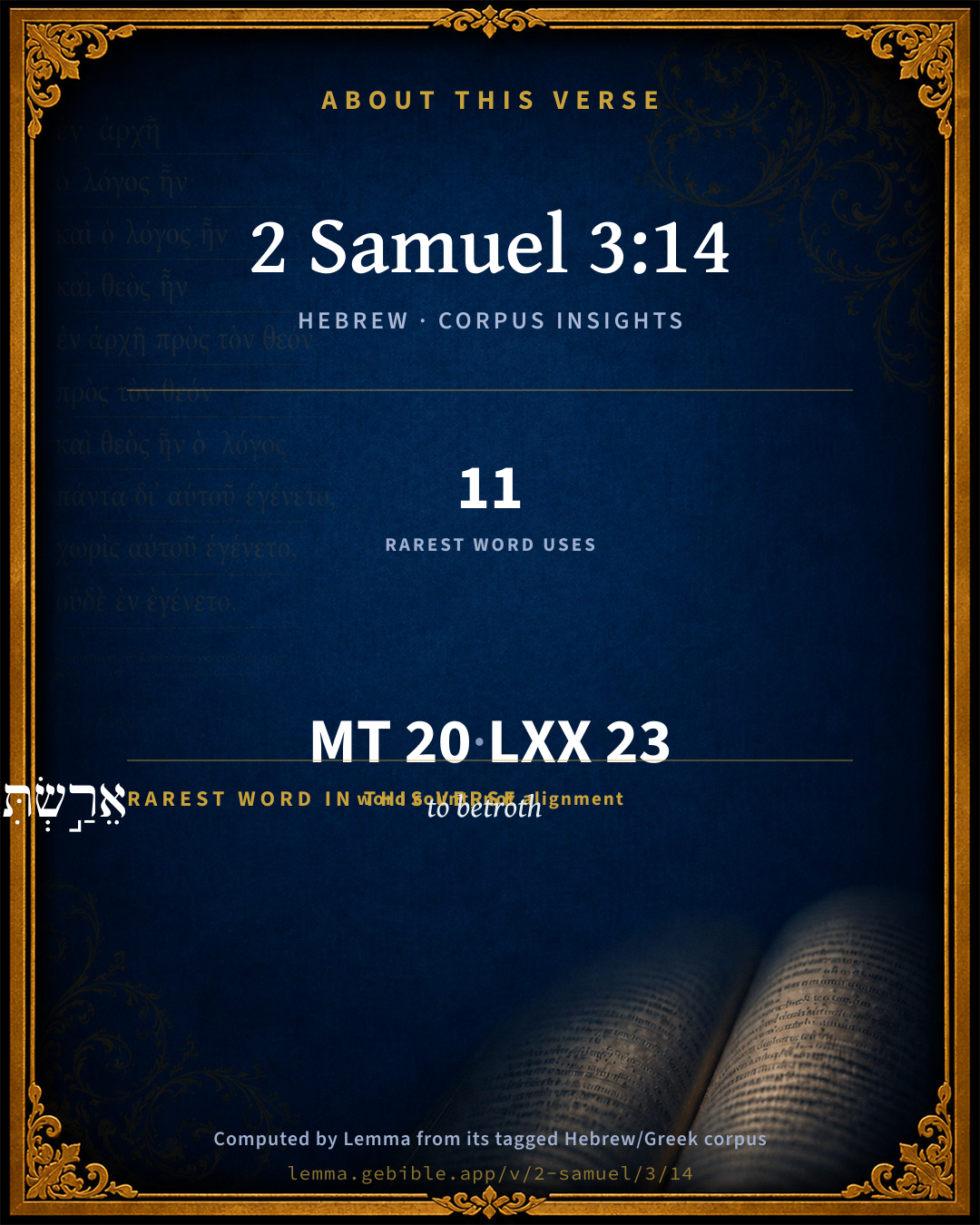
About this verse

These counts appear in no published source. They are computed here, from the morphology-tagged text and Lemma’s own curated glosses. What Lemma adds →

20
words
17
distinct lemmas
Historical
section

Notable vocabulary

The rarest word here is אֵרַ֣שְׂתִּי to betroth H781 — appearing just 11 times in the whole Hebrew Bible.

Shared distinctive vocabulary

אֵרַ֣שְׂתִּי to betroth H781 occurs in 10 verses of the Hebrew Bible. Also found in:

Grammatical profile

  • 4 verbs
  • 10 nouns
  • 1 adjective
  • 2 prepositions
  • 3 particles

Verb forms

  • וַיִּשְׁלַ֤ח Qal · Sequential Imperfect
  • לֵאמֹ֑ר Qal · Infinitive Construct
  • תְּנָ֤ה Qal · Imperative
  • אֵרַ֣שְׂתִּי Piel · Perfect

Repetition

A word recurs within this verse — often emphatic in Hebrew:

  • אִֽישׁ Ishbosheth H378 ×2

Hebrew & Septuagint length

In English translation the verse runs 28 words from the Hebrew and 26 from the Septuagint (LXX English) — closely comparable.

A rough comparison of the two English renderings, which tokenize alike — not a word-level alignment.

Word counts can differ between the Hebrew and the Greek without any difference in meaning — e.g. the Hebrew direct-object marker אֵת has no separate Greek word, and Greek often adds the article ὁ.

In the original languages it is 20 Hebrew tokens and 23 Greek tokens — but the two are counted differently (Hebrew bundles its prefixes and suffixes into one token; the Greek is in lemma form), so that isn’t a like-for-like length.

Cross-references

3

Topical passages linked to 2 Samuel 3:14 in the Treasury of Scripture Knowledge — connected by theme and wording, ordered by reader-vote popularity; previews shown in the World English Bible.

  • 1 Samuel 18:27 and David arose and went, he and his men, and killed of the Philistines two hundred men; and David brought their foreskins, and they gave them in full number to the king, that he might be the king's son-in-law. Saul gave him Michal his daughter as wife.
  • 1 Samuel 18:25 Saul said, Thus shall you tell David, The king desires no dowry except one hundred foreskins of the Philistines, to be avenged of the king's enemies. Now Saul thought to make David fall by the hand of the Philistines.
  • 2 Samuel 2:10 Ish-bosheth, Saul's son, was forty years old when he began to reign over Israel, and he reigned two years. But the house of Judah followed David.

Cross-references courtesy of OpenBible.info (CC BY 4.0).

Hebrew and Greek witnesses Masoretic Hebrew ↔ Greek Septuagint

The same verse in the two great witnesses to the Old Testament, shown verse-for-verse.

These are two independent witnesses, not word-aligned to each other, and the Septuagint is shown in lemma (dictionary) form.

Hebrew 2 Samuel 3:14 Masoretic · Westminster Leningrad Codex

וַיִּשְׁלַ֤ח דָּוִד֙ מַלְאָכִ֔ים אֶל אִֽישׁ בֹּ֥שֶׁת בֶּן שָׁא֖וּל לֵאמֹ֑ר תְּנָ֤ה אֶת אִשְׁתִּי֙ אֶת מִיכַ֔ל אֲשֶׁר֙ אֵרַ֣שְׂתִּי לִ֔י בְּמֵאָ֖ה עָרְל֥וֹת פְּלִשְׁתִּֽים

David sent messengers to Ish-bosheth, Saul's son, saying, Deliver me my wife Michal, whom I pledged to be married to me for one hundred foreskins of the Philistines.

World English Bible · Public Domain

Greek LXX 2 Samuel 3:14 Septuagint · lemma form

καί ἐκ ἀποστέλλω δαυίδ πρός μεμφιβοσθε υἱός σαούλ ἄγγελος λέγω ἀποδίδωμι ἐγώ ὁ γυνή ἐγώ ὁ μελχολ ὅς λαμβάνω ἐν ἑκατόν ἀκροβυστία ἀλλόφυλος

And David sent messengers to Jebosthe the son of Saul, saying, Restore me my wife Melchol, whom I took for one hundred foreskins of the Philistines.

LXX2012 (modern English Septuagint) · Public Domain

Hebrew: Westminster Leningrad Codex (CC BY 4.0). Greek: Septuagint (public domain); English from LXX2012 (modern English Septuagint) (Public Domain). How the Septuagint differs from the Hebrew →

Targum (Aramaic paraphrase)

1

The Targum is the ancient Jewish Aramaic paraphrase of the Hebrew Scriptures — an interpretive translation, not the Hebrew text itself. Onkelos (literal) and Pseudo-Jonathan (expansive) render the Torah, and Jonathan the Prophets. Coverage is partial: where no permissively-licensed English translation exists for a verse, only the Aramaic is shown. This is verse-level text, not a word-by-word alignment to the Hebrew.

  1. Targum Jonathan Prophets (Joshua–Malachi)
    וּשְׁלַח דָוִד אִזְגַדִין לְוַת אִישׁ בֹּשֶׁת בַּר שָׁאוּל לְמֵימָר הַב יַת אִתְּתִי יַת מִיכַל דְאָרָסִית לִי בִּמְאָה עָרְלוֹת פְּלִשְׁתָּאֵי:

    (no public-domain English translation for this verse)

    Targum Jonathan — Aramaic: “Mikraot Gedolot” (public domain). English: “Sefaria Community Translation” (CC0 1.0 (public-domain dedication)); “London "Chaldee Paraphrase," 1871” (public domain). Text via Sefaria.

Commentary

Notes on 2 Samuel 3:14 from classic Christian and Jewish commentators (each source and its license shown beneath its notes). The classic Christian expositions comment on the surrounding passage and are grouped to its opening verse, so a note may address several verses; the Jewish commentaries on the Tanakh (Rashi and others) are per-verse, so they appear only where the commentator wrote on this verse.

Lemma curates 59 commentaries, every one of them public domain or Creative Commons licensed, each selected and text-cleaned for this edition rather than reprinted as found. About our sources →

Trapp's Complete Commentary

John Trapp

2Sa 3:14 And David sent messengers to Ishbosheth Saul’s son, saying, Deliver [me] my wife Michal, which I espoused to me for an hundred foreskins of the Philistines.

Ver. 14. For a hundred foreskins.] He might have said two hundred; but he thought better to speak with the least. In maxima sui mole se minimum ostendunt stellae.

John Trapp, A Commentary or Exposition upon All the Books of the Old and New Testament (1647–1656) — public domain. Text from a community e-Sword module.

Joseph Benson's Commentary

2Sa 3:14. David sent messengers to Ish-bosheth — We are not informed what answer Abner gave to David when he required the forementioned condition of him. But it is probable he let him know, as the truth was, that it was not in his power to bring Michal to him without Ish-bosheth’s consent, whose sister, as well as subject, she was; at least that it was not safe to attempt it, and therefore advised him to send to her brother, who could not easily deny what he desired. Be this as it may, David sent to Ish- bosheth, and thereby opened to him a door of hope for reconciliation, lest, being desperate, he should use every possible means to hinder Abner from his present design. Saying, Deliver me my wife — Who, though she was taken from me by force, and constrained to marry another, yet is my rightful wife. David demands her, both for the affection he still retained for her, and upon a political consideration, that she might strengthen his title to the kingdom.

Joseph Benson's Commentary on the Old and New Testaments (1811–1818) — public domain. Text from a community e-Sword module.

Tyndale Open Study Notes

Tyndale Open Resources

3:14 the lives of 100 Philistines: Saul had hoped that David would be killed in his attempt to secure the bride-price (see 1 Sam 18:17-27).

Tyndale Open Study Notes — © Tyndale Open Resources, licensed CC BY-SA 4.0. Text via the HelloAO Bible API.

Adam Clarke's Commentary

Verse 14. Deliver me my wife] It is supposed that he meant to screen Abner; and to prevent that violence which he might have used in carrying off Michal.

Adam Clarke's Commentary on the Bible (1810–1826) — public domain. Text from a community e-Sword/MySword module.

Ellicott's Commentary for English Readers

(14) To Ish-bosheth.—The demand is made upon the de facto king that all may be done legally, and David may not appear to be reclaiming his wife by force. At the same time, Ish-bosheth is thus compelled to acknowledge the wrong done to David and his inability to refuse his demand. It appears from 2Sa_3:16 that Abner was employed to execute the command, and, in fact, the whole matter was really determined by him, the king being merely the official and legal instrument.

An hundred foreskins.—David had actually delivered to Saul as her dowry two hundred, but only one hundred had been required (1Sa_18:25; 1Sa_18:27), and therefore only that number is mentioned.

A Bible Commentary for English Readers, edited by Charles John Ellicott (1878–1897) — public domain. Text from a community e-Sword module.

The Cambridge Bible for Schools and Colleges

gen. ed. J. J. S. Perowne

14. David sent messengers to Ish-bosheth] The acceptance of the condition by Abner is implied, but the formal demand was made from Ish-bosheth, who was powerless to resist the will of his master. Thus the restoration of Michal took place openly as a public act of justice; it clearly exhibited the strength of David and the weakness of Ish-bosheth; it gave Abner opportunity to go to Hebron as Michal’s escort, and mature his plans for deposing Ish-bosheth.

which I espoused, &c.] Saul proposed the slaughter of an hundred Philistines as the price of Michal’s hand in lieu of dowry: David paid him double (1Sa_18:25; 1Sa_18:27).

The Cambridge Bible for Schools and Colleges (gen. ed. J. J. S. Perowne; Cambridge University Press, 1878–1918) — public domain. Text from a community e-Sword module.

John Gill's Exposition

And David sent messengers to Ishbosheth, Saul's son,.... When Abner's messengers returned to him, and acquainted him with the condition of David's entering into a league with him, it is highly probable that Abner sent them or others to David, to let him know that he could not do this of himself; that it was advisable for him to write to Ishbosheth, whose sister she was, and demand her of him; and that then he would use his interest with Ishbosheth to grant it, and this method David took:

saying, deliver me my wife Michal, which I espoused to me for an hundred foreskins of the Philistines; two arguments he made use of to enforce his demand; one is, that it was his wife he required, to whom he had a right, and no other man; and the other is, that he had purchased her at a great expense, at the risk of his life, in slaying an hundred Philistines, whose foreskins he paid in for her at the instance of Saul; he mentions but one hundred, though he gave two hundred as her dowry, no more being required than one hundred; see Sa1 18:25. Josephus very wrongly says six hundred (b); the Syriac and Arabic have here two hundred.

(b) Antiqu. l 7. c. 1. sect. 4.

John Gill's Exposition of the Whole Bible (1746–1763) — public domain (CC PDM 1.0). Text via the HelloAO Bible API.

Albert Barnes' Notes on the Bible

Sent messengers to Ish-bosheth - Not to Abner, for the league between David and Abner was a profound secret, but to Ish-bosheth who, David knew, must act, feeble as he was, at Abner’s dictation. Abner’s first act of overt allegiance to David was thus done at Ish-bosheth’s bidding; and the effect of the humiliation laid upon Ish-bosheth in exposing his weakness to his own subjects, and so shaking their allegiance to him, was such that Abner needed to use no more disguise.

Albert Barnes' Notes on the Bible (1834–1885) — public domain. Text from a community e-Sword/MySword module.

Haydock's Catholic Bible Commentary

Isboseth. Thus he would screen the perfidy of Abner, (Menochius) and hinder him from using any violence. (Calmet) --- The pacific king accedes immediately to the request, as he had no personal aversion to David, and saw that he was in a far more elevated condition than Phaltiel. (Haydock) --- Moreover, this was no time to irritate him more, as Abner was discontented. (Menochius)

George Leo Haydock (1774–1849), Haydock's Catholic Family Bible and Commentary, 1859 edition — public domain. Excludes Psalms (Douay-Rheims chapter numbering differs from Protestant) and Deuterocanonical books (Catholic canon only).

Matthew Poole's English Annotations

Ish-bosheth’s consent was necessary, both to take her away from her present husband, and to persuade her to return to David. Hereby David opened to him also a door of hope for his reconciliation, lest being desperate he should hinder Abner in his present design.

My wife Michal; who, though she was taken from me by force, and constrained to marry another, 1Sa 25:44, yet is indeed my rightful wife. Her David demands, partly, for the affection he formerly had and still retained to her; partly, to deliver her from the sin and reproach of adultery with another man, who was not in truth and justice her husband, though he was so called and accounted; and partly, upon a politic consideration, that she might strengthen his right and title to the kingdom.

Matthew Poole's English Annotations on the Holy Bible (1683–1685) — public domain. Text from a community e-Sword/MySword module.

Whedon's Commentary on the Bible

Daniel D. Whedon

14. David sent… to Ishbosheth — For the settlement of this matter properly belonged to him who assumed to be Saul’s successor. By giving her to Phaltiel, Saul had wronged David, and now it is Ishbosheth’s place to rectify that wrong.

Daniel D. Whedon (gen. ed.), Commentary on the Old and New Testaments (1874–1909) — public domain. Text from a community e-Sword module.

The Pulpit Commentary

A hundred foreskins. This was the number which Saul had required, (1Sa_18:25) and David acted rightly in not boasting that he had really given twice as many. (1Sa_18:27) As he had paid her father the stipulated price, Michal, by Oriental law, was David"s property.

The Pulpit Commentary (1880–1919), ed. H.D.M. Spence-Jones & Joseph S. Exell — public domain. Text from a community e-Sword module.

John Wesley's Explanatory Notes

Ishbosheth - Whose consent was necessary, both to take her away from her present husband, and to persuade her to return to David. Hereby also David opened to him a door of hope for his reconciliation, lest being desperate he should hinder Abner in his present design. My wife - Who, though she was taken from me by force, and constrained to marry another, yet is my rightful wife. David demands her, both for the affection he still retained to her, and upon a political consideration that she might strengthen his title to the kingdom.

John Wesley, Explanatory Notes Upon the Whole Bible (1754–1765) — public domain. Text via the GEBible commentary corpus.

unfoldingWord translationNotes

Door43 World Missions Community

one hundred Philistine foreskins

This represents the number of men David killed so that Saul would allow him to marry Michal. These men are represented here by their "foreskins." The "foreskin" is the fold of skin that covers the male reproductive organ. (See: Numbers and Synecdoche)

took her from her husband

Paltiel was Michal's second husband. Saul gave her to him after David fled from Saul. (See: Assumed Knowledge and Implicit Information)

Paltiel ... Laish

These are the names of men. (See: How to Translate Names)

Bahurim

This is the name of a village. (See: How to Translate Names)

translationWords

Saul (OT)

Philistines

Abner

unfoldingWord translationNotes — © Distant Shores Media and the Door43 World Missions Community, licensed CC BY-SA 4.0. Source: git.door43.org/Door43/en_tn.

Lesson kit

Teaching starters — assembled from the data on this page, not authored interpretation. Every prompt links to the verse data it draws on. Edit before teaching.

2 Samuel, in the Historical, opens this verse with 20 words (17 distinct Hebrew lemmas). Its most distinctive word is ʼâras (“to betroth”). A historical commentator’s framing appears above. Read the whole chapter for the surrounding context.

Discussion questions

  1. What does “to betroth” (ʼâras) contribute to the verse as a whole?
  2. How does Exodus 22:16, which shares the word «to betroth», read alongside this verse?
  3. What does the repetition of “Ishbosheth” (2× in this one verse) do in this verse?
  4. The translations on this page render this verse differently — a whole-verse word diff, not a word-by-word alignment. What might account for the different wordings?
  5. «וַיִּשְׁלַ֤ח» is a Qal Sequential Imperfect verb. How does that grammatical form shape the action described?
  6. Compare how Trapp's Complete Commentary and Joseph Benson's Commentary read this verse. Where do they agree or differ?

Things to notice

Reading settings

Reading text

Shown beneath each verse's original-language words.

Old Testament
Old Testament edition

Read the OT as the Masoretic Hebrew (MT) or the Greek Septuagint (LXX).

English shown for the Greek Septuagint (in the Hebrew ↔ Greek comparison).

Comparing translations? Open the Compare panel on any verse page to stack up to four side by side.