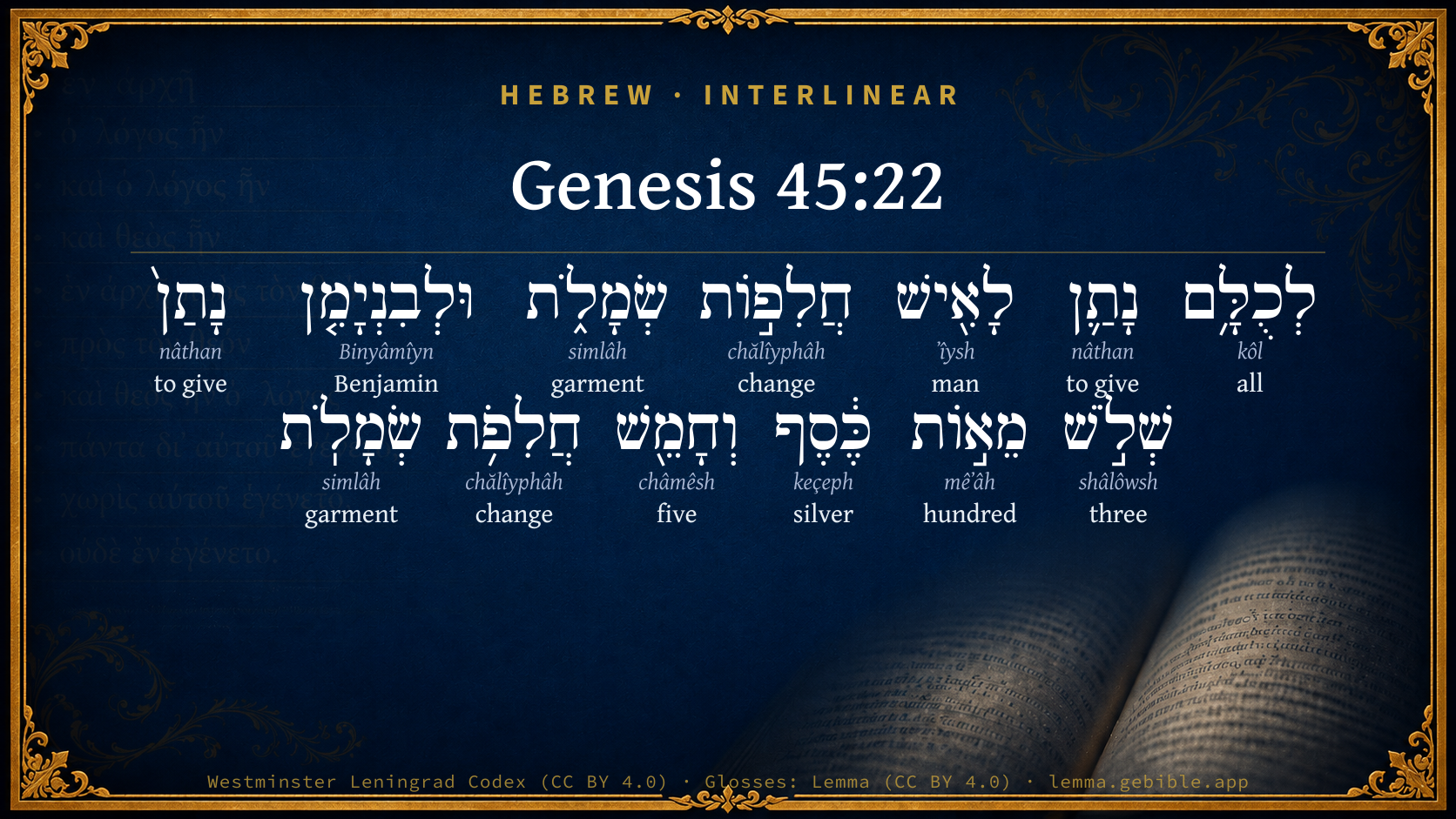
Genesis 45:22

Hebrew (Westminster Leningrad Codex) Genesis 45:22 appears in the Hebrew Old Testament. The text above is from the Westminster Leningrad Codex. Each word links to its Strong’s number, a concise gloss, and parsing drawn from the Open Scriptures Hebrew Bible morphology. Click any word for its full Brown-Driver-Briggs (BDB) entry.
Download image
Cite this verse

Genesis 45:22 (World English Bible). Public Domain. Lemma interlinear Bible study tool, https://lemma.gebible.app/v/genesis/45/22.

Show BibTeX & RIS
BibTeX
RIS
English Translation
To all of them he gave each man changes of clothing, but to Benjamin he gave three hundred pieces of silver and five changes of clothing.
World English Bible · Public Domain
Highlights
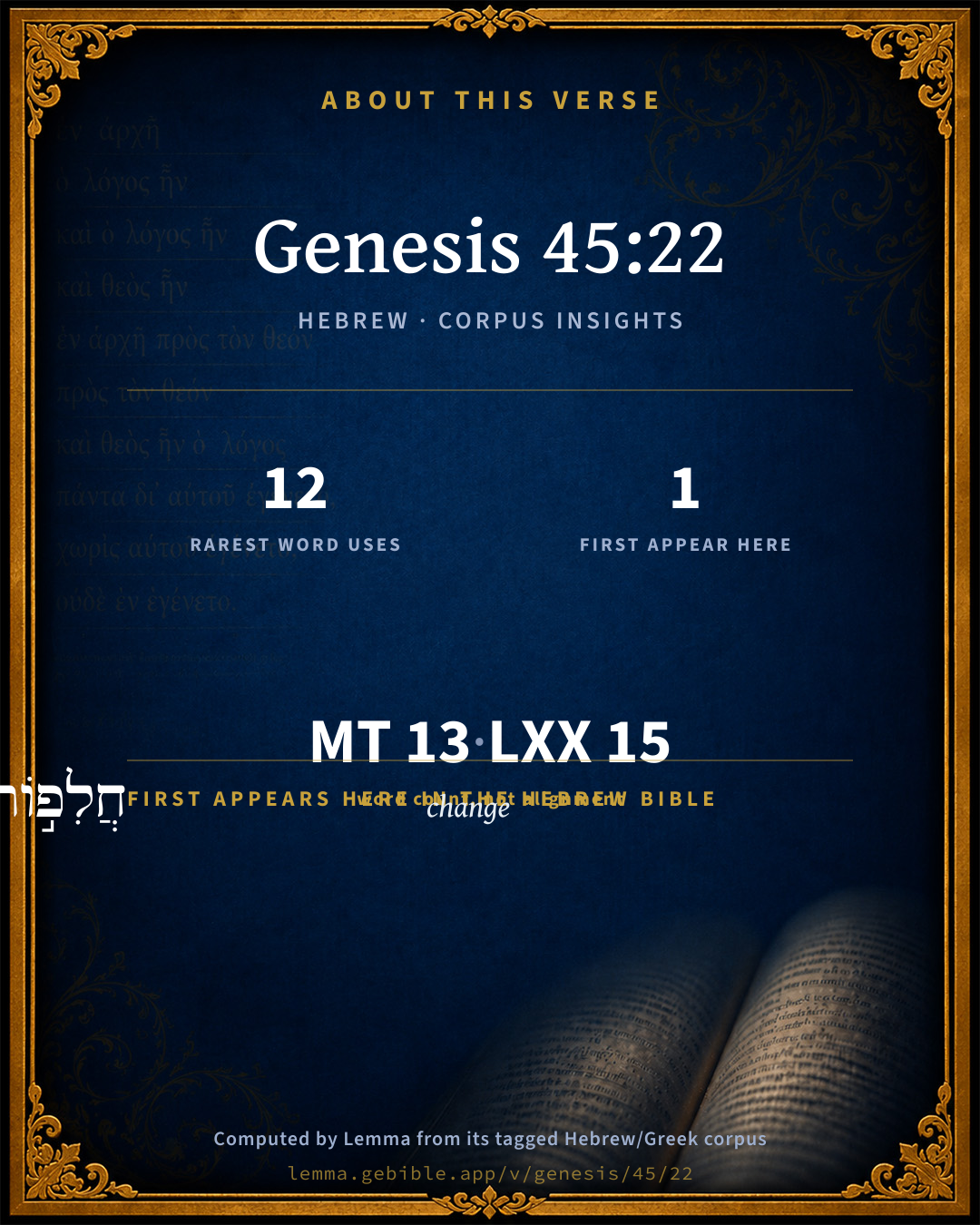
  • 1 first appearance in the Hebrew Bible
Full analysis ↓
Download a study sheet

One document with this verse’s original text, its word-by-word gloss line, the meaning frame, cross-references with their text, attributed commentary, and full source and license credits — printable, and it pastes into notes with its structure intact.

This verse Autodidact and up

Study sheet (.html) Plain text (.txt)

A passage Seminary Student

Up to 50 verses in one chapter. A passage sheet keeps up to 6 commentary sources and 12 cross-references per verse, in the order this page ranks them, and says so on the sheet whenever that leaves anything out. Ask for a single verse and you get the Autodidact verse sheet above.

Everything on this page stays free to read, with no account — the sheet is a download of what is already on screen, not access to it.

Want to remove ads? Support Godless Engineer
Compare translations 3

The same verse in 3 English versions, stacked beneath the original-language interlinear above. Click any original word for its lexicon entry.

Each is an independent rendering of the whole verse — the interlinear is not word-aligned to these translations.

Highlighted words mark where these versions differ — a whole-verse word diff, not a word-by-word alignment.

  • World English Bible Public Domain
    To all of them he gave each man changes of clothing, but to Benjamin he gave three hundred pieces of silver and five changes of clothing.
  • King James Version Public Domain
    To all of them he gave each man changes of raiment; but to Benjamin he gave three hundred pieces of silver, and five changes of raiment.
  • unfoldingWord Literal Text CC BY-SA 4.0
    To all of them, to each, he gave changes of clothes, but to Benjamin he gave 300 of silver and five changes of clothes.

unfoldingWord Literal Text — © unfoldingWord, licensed CC BY-SA 4.0. Word-aligned USFM3 via Door43 (git.door43.org/unfoldingWord/en_ult).

Versions to compare (up to 4)

3 of 4 selected

Show all 18 translations

Every available English version of this verse, each an independent rendering of the whole verse.

  • World English Bible Public Domain
    To all of them he gave each man changes of clothing, but to Benjamin he gave three hundred pieces of silver and five changes of clothing.
  • Berean Standard Bible Public Domain
    He gave new garments to each of them, but to Benjamin he gave three hundred shekels of silver and five sets of clothes.
  • Majority Standard Bible Public Domain
    He gave new garments to each of them, but to Benjamin he gave three hundred shekels of silver and five sets of clothes.
  • King James Version Public Domain
    To all of them he gave each man changes of raiment; but to Benjamin he gave three hundred pieces of silver, and five changes of raiment.
  • American Standard Version (1901) Public Domain
    To all of them he gave each man changes of raiment; but to Benjamin he gave three hundred pieces of silver, and five changes of raiment.
  • Revised Version (1885) Public Domain
    To all of them he gave each man changes of raiment; but to Benjamin he gave three hundred pieces of silver, and five changes of raiment.
  • Geneva Bible (1599) Public Domain
    He gaue them all, none except, change of raiment: but vnto Beniamin he gaue three hundreth pieces of siluer, and fiue sutes of raiment.
  • Douay-Rheims (1899) Public Domain
    He ordered also to be brought out for every one of them two robes: but to Benjamin he gave three hundred pieces of silver with Ave robes of the best:
  • Young's Literal Translation Public Domain
    to all of them hath he given -- to each changes of garments, and to Benjamin he hath given three hundred silverlings, and five changes of garments;
  • Literal Standard Version CC BY-SA 4.0
    to all of them has he given—to each changes of garments, and to Benjamin he has given three hundred pieces of silver, and five changes of garments;
  • Unlocked Literal Bible CC BY-SA 4.0
    To all of them he gave each man changes of clothing, but to Benjamin he gave three hundred pieces of silver and five changes of clothing.
  • unfoldingWord Literal Text CC BY-SA 4.0
    To all of them, to each, he gave changes of clothes, but to Benjamin he gave 300 of silver and five changes of clothes.
  • Darby Bible Public Domain
    To each one of them all he gave changes of clothing; but to Benjamin he gave three hundred [pieces] of silver and five changes of clothing.
  • World Messianic Bible Public Domain
    He gave each one of them changes of clothing, but to Benjamin he gave three hundred pieces of silver and five changes of clothing.
  • Webster's Bible Public Domain
    To all of them he gave each man changes of raiment: but to Benjamin he gave three hundred pieces of silver, and five changes of raiment.
  • Free Bible Version CC BY-SA 4.0
    He gave each of them new clothes. But to Benjamin he gave five sets of clothes and 300 pieces of silver.
  • Bible in Basic English Public Domain
    To every one of them he gave three changes of clothing; but to Benjamin he gave three hundred bits of silver and five changes of clothing.
  • JPS Tanakh (1917) Public Domain
    To all of them he gave each man changes of raiment; but to Benjamin he gave three hundred shekels of silver, and five changes of raiment.

Literal Standard Version (2020), Covenant Press — licensed CC BY-SA 4.0. Text via the HelloAO Bible API (eBible.org). Unlocked Literal Bible (unfoldingWord) — licensed CC BY-SA 4.0. Text via the HelloAO Bible API (eBible.org). unfoldingWord Literal Text — © unfoldingWord, licensed CC BY-SA 4.0. Word-aligned USFM3 via Door43 (git.door43.org/unfoldingWord/en_ult). Free Bible Version, Dr. Jonathan Gallagher — licensed CC BY-SA 4.0. Text via the HelloAO Bible API (eBible.org).

Word by word

More ways to search: Search by grammar → Find every occurrence → Compare this word →

Practice this passage: Drill this verse → Learn its vocabulary →

חֲלִפ֣וֹת
chălîyphâh
H2487
“changes of”
Noun, Common, Feminine, Plural, Construct
Part of Speech
Noun
Type
Common
Gender
Feminine
Number
Plural
State
Construct
Full BDB Definition

Origin: from H2498

TWOT: 666c

a change, change (of garments), replacement - change (of raiment) - relays - relief (from death) - changing, varying (course of life)
  1. לְכֻלָּ֥ם kôl H3605 “to/for · all · their” Preposition + Noun, Common, Masculine, Singular, Construct + Suffix, Personal, 3rd Person, Masculine, Plural
  2. נָתַ֛ן nâthan H5414 “to give” Verb, Qal, Perfect, 3rd Person, Masculine, Singular
  3. לָאִ֖ישׁ ʼîysh H376 “to/for the · man” Preposition, Determined + Noun, Common, Masculine, Singular, Absolute
  4. שְׂמָלֹ֑ת simlâh H8071 “garments” Noun, Common, Feminine, Plural, Absolute
  5. וּלְבִנְיָמִ֤ן Binyâmîyn H1144 “and · to/for · Benjamin” Conjunction + Preposition + Noun, Proper
  6. נָתַן֙ nâthan H5414 “to give” Verb, Qal, Perfect, 3rd Person, Masculine, Singular
  7. שְׁלֹ֣שׁ shâlôwsh H7969 “three” Adjective, Cardinal number, Feminine, Singular, Absolute
  8. מֵא֣וֹת mêʼâh H3967 “hundred” Adjective, Cardinal number, Both, Plural, Absolute
  9. כֶּ֔סֶף keçeph H3701 “silver” Noun, Common, Masculine, Singular, Absolute
  10. וְחָמֵ֖שׁ châmêsh H2568 “and · five” Conjunction + Adjective, Cardinal number, Feminine, Singular, Absolute
  11. חֲלִפֹ֥ת chălîyphâh H2487 “changes of” Noun, Common, Feminine, Plural, Construct
  12. שְׂמָלֹֽת simlâh H8071 “garments” Noun, Common, Feminine, Plural, Absolute

About this verse

These counts appear in no published source. They are computed here, from the morphology-tagged text and Lemma’s own curated glosses. What Lemma adds →

13
words
10
distinct lemmas
Pentateuch
section

Notable vocabulary

The rarest word here is חֲלִפ֣וֹת change H2487 — appearing just 12 times in the whole Hebrew Bible.

First appearance in Scripture

This word makes its first canonical appearance in the Hebrew Bible here:

  • חֲלִפ֣וֹת change H2487

Shared distinctive vocabulary

חֲלִפ֣וֹת change H2487 occurs in 11 verses of the Hebrew Bible. Also found in:

Grammatical profile

  • 2 verbs
  • 8 nouns
  • 3 adjectives

Verb forms

  • נָתַ֛ן Qal · Perfect
  • נָתַן֙ Qal · Perfect

Repetition

Words recur within this verse — often emphatic in Hebrew:

  • נָתַ֛ן to give H5414 ×2
  • חֲלִפ֣וֹת change H2487 ×2
  • שְׂמָלֹ֑ת garment H8071 ×2

Hebrew & Septuagint length

In English translation the verse runs 26 words from the Hebrew and 26 from the Septuagint (LXX English) — the same length.

A rough comparison of the two English renderings, which tokenize alike — not a word-level alignment.

Word counts can differ between the Hebrew and the Greek without any difference in meaning — e.g. the Hebrew direct-object marker אֵת has no separate Greek word, and Greek often adds the article ὁ.

In the original languages it is 13 Hebrew tokens and 15 Greek tokens — but the two are counted differently (Hebrew bundles its prefixes and suffixes into one token; the Greek is in lemma form), so that isn’t a like-for-like length.

Cross-references

6

Topical passages linked to Genesis 45:22 in the Treasury of Scripture Knowledge — connected by theme and wording, ordered by reader-vote popularity; previews shown in the World English Bible.

  • Genesis 43:34 He sent portions to them from before him, but Benjamin's portion was five times as much as any of theirs. They drank, and were merry with him.
  • 2 Kings 5:5 The king of Syria said, Go now, and I will send a letter to the king of Israel. He departed, and took with him ten talents of silver, and six thousand [pieces] of gold, and ten changes of clothing.
  • Judges 14:12 Samson said to them, Let me now put forth a riddle to you: if you can declare it to me within the seven days of the feast, and find it out, then I will give you thirty linen garments and thirty changes of clothing;
  • 2 Kings 5:22–23 He said, All is well. My master has sent me, saying, Behold, even now there are come to me from the hill-country of Ephraim two young men of the sons of the prophets; please give them a talent of silver, and two changes of clothing.
  • Judges 14:19 The Spirit of Yahweh came mightily on him, and he went down to Ashkelon, and struck thirty men of them, and took their spoil, and gave the changes [of clothing] to those who declared the riddle. His anger was kindled, and he went up to his father's house.
  • Revelation 6:11 A long white robe was given to each of them. They were told that they should rest yet for a while, until their fellow servants and their brothers, who would also be killed even as they were, should complete their course.

Cross-references courtesy of OpenBible.info (CC BY 4.0).

Hebrew and Greek witnesses Masoretic Hebrew ↔ Greek Septuagint

The same verse in the two great witnesses to the Old Testament, shown verse-for-verse.

These are two independent witnesses, not word-aligned to each other, and the Septuagint is shown in lemma (dictionary) form.

Hebrew Genesis 45:22 Masoretic · Westminster Leningrad Codex

לְכֻלָּ֥ם נָתַ֛ן לָאִ֖ישׁ חֲלִפ֣וֹת שְׂמָלֹ֑ת וּלְבִנְיָמִ֤ן נָתַן֙ שְׁלֹ֣שׁ מֵא֣וֹת כֶּ֔סֶף וְחָמֵ֖שׁ חֲלִפֹ֥ת שְׂמָלֹֽת

To all of them he gave each man changes of clothing, but to Benjamin he gave three hundred pieces of silver and five changes of clothing.

World English Bible · Public Domain

Greek LXX Genesis 45:22 Septuagint · lemma form

καί πᾶς δίδωμι δισσός στολή ὁ δέ βενιαμίν δίδωμι τριακόσιοι χρυσοῦς καί πέντε ἐκἀλλάσσω στολή

And he gave to them all two sets of raiment apiece; but to Benjamin he gave three hundred pieces of gold, and five changes of raiment.

LXX2012 (modern English Septuagint) · Public Domain

On this verse, The Cambridge Bible for Schools and Colleges discusses the Septuagint’s reading. Read the note in Commentary ↓

Hebrew: Westminster Leningrad Codex (CC BY 4.0). Greek: Septuagint (public domain); English from LXX2012 (modern English Septuagint) (Public Domain). How the Septuagint differs from the Hebrew →

Targum (Aramaic paraphrase)

2

The Targum is the ancient Jewish Aramaic paraphrase of the Hebrew Scriptures — an interpretive translation, not the Hebrew text itself. Onkelos (literal) and Pseudo-Jonathan (expansive) render the Torah, and Jonathan the Prophets. Coverage is partial: where no permissively-licensed English translation exists for a verse, only the Aramaic is shown. This is verse-level text, not a word-by-word alignment to the Hebrew.

  1. Targum Onkelos Torah (Genesis–Deuteronomy)
    לְכָלְהוֹן יְהַב לִגְבַר אִצְטְלַּוָּן דִּלְבוּשִׁין וּלְבִנְיָמִן יְהַב תְּלַת מְאָה סִלְעִין דִּכְסַף וַחֲמֵשׁ אִצְטְלַוָּן דִּלְבוּשִׁין

    (no public-domain English translation for this verse)

    Targum Onkelos — Aramaic: “Onkelos Genesis” (public domain); “Onkelos Exodus” (public domain); “Onkelos Leviticus” (public domain); “Onkelos Numbers” (public domain); “Onkelos Deuteronomy” (public domain). English: “Sefaria Community Translation” (CC0 1.0 (public-domain dedication)); “J.W. Etheridge. The Targums of Onkelos and Jonathan Ben Uzziel on the Pentateuch. London: Longmans, Green, 1862” (public domain). Text via Sefaria.

  2. Targum Pseudo-Jonathan Torah (Genesis–Deuteronomy)
    לְכֻלְהוֹן יְהַב לְגַבְרָא אִסְטְלוֹי דִלְבוּשׁ וּלְבִנְיָמִין יְהַב תְּלַת מְאָה סַלְעִין דִכְסַף וַחֲמֵשׁ אִיסְטוֹלֵי דִלְבוּשִׁין

    And to each of them he gave vestments and apparel; but to Benjamin he gave three hundred shekels of silver, and five vestments for apparel.

    Targum Pseudo-Jonathan — Aramaic: “Targum Jonathan on Genesis” (public domain); “Targum Jonathan on Exodus” (public domain); “Targum Jonathan on Leviticus” (public domain); “Targum Jonathan on Numbers” (public domain); “Targum Jonathan on Deuteronomy” (public domain). English: “The Targum of Jonathan ben Uzziel, trans. J. W. Etheridge, London, 1862” (public domain). Text via Sefaria.

Commentary

Notes on Genesis 45:22 from classic Christian and Jewish commentators (each source and its license shown beneath its notes). The classic Christian expositions comment on the surrounding passage and are grouped to its opening verse, so a note may address several verses; the Jewish commentaries on the Tanakh (Rashi and others) are per-verse, so they appear only where the commentator wrote on this verse.

Lemma curates 59 commentaries, every one of them public domain or Creative Commons licensed, each selected and text-cleaned for this edition rather than reprinted as found. About our sources →

Trapp's Complete Commentary

John Trapp

Gen 45:22 To all of them he gave each man changes of raiment; but to Benjamin he gave three hundred [pieces] of silver, and five changes of raiment.

Ver. 22. But to Benjamin he gave, &c.] God gives his best blessings to his Benjamins. "He is the Saviour of all men, but specially of them that believe." {1Ti 4:10} "The Lord openeth the eyes of the blind, the Lord raiseth them that are bowed down"; - these are common favours: but behold a better thing; - "the Lord loveth the righteous." {Psa 146:8} This is more than all the rest. Outward things God gives to the wicked also, but as Joseph put his cup into their sack to pick a quarrel with them; or at best, as he gave them here change of raiment, to show his general love to them: but three hundred silverlings and five suits none but a Benjamin shall have the honour and favour of. Artabazus, in Xenophon, complained, when Cyrus had given him a cup of gold, and Chrysantas a kiss, in token of his special respect and love, saying, that the cup that he gave him was not so good gold as the kiss that he gave Chrysantas. When David said to Ziba, "All is thine that pertained to Mephibosheth"; Ziba answereth, "I humbly beseech thee that I may find grace in thy sight." {2Sa 16:4} As who should say, I had rather have the king’s favour than the lands. Valde protestatus sum, said Luther, me nolle sic ab eo satiari. He would not be put off with lands and large offers. And Moses would not hear of an angel to go along with them. He would have God himself, or none. {Exo 33:12-17} The blessings that come "out of Sion," are choice, peculiar, even above any that come out of "heaven and earth." {Psa 134:3}

John Trapp, A Commentary or Exposition upon All the Books of the Old and New Testament (1647–1656) — public domain. Text from a community e-Sword module.

Jamieson, Fausset & Brown

Robert Jamieson, A. R. Fausset & David Brown

changes of raiment--It was and is customary, with great men, to bestow on their friends dresses of distinction, and in places where they are of the same description and quality, the value of these presents consists in their number. The great number given to Benjamin bespoke the warmth of his brother's attachment to him; and Joseph felt, from the amiable temper they now all displayed, he might, with perfect safety, indulge this fond partiality for his mother's son.

Jamieson, Fausset & Brown — Commentary Critical and Explanatory on the Whole Bible (1871) — public domain (CC PDM 1.0). Text via the HelloAO Bible API.

Adam Clarke's Commentary

Verse 22. Changes of raiment] It is a common custom with all the Asiatic sovereigns to give both garments and money to ambassadors and persons of distinction, whom they particularly wish to honour. Hence they keep in their wardrobes several hundred changes of raiment, ready made up for presents of this kind. That such were given by way of reward and honour, see Jdg 14:12, Jdg 14:19; Re 6:11. At the close of a feast the Hindoos, among other presents to the guests, commonly give new garments. A Hindoo garment is merely a piece of cloth, requiring no work of the tailor. - Ward.

Adam Clarke's Commentary on the Bible (1810–1826) — public domain. Text from a community e-Sword/MySword module.

John Calvin's Commentaries

22. And to all of them he gave each man changes of raiment. That he furnishes his brethren with supplies for their journey is not wonderful: but to what purpose was it that he loaded them with money and garments, seeing they would so soon return? I, indeed, do not doubt that he did it on account of his father and the wives of his brethren, in order that they might have less reluctance to leave the land of Canaan. For he knew that his message would scarcely be believed, unless some manifest tokens of its truth were presented. It might also be, that he not only endeavored to allure those who were absent, but that he also wished to testify, more and more, his love towards his brethren. But the former consideration has more weight with me, because he took greater care in furnishing Benjamin than the rest. Jerome has translated the expression, “changes of raiment,” by “two robes,” and other interpreters, following him, expound it as meaning “different kinds of garments.” I know not whether this be solid. I rather suppose they were elegant garments, such as were used at nuptials and on festal days; for I think that constant custom was silently opposed to this variety of dress.

John Calvin's Commentaries (1540-1563) — public domain. Text from the Calvin Translation Society English edition (1840s-50s) via the Christian Classics Ethereal Library (ccel.org). Calvin's coverage is partial (roughly two-thirds of the Bible); uncommented books and verses are honest gaps, never fabricated. The 19th-century editor's footnotes and remarks are omitted so the notes are faithfully Calvin's own voice.

Ellicott's Commentary for English Readers

(22) Changes of raiment.—Gifts of clothing were marks of special favour in the East (Gen_41:42). Joseph’s brethren would thus show by their very apparel how honourable had been their treatment.

A Bible Commentary for English Readers, edited by Charles John Ellicott (1878–1897) — public domain. Text from a community e-Sword module.

The Cambridge Bible for Schools and Colleges

gen. ed. J. J. S. Perowne

22. changes of raiment] i.e. costly robes which would be worn instead of workday apparel on special occasions. Cf. Gen_27:15; Jdg_14:12-13; Jdg_14:19; 2Ki_5:5; 2Ki_5:22-23. The versions LXX δισσὰς στολάς = “double robes,” and Lat. binas stolas, have misunderstood the meaning.

three hundred pieces of silver] i.e. 300 shekels. See notes on Gen_20:16, and Gen_23:16.

five changes] See note on Gen_43:34.

The Cambridge Bible for Schools and Colleges (gen. ed. J. J. S. Perowne; Cambridge University Press, 1878–1918) — public domain. Text from a community e-Sword module.

John Gill's Exposition

To all of them he gave each man changes of raiment,.... Rich apparel, two suits of clothes, to shift and change upon occasion, such as Homer (k) calls , "changeable garments"; those he gave to everyone of his brethren, partly that they might have something to show to their father and to their wives, which would cause them to give credit to the report they should give of Joseph, and his great prosperity; and partly that they might, upon their return, be provided with suitable apparel to appear before Pharaoh, and chiefly this was intended to show his great respect and affection for them, and reconciliation to them:

but to Benjamin he gave three hundred pieces of silver; or shekels, as the Targums of Onkelos and Jonathan, which amounted to between thirty and forty pounds of our money; the Septuagint very wrongly renders it three hundred "pieces of gold"; and besides these he gave him also

five changes of raiment; because of his greater love and affection for him.

(k) Odyss. 8.

John Gill's Exposition of the Whole Bible (1746–1763) — public domain (CC PDM 1.0). Text via the HelloAO Bible API.

Haydock's Catholic Bible Commentary

Two robes (stolas) hanging down to the feet. These properly belong to women. But they are worn by men in the East. It was customary to make presents of such robes, as it is still among the great men and kings of that country. Lucullus kept 6000 cloaks in his wardrobe. (Horat. 1. sat. 2.) (Calmet) --- Of silver, sicles. The Septuagint has "of gold," as also chap. xxxvii. 28.

George Leo Haydock (1774–1849), Haydock's Catholic Family Bible and Commentary, 1859 edition — public domain. Excludes Psalms (Douay-Rheims chapter numbering differs from Protestant) and Deuterocanonical books (Catholic canon only).

Matthew Poole's English Annotations

Changes of raiment; new and handsome garments, which upon their coming into Pharaoh’s presence, and on other occasions, they might wear instead of those more old and homely ones, which they brought with them from Canaan. Compare Jdg 14:12,19; 2Ki 5:5.

Matthew Poole's English Annotations on the Holy Bible (1683–1685) — public domain. Text from a community e-Sword/MySword module.

Whedon's Commentary on the Bible

Daniel D. Whedon

22. Changes of raiment — Suits of clothing, a common present among the wealthy and noble in eastern countries.

Three hundred pieces of silver — Silver shekels are doubtless intended, weighed and not coined; amounting to about nine and one half pounds.

Daniel D. Whedon (gen. ed.), Commentary on the Old and New Testaments (1874–1909) — public domain. Text from a community e-Sword module.

The Pulpit Commentary

Ver. 22. To all of them he gave each man changes of raiment; literally, alterations of garments, i.e. changes or suits of dress (Jud_1:14:12, 13; 2Ki_5:5) probably dress clothes for special occasions (Keil, Lange, Murphy); dissav stolav (LXX); binas stolas (Vulgate) but (literally, and) to Benjamin he gave not to make amends forhaving given him a fright (Lange), but as a special token of fraternal affection (Murphy) three hundred pieces of silver,-literally, three hundred of silver (cf. Gen_43:4) and five changes of raiment which renders it probable that the brothers only received two.

The Pulpit Commentary (1880–1919), ed. H.D.M. Spence-Jones & Joseph S. Exell — public domain. Text from a community e-Sword module.

Radak

Rabbi David Kimhi (Radak)

לאיש, to each of them separately, individually.

Radak on the Tanakh — English translations: “Sefaria Community Translation” (CC0 1.0 (public-domain dedication)); “Eliyahu Munk, HaChut Hameshulash” (CC BY 4.0); “Rabbi Mike Feuer, Jerusalem Anthology” (CC BY 4.0); and “R. David Kimhi on the first book of Psalms, Translated by R.G. Finch, London, 1919” (public domain). Text via Sefaria.

Lesson kit

Teaching starters — assembled from the data on this page, not authored interpretation. Every prompt links to the verse data it draws on. Edit before teaching.

Genesis, in the Pentateuch, opens this verse with 13 words (10 distinct Hebrew lemmas). Its most distinctive word is chălîyphâh (“change”). A historical commentator’s framing appears above. Read the whole chapter for the surrounding context.

Discussion questions

  1. What does “change” (chălîyphâh) contribute to the verse as a whole?
  2. This is the first place “change” appears in Scripture (first appears here). What does its debut here establish?
  3. How does Judges 14:12, which shares the word «change», read alongside this verse?
  4. What does the repetition of “to give” (2× in this one verse) do in this verse?
  5. The translations on this page render this verse differently — a whole-verse word diff, not a word-by-word alignment. What might account for the different wordings?
  6. «נָתַ֛ן» is a Qal Perfect verb. How does that grammatical form shape the action described?
  7. Compare how Trapp's Complete Commentary and Jamieson, Fausset & Brown read this verse. Where do they agree or differ?

Things to notice

Reading settings

Reading text

Shown beneath each verse's original-language words.

Old Testament
Old Testament edition

Read the OT as the Masoretic Hebrew (MT) or the Greek Septuagint (LXX).

English shown for the Greek Septuagint (in the Hebrew ↔ Greek comparison).

Comparing translations? Open the Compare panel on any verse page to stack up to four side by side.