
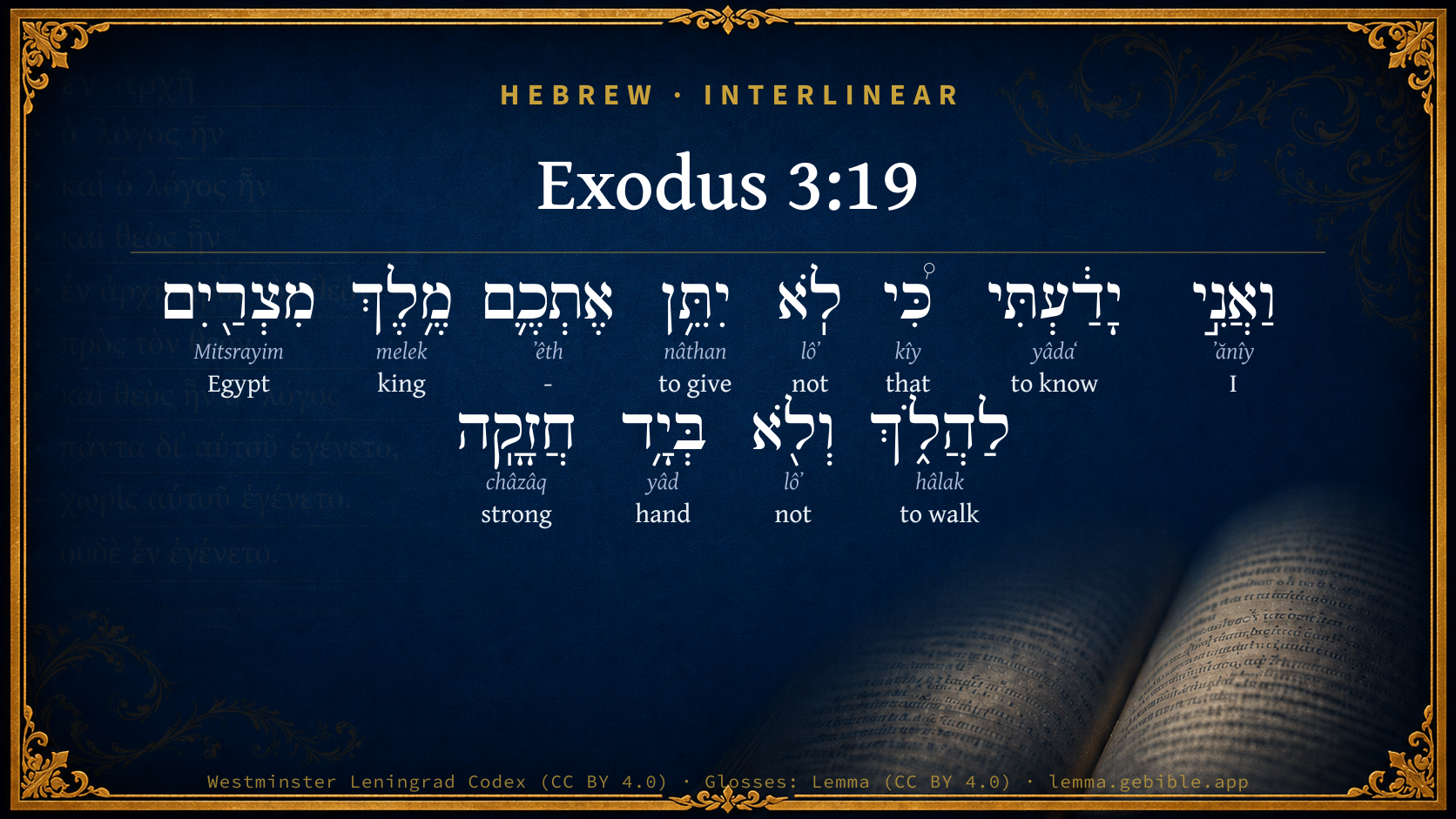
Exodus 3:19

Hebrew (Westminster Leningrad Codex) Exodus 3:19 appears in the Hebrew Old Testament. The text above is from the Westminster Leningrad Codex. Each word links to its Strong’s number, a concise gloss, and parsing drawn from the Open Scriptures Hebrew Bible morphology. Click any word for its full Brown-Driver-Briggs (BDB) entry.
Download image
Cite this verse

Exodus 3:19 (World English Bible). Public Domain. Lemma interlinear Bible study tool, https://lemma.gebible.app/v/exodus/3/19.

Show BibTeX & RIS
BibTeX
RIS
English Translation
I know that the king of Egypt won't give you permission to go, no, not by a mighty hand.
World English Bible · Public Domain
Highlights
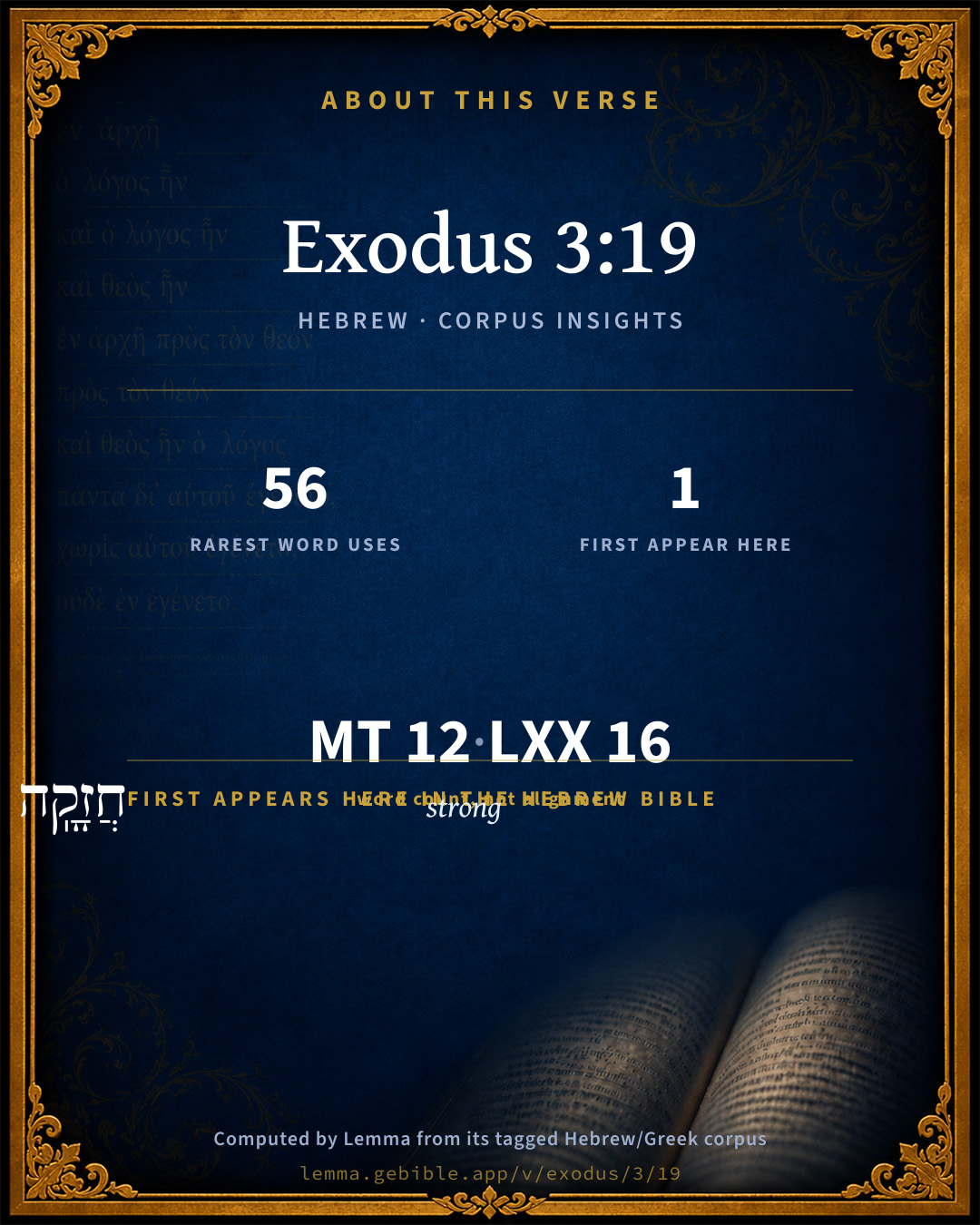
  • 1 first appearance in the Hebrew Bible
Full analysis ↓
Download a study sheet

One document with this verse’s original text, its word-by-word gloss line, the meaning frame, cross-references with their text, attributed commentary, and full source and license credits — printable, and it pastes into notes with its structure intact.

This verse Autodidact and up

Study sheet (.html) Plain text (.txt)

A passage Seminary Student

Up to 50 verses in one chapter. A passage sheet keeps up to 6 commentary sources and 12 cross-references per verse, in the order this page ranks them, and says so on the sheet whenever that leaves anything out. Ask for a single verse and you get the Autodidact verse sheet above.

Everything on this page stays free to read, with no account — the sheet is a download of what is already on screen, not access to it.

Want to remove ads? Support Godless Engineer
Compare translations 3

The same verse in 3 English versions, stacked beneath the original-language interlinear above. Click any original word for its lexicon entry.

Each is an independent rendering of the whole verse — the interlinear is not word-aligned to these translations.

Highlighted words mark where these versions differ — a whole-verse word diff, not a word-by-word alignment.

  • World English Bible Public Domain
    I know that the king of Egypt won't give you permission to go, no, not by a mighty hand.
  • King James Version Public Domain
    And I am sure that the king of Egypt will not let you go, no, not by a mighty hand.
  • unfoldingWord Literal Text CC BY-SA 4.0
    And I know that the king of Egypt will not permit you to go, and not with a strong hand.

unfoldingWord Literal Text — © unfoldingWord, licensed CC BY-SA 4.0. Word-aligned USFM3 via Door43 (git.door43.org/unfoldingWord/en_ult).

Versions to compare (up to 4)

3 of 4 selected

Show all 18 translations

Every available English version of this verse, each an independent rendering of the whole verse.

  • World English Bible Public Domain
    I know that the king of Egypt won't give you permission to go, no, not by a mighty hand.
  • Berean Standard Bible Public Domain
    But I know that the king of Egypt will not allow you to go unless a mighty hand compels him.
  • Majority Standard Bible Public Domain
    But I know that the king of Egypt will not allow you to go unless a mighty hand compels him.
  • King James Version Public Domain
    And I am sure that the king of Egypt will not let you go, no, not by a mighty hand.
  • American Standard Version (1901) Public Domain
    And I know that the king of Egypt will not give you leave to go, no, not by a mighty hand.
  • Revised Version (1885) Public Domain
    And I know that the king of Egypt will not give you leave to go, no, not by a mighty hand.
  • Geneva Bible (1599) Public Domain
    But I know, that the King of Egypt wil not let you goe, but by strong hande.
  • Douay-Rheims (1899) Public Domain
    But I know that the king of Egypt will not let you go, but by a mighty hand.
  • Young's Literal Translation Public Domain
    `And I -- I have known that the king of Egypt doth not permit you to go, unless by a strong hand,
  • Literal Standard Version CC BY-SA 4.0
    And I have known that the king of Egypt does not permit you to go, unless by a strong hand,
  • Unlocked Literal Bible CC BY-SA 4.0
    But I know that the king of Egypt will not let you go, unless his hand is forced.
  • unfoldingWord Literal Text CC BY-SA 4.0
    And I know that the king of Egypt will not permit you to go, and not with a strong hand.
  • Darby Bible Public Domain
    But I know that the king of Egypt will not let you go, no, not by a powerful hand.
  • World Messianic Bible Public Domain
    I know that the king of Egypt won’t give you permission to go, no, not by a mighty hand.
  • Webster's Bible Public Domain
    And I am sure that the king of Egypt will not let you go, no, not by a mighty hand.
  • Free Bible Version CC BY-SA 4.0
    But I know that the king of Egypt won't let you go unless he's forced to do so by a power stronger than him.
  • Bible in Basic English Public Domain
    And I am certain that the king of Egypt will not let you go without being forced.
  • JPS Tanakh (1917) Public Domain
    And I know that the king of Egypt will not give you leave to go, except by a mighty hand.

Literal Standard Version (2020), Covenant Press — licensed CC BY-SA 4.0. Text via the HelloAO Bible API (eBible.org). Unlocked Literal Bible (unfoldingWord) — licensed CC BY-SA 4.0. Text via the HelloAO Bible API (eBible.org). unfoldingWord Literal Text — © unfoldingWord, licensed CC BY-SA 4.0. Word-aligned USFM3 via Door43 (git.door43.org/unfoldingWord/en_ult). Free Bible Version, Dr. Jonathan Gallagher — licensed CC BY-SA 4.0. Text via the HelloAO Bible API (eBible.org).

Word by word

More ways to search: Search by grammar → Find every occurrence → Compare this word →

Practice this passage: Drill this verse → Learn its vocabulary →

חֲזָקָֽה
châzâq
H2389
“strong”
Adjective, Adjective, Feminine, Singular, Absolute
Part of Speech
Adjective
Type
Adjective
Gender
Feminine
Number
Singular
State
Absolute
Full BDB Definition

Origin: from H2388

TWOT: 636a

strong, stout, mighty - strong - severe, sharp, hot - firm, hard - a strong one (substantive)
  1. וַאֲנִ֣י ʼănîy H589 “and · I” Conjunction + Pronoun, Personal, 1st Person, Common, Singular
  2. יָדַ֔עְתִּי yâdaʻ H3045 “to know” Verb, Qal, Perfect, 1st Person, Common, Singular
  3. כִּ֠י kîy H3588 “that” Conjunction
  4. לֹֽא lôʼ H3808 “not” Particle, Negative
  5. יִתֵּ֥ן nâthan H5414 “to give” Verb, Qal, Imperfect, 3rd Person, Masculine, Singular
  6. אֶתְכֶ֛ם ʼêth H853 “- · you” Particle, Direct Object + Suffix, Personal, 2nd Person, Masculine, Plural
  7. מֶ֥לֶךְ melek H4428 “king of” Noun, Common, Masculine, Singular, Construct
  8. מִצְרַ֖יִם Mitsrayim H4714 “Egypt” Noun, Proper
  9. לַהֲלֹ֑ךְ hâlak H1980 “to walk” Preposition + Verb, Qal, Infinitive Construct
  10. וְלֹ֖א lôʼ H3808 “and · not” Conjunction + Particle, Negative
  11. בְּיָ֥ד yâd H3027 “in/at · hand” Preposition + Noun, Common, Both, Singular, Absolute

About this verse

These counts appear in no published source. They are computed here, from the morphology-tagged text and Lemma’s own curated glosses. What Lemma adds →

12
words
11
distinct lemmas
Pentateuch
section

First appearance in Scripture

This word makes its first canonical appearance in the Hebrew Bible here:

  • חֲזָקָֽה strong H2389

Shared distinctive vocabulary

חֲזָקָֽה strong H2389 occurs in 54 verses of the Hebrew Bible. Also found in:

Grammatical profile

  • 3 verbs
  • 3 nouns
  • 1 adjective
  • 1 pronoun
  • 1 conjunction
  • 3 particles

Verb forms

  • יָדַ֔עְתִּי Qal · Perfect
  • יִתֵּ֥ן Qal · Imperfect
  • לַהֲלֹ֑ךְ Qal · Infinitive Construct

Repetition

A word recurs within this verse — often emphatic in Hebrew:

Hebrew & Septuagint length

In English translation the verse runs 19 words from the Hebrew and 18 from the Septuagint (LXX English) — closely comparable.

A rough comparison of the two English renderings, which tokenize alike — not a word-level alignment.

Word counts can differ between the Hebrew and the Greek without any difference in meaning — e.g. the Hebrew direct-object marker אֵת has no separate Greek word, and Greek often adds the article ὁ.

In the original languages it is 12 Hebrew tokens and 16 Greek tokens — but the two are counted differently (Hebrew bundles its prefixes and suffixes into one token; the Greek is in lemma form), so that isn’t a like-for-like length.

Cross-references

5

Topical passages linked to Exodus 3:19 in the Treasury of Scripture Knowledge — connected by theme and wording, ordered by reader-vote popularity; previews shown in the World English Bible.

  • Exodus 5:2 Pharaoh said, "Who is Yahweh, that I should listen to his voice to let Israel go? I don't know Yahweh, and moreover I will not let Israel go."
  • Exodus 6:1 Yahweh said to Moses, "Now you shall see what I will do to Pharaoh, for by a strong hand he shall let them go, and by a strong hand he shall drive them out of his land."
  • Exodus 7:1–14 Yahweh said to Moses, "Behold, I have made you as God to Pharaoh; and Aaron your brother shall be your prophet.
  • Psalms 136:11–12 And brought out Israel from among them; For his loving kindness endures forever;
  • Isaiah 63:12–13 who caused his glorious arm to go at the right hand of Moses? who divided the waters before them, to make himself an everlasting name?

Cross-references courtesy of OpenBible.info (CC BY 4.0).

Hebrew and Greek witnesses Masoretic Hebrew ↔ Greek Septuagint

The same verse in the two great witnesses to the Old Testament, shown verse-for-verse.

These are two independent witnesses, not word-aligned to each other, and the Septuagint is shown in lemma (dictionary) form.

Hebrew Exodus 3:19 Masoretic · Westminster Leningrad Codex

וַאֲנִ֣י יָדַ֔עְתִּי כִּ֠י לֹֽא יִתֵּ֥ן אֶתְכֶ֛ם מֶ֥לֶךְ מִצְרַ֖יִם לַהֲלֹ֑ךְ וְלֹ֖א בְּיָ֥ד חֲזָקָֽה

I know that the king of Egypt won't give you permission to go, no, not by a mighty hand.

World English Bible · Public Domain

Greek LXX Exodus 3:19 Septuagint · lemma form

ἐγώ δέ οἶδα ὅτι οὐ προἵημι σύ φαραώ βασιλεύς αἴγυπτος πορεύομαι ἐάν μή μετά χείρ κραταιός

But I know that Pharao king of Egypt will not let you go, save with a mighty hand;

LXX2012 (modern English Septuagint) · Public Domain

On this verse, Adam Clarke's Commentary discusses the Septuagint’s reading. Read the note in Commentary ↓

Hebrew: Westminster Leningrad Codex (CC BY 4.0). Greek: Septuagint (public domain); English from LXX2012 (modern English Septuagint) (Public Domain). How the Septuagint differs from the Hebrew →

Targum (Aramaic paraphrase)

2

The Targum is the ancient Jewish Aramaic paraphrase of the Hebrew Scriptures — an interpretive translation, not the Hebrew text itself. Onkelos (literal) and Pseudo-Jonathan (expansive) render the Torah, and Jonathan the Prophets. Coverage is partial: where no permissively-licensed English translation exists for a verse, only the Aramaic is shown. This is verse-level text, not a word-by-word alignment to the Hebrew.

  1. Targum Onkelos Torah (Genesis–Deuteronomy)
    וּקְדָמַי גְלֵי אֲרֵי לָא יִשְׁבּוֹק יָתְכוֹן מַלְכָּא דְמִצְרַיִם לְמֵיזָל וְלָא מִן קֳדָם דְחֵילֵהּ תַּקִיף:

    (no public-domain English translation for this verse)

    Targum Onkelos — Aramaic: “Onkelos Genesis” (public domain); “Onkelos Exodus” (public domain); “Onkelos Leviticus” (public domain); “Onkelos Numbers” (public domain); “Onkelos Deuteronomy” (public domain). English: “Sefaria Community Translation” (CC0 1.0 (public-domain dedication)); “J.W. Etheridge. The Targums of Onkelos and Jonathan Ben Uzziel on the Pentateuch. London: Longmans, Green, 1862” (public domain). Text via Sefaria.

  2. Targum Pseudo-Jonathan Torah (Genesis–Deuteronomy)
    וַאֲנָא קֳדָמַי גְלֵי אֲרוּם לָא יִשְׁבּוֹק יַתְכוֹן מַלְכָּא דְמִצְרַיִם לְמֵיזַל וְלָא מִן דְחֵילֵיהּ תַּקִיף אֱלָהֵין בְּגִין דִבְמֵימְרִי לְאוֹכְחוֹתֵיהּ בְּמַכְתָּשִׁין בִּישִׁין

    But it is manifest before Me that the king of Mizraim will not let you go, (no,) not from fear of Him who is Mighty, until that by My Word he shall have been punished with evil plagues.

    Targum Pseudo-Jonathan — Aramaic: “Targum Jonathan on Genesis” (public domain); “Targum Jonathan on Exodus” (public domain); “Targum Jonathan on Leviticus” (public domain); “Targum Jonathan on Numbers” (public domain); “Targum Jonathan on Deuteronomy” (public domain). English: “The Targum of Jonathan ben Uzziel, trans. J. W. Etheridge, London, 1862” (public domain). Text via Sefaria.

Commentary

Notes on Exodus 3:19 from classic Christian and Jewish commentators (each source and its license shown beneath its notes). The classic Christian expositions comment on the surrounding passage and are grouped to its opening verse, so a note may address several verses; the Jewish commentaries on the Tanakh (Rashi and others) are per-verse, so they appear only where the commentator wrote on this verse.

Lemma curates 59 commentaries, every one of them public domain or Creative Commons licensed, each selected and text-cleaned for this edition rather than reprinted as found. About our sources →

Trapp's Complete Commentary

John Trapp

Exo 3:19 And I am sure that the king of Egypt will not let you go, no, not by a mighty hand.

Ver. 19. Will not let you go.] A sturdy rebel he was; but God tamed him, and took him down by those ten plagues, comprised in these four verses -

“Fit cruor ex undis, conspurcant omnia ranae;

Dat pulvis cimices, postea musca venit.

Dein pestis, post ulcera, grando, locusta, tenebrae:

Tandem prototocos ultima plaga necat.”

John Trapp, A Commentary or Exposition upon All the Books of the Old and New Testament (1647–1656) — public domain. Text from a community e-Sword module.

The Biblical Illustrator

Joseph S. Exell

Exo_3:19-22

I am sure the king of Egypt will not let you go.

The Divine knowledge of the success or otherwise of ministerial work

I. That God is thoroughly acquainted with the moral obstinacy of men.

1. There are many people who act like Pharaoh in relation to the commands of God. God knows such people. Their names are vocal on His lips. He tells His servants about them. He indicates judgments in reference to them. Such people are almost beyond the reach of ministerial influence. The minister is not altogether responsible for the success of his mission. He cannot force men to be good.

2. In all the commissions of human life God recognises the free agency of the wicked. Is it not a mystery that man has the ability to oppose the will of God?

3. We may inquire into the utility of employing Christian agency where the result will be ineffectual. To leave impenitent sinners without excuse.

II. That God is thoroughly acquainted with the method He will pursue in reference to the morally obstinate.

1. God deals with the morally obstinate after the method of a consecutive plan. First, He prepares the messenger to visit and teach them; then gives him the message; then tells him how to make it known; then smites in judgments, successive, severe. Thus God does not deal with the morally obstinate according to the impulse of the moment--fitfully, incidentally, but according to a harmonious, merciful, self-consistent plan--a plan that will admit of the repentance and faith of the sinner.

2. God sometimes meets the morally obstinate with demonstrations of His power. I will stretch out, etc.

III. That God can thwart the intention of the morally obstinate by their own wickedness, and by the conduct of their comrades (Exo_3:22). (J. S. Exell, M. A.)

.

The Biblical Illustrator, edited by Joseph S. Exell (c. 1880s–1900s) — public domain. Text from a community e-Sword module.

The Preacher's Complete Homiletical Commentary

Joseph S. Exell (gen. ed.)

MAIN HOMILETICS OF THE PARAGRAPH.—Exo_3:19-22

THE DIVINE KNOWLEDGE OF THE SUCCESS OR OTHERWISE OF MINISTERIAL WORK

I. That God is thoroughly acquainted with the moral obstinacy of men. “And I am sure that the King of Egypt will not let you go.”

1. There are many people who act like Pharaoh in relation to the commands of God. As Pharaoh treated Moses and the Israelites with contempt—manifesting pride—obstinacy—so there are men and women to-day as proud and obstinate in reference to the requirements of Christ and His Gospel; ministers address Divine messages to them—urge the Divine claims—all in vain. God knows such people. Their names are vocal on His lips. He tells His servants about them. He indicates judgments in reference to them. Such people are almost beyond the reach of ministerial influence. The minister is not altogether responsible for the success of his mission. He cannot force men to be good.

2. In all the commissions of human life God recognises the free agency of the wicked. God could with ease have set the Israelites at liberty, as He did Paul and Silas. Such was not the Divine will. He desired to use moral instrumentalities, in harmony with the volition of man. Is it not a mystery that man has the ability to oppose the will of God?

3. We may inquire into the utility of employing Christian agency where the result will be ineffectual. What utility could there be in the mission of Moses to Pharaoh, when God knew right well that it would be unavailing, and informed Moses of the fact? Why, then, was Moses sent; and would not this knowledge discourage and introduce an element of weakness into his effort? He went at the sovereign command of God to teach Pharaoh the Divine will, that he might be without excuse, that he might be acquainted with the designed freedom of Israel—for the sending of Moses had reference to Israel as well as to the king. It also commenced a series of events that ultimately issued in the overthrow of Pharaoh, and the victory of the Supreme Being on behalf of His people. So ministers are sent to nations—people—to-day who will remain finally impenitent. Such is the method of the Divine arrangement—such the attention of Divine mercy to the worst of characters—such the power of right that it will conquer, if in judgment.

II. That God is thoroughly acquainted with the method He will pursue in reference to the morally obstinate.

1. God deals with the morally obstinate after the method of a consecutive plan. First, He prepares the messenger to visit and teach them; then gives him the message; then tells him how to make it known; then smites in judgments, successive, severs. Thus God does not deal with the morally obstinate according to the impulse of the moment—fitfully, incidentally, but according to a harmonious, merciful, self-consistent plan—a plan that will admit of the repentance and faith of the sinner.

2. God sometimes meets the morally obstinate with demonstrations of His power. “I will stretch out my hand, and smite Egypt with all my wonders,” etc. Here, then, we have human power in conflict with the Divine—the King of Egypt against the King of Heaven. Which will conquer? The sequel. So sometimes God meets the obstinate sinner with tokens of power,

(1) afflictive,

(2) convincing,

(3) subduing.

III. That God can thwart the intention of the morally obstinate by their own wickedness, and by the conduct of their comrades. (Exo_3:22.)

1. Pharaoh’s obstinacy was thwarted by his own wickedness. The Egyptians aided the escape of Israel—gave them articles to facilitate their journey. So the purposes of obstinate men are often thwarted by those who share their sin and determination. The work of defeating and subduing obstinate sin is not left wholly to ministers. Often the Egyptians help them.

3. How thoroughly all agencies are at the disposal of God. His ministers are not the only instrumentalities at his call. All events, all persons cluster round them as a centre, and, under Divine direction, accomplish the moral freedom of the good.

SUGGESTIVE COMMENTS ON THE VERSES

Exo_3:19. God declares the worst as well as the best that meet His servants in the way of salvation.

God knows what the powers of the world will do against the Church, and yet He tries them.

It is incident to worldly powers to deny the humblest request from God.

God in His wisdom suffers worldly powers to wrestle with His mighty hand.

Their sin is aggravated who ever contend with the mighty hand of God.

The madness of sinners is so great, that they will put God’s power to the test.

Exo_3:20. God is at hand to deal with them that contend with His power.

God’s hand put forth will startle the arm of flesh.

Upon God’s putting forth His hand to vengeance, great smitings are on His enemies.

Wonderful vengeance God’s hand giveth forth sometimes to quell the resistance of adversaries.

God will certainly work wonderful plagues where He threatens them.

The very midst of God’s enemies shall have experience of His wonderful plagues.

Where grace will not prevail with wicked men, force shall.

Sin endures its plagues to no purpose, as it is obliged to yield.

Exo_3:21-22. There is a grace of favour which the world may show unto God’s Church.

It is God’s only work to incline the hearts of enemies to favour His people.

Fulness, as well as freedom, yield to God’s people at His Word.

God’s Church is neighbour with a wicked world till His time. Even the world has some valuable things that it can give to the Church.

Sometimes God makes the sons and daughters of the Church carry away the treasures of enemies.

At God’s command, the Church shall spoil the enemies that spoiled her.

A great part of the gold and silver now obtained was afterward used in building and furnishing the tabernacle.

The relation of God:—

1. To human outgoings.

2. To human hearts.

3. to human treasures.

God is the proper owner of all treasures, and can dispose of them as He will.

The word rendered “borrow” means simply to ask (Psalms , 2-8, ask), and should be so translated. Israel had, after their toil for the Egyptians, & right to ask their help on their departure.

That “spoiled” does not imply robbery or injustice is evident from its use by Laban’s daughters (Gen_31:16).

The Egyptians would be so overcome by abject distress as to be ready to part with a considerable portion of their wealth, in order to get rid of a people whose presence menaced them with utter extermination.

God has many ways of balancing accounts between the injured and the injurious—of righting the oppressed, and compelling those that have done wrong, to make restitution; for he sits upon the throne, judging right [Matthew Henry].

ILLUSTRATIONS

Exo_3:19-20. Like as, if a man’s foot, leg, or arm be broken, with how great pain the same is restored to its former estate all men know; but if any member of our body should be broken twice or thrice, or more often, in one and the self-same place, every man can then judge how hard a thing it were for that part to recover its perfect strength and health again: even so fareth it in the ruptures and wounds of our soul. If a man do commit sin once or twice, and do unfeignedly, without dissimulation, make his refuge to the medicine of repentance, he doth out of hand obtain health again, and that sometimes without any scar or blemish of the disease past; but if he begin to add sins upon sins in such sort that the wounds of the soul do rather putrefy within him, by covering and defending them, than heal, by repentance and confession, it is to be feared such a one shall not find repentance at commandment when he wisheth for it [Cawdray].

Exo_3:20. As the course of a stream, being stopped, it gathereth a great dam, and being let suddenly go, it overfloweth all in its way; even so God’s anger, being stayed a time, the windows of heaven being opened, it will (shortly, it is to be feared) pour down on our heads plentifully for the manifold sins that reign in every estate throughout the whole land.

As wet wood, although it be long burning, yet will burn faster at last; so the anger of God, although it be long coming, yet it will come the fiercer at the last.

The Preacher's Complete Homiletical Commentary (gen. ed. Joseph S. Exell; Funk & Wagnalls, c. 1892) — public domain (pre-1929). A full-Bible homiletical/sermon-outline anthology covering 65 of 66 books (2 John is absent from the source module). Text from a community e-Sword module.

Tyndale Open Study Notes

Tyndale Open Resources

3:19 I know: See “Hardened Hearts” Theme Note.

Tyndale Open Study Notes — © Tyndale Open Resources, licensed CC BY-SA 4.0. Text via the HelloAO Bible API.

Adam Clarke's Commentary

Verse 19. I am sure that the king of Egypt will not let you go, no, not by a mighty hand] When the facts detailed in this history have been considered in connection with the assertion as it stands in our Bibles, the most palpable contradiction has appeared. That the king of Egypt did let them go, and that by a mighty hand, the book itself amply declares. We should therefore seek for another meaning of the original word. ולא velo, which generally means and not, has sometimes the meaning of if not, unless, except, c. and in Becke's Bible, 1549, it is thus translated: I am sure that the kyng of Egypt wyl not let you go, EXCEPT wyth a mighty hand. This import of the negative particle, which is noticed by Noldius, Heb. Part., p. 328, was perfectly understood by the Vulgate, where it is translated nisi, unless; and the Septuagint in their εαν μη which is of the same import; and so also the Coptic. The meaning therefore is very plain: The king of Egypt, who now profits much by your servitude, will not let you go till he sees my hand stretched out, and he and his nation be smitten with ten plagues. Hence God immediately adds, Ex 3:20: I will stretch out my hand, and smite Egypt with all my wonders -and after that, he will let you go.

Adam Clarke's Commentary on the Bible (1810–1826) — public domain. Text from a community e-Sword/MySword module.

Ellicott's Commentary for English Readers

(19) I am sure.—Heb., I know, which is more suitable, since it is God who speaks, and to Him the future is known with as absolute a certainty as the past.

No, not by a mighty hand.—Rather, not even under a mighty hand (ne quidem valida manu castigatus, Rosenmüller). Pharaoh, even when chastised by My mighty hand, will not voluntarily permit of your departure (see Exo_14:5-23).

A Bible Commentary for English Readers, edited by Charles John Ellicott (1878–1897) — public domain. Text from a community e-Sword module.

The Cambridge Bible for Schools and Colleges

gen. ed. J. J. S. Perowne

19. But I know. The pron. is emphatic.

no, not by a mighty hand] not even when severely smitten by God’s hand,—as in the first nine plagues. But it is strange that the tenth plague (when the Pharaoh did let them go) should be excluded. What we expect (cf. v. 20) is, ‘except by a mighty hand’ (so LXX.); and this ought probably to be read (אם לא for ולא). Mighty hand as Exo_6:1, Exo_13:9, Exo_32:11; Num_20:20 (of Edom): and often in Dt. (esp. in the combination ‘a mighty hand and stretched out arm,’ Deu_4:34, Deu_5:15 al.).

19–20. But the Pharaoh will not let Israel go, till the Egyptians have experienced the power of Jehovah’s hand.

The Cambridge Bible for Schools and Colleges (gen. ed. J. J. S. Perowne; Cambridge University Press, 1878–1918) — public domain. Text from a community e-Sword module.

John Gill's Exposition

And I am sure that the king of Egypt will not let you go,.... Or "but" (c) "I am sure", &c. though so reasonable a request was made him, yet it would not be granted; this is observed to them, that they might not be discouraged when he should refuse to dismiss them, which the omniscient God knew beforehand, and acquaints them with it, that, when it came to pass, they might be induced to believe that the mission of Moses was of God, rather than the contrary:

no, not by a mighty hand; the mighty power of God displayed once and again, even in nine plagues inflicted on him, until the tenth and last came upon him; or "unless by a mighty hand" (d), even the almighty hand of God; prayers, entreaties, persuasions, and arguments, will signify nothing, unless the mighty power of God is exerted upon him.

(c) "ego autem", Junius & Tremellius, Piscator; "sed ego", V. L. (d) Sept. "nisi", V. L. Pagninus, Vatablus; so Noldius, p. 344. No. 1246.

John Gill's Exposition of the Whole Bible (1746–1763) — public domain (CC PDM 1.0). Text via the HelloAO Bible API.

Albert Barnes' Notes on the Bible

No, not - See the marginal rendering. Others explain it to mean, Pharaoh will not let the people go even when severely smitten.

Albert Barnes' Notes on the Bible (1834–1885) — public domain. Text from a community e-Sword/MySword module.

Matthew Poole's English Annotations

I am sure; I know it infallibly beforehand.

No, not by a mighty hand; though he see and feel the miraculous and dreadful works of a strong, yea, almighty hand, yet he will not consent to your going; which the history makes good. Nor did he let them go till he could hold them no longer, till the fear of his own life, and the clamours of his people, forced him to give way to it. And yet after that he repents of his permission, and laboured to bring them back again. Others, but or except by a strong hand, i.e. except by my almighty power he be forced to it. Both translations come to the same sense.

Matthew Poole's English Annotations on the Holy Bible (1683–1685) — public domain. Text from a community e-Sword/MySword module.

Whedon's Commentary on the Bible

Daniel D. Whedon

19. And I am sure — Literally, I know, “that the king of Egypt will not let you go.” No,

not by a mighty hand — Rather, But by a mighty hand. Obedience to this simple, plain demand made by Moses was possible, but God knew that Pharaoh would disobey, and predicted the results of his free volition. God knew Pharaoh’s proud and obstinate heart.

Daniel D. Whedon (gen. ed.), Commentary on the Old and New Testaments (1874–1909) — public domain. Text from a community e-Sword module.

The Pulpit Commentary

I am sure. Literally, "I know," a better rendering, since, "I am sure" implies something leas than knowledge. No, not by a mighty hand. Or "not even by a mighty hand." Pharaoh will not be willing to let you go even when my mighty hand is laid upon him. (see Exo_8:15, Exo_8:19, 32 9:12, 35 10:20, 27) "But by strong hand" (marg. ) is a rendering which the rules of grammar do not permit.

Vers. 19, 20. Pharaoh"s obduracy, and God"s mode of overcoming it.

There are stubborn hearts which no warnings can impress, no lessons teach, no pleading, even of God"s Spirit, bond. With such he "will not always strive." After they have resisted him till his patience is exhausted, he will break them, crush them., overrule their opposition, and make it futile. God"s will surely triumphs in the end. But it may be long first. God is so patient, so enduring, so long-suffering, that he will permit for months, or even years, the contradiction of sinners against himself. He will not interfere with the exercise of their free-will. He will warn, chide, chasten, afflict, contend with the sinner; try him to the uttermost; seek to lead him to repentance; give him chance after chance. But he will not compel him to submit himself; man may resist to the last; and even "curse God and die" at war with him. The final success in such a struggle cannot, however, rest with man. God "will not alway be chiding, neither keepeth he his anger for ever." At the fitting time he "stretches forth his hand and smites" the sinner, strikes him down, or sets him aside, as the storm-wind sets aside a feeble barrier of frail rushes, and works his own will in his own way. Mostly he works by natural causes; but now and again in the history of the world he has asserted himself more openly, and has broken the power and chastised the pride of a Pharaoh, a Benhadad, or a Sennacherib, in a miraculous way. Such manifestations of his might produce a marked effect, causing, as they do, "all the kingdoms of the earth to know that he is the Lord God, and he only". (2Ki_19:19)

The Pulpit Commentary (1880–1919), ed. H.D.M. Spence-Jones & Joseph S. Exell — public domain. Text from a community e-Sword module.

John Wesley's Explanatory Notes

I am sure he will not let you go - God sends his messengers to those whose obstinacy he foresees, that it may appear he would have them turn and live.

John Wesley, Explanatory Notes Upon the Whole Bible (1754–1765) — public domain. Text via the GEBible commentary corpus.

Kretzmann's Popular Commentary

Paul E. Kretzmann

The Promise of Deliverance

v. 19. And I am sure that the king of Egypt will not let you go, no, not by a mighty hand. The omniscient God knew that Pharaoh would not permanently submit to Him, not even after the ten plagues, but would deliberately harden himself against his better knowledge and thus invite destruction upon himself.

v. 20. And I will stretch out My hand and smite Egypt with all My wonders which I will do in the midst thereof. The Lord announces that He will glorify Himself by means of great miracles which He would perform in the midst of Egypt, thus letting all men know that He was supreme. And after that he will let you go.

v. 21. And I will give this people favor in the sight of the Egyptians; and it shall come to pass that, when ye go, ye shall not go empty;

v. 22. but every woman shall borrow, that is, ask, request, of her neighbor, and of her that sojourneth in her house, jewels of silver, and jewels of gold, and raiment; and ye shall put them upon your sons and upon your daughters; and ye shall spoil the Egyptians. By God’s dispensation, the Egyptian women would show their Israelite neighbors all kindness in readily bringing forth all the jewelry and the vessels of precious metals which they desired, this spoiling of the Egyptians being intended by God to compensate the Israelites for the many years of serfdom and slavery. It may often seem that there is neither right nor justice in the world, but the righteousness of God will always bring deliverance to His children, very often with a greater blessing than they expected.

Paul E. Kretzmann, Popular Commentary of the Bible (1921–1924) — public domain. Text from a community e-Sword module.

unfoldingWord translationNotes

Door43 World Missions Community

General Information:

God continues speaking to Moses.

unless his hand is forced

This can be stated in active form. The word "hand" is a metonym for the power of the owner of the hand. Possible meanings are 1) "only if he sees that he has no power to do anything else," where the "hand" belongs to Pharaoh; where the "hand" belongs to Yahweh, 2) "only if I force him to let you go" or 3) "not even if I force him to let you go." (See: Metonymy and Idiom and Active or Passive)

I will reach out with my hand and attack

Here "hand" refers to God's power. AT: "I will powerfully attack" (See: Metonymy)

will not go empty-handed

The word here "empty-handed" is used to emphasize the opposite meaning. AT: "will go with your hands full of good things" or "will go with many valuable things" (See: Double Negatives)

any women staying in her neighbors' houses

"any Egyptian woman staying in the houses of her Egyptian neighbors"

translationWords

Egypt

miracle

favor

silver

gold

unfoldingWord translationNotes — © Distant Shores Media and the Door43 World Missions Community, licensed CC BY-SA 4.0. Source: git.door43.org/Door43/en_tn.

Rashi

Rabbi Shlomo Yitzchaki (Rashi)

לא יתן אתכם מלך מצרים להלך THE KING OF EGYPT WILL NOT LET YOU GO, if I do not (ולא) show him My strong hand (יד חזקה) — it is as much as to say: so long as I do not let him feel My strong hand he will not let you go.

לא יתן — Translate this as the Targum does: he will not give leave. Similar uses of נתן followed by ל with the infinitive in sense of permitting are: (Genesis 20:6) “therefore I did not permit thee (נתתיך) to touch her”; (Genesis 31:7) “And God did not permit him (נתנו) to do me evil”. Still all these passages really have the sense of giving”. Some explain the phrase ולא ביד חזקה to signify: “He will not permit you to go, and this will not be because his hand is strong”, for (v. 20) “As soon as I stretch forth My hand I will smite the Egyptians [… and afterwards he will let you go]”. And so the Targum renders it: and not on account that his power is mighty. This explanation was told me in the name of Rabbi Jacob the son of Menachem.

Rashi on the Tanakh — English translations: “The Judaica Press complete Tanach with Rashi, translated by A. J. Rosenberg” (CC BY 4.0); “Pentateuch with Rashi's commentary by M. Rosenbaum and A.M. Silbermann, 1929-1934” (public domain); “The Metsudah Tanach series, Lakewood, N.J” (CC BY 4.0); and “The Book of Joshua, Metsudah Publications, 1997” (CC BY 4.0). Text via Sefaria.

Ramban (Nachmanides)

Rabbi Moshe ben Nachman (Ramban / Nachmanides)

V’LO B’YAD CHAZAKAH’ (AND NOT BY A MIGHTY HAND). “So long as I do not let him feel My mighty hand he will not let you go.” Thus the words of Rashi. The correct interpretation in my opinion is: “The king of Egypt will not give you leave to go by plea, and not [even] by a mighty hand, until I will put forth My hand with all My wonders which I will do in his midst, by a mighty hand, and by an outstretched arm, and by great terrors, and by signs and by wonders. And after that he will let you go.” Indeed, all these manifestations came upon him before he gave them leave to go.

Ramban (Nachmanides) on the Tanakh — English translation: “Commentary on the Torah by Ramban (Nachmanides). Translated and annotated by Charles B. Chavel. New York, Shilo Pub. House, 1971-1976” (CC BY 4.0). Text via Sefaria.

Lesson kit

Teaching starters — assembled from the data on this page, not authored interpretation. Every prompt links to the verse data it draws on. Edit before teaching.

Exodus, in the Pentateuch, opens this verse with 12 words (11 distinct Hebrew lemmas). Its most distinctive word is châzâq (“strong”). A historical commentator’s framing appears above. Read the whole chapter for the surrounding context.

Discussion questions

  1. How does “strong” (châzâq) shape what this verse is saying?
  2. This is the first place “strong” appears in Scripture (first appears here). What does its debut here establish?
  3. How does Exodus 6:1, which shares the word «strong», read alongside this verse?
  4. What does the repetition of “not” (2× in this one verse) do in this verse?
  5. These translations render this verse differently; the difference is in the English rendering, not the original. What questions does that raise?
  6. «יָדַ֔עְתִּי» is a Qal Perfect verb. How does that grammatical form shape the action described?
  7. Compare how Trapp's Complete Commentary and The Biblical Illustrator read this verse. Where do they agree or differ?

Things to notice

Reading settings

Reading text

Shown beneath each verse's original-language words.

Old Testament
Old Testament edition

Read the OT as the Masoretic Hebrew (MT) or the Greek Septuagint (LXX).

English shown for the Greek Septuagint (in the Hebrew ↔ Greek comparison).

Comparing translations? Open the Compare panel on any verse page to stack up to four side by side.