
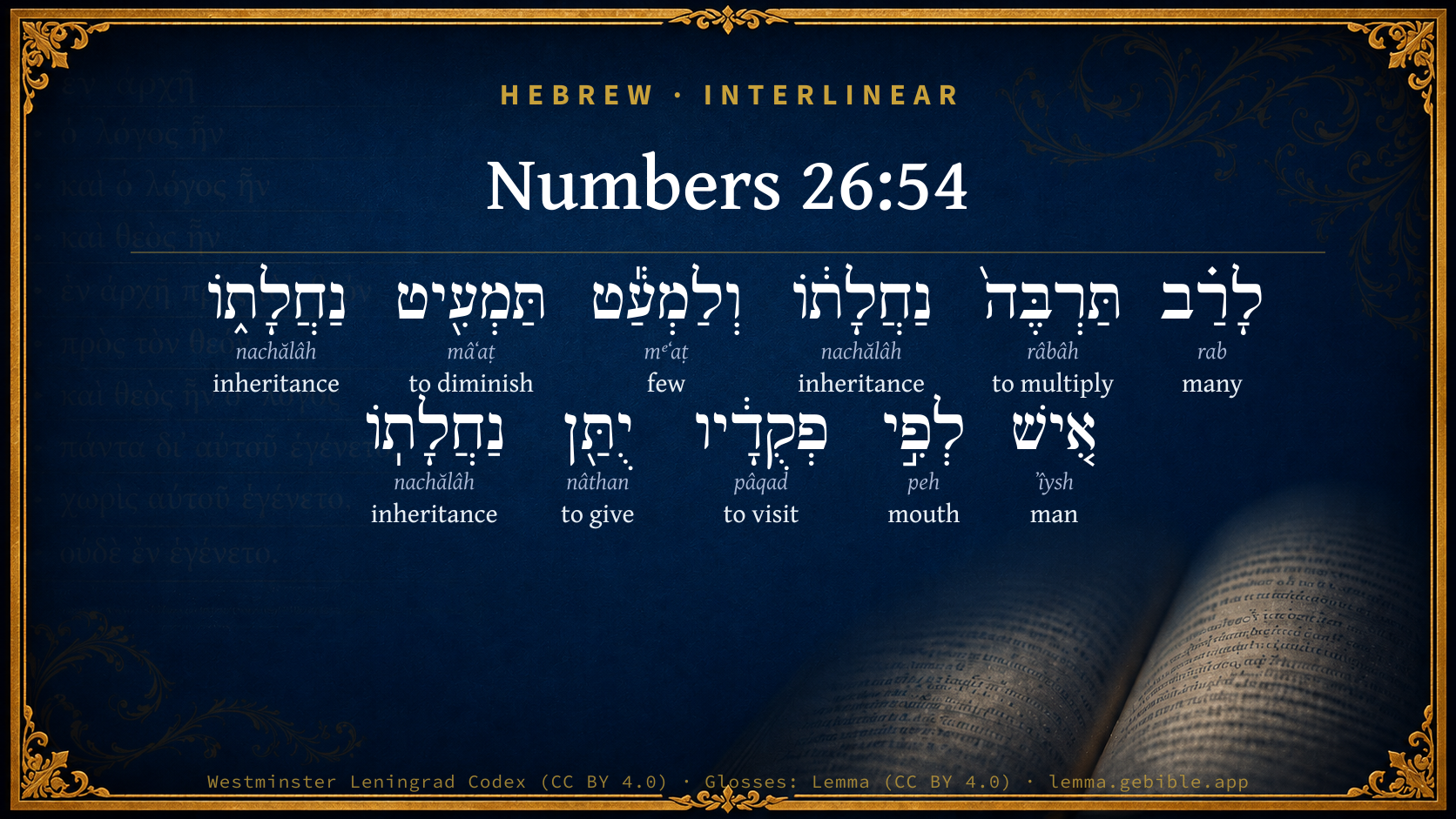
Numbers 26:54

Hebrew (Westminster Leningrad Codex) Numbers 26:54 appears in the Hebrew Old Testament. The text above is from the Westminster Leningrad Codex. Each word links to its Strong’s number, a concise gloss, and parsing drawn from the Open Scriptures Hebrew Bible morphology. Click any word for its full Brown-Driver-Briggs (BDB) entry.
Download image
Cite this verse

Numbers 26:54 (World English Bible). Public Domain. Lemma interlinear Bible study tool, https://lemma.gebible.app/v/numbers/26/54.

Show BibTeX & RIS
BibTeX
RIS
English Translation
To the more you shall give the more inheritance, and to the fewer you shall give the less inheritance: to everyone according to those who were numbered of him shall his inheritance be given.
World English Bible · Public Domain
Download a study sheet

One document with this verse’s original text, its word-by-word gloss line, the meaning frame, cross-references with their text, attributed commentary, and full source and license credits — printable, and it pastes into notes with its structure intact.

This verse Autodidact and up

Study sheet (.html) Plain text (.txt)

A passage Seminary Student

Up to 50 verses in one chapter. A passage sheet keeps up to 6 commentary sources and 12 cross-references per verse, in the order this page ranks them, and says so on the sheet whenever that leaves anything out. Ask for a single verse and you get the Autodidact verse sheet above.

Everything on this page stays free to read, with no account — the sheet is a download of what is already on screen, not access to it.

Want to remove ads? Support Godless Engineer
Compare translations 3

The same verse in 3 English versions, stacked beneath the original-language interlinear above. Click any original word for its lexicon entry.

Each is an independent rendering of the whole verse — the interlinear is not word-aligned to these translations.

Highlighted words mark where these versions differ — a whole-verse word diff, not a word-by-word alignment.

  • World English Bible Public Domain
    To the more you shall give the more inheritance, and to the fewer you shall give the less inheritance: to everyone according to those who were numbered of him shall his inheritance be given.
  • King James Version Public Domain
    To many thou shalt give the more inheritance, and to few thou shalt give the less inheritance: to every one shall his inheritance be given according to those that were numbered of him.
  • unfoldingWord Literal Text CC BY-SA 4.0
    To the numerous you shall increase his inheritance, and to the small you shall lessen his inheritance. His inheritance shall be given, a man according to the mouth of his counted ones.

unfoldingWord Literal Text — © unfoldingWord, licensed CC BY-SA 4.0. Word-aligned USFM3 via Door43 (git.door43.org/unfoldingWord/en_ult).

Versions to compare (up to 4)

3 of 4 selected

Show all 18 translations

Every available English version of this verse, each an independent rendering of the whole verse.

  • World English Bible Public Domain
    To the more you shall give the more inheritance, and to the fewer you shall give the less inheritance: to everyone according to those who were numbered of him shall his inheritance be given.
  • Berean Standard Bible Public Domain
    Increase the inheritance for a large tribe and decrease it for a small one; each tribe is to receive its inheritance according to the number of those registered.
  • Majority Standard Bible Public Domain
    Increase the inheritance for a large tribe and decrease it for a small one; each tribe is to receive its inheritance according to the number of those registered.
  • King James Version Public Domain
    To many thou shalt give the more inheritance, and to few thou shalt give the less inheritance: to every one shall his inheritance be given according to those that were numbered of him.
  • American Standard Version (1901) Public Domain
    To the more thou shalt give the more inheritance, and to the fewer thou shalt give the less inheritance: to every one according to those that were numbered of him shall his inheritance be given.
  • Revised Version (1885) Public Domain
    To the more thou shalt give the more inheritance, and to the fewer thou shalt give the less inheritance: to every one according to those that were numbered of him shall his inheritance be given.
  • Geneva Bible (1599) Public Domain
    To many thou shalt giue the more inheritance, and to fewe thou shalt giue lesse inheritance: to euery one according to his nomber shalbe giuen his inheritance.
  • Douay-Rheims (1899) Public Domain
    To the greater number thou shalt give a greater portion, and to the fewer a less: to every one, as they have now been reckoned up, shall a possession be delivered:
  • Young's Literal Translation Public Domain
    to the many thou dost increase their inheritance, and to the few thou dost diminish their inheritance; `to' each according to his numbered ones is given his inheritance.
  • Literal Standard Version CC BY-SA 4.0
    to the many you increase their inheritance, and to the few you diminish their inheritance; each is given his inheritance according to his numbered ones.
  • Unlocked Literal Bible CC BY-SA 4.0
    To the larger clans you must give more inheritance, and to the smaller clans you must give less inheritance. To every family you must give an inheritance according to the number of men who were counted.
  • unfoldingWord Literal Text CC BY-SA 4.0
    To the numerous you shall increase his inheritance, and to the small you shall lessen his inheritance. His inheritance shall be given, a man according to the mouth of his counted ones.
  • Darby Bible Public Domain
    to the many thou shalt increase their inheritance, and to the few thou shalt diminish their inheritance; to every one shall his inheritance be given according to those that were numbered of him.
  • World Messianic Bible Public Domain
    To the more you shall give the more inheritance, and to the fewer you shall give the less inheritance. To everyone according to those who were counted of him shall his inheritance be given.
  • Webster's Bible Public Domain
    To many thou shalt give the more inheritance, and to few thou shalt give the less inheritance: to every one shall his inheritance be given, according to those that were numbered of him.
  • Free Bible Version CC BY-SA 4.0
    Give a larger area of land to a larger tribe, and a smaller area to a smaller tribe. Each tribe shall receive their allotment of land depending on their number counted in the census.
  • Bible in Basic English Public Domain
    To those families who are more in number, give a greater heritage; to those who are less in number, a smaller part: to every one let the heritage be given in relation to the number in his family.
  • JPS Tanakh (1917) Public Domain
    To the more thou shalt give the more inheritance, and to the fewer thou shalt give the less inheritance; to each one according to those that were numbered of it shall its inheritance be given.

Literal Standard Version (2020), Covenant Press — licensed CC BY-SA 4.0. Text via the HelloAO Bible API (eBible.org). Unlocked Literal Bible (unfoldingWord) — licensed CC BY-SA 4.0. Text via the HelloAO Bible API (eBible.org). unfoldingWord Literal Text — © unfoldingWord, licensed CC BY-SA 4.0. Word-aligned USFM3 via Door43 (git.door43.org/unfoldingWord/en_ult). Free Bible Version, Dr. Jonathan Gallagher — licensed CC BY-SA 4.0. Text via the HelloAO Bible API (eBible.org).

Word by word

More ways to search: Search by grammar → Find every occurrence → Compare this word →

Practice this passage: Drill this verse → Learn its vocabulary →

תַּמְעִ֖יט
mâʻaṭ
H4591
“to diminish”
Verb, Hiphil, Imperfect, 2nd Person, Masculine, Singular
Part of Speech
Verb
Stem
Hiphil
Form
Imperfect
Person
2nd Person
Gender
Masculine
Number
Singular
Full BDB Definition

Origin: a primitive root

TWOT: 1228

to be or become small, be few, be diminished - (Qal) - to diminish - to be too small - (Piel) to become few - (Hiphil) - to make small, make few, diminish - to give less
  1. לָרַ֗ב rab H7227 “to/for the · many” Preposition, Determined + Adjective, Adjective, Masculine, Singular, Absolute
  2. תַּרְבֶּה֙ râbâh H7235 “to multiply” Verb, Hiphil, Imperfect, 2nd Person, Masculine, Singular
  3. נַחֲלָת֔וֹ nachălâh H5159 “inheritance · his” Noun, Common, Feminine, Singular, Construct + Suffix, Personal, 3rd Person, Masculine, Singular
  4. וְלַמְעַ֕ט mᵉʻaṭ H4592 “and · to/for the · few” Conjunction + Preposition, Determined + Adjective, Adjective, Masculine, Singular, Absolute
  5. נַחֲלָת֑וֹ nachălâh H5159 “inheritance · his” Noun, Common, Feminine, Singular, Construct + Suffix, Personal, 3rd Person, Masculine, Singular
  6. אִ֚ישׁ ʼîysh H376 “man” Noun, Common, Masculine, Singular, Absolute
  7. לְפִ֣י peh H6310 “to/for · mouth of” Preposition + Noun, Common, Masculine, Singular, Construct
  8. פְקֻדָ֔יו pâqad H6485 “visited · him” Verb, Qal, Participle Passive, Masculine, Plural, Construct + Suffix, Personal, 3rd Person, Masculine, Singular
  9. יֻתַּ֖ן nâthan H5414 “to give” Verb, Hophal, Imperfect, 3rd Person, Masculine, Singular
  10. נַחֲלָתֽוֹ nachălâh H5159 “inheritance · his” Noun, Common, Feminine, Singular, Construct + Suffix, Personal, 3rd Person, Masculine, Singular

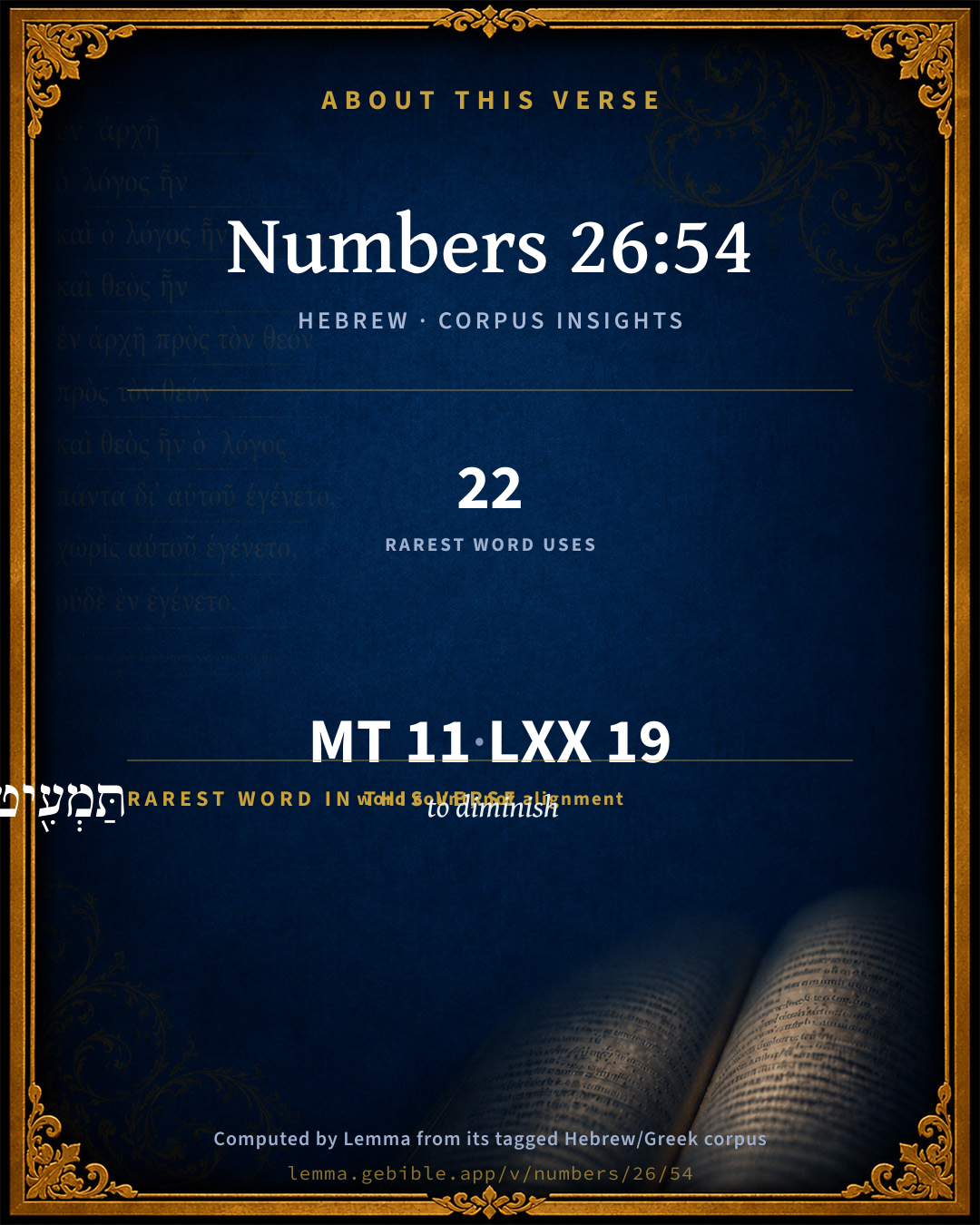
About this verse

These counts appear in no published source. They are computed here, from the morphology-tagged text and Lemma’s own curated glosses. What Lemma adds →

11
words
9
distinct lemmas
Pentateuch
section

Notable vocabulary

The rarest word here is תַּמְעִ֖יט to diminish H4591 — appearing just 22 times in the whole Hebrew Bible.

Shared distinctive vocabulary

תַּמְעִ֖יט to diminish H4591 occurs in 21 verses of the Hebrew Bible. Also found in:

Grammatical profile

  • 4 verbs
  • 5 nouns
  • 2 adjectives

Verb forms

  • תַּרְבֶּה֙ Hiphil · Imperfect
  • תַּמְעִ֖יט Hiphil · Imperfect
  • פְקֻדָ֔יו Qal · Participle Passive
  • יֻתַּ֖ן Hophal · Imperfect

Repetition

A word recurs within this verse — often emphatic in Hebrew:

  • נַחֲלָת֔וֹ inheritance H5159 ×3

Hebrew & Septuagint length

In English translation the verse runs 34 words from the Hebrew and 34 from the Septuagint (LXX English) — the same length.

A rough comparison of the two English renderings, which tokenize alike — not a word-level alignment.

Word counts can differ between the Hebrew and the Greek without any difference in meaning — e.g. the Hebrew direct-object marker אֵת has no separate Greek word, and Greek often adds the article ὁ.

In the original languages it is 11 Hebrew tokens and 19 Greek tokens — but the two are counted differently (Hebrew bundles its prefixes and suffixes into one token; the Greek is in lemma form), so that isn’t a like-for-like length.

Cross-references

4

Topical passages linked to Numbers 26:54 in the Treasury of Scripture Knowledge — connected by theme and wording, ordered by reader-vote popularity; previews shown in the World English Bible.

  • Numbers 33:54 You shall inherit the land by lot according to your families; to the more you shall give the more inheritance, and to the fewer you shall give the less inheritance: wherever the lot falls to any man, that shall be his; according to the tribes of your fathers shall you inherit.
  • Numbers 32:3 Ataroth, and Dibon, and Jazer, and Nimrah, and Heshbon, and Elealeh, and Sebam, and Nebo, and Beon,
  • Numbers 32:5 They said, If we have found favor in your sight, let this land be given to your servants for a possession; don't bring us over the Jordan.
  • Joshua 17:14 The children of Joseph spoke to Joshua, saying, Why have you given me but one lot and one part for an inheritance, seeing I am a great people, because hitherto Yahweh has blessed me?

Cross-references courtesy of OpenBible.info (CC BY 4.0).

Hebrew and Greek witnesses Masoretic Hebrew ↔ Greek Septuagint

The same verse in the two great witnesses to the Old Testament, shown verse-for-verse.

These are two independent witnesses, not word-aligned to each other, and the Septuagint is shown in lemma (dictionary) form.

Hebrew Numbers 26:54 Masoretic · Westminster Leningrad Codex

לָרַ֗ב תַּרְבֶּה֙ נַחֲלָת֔וֹ וְלַמְעַ֕ט תַּמְעִ֖יט נַחֲלָת֑וֹ אִ֚ישׁ לְפִ֣י פְקֻדָ֔יו יֻתַּ֖ן נַחֲלָתֽוֹ

To the more you shall give the more inheritance, and to the fewer you shall give the less inheritance: to everyone according to those who were numbered of him shall his inheritance be given.

World English Bible · Public Domain

Greek LXX Numbers 26:54 Septuagint · lemma form

ὁ πολύς πλεονάζω ὁ κληρονομία καί ὁ ἐλαχύς ἐλαττόω ὁ κληρονομία αὐτός ἕκαστος καθώς ἐπισκέπτω δίδωμι ὁ κληρονομία αὐτός

To the greater number you shall give the greater inheritance, and to the less number you shall give the less inheritance: to each one, as they have been numbered, shall their inheritance be given.

LXX2012 (modern English Septuagint) · Public Domain

Hebrew: Westminster Leningrad Codex (CC BY 4.0). Greek: Septuagint (public domain); English from LXX2012 (modern English Septuagint) (Public Domain). How the Septuagint differs from the Hebrew →

Targum (Aramaic paraphrase)

2

The Targum is the ancient Jewish Aramaic paraphrase of the Hebrew Scriptures — an interpretive translation, not the Hebrew text itself. Onkelos (literal) and Pseudo-Jonathan (expansive) render the Torah, and Jonathan the Prophets. Coverage is partial: where no permissively-licensed English translation exists for a verse, only the Aramaic is shown. This is verse-level text, not a word-by-word alignment to the Hebrew.

  1. Targum Onkelos Torah (Genesis–Deuteronomy)
    לְסַגִיאֵי תִּסְגוּן אַחֲסַנְתְּהוֹן וְלִזְעֵירֵי תַּזְעֲרוּן אַחֲסַנְתְּהוֹן גְבַר לְפוּם מִנְיָנוֹהִי תִּתְיְהֵב אַחֲסַנְתֵּיהּ

    (no public-domain English translation for this verse)

    Targum Onkelos — Aramaic: “Onkelos Genesis” (public domain); “Onkelos Exodus” (public domain); “Onkelos Leviticus” (public domain); “Onkelos Numbers” (public domain); “Onkelos Deuteronomy” (public domain). English: “Sefaria Community Translation” (CC0 1.0 (public-domain dedication)); “J.W. Etheridge. The Targums of Onkelos and Jonathan Ben Uzziel on the Pentateuch. London: Longmans, Green, 1862” (public domain). Text via Sefaria.

  2. Targum Pseudo-Jonathan Torah (Genesis–Deuteronomy)
    לְשִׁבְטָא דְעַמֵיהּ סַגִי תִּסְגוּן אַחְסַנְתְּהוֹן וּלְשִׁבְטָא דְעַמֵיהּ זְעֵיר תַּזְעֵיר אַחְסַנְתְּהוֹן גְבַר לְפוּם סְכוּמְהוֹן יִתְיְהַב אַחְסַנְתֵּיהּ

    To that tribe whose people are many thou shalt make their inheritance large, and to the tribe whose people are few thou shalt give a smaller inheritance; to each his heritage shall be given according to the number of his names.

    Targum Pseudo-Jonathan — Aramaic: “Targum Jonathan on Genesis” (public domain); “Targum Jonathan on Exodus” (public domain); “Targum Jonathan on Leviticus” (public domain); “Targum Jonathan on Numbers” (public domain); “Targum Jonathan on Deuteronomy” (public domain). English: “The Targum of Jonathan ben Uzziel, trans. J. W. Etheridge, London, 1862” (public domain). Text via Sefaria.

Commentary

Notes on Numbers 26:54 from classic Christian and Jewish commentators (each source and its license shown beneath its notes). The classic Christian expositions comment on the surrounding passage and are grouped to its opening verse, so a note may address several verses; the Jewish commentaries on the Tanakh (Rashi and others) are per-verse, so they appear only where the commentator wrote on this verse.

Lemma curates 59 commentaries, every one of them public domain or Creative Commons licensed, each selected and text-cleaned for this edition rather than reprinted as found. About our sources →

Jamieson, Fausset & Brown

Robert Jamieson, A. R. Fausset & David Brown

To many thou shalt give the more inheritance--that is, to the more numerous tribes a larger allotment shall be granted.

according to those that were numbered--the number of persons twenty years old at the time of the census being made, without taking into account either the increase of those who might have attained that age, when the land should be actually distributed, or the diminution from that amount, occasioned during the war of invasion.

Jamieson, Fausset & Brown — Commentary Critical and Explanatory on the Whole Bible (1871) — public domain (CC PDM 1.0). Text via the HelloAO Bible API.

The Cambridge Bible for Schools and Colleges

gen. ed. J. J. S. Perowne

54. thou shalt give the more inheritance] Moses was not allowed to enter Canaan; if, therefore, ‘thou shalt give’ is to be understood strictly, the allotment and distribution were to take place before his death, while the people were still in the land of Moab. This appears to be the view taken in the early passage Jdg_1:1-3. But according to P (Jos_13:15-23; Jos_14:1-5) the lots were not cast till the whole land was won. We must probably, therefore, understand ‘thou shalt give’ loosely—‘thou shalt command that it be given.’ This is more clearly expressed in Num_33:50-54.

according to those that were numbered of him] i.e. in proportion to his (the tribe’s) numbers.

The Cambridge Bible for Schools and Colleges (gen. ed. J. J. S. Perowne; Cambridge University Press, 1878–1918) — public domain. Text from a community e-Sword module.

Haydock's Catholic Bible Commentary

A less. God introduced among his people that equality, which was so much desired by Lycurgus, Solon, &c. The fertility of the land assigned to Benjamin, compensated for the smallness of its quantity.

George Leo Haydock (1774–1849), Haydock's Catholic Family Bible and Commentary, 1859 edition — public domain. Excludes Psalms (Douay-Rheims chapter numbering differs from Protestant) and Deuterocanonical books (Catholic canon only).

Matthew Poole's English Annotations

Thou shalt give; thou, Moses, partly by thyself, for he divided the land beyond Jordan to the two tribes and a half; and partly by thy successor Joshua, whom thou shalt empower and command to do it.

According to those that were numbered of him; according to the number of the families and persons now numbered, and being twenty years old, no regard being to be had either to any increase of the number by those who came up to that age between this time and the division of the land, or to the diminution of this number by the sword of Canaanites or otherwise.

Matthew Poole's English Annotations on the Holy Bible (1683–1685) — public domain. Text from a community e-Sword/MySword module.

unfoldingWord translationNotes

Door43 World Missions Community

General Information:

Yahweh continues speaking to Moses.

give more inheritance

In this passage, the word "inheritance" refers to land inherited. The full meaning of this statement can be made clear. AT: "give more land as an inheritance" (See: Assumed Knowledge and Implicit Information)

who were counted

This can be stated in active form. AT: "whom the leaders of Israel counted" (See: Active or Passive)

the land must be divided

This can be stated in active form. AT: "you must divide the land" (See: Active or Passive)

by random lots

"by casting lots"

it will be divided

This can be stated in active form. AT: "you will divide it" (See: Active or Passive)

distributed to them

This can be stated in active form. AT: "and you must distribute the land to them" (See: Active or Passive)

translationWords

clan

family

lots

tribe

unfoldingWord translationNotes — © Distant Shores Media and the Door43 World Missions Community, licensed CC BY-SA 4.0. Source: git.door43.org/Door43/en_tn.

Rashi

Rabbi Shlomo Yitzchaki (Rashi)

לרב תרבה נחלתו TO THE NUMEROUS THOU SHALT GIVE MORE INHERITANCE — To the tribe that had a numerous population they gave a large portion of land. Although the portions were not of equal area because, as we have now said, in all cases they assigned the portions according to the size of the tribe, yet they did so only by aid of the lot, but the lot fell by the utterance of the Holy Spirit, as is explained in Baba Batra 122a: Eleazar the Priest was clothed with the Urim and Thummim, and spake by the Holy Spirit, “If such-and-such a tribe comes up, such-and-such a territory shall come up with him”. The names of the tribes were written on twelve tablets, and those of twelve districts on twelve tablets. They mixed them in an urn, and the prince of a tribe inserted his hand in it and took out two tablets. There came up in his hand the tablet bearing the name of his tribe and the tablet relating to the district that had been declared by the Urim and Tummim to be intended for it. The lot, itself cried out, saying, “I, the lot, have come up for such-and-such a district for such-and-such a tribe”, as it is said, (v. 56) על פי הגורל by the mouth (utterance) of the lot [shall the possession thereof be divided]” (Midrash Tanchuma, Pinchas 6). The land was not divided by measurement alone because one district is superior to another but it was divided by estimating its fertility: a bad piece of land sufficient to sow a Kor was regarded as the equivalent of a good piece of land sufficient to sow a Seah (the thirtieth part of a Kor) — all depended upon the value of the soil.

Rashi on the Tanakh — English translations: “The Judaica Press complete Tanach with Rashi, translated by A. J. Rosenberg” (CC BY 4.0); “Pentateuch with Rashi's commentary by M. Rosenbaum and A.M. Silbermann, 1929-1934” (public domain); “The Metsudah Tanach series, Lakewood, N.J” (CC BY 4.0); and “The Book of Joshua, Metsudah Publications, 1997” (CC BY 4.0). Text via Sefaria.

Ramban (Nachmanides)

Rabbi Moshe ben Nachman (Ramban / Nachmanides)

TO THE MORE THOU SHALT GIVE THE MORE INHERITANCE. “To a tribe which was larger in population they gave a larger portion [of the Land than that given to the smaller tribes]. And although the portions were [thus] not equal, since they divided [the Land] according to the size of the tribe, they did so only by means of the lot [as commanded in Verse 55], and the lot [assigned the portions] by means of Ruach Hakodesh. ”, Note 64. This is Rashi’s language.But the interpretation of our Rabbis about this verse is not so. Instead, they said in the Sifre: 132. “To the more thou shalt give the more inheritance. Supposing somebody came out of Egypt with ten sons, and when they entered the Land they were [only] five etc. [we apply to this case the verse, To the more thou shalt give the more inheritance; if on the other hand he had five sons when he came out of Egypt, and when they entered the Land they were ten, we apply to them the verse, and to the fewer thou shalt give the less inheritance]. ”, but upon the number that the family had when they left Egypt — hence if they became fewer, we still apply the verse: To the more … since they were more when they left Egypt, and vice versa. It is thus obvious that the Sifre applied these verses to the division of the Land among the fathers’ houses, and not, as Rashi explained it, to the division between the twelve tribes as a whole. And likewise it is explicitly stated in the Gemara that the meaning of [this section] according to the Sages was not to distinguish in any way between [the portion given to] each particular tribe [since they each received an equal portion], just as they have said: “It is well-understood according to the Sage who says [that the Land was divided] according to [the numbers of] those who came out of Egypt, why Scripture states, To the more thou shalt give the more inheritance etc.” etc.; whereas if he had originally five sons etc. [as explained by Ramban above in the text]. But according to the Sage who says that the Land was divided according to the number of people at the time that they entered the Land, what is the meaning of the phrases: to the more and to the fewer, since each family received a share equal to its numbers at that time?” From this text, too, it is obvious that the Sages were not referring to differences between the portions of larger or smaller tribes, but instead applied this verse to the subsequent allocation of the land among the various families of each tribe. Furthermore, I have already written in Seder Vayechi Yaakov that in the Gemara of the Chapter Yesh Nochalin the Rabbis expressly came to the conclusion that the Land was not divided according to the heads of men, [i.e., according to the overall population], but it was divided among [all] the tribes [equally]. Thus they divided it into twelve equal parts, and each tribe took that part which was assigned to it by the lot. It was for this [reason] that the sons of Joseph complained about it, saying [to Joshua], ‘Why hast thou given me but one lot and one part for an inheritance, seeing I am a great people?’ However, Joshua did not give them any additional [land] at all [since each tribe received an equal share], but he told them, ‘[If thou be a great people], get thee up to the forest, and cut down for thyself there in the land of the Perizzites and of the Rephaim; since the hill-country of Ephraim is too narrow for thee, ’, Verse 15. meaning to say that they should conquer for themselves that land [which had been assigned to them and] which they had not yet taken, and thereby they should extend their border.This is [also the meaning of] that which Scripture says, according to the names of the tribes of their fathers they shall inherit. [According to the lot shall their inheritance be divided] between the more and the fewer. [That is to say], each of the tribes should take equally, whether it has a large population or a small one. And then the meaning of [the verse which says], To the more thou shalt give the more inheritance, and the fewer thou shalt give the less inheritance, [is not “to the tribe that is more populous you shall give more etc. but] to the members of the tribe itself [for each tribe received an equal portion; and therefore Scripture is saying here that when the tribe divides its portion amongst its individual families, it should give a larger portion to a family with more members etc.]. Or [the meaning of this phrase may be] according to its interpretation [by the Rabbis, as mentioned above], but upon the number that the family had when they left Egypt — hence if they became fewer, we still apply the verse: To the more … since they were more when they left Egypt, and vice versa. It is thus obvious that the Sifre applied these verses to the division of the Land among the fathers’ houses, and not, as Rashi explained it, to the division between the twelve tribes as a whole. that it [the Land] was divided according to [the numbers of] those who left Egypt. Thus supposing somebody came out of Egypt with ten sons, and when they entered the Land they were [only] five, we apply to this case the verse, To the more thou shalt give the more inheritance.” That is to say, if those ten sons who were twenty years old [or more] at the time that they left Egypt died, and they had five sons [born to them] in the desert, or if [five of the children] were minors [at the time of the exodus], and became twenty years of age [in the desert], we apply to such a case the verse, To the more thou shalt give the more, meaning: to those who were more at the time of leaving Egypt, thou shalt give the more [land], even though they are now fewer. “And supposing a person came out of Egypt with five sons, and at the time that they entered the Land they were ten, in that case we apply to him [the verse], and to the fewer thou shalt give the less, ” at the time of the exodus from Egypt, thou shalt give less land, even though they are now, at the time of entering the Land, greater in population.” as is stated in the Sifre [mentioned above].However, I have seen there [in the Sifre 132. a text explaining our verse] which states [as follows]: “To each one according to those that were numbered of it [shall its inheritance be given]. This teaches us that the Land was only allocated amongst each tribe according to what it was [in population]. Thus it is said, And the children of Joseph spoke unto Joshua, saying: ‘Why hast thou given me but one lot and one part for an inheritance, seeing I am a great people, forasmuch as the Eternal hath blessed me thus?’ What does it say [further]? And Joshua said unto them: ‘If thou be a great people, get thee up to the forest, and cut down for thyself there in the land of the Perizzites and of the Rephaim; since the hill-country of Ephraim is too narrow for thee. ’ ”, Verse 15. This is the language of this Beraitha. And it appears from it that the Land was indeed divided [amongst the twelve tribes themselves] according to the number of heads [i.e., according to their population], as the Rabbi [Rashi] has said! But according to the Gemara this [Beraitha] is rejected [as the final interpretation]. Furthermore, if it is so [as the Beraitha implies, that the Land was divided amongst the tribes themselves according to their relative populations], what did the children of Joseph complain about? Surely he [Joshua] gave them [a greater share] in proportion to their larger numbers, as [he gave] the other tribes [according to their relative sizes]!In my opinion this Beraitha is a shortened text, and it is [in fact based] upon that which the Rabbis said in the Gemara that the children of Joseph complained because of their many [young] children. The explanation of the matter is [thus as follows]: The children of Joseph took [the amount of land which they deserved] as two tribes, the children of Ephraim one share, and the children of Menasheh another share, for so it is written,. and neither of their [two] tribes was larger in population than any of the other tribes. Indeed, some of the other tribes were more numerous than they were, for the tribes of Judah, Issachar, Zebulun, and Dan were [all] more populous than they were, so why [therefore] should they have complained whilst the more numerous ones remained quiet? This [question] applies with even greater force if the Land was divided according to [the number of] those who came out of Egypt, according to the interpretation [of the Sifre quoted above], because the sons of Judah at the [time of the] first census were more numerous than these two tribes [Ephraim and Menasheh] put together!, Verses 33 and 35). Thus the tribe of Judah had far greater cause to complain than Ephraim or Menasheh. Therefore [we must rather say that] they complained because of their children, for the sons of Menasheh in the [first] census [taken at the time] of the exodus from Egypt totalled thirty-two thousand [and two hundred], whereas they had increased by the [time of the] second census [taken] in the desert to fifty-two thousand [and seven hundred]! None of the [other] tribes increased to such an extent. And they [the tribe of Menasheh] continued to increase in population until the [time of the] division of the Land [in the days of Joshua], of the division of the Land by Joshua, there was a period of something over seven years, since tradition assigns a period of seven years for the conquest of the Land, and seven years for its division. In the meantime, naturally, the sons of Menasheh continued to increase. and this also happened in the case of the children of Ephraim. in numbers between the first census at the time of the exodus from Egypt and the second census here! [In the first census they totalled 40,500 (Above, 1:33), and in the second census 32,500 (Verse 37 here)]. A suggestion has been made [by Kur Zahav] that Ramban’s meaning is as follows: Since Scripture says that it were the children of ‘Joseph’ who complained [a term which of course comprises the tribes of both Ephraim and Menasheh], it shows that the children of Ephraim also had increased between the time of the second census and the division of the Land, although they had decreased between the time of the first census at the exodus and the second census now. This interpretation is supported by a close reading of the text of Ramban here, who wrote: “[the tribe of Menasheh] continued to increase in population until the [time of the] division of the Land,” and then added: “and this also happened in the case of the children of Ephraim.” See also my Hebrew commentary, p. 312. Now since these children received no share [in the Land], therefore [the children of Joseph] complained, but there was no man to hear them, for such was the law — that only those who were above twenty years of age received a share in the Land. Therefore the Beraitha [quoted above] is saying: “According to those that were numbered — who were twenty years old and over. This teaches us that the Land was only allocated amongst each tribe according to what it was [in population] at the time of the census, meaning that they were not to give anything to the children, even if they had grown up and reached the age of twenty at the time that they divided [the Land].Now the verse stating [that the children of Joseph complained to Joshua, saying]: Why hast thou given me but one lot and one part for an inheritance, seeing I am a great people, cannot, as all must agree, be understood as would appear from its literal meaning. For if he [Joshua] divided the Land amongst them [the twelve tribes] according to the number of people [in each tribe], as Rashi explained, then they [the children of Joseph] must have taken their fair share, for according to their greater population, [in the same proportion] they took a larger portion [in the Land]. And if [the Land was divided] according to the [number of] tribes [so that each tribe received an equal part], it is impossible that Joshua should not have given them their share of the birthright, for he would not have transgressed the testament of Jacob! And the Holy One, blessed be He, also commanded likewise in the Torah, [mentioning] the tribes of Ephraim and Menasheh [separately, amongst those who were to take possession of the Land]. Moreover, it is expressly written that he [Joshua] gave them [the children of Joseph] two lots, as it is said, And the border of the children of Ephraim according to their families was thus; This is the inheritance of the tribe of the children of Ephraim. And [with reference to] the children of Menasheh [it is said], And this was the lot for the tribe of Menasheh;, 17:1. And the border of Menasheh was etc., Verse 7. just as it is said in the case of [all] the other tribes. But in saying: [Why hast thou given me but] one lot and one part they meant to say: “All that you [Joshua] have given the two of us together, each one [of us] deserves to get as his [own] lot.” They used this expression because Joshua at first cast [only] one lot for both of them, as it is said, And the lot for ‘the children of Joseph’ went out from the Jordan at Jericho etc., 16:1. until: the goings out thereof were at the sea., Verse 3. And there it is stated, And the children of Joseph, Menasheh and Ephraim, took their inheritance, Verse 4. meaning to say that they both took their inheritance by means of this [one] lot, and afterwards he divided this portion amongst the two of them by [a further] lot, as it is said there, And the border of the children of Ephraim according to their families was thus, Verse 5. and it is [further] written, And this was the lot for the tribe of Menasheh., 17:1. Therefore they [the children of Joseph] said to Joshua: “Behold, this single first lot [which you drew for the two of us before you further subdivided it], each one of us deserves to get, since we are a great people, and why [therefore] did you subdivide it afterwards into two parts?” And the [reason for this] complaint, according to the explanation of the Gemara, was because of their children who increased greatly amongst them.And according to the simple meaning of Scripture, it seems to me that this complaint [to Joshua by the children of Joseph] was that of the children of Menasheh [only, and not that of the children of Ephraim], but the two tribes came to him together. Similarly, Then the children of Judah drew nigh unto Joshua in Gilgal, and Caleb the son of Jephunneh the Kenizite said unto him etc., 14:6. for that case [affected only] one person, and yet the whole tribe came to join him in his complaint. And the [particular] grievance of the children of Menasheh was because none of the other tribes had left many great cities in the hands of the Canaanites, as had Menasheh, who left [unconquered] the three regions, 17:11. [which Yonathan translated] “three districts.” A proof for this [explanation of the cause of their grievance] is that it is after it says, And the children of Menasheh could not drive out the inhabitants of those cities, Verse 12. that it is written: And the children of Joseph spoke, for at first they did not complain, until they had waged war against them and they were not able to prevail over them. It is possible that this is the meaning of [the expression] one lot and one part. They said: “Because you cast originally one lot for both of us [Ephraim and Menasheh], our portion [in the Land] came together, and so it happened that both of our portions were [allocated] in this place which is difficult to capture but had you cast two lots for us, as was done for all other [separate] tribes, our portion might have been allocated in a place which is easier to conquer.” And Joshua replied [to this claim by saying] that if they go up to the forest of the Perizzites and the Rephaim, Verse 15. they will be able to select for themselves from there whatever they want, and thus extend their borders., Verse 15. Then they [the children of Joseph] spoke up and explained their [original] grievance, saying, “The hill-country will also not be enough for us, for all the Canaanites that you have given us in the land of the valley have chariots of iron. ”, Verse 16. Then Joshua told them that he would not give them in the mountain one lot only, Verse 17. but the whole of the hill-country shall be theirs together with the large forest which is there, Verse 18. and they should choose for themselves as much as they need from those [lands], and they shall have all the goings out of the borders of the hill-country. And [he further told them that] they would drive out the Canaanites from there though they have chariots of iron, and though they be strong, Verse 18. as a result of which none of the other tribes wanted it [that land], but they, the two brothers, who are a numerous people and have great power, Verse 17. will [be able to] help each other to drive them [the Canaanites] out. The end of the matter was that Joshua did not listen to them and did not add anything to their portion, for such was the law [that they get in the same proportion as all the other tribes]. We have written at length on this subject, because of the necessity [to clarify this matter fully] and we have furthermore written about it, with proofs, in the section of Vayechi Yaakov. The general principle thus is that the law which [the Rabbis] reached as a conclusion in the Gemara [that the Land was divided amongst the twelve tribes into twelve equal parts] is true, and that is the proper basis on which to explain the verses. Thus the meaning of the section [before us] is as follows: Unto these who are mentioned according to their families the Land shall be divided [for an inheritance] according to the number of names, giving each male person, according to their number, his share. To the more ye shall give the more inheritance — thus for example they are to divide the land of Reuben into four parts [because the tribe consisted of four main families], and “we will give to the family of the Hanochites, for example, who were the largest [in population], a greater inheritance, and to the family of the Palluites, [for example], who were the least populous, we will give a smaller share, for to each one according to those that were numbered of the [particular] family shall its inheritance be given, and the whole family shall receive its share in one place.” It was for this reason that He [commanded here] that they should be counted according to their families. Therefore the Sages mentioned [with reference to the law of the Seventh year]:. “If they divided the land [of a tribe] amongst its [main] families, but did not [yet] subdivide it amongst the houses of the families, and each individual does not yet know what his share is … etc.” (Leviticus 25:4) [using the singular, to indicate that] the law applies only when each person recognizes his own field.”

Ramban (Nachmanides) on the Tanakh — English translation: “Commentary on the Torah by Ramban (Nachmanides). Translated and annotated by Charles B. Chavel. New York, Shilo Pub. House, 1971-1976” (CC BY 4.0). Text via Sefaria.

Lesson kit

Teaching starters — assembled from the data on this page, not authored interpretation. Every prompt links to the verse data it draws on. Edit before teaching.

Numbers, in the Pentateuch, opens this verse with 11 words (9 distinct Hebrew lemmas). Its most distinctive word is mâʻaṭ (“to diminish”). A historical commentator’s framing appears above. Read the whole chapter for the surrounding context.

Discussion questions

  1. What does “to diminish” (mâʻaṭ) contribute to the verse as a whole?
  2. How does Exodus 12:4, which shares the word «to diminish», read alongside this verse?
  3. What does the repetition of “inheritance” (3× in this one verse) do in this verse?
  4. These translations render this verse differently; the difference is in the English rendering, not the original. What questions does that raise?
  5. «תַּרְבֶּה֙» is a Hiphil Imperfect verb. How does that grammatical form shape the action described?
  6. Compare how Jamieson, Fausset & Brown and The Cambridge Bible for Schools and Colleges read this verse. Where do they agree or differ?

Things to notice

Reading settings

Reading text

Shown beneath each verse's original-language words.

Old Testament
Old Testament edition

Read the OT as the Masoretic Hebrew (MT) or the Greek Septuagint (LXX).

English shown for the Greek Septuagint (in the Hebrew ↔ Greek comparison).

Comparing translations? Open the Compare panel on any verse page to stack up to four side by side.