
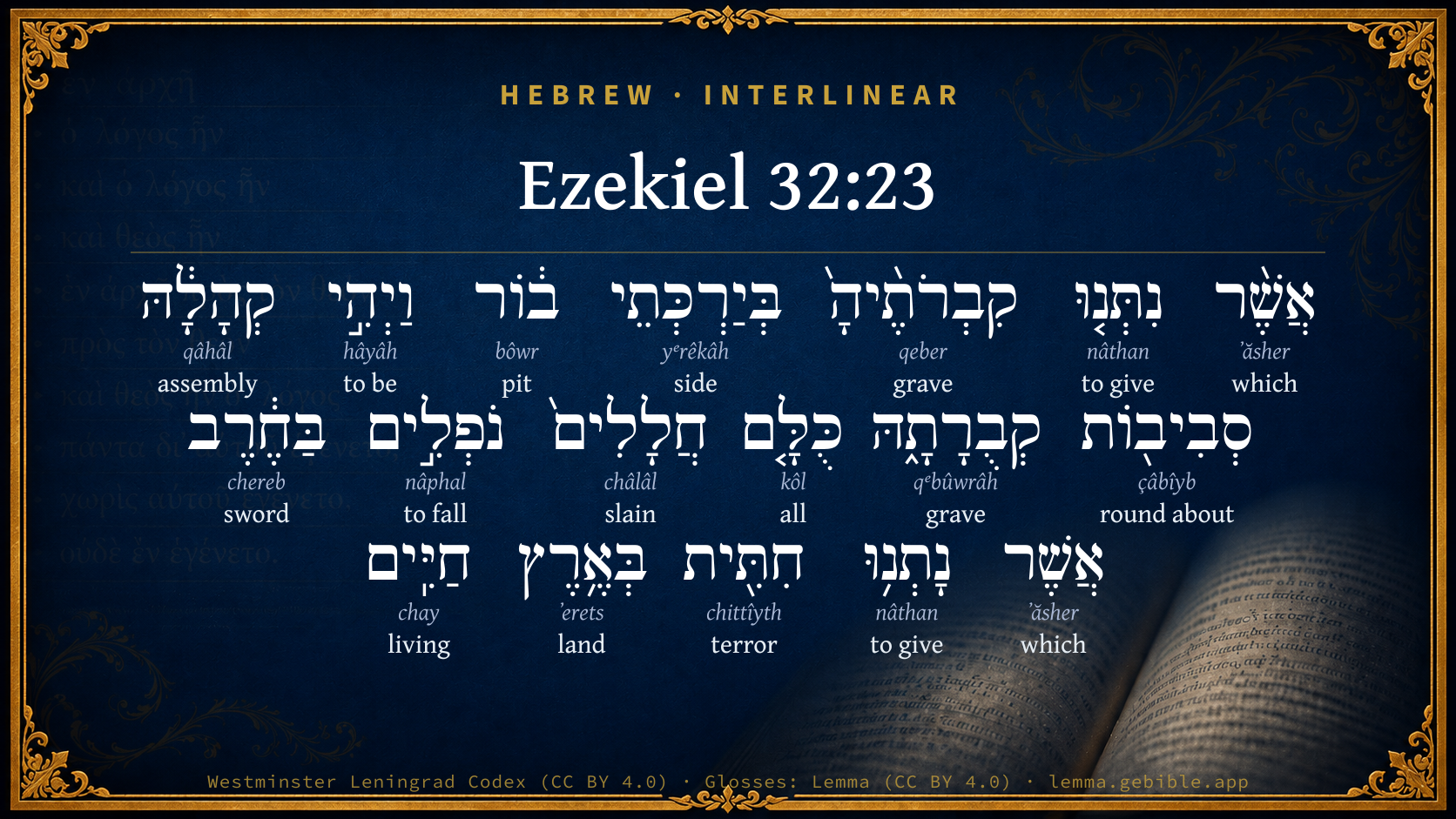
Ezekiel 32:23

Hebrew (Westminster Leningrad Codex) Ezekiel 32:23 appears in the Hebrew Old Testament. The text above is from the Westminster Leningrad Codex. Each word links to its Strong’s number, a concise gloss, and parsing drawn from the Open Scriptures Hebrew Bible morphology. Click any word for its full Brown-Driver-Briggs (BDB) entry.
Download image
Cite this verse

Ezekiel 32:23 (World English Bible). Public Domain. Lemma interlinear Bible study tool, https://lemma.gebible.app/v/ezekiel/32/23.

Show BibTeX & RIS
BibTeX
RIS
English Translation
whose graves are set in the uttermost parts of the pit, and her company is round about her grave; all of them slain, fallen by the sword, who caused terror in the land of the living.
World English Bible · Public Domain
Download a study sheet

One document with this verse’s original text, its word-by-word gloss line, the meaning frame, cross-references with their text, attributed commentary, and full source and license credits — printable, and it pastes into notes with its structure intact.

This verse Autodidact and up

Study sheet (.html) Plain text (.txt)

A passage Seminary Student

Up to 50 verses in one chapter. A passage sheet keeps up to 6 commentary sources and 12 cross-references per verse, in the order this page ranks them, and says so on the sheet whenever that leaves anything out. Ask for a single verse and you get the Autodidact verse sheet above.

Everything on this page stays free to read, with no account — the sheet is a download of what is already on screen, not access to it.

Want to remove ads? Support Godless Engineer
Compare translations 3

The same verse in 3 English versions, stacked beneath the original-language interlinear above. Click any original word for its lexicon entry.

Each is an independent rendering of the whole verse — the interlinear is not word-aligned to these translations.

Highlighted words mark where these versions differ — a whole-verse word diff, not a word-by-word alignment.

  • World English Bible Public Domain
    whose graves are set in the uttermost parts of the pit, and her company is round about her grave; all of them slain, fallen by the sword, who caused terror in the land of the living.
  • King James Version Public Domain
    Whose graves are set in the sides of the pit, and her company is round about her grave: all of them slain, fallen by the sword, which caused terror in the land of the living.
  • unfoldingWord Literal Text CC BY-SA 4.0
    Those whose graves are set in the recesses of the pit are there, with all her assembly. Her graves surround all of those who were killed, who fell by the sword, those who brought terror on the land of the living.

unfoldingWord Literal Text — © unfoldingWord, licensed CC BY-SA 4.0. Word-aligned USFM3 via Door43 (git.door43.org/unfoldingWord/en_ult).

Versions to compare (up to 4)

3 of 4 selected

Show all 18 translations

Every available English version of this verse, each an independent rendering of the whole verse.

  • World English Bible Public Domain
    whose graves are set in the uttermost parts of the pit, and her company is round about her grave; all of them slain, fallen by the sword, who caused terror in the land of the living.
  • Berean Standard Bible Public Domain
    Her graves are set in the depths of the Pit, and her company is all around her grave. All of them are slain, fallen by the sword—those who once spread terror in the land of the living.
  • Majority Standard Bible Public Domain
    Her graves are set in the depths of the Pit, and her company is all around her grave. All of them are slain, fallen by the sword—those who once spread terror in the land of the living.
  • King James Version Public Domain
    Whose graves are set in the sides of the pit, and her company is round about her grave: all of them slain, fallen by the sword, which caused terror in the land of the living.
  • American Standard Version (1901) Public Domain
    whose graves are set in the uttermost parts of the pit, and her company is round about her grave; all of them slain, fallen by the sword, who caused terror in the land of the living.
  • Revised Version (1885) Public Domain
    whose graves are set in the uttermost parts of the pit, and her company is round about her grave: all of them slain, fallen by the sword, which caused terror in the land of the living.
  • Geneva Bible (1599) Public Domain
    Whose graues are made in the side of the pit, and his multitude are rounde about his graue: all they are slaine and fallen by the sworde, which caused feare to be in the land of the liuing.
  • Douay-Rheims (1899) Public Domain
    Whose graves are set in the lowest parts of the pit: and his multitude lay round about his grave: all of them slain, and fallen by the sword, they that heretofore spread terror in the land of the living.
  • Young's Literal Translation Public Domain
    Whose graves are appointed in the sides of the pit, And her assembly is round about her grave, All of them wounded, falling by sword, Because they gave terror in the land of the living.
  • Literal Standard Version CC BY-SA 4.0
    Whose graves are appointed in the sides of the pit, || And her assembly is around her grave, || All of them wounded, falling by sword, || Because they gave terror in the land of the living.
  • Unlocked Literal Bible CC BY-SA 4.0
    Those whose graves are set in the recesses of the pit are there, with all her assembly. Her graves surround all of those who were killed, who fell by the sword, those who brought terror on the land of the living.
  • unfoldingWord Literal Text CC BY-SA 4.0
    Those whose graves are set in the recesses of the pit are there, with all her assembly. Her graves surround all of those who were killed, who fell by the sword, those who brought terror on the land of the living.
  • Darby Bible Public Domain
    their graves are set in the sides of the pit, and his assemblage is round about his grave; all of them slain, fallen by the sword, -- who caused terror in the land of the living.
  • World Messianic Bible Public Domain
    whose graves are set in the uttermost parts of the pit, and her company is around her grave, all of them slain, fallen by the sword, who caused terror in the land of the living.
  • Webster's Bible Public Domain
    Whose graves are set in the sides of the pit, and her company is around her grave: all of them slain, fallen by the sword, who caused terror in the land of the living.
  • Free Bible Version CC BY-SA 4.0
    Its graves are set in the deepest parts of the place of the dead, and the graves of all its people surround Assyria's grave. All of them died violent deaths, killed by the sword, these people who once terrorized others when they were alive.
  • Bible in Basic English Public Domain
    Whose resting-places are in the inmost parts of the underworld, who were a cause of fear in the land of the living.
  • JPS Tanakh (1917) Public Domain
    whose graves are set in the uttermost parts of the pit, and her company is round about her grave; all of them slain, fallen by the sword, who caused terror in the land of the living.

Literal Standard Version (2020), Covenant Press — licensed CC BY-SA 4.0. Text via the HelloAO Bible API (eBible.org). Unlocked Literal Bible (unfoldingWord) — licensed CC BY-SA 4.0. Text via the HelloAO Bible API (eBible.org). unfoldingWord Literal Text — © unfoldingWord, licensed CC BY-SA 4.0. Word-aligned USFM3 via Door43 (git.door43.org/unfoldingWord/en_ult). Free Bible Version, Dr. Jonathan Gallagher — licensed CC BY-SA 4.0. Text via the HelloAO Bible API (eBible.org).

Word by word

More ways to search: Search by grammar → Find every occurrence → Compare this word →

Practice this passage: Drill this verse → Learn its vocabulary →

חִתִּ֖ית
chittîyth
H2851
“terror”
Noun, Common, Feminine, Singular, Absolute
Part of Speech
Noun
Type
Common
Gender
Feminine
Number
Singular
State
Absolute
Full BDB Definition

Origin: from H2865

TWOT: 784f

terror
  1. אֲשֶׁ֨ר ʼăsher H834 “which” Particle, Relative
  2. נִתְּנ֤וּ nâthan H5414 “to give” Verb, Niphal, Perfect, 3rd Person, Common, Plural
  3. קִבְרֹתֶ֨יהָ֙ qeber H6913 “graves · her” Noun, Common, Masculine, Plural, Construct + Suffix, Personal, 3rd Person, Feminine, Singular
  4. בְּיַרְכְּתֵי yᵉrêkâh H3411 “in/at · sides of” Preposition + Noun, Common, Feminine, Dual, Construct
  5. ב֔וֹר bôwr H953 “pit” Noun, Common, Masculine, Singular, Absolute
  6. וַיְהִ֣י hâyâh H1961 “and · to be” Conjunction + Verb, Qal, Sequential Imperfect, 3rd Person, Masculine, Singular
  7. קְהָלָ֔הּ qâhâl H6951 “assembly · her” Noun, Common, Masculine, Singular, Construct + Suffix, Personal, 3rd Person, Feminine, Singular
  8. סְבִיב֖וֹת çâbîyb H5439 “surroundings of” Noun, Common, Both, Plural, Construct
  9. קְבֻרָתָ֑הּ qᵉbûwrâh H6900 “grave · her” Noun, Common, Feminine, Singular, Construct + Suffix, Personal, 3rd Person, Feminine, Singular
  10. כֻּלָּ֤ם kôl H3605 “all · their” Noun, Common, Masculine, Singular, Construct + Suffix, Personal, 3rd Person, Masculine, Plural
  11. חֲלָלִים֙ châlâl H2491 “slain” Adjective, Adjective, Masculine, Plural, Absolute
  12. נֹפְלִ֣ים nâphal H5307 “falling” Verb, Qal, Participle Active, Masculine, Plural, Absolute
  13. בַּחֶ֔רֶב chereb H2719 “in/at the · sword” Preposition, Determined + Noun, Common, Feminine, Singular, Absolute
  14. אֲשֶׁר ʼăsher H834 “which” Particle, Relative
  15. נָתְנ֥וּ nâthan H5414 “to give” Verb, Qal, Perfect, 3rd Person, Common, Plural
  16. בְּאֶ֥רֶץ ʼerets H776 “in/at · land of” Preposition + Noun, Common, Both, Singular, Construct
  17. חַיִּֽים chay H2416 “living” Adjective, Adjective, Masculine, Plural, Absolute

About this verse

These counts appear in no published source. They are computed here, from the morphology-tagged text and Lemma’s own curated glosses. What Lemma adds →

18
words
16
distinct lemmas
Prophets
section

Notable vocabulary

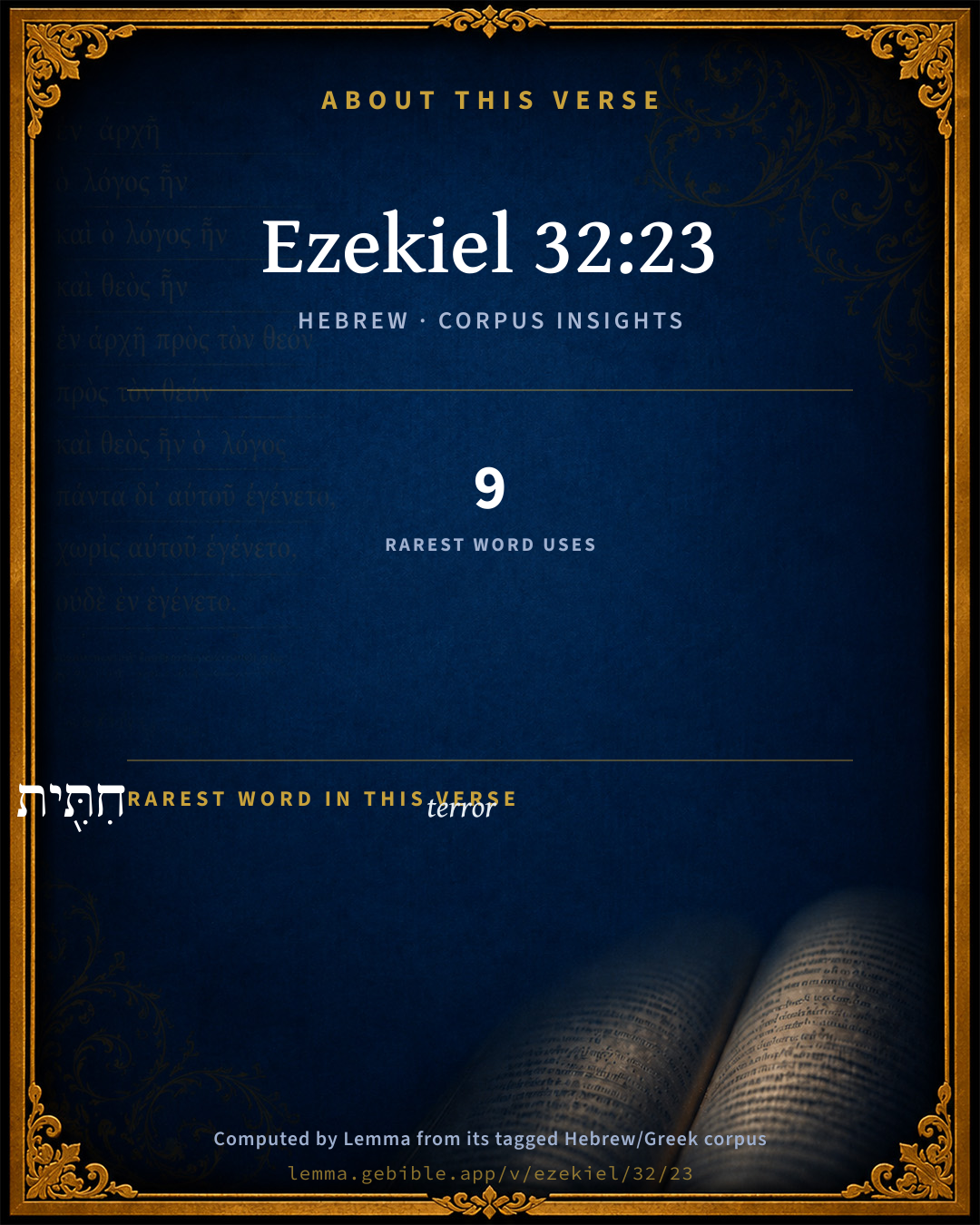
The rarest word here is חִתִּ֖ית terror H2851 — appearing just 9 times in the whole Hebrew Bible.

Shared distinctive vocabulary

חִתִּ֖ית terror H2851 occurs in 8 verses of the Hebrew Bible. Also found in:

Grammatical profile

  • 4 verbs
  • 10 nouns
  • 2 adjectives
  • 2 particles

Verb forms

  • נִתְּנ֤וּ Niphal · Perfect
  • וַיְהִ֣י Qal · Sequential Imperfect
  • נֹפְלִ֣ים Qal · Participle Active
  • נָתְנ֥וּ Qal · Perfect

Repetition

Words recur within this verse — often emphatic in Hebrew:

  • נִתְּנ֤וּ to give H5414 ×2
  • אֲשֶׁ֨ר which H834 ×2

Hebrew & Septuagint length

In English translation the verse runs 36 words from the Hebrew and 42 from the Septuagint (LXX English) — closely comparable.

A rough comparison of the two English renderings, which tokenize alike — not a word-level alignment.

Word counts can differ between the Hebrew and the Greek without any difference in meaning — e.g. the Hebrew direct-object marker אֵת has no separate Greek word, and Greek often adds the article ὁ.

Cross-references

12

Topical passages linked to Ezekiel 32:23 in the Treasury of Scripture Knowledge — connected by theme and wording, ordered by reader-vote popularity; previews shown in the World English Bible.

  • Ezekiel 26:20 then will I bring you down with those who descend into the pit, to the people of old time, and will make you to dwell in the lower parts of the earth, in the places that are desolate of old, with those who go down to the pit, that you be not inhabited; and I will set glory in the land of the living:
  • Psalms 27:13 I am still confident of this: I will see the goodness of Yahweh in the land of the living.
  • Ezekiel 26:17 They shall take up a lamentation over you, and tell you, How are you destroyed, who were inhabited by seafaring men, the renowned city, who was strong in the sea, she and her inhabitants, who caused their terror to be on all who lived there!
  • Ezekiel 32:24–27 There is Elam and all her multitude round about her grave; all of them slain, fallen by the sword, who are gone down uncircumcised into the lower parts of the earth, who caused their terror in the land of the living, and have borne their shame with those who go down to the pit.
  • Job 28:13 Man doesn't know its price; Neither is it found in the land of the living.
  • Psalms 116:9 I will walk before Yahweh in the land of the living.
  • Psalms 142:5 I cried to you, Yahweh. I said, "You are my refuge, My portion in the land of the living."
  • Isaiah 14:15–16 Yet you shall be brought down to Sheol, to the uttermost parts of the pit.
  • Isaiah 38:11 I said, I shall not see Yah, Yah in the land of the living: I shall see man no more with the inhabitants of the world.
  • Isaiah 51:12–13 I, even I, am he who comforts you: who are you, that you are afraid of man who shall die, and of the son of man who shall be made as grass;
  • Jeremiah 11:19 But I was like a gentle lamb that is led to the slaughter; and I didn't know that they had devised devices against me, [saying], Let us destroy the tree with the fruit of it, and let us cut him off from the land of the living, that his name may be no more remembered.
  • Ezekiel 32:32 For I have put his terror in the land of the living; and he shall be laid in the midst of the uncircumcised, with those who are slain by the sword, even Pharaoh and all his multitude, says the Lord Yahweh.

Cross-references courtesy of OpenBible.info (CC BY 4.0).

Hebrew and Greek witnesses Masoretic Hebrew ↔ Greek Septuagint

The same verse in the two great witnesses to the Old Testament, shown verse-for-verse.

These are two independent witnesses, not word-aligned to each other, and the Septuagint is shown in lemma (dictionary) form.

Hebrew Ezekiel 32:23 Masoretic · Westminster Leningrad Codex

אֲשֶׁ֨ר נִתְּנ֤וּ קִבְרֹתֶ֨יהָ֙ בְּיַרְכְּתֵי ב֔וֹר וַיְהִ֣י קְהָלָ֔הּ סְבִיב֖וֹת קְבֻרָתָ֑הּ כֻּלָּ֤ם חֲלָלִים֙ נֹפְלִ֣ים בַּחֶ֔רֶב אֲשֶׁר נָתְנ֥וּ חִתִּ֖ית בְּאֶ֥רֶץ חַיִּֽים

whose graves are set in the uttermost parts of the pit, and her company is round about her grave; all of them slain, fallen by the sword, who caused terror in the land of the living.

World English Bible · Public Domain

Greek LXX Ezekiel 32:23 Septuagint · lemma form

ὁ δίδωμι ὁ φόβος αὐτός ἐπί γῆ ζωή

and their burial is in the depth of the pit, and his company are set around about his tomb: all the slain that fell by the sword, who had caused the fear of them to be upon the land of the living.

LXX2012 (modern English Septuagint) · Public Domain

Hebrew: Westminster Leningrad Codex (CC BY 4.0). Greek: Septuagint (public domain); English from LXX2012 (modern English Septuagint) (Public Domain). How the Septuagint differs from the Hebrew →

Targum (Aramaic paraphrase)

1

The Targum is the ancient Jewish Aramaic paraphrase of the Hebrew Scriptures — an interpretive translation, not the Hebrew text itself. Onkelos (literal) and Pseudo-Jonathan (expansive) render the Torah, and Jonathan the Prophets. Coverage is partial: where no permissively-licensed English translation exists for a verse, only the Aramaic is shown. This is verse-level text, not a word-by-word alignment to the Hebrew.

  1. Targum Jonathan Prophets (Joshua–Malachi)
    דְאִתְמְסָרוּ לִקְבוּרָא בִּסְיָפֵי גוֹב בֵּית אַבְדָנָא וַהֲוַת מַשִׁרְיָתְהוֹן סָחֲרָנוּתְהוֹן קְבוּרָתְהוֹן כּוּלְהוֹן קְטִילַיָא דְאִתְקְטִילוּ בְּחַרְבָּא דְאִתְמְסִירוּ לִתְּבַר עַל דְשַׁלִיטוּ בְּאַרְעָא דְיִשְׂרָאֵל:

    (no public-domain English translation for this verse)

    Targum Jonathan — Aramaic: “Mikraot Gedolot” (public domain). English: “Sefaria Community Translation” (CC0 1.0 (public-domain dedication)); “London "Chaldee Paraphrase," 1871” (public domain). Text via Sefaria.

Commentary

Notes on Ezekiel 32:23 from classic Christian and Jewish commentators (each source and its license shown beneath its notes). The classic Christian expositions comment on the surrounding passage and are grouped to its opening verse, so a note may address several verses; the Jewish commentaries on the Tanakh (Rashi and others) are per-verse, so they appear only where the commentator wrote on this verse.

Lemma curates 59 commentaries, every one of them public domain or Creative Commons licensed, each selected and text-cleaned for this edition rather than reprinted as found. About our sources →

Trapp's Complete Commentary

John Trapp

Eze 32:23 Whose graves are set in the sides of the pit, and her company is round about her grave: all of them slain, fallen by the sword, which caused terror in the land of the living.

Ver. 23. Whose graves are set in the sides of the pit.] In the bottom of the burning lake, which from the high top of a kingdom is a foul fall. Their being there buried may import that they shall never come out.

Which caused terror.] As breathing nothing but blood and slaughter, raising a tempest wherever they came, so that they became terrores terrae, terrors of the earth, as dreadful as devils.

John Trapp, A Commentary or Exposition upon All the Books of the Old and New Testament (1647–1656) — public domain. Text from a community e-Sword module.

Jamieson, Fausset & Brown

Robert Jamieson, A. R. Fausset & David Brown

in the sides of the pit--Sepulchres in the East were caves hollowed out of the rock, and the bodies were laid in niches formed at the sides. MAURER needlessly departs from the ordinary meaning, and translates, "extremities" (compare Isa 14:13, Isa 14:15).

which caused terror--They, who alive were a terror to others, are now, in the nether world, themselves a terrible object to behold.

Jamieson, Fausset & Brown — Commentary Critical and Explanatory on the Whole Bible (1871) — public domain (CC PDM 1.0). Text via the HelloAO Bible API.

Adam Clarke's Commentary

Verse 23. Whose graves are set in the sides of the pit] Alluding to the niches in the sides of the subterranean caves or burying-places, where the bodies are laid. These are numerous in Egypt.

Adam Clarke's Commentary on the Bible (1810–1826) — public domain. Text from a community e-Sword/MySword module.

The Cambridge Bible for Schools and Colleges

gen. ed. J. J. S. Perowne

23. sides of the pit] i.e. the depths or bottom of the pit.

caused terror] Cf. Eze_26:17; Eze_26:20. This phrase must mean that Asshur inspired terror into the nations by his might; to suppose that the meaning is that the fate of Asshur by the judgment of God caused terror (Hitz.) is altogether false, cf. Eze_32:24-27; Eze_32:32.

The Cambridge Bible for Schools and Colleges (gen. ed. J. J. S. Perowne; Cambridge University Press, 1878–1918) — public domain. Text from a community e-Sword module.

John Gill's Exposition

Whose graves are set in the sides of the pit,.... Or vault, where lay the king of Assyria, and those who fell by the sword with him, who are represented as lying in graves all around him; the nearest to him those who were in the highest posts, and most valiant and courageous, and next the common soldiers, as follows:

and her company is round about her grave not Pharaoh's company round about the grave of the Assyrian monarch; but the company of the king of Assyria, or his army, as the Targum, round about grave; or lying about in the ruins of his kingdom:

all of them slain, fallen by the sword, which caused terror in the land of the living; even they who now are in the state of the dead, and can no more disturb and distress any, while they were alive, or in the world, struck terror in all neighbouring states and kingdoms; threatening destruction to them, and obliging them to submit to their tyranny and exactions. Jarchi interprets this of the land of Israel; and the Jewish writers commonly understand by the land of the living the land of Canaan wherever they meet with it; because here men worshipped the living God, and lived before him; and the inhabitants of this land were often terrified by the king of Assyria. So the Targum,

"because they ruled in the land of Israel.''

John Gill's Exposition of the Whole Bible (1746–1763) — public domain (CC PDM 1.0). Text via the HelloAO Bible API.

Matthew Poole's English Annotations

At least for decorum here is supposed a spacious vault, or pit, in midst whereof the king of Asshur in a stately tomb lies buried, and round about the vault are places to lay others dead with him, and in his cause, some of his more famous captains and commanders.

Her company; the common subjects and soldiers of the Assyrian empire, all buried undistinguished about her: see Eze 32:22.

Her grave: the ruins of an empire are its grave; and so all the subjects of this empire lie buried with it.

Caused terror; were a terror to all they would be enemies to, and proudly boasted of and inhumanly used their power, now lie quiet, their dust little regarded, less feared, and least of all pitied. In the land of the living; while they were in the land of the living, a periphrasis of life.

Matthew Poole's English Annotations on the Holy Bible (1683–1685) — public domain. Text from a community e-Sword/MySword module.

John Wesley's Explanatory Notes

Whose graves - Here is supposed a spacious vault, in the midst whereof the king of Ashur lies, and round the vault, his familiar captains and commanders. Her company - The common subjects of the Assyrian empire, all buried undistinguished about her. Her grave - The ruins of an empire are its grave. In the land - While they were in the land of the living.

John Wesley, Explanatory Notes Upon the Whole Bible (1754–1765) — public domain. Text via the GEBible commentary corpus.

Rashi

Rabbi Shlomo Yitzchaki (Rashi)

in the utmost part of the Pit in the depths of the Pit; in the midst of its depth.

and whose company was in the midst of the Grave, “was around its grave.”

who cast destruction [Heb. חִתִית,] who cast destruction in the land of Israel.

Rashi on the Tanakh — English translations: “The Judaica Press complete Tanach with Rashi, translated by A. J. Rosenberg” (CC BY 4.0); “Pentateuch with Rashi's commentary by M. Rosenbaum and A.M. Silbermann, 1929-1934” (public domain); “The Metsudah Tanach series, Lakewood, N.J” (CC BY 4.0); and “The Book of Joshua, Metsudah Publications, 1997” (CC BY 4.0). Text via Sefaria.

Lesson kit

Teaching starters — assembled from the data on this page, not authored interpretation. Every prompt links to the verse data it draws on. Edit before teaching.

Ezekiel, in the Prophets, opens this verse with 18 words (16 distinct Hebrew lemmas). Its most distinctive word is chittîyth (“terror”). A historical commentator’s framing appears above. Read the whole chapter for the surrounding context.

Discussion questions

  1. What does “terror” (chittîyth) contribute to the verse as a whole?
  2. How does Ezekiel 26:17, which shares the word «terror», read alongside this verse?
  3. What does the repetition of “to give” (2× in this one verse) do in this verse?
  4. These translations render this verse differently; the difference is in the English rendering, not the original. What questions does that raise?
  5. «נִתְּנ֤וּ» is a Niphal Perfect verb. How does that grammatical form shape the action described?
  6. Compare how Trapp's Complete Commentary and Jamieson, Fausset & Brown read this verse. Where do they agree or differ?

Things to notice

Reading settings

Reading text

Shown beneath each verse's original-language words.

Old Testament
Old Testament edition

Read the OT as the Masoretic Hebrew (MT) or the Greek Septuagint (LXX).

English shown for the Greek Septuagint (in the Hebrew ↔ Greek comparison).

Comparing translations? Open the Compare panel on any verse page to stack up to four side by side.