
Genesis 31:9

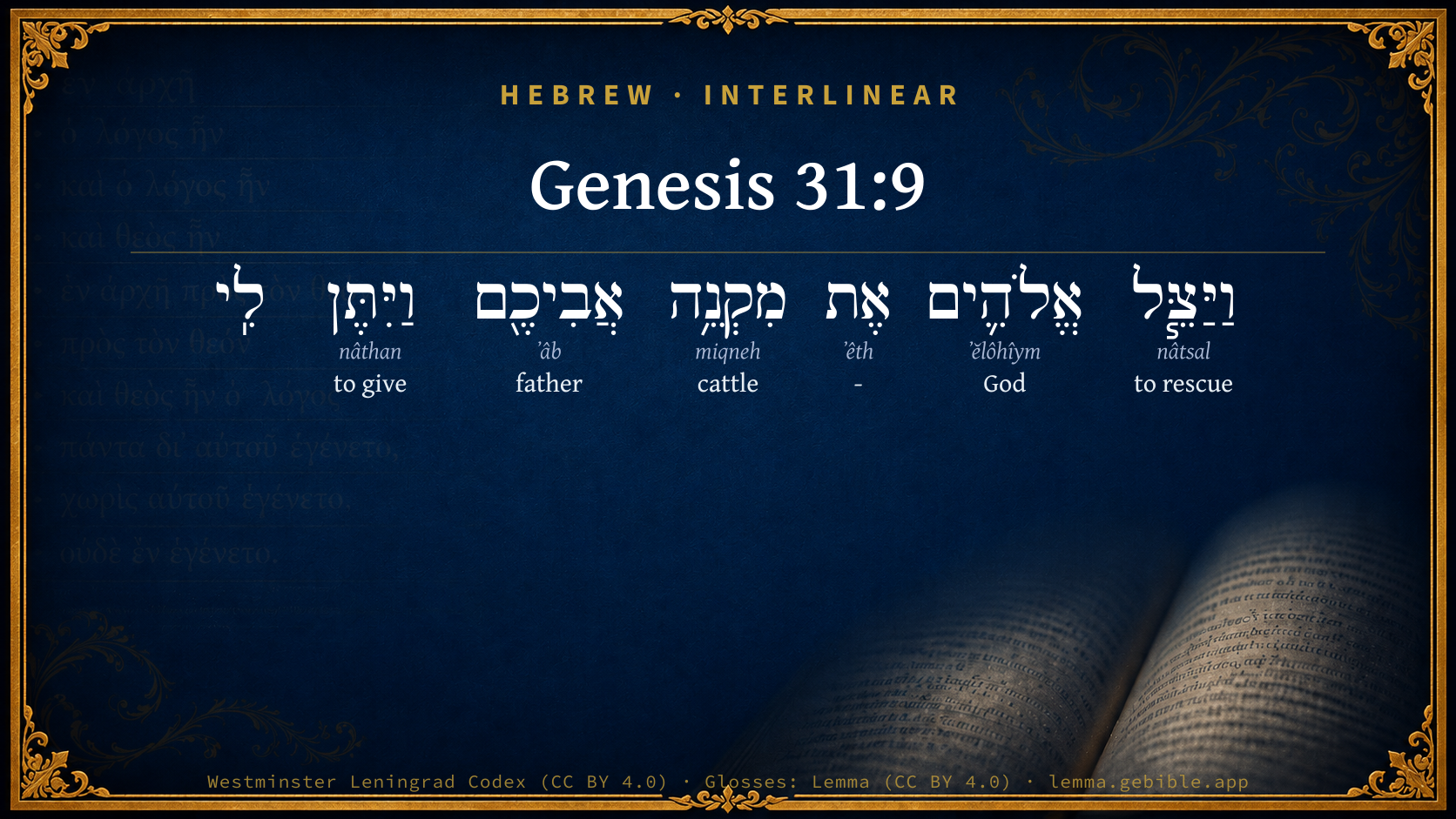
Hebrew (Westminster Leningrad Codex) Genesis 31:9 appears in the Hebrew Old Testament. The text above is from the Westminster Leningrad Codex. Each word links to its Strong’s number, a concise gloss, and parsing drawn from the Open Scriptures Hebrew Bible morphology. Click any word for its full Brown-Driver-Briggs (BDB) entry.
Download image
Cite this verse

Genesis 31:9 (World English Bible). Public Domain. Lemma interlinear Bible study tool, https://lemma.gebible.app/v/genesis/31/9.

Show BibTeX & RIS
BibTeX
RIS
English Translation
Thus God has taken away the cattle of your father, and given them to me.
World English Bible · Public Domain
Highlights
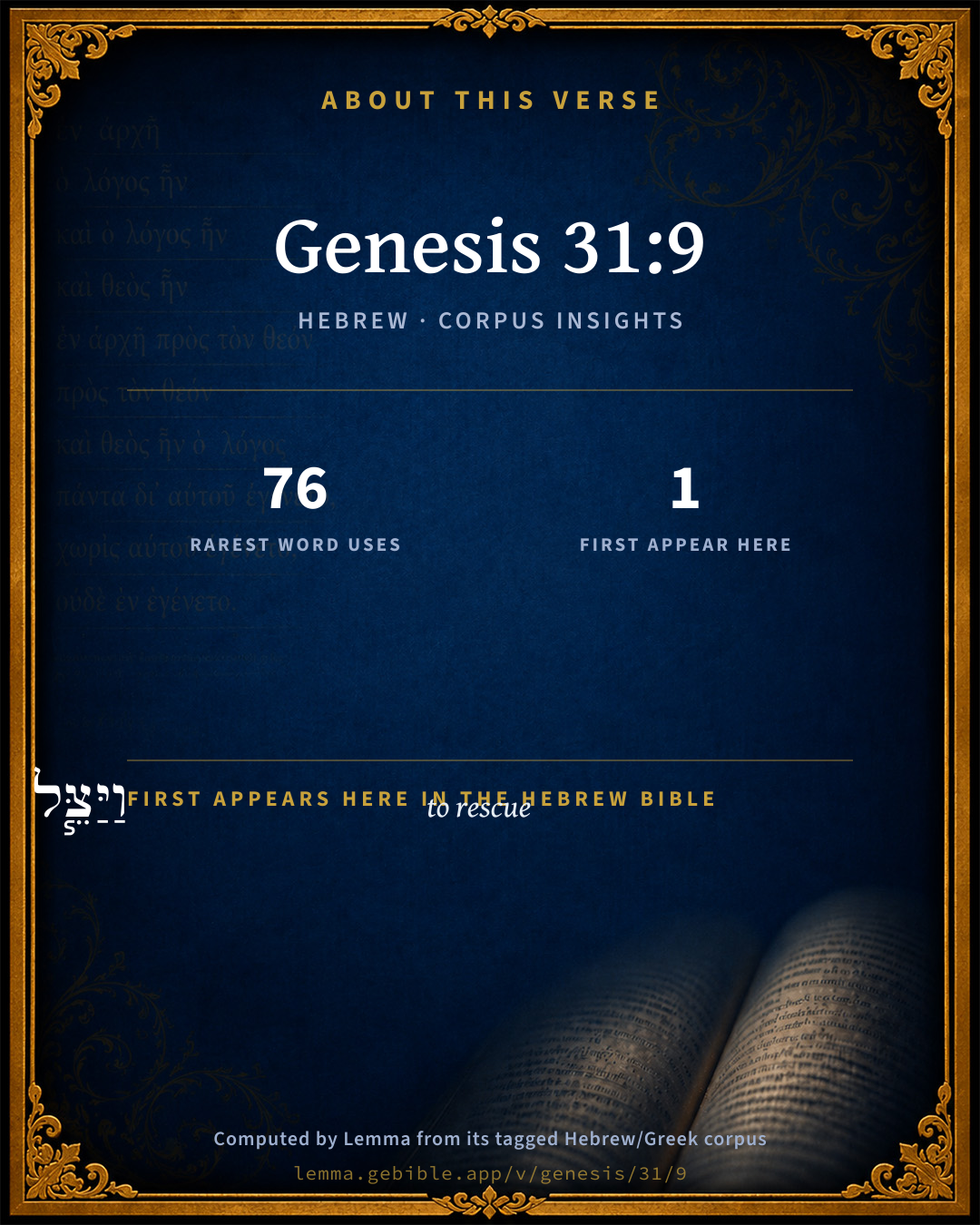
  • 1 first appearance in the Hebrew Bible
Full analysis ↓
Download a study sheet

One document with this verse’s original text, its word-by-word gloss line, the meaning frame, cross-references with their text, attributed commentary, and full source and license credits — printable, and it pastes into notes with its structure intact.

This verse Autodidact and up

Study sheet (.html) Plain text (.txt)

A passage Seminary Student

Up to 50 verses in one chapter. A passage sheet keeps up to 6 commentary sources and 12 cross-references per verse, in the order this page ranks them, and says so on the sheet whenever that leaves anything out. Ask for a single verse and you get the Autodidact verse sheet above.

Everything on this page stays free to read, with no account — the sheet is a download of what is already on screen, not access to it.

Want to remove ads? Support Godless Engineer
Compare translations 3

The same verse in 3 English versions, stacked beneath the original-language interlinear above. Click any original word for its lexicon entry.

Each is an independent rendering of the whole verse — the interlinear is not word-aligned to these translations.

Highlighted words mark where these versions differ — a whole-verse word diff, not a word-by-word alignment.

  • World English Bible Public Domain
    Thus God has taken away the cattle of your father, and given them to me.
  • King James Version Public Domain
    Thus God hath taken away the cattle of your father, and given them to me.
  • unfoldingWord Literal Text CC BY-SA 4.0
    So God took away the livestock of your father and gave to me.

unfoldingWord Literal Text — © unfoldingWord, licensed CC BY-SA 4.0. Word-aligned USFM3 via Door43 (git.door43.org/unfoldingWord/en_ult).

Versions to compare (up to 4)

3 of 4 selected

Show all 18 translations

Every available English version of this verse, each an independent rendering of the whole verse.

  • World English Bible Public Domain
    Thus God has taken away the cattle of your father, and given them to me.
  • Berean Standard Bible Public Domain
    Thus God has taken away your father’s livestock and given them to me.
  • Majority Standard Bible Public Domain
    Thus God has taken away your father’s livestock and given them to me.
  • King James Version Public Domain
    Thus God hath taken away the cattle of your father, and given them to me.
  • American Standard Version (1901) Public Domain
    Thus God hath taken away the cattle of your father, and given them to me.
  • Revised Version (1885) Public Domain
    Thus God hath taken away the cattle of your father, and given them to me.
  • Geneva Bible (1599) Public Domain
    Thus hath God taken away your fathers substance, and giuen it me.
  • Douay-Rheims (1899) Public Domain
    And God hath taken your father's substance, and given it to me.
  • Young's Literal Translation Public Domain
    and God taketh away the substance of your father, and doth give to me.
  • Literal Standard Version CC BY-SA 4.0
    and God takes away the substance of your father, and gives to me.
  • Unlocked Literal Bible CC BY-SA 4.0
    In this way God has taken away the livestock of your father and given them to me.
  • unfoldingWord Literal Text CC BY-SA 4.0
    So God took away the livestock of your father and gave to me.
  • Darby Bible Public Domain
    And God has taken away the cattle of your father, and given [them] to me.
  • World Messianic Bible Public Domain
    Thus God has taken away your father’s livestock, and given them to me.
  • Webster's Bible Public Domain
    Thus God hath taken away the cattle of your father, and given them to me.
  • Free Bible Version CC BY-SA 4.0
    This is how God took your father's livestock and gave them to me.
  • Bible in Basic English Public Domain
    So God has taken away your father's cattle and has given them to me.
  • JPS Tanakh (1917) Public Domain
    Thus God hath taken away the cattle of your father, and given them to me.

Literal Standard Version (2020), Covenant Press — licensed CC BY-SA 4.0. Text via the HelloAO Bible API (eBible.org). Unlocked Literal Bible (unfoldingWord) — licensed CC BY-SA 4.0. Text via the HelloAO Bible API (eBible.org). unfoldingWord Literal Text — © unfoldingWord, licensed CC BY-SA 4.0. Word-aligned USFM3 via Door43 (git.door43.org/unfoldingWord/en_ult). Free Bible Version, Dr. Jonathan Gallagher — licensed CC BY-SA 4.0. Text via the HelloAO Bible API (eBible.org).

Word by word

More ways to search: Search by grammar → Find every occurrence → Compare this word →

Practice this passage: Drill this verse → Learn its vocabulary →

About this verse

These counts appear in no published source. They are computed here, from the morphology-tagged text and Lemma’s own curated glosses. What Lemma adds →

7
words
6
distinct lemmas
Pentateuch
section

First appearance in Scripture

This word makes its first canonical appearance in the Hebrew Bible here:

  • וַיַּצֵּ֧ל to rescue H5337

Grammatical profile

  • 2 verbs
  • 3 nouns
  • 1 preposition
  • 1 particle

Verb forms

  • וַיַּצֵּ֧ל Hiphil · Sequential Imperfect
  • וַיִּתֶּן Qal · Sequential Imperfect

Hebrew & Septuagint length

In English translation the verse runs 15 words from the Hebrew and 16 from the Septuagint (LXX English) — closely comparable.

A rough comparison of the two English renderings, which tokenize alike — not a word-level alignment.

Word counts can differ between the Hebrew and the Greek without any difference in meaning — e.g. the Hebrew direct-object marker אֵת has no separate Greek word, and Greek often adds the article ὁ.

Cross-references

6

Topical passages linked to Genesis 31:9 in the Treasury of Scripture Knowledge — connected by theme and wording, ordered by reader-vote popularity; previews shown in the World English Bible.

  • Genesis 31:1 He heard the words of Laban's sons, saying, "Jacob has taken away all that was our father's. From that which was our father's, has he gotten all this wealth."
  • Genesis 31:16 For all the riches which God has taken away from our father, that is ours and our children's. Now then, whatever God has said to you, do."
  • Proverbs 13:22 A good man leaves an inheritance to his children's children, But the wealth of the sinner is stored for the righteous.
  • Esther 8:1–2 On that day did the king Ahasuerus give the house of Haman the Jews' enemy to Esther the queen. Mordecai came before the king; for Esther had told what he was to her.
  • Psalms 50:10 For every animal of the forest is mine, And the cattle on a thousand hills.
  • Matthew 20:15 Isn't it lawful for me to do what I want to with what I own? Or is your eye evil, because I am good?'

Cross-references courtesy of OpenBible.info (CC BY 4.0).

Hebrew and Greek witnesses Masoretic Hebrew ↔ Greek Septuagint

The same verse in the two great witnesses to the Old Testament, shown verse-for-verse.

These are two independent witnesses, not word-aligned to each other, and the Septuagint is shown in lemma (dictionary) form.

Hebrew Genesis 31:9 Masoretic · Westminster Leningrad Codex

וַיַּצֵּ֧ל אֱלֹהִ֛ים אֶת מִקְנֵ֥ה אֲבִיכֶ֖ם וַיִּתֶּן לִֽי

Thus God has taken away the cattle of your father, and given them to me.

World English Bible · Public Domain

Greek LXX Genesis 31:9 Septuagint · lemma form

καί ἀποαἱρέω ὁ θεός πᾶς ὁ κτῆνος ὁ πατήρ σύ καί δίδωμι ἐγώ αὐτός

So God has taken away all the cattle of your father, and given them to me.

LXX2012 (modern English Septuagint) · Public Domain

Hebrew: Westminster Leningrad Codex (CC BY 4.0). Greek: Septuagint (public domain); English from LXX2012 (modern English Septuagint) (Public Domain). How the Septuagint differs from the Hebrew →

Targum (Aramaic paraphrase)

2

The Targum is the ancient Jewish Aramaic paraphrase of the Hebrew Scriptures — an interpretive translation, not the Hebrew text itself. Onkelos (literal) and Pseudo-Jonathan (expansive) render the Torah, and Jonathan the Prophets. Coverage is partial: where no permissively-licensed English translation exists for a verse, only the Aramaic is shown. This is verse-level text, not a word-by-word alignment to the Hebrew.

  1. Targum Onkelos Torah (Genesis–Deuteronomy)
    וְאַפְרֵשׁ יְיָ יָת גֵּיתֵי דַּאֲבוּכוֹן וִיהַב לִי

    (no public-domain English translation for this verse)

    Targum Onkelos — Aramaic: “Onkelos Genesis” (public domain); “Onkelos Exodus” (public domain); “Onkelos Leviticus” (public domain); “Onkelos Numbers” (public domain); “Onkelos Deuteronomy” (public domain). English: “Sefaria Community Translation” (CC0 1.0 (public-domain dedication)); “J.W. Etheridge. The Targums of Onkelos and Jonathan Ben Uzziel on the Pentateuch. London: Longmans, Green, 1862” (public domain). Text via Sefaria.

  2. Targum Pseudo-Jonathan Torah (Genesis–Deuteronomy)
    וְרוֹקַן יְיָ יַת בֵּיתָא דַאֲבוּכוֹן וִיהַב לִי

    and the Lord hath taken away the flock of your father, and hath given (it) to me.

    Targum Pseudo-Jonathan — Aramaic: “Targum Jonathan on Genesis” (public domain); “Targum Jonathan on Exodus” (public domain); “Targum Jonathan on Leviticus” (public domain); “Targum Jonathan on Numbers” (public domain); “Targum Jonathan on Deuteronomy” (public domain). English: “The Targum of Jonathan ben Uzziel, trans. J. W. Etheridge, London, 1862” (public domain). Text via Sefaria.

Commentary

Notes on Genesis 31:9 from classic Christian and Jewish commentators (each source and its license shown beneath its notes). The classic Christian expositions comment on the surrounding passage and are grouped to its opening verse, so a note may address several verses; the Jewish commentaries on the Tanakh (Rashi and others) are per-verse, so they appear only where the commentator wrote on this verse.

Lemma curates 59 commentaries, every one of them public domain or Creative Commons licensed, each selected and text-cleaned for this edition rather than reprinted as found. About our sources →

Trapp's Complete Commentary

John Trapp

Gen 31:9 Thus God hath taken away the cattle of your father, and given [them] to me.

Ver. 9. Thus God hath taken away, &c.] He is the true proprietary, and gives and takes away these outward things at pleasure; as Hannah hath it. {1Sa 2:7} And, "promotion cometh neither from the east nor west," saith David; "nor yet from the south," {Psa 75:6} where the warm sunshine is: much less from the north (for, Ab Aquilone nihil boni); "but God is the judge; he puts down" Laban "and sets up" Jacob; {Psa 75:7} he spoiled the Egyptians, and enriched the Israelites with their jewels; {Exo 12:36} which yet proved a snare to them, perhaps, in the matter of the golden calf; as riches always do, when sent to men by God’s providence only, and not out of his favour, as here to Jacob, and by virtue of the promise.

John Trapp, A Commentary or Exposition upon All the Books of the Old and New Testament (1647–1656) — public domain. Text from a community e-Sword module.

Joseph Benson's Commentary

Gen 31:9. God hath taken away the cattle of your father, and given them to me — Thus the righteous God paid Jacob for his hard service out of Laban’s estate, as he afterward paid the seed of Jacob for the service of the Egyptians with the spoils of that people.

Joseph Benson's Commentary on the Old and New Testaments (1811–1818) — public domain. Text from a community e-Sword module.

Geneva Bible (1599)

Geneva Bible translators

This declareth that the thing, which Jacob did before, was by God’s commandment, and not through deceit.

Or, cattle.

Geneva Bible (1599) marginal notes — public domain. Text via Bolls.life.

John Gill's Exposition

And it came to pass, at the time that the cattle conceived,.... Whether in spring or in autumn cannot be said, for it seems this was twice a year; this probably was at the beginning of the six years' servitude, or just before the agreement was made between Laban and Jacob, and was an instruction to the latter how to make his bargain with the former:

that I lifted up mine eyes, and saw in a dream; in a vision of the night, so things were represented to his fancy and imagination:

and, behold, the rams which leaped upon the cattle were ringstraked,

speckled, and grisled; from whence he might conclude, that the cattle they leaped upon would bring forth the like, and so be a direction to him to make his agreement with Laban to have such for his hire; not that the rams in the flock were really of those colours, for they were all white, but so they were represented to Jacob in the vision, to suggest to him, that such would be produced by them; and it is not improbable by the artifice Jacob was directed to, and took, that the ewes, when they came to the watering troughs to drink, upon seeing the party coloured rods in the water, these made such an impression upon their imaginations, that they fancied the rams that leaped upon them were of those colours, and so conceived and brought forth the like. Here is another colour mentioned, not taken notice of before, at least by this name, "grisled"; it stands in the place of "spotted", and seems to be the same with that, and signified such as had spots on them like hailstones, and distinguishes them from the speckled: the speckled were such as were white with black spots, these such as were black, and had white spots like hail.

John Gill's Exposition of the Whole Bible (1746–1763) — public domain (CC PDM 1.0). Text via the HelloAO Bible API.

The Pulpit Commentary

Thus literally, and (as the result of this)God hath taken away the cattle of your father, and given them to me. In ascribing to God what he had himself effected by (so-called) fraud, this language of Jacob appears to some inexcusable (Kalisch); in passing over his own stratagem in silence Jacob has been charged with not telling the whole truth to his wives (Keil). A more charitable consideration of Jacob"s statement, however, discerns-in it an e vide nce of his piety, which recognized and gratefully acknowledged that not his own "consummate cunning, "but Jehovah s watchful care had enabled him to outwit the dishonest craft of Laban (Rosenm Ainsworth, Bush, Candlish, Murphy).

The Pulpit Commentary (1880–1919), ed. H.D.M. Spence-Jones & Joseph S. Exell — public domain. Text from a community e-Sword module.

John Wesley's Explanatory Notes

God hath taken away the cattle of your father and given them to me - Thus the righteous God paid Jacob for his hard service out of Laban's estate; as afterwards he paid the seed of Jacob for their service of the Egyptians with their spoils.

John Wesley, Explanatory Notes Upon the Whole Bible (1754–1765) — public domain. Text via the GEBible commentary corpus.

Keil & Delitzsch

C. F. Keil & F. Delitzsch

אביכם: for אביכן as in Gen 32:16, etc. - "Ten times:" i.e., as often as possible, the ten as a round number expressing the idea of completeness. From the statement that Laban had changed his wages ten times, it is evident that when Laban observed, that among his sheep and goats, of one colour only, a large number of mottled young were born, he made repeated attempts to limit the original stipulation by changing the rule as to the colour of the young, and so diminishing Jacob's wages. But when Jacob passes over his own stratagem in silence, and represents all that he aimed at and secured by crafty means as the fruit of God's blessing, this differs no doubt from the account in Gen 30. It is not a contradiction, however, pointing to a difference in the sources of the two chapters, but merely a difference founded upon actual fact, viz., the fact that Jacob did not tell the whole truth to his wives. Moreover self-help and divine help do not exclude one another. Hence his account of the dream, in which he saw that the rams that leaped upon the cattle were all of various colours, and heard the voice of the angel of God calling his attention to what had been seen, in the words, "I have seen all that Laban hath done to thee," may contain actual truth; and the dream may be regarded as a divine revelation, which was either sent to explain to him now, at the end of the sixth year, "that it was not his stratagem, but the providence of God which had prevented him from falling a victim to Laban's avarice, and had brought him such wealth" (Delitzsch); or, if the dream occurred at an earlier period, was meant to teach him, that "the help of God, without any such self-help, could procure him justice and safety in spite of Laban's selfish covetousness" (Kurtz). It is very difficult to decide between these two interpretations. As Jehovah's instructions to him to return were not given till the end of his period of service, and Jacob connects them so closely with the vision of the rams that they seem contemporaneous, Delitzsch's view appears to deserve the preference. But the עשׂה in Gen 31:12, "all that Laban is doing to thee," does not exactly suit this meaning; and we should rather expect to find עשׂה used at the end of the time of service. The participle rather favours Kurtz's view, that Jacob had the vision of the rams and the explanation from the angel at the beginning of the last six years of service, but that in his communication to his wives, in which there was no necessity to preserve a strict continuity or distinction of time, he connected it with the divine instructions to return to his home, which he received at the end of his time of service. But if we decide in favour of this view, we have no further guarantee for the objective reality of the vision of the rams, since nothing is said about it in the historical account, and it is nowhere stated that the wealth obtained by Jacob's craftiness was the result of the divine blessing. The attempt so unmistakeably apparent in Jacob's whole conversation with his wives, to place his dealing with Laban in the most favourable light for himself, excites the suspicion, that the vision of which he spoke was nothing more than a natural dream, the materials being supplied by the three thoughts that were most frequently in his mind, by night as well as by day, viz., (1) his own schemes and their success; (2) the promise received at Bethel; (3) the wish to justify his actions to his own conscience; and that these were wrought up by an excited imagination into a visionary dream, of the divine origin of which Jacob himself may not have had the slightest doubt. - In Gen 31:13 האל has the article in the construct state, contrary to the ordinary rule; cf. Ges. 110, 2b; Ewald, 290.

Keil & Delitzsch — Biblical Commentary on the Old Testament (1861–1891) — public domain (CC PDM 1.0). Text via the HelloAO Bible API. (Old Testament only.)

Radak

Rabbi David Kimhi (Radak)

ויצל, a form of removing something (in order to save it). מקנה אביכם, seeing that he was robbing me, G’d arranged it so that most of the sheep gave birth to young ones whose skin bore the markings which we had agreed should be mine. Not only this, but G’d showed me in a dream that my good fortune was due to His intervention on my behalf and was not due to a fortuitous natural event. G’d takes a personal interest in what happens to those who revere Him, and He saves them from those who unjustly oppress them.

Radak on the Tanakh — English translations: “Sefaria Community Translation” (CC0 1.0 (public-domain dedication)); “Eliyahu Munk, HaChut Hameshulash” (CC BY 4.0); “Rabbi Mike Feuer, Jerusalem Anthology” (CC BY 4.0); and “R. David Kimhi on the first book of Psalms, Translated by R.G. Finch, London, 1919” (public domain). Text via Sefaria.

Lesson kit

Teaching starters — assembled from the data on this page, not authored interpretation. Every prompt links to the verse data it draws on. Edit before teaching.

Genesis, in the Pentateuch, opens this verse with 7 words (6 distinct Hebrew lemmas). Its most distinctive word is miqneh (“cattle”). A historical commentator’s framing appears above. Read the whole chapter for the surrounding context.

Discussion questions

  1. What does “cattle” (miqneh) contribute to the verse as a whole?
  2. This is the first place “to rescue” appears in Scripture (first appears here). What does its debut here establish?
  3. How does Genesis 31:1, which shares this passage’s theme, read alongside this verse?
  4. The translations on this page render this verse differently — a whole-verse word diff, not a word-by-word alignment. What might account for the different wordings?
  5. «וַיַּצֵּ֧ל» is a Hiphil Sequential Imperfect verb. How does that grammatical form shape the action described?
  6. Compare how Trapp's Complete Commentary and Joseph Benson's Commentary read this verse. Where do they agree or differ?

Things to notice

  • 1 word makes its first canonical appearance in Scripture here.
  • These translations choose different wording for 8 words in this verse.
  • 6 distinct Hebrew lemmas span 7 words in this verse.

Reading settings

Reading text

Shown beneath each verse's original-language words.

Old Testament
Old Testament edition

Read the OT as the Masoretic Hebrew (MT) or the Greek Septuagint (LXX).

English shown for the Greek Septuagint (in the Hebrew ↔ Greek comparison).

Comparing translations? Open the Compare panel on any verse page to stack up to four side by side.