
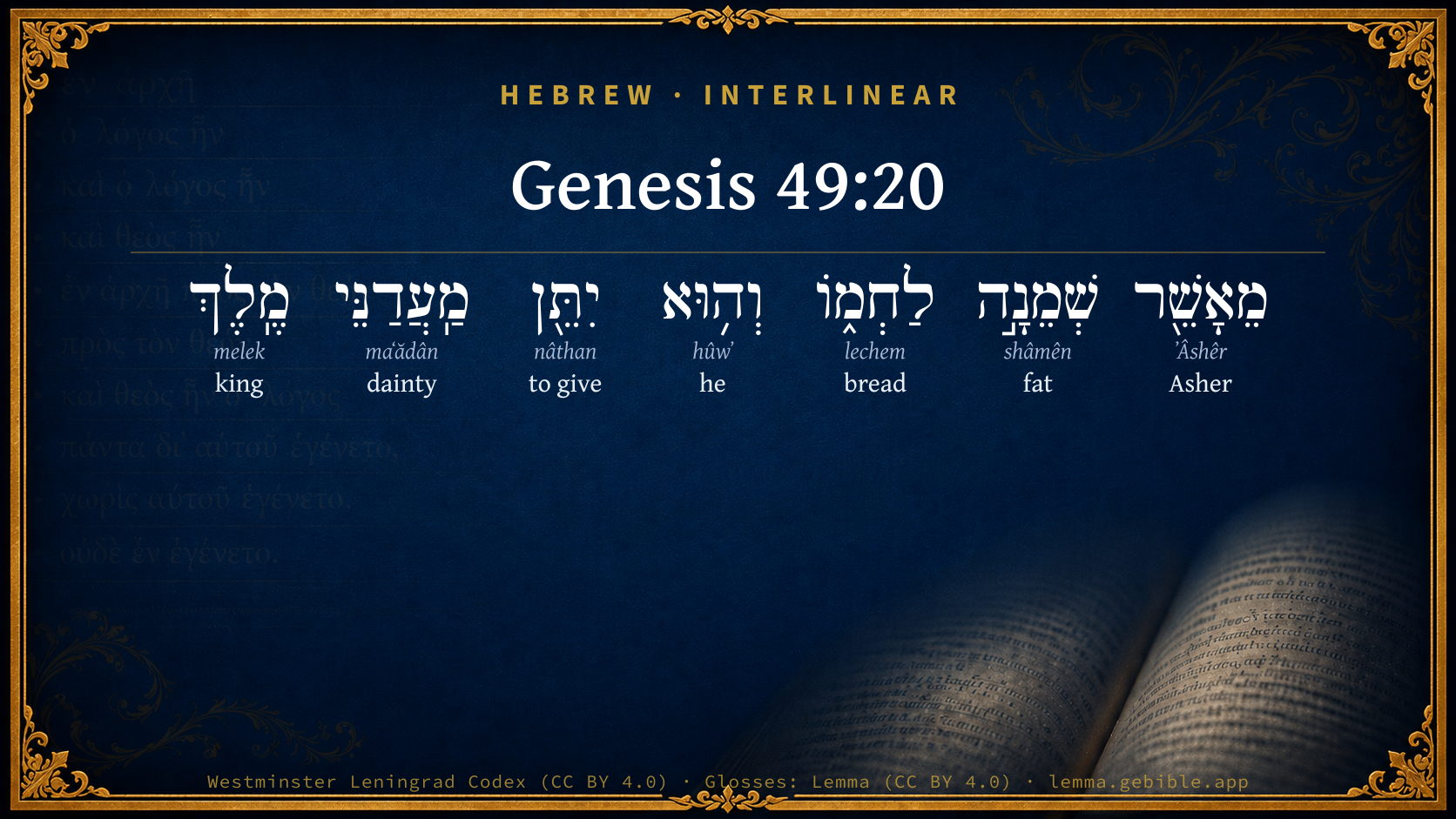
Genesis 49:20

Hebrew (Westminster Leningrad Codex) Genesis 49:20 appears in the Hebrew Old Testament. The text above is from the Westminster Leningrad Codex. Each word links to its Strong’s number, a concise gloss, and parsing drawn from the Open Scriptures Hebrew Bible morphology. Click any word for its full Brown-Driver-Briggs (BDB) entry.
Download image
Cite this verse

Genesis 49:20 (World English Bible). Public Domain. Lemma interlinear Bible study tool, https://lemma.gebible.app/v/genesis/49/20.

Show BibTeX & RIS
BibTeX
RIS
English Translation
Out of Asher his bread will be fat, He will yield royal dainties.
World English Bible · Public Domain
Highlights
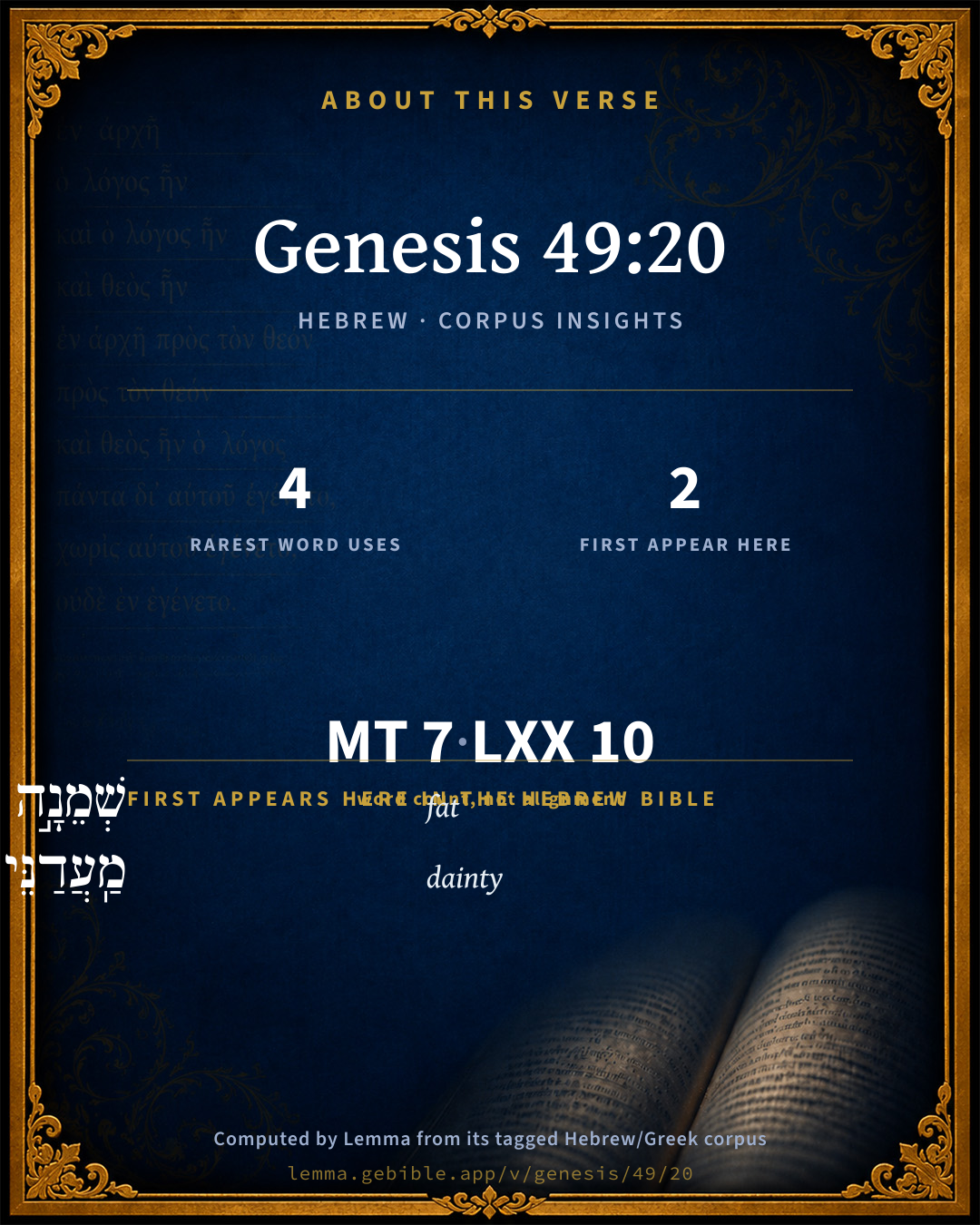
  • 2 first appearances in the Hebrew Bible
Full analysis ↓
Download a study sheet

One document with this verse’s original text, its word-by-word gloss line, the meaning frame, cross-references with their text, attributed commentary, and full source and license credits — printable, and it pastes into notes with its structure intact.

This verse Autodidact and up

Study sheet (.html) Plain text (.txt)

A passage Seminary Student

Up to 50 verses in one chapter. A passage sheet keeps up to 6 commentary sources and 12 cross-references per verse, in the order this page ranks them, and says so on the sheet whenever that leaves anything out. Ask for a single verse and you get the Autodidact verse sheet above.

Everything on this page stays free to read, with no account — the sheet is a download of what is already on screen, not access to it.

Want to remove ads? Support Godless Engineer
Compare translations 3

The same verse in 3 English versions, stacked beneath the original-language interlinear above. Click any original word for its lexicon entry.

Each is an independent rendering of the whole verse — the interlinear is not word-aligned to these translations.

Highlighted words mark where these versions differ — a whole-verse word diff, not a word-by-word alignment.

  • World English Bible Public Domain
    Out of Asher his bread will be fat, He will yield royal dainties.
  • King James Version Public Domain
    Out of Asher his bread shall be fat, and he shall yield royal dainties.
  • unfoldingWord Literal Text CC BY-SA 4.0
    From Asher, his bread fat, and he will provide king’s delicacies. q1

unfoldingWord Literal Text — © unfoldingWord, licensed CC BY-SA 4.0. Word-aligned USFM3 via Door43 (git.door43.org/unfoldingWord/en_ult).

Versions to compare (up to 4)

3 of 4 selected

Show all 18 translations

Every available English version of this verse, each an independent rendering of the whole verse.

  • World English Bible Public Domain
    Out of Asher his bread will be fat, He will yield royal dainties.
  • Berean Standard Bible Public Domain
    Asher’s food will be rich; he shall provide royal delicacies.
  • Majority Standard Bible Public Domain
    Asher’s food will be rich; he shall provide royal delicacies.
  • King James Version Public Domain
    Out of Asher his bread shall be fat, and he shall yield royal dainties.
  • American Standard Version (1901) Public Domain
    Out of the Asher his bread shall be fat, And he shall yield royal dainties.
  • Revised Version (1885) Public Domain
    Out of Asher his bread shall be fat, And he shall yield royal dainties.
  • Geneva Bible (1599) Public Domain
    Concerning Asher, his bread shalbe fat, and he shall giue pleasures for a king.
  • Douay-Rheims (1899) Public Domain
    I will look for thy salvation, 0 Lord.
  • Young's Literal Translation Public Domain
    Out of Asher his bread `is' fat; And he giveth dainties of a king.
  • Literal Standard Version CC BY-SA 4.0
    Out of Asher his bread [is] fat; And he gives delicacies of a king.
  • Unlocked Literal Bible CC BY-SA 4.0
    Asher's food will be rich, and he will provide royal delicacies.
  • unfoldingWord Literal Text CC BY-SA 4.0
    From Asher, his bread fat, and he will provide king’s delicacies. q1
  • Darby Bible Public Domain
    Out of Asher, his bread shall be fat, And he will give royal dainties.
  • World Messianic Bible Public Domain
    “Asher’s food will be rich. He will produce royal dainties.
  • Webster's Bible Public Domain
    Out of Asher his bread shall be fat, and he shall yield royal dainties.
  • Free Bible Version CC BY-SA 4.0
    Asher will have delicious food—he'll produce fancy food for royalty.
  • Bible in Basic English Public Domain
    Asher's bread is fat; he gives delicate food for kings.
  • JPS Tanakh (1917) Public Domain
    As for Asher, his bread shall be fat, and he shall yield royal dainties.

Literal Standard Version (2020), Covenant Press — licensed CC BY-SA 4.0. Text via the HelloAO Bible API (eBible.org). Unlocked Literal Bible (unfoldingWord) — licensed CC BY-SA 4.0. Text via the HelloAO Bible API (eBible.org). unfoldingWord Literal Text — © unfoldingWord, licensed CC BY-SA 4.0. Word-aligned USFM3 via Door43 (git.door43.org/unfoldingWord/en_ult). Free Bible Version, Dr. Jonathan Gallagher — licensed CC BY-SA 4.0. Text via the HelloAO Bible API (eBible.org).

Word by word

More ways to search: Search by grammar → Find every occurrence → Compare this word →

Practice this passage: Drill this verse → Learn its vocabulary →

About this verse

These counts appear in no published source. They are computed here, from the morphology-tagged text and Lemma’s own curated glosses. What Lemma adds →

7
words
7
distinct lemmas
Pentateuch
section

Notable vocabulary

The rarest word here is מַֽעֲדַנֵּי dainty H4574 — appearing just 4 times in the whole Hebrew Bible.

First appearance in Scripture

These words make their first canonical appearance in the Hebrew Bible here:

  • שְׁמֵנָ֣ה fat H8082
  • מַֽעֲדַנֵּי dainty H4574

Shared distinctive vocabulary

מַֽעֲדַנֵּי dainty H4574 occurs in 4 verses of the Hebrew Bible. Also found in:

Grammatical profile

  • 1 verb
  • 4 nouns
  • 1 adjective
  • 1 pronoun

Verb forms

  • יִתֵּ֖ן Qal · Imperfect

Hebrew & Septuagint length

In English translation the verse runs 13 words from the Hebrew and 13 from the Septuagint (LXX English) — the same length.

A rough comparison of the two English renderings, which tokenize alike — not a word-level alignment.

Word counts can differ between the Hebrew and the Greek without any difference in meaning — e.g. the Hebrew direct-object marker אֵת has no separate Greek word, and Greek often adds the article ὁ.

In the original languages it is 7 Hebrew tokens and 10 Greek tokens — but the two are counted differently (Hebrew bundles its prefixes and suffixes into one token; the Greek is in lemma form), so that isn’t a like-for-like length.

Cross-references

4

Topical passages linked to Genesis 49:20 in the Treasury of Scripture Knowledge — connected by theme and wording, ordered by reader-vote popularity; previews shown in the World English Bible.

  • Deuteronomy 33:24–25 Of Asher he said, Blessed be Asher with children; Let him be acceptable to his brothers, Let him dip his foot in oil.
  • Genesis 30:13 Leah said, "Happy am I, for the daughters will call me happy." She named him Asher.
  • Genesis 46:17 The sons of Asher: Imnah, Ishvah, Ishvi, Beriah, and Serah their sister. The sons of Beriah: Heber and Malchiel.
  • Joshua 19:24–31 The fifth lot came out for the tribe of the children of Asher according to their families.

Cross-references courtesy of OpenBible.info (CC BY 4.0).

Hebrew and Greek witnesses Masoretic Hebrew ↔ Greek Septuagint

The same verse in the two great witnesses to the Old Testament, shown verse-for-verse.

These are two independent witnesses, not word-aligned to each other, and the Septuagint is shown in lemma (dictionary) form.

Hebrew Genesis 49:20 Masoretic · Westminster Leningrad Codex

מֵאָשֵׁ֖ר שְׁמֵנָ֣ה לַחְמ֑וֹ וְה֥וּא יִתֵּ֖ן מַֽעֲדַנֵּי מֶֽלֶךְ

Out of Asher his bread will be fat, He will yield royal dainties.

World English Bible · Public Domain

Greek LXX Genesis 49:20 Septuagint · lemma form

ασηρ πίων αὐτός ὁ ἄρτος καί αὐτός δίδωμι τρυφή ἄρχων

Aser, his bread shall be fat; and he shall yield dainties to princes.

LXX2012 (modern English Septuagint) · Public Domain

On this verse, The Cambridge Bible for Schools and Colleges discusses the Septuagint’s reading. Read the note in Commentary ↓

Hebrew: Westminster Leningrad Codex (CC BY 4.0). Greek: Septuagint (public domain); English from LXX2012 (modern English Septuagint) (Public Domain). How the Septuagint differs from the Hebrew →

Targum (Aramaic paraphrase)

2

The Targum is the ancient Jewish Aramaic paraphrase of the Hebrew Scriptures — an interpretive translation, not the Hebrew text itself. Onkelos (literal) and Pseudo-Jonathan (expansive) render the Torah, and Jonathan the Prophets. Coverage is partial: where no permissively-licensed English translation exists for a verse, only the Aramaic is shown. This is verse-level text, not a word-by-word alignment to the Hebrew.

  1. Targum Onkelos Torah (Genesis–Deuteronomy)
    דְאָשֵׁר טָבָא אַרְעֵהּ וְהוּא מְרַבְיָא בְּתַפְנוּקֵי מַלְכִין

    (no public-domain English translation for this verse)

    Targum Onkelos — Aramaic: “Onkelos Genesis” (public domain); “Onkelos Exodus” (public domain); “Onkelos Leviticus” (public domain); “Onkelos Numbers” (public domain); “Onkelos Deuteronomy” (public domain). English: “Sefaria Community Translation” (CC0 1.0 (public-domain dedication)); “J.W. Etheridge. The Targums of Onkelos and Jonathan Ben Uzziel on the Pentateuch. London: Longmans, Green, 1862” (public domain). Text via Sefaria.

  2. Targum Pseudo-Jonathan Torah (Genesis–Deuteronomy)
    טוֹבוֹי דְאָשֵׁר מִן שְׁמֵינִין הִינוּן פֵּירוֹי אַרְעֲיָא מַרְבְּיָת בּוּשְמִין וְעִיקְרֵי סַמָנִין

    Happy is Asher whose fruitage is plenteous, and whose land aboundeth in balsams and costly perfumes.

    Targum Pseudo-Jonathan — Aramaic: “Targum Jonathan on Genesis” (public domain); “Targum Jonathan on Exodus” (public domain); “Targum Jonathan on Leviticus” (public domain); “Targum Jonathan on Numbers” (public domain); “Targum Jonathan on Deuteronomy” (public domain). English: “The Targum of Jonathan ben Uzziel, trans. J. W. Etheridge, London, 1862” (public domain). Text via Sefaria.

Commentary

Notes on Genesis 49:20 from classic Christian and Jewish commentators (each source and its license shown beneath its notes). The classic Christian expositions comment on the surrounding passage and are grouped to its opening verse, so a note may address several verses; the Jewish commentaries on the Tanakh (Rashi and others) are per-verse, so they appear only where the commentator wrote on this verse.

Lemma curates 59 commentaries, every one of them public domain or Creative Commons licensed, each selected and text-cleaned for this edition rather than reprinted as found. About our sources →

Trapp's Complete Commentary

John Trapp

Gen 49:20 Out of Asher his bread [shall be] fat, and he shall yield royal dainties.

Ver. 20. Out of Asher his bread shall be fat.] The "heart of the wheat," as the psalmist hath it. {Psa 81:16} Or, choicest bread corn. Moses expoundeth this; Asher shall "dip his foot in oil." {Deu 33:24} That is, he shall dwell in "the horn of the son of oil," as the expression is. {Isa 5:1, marg.} Or in a very fruitful corn country, which was a singular blessing, according to his name, which signifieth bliss and happiness.

He shall yield dainties for a king.] Kings use to feed of the finest. {a} Yet of Augustus we read, that he was never elaborate in his diet; but content with ordinary and common food. He never drank but thrice at one meal, and lived near fourscore years. Queen Elizabeth of England did seldom eat but one sort of meat, rose ever with an appetite, and lived about seventy years: King Edward VI called her by no other name than his "sweet sister Temperance." Contrarily, Sulla the Roman dictator, by surfeiting and banqueting, at last got a most miserable disease, and died full of lice. Surfeiters either dig their graves with their own teeth (the Grecians called the intemperate, ασωτους quasi ασωστους, as wanting health), or else they come to some untimely end, by the just judgment of God; as those monstrous epicures, Caligula, Heliogabalus, Geta the Emperor, who was served in with dainties by the alphabet. One while he would have anserem, anatem, aprum; another time he would have phasianum, farra, ficus; sometime again, pullum, pavonem, perdicem, porcellum, piscem, perham, &c. This was one of those Caesars who got nothing by their honour, but ut citius interficerentur.

{a} Newlander’s Cure, by Sir Edward Vaughan. Camd., Elisab. Sabellic. Aenead., ii. Plures pereunt gula quam gladio, lancibus quam lanceis, crapula quam capulo, &c. - Heidfeld. Bauson., lib. iii. cap. 1.

John Trapp, A Commentary or Exposition upon All the Books of the Old and New Testament (1647–1656) — public domain. Text from a community e-Sword module.

The Biblical Illustrator

Joseph S. Exell

Gen_49:20

Asher

The blessing of Asher:

Let us look at some of the spiritual points of instruction contained in this blessing of Jacob upon Asher.

And first as to their bread, which is described as fat. Christ is the bread of life to all His people, and this bread may indeed be said to be fat. The Psalmist uses a similar figure when he says, My soul shall be satisfied with marrow and fatness; and again, They shall be abundantly satisfied with the fatness of Thy house. And again, in speaking of those who dwell in Gods presence, he says, Those that be planted in the house of the Lord shall flourish in the courts of our God: they shall still bring forth fruit in old age; they shall be fat and flourishing (Psa_92:13-14). What a rich and blessed portion for the soul is hid in Christ! How our highest thoughts of it are infinitely surpassed! I sat down under His shadow with great delight, and His fruit was sweet to my taste, lie brought me to the banqueting-house, and His banner over me was love (Son_2:3-4). And observe another deeply important truth: He shall yield royal dainties. The possession and enjoyment of Christ, and all the treasures of His grace, involves a great responsibility. Asher is to yield royal dainties--to give out what it possesses to others. If Christ be indeed ours, and weare living upon Him continually, we shall do the same. And to give out, we must live upon Him. It is this we need--living, abiding communion with a precious Christ. O reader! let not Satan deceive us by allowing us to have everything but this! This is his grand device, and how wonderfully he has succeeded let the lives of most Christians tell! And what is Asher said to give out in this passage? Royal dainties. Yes, indeed, as we live upon Christ, that which the soul gives out is no ordinary food. It is dainties--precious food--and with the stamp of the King upon them. There is a royal pardon, a royal love, a royal Saviour, from whom they all flow freely down. (F. Whitfield, M. A.)

The Biblical Illustrator, edited by Joseph S. Exell (c. 1880s–1900s) — public domain. Text from a community e-Sword module.

Joseph Benson's Commentary

Gen 49:20. Out of Asher his bread shall be fat — This implies that it should be a rich tribe, replenished not only with bread for necessity, but with fatness, with dainties, royal dainties, and these exported out of Asher to other tribes, perhaps to other lands. The God of nature has provided for us not only necessaries but dainties, that we might call him a bountiful benefactor; yet, whereas all places are competently furnished with necessaries, only some places afford dainties. Corn is more common than spices. Were the supports of luxury as universal as the supports of life, the world, in consequence of the wickedness of man, would be worse than it is, and surely it is bad enough.

Joseph Benson's Commentary on the Old and New Testaments (1811–1818) — public domain. Text from a community e-Sword module.

Tyndale Open Study Notes

Tyndale Open Resources

49:20 Asher would be fertile and productive, providing rich foods. The tribe settled along the rich northern coast of Canaan.

Tyndale Open Study Notes — © Tyndale Open Resources, licensed CC BY-SA 4.0. Text via the HelloAO Bible API.

Geneva Bible (1599)

Geneva Bible translators

He shall abound in corn and pleasant fruits.

Geneva Bible (1599) marginal notes — public domain. Text via Bolls.life.

John Calvin's Commentaries

20. Out of Asher. The inheritance of Asher is but just alluded to, which he declares shall be fruitful in the best and finest wheat, so that it shall need no foreign supply of food, having abundance at home. By royal dainties, he means such as are exquisite. Should any one object, that it is no great thing to be fed with nutritious and pleasant bread; I answer; we must consider the end designed; namely, that they might hereby know that they were fed by the paternal care of God.

John Calvin's Commentaries (1540-1563) — public domain. Text from the Calvin Translation Society English edition (1840s-50s) via the Christian Classics Ethereal Library (ccel.org). Calvin's coverage is partial (roughly two-thirds of the Bible); uncommented books and verses are honest gaps, never fabricated. The 19th-century editor's footnotes and remarks are omitted so the notes are faithfully Calvin's own voice.

Ellicott's Commentary for English Readers

(20) Asher.—The territory of this tribe, extending along the coast from Mount Carmel to Lebanon, was very productive. Zebulun, the trading tribe, could reach the sea only through their possessions.

A Bible Commentary for English Readers, edited by Charles John Ellicott (1878–1897) — public domain. Text from a community e-Sword module.

The Cambridge Bible for Schools and Colleges

gen. ed. J. J. S. Perowne

20. Out of Asher] Almost certainly the marg. gives the right reading, Asher, his bread &c. The preposition rendered “out of” is the letter m, which is superfluous here, but is required for the pronoun “their,” in the words “their heel” at the close of the preceding verse. The name of the tribe will then open the verse as a kind of nominativus pendens, i.e. “As for Asher, his bread, &c.” Cf. Deu_32:4, “The Rock, his work is perfect.” So the versions, LXX, Lat., Syr.

bread shall be fat] Cf. Deu_33:24, “Blessed be Asher … and let him dip his foot in oil.”

yield royal dainties] The fertility of Asher’s land will supply the wants of the kings of Tyre and Sidon. In Jdg_5:17 Asher rests on the sea coast. There is a play intended on the name of the tribe Asher, and the Hebrew word for “happy” (cf. Gen_30:13), referring to the “happiness” of its fertility. Cf. Arabia Felix.

The Cambridge Bible for Schools and Colleges (gen. ed. J. J. S. Perowne; Cambridge University Press, 1878–1918) — public domain. Text from a community e-Sword module.

John Gill's Exposition

Joseph is a fruitful bough,.... Or as one, like the bough or branch of a tree laden with fruit, as he was with children; one of which he called Ephraim from his fruitfulness, and both his sons became numerous, and the heads of two tribes in Israel; and with other temporal fruits and blessings, as riches, honour, &c. and especially with the fruits of grace and righteousness:

even a fruitful bough by a well; those are the most fruitful that are near a well or fountain of water, as such trees are which are planted by rivers of water, see Psa 1:3 this being repeated may have respect to the two boughs or branches of Joseph's family, or the two fruitful and numerous tribes that sprung from him:

whose branches run over the wall; as such trees that are set against one, and by the reflected heat of the sun grow the more, and become more fruitful. The word for "branches" is "daughters", which some refer to the daughters of Manasseh and Zelophehad, who received their inheritance on both sides of Jordan; and others interpret it of the cities of the tribes of Ephraim and Manasseh, as cities are sometimes called.

John Gill's Exposition of the Whole Bible (1746–1763) — public domain (CC PDM 1.0). Text via the HelloAO Bible API.

Haydock's Catholic Bible Commentary

Fat, delicious. This country was very luxuriant, Deuteronomy xxxiii. 24. (Menochius)

George Leo Haydock (1774–1849), Haydock's Catholic Family Bible and Commentary, 1859 edition — public domain. Excludes Psalms (Douay-Rheims chapter numbering differs from Protestant) and Deuterocanonical books (Catholic canon only).

Matthew Poole's English Annotations

i.e. Out of the land of

Asher. Or, As for or concerning Asher, his bread-corn shall be fuller and sweeter and better than ordinary; and he shall yield royal dainties; not only oil for ointments, but also delicious and excellent fruits, fit to be presented to a king. See Deu 33:24,25.

Matthew Poole's English Annotations on the Holy Bible (1683–1685) — public domain. Text from a community e-Sword/MySword module.

Whedon's Commentary on the Bible

Daniel D. Whedon

20. Fat his bread — Grammatically, bread is in apposition with fat. The tribe of Asher occupied the rich and fertile region along the Mediterranean, north of Mount Carmel. According to Moses (Deu_33:24) Asher should “dip his foot in oil.”

Daniel D. Whedon (gen. ed.), Commentary on the Old and New Testaments (1874–1909) — public domain. Text from a community e-Sword module.

The Pulpit Commentary

Out of Asher his bread shall be fat, and he shall yield royal dainties literally, dainties of, or for, the king. The first clause may be otherwise rendered: Of Asher the bread shall be fat (Kalisch); fat shall be his bread (Murphy); Out of Asher (cometh) fat his bread (Keil). The import of the blessing is that Asher should possess a specially productive soil

The Pulpit Commentary (1880–1919), ed. H.D.M. Spence-Jones & Joseph S. Exell — public domain. Text from a community e-Sword module.

John Wesley's Explanatory Notes

Concerning Asher, he foretells, That it should be a rich tribe, replenished not only with bread for necessity, but with fatness, with dainties, royal dainties, and these exported out of Asher, to other tribes, perhaps to other lands. The God of nature has provided for us not only necessaries but dainties, that we might call him a bountiful benefactor; yet, whereas all places are competently furnished with necessaries, only some places afford dainties. Corn is more common than spices. Were the supports of luxury as universal as the supports of life, the world would be worse than it is, and that needs not.

John Wesley, Explanatory Notes Upon the Whole Bible (1754–1765) — public domain. Text via the GEBible commentary corpus.

Keil & Delitzsch

C. F. Keil & F. Delitzsch

"Out of Asher (cometh) fat, his bread, and he yieldeth royal dainties." לחמו is in apposition to שׁמנה, and the suffix is to be emphasized: the fat, which comes from him, is his bread, his own food. The saying indicates a very fruitful soil. Asher received as his inheritance the lowlands of Carmel on the Mediterranean as far as the territory of Tyre, one of the most fertile parts of Canaan, abounding in wheat and oil, with which Solomon supplied and household of king Hiram (Kg1 5:11).

Keil & Delitzsch — Biblical Commentary on the Old Testament (1861–1891) — public domain (CC PDM 1.0). Text via the HelloAO Bible API. (Old Testament only.)

Rashi

Rabbi Shlomo Yitzchaki (Rashi)

מאשר שמנה לחמו OUT OF ASHER COMETH HIS FAT BREAD —The food that will come from the territory of Asher will be fat, for there will be numerous olive-trees in his territory so that it will flow with oil like a fountain. Moses blessed him in a like manner: (Deuteronomy 33:24) “and he will dip his foot in oil”. So we learn in the Treatise of Menachot 85b: once the people of Laodicia were in need of oil. Their agent was able to obtain the very large quantity they required only at a city in Asher, having failed at Jerusalem and other cities.

Rashi on the Tanakh — English translations: “The Judaica Press complete Tanach with Rashi, translated by A. J. Rosenberg” (CC BY 4.0); “Pentateuch with Rashi's commentary by M. Rosenbaum and A.M. Silbermann, 1929-1934” (public domain); “The Metsudah Tanach series, Lakewood, N.J” (CC BY 4.0); and “The Book of Joshua, Metsudah Publications, 1997” (CC BY 4.0). Text via Sefaria.

Radak

Rabbi David Kimhi (Radak)

מאשר שמנה לחמו, the introductory letter מ appears to indicate that the bounty described in the verse following applied to only part of the territory in which Asher dwelled. The word לחמו is a euphemism for the whole ancestral land of the tribe of Asher, as it is what produces the bread of this tribe. The word לחם here as well as in many other examples, is a collective term including all the food these people grew and consumed. There were many olive trees on the territory of Asher, something confirmed by Moses in Deut. 33,24 where the tribe is described as immersing its feet in that oil. Also all the other fruit grown on its soil was especially good in quality. This is why the verse concludes with the words: והוא יתן מעדני מלך, that the dignitaries of that tribe would send gifts of these fruit to be served at the king’s table.

Radak on the Tanakh — English translations: “Sefaria Community Translation” (CC0 1.0 (public-domain dedication)); “Eliyahu Munk, HaChut Hameshulash” (CC BY 4.0); “Rabbi Mike Feuer, Jerusalem Anthology” (CC BY 4.0); and “R. David Kimhi on the first book of Psalms, Translated by R.G. Finch, London, 1919” (public domain). Text via Sefaria.

Lesson kit

Teaching starters — assembled from the data on this page, not authored interpretation. Every prompt links to the verse data it draws on. Edit before teaching.

Genesis, in the Pentateuch, opens this verse with 7 words (7 distinct Hebrew lemmas). Its most distinctive word is maʻădân (“dainty”). A historical commentator’s framing appears above. Read the whole chapter for the surrounding context.

Discussion questions

  1. The word maʻădân carries the sense “dainty.” How does it shape the verse?
  2. 2 words make their first appearance in Scripture here. What does this debut establish?
  3. How does 1 Samuel 15:32, which shares the word «dainty», read alongside this verse?
  4. These translations render this verse differently; the difference is in the English rendering, not the original. What questions does that raise?
  5. «יִתֵּ֖ן» is a Qal Imperfect verb. How does that grammatical form shape the action described?
  6. Compare how Trapp's Complete Commentary and The Biblical Illustrator read this verse. Where do they agree or differ?

Things to notice

Reading settings

Reading text

Shown beneath each verse's original-language words.

Old Testament
Old Testament edition

Read the OT as the Masoretic Hebrew (MT) or the Greek Septuagint (LXX).

English shown for the Greek Septuagint (in the Hebrew ↔ Greek comparison).

Comparing translations? Open the Compare panel on any verse page to stack up to four side by side.