
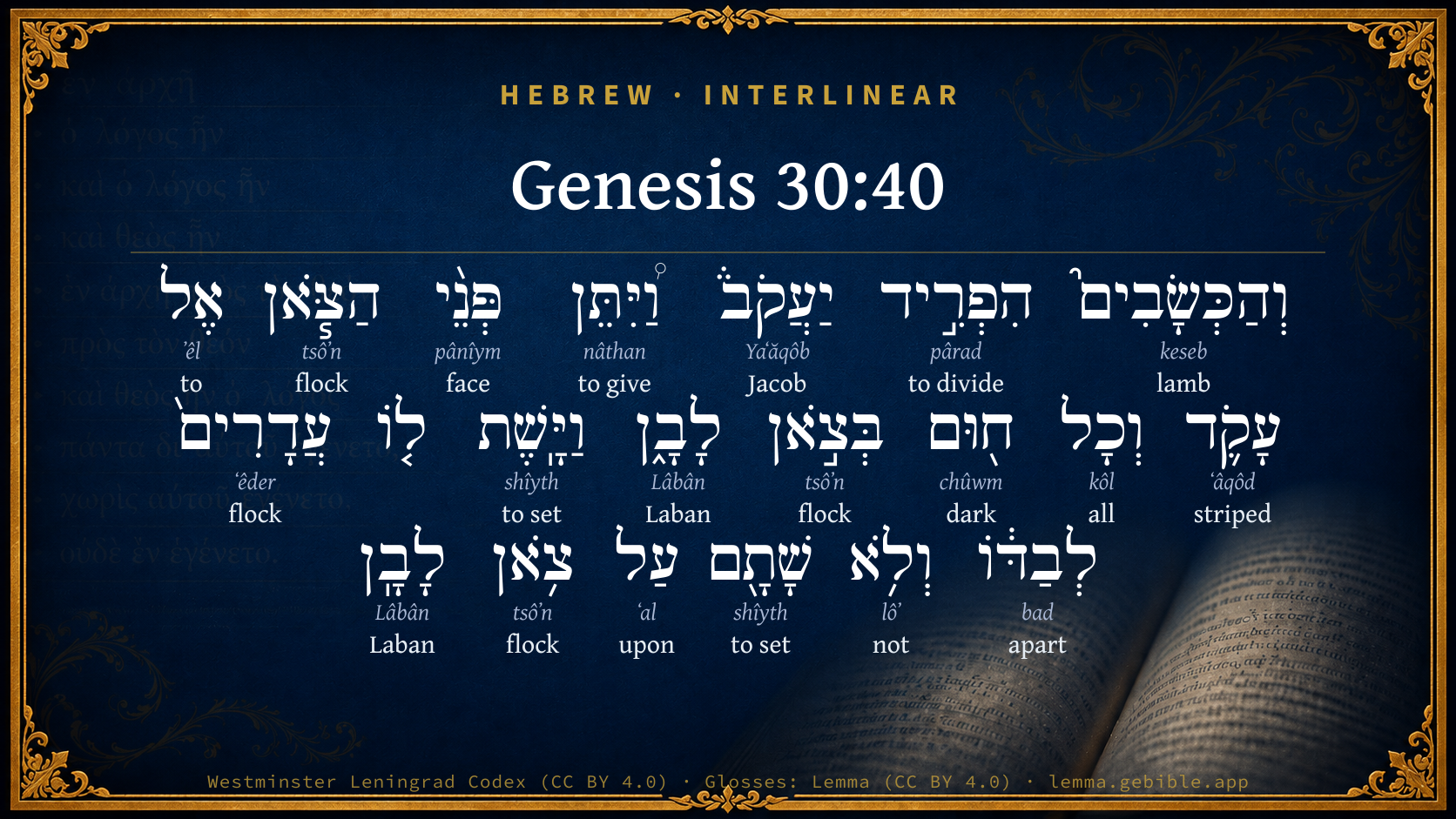
Genesis 30:40

Hebrew (Westminster Leningrad Codex) Genesis 30:40 appears in the Hebrew Old Testament. The text above is from the Westminster Leningrad Codex. Each word links to its Strong’s number, a concise gloss, and parsing drawn from the Open Scriptures Hebrew Bible morphology. Click any word for its full Brown-Driver-Briggs (BDB) entry.
Download image
Cite this verse

Genesis 30:40 (World English Bible). Public Domain. Lemma interlinear Bible study tool, https://lemma.gebible.app/v/genesis/30/40.

Show BibTeX & RIS
BibTeX
RIS
English Translation
Jacob separated the lambs, and set the faces of the flocks toward the streaked and all the black in the flock of Laban: and he put his own droves apart, and didn't put them into Laban's flock.
World English Bible · Public Domain
Download a study sheet

One document with this verse’s original text, its word-by-word gloss line, the meaning frame, cross-references with their text, attributed commentary, and full source and license credits — printable, and it pastes into notes with its structure intact.

This verse Autodidact and up

Study sheet (.html) Plain text (.txt)

A passage Seminary Student

Up to 50 verses in one chapter. A passage sheet keeps up to 6 commentary sources and 12 cross-references per verse, in the order this page ranks them, and says so on the sheet whenever that leaves anything out. Ask for a single verse and you get the Autodidact verse sheet above.

Everything on this page stays free to read, with no account — the sheet is a download of what is already on screen, not access to it.

Want to remove ads? Support Godless Engineer
Compare translations 3

The same verse in 3 English versions, stacked beneath the original-language interlinear above. Click any original word for its lexicon entry.

Each is an independent rendering of the whole verse — the interlinear is not word-aligned to these translations.

Highlighted words mark where these versions differ — a whole-verse word diff, not a word-by-word alignment.

  • World English Bible Public Domain
    Jacob separated the lambs, and set the faces of the flocks toward the streaked and all the black in the flock of Laban: and he put his own droves apart, and didn't put them into Laban's flock.
  • King James Version Public Domain
    And Jacob did separate the lambs, and set the faces of the flocks toward the ring-streaked, and all the brown in the flock of Laban; and he put his own flocks by themselves, and put them not unto Laban's cattle.
  • unfoldingWord Literal Text CC BY-SA 4.0
    Then Jacob set apart the lambs, and he made the faces of the flock look at the streaked and all the dark-colored in the flock of Laban. And he put flocks for himself by themselves, and he did not put them with the flock of Laban.

unfoldingWord Literal Text — © unfoldingWord, licensed CC BY-SA 4.0. Word-aligned USFM3 via Door43 (git.door43.org/unfoldingWord/en_ult).

Versions to compare (up to 4)

3 of 4 selected

Show all 18 translations

Every available English version of this verse, each an independent rendering of the whole verse.

  • World English Bible Public Domain
    Jacob separated the lambs, and set the faces of the flocks toward the streaked and all the black in the flock of Laban: and he put his own droves apart, and didn't put them into Laban's flock.
  • Berean Standard Bible Public Domain
    Jacob set apart the young, but made the rest face the streaked dark-colored sheep in Laban’s flocks. Then he set his own stock apart and did not put them with Laban’s animals.
  • Majority Standard Bible Public Domain
    Jacob set apart the young, but made the rest face the streaked dark-colored sheep in Laban’s flocks. Then he set his own stock apart and did not put them with Laban’s animals.
  • King James Version Public Domain
    And Jacob did separate the lambs, and set the faces of the flocks toward the ring-streaked, and all the brown in the flock of Laban; and he put his own flocks by themselves, and put them not unto Laban's cattle.
  • American Standard Version (1901) Public Domain
    And Jacob separated the lambs, and set the faces of the flocks toward the ringstreaked and all the black in the flock of Laban: and he put his own droves apart, and put them not unto Laban's flock.
  • Revised Version (1885) Public Domain
    And Jacob separated the lambs, and set the faces of the flocks toward the ringstraked and all the black in the flock of Laban; and he put his own droves apart, and put them not unto Laban’s flock.
  • Geneva Bible (1599) Public Domain
    And Iaakob parted these lambes, and turned the faces of the flocke towardes these lambes partie coloured and all maner of blacke, among the sheepe of Laban: so hee put his owne flockes by themselues, and put them not with Labans flocke.
  • Douay-Rheims (1899) Public Domain
    And Jacob separated the flock, and put the rods in the troughs before the eyes of the rams: and all the white and the black were Laban's: and the rest were Jacob's, when the flocks were separated one from the other.
  • Young's Literal Translation Public Domain
    And the lambs hath Jacob parted, and he putteth the face of the flock towards the ring-straked, also all the brown in the flock of Laban, and he setteth his own droves by themselves, and hath not set them near Laban's flock.
  • Literal Standard Version CC BY-SA 4.0
    And Jacob has parted the lambs, and he puts the face of the flock toward the striped, also all the brown in the flock of Laban, and he sets his own droves by themselves, and has not set them near Laban’s flock.
  • Unlocked Literal Bible CC BY-SA 4.0
    Jacob separated out these lambs, but made the rest of them face toward the striped animals and all the black sheep in the flock of Laban. Then he separated out his flocks for himself alone and did not put them together with Laban's flocks.
  • unfoldingWord Literal Text CC BY-SA 4.0
    Then Jacob set apart the lambs, and he made the faces of the flock look at the streaked and all the dark-colored in the flock of Laban. And he put flocks for himself by themselves, and he did not put them with the flock of Laban.
  • Darby Bible Public Domain
    And Jacob separated the lambs, and set the faces of the flock toward the ringstraked, and all the brown in the flock of Laban; and he made himself separate flocks, and did not put them with Laban's flock.
  • World Messianic Bible Public Domain
    Jacob separated the lambs, and set the faces of the flocks toward the streaked and all the black in Laban’s flock. He put his own droves apart, and didn’t put them into Laban’s flock.
  • Webster's Bible Public Domain
    And Jacob separated the lambs, and set the faces of the flocks towards the ring-streaked, and all the brown in the flock of Laban: and he put his own flocks by themselves, and put them not with Laban's cattle.
  • Free Bible Version CC BY-SA 4.0
    Jacob separated all these ones out. Then he made his flock face towards those in Laban's flock that were streaked and dark. This is the way he kept his flocks apart from Laban's flock.
  • Bible in Basic English Public Domain
    These lambs Jacob kept separate; and he put his flock in a place by themselves and not with Laban's flock.
  • JPS Tanakh (1917) Public Domain
    And Jacob separated the lambs — he also set the faces of the flocks toward the streaked and all the dark in the flock of Laban — and put his own droves apart, and put them not unto Laban's flock.

Literal Standard Version (2020), Covenant Press — licensed CC BY-SA 4.0. Text via the HelloAO Bible API (eBible.org). Unlocked Literal Bible (unfoldingWord) — licensed CC BY-SA 4.0. Text via the HelloAO Bible API (eBible.org). unfoldingWord Literal Text — © unfoldingWord, licensed CC BY-SA 4.0. Word-aligned USFM3 via Door43 (git.door43.org/unfoldingWord/en_ult). Free Bible Version, Dr. Jonathan Gallagher — licensed CC BY-SA 4.0. Text via the HelloAO Bible API (eBible.org).

Word by word

More ways to search: Search by grammar → Find every occurrence → Compare this word →

Practice this passage: Drill this verse → Learn its vocabulary →

ח֖וּם
chûwm
H2345
“dark”
Adjective, Adjective, Masculine, Singular, Absolute
Part of Speech
Adjective
Type
Adjective
Gender
Masculine
Number
Singular
State
Absolute
Full BDB Definition

Origin: from an unused root meaning to be warm

TWOT: 625a

dark colour, darkened, dark brown or black
  1. וְהַכְּשָׂבִים֮ keseb H3775 “and · the · lambs” Conjunction + Particle, Definite Article + Noun, Common, Masculine, Plural, Absolute
  2. הִפְרִ֣יד pârad H6504 “to divide” Verb, Hiphil, Perfect, 3rd Person, Masculine, Singular
  3. יַעֲקֹב֒ Yaʻăqôb H3290 “Jacob” Noun, Proper
  4. וַ֠יִּתֵּן nâthan H5414 “and · to give” Conjunction + Verb, Qal, Sequential Imperfect, 3rd Person, Masculine, Singular
  5. פְּנֵ֨י pânîym H6440 “face(s) of” Noun, Common, Both, Plural, Construct
  6. הַצֹּ֧אן tsôʼn H6629 “the · flock” Particle, Definite Article + Noun, Common, Both, Singular, Absolute
  7. אֶל ʼêl H413 “to” Preposition
  8. עָקֹ֛ד ʻâqôd H6124 “striped” Adjective, Adjective, Masculine, Singular, Absolute
  9. וְכָל kôl H3605 “and · all of” Conjunction + Noun, Common, Masculine, Singular, Construct
  10. בְּצֹ֣אן tsôʼn H6629 “in/at · flock of” Preposition + Noun, Common, Both, Singular, Construct
  11. לָבָ֑ן Lâbân H3837 “Laban” Noun, Proper
  12. וַיָּֽשֶׁת shîyth H7896 “and · to set” Conjunction + Verb, Qal, Sequential Imperfect, 3rd Person, Masculine, Singular
  13. עֲדָרִים֙ ʻêder H5739 “flocks” Noun, Common, Masculine, Plural, Absolute
  14. לְבַדּ֔וֹ bad H905 “to/for · apart · his” Preposition + Noun, Common, Masculine, Singular, Construct + Suffix, Personal, 3rd Person, Masculine, Singular
  15. וְלֹ֥א lôʼ H3808 “and · not” Conjunction + Particle, Negative
  16. שָׁתָ֖ם shîyth H7896 “to set · them” Verb, Qal, Perfect, 3rd Person, Masculine, Singular + Suffix, Personal, 3rd Person, Masculine, Plural
  17. עַל ʻal H5921 “upon” Preposition
  18. צֹ֥אן tsôʼn H6629 “flock of” Noun, Common, Both, Singular, Construct
  19. לָבָֽן Lâbân H3837 “Laban” Noun, Proper

About this verse

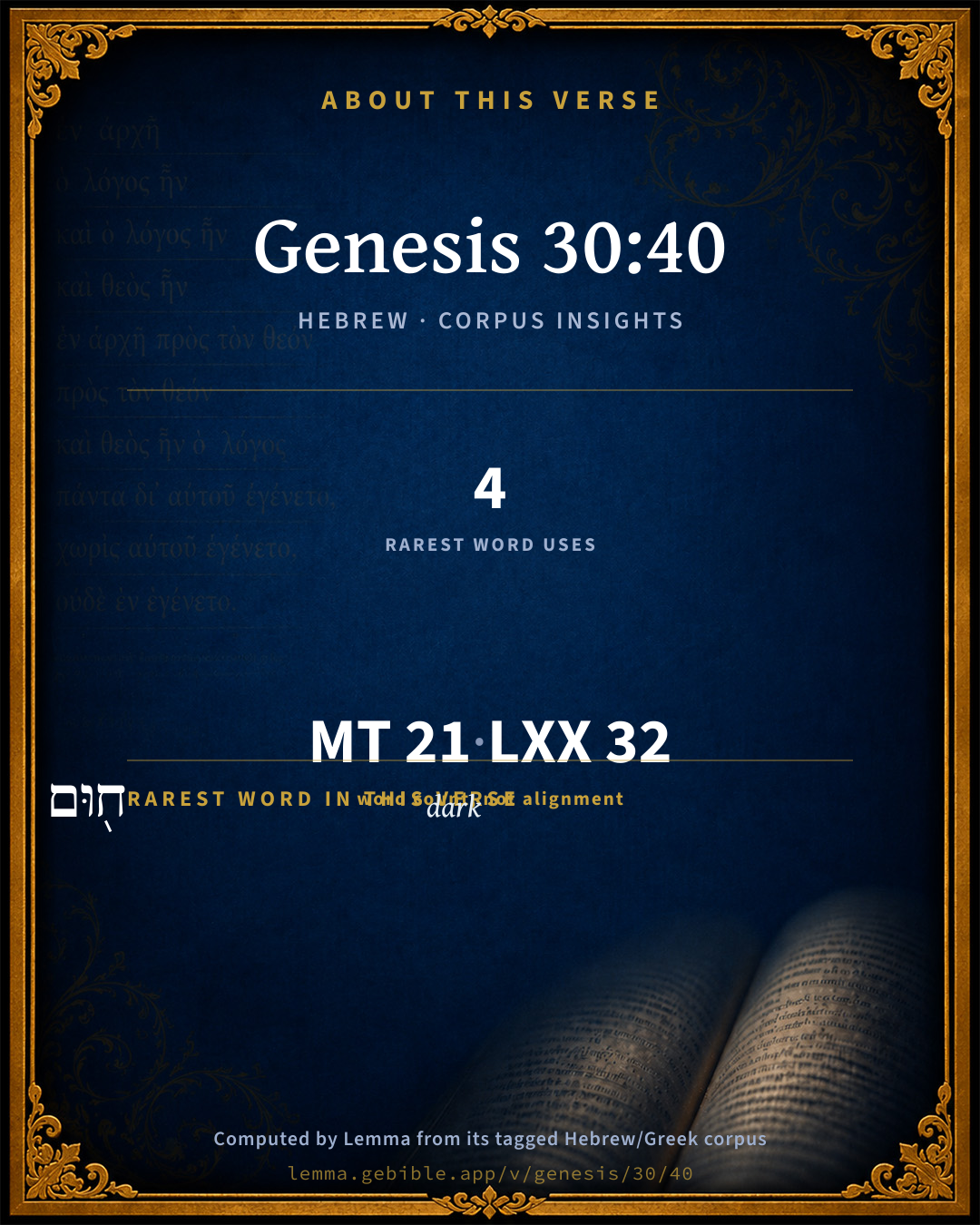
These counts appear in no published source. They are computed here, from the morphology-tagged text and Lemma’s own curated glosses. What Lemma adds →

21
words
16
distinct lemmas
Pentateuch
section

Notable vocabulary

The rarest word here is ח֖וּם dark H2345 — appearing just 4 times in the whole Hebrew Bible.

Shared distinctive vocabulary

ח֖וּם dark H2345 occurs in 4 verses of the Hebrew Bible. Also found in:

Grammatical profile

  • 4 verbs
  • 11 nouns
  • 2 adjectives
  • 3 prepositions
  • 1 particle

Verb forms

  • הִפְרִ֣יד Hiphil · Perfect
  • וַ֠יִּתֵּן Qal · Sequential Imperfect
  • וַיָּֽשֶׁת Qal · Sequential Imperfect
  • שָׁתָ֖ם Qal · Perfect

Repetition

Words recur within this verse — often emphatic in Hebrew:

  • הַצֹּ֧אן flock H6629 ×3
  • לָבָ֑ן Laban H3837 ×2
  • וַיָּֽשֶׁת to set H7896 ×2

Hebrew & Septuagint length

In English translation the verse runs 37 words from the Hebrew and 37 from the Septuagint (LXX English) — the same length.

A rough comparison of the two English renderings, which tokenize alike — not a word-level alignment.

Word counts can differ between the Hebrew and the Greek without any difference in meaning — e.g. the Hebrew direct-object marker אֵת has no separate Greek word, and Greek often adds the article ὁ.

In the original languages it is 21 Hebrew tokens and 32 Greek tokens — but the two are counted differently (Hebrew bundles its prefixes and suffixes into one token; the Greek is in lemma form), so that isn’t a like-for-like length.

Hebrew and Greek witnesses Masoretic Hebrew ↔ Greek Septuagint

The same verse in the two great witnesses to the Old Testament, shown verse-for-verse.

These are two independent witnesses, not word-aligned to each other, and the Septuagint is shown in lemma (dictionary) form.

Hebrew Genesis 30:40 Masoretic · Westminster Leningrad Codex

וְהַכְּשָׂבִים֮ הִפְרִ֣יד יַעֲקֹב֒ וַ֠יִּתֵּן פְּנֵ֨י הַצֹּ֧אן אֶל עָקֹ֛ד וְכָל ח֖וּם בְּצֹ֣אן לָבָ֑ן וַיָּֽשֶׁת ל֤וֹ עֲדָרִים֙ לְבַדּ֔וֹ וְלֹ֥א שָׁתָ֖ם עַל צֹ֥אן לָבָֽן

Jacob separated the lambs, and set the faces of the flocks toward the streaked and all the black in the flock of Laban: and he put his own droves apart, and didn't put them into Laban's flock.

World English Bible · Public Domain

Greek LXX Genesis 30:40 Septuagint · lemma form

ὁ δέ ἀμνός διαστέλλω ἰακώβ καί ἵστημι ἐναντίον ὁ πρόβατον κριός διάλευκος καί πᾶς ποικίλος ἐν ὁ ἀμνός καί διαχωρίζω ἑαυτοῦ ποίμνιον κατά ἑαυτοῦ καί οὐ μίγνυμι αὐτός εἰς ὁ πρόβατον λαβαν

And Jacob separated the lambs, and set before the sheep a speckled ram, and every variegated one among the lambs, and he separated flocks for himself alone, and did not mingle them with the sheep of Laban.

LXX2012 (modern English Septuagint) · Public Domain

Hebrew: Westminster Leningrad Codex (CC BY 4.0). Greek: Septuagint (public domain); English from LXX2012 (modern English Septuagint) (Public Domain). How the Septuagint differs from the Hebrew →

Targum (Aramaic paraphrase)

2

The Targum is the ancient Jewish Aramaic paraphrase of the Hebrew Scriptures — an interpretive translation, not the Hebrew text itself. Onkelos (literal) and Pseudo-Jonathan (expansive) render the Torah, and Jonathan the Prophets. Coverage is partial: where no permissively-licensed English translation exists for a verse, only the Aramaic is shown. This is verse-level text, not a word-by-word alignment to the Hebrew.

  1. Targum Onkelos Torah (Genesis–Deuteronomy)
    וְאִמְּרַיָּא אַפְרֵשׁ יַעֲקֹב וִיהַב בְּרֵישׁ עָנָא כָּל דִּרְגוֹל וְכָל דִּשְׁחוּם בְּעָנָא דְלָבָן וְשַׁוִּי לֵהּ עֶדְרִין בִּלְחוֹדוֹהִי וְלָא עֲרֵבִנּוּן עִם עָנָא דְלָבָן

    (no public-domain English translation for this verse)

    Targum Onkelos — Aramaic: “Onkelos Genesis” (public domain); “Onkelos Exodus” (public domain); “Onkelos Leviticus” (public domain); “Onkelos Numbers” (public domain); “Onkelos Deuteronomy” (public domain). English: “Sefaria Community Translation” (CC0 1.0 (public-domain dedication)); “J.W. Etheridge. The Targums of Onkelos and Jonathan Ben Uzziel on the Pentateuch. London: Longmans, Green, 1862” (public domain). Text via Sefaria.

  2. Targum Pseudo-Jonathan Torah (Genesis–Deuteronomy)
    וְטַלְיָא אַפְרֵישׁ יַעֲקב וִיהַב בְּרֵישׁ עָנָא מַשְׁכּוֹבִיתָא כָּל יַת דִרְגוֹל וְכָל דִלְחוּשׁ בְּעָנָא דְלָבָן וְשַׁוֵי לֵיהּ עֶדְרִין בִּלְחוֹדוֹי וְלָא עַרְבֵּיבִנוּן עִם עָנָא דְלָבָן

    And the lambs did Jakob set apart, and place in front of the flocks; all the various coloured and the black among Laban's sheep he set for himself a flock apart, and did not mix them with the sheep of Laban.

    Targum Pseudo-Jonathan — Aramaic: “Targum Jonathan on Genesis” (public domain); “Targum Jonathan on Exodus” (public domain); “Targum Jonathan on Leviticus” (public domain); “Targum Jonathan on Numbers” (public domain); “Targum Jonathan on Deuteronomy” (public domain). English: “The Targum of Jonathan ben Uzziel, trans. J. W. Etheridge, London, 1862” (public domain). Text via Sefaria.

Commentary

Notes on Genesis 30:40 from classic Christian and Jewish commentators (each source and its license shown beneath its notes). The classic Christian expositions comment on the surrounding passage and are grouped to its opening verse, so a note may address several verses; the Jewish commentaries on the Tanakh (Rashi and others) are per-verse, so they appear only where the commentator wrote on this verse.

Lemma curates 59 commentaries, every one of them public domain or Creative Commons licensed, each selected and text-cleaned for this edition rather than reprinted as found. About our sources →

Trapp's Complete Commentary

John Trapp

Gen 30:40 And Jacob did separate the lambs, and set the faces of the flocks toward the ringstraked, and all the brown in the flock of Laban; and he put his own flocks by themselves, and put them not unto Laban’s cattle.

Ver. 40. And set the faces of the flocks, &c.] That by the sight of the speckled cattle they might bring forth lambs like them that were in their eye.

John Trapp, A Commentary or Exposition upon All the Books of the Old and New Testament (1647–1656) — public domain. Text from a community e-Sword module.

Joseph Benson's Commentary

Gen 30:40. Jacob set the faces of the flocks toward the ring-streaked — Having used the pilled rods by divine direction, and seeing the effects they produced, he here employs his own natural sagacity, and turns the faces of Laban’s flocks toward the ring-streaked and the brown, that by looking frequently on them, they might be disposed in their conception to bring forth the like. And he put his own flocks apart, lest, by looking at Laban’s, their young might fall off from being ring-streaked and brown.

Joseph Benson's Commentary on the Old and New Testaments (1811–1818) — public domain. Text from a community e-Sword module.

Adam Clarke's Commentary

Verse 40. Jacob did separate the lambs, c.] When Jacob undertook the care of Laban's flock, according to the agreement already mentioned, there were no party-coloured sheep or goats among them, therefore the ring-streaked, &c., mentioned in this verse, must have been born since the agreement was made and Jacob makes use of them precisely as he used the pilled rods, that, having these before their eyes during conception, the impression might be made upon their imagination which would lead to the results already mentioned.

Adam Clarke's Commentary on the Bible (1810–1826) — public domain. Text from a community e-Sword/MySword module.

Ellicott's Commentary for English Readers

(40) Jacob . . . set the faces of the flocks toward . . . —As the speckled lambs and kids would for some time remain with Labau’s flocks, this may perhaps mean that, when driving them to water, Jacob placed all the striped kids and dark lambs together, that, by being in a mass, they might work upon the imagination of the ewes and she-goats. Finally, after these had conceived he drove the parti-coloured young away to his own flocks.

A Bible Commentary for English Readers, edited by Charles John Ellicott (1878–1897) — public domain. Text from a community e-Sword module.

The Cambridge Bible for Schools and Colleges

gen. ed. J. J. S. Perowne

40. set the faces … Laban] This is a very obscure sentence in the original. It probably describes a second device practised by Jacob. At the breeding time he caused the ewes which belonged to Laban to pasture within view of his own parti-coloured and black animals, in order to increase the tendency of Laban’s flock to produce spotted and parti-coloured lambs. The difficulty, however, of the language has made some scholars suppose that the words “and set … of Laban” are a gloss. As they stand, they seem to contradict Gen_30:33; Gen_30:36, according to which Laban had already removed to a distance the parti-coloured animals.

The Cambridge Bible for Schools and Colleges (gen. ed. J. J. S. Perowne; Cambridge University Press, 1878–1918) — public domain. Text from a community e-Sword module.

Haydock's Catholic Bible Commentary

All the white, &c. Notwithstanding Jacob’s stratagem, some had lambs all of a colour. The force of fancy is very surprising on such occasions. Oppian, Aristotle, and others, recommend Jacob’s plan as consonant to nature. (Haydock)

George Leo Haydock (1774–1849), Haydock's Catholic Family Bible and Commentary, 1859 edition — public domain. Excludes Psalms (Douay-Rheims chapter numbering differs from Protestant) and Deuterocanonical books (Catholic canon only).

Matthew Poole's English Annotations

Jacob did separate the lambs, such as were ring-straked and brown from the white, as it here follows. He caused

the ring-straked and all the brown to go foremost, and the white to follow them, that by the continued beholding of them in the time of their conjunction, they might have their colour more imprinted upon their fancies, and thereby convey it to their young ones. He

put them not unto Laban’s cattle; which he did upon the same reason, lest the constant beholding of them should make them bring forth the like, i.e. single-coloured ones.

Matthew Poole's English Annotations on the Holy Bible (1683–1685) — public domain. Text from a community e-Sword/MySword module.

Whedon's Commentary on the Bible

Daniel D. Whedon

40. Separate the lambs — That is, the lambs produced after the separation mentioned in Gen_30:35. These ringstreaked lambs were, as a second artifice, made like the rods to serve his purpose.

Put his own flocks by themselves — As he had a right to do. Laban’s cattle here denote those of uniform color in the flocks tended by Jacob.

Daniel D. Whedon (gen. ed.), Commentary on the Old and New Testaments (1874–1909) — public domain. Text from a community e-Sword module.

The Pulpit Commentary

And Jacob did separate the lambs (i.e. the speckled lambs procured by the foregoing artifice he removed from the main body of the flock), and set the faces of the flocks toward the ringstraked, and all the brown in the flock of Laban (this was Jacob"s second artifice, to make the speckled lambs serve the same purpose as the pilled rods); and he put his own flocks by themselves, and put them not unto Laban"s cattle so that they were not exposed to the risk of producing offspring of uniform color.

The Pulpit Commentary (1880–1919), ed. H.D.M. Spence-Jones & Joseph S. Exell — public domain. Text from a community e-Sword module.

Rashi

Rabbi Shlomo Yitzchaki (Rashi)

והכשבים הפריד יעקב AND JACOB PARTED THE LAMBS — Those sheep that were thus born spotted on the ankles and speckled he separated and set apart by themselves, thus forming them into a separate flock. He led that spotted flock in front of ordinary sheep so that the faces of the sheep that followed behind them were gazing at them. This is what Scripture means in saying, “He set the faces of the flocks towards the spotted” — that the faces of the sheep were directed towards the spotted animals and towards all that were brownish which he found amongst Laban’s sheep (i. e., amongst the sickly sheep which Laban had left him; cf. Genesis 5:36).

וישת לו עדרים means he formed them into a separate flock as I have already explained.

Rashi on the Tanakh — English translations: “The Judaica Press complete Tanach with Rashi, translated by A. J. Rosenberg” (CC BY 4.0); “Pentateuch with Rashi's commentary by M. Rosenbaum and A.M. Silbermann, 1929-1934” (public domain); “The Metsudah Tanach series, Lakewood, N.J” (CC BY 4.0); and “The Book of Joshua, Metsudah Publications, 1997” (CC BY 4.0). Text via Sefaria.

Ramban (Nachmanides)

Rabbi Moshe ben Nachman (Ramban / Nachmanides)

AND JACOB SEPARATED THE LAMBS. Rashi comments: “Those sheep that were thus born spotted on the ankles and speckled, he separated and set apart by themselves, thus forming them into a separate flock. The spotted flock he led in front of the ordinary sheep so that the faces of the sheep that followed behind them were gazing at them. This is what Scripture means in saying, And he set the faces of the flocks towards the spotted; the faces of the sheep were directed towards the spotted animals and towards all that were brownish which were found amongst Laban’s sheep. And he put his own droves by themselves, and set them not with Laban’s flocks, as I have already explained.” This is the Rabbi’s [Rashi’s] language. But his words here are not correct. For why did Jacob separate the spotted lambs so that there did not remain in Laban’s flock any speckled or brownish ones, neither in the sheep nor in the goats? And if those that he separated were the ringstraked, speckled and spotted which the sheep had given birth to and which belonged to him, and it was from them that he made this spotted flock, why did he separate only the lambs and did not take also the he-goats and she-goats which were born spotted and make from all of them this spotted flock which he led before the sheep? Moreover, Scripture makes no mention of the fact that brownish ones were born. And again, according to the opinion of the Rabbi [Rashi], there were no ringstraked and spotted among the lambs for these were not his hire. Only the brownish were, and for the brownish he had made no sticks.But the explanation of the verse is that Jacob separated the lambs from the goats and made from them a separate flock. Now he had a flock of brownish lambs and a flock of spotted and speckled goats. He then had the faces of all the flocks — of the lambs and of the goats — directed towards the ringstraked and towards all the brownish which were in the flock of Laban, since he put the ringstraked before the goats and all the brownish before the lambs, this being in accordance with the opinion of the earlier Rabbis, [Rashi and Ibn Ezra, as explained above], or, according to [Ramban’s] opinion, the ringstraked and all the brownish before the lamb. For the purpose of the separation of the lambs from the goats was on account of the brownish which were his hire from the lambs alone.The correct interpretation appears to me to be that Scripture is saying, Jacob separated [only] the lambs and set the faces of the flocks, which refer to the above mentioned lambs, to the ringstraked and all the brownish in the flock of Laban, and he put his own droves of the ringstraked and the brownish by themselves, and he set them not with Laban’s flocks, for these, [the ringstraked and the brownish], were his hire. And the meaning of the expression, in the flock of Laban, is that he did so with all of Laban’s flocks but not that they belonged to Laban since the ringstraked among the lambs were Jacob’s.Now do not ask why Scripture at first says “lambs” and then says “the faces of the flocks” rather than “the faces of the lambs”, for it is normal for Scripture to express itself this way. In this section there is a similar case in connection with the mountain of Gilead.. “The mountain” mentioned at the beginning of the verse is the “mountain of Gilead” mentioned at the end. And the reason Jacob did this with the lambs more than with the goats is that there were no brownish ones among the sticks he put up. It is possible that he knew that because of their heaviness, it is natural for lambs to require many signs to arouse them — more than the light-weight he-goats require.

Ramban (Nachmanides) on the Tanakh — English translation: “Commentary on the Torah by Ramban (Nachmanides). Translated and annotated by Charles B. Chavel. New York, Shilo Pub. House, 1971-1976” (CC BY 4.0). Text via Sefaria.

Radak

Rabbi David Kimhi (Radak)

והכבשים הפריד יעקב, he separated the females from the goats whether male or female, not watering the two species at the same time, in order to prevent goats with undesirable skin patterns being born. None of the goats that were not black belonged to Yaakov [according to Joseph Kimichi’s commentary, there was nothing wrong in what Yaakov did or failed to do, since these goats never had displayed such skin patterns, so why should Yaakov encourage their being born with new skin patterns. Ed.] Yaakov watered the goats elsewhere where they did not observe any sticks or branches that could arouse their imagination. Yaakov did not have any black paint which would have enabled him to paint sticks black. Even if he had possessed such paint, his stratagem would have become public knowledge as naturally black sticks or branches did not exist in that region. He therefore had to content himself with increasing his share of the births of the sheep, foregoing any artificial measures to make the goats throw young ones that were black-skinned. [the interested reader will find that different commentators arrive at different conclusions regarding exactly what was agreed between Yaakov and Lavan, and they each explain his procedures according to their understanding of the agreement. Ed.]

וישת לו עדרים לבדו, from the lambs that were born as his share, year after year, Yaakov formed separate flocks which he kept apart seeing that they amounted to a formidable number of animals. He did not let them graze anywhere near where Lavan’s flocks were grazing. Lavan had displayed envy of Yaakov, and therefore Yaakov did not want to inflame his envy by letting him see his flocks all the time, knowing that Yaakov’s share of the newly born sheep had outnumbered those born as his own share

על צאן, as if the Torah had written עם צאן, “with the sheep.” A similar construction is found in Exodus 35,22 ויבאו האנשים על הנשים, “the men came together with the women.”

Radak on the Tanakh — English translations: “Sefaria Community Translation” (CC0 1.0 (public-domain dedication)); “Eliyahu Munk, HaChut Hameshulash” (CC BY 4.0); “Rabbi Mike Feuer, Jerusalem Anthology” (CC BY 4.0); and “R. David Kimhi on the first book of Psalms, Translated by R.G. Finch, London, 1919” (public domain). Text via Sefaria.

Lesson kit

Teaching starters — assembled from the data on this page, not authored interpretation. Every prompt links to the verse data it draws on. Edit before teaching.

Genesis, in the Pentateuch, opens this verse with 21 words (16 distinct Hebrew lemmas). Its most distinctive word is chûwm (“dark”). A historical commentator’s framing appears above. Read the whole chapter for the surrounding context.

Discussion questions

  1. The word chûwm carries the sense “dark.” How does it shape the verse?
  2. How does Genesis 30:32, which shares the word «dark», read alongside this verse?
  3. What does the repetition of “flock” (3× in this one verse) do in this verse?
  4. These translations render this verse differently. What is at stake in choosing one wording over another?
  5. «הִפְרִ֣יד» is a Hiphil Perfect verb. How does that grammatical form shape the action described?
  6. Compare how Trapp's Complete Commentary and Joseph Benson's Commentary read this verse. Where do they agree or differ?

Things to notice

Reading settings

Reading text

Shown beneath each verse's original-language words.

Old Testament
Old Testament edition

Read the OT as the Masoretic Hebrew (MT) or the Greek Septuagint (LXX).

English shown for the Greek Septuagint (in the Hebrew ↔ Greek comparison).

Comparing translations? Open the Compare panel on any verse page to stack up to four side by side.