
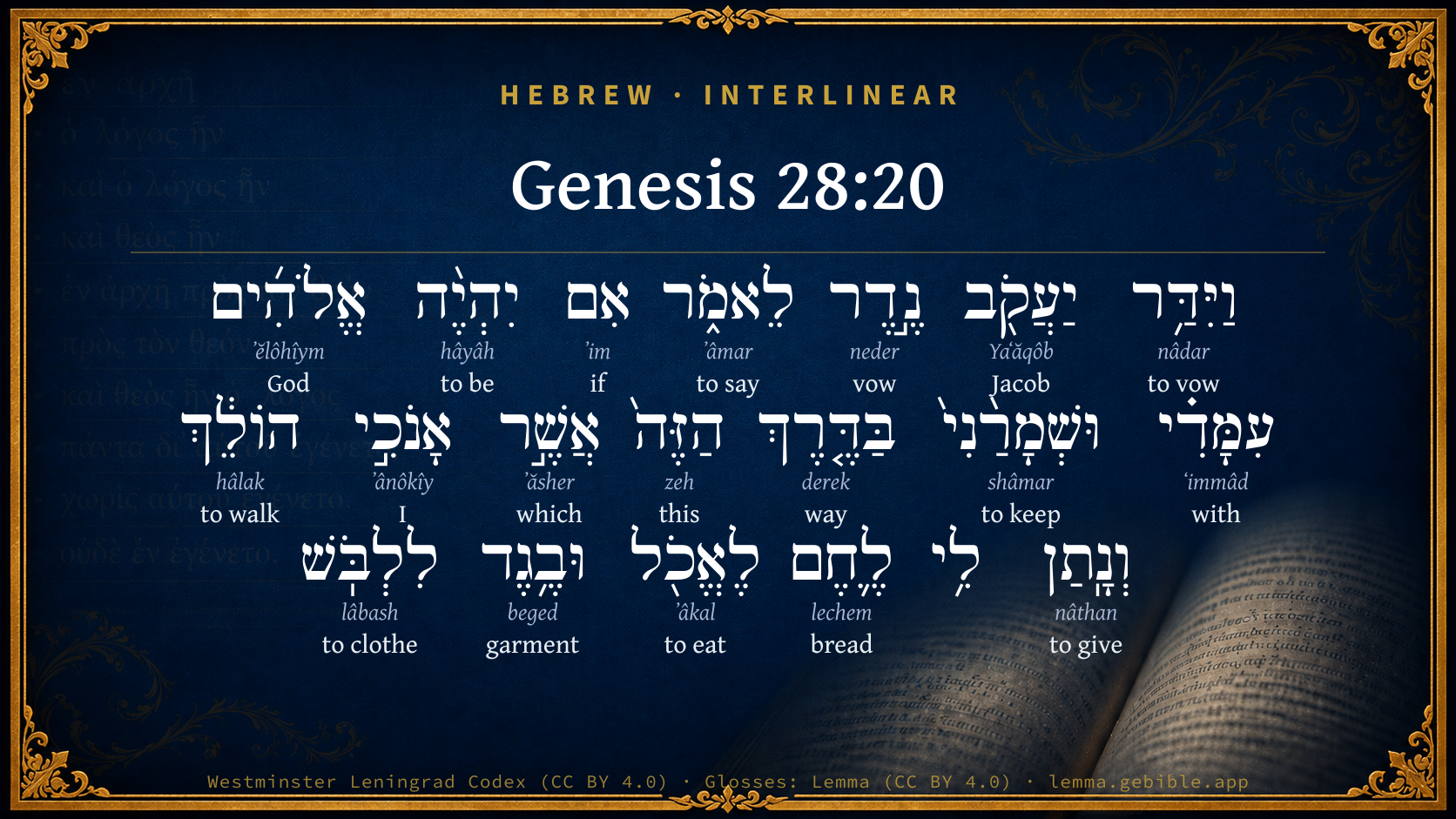
Genesis 28:20

Hebrew (Westminster Leningrad Codex) Genesis 28:20 appears in the Hebrew Old Testament. The text above is from the Westminster Leningrad Codex. Each word links to its Strong’s number, a concise gloss, and parsing drawn from the Open Scriptures Hebrew Bible morphology. Click any word for its full Brown-Driver-Briggs (BDB) entry.
Download image
Cite this verse

Genesis 28:20 (World English Bible). Public Domain. Lemma interlinear Bible study tool, https://lemma.gebible.app/v/genesis/28/20.

Show BibTeX & RIS
BibTeX
RIS
English Translation
Jacob vowed a vow, saying, "If God will be with me, and will keep me in this way that I go, and will give me bread to eat, and clothing to put on,
World English Bible · Public Domain
Highlights
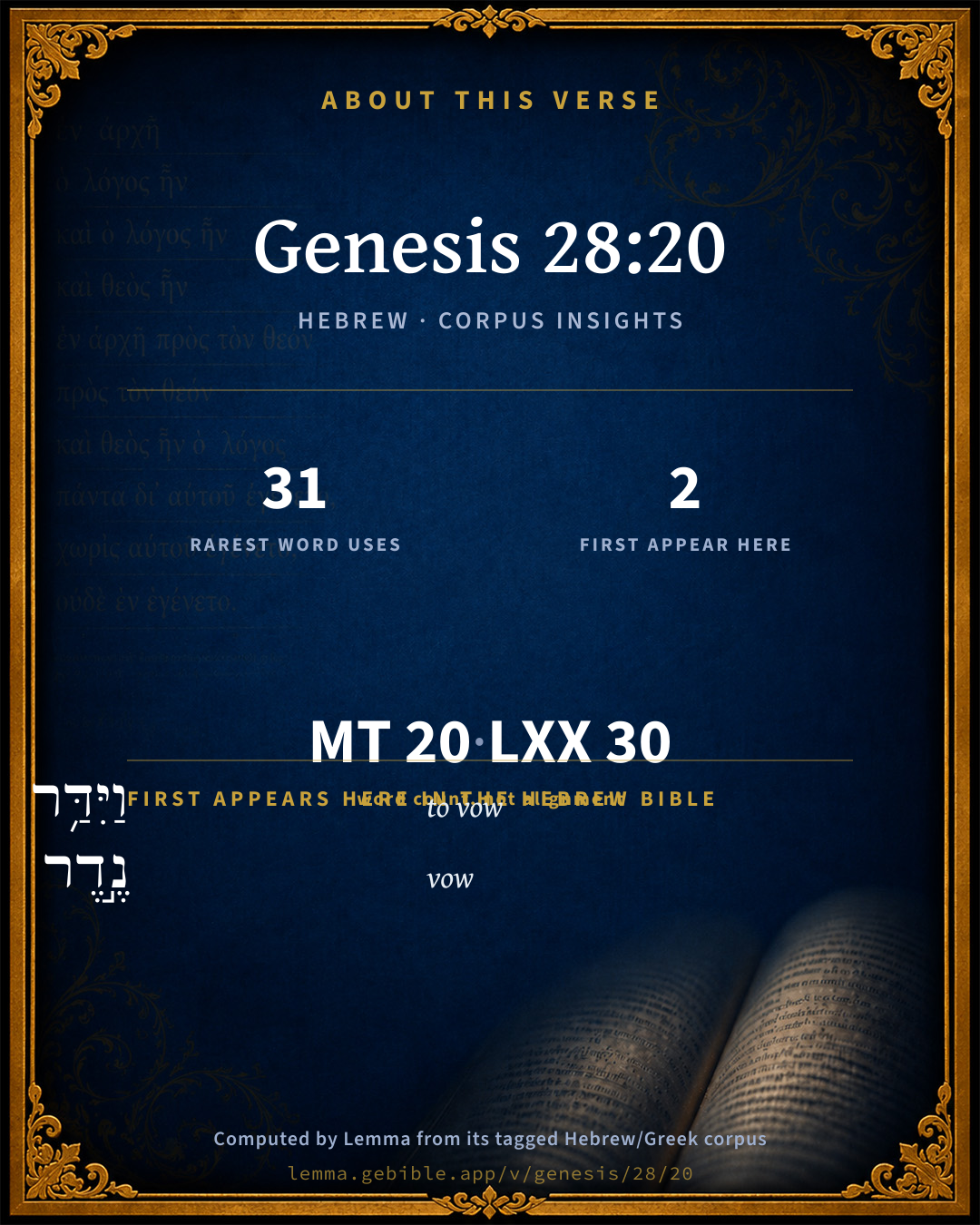
  • 2 first appearances in the Hebrew Bible
Full analysis ↓
Download a study sheet

One document with this verse’s original text, its word-by-word gloss line, the meaning frame, cross-references with their text, attributed commentary, and full source and license credits — printable, and it pastes into notes with its structure intact.

This verse Autodidact and up

Study sheet (.html) Plain text (.txt)

A passage Seminary Student

Up to 50 verses in one chapter. A passage sheet keeps up to 6 commentary sources and 12 cross-references per verse, in the order this page ranks them, and says so on the sheet whenever that leaves anything out. Ask for a single verse and you get the Autodidact verse sheet above.

Everything on this page stays free to read, with no account — the sheet is a download of what is already on screen, not access to it.

Want to remove ads? Support Godless Engineer
Compare translations 3

The same verse in 3 English versions, stacked beneath the original-language interlinear above. Click any original word for its lexicon entry.

Each is an independent rendering of the whole verse — the interlinear is not word-aligned to these translations.

Highlighted words mark where these versions differ — a whole-verse word diff, not a word-by-word alignment.

  • World English Bible Public Domain
    Jacob vowed a vow, saying, "If God will be with me, and will keep me in this way that I go, and will give me bread to eat, and clothing to put on,
  • King James Version Public Domain
    And Jacob vowed a vow, saying, If God will be with me, and will keep me in this way that I go, and will give me bread to eat, and raiment to put on,
  • unfoldingWord Literal Text CC BY-SA 4.0
    Then Jacob vowed a vow, saying, “If God will be with me and watch over me on this road that I am walking on and give to me bread to eat and clothes to wear,

unfoldingWord Literal Text — © unfoldingWord, licensed CC BY-SA 4.0. Word-aligned USFM3 via Door43 (git.door43.org/unfoldingWord/en_ult).

Versions to compare (up to 4)

3 of 4 selected

Show all 18 translations

Every available English version of this verse, each an independent rendering of the whole verse.

  • World English Bible Public Domain
    Jacob vowed a vow, saying, "If God will be with me, and will keep me in this way that I go, and will give me bread to eat, and clothing to put on,
  • Berean Standard Bible Public Domain
    Then Jacob made a vow, saying, “If God will be with me and watch over me on this journey, and if He will provide me with food to eat and clothes to wear,
  • Majority Standard Bible Public Domain
    Then Jacob made a vow, saying, “If God will be with me and watch over me on this journey, and if He will provide me with food to eat and clothes to wear,
  • King James Version Public Domain
    And Jacob vowed a vow, saying, If God will be with me, and will keep me in this way that I go, and will give me bread to eat, and raiment to put on,
  • American Standard Version (1901) Public Domain
    And Jacob vowed a vow, saying, If God will be with me, and will keep me in this way that I go, and will give me bread to eat, and raiment to put on,
  • Revised Version (1885) Public Domain
    And Jacob vowed a vow, saying, If God will be with me, and will keep me in this way that I go, and will give me bread to eat, and raiment to put on,
  • Geneva Bible (1599) Public Domain
    Then Iaakob vowed a vowe, saying, If God will be with me, and will keepe me in this iourney which I go, and wil giue me bread to eate, and clothes to put on:
  • Douay-Rheims (1899) Public Domain
    And he made a vow, saying: If God shall be with me, and shall keep me in the way by which I walk, and shall give me bread to eat, and raiment to put on,
  • Young's Literal Translation Public Domain
    And Jacob voweth a vow, saying, `Seeing God is with me, and hath kept me in this way which I am going, and hath given to me bread to eat, and a garment to put on --
  • Literal Standard Version CC BY-SA 4.0
    And Jacob vows a vow, saying, “Seeing God is with me, and has kept me in this way which I am going, and has given to me bread to eat, and a garment to put on—
  • Unlocked Literal Bible CC BY-SA 4.0
    Jacob vowed a vow, saying, “If God will be with me and will protect me on this road on which I am walking, and will give me bread to eat, and clothes to wear,
  • unfoldingWord Literal Text CC BY-SA 4.0
    Then Jacob vowed a vow, saying, “If God will be with me and watch over me on this road that I am walking on and give to me bread to eat and clothes to wear,
  • Darby Bible Public Domain
    And Jacob vowed a vow, saying, If God will be with me, and keep me on this road that I go, and will give me bread to eat, and a garment to put on,
  • World Messianic Bible Public Domain
    Jacob vowed a vow, saying, “If God will be with me, and will keep me in this way that I go, and will give me bread to eat, and clothing to put on,
  • Webster's Bible Public Domain
    And Jacob vowed a vow, saying, If God will be with me, and will keep me in this way that I go, and will give me bread to eat, and raiment to put on,
  • Free Bible Version CC BY-SA 4.0
    Jacob also made a solemn promise, saying, “God, if you will be with me, and take care of me on my journey, and give me food to eat and clothes to wear
  • Bible in Basic English Public Domain
    Then Jacob took an oath, and said, If God will be with me, and keep me safe on my journey, and give me food and clothing to put on,
  • JPS Tanakh (1917) Public Domain
    And Jacob vowed a vow, saying: 'If God will be with me, and will keep me in this way that I go, and will give me bread to eat, and raiment to put on,

Literal Standard Version (2020), Covenant Press — licensed CC BY-SA 4.0. Text via the HelloAO Bible API (eBible.org). Unlocked Literal Bible (unfoldingWord) — licensed CC BY-SA 4.0. Text via the HelloAO Bible API (eBible.org). unfoldingWord Literal Text — © unfoldingWord, licensed CC BY-SA 4.0. Word-aligned USFM3 via Door43 (git.door43.org/unfoldingWord/en_ult). Free Bible Version, Dr. Jonathan Gallagher — licensed CC BY-SA 4.0. Text via the HelloAO Bible API (eBible.org).

Word by word

More ways to search: Search by grammar → Find every occurrence → Compare this word →

Practice this passage: Drill this verse → Learn its vocabulary →

וַיִּדַּ֥ר
nâdar
H5087
“and · to vow”
Conjunction + Verb, Qal, Sequential Imperfect, 3rd Person, Masculine, Singular
Part of Speech
Conjunction + Verb
Stem
Qal
Form
Sequential Imperfect
Person
3rd Person
Gender
Masculine
Number
Singular
Full BDB Definition

Origin: a primitive root

TWOT: 1308

to vow, make a vow - (Qal) to vow a vow
  1. יַעֲקֹ֖ב Yaʻăqôb H3290 “Jacob” Noun, Proper
  2. נֶ֣דֶר neder H5088 “vow” Noun, Common, Masculine, Singular, Absolute
  3. לֵאמֹ֑ר ʼâmar H559 “to say” Preposition + Verb, Qal, Infinitive Construct
  4. אִם ʼim H518 “if” Conjunction
  5. יִהְיֶ֨ה hâyâh H1961 “to be” Verb, Qal, Imperfect, 3rd Person, Masculine, Singular
  6. אֱלֹהִ֜ים ʼĕlôhîym H430 “God(s)” Noun, Common, Masculine, Plural, Absolute
  7. עִמָּדִ֗י ʻimmâd H5978 “with · me” Preposition + Suffix, Personal, 1st Person, Common, Singular
  8. וּשְׁמָרַ֨נִי֙ shâmar H8104 “and · to keep · me” Conjunction + Verb, Qal, Sequential Perfect, 3rd Person, Masculine, Singular + Suffix, Personal, 1st Person, Common, Singular
  9. בַּדֶּ֤רֶךְ derek H1870 “in/at the · way” Preposition, Determined + Noun, Common, Both, Singular, Absolute
  10. הַזֶּה֙ zeh H2088 “the · this” Particle, Definite Article + Pronoun, Demonstrative, Masculine, Singular
  11. אֲשֶׁ֣ר ʼăsher H834 “which” Particle, Relative
  12. אָנֹכִ֣י ʼânôkîy H595 “I” Pronoun, Personal, 1st Person, Common, Singular
  13. הוֹלֵ֔ךְ hâlak H1980 “walking” Verb, Qal, Participle Active, Masculine, Singular, Absolute
  14. וְנָֽתַן nâthan H5414 “and · to give” Conjunction + Verb, Qal, Sequential Perfect, 3rd Person, Masculine, Singular
  15. לֶ֛חֶם lechem H3899 “bread” Noun, Common, Both, Singular, Absolute
  16. לֶאֱכֹ֖ל ʼâkal H398 “to eat” Preposition + Verb, Qal, Infinitive Construct
  17. וּבֶ֥גֶד beged H899 “and · garment” Conjunction + Noun, Common, Masculine, Singular, Absolute
  18. לִלְבֹּֽשׁ lâbash H3847 “to clothe” Preposition + Verb, Qal, Infinitive Construct

About this verse

These counts appear in no published source. They are computed here, from the morphology-tagged text and Lemma’s own curated glosses. What Lemma adds →

20
words
19
distinct lemmas
Pentateuch
section

First appearance in Scripture

These words make their first canonical appearance in the Hebrew Bible here:

  • וַיִּדַּ֥ר to vow H5087
  • נֶ֣דֶר vow H5088

Shared distinctive vocabulary

וַיִּדַּ֥ר to vow H5087 occurs in 28 verses of the Hebrew Bible. Also found in:

Grammatical profile

  • 8 verbs
  • 6 nouns
  • 2 pronouns
  • 2 prepositions
  • 1 conjunction
  • 1 particle

Verb forms

  • וַיִּדַּ֥ר Qal · Sequential Imperfect
  • לֵאמֹ֑ר Qal · Infinitive Construct
  • יִהְיֶ֨ה Qal · Imperfect
  • וּשְׁמָרַ֨נִי֙ Qal · Sequential Perfect
  • הוֹלֵ֔ךְ Qal · Participle Active
  • וְנָֽתַן Qal · Sequential Perfect
  • לֶאֱכֹ֖ל Qal · Infinitive Construct
  • לִלְבֹּֽשׁ Qal · Infinitive Construct

Hebrew & Septuagint length

In English translation the verse runs 33 words from the Hebrew and 37 from the Septuagint (LXX English) — closely comparable.

A rough comparison of the two English renderings, which tokenize alike — not a word-level alignment.

Word counts can differ between the Hebrew and the Greek without any difference in meaning — e.g. the Hebrew direct-object marker אֵת has no separate Greek word, and Greek often adds the article ὁ.

In the original languages it is 20 Hebrew tokens and 30 Greek tokens — but the two are counted differently (Hebrew bundles its prefixes and suffixes into one token; the Greek is in lemma form), so that isn’t a like-for-like length.

Cross-references

27

Topical passages linked to Genesis 28:20 in the Treasury of Scripture Knowledge — connected by theme and wording, ordered by reader-vote popularity; previews shown in the World English Bible.

  • 1 Timothy 6:8 But having food and clothing, we will be content with that.
  • 2 Samuel 15:8 For your servant vowed a vow while I abode at Geshur in Syria, saying, If Yahweh shall indeed bring me again to Jerusalem, then I will serve Yahweh.
  • Genesis 31:13 I am the God of Bethel, where you anointed a pillar, where you vowed a vow to me. Now arise, get out from this land, and return to the land of your birth."
  • Psalms 66:13 I will come into your temple with burnt offerings. I will pay my vows to you,
  • John 1:16 From his fullness we all received grace upon grace.
  • Judges 11:30–31 Jephthah vowed a vow to Yahweh, and said, If you will indeed deliver the children of Ammon into my hand,
  • Psalms 56:12 Your vows are on me, God. I will give thank offerings to you.
  • Psalms 61:8 So I will sing praise to your name forever, That I may fulfill my vows daily.
  • Psalms 76:11 Make vows to Yahweh your God, and fulfill them! Let all of his neighbors bring presents to him who is to be feared.
  • Psalms 116:14 I will pay my vows to Yahweh, Yes, in the presence of all his people.
  • Psalms 116:18 I will pay my vows to Yahweh, Yes, in the presence of all his people,
  • Psalms 119:106 I have sworn, and have confirmed it, That I will obey your righteous ordinances.
  • Psalms 132:2 How he swore to Yahweh, And vowed to the Mighty One of Jacob:
  • Acts 23:12–15 When it was day, some of the Jews banded together, and bound themselves under a curse, saying that they would neither eat nor drink until they had killed Paul.
  • Genesis 28:15 Behold, I am with you, and will keep you, wherever you go, and will bring you again into this land. For I will not leave you, until I have done that which I have spoken of to you."
  • Numbers 6:1–20 Yahweh spoke to Moses, saying,
  • Numbers 21:2–3 Israel vowed a vow to Yahweh, and said, If you will indeed deliver this people into my hand, then I will utterly destroy their cities.
  • 1 Samuel 1:11 She vowed a vow, and said, Yahweh of hosts, if you will indeed look on the affliction of your handmaid, and remember me, and not forget your handmaid, but will give to your handmaid a man-child, then I will give him to Yahweh all the days of his life, and there shall no razor come on his head.
  • 1 Samuel 1:28 therefore also I have granted him to Yahweh; as long as he lives he is granted to Yahweh. He worshiped Yahweh there.
  • 1 Samuel 14:24 The men of Israel were distressed that day; for Saul had adjured the people, saying, Cursed be the man who eats any food until it be evening, and I be avenged on my enemies. So none of the people tasted food.
  • Nehemiah 9:1–10 Now in the twenty-fourth day of this month the children of Israel were assembled with fasting, and with sackcloth, and earth on them.
  • Psalms 22:25 Of you comes my praise in the great assembly. I will pay my vows before those who fear him.
  • Psalms 61:5 For you, God, have heard my vows. You have given me the heritage of those who fear your name.
  • Ecclesiastes 5:1–7 Guard your steps when you go to God's house; for to draw near to listen is better than to give the sacrifice of fools, for they don't know that they do evil.
  • Isaiah 19:21 Yahweh shall be known to Egypt, and the Egyptians shall know Yahweh in that day; yes, they shall worship with sacrifice and offering, and shall vow a vow to Yahweh, and shall perform it.
  • Acts 18:18 Paul, having stayed after this many more days, took his leave of the brothers, and sailed from there for Syria, together with Priscilla and Aquila. He shaved his head in Cenchreae, for he had a vow.
  • Leviticus 27:1–34 Yahweh spoke to Moses, saying,

Cross-references courtesy of OpenBible.info (CC BY 4.0).

Hebrew and Greek witnesses Masoretic Hebrew ↔ Greek Septuagint

The same verse in the two great witnesses to the Old Testament, shown verse-for-verse.

These are two independent witnesses, not word-aligned to each other, and the Septuagint is shown in lemma (dictionary) form.

Hebrew Genesis 28:20 Masoretic · Westminster Leningrad Codex

וַיִּדַּ֥ר יַעֲקֹ֖ב נֶ֣דֶר לֵאמֹ֑ר אִם יִהְיֶ֨ה אֱלֹהִ֜ים עִמָּדִ֗י וּשְׁמָרַ֨נִי֙ בַּדֶּ֤רֶךְ הַזֶּה֙ אֲשֶׁ֣ר אָנֹכִ֣י הוֹלֵ֔ךְ וְנָֽתַן לִ֥י לֶ֛חֶם לֶאֱכֹ֖ל וּבֶ֥גֶד לִלְבֹּֽשׁ

Jacob vowed a vow, saying, "If God will be with me, and will keep me in this way that I go, and will give me bread to eat, and clothing to put on,

World English Bible · Public Domain

Greek LXX Genesis 28:20 Septuagint · lemma form

καί εὔχομαι ἰακώβ εὐχή λέγω ἐάν εἰμί κύριος ὁ θεός μετά ἐγώ καί διαφυλάσσω ἐγώ ἐν ὁ ὁδός οὗτος ὅς ἐγώ πορεύομαι καί δίδωμι ἐγώ ἄρτος ἐσθίω καί ἱμάτιον περιβάλλω

And Jacob vowed a vow, saying, If the Lord God will be with me, and guard me throughout on this journey, on which I am going, and give me bread to eat, and raiment to put on,

LXX2012 (modern English Septuagint) · Public Domain

On this verse, The Pulpit Commentary discusses the Septuagint’s reading. Read the note in Commentary ↓

Hebrew: Westminster Leningrad Codex (CC BY 4.0). Greek: Septuagint (public domain); English from LXX2012 (modern English Septuagint) (Public Domain). How the Septuagint differs from the Hebrew →

Targum (Aramaic paraphrase)

2

The Targum is the ancient Jewish Aramaic paraphrase of the Hebrew Scriptures — an interpretive translation, not the Hebrew text itself. Onkelos (literal) and Pseudo-Jonathan (expansive) render the Torah, and Jonathan the Prophets. Coverage is partial: where no permissively-licensed English translation exists for a verse, only the Aramaic is shown. This is verse-level text, not a word-by-word alignment to the Hebrew.

  1. Targum Onkelos Torah (Genesis–Deuteronomy)
    וְקַיִּים יַעֲקֹב קְיָם לְמֵימָר אִם יְהֵא מֵימְרָא דַּיְיָ בְּסַעְדִי וְיִטְרִינַנִּי בְּאָרְחָא הָדֵין דִּי אֲנָא אָזֵל וְיִתֶּן לִי לַחֲמָא (נ''י לְחֵם) לְמֵיכַל וּכְסוּ לְמִלְבָּשׁ

    (no public-domain English translation for this verse)

    Targum Onkelos — Aramaic: “Onkelos Genesis” (public domain); “Onkelos Exodus” (public domain); “Onkelos Leviticus” (public domain); “Onkelos Numbers” (public domain); “Onkelos Deuteronomy” (public domain). English: “Sefaria Community Translation” (CC0 1.0 (public-domain dedication)); “J.W. Etheridge. The Targums of Onkelos and Jonathan Ben Uzziel on the Pentateuch. London: Longmans, Green, 1862” (public domain). Text via Sefaria.

  2. Targum Pseudo-Jonathan Torah (Genesis–Deuteronomy)
    וְקַיֵים יַעֲקב קְיָים לְמֵימָר אִין יְהִי מֵימְרָא דַיְיָ בְּסַעֲדִי וְיִטְרִנַנִי מִשְׁפִיכוֹת אֲדָם זַכְּאַי פּוּלְחָנָא נוּכְרָאָה וְגִילוּי עִרְיָתָא בְּאוֹרְחָא הָדֵין דַאֲנָא אָזִיל וְיִתֵּן לִי לְחֵם לְמֵיכוֹל וּכְסוּ לְמִילְבּוּשׁ

    And Jakob vowed a vow, saying, If the Word of the Lord will be my Helper, and will keep me from shedding innocent blood, and from strange worship, and from impure converse, in this way that I am going; and will give me bread to eat, and raiment to wear,

    Targum Pseudo-Jonathan — Aramaic: “Targum Jonathan on Genesis” (public domain); “Targum Jonathan on Exodus” (public domain); “Targum Jonathan on Leviticus” (public domain); “Targum Jonathan on Numbers” (public domain); “Targum Jonathan on Deuteronomy” (public domain). English: “The Targum of Jonathan ben Uzziel, trans. J. W. Etheridge, London, 1862” (public domain). Text via Sefaria.

Commentary

Notes on Genesis 28:20 from classic Christian and Jewish commentators (each source and its license shown beneath its notes). The classic Christian expositions comment on the surrounding passage and are grouped to its opening verse, so a note may address several verses; the Jewish commentaries on the Tanakh (Rashi and others) are per-verse, so they appear only where the commentator wrote on this verse.

Lemma curates 59 commentaries, every one of them public domain or Creative Commons licensed, each selected and text-cleaned for this edition rather than reprinted as found. About our sources →

Jamieson, Fausset & Brown

Robert Jamieson, A. R. Fausset & David Brown

JACOB'S VOW. (Gen 28:20-22)

Jacob vowed a vow--His words are not to be considered as implying a doubt, far less as stating the condition or terms on which he would dedicate himself to God. Let "if" be changed into "since," and the language will appear a proper expression of Jacob's faith--an evidence of his having truly embraced the promise. How edifying often to meditate on Jacob at Beth-el.

Next: Genesis Chapter 29

Jamieson, Fausset & Brown — Commentary Critical and Explanatory on the Whole Bible (1871) — public domain (CC PDM 1.0). Text via the HelloAO Bible API.

Ellicott's Commentary for English Readers

(20-22) Then shall the Lord (Jehovah) be my God.—This is a false translation, and gives a wrong sense. Jacob, in his vow, which implies no doubt on his part, but is his acceptance of the terms of the covenant, says: “If Elohim will be with me, and will protect me on this journey that I go, and will give me bread to eat and clothing to wear, and if I come again in peace to my father’s house, and Jehovah will be my Elohim, then this stone which I have set up as a pillar shall be Beth-Elohiin; and of all that thou shalt give me I will surely pay thee tithes.” Gen_28:20-21 are a recapitulation of the mercies of which he was to be the recipient, while in Gen_28:22 Jacob states what shall be his vow of gratitude.

But what was a Beth-Elohim? It has been supposed that it was a sort of cromlech, set up to be itself an object of adoration. Attention has also been called to the Baitylia, or stones “possessed of a soul,” which the Phœnicians are said by Eusebius (Praep. Evang. i. 10) to have worshipped; and it has been thought, with some probability, that the word is a corrupt form of the Hebrew Beth-Elohim. These Baitylia. however, were meteoric stones, and their sanctity arose from their having fallen from heaven. Stones, moreover, set up at first simply as memorials may in time have been worshipped, and hence the prohibition in Lev_26:1, Deu_16:22; but there is no trace of any such idolatrous tendency here. Jacob apparently meant by a Beth-Elohim a place where prayer and offerings would be acceptable, because God ad manifested Himself there; and His vow signified that if, preserved by Jehovah’s care, he was permitted to visit the place again, he would consecrate it to Jehovah’s service, and spend there in sacrifice, or in some other way to His honour, the tithe of whatever property he might have acquired.

A Bible Commentary for English Readers, edited by Charles John Ellicott (1878–1897) — public domain. Text from a community e-Sword module.

Trapp's Complete Commentary

John Trapp

Gen 28:20 And Jacob vowed a vow, saying, If God will be with me, and will keep me in this way that I go, and will give me bread to eat, and raiment to put on,

Ver. 20. And Jacob vowed a vow.] The first holy vow that ever we read of: whence Jacob also is called the father of vows; which, out of this text, may be thus described. A vow is nothing else but a religious promise made to God in prayer, and grounded upon the promise of God; whereby we tie ourselves, by way of thankfulness, to do something that is lawful, and within our power; with condition of obtaining some further favour at the hands of God. Thus Jacob vows to God only: he is the sole object of fear, therefore also of vows. See them set together, Psa 76:11. Next, he prays when he vows. Eυχη ετ προσευχη: a vow and a prayer are of near and necessary affinity. See Psa 61:8 Jdg 11:30-31. That was a blasphemous vow of Pope Julius, that said, he would have his will, al despito di Dio .{ a} And not unlike of Solyman the great Turk, in a speech to his soldiers: So help me great Mohammed, I vow, in despite of Christ and John, in short time to set up mine ensigns with the Moon, in the middle of the market place in Rhodes. {b} Jacob, as he vowed only by the fear of his father Isaac, so he presented his vow in a holy prayer, not in a hellish execration. I add, that it is a promise grounded upon God’s promise; so was Jacob’s here, in all points, as is to be seen if compared with Gen 28:15. Next, I say, that by this vow we bind ourselves, &c. Not as casting any new snare upon ourselves thereby; but rather a new provocation to the payment of an old debt. For what can Jacob vow to God that he owes him not beforehand, without any such obligation? This he doth, too, by way of thankfulness; as doth likewise David in Psa 116:8-9, and otherwhere. And that which he voweth is lawful and possible: not as theirs was, that vowed Paul’s death, {Act 23:14} or as Julian the apostate’s, who, going against the Persians, made this vow; that if he sped well, he would offer the blood of Christians. Or as that Constable of France, who covenanted with God, that if he had the victory at St Quintin’s, he would attack Geneva. {c} These men thought they had made a great good bargain with God; but did not his hot wrath kindle against them? So Gerald Earl of Desmond’s Irishmen were justly consumed with famine and sword, which had barbarously vowed to forswear God, before they would forsake him. {d} Lastly, all this that Jacob doth, is on condition of some further favour: "If God will be with me, and will preserve me, and provide for me," &c. All which he doubts not of, as having a promise; but yet helps forward his faith by this holy vow; then shall God have the utmost, both in inward and outward worship: for God shall be his God; and he will build him a house, and pay him tithes, &c.

And will give me bread to eat.] "Having food and raiment," saith the apostle, "let us therewith be content." Nature is content with little; {e} grace with less. Insaniae damnandi sunt, qui tam multa, tam anxie congerunt, quum sit tam paucis opus , saith Ludovicus Vives. Oλιγοδεης ο σπουδαιος, saith Clem. Alex. Cibus et potus sunt divitiae Christianorum , saith Jerome. Bread and water, with the gospel, are good cheer, saith Greenham. Cui cum paupertate bene convenit, pauper non est .{ f} The disciples are bid pray for bread, not biscuit: they dined, on a Sabbath day, with grain rubbed in their hands, with broiled fish, &c. Luther made many a meal of a herring; {g} Junius, of an egg. One told a philosopher, If you will be content to please Dionysius, you need not feed upon green herbs. He replied, And if you be content to feed upon green herbs, you need not please Dionysius.

{a} Act. and Mon.

{b} Turk. Hist.

{c} Act. and Mon., 1914.

{d} Camd. Elisab., fol. 258. A.D. 1583.

{e} Vir bonis paucis indiget .

{f} Seneca.

{g} Melch. Adam.

John Trapp, A Commentary or Exposition upon All the Books of the Old and New Testament (1647–1656) — public domain. Text from a community e-Sword module.

The Biblical Illustrator

Joseph S. Exell

Gen_28:20-22

And Jacob vowed a vow

Covenant vows

I.

Let us, in the beginning, consider what is taught us in Gods Word about vows in general, and that will lead the way easily to the examination of those peculiar in the Christian dispensation.

1. The Old Testament is the main source of all profitable information. Indeed it hardly appears necessary to go beyond it. Classic history, however, makes clear the fact that all religions and schemes of faith have encouraged their devotees in the practice of making vows to their deities. Temples of every sort, the world over, are filled with votive offerings, presented by grateful recipients of Divine favour, when they have been delivered from danger, or prospered in difficult enterprises. Even the rituals of heathenism, the wildest and the wisest seem to agree in this. The custom, therefore, has very ancient authority. It was not an original invention of Jacob. Nor was it introduced by Moses, nor was it ever announced from heaven. Its history is as old as the annals of the race. The great law-giver Moses, acting under Divine direction, found this custom when he came to the leadership of Israel, He simply set himself to regulate the practice, and put it under some code of intelligent management.

2. The New Testament doctrine. No precept given; no regulation prescribed. The spirit of the New Testament is one of freedom. Freedom, however, is not lawlessness; liberty is not license. It is possible that there may be found in our churches some persons, or even in our own moods, some moments to which vows could be of service.

II. From these general considerations, it gives us pleasure and relief to turn to the special examination of what we term Christian vows.

1. We mean by this expression to cover a class of covenant engagements which stand in close relationship to the New Testament church. They are represented in the two ordinances of Baptism and the Lords Supper.

2. The reach of these vows is universal. They cover our possessions--our ways--our hearts--our lives.

3. A reach so extensive as this flings over the whole transaction a spirit of profound solemnity. The parties to the covenant are not man and man, but man and God. The witnesses who stand around are the world, the church, angels--and devils. The sanctions of the covenant are expressibly sacred and awful. All the good and evil of this life, all the blessings and the curses of the life to come hang upon the question of our fidelity in keeping the faith we have pledged.

4. Now no mere human being could abide the pressure of engagements of such reach and solemnity, except for the alleviation annexed to them. There is a promise underneath each one of them all. God not only keeps His own covenant, but helps us keep ours.

5. The use which can be made practically of these covenant engagements of ours is threefold. They give us a profitable caution; they furnish ground for fresh hope; they remind us of former experiences of trust and deliverance. The stated, steady repetition of them at periodic times, is of prodigious service. They suddenly arrest us in the midst of daily life, and demand a return of thoughtful surrender. The moment temptation confronts us, a voice seems to speak in the air--Remember thine oath! And if we are intelligent, we are quite glad to remember it; for God covenanted when we did. There is a dowry in every duty, and a promise in every call. Our vows come to be burdens less, and badges more; they are not fetters on our limbs, but rings on our fingers. (C. S. Robinson, D. D.)

A long look ahead

I. WHAT JACOB SOUGHT.

1. Gods presence.

2. Divine protection.

3. Divine providence.

4. Divine peace.

II. WHAT JACOB PROMISED.

1. To surrender himself, his entire being, to God.

2. To establish a perennial reminder of Divine goodness and mercy on the spot where he had first found it.

3. To consecrate to God a fixed portion of his income for all benevolent and religious use. (C. S. Robinson, D. D.)

The noble resolve

There were three steps in Gods dealings with this mean and crafty spirit; and in one form or another they have a universal application.

1. To begin with, God revealed Jacob to himself.

2. In the next place, God permitted Jacob to suffer the loss of all earthly friends and goods.

3. Finally, God thrust into Jacobs life a revelation of His love. That ladder symbolized the love of God. All through his life that love had surrounded Jacob with its balmy atmosphere; but he had never realized, or returned, or yielded to it. But now it was gathered up and crystallized into one definite appeal, and thrust upon him; so that he could do no other than behold it. And in that hour of conviction and need, it was as welcome as a ladder put down into a dark and noisome pit, where a man is sinking fast into despair; he quickly hails its seasonable aid, and begins to climb back to daylight. The revelation of Gods love will have five results on the receptive spirit.

I. IT WILL MAKE US QUICK TO DISCOVER GOD. Jacob had been inclined to localize God in his fathers tents: as many localize Him now in chapel, church, or minister; supposing that prayer and worship are more acceptable there than anywhere beside. Now he learned that God was equally in every place--on the moorland waste as well as by Isaacs altar, though his eyes had been too blind to perceive Him. In point of fact, the difference lay not in God, but in himself; the human spirit carries with it everywhere its own atmosphere, through which it may see, or not see, the presence of the Omnipresent. If your spirit is reverent, it will discern God on a moorland waste. If your spirit is thoughtless and careless, it will fail to find Him even in the face of Jesus Christ.

II. IT WILL INSPIRE US WITH GODLY FEAR. He was afraid, and said, How dreadful is this place! Perfect love casteth out fear--the fear that hath torment; but it begets in us another fear, which is the beginning of wisdom and the foundation of all noble lives; the fear that reveres God, and shudders to grieve Him; and dreads to lose the tiniest chance of doing His holy will. True love is always fearless and fearful. It is fearless with the freedom of undoubting trust; but it is fearful lest it should miss a single grain of-tender affection, or should bring a moments shadow over the face of the beloved.

III. IT WILL CONSTRAIN US TO GIVE OURSELVES TO GOD.

IV. IT WILL PROMPT US TO DEVOTE OUR PROPERTY TO HIM. Of all that Thou shalt give me, I will surely give the tenth unto Thee. There is no reason to doubt that this became the principle of Jacobs life: and if so, he shames the majority of Christian people--most of whom do not give on principle; and give a very uncertain and meagre percentage of their income.

V. IT WILL FILL US WITH JOY. Then Jacob lifted up his feet (Gen_29:1, marg.). Does not that denote the light-hearted alacrity with which he sped upon his way? His feet were winged with joy, and seemed scarcely to tread the earth. All sorrow had gone from his heart; for he had handed his burdens over to those ascending angels. And this will be our happy lot, if only we will believe the love that God hath to us. We, too, shall lose our burdens at the foot of the Cross; and we shall learn the blessed secret of handing over, as soon as they arise, all worries and fears to our pitiful High Priest. (F. B. Meyer, B. A.)

Jacobs vow

I. WHAT JACOB DESIRED OF GOD IN REFERENCE TO THIS WORLD.

1. The comfortable presence and favour of God. If God will be with me. When the ancients would express all that seemed beneficial in life, they used this phrase (Gen_39:2-3; Gen_39:21). The wisdom, courage, and success of David is resolved into this; The Lord was with him (1Sa_18:14; 1Sa_18:28; 2Sa_5:10). This administers solid, satisfying comfort to the soul (Psa_4:6-7; Psa_36:7-9; Psa_63:1; Joh_4:14).

2. The guidance of the Divine counsel and the protection of the Divine providence. And will keep me in this way that I go. This is a most sure direction and safe defence. The righteous shall not err in anything of importance, either as to this life or the next; either as to truth or duty. They shall be safe (Pro_18:10; Psa_27:1-6; Psa_32:7).

II. WHAT JACOB PROMISES TO GOD. Then shall the Lord be my God. (J. Benson.)

The vow

I. Notice THE IMPRESSION MADE UPON JACOBS MIND. This vision, which had been vouchsafed to him, was not a mere idle dream, passing confusedly away with the shades of night, and leaving no useful lesson impressed upon the heart. It was a mysterious scene, permitted to pass before the mind of Jacob in his sleep; but it left a real, powerful, and lasting impression behind. The impression produced was rational, powerful, convincing, and influential; it was such an impression as was most desirable under his circumstances, and such as issued in the most becoming and consistent conduct.

1. He was impressed with a sense of the presence and nearness of the invisible God. Jacob awaked out of his sleep, and he said, Surely the Lord is in this place, and I knew it not. He had a clear conviction that God had been with him in a very peculiar manner. He inhabiteth eternity. He filleth all in all. He is about our bed, and about our path, and spies out all our ways. If we go up to heaven He is there, if we go down to hell He is there also. In Him we live, and move, and have our being--and He is not far off from any one of us. But the scripture shows us also, that God is particularly present with, and near to His saints. A large portion of the revealed word of God is occupied in showing that the Lord is nigh unto them that call upon Him; that if we will draw nigh to God, He will draw nigh to us. The eternal God is thy refuge, and underneath thee are the everlasting arms. The 121st Psalm seems almost to refer to this very event, when it says, Behold, He that keepeth Israel shall neither slumber nor sleep. There is then, for the first time, a consciousness of Gods existence--of his presence and nearness to the soul--a reality of communion with Him--a living sensibly within the range of His holy influence and dominion--and a bringing this fact to bear continually upon the conduct and the heart. The impression produced on his mind through a vision, was the same as that which is now given through the shining of the light of the glorious Gospel of Christ into the heart. It was the knowledge of God.

2. He felt that the presence of God was awful. He said, Surely the Lord is in this place; and he was afraid, and said, How dreadful is this place! No man can trifle with religious services who is admitted to the reality of religious privileges. The more his religions impressions, convictions, intentions, and enjoyments, assume the character of reality, the more serious will he be in his spirit, and in all his religious feelings and transactions. A becoming seriousness of deportment is always the result of frequent communion with God--of much living in the Divine presence. It will not be irrelevant to notice here that a truly sincere and serious spirit in religion will show itself in an enlightened, but not superstitious, attention to all the decencies and proprieties of the public service of God.

3. Jacob was impressed with the conviction that the place where God communicates with men is the gate of heaven. That communion with God by faith is an opening to the mind of the eternal and invisible world, a realizing of that interior and more elevated scene of Gods dominions, where He reigns unveiled. Faith is the gate of heaven.

4. This vision evidently impressed Jacob with a higher notion of the benevolence and kindness of God. It was altogether a revelation of a peculiarly merciful character.

II. We come to notice THE CONDUCT WHICH JACOB IMMEDIATELY ADOPTED. His provision for the external act of worship was but scanty; but whatever, under his straitened circumstances, he could perform, he did.

There was here no idle and specious delay. It would have been easy to have deferred this solemn scene of worship to a more seasonable opportunity, when he would be better provided. But this is not the effect of the gifts of Divine grace. The mercy of God, thus graciously revealed to him, had touched his heart; and it made the religious service, and the religious vow, his delight. He rose early, and while his feelings were yet fresh, and unblemished by the mere natural course of vagrant thought, he addressed himself to this act of piety, that he might perpetuate in his waking hours the enjoyments of his extraordinary dream. What could be more simple and spiritual than this act of worship? All the formalities of official sacrifice are, in the want of means for them, dispensed with. No bleeding sacrifice was there; but in the simple symbol that he was compelled to use, the true spirit of the appointed ceremony was retained. The type of the true Israel, he appears to have out-reached the bounds of knowledge in those earlier days, and to have approached God as a true worshipper, in spirit and in truth.

III. But we shall consider this more particularly as we notice THE VOW WHICH JACOB MADE. There are several circumstances in the language of Jacobs vow which are worthy of remark.

1. His piety, If God will be with me. He does not ask for the advantage of powerful friends, or connections in life. He sought first the kingdom of God and His righteousness,--counting the lovingkindness of God better than life; and the favour of God more valuable than worldly friends or honours. The love of God is the essential feature of true piety.

2. Observe his moderation. It is the legitimate effect of true religion, to moderato the desires of the heart for everything but spiritual blessings. The land whereupon thou liest, to thee will I give it, and to thy seed: but he simply limited his prayer to this, If God will give me bread to eat, and raiment to put on, so that I come again to my fathers house in peace. In the face of so extensive a promise, he asked only for food and clothing, and a return to his fathers house. It is true, that generally in the outset of life, mens views and wishes are more moderate than they afterwards become; and even ambition is limited in its wishes, by the bounds of apparent probability--so much so, that in looking back upon past life, the moderation of mans early wishes is often a matter of surprise to themselves. But the spirit of Jacob was shown in this, that with the promise of wealth and exaltation before him, he still confined his wish to the needful supply of his daily wants--to food and raiment, and safe return. How few are there who are content with Jacobs portion! I speak of some, of whom there is reason to hope that they have Jacobs God for their God, but with whom there still seems a lingering attachment to the world which they are professing to renounce, and an unjustifiable managing and contriving to obtain, either for themselves or their children, a surer hold upon its dignities and its possessions.

3. Observe, again, Jacobs gratitude. He prayed even for less than God had promised; but he felt that all that he could ever be possessed of was a merciful gift, and he was willing to acknowledge that it was due to him from whom it was received. This stone, which I have set up for a pillar, shall be Gods house; and of all that thou shalt give me, I will give the tenth unto thee. A zealous contribution of personal exertion, and pecuniary aid, to the cause of God and of truth, had always marked the real servant of the Lord. The worldly man may be benevolent to men, but he is never liberal for God. Again, fix your attention on the event of Jacobs life, and consider how important was the influence which it had upon him. All his life was coloured by this solemn and interesting transaction. How important it is, then, to begin life with God--to set out rightly. Lastly, let the whole tenour of Jacobs conduct on this occasion show you, in illustration of the remark with which we set out, the legitimate effect of Divine mercy. It leads directly to holiness of life. (E. Craig.)

Lessons

1. Gods promises and appearance to His may well require their vows to Him.

2. Vows to God must follow His promises, not precede by conditioning with Him.

3. Gods presence, provision, protection, and safeguarding His own, is just ground of vowing souls to Him.

4. It is just to vow mans self in inward worship to God, as the Lord promiseth Himself to him.

5. It is righteous to vow outward worship to God in time and place, as He desireth.

6. It is mans duty to vow and pay the tenth of all his estate to God for the uses He hath appointed (Gen_28:22). (G. Hughes, B. D.)

Jacobs contract with God

This vow has been sneered at--a bargain of Jacobs it is said. And in truth it is not in the highest spirit. But at least there is no affection of superfine piety in the Bible. That is something. What it is, it is. But what is this? Perhaps not a shrewd bargain, but a solemn and creditable contract with God, namely, that Jacob will be faithful to God if God will be faithful to him. Not the highest, certainly--not Jobs Though He slay me, yet will I trust in Him. Jacob would have stood on a far nobler height had he said, I will worship this adorable God, who has shown me His glory as He stooped to my low estate. I will trust and obey Him though He desert me and strip me. Yes; but when shall we have done thinking that our refinements and perfections of view were theirs? An occasional spirit like Abrahams went higher than Jacobs. A spirit like Jobs shot far higher, yet, I think, and anticipated the whole possibility of man. These were splendid anomalies; but Jacob was the true representative of the good man of his time. Remembering this, the contrast was not as bad as it seems, but was natural and even beautiful. He does not ask God for riches, but simply, like a child (for these primitive men were but children), he asks only for protection and support: If the Lord, &c. This, although it has a childs religious inferiority, yet seems so artless and heartless that I think it was, even to the ear of God, a very pleasing speech. And I wish that we would go as far. Suppose now, we say--which of us is ready?--If the Lord will keep me alive for this year, and give me food and raiment, He shall be my God. Let no man sneer at Jacob until he is Jacobs equal. (A. G. Mercer, D. D.)

Of all that Thou shalt give me, I will surely give the tenth unto Thee.

Tithes at the start

The two important matters of notice, in this text, are the early purpose of this young patriarch to give a portion of his wealth to religious ends, and the establishment of a fixed system in presenting it. It seems to be in Scripture history the exact beginning of all that custom of tithing the people which meets us everywhere in the Old Testament. It has arrested my attention, because it is the act of a young man just starting in the new life. It furnishes me with this for a topic--Systematic beneficence: its principle and its measure.

I. THE PRINCIPLE may be stated in one compact sentence: A Christian is to contribute, not on impulse, but by plan. Jacob seems to have understood in the outset that this was to be the practical side of his life.

1. This duty should be taken up early by every young Christian as a matter of study.

2. It will not do to discharge this work all at once. A settled habit of giving is promoted only by a settled exercise of giving.

3. It will not do to leave this duty to a mere impulse of excitement. Christians ought never to wait for fervid appeals or ardent addresses to sympathy,

4. It will not do to perform this duty as a mere mechanical form. We are told, in one familiar verse of the New Testament, that he which soweth sparingly, shall reap also sparingly. This singular word sparingly occurs nowhere else in the Scriptures. It means grievingly, regretfully; holding back after the gift, if such an expression may be allowed.

5. This duty is to be discharged only with a diligent comparison of means with ends. System in giving is the secret of all success.

II. THE MEASURE OF CHRISTIAN BENEFICENCE.

1. Give tithes to start with.

2. Tithes, just to start with, will in many cases force a Christian on to increase as he grows in fortune. When life grows easier, and gains more plentiful, the good Lord, whose stewards we are, raises His rates of loan, and expects more liberal returns.

III. CONSIDERATIONS WHICH ENTER INTO THE RECKONING.

1. Think of what has been done in our behalf by God, our Maker and Redeemer. We should measure our gifts in money by our receipts in grace.

2. Remember whence the prosperity came, out of which we give money. God seeks where He has given.

3. Consider the extent of the work which is to be accomplished.

4. Think of the promises which reward the free-giver. The liberal soul shall be made fat.

5. Think of the exigencies arising under the favouring providences of God.

6. Think of the listlessness of others.

Conclusion: He who gives tithes at the start will grow himself as his fortune grows. He that delays will harden. And it should never be forgotten that money is only the measure of manhood when consecrated to Christ. It is ourselves we give to Him, ourselves He demands. (C. S.Robinson, D. D.)

The tenth is Gods

The late Bishop Selwyn used often to quote that motto of John Wesleys, Save all you can and give all you save, and he did not think that charity began until after a tithe had been paid to God. Whatever your income, he wrote once to his son, remember that only nine-tenths of it are at your disposal. (Old Testament Anecdotes.)

Giving a tenth

Heathen nations used to give a tenth for religious objects. Oberlin, a poor French minister, did this in giving his tenth of income, and then God so blessed him in his circumstances, that he used to say he abounded in wealth. One day Oberlin was reading in the Old Testament where God told the Jews that He expected them to give a tithe of all their property to Him, said he to himself, Well, I am sure that I, as a Christian, have three times as many blessings as the Jews had. If it was right for a Jew to give one tenth of his property to God, surely I ought to give at least three times as much as that. So he made up his mind to do this. The Jews called giving the hedge of riches. Perhaps there was never a man more generous than Mr. Wesley. For years, when his yearly income was between £30 and £120, he lived upon £28 a year, and gave away the remainder. It is supposed that during his life he gave away £30,000, and when he died he left little more than was necessary to bury him, and to pay his debts.

A tenth of all

"Take it quick, quick, said a merchant who had promised, like Jacob, to return to the Lord a tenth of all that he should give him, and found that it amounted to so large a sum, that he said, I cannot give so much, and set aside a smaller amount. Then his conscience smote him, and, coming to himself, he said, What I can I be so mean? Because God has thus blessed me that I have this large profit, shall I now rob Him of His portion? And fearing his own selfish nature, he made haste to place it beyond his reach in the treasury of the Lord, coming almost breathless to the pastors house, and holding the money in his outstretched hand.

Helping on the work of God

A widow found pardon and peace in her Saviour in her sixty-ninth year. Her gratitude and love overflowed and often refreshed the hearts of Christians of long experience. The house of God became very dear to her, and she was often seen to drop a gift in the church door box though her income was only 2s. 6d. per week. A fall in her seventy-second year prevented her ever coming out again. A little boy being seen to drop something into the box, was asked what it was. He said, It is Mrs. W--s penny.. He was told to take it back to her, and to say that her good intention was prized, but that her friends could not let her thus reduce her small means, especially as she could not come out to worship. She replied, Boy, why did you let them see you give it? Take it again and put it in when no one sees you. Then weeping, she said, What, and am I not to be allowed to help in the work of God any more because I cant get out?

Substance consecrated to God

John Crossley, the founder of the firm of the Crossleys of Halifax, married a Yorkshire farmers daughter, a woman of genuine piety and strong common sense. Crossley was frugal and thrifty. He got on well, laid by his earnings, and at length was able to rent a wool-mill and dwelling-house. When the couple were about entering their new quarters a holy purpose of consecration took possession of the young wife. On the day of entering the house she rose at four oclock in the morning and went into the door-yard. There in the early twilight, before entering the house, she kneeled on the ground and gave her life anew to God. She vowed most solemnly in these words, If the Lord does bless me at this place the poor shall have a share of it. That grand act of consecration was the germ of a life of marvellous nobility. (F. G.Clarke, D. D.)

.

The Biblical Illustrator, edited by Joseph S. Exell (c. 1880s–1900s) — public domain. Text from a community e-Sword module.

Joseph Benson's Commentary

Gen 28:20. Jacob vowed a vow — That is, bound himself by a solemn promise and obligation. This being the first instance of a religious vow which occurs in Scripture, it may be proper to observe, that such a vow is a binding of the soul by a solemn and voluntary promise, made to God, to do, or more carefully to do a thing, which otherwise by our duty and God’s law we are bound to do; or to do certain things, lawful in themselves, but otherwise left indifferent to be done or not; or to abstain from some things otherwise lawful to be used; and all this in a way of thankfulness to God for some extraordinary blessings received, (Jon 1:16,) or for the obtaining of some special benefits which we greatly desire, and stand in need of, Num 21:1-2; Jdg 11:30; 1Sa 1:2;

Pro 31:2. Jacob was now in fear and distress; and in times of trouble it is seasonable to make vows. Jacob had now a gracious visit from heaven, and when God ratifies his promises to us, it is proper for us to repeat our promises to him. If thou wilt be with me and keep me — We need desire no more to make us easy and happy wherever we are, but to have God’s presence with us, and to be under his protection. Then shall the Lord be my God — Then I will believe, love, and rejoice in him as my God, and I will be the more strongly engaged to abide with him. And this pillar shall be God’s house — That is, an altar shall be erected here to the honour of God. And of all that thou shalt give me I will surely give the tenth unto thee — To be spent either upon God’s altars, or upon his poor, which are both his receivers in the world. The tenth is a very fit proportion to be devoted to God, and employed for him; though, as circumstances vary, it may be more or less, as God prospers us.

Joseph Benson's Commentary on the Old and New Testaments (1811–1818) — public domain. Text from a community e-Sword module.

Tyndale Open Study Notes

Tyndale Open Resources

28:20-22 In view of what God would do for him, Jacob vowed to do certain things for God. He believed the Lord’s words and responded in gratitude. Jacob’s vow influenced Israel’s way of making commitments to God in worship.

Tyndale Open Study Notes — © Tyndale Open Resources, licensed CC BY-SA 4.0. Text via the HelloAO Bible API.

Geneva Bible (1599)

Geneva Bible translators

He bindeth not God under this condition, but acknowledgeth his infirmity, and promiseth to be thankful.

Geneva Bible (1599) marginal notes — public domain. Text via Bolls.life.

Adam Clarke's Commentary

Verse 20. Vowed a vow] A vow is a solemn, holy promise, by which a man bound himself to do certain things in a particular way, time, c., and for power to accomplish which he depended on God hence all vows were made with prayer.

If God will be with me, c.] Jacob seems to make this vow rather for his posterity than for himself, as we may learn from Ge 28:13-15 for he particularly refers to the promises which God had made to him, which concerned the multiplication of his offspring, and their establishment in that land. If, then, God shall fulfil these promises, he binds his posterity to build God a house, and to devote for the maintenance of his worship the tenth of all their earthly goods. This mode of interpretation removes that appearance of self-interest which almost any other view of the subject presents. Jacob had certainly, long ere this, taken Jehovah for his God; and so thoroughly had he been instructed in the knowledge of Jehovah, that we may rest satisfied no reverses of fortune could have induced him to apostatize: but as his taking refuge with Laban was probably typical of the sojourning of his descendants in Egypt, his persecution, so as to be obliged to depart from Laban, the bad treatment of his posterity by the Egyptians, his rescue from death, preservation on his journey, re-establishment in his own country, &c., were all typical of the exodus of his descendants, their travels in the desert, and establishment in the promised land, where they built a house to God, and where, for the support and maintenance of the pure worship of God, they gave to the priests and Levites the tenth of all their worldly produce. If all this be understood as referring to Jacob only, the Scripture gives us no information how he performed his vow.

Adam Clarke's Commentary on the Bible (1810–1826) — public domain. Text from a community e-Sword/MySword module.

John Calvin's Commentaries

20. And Jacob vowed a vow. The design of this vow was, that Jacob would manifest his gratitude, if God should prove favorable unto him. Thus they offered peace-offerings under the law, to testify their gratitude; and since thanksgiving is a sacrifice of a sweet odour, the Lord declares vows of this nature to be acceptable to him; and therefore we must also have respect to this point, when we are asked what and how it is lawful to vow to God; for some are too fastidious, who would utterly condemn all vows rather than open the door to superstitions. But if the rashness of those persons is perverse, who indiscriminately pour forth their vows, we must also beware lest we become like those on the opposite side, who disallow all vows without exception. Now, in order that a vow may be lawful and pleasing to God, it is first necessary that it should tend to a right end; and next, that men should devote nothing by a vow but what is in itself approved by God, and what he has placed within their own power. When the separate parts of this vow are examined, we shall see holy Jacob so regulating his conduct as to omit none of these things which I have mentioned. In the first place, he has nothing else in his mind than to testify his gratitude. Secondly, he confines whatever he is about to do, to the lawful worship of God. Inthe third place, he does not proudly promise what he had not the power to perform, but devotes the tithe of his goods as a sacred oblation. Wherefore, the folly of the Papists is easily refuted; who, in order to justify their own confused farrago of vows, catch at one or another vow, soberly conceived, as a precedent, when in the meantime their own license exceeds all bounds. Whatever comes uppermost they are not ashamed to obtrude upon God. One man makes his worship to consist in abstinence from flesh, another in pilgrimages, a third in sanctifyingcertain days by the use of sackcloth, or by other things of the same kind; and not to God only do they make their vows, but also admit any dead person they please into a participation of this honor. They arrogate to themselves the choice of perpetual celibacy. What do they find in the example of Jacob which has any similitude or affinity to such rashness, that they should hence catch at such a covering for themselves? But, for the purpose of bringing all these things clearly to light, we must first enter upon an explanation of the words. It may seem absurd that Jacob here makes a covenant with God, to be his worshipper, if he will give him what he desires; as if truly he did not intend to worship God for nothing. I answer, that, by interposing this condition, Jacob did not by any means act from distrust, as if he doubted of God’s continual protection; but that in this manner made provision against his own infirmity, in preparing himself to celebrate the divine goodness by a vow previously made. The superstitious deal with God just as they do with mortal man; they try to soothe him with their allurements. The design of Jacob was far different; namely, that he might the more effectually stimulate himself to the duties of religion. He had often heard from the mouth of God, I will be always with thee; and he annexes his vow as an appendage to that promise. He seems indeed, at first sight, like a mercenary, acting in a servile manner; but since he depends entirely upon the promises given unto him, and forms both his language and his affections in accordance with them, he aims at nothing but the confirmation of his faith, and gathers together those aids which he knows to be suitable to his infirmity. When, therefore, he speaks of food and clothing, we must not, on that account, accuse him of solicitude respecting this earthly life alone; whereas he rather contends, like a valiant champion, against violent temptations. He found himself in want of all things; hunger and nakedness were continually threatening him with death, not to mention his other innumerable dangers: therefore he arms himself with confidence, that he might proceed through all difficulties and obstacles, being fully assured that every kind of assistance was laid up for him in the grace of God: for he confesses himself to be in extreme destitution, when he says, If the Lord will supply me with food and raiment. It may nevertheless be asked, since his grandfather Abraham had sent his servant with a splendid retinue, with camels and precious ornaments; why does Isaac now send away his son without a single companion, and almost without provisions? It is possible that he was thus dismissed, that the mind of cruel Esau might be moved to tenderness by a spectacle so miserable. Yet, in my judgment, another reason was of greater weight; for Abraham, fearing lest his son Isaac should remain with his relatives, took an oath from his servant that he would not suffer his son to go into Mesopotamia. But now, since necessity compels holy Isaac to determine differently for his son Jacob; he, at least, takes care not to do anything which might retard his return. He therefore supplies him with no wealth, and with no delicacies which might ensnare his mind, but purposely sends him away poor and empty, that he might be the more ready to return. Thus we see that Jacob preferred his father’s house to all kingdoms, and had no desire of settled repose elsewhere.

John Calvin's Commentaries (1540-1563) — public domain. Text from the Calvin Translation Society English edition (1840s-50s) via the Christian Classics Ethereal Library (ccel.org). Calvin's coverage is partial (roughly two-thirds of the Bible); uncommented books and verses are honest gaps, never fabricated. The 19th-century editor's footnotes and remarks are omitted so the notes are faithfully Calvin's own voice.

The Cambridge Bible for Schools and Colleges

gen. ed. J. J. S. Perowne

20. vowed a vow] See Gen_31:13. This is the first mention in the O.T. of a religious vow, i.e. a solemn promise, enforced by an adjuration of the Deity, to dedicate, or wholly set apart, some offering or gift.

If God will be with me] Jacob’s vow is made with special reference to the personal promise in Gen_28:15. Its three conditions are: (1) Divine presence (with me), (2) Divine preservation (keep me), (3) Divine restoration (so that I come again).

The Cambridge Bible for Schools and Colleges (gen. ed. J. J. S. Perowne; Cambridge University Press, 1878–1918) — public domain. Text from a community e-Sword module.

John Gill's Exposition

And Jacob vowed a vow,.... Which is the first vow we read of in Scripture:

saying, if God will be with me; the word if is not a sign of doubting, but is either an adverb of time, and may be rendered, "when God shall be with me" (t); or as a supposition, expressive of an inference or conclusion drawn, "seeing God will be with me" (u); which he had the utmost reason to believe he would, since he had not only promised it, but had so lately granted him his presence in a very singular and remarkable manner, referring to the promise of God, Gen 28:15,

and will keep me in this way that I go; as he had said he would, and as hitherto he had, and for the future he had reason to believe he still would:

and will give me bread to eat, and raiment to put on; which is included in that clause, "I will not leave thee", &c. Gen 28:15, even not without food and raiment; which is all men can desire or use, and therefore with them should be content.

(t) "quum", Junius & Tremellius; so Ainsworth. (u) Quandoquidem, Tigurine version.

John Gill's Exposition of the Whole Bible (1746–1763) — public domain (CC PDM 1.0). Text via the HelloAO Bible API.

Haydock's Catholic Bible Commentary

A vow; not simply that he would acknowledge one God, but that he would testify his peculiar veneration for him, by erecting an altar, at his return, and by giving voluntarily the tithes of all he had. (Worthington) (chap. xxxv. 7.) How he gave these tithes, we do not read. Perhaps he might herby engage his posterity to give them under the law of Moses. (Calmet)

George Leo Haydock (1774–1849), Haydock's Catholic Family Bible and Commentary, 1859 edition — public domain. Excludes Psalms (Douay-Rheims chapter numbering differs from Protestant) and Deuterocanonical books (Catholic canon only).

Matthew Poole's English Annotations

Jacob vowed a vow, i.e. bound himself by a solemn promise or obligation. Compare Gen 14:22; Ecc 5:4.

If God will be with me. He speaks not thus as if he doubted of the truth of God’s promises, or would, like a mercenary person, make a bargain with God, but rather supposeth that God will do this for him, as he had in effect promised, Gen 28:15, and thereupon obligeth himself to a grateful return to God for this mercy:

If God will be with me, & c., as he hath just now assured me he will; or, Seeing God will be with me, & c., for the Hebrew im doth not always imply a doubt, but rather a supposition, and is oft rendered seeing that, as Exo 20:25; Num 36:4; 1Sa 15:17; Amo 7:2. And so the Greek particle answering to the Hebrew im is used, Mat 6:22; Luk 11:34.

Bread; food convenient, as it is called, Pro 30:8, which is oft signified by the name of

bread. See Gen 3:19.

Matthew Poole's English Annotations on the Holy Bible (1683–1685) — public domain. Text from a community e-Sword/MySword module.

Whedon's Commentary on the Bible

Daniel D. Whedon

20. Vowed a vow — A becoming thing to do after such revelation and promise.

If God will be with me — The if does not imply doubt in God’s promise, but is the natural form of his taking God at his word: If God is going to do so much for me, then will I do something for him.

Daniel D. Whedon (gen. ed.), Commentary on the Old and New Testaments (1874–1909) — public domain. Text from a community e-Sword module.

The Pulpit Commentary

Vers. 20, 21. And Jacob vowed a vow, not in any mercenary or doubtful spirit, but as an expression of gratitude for the Divine mercy (Calvin), as the soul"s full and free acceptance of the Lord to be its own God (Murphy), as the instinctive impulse of the new creature (Candlish)saying, If (not the language of uncertainty, but equivalent to "since, " or "forasmuch as;" Jacob by faith both appropriating and anticipating the fulfillment of the preceding promise) God (Elohim; for the reason of which vide infra) will be with me, as he has promised (ver. 15), and as I believe he willand will keep me in this way that I go, a particular appropriation of the general promise (ver. 15)and will give me bread to eat, and raiment to put on (i.e. all the necessaries of life, included, though not specially mentioned, in the preceding promise), so that I come again to my father"s house also guaranteed by God (ver. 15), and here accepted by the patriarchin peace (i.e. especially free from Esau"s avenging threats); then shall the Lord be my God literally, and Jehovah will be to me for Elohim (Rosenm Hengstenberg, Keil, Kalisch, "Speaker"s Commentary"), though the received translation is not without support (LXX, Vulgate, Syriac, Calvin, Michaelis, Lange, Murphy, Wordsworth); but to have bargained and bartered with God in the way which this suggests before assenting to accept him as an object of trust and worship would have been little less than criminal. Accordingly, the clause is best placed in the protasis of the sentence, which then practically reads, "if Elohim will be Jehovah to me, and if Jehovah will be to me Elohim" (vide Hengstenberg, "Introduction," vol. 1. p. 358).

The Pulpit Commentary (1880–1919), ed. H.D.M. Spence-Jones & Joseph S. Exell — public domain. Text from a community e-Sword module.

John Wesley's Explanatory Notes

And Jacob vowed a vow - By religious vows we give glory to God, and own our dependance upon him, and we lay a bond upon our own souls, to engage and quicken our obedience to him. Jacob was now in fear and distress, and in times of trouble it is seasonable to make vows, or when we are in pursuit of any special mercy, John i, 16 Psalm lxvi, 13, 14; 1 Sam. i, 11 Num. xxi, 1, 2, 3. Jacob had now had a gracious visit from heaven, God had renewed his covenant with him, and the covenant is mutual; when God ratifies his promises to us, it is proper for us to repeat our promises to him. If thou wilt be with me and keep me - We need desire no more to make us easy and happy wherever we are, but to have God's presence with us, and to be under his protection. It is comfortable in a journey to have a guide in an unknown way, a guard in a dangerous way, to be well carried, well provided for, and to have good company in any way; and they that have God with them, have all this in the best manner. Then shall the Lord be my God - Then I will rejoice in him as my God, then I will be the more strongly engaged to abide with him. And this pillar shall be God's house - That is, an altar shall be erected here to the honour of God. And of all that thou shalt give me I will surely give the tenth unto thee - To be spent either upon God's altar or upon his poor, which are both his receivers in the world. The tenth is a very fit proportion to be devoted to God, and employed for him; though as circumstances vary, it may be more or less, as God prospers us.

John Wesley, Explanatory Notes Upon the Whole Bible (1754–1765) — public domain. Text via the GEBible commentary corpus.

Keil & Delitzsch

C. F. Keil & F. Delitzsch

Lastly, Jacob made a vow: that if God would give him the promised protection on his journey, and bring him back in safety to his father's house, Jehovah should be his God (והיה in Gen 28:21 commences the apodosis), the stone which he had set up should be a house of God, and Jehovah should receive a tenth of all that He gave to him. It is to be noticed here, that Elohim is used in the protasis instead of Jehovah, as constituting the essence of the vow: if Jehovah, who had appeared to him, proved Himself to be God by fulfilling His promise, then he would acknowledge and worship Him as his God, by making the stone thus set up into a house of God, i.e., a place of sacrifice, and by tithing all his possessions. With regard to the fulfilment of this vow, we learn from Gen 35:7 that Jacob built an altar, and probably also dedicated the tenth to God, i.e., offered it to Jehovah; or, as some have supposed, applied it partly to the erection and preservation of the altar, and partly to burnt and thank-offerings combined with sacrificial meals, according to the analogy of Deu 14:28-29 (cf. Gen 31:54; Gen 46:1).

Keil & Delitzsch — Biblical Commentary on the Old Testament (1861–1891) — public domain (CC PDM 1.0). Text via the HelloAO Bible API. (Old Testament only.)

unfoldingWord translationNotes

Door43 World Missions Community

vowed a vow

"made a vow" or "solemnly promised God"

If God will ... then Yahweh will be my God

Jacob is speaking to God in the third person. This can be stated in the second person. AT: "If you will ... then you, Yahweh, will be the God that I will worship" (See: First, Second, or Third Person)

on this road on which I am walking

This stands for Jacob's journey to find a wife and to return home. AT: "on this journey" (See: Metonymy)

will give me bread to eat

Here "bread" stands for food in general. (See: Synecdoche)

to my father's house

Here "house" stands for Jacob's family. AT: "to my father and the rest of my family" (See: Metonymy)

a sacred stone

This means that the stone will mark the place where God appeared to him and it will be a place where people can worship God. AT: "God's house" or "God's place"

translationWords

vow

Yahweh

God

bread

column

holy

tenth

unfoldingWord translationNotes — © Distant Shores Media and the Door43 World Missions Community, licensed CC BY-SA 4.0. Source: git.door43.org/Door43/en_tn.

Rashi

Rabbi Shlomo Yitzchaki (Rashi)

אם יהיה אלהים עמדי IF GOD WILL BE WITH ME — if He will keep for me these promises which He has made me that He would be with me, even as He said to me (v. 15), “Behold, I am with thee” (Genesis Rabbah 70:4),

ושמרני AND IF HE WILL KEEP ME — even as He said to me (v. 15) “And I will keep thee whithersoever thou goest”, (Genesis Rabbah 70:4)

ונתן לי לחם לאכול AND IF HE WILL GIVE ME BREAD TO EAT — even as He said (v. 15) “For I will not forsake thee” (Genesis Rabbah 70:4), — for one who has to beg his bread is called “forsaken”, as it is said (Psalms 37:25) “I have not seen the righteous forsaken and his seed begging bread”.

Rashi on the Tanakh — English translations: “The Judaica Press complete Tanach with Rashi, translated by A. J. Rosenberg” (CC BY 4.0); “Pentateuch with Rashi's commentary by M. Rosenbaum and A.M. Silbermann, 1929-1934” (public domain); “The Metsudah Tanach series, Lakewood, N.J” (CC BY 4.0); and “The Book of Joshua, Metsudah Publications, 1997” (CC BY 4.0). Text via Sefaria.

Ramban (Nachmanides)

Rabbi Moshe ben Nachman (Ramban / Nachmanides)

IF (‘IM’) G-D WILL BE WITH ME. Rashi comments: “If He will keep for me these promises which He made to me.” The reason for the condition is lest the sin cause the abrogation of the promises. And so the Rabbis said in Bereshith Rabbah, “Rabbi Huna said in the name of Rabbi Acha, ‘And behold, I am with thee, and yet it is written, If G-d will be with me! However, from here you infer that there is no assurance to the righteous in this world.’”In line with the simple meaning of Scripture it is further possible that the word im does not indicate a doubt in the matter, but such is the way of Scripture when referring to future events, such as: until ‘im asithi’ (I have done). And so also: ‘Ve’im’ there shall be the jubilee of the children of Israel. In all these cases it means if there will come a time when the condition is satisfied, then the deed will be fulfilled, that is to say, ve’im does not mean “if it occurs,” but rather “when it occurs.”

Ramban (Nachmanides) on the Tanakh — English translation: “Commentary on the Torah by Ramban (Nachmanides). Translated and annotated by Charles B. Chavel. New York, Shilo Pub. House, 1971-1976” (CC BY 4.0). Text via Sefaria.

Radak

Rabbi David Kimhi (Radak)

וידר, the vow Yaakov made at this point was a conditional one. The conditional nature did not mean that Yaakov doubted the promise G’d had made to him and G’d’s ability to fulfill it; rather he was afraid that just as all of G’d’s promises presume that the recipient remains worthy of them, so Yaakov was also afraid that some errors he might commit in the future, sinful conduct, would invalidate G’d promises. This is the only reason that he prefaced the vow with the words: “if G’d will be with me, etc.” He was afraid that if he would commit a sin or sins he might never see his father’s house again so that he would be unable to fulfill the vow he was about to make.

לחם לאכול ובגד ללבוש, he did not ask G’d for anything but the bare necessities of life. He did not need to ask for water as people find enough water to drink all over on earth.

Radak on the Tanakh — English translations: “Sefaria Community Translation” (CC0 1.0 (public-domain dedication)); “Eliyahu Munk, HaChut Hameshulash” (CC BY 4.0); “Rabbi Mike Feuer, Jerusalem Anthology” (CC BY 4.0); and “R. David Kimhi on the first book of Psalms, Translated by R.G. Finch, London, 1919” (public domain). Text via Sefaria.

Lesson kit

Teaching starters — assembled from the data on this page, not authored interpretation. Every prompt links to the verse data it draws on. Edit before teaching.

Genesis, in the Pentateuch, opens this verse with 20 words (19 distinct Hebrew lemmas). Its most distinctive word is nâdar (“to vow”). A historical commentator’s framing appears above. Read the whole chapter for the surrounding context.

Discussion questions

  1. How does “to vow” (nâdar) shape what this verse is saying?
  2. 2 words here appear for the first time in Scripture. What is being introduced at this debut?
  3. Genesis 31:13 shares the word «to vow» with this verse. How do the two illuminate each other?
  4. The translations on this page render this verse differently — a whole-verse word diff, not a word-by-word alignment. What might account for the different wordings?
  5. The verb «וַיִּדַּ֥ר» is Qal Sequential Imperfect. How does its form color the action?
  6. Reading how Jamieson, Fausset & Brown and Ellicott's Commentary for English Readers read this verse, where do the two commentators agree and where do they part?

Things to notice

Reading settings

Reading text

Shown beneath each verse's original-language words.

Old Testament
Old Testament edition

Read the OT as the Masoretic Hebrew (MT) or the Greek Septuagint (LXX).

English shown for the Greek Septuagint (in the Hebrew ↔ Greek comparison).

Comparing translations? Open the Compare panel on any verse page to stack up to four side by side.