
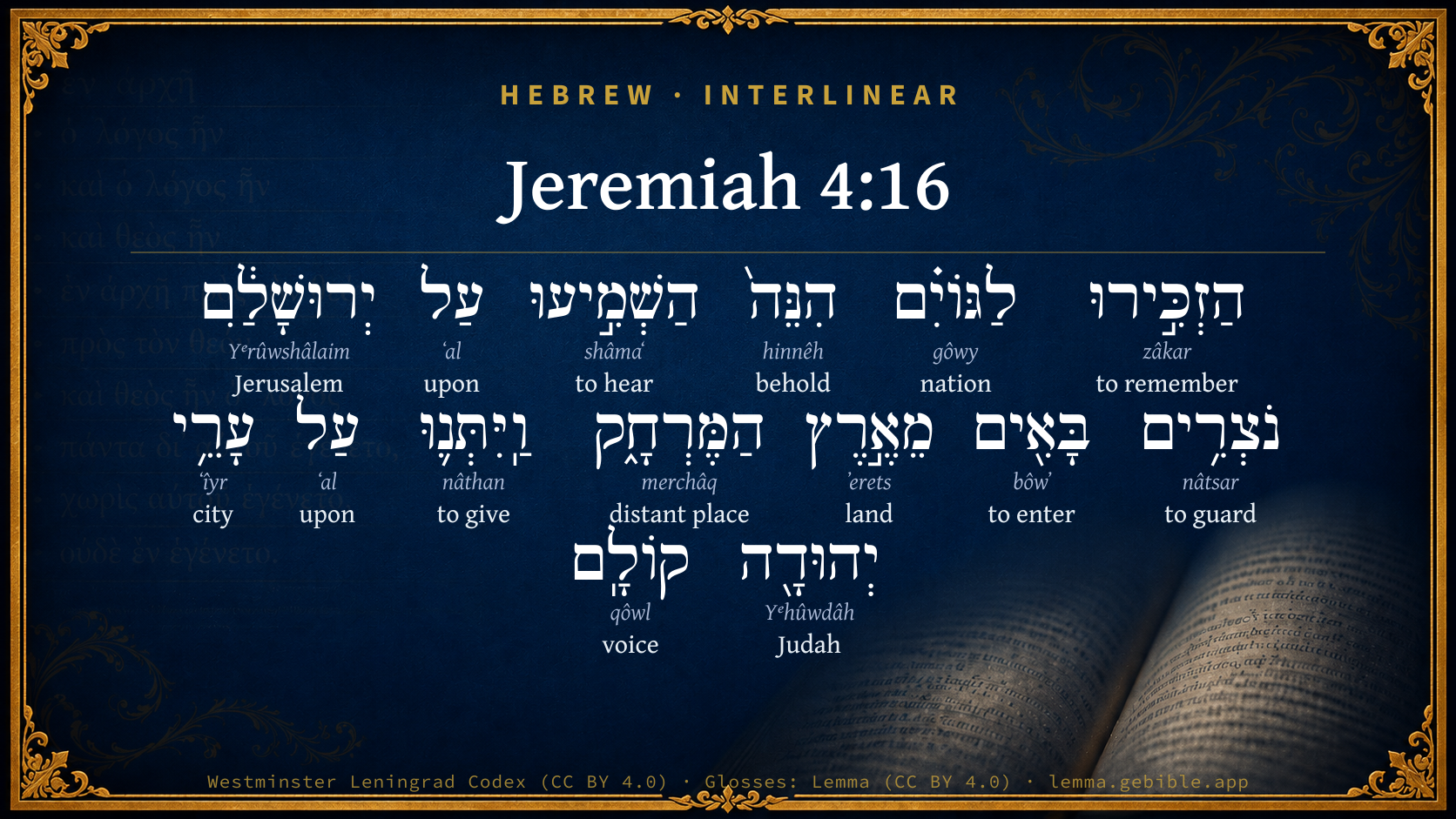
Jeremiah 4:16

Hebrew (Westminster Leningrad Codex) Jeremiah 4:16 appears in the Hebrew Old Testament. The text above is from the Westminster Leningrad Codex. Each word links to its Strong’s number, a concise gloss, and parsing drawn from the Open Scriptures Hebrew Bible morphology. Click any word for its full Brown-Driver-Briggs (BDB) entry.
Download image
Cite this verse

Jeremiah 4:16 (World English Bible). Public Domain. Lemma interlinear Bible study tool, https://lemma.gebible.app/v/jeremiah/4/16.

Show BibTeX & RIS
BibTeX
RIS
English Translation
make you mention to the nations; behold, publish against Jerusalem, [that] watchers come from a far country, and give out their voice against the cities of Judah.
World English Bible · Public Domain
Download a study sheet

One document with this verse’s original text, its word-by-word gloss line, the meaning frame, cross-references with their text, attributed commentary, and full source and license credits — printable, and it pastes into notes with its structure intact.

This verse Autodidact and up

Study sheet (.html) Plain text (.txt)

A passage Seminary Student

Up to 50 verses in one chapter. A passage sheet keeps up to 6 commentary sources and 12 cross-references per verse, in the order this page ranks them, and says so on the sheet whenever that leaves anything out. Ask for a single verse and you get the Autodidact verse sheet above.

Everything on this page stays free to read, with no account — the sheet is a download of what is already on screen, not access to it.

Want to remove ads? Support Godless Engineer
Compare translations 3

The same verse in 3 English versions, stacked beneath the original-language interlinear above. Click any original word for its lexicon entry.

Each is an independent rendering of the whole verse — the interlinear is not word-aligned to these translations.

Highlighted words mark where these versions differ — a whole-verse word diff, not a word-by-word alignment.

  • World English Bible Public Domain
    make you mention to the nations; behold, publish against Jerusalem, [that] watchers come from a far country, and give out their voice against the cities of Judah.
  • King James Version Public Domain
    Make ye mention to the nations; behold, publish against Jerusalem, that watchers come from a far country, and give out their voice against the cities of Judah.
  • unfoldingWord Literal Text CC BY-SA 4.0
    Report to the nations: Behold! Announce to Jerusalem, Guards are coming from the distant land, and they give their voice against the cities of Judah.

unfoldingWord Literal Text — © unfoldingWord, licensed CC BY-SA 4.0. Word-aligned USFM3 via Door43 (git.door43.org/unfoldingWord/en_ult).

Versions to compare (up to 4)

3 of 4 selected

Show all 18 translations

Every available English version of this verse, each an independent rendering of the whole verse.

  • World English Bible Public Domain
    make you mention to the nations; behold, publish against Jerusalem, [that] watchers come from a far country, and give out their voice against the cities of Judah.
  • Berean Standard Bible Public Domain
    Warn the nations now! Proclaim to Jerusalem: “A besieging army comes from a distant land; they raise their voices against the cities of Judah.
  • Majority Standard Bible Public Domain
    Warn the nations now! Proclaim to Jerusalem: “A besieging army comes from a distant land; they raise their voices against the cities of Judah.
  • King James Version Public Domain
    Make ye mention to the nations; behold, publish against Jerusalem, that watchers come from a far country, and give out their voice against the cities of Judah.
  • American Standard Version (1901) Public Domain
    make ye mention to the nations; behold, publish against Jerusalem, `that' watchers come from a far country, and give out their voice against the cities of Judah.
  • Revised Version (1885) Public Domain
    make ye mention to the nations; behold, publish against Jerusalem, that watchers come from a far country, and give out their voice against the cities of Judah.
  • Geneva Bible (1599) Public Domain
    Make ye mention of the heathen, and publish in Ierusalem, Beholde, the skoutes come from a farre countrey, and crie out against the cities of Iudah.
  • Douay-Rheims (1899) Public Domain
    Say ye to the nations: Behold it is heard in Jerusalem, that guards are coming from a far country, and give out their voice against the cities of Juda.
  • Young's Literal Translation Public Domain
    Make ye mention to the nations, Lo, sound ye to Jerusalem: `Besiegers are coming from the land afar off, And they give forth against cities of Judah their voice.
  • Literal Standard Version CC BY-SA 4.0
    “Make mention to the nations, || Behold, sound to Jerusalem, || Besiegers are coming from the far-off land, || And they give forth their voice against cities of Judah.
  • Unlocked Literal Bible CC BY-SA 4.0
    Make the nations think about this: See, announce to Jerusalem that besiegers are coming from a distant land to shout in battle against the cities of Judah.
  • unfoldingWord Literal Text CC BY-SA 4.0
    Report to the nations: Behold! Announce to Jerusalem, Guards are coming from the distant land, and they give their voice against the cities of Judah.
  • Darby Bible Public Domain
    Inform the nations; behold, make Jerusalem to hear: Besiegers come from a far country, and raise their voice against the cities of Judah.
  • World Messianic Bible Public Domain
    “Tell the nations, behold, publish against Jerusalem, ‘Watchers come from a far country, and raise their voice against the cities of Judah.
  • Webster's Bible Public Domain
    Make ye mention to the nations; behold, publish against Jerusalem, that watchers come from a far country, and give out their voice against the cities of Judah.
  • Free Bible Version CC BY-SA 4.0
    “Let the nations know! Look what's happening! Announce this to Jerusalem: An army is coming to besiege you from a distant country; shouting war cries against the towns of Judah.
  • Bible in Basic English Public Domain
    Make this come to the minds of the nations, make a statement openly against Jerusalem, that attackers are coming from a far country and their voices will be loud against the towns of Judah.
  • JPS Tanakh (1917) Public Domain
    'Make ye mention to the nations: Behold — publish concerning Jerusalem — watchers come from a far country, and give out their voice against the cities of Judah.'

Literal Standard Version (2020), Covenant Press — licensed CC BY-SA 4.0. Text via the HelloAO Bible API (eBible.org). Unlocked Literal Bible (unfoldingWord) — licensed CC BY-SA 4.0. Text via the HelloAO Bible API (eBible.org). unfoldingWord Literal Text — © unfoldingWord, licensed CC BY-SA 4.0. Word-aligned USFM3 via Door43 (git.door43.org/unfoldingWord/en_ult). Free Bible Version, Dr. Jonathan Gallagher — licensed CC BY-SA 4.0. Text via the HelloAO Bible API (eBible.org).

Word by word

More ways to search: Search by grammar → Find every occurrence → Compare this word →

Practice this passage: Drill this verse → Learn its vocabulary →

הַמֶּרְחָ֑ק
merchâq
H4801
“the · distant place”
Particle, Definite Article + Noun, Common, Masculine, Singular, Absolute
Part of Speech
Particle + Noun
Type
Common
Gender
Masculine
Number
Singular
State
Absolute
Full BDB Definition

Origin: from H7368

TWOT: 2151c

distant place, distance, far country
  1. הַזְכִּ֣ירוּ zâkar H2142 “remember” Verb, Hiphil, Imperative, 2nd Person, Masculine, Plural
  2. לַגּוֹיִ֗ם gôwy H1471 “to/for the · nations” Preposition, Determined + Noun, Common, Masculine, Plural, Absolute
  3. הִנֵּה֙ hinnêh H2009 “behold” Particle, Demonstrative
  4. הַשְׁמִ֣יעוּ shâmaʻ H8085 “hear” Verb, Hiphil, Imperative, 2nd Person, Masculine, Plural
  5. עַל ʻal H5921 “upon” Preposition
  6. יְרוּשָׁלִַ֔ם Yᵉrûwshâlaim H3389 “Jerusalem” Noun, Proper
  7. נֹצְרִ֥ים nâtsar H5341 “guarding” Verb, Qal, Participle Active, Masculine, Plural, Absolute
  8. בָּאִ֖ים bôwʼ H935 “entering” Verb, Qal, Participle Active, Masculine, Plural, Absolute
  9. מֵאֶ֣רֶץ ʼerets H776 “from · land of” Preposition + Noun, Common, Both, Singular, Construct
  10. וַֽיִּתְּנ֛וּ nâthan H5414 “and · to give” Conjunction + Verb, Qal, Sequential Imperfect, 3rd Person, Masculine, Plural
  11. עַל ʻal H5921 “upon” Preposition
  12. עָרֵ֥י ʻîyr H5892 “cities of” Noun, Common, Feminine, Plural, Construct
  13. יְהוּדָ֖ה Yᵉhûwdâh H3063 “Judah” Noun, Proper
  14. קוֹלָֽם qôwl H6963 “voice · their” Noun, Common, Masculine, Singular, Construct + Suffix, Personal, 3rd Person, Masculine, Plural

About this verse

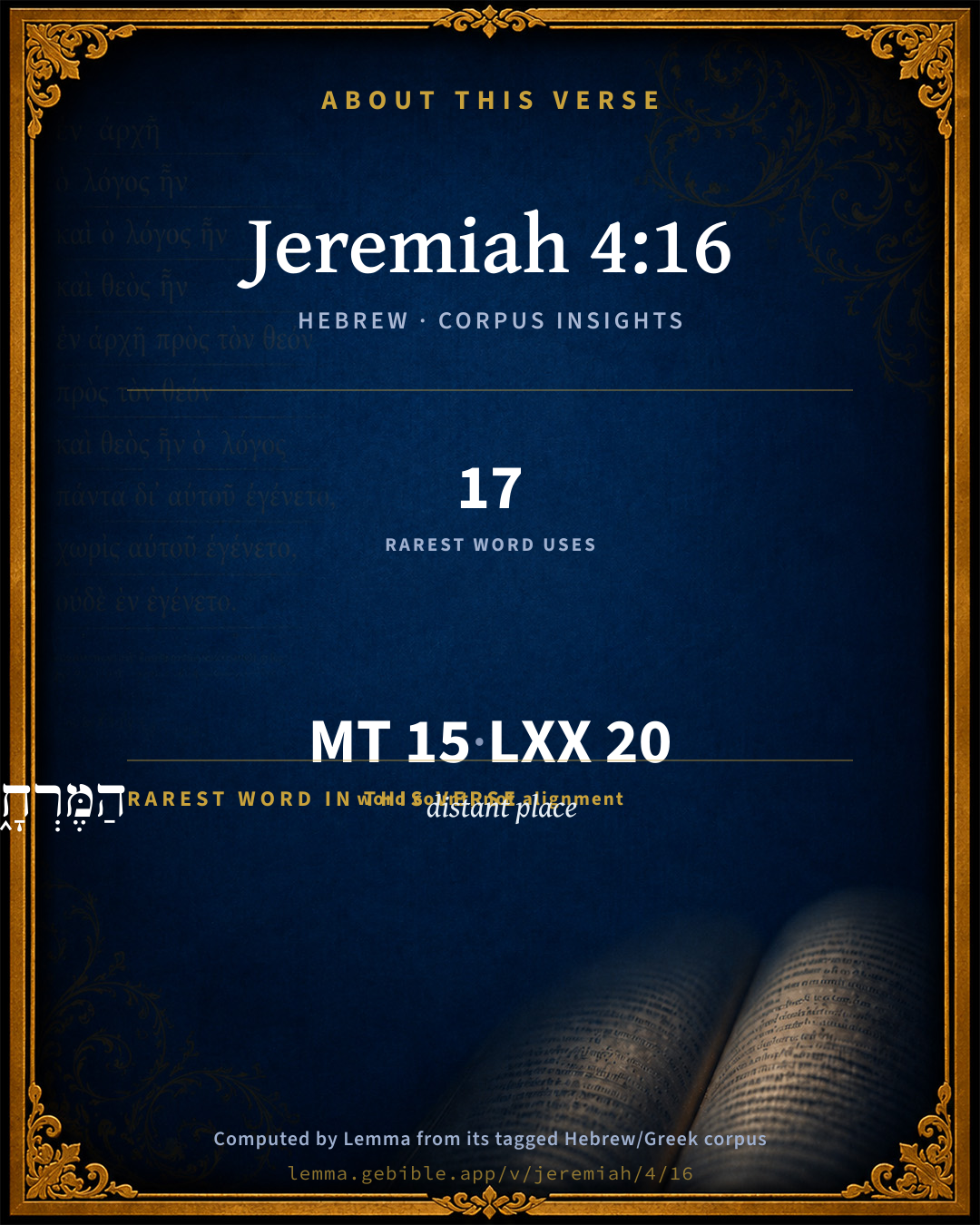
These counts appear in no published source. They are computed here, from the morphology-tagged text and Lemma’s own curated glosses. What Lemma adds →

15
words
14
distinct lemmas
Prophets
section

Notable vocabulary

The rarest word here is הַמֶּרְחָ֑ק distant place H4801 — appearing just 17 times in the whole Hebrew Bible.

Shared distinctive vocabulary

הַמֶּרְחָ֑ק distant place H4801 occurs in 17 verses of the Hebrew Bible. Also found in:

Grammatical profile

  • 5 verbs
  • 7 nouns
  • 2 prepositions
  • 1 particle

Verb forms

  • הַזְכִּ֣ירוּ Hiphil · Imperative
  • הַשְׁמִ֣יעוּ Hiphil · Imperative
  • נֹצְרִ֥ים Qal · Participle Active
  • בָּאִ֖ים Qal · Participle Active
  • וַֽיִּתְּנ֛וּ Qal · Sequential Imperfect

Repetition

A word recurs within this verse — often emphatic in Hebrew:

Hebrew & Septuagint length

In the original languages it is 15 Hebrew tokens and 20 Greek tokens — but the two are counted differently (Hebrew bundles its prefixes and suffixes into one token; the Greek is in lemma form), so that isn’t a like-for-like length.

Cross-references

13

Topical passages linked to Jeremiah 4:16 in the Treasury of Scripture Knowledge — connected by theme and wording, ordered by reader-vote popularity; previews shown in the World English Bible.

  • Jeremiah 5:15 Behold, I will bring a nation on you from far, house of Israel, says Yahweh: it is a mighty nation, it is an ancient nation, a nation whose language you don't know, neither understand what they say.
  • Ezekiel 21:22 In his right hand was the divination [for] Jerusalem, to set battering rams, to open the mouth in the slaughter, to lift up the voice with shouting, to set battering rams against the gates, to cast up mounds, to build forts.
  • Isaiah 39:3 Then came Isaiah the prophet to king Hezekiah, and said to him, What said these men? and from whence came they to you? Hezekiah said, They are come from a far country to me, even from Babylon.
  • Deuteronomy 28:49–52 Yahweh will bring a nation against you from far, from the end of the earth, as the eagle flies; a nation whose language you shall not understand;
  • Isaiah 34:1 Come near, you nations, to hear; and listen, you peoples: let the earth hear, and the fullness of it; the world, and all things that come forth from it.
  • Jeremiah 2:15 The young lions have roared on him, and yelled; and they have made his land waste: his cities are burned up, without inhabitant.
  • Jeremiah 4:17 As keepers of a field are they against her round about, because she has been rebellious against me, says Yahweh.
  • Jeremiah 5:6 Therefore a lion out of the forest shall kill them, a wolf of the evenings shall destroy them, a leopard shall watch against their cities; everyone who goes out there shall be torn in pieces; because their transgressions are many, [and] their backsliding is increased.
  • Jeremiah 6:18 Therefore hear, you nations, and know, congregation, what is among them.
  • Jeremiah 16:6 Both great and small shall die in this land; they shall not be buried, neither shall men lament for them, nor cut themselves, nor make themselves bald for them;
  • Jeremiah 31:10 Hear the word of Yahweh, you nations, and declare it in the isles afar off; and say, He who scattered Israel will gather him, and keep him, as shepherd does his flock.
  • Jeremiah 39:1 It happened when Jerusalem was taken, (in the ninth year of Zedekiah king of Judah, in the tenth month, came Nebuchadrezzar king of Babylon and all his army against Jerusalem, and besieged it;
  • Jeremiah 50:2 Declare you among the nations and publish, and set up a standard; publish, and don't conceal: say, Babylon is taken, Bel is disappointed, Merodach is dismayed; her images are disappointed, her idols are dismayed.

Cross-references courtesy of OpenBible.info (CC BY 4.0).

Hebrew and Greek witnesses Masoretic Hebrew ↔ Greek Septuagint

The same verse in the two great witnesses to the Old Testament, shown verse-for-verse.

These are two independent witnesses, not word-aligned to each other, and the Septuagint is shown in lemma (dictionary) form.

Hebrew Jeremiah 4:16 Masoretic · Westminster Leningrad Codex

הַזְכִּ֣ירוּ לַגּוֹיִ֗ם הִנֵּה֙ הַשְׁמִ֣יעוּ עַל יְרוּשָׁלִַ֔ם נֹצְרִ֥ים בָּאִ֖ים מֵאֶ֣רֶץ הַמֶּרְחָ֑ק וַֽיִּתְּנ֛וּ עַל עָרֵ֥י יְהוּדָ֖ה קוֹלָֽם

make you mention to the nations; behold, publish against Jerusalem, [that] watchers come from a far country, and give out their voice against the cities of Judah.

World English Bible · Public Domain

Greek LXX Structure differs

In the Septuagint, Jeremiah is about an eighth shorter than the Hebrew and arranges its material differently — the Oracles Against the Nations (Hebrew chapters 46–51) appear in the middle of the Greek book, after 25:13. Because the chapter and verse boundaries do not line up, a verse-for-verse comparison with the Hebrew is not shown.

A verse-for-verse comparison isn’t shown here because the chapters and verses don’t line up. Switch to the LXX edition with the MT / LXX toggle above to read the Greek directly.

Hebrew: Westminster Leningrad Codex (CC BY 4.0). Greek: Septuagint (public domain); English from a public-domain English Septuagint. How the Septuagint differs from the Hebrew →

Targum (Aramaic paraphrase)

1

The Targum is the ancient Jewish Aramaic paraphrase of the Hebrew Scriptures — an interpretive translation, not the Hebrew text itself. Onkelos (literal) and Pseudo-Jonathan (expansive) render the Torah, and Jonathan the Prophets. Coverage is partial: where no permissively-licensed English translation exists for a verse, only the Aramaic is shown. This is verse-level text, not a word-by-word alignment to the Hebrew.

  1. Targum Jonathan Prophets (Joshua–Malachi)
    אַדְכָּרוּ לְעַמְמַיָא הָא בַשְׂרוּ עַל יְרוּשְׁלֵם אֱמָרוּ מַשִׁרְיַת עַמְמִין חֲטוֹפִין כִּקְטוֹפִין אָתָן מֵאֲרַע רְחִיקָא וְיִשְׁרוֹן עַל קִרְוַיָא דְבֵית יְהוּדָה וִירִימוּן עֲלֵיהוֹן קָלְהוֹן:

    (no public-domain English translation for this verse)

    Targum Jonathan — Aramaic: “Mikraot Gedolot” (public domain). English: “Sefaria Community Translation” (CC0 1.0 (public-domain dedication)); “London "Chaldee Paraphrase," 1871” (public domain). Text via Sefaria.

Commentary

Notes on Jeremiah 4:16 from classic Christian and Jewish commentators (each source and its license shown beneath its notes). The classic Christian expositions comment on the surrounding passage and are grouped to its opening verse, so a note may address several verses; the Jewish commentaries on the Tanakh (Rashi and others) are per-verse, so they appear only where the commentator wrote on this verse.

Lemma curates 59 commentaries, every one of them public domain or Creative Commons licensed, each selected and text-cleaned for this edition rather than reprinted as found. About our sources →

Trapp's Complete Commentary

John Trapp

Jer 4:16 Make ye mention to the nations; behold, publish against Jerusalem, [that] watchers come from a far country, and give out their voice against the cities of Judah.

Ver. 16. Make ye mention to the nations,] i.e., To the Jews, who haply are called the nations, because once better accounted of than all nations. Thus the saints are called "All things," {Col 1:18} and the Rabbis have a saying, that those seventy souls which came down to Egypt with Jacob, were more worth than all the seventy nations of the world besides.

That watchers are come.] Nebuchadnezzar’s body guard, say some. Heb., Notserim - i.e., Nebuchadnezzarenes. {a} Others give a better reason of the word from the next verse.

And give out their voice against the cities of Judah.] While they invade them cum barritu militari, with a horrid and horrible noise, such as the Turks use today also when they set upon any city to storm it.

{a} Sicut a Caesare Caesariani, a Praetore Praetoriani.

John Trapp, A Commentary or Exposition upon All the Books of the Old and New Testament (1647–1656) — public domain. Text from a community e-Sword module.

Joseph Benson's Commentary

Jer 4:16-17. Make ye mention to the nations — Tell the nations that now inhabit the cities of the ten tribes, that the Chaldean army is approaching, that they may provide for their own safety. Behold, publish against Jerusalem — Let her be made acquainted with what is coming upon her. Let her have notice beforehand, that she may be warned. That watchers come from a far country — That is soldiers from Chaldea, that will watch all opportunities to do mischief. By watchers, some think, are meant those scouts who usually precede an army, and announce its approach, whom Cesar, in his Commentaries, calls antecessores, or antecursores. But Blaney and others are of opinion that besiegers are intended, placing sentinels round the city to prevent any from coming in or going out, and keeping the place in continual alarm by shouts of war. As keepers of the field, &c. — Those couriers or spies of the Chaldean army will be as diligent in their observation of Judah and Jerusalem, or those besiegers will as strictly watch her on all sides, as the keepers of a field watch the cattle, or the vineyards and fruits thereof, under their care. “As in the East,” says Sir John Chardin, in a MS. note on this place, quoted by Harmer, “pulse, roots, &c., grow in open and unenclosed fields, when they begin to be fit to be gathered, they place guards; if near a great road, more; if distant, fewer, who place themselves in and round about these grounds, as is practised in Arabia,” chap. 5. obser. 15.

Joseph Benson's Commentary on the Old and New Testaments (1811–1818) — public domain. Text from a community e-Sword module.

Jamieson, Fausset & Brown

Robert Jamieson, A. R. Fausset & David Brown

The neighboring foreign "nations" are summoned to witness Jehovah's judgments on His rebel people (Jer 6:18-19).

watchers--that is, besiegers (compare Sa2 11:16); observed or watched, that is, besieged.

their voice--the war shout.

Jamieson, Fausset & Brown — Commentary Critical and Explanatory on the Whole Bible (1871) — public domain (CC PDM 1.0). Text via the HelloAO Bible API.

Adam Clarke's Commentary

Verse 16. Watchers come from a far country] Persons to besiege fortified places.

Adam Clarke's Commentary on the Bible (1810–1826) — public domain. Text from a community e-Sword/MySword module.

John Calvin's Commentaries

The beginning of this verse is variously explained. Some read, “Remember ye the nations, “and think that the Prophet says this, because many of the nations were heralds of that vengeance of God, which the Jews despised, as they thought that what the true heralds of God declared were mere fables. They therefore take the meaning of this passage, as though Jeremiah sent the Jews to the nations, intimating that they were unworthy that God should send them his usual teachers. But as the verb is in Hiphil, we ought rather to read, Rehearse it: and some give this explanation, “Rehearse, “or tell, “of the nations;” that is, “Announce that the Chaldeans are hastening to lay waste the land, to pull down the cities of Judah and to destroy the people.” But there is a third meaning which, in my judgment, comports better with the passage. He literally says, Rehearse it to the nations; behold, proclaim against Jerusalem: for as the Prophet saw that he spent his labor in vain on that stupid people, who had become so hardened in their perverseness, that they were wholly inattentive and unteachable, he turned his address to the nations, and said, “Rehearse it to the Gentiles;” as though he had said, “I have long ago reminded this people, that God had other teachers; but what have we gained by our labor, except that the people become continually worse: since then it is so, now he says, ‘Declare it to the nations concerning Jerusalem;’ let the Jews hear nothing more of their ruin, but let God’s vengeance on them be made known to the heathens.” There is nothing strained or obscure in this explanation; and it is wholly consonant with the prophetic style.

He then deigned no longer to favor his own nation with heavenly truth; because this would have cast what was holy to the dogs; but he directs his discourse to the heathens, as though he had said, “There is more knowledge in the blind and unbelieving than in the chosen people of God.” This does not shew but that he afterwards continued a long time in the discharge of his office; for the prophets, inflamed with zeal for God, often threatened the people with utter ruin, and afterwards performed their charge and tried whether they, of whom they seemed to despair, were healable.

He says that besiegers would come from a far country. Some render נצרים, netserim, keepers; and they think that Jeremiah alludes to Nebuchadnezzar, because his captains would come to destroy Jerusalem and to demolish the cities of Judah. But I prefer to render the word “besiegers.” Though some think that נצר, netser, sometimes means to destroy or lay waste; yet the other meaning seems more suitable, as it appears evident from the next verse. To render it keepers, seems to be frigid; though this is what is done almost by all. I render it “besiegers,” — Come then shall besiegers; for נצר, netser, means not only to keep, but also to shut up in a strait place. Come, he says, shall besiegers from a far country. He used these expressions, that the people might not promise themselves impunity, as it has been before stated, through the forbearance of God: for when God deferred his vengeance, they thought themselves relieved from all fear. Hence he says, that though the enemy was not as yet present, though they did not as yet hear the sound of the coming enemy, God at the same time did not threaten them in vain; for he would in an instant send for those from a distant land, who would execute his vengeance.

What follows, they shall send forth their voice against the cities of Judah, is added, in order that the Jews might know that they could by no hindrances prevent God from bringing quickly the Chaldeans to terrify their cities by their sound. What he indeed means is the shout by which soldiers rouse one another to fight: but as this is commonly done as a sign of victory, he intimates that it was all over with the Jews; for the soldiers had as it were already uttered their triumphant shoutings. It follows —

John Calvin's Commentaries (1540-1563) — public domain. Text from the Calvin Translation Society English edition (1840s-50s) via the Christian Classics Ethereal Library (ccel.org). Calvin's coverage is partial (roughly two-thirds of the Bible); uncommented books and verses are honest gaps, never fabricated. The 19th-century editor's footnotes and remarks are omitted so the notes are faithfully Calvin's own voice.

Ellicott's Commentary for English Readers

(16) Make ye mention.—Better, Proclaim ye to the nations; behold. Call them to gaze on the ruin of Jerusalem, then, Cry aloud as for Jerusalem, that watchers (i.e., the besieging armies) are coming from a far country, and that they will give out their voice (i.e. raise the cry of war) against the cities of Judah.

A Bible Commentary for English Readers, edited by Charles John Ellicott (1878–1897) — public domain. Text from a community e-Sword module.

The Cambridge Bible for Schools and Colleges

gen. ed. J. J. S. Perowne

16. make ye mention to the nations] They are bidden to witness the impending judgement. Cp. Mic_1:2, and the appeal to heaven and earth in Isa_1:2, Mic_6:1 f.

watchers] besiegers, the Chaldaeans. But to obtain this sense we must omit the first consonant of the Hebrew word. By a change of one consonant we get the Hebrew for leopards (nĕmêrim). Cp. Jer_5:6; Hab_1:8.

The Cambridge Bible for Schools and Colleges (gen. ed. J. J. S. Perowne; Cambridge University Press, 1878–1918) — public domain. Text from a community e-Sword module.

John Gill's Exposition

Make ye mention to the nations,.... This, according to Kimchi, is the sum and substance of the voice from Dan. It seems to be a summons to the nations to gather together to join the king of Babylon in his enterprise against Jerusalem; see Kg2 24:2,

publish against Jerusalem; what follows:

that watchers come from afar country; from Babylon, which is said to be a far country, Isa 39:3, these are the soldiers of the king of Babylon; they are called Notzerim; which word agrees with the latter part of Nebuchadnezzar's name; to which some (b) think there is some reference, showing that his army is meant. It should be rendered "besiegers", as it is by some (c); for these were not Nebuchadnezzar's bodyguard, but his whole army, who were come up to besiege Jerusalem; and they are compared to watchers and keepers of a field in the next verse, where another word is used. The Targum is,

"the army of a rapacious people, like the grape gatherers, come from a far country:''

and give out their voice against the cities of Judah; threaten the ruin of them; blow the trumpet, the alarm of war; give the orders to besiege; and, being sure of victory, triumph before the attack is made.

(b) R. Joseph Kimchi, R. Jonah, and Ben Melech, but disapproved of by Abarbinel. (c) "obsessores", Calvin, Buxtorf; a vel "obsedit"; so Jarchi.

John Gill's Exposition of the Whole Bible (1746–1763) — public domain (CC PDM 1.0). Text via the HelloAO Bible API.

Albert Barnes' Notes on the Bible

Proclaim ye to the pagan, “Behold!” Cry aloud concerning “Jerusalem, that watchers” are on their way “from a far country: and” will “give out their voice against the cities of Judah.” The pagan are summoned to witness the chastisement of Jerusalem, that they may take warning thereby. By “watchers” are meant besiegers, who will surround the city with a line of sentinels.

Albert Barnes' Notes on the Bible (1834–1885) — public domain. Text from a community e-Sword/MySword module.

Haydock's Catholic Bible Commentary

Guards. The Chaldeans will besiege the city, and prevent provisions from entering, 4 Kings xxv. 1. (Calmet)

George Leo Haydock (1774–1849), Haydock's Catholic Family Bible and Commentary, 1859 edition — public domain. Excludes Psalms (Douay-Rheims chapter numbering differs from Protestant) and Deuterocanonical books (Catholic canon only).

Matthew Poole's English Annotations

Make ye mention to the nations: these are either the nations in Judea; or these words are a proclamation, summoning in the nations by the Chaldeans, as it were, in pursuance of a commission from God, to bring great armies together against Jerusalem; or they are the prophets turning away from Judah, as despairing of doing any good upon them, and calling for the nations to execute God’s sentence.

Publish; let her be acquainted with what is coming upon her, let her have public notice beforehand, that she may be warned.

Watchers; military watchers, i.e. the Chaldean soldiers, that shall so carefully and watchfully encompass Jerusalem, that none shall escape; possibly a metaphor from hunters, that in hunting their prey lay wait at every passage, that the game may not escape. See 2Ki 25:4,5. Or possibly there may be an allusion to Nebuchadnezzar’s name; the Hebrew word for watchers being notscrim, which comes from natser, the end of his name, as if they were termed Nebuchadnezzartans, as the keepers or guards of his person; as they were called Caesarcans from Caesar.

Come; they are now at hand, you may as it were see them.

From a far country; from Chaldea.

Give out their voice; they will proclaim war against them; or a shout, either encouraging soldiers to the battle, or triumphing after the victory; or the outcries that they will make, such as the Turks now make in their onsets, Jer 2:15.

Matthew Poole's English Annotations on the Holy Bible (1683–1685) — public domain. Text from a community e-Sword/MySword module.

The Pulpit Commentary

Make ye mention, etc. This verse contains a call to the neighboring nations to take notice of an event which nearly concerns them all. True, it is only the investment of Jerusalem which can as yet be reported, but there can hardly be a doubt of the issue, and the capture of the principal fortress will at once be followed by that of the other fortified "cities of Judah." Against in the second clause should rather be concerning. (For the use of "behold" before an imperative, comp. Psa_134:1) Watchers; i.e. besiegers (comp. ver. 17), who like the panther lie in wait for every one who comes out of the city, to kill him. (Jer_5:6; comp. Jer_6:25)

The Pulpit Commentary (1880–1919), ed. H.D.M. Spence-Jones & Joseph S. Exell — public domain. Text from a community e-Sword module.

John Wesley's Explanatory Notes

Make mention - These words are a proclamation, summoning the nations by the Chaldeans. Watchers - Chaldean soldiers, who shall so carefully encompass Jerusalem, that none shall escape. Give out - They give a shout, encouraging the soldiers to battle.

John Wesley, Explanatory Notes Upon the Whole Bible (1754–1765) — public domain. Text via the GEBible commentary corpus.

unfoldingWord translationNotes

Door43 World Missions Community

besiegers are coming

Besiegers are soldiers who surround a city in order to keep the people in the city from being able to get supplies of food and water.

They will be like the watchmen of a cultivated field against her all around

Carefully guarding a city to keep people from going in and out is spoken of as if they are carefully watching a field to keep people from stealing from it. AT: "they will guard Jerusalem carefully like watchmen who carefully guard a cultivated field" (See: Simile)

against her all around

The word "her" refers to Jerusalem. Jerusalem was often spoken of as if it were a woman. (See: Personification)

she has been rebellious against me

The word "she" refers to Jerusalem and represents the people of Jerusalem. The word "me" refers to Yahweh. AT: "the people of Jerusalem have been rebellious against me" (See: Metonymy)

this is Yahweh's declaration

Yahweh speaks of himself by name to express the certainty of what he is declaring. See how you translated this in Jeremiah 1:8. AT: "this is what Yahweh has declared" or "this is what I, Yahweh, have declared" (See: First, Second, or Third Person)

your conduct and your deeds have done these things to you

Here "conduct" and "deeds" are spoken of as if they are people that could do things. These abstract nouns can be expressed with the phrase "what you have done." AT: "These things are happening to you because of what you have done" (See: Personification and Abstract Nouns)

It will strike your very heart

Here "heart" probably refers to the emotions, and "strike your very heart" probably refers to causing them to suffer terribly. AT: "It will be as if it strikes your very heart" or "It will cause you to suffer terrible anguish" (See: Metaphor)

translationWords

nation

rebel

works

unfoldingWord translationNotes — © Distant Shores Media and the Door43 World Missions Community, licensed CC BY-SA 4.0. Source: git.door43.org/Door43/en_tn.

Rashi

Rabbi Shlomo Yitzchaki (Rashi)

besiegers Heb. נצרים. Those who will make a siege upon them.

Rashi on the Tanakh — English translations: “The Judaica Press complete Tanach with Rashi, translated by A. J. Rosenberg” (CC BY 4.0); “Pentateuch with Rashi's commentary by M. Rosenbaum and A.M. Silbermann, 1929-1934” (public domain); “The Metsudah Tanach series, Lakewood, N.J” (CC BY 4.0); and “The Book of Joshua, Metsudah Publications, 1997” (CC BY 4.0). Text via Sefaria.

Lesson kit

Teaching starters — assembled from the data on this page, not authored interpretation. Every prompt links to the verse data it draws on. Edit before teaching.

Jeremiah, in the Prophets, opens this verse with 15 words (14 distinct Hebrew lemmas). Its most distinctive word is merchâq (“distant place”). A historical commentator’s framing appears above. Read the whole chapter for the surrounding context.

Discussion questions

  1. The word merchâq carries the sense “distant place.” How does it shape the verse?
  2. Psalms 138:6 shares the word «distant place» with this verse. How do the two illuminate each other?
  3. “upon” occurs 2× in this one verse. What is the effect of the repetition?
  4. The translations on this page render this verse differently — a whole-verse word diff, not a word-by-word alignment. What might account for the different wordings?
  5. The verb «הַזְכִּ֣ירוּ» is Hiphil Imperative. How does its form color the action?
  6. Reading how Trapp's Complete Commentary and Joseph Benson's Commentary read this verse, where do the two commentators agree and where do they part?

Things to notice

Reading settings

Reading text

Shown beneath each verse's original-language words.

Old Testament
Old Testament edition

Read the OT as the Masoretic Hebrew (MT) or the Greek Septuagint (LXX).

English shown for the Greek Septuagint (in the Hebrew ↔ Greek comparison).

Comparing translations? Open the Compare panel on any verse page to stack up to four side by side.