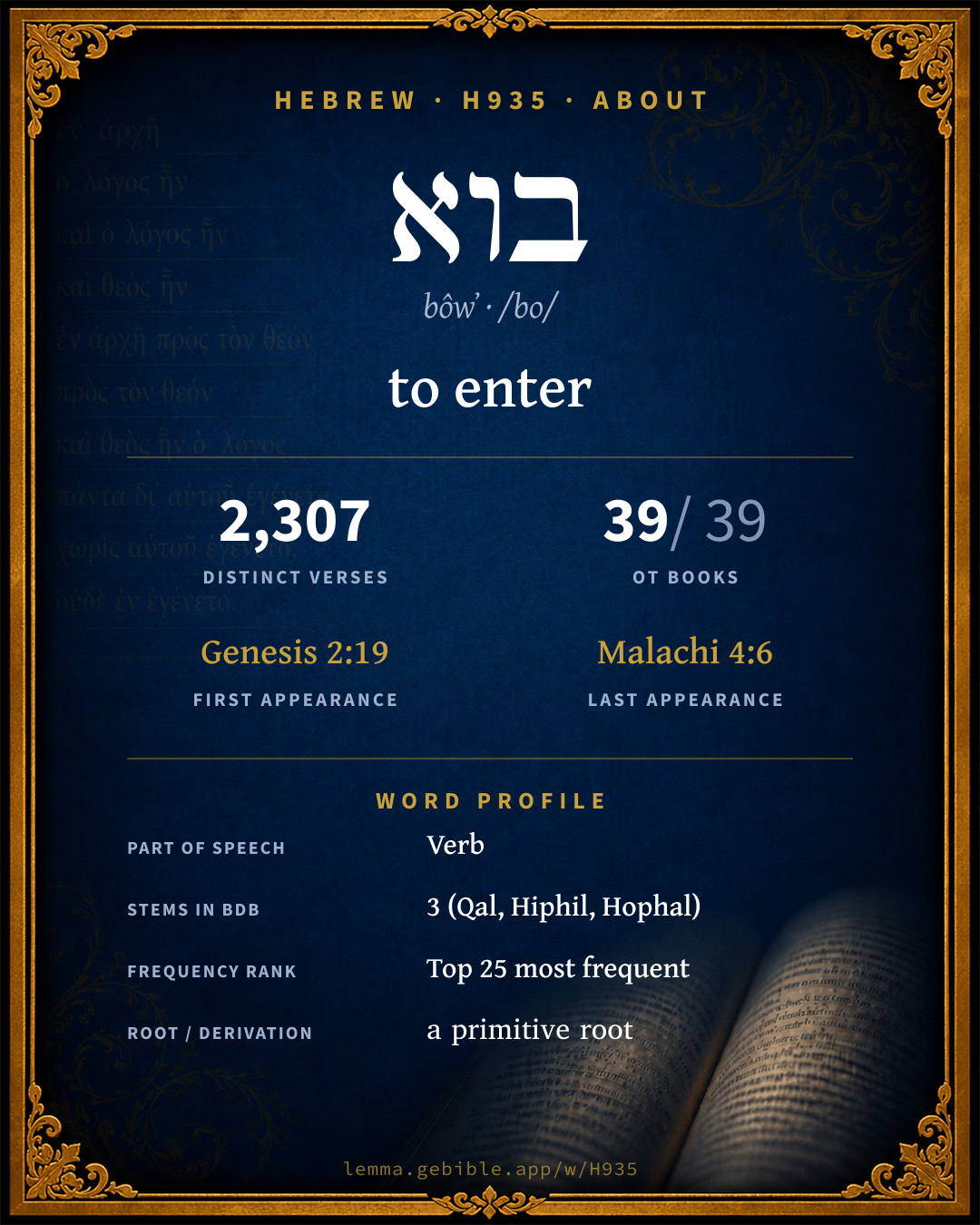
בּוֹא
to enter
‘to enter’ is one of 14 main senses fuller range ↓
Full lexicon entry — Brown-Driver-Briggs (BDB)
From Brown-Driver-Briggs (BDB)
Where this word appears
See every Qal verb in the Hebrew Bible →
Grammar key — what these labels mean
Part of speech
- Verb
- An action or state-of-being word.
- Noun
- A naming word — a person, place, thing, or idea.
Noun type
- Proper
- A name of a specific person, place, or people (e.g. Abraham, Zion, Israel).
- Common
- A common noun — a general class of person, place, or thing (“king,” “city,” “water”), not a specific name.
Stem
- Qal
- The basic, simple active stem — the plain form of the verb (“he wrote”). Here: ‘come in’
- Hiphil
- The causative active stem (“he caused / brought about”). Here: ‘cause to come in’
- Hophal
- The passive counterpart of the Hiphil (“he was caused to…”). Here: ‘be brought in’
Form
- Sequential Imperfect
- An imperfect with prefixed waw — the standard past-narrative form (waw-consecutive imperfect).
- Perfect
- A completed action or state — Hebrew marks aspect (completeness) more than strict tense (“he wrote”).
- Imperfect
- An incomplete, ongoing, or future action (“he will / would write”).
- Infinitive Construct
- A bound verbal noun, frequently with prepositions (“to write / in writing”).
- Participle Active
- A verbal adjective expressing ongoing or characteristic action (“writing / one who writes”).
- Sequential Perfect
- A perfect with prefixed waw continuing a preceding imperfect or command (waw-consecutive perfect).
- Imperative
- A direct command (“write!”).
- Jussive
- A third- or second-person volitional form expressing wish or command (“let him write”).
- Infinitive Absolute
- An unbound verbal noun, often intensifying or standing in for a finite verb.
- Participle Passive
- A verbal adjective expressing action received (“written”).
- Cohortative
- A first-person volitional form expressing wish or resolve (“let me / let us write”).
State
- Absolute
- The independent form of a noun, not bound to a following word.
- Construct
- A noun bound to a following noun in a possessive / “of” relationship (the construct chain).
Person
- 3rd Person
- The one spoken about (“he / she / it / they”).
- 2nd Person
- The one addressed (“you”).
- 1st Person
- The speaker (“I / we”).
Gender
- Masculine
- Grammatically masculine.
- Common
- Either gender — not distinguished for this form.
- Feminine
- Grammatically feminine.
Number
- Singular
- One.
- Plural
- More than one (in Hebrew, generally three or more).
Grammatical forms 99 distinct
- Verb, Qal, Sequential Imperfect, 3rd Person, Masculine, Singular 264 times (10%)
- Verb, Qal, Infinitive Construct 264 times (10%)
- Verb, Qal, Perfect, 3rd Person, Masculine, Singular 197 times (8%)
- Verb, Qal, Sequential Imperfect, 3rd Person, Masculine, Plural 192 times (7%)
- Verb, Qal, Imperfect, 3rd Person, Masculine, Singular 165 times (6%)
- Verb, Qal, Perfect, 3rd Person, Common, Plural 105 times (4%)
- Verb, Qal, Participle Active, Masculine, Singular, Absolute 92 times (4%)
- Verb, Hiphil, Sequential Imperfect, 3rd Person, Masculine, Singular 89 times (3%)
+91 more forms (1,224 occurrences)
Parsed forms decoded from the imported morphology (morphhb / Westminster Leningrad Codex — WLC text public domain, morphhb tagging CC BY 4.0), counted across 2,592 parsed occurrences — not distinct verses.
Page 1 of 12 — showing verses 1–200 of 2,307 distinct verses where H935 appears, across 39 books. Click any verse to open its interlinear word-by-word view. Verse text shown in the World English Bible for context — . Each verse’s Hebrew form is shown with its reference; the English is not keyword-highlighted, since the data carries no word-level English alignment. Use “Compare translations” on any verse to read it across multiple English versions. This concordance covers the Hebrew Bible; Septuagint (Greek Old Testament) occurrences are not indexed here.
Genesis 198 verses
- Genesis 2:19 וַ/יָּבֵא֙ conj + Hiphil wimpf 3ms Out of the ground Yahweh God formed every animal of the field, and every bird of the sky, and brought them to the man to see what he would call them. Whatever the man called every living creature, that was its name.
- Genesis 2:22 וַ/יְבִאֶ֖/הָ conj + Hiphil wimpf 3ms + sfx pers 3fs He made the rib, which Yahweh God had taken from the man, into a woman, and brought her to the man.
- Genesis 4:3 וַ/יָּבֵ֨א conj + Hiphil wimpf 3ms As time passed, it happened that Cain brought an offering to Yahweh from the fruit of the ground.
- Genesis 4:4 הֵבִ֥יא Hiphil pf 3ms Abel also brought some of the firstborn of his flock and of the fat of it. Yahweh respected Abel and his offering,
- Genesis 6:4 יָבֹ֜אוּ Qal impf 3mp The Nephilim were in the earth in those days, and also after that, when God's sons came to men's daughters. They bore children to them: the same were the mighty men who were of old, men of renown.
- Genesis 6:13 בָּ֣א Qal pf 3ms God said to Noah, "The end of all flesh has come before me, for the earth is filled with violence through them. Behold, I will destroy them with the earth.
- Genesis 6:17 מֵבִ֨יא Hiphil ptcp.act ms I, even, I do bring the flood of waters on this earth, to destroy all flesh having the breath of life from under the sky. Everything that is in the earth will die.
- Genesis 6:18 וּ/בָאתָ֙ conj + Qal wpf 2ms But I will establish my covenant with you. You shall come into the ark, you, your sons, your wife, and your sons' wives with you.
- Genesis 6:19 תָּבִ֥יא Hiphil impf 2ms Of every living thing of all flesh, you shall bring two of every sort into the ark, to keep them alive with you. They shall be male and female.
- Genesis 6:20 יָבֹ֥אוּ Qal impf 3mp Of the birds after their kind, of the cattle after their kind, of every creeping thing of the ground after its kind, two of every sort shall come to you, to keep them alive.
- Genesis 7:1 בֹּֽא Qal impv 2ms Yahweh said to Noah, "Come with all of your household into the ark, for I have seen your righteousness before me in this generation.
- Genesis 7:7 וַ/יָּ֣בֹא conj + Qal wimpf 3ms Noah went into the ark with his sons, his wife, and his sons' wives, because of the waters of the flood.
- Genesis 7:9 בָּ֧אוּ Qal pf 3cp went by pairs to Noah into the ark, male and female, as God commanded Noah.
- Genesis 7:13 בָּ֣א Qal pf 3ms In the same day Noah, and Shem, Ham, and Japheth, the sons of Noah, and Noah's wife, and the three wives of his sons with them, entered into the ark;
- Genesis 7:15 וַ/יָּבֹ֥אוּ conj + Qal wimpf 3mp They went to Noah into the ark, by pairs of all flesh with the breath of life in them.
- Genesis 7:16 וְ/הַ/בָּאִ֗ים בָּ֔אוּ conj + ptcl def.art + Qal ptcp.act mp Qal pf 3cp Those who went in, went in male and female of all flesh, as God commanded him; and Yahweh shut him in.
- Genesis 8:9 וַ/יָּבֵ֥א conj + Hiphil wimpf 3ms but the dove found no place to rest her foot, and she returned to him into the ark; for the waters were on the surface of the whole earth. He put forth his hand, and took her, and brought her to him into the ark.
- Genesis 8:11 וַ/תָּבֹ֨א conj + Qal wimpf 3fs The dove came back to him at evening, and, behold, in her mouth was an olive leaf plucked off. So Noah knew that the waters were abated from off the earth.
- Genesis 10:19 בֹּאֲ/כָ֥ה בֹּאֲ/כָ֞ה Qal inf.cs + sfx pers 2ms Qal inf.cs + sfx pers 2ms The border of the Canaanites was from Sidon, as you go toward Gerar, to Gaza; as you go toward Sodom, Gomorrah, Admah, and Zeboiim, to Lasha.
- Genesis 10:30 בֹּאֲ/כָ֥ה Qal inf.cs + sfx pers 2ms Their dwelling was from Mesha, as you go toward Sephar, the mountain of the east.
- Genesis 11:31 וַ/יָּבֹ֥אוּ conj + Qal wimpf 3mp Terah took Abram his son, Lot the son of Haran, his son's son, and Sarai his daughter-in-law, his son Abram's wife. They went forth from Ur of the Chaldees, to go into the land of Canaan. They came to Haran, and lived there.
- Genesis 12:5 וַ/יָּבֹ֖אוּ conj + Qal wimpf 3mp Abram took Sarai his wife, Lot his brother's son, all their substance that they had gathered, and the souls who they had gotten in Haran; and they went forth to go into the land of Canaan. Into the land of Canaan they came.
- Genesis 12:11 לָ/ב֣וֹא prep + Qal inf.cs It happened, when he was come near to enter into Egypt, that he said to Sarai his wife, "See now, I know that you are a beautiful woman to look on.
- Genesis 12:14 כְּ/ב֥וֹא prep + Qal inf.cs It happened that when Abram had come into Egypt, the Egyptians saw that the woman was very beautiful.
- Genesis 13:10 בֹּאֲ/כָ֖ה Qal inf.cs + sfx pers 2ms Lot lifted up his eyes, and saw all the plain of the Jordan, that it was well watered every where, before Yahweh destroyed Sodom and Gomorrah, like the garden of Yahweh, like the land of Egypt, as you go to Zoar.
- Genesis 13:18 וַ/יָּבֹ֛א conj + Qal wimpf 3ms Abram moved his tent, and came and lived by the oaks of Mamre, which are in Hebron, and built an altar there to Yahweh.
- Genesis 14:5 בָּ֣א Qal pf 3ms In the fourteenth year Chedorlaomer came, and the kings who were with him, and struck the Rephaim in Ashteroth Karnaim, and the Zuzim in Ham, and the Emim in Shaveh-kiriathaim,
- Genesis 14:7 וַ/יָּבֹ֜אוּ conj + Qal wimpf 3mp They returned, and came to En-mishpat (the same is Kadesh), and struck all the country of the Amalekites, and also the Amorites, that lived in Hazazon Tamar.
- Genesis 14:13 וַ/יָּבֹא֙ conj + Qal wimpf 3ms One who had escaped came and told Abram, the Hebrew. Now he lived by the oaks of Mamre, the Amorite, brother of Eshcol, and brother of Aner; and these were allies of Abram.
- Genesis 15:12 לָ/ב֔וֹא prep + Qal inf.cs When the sun was going down, a deep sleep fell on Abram. Now terror and great darkness fell on him.
- Genesis 15:15 תָּב֥וֹא Qal impf 2ms But you will go to your fathers in peace. You will be buried in a good old age.
- Genesis 15:17 בָּ֔אָה Qal pf 3fs It came to pass that, when the sun went down, and it was dark, behold, a smoking furnace, and a flaming torch passed between these pieces.
- Genesis 16:2 בֹּא Qal impv 2ms Sarai said to Abram," See now, Yahweh has restrained me from bearing. Please go in to my handmaid. It may be that I will obtain children by her." Abram listened to the voice of Sarai.
- Genesis 16:4 וַ/יָּבֹ֥א conj + Qal wimpf 3ms He went in to Hagar, and she conceived. When she saw that she had conceived, her mistress was despised in her eyes.
- Genesis 16:8 בָ֖את Qal pf 2fs He said, "Hagar, Sarai's handmaid, where did you come from? Where are you going?" She said, "I am fleeing from the face of my mistress Sarai."
- Genesis 18:11 בָּאִ֖ים Qal ptcp.act mp Now Abraham and Sarah were old, well advanced in age. It had ceased to be with Sarah after the manner of women.
- Genesis 18:19 הָבִ֤יא Hiphil inf.cs For I have known him, to the end that he may command his children and his household after him, that they may keep the way of Yahweh, to do righteousness and justice; to the end that Yahweh may bring on Abraham that which he has spoken of him."
- Genesis 18:21 הַ/בָּ֥אָה ptcl def.art + Qal pf 3fs I will go down now, and see whether they have done altogether according to the cry of it, which is come to me. If not, I will know."
- Genesis 19:1 וַ֠/יָּבֹאוּ conj + Qal wimpf 3mp The two angels came to Sodom at evening. Lot sat in the gate of Sodom. Lot saw them, and rose up to meet them. He bowed himself with his face to the earth,
- Genesis 19:3 וַ/יָּבֹ֖אוּ conj + Qal wimpf 3mp He urged them greatly, and they came in with him, and entered into his house. He made them a feast, and baked unleavened bread, and they ate.
- Genesis 19:5 בָּ֥אוּ Qal pf 3cp They called to Lot, and said to him, "Where are the men who came in to you this night? Bring them out to us, that we may have sex with them."
- Genesis 19:8 בָּ֖אוּ Qal pf 3cp See now, I have two virgin daughters. Please let me bring them out to you, and do you to them as is good in your eyes. Only don't do anything to these men, because they have come under the shadow of my roof."
- Genesis 19:9 בָּֽא Qal pf 3ms They said, "Stand back!" They said, "This one fellow came in to live as a foreigner, and he appoints himself a judge. Now will we deal worse with you, than with them!" They pressed hard on the man, even Lot, and drew near to break the door.
- Genesis 19:10 וַ/יָּבִ֧יאוּ conj + Hiphil wimpf 3mp But the men put forth their hand, and brought Lot into the house to them, and shut the door.
- Genesis 19:22 בֹּאֲ/ךָ֖ Qal inf.cs + sfx pers 2ms Hurry, escape there, for I can't do anything until you get there." Therefore the name of the city was called Zoar.
- Genesis 19:23 בָּ֥א Qal pf 3ms The sun was risen on the earth when Lot came to Zoar.
- Genesis 19:31 לָ/ב֣וֹא prep + Qal inf.cs The firstborn said to the younger, "Our father is old, and there is not a man in the earth to come in to us after the manner of all the earth.
- Genesis 19:33 וַ/תָּבֹ֤א conj + Qal wimpf 3fs They made their father drink wine that night: and the firstborn went in, and lay with her father. He didn't know when she lay down, nor when she arose.
- Genesis 19:34 וּ/בֹ֨אִי֙ conj + Qal impv 2fs It came to pass on the next day, that the firstborn said to the younger, "Behold, I lay last night with my father. Let us make him drink wine again, tonight. You go in, and lie with him, that we may preserve our father's seed."
- Genesis 20:3 וַ/יָּבֹ֧א conj + Qal wimpf 3ms But God came to Abimelech in a dream of the night, and said to him, "Behold, you are a dead man, because of the woman whom you have taken. For she is a man's wife."
- Genesis 20:9 הֵבֵ֧אתָ Hiphil pf 2ms Then Abimelech called Abraham, and said to him, "What have you done to us? How have I sinned against you, that you have brought on me and on my kingdom a great sin? You have done deeds to me that ought not to be done!"
- Genesis 20:13 נָב֣וֹא Qal impf 1cp It happened, when God caused me to wander from my father's house, that I said to her, 'This is your kindness which you shall show to me. Everywhere that we go, say of me, "He is my brother."'"
- Genesis 22:9 וַ/יָּבֹ֗אוּ conj + Qal wimpf 3mp They came to the place which God had told him of. Abraham built the altar there, and laid the wood in order, bound Isaac his son, and laid him on the altar, on the wood.
- Genesis 23:2 וַ/יָּבֹא֙ conj + Qal wimpf 3ms Sarah died in Kiriath Arba (the same is Hebron), in the land of Canaan. Abraham came to mourn for Sarah, and to weep for her.
- Genesis 23:10 בָּאֵ֥י Qal ptcp.act mp cs Now Ephron was sitting in the midst of the children of Heth. Ephron the Hittite answered Abraham in the hearing of the children of Heth, even of all who went in at the gate of his city, saying,
- Genesis 23:18 בָּאֵ֥י Qal ptcp.act mp cs to Abraham for a possession in the presence of the children of Heth, before all who went in at the gate of his city.
- Genesis 24:1 בָּ֖א Qal pf 3ms Abraham was old, and well stricken in age. Yahweh had blessed Abraham in all things.
- Genesis 24:30 וַ/יָּבֹא֙ conj + Qal wimpf 3ms It happened, when he saw the ring, and the bracelets on his sister's hands, and when he heard the words of Rebekah his sister, saying, "This is what the man said to me," that he came to the man. Behold, he was standing by the camels at the spring.
- Genesis 24:31 בּ֖וֹא Qal impv 2ms He said, "Come in, you blessed of Yahweh. Why do you stand outside? For I have prepared the house, and room for the camels."
- Genesis 24:32 וַ/יָּבֹ֤א conj + Qal wimpf 3ms The man came into the house, and he unloaded the camels. He gave straw and provender for the camels, and water to wash his feet and the feet of the men who were with him.
- Genesis 24:41 תָב֖וֹא Qal impf 2ms Then will you be clear from my oath, when you come to my relatives. If they don't give her to you, you shall be clear from my oath.'
- Genesis 24:42 וָ/אָבֹ֥א conj + Qal wimpf 1cs I came this day to the spring, and said, 'Yahweh, the God of my master Abraham, if now you do prosper my way which I go.
- Genesis 24:62 בָּ֣א מִ/בּ֔וֹא Qal pf 3ms prep + Qal inf.cs Isaac came from the way of Beer Lahai Roi. For he lived in the land of the South.
- Genesis 24:63 בָּאִֽים Qal ptcp.act mp Isaac went out to meditate in the field at the evening. He lifted up his eyes, and saw, and, behold, there were camels coming.
- Genesis 24:67 וַ/יְבִאֶ֣/הָ conj + Hiphil wimpf 3ms + sfx pers 3fs Isaac brought her into his mother Sarah's tent, and took Rebekah, and she became his wife. He loved her. Isaac was comforted after his mother's death.
- Genesis 25:18 בֹּאֲ/כָ֖ה Qal inf.cs + sfx pers 2ms They lived from Havilah to Shur that is before Egypt, as you go toward Assyria. He lived opposite all his relatives.
- Genesis 25:29 וַ/יָּבֹ֥א conj + Qal wimpf 3ms Jacob boiled stew. Esau came in from the field, and he was famished.
- Genesis 26:10 וְ/הֵבֵאתָ֥ conj + Hiphil wpf 2ms Abimelech said, "What is this you have done to us? One of the people might easily have lain with your wife, and you would have brought guilt on us!"
- Genesis 26:27 בָּאתֶ֣ם Qal pf 2mp Isaac said to them, "Why have you come to me, since you hate me, and have sent me away from you?"
- Genesis 26:32 וַ/יָּבֹ֨אוּ֙ conj + Qal wimpf 3mp It happened the same day, that Isaac's servants came, and told him concerning the well which they had dug, and said to him, "We have found water."
- Genesis 27:4 וְ/הָבִ֥יאָ/ה conj + Hiphil impv 2ms + sfx h Make me savory food, such as I love, and bring it to me, that I may eat, and that my soul may bless you before I die."
- Genesis 27:5 לְ/הָבִֽיא prep + Hiphil inf.cs Rebekah heard when Isaac spoke to Esau his son. Esau went to the field to hunt for venison, and to bring it.
- Genesis 27:7 הָבִ֨יאָ/ה Hiphil impv 2ms + sfx h 'Bring me venison, and make me savory food, that I may eat, and bless you before Yahweh before my death.'
- Genesis 27:10 וְ/הֵבֵאתָ֥ conj + Hiphil wpf 2ms You shall bring it to your father, that he may eat, so that he may bless you before his death."
- Genesis 27:12 וְ/הֵבֵאתִ֥י conj + Hiphil wpf 1cs What if my father touches me? I will seem to him as a deceiver, and I would bring a curse on myself, and not a blessing."
- Genesis 27:14 וַ/יָּבֵ֖א conj + Hiphil wimpf 3ms He went, and got them, and brought them to his mother. His mother made savory food, such as his father loved.
- Genesis 27:18 וַ/יָּבֹ֥א conj + Qal wimpf 3ms He came to his father, and said, "My father?" He said, "Here I am. Who are you, my son?"
- Genesis 27:25 וַ/יָּ֧בֵא conj + Hiphil wimpf 3ms He said, "Bring it near to me, and I will eat of my son's venison, that my soul may bless you." He brought it near to him, and he ate. He brought him wine, and he drank.
- Genesis 27:30 בָּ֖א Qal pf 3ms It happened, as soon as Isaac had made an end of blessing Jacob, and Jacob had just gone out from the presence of Isaac his father, that Esau his brother came in from his hunting.
- Genesis 27:31 וַ/יָּבֵ֖א conj + Hiphil wimpf 3ms He also made savory food, and brought it to his father. He said to his father, "Let my father arise, and eat of his son's venison, that your soul may bless me."
- Genesis 27:33 וַ/יָּ֨בֵא תָּב֖וֹא conj + Hiphil wimpf 3ms Qal impf 2ms Isaac trembled violently, and said, "Who, then, is he who has taken venison, and brought it me, and I have eaten of all before you came, and have blessed him? Yes, he will be blessed."
- Genesis 27:35 בָּ֥א Qal pf 3ms He said, "Your brother came with deceit, and has taken away your blessing."
- Genesis 28:11 בָ֣א Qal pf 3ms He came to a certain place, and stayed there all night, because the sun had set. He took one of the stones of the place, and put it under his head, and lay down in that place to sleep.
- Genesis 29:6 בָּאָ֖ה Qal ptcp.act fs He said to them, "Is it well with him?" They said, "It is well. See, Rachel, his daughter, is coming with the sheep."
- Genesis 29:9 בָּ֗אָה Qal pf 3fs While he was yet speaking with them, Rachel came with her father's sheep, for she kept them.
- Genesis 29:13 וַ/יְבִיאֵ֖/הוּ conj + Hiphil wimpf 3ms + sfx pers 3ms It happened, when Laban heard the news of Jacob, his sister's son, that he ran to meet Jacob, and embraced him, and kissed him, and brought him to his house. Jacob told Laban all these things.
- Genesis 29:21 וְ/אָב֖וֹאָה conj + Qal coh 1cs Jacob said to Laban, "Give me my wife, for my days are fulfilled, that I may go in to her."
- Genesis 29:23 וַ/יָּבֵ֥א וַ/יָּבֹ֖א conj + Hiphil wimpf 3ms conj + Qal wimpf 3ms It happened in the evening, that he took Leah his daughter, and brought her to him. He went in to her.
- Genesis 29:30 וַ/יָּבֹא֙ conj + Qal wimpf 3ms He went in also to Rachel, and he loved also Rachel more than Leah, and served with him yet seven other years.
- Genesis 30:3 בֹּ֣א Qal impv 2ms She said, "Behold, my maid Bilhah. Go in to her, that she may bear on my knees, and I also may obtain children by her."
- Genesis 30:4 וַ/יָּבֹ֥א conj + Qal wimpf 3ms She gave him Bilhah her handmaid as wife, and Jacob went in to her.
- Genesis 30:11 בָּ֣א Qal ptcp.act ms Leah said, "How fortunate!" She named him Gad.
- Genesis 30:14 וַ/יָּבֵ֣א conj + Hiphil wimpf 3ms Reuben went in the days of wheat harvest, and found mandrakes in the field, and brought them to his mother, Leah. Then Rachel said to Leah, "Please give me some of your son's mandrakes."
- Genesis 30:16 וַ/יָּבֹ֨א תָּב֔וֹא conj + Qal wimpf 3ms Qal impf 2ms Jacob came from the field in the evening, and Leah went out to meet him, and said, "You must come in to me; for I have surely hired you with my son's mandrakes." He lay with her that night.
- Genesis 30:33 תָב֥וֹא Qal impf 2ms So my righteousness will answer for me hereafter, when you come concerning my hire that is before you. Everyone that is not speckled and spotted among the goats, and black among the sheep, that might be with me, will be counted stolen."
- Genesis 30:38 תָּבֹ֨אןָ בְּ/בֹאָ֥/ן Qal impf 3fp prep + Qal inf.cs + sfx pers 3fp He set the rods which he had peeled opposite the flocks in the gutters in the watering-troughs where the flocks came to drink. They conceived when they came to drink.
- Genesis 31:18 לָ/ב֛וֹא prep + Qal inf.cs and he carried away all his cattle, and all his substance which he had gathered, the cattle of his getting, which he had gathered in Paddan Aram, to go to Isaac his father to the land of Canaan.
- Genesis 31:24 וַ/יָּבֹ֧א conj + Qal wimpf 3ms God came to Laban, the Syrian, in a dream of the night, and said to him, "Take heed to yourself that you don't speak to Jacob either good or bad."
- Genesis 31:33 וַ/יָּבֹ֨א וַ/יָּבֹ֖א conj + Qal wimpf 3ms conj + Qal wimpf 3ms Laban went into Jacob's tent, into Leah's tent, and into the tent of the two maid-servants; but he didn't find them. He went out of Leah's tent, and entered into Rachel's tent.
- Genesis 31:39 הֵבֵ֣אתִי Hiphil pf 1cs That which was torn of animals, I didn't bring to you. I bore the loss of it. Of my hand you required it, whether stolen by day or stolen by night.
- Genesis 32:6 בָּ֤אנוּ Qal pf 1cp The messengers returned to Jacob, saying, "We came to your brother Esau. Not only that, but he comes to meet you, and four hundred men with him."
- Genesis 32:8 יָב֥וֹא Qal impf 3ms and he said, "If Esau comes to the one company, and strikes it, then the company which is left will escape."
- Genesis 32:11 יָב֣וֹא Qal impf 3ms Please deliver me from the hand of my brother, from the hand of Esau: for I fear him, lest he come and strike me, and the mothers with the children.
- Genesis 32:13 הַ/בָּ֧א ptcl def.art + Qal ptcp.act ms He lodged there that night, and took from that which he had with him, a present for Esau, his brother:
- Genesis 33:1 בָּ֔א Qal ptcp.act ms Jacob lifted up his eyes, and looked, and, behold, Esau was coming, and with him four hundred men. He divided the children between Leah, Rachel, and to the two handmaids.
- Genesis 33:11 הֻבָ֣את Hophal pf 3fs Please take the gift that I brought to you; because God has dealt graciously with me, and because I have enough." He urged him, and he took it.
- Genesis 33:14 אָבֹ֥א Qal impf 1cs Please let my lord pass over before his servant: and I will lead on gently, according to the pace of the cattle that are before me and according to the pace of the children, until I come to my lord to Seir."
- Genesis 33:18 וַ/יָּבֹא֩ בְּ/בֹא֖/וֹ conj + Qal wimpf 3ms prep + Qal inf.cs + sfx pers 3ms Jacob came in peace to the city of Shechem, which is in the land of Canaan, when he came from Paddan Aram; and encamped before the city.
- Genesis 34:5 בֹּאָֽ/ם Qal inf.cs + sfx pers 3mp Now Jacob heard that he had defiled Dinah, his daughter; and his sons were with his cattle in the field. Jacob held his peace until they came.
- Genesis 34:7 בָּ֤אוּ Qal pf 3cp The sons of Jacob came in from the field when they heard it. The men were grieved, and they were very angry, because he had done folly in Israel in lying with Jacob's daughter; which thing ought not to be done.
- Genesis 34:20 וַ/יָּבֹ֥א conj + Qal wimpf 3ms Hamor and Shechem, his son, came to the gate of their city, and talked with the men of their city, saying,
- Genesis 34:25 וַ/יָּבֹ֥אוּ conj + Qal wimpf 3mp It happened on the third day, when they were sore, that two of Jacob's sons, Simeon and Levi, Dinah's brothers, each took his sword, came upon the unsuspecting city, and killed all the males.
- Genesis 34:27 בָּ֚אוּ Qal pf 3cp Jacob's sons came on the dead, and plundered the city, because they had defiled their sister.
- Genesis 35:6 וַ/יָּבֹ֨א conj + Qal wimpf 3ms So Jacob came to Luz, which is in the land of Canaan (the same is Bethel), he and all the people who were with him.
- Genesis 35:9 בְּ/בֹא֖/וֹ prep + Qal inf.cs + sfx pers 3ms God appeared to Jacob again, when he came from Paddan Aram, and blessed him.
- Genesis 35:16 לָ/ב֣וֹא prep + Qal inf.cs They traveled from Bethel. There was still some distance to come to Ephrath, and Rachel travailed. She had hard labor.
- Genesis 35:27 וַ/יָּבֹ֤א conj + Qal wimpf 3ms Jacob came to Isaac his father, to Mamre, to Kiriath Arba (the same is Hebron), where Abraham and Isaac lived as foreigners.
- Genesis 37:2 וַ/יָּבֵ֥א conj + Hiphil wimpf 3ms This is the history of the generations of Jacob. Joseph, being seventeen years old, was feeding the flock with his brothers. He was a boy with the sons of Bilhah and Zilpah, his father's wives. Joseph brought an evil report of them to their father.
- Genesis 37:10 הֲ/ב֣וֹא נָב֗וֹא ptcl inter + Qal inf.abs Qal impf 1cp He told it to his father and to his brothers. His father rebuked him, and said to him, "What is this dream that you have dreamed? Will I and your mother and your brothers indeed come to bow ourselves down to you to the earth?"
- Genesis 37:14 וַ/יָּבֹ֖א conj + Qal wimpf 3ms He said to him, "Go now, see whether it is well with your brothers, and well with the flock; and bring me word again." So he sent him out of the valley of Hebron, and he came to Shechem.
- Genesis 37:19 בָּֽא Qal ptcp.act ms They said one to another, "Behold, this dreamer comes.
- Genesis 37:23 בָּ֥א Qal pf 3ms It happened, when Joseph came to his brothers, that they stripped Joseph of his coat, the coat of many colors that was on him;
- Genesis 37:25 בָּאָ֖ה Qal ptcp.act fs They sat down to eat bread, and they lifted up their eyes and looked, and saw a caravan of Ishmaelites was coming from Gilead, with their camels bearing spices and balm and myrrh, going to carry it down to Egypt.
- Genesis 37:28 וַ/יָּבִ֥יאוּ conj + Hiphil wimpf 3mp Midianites who were merchants passed by, and they drew and lifted up Joseph out of the pit, and sold Joseph to the Ishmaelites for twenty pieces of silver. They brought Joseph into Egypt.
- Genesis 37:30 בָֽא Qal ptcp.act ms He returned to his brothers, and said, "The child is no more; and I, where will I go?"
- Genesis 37:32 וַ/יָּבִ֨יאוּ֙ conj + Hiphil wimpf 3mp They took the coat of many colors, and they brought it to their father, and said, "We have found this. Examine it, now, whether it is your son's coat or not."
- Genesis 38:2 וַ/יָּבֹ֥א conj + Qal wimpf 3ms Judah saw there a daughter of a certain Canaanite whose name was Shua. He took her, and went in to her.
- Genesis 38:8 בֹּ֛א Qal impv 2ms Judah said to Onan, "Go in to your brother's wife, and perform the duty of a husband's brother to her, and raise up seed to your brother."
- Genesis 38:9 בָּ֨א Qal pf 3ms Onan knew that the seed wouldn't be his; and it happened, when he went in to his brother's wife, that he spilled it on the ground, lest he should give seed to his brother.
- Genesis 38:16 אָב֣וֹא תָב֖וֹא Qal coh 1cs Qal impf 2ms He turned to her by the way, and said, "Please come, let me come in to you:" for he didn't know that she was his daughter-in-law. She said, "What will you give me, that you may come in to me?"
- Genesis 38:18 וַ/יָּבֹ֥א conj + Qal wimpf 3ms He said, "What pledge will I give you?" She said, "Your signet and your cord, and your staff that is in your hand." He gave them to her, and came in to her, and she conceived by him.
- Genesis 39:11 וַ/יָּבֹ֥א conj + Qal wimpf 3ms It happened about this time, that he went into the house to do his work, and there were none of the men of the house inside.
- Genesis 39:14 הֵ֥בִיא בָּ֤א Hiphil pf 3ms Qal pf 3ms that she called to the men of her house, and spoke to them, saying, "Behold, he has brought in a Hebrew to us to mock us. He came in to me to lie with me, and I cried with a loud voice.
- Genesis 39:16 בּ֥וֹא Qal inf.cs She laid up his garment by her, until his master came home.
- Genesis 39:17 בָּֽא הֵבֵ֥אתָ Qal pf 3ms Hiphil pf 2ms She spoke to him according to these words, saying, "The Hebrew servant, whom you have brought to us, came in to me to mock me,
- Genesis 40:6 וַ/יָּבֹ֧א conj + Qal wimpf 3ms Joseph came in to them in the morning, and saw them, and saw that they were sad.
- Genesis 41:14 וַ/יָּבֹ֖א conj + Qal wimpf 3ms Then Pharaoh sent and called Joseph, and they brought him hastily out of the dungeon. He shaved himself, changed his clothing, and came in to Pharaoh.
- Genesis 41:21 וַ/תָּבֹ֣אנָה בָ֣אוּ conj + Qal wimpf 3fp Qal pf 3cp and when they had eaten them up, it couldn't be known that they had eaten them, but they were still ill-favored, as at the beginning. So I awoke.
- Genesis 41:29 בָּא֑וֹת Qal ptcp.act fp Behold, there come seven years of great plenty throughout all the land of Egypt.
- Genesis 41:35 הַ/בָּאֹ֖ת ptcl def.art + Qal ptcp.act fp Let them gather all the food of these good years that come, and lay up grain under the hand of Pharaoh for food in the cities, and let them keep it.
- Genesis 41:50 תָּב֖וֹא Qal impf 3fs To Joseph were born two sons before the year of famine came, whom Asenath, the daughter of Potiphera priest of On, bore to him.
- Genesis 41:54 לָ/ב֔וֹא prep + Qal inf.cs The seven years of famine began to come, just as Joseph had said. There was famine in all lands, but in all the land of Egypt there was bread.
- Genesis 41:57 בָּ֣אוּ Qal pf 3cp All countries came into Egypt, to Joseph, to buy grain, because the famine was severe in all the earth.
- Genesis 42:5 וַ/יָּבֹ֨אוּ֙ הַ/בָּאִ֑ים conj + Qal wimpf 3mp ptcl def.art + Qal ptcp.act mp The sons of Israel came to buy among those who came, for the famine was in the land of Canaan.
- Genesis 42:6 וַ/יָּבֹ֨אוּ֙ conj + Qal wimpf 3mp Joseph was the governor over the land. It was he who sold to all the people of the land. Joseph's brothers came, and bowed themselves down to him with their faces to the earth.
- Genesis 42:7 בָּאתֶ֔ם Qal pf 2mp Joseph saw his brothers, and he recognized them, but acted like a stranger to them, and spoke roughly with them. He said to them, "Where did you come from?" They said, "From the land of Canaan to buy food."
- Genesis 42:9 בָּאתֶֽם Qal pf 2mp Joseph remembered the dreams which he dreamed about them, and said to them, "You are spies! You have come to see the nakedness of the land."
- Genesis 42:10 בָּ֖אוּ Qal pf 3cp They said to him, "No, my lord, but your servants have come to buy food.
- Genesis 42:12 בָּאתֶ֥ם Qal pf 2mp He said to them, "No, but you have come to see the nakedness of the land."
- Genesis 42:15 בְּ/ב֛וֹא prep + Qal inf.cs Hereby you shall be tested. By the life of Pharaoh you shall not go forth from here, unless your youngest brother come here.
- Genesis 42:19 הָבִ֔יאוּ Hiphil impv 2mp If you are honest men, then let one of your brothers be bound in your prison-house; but you go, carry grain for the famine of your houses.
- Genesis 42:20 תָּבִ֣יאוּ Hiphil impf 2mp Bring your youngest brother to me; so will your words be verified, and you won't die." They did so.
- Genesis 42:21 בָּ֣אָה Qal pf 3fs They said one to another, "We are most assuredly guilty concerning our brother, in that we saw the distress of his soul, when he begged us, and we wouldn't listen. Therefore this distress has come on us."
- Genesis 42:29 וַ/יָּבֹ֛אוּ conj + Qal wimpf 3mp They came to Jacob their father to the land of Canaan, and told him all that had happened to them, saying,
- Genesis 42:34 וְ֠/הָבִיאוּ conj + Hiphil impv 2mp Bring your youngest brother to me. Then I will know that you are not spies, but that you are honest men. So I will deliver your brother to you, and you shall trade in the land.'"
- Genesis 42:37 אֲבִיאֶ֖/נּוּ Hiphil impf 1cs + sfx pers 3ms Reuben spoke to his father, saying, "Kill my two sons, if I don't bring him to you. Deliver him into my hand, and I will bring him to you again."
- Genesis 43:2 הֵבִ֖יאוּ Hiphil pf 3cp It happened, when they had eaten up the grain which they had brought out of Egypt, their father said to them, "Go again, buy us a little more food."
- Genesis 43:9 הֲבִיאֹתִ֤י/ו Hiphil pf 1cs + sfx pers 3ms I will be collateral for him. From my hand will you require him. If I don't bring him to you, and set him before you, then let me bear the blame forever,
- Genesis 43:16 הָבֵ֥א Hiphil impv 2ms When Joseph saw Benjamin with them, he said to the steward of his house, "Bring the men into the house, and butcher an animal, and make ready; for the men will dine with me at noon."
- Genesis 43:17 וַ/יָּבֵ֥א conj + Hiphil wimpf 3ms The man did as Joseph commanded, and the man brought the men to Joseph's house.
- Genesis 43:18 הֽוּבְאוּ֮ מֽוּבָאִ֑ים Hophal pf 3cp Hophal ptcp.pass mp The men were afraid, because they were brought to Joseph's house; and they said, "Because of the money that was returned in our sacks at the first time are we brought in; that he may seek occasion against us, and fall on us, and take us for bondservants, along with our donkeys."
- Genesis 43:21 בָ֣אנוּ Qal pf 1cp and it happened, when we came to the lodging-place, that we opened our sacks, and, behold, every man's money was in the mouth of his sack, our money in full weight. We have brought it again in our hand.
- Genesis 43:23 בָּ֣א Qal pf 3ms He said, "Peace be to you. Don't be afraid. Your God, and the God of your father, has given you treasure in your sacks. I received your money." He brought Simeon out to them.
- Genesis 43:24 וַ/יָּבֵ֥א conj + Hiphil wimpf 3ms The man brought the men into Joseph's house, and gave them water, and they washed their feet. He gave their donkeys fodder.
- Genesis 43:25 בּ֥וֹא Qal inf.cs They made ready the present for Joseph's coming at noon, for they heard that they should eat bread there.
- Genesis 43:26 וַ/יָּבֹ֤א וַ/יָּבִ֥יאּוּ conj + Qal wimpf 3ms conj + Hiphil wimpf 3mp When Joseph came home, they brought him the present which was in their hand into the house, and bowed down themselves to him to the earth.
- Genesis 43:30 וַ/יָּבֹ֥א conj + Qal wimpf 3ms Joseph made haste; for his heart yearned over his brother: and he sought a place to weep; and he entered into his room, and wept there.
- Genesis 44:14 וַ/יָּבֹ֨א conj + Qal wimpf 3ms Judah and his brothers came to Joseph's house, and he was still there. They fell on the ground before him.
- Genesis 44:30 כְּ/בֹאִ/י֙ prep + Qal inf.cs + sfx pers 1cs Now therefore when I come to your servant my father, and the boy is not with us; seeing that his life is bound up in the boy's life;
- Genesis 44:32 אֲבִיאֶ֨/נּוּ֙ Hiphil impf 1cs + sfx pers 3ms For your servant became collateral for the boy to my father, saying, 'If I don't bring him to you, then I will bear the blame to my father forever.'
- Genesis 45:16 בָּ֖אוּ Qal pf 3cp The report of it was heard in Pharaoh's house, saying, "Joseph's brothers have come." It pleased Pharaoh well, and his servants.
- Genesis 45:17 בֹ֖אוּ Qal impv 2mp Pharaoh said to Joseph, "Tell your brothers, 'Do this. Load your animals, and go, travel to the land of Canaan.
- Genesis 45:18 וּ/בֹ֣אוּ conj + Qal impv 2mp Take your father and your households, and come to me, and I will give you the good of the land of Egypt, and you will eat the fat of the land.'
- Genesis 45:19 וּ/בָאתֶֽם conj + Qal wpf 2mp Now you are commanded: do this. Take wagons out of the land of Egypt for your little ones, and for your wives, and bring your father, and come.
- Genesis 45:25 וַ/יָּבֹ֨אוּ֙ conj + Qal wimpf 3mp They went up out of Egypt, and came into the land of Canaan, to Jacob their father.
- Genesis 46:1 וַ/יָּבֹ֖א conj + Qal wimpf 3ms Israel traveled with all that he had, and came to Beersheba, and offered sacrifices to the God of his father, Isaac.
- Genesis 46:6 וַ/יָּבֹ֖אוּ conj + Qal wimpf 3mp They took their cattle, and their goods, which they had gotten in the land of Canaan, and came into Egypt-- Jacob, and all his seed with him,
- Genesis 46:7 הֵבִ֥יא Hiphil pf 3ms his sons, and his sons' sons with him, his daughters, and his sons' daughters, and he brought all his seed with him into Egypt.
- Genesis 46:8 הַ/בָּאִ֥ים ptcl def.art + Qal ptcp.act mp These are the names of the children of Israel, who came into Egypt, Jacob and his sons: Reuben, Jacob's firstborn.
- Genesis 46:26 הַ/בָּאָ֨ה ptcl def.art + Qal ptcp.act fs All the souls who came with Jacob into Egypt, who were his direct descendants, besides Jacob's sons' wives, all the souls were sixty-six.
- Genesis 46:27 הַ/בָּ֥אָה ptcl def.art + Qal pf 3fs The sons of Joseph, who were born to him in Egypt, were two souls. All the souls of the house of Jacob, who came into Egypt, were seventy.
- Genesis 46:28 וַ/יָּבֹ֖אוּ conj + Qal wimpf 3mp He sent Judah before him to Joseph, to show the way before him to Goshen, and they came into the land of Goshen.
- Genesis 46:31 בָּ֥אוּ Qal pf 3cp Joseph said to his brothers, and to his father's house, "I will go up, and speak with Pharaoh, and will tell him, 'My brothers, and my father's house, who were in the land of Canaan, have come to me.
- Genesis 46:32 הֵבִֽיאוּ Hiphil pf 3cp These men are shepherds, for they have been keepers of cattle, and they have brought their flocks, and their herds, and all that they have.'
- Genesis 47:1 וַ/יָּבֹ֣א בָּ֖אוּ conj + Qal wimpf 3ms Qal pf 3cp Then Joseph went in and told Pharaoh, and said, "My father and my brothers, with their flocks, their herds, and all that they own, have come out of the land of Canaan; and, behold, they are in the land of Goshen."
- Genesis 47:4 בָּאנוּ֒ Qal pf 1cp They said to Pharaoh, "We have come to live as foreigners in the land, for there is no pasture for your servants' flocks. For the famine is severe in the land of Canaan. Now therefore, please let your servants dwell in the land of Goshen."
- Genesis 47:5 בָּ֥אוּ Qal pf 3cp Pharaoh spoke to Joseph, saying, "Your father and your brothers have come to you.
- Genesis 47:7 וַ/יָּבֵ֤א conj + Hiphil wimpf 3ms Joseph brought in Jacob, his father, and set him before Pharaoh, and Jacob blessed Pharaoh.
- Genesis 47:14 וַ/יָּבֵ֥א conj + Hiphil wimpf 3ms Joseph gathered up all the money that was found in the land of Egypt, and in the land of Canaan, for the grain which they bought: and Joseph brought the money into Pharaoh's house.
- Genesis 47:15 וַ/יָּבֹאוּ֩ conj + Qal wimpf 3mp When the money was all spent in the land of Egypt, and in the land of Canaan, all the Egyptians came to Joseph, and said, "Give us bread, for why should we die in your presence? For our money fails."
- Genesis 47:17 וַ/יָּבִ֣יאוּ conj + Hiphil wimpf 3mp They brought their cattle to Joseph, and Joseph gave them bread in exchange for the horses, and for the flocks, and for the herds, and for the donkeys: and he fed them with bread in exchange for all their cattle for that year.
- Genesis 47:18 וַ/יָּבֹ֨אוּ conj + Qal wimpf 3mp When that year was ended, they came to him the second year, and said to him, "We will not hide from my lord how our money is all spent, and the herds of cattle are my lord's. There is nothing left in the sight of my lord, but our bodies, and our lands.
- Genesis 48:2 בָּ֣א Qal ptcp.act ms Someone told Jacob, and said, "Behold, your son Joseph comes to you," and Israel strengthened himself, and sat on the bed.
- Genesis 48:5 בֹּאִ֥/י Qal inf.cs + sfx pers 1cs Now your two sons, who were born to you in the land of Egypt before I came to you into Egypt, are mine; Ephraim and Manasseh, even as Reuben and Simeon, will be mine.
- Genesis 48:7 בְּ/בֹאִ֣/י לָ/בֹ֣א prep + Qal inf.cs + sfx pers 1cs prep + Qal inf.cs As for me, when I came from Paddan, Rachel died by me in the land of Canaan in the way, when there was still some distance to come to Ephrath, and I buried her there in the way to Ephrath (the same is Bethlehem)."
- Genesis 49:6 תָּבֹ֣א Qal juss 3fs My soul, don't come into their council; My glory, don't be united to their assembly; For in their anger they killed a man, In their self-will they hamstrung an ox.
- Genesis 49:10 יָבֹ֣א Qal impf 3ms The scepter will not depart from Judah, Nor the ruler's staff from between his feet, Until he comes to whom it belongs. To him will the obedience of the peoples be.
- Genesis 50:10 וַ/יָּבֹ֜אוּ conj + Qal wimpf 3mp They came to the threshing floor of Atad, which is beyond the Jordan, and there they lamented with a very great and sore lamentation. He mourned for his father seven days.
Exodus 114 verses
- Exodus 1:1 הַ/בָּאִ֖ים בָּֽאוּ ptcl def.art + Qal ptcp.act mp Qal pf 3cp Now these are the names of the sons of Israel, who came into Egypt (every man and his household came with Jacob):
- Exodus 1:19 תָּב֧וֹא Qal impf 3fs The midwives said to Pharaoh, "Because the Hebrew women aren't like the Egyptian women; for they are vigorous, and give birth before the midwife comes to them."
About this entry
At a glance — auto-summarized from this page’s data, not written by a person. Every figure links to its source below. This summary describes the numbers; it doesn’t interpret them.
The Hebrew verb בוא centers on the idea of “to enter.” Debuting at Genesis 2:19, it then recurs through the corpus. It appears 2,307 verses across 39 books of the Hebrew Bible, among its most common vocabulary. As a verb its force shifts by stem, across 3 stems (Qal, Hiphil, and more). It shares a root with באה, מבוא and תבואה. For the data behind this summary, explore the sense tree and the renderings breakdown below.
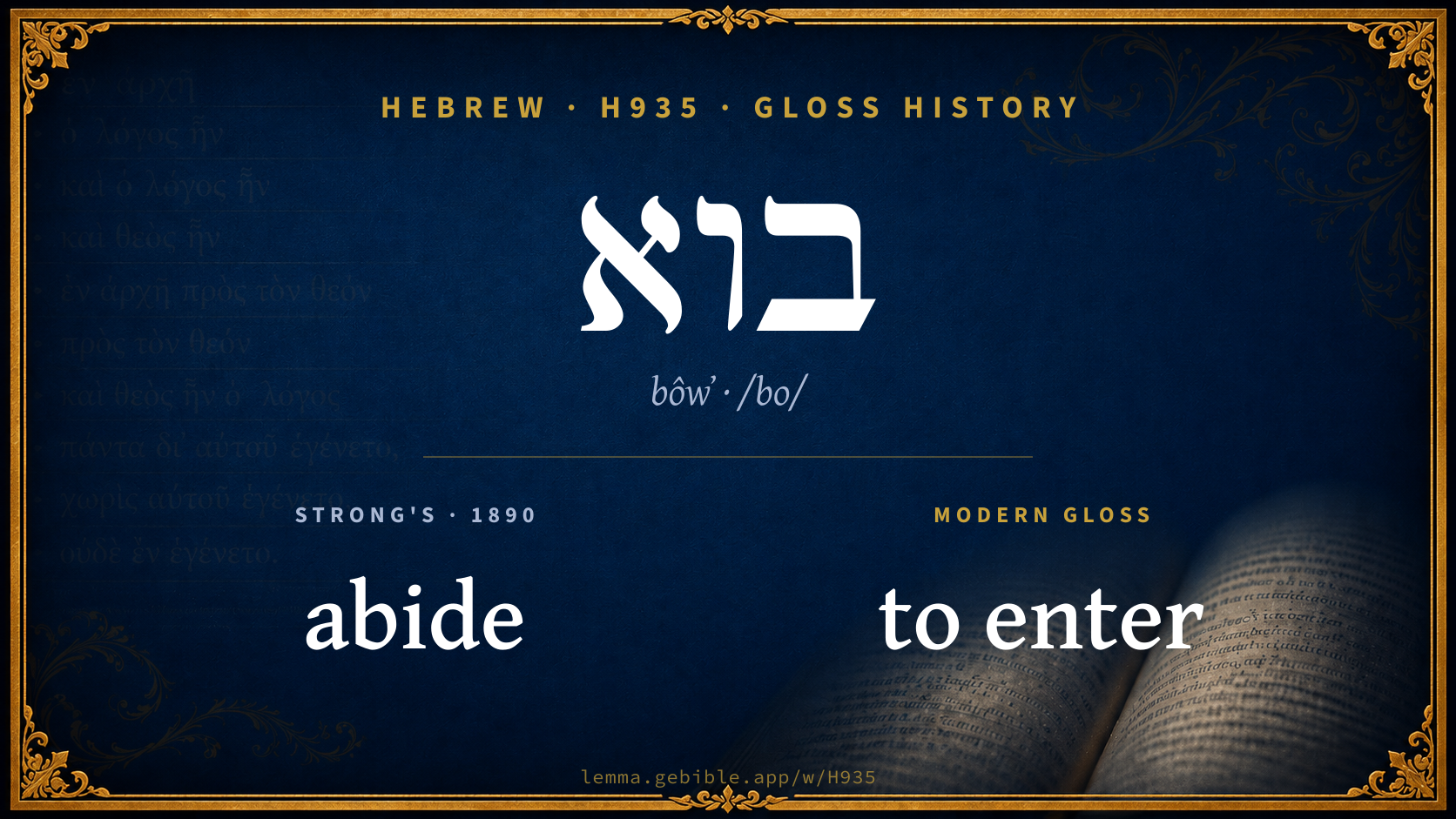
Gloss history
Strong's 1890 vs modern scholarship
About this word
Strong's H935 catalogs a Hebrew word from the Hebrew Old Testament.
These counts are not copied from any lexicon or concordance. They are computed here, from the morphology-tagged Hebrew Old Testament. What Lemma adds →
- 2,307
- distinct verses
- The word appears in 2,307 distinct verses.
- 39 / 39
- OT books
- The word appears in 39 of 39 Old Testament books.
- #14
- by frequency
- Top 25 most frequent Hebrew words (rank 14 of 8,640 Hebrew words by occurrence).
View all 2,307 occurrences in the concordance →
By section of the Old Testament
By traditional corpus
Conventional, traditional groupings — biblical authorship is debated, so this is a traditional corpus grouping, not an authorship claim. Each share is this word’s portion of its verses in that division of the Hebrew canon. Each figure is a share of the word’s 2,307 distinct verses.
- Prophets (Nevi'im) 1,213 verses · 53%
- Torah (Pentateuch) 570 verses · 25%
- Writings (Ketuvim) 524 verses · 23%
How translations render this word
Counts come from each version’s own published word-to-Strong’s tagging or interlinear alignment — an approximate guide to how each version renders this word, not a word-level alignment the data otherwise carries. Because each total is that version’s own tagged count, the per-version totals vary from one another and need not match the appearance or distinct-verse counts above. These counts may also differ from a printed concordance because Lemma counts each distinctly tagged rendering and does not collapse phrase taggings into a single head-word total. This is a fixed set of word-tagged versions (KJV, ASV, BSB, ULT) and does not change with the reading translation you choose elsewhere. Each version’s license is shown beside its name below (and on Sources).
- King James Version: Came 420×, Come 175×, Brought 98×
- American Standard Version: Came 379×, Come 123×, Brought 81×
- Berean Standard Bible: Came 212×, Come 112×, Went 85×
- unfoldingWord Literal Text: Came 327×, And 220×, Come 155×
King James Version Public Domain
Renders H935 across 2,573 tagged occurrences — most commonly:
Plus other, less common renderings. Plus 509 renderings that appear only once — usually multi-word phrases or single function words the recovered tagging swept in, not distinct renderings. Not rendered by a distinct English word in 6 further occurrences.
American Standard Version Public Domain
Renders H935 across 2,567 tagged occurrences — most commonly:
Plus other, less common renderings. Plus 571 renderings that appear only once — usually multi-word phrases or single function words the recovered tagging swept in, not distinct renderings.
Berean Standard Bible Public Domain
Renders H935 across 2,440 tagged occurrences — most commonly:
Plus other, less common renderings. Plus 505 renderings that appear only once — usually multi-word phrases or single function words the recovered tagging swept in, not distinct renderings. Not rendered by a distinct English word in 112 further occurrences.
unfoldingWord Literal Text CC BY-SA 4.0
Renders H935 across 2,955 tagged occurrences — most commonly:
Plus other, less common renderings. Plus 290 renderings that appear only once — usually multi-word phrases or single function words the recovered tagging swept in, not distinct renderings.
41 senses and sub-senses in the full BDB
Hebrew verbs can shift meaning by stem (binyan): Qal is the basic action, Niphal is often passive or reflexive, Piel often intensifies or makes it factitive, and Hiphil is typically causative. The senses below are grouped under the stem BDB assigns to each. This entry also uses Hophal (the passive of Hiphil).
What do BDB’s symbols mean?
BDB uses these scholarly abbreviations:
| Symbol | Meaning |
|---|---|
| 𝔊 | the Septuagint (the ancient Greek translation, LXX) |
| 𝔙 | the Vulgate (the Latin translation) |
| 𝔖 | the Syriac version (the Peshitta) |
| 𝔗 | the Targum (the Aramaic translation) |
| ψ | the Psalms |
| √ | root (the underlying root or stem) |
| ‖ | parallel passage (a synonymous or contrasted parallel) |
| † | the dagger: every passage where the word occurs is cited |
The 41 senses and sub-senses the full Brown-Driver-Briggs lexicon distinguishes for this word, in lexicon order (not ranked by frequency), with BDB’s own verbatim wording and sub-sense lettering. Shown in Hebrew script with BDB’s own scholarly abbreviations. The condensed entry is in the Lexicon Entry tab. See also the Forms in the corpus table below.
Qal
- Pf. בָּא Gn 6:13 +; 3 fs. בָּ֫אָה Gn 15:17 +; sf. בָּאַתְנוּ ψ 44:18; 2 ms. בָּ֫אתָ Jos 13:1 +, בָּ֫אתָה 2 S 3:7; 2 fs. בָּאתְ Gn 16:8 Ru 2:12, וּבָאתְ consec. Ru 3:4 2 S 14:3 Mi 4:10; 3 pl. בָּאוּ Gn 7:9 +; 1 pl. בָּאנוּ Gn 32:7 + (בָּנוּ 1 S 25:8), etc.; Impf. יָבוֹא Gn 32:9 +, יָבֹא Gn 49:10 +; 3 fs. תָּבוֹא Gn 41:50 +; sf. תְּבוֹאָֽתְךָ Jb 22:21 (but text dub. v. Köi. 644); 2 ms. תָּבוֹא Gn 15:15 +; 2 fs. תָּבוֹאִי Ru 3:17 +; 1 s. אָבוֹא Gn 33:14 +; cohort. אָבֹ֫אָה Ju 15:1, אָב֫וֹאָה Gn 29:21 +, וַתָּבֹאתִי 1 S 25:34 (Qr וַתָּבֹאת, but text prob. wrong, v. Köi. 647 Dr, read וַתָּבֹאִי); 3 pl. m. יָבוֹאוּ Gn 6:20 +, also (by textual error) בֹּאוּ Je 27:18 cf. Köi. 645, יְבֹא֑וּן ψ 95:11, sf. יְבֹאוּנִי ψ 119:77, וִיבֹאֻנִי v 41; 3 f. pl. תָּבֹאןָ Gn 30:38, תָּבוֹאנָה 1 S 10:7 +; תְּבֹאֶינָה 1 S 10:7 ψ 45:16, etc.; Imv. בּוֹא, בֹּא Gn 7:1 +, בֹּ֫אָה 1 S 20:21 1 K 13:7, בּ֫וֹאִי, בֹּ֫אִי 2 S 13:11 +; mpl. בֹּ֫אוּ Gn 45:17 +; Inf. בּוֹא, בֹּא Gn 39:16 +; sf. בֹּאִי, בּוֹאִי Gn 48:5 +, בּוֹאֲךָ 1 S 29:6 +, בֹּאֲכָה Gn 10:19 +, etc., בֹּאָם Gn 34:5 +, בֹּאָן Gn 30:38 cf. Ez 42:12 (where Co for בְּבוֹאָן reads לבוא להנה); Pt. בָּא Gn 33:1 +; f. בָּאָ֫ה Gn 29:6 +, הַבָּ֫אָה Gn 18:21 + (accent wrong Ew§ 331 b N.); pl. בָּאִים Gn 18:11 +; cstr. בָּאֵי Gn 23:10 +; f. abs. בָּאוֹת Gn 41:29; (see further on forms Köi. 634 f.);— e.g. Genesis 6:13
- 1. come in, sq. אֶל Gn 6:18; 7:9, 13, sq. בְּ Gn 19:8 & so (subj. רוּחַ) Ez 2:2; 37:10, sq. לְ Est 6:4, sq. ה—ָ loc. Gn 12:11; 41:57 Nu 14:24, sq. acc. (בית) Ju 18:18 2 K 11:19 cf. ψ 100:4 (שַׁעֲרָיו), & בָּאֵי שַׁעַר עִירוֹ Gn 23:10, 18; even of lifeless things 2 K 18:21, וּבָא בְכַפּוֹ (of broken reed) = pierce; of food and drink (sq. אֶל־) Dn 10:3 cf. Gn 41:21 (fat kine when eaten by lean kine); v. also (sq. בְּ) Nu 5:22, 24, 27; abs. Gn 7:16; 24:31 1 K 1:42; 14:6 cf. 2 K 11:5, 9 = 2 Ch 23:4, 8 +; more partic. e.g. Genesis 6:18
- a. opp. יָצָא, go out and come in (Sab. וצֿאם או בהאם Hal152) Jos 6:1 1 K 15:17 = 2 Ch 16:1 2 K 11:8 = 2 Ch 23:7; especially in sense of going about one’s affairs Dt 28:6; 19 Zc 8:10 ψ 121:8; id. + ישׁב 2 K 19:27 = Is 37:28; also sq. לִפְנֵי הָעָם etc. = act as ruler (judge) of, Nu 27:17 2 Ch 1:10 cf. 1 K 3:7; of leading an army 1 S 18:13, 16 cf. also Jos 14:11; v. further Dt 31:2 1 S 29:6 & sub c. infr. e.g. Joshua 6:1
- b. of taking part in worship of congregation Dt 23:2, 3(×2), 4(×2) + (sq. בְּ); or entering into tabernacle for priestly service Ex 28:29, 35 Lv 16:22 (all sq. אֶל־), Ex 28:30 (sq. לִפְנֵי יהוה), Lv 16:17 (sq. inf.) +. e.g. Deuteronomy 23:2
- c. of entering on official duty 2 K 11:9 = 2 Ch 23:8 1 Ch 27:1 (all opp. יצא). e.g. 2 Kings 11:9
- d. of bride coming into her husband’s house Jos 15:18 = Ju 1:14. e.g. Joshua 15:18
- e. of entering a woman’s tent or apartment (with implication coire cum femina, cf. Arabic بَآءٌ NH בִּיאָה coitio; on origin of this use of word cf. RSK 90, 167, 291) Ju 15:1 אֶל־אִשְׁתִּי הֶחָ֑דְרָה, 16;1 Gn 6:4; 16:2; 30:3; 38:8, 9; 39:14 Dt 22:13 2 S 12:24; 16:21; 20:3 Ez 23:44(×3) Pr 6:29 (all sq. אֶל־); sq. עַל־ Gn 19:31 Dt 25:5 יָבֹא עָלֶיהָ וּלְקָחָהּ לוֹ לְאִשָּׁה; cf. בָּאֶיהָ Pr 2:19;—subj. rarely woman Gn 19:34 2 S 11:4. e.g. Judges 15:1
- f. of associating with (sq. בְּ) Jos 23:7, 12 cf. Gn 49:6 בְּסֹדָם אַל תָּבֹא נַפְשִׁי (אַל־תֵּחַד ‖ בִּקְהָלָם). e.g. Joshua 23:7
- g. of entering into specific relations, בּ׳ בְאָלָה, בּ׳ בִבְרִית (v. אלה, ברית); בּוֹא בְדָמִים come into blood-guiltiness, became guilty of murder 1 S 25:26. e.g. 1 Samuel 25:26
- h. of burial, בּ׳ אֶל־קֶבֶר 1 K 13:22; 14:13 cf. תָּבוֹא אֶל־אֲבוֹתֶיךָ Gn 15:15 (‖ תִּקָּבֵר). e.g. 1 Kings 13:22
- i. of sun, set (go in, enter, cf. Assyrian erîb šamši COT Gn 19:23; opp. יצא go forth, rise) Gn 15:12, 17; 28:11 Ex 17:12; 22:25 Lv 22:7 Dt 16:6; 23:12; 24:13, 15 Jos 8:29; 10:13, 27 Ju 19:14 Ec 1:5 2 S 2:24; 3:35 1 K 22:36; 18:34; so also fig. Je 15:9 of calamity בּאה שִׁמְשָׁהּ בְּעוֹד יוֹמָם (‖ אֻמְלְלָה יֹלֶדֶת הַשִּׁבְעָה etc.), cf. Is 60:20; Mi 3:6 וּב׳ הַשֶּׁמֶשׁ עַל־הַנְּבִיאִים of ignorance and confusion. e.g. Genesis 19:23
- j. of harvest, come in = be gathered Lv 25:22 (cf. תְּבוּאָה); so of revenue (income) 1 K 10:14 = 2 Ch 9:13 (sq. לְ pers.),—opp. יצא be expended. k. in other phrases: וַתָּבֹא הָעִיר בַּמָּצוֹר 2 K 24:10 + and the city came into siege; cf. ψ 105:18 בַּרְזֶל בָּאָה נַפְשׁוֹ his soul came into iron (v. AV RVm; Che felt iron chains, cf. Ew Ol Hup Pe; 𝔗 Hi De al. iron came upon his soul); בָּא בַּיָּמִים come into (the) days, = advanced in age Gn 24:1 Jos 13:1; 23:1 (all ‖ זָקֵן); on 1 S 17:12 v. Dr e.g. Leviticus 25:22
- 2. come (approach, arrive) opp. הָלַךְ Gn 16:8 1 S 20:21 (cf. v 22) Ne 6:17 Ec 5:14, 15 (of birth opp. death); sq. אֶל־ pers. vel rei Gn 14:7; 37:23; sq. עַל־ Ex 18:23 2 Ch 20:24 (come up upon, almost = ascend); cf. also Lv 21:11 Nu 6:6; sq. לְ 1 S 9:12 2 Ch 29:17; sq. עַד Nu 13:22 Ju 15:14 2 S 16:5; cf. בָּאוּ בָנִים עַד־מַשְׁבֵּר 2 K 19:3 = Is 37:3 children have come to the birth; sq. עַד + אֶל 2 K 9:20 בָּא עַד אֲלֵיהֶם; sq. ָה loc. Ju 11:16 2 K 6:4; sq. acc. 1 S 4:12; 2 K 8:7 Je 32:24; cf. also La 1:4 בָּאֵי מוֹעֵד those coming to an appointed feast; abs. Gn 45:16 Joseph’s brethren are come, & often; also of lifeless things, ark of י׳ 1 S 4:6; wind Jb 1:19; so כַּסְפְּכֶם בָּא אֵלָ֑י Gn 43:23 your money came unto me = I received your money; our inheritance has fallen to us Nu 32:19 (c. אֶל־); so 1 S 9:16 its cry is come unto me, cf. Gn 18:21 Ex 3:9 La 1:22; of time, often of imminent future, especially in phr. הִנֵּה יָמִים בָּאִים Is 39:6 = 2 K 20:17 Je 7:32; 9:24; 16:14; 19:6; cf. also 1 S 26:10 Ez 7:7 +; of day of י׳ Jo 2:1; 3:4 Zc 14:1 Mal 3:2, 19, 23; also ptcp. as adj. הַיָּמִים הַבָּאִים Ec 2:16 cf. Je 47:4; as subst. הַבָּאוֹת Is 41:22 things to come, future things; & הַבָּאִים alone = adv. in (days) to come Is 27:6; partic. e.g. Genesis 16:8
- a. come with, i. e. come, bringing, sq. בְּ: אָבוֹא בֵיתְךָ בְעוֹלוֹת ψ 66:13; אָבוֹא בִּגְבֻרוֹת אדני י׳ ψ 71:16 (‖ אַזְכִּיר צִדְקָֽתְךָ) so Lv 16:3 & perhaps Pr 18:6—cf. בְּ III. 1. b. e.g. Psalms 66:13
- b. come upon, fall or light upon, of enemy, attack, sq. עַל־ Gn 34:27 1 S 11:12 cf. Gn 32:9 (sq. אֶל־); sq. sf. Jb 15:21, so also 20:22 Ez 32:11; of calamity, etc. Pr 10:24; 28:22 ψ 36:12; 44:18 (all c. sf.); sq. לְ Jb 3:25 (‖ אתה c. sf.) Is 47:9 (‖ בוא על); of blessing, sq. עַל־ Jos 23:15; sq. sf. Jb 22:21 (cf. Di) ψ 119:41, 77. e.g. Genesis 34:27
- c. come to pass, of signs, wonders, predictions, etc. Dt 13:3 Jos 23:14 1 S 9:6 (בֹּא יָבֹא) Is 42:9 Je 28:9 Pr 13:12 Jb 6:8 +. e.g. Deuteronomy 13:3
- d. Gn 6:13 קֵץ כָּל־בָּשָׂר בָּא לְפָנַי perhaps has presented itself before me (v. Kn), cf. La 1:22 supr. & 2 Ch 7:11 (where בוא for usual עלה); but perhaps (cf. Di) has come to pass before me, i. e. in my mind it is already a fact. e.g. Genesis 6:13
- e. † in phr. עַד־בּוֹאֲךָ עַזָּה Ju 6:4 cf. 11:33 1 S 17:52 2 S 5:25 1 K 18:46 (עַד־בֹּאֲכָה) until thou comest to = as far as; so also בּוֹאֲךָ (בֹּאֲכָה) alone, = as far as, or in the direction of, Gn 10:19(×2), 30; 13:10; 25:18 1 S 27:8 (all sq. ָה loc.) 1 S 15:7; so לְבֹא חֲמָת Nu 13:21; 34:8 Ez 48:1, cf. Ez 47:15 (in a different connexion לָבוֹא אפרתה Gn 35:16; 48:7); עַד לְבוֹא ח׳ Jos 13:5 Ju 3:3 1 Ch 13:5, cf. 5:9 2 Ch 26:8 Ez 47:20; מִלְּבוֹא ח׳ Am 6:14 1 K 8:65 2 K 14:25 2 Ch 7:8; of Isaac בָּא מִבּוֹא בְּאֵר לַחַי רֹאִי Gn 24:62 (but text dub.) e.g. Judges 6:4
- f. attain to וְעַד הַשְּׁלשָׁה לֹא בָא 2 S 23:19 = 1 Ch 11:21. e.g. 2 Samuel 23:19
- g. be enumerated הַבָּאִים בְּשֵׁמוֹת, lit. those coming with names 1 Ch 4:38. e.g. 1 Chronicles 4:38
- 3. go, i.e. walk, associate with (עִם) ψ 26:4, so c. אֵת Pr 22:24 (cf. הלך את 13:20 & התהלך את Gn 5:22, 24; 6:9). e.g. Psalms 26:4
- 4. go (cf. הלך) from speaker, but with limit of motion given Is 22:15 לֶךְ־בֹּא אֶל־, so Ez 3:4, 11; Gn 45:17 וּלְכוּ־בֹאוּ אַרְצָה כְּנָ֑עַן; 1 S 22:5 לֵךְ וּבָאתָ־לְךָ אֶרֶץ יְהוּדָה; Is 47:5 Jon 1:3 אֳנִיָּה בָּאָה תַרְשִׁישׁ a ship going to Tarshish; go to war יָבֹאוּ לַמִּלְחָמָה Nu 32:6. e.g. Isaiah 22:15
Hiphil
- Pf. הֵבִיא Gn 4:4 +; sf. הֱבִיאַנִי Dt 9:4 +, etc.; 2 ms. הֵבֵיאתָ Is 43:23, הֵבֵאתָ Gn 20:9 +, etc.; sf. הֲבִיֹאתַנִי 2 S 7:18 1 Ch 17:16, הֲבִיאֹתָנוּ Nu 16:14, הֲבֵתָנוּ ψ 66:11; 1 s. הֵבֵאתִי Gn 31:39 +, והבאיתי Je 25:13 Kt (Qr וְהֵבֵאתִי); sf. וַהֲבִיאוֹתִיךָ Ez 38:16 +, הֲבֵאתִיהָ Is 37:26, etc.; 3 pl. הֵבִיאוּ Gn 43:2 +; sf. הֱבִיאוּהוּ 2 Ch 28:27 etc.; 2 mpl. הֲבֵאתֶם Nu 20:4 +; וַהֲבִיאֹתֶם 1 S 16:17; 1 pl. sf. הֲבִיאֹנֻם Nu 32:17; Impf. יָבִיא (יָבִא) Lv 4:32 +, וַיָּבֵא Gn 2:19 +; sf. וַיְבִיאֵנִי Ez 40:17, etc.; 2 ms. תָּבִיא Jb 14:3; sf. תְּבִיאֵהוּ Je 13:1, וַתְּבִיאֵם Ne 9:23, תְּבִאֵ֗מוֹ Ex 15:17, אָבִיא Ex 11:1 + (אָבִי 1 K 21:29 Mi 1:15), etc.; Imv. הָבֵא Gn 43:16 Ex 4:6, הָבֵיא 1 S 20:40, הָבִיאָה Gn 27:7 +; fs. הָבִיאִי 2 S 13:10 +, etc.; Inf. abs. הָבֵא Hg 1:6; cstr. הָבִיא Gn 18:19 +; Pt. מֵבִיא ψ 74:5 +, מֵבִי 1 K 21:21 + 3 times, מְבִיאֲךָ Dt 8:7; pl. מְבִיאִים (מְבִאִים) 1 K 10:25 +; cstr. מְבִאֵי Je 17:26, מְבִיאֶיהָ Dn 11:6;— e.g. Genesis 4:4
- 1. cause to come in, bring in (conduct, lead, obj. persons and animals), sq. אֶל־ Gn 6:19 Ct 2:4; 3:4; sq. בְּ Lv 26:41 ψ 66:11; sq. לְ Ju 19:21 1 S 19:22; sq. לִפְנֵי Est 1:11, 17; sq. ָה loc. Gn 24:67; 46:7; sq. ָה + אֶל־ Gn 19:10, sq. acc. (חֶדֶר) Ct 1:4 2 K 9:2; also bring, carry in (lifeless things), sq. אֶל־ Nu 31:54 Mal 3:10; sq. בְּ Je 17:21; send, of sending (shooting) arrows (fig.) La 3:13; cf. Lv 26:36; of sending breath (רוּחַ) into dry bones Ez 37:5 (Co על); sq. לְ Ne 13:12; sq. ָה loc. Ex 26:33 2 K 20:20 וַיָּבֵא אֶת־הַמַּיִם הָעִ֑ירָה; sq. acc. (חֶדֶר) 2 S 13:10; also 2 Ch 15:18 (בֵּית); abs. 2 S 6:17; partic. e.g. Genesis 6:19
- a. opp. הוֹצִיא (bring out) Dt 9:28 (sq. אֶל־); especially in combination with הוֹצִיא lead out and in (to and from battle) Nu 27:17 1 Ch 11:2. e.g. Deuteronomy 9:28
- b. bring in women as wives for sons (sq. מִן הַחוּץ) Ju 12:9 (opp. שִׁלַּח הַחוּצָה). e.g. Judges 12:9
- c. bring into judgment וְאֹתִי תָבִיא בְּמִשְׁפָּט עִמָּ֑ךְ Jb 14:3 cf. Ec 11:9; 12:4. e.g. Job 14:3
- d. cause sun to go down Am 8:9 (symbol of judgment). e.g. Amos 8:9
- e. of harvest, bring in, gather 2 S 9:10 Hg 1:6 (opp. זרע) cf. Ne 13:15. e.g. 2 Samuel 9:10
- f. put staves into (בְּ) rings Ex 25:14; 37:5; 38:7 cf. 26:11 Lv 14:42; hand into (בְּ) bosom Ex 4:6(×2); girdle into (בְּ) water Je 13:1. e.g. Exodus 25:14
- g. other phrases, הֵבִיאוּ צַוָּ֯רָם בַּעֲבֹדַת אֲדֹנֵיהֶם Ne 3:5 put their necks to the work, etc.; fig. הביאו את־צואריכם בְּעֹל Je 27:12; הָבִיאָה לַמּוּסָר לֵבֶּ֑ךָ Pr 23:12 apply to instruction thy heart; וְנָבִא לְבַב חָכְמָה ψ 90:12 that we may gain a heart of wisdom. e.g. Nehemiah 3:5
- 2. cause to come, bring, bring near, etc. (animate obj.) sq. אֶל־ Gn 2:19, 22; 43:9 Lv 24:11 Nu 5:15; often of bringing Isr. to Canaan Ex 6:8; 23:23 +, cf. Is 14:2; 56:7 Ne 1:9; abs. Dt 4:38; 6:23; sq. לְ Gn 39:14, 17; sq. ָה loc. Ez 12:13; sq. הֲלֹם Ju 18:3, & עַד־הֲלֹם (fig. of Yahweh’s prospering care) 2 S 7:18 = 1 Ch 17:16; abs. Gn 46:32; also with lifeless obj., Gn 27:10 (sq. לְ), so 2 Ch 36:7; Gn 31:39 (sq. אֶל־); sq. acc. 2 K 12:5 2 Ch 36:18 Dn 1:2(×2); sq. ָה loc. Ex 26:33 Je 20:5; sq. לִפְנֵי 2 Ch 24:14; of ravens bringing food 1 K 17:6 (sq. לְ); of bringing presents Gn 43:26 1 S 9:7; 10:27 (all sq. לְ); cf. 1 S 17:18; especially offerings, sq. לְ Gn 4:3 Nu 15:25 Ne 10:35, 37 (לְבֵית), etc.; Lv 2:2 sq. אֶל־ of priest; abs. Gn 4:4 Lv 4:32; 23:14, 15 Mal 1:13(×2) 2 Ch 31:5; cf. also Ex 35:21, 22, 23, 24:(×2), 27, 29 (sq. לְ for) so 36:3 +; of time, cause a day to come La 1:21; cause cry to come (עַל־) Jb 34:28; = carry והב׳ בָּנַיִךְ בְּחֹצֶן Is 49:22 (‖ עַל־כָּתֵף נשׂא); carry God in (בְּ) the hand Jb 12:6 (cf. אֱלהַּ p. 43); allow to come, almost = invite Est 5:12 (sq. אֶל־) cf. v 10; partic. e.g. Genesis 2:19
- a. sq. עַל־ bring against, or upon, bring enemies against Je 25:9 cf. Ez 23:22; obj. sword Lv 26:25 Ez 5:17; 11:8; 14:17; 33:2; plague Ex 11:1; curse or calamity Gn 27:12 Dt 29:26 1 K 9:9 = 2 Ch 7:22 Jb 42:11 cf. Je 25:13; 36:31; 44:2; 49:8, 37 Ez 14:22; sin Gn 20:9; 26:10 Ex 32:21; cf. also sq. אֶל־ Je 32:42; 49:36. e.g. Jeremiah 25:9
- b. bring to pass 2 K 19:25 = Is 37:26 cf. 1 Ch 4:10 ψ 78:29. e.g. 2 Kings 19:25
- c. bring, bring forward, bring on the scene Mi 1:15 Zc 3:8. e.g. Micah 1:15
- d. bring for a purpose, sq. inf. ψ 78:71 עָלוֹת הֱבִיאוֹ לִרְעוֹת בְּיַעֲקֹב עַמּוֹ מֵאַחַר. e.g. Psalms 78:71
- e. bring, procure בְּנַפְשֵׁנוּ נָבִיא לַחְמֵנוּ La 5:9, ψ 90:12. e.g. Lamentations 5:9
Hophal
- Pf. הוּבָא Lv 10:18 +; 3 fs. הֻבָאת Gn 33:11 (v. infr.); 2 ms. הֻבָ֫אתָה Ez 40:4; 3 pl. הוּבְאוּ Gn 43:18; Impf. יוּבָא Lv 6:23 +, יוּבָ֑אוּ Je 27:22; Pt. מוּבָא 2 K 12:10 +; pl. מוּבָאִים Gn 43:18 Ez 30:11 + 23:42 (Co מרבדים), מוּבָאוֹת ψ 45:15;— e.g. Leviticus 10:18
- a. be brought in (of pers. and things), abs. Gn 43:18; sq. בית into a house Gn 43:18; temple 2 K 12:5, 10, 14, 17; 22:4 2 Ch 34:9, 14. e.g. Genesis 43:18
- b. be brought, sq. לְ Gn 33:11 (but 𝔊 read Hiph. I have brought), ψ 45:15; sq. אֶל־ unto Lv 6:23; 10:18; 13:2, 9; 14:2; cf. Ez 23:42 (but v. Co VB); sq. הֵ֫נָּה Ez 40:4; sq. בָּבֶ֫לָה Je 27:22; sq. inf. Lv 16:27 Ez 30:11; sq. מִן Je 10:9. e.g. Genesis 33:11
- c. be introduced, put, sq. בְּ, staves into rings Ex 27:7; vessel into water Lv 11:32. e.g. Exodus 27:7
Senses from the full Brown-Driver-Briggs lexicon (Brown, Driver, Briggs; Oxford 1906 — public domain), digitized via Sefaria, supplemented by the OpenScriptures HebrewLexicon (CC BY 4.0). Full attribution on Sources.
Word origin
vb. come in, come, go in, go (Assyrian bâʾu HptKAT 499, Ethiopic ቦአ Arabic بَآءَ return)—
— Brown-Driver-Briggs (Oxford 1906, public domain), digitized via Sefaria, supplemented by the OpenScriptures HebrewLexicon (CC BY 4.0). See Sources.
Origin: a primitive root
Jastrow Dictionary
A second Hebrew/Aramaic lexicon for comparison, covering Aramaic and post-biblical (Talmudic, Targumic, Midrashic) usage that the biblical-Hebrew BDB does not. Matched by lemma rather than by Strong’s number, so a lemma may carry more than one Jastrow headword (shown separately below), and the entries cover usage well beyond the Bible.
בּוֹא
- 1. to enter, come. R. Hash. I, 2 בָּאֵי העולם those come into the world, i.e. mortals. Ḥull. 54ᵇ בּוֹאֲכֶם בשלום be welcome!—Tanḥ. Vaëra 14; Midr. Till. to Ps. LXXVIII, 47, a. e. (play on ב̇ח̇נ̇מ̇ל̇ ibid.) [ב̇א נ̇ח̇ מ̇ל̇] ב̇א ח̇ן̇ מ̇ל̇ it (the locust) comes, encamps [rests], and plucks. Y. Shebu. VIII, 38ᶜ top, a. e. במקום שבאת, v. גְּזֵרָה.—Y. Peah I, 15ᶜ top, a. fr. יָבֹא עלי אם וכ׳ may (evil) befall me, if—; cmp. אֲתָא; Koh. R. to X, 8 אם לא יבא וכ׳ (corr. acc.).
- 2. with על (b. h. to have sexual connection. Kerith. I, 1; a. fr.
- 3. with לְיַד or לִידֵי to fall into the power of.—Aboth II, 1 ואין אתה בא לידי עבירה and sin will have no power over thee. Yoma 86ᵇ בא לידו דבר וכ׳ (not באת) he had the power (the chance) to commit a sin &c.; Kidd. 39ᵇ; a. fr.—בּוֹא וראה come and see (I will prove). Yoma l. c.; a. fr.
- 1. to bring, carry. Gitt. I, 1 המֵבִיא וכ׳ he who brings (as a messenger) a letter of divorce from abroad; a. fr.
- 2. to offer. Bicc. I, 1; a. fr.
- 3. to draw an object toward’s one’s self, opp. הוֹלִיךְ, v. הָלַךְ. Ḥull. II, 3 הוליך ולא ה׳ he put the knife out (in slaughtering) but did not draw it backward; ה׳ ולא וכ׳ or drew it toward himself but did not then move forward; a. fr.
- 4. to bring about, produce, cause. Aboth I, 17 מביא חטא begets sin; a. fr.
- 5. to lead, procure admittance. Ab. Zar. 20ᵇ Torah מביאה לידי וכ׳ (v. supra) leads to careful conduct &c. Ib. 18ᵃ אתה מְבִיאֵנִי וכ׳ wilt thou procure me (promise me) admittance into the world to come?; a. fr.
A Dictionary of the Targumim, the Talmud Babli and Yerushalmi, and the Midrashic Literature (Marcus Jastrow; London, Luzac, 1903) — Public Domain. Digitized via Sefaria. Digitized via Sefaria. Full attribution on Sources.
Forms in the corpus
The 1,091 distinct written forms H935 takes in the Hebrew Bible, most frequent first — each parse links to that stem’s occurrences in the concordance. Hebrew forms include their vowel points and cantillation, so a single lemma takes many written forms.
The 60 most common forms are shown; 1,031 rarer forms follow in the full concordance.
Same root — word family
Other BDB entries built from the same root as H935, grouped by Strong’s listed origin. These share a root / origin per the lexicon — not necessarily a shared meaning. Each links to that word’s own entry.
Derived from this word
Compare all same-root words → They share a root, not necessarily a meaning.
Septuagint verse parallels
This word appears in 2,182 verses that also exist in the Greek Old Testament (Septuagint), out of the 2,307 Hebrew verses it occurs in. You can read those verses in Greek by switching the Old Testament edition to the Septuagint.
Read these verses in the Septuagint
- Genesis 2:19
- Exodus 1:1
- Leviticus 2:2
- Numbers 4:3
- Deuteronomy 1:7
- Joshua 1:11
- Judges 1:7
- Ruth 1:2
- 1 Samuel 1:19
- 2 Samuel 1:2
- 1 Kings 1:1
- 2 Kings 1:13
This is a verse-level parallel only — the same verses exist in both the Hebrew and Greek Old Testaments. No word-level Hebrew↔Greek correspondence is claimed: the data carries no such alignment, so no Greek word is shown as this Hebrew word’s translation. Coverage is not total — the Septuagint omits the deuterocanon and renumbers the Psalms, so some Hebrew verses have no direct Greek parallel.