Exodus 14:23

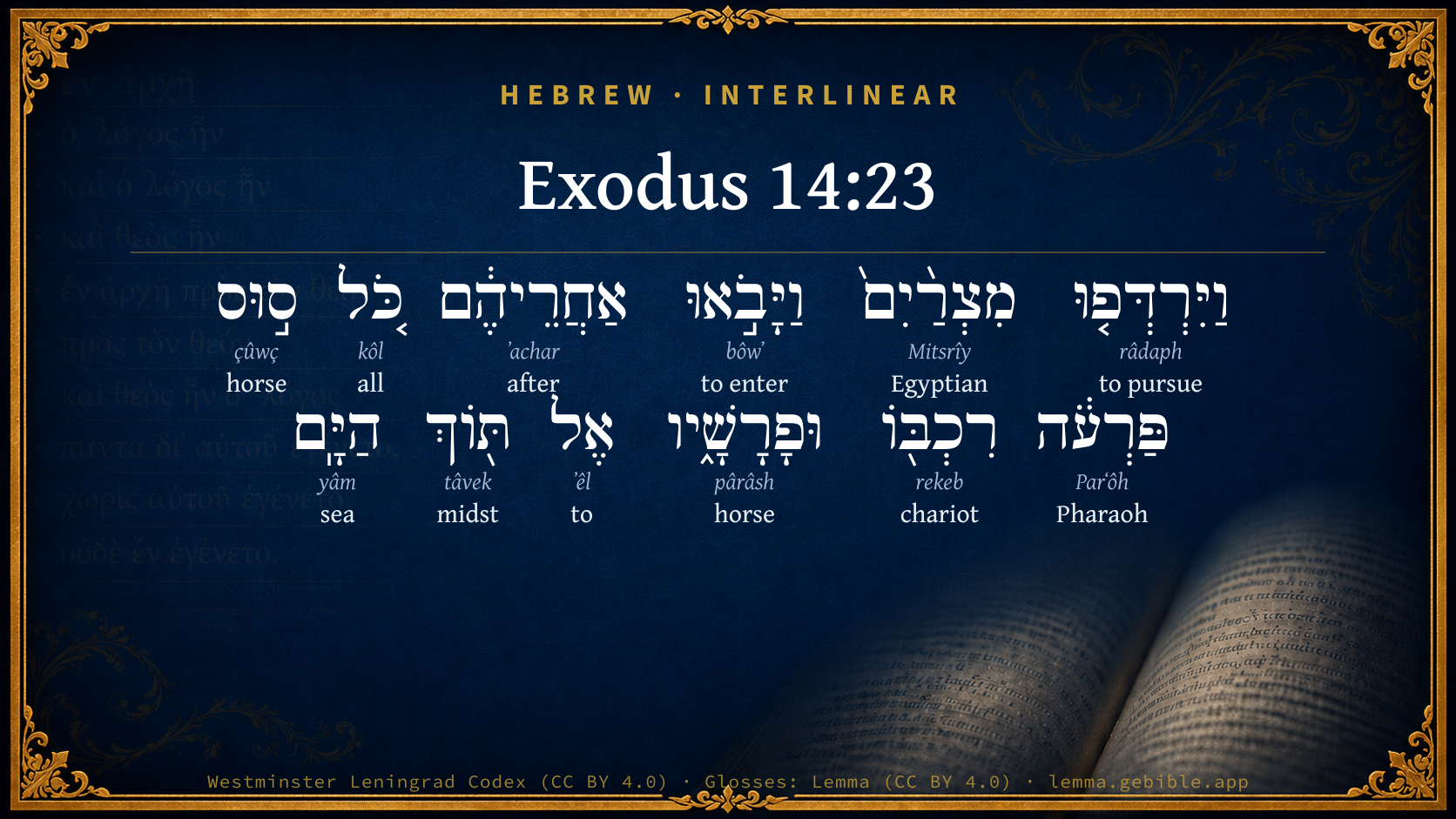
Hebrew (Westminster Leningrad Codex) Exodus 14:23 appears in the Hebrew Old Testament. The text above is from the Westminster Leningrad Codex. Each word links to its Strong’s number, a concise gloss, and parsing drawn from the Open Scriptures Hebrew Bible morphology. Click any word for its full Brown-Driver-Briggs (BDB) entry.
Download image
Cite this verse

Exodus 14:23 (World English Bible). Public Domain. Lemma interlinear Bible study tool, https://lemma.gebible.app/v/exodus/14/23.

Show BibTeX & RIS
BibTeX
RIS
English Translation
The Egyptians pursued, and went in after them into the midst of the sea: all of Pharaoh's horses, his chariots, and his horsemen.
World English Bible · Public Domain
Download a study sheet

One document with this verse’s original text, its word-by-word gloss line, the meaning frame, cross-references with their text, attributed commentary, and full source and license credits — printable, and it pastes into notes with its structure intact.

This verse Autodidact and up

Study sheet (.html) Plain text (.txt)

A passage Seminary Student

Up to 50 verses in one chapter. A passage sheet keeps up to 6 commentary sources and 12 cross-references per verse, in the order this page ranks them, and says so on the sheet whenever that leaves anything out. Ask for a single verse and you get the Autodidact verse sheet above.

Everything on this page stays free to read, with no account — the sheet is a download of what is already on screen, not access to it.

Want to remove ads? Support Godless Engineer
Compare translations 3

The same verse in 3 English versions, stacked beneath the original-language interlinear above. Click any original word for its lexicon entry.

Each is an independent rendering of the whole verse — the interlinear is not word-aligned to these translations.

Highlighted words mark where these versions differ — a whole-verse word diff, not a word-by-word alignment.

  • World English Bible Public Domain
    The Egyptians pursued, and went in after them into the midst of the sea: all of Pharaoh's horses, his chariots, and his horsemen.
  • King James Version Public Domain
    And the Egyptians pursued, and went in after them to the midst of the sea, even all Pharaoh's horses, his chariots, and his horsemen.
  • unfoldingWord Literal Text CC BY-SA 4.0
    And the Egyptians pursued, and entered after them—every horse of Pharaoh, his chariots, and his horsemen—into the middle of the sea.

unfoldingWord Literal Text — © unfoldingWord, licensed CC BY-SA 4.0. Word-aligned USFM3 via Door43 (git.door43.org/unfoldingWord/en_ult).

Versions to compare (up to 4)

3 of 4 selected

Show all 18 translations

Every available English version of this verse, each an independent rendering of the whole verse.

  • World English Bible Public Domain
    The Egyptians pursued, and went in after them into the midst of the sea: all of Pharaoh's horses, his chariots, and his horsemen.
  • Berean Standard Bible Public Domain
    And the Egyptians chased after them—all Pharaoh’s horses, chariots, and horsemen—and followed them into the sea.
  • Majority Standard Bible Public Domain
    And the Egyptians chased after them—all Pharaoh’s horses, chariots, and horsemen—and followed them into the sea.
  • King James Version Public Domain
    And the Egyptians pursued, and went in after them to the midst of the sea, even all Pharaoh's horses, his chariots, and his horsemen.
  • American Standard Version (1901) Public Domain
    And the Egyptians pursued, and went in after them into the midst of the sea, all Pharaoh's horses, his chariots, and his horsemen.
  • Revised Version (1885) Public Domain
    And the Egyptians pursued, and went in after them into the midst of the sea, all Pharaoh’s horses, his chariots, and his horsemen.
  • Geneva Bible (1599) Public Domain
    And the Egyptians pursued and went after them to the middes of the Sea, euen all Pharaohs horses, his charets, and his horsemen.
  • Douay-Rheims (1899) Public Domain
    And the Egyptians pursuing went in after them, and all Pharao's horses, his chariots and horsemen through the midst of the sea,
  • Young's Literal Translation Public Domain
    And the Egyptians pursue, and go in after them (all the horses of Pharaoh, his chariots, and his horsemen) unto the midst of the sea,
  • Literal Standard Version CC BY-SA 4.0
    And the Egyptians pursue, and go in after them (all the horses of Pharaoh, his chariots, and his horsemen) into the midst of the sea,
  • Unlocked Literal Bible CC BY-SA 4.0
    The Egyptians pursued them. They went after them into the middle of the sea—all Pharaoh's horses, chariots, and horsemen.
  • unfoldingWord Literal Text CC BY-SA 4.0
    And the Egyptians pursued, and entered after them—every horse of Pharaoh, his chariots, and his horsemen—into the middle of the sea.
  • Darby Bible Public Domain
    And the Egyptians pursued and came after them -- all Pharaoh's horses, his chariots and his horsemen, into the midst of the sea.
  • World Messianic Bible Public Domain
    The Egyptians pursued, and went in after them into the middle of the sea: all of Pharaoh’s horses, his chariots, and his horsemen.
  • Webster's Bible Public Domain
    And the Egyptians pursued, and went in after them to the midst of the sea, even all Pharaoh's horses, his chariots, and his horsemen.
  • Free Bible Version CC BY-SA 4.0
    The Egyptians chased after them—all Pharaoh's horses, chariots, and horsemen. They followed the Israelites into the sea.
  • Bible in Basic English Public Domain
    Then the Egyptians went after them into the middle of the sea, all Pharaoh's horses and his war-carriages and his horsemen.
  • JPS Tanakh (1917) Public Domain
    And the Egyptians pursued, and went in after them into the midst of the sea, all Pharaoh's horses, his chariots, and his horsemen.

Literal Standard Version (2020), Covenant Press — licensed CC BY-SA 4.0. Text via the HelloAO Bible API (eBible.org). Unlocked Literal Bible (unfoldingWord) — licensed CC BY-SA 4.0. Text via the HelloAO Bible API (eBible.org). unfoldingWord Literal Text — © unfoldingWord, licensed CC BY-SA 4.0. Word-aligned USFM3 via Door43 (git.door43.org/unfoldingWord/en_ult). Free Bible Version, Dr. Jonathan Gallagher — licensed CC BY-SA 4.0. Text via the HelloAO Bible API (eBible.org).

Word by word

More ways to search: Search by grammar → Find every occurrence → Compare this word →

Practice this passage: Drill this verse → Learn its vocabulary →

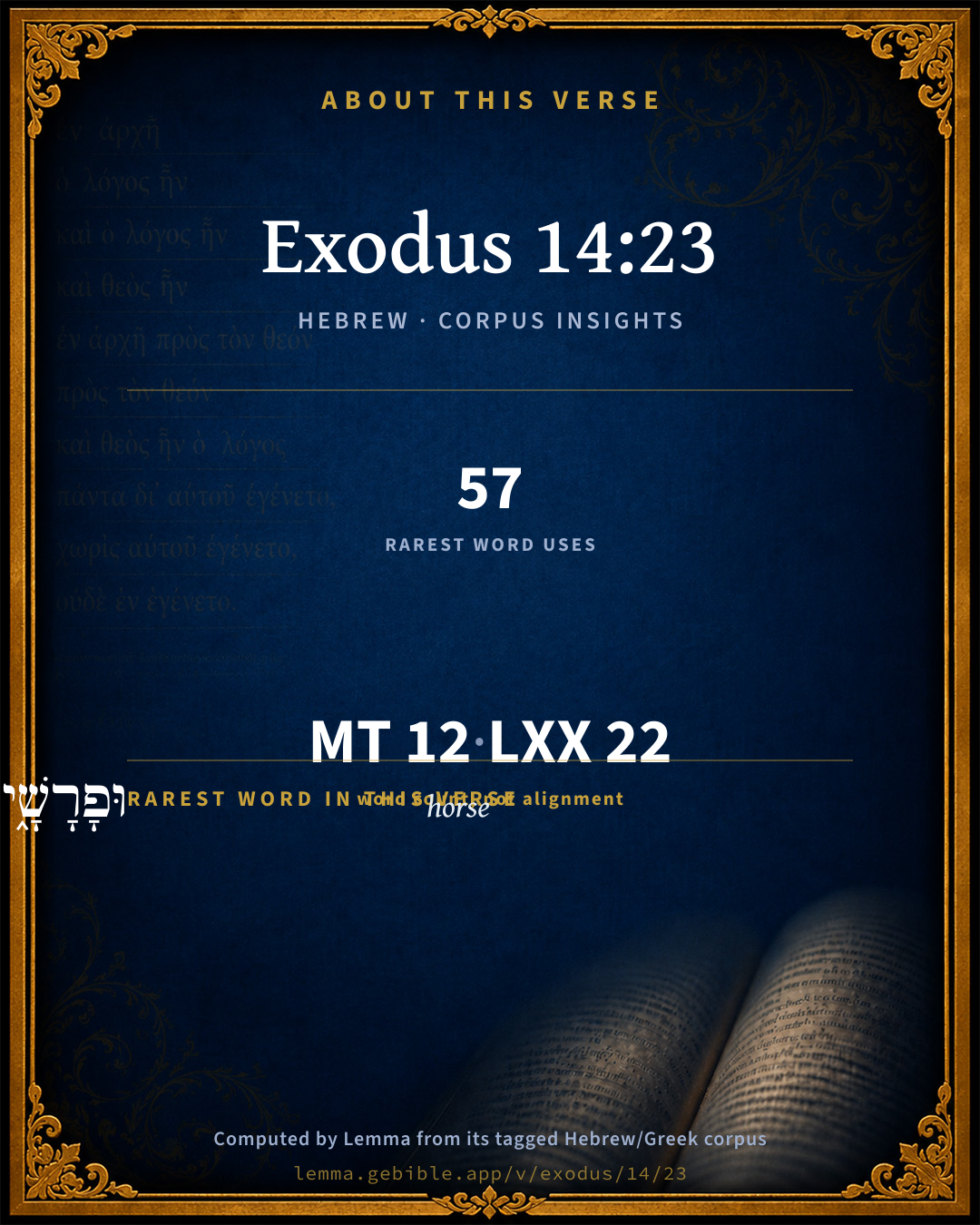
וּפָרָשָׁ֑יו
pârâsh
H6571
“and · horses · his”
Conjunction + Noun, Common, Masculine, Plural, Construct + Suffix, Personal, 3rd Person, Masculine, Singular
Part of Speech
Conjunction + Noun
Type
Common
Gender
Masculine
Number
Plural
State
Construct
Full BDB Definition

Origin: from H6567

TWOT: 1836a

horse, steed, warhorse - horseman
  1. וַיִּרְדְּפ֤וּ râdaph H7291 “and · to pursue” Conjunction + Verb, Qal, Sequential Imperfect, 3rd Person, Masculine, Plural
  2. מִצְרַ֨יִם֙ Mitsrîy H4713 “Egyptian” Noun, Proper
  3. וַיָּבֹ֣אוּ bôwʼ H935 “and · to enter” Conjunction + Verb, Qal, Sequential Imperfect, 3rd Person, Masculine, Plural
  4. אַחֲרֵיהֶ֔ם ʼachar H310 “after · them” Preposition + Suffix, Personal, 3rd Person, Masculine, Plural
  5. כֹּ֚ל kôl H3605 “all of” Noun, Common, Masculine, Singular, Construct
  6. ס֣וּס çûwç H5483 “horse of” Noun, Common, Masculine, Singular, Construct
  7. פַּרְעֹ֔ה Parʻôh H6547 “Pharaoh” Noun, Proper
  8. רִכְבּ֖וֹ rekeb H7393 “chariot · his” Noun, Common, Masculine, Singular, Construct + Suffix, Personal, 3rd Person, Masculine, Singular
  9. אֶל ʼêl H413 “to” Preposition
  10. תּ֖וֹךְ tâvek H8432 “midst of” Noun, Common, Masculine, Singular, Construct
  11. הַיָּֽם yâm H3220 “the · sea” Particle, Definite Article + Noun, Common, Masculine, Singular, Absolute

About this verse

These counts appear in no published source. They are computed here, from the morphology-tagged text and Lemma’s own curated glosses. What Lemma adds →

12
words
12
distinct lemmas
Pentateuch
section

Shared distinctive vocabulary

וּפָרָשָׁ֑יו horse H6571 occurs in 54 verses of the Hebrew Bible. Also found in:

Grammatical profile

  • 2 verbs
  • 8 nouns
  • 2 prepositions

Verb forms

  • וַיִּרְדְּפ֤וּ Qal · Sequential Imperfect
  • וַיָּבֹ֣אוּ Qal · Sequential Imperfect

Hebrew & Septuagint length

In English translation the verse runs 23 words from the Hebrew and 27 from the Septuagint (LXX English) — closely comparable.

A rough comparison of the two English renderings, which tokenize alike — not a word-level alignment.

Word counts can differ between the Hebrew and the Greek without any difference in meaning — e.g. the Hebrew direct-object marker אֵת has no separate Greek word, and Greek often adds the article ὁ.

In the original languages it is 12 Hebrew tokens and 22 Greek tokens — but the two are counted differently (Hebrew bundles its prefixes and suffixes into one token; the Greek is in lemma form), so that isn’t a like-for-like length.

Cross-references

6

Topical passages linked to Exodus 14:23 in the Treasury of Scripture Knowledge — connected by theme and wording, ordered by reader-vote popularity; previews shown in the World English Bible.

  • Exodus 14:17 I, behold, I will harden the hearts of the Egyptians, and they shall go in after them: and I will get myself honor over Pharaoh, and over all his host, over his chariots, and over his horsemen.
  • Exodus 15:19 For the horses of Pharaoh went in with his chariots and with his horsemen into the sea, and Yahweh brought back the waters of the sea on them; but the children of Israel walked on dry land in the midst of the sea.
  • Exodus 15:9 The enemy said, 'I will pursue, I will overtake, I will divide the spoil. My desire shall be satisfied on them. I will draw my sword, my hand shall destroy them.'
  • 1 Kings 22:20 Yahweh said, Who shall entice Ahab, that he may go up and fall at Ramoth-gilead? One said on this manner; and another said on that manner.
  • Ecclesiastes 9:3 This is an evil in all that is done under the sun, that there is one event to all: yes also, the heart of the sons of men is full of evil, and madness is in their heart while they live, and after that they go to the dead.
  • Isaiah 14:24–27 Yahweh of Hosts has sworn, saying, Surely, as I have thought, so shall it happen; and as I have purposed, so shall it stand:

Cross-references courtesy of OpenBible.info (CC BY 4.0).

Hebrew and Greek witnesses Masoretic Hebrew ↔ Greek Septuagint

The same verse in the two great witnesses to the Old Testament, shown verse-for-verse.

These are two independent witnesses, not word-aligned to each other, and the Septuagint is shown in lemma (dictionary) form.

Hebrew Exodus 14:23 Masoretic · Westminster Leningrad Codex

וַיִּרְדְּפ֤וּ מִצְרַ֨יִם֙ וַיָּבֹ֣אוּ אַחֲרֵיהֶ֔ם כֹּ֚ל ס֣וּס פַּרְעֹ֔ה רִכְבּ֖וֹ וּפָרָשָׁ֑יו אֶל תּ֖וֹךְ הַיָּֽם

The Egyptians pursued, and went in after them into the midst of the sea: all of Pharaoh's horses, his chariots, and his horsemen.

World English Bible · Public Domain

Greek LXX Exodus 14:23 Septuagint · lemma form

καταδιώκω δέ ὁ αἰγύπτιος καί εἰςἔρχομαι ὀπίσω αὐτός πᾶς ὁ ἵππος φαραώ καί ὁ ἅρμα καί ὁ ἀναβάτης εἰς μέσος ὁ θάλασσα

And the Egyptians pursued them and went in after them, and every horse of Pharao, and his chariots, and his horsemen, into the midst of the sea.

LXX2012 (modern English Septuagint) · Public Domain

On this verse, Ellicott's Commentary for English Readers discusses the Septuagint’s reading. Read the note in Commentary ↓

Hebrew: Westminster Leningrad Codex (CC BY 4.0). Greek: Septuagint (public domain); English from LXX2012 (modern English Septuagint) (Public Domain). How the Septuagint differs from the Hebrew →

Targum (Aramaic paraphrase)

2

The Targum is the ancient Jewish Aramaic paraphrase of the Hebrew Scriptures — an interpretive translation, not the Hebrew text itself. Onkelos (literal) and Pseudo-Jonathan (expansive) render the Torah, and Jonathan the Prophets. Coverage is partial: where no permissively-licensed English translation exists for a verse, only the Aramaic is shown. This is verse-level text, not a word-by-word alignment to the Hebrew.

  1. Targum Onkelos Torah (Genesis–Deuteronomy)
    וּרְדָפוּ מִצְרָאֵי וְעַלוּ בַתְרֵיהוֹן כֹּל סוּסָוַת פַּרְעֹה רְתִכּוֹהִי וּפָרָשׁוֹהִי לְגוֹ יַמָא:

    (no public-domain English translation for this verse)

    Targum Onkelos — Aramaic: “Onkelos Genesis” (public domain); “Onkelos Exodus” (public domain); “Onkelos Leviticus” (public domain); “Onkelos Numbers” (public domain); “Onkelos Deuteronomy” (public domain). English: “Sefaria Community Translation” (CC0 1.0 (public-domain dedication)); “J.W. Etheridge. The Targums of Onkelos and Jonathan Ben Uzziel on the Pentateuch. London: Longmans, Green, 1862” (public domain). Text via Sefaria.

  2. Targum Pseudo-Jonathan Torah (Genesis–Deuteronomy)
    וּרְדָפוּ מִצְרָאֵי וְעָלוּ מִן בַּתְרֵיהוֹן כָּל סוּסָוַות פַּרְעה רְתִיכוֹי וּפְרָשׁוֹי לְגוֹ יַמָּא

    And the Mizraee followed and went in after them, all the horses of Pharoh, and his chariots and horsemen, into the midst of the sea.

    Targum Pseudo-Jonathan — Aramaic: “Targum Jonathan on Genesis” (public domain); “Targum Jonathan on Exodus” (public domain); “Targum Jonathan on Leviticus” (public domain); “Targum Jonathan on Numbers” (public domain); “Targum Jonathan on Deuteronomy” (public domain). English: “The Targum of Jonathan ben Uzziel, trans. J. W. Etheridge, London, 1862” (public domain). Text via Sefaria.

Commentary

Notes on Exodus 14:23 from classic Christian and Jewish commentators (each source and its license shown beneath its notes). The classic Christian expositions comment on the surrounding passage and are grouped to its opening verse, so a note may address several verses; the Jewish commentaries on the Tanakh (Rashi and others) are per-verse, so they appear only where the commentator wrote on this verse.

Lemma curates 59 commentaries, every one of them public domain or Creative Commons licensed, each selected and text-cleaned for this edition rather than reprinted as found. About our sources →

Trapp's Complete Commentary

John Trapp

Exo 14:23 And the Egyptians pursued, and went in after them to the midst of the sea, [even] all Pharaoh’s horses, his chariots, and his horsemen.

Ver. 23. And the Egyptians pursued.] God permitting it, and making fair weather before them, they also blustering, and "breathing out threatenings," saying, "I will pursue, I will overtake, I will divide the spoil," &c., till anon "they sank as lead in the mighty waters." {Exo 15:9-10}

John Trapp, A Commentary or Exposition upon All the Books of the Old and New Testament (1647–1656) — public domain. Text from a community e-Sword module.

Joseph Benson's Commentary

Exo 14:23. And the Egyptians went in after them into the midst of the sea — They thought, Why might they not venture where Israel did? They were more advantageously provided with chariots and horses, while the Israelites were on foot.

Joseph Benson's Commentary on the Old and New Testaments (1811–1818) — public domain. Text from a community e-Sword module.

The Preacher's Complete Homiletical Commentary

Joseph S. Exell (gen. ed.)

CRITICAL NOTES.—

Exo_14:25. Took off their chariot wheels.] “And made glide out their chariot wheels”—Kalisch. “And turneth aside the wheels of their chariots”—Young. The original word means to “make depart,” “turn away,” “put aside,” “remove,” &c. Hence, and from the incongruity of supposing any further progress made in wheelless chariots, it may well be doubted whether the rendering of the English version conveys the true meaning of the narrative. More in keeping with the context would be the more general notion of removing the wheels from their track, causing them to slip away so as to make progress extremely difficult. Only, this effect should clearly be connected with the Divine troubling of the Egyptian host. Precisely how the cause produced this effect we are not told: it is a matter of little or no Importance.

MAIN HOMILETICS OF THE PARAGRAPH.—Exo_14:23-29

THE DIVINE TROUBLING OF THE WICKED

I. That the Divine troubling of the wicked takes place in the midst of their presumption and sin. “And the Egyptians pursued, and went in after them to the midst of the sea. “Thus we see that the Egyptians were at this time in full pursuit of the Israelites, and were presumptuously following them into the miraculously divided waters. Hence they were in direct opposition to the command of God,—they were seeking the bondage and ruin of a vast people. They were animated by their besetting sin,—an intense spirit of selfish despotism Sin has immense power of will. It is careless of the greatest peril, it will pursue its design into the waters of the Red Sea, and will venture on paths which are only safe for the people of God, and in which it can easily be destroyed. It does not always act with sufficient calculation and caution; it rushes blindly to its awful destiny. It was when the Egyptians were in the midst of the waters that they were troubled by God. It is easy for God to trouble the sinner in the midst of his sin. When the sinner is hottest in pursuit and surest of success in his unholy aim, then the Divine Being can trouble him through the cloud. Belshazzar was thus troubled in the hour of his impious feast (Dan_5:9). Thus the wicked are troubled when they are engaged in their most desperate attempts at evil; when they are least expecting disaster, they are troubled by the smitings of an alarmed conscience,—they are troubled by the hand of God. The Divine eye looks through the cloud upon the exploits of the wicked.

II. That the Divine troubling of the wicked causes the mad schemes in which they are engaged to drag heavily. “And took off their chariot wheels, that they drave them heavily.” The Egyptians had got their best armaments with them,—their strongest chariots, their finest horses, their most skilful men, and all was in splendid battle array. And yet their chariots drave heavily! Why? Were they not well made? Were they not well managed? Yes; but they were troubled by God. Thus God can bring to naught the best preparations of the sinner for his cruel designs; He can render useless the finest chariots. The sinner finds it hard work to drive his car. The Divine troubling is an impediment to the enterprise of the evil-doer; in this way the success of evil to an alarming extent is prevented, and the safety of the Church is attained. Sin cannot prosper, because it is against God. It is a mercy that the chariots of sin drag heavily, or men would ride to hell more quickly than they do.

III. That the Divine troubling of the wicked sometimes causes them to wish to retreat from their evil designs when it is too late. “So that the Egyptians said, Let us flee from the face of Israel, for the Lord fighteth for them against the Egyptians.” Why did the Egyptians wish to flee? Were they not well armed? Was not their King with them? Were they not brave? Were they not near to the slaves they wished to recapture? There are times when sinners are obliged to see that their wicked enterprises are vain, and that they cannot succeed. They are obliged to acknowledge the failure of their best energies. They soon know when they are troubled by the Lord. Then they wish to make the best escape they can, but it is too late. Let us beware of the folly and danger of pursuing a life of sin so long that there can be no escape therefrom. It is dangerous to delay conversion. Some men will never retreat from sin till they are troubled by God, and then perhaps they cannot.

IV. That the Divine troubling of the wicked will in all probability culminate in their utter ruin and destruction. “And the Lord said unto Moses, Stretch out thine hand over the sea, that the waters may come again upon the Egyptians, upon their chariots, and upon their horsemen.… There remained not so much as one of them.” Here, then, we have a picture of what will be the end of those who sin against God, and who provoke His troubling ministries. God can employ many agencies to work their ruin. The waters will obey His behest. There are many rods by which they may be smitten. Then the display of sin, the best strength of sin, and all the allies of sin will yield to the retributive hand of God. The end of sin is to be buried in the great waters. The sinner is walking to an awful destiny. LESSONS:—

1. That the wicked are sure to be Divinely troubled.

2. That it is vain to seek to bring the Church into bondage.

3. That the end of sin is death.

SUGGESTIVE COMMENTS ON THE VERSES

Exo_14:22-23. The Church is pursued:—

1. By cruel tyrants.

2. By combined enemies.

3. Into hazardous places.

4. By intense hatred.

The folly of sin:—

1. It will rush into dangerous places.

2. It will risk all its best agencies.

3. It will go beyond the possibility of retreat.

The enterprise of the wicked:—

1. Divinely observed.

2. Easily troubled.

3. Terribly defeated.

Sinners are troubled:—

1. By the voice of conscience.

2. By the painful discipline of life.

3. By the failure of their best concerted schemes.

Exo_14:25-28. Morning and evening may not be the same to the wicked for their hopes.

God will stop the movements of persecuting powers in His due and proper time.

Persecutors always find that Jehovah fights for His Church.

ILLUSTRATIONS

BY

REV. WM. ADAMSON

Convictions! Exo_14:23-29. Away on the Pampa dell Sacramento roam wild tribes of Indians. Of all, the Cashiboos are the most savage and warlike. Equally cunning as fierce, when they see the traveller they do not attack him at once in the broad day. They watch and track him to his sleeping-place, and when he is locked in slumber deep, they spring upon him for the cannibal feast. Sometimes the sleeper is aroused in time to defend himself. When these wild, subtle savages find that they have no chance of success, they retire. But it is only to watch and wait, until some other night arrives when they may renew the attack with more success. Pharaoh’s lusts sought his destruction. Again and again, did they spring upon him in his sleep of self-indulgence; but he awoke to timely—though alas! transient—repentance. With cruel craft and confidence did they persist, until at last they accomplished their remorseless purpose—

“Until, at last, the crushing torrent fell,

And swept from earth the pampered child of hell.”

Wheels Dragging! Exo_14:25. It is sometimes of God’s mercy, remarks Beecher, that men in the eager pursuit of worldly aggrandisement are baffled. They are like a train going down an inclined plane—putting on the break is not pleasant, but it keeps the car on the track. A man was driving furiously down a hill in the direction of the seaport, where he was to embark for California. The carriage wheel struck against a stone, and was shattered to pieces. Bruised and angry, he curse his adverse fate, which forced him to trudge for miles along the road, only to find on arrival that the vessel had sailed. But this “drag upon the wheel” proved a mercy in disguise; for the same night, the stormy wind arose, and swept the departed ship beneath its mountain waves. How often, God makes a man’s chariot wheels drag heavily in mercy to his soul, when he will not see it. Persisting in his course, he finds himself at last sinking beneath the Waves of Woe, like Pharaoh—

“Whose heart of adamant,

Had led him to assay the ocean depths,

And satisfy his lust on Israel there.”

—Bickersteth.

Death! Exo_14:28-30. Pharaoh and his charioteer had the same watery grave. What a pill for pride! Napoleon the Great must die as well as the meanest of his camp-followers. When Xerxes wept over his three million warriors as the sure prey of relentless death, he probably forgot for the moment that his own ambitious heart would be pierced by the same sharp dart. The waters of death lie before us all—whether proud or poor, prince or pauper. Monarch and slave alike are swallowed up there, as the waves of the Red Sea make no distinction between mighty Pharaoh and the meanest of his host. What then will be the gain!

“Can storied urn, or monumental bust,

Back to its mansion call the fleeting breath?

Can glory’s voice awake the silent dust?

Or flattery soothe the dull cold ear of death?

Contrast! Exo_14:23. In some respects Pharaoh and Nebuchadnezzar resembled each other. Both held the Israelites in captivity—both were of mighty and lofty spirit—and both oppressed the children of the captives—both were warned by a holy prophet—and on both dread judgments descended. But here the resemblance stops. In Pharaoh, we behold a man whom no chastisement could reclaim—whom no grief could effectually humble. He had trembled at the awful thunder from heaven—and started as the fierce fire ran along the ground. He had seen the clouds of locusts darken in the sky—had beheld the river running blood—and had swelled the wail of a nation when his first-born was smitten with death. Yet Pharaoh never truly repented. His heart, like the hardened rock, returned sparks of fire for the blows that struck it. He died, as he had lived, in open rebellion against God.

“Meroy’s boon refused

Shall fall in judgment on the soul perverse

That slights the gift.”

—Mant.

The Preacher's Complete Homiletical Commentary (gen. ed. Joseph S. Exell; Funk & Wagnalls, c. 1892) — public domain (pre-1929). A full-Bible homiletical/sermon-outline anthology covering 65 of 66 books (2 John is absent from the source module). Text from a community e-Sword module.

Jamieson, Fausset & Brown

Robert Jamieson, A. R. Fausset & David Brown

the Egyptians pursued, and went in after them to the midst of the sea--From the darkness caused by the intercepting cloud, it is probable that they were not aware on what ground they were driving: they heard the sound of the fugitives before them, and they pushed on with the fury of the avengers of blood, without dreaming that they were on the bared bed of the sea.

Jamieson, Fausset & Brown — Commentary Critical and Explanatory on the Whole Bible (1871) — public domain (CC PDM 1.0). Text via the HelloAO Bible API.

Ellicott's Commentary for English Readers

(23) All Pharaoh’s horses, his chariots, and his horsemen.—The chariot and cavalry force alone entered the sea, not the infantry. (Comp, Exo_14:28 and Exo_15:1.) The point is of importance as connected with the question whether the Pharaoh himself perished. If all his force entered, he could not well have stayed behind; if only a portion, he might have elected to remain with the others. Menephthah, the probable Pharaoh of the Exodus, was apt to consult his own safety. (Records of the Past, vol. iv., pp. 44-45.)

(23-28) The Egyptians pursued.—All the Israelites having entered the bed of the sea, the pillar of the cloud, it would seem, withdrew after them, and the Egyptians, who, if they could not see, could at any rate hear the sound of the departure, began to advance, following on the track of the fugitives. What they thought concerning the miracle, or what they expected, it is difficult to say. They can scarcely have entered on the bed of the sea without knowing it. Probably they assumed that, as the bed had somehow become dry, it would continue dry long enough for their chariots and horsemen to get across. The distance may not have been so much as a mile, which they may have expected to accomplish in ten minutes; but when once they were entered, their troubles began. “The Lord looked unto the host of the Egyptians through the pillar . . . and troubled the host of the Egyptians” (Exo_14:24). By some terrible manifestation of His presence and of His anger, proceeding from the pillar of the cloud in their front, God threw the Egyptian troops into consternation and confusion. A panic terror seized them. Some probably stopped, some fled; but there were others who persevered. Then followed a second difficulty. The progress of the chariots was obstructed. According to the present reading of the Hebrew text, the wheels parted from the axles, which would naturally bring the vehicles to a stand. According to the LXX. and a reading found in the Samaritan Pentateuch, the wheels “became entangled,” as they would if they sank up to the axles in the soft ooze. Hereby the advance was rendered slow and difficult: “they drave them heavily.” To the Egyptians the obstruction seemed more than could be accounted for by natural causes, and they became convinced that Jehovah was fighting for Israel and against them (Exo_14:25). Hereupon they turned and fled. But the flight was even harder than the advance. A confused mass of horses and chariots filled the channel—they impeded each other—could make no progress—could scarcely move. Then came the final catastrophe. At God’s command, Moses once more stretched his hand over the sea, and the waters returned on either side—a north-west wind brought back those of the Bitter Lakes (Exo_14:10), the flood tide those of the Bed Sea—and the whole of the force that had entered on the sea-bed in pursuit of the Israelites was destroyed.

A Bible Commentary for English Readers, edited by Charles John Ellicott (1878–1897) — public domain. Text from a community e-Sword module.

John Gill's Exposition

And the Egyptians pursued,.... The Israelites going forwards towards the sea as they were ordered, and going into it:

and went in after them into the midst of the sea; which if fearful of, they might conclude it was as safe for them to go in as for the Israelites; but perhaps through the darkness of the night, and the eagerness of their pursuit, they might not perceive where they were, nor the danger they were exposed unto:

even all Pharaoh's horses, his chariots, and his horsemen: which is observed to show, that as all that did go in perished, not one was saved, as after related, so all he brought with him, the whole of his army, went in, so that all that went out of Egypt were destroyed.

John Gill's Exposition of the Whole Bible (1746–1763) — public domain (CC PDM 1.0). Text via the HelloAO Bible API.

The Pulpit Commentary

Vers. 23-31. THE DESTRUCTION OF THE EGYPTIANS. As the rearguard of the Israelite host having entered the tract from which the waters had retired, proceeded along it, and left the western end of the isthmus vacant, the pillar of the cloud seems to have followed it up and withdrawn with it. The Egyptians immediately advanced. Notwithstanding the preternatural darkness, they had become aware, perhaps by means of their ears, of the movement that was taking place, and with early dawn they were under arms and pressing on the line of the Israelite retreat. They found the channel still dry, and hastily entering it with their chariot force, they hurried forward in pursuit. The first check which they received was wholly supernatural. The Lord looked unto the host of the Egyptians through the pillar of fire and of the cloud, and troubled the host of the Egyptians" (ver. 24). Details here are wanting; but less cannot be meant, than that some strange phenomena connected with the retiring pillar" caused a panic and threw the ranks of the army into confusion. Then followed natural impediments. The Lord took off," or clogged" their chariot Wheels, and made them go heavilyi.e. , the chariot wheels, not by miracle, but by the operation of God"s natural laws, sank into the soft sand over which the Israelites had passed easily, having no wheeled vehicles, and the chariots were consequently dragged forward slowly and with difficulty. The double hindrance, from the confusion and the stoppage of the chariots, so discouraged the Egyptians, that after a time they resolved on beating a retreat (ver. 25). They had set out on their return, when Moses, at Gods instance, stretched forth his hand once mere over the sea, and the waters on both sides began at once to return. The Egyptians saw their danger, and fled against" the advancing tide, racing against it, as it were, and seeking to reach the shore. But in vain. The waves came on rapidly, and (in the language of ver. 28) there was not a man of all those who had entered the dry bed of the sea that was not overwhelmed and drowned in the waters. We should he wrong to press this language to the extreme letter. In graphic narrative the sacred writers uniformly employ universal expressions, where they mean to give the general fact or general result. The true meaning is, that the pursuit altogether failed. Not an Egyptian made his way alive across the strait. All that the Israelites ever saw afterwards of the army that they had so much dreaded (ver. 10) was a ghastly mass of corpses thrown up by the tide on the Asiatic shore (ver. 30).

All Pharaoh"s horses, his chariots, and his horsemen. Here, as elsewhere, the word translated horsemen" probably means the men who rode in the chariots. Observe that the Pharaoh himself is not said to have gone in. Menephthah was apt to avoid placing himself in a position of danger (Records of the Past, vol. 4. pp. 44, 45). Nor is any of the infantry said to have entered the bed of the sea.

Vers. 23-30. God"s dealings with the wicked and impenitent.

If the passage of Israel through the Red Sea shows conspicuously Gods protection of his people in the time of trouble, the overthrow of the Egyptians indicates, at least as conspicuously, his execution of wrath upon the wicked.

I First of all, IT IS NOTICEABLE HOW HIS EYE UPON THEIR HEARTS, LOOKING INTO THEM THROUGH THE CLOUD AND DARKNESS WHEREIN THEY ARE ENVELOPED, TROUBLES THEM. Bad men cannot bear God"s eye upon their hearts. It sees through all veils, penetrates all disguises, detects all subterfuges. The bad man is a riddle, even to himself, and would feign continue an enigma, impenetrable, mysterious. But the searching eye of God turned full upon him, so illuminates every dark corner and unexplored cranny of his nature, that all becomes only too patent and clear. All things are naked and open unto the eyes of him with whom we have to do. " Under that steadfast gaze the mystery melts away, like a summer fog, and the bad man sees himself revealed, without disguise as a very ordinary and commonplace offender.

II IT IS WORTHY OF OBSERVATION THAT HE OFTEN CLOGS THEIR CHARIOT WHEELS, AND MAKES THEM TO GO HEAVILY. The enterprises which the wicked undertake are continually interfered with. God will not let them have the success which their framers anticipate, and which for their cleverness and ingenuity they may be said to deserve. He clogs the wheels" of their various designs, and makes them drag heavily. One miscarriage follows another. This enterprise will not advance at all; that, by dint of great exertion, moves but slowly. It is as though the chariot wheels sank into quicksands. It is not often that they wake up to the conviction that the Lord fighteth against the Egyptians; " though this may happen sometimes. Then perhaps they repent them of their vain attempt, and would feign retreat from it. But it is TOO LATE.

III IT IS MOST NOTICEABLE HOW AT LAST GOD"S JUDGMENTS COME IN WITH AN OVERWHELMING FLOOD, WHICH THERE IS NO ESCAPING. It is a fearful thing to fall into the hands of the living God. " Upon the ungodly God at the last rains down snares, fire and brimstone, storm and tempest this is their portion to drink. " Sudden destruction comes upon them unawares. " Now it is in financial ruin, now in utter failure of health, now in complete prostration of the spirit, and an intolerable sense of remorse and despair that the judgment descends blow follows blow, failure succeeds to failure, all the old refuges and supports prove unavailing angry floods pour in on every side there is no reaching the shore all is tossing surf, slippery rock, and entangling sea-weed not a hand is stretched out to save. So they go down to the pit the devouring waves swallow them up the waterfloods go up over their heads they disappear, and their place knows them no more. The wages of sin is death; and the end of sin is death. The ultimate end of impenitent sin is eternal death. Let men, while there is time, turn away from sin, give up their wicked enterprises, retrace their steps taking warning from the awful Red Sea calamity, and the terrible destruction there wrought.

HOMILIES BY J. ORR Vers. 23-31. The overthrow of the Egyptians.

Egyptians pursued, and went in after them to the midst of the sea," etc. On this observe:

I THE INFATUATION OF THE PURSUERS (ver. 23). We do not speak of the lessons they had already received as to the folly of contending with Jehovah. The plagues were past. The memory of them had been cast behind their backs. What we do wonder at is, that when the Egyptians reached the shore, and saw there what they did see, they were not deterred from proceeding further. What did they see?

1. They saw the sea divided. They could hardly mistake this for a merely natural phenomenon. The place where the Israelites crossed may have been, under special conditions, and to a limited extent, fordable. But it is safe to say that the division now effected was one the like of which had never been heard of before, and such as, occurring at this particular juncture, ought to have convinced the Egyptians that it was a result of Gods special Providence, and intended for the protection of the Israelites. Special interpositions, on behalf of the Church, ought to arrest the attention of her enemies.

2. They saw the cloud that went with Israel move to the rear, obviously with the design of intercepting their pursuit (vers. 19, 20). This, with the ominous darkness which enveloped them, was a second circumstance which ought to have warned them that Jehovah was fighting for his people.

3. There was the danger, which could not but present itself to them, of being overwhelmed by the returning sea. In whatever way the division of the waters was conceived Of, whether as a natural phenomenon, or as a fact of supernatural origin, it was plainly a perilous experiment to attempt the pursuit. Viewing it as the result of an ebb-tide, aided by a strong east wind, there was the risk of being caught by the returning tide; or if the wind abated, or changed its direction, of being immediately submerged. In the other case there was the danger, almost the certainty, of the supernatural power which restrained the waters permitting them to flow back on the pursuers. What infatuation, then, possessed the Egyptians, prompting them to enter the sea?

(1) A false sense of honour. Having engaged in the pursuit, it would be deemed a point of honour not to desist from it, so long as the faintest chance of success remained. They had gone too far to retreat now at the waters edge.

(2) Rage. Fury and disappointment would possess them, as, in the very hour of their fancied triumph, they saw their prey thus elude them. Was Pharaoh and his mighty host to be thus mocked and set at nought thus suddenly reined up and baffled? What would Egypt think of her warriors, if, setting out on such an expedition, they returned humiliated and empty-handed? At all hazards Israel must be pursued.

(3) There was the chance of getting through. The distance was short; the way lay open; if Israel had got across, so might the Egyptians. On this chance, in the spirit of the gambler, they would stake everything. What havoc have these same motives a false sense of honour, (cf. Mat_14:9) a spirit of uncalculating rage, the headstrong gambling disposition, played in the history of the world! Together, or apart, they account formuch of its infatuation. See specially in this conduct of Pharaoh, a picture of the infatuation to which the enemies of Christs Church have so frequently been given over, and which will linger among them till the end. Compare e.g. the Apocalyptic gathering of the antichristian powers, to do battle with the Lamb. (Rev_16:14-17 Rev_19:11-21)

II THE RECEPTION WHICH THEY RECEIVED FROM GOD.

1. In the morning watch," and when the Egyptians were in the midst of the sea," God looked forth upon them from the pillar of cloud (ver. 23). The expression is a pregnant one. The look was a fire-look some fire-appearance of a startling kind which issued from the cloud, and shed terror over the pursuers. It was accompanied with thunderings and lightnings. (Psa_77:18, Psa_77:19) God"s looks are potent. When God looked " on Israel, (Exo_2:25) it meant that he was about to bring salvation to them. When he locked" on the Egyptians, it was the prelude to their destruction. Through that pillar glares forth an eye which sends a separate dismay into each Egyptian heast and all is felt to be lost. We find two imitations of this in modern poetry one by Coleridge, in his Ode on the Departing Year,"where he prays God to

Open his eye of fire from some uncertain cloud,

and another (by Southey) in the Curse of Kehama,"where, after the Man Almighty,"holding his Amreeta Cup, had exclaimed

Now, Seeva, look to thine abode!

it is added, when the cup is drunk

Then Seeva opend on the accursed one His eye of anger upon him alone The wrath beam fell He shudders, but too late. (Gilfillan.)

1. God troubled their hosts (vers. 24, 25). There is meant by this some supernatural exertion of power. It was not due to natural causes alone that the chariot wheels were taken off," and that they drave heavily. It was God who, by his heavy hand upon them, was thus obstructing their progress. The invisible powers were fighting against the Egyptians, as the stars in their courses fought against Sisera". (Jud_1:5:20) Those are sure to drive heavily, who drive in the face of God"s inhibition, and under his ban.

2. God brought the sea back upon them (ver. 26). Swiftly, fatally, at the stretching forth of Moses rod, the sea returned in its strength, and utterly overwhelmed them. And such, in its main outline, is the reception which Jehovah must give to all his enemies. His wrath already rests upon them. His fiery look will one day scare them. Even now they are troubled and impeded by it, and by the resistance which he opposes to their plans. Finally, he will overwhelm them in the sea of his wrath. He will visit them with everlasting destruction from the presence of the Lord, and from the glory of his power". (1Th_1:9) Hence

III THEIR COMPLETE DESTRUCTION (vers. 27, 28). They perished suddenly, miserably, and all together. Type of the overthrow of God"s enemies in the end. (2Th_2:8; Rev_16:16, 17 19:17-21 20:9) The blow was a crushing one to Egypt, It filled up the measure of her punishment for the evil she had done to Israel. After the death of the first-born, there could remain nothing to Pharaoh and his servants, in the event of their still hardening themselves, but a certain fearful looking for of judgment, and fiery indignation". (Heb_10:27) Does some one say, what a waste of human life how unlike a God of mercy! Rather, surely, how striking a testimony to the reality of retribution how sure a token of the righteous doom which in the end will infallibly overtake every obdurate transgressor! God will not permit sinners always to defy him. His wrath and power are resistless. The ungodly and sinner" must expect to feel the weight of them.

IV RESULT (vers. 30, 31).

1. Israel was saved.

2. The Egyptian dead were found strewn upon the shore. This

1. A memorial of God"s vengeance.

2. An awful satire on so-called human greatness.

3. A pledge of security to Israel.

3. The people were filled with gratitude and fear. They believed the Lord. " The wonder is that after so marvellous a deliverance they could ever again doubt him. J.O.

The Pulpit Commentary (1880–1919), ed. H.D.M. Spence-Jones & Joseph S. Exell — public domain. Text from a community e-Sword module.

John Wesley's Explanatory Notes

And the Egyptians went in after them into the midst of the sea - They thought, why might they not venture where Israel did? They were more advantageously provided with chariots and horses, while the Israelites were on foot.

John Wesley, Explanatory Notes Upon the Whole Bible (1754–1765) — public domain. Text via the GEBible commentary corpus.

unfoldingWord translationNotes

Door43 World Missions Community

He caused panic among the Egyptians

Panic is when someone becomes so afraid that they cannot think normally.

Their chariot wheels were clogged

This can be stated in active form. AT: "Mud clogged their chariot wheels" or "Their chariot wheels were getting stuck in the mud" (See: Active or Passive)

translationWords

Egypt

Pharaoh

chariot

horseman

unfoldingWord translationNotes — © Distant Shores Media and the Door43 World Missions Community, licensed CC BY-SA 4.0. Source: git.door43.org/Door43/en_tn.

Rashi

Rabbi Shlomo Yitzchaki (Rashi)

כל סוס פרעה (The word סוס is singular) — But was there only one horse? But the use of the singular teaches us that they were all accounted before the Omnipresent as only one horse (cf. Mekhilta).

Rashi on the Tanakh — English translations: “The Judaica Press complete Tanach with Rashi, translated by A. J. Rosenberg” (CC BY 4.0); “Pentateuch with Rashi's commentary by M. Rosenbaum and A.M. Silbermann, 1929-1934” (public domain); “The Metsudah Tanach series, Lakewood, N.J” (CC BY 4.0); and “The Book of Joshua, Metsudah Publications, 1997” (CC BY 4.0). Text via Sefaria.

Lesson kit

Teaching starters — assembled from the data on this page, not authored interpretation. Every prompt links to the verse data it draws on. Edit before teaching.

Exodus, in the Pentateuch, opens this verse with 12 words (12 distinct Hebrew lemmas). Its most distinctive word is pârâsh (“horse”). A historical commentator’s framing appears above. Read the whole chapter for the surrounding context.

Discussion questions

  1. How does “horse” (pârâsh) shape what this verse is saying?
  2. Genesis 50:9 shares the word «horse» with this verse. How do the two illuminate each other?
  3. These translations render this verse differently; the difference is in the English rendering, not the original. What questions does that raise?
  4. The verb «וַיִּרְדְּפ֤וּ» is Qal Sequential Imperfect. How does its form color the action?
  5. Reading how Trapp's Complete Commentary and Joseph Benson's Commentary read this verse, where do the two commentators agree and where do they part?

Things to notice

Reading settings

Reading text

Shown beneath each verse's original-language words.

Old Testament
Old Testament edition

Read the OT as the Masoretic Hebrew (MT) or the Greek Septuagint (LXX).

English shown for the Greek Septuagint (in the Hebrew ↔ Greek comparison).

Comparing translations? Open the Compare panel on any verse page to stack up to four side by side.