
Genesis 43:9

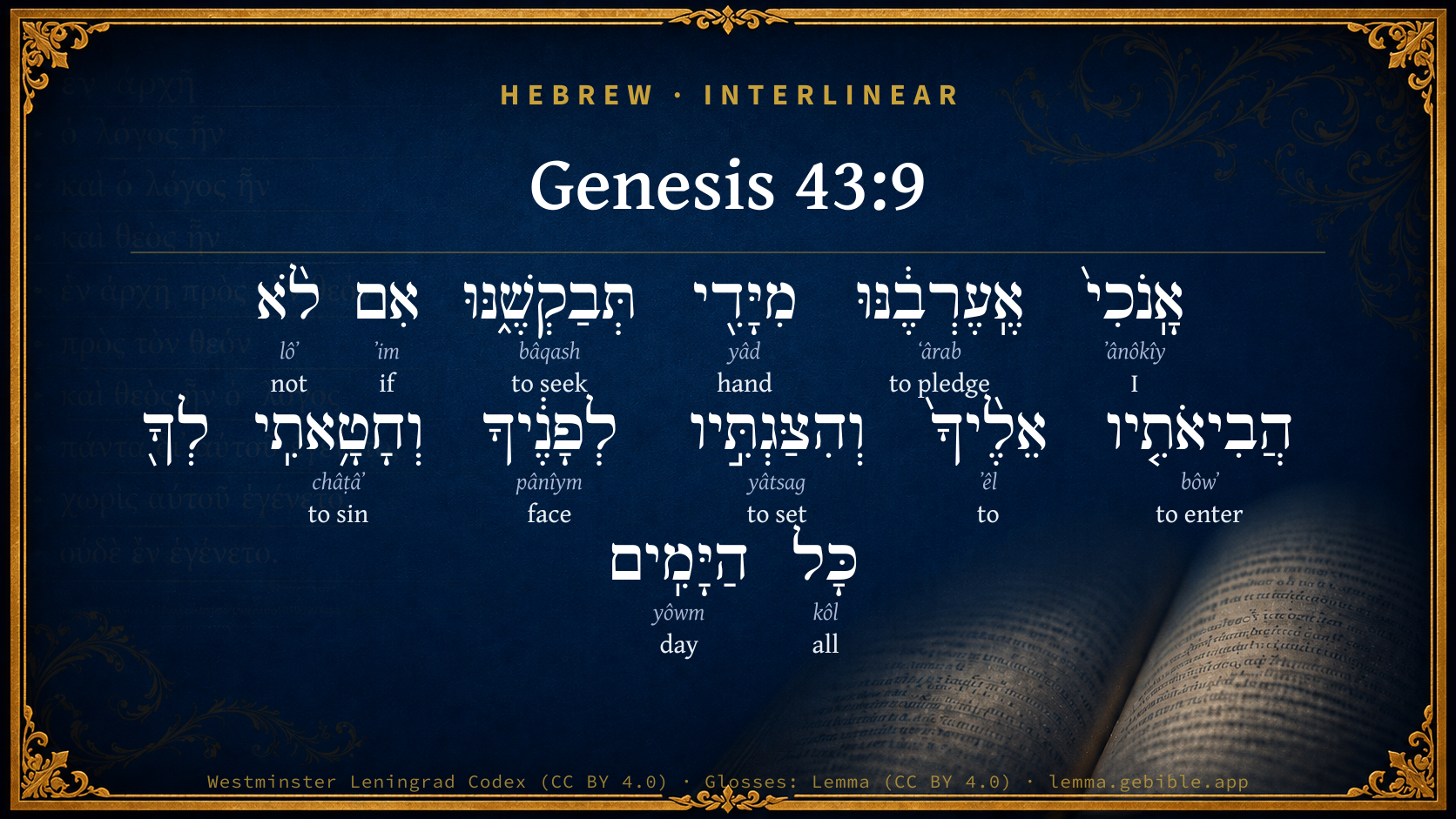
Hebrew (Westminster Leningrad Codex) Genesis 43:9 appears in the Hebrew Old Testament. The text above is from the Westminster Leningrad Codex. Each word links to its Strong’s number, a concise gloss, and parsing drawn from the Open Scriptures Hebrew Bible morphology. Click any word for its full Brown-Driver-Briggs (BDB) entry.
Download image
Cite this verse

Genesis 43:9 (World English Bible). Public Domain. Lemma interlinear Bible study tool, https://lemma.gebible.app/v/genesis/43/9.

Show BibTeX & RIS
BibTeX
RIS
English Translation
I will be collateral for him. From my hand will you require him. If I don't bring him to you, and set him before you, then let me bear the blame forever,
World English Bible · Public Domain
Highlights
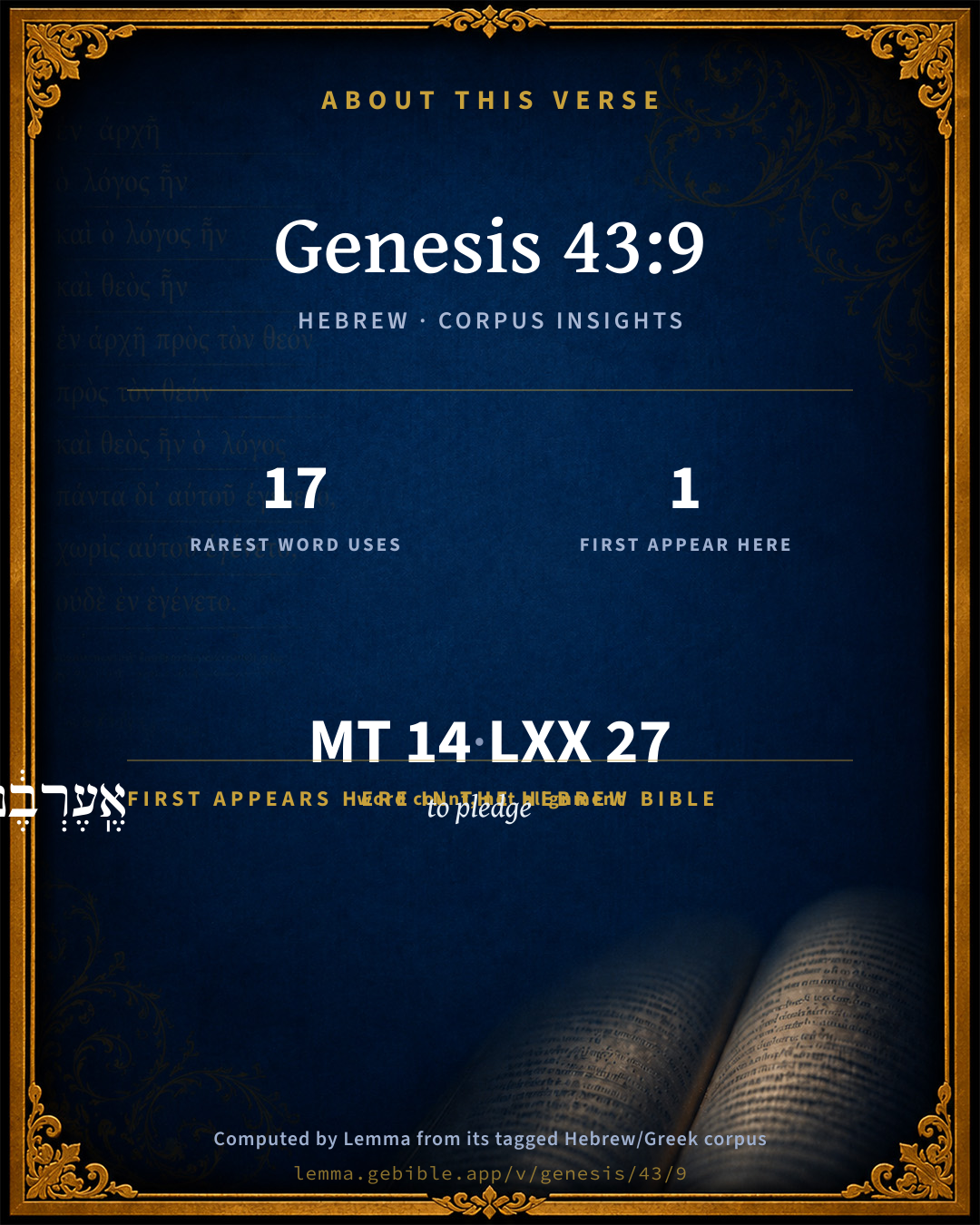
  • 1 first appearance in the Hebrew Bible
Full analysis ↓
Download a study sheet

One document with this verse’s original text, its word-by-word gloss line, the meaning frame, cross-references with their text, attributed commentary, and full source and license credits — printable, and it pastes into notes with its structure intact.

This verse Autodidact and up

Study sheet (.html) Plain text (.txt)

A passage Seminary Student

Up to 50 verses in one chapter. A passage sheet keeps up to 6 commentary sources and 12 cross-references per verse, in the order this page ranks them, and says so on the sheet whenever that leaves anything out. Ask for a single verse and you get the Autodidact verse sheet above.

Everything on this page stays free to read, with no account — the sheet is a download of what is already on screen, not access to it.

Want to remove ads? Support Godless Engineer
Compare translations 3

The same verse in 3 English versions, stacked beneath the original-language interlinear above. Click any original word for its lexicon entry.

Each is an independent rendering of the whole verse — the interlinear is not word-aligned to these translations.

Highlighted words mark where these versions differ — a whole-verse word diff, not a word-by-word alignment.

  • World English Bible Public Domain
    I will be collateral for him. From my hand will you require him. If I don't bring him to you, and set him before you, then let me bear the blame forever,
  • King James Version Public Domain
    I will be surety for him; of my hand shalt thou require him: if I bring him not unto thee, and set him before thee, then let me bear the blame for ever:
  • unfoldingWord Literal Text CC BY-SA 4.0
    I myself will guarantee him. From my hand you can require him. If I do not bring him to you and set him before you, then I will have sinned against you all the days.

unfoldingWord Literal Text — © unfoldingWord, licensed CC BY-SA 4.0. Word-aligned USFM3 via Door43 (git.door43.org/unfoldingWord/en_ult).

Versions to compare (up to 4)

3 of 4 selected

Show all 18 translations

Every available English version of this verse, each an independent rendering of the whole verse.

  • World English Bible Public Domain
    I will be collateral for him. From my hand will you require him. If I don't bring him to you, and set him before you, then let me bear the blame forever,
  • Berean Standard Bible Public Domain
    I will guarantee his safety. You may hold me personally responsible. If I do not bring him back and set him before you, then may I bear the guilt before you all my life.
  • Majority Standard Bible Public Domain
    I will guarantee his safety. You may hold me personally responsible. If I do not bring him back and set him before you, then may I bear the guilt before you all my life.
  • King James Version Public Domain
    I will be surety for him; of my hand shalt thou require him: if I bring him not unto thee, and set him before thee, then let me bear the blame for ever:
  • American Standard Version (1901) Public Domain
    I will be surety for him; of my hand shalt thou require him: if I bring him not unto thee, and set him before thee, then let me bear the blame for ever:
  • Revised Version (1885) Public Domain
    I will be surety for him; of my hand shalt thou require him: if I bring him not unto thee, and set him before thee, then let me bear the blame for ever:
  • Geneva Bible (1599) Public Domain
    I wil be suertie for him: of mine hand shalt thou require him. If I bring him not to thee, and set him before thee, then let me beare the blame for euer.
  • Douay-Rheims (1899) Public Domain
    I take the boy upon me, require him at my hand: unless I bring him again, and restore him to thee, I will be guilty of sin against thee for ever.
  • Young's Literal Translation Public Domain
    I -- I am surety `for' him, from my hand thou dost require him; if I have not brought him in unto thee, and set him before thee -- then I have sinned against thee all the days;
  • Literal Standard Version CC BY-SA 4.0
    I am guarantor [for] him, from my hand you require him; if I have not brought him to you, and set him before you—then I have sinned against you all the days;
  • Unlocked Literal Bible CC BY-SA 4.0
    I will be a guarantee for him. You will hold me responsible. If I do not bring him back to you and set him before you, then let me bear the blame forever.
  • unfoldingWord Literal Text CC BY-SA 4.0
    I myself will guarantee him. From my hand you can require him. If I do not bring him to you and set him before you, then I will have sinned against you all the days.
  • Darby Bible Public Domain
    I will be surety for him: of my hand shalt thou require him; if I bring him not to thee, and set him before thy face, then shall I be guilty toward thee for ever.
  • World Messianic Bible Public Domain
    I’ll be collateral for him. From my hand will you require him. If I don’t bring him to you, and set him before you, then let me bear the blame forever;
  • Webster's Bible Public Domain
    \\43:10\\For except we had delayed, surely now we had returned this second time.
  • Free Bible Version CC BY-SA 4.0
    I promise to take care of him—I'll be personally responsible for bringing him back to you. If I don't, then I will always carry the blame!
  • Bible in Basic English Public Domain
    Truly, if we had not let the time go by, we might have come back again by now.
  • JPS Tanakh (1917) Public Domain
    I will be surety for him; of my hand shalt thou require him; if I bring him not unto thee, and set him before thee, then let me bear the blame for ever.

Literal Standard Version (2020), Covenant Press — licensed CC BY-SA 4.0. Text via the HelloAO Bible API (eBible.org). Unlocked Literal Bible (unfoldingWord) — licensed CC BY-SA 4.0. Text via the HelloAO Bible API (eBible.org). unfoldingWord Literal Text — © unfoldingWord, licensed CC BY-SA 4.0. Word-aligned USFM3 via Door43 (git.door43.org/unfoldingWord/en_ult). Free Bible Version, Dr. Jonathan Gallagher — licensed CC BY-SA 4.0. Text via the HelloAO Bible API (eBible.org).

Word by word

More ways to search: Search by grammar → Find every occurrence → Compare this word →

Practice this passage: Drill this verse → Learn its vocabulary →

וְהִצַּגְתִּ֣יו
yâtsag
H3322
“and · to set · him”
Conjunction + Verb, Hiphil, Sequential Perfect, 1st Person, Common, Singular + Suffix, Personal, 3rd Person, Masculine, Singular
Part of Speech
Conjunction + Verb
Stem
Hiphil
Form
Sequential Perfect
Person
1st Person
Gender
Common
Number
Singular
Full BDB Definition

Origin: a primitive root

TWOT: 895

to place, set, establish - (Hiphil) - to set, place - to present - to exhibit - (Hophal) to be stopped, be stayed, be detained
  1. אָֽנֹכִי֙ ʼânôkîy H595 “I” Pronoun, Personal, 1st Person, Common, Singular
  2. אֶֽעֶרְבֶ֔נּוּ ʻârab H6148 “to pledge · him” Verb, Qal, Imperfect, 1st Person, Common, Singular + Suffix, Personal, 3rd Person, Masculine, Singular
  3. מִיָּדִ֖י yâd H3027 “from · hand · my” Preposition + Noun, Common, Both, Singular, Construct + Suffix, Personal, 1st Person, Common, Singular
  4. תְּבַקְשֶׁ֑נּוּ bâqash H1245 “to seek · him” Verb, Piel, Imperfect, 2nd Person, Masculine, Singular + Suffix, Personal, 3rd Person, Masculine, Singular
  5. אִם ʼim H518 “if” Conjunction
  6. לֹ֨א lôʼ H3808 “not” Particle, Negative
  7. הֲבִיאֹתִ֤יו bôwʼ H935 “to enter · him” Verb, Hiphil, Perfect, 1st Person, Common, Singular + Suffix, Personal, 3rd Person, Masculine, Singular
  8. אֵלֶ֨יךָ֙ ʼêl H413 “to · you” Preposition + Suffix, Personal, 2nd Person, Masculine, Singular
  9. לְפָנֶ֔יךָ pânîym H6440 “to/for · face(s) · your” Preposition + Noun, Common, Both, Plural, Construct + Suffix, Personal, 2nd Person, Masculine, Singular
  10. וְחָטָ֥אתִֽי châṭâʼ H2398 “and · to sin” Conjunction + Verb, Qal, Sequential Perfect, 1st Person, Common, Singular
  11. כָּל kôl H3605 “all of” Noun, Common, Masculine, Singular, Construct
  12. הַיָּמִֽים yôwm H3117 “the · days” Particle, Definite Article + Noun, Common, Masculine, Plural, Absolute

About this verse

These counts appear in no published source. They are computed here, from the morphology-tagged text and Lemma’s own curated glosses. What Lemma adds →

14
words
13
distinct lemmas
Pentateuch
section

Notable vocabulary

The rarest word here is וְהִצַּגְתִּ֣יו to set H3322 — appearing just 17 times in the whole Hebrew Bible.

First appearance in Scripture

This word makes its first canonical appearance in the Hebrew Bible here:

  • אֶֽעֶרְבֶ֔נּוּ to pledge H6148

Shared distinctive vocabulary

וְהִצַּגְתִּ֣יו to set H3322 occurs in 16 verses of the Hebrew Bible. Also found in:

Grammatical profile

  • 5 verbs
  • 4 nouns
  • 1 pronoun
  • 2 prepositions
  • 1 conjunction
  • 1 particle

Verb forms

  • אֶֽעֶרְבֶ֔נּוּ Qal · Imperfect
  • תְּבַקְשֶׁ֑נּוּ Piel · Imperfect
  • הֲבִיאֹתִ֤יו Hiphil · Perfect
  • וְהִצַּגְתִּ֣יו Hiphil · Sequential Perfect
  • וְחָטָ֥אתִֽי Qal · Sequential Perfect

Hebrew & Septuagint length

In English translation the verse runs 32 words from the Hebrew and 32 from the Septuagint (LXX English) — the same length.

A rough comparison of the two English renderings, which tokenize alike — not a word-level alignment.

Word counts can differ between the Hebrew and the Greek without any difference in meaning — e.g. the Hebrew direct-object marker אֵת has no separate Greek word, and Greek often adds the article ὁ.

In the original languages it is 14 Hebrew tokens and 27 Greek tokens — but the two are counted differently (Hebrew bundles its prefixes and suffixes into one token; the Greek is in lemma form), so that isn’t a like-for-like length.

Cross-references

14

Topical passages linked to Genesis 43:9 in the Treasury of Scripture Knowledge — connected by theme and wording, ordered by reader-vote popularity; previews shown in the World English Bible.

  • Genesis 42:37 Reuben spoke to his father, saying, "Kill my two sons, if I don't bring him to you. Deliver him into my hand, and I will bring him to you again."
  • Genesis 44:32–33 For your servant became collateral for the boy to my father, saying, 'If I don't bring him to you, then I will bear the blame to my father forever.'
  • Philemon 1:18–19 But if he has wronged you at all, or owes you anything, put that to my account.
  • Hebrews 7:22 By so much has Jesus become the collateral of a better covenant.
  • Genesis 9:5 I will surely require your blood of your lives. At the hand of every animal I will require it. At the hand of man, even at the hand of every man's brother, I will require the life of man.
  • Genesis 31:39 That which was torn of animals, I didn't bring to you. I bore the loss of it. Of my hand you required it, whether stolen by day or stolen by night.
  • 1 Kings 1:21 Otherwise it will happen, when my lord the king shall sleep with his fathers, that I and my son Solomon shall be counted offenders.
  • Job 17:3 "Now give a pledge, be collateral for me with yourself. Who is there who will strike hands with me?
  • Psalms 119:122 Ensure your servant's well-being. Don't let the proud oppress me.
  • Ezekiel 3:18 When I tell the wicked, You shall surely die; and you give him no warning, nor speak to warn the wicked from his wicked way, to save his life; the same wicked man shall die in his iniquity; but his blood will I require at your hand.
  • Ezekiel 3:20 Again, when a righteous man does turn from his righteousness, and commit iniquity, and I lay a stumbling block before him, he shall die: because you have not given him warning, he shall die in his sin, and his righteous deeds which he has done shall not be remembered; but his blood will I require at your hand.
  • Ezekiel 33:6 But if the watchman sees the sword come, and doesn't blow the trumpet, and the people aren't warned, and the sword comes, and take any person from among them; he is taken away in his iniquity, but his blood will I require at the watchman's hand.
  • Ezekiel 33:8 When I tell the wicked, O wicked man, you shall surely die, and you don't speak to warn the wicked from his way; that wicked man shall die in his iniquity, but his blood will I require at your hand.
  • Luke 11:50 that the blood of all the prophets, which was shed from the foundation of the world, may be required of this generation;

Cross-references courtesy of OpenBible.info (CC BY 4.0).

Hebrew and Greek witnesses Masoretic Hebrew ↔ Greek Septuagint

The same verse in the two great witnesses to the Old Testament, shown verse-for-verse.

These are two independent witnesses, not word-aligned to each other, and the Septuagint is shown in lemma (dictionary) form.

Hebrew Genesis 43:9 Masoretic · Westminster Leningrad Codex

אָֽנֹכִי֙ אֶֽעֶרְבֶ֔נּוּ מִיָּדִ֖י תְּבַקְשֶׁ֑נּוּ אִם לֹ֨א הֲבִיאֹתִ֤יו אֵלֶ֨יךָ֙ וְהִצַּגְתִּ֣יו לְפָנֶ֔יךָ וְחָטָ֥אתִֽי לְךָ֖ כָּל הַיָּמִֽים

I will be collateral for him. From my hand will you require him. If I don't bring him to you, and set him before you, then let me bear the blame forever,

World English Bible · Public Domain

Greek LXX Genesis 43:9 Septuagint · lemma form

ἐγώ δέ ἐκδέχομαι αὐτός ἐκ χείρ ἐγώ ζητέω αὐτός ἐάν μή ἄγω αὐτός πρός σύ καί ἵστημι αὐτός ἐναντίον σύ ἁμαρτάνω εἰμί πρός σύ πᾶς ὁ ἡμέρα

And I engage for him; at my hand do you require him; if I bring him not to you, and place him before you, I shall be guilty toward you for ever.

LXX2012 (modern English Septuagint) · Public Domain

On this verse, The Cambridge Bible for Schools and Colleges discusses the Septuagint’s reading. Read the note in Commentary ↓

Hebrew: Westminster Leningrad Codex (CC BY 4.0). Greek: Septuagint (public domain); English from LXX2012 (modern English Septuagint) (Public Domain). How the Septuagint differs from the Hebrew →

Targum (Aramaic paraphrase)

2

The Targum is the ancient Jewish Aramaic paraphrase of the Hebrew Scriptures — an interpretive translation, not the Hebrew text itself. Onkelos (literal) and Pseudo-Jonathan (expansive) render the Torah, and Jonathan the Prophets. Coverage is partial: where no permissively-licensed English translation exists for a verse, only the Aramaic is shown. This is verse-level text, not a word-by-word alignment to the Hebrew.

  1. Targum Onkelos Torah (Genesis–Deuteronomy)
    אֲנָא מְעָרַבְנָא בֵהּ מִן יְדִי תִּבְעִנֵּהּ אִם לָא אַיְתִנֵּהּ לָךְ וַאֲקֵימִנֵּהּ קֳדָמָךְ וְאֵהֵי חָטֵי לָךְ כָּל יוֹמַיָּא

    (no public-domain English translation for this verse)

    Targum Onkelos — Aramaic: “Onkelos Genesis” (public domain); “Onkelos Exodus” (public domain); “Onkelos Leviticus” (public domain); “Onkelos Numbers” (public domain); “Onkelos Deuteronomy” (public domain). English: “Sefaria Community Translation” (CC0 1.0 (public-domain dedication)); “J.W. Etheridge. The Targums of Onkelos and Jonathan Ben Uzziel on the Pentateuch. London: Longmans, Green, 1862” (public domain). Text via Sefaria.

  2. Targum Pseudo-Jonathan Torah (Genesis–Deuteronomy)
    אֲנָא מְעַרַבְנָא בֵּיהּ מִן יְדַי תַּבְעִינֵיהּ אִין לָא אַיְיתִינֵיהּ לְוָתָךְ וַאַקִימִינֵיהּ לְקָמָךְ וְנִתְחַיֵיב קָמָךְ כָּל יוֹמַיָא

    I will be surety for him: of my hand shalt thou require him. If I bring him not to thee again, and set him before thee, the guilt be upon me before thee all days.

    Targum Pseudo-Jonathan — Aramaic: “Targum Jonathan on Genesis” (public domain); “Targum Jonathan on Exodus” (public domain); “Targum Jonathan on Leviticus” (public domain); “Targum Jonathan on Numbers” (public domain); “Targum Jonathan on Deuteronomy” (public domain). English: “The Targum of Jonathan ben Uzziel, trans. J. W. Etheridge, London, 1862” (public domain). Text via Sefaria.

Commentary

Notes on Genesis 43:9 from classic Christian and Jewish commentators (each source and its license shown beneath its notes). The classic Christian expositions comment on the surrounding passage and are grouped to its opening verse, so a note may address several verses; the Jewish commentaries on the Tanakh (Rashi and others) are per-verse, so they appear only where the commentator wrote on this verse.

Lemma curates 59 commentaries, every one of them public domain or Creative Commons licensed, each selected and text-cleaned for this edition rather than reprinted as found. About our sources →

Trapp's Complete Commentary

John Trapp

Gen 43:9 I will be surety for him; of my hand shalt thou require him: if I bring him not unto thee, and set him before thee, then let me bear the blame for ever:

Ver. 9. I will be surety for him.] Herein he was a type of Christ, that came of him, who is both our surety to God, for the discharge of our debt and duty, and God’s surety to us, for the performance of his promises. {Heb 7:22}

John Trapp, A Commentary or Exposition upon All the Books of the Old and New Testament (1647–1656) — public domain. Text from a community e-Sword module.

Joseph Benson's Commentary

Gen 43:9. Let me bear the blame for ever — Hebrew, Be an offender to thee: let me bear the guilt, and shame, and punishment due to so great an offender — Judah’s conscience had lately smitten him for what he had done a great while ago against Joseph; and as an evidence of the truth of his repentance, he is ready to undertake, as far as a man could do it, for Benjamin’s security. He will not only not wrong him, but will do all he can to protect him. This is such restitution as the case will admit: when he knew not how he could retrieve Joseph, he would make some amends for the irreparable injury he had done him, by doubling his care concerning Benjamin.

Joseph Benson's Commentary on the Old and New Testaments (1811–1818) — public domain. Text from a community e-Sword module.

Geneva Bible (1599)

Geneva Bible translators

Hebrew, I will sin to thee.

Geneva Bible (1599) marginal notes — public domain. Text via Bolls.life.

Adam Clarke's Commentary

Verse 9. Let me bear the blame for ever] וחטאתי לך כל הימים vechatathi lecha col haiyamim, then shall I sin against thee all my days, and consequently be liable to punishment for violating my faith.

Adam Clarke's Commentary on the Bible (1810–1826) — public domain. Text from a community e-Sword/MySword module.

Ellicott's Commentary for English Readers

(9) Then let me bear the blame for ever.—This is much more manly and therefore more persuasive than Reuben’s talk about pledging the lives of his children. For it was real, nor would it be a slight matter to stand in his father’s presence all the rest of his life as one guilty of a grievous crime.

A Bible Commentary for English Readers, edited by Charles John Ellicott (1878–1897) — public domain. Text from a community e-Sword module.

The Cambridge Bible for Schools and Colleges

gen. ed. J. J. S. Perowne

9. I will be surety] i.e. I will guarantee to bring him back. In Gen_42:37 Reuben had been ready to pledge the lives of his two sons for Benjamin’s safety. Here Judah is ready to pledge his own life; see Gen_44:32. The versions fairly reproduce the original: LXX ἐκδέχομαι αὐτόν; Lat. suscipio puerum.

let me bear the blame for ever] R.V. marg. gives the literal rendering I shall have sinned against thee for ever, LXX ἡμαρτηκὼς ἔσομαι, Lat. peccati reus ero. Compare the same idiom in Gen_31:39, “I bare the loss,” and 1Ki_1:21, “I and my son Solomon shall be counted offenders” (Heb. sinners). The penalty will be proportioned to the failure.

The Cambridge Bible for Schools and Colleges (gen. ed. J. J. S. Perowne; Cambridge University Press, 1878–1918) — public domain. Text from a community e-Sword module.

John Gill's Exposition

For except we had lingered,.... Delayed going down to Egypt, through the demur Jacob made of tending Benjamin with them:

surely now we had returned this second time; they would have made their journey to Egypt, and returned again with their corn, and their brother Benjamin too, as Judah supposed, before this time; so that by these delays they were losing time, and involving themselves and families in distress for want of corn.

John Gill's Exposition of the Whole Bible (1746–1763) — public domain (CC PDM 1.0). Text via the HelloAO Bible API.

Haydock's Catholic Bible Commentary

For ever. Always lay the blame on me, and punish me as you think fit. (Menochius)

George Leo Haydock (1774–1849), Haydock's Catholic Family Bible and Commentary, 1859 edition — public domain. Excludes Psalms (Douay-Rheims chapter numbering differs from Protestant) and Deuterocanonical books (Catholic canon only).

John Wesley's Explanatory Notes

Judah's conscience had lately smitten him for what he had done a great while ago against Joseph; and as an evidence of the truth of his repentance, he is ready to undertake, as far as a man could do it, for Benjamin's security. He will not only not wrong him but will do all he can to protect him. This is such restitution as the case will admit: when he knew not how he could retrieve Joseph, he would make some amends for the irreparable injury he had done him, by doubling his care concerning Benjamin.

John Wesley, Explanatory Notes Upon the Whole Bible (1754–1765) — public domain. Text via the GEBible commentary corpus.

Rashi

Rabbi Shlomo Yitzchaki (Rashi)

והצגתיו לפניך AND SET HIM BEFORE THEE — for I will not bring him back to you dead but alive.

וחטאתי לך כל הימים THEN SHALL I HAVE SINNED AGAINST THEE ALL THE DAYS — also in the world to come (Genesis Rabbah 91:10).

Rashi on the Tanakh — English translations: “The Judaica Press complete Tanach with Rashi, translated by A. J. Rosenberg” (CC BY 4.0); “Pentateuch with Rashi's commentary by M. Rosenbaum and A.M. Silbermann, 1929-1934” (public domain); “The Metsudah Tanach series, Lakewood, N.J” (CC BY 4.0); and “The Book of Joshua, Metsudah Publications, 1997” (CC BY 4.0). Text via Sefaria.

Radak

Rabbi David Kimhi (Radak)

וחטאתי לך, Yehudah did not really man that if he did not bring Binyamin back this would automatically be a sin in the objective meaning of the word. He meant that he would consider himself as a sinner against his father forever in the unlikely event that this would happen. He would guarantee his brother’s return under such conditions. These considerations prompted our sages in Makkot 11 to characterise Yehudah as placing himself in the position of a conditional outcast, מנודה, they derive the halachah that someone who places himself in such a state requires the court to annul his conditional vow, status. Needless to say that ostracising oneself from the Jewish community even conditionally is forbidden, and we have a tradition that the bones inside Yehudah’s coffin were rattling for the entire 40 years the Jewish people carried the coffins of the 12 founding leaders of the tribes with them through the desert. This stopped only at the request of Moses who asked mercy for Yehudah in his final blessing in Deuteronomy 33,7, וזאת 'ליהודה וגו

Radak on the Tanakh — English translations: “Sefaria Community Translation” (CC0 1.0 (public-domain dedication)); “Eliyahu Munk, HaChut Hameshulash” (CC BY 4.0); “Rabbi Mike Feuer, Jerusalem Anthology” (CC BY 4.0); and “R. David Kimhi on the first book of Psalms, Translated by R.G. Finch, London, 1919” (public domain). Text via Sefaria.

Lesson kit

Teaching starters — assembled from the data on this page, not authored interpretation. Every prompt links to the verse data it draws on. Edit before teaching.

Genesis, in the Pentateuch, opens this verse with 14 words (13 distinct Hebrew lemmas). Its most distinctive word is yâtsag (“to set”). A historical commentator’s framing appears above. Read the whole chapter for the surrounding context.

Discussion questions

  1. What does “to set” (yâtsag) contribute to the verse as a whole?
  2. The word “to pledge” first appears here in Scripture. What is being introduced at this debut?
  3. Genesis 30:38 shares the word «to set» with this verse. How do the two illuminate each other?
  4. The translations on this page render this verse differently — a whole-verse word diff, not a word-by-word alignment. What might account for the different wordings?
  5. The verb «אֶֽעֶרְבֶ֔נּוּ» is Qal Imperfect. How does its form color the action?
  6. Reading how Trapp's Complete Commentary and Joseph Benson's Commentary read this verse, where do the two commentators agree and where do they part?

Things to notice

Reading settings

Reading text

Shown beneath each verse's original-language words.

Old Testament
Old Testament edition

Read the OT as the Masoretic Hebrew (MT) or the Greek Septuagint (LXX).

English shown for the Greek Septuagint (in the Hebrew ↔ Greek comparison).

Comparing translations? Open the Compare panel on any verse page to stack up to four side by side.