Genesis 46:32

Hebrew (Westminster Leningrad Codex) Genesis 46:32 appears in the Hebrew Old Testament. The text above is from the Westminster Leningrad Codex. Each word links to its Strong’s number, a concise gloss, and parsing drawn from the Open Scriptures Hebrew Bible morphology. Click any word for its full Brown-Driver-Briggs (BDB) entry.
Download image
Cite this verse

Genesis 46:32 (World English Bible). Public Domain. Lemma interlinear Bible study tool, https://lemma.gebible.app/v/genesis/46/32.

Show BibTeX & RIS
BibTeX
RIS
English Translation
These men are shepherds, for they have been keepers of cattle, and they have brought their flocks, and their herds, and all that they have.'
World English Bible · Public Domain
Download a study sheet

One document with this verse’s original text, its word-by-word gloss line, the meaning frame, cross-references with their text, attributed commentary, and full source and license credits — printable, and it pastes into notes with its structure intact.

This verse Autodidact and up

Study sheet (.html) Plain text (.txt)

A passage Seminary Student

Up to 50 verses in one chapter. A passage sheet keeps up to 6 commentary sources and 12 cross-references per verse, in the order this page ranks them, and says so on the sheet whenever that leaves anything out. Ask for a single verse and you get the Autodidact verse sheet above.

Everything on this page stays free to read, with no account — the sheet is a download of what is already on screen, not access to it.

Want to remove ads? Support Godless Engineer
Compare translations 3

The same verse in 3 English versions, stacked beneath the original-language interlinear above. Click any original word for its lexicon entry.

Each is an independent rendering of the whole verse — the interlinear is not word-aligned to these translations.

Highlighted words mark where these versions differ — a whole-verse word diff, not a word-by-word alignment.

  • World English Bible Public Domain
    These men are shepherds, for they have been keepers of cattle, and they have brought their flocks, and their herds, and all that they have.'
  • King James Version Public Domain
    And the men are shepherds, for their trade hath been to feed cattle; and they have brought their flocks, and their herds, and all that they have.
  • unfoldingWord Literal Text CC BY-SA 4.0
    And the men herders of sheep, for they are livestock men, and they have brought their flock and their herd and everything that to them.’

unfoldingWord Literal Text — © unfoldingWord, licensed CC BY-SA 4.0. Word-aligned USFM3 via Door43 (git.door43.org/unfoldingWord/en_ult).

Versions to compare (up to 4)

3 of 4 selected

Show all 18 translations

Every available English version of this verse, each an independent rendering of the whole verse.

  • World English Bible Public Domain
    These men are shepherds, for they have been keepers of cattle, and they have brought their flocks, and their herds, and all that they have.'
  • Berean Standard Bible Public Domain
    The men are shepherds; they raise livestock, and they have brought their flocks and herds and all that they own.’
  • Majority Standard Bible Public Domain
    The men are shepherds; they raise livestock, and they have brought their flocks and herds and all that they own.’
  • King James Version Public Domain
    And the men are shepherds, for their trade hath been to feed cattle; and they have brought their flocks, and their herds, and all that they have.
  • American Standard Version (1901) Public Domain
    and the men are shepherds, for they have been keepers of cattle; and they have brought their flocks, and their herds, and all that they have.
  • Revised Version (1885) Public Domain
    and the men are shepherds, for they have been keepers of cattle; and they have brought their flocks, and their herds, and all that they have.
  • Geneva Bible (1599) Public Domain
    And the men are shepheardes, and because they are shepheardes, they haue brought their sheepe and their cattell, and all that they haue.
  • Douay-Rheims (1899) Public Domain
    And the men are shepherds, and their occupation is to feed cattle: their flocks and herds, and all they have, they have brought with them.
  • Young's Literal Translation Public Domain
    and the men `are' feeders of a flock, for they have been men of cattle; and their flock, and their herd, and all that they have, they have brought.'
  • Literal Standard Version CC BY-SA 4.0
    and the men [are] feeders of a flock, for they have been men of livestock; and their flock, and their herd, and all that they have, they have brought.
  • Unlocked Literal Bible CC BY-SA 4.0
    The men are shepherds, for they have been keepers of livestock. They have brought their flocks, their herds, and all that they have.'
  • unfoldingWord Literal Text CC BY-SA 4.0
    And the men herders of sheep, for they are livestock men, and they have brought their flock and their herd and everything that to them.’
  • Darby Bible Public Domain
    and the men are shepherds, for they have been occupied with cattle; and they have brought their sheep, and their cattle, and all that they have.
  • World Messianic Bible Public Domain
    These men are shepherds, for they have been keepers of livestock, and they have brought their flocks, and their herds, and all that they have.’
  • Webster's Bible Public Domain
    And the men are shepherds, for their employment hath been to feed cattle; and they have brought their flocks, and their herds, and all that they have.
  • Free Bible Version CC BY-SA 4.0
    They are shepherds and keep livestock. They have brought with them their flocks and herds and all their possessions.’
  • Bible in Basic English Public Domain
    And these men are keepers of sheep and owners of cattle, and have with them their flocks and their herds and all they have.
  • JPS Tanakh (1917) Public Domain
    and the men are shepherds, for they have been keepers of cattle; and they have brought their flocks, and their herds, and all that they have.

Literal Standard Version (2020), Covenant Press — licensed CC BY-SA 4.0. Text via the HelloAO Bible API (eBible.org). Unlocked Literal Bible (unfoldingWord) — licensed CC BY-SA 4.0. Text via the HelloAO Bible API (eBible.org). unfoldingWord Literal Text — © unfoldingWord, licensed CC BY-SA 4.0. Word-aligned USFM3 via Door43 (git.door43.org/unfoldingWord/en_ult). Free Bible Version, Dr. Jonathan Gallagher — licensed CC BY-SA 4.0. Text via the HelloAO Bible API (eBible.org).

Word by word

More ways to search: Search by grammar → Find every occurrence → Compare this word →

Practice this passage: Drill this verse → Learn its vocabulary →

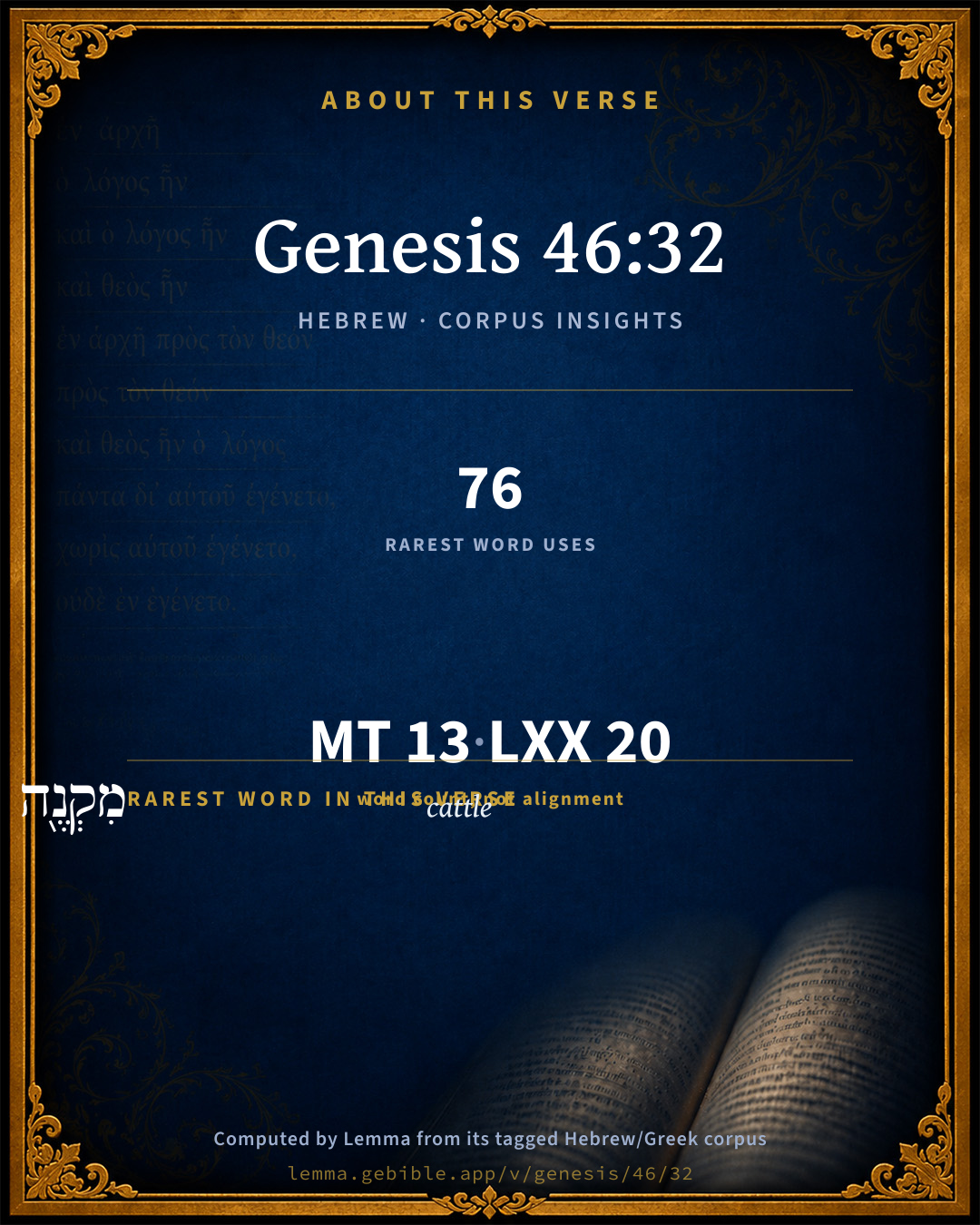
מִקְנֶ֖ה
miqneh
H4735
“cattle”
Noun, Common, Masculine, Singular, Absolute
Part of Speech
Noun
Type
Common
Gender
Masculine
Number
Singular
State
Absolute
Full BDB Definition

Origin: from H7069

TWOT: 2039b

cattle, livestock - cattle, livestock - in general of a purchasable domestic animal - cows, sheep, goats (in herds and flocks)
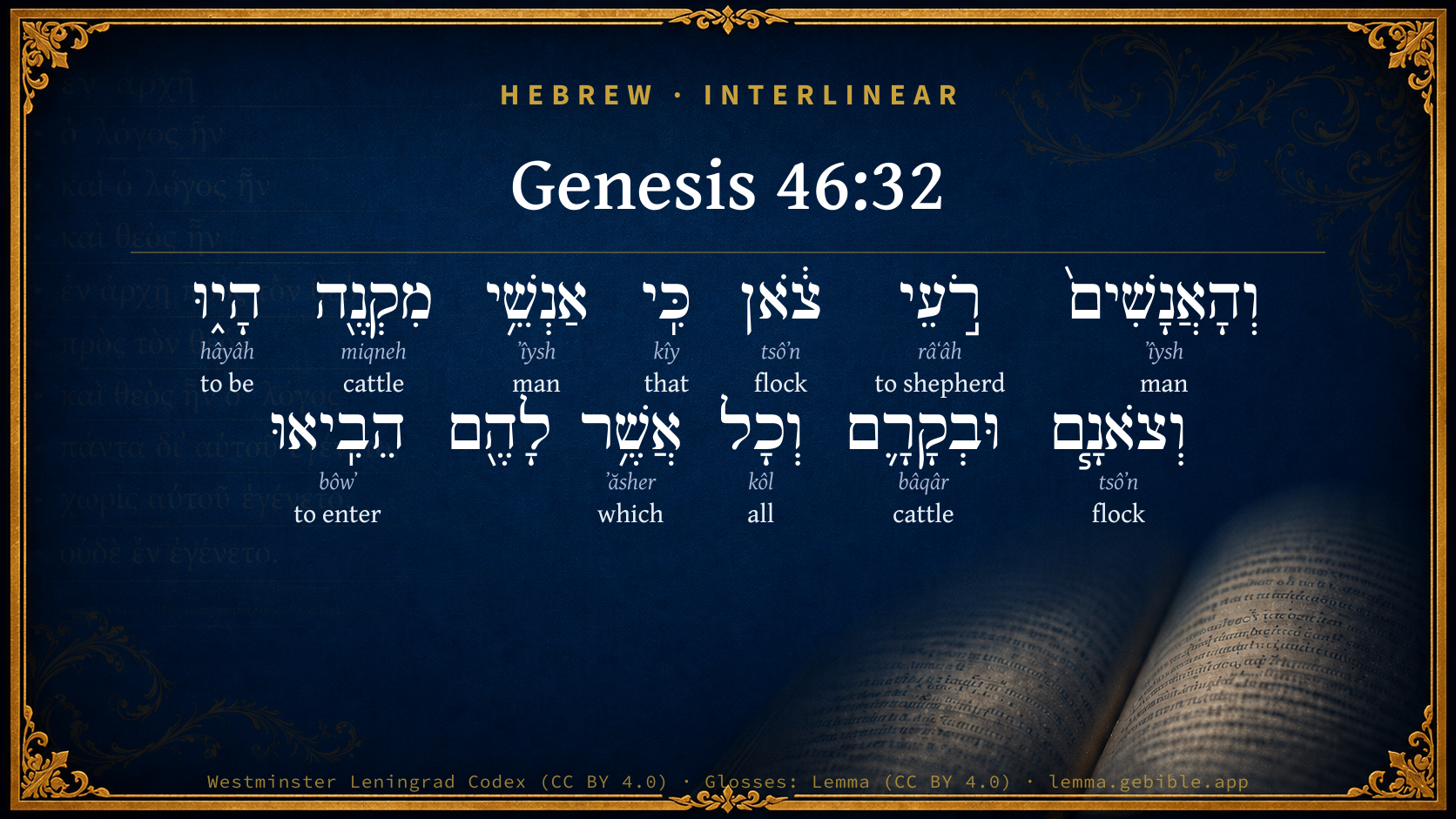
  1. וְהָאֲנָשִׁים֙ ʼîysh H376 “and · the · men” Conjunction + Particle, Definite Article + Noun, Common, Masculine, Plural, Absolute
  2. רֹ֣עֵי râʻâh H7462 “shepherding” Verb, Qal, Participle Active, Masculine, Plural, Construct
  3. צֹ֔אן tsôʼn H6629 “flock” Noun, Common, Both, Singular, Absolute
  4. כִּֽי kîy H3588 “that” Conjunction
  5. אַנְשֵׁ֥י ʼîysh H376 “men of” Noun, Common, Masculine, Plural, Construct
  6. הָי֑וּ hâyâh H1961 “to be” Verb, Qal, Perfect, 3rd Person, Common, Plural
  7. וְצֹאנָ֧ם tsôʼn H6629 “and · flock · their” Conjunction + Noun, Common, Both, Singular, Construct + Suffix, Personal, 3rd Person, Masculine, Plural
  8. וּבְקָרָ֛ם bâqâr H1241 “and · cattle · their” Conjunction + Noun, Common, Both, Singular, Construct + Suffix, Personal, 3rd Person, Masculine, Plural
  9. וְכָל kôl H3605 “and · all of” Conjunction + Noun, Common, Masculine, Singular, Construct
  10. אֲשֶׁ֥ר ʼăsher H834 “which” Particle, Relative
  11. הֵבִֽיאוּ bôwʼ H935 “to enter” Verb, Hiphil, Perfect, 3rd Person, Common, Plural

About this verse

These counts appear in no published source. They are computed here, from the morphology-tagged text and Lemma’s own curated glosses. What Lemma adds →

13
words
10
distinct lemmas
Pentateuch
section

Grammatical profile

  • 3 verbs
  • 7 nouns
  • 1 preposition
  • 1 conjunction
  • 1 particle

Verb forms

  • רֹ֣עֵי Qal · Participle Active
  • הָי֑וּ Qal · Perfect
  • הֵבִֽיאוּ Hiphil · Perfect

Repetition

Words recur within this verse — often emphatic in Hebrew:

  • וְהָאֲנָשִׁים֙ man H376 ×2
  • צֹ֔אן flock H6629 ×2

Hebrew & Septuagint length

In English translation the verse runs 25 words from the Hebrew and 27 from the Septuagint (LXX English) — closely comparable.

A rough comparison of the two English renderings, which tokenize alike — not a word-level alignment.

Word counts can differ between the Hebrew and the Greek without any difference in meaning — e.g. the Hebrew direct-object marker אֵת has no separate Greek word, and Greek often adds the article ὁ.

In the original languages it is 13 Hebrew tokens and 20 Greek tokens — but the two are counted differently (Hebrew bundles its prefixes and suffixes into one token; the Greek is in lemma form), so that isn’t a like-for-like length.

Cross-references

15

Topical passages linked to Genesis 46:32 in the Treasury of Scripture Knowledge — connected by theme and wording, ordered by reader-vote popularity; previews shown in the World English Bible.

  • Genesis 47:3 Pharaoh said to his brothers, "What is your occupation?" They said to Pharaoh, "Your servants are shepherds, both we, and our fathers."
  • Genesis 4:2 Again she gave birth, to Cain's brother Abel. Abel was a keeper of sheep, but Cain was a tiller of the ground.
  • Genesis 9:20 Noah began to be a farmer, and planted a vineyard.
  • Genesis 31:18 and he carried away all his cattle, and all his substance which he had gathered, the cattle of his getting, which he had gathered in Paddan Aram, to go to Isaac his father to the land of Canaan.
  • Genesis 37:2 This is the history of the generations of Jacob. Joseph, being seventeen years old, was feeding the flock with his brothers. He was a boy with the sons of Bilhah and Zilpah, his father's wives. Joseph brought an evil report of them to their father.
  • Genesis 45:10 You shall dwell in the land of Goshen, and you will be near to me, you, your children, your children's children, your flocks, your herds, and all that you have.
  • Genesis 46:34 that you shall say, 'Your servants have been keepers of cattle from our youth even until now, both we, and our fathers:' that you may dwell in the land of Goshen; for every shepherd is an abomination to the Egyptians."
  • Exodus 3:1 Now Moses was keeping the flock of Jethro, his father-in-law, the priest of Midian, and he led the flock to the back of the wilderness, and came to God's mountain, to Horeb.
  • 1 Samuel 17:15 Now David went back and forth from Saul to feed his father's sheep at Bethlehem.
  • 1 Kings 9:27 Hiram sent in the navy his servants, sailors who had knowledge of the sea, with the servants of Solomon.
  • 1 Kings 18:5–6 Ahab said to Obadiah, Go through the land, to all the springs of water, and to all the brooks: peradventure we may find grass and save the horses and mules alive, that we not lose all the animals.
  • Psalms 78:70–72 He also chose David his servant, And took him from the sheepfolds;
  • Isaiah 40:11 He will feed his flock like a shepherd, he will gather the lambs in his arm, and carry them in his bosom, [and] will gently lead those who have their young.
  • Zechariah 13:5 but he will say, 'I am no prophet, I am a tiller of the ground; for I have been made a bondservant from my youth.'
  • 1 Samuel 16:11 Samuel said to Jesse, Are here all your children? He said, There remains yet the youngest, and, behold, he is keeping the sheep. Samuel said to Jesse, Send and get him; for we will not sit down until he come here.

Cross-references courtesy of OpenBible.info (CC BY 4.0).

Hebrew and Greek witnesses Masoretic Hebrew ↔ Greek Septuagint

The same verse in the two great witnesses to the Old Testament, shown verse-for-verse.

These are two independent witnesses, not word-aligned to each other, and the Septuagint is shown in lemma (dictionary) form.

Hebrew Genesis 46:32 Masoretic · Westminster Leningrad Codex

וְהָאֲנָשִׁים֙ רֹ֣עֵי צֹ֔אן כִּֽי אַנְשֵׁ֥י מִקְנֶ֖ה הָי֑וּ וְצֹאנָ֧ם וּבְקָרָ֛ם וְכָל אֲשֶׁ֥ר לָהֶ֖ם הֵבִֽיאוּ

These men are shepherds, for they have been keepers of cattle, and they have brought their flocks, and their herds, and all that they have.'

World English Bible · Public Domain

Greek LXX Genesis 46:32 Septuagint · lemma form

ὁ δέ ἀνήρ εἰμί ποιμήν ἀνήρ γάρ κτηνοτρόφος εἰμί καί ὁ κτῆνος καί ὁ βοῦς καί πᾶς ὁ αὐτός ἄγω

And the men are shepherds; for they have been feeders of cattle, and they have brought with them their cattle, and their kine, and all their property.

LXX2012 (modern English Septuagint) · Public Domain

Hebrew: Westminster Leningrad Codex (CC BY 4.0). Greek: Septuagint (public domain); English from LXX2012 (modern English Septuagint) (Public Domain). How the Septuagint differs from the Hebrew →

Targum (Aramaic paraphrase)

2

The Targum is the ancient Jewish Aramaic paraphrase of the Hebrew Scriptures — an interpretive translation, not the Hebrew text itself. Onkelos (literal) and Pseudo-Jonathan (expansive) render the Torah, and Jonathan the Prophets. Coverage is partial: where no permissively-licensed English translation exists for a verse, only the Aramaic is shown. This is verse-level text, not a word-by-word alignment to the Hebrew.

  1. Targum Onkelos Torah (Genesis–Deuteronomy)
    וְגֻּבְרַיָּא רָעֵי עָנָא אֲרֵי גֻּבְרֵי מָרֵי גֵּיתֵי הֲווֹ וְעָנְהוֹן וְתוֹרְהוֹן וְכָל דִּי לְהוֹן אַיְתִיאוּ

    (no public-domain English translation for this verse)

    Targum Onkelos — Aramaic: “Onkelos Genesis” (public domain); “Onkelos Exodus” (public domain); “Onkelos Leviticus” (public domain); “Onkelos Numbers” (public domain); “Onkelos Deuteronomy” (public domain). English: “Sefaria Community Translation” (CC0 1.0 (public-domain dedication)); “J.W. Etheridge. The Targums of Onkelos and Jonathan Ben Uzziel on the Pentateuch. London: Longmans, Green, 1862” (public domain). Text via Sefaria.

  2. Targum Pseudo-Jonathan Torah (Genesis–Deuteronomy)
    וְגוּבְרַיָא רַעֲיָין דְעָאָן אֲרוּם גוּבְרֵי מָרֵי גֵיתֵי הֲווֹ וְעַנְהוֹן וְתוֹרֵיהוֹן וְכָל דִילְהוֹן אַיְיתִיאוּ

    The men are pastors of sheep; for they are men, the masters of flocks; and their sheep and oxen and all which they have, they have brought.

    Targum Pseudo-Jonathan — Aramaic: “Targum Jonathan on Genesis” (public domain); “Targum Jonathan on Exodus” (public domain); “Targum Jonathan on Leviticus” (public domain); “Targum Jonathan on Numbers” (public domain); “Targum Jonathan on Deuteronomy” (public domain). English: “The Targum of Jonathan ben Uzziel, trans. J. W. Etheridge, London, 1862” (public domain). Text via Sefaria.

Commentary

Notes on Genesis 46:32 from classic Christian and Jewish commentators (each source and its license shown beneath its notes). The classic Christian expositions comment on the surrounding passage and are grouped to its opening verse, so a note may address several verses; the Jewish commentaries on the Tanakh (Rashi and others) are per-verse, so they appear only where the commentator wrote on this verse.

Lemma curates 59 commentaries, every one of them public domain or Creative Commons licensed, each selected and text-cleaned for this edition rather than reprinted as found. About our sources →

Trapp's Complete Commentary

John Trapp

Gen 46:32 And the men [are] shepherds, for their trade hath been to feed cattle; and they have brought their flocks, and their herds, and all that they have.

Ver. 32. The men are shepherds.] The truly virtuous or valorous are no whit ashamed of their lowly parentage, but rather glory in themselves, that their merit hath advanced them above so many thousands far better descended. Dr Cox, almoner, and Sir John Cheek, tutor, to King Edward VI, were men of lowly birth, but so well esteemed, saith the historian, {a} for virtue and learning, that they might well be said to be born of themselves. So were Iphicrates, that brave Athenian, the son of a cobbler; Eumenes, one of Alexander’s best captains, the son of a carter; Agathocles king of Sicily, of a potter, &c. And these would many times freely discourse of their beginning, and plainly relate their bringing up, and what their parents were.

And they have brought their flocks.] As choosing rather a poor shepherd’s life in God’s service, than to ruffle it as courtiers, out of the Church. So did Moses afterwards; and David; {Psa 84:10} and the poor prophet that died so deep in debt; and Micaiah; and those that "wandered about in sheep skins and goat skins," {Heb 11:37} who haply might have rustled in silks and velvets, if they would have strained their consciences. Origen was contented to be a poor catechist at Alexandria, every day in fear of death, when he might have been with his fellow pupil Plotinus, in great authority and favour, if not a Christian. Luther was offered a cardinalship, to have held his tongue; Galeacius Caracciohs, a great sum of gold, to have returned to his marquesdom in Italy, &c. God takes it kindly when men will go "after him in the wilderness, in a land not sown"; {Jer 2:2} that is, choose him and his ways in affliction, and with self-denial.

{a} Sir John Heywood in his Edward VI

John Trapp, A Commentary or Exposition upon All the Books of the Old and New Testament (1647–1656) — public domain. Text from a community e-Sword module.

Geneva Bible (1599)

Geneva Bible translators

He was not ashamed of his father and kindred, though they were of base condition.

Geneva Bible (1599) marginal notes — public domain. Text via Bolls.life.

Ellicott's Commentary for English Readers

(32) The men are shepherds.—As Joseph’s object was to keep his brethren isolated in Goshen, he instructs them not to conceal their occupation, because Pharaoh on knowing it would not wish them to dwell in Egypt itself.

A Bible Commentary for English Readers, edited by Charles John Ellicott (1878–1897) — public domain. Text from a community e-Sword module.

The Cambridge Bible for Schools and Colleges

gen. ed. J. J. S. Perowne

32. the men are shepherds] These words are followed by what may be a gloss, “for they have been keepers of cattle” (probably drawn from Gen_46:34). If not a gloss, “shepherds” must include herdsmen, and “cattle” be used here quite generally of flocks and herds. In Gen_47:3 “thy servants are shepherds”: but in Gen_47:6 Pharaoh makes them “rulers over my cattle.”

The Cambridge Bible for Schools and Colleges (gen. ed. J. J. S. Perowne; Cambridge University Press, 1878–1918) — public domain. Text from a community e-Sword module.

Whedon's Commentary on the Bible

Daniel D. Whedon

32. The men are shepherds — “In spite of the fact that shepherds were ‘an abomination to the Egyptians,’ Joseph introduces his brethren as shepherds; yea, for that reason he does so. This fact would secure them the isolation demanded by their providential mission. Compare the note at the beginning of this chapter, and see note on Gen_47:3.” — Newhall.

Daniel D. Whedon (gen. ed.), Commentary on the Old and New Testaments (1874–1909) — public domain. Text from a community e-Sword module.

Ramban (Nachmanides)

Rabbi Moshe ben Nachman (Ramban / Nachmanides)

AND THE MEN ARE SHEPHERDS, FOR THEY HAVE BEEN KEEPERS OF CATTLE. Joseph told them that they are shepherds but that they do not tend to the cattle of others because even with respect to their own cattle, they have servants and attendants to pasture them. It is only that their wealth consists of cattle. This is the sense of the expression, they have been keepers of cattle, and had wealth, and a very great household by virtue of the great multitude of cattle which they possessed. It was Joseph’s intention to mention them in an honorable way.

Ramban (Nachmanides) on the Tanakh — English translation: “Commentary on the Torah by Ramban (Nachmanides). Translated and annotated by Charles B. Chavel. New York, Shilo Pub. House, 1971-1976” (CC BY 4.0). Text via Sefaria.

Lesson kit

Teaching starters — assembled from the data on this page, not authored interpretation. Every prompt links to the verse data it draws on. Edit before teaching.

Genesis, in the Pentateuch, opens this verse with 13 words (10 distinct Hebrew lemmas). Its most distinctive word is miqneh (“cattle”). A historical commentator’s framing appears above. Read the whole chapter for the surrounding context.

Discussion questions

  1. The word miqneh carries the sense “cattle.” How does it shape the verse?
  2. How does Genesis 47:3, which shares this passage’s theme, read alongside this verse?
  3. What does the repetition of “man” (2× in this one verse) do in this verse?
  4. The translations on this page render this verse differently — a whole-verse word diff, not a word-by-word alignment. What might account for the different wordings?
  5. «רֹ֣עֵי» is a Qal Participle Active verb. How does that grammatical form shape the action described?
  6. Compare how Trapp's Complete Commentary and Geneva Bible (1599) read this verse. Where do they agree or differ?

Things to notice

Reading settings

Reading text

Shown beneath each verse's original-language words.

Old Testament
Old Testament edition

Read the OT as the Masoretic Hebrew (MT) or the Greek Septuagint (LXX).

English shown for the Greek Septuagint (in the Hebrew ↔ Greek comparison).

Comparing translations? Open the Compare panel on any verse page to stack up to four side by side.