
Genesis 50:10

Hebrew (Westminster Leningrad Codex) Genesis 50:10 appears in the Hebrew Old Testament. The text above is from the Westminster Leningrad Codex. Each word links to its Strong’s number, a concise gloss, and parsing drawn from the Open Scriptures Hebrew Bible morphology. Click any word for its full Brown-Driver-Briggs (BDB) entry.
Download image
Cite this verse

Genesis 50:10 (World English Bible). Public Domain. Lemma interlinear Bible study tool, https://lemma.gebible.app/v/genesis/50/10.

Show BibTeX & RIS
BibTeX
RIS
English Translation
They came to the threshing floor of Atad, which is beyond the Jordan, and there they lamented with a very great and sore lamentation. He mourned for his father seven days.
World English Bible · Public Domain
Highlights
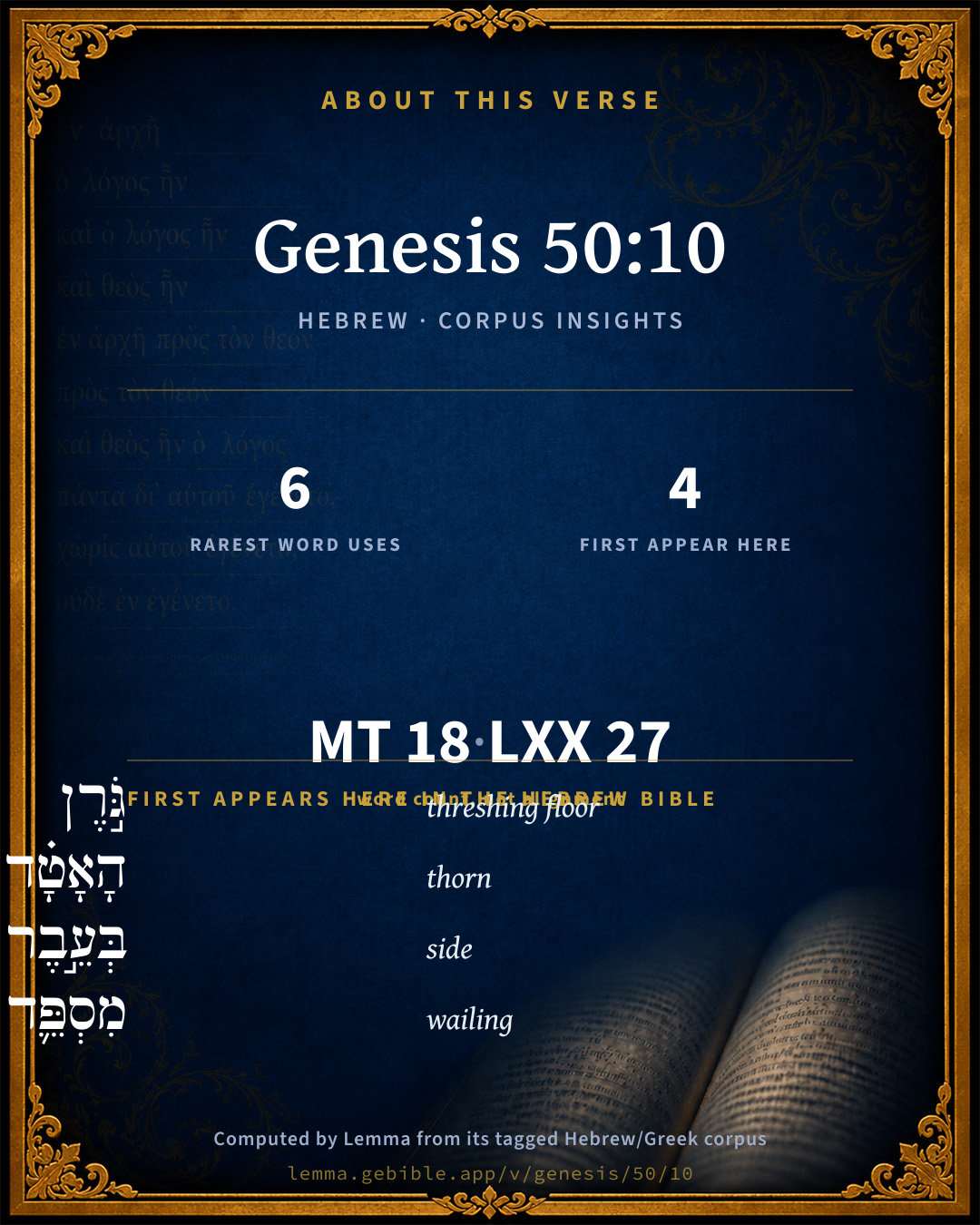
  • 4 first appearances in the Hebrew Bible
Full analysis ↓
Download a study sheet

One document with this verse’s original text, its word-by-word gloss line, the meaning frame, cross-references with their text, attributed commentary, and full source and license credits — printable, and it pastes into notes with its structure intact.

This verse Autodidact and up

Study sheet (.html) Plain text (.txt)

A passage Seminary Student

Up to 50 verses in one chapter. A passage sheet keeps up to 6 commentary sources and 12 cross-references per verse, in the order this page ranks them, and says so on the sheet whenever that leaves anything out. Ask for a single verse and you get the Autodidact verse sheet above.

Everything on this page stays free to read, with no account — the sheet is a download of what is already on screen, not access to it.

Want to remove ads? Support Godless Engineer
Compare translations 3

The same verse in 3 English versions, stacked beneath the original-language interlinear above. Click any original word for its lexicon entry.

Each is an independent rendering of the whole verse — the interlinear is not word-aligned to these translations.

Highlighted words mark where these versions differ — a whole-verse word diff, not a word-by-word alignment.

  • World English Bible Public Domain
    They came to the threshing floor of Atad, which is beyond the Jordan, and there they lamented with a very great and sore lamentation. He mourned for his father seven days.
  • King James Version Public Domain
    And they came to the threshingfloor of Atad, which is beyond Jordan, and there they mourned with a great and very sore lamentation: and he made a mourning for his father seven days.
  • unfoldingWord Literal Text CC BY-SA 4.0
    Then they came to the threshing floor of Atad, which beyond the Jordan, and they lamented there a very great and heavy lamentation. And he did seven days mourning for his father.

unfoldingWord Literal Text — © unfoldingWord, licensed CC BY-SA 4.0. Word-aligned USFM3 via Door43 (git.door43.org/unfoldingWord/en_ult).

Versions to compare (up to 4)

3 of 4 selected

Show all 18 translations

Every available English version of this verse, each an independent rendering of the whole verse.

  • World English Bible Public Domain
    They came to the threshing floor of Atad, which is beyond the Jordan, and there they lamented with a very great and sore lamentation. He mourned for his father seven days.
  • Berean Standard Bible Public Domain
    When they reached the threshing floor of Atad, which is across the Jordan, they lamented and wailed loudly, and Joseph mourned for his father seven days.
  • Majority Standard Bible Public Domain
    When they reached the threshing floor of Atad, which is across the Jordan, they lamented and wailed loudly, and Joseph mourned for his father seven days.
  • King James Version Public Domain
    And they came to the threshingfloor of Atad, which is beyond Jordan, and there they mourned with a great and very sore lamentation: and he made a mourning for his father seven days.
  • American Standard Version (1901) Public Domain
    And they came to the threshing-floor of Atad, which is beyond the Jordan, and there they lamented with a very great and sore lamentation: and he made a mourning for his father seven days.
  • Revised Version (1885) Public Domain
    And they came to the threshing-floor of Atad, which is beyond Jordan, and there they lamented with a very great and sore lamentation: and he made a mourning for his father seven days.
  • Geneva Bible (1599) Public Domain
    And they came to Goren Atad, which is beyond Iorden, and there they made a great and exceeding sore lamentation: and he mourned for his father seuen dayes.
  • Douay-Rheims (1899) Public Domain
    And they came to the threshingfloor of Atad, which is situated beyond the Jordan: where celebrating the exequies with a great and vehement lamentation, they spent full seven days.
  • Young's Literal Translation Public Domain
    And they come unto the threshing-floor of Atad, which `is' beyond the Jordan, and they lament there, a lamentation great and very grievous; and he maketh for his father a mourning seven days,
  • Literal Standard Version CC BY-SA 4.0
    And they come to the threshing-floor of Atad, which [is] beyond the Jordan, and they lament there, a lamentation great and very grievous; and he makes for his father a mourning seven days,
  • Unlocked Literal Bible CC BY-SA 4.0
    When they came to the threshing floor of Atad on the other side of the Jordan, they mourned with very great and grievous sorrow. There Joseph made a seven-day mourning for his father.
  • unfoldingWord Literal Text CC BY-SA 4.0
    Then they came to the threshing floor of Atad, which beyond the Jordan, and they lamented there a very great and heavy lamentation. And he did seven days mourning for his father.
  • Darby Bible Public Domain
    And they came to the threshing-floor of Atad, which is beyond the Jordan; and there they lamented with a great and very grievous lamentation; and he made a mourning for his father of seven days.
  • World Messianic Bible Public Domain
    They came to the threshing floor of Atad, which is beyond the Jordan, and there they lamented with a very great and severe lamentation. He mourned for his father seven days.
  • Webster's Bible Public Domain
    And they came to the threshing-floor of Atad, which is beyond Jordan, and there they mourned with a great and very sore lamentation: and he made a mourning for his father seven days.
  • Free Bible Version CC BY-SA 4.0
    When they got to the threshing floor of Atad, on the other side of the Jordan, they wept loudly in sorrow. Joseph held a seven-day ceremony of mourning for his father there.
  • Bible in Basic English Public Domain
    And they came to the grain-floor of Atad on the other side of Jordan, and there they gave the last honours to Jacob, with great and bitter sorrow, weeping for their father for seven days.
  • JPS Tanakh (1917) Public Domain
    And they came to the threshing-floor of Atad, which is beyond the Jordan, and there they wailed with a very great and sore wailing; and he made a mourning for his father seven days.

Literal Standard Version (2020), Covenant Press — licensed CC BY-SA 4.0. Text via the HelloAO Bible API (eBible.org). Unlocked Literal Bible (unfoldingWord) — licensed CC BY-SA 4.0. Text via the HelloAO Bible API (eBible.org). unfoldingWord Literal Text — © unfoldingWord, licensed CC BY-SA 4.0. Word-aligned USFM3 via Door43 (git.door43.org/unfoldingWord/en_ult). Free Bible Version, Dr. Jonathan Gallagher — licensed CC BY-SA 4.0. Text via the HelloAO Bible API (eBible.org).

Word by word

More ways to search: Search by grammar → Find every occurrence → Compare this word →

Practice this passage: Drill this verse → Learn its vocabulary →

הָאָטָ֗ד
ʼâṭâd
H329
“thorn”
Particle, Definite Article
Part of Speech
Particle
Type
Definite Article
Full BDB Definition

Origin: from an unused root probably meaning to pierce or make fast

TWOT: 71a

bramble, thorn, buckthorn - the threshing Atad, meaning thorn, also called Abelmizraim and afterwards called Bethhogla was located on the west of Jordan between the Jordan and Jericho
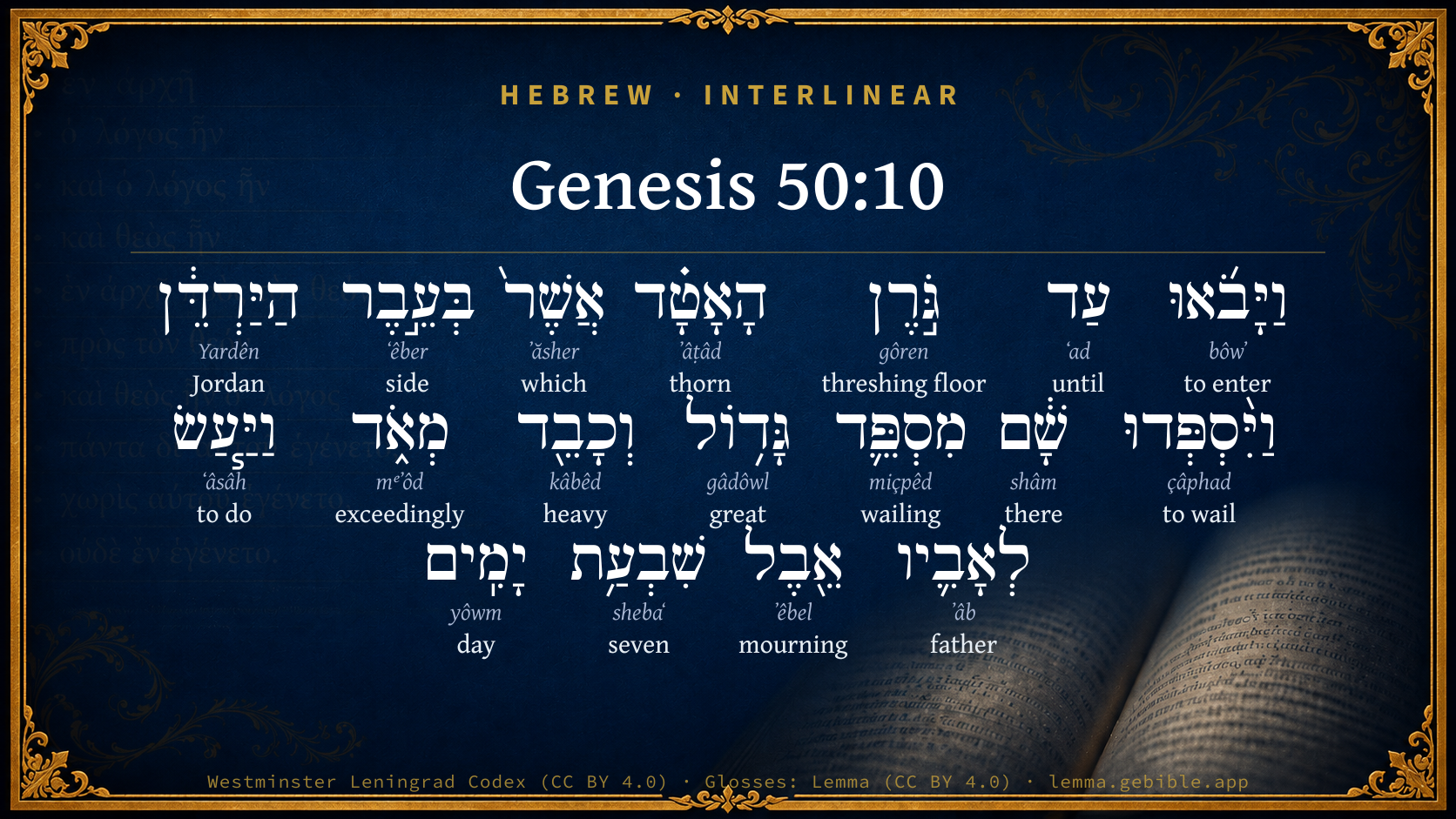
  1. וַיָּבֹ֜אוּ bôwʼ H935 “and · to enter” Conjunction + Verb, Qal, Sequential Imperfect, 3rd Person, Masculine, Plural
  2. עַד ʻad H5704 “until” Preposition
  3. גֹּ֣רֶן gôren H1637 “threshing floor of” Noun, Common, Both, Singular, Construct
  4. אֲשֶׁר֙ ʼăsher H834 “which” Particle, Relative
  5. בְּעֵ֣בֶר ʻêber H5676 “in/at · side of” Preposition + Noun, Common, Masculine, Singular, Construct
  6. הַיַּרְדֵּ֔ן Yardên H3383 “the · Jordan” Particle, Definite Article + Noun, Proper
  7. וַיִּ֨סְפְּדוּ çâphad H5594 “and · to wail” Conjunction + Verb, Qal, Sequential Imperfect, 3rd Person, Masculine, Plural
  8. שָׁ֔ם shâm H8033 “there” Adverb
  9. מִסְפֵּ֛ד miçpêd H4553 “wailing” Noun, Common, Masculine, Singular, Absolute
  10. גָּד֥וֹל gâdôwl H1419 “great” Adjective, Adjective, Masculine, Singular, Absolute
  11. וְכָבֵ֖ד kâbêd H3515 “and · heavy” Conjunction + Adjective, Adjective, Masculine, Singular, Absolute
  12. מְאֹ֑ד mᵉʼôd H3966 “exceedingly” Adverb
  13. וַיַּ֧עַשׂ ʻâsâh H6213 “and · to do” Conjunction + Verb, Qal, Sequential Imperfect, 3rd Person, Masculine, Singular
  14. לְאָבִ֛יו ʼâb H1 “to/for · father · his” Preposition + Noun, Common, Masculine, Singular, Construct + Suffix, Personal, 3rd Person, Masculine, Singular
  15. אֵ֖בֶל ʼêbel H60 “mourning” Noun, Common, Masculine, Singular, Absolute
  16. שִׁבְעַ֥ת shebaʻ H7651 “seven” Adjective, Cardinal number, Masculine, Singular, Construct
  17. יָמִֽים yôwm H3117 “days” Noun, Common, Masculine, Plural, Absolute

About this verse

These counts appear in no published source. They are computed here, from the morphology-tagged text and Lemma’s own curated glosses. What Lemma adds →

18
words
18
distinct lemmas
Pentateuch
section

Notable vocabulary

The rarest word here is הָאָטָ֗ד thorn H329 — appearing just 6 times in the whole Hebrew Bible.

First appearance in Scripture

These words make their first canonical appearance in the Hebrew Bible here:

  • גֹּ֣רֶן threshing floor H1637
  • הָאָטָ֗ד thorn H329
  • בְּעֵ֣בֶר side H5676
  • מִסְפֵּ֛ד wailing H4553

Shared distinctive vocabulary

הָאָטָ֗ד thorn H329 occurs in 5 verses of the Hebrew Bible. Also found in:

Grammatical profile

  • 3 verbs
  • 7 nouns
  • 3 adjectives
  • 1 preposition
  • 2 adverbs
  • 2 particles

Verb forms

  • וַיָּבֹ֜אוּ Qal · Sequential Imperfect
  • וַיִּ֨סְפְּדוּ Qal · Sequential Imperfect
  • וַיַּ֧עַשׂ Qal · Sequential Imperfect

Hebrew & Septuagint length

In English translation the verse runs 31 words from the Hebrew and 34 from the Septuagint (LXX English) — closely comparable.

A rough comparison of the two English renderings, which tokenize alike — not a word-level alignment.

Word counts can differ between the Hebrew and the Greek without any difference in meaning — e.g. the Hebrew direct-object marker אֵת has no separate Greek word, and Greek often adds the article ὁ.

In the original languages it is 18 Hebrew tokens and 27 Greek tokens — but the two are counted differently (Hebrew bundles its prefixes and suffixes into one token; the Greek is in lemma form), so that isn’t a like-for-like length.

Cross-references

9

Topical passages linked to Genesis 50:10 in the Treasury of Scripture Knowledge — connected by theme and wording, ordered by reader-vote popularity; previews shown in the World English Bible.

  • Job 2:13 So they sat down with him on the ground seven days and seven nights, and none spoke a word to him, for they saw that his grief was very great.
  • Acts 8:2 Devout men buried Stephen, and lamented greatly over him.
  • 2 Samuel 1:17 David lamented with this lamentation over Saul and over Jonathan his son
  • 1 Samuel 31:13 They took their bones, and buried them under the tamarisk tree in Jabesh, and fasted seven days.
  • Genesis 50:4 When the days of weeping for him were past, Joseph spoke to the house of Pharaoh, saying, "If now I have found favor in your eyes, please speak in the ears of Pharaoh, saying,
  • Genesis 50:11 When the inhabitants of the land, the Canaanites, saw the mourning in the floor of Atad, they said, "This is a grievous mourning by the Egyptians." Therefore, the name of it was called Abel Mizraim, which is beyond the Jordan.
  • Numbers 19:11 He who touches the dead body of any man shall be unclean seven days:
  • Deuteronomy 1:1 These are the words which Moses spoke to all Israel beyond the Jordan in the wilderness, in the Arabah over against Suph, between Paran, and Tophel, and Laban, and Hazeroth, and Dizahab.
  • Deuteronomy 34:8 The children of Israel wept for Moses in the plains of Moab thirty days: so the days of weeping in the mourning for Moses were ended.

Cross-references courtesy of OpenBible.info (CC BY 4.0).

Hebrew and Greek witnesses Masoretic Hebrew ↔ Greek Septuagint

The same verse in the two great witnesses to the Old Testament, shown verse-for-verse.

These are two independent witnesses, not word-aligned to each other, and the Septuagint is shown in lemma (dictionary) form.

Hebrew Genesis 50:10 Masoretic · Westminster Leningrad Codex

וַיָּבֹ֜אוּ עַד גֹּ֣רֶן הָאָטָ֗ד אֲשֶׁר֙ בְּעֵ֣בֶר הַיַּרְדֵּ֔ן וַיִּ֨סְפְּדוּ שָׁ֔ם מִסְפֵּ֛ד גָּד֥וֹל וְכָבֵ֖ד מְאֹ֑ד וַיַּ֧עַשׂ לְאָבִ֛יו אֵ֖בֶל שִׁבְעַ֥ת יָמִֽים

They came to the threshing floor of Atad, which is beyond the Jordan, and there they lamented with a very great and sore lamentation. He mourned for his father seven days.

World English Bible · Public Domain

Greek LXX Genesis 50:10 Septuagint · lemma form

καί παραγίγνομαι ἐπί ἅλων αταδ ὅς εἰμί πέραν ὁ ἰορδάνης καί κόπτω αὐτός κοπετός μέγας καί ἰσχυρός σφόδρα καί ποιέω ὁ πένθος ὁ πατήρ αὐτός ἑπτά ἡμέρα

And they came to the threshing floor of Atad, which is beyond Jordan; and they bewailed him with a great and very sore lamentation; and he made a mourning for his father seven days.

LXX2012 (modern English Septuagint) · Public Domain

Hebrew: Westminster Leningrad Codex (CC BY 4.0). Greek: Septuagint (public domain); English from LXX2012 (modern English Septuagint) (Public Domain). How the Septuagint differs from the Hebrew →

Targum (Aramaic paraphrase)

2

The Targum is the ancient Jewish Aramaic paraphrase of the Hebrew Scriptures — an interpretive translation, not the Hebrew text itself. Onkelos (literal) and Pseudo-Jonathan (expansive) render the Torah, and Jonathan the Prophets. Coverage is partial: where no permissively-licensed English translation exists for a verse, only the Aramaic is shown. This is verse-level text, not a word-by-word alignment to the Hebrew.

  1. Targum Onkelos Torah (Genesis–Deuteronomy)
    וַאֲתוֹ עַד בֵּית אִדְרֵי דְאָטָד דִּי בְּעִבְרָא דְיַרְדְנָא וּסְפָדוּ תַמָּן מִסְפֵּד רַב וְתַקִּיף לַחֲדָא וְעָבַד לַאֲבוּהִי אֶבְלָא שַׁבְעָא יוֹמִין

    (no public-domain English translation for this verse)

    Targum Onkelos — Aramaic: “Onkelos Genesis” (public domain); “Onkelos Exodus” (public domain); “Onkelos Leviticus” (public domain); “Onkelos Numbers” (public domain); “Onkelos Deuteronomy” (public domain). English: “Sefaria Community Translation” (CC0 1.0 (public-domain dedication)); “J.W. Etheridge. The Targums of Onkelos and Jonathan Ben Uzziel on the Pentateuch. London: Longmans, Green, 1862” (public domain). Text via Sefaria.

  2. Targum Pseudo-Jonathan Torah (Genesis–Deuteronomy)
    וְאָתוּ עַד בֵּית אִידְרֵי דְאָטָד דִי בְּעִיבְרָא דְיוֹרְדְנָא וּסְפָדוּ תַּמָן מִסְפַּד רַב וּתְקֵיף לַחֲדָא וְעָבֵד לְאָבוֹי אוּבְלָא שַׁבְעָא יוֹמִין

    And they came to the threshing floor of Atad, which is beyond the Jardena, and there they lamented with a great and mighty lamentation. And he made there a mourning for his father seven days.

    Targum Pseudo-Jonathan — Aramaic: “Targum Jonathan on Genesis” (public domain); “Targum Jonathan on Exodus” (public domain); “Targum Jonathan on Leviticus” (public domain); “Targum Jonathan on Numbers” (public domain); “Targum Jonathan on Deuteronomy” (public domain). English: “The Targum of Jonathan ben Uzziel, trans. J. W. Etheridge, London, 1862” (public domain). Text via Sefaria.

Commentary

Notes on Genesis 50:10 from classic Christian and Jewish commentators (each source and its license shown beneath its notes). The classic Christian expositions comment on the surrounding passage and are grouped to its opening verse, so a note may address several verses; the Jewish commentaries on the Tanakh (Rashi and others) are per-verse, so they appear only where the commentator wrote on this verse.

Lemma curates 59 commentaries, every one of them public domain or Creative Commons licensed, each selected and text-cleaned for this edition rather than reprinted as found. About our sources →

Trapp's Complete Commentary

John Trapp

Gen 50:10 And they came to the threshingfloor of Atad, which [is] beyond Jordan, and there they mourned with a great and very sore lamentation: and he made a mourning for his father seven days.

Ver. 10. And he made a mourning for his father.] Not seventy days, as those infidels did, Gen 50:3. But why mourned he at all, since God had signified his will? So far forth as something concurs with God’s will that is grievous to us, we may mourn moderately without offence.

John Trapp, A Commentary or Exposition upon All the Books of the Old and New Testament (1647–1656) — public domain. Text from a community e-Sword module.

Joseph Benson's Commentary

Gen 50:10. They mourned with a very great and sore lamentation — “This,” says Sir John Chardin, quoted by Harmer, (vol. 2. p. 136,) “is exactly the genius of the people of Asia, especially of the women. Their sentiments of joy or grief are properly transports; and their transports are ungoverned, excessive, and truly outrageous. When any one returns from a long journey, or dies, his family bursts into cries that may be heard twenty doors off; and this is renewed at different times, and continues many days, according to the vigour of the passion. Especially are these cries long in the case of death, and frightful; for their mourning is right down despair, and an image of hell. I was lodged, in the year 1676, at Ispahan, near the royal square; the mistress of the next house to mine died at that time. The moment she expired, all the family, to the number of twenty-five or thirty people, set up such a furious cry, that I was quite startled, and was above two hours before I could recover myself. These cries continue a long time, then cease all at once; they begin again as suddenly at day-break and in concert. It is this suddenness which is so terrifying, together with a greater shrillness or loudness than any one would easily imagine. This enraged kind of mourning, if I may call it so, continued forty days, not equally violent, but with diminution from day to day. The longest and most violent acts were when they washed the body, when they perfumed it, when they carried it out to be interred, at making the inventory, and when they divided the effects. You are not to suppose that those that were ready to split their throats with crying out wept as much: the greatest part of them did not shed a single tear through the whole tragedy.” It is probable, however, that there was more sincerity in the mourning, even of the Egyptians, for Jacob, than is described in these words; for they seem evidently to have greatly respected him. And their solemn mourning for him (Gen 50:11) gave a name to the place, Abel-Misraim, which, in Hebrew, signifies, The mourning of the Egyptians: which served for a testimony against the next generation of the Egyptians, who oppressed the posterity of this Jacob, to whom their ancestors showed such respect.

Joseph Benson's Commentary on the Old and New Testaments (1811–1818) — public domain. Text from a community e-Sword module.

Tyndale Open Study Notes

Tyndale Open Resources

50:10-13 This journey into Canaan was made in sorrow to bury a man; the next journey into the land would be to live there.

Tyndale Open Study Notes — © Tyndale Open Resources, licensed CC BY-SA 4.0. Text via the HelloAO Bible API.

Geneva Bible (1599)

Geneva Bible translators

Or, the corn floor of Atad.

Geneva Bible (1599) marginal notes — public domain. Text via Bolls.life.

Jamieson, Fausset & Brown

Robert Jamieson, A. R. Fausset & David Brown

they came to the threshing-floor of Atad, &c.--"Atad" may be taken as a common noun, signifying "the plain of the thorn bushes." It was on the border between Egypt and Canaan; and as the last opportunity of indulging grief was always the most violent, the Egyptians made a prolonged halt at this spot, while the family of Jacob probably proceeded by themselves to the place of sepulture.

Jamieson, Fausset & Brown — Commentary Critical and Explanatory on the Whole Bible (1871) — public domain (CC PDM 1.0). Text via the HelloAO Bible API.

Adam Clarke's Commentary

Verse 10. The threshing-floor of Atad] As אטד atad signifies a bramble or thorn, it has been understood by the Arabic, not as a man's name, but as the name of a place; but all the other versions and the Targums consider it as the name of a man. Threshing-floors were always in a field, in the open air; and Atad was probably what we would call a great farmer or chief of some clan or tribe in that place. Jerome supposed the place to have been about two leagues from Jericho; but we have no certain information on this point. The funeral procession stopped here, probably as affording pasturage to their cattle while they observed the seven days' mourning which terminated the funeral solemnities, after which nothing remained but the interment of the corpse. The mourning of the ancient Hebrews was usually of seven days' continuance, Nu 19:19; 1Sa 31:13; though on certain occasions it was extended to thirty days, Nu 20:29; De 21:13; De 34:8, but never longer. The seventy days' mourning mentioned above was that of the Egyptians, and was rendered necessary by the long process of embalming, which obliged them to keep the body out of the grave for seventy days, as we learn both from Herodotus and Diodorus. Seven days by the order of God a man was to mourn for his dead, because during that time he was considered as unclean; but when those were finished he was to purify himself, and consider the mourning as ended; Nu 19:11; Nu 19:19. Thus God gave seven days, in some cases thirty, to mourn in: man, ever in his own estimation wiser than the word of God, has added eleven whole months to the term, which nature itself pronounces to be absurd, because it is incapable of supporting grief for such a time; and thus mourning is now, except in the first seven or thirty days, a mere solemn ill-conducted FARCE, a grave mimicry, a vain show, that convicts itself of its own hypocrisy. Who will rise up on the side of God and common sense, and restore becoming sorrow on the death of a relative to decency of garb and moderation in its continuance? Suppose the near relatives of the deceased were to be allowed seven days of seclusion from society, for the purpose of meditating on death and eternity, and after this to appear in a mourning habit for thirty days; every important end would be accomplished, and hypocrisy, the too common attendant of man, be banished, especially from that part of his life in which deep sincerity is not less becoming than in the most solemn act of his religious intercourse with God.

In a kind of politico-religious institution formed by his late majesty Ferdinand IV., king of Naples and the Sicilies, I find the following rational institute relative to this point: "There shall be no mourning among you but only on the death of a father, mother, husband, or wife. To render to these the last duties of affection, children, wives, and husbands only shall be permitted to wear a sign or emblem of grief: a man may wear a crape tied round his right arm; a woman, a black handkerchief around her neck; and this in both cases for only two months at the most." Is there a purpose which religion, reason, or decency can demand that would not be answered by such external mourning as this? Only such relatives as the above, brothers and sisters being included, can mourn; all others make only a part of the dumb hypocritical show.

Adam Clarke's Commentary on the Bible (1810–1826) — public domain. Text from a community e-Sword/MySword module.

Ellicott's Commentary for English Readers

(10) Threshingfloor of Atad.—Atad means “a thorn-bush,” the rhamnus paliurus of Linnaeus, translated “bramble” in Jdg_9:14. As agriculture was only beginning to be practised in Canaan, this threshing. floor would be common property, situated in some place easy of access, and probably a village would grow up near it.

Beyond Jordan.—It is disputed whether this means on the east or on the west of the Jordan. It is certain that the route taken by Joseph lay to the east of the Dead Sea; for Goren-Atad is placed by Jerome at Beth-Hoglah, which lay between the Jordan and Jericho, and Joseph could have gone thither only by travelling through the territories of Moab and Amnion. This may seem a long detour, but, as may be seen in the Excursus on the Expedition of Chedorlaomer, the route through the wilderness of Judah was very difficult; and though the western shore of the Dead Sea was practicable as far as Engedi, it was necessary there to ascend a mountain-path so steep that a few Amorites might have guarded it against any number of invaders; and probably it was absolutely impracticable for chariots. It would have been easy, however, to reach Hebron through the Philistine country; but it is remarkable that we find hostilities going on between the descendants of Joseph and the Philistines (1Ch_7:21); and if raids were of common occurrence between the Semitic clans in Goshen and the Philistines, Joseph would not expose his father’s remains to the danger of an attack. Possibly they may even have refused their consent, and hence the attack upon them by Ephraim’s sons. On the other hand, the sons of Esau would show great respect to the body of their uncle—(Jewish tradition makes even the sons of Ishmael and of Keturah take part in the mourning)—and moreover they had not yet attained to any great power; and we gather from Esau’s march through the lands on the west of the Dead Sea (Gen_32:6) that the natives there were too few and feeble to resist the chariots and horsemen which formed the escort. While therefore “beyond Jordan” would naturally mean “on the east of Jordan,” it may here express the fact that Joseph had just crossed the Jordan when the lamentation was made. The only other tenable explanation is that Goren-Atad was really on the eastern bank of the Jordan, and that though Beth-Hoglah was the nearest village, the two were not identical. It would be natural to make the solemn seven days’ mourning, either when just about to enter the Canaanite territory or at the tomb.

A Bible Commentary for English Readers, edited by Charles John Ellicott (1878–1897) — public domain. Text from a community e-Sword module.

The Cambridge Bible for Schools and Colleges

gen. ed. J. J. S. Perowne

10. the threshing-floor of Atad] Goren-ha-Atad, a threshing-floor of “the thornbush,” or “bramble” (Jdg_9:14-15). The place is nowhere else referred to.

beyond Jordan] By this expression is generally meant “on the east side of Jordan.” If so, we must suppose that for some reason the burial company leaving Egypt travelled round the southern extremity of the Dead Sea. But this appears extremely improbable. The traditional burial-place of Jacob was at Machpelah. No Israelite could suppose that, even for the purpose of doing honour to Jacob, it would have been necessary to go round into trans-Jordanic territory. Winckler conjectures that the original reading was “on the other side of the river” (viz. “the River of Egypt,” or ‘El-Arîsh, the boundary of Egypt and Canaan, cf. Num_34:5; 1Ki_8:65), and that this was carelessly altered by the error of a scribe to the more familiar phrase “beyond Jordan.” Whether this conjecture be accepted or not, the present text is unintelligible. It is very unlikely that any legend would have arisen connecting Jacob’s burial-place with the eastern bank of the Jordan.

seven days] See note on Gen_50:3. “Lamentation” (cf. Gen_23:2), i.e. the Oriental custom of “wailing” for the dead.

The Cambridge Bible for Schools and Colleges (gen. ed. J. J. S. Perowne; Cambridge University Press, 1878–1918) — public domain. Text from a community e-Sword module.

John Gill's Exposition

And they came to the threshingfloor of Atad,.... Which was either the name of a man the owner of it, or of a place so called from the thorns and brambles which grew here, and with which the threshingfloor was surrounded, as Jarchi says, see Jdg 9:14 and it was usual to make a hedge of thorns round about a threshingfloor (o), that it might be preserved; mention is made in the Talmud (p) of the wilderness of Atad, perhaps so called from the thorns and brambles in it: Jerom says (q) it was three miles from Jericho and two from Jordan, and was in his time called Bethagla, the place of a circuit, because there they went about after the manner of mourners at the funeral of Jacob. This, according to some (r), was two hundred and forty miles from On, where Joseph was supposed to live, sixteen from Jerusalem, and forty from Hebron, where Jacob was buried: nay, Austin (s) says it was above fifty miles from that place, as affirmed by those who well knew those parts:

which is beyond Jordan; as it was to those that came out of Egypt:

and there they mourned with a great and very sore lamentation; being now entered into the country where the corpse was to be interred; and perhaps they might choose to stop here and express tokens of mourning, that the inhabitants might be apprised of their design in coming, which was not to invade them and make war upon them, only to bury their dead: this mourning seems to be made chiefly by the Egyptians, which was done in an external way, and it may be by persons brought with them for that purpose; since both the name of the place after given was from their mourning there, and the mourning of Joseph is next observed as distinct from theirs:

and he made a mourning for his father seven days; which was the time of mourning, afterwards observed by the Jews, see Sa1 31:13, this Joseph ordered and observed after he had buried his father, as Aben Ezra says, is affirmed by their ancient Rabbins, and perhaps might be at this same place upon their return.

(o) T. Bab. Sotah, fol. 13. 1. & Gloss. in ib. Aruch in voc. fol. 39. 4. (p) T. Hieros. Nedarim, fol. 40. 1. (q) De locis Heb. fol. 87. G. (r) Bunting's Travels, p. 79, 80. (s) Quaest. is Gen. l. 1. p. 54. "inter opera ejus", tom. 4.

John Gill's Exposition of the Whole Bible (1746–1763) — public domain (CC PDM 1.0). Text via the HelloAO Bible API.

Haydock's Catholic Bible Commentary

Atad, which was so called, from being encompassed with thorns. (Calmet) --- Beyond; with relation to Moses, (Haydock) or on the west side of the Jordan. (Calmet)

George Leo Haydock (1774–1849), Haydock's Catholic Family Bible and Commentary, 1859 edition — public domain. Excludes Psalms (Douay-Rheims chapter numbering differs from Protestant) and Deuterocanonical books (Catholic canon only).

Matthew Poole's English Annotations

Atad, a man so called; or, of thorn, or thorns, as the word signifies, Jdg 9:14; Psa 58:9. So it might be a place either abounding or encompassed with thorns.

Beyond, or on this side; for the word signifies both, and it may be taken either way here; the one in respect of Egypt, the other in regard of the place in which Moses wrote. It is certain they fetched a great compass, whether for the commodiousness of the way for their chariots, and for conveniences for so great a company, or to prevent all jealousies in the people, as if they came thither with ill design, is not material.

There they mourned, because there was the entrance into that country or territory where he was to be buried. Though the Egyptians were not much grieved nor concerned for Jacob’s death, yet they used bitter cries and lamentations, which possibly were made or aggravated by persons hired and used upon such occasions. See Jer 9:17.

Seven days, according to the custom. See 1Sa 31:13.

Matthew Poole's English Annotations on the Holy Bible (1683–1685) — public domain. Text from a community e-Sword/MySword module.

Whedon's Commentary on the Bible

Daniel D. Whedon

10. The threshing-floor of Atad — Or, the threshing-floor of the thorn. The words may be taken as the proper name of a place, Goren-haatadh. It was beyond Jordan, that is, on the east of Jordan, for such is the natural meaning of this phrase. Accordingly, it appears that this vast procession took a circuitous route, went round the Dead Sea, and entered Canaan on the east. Why they should have taken such a journey does not appear in this narrative, and some have regarded it as so improbable that they have discarded the natural meaning of the language here employed, and have explained beyond Jordan as meaning west of the Jordan. According to Jerome it was called in his time Beth-agla, and some have sought to identify it with the modern Ain Hadjla, the Beth-hoglah of the tribe of Judah, (Jos_15:6,) situated at the northern end of the Dead Sea, about two miles west of the Jordan. One writing at the east of the Jordan, as the author of this passage is supposed to have done, would have spoken of this place as beyond Jordan. But this identification with Beth-hoglah is of no sufficient authority, and why any writer should have designated a place west of the Jordan as beyond Jordan is inexplicable, if this funeral procession did not go anywhere in the vicinity of the Jordan. Better, therefore, to suppose that this round-about journey was taken to avoid conflict with hostile tribes then occupying the country on the direct road to Hebron. For a similar reason the whole house of Israel at a later day compassed the land of Edom and entered Canaan from the east. At this place, perhaps nothing but a threshing-floor surrounded by thornbushes, but affording a suitable place for the purpose, they mourned with a great and very sore lamentation for the space of seven days. Thus to the seventy days of mourning in Egypt, (Gen_50:3,) they now added a full week at the borders of Canaan.

Daniel D. Whedon (gen. ed.), Commentary on the Old and New Testaments (1874–1909) — public domain. Text from a community e-Sword module.

The Pulpit Commentary

And they came to the threshing-floor of Atad. The threshing-floor, or goren, was a large open circular area which was used for trampling out the corn by means of oxen, and was exceedingly convenient for the accommodation of a large body of people such as accompanied Joseph. The goren at which the funeral party halted was named Atad (i.e. Buckthorn), either from the name of the owner, or from the quantity of buck-thorn which grew in the neighborhood. Which is beyond Jordan literally, on the other side of the Jordan, i.e. west side, if the narrator wrote from his own standpoint (Jerome, Drusius, Ainsworth, Kalisch, "Speaker"s Commentary," Wordsworth, et alii), in which case the funeral train would in all probability follow the direct route through the country of the Philistines, and Goren Atad would be situated somewhere south of Hebron, in the territory (afterwards) of Judah; but east side of the river if the phrase must be interpreted from the standpoint of Palestine (Clericus, Rosenm Hengstenberg, Kurtz, Keil, Lange, Gerlach, Havernick, Murphy, and others), in which case the burial procession must have journeyed by the wilderness, as the Israelites on a latter occasion did, and probably for not dissimilar reasons. In favor of the former interpretation may be claimed ver. 11, which says the Canaanites beheld the mourning, implying seemingly that it occurred within the borders of Canaan, i.e. on the west of the Jordan; while support for the latter is derived from ver. 13, which appears to state that after the lamentation at Goren Atad the sons of Jacob carried him into Canaan, almost necessarily involving the inference that Goren Atad was on the east of the Jordan; but vide infra. If the former is correct, Goren Atad was probably the place which Jerome calls Betagla tertio ab Hiericho lapide, duobus millibus ab Jordane; if the latter is correct, it does not prove a post-Mosaic authorship (Tuch, Bohlen, &c.), since the phrase appears to have had an ideal usage with reference to Canaan in addition to the objective geographical one (Hengstenberg "On the Genuineness of the Pentateuch," vol. 2. p. 260; Keil"s "Introduction," vol. 1. p. 189; Kalisch "On Genesis," p. 776). And there they mourned with a great and very sore lamentation. The Egyptians were exceedingly demonstrative and vehement in their public lamentations for the dead, rending their garments, smiting on their breasts, throwing dust and mud on their heads, calling on.the deceased by name, and chanting funeral dirges to the music of a tambourine with the tinkling plates removed (Wilkinson"s "Ancient Egyptians," vol. 3. p. 440, ed. 1878). And he made a mourning for his father seven days. This was a special mourning before interment (cf. Ecc 22:11).

The Pulpit Commentary (1880–1919), ed. H.D.M. Spence-Jones & Joseph S. Exell — public domain. Text from a community e-Sword module.

Keil & Delitzsch

C. F. Keil & F. Delitzsch

Thus they came to Goren Atad beyond the Jordan, as the procession did not take the shortest route by Gaza through the country of the Philistines, probably because so large a procession with a military escort was likely to meet with difficulties there, but went round by the Dead Sea. There, on the border of Canaan, a great mourning and funeral ceremony was kept up for seven days, from which the Canaanites, who watched it from Canaan, gave the place the name of Abel-mizraim, i.e., meadow (אבל with a play upon אבל mourning) of the Egyptians. The situation of Goren Atad (the buck-thorn floor), or Abel-mizraim, has not been discovered. According to Gen 50:11, it was on the other side, i.e., the eastern side, of the Jordan. This is put beyond all doubt by Gen 50:12, where the sons of Jacob are said to have carried the corpse into the land of Canaan (the land on this side) after the mourning at Goren Atad.

(Note: Consequently the statement of Jerome in the Onam. s. v. Area Atad - "locus trans Jordanem, in quo planxerunt quondam Jacob, tertio ab Jerico lapide, duobus millibus ab Jordane, qui nunc vocatur Bethagla, quod interpretatur locus gyri, eo quod ibi more plangentium circumierint in funere Jacob" - is wrong. Beth Agla cannot be the same as Goren Atad, if only because of the distances given by Jerome from Jericho and the Jordan. They do not harmonize at all with his trans Jordanem, which is probably taken from this passage, but point to a place on this side of the Jordan; but still more, because Beth Hagla was on the frontier of Benjamin towards Judah (Jos 15:6; Jos 18:19), and its name has been retained in the fountain and tower of Hajla, an hour and a quarter to the S.E. of Riha (Jericho), and three-quarters of an hour from the Jordan, by which the site of the ancient Beth Hagla is certainly determined. (Vid., Robinson, Pal., ii. p. 268ff.))

Keil & Delitzsch — Biblical Commentary on the Old Testament (1861–1891) — public domain (CC PDM 1.0). Text via the HelloAO Bible API. (Old Testament only.)

unfoldingWord translationNotes

Door43 World Missions Community

When they came

The word "they" refers to the participants in the burial procession.

floor of Atad

Possible meanings are 1) the word "Atad" means "thorn" and it may refer to a place where large amounts of thorns grew, or 2) it may be the name of the person who owns the threshing floor. (See: How to Translate Names)

they mourned with very great and grievous sorrow

"they were extremely sad and they mourned very much"

a seven-day

"a 7-day" (See: Numbers)

in the floor of Atad

Possible meanings are 1) "on the threshing floor that belonged to a man named Atad" or "in the threshing floor at a place called Atad" (See: How to Translate Names)

This is a very sad occasion for the Egyptians

"The mourning of the Egyptians is very great"

Abel Mizraim

The translator can add a footnote that says: "The name Abel Mizraim means "the mourning of Egypt.'" (See: How to Translate Names)

translationWords

thresh

Jordan River

mourn

day

Canaan

Egypt

unfoldingWord translationNotes — © Distant Shores Media and the Door43 World Missions Community, licensed CC BY-SA 4.0. Source: git.door43.org/Door43/en_tn.

Rashi

Rabbi Shlomo Yitzchaki (Rashi)

גרן האטד THE THRESHING FLOOR OF ATAD — It was so called because it was surrounded by a hedge of (אטדין) thorns (not because thorns were threshed there) Our Rabbis explained that it was so called in consequence of an incident that occurred there — that all the kings of Canaan and the princes of Ishmael came to wage war against them, but as soon as they saw Joseph’s crown hanging over Jacob’s coffin they all rose and hung their crowns on it and thus wreathed it with crowns like a threshing floor that is surrounded with a hedge of thorns (Sotah 13a).

Rashi on the Tanakh — English translations: “The Judaica Press complete Tanach with Rashi, translated by A. J. Rosenberg” (CC BY 4.0); “Pentateuch with Rashi's commentary by M. Rosenbaum and A.M. Silbermann, 1929-1934” (public domain); “The Metsudah Tanach series, Lakewood, N.J” (CC BY 4.0); and “The Book of Joshua, Metsudah Publications, 1997” (CC BY 4.0). Text via Sefaria.

Lesson kit

Teaching starters — assembled from the data on this page, not authored interpretation. Every prompt links to the verse data it draws on. Edit before teaching.

Genesis, in the Pentateuch, opens this verse with 18 words (18 distinct Hebrew lemmas). Its most distinctive word is ʼâṭâd (“thorn”). A historical commentator’s framing appears above. Read the whole chapter for the surrounding context.

Discussion questions

  1. What does “thorn” (ʼâṭâd) contribute to the verse as a whole?
  2. 4 words here appear for the first time in Scripture. What is being introduced at this debut?
  3. Genesis 50:11 shares the word «thorn» with this verse. How do the two illuminate each other?
  4. The translations on this page render this verse differently — a whole-verse word diff, not a word-by-word alignment. What might account for the different wordings?
  5. The verb «וַיָּבֹ֜אוּ» is Qal Sequential Imperfect. How does its form color the action?
  6. Reading how Trapp's Complete Commentary and Joseph Benson's Commentary read this verse, where do the two commentators agree and where do they part?

Things to notice

Reading settings

Reading text

Shown beneath each verse's original-language words.

Old Testament
Old Testament edition

Read the OT as the Masoretic Hebrew (MT) or the Greek Septuagint (LXX).

English shown for the Greek Septuagint (in the Hebrew ↔ Greek comparison).

Comparing translations? Open the Compare panel on any verse page to stack up to four side by side.