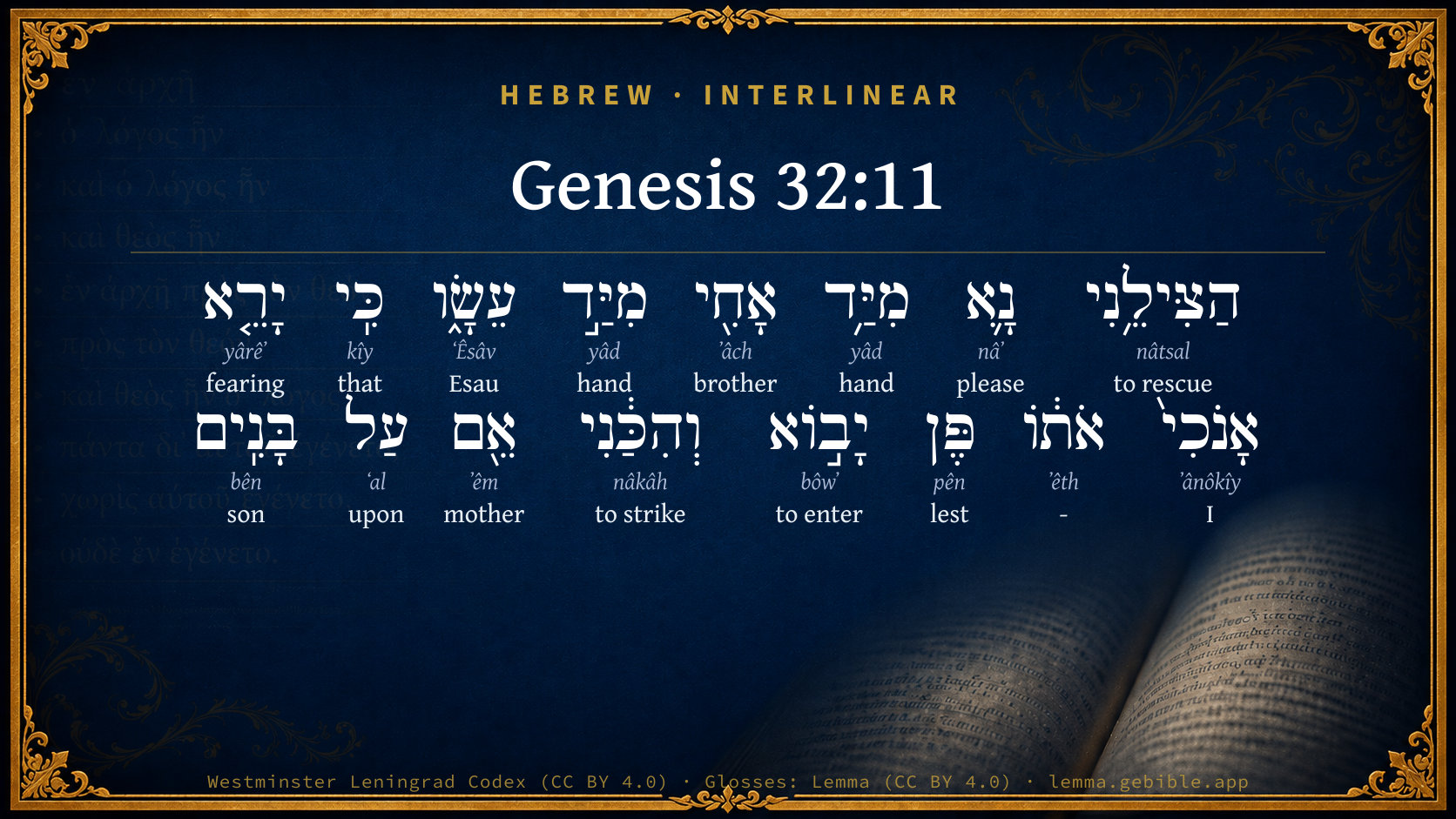
Genesis 32:11

Hebrew (Westminster Leningrad Codex) Genesis 32:11 appears in the Hebrew Old Testament. The text above is from the Westminster Leningrad Codex. Each word links to its Strong’s number, a concise gloss, and parsing drawn from the Open Scriptures Hebrew Bible morphology. Click any word for its full Brown-Driver-Briggs (BDB) entry.
Download image
Cite this verse

Genesis 32:11 (World English Bible). Public Domain. Lemma interlinear Bible study tool, https://lemma.gebible.app/v/genesis/32/11.

Show BibTeX & RIS
BibTeX
RIS
English Translation
Please deliver me from the hand of my brother, from the hand of Esau: for I fear him, lest he come and strike me, and the mothers with the children.
World English Bible · Public Domain
Download a study sheet

One document with this verse’s original text, its word-by-word gloss line, the meaning frame, cross-references with their text, attributed commentary, and full source and license credits — printable, and it pastes into notes with its structure intact.

This verse Autodidact and up

Study sheet (.html) Plain text (.txt)

A passage Seminary Student

Up to 50 verses in one chapter. A passage sheet keeps up to 6 commentary sources and 12 cross-references per verse, in the order this page ranks them, and says so on the sheet whenever that leaves anything out. Ask for a single verse and you get the Autodidact verse sheet above.

Everything on this page stays free to read, with no account — the sheet is a download of what is already on screen, not access to it.

Want to remove ads? Support Godless Engineer
Compare translations 3

The same verse in 3 English versions, stacked beneath the original-language interlinear above. Click any original word for its lexicon entry.

Each is an independent rendering of the whole verse — the interlinear is not word-aligned to these translations.

Highlighted words mark where these versions differ — a whole-verse word diff, not a word-by-word alignment.

  • World English Bible Public Domain
    Please deliver me from the hand of my brother, from the hand of Esau: for I fear him, lest he come and strike me, and the mothers with the children.
  • King James Version Public Domain
    Deliver me, I pray thee, from the hand of my brother, from the hand of Esau: for I fear him, lest he will come and smite me, and the mother with the children.
  • unfoldingWord Literal Text CC BY-SA 4.0
    Please save me from the hand of my brother, from the hand of Esau, because I am afraid of him, that he will come and strike me the mothers with the children!

unfoldingWord Literal Text — © unfoldingWord, licensed CC BY-SA 4.0. Word-aligned USFM3 via Door43 (git.door43.org/unfoldingWord/en_ult).

Versions to compare (up to 4)

3 of 4 selected

Show all 18 translations

Every available English version of this verse, each an independent rendering of the whole verse.

  • World English Bible Public Domain
    Please deliver me from the hand of my brother, from the hand of Esau: for I fear him, lest he come and strike me, and the mothers with the children.
  • Berean Standard Bible Public Domain
    Please deliver me from the hand of my brother Esau, for I am afraid that he may come and attack me and the mothers and children with me.
  • Majority Standard Bible Public Domain
    Please deliver me from the hand of my brother Esau, for I am afraid that he may come and attack me and the mothers and children with me.
  • King James Version Public Domain
    Deliver me, I pray thee, from the hand of my brother, from the hand of Esau: for I fear him, lest he will come and smite me, and the mother with the children.
  • American Standard Version (1901) Public Domain
    Deliver me, I pray thee, from the hand of my brother, from the hand of Esau: for I fear him, lest he come and smite me, the mother with the children.
  • Revised Version (1885) Public Domain
    Deliver me, I pray thee, from the hand of my brother, from the hand of Esau: for I fear him, lest he come and smite me, the mother with the children.
  • Geneva Bible (1599) Public Domain
    I pray thee, Deliuer me from the hande of my brother, from the hande of Esau: for I feare him, least he will come and smite me, and the mother vpon the children.
  • Douay-Rheims (1899) Public Domain
    Deliver me from the hand of my brother Esau, for I am greatly afraid of him: lest perhaps he come, and kill the mother with the children.
  • Young's Literal Translation Public Domain
    `Deliver me, I pray Thee, from the hand of my brother, from the hand of Esau: for I am fearing him, less he come and have smitten me -- mother beside sons;
  • Literal Standard Version CC BY-SA 4.0
    Please deliver me from the hand of my brother, from the hand of Esau: for I am fearing him, lest he come and has struck me—mother beside sons;
  • Unlocked Literal Bible CC BY-SA 4.0
    Please rescue me from the hand of my brother, from the hand of Esau, for I am afraid of him, that he will come and attack me and the mothers with the children.
  • unfoldingWord Literal Text CC BY-SA 4.0
    Please save me from the hand of my brother, from the hand of Esau, because I am afraid of him, that he will come and strike me the mothers with the children!
  • Darby Bible Public Domain
    Deliver me, I pray thee, from the hand of my brother, from the hand of Esau; for I fear him, lest he come and smite me, [and] the mother with the children.
  • World Messianic Bible Public Domain
    Please deliver me from the hand of my brother, from the hand of Esau; for I fear him, lest he come and strike me and the mothers with the children.
  • Webster's Bible Public Domain
    Deliver me, I pray thee, from the hand of my brother, from the hand of Esau: for I fear him, lest he shall come and smite me, and the mother with the children.
  • Free Bible Version CC BY-SA 4.0
    Please save me from my brother; defend me from Esau! I'm terrified that he's coming to attack me, my wives, and my children.
  • Bible in Basic English Public Domain
    Be my saviour from the hand of Esau, my brother: for my fear is that he will make an attack on me, putting to death mother and child.
  • JPS Tanakh (1917) Public Domain
    (32-12) Deliver me, I pray Thee, from the hand of my brother, from the hand of Esau; for I fear him, lest he come and smite me, the mother with the children.

Literal Standard Version (2020), Covenant Press — licensed CC BY-SA 4.0. Text via the HelloAO Bible API (eBible.org). Unlocked Literal Bible (unfoldingWord) — licensed CC BY-SA 4.0. Text via the HelloAO Bible API (eBible.org). unfoldingWord Literal Text — © unfoldingWord, licensed CC BY-SA 4.0. Word-aligned USFM3 via Door43 (git.door43.org/unfoldingWord/en_ult). Free Bible Version, Dr. Jonathan Gallagher — licensed CC BY-SA 4.0. Text via the HelloAO Bible API (eBible.org).

Word by word

More ways to search: Search by grammar → Find every occurrence → Compare this word →

Practice this passage: Drill this verse → Learn its vocabulary →

יָרֵ֤א
yârêʼ
H3373
“fearing”
Verb, Qal, Participle Active, Masculine, Singular, Absolute
Part of Speech
Verb
Stem
Qal
Form
Participle Active
Gender
Masculine
Number
Singular
State
Absolute
Full BDB Definition

Origin: from H3372

TWOT: 907a

fearing, reverent, afraid
  1. הַצִּילֵ֥נִי nâtsal H5337 “rescue · me” Verb, Hiphil, Imperative, 2nd Person, Masculine, Singular + Suffix, Personal, 1st Person, Common, Singular
  2. נָ֛א nâʼ H4994 “please” Particle, Exhortation
  3. מִיַּ֥ד yâd H3027 “from · hand of” Preposition + Noun, Common, Both, Singular, Construct
  4. אָחִ֖י ʼâch H251 “brother · my” Noun, Common, Masculine, Singular, Construct + Suffix, Personal, 1st Person, Common, Singular
  5. מִיַּ֣ד yâd H3027 “from · hand of” Preposition + Noun, Common, Both, Singular, Construct
  6. עֵשָׂ֑ו ʻÊsâv H6215 “Esau” Noun, Proper
  7. כִּֽי kîy H3588 “that” Conjunction
  8. אָנֹכִי֙ ʼânôkîy H595 “I” Pronoun, Personal, 1st Person, Common, Singular
  9. אֹת֔וֹ ʼêth H853 “- · him” Particle, Direct Object + Suffix, Personal, 3rd Person, Masculine, Singular
  10. פֶּן pên H6435 “lest” Conjunction
  11. יָב֣וֹא bôwʼ H935 “to enter” Verb, Qal, Imperfect, 3rd Person, Masculine, Singular
  12. וְהִכַּ֔נִי nâkâh H5221 “and · to strike · me” Conjunction + Verb, Hiphil, Sequential Perfect, 3rd Person, Masculine, Singular + Suffix, Personal, 1st Person, Common, Singular
  13. אֵ֖ם ʼêm H517 “mother” Noun, Common, Feminine, Singular, Absolute
  14. עַל ʻal H5921 “upon” Preposition
  15. בָּנִֽים bên H1121 “sons” Noun, Common, Masculine, Plural, Absolute

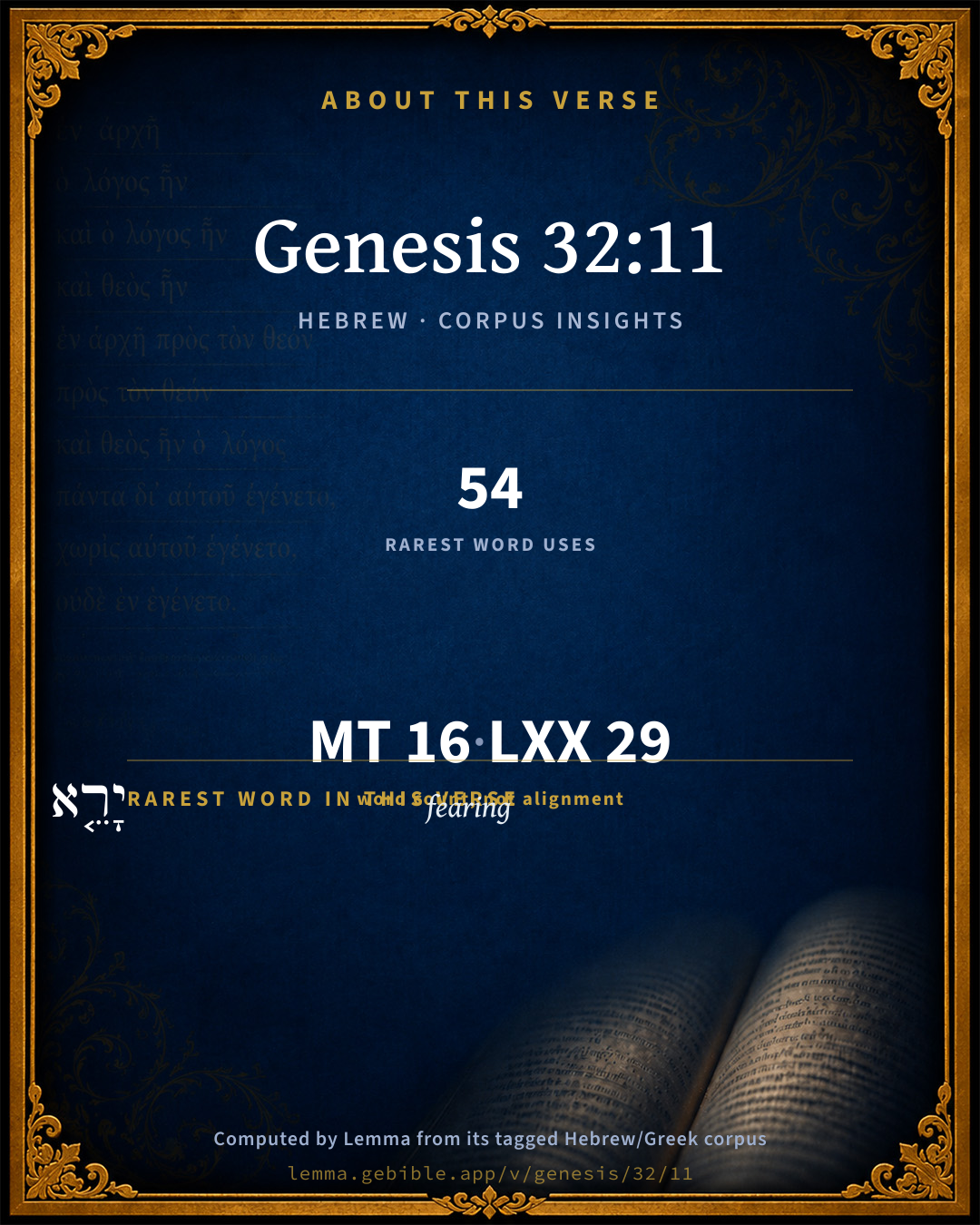
About this verse

These counts appear in no published source. They are computed here, from the morphology-tagged text and Lemma’s own curated glosses. What Lemma adds →

16
words
15
distinct lemmas
Pentateuch
section

Shared distinctive vocabulary

יָרֵ֤א fearing H3373 occurs in 54 verses of the Hebrew Bible. Also found in:

Grammatical profile

  • 4 verbs
  • 6 nouns
  • 1 pronoun
  • 1 preposition
  • 2 conjunctions
  • 2 particles

Verb forms

  • הַצִּילֵ֥נִי Hiphil · Imperative
  • יָרֵ֤א Qal · Participle Active
  • יָב֣וֹא Qal · Imperfect
  • וְהִכַּ֔נִי Hiphil · Sequential Perfect

Repetition

A word recurs within this verse — often emphatic in Hebrew:

  • מִיַּ֥ד hand H3027 ×2

Hebrew & Septuagint length

In English translation the verse runs 30 words from the Hebrew and 33 from the Septuagint (LXX English) — closely comparable.

A rough comparison of the two English renderings, which tokenize alike — not a word-level alignment.

Word counts can differ between the Hebrew and the Greek without any difference in meaning — e.g. the Hebrew direct-object marker אֵת has no separate Greek word, and Greek often adds the article ὁ.

In the original languages it is 16 Hebrew tokens and 29 Greek tokens — but the two are counted differently (Hebrew bundles its prefixes and suffixes into one token; the Greek is in lemma form), so that isn’t a like-for-like length.

Cross-references

15

Topical passages linked to Genesis 32:11 in the Treasury of Scripture Knowledge — connected by theme and wording, ordered by reader-vote popularity; previews shown in the World English Bible.

  • Psalms 59:1–2 Deliver me from my enemies, my God. Set me on high from those who rise up against me.
  • Proverbs 18:19 A brother offended is more difficult than a fortified city; And disputes are like the bars of a castle.
  • Matthew 6:13 Bring us not into temptation, but deliver us from the evil one. For yours is the Kingdom, the power, and the glory forever. Amen.'
  • Genesis 27:41 Esau hated Jacob because of the blessing with which his father blessed him. Esau said in his heart, "The days of mourning for my father are at hand. Then I will kill my brother Jacob."
  • 1 Samuel 12:10 They cried to Yahweh, and said, We have sinned, because we have forsaken Yahweh, and have served the Baals and the Ashtaroth: but now deliver us out of the hand of our enemies, and we will serve you.
  • 1 Samuel 24:15 Yahweh therefore be judge, and give sentence between me and you, and see, and plead my cause, and deliver me out of your hand.
  • Psalms 16:1 Preserve me, God, for in you do I take refuge.
  • Psalms 25:20 Oh keep my soul, and deliver me. Let me not be disappointed, for I take refuge in you.
  • Psalms 31:2 Bow down your ear to me. Deliver me speedily. Be to me a strong rock, A house of defense to save me.
  • Psalms 43:1 Vindicate me, God, and plead my cause against an ungodly nation. Oh, deliver me from deceitful and wicked men.
  • Psalms 119:134 Redeem me from the oppression of man, So I will observe your precepts.
  • Psalms 142:6 Listen to my cry, For I am in desperate need. Deliver me from my persecutors, For they are stronger than me.
  • Daniel 3:17 If it be [so], our God whom we serve is able to deliver us from the burning fiery furnace; and he will deliver us out of your hand, O king.
  • Hosea 10:14 Therefore a battle roar will arise among your people, And all your fortresses will be destroyed, As Shalman destroyed Beth Arbel in the day of battle. The mother was dashed in pieces with her children.
  • Deuteronomy 22:6 If a bird's nest chance to be before you in the way, in any tree or on the ground, with young ones or eggs, and the hen sitting on the young, or on the eggs, you shall not take the hen with the young:

Cross-references courtesy of OpenBible.info (CC BY 4.0).

Hebrew and Greek witnesses Masoretic Hebrew ↔ Greek Septuagint

The same verse in the two great witnesses to the Old Testament, shown verse-for-verse.

These are two independent witnesses, not word-aligned to each other, and the Septuagint is shown in lemma (dictionary) form.

Hebrew Genesis 32:11 Masoretic · Westminster Leningrad Codex

הַצִּילֵ֥נִי נָ֛א מִיַּ֥ד אָחִ֖י מִיַּ֣ד עֵשָׂ֑ו כִּֽי יָרֵ֤א אָנֹכִי֙ אֹת֔וֹ פֶּן יָב֣וֹא וְהִכַּ֔נִי אֵ֖ם עַל בָּנִֽים

Please deliver me from the hand of my brother, from the hand of Esau: for I fear him, lest he come and strike me, and the mothers with the children.

World English Bible · Public Domain

Greek LXX Genesis 32:11 Septuagint · lemma form

ἱκανόω ἐγώ ἀπό πᾶς δικαιοσύνη καί ἀπό πᾶς ἀλήθεια ὅς ποιέω ὁ παῖς σύ ἐν γάρ ὁ ῥάβδος ἐγώ διαβαίνω ὁ ἰορδάνης οὗτος νῦν δέ γίγνομαι εἰς δύο παρεμβολή

Deliver me from the hand of my brother, from the hand of Esau, for I am afraid of him, lest haply he should come and strike me, and the mother upon the children.

LXX2012 (modern English Septuagint) · Public Domain

Hebrew: Westminster Leningrad Codex (CC BY 4.0). Greek: Septuagint (public domain); English from LXX2012 (modern English Septuagint) (Public Domain). How the Septuagint differs from the Hebrew →

Targum (Aramaic paraphrase)

2

The Targum is the ancient Jewish Aramaic paraphrase of the Hebrew Scriptures — an interpretive translation, not the Hebrew text itself. Onkelos (literal) and Pseudo-Jonathan (expansive) render the Torah, and Jonathan the Prophets. Coverage is partial: where no permissively-licensed English translation exists for a verse, only the Aramaic is shown. This is verse-level text, not a word-by-word alignment to the Hebrew.

  1. Targum Onkelos Torah (Genesis–Deuteronomy)
    זְעִירָן זָכוּתַי מִכֹּל חִסְדִּן וּמִכָּל טַבְוָן דִּי עֲבַדְתָּ עִם עַבְדָּךְ אֲרֵי יְחִידִי עֲבָרִית יָת יַרְדְּנָא הָדֵין וּכְעַן הֲוֵיתִי לִתְרֵין (נ''י לְתַרְתֵּין) מַשִּׁרְיָן

    (no public-domain English translation for this verse)

    Targum Onkelos — Aramaic: “Onkelos Genesis” (public domain); “Onkelos Exodus” (public domain); “Onkelos Leviticus” (public domain); “Onkelos Numbers” (public domain); “Onkelos Deuteronomy” (public domain). English: “Sefaria Community Translation” (CC0 1.0 (public-domain dedication)); “J.W. Etheridge. The Targums of Onkelos and Jonathan Ben Uzziel on the Pentateuch. London: Longmans, Green, 1862” (public domain). Text via Sefaria.

  2. Targum Pseudo-Jonathan Torah (Genesis–Deuteronomy)
    לֵית אֲנָא כְּמֵיסַת וּזְעֵיר אֲנָא מִכָּל טַבְוָון וּמִן כָּל קוּשְׁטָא דִי עָבַדְתְּ עִם עַבְדָךְ אֲרוּם בְּחוּטְרִי בִּלְחוֹד עֲבָרִית יַת יוֹרְדְנָא הָדֵין וּכְדוּן הֲוֵינָא לְתַרְתֵּין מַשִׁרְוַיָין

    I am altogether less than any of the (acts of) goodness and truth which Thou hast exercised towards Thy servant: for with my staff, alone, I passed this Jardena, and now I am become two bands.

    Targum Pseudo-Jonathan — Aramaic: “Targum Jonathan on Genesis” (public domain); “Targum Jonathan on Exodus” (public domain); “Targum Jonathan on Leviticus” (public domain); “Targum Jonathan on Numbers” (public domain); “Targum Jonathan on Deuteronomy” (public domain). English: “The Targum of Jonathan ben Uzziel, trans. J. W. Etheridge, London, 1862” (public domain). Text via Sefaria.

Commentary

Notes on Genesis 32:11 from classic Christian and Jewish commentators (each source and its license shown beneath its notes). The classic Christian expositions comment on the surrounding passage and are grouped to its opening verse, so a note may address several verses; the Jewish commentaries on the Tanakh (Rashi and others) are per-verse, so they appear only where the commentator wrote on this verse.

Lemma curates 59 commentaries, every one of them public domain or Creative Commons licensed, each selected and text-cleaned for this edition rather than reprinted as found. About our sources →

Trapp's Complete Commentary

John Trapp

Gen 32:11 Deliver me, I pray thee, from the hand of my brother, from the hand of Esau: for I fear him, lest he will come and smite me, [and] the mother with the children.

Ver. 11. And the mother with the children.] It seems to be a metaphor taken from birds, when fowlers take away the young and the dams together; which God forbade, Deu 22:6. See the like also of the ewe and the lamb, not to be slain in one day, Lev 22:28. But, Homo homini lupus, nay, daemon. The Indians would say that it had been better for them that their country had been given to the devils of hell, than to the Spaniards, such hath been their cruelty towards those poor creatures; and that, if Spaniards went to heaven, they would never come there. Three poor women were burnt at the Isle of Guernsey for religion; together with the infant child falling out of the mother’s womb, and cruelly cast back into the flames. {a} Another sweet child of eight or nine years old, coming to Bonner’s house, to see if he might speak with his father, a prisoner in the Lollard’s Tower, was, for some bold answer that he gave the bishop’s chaplain, so cruelly whipped, that he died within four days after. {b} At Merindol in France, besides other execrable outrages and butcheries there done by Minerius, one of the Pope’s captains, the paps of many women were cut off, which gave suck to their children; which, looking for suck at their mother’s breasts, being dead before, died also for hunger. {c} Was not this, to "kill the mother with the children?" And was not that a barbarous act of Pope Honorius III, in the year of grace 1224, to cause four hundred Scots to be hanged up, and their children castrated! and all for the death of Adam, bishop of Caithness, who was burned in his own kitchen, by his own citizens, for that he had excommunicated some of them for non-payment of tithes. {d}

{a} Act. and Mon., fol. 1392.

{b} Ibid., fol. 1864.

{c} Ibid., fol. 868.

{d} Jac. Revius, De Vitis Pontiff, p. 163.

John Trapp, A Commentary or Exposition upon All the Books of the Old and New Testament (1647–1656) — public domain. Text from a community e-Sword module.

The Biblical Illustrator

Joseph S. Exell

Gen_32:11-12

Deliver me, I pray Thee, from the hand of my brother

Jacobs prayer

Observe the spirit of Jacobs prayer.

I. IT WAS A REVERENT SPIRIT.

II. A HUMBLE SPIRIT.

III. A THANKFUL SPIRIT.

IV. A SPIRIT DEEPLY SENSIBLE OF ITS DEPENDENCY UPON GOD.

V. A SPIRIT OF GREAT CONFIDENCE IN GOD. (Homilist.)

Lessons

1. The greatest fears do not drive away holy souls from prayer: faith looks to God for help.

2. Jehovah alone is the rock of salvation to whom believing souls fly for deliverance.

3. Dismal is the danger by the hand of a brother engaged that is cruel and bloody.

4. Fears may possess the hearts of Gods ,covenanted ones in respect of such cruel instruments and of danger by them to them and theirs (Gen_32:11).

5. Gods promise of salvation quickens faith and strengthens prayer in His saints against their own unworthiness.

6. It is fit for faith to press God with the certainty and enlargedness of His promise to His servants.

7. General promises of grace are to be drawn to special use in times of temptation.

8. Upon such promises saints dare trust God with themselves and children (Gen_32:12). (G. Hughes, B. D.)

I fear him

Fear and faith

Jacobs fear, and Jacobs faith--I fear him: and Thou saidst. Whether is that a contrast, or a connection, or both? I believe that it is both. And I have linked the two together as the text, because they will be found to stand thus related by the double tie of contrast and connection--deep, painful contrast, and yet strangely close kindredness also and connection--the fear with the faith--I fear him: and Thou saidst.

I. JACOBS FEAR AT THIS TIME--I fear him, said he.

1. My first remark respecting the fear is, that there was a great deal of unworthy unbelief in it.

2. And yet, secondly, there was not wanting in it an element, kindred at least to faith. True, he might have left the Divine promise--ought to have left it tranquilly--in the keeping of the Divine power and faithfulness. Still, this is no mere craven dread of his personal safety, nor of that even of his beloved family, simply as such, but for that family as in relation to the Divine covenant, with which his own hopes for eternity, and the welfare of all the families of the earth, were bound up. There was an element in his fear, I say, kindred at least to faith.

3. And, thirdly, I observe on Jacobs fear, that, amid all its unworthiness, it was a fear told freely out to God--laid bare before the omniscient One--I fear him, says he, speaking to Jehovah. A great lesson this, beloved, for us in reference to our difficulties, temptations, fears--that we bring them all to the Lord--tell them freely out to Him. It may be that our fears are weak and foolish--such as others might only smile at. Or it may be that they are deeply unworthy, and such as we should be ashamed to tell to others. But they shall be much more than safe with God. Let us tell them to Him, hearing the voice, Bring them hither to Me.

4. As it was a fear told freely out to the Lord, so it shut up Jacob the more to the Lord, and to His word of promise.

II. JACOBS FAITH: Thou saidst--I fear him: and Thou saidst.

1. Well, the things that have been already said have prepared us for my first remark on the faith, which is, that it is faith in conflict--faith in a struggle with unbelief and fear.

2. And so, secondly, I observe, on Jacobs faith here, that, if it is faith in conflict--in a struggle with unbelief--it is faith prevailing, victorious, in the conflict, I fear him: and Thou saidst. I pray you to note that that is Jacobs closing word--he ends here. He plants his foot on this rock of the promise, and here will abide, Thou saidst.

3. But, thirdly, I observe in Jacobs faith, that it is faith in the midst of difficulties taking simple hold of God in his word of promise.

4. Once more, I observe that this is faith exercised in immediate converse and fellowship with God in prayer. Brethren, prayer and faith are entirely distinct; yet they are most intimately connected together. For, as there is no true prayer without some measure of faith, so faith is never better exercised than in prayer. (C. J. Brown, D. D.)

Thou saidst, I will surely do thee good

The Master-key opening the gate of heaven

The possession of a God, or the non-possession of a God, makes the greatest possible difference between man and man. Esau is a princely being, but he is a profane person. Jacob is a weak, fallible, frail creature, but he has a God. Have you not heard of the mighty God of Jacob? My dear hearers, you can divide yourselves without difficulty by this rule: have you a God, or have you none? If you have no God, what have you? If you have no God, what good have you to expect? What, indeed, can be good to you? If you have no God, how can you face the past, the present, or the future? But if you have God for your portion, your whole history is covered. The God of the past has blotted out your sin, the God of the present makes all things work for your good, the God of the future will never leave you nor forsake you.

In God you are prepared for every emergency. He shall guard thee from all evil; the Lord shall preserve thy soul.

1. Because Jacob had a God, therefore he went to Him in the hour of his trouble. As well have no God, as have an unreal God, who cannot be found in the midnight of our need. But what a blessing it is to be able to go to our God at all times, and pour out our hearts before Him; for our God will be our Helper, and that right early! He is our near and dear Friend, in joy and in sorrow.

2. Make thou good use of thy God, and especially gain the fullest advantage from Him by pleading with Him in prayer. In troublous times, our best communion with God will be carried on by supplication. Tell Him thy case; search out His promise, and then plead it with holy boldness. This is the best, the surest, the speediest way of relief.

3. Beloved, we see that Jacob had a God, and that he made use of Him in prayer; but the point I want to call your attention to at this time is, that the stress, the force, the very sinew of Jacobs prayer consisted in his pleading the promise of God with God. When he came to real wrestling with the Lord, then he cried, Thou saidst. That is the way to lay a hold upon the covenant angel--Thou saidst. The art of wrestling lies much in a proper use of Thou saidst. Jacob, with all his mistakes, was a master of the art of prayer: we justly call him wrestling Jacob. He said, I will not let Thee go. He gets grip for his hands out of this Thou saidst. In handling my text, which was Jacobs prayer, I shall notice--

I. First, it ought to be OUR MEMORIAL. I mean that we ought to recollect much more than we do what God has said. We should lay up His word in our hearts as men lay up gold and gems in their caskets: it should be as dear to us as life itself. My heart stands in awe of Gods word, and I am sorrowful because so many trifle with it. No good can come of irreverence towards Scripture; we ought to cherish it in our heart of hearts.

1. We ought to do this, first, with regard to what God hath said. You notice that Jacob puts it, Thou saidst, and then he quotes the words--Surely I will do thee good. It is an essential part of the education of a Christian to learn the promises.

2. Moreover, Jacob also knew when God had spoken a promise, for he quotes twice the fact that God had spoken to him, and said so-and-so. It is clear that he knew when the promise was spoken. I have often found peculiar comfort, not only in a promise, but in noticing the occasion for its being made.

3. There is another matter which it is important for us to know, namely, to whom God made the promise. Jacob knew to whom it was spoken. He tells us in a previous verse that God had spoken a certain promise to himself. Which saidst unto me, Return unto thy country, and to thy kindred, and I will deal well with thee. A promise that was made to another man will be of no service to me until I can discover that I, being in the same condition as that other man, and being of like character to that other man, and exercising like faith to that other man, do stand before God in the same position as he did, and therefore the word addressed to him is spoken also to me. Brethren, I entreat you continually to study Gods word to see whether the promise is made to your character and condition, and so is made to yourself, as much as if your name were written upon it.

II. Secondly, Thou saidst, I will surely do thee good this is GODS BOND. Nothing holds a man like his word, and nothing so fully fixes the course of action of the Lord our God as His own promise. From the necessity of His nature He will be faithful. What a mighty thing, then, is a promise, since it is a bond which holds God Himself! How does it do so?

1. I answer, it holds Him, first, by His truth. If a man says, I will, it is not in his power, without a breach of truth, to refuse to make good his word. If a promise be made by one man to another, it is considered to be a matter of honour to fulfil it. Unless a man is willing to tarnish his honour, and disgrace his truthfulness, he will certainly do as he has solemnly promised to do. Alas! many persons think lightly of truthfulness: they even dare to swear lightly; but what do we think of such people? To utter solemn promises, and then to disown them, is not the way to be esteemed and honoured. It can never be so with God. None can impeach His veracity. None shall ever be able to do so.

2. But, next, he who enters into an engagement is bound to keep his word, or he is considered to be vacillating and changeable: the Lord is, therefore, held by His immutability. He is God, and changes not.

3. But sometimes men make a promise, and they are unable to fulfil it from want of power. Many a time it has cost honest minds great grief to feel that, though they are willing enough to do what they have engaged to do, yet they have lost their ability to perform their word. This is a grave sorrow to a sincere mind. This can never happen to the Almighty God. He fainteth not, neither is weary. To Him there is no feebleness of decline, or failure of decay. God All-sufficient is still His name.

4. Once more, the Lords wisdom also holds Him to His promise. Men make engagements thoughtlessly, and before long they realize that it would he ruinous to keep them. It is foolish to keep a foolish promise. Yet because wisdom is not in us we make mistakes, and find ourselves in serious difficulties. It may so happen that a person may feel compelled to say, I promised to do that which, upon nacre careful consideration, I find it would be wicked and unjust for me to do. My promise was void from the beginning, for no man has a right to promise to do wrong. Whatever justification an erring man can find in his folly to excuse him from fulfilling his rash promise, nothing of the kind can occur with God. He never speaks without knowledge, for He sees the end from the beginning, and He is infallibly good and wise.

5. I should not complete my statement if I did not add that to go to God through Jesus Christ, is to use the best and most powerful of pleas.

III. So then, last of all, this may be, and this ought to be, in prayer OUR PLEA, as it was Jacobs plea--even this Thou saidst.

1. We may urge the gracious promise of the Lord as pleading against our own unworthiness. This must win the suit. If a man has made me a promise, he cannot refuse to keep it on the ground that I am unworthy; because it is his own character that is at stake, not mine. However unworthy I am, he must not prove himself to be unworthy by failing to keep his word.

2. This is also good pleading as against our present danger. See how Jacob puts it with regard to his own peril. He sets out his very natural fear from his brothers anger: the mother, the children, everybody would be smitten by fierce Esau; and to save himself from this threatened horror Jacob lifts the shield of the promise, and as good as says to the Lord his God, If this calamity should happen, how can Thy promise be kept? Thou saidst, Surely I will do thee good; but, Lord, it is not good for Esaus sword to shed our blood! If Thou permit his anger to slay us, where is Thine engagement to do good unto Thy servant? This reminds one of the plea of Moses, when he asked, What will the Egyptions say? If Israel were destroyed in the wilderness, what would Jehovah do for His great name? This is a prevalent argument.

3. Once more, as to future blessedness. Jacob used this argument, Thou saidst, I will surely do thee good, as to all his future hopes, for he went on to say, Thou saidst, I will make thy seed as the sand of the sea, which cannot be numbered for multitude. Not as much as he should, but still in a measure Jacob lived in the future. He lived under the influence and expectation of the covenant blessing. Now, brethren, what hope have you and I of getting to heaven? None, except that the Lord has said, I give unto my sheep eternal life; and they shall never perish. I shall never perish, for Jesus says I never shall. He has also said, Where I am, there shall also My servant be. Therefore I shall be in the glory with Him, and that is enough for me. (C. H. Spurgeon)

.

Good comes through difficulty

Now the highest and richest good often comes to men through difficulties and disappointments, losses and crosses, sicknesses and sorrows. Men are very prone to forget this, and to get discouraged in the hour of trial, but it is true nevertheless. The vinedresser does the vine good, not only by manuring its roots and admitting sunshine to its branches, but by sometimes opening his knife and cutting off superfluous leaves and wanton shoots, for by this pruning he has enabled the tree to bear more abundant fruit. The doctor does the patient good, sometimes by kindly looks and hopeful words, and soothing powders, but at other times by prohibiting favourite foods administering nauseous medicines, and even by using the sharp lancet. The father does his child good, not by gratifying all his desires and humouring all his whims, but rather sometimes by prohibiting certain pleasures, enjoying special tasks, and occasionally using the rod. The heavenly Vinedresser, Doctor and Father, deals with us on similar principles. He does not say to any one of us, I will always consult thy wishes, gratify thy tastes, and gladden thine heart, but I will always do thee good. And many have found that pain ministers to profit, that the sickness of the body promotes the health of the soul, that the cutting off of temporal comforts opens the way for the inflowing of spiritual blessings; and that the removal of earthly friends brings them into closer sympathy and communion with Jesus Christ the heavenly Friend; so that with David they have been able to say, It is good for me that I have been afflicted, for before I was afflicted I went astray, but now I know Thy law; and with Paul, These light afflictions which are but for a moment work out for us a far more exceeding and eternal weight of glory.

The Biblical Illustrator, edited by Joseph S. Exell (c. 1880s–1900s) — public domain. Text from a community e-Sword module.

Joseph Benson's Commentary

Gen 32:11-12. Deliver me from my brother Esau, for I fear him — The fear that quickens prayer is itself pleadable. It was not a robber, but a murderer that he was afraid of: nor was it his own life only that lay at stake, but the mothers’, and the children’s. Thou saidst, I will surely do thee good — God’s promises, as they are the surest guide of our desires in prayer, and furnish us with the best petitions; so they are the firmest ground of our hopes, and furnish us with the best pleas.

Joseph Benson's Commentary on the Old and New Testaments (1811–1818) — public domain. Text from a community e-Sword module.

Geneva Bible (1599)

Geneva Bible translators

Meaning, he will put all to death. This proverb cometh of them which kill the bird together with his young ones.

Geneva Bible (1599) marginal notes — public domain. Text via Bolls.life.

Adam Clarke's Commentary

Verse 11. And the mother with the children.] He must have had an awful opinion of his brother when he used this expression, which implies the utmost cruelty, proceeding in the work of slaughter to total extermination. See Ho 10:14.

Adam Clarke's Commentary on the Bible (1810–1826) — public domain. Text from a community e-Sword/MySword module.

John Calvin's Commentaries

11. Deliver me. After he has declared himself to be bound by so many of God’s benefits that he cannot boast of his own merits, and thus raised his mind to higher expectation, he now mentions his own necessity, as if he would say, “O Lord, unless thou choosest to reduce so many excellent gifts to nothing, now is the time for thee to succor one, and to avert the destruction which, through my brother, is suspended over me.” But having thus expressed his fear, he adds a clause concerning the blessing promised him, that he may confirm himself in the promises made to him. To slay the mother with the children, I suppose to have been a proverbial saying among the Jews, which means to leave nothing remaining. It is a metaphor taken from birds, when hawks seize the young with their dams, and empty the whole nest.

John Calvin's Commentaries (1540-1563) — public domain. Text from the Calvin Translation Society English edition (1840s-50s) via the Christian Classics Ethereal Library (ccel.org). Calvin's coverage is partial (roughly two-thirds of the Bible); uncommented books and verses are honest gaps, never fabricated. The 19th-century editor's footnotes and remarks are omitted so the notes are faithfully Calvin's own voice.

The Cambridge Bible for Schools and Colleges

gen. ed. J. J. S. Perowne

11. from the hand of Esau] Jacob in his prayer makes no reference to the possible cause of Esau’s anger, and expresses no consciousness of, nor sorrow for, his own wrong-doing towards either Esau or Isaac.

the mother with the children] A proverbial phrase for “the mother and family”; cf. Hos_10:14.

The Cambridge Bible for Schools and Colleges (gen. ed. J. J. S. Perowne; Cambridge University Press, 1878–1918) — public domain. Text from a community e-Sword module.

John Gill's Exposition

Deliver me, I pray thee, from the hand of my brother, from the hand of Esau,.... For though his brother, it was his brother Esau, that had formerly vowed revenge upon him, and had determined to kill him, Gen 27:41, and he knew not but that he was still of the same mind; and now having an opportunity, and in his power to do it, being accompanied with four hundred men, he feared he would attempt it; and therefore entreats the Lord, who was greater than he, to deliver him from falling into his hands, and being destroyed by him:

for I fear him, lest he will come and smite me, and the mother with the children; for whom Jacob seems to be more concerned than for himself; the phrase denotes the utter destruction of his family, and the cruelty and inhumanity that would be exercised therein; which shows what an opinion he had of his brother, and of his savage disposition.

John Gill's Exposition of the Whole Bible (1746–1763) — public domain (CC PDM 1.0). Text via the HelloAO Bible API.

Haydock's Catholic Bible Commentary

The children; sparing neither sex nor age, but destroying all. (Calmet) --- Jacob insists on the promises of God; yet fears lest he should, by some offence, have deserved to forfeit his protection; particularly, as he had been living 20 years among idolaters. He acts with all prudence. (Worthington)

George Leo Haydock (1774–1849), Haydock's Catholic Family Bible and Commentary, 1859 edition — public domain. Excludes Psalms (Douay-Rheims chapter numbering differs from Protestant) and Deuterocanonical books (Catholic canon only).

Matthew Poole's English Annotations

A proverbial speech, noting a total destruction. Compare Deu 22:6; Hos 10:14.

Matthew Poole's English Annotations on the Holy Bible (1683–1685) — public domain. Text from a community e-Sword/MySword module.

John Wesley's Explanatory Notes

Lord, deliver me from Esau, for I fear him - The fear that quickens prayer is itself pleadable. It was not a robber, but a murderer that he was afraid of: nor was it his own life only that lay at stake, but the mothers, and the childrens.

John Wesley, Explanatory Notes Upon the Whole Bible (1754–1765) — public domain. Text via the GEBible commentary corpus.

unfoldingWord translationNotes

Door43 World Missions Community

rescue me

"save me"

from the hand of my brother, from the hand of Esau

Here the word "hand" refers to power. The two phrases mean basically the same thing. The second clarifies that the brother whom Jacob intended was Esau. AT: "from the power of my brother, Esau" or "from my brother, Esau" (See: Metonymy and Parallelism)

I am afraid of him, that he will

"I am afraid that he will"

But you said, 'I will certainly make you prosper. I will make your descendants ... number.'

This is a quotation within a quotation. It can be stated an an indirect quotation. AT: "But you said that you would certainly prosper me, and that you would make my descendants ... number" (See: Quotes Within Quotes and Direct and Indirect Quotations)

make you prosper

"do good to you" or "treat you well"

I will make your descendants like the sand of the sea

This speaks about the very large number of Jacob's descendants as if their number will be like the grains of sand on the seashore. (See: Simile)

which cannot be numbered for their number

This can be stated in active form. AT: "which no one can count because of their number" (See: Active or Passive)

translationWords

hand

Esau

fear

descend

unfoldingWord translationNotes — © Distant Shores Media and the Door43 World Missions Community, licensed CC BY-SA 4.0. Source: git.door43.org/Door43/en_tn.

Rashi

Rabbi Shlomo Yitzchaki (Rashi)

קטנתי מכל החסדים I AM TOO UNWORTHY OF ALL THE MERCIES (This may be rendered “I am small — unworthy — because of all the kindnesses) — My merits are diminished in consequence of all the kindness and truth which You have already shown me. For this reason I am afraid: perhaps, since You made these promises to me, I have become depraved (נתקלקלתי) by sin (another version of Rashi has נתלכלכתי, I have become defiled by sin) and this may cause me to be delivered unto Esau’s power (Shabbat 32a).

ומכל האמת [my merits are diminished in consequence] OF ALL THE TRUTH — of the true fulfillment (אמיתת) of Your promises — because You have already kept all the promises You made me

כי במקלי FOR WITH MY STAFF — I had with me neither silver nor gold nor cattle — only this staff of mine. The Midrashic explanation is, that he had placed his staff in the Jordan and Jordan had divided for him to pass over.

Rashi on the Tanakh — English translations: “The Judaica Press complete Tanach with Rashi, translated by A. J. Rosenberg” (CC BY 4.0); “Pentateuch with Rashi's commentary by M. Rosenbaum and A.M. Silbermann, 1929-1934” (public domain); “The Metsudah Tanach series, Lakewood, N.J” (CC BY 4.0); and “The Book of Joshua, Metsudah Publications, 1997” (CC BY 4.0). Text via Sefaria.

Ramban (Nachmanides)

Rabbi Moshe ben Nachman (Ramban / Nachmanides)

‘KATONTI’ OF ALL THE MERCIES, AND OF ALL THE TRUTH. “My merits have diminished as a consequence of all the kindness and truth which You have already shown me. For this reason I am afraid lest I have become depraved by sin since the time You made these promises to me, and this may cause me to be delivered into the hand of Esau.” This is Rashi’s language. But it is not a correct interpretation because it does not fit into the language of the verse, [for katan refers to size, not quantity]. Furthermore, Jacob said afterwards, And Thou saidst: I will surely do thee good and make thy seed as the sand of the sea, but of what efficacy would this promise be if subsequent sin caused him to be deprived of it? Moreover, Jacob mentioned two promises which the Holy One, blessed be He, had made him — one in Beth-el, and one in Haran, 31:3. — and he first stated the promise given to him in Haran, O Eternal, who saidst unto me: Return unto thy country, and to thy kindred, and I will do to thee good, this being what was said to him when he was about to leave the house of Laban: Return unto the land of thy fathers, and to thy kindred, and I will be with thee., 31:3. Now following this promise, G-d did not bestow good upon Jacob to account for all these mercies and truths of which Jacob mentioned that his merits should be diminished on account of them.The word katonti rather means that he is too small to have been worthy of all the mercies which He had done for him. Likewise, How shall Jacob stand? for he is small, that is, too small to be able to bear all that was decreed against him. And so the Rabbis said in Bereshith Rabbah, “Katonti. Rabbi Abba said that it means ‘I am not worthy.’” Now hachasadim (the mercies) are the kindnesses which G-d did for him without having vowed to do them, and ha’emeth (the truth) is the kindness which He promised him and fulfilled. Jacob thus said that he was unworthy of G-d’s promising him and performing those kindnesses which He promised him, nor was he worthy of those other many kindnesses which He did for him without having promised to do them.But I have not understood the opinion of Onkelos who translated, “from all the mercies and all the good,” when he is accustomed to translate chesed ve’emeth as “mercy and truth.” Perhaps Onkelos is rendering chasadim here as referring to Jacob’s rescue, that is, the many times He had saved him from his troubles. Onkelos rendered emeth as referring to all this good which Jacob possessed, for G-d had given him sons and daughters, wealth and belongings, and honor.The correct interpretation appears to me to be that long-lasting kindnesses such as children and wealth are called emeth, which is from the root of emunah (faith), just as: ‘Vene’eman’ (and confirmed shall be) thy house and thy kingdom forever, which connotes assured existence; His bread shall be given, his waters ‘ne’emanim’ (shall be sure), just as the prophet said, Wilt thou indeed be unto me as a deceitful brook as waters that are not ‘ne’emanu’ (sure)?

Ramban (Nachmanides) on the Tanakh — English translation: “Commentary on the Torah by Ramban (Nachmanides). Translated and annotated by Charles B. Chavel. New York, Shilo Pub. House, 1971-1976” (CC BY 4.0). Text via Sefaria.

Radak

Rabbi David Kimhi (Radak)

קטנתי, I am not asking You G’d to help me in a manner commensurate with my merits, as I am perfectly aware that these are utterly inadequate. כל החסדים וכל האמת אשר עשית את עבדך, Yaakov described as חסד the acts of unearned love G’d had performed for him, whereas he described as אמת, “truth,” i.e. deserved compensation, that G’d would keep His promise to him. (“Here, I am going to be with you, etc.” 28,15) He feels entitled to expect G’d to keep His promises when these are of a positive nature. When G’d had said to him that He would protect him wherever he would go, this had not been a conditional promise, dependent on Yaakov being worthy of such protection. He is aware that he may have sinned, but expects the promise to be kept for the sake of his father and grandfather both of whom G’d Himself had invoked in association with this promise. He feels that he deserves such protection, having heard that Esau is an unreformed sinner, still relating to him with hostility.

Radak on the Tanakh — English translations: “Sefaria Community Translation” (CC0 1.0 (public-domain dedication)); “Eliyahu Munk, HaChut Hameshulash” (CC BY 4.0); “Rabbi Mike Feuer, Jerusalem Anthology” (CC BY 4.0); and “R. David Kimhi on the first book of Psalms, Translated by R.G. Finch, London, 1919” (public domain). Text via Sefaria.

Lesson kit

Teaching starters — assembled from the data on this page, not authored interpretation. Every prompt links to the verse data it draws on. Edit before teaching.

Genesis, in the Pentateuch, opens this verse with 16 words (15 distinct Hebrew lemmas). Its most distinctive word is yârêʼ (“fearing”). A historical commentator’s framing appears above. Read the whole chapter for the surrounding context.

Discussion questions

  1. How does “fearing” (yârêʼ) shape what this verse is saying?
  2. How does Genesis 22:12, which shares the word «fearing», read alongside this verse?
  3. What does the repetition of “hand” (2× in this one verse) do in this verse?
  4. These translations render this verse differently. What is at stake in choosing one wording over another?
  5. «הַצִּילֵ֥נִי» is a Hiphil Imperative verb. How does that grammatical form shape the action described?
  6. Compare how Trapp's Complete Commentary and The Biblical Illustrator read this verse. Where do they agree or differ?

Things to notice

Reading settings

Reading text

Shown beneath each verse's original-language words.

Old Testament
Old Testament edition

Read the OT as the Masoretic Hebrew (MT) or the Greek Septuagint (LXX).

English shown for the Greek Septuagint (in the Hebrew ↔ Greek comparison).

Comparing translations? Open the Compare panel on any verse page to stack up to four side by side.