Genesis 19:5

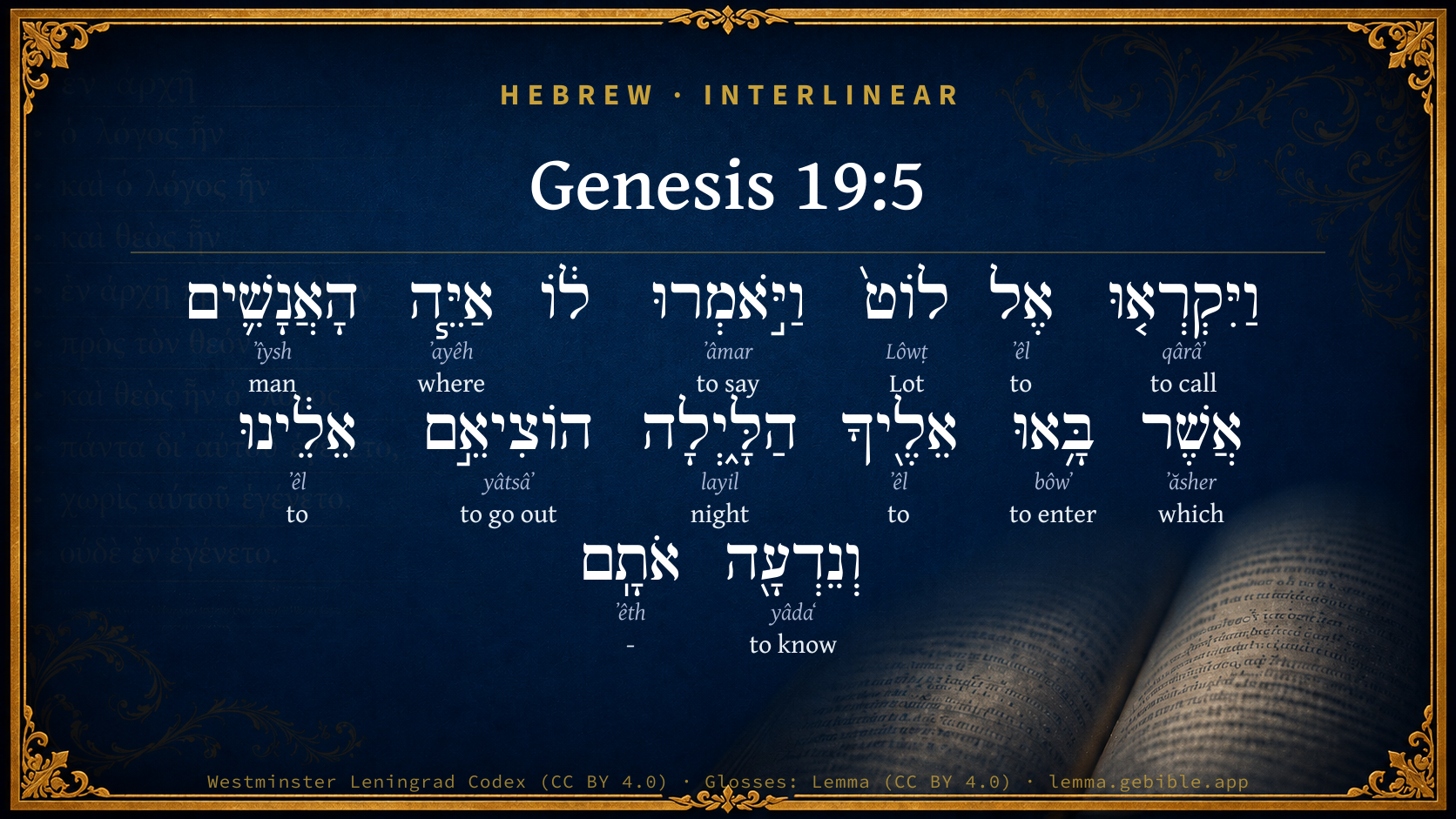
Hebrew (Westminster Leningrad Codex) Genesis 19:5 appears in the Hebrew Old Testament. The text above is from the Westminster Leningrad Codex. Each word links to its Strong’s number, a concise gloss, and parsing drawn from the Open Scriptures Hebrew Bible morphology. Click any word for its full Brown-Driver-Briggs (BDB) entry.
Download image
Cite this verse

Genesis 19:5 (World English Bible). Public Domain. Lemma interlinear Bible study tool, https://lemma.gebible.app/v/genesis/19/5.

Show BibTeX & RIS
BibTeX
RIS
English Translation
They called to Lot, and said to him, "Where are the men who came in to you this night? Bring them out to us, that we may have sex with them."
World English Bible · Public Domain
Download a study sheet

One document with this verse’s original text, its word-by-word gloss line, the meaning frame, cross-references with their text, attributed commentary, and full source and license credits — printable, and it pastes into notes with its structure intact.

This verse Autodidact and up

Study sheet (.html) Plain text (.txt)

A passage Seminary Student

Up to 50 verses in one chapter. A passage sheet keeps up to 6 commentary sources and 12 cross-references per verse, in the order this page ranks them, and says so on the sheet whenever that leaves anything out. Ask for a single verse and you get the Autodidact verse sheet above.

Everything on this page stays free to read, with no account — the sheet is a download of what is already on screen, not access to it.

Want to remove ads? Support Godless Engineer
Compare translations 3

The same verse in 3 English versions, stacked beneath the original-language interlinear above. Click any original word for its lexicon entry.

Each is an independent rendering of the whole verse — the interlinear is not word-aligned to these translations.

Highlighted words mark where these versions differ — a whole-verse word diff, not a word-by-word alignment.

  • World English Bible Public Domain
    They called to Lot, and said to him, "Where are the men who came in to you this night? Bring them out to us, that we may have sex with them."
  • King James Version Public Domain
    And they called unto Lot, and said unto him, Where are the men which came in to thee this night? bring them out unto us, that we may know them.
  • unfoldingWord Literal Text CC BY-SA 4.0
    Then they called to Lot and said to him, “Where the men who came to you tonight? Bring them out to us so that we can know them!”

unfoldingWord Literal Text — © unfoldingWord, licensed CC BY-SA 4.0. Word-aligned USFM3 via Door43 (git.door43.org/unfoldingWord/en_ult).

Versions to compare (up to 4)

3 of 4 selected

Show all 18 translations

Every available English version of this verse, each an independent rendering of the whole verse.

  • World English Bible Public Domain
    They called to Lot, and said to him, "Where are the men who came in to you this night? Bring them out to us, that we may have sex with them."
  • Berean Standard Bible Public Domain
    They called out to Lot, saying, “Where are the men who came to you tonight? Send them out to us so we can have relations with them!”
  • Majority Standard Bible Public Domain
    They called out to Lot, saying, “Where are the men who came to you tonight? Send them out to us so we can have relations with them!”
  • King James Version Public Domain
    And they called unto Lot, and said unto him, Where are the men which came in to thee this night? bring them out unto us, that we may know them.
  • American Standard Version (1901) Public Domain
    and they called unto Lot, and said unto him, Where are the men that came in to thee this night? bring them out unto us, that we may know them.
  • Revised Version (1885) Public Domain
    and they called unto Lot, and said unto him, Where are the men which came in to thee this night? bring them out unto us, that we may know them.
  • Geneva Bible (1599) Public Domain
    Who crying vnto Lot said to him, Where are the men, which came to thee this night? bring them out vnto vs that we may knowe them.
  • Douay-Rheims (1899) Public Domain
    And they called Lot, and said to him: Where are the men that came in to thee at night? bring them out hither that we may know them:
  • Young's Literal Translation Public Domain
    and they call unto Lot and say to him, `Where `are' the men who have come in unto thee to-night? bring them out unto us, and we know them.'
  • Literal Standard Version CC BY-SA 4.0
    and they call to Lot and say to him, “Where [are] the men who have come to you tonight? Bring them out to us, and we know them.”
  • Unlocked Literal Bible CC BY-SA 4.0
    They called to Lot, and said to him, “Where are the men that came in to you tonight? Bring them out to us, that we may sleep with them.”
  • unfoldingWord Literal Text CC BY-SA 4.0
    Then they called to Lot and said to him, “Where the men who came to you tonight? Bring them out to us so that we can know them!”
  • Darby Bible Public Domain
    And they called to Lot, and said to him, Where are the men that have come in to thee to-night? bring them out to us that we may know them.
  • World Messianic Bible Public Domain
    They called to Lot, and said to him, “Where are the men who came in to you this night? Bring them out to us, that we may have sex with them.”
  • Webster's Bible Public Domain
    And they called to Lot, and said to him, Where are the men who came in to thee this night? bring them out to us, that we may know them.
  • Free Bible Version CC BY-SA 4.0
    They shouted out to Lot, “Where are the men who came to stay with you tonight? Bring them out here to us so we can have sex with them.”
  • Bible in Basic English Public Domain
    And crying out to Lot, they said, Where are the men who came to your house this night? Send them out to us, so that we may take our pleasure with them.
  • JPS Tanakh (1917) Public Domain
    And they called unto Lot, and said unto him: 'Where are the men that came in to thee this night? bring them out unto us, that we may know them.'

Literal Standard Version (2020), Covenant Press — licensed CC BY-SA 4.0. Text via the HelloAO Bible API (eBible.org). Unlocked Literal Bible (unfoldingWord) — licensed CC BY-SA 4.0. Text via the HelloAO Bible API (eBible.org). unfoldingWord Literal Text — © unfoldingWord, licensed CC BY-SA 4.0. Word-aligned USFM3 via Door43 (git.door43.org/unfoldingWord/en_ult). Free Bible Version, Dr. Jonathan Gallagher — licensed CC BY-SA 4.0. Text via the HelloAO Bible API (eBible.org).

Word by word

More ways to search: Search by grammar → Find every occurrence → Compare this word →

Practice this passage: Drill this verse → Learn its vocabulary →

לוֹט֙
Lôwṭ
H3876
“Lot”
Noun, Proper
Part of Speech
Noun
Type
Proper
Full BDB Definition

Origin: the same as H3875

TWOT: None

Lot = "covering" - son of Haran and Abraham's nephew who settled in Sodom and was delivered from its destruction by God
  1. וַיִּקְרְא֤וּ qârâʼ H7121 “and · to call” Conjunction + Verb, Qal, Sequential Imperfect, 3rd Person, Masculine, Plural
  2. אֶל ʼêl H413 “to” Preposition
  3. וַיֹּ֣אמְרוּ ʼâmar H559 “and · to say” Conjunction + Verb, Qal, Sequential Imperfect, 3rd Person, Masculine, Plural
  4. אַיֵּ֧ה ʼayêh H346 “where” Particle, Interrogative
  5. הָאֲנָשִׁ֛ים ʼîysh H376 “the · men” Particle, Definite Article + Noun, Common, Masculine, Plural, Absolute
  6. אֲשֶׁר ʼăsher H834 “which” Particle, Relative
  7. בָּ֥אוּ bôwʼ H935 “to enter” Verb, Qal, Perfect, 3rd Person, Common, Plural
  8. אֵלֶ֖יךָ ʼêl H413 “to · you” Preposition + Suffix, Personal, 2nd Person, Masculine, Singular
  9. הַלָּ֑יְלָה layil H3915 “the · night” Particle, Definite Article + Noun, Common, Masculine, Singular, Absolute
  10. הוֹצִיאֵ֣ם yâtsâʼ H3318 “go out · them” Verb, Hiphil, Imperative, 2nd Person, Masculine, Singular + Suffix, Personal, 3rd Person, Masculine, Plural
  11. אֵלֵ֔ינוּ ʼêl H413 “to · us” Preposition + Suffix, Personal, 1st Person, Common, Plural
  12. וְנֵדְעָ֖ה yâdaʻ H3045 “and · to know” Conjunction + Verb, Qal, Cohortative, 1st Person, Common, Plural
  13. אֹתָֽם ʼêth H853 “- · them” Particle, Direct Object + Suffix, Personal, 3rd Person, Masculine, Plural

About this verse

These counts appear in no published source. They are computed here, from the morphology-tagged text and Lemma’s own curated glosses. What Lemma adds →

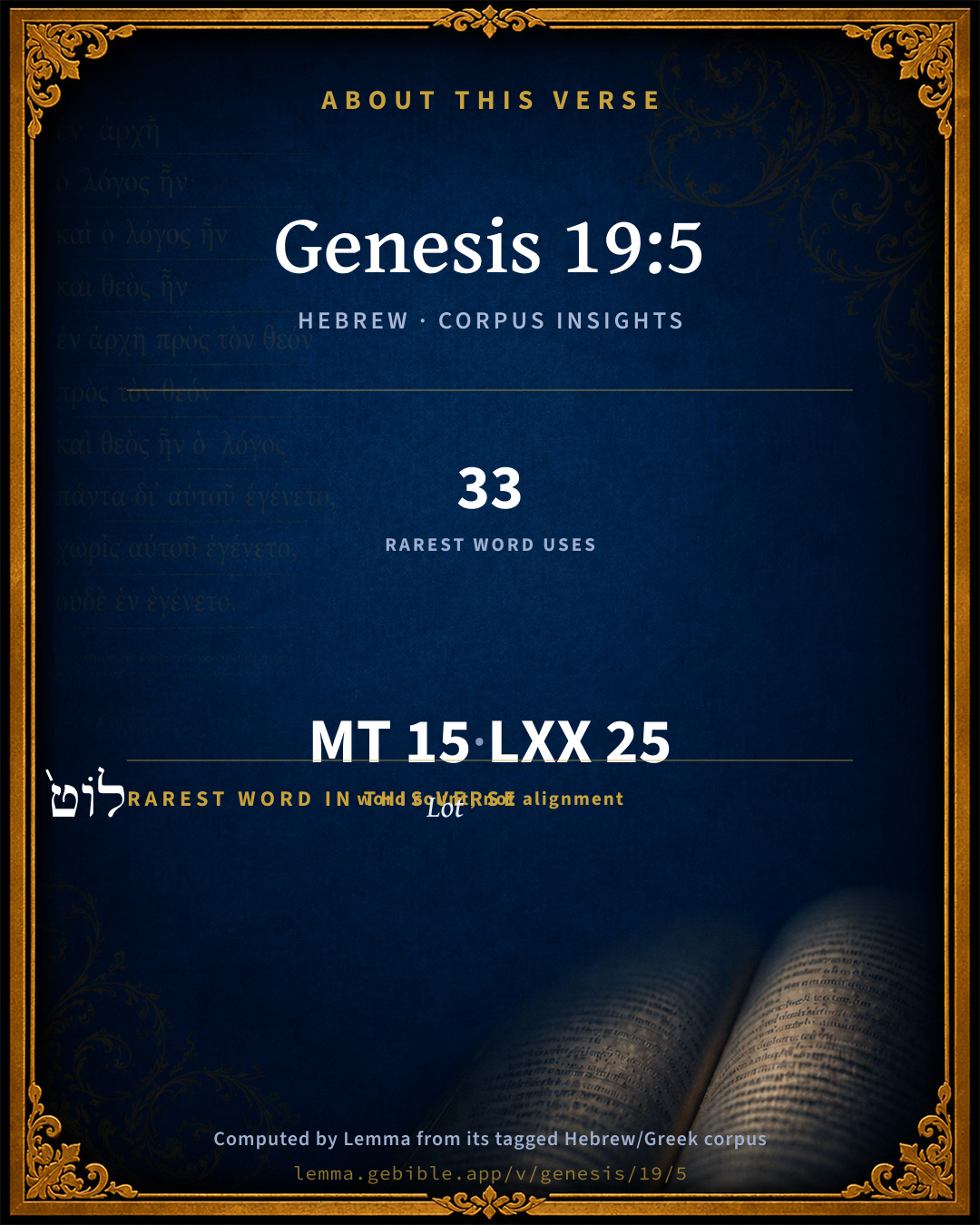
15
words
12
distinct lemmas
Pentateuch
section

Shared distinctive vocabulary

לוֹט֙ Lot H3876 occurs in 30 verses of the Hebrew Bible. Also found in:

Grammatical profile

  • 5 verbs
  • 3 nouns
  • 4 prepositions
  • 3 particles

Verb forms

  • וַיִּקְרְא֤וּ Qal · Sequential Imperfect
  • וַיֹּ֣אמְרוּ Qal · Sequential Imperfect
  • בָּ֥אוּ Qal · Perfect
  • הוֹצִיאֵ֣ם Hiphil · Imperative
  • וְנֵדְעָ֖ה Qal · Cohortative

Repetition

A word recurs within this verse — often emphatic in Hebrew:

  • אֶל to H413 ×3

Hebrew & Septuagint length

In English translation the verse runs 31 words from the Hebrew and 31 from the Septuagint (LXX English) — the same length.

A rough comparison of the two English renderings, which tokenize alike — not a word-level alignment.

Word counts can differ between the Hebrew and the Greek without any difference in meaning — e.g. the Hebrew direct-object marker אֵת has no separate Greek word, and Greek often adds the article ὁ.

In the original languages it is 15 Hebrew tokens and 25 Greek tokens — but the two are counted differently (Hebrew bundles its prefixes and suffixes into one token; the Greek is in lemma form), so that isn’t a like-for-like length.

Cross-references

16

Topical passages linked to Genesis 19:5 in the Treasury of Scripture Knowledge — connected by theme and wording, ordered by reader-vote popularity; previews shown in the World English Bible.

  • Judges 19:22 As they were making their hearts merry, behold, the men of the city, certain base fellows, beset the house round about, beating at the door; and they spoke to the master of the house, the old man, saying, Bring forth the man who came into your house, that we may know him.
  • Isaiah 3:9 The look of their faces testify against them. They parade their sin like Sodom. They don't hide it. Woe to their soul! For they have brought disaster upon themselves.
  • Jude 1:7 Even as Sodom and Gomorrah, and the cities around them, having, in the same way as these, given themselves over to sexual immorality and gone after strange flesh, are set forth as an example, suffering the punishment of eternal fire.
  • Leviticus 18:22 "'You shall not lie with a man, as with a woman. That is detestible.
  • Romans 1:26–27 For this reason, God gave them up to vile passions. For their women changed the natural function into that which is against nature.
  • Ezekiel 16:51 Neither has Samaria committed half of your sins; but you have multiplied your abominations more than they, and have justified your sisters by all your abominations which you have done.
  • Matthew 11:23–24 You, Capernaum, who are exalted to Heaven, you will go down to Hades. For if the mighty works had been done in Sodom which were done in you, it would have remained until this day.
  • 1 Corinthians 6:9 Or don't you know that the unrighteous will not inherit the Kingdom of God? Don't be deceived. Neither the sexually immoral, nor idolaters, nor adulterers, nor male prostitutes, nor homosexuals,
  • 1 Timothy 1:10 for the sexually immoral, for homosexuals, for slave-traders, for liars, for perjurers, and for any other thing contrary to the sound doctrine;
  • Ezekiel 16:49 Behold, this was the iniquity of your sister Sodom: pride, fullness of bread, and prosperous ease was in her and in her daughters; neither did she strengthen the hand of the poor and needy.
  • Leviticus 20:13 If a man lies with a male, as with a woman, both of them have committed an abomination: they shall surely be put to death; their blood shall be upon them.
  • Isaiah 1:9 Unless Yahweh of hosts had left to us a very small remnant, We would have been as Sodom; We would have been like Gomorrah.
  • Jeremiah 3:3 Therefore the showers have been withheld, and there has been no latter rain; yet you have a prostitute's forehead, you refused to be ashamed.
  • Jeremiah 6:15 Were they ashamed when they had committed abomination? nay, they were not at all ashamed, neither could they blush: therefore they shall fall among those who fall; at the time that I visit them they shall be cast down, says Yahweh.
  • Romans 1:23–24 and traded the glory of the incorruptible God for the likeness of an image of corruptible man, and of birds, and four-footed animals, and creeping things.
  • 2 Timothy 3:13 But evil men and impostors will grow worse and worse, deceiving and being deceived.

Cross-references courtesy of OpenBible.info (CC BY 4.0).

Hebrew and Greek witnesses Masoretic Hebrew ↔ Greek Septuagint

The same verse in the two great witnesses to the Old Testament, shown verse-for-verse.

These are two independent witnesses, not word-aligned to each other, and the Septuagint is shown in lemma (dictionary) form.

Hebrew Genesis 19:5 Masoretic · Westminster Leningrad Codex

וַיִּקְרְא֤וּ אֶל לוֹט֙ וַיֹּ֣אמְרוּ ל֔וֹ אַיֵּ֧ה הָאֲנָשִׁ֛ים אֲשֶׁר בָּ֥אוּ אֵלֶ֖יךָ הַלָּ֑יְלָה הוֹצִיאֵ֣ם אֵלֵ֔ינוּ וְנֵדְעָ֖ה אֹתָֽם

They called to Lot, and said to him, "Where are the men who came in to you this night? Bring them out to us, that we may have sex with them."

World English Bible · Public Domain

Greek LXX Genesis 19:5 Septuagint · lemma form

καί ἐκκαλέω ὁ λωτ καί λέγω πρός αὐτός ποῦ εἰμί ὁ ἀνήρ ὁ εἰςἔρχομαι πρός σύ ὁ νύξ ἐκἄγω αὐτός πρός ἐγώ ἵνα συνγίγνομαι αὐτός

And they called out Lot, and said to him, Where are the men that went in to you this night? bring them out to us that we may be with them.

LXX2012 (modern English Septuagint) · Public Domain

Hebrew: Westminster Leningrad Codex (CC BY 4.0). Greek: Septuagint (public domain); English from LXX2012 (modern English Septuagint) (Public Domain). How the Septuagint differs from the Hebrew →

Targum (Aramaic paraphrase)

2

The Targum is the ancient Jewish Aramaic paraphrase of the Hebrew Scriptures — an interpretive translation, not the Hebrew text itself. Onkelos (literal) and Pseudo-Jonathan (expansive) render the Torah, and Jonathan the Prophets. Coverage is partial: where no permissively-licensed English translation exists for a verse, only the Aramaic is shown. This is verse-level text, not a word-by-word alignment to the Hebrew.

  1. Targum Onkelos Torah (Genesis–Deuteronomy)
    וּקְרוֹ לְלוֹט וַאֲמָרוּ לֵהּ אָן גֻּבְרַיָא דִּי אֲתוֹ לְוָתָךְ לֵילְיָא אַפֵּקִנּוּן לְוָתָנָא וְנִדַּע יָתְהוֹן

    (no public-domain English translation for this verse)

    Targum Onkelos — Aramaic: “Onkelos Genesis” (public domain); “Onkelos Exodus” (public domain); “Onkelos Leviticus” (public domain); “Onkelos Numbers” (public domain); “Onkelos Deuteronomy” (public domain). English: “Sefaria Community Translation” (CC0 1.0 (public-domain dedication)); “J.W. Etheridge. The Targums of Onkelos and Jonathan Ben Uzziel on the Pentateuch. London: Longmans, Green, 1862” (public domain). Text via Sefaria.

  2. Targum Pseudo-Jonathan Torah (Genesis–Deuteronomy)
    וּקְרוֹ לְלוֹט וְאָמְרוּ לֵיהּ מַאן גוּבְרַיָא דְעָלוּ לְוָתָךְ לֵילְיָא דֵין אֲפֵּיקִינוּן לְוָותָן וּנְשַׁמֵשׁ עִמְהוֹן

    And they cried to Lot, and said to him, Where are the men who entered with thee tonight? Bring them out to us, and we will lie with them.

    Targum Pseudo-Jonathan — Aramaic: “Targum Jonathan on Genesis” (public domain); “Targum Jonathan on Exodus” (public domain); “Targum Jonathan on Leviticus” (public domain); “Targum Jonathan on Numbers” (public domain); “Targum Jonathan on Deuteronomy” (public domain). English: “The Targum of Jonathan ben Uzziel, trans. J. W. Etheridge, London, 1862” (public domain). Text via Sefaria.

Commentary

Notes on Genesis 19:5 from classic Christian and Jewish commentators (each source and its license shown beneath its notes). The classic Christian expositions comment on the surrounding passage and are grouped to its opening verse, so a note may address several verses; the Jewish commentaries on the Tanakh (Rashi and others) are per-verse, so they appear only where the commentator wrote on this verse.

Lemma curates 59 commentaries, every one of them public domain or Creative Commons licensed, each selected and text-cleaned for this edition rather than reprinted as found. About our sources →

Trapp's Complete Commentary

John Trapp

Gen 19:5 And they called unto Lot, and said unto him, Where [are] the men which came in to thee this night? bring them out unto us, that we may know them.

Ver. 5. That we may know them.] O faces hatched with impudency! They shroud not their sin in a mantle of secrecy, but hang out these sour grapes to the sun to ripen.

John Trapp, A Commentary or Exposition upon All the Books of the Old and New Testament (1647–1656) — public domain. Text from a community e-Sword module.

Adam Clarke's Commentary

Verse 5. Where are the men which came in to thee, c.] This account justifies the character given of this depraved people in the preceding chapter, Ge 18:20, and in Ge 23:13. As their crime was the deepest disgrace to human nature, so it is too bad to be described in the sacred text it is sufficiently marked; and the iniquity which, from these most abominable wretches, has been called Sodomy, is punished in our country with death.

Adam Clarke's Commentary on the Bible (1810–1826) — public domain. Text from a community e-Sword/MySword module.

John Calvin's Commentaries

5. Where are the men ? Although it was their intention shamefully to abuse the strangers to their outrageous appetite, yet, in words, they pretend that their object is different. For, as if Lot had been guilty of a fault in admitting unknown men into the city, wherein he himself was a stranger, they command these men to be brought out before them. Some expound the word know in a carnal sense; and thus the Greek interpreters have translated it. But I think the word has here a different meaning; as if the men had said, We wish to know whom thou bringest, as guests, into our city. The Scripture truly is accustomed modestly to describe an act of shame by the word know; and therefore we may infer that the men of Sodom would have spoken, in coarser language, of such an act: but, for the sake of concealing their wicked design, they here imperiously expostulate with the holy man, for having dared to receive unknown persons into his house. Here, however, a question arises; for if the men of Sodom were in the habit of vexing strangers, of all kinds, in this manner, how shall we suppose they had acted towards others? For Lot was not now for the first time beginning to be hospitable; and they, too, had always been addicted to lust. Lot was prepared to expose his own daughters to dishonor, in order to save his guests; how often, then, might it have been necessary to prostitute them before, if the fury of men of such character could not be otherwise assuaged? Now truly, if Lot had known that such danger was impending; he ought rather to have exhorted his guests to withdraw in time. In my opinion, however, although Lot knew the manners of the city; he had, nevertheless, no suspicion of what really happened, that they would make an assault upon his house; this, indeed, seems to have been quite a new thing. It was, however, fitting, when the angels were sent to investigate the true state of the people, that they should all break out into this detestable crime. So the wicked, after they have long securely exulted in their iniquity, at length, by furiously rushing onward, accelerate their destruction in a moment. God therefore designed, in calling the men of Sodom to judgment, to exhibit, as it were, the extreme act of their wicked life; and he impelled them, by the spirit of deep infatuation, to a crime, the atrocity of which would not suffer the destruction of the place to be any longer deferred. For as the hospitality of the holy man, Lot, was honored with a signal reward; because he, unawares, received angels instead of men, and had them as guests in his house; so God avenged, with more severe punishment, the shameful lust of the others; who, while endeavoring to do violence to angels, were not only injurious towards men; but, to the utmost of their power, dishonored the celestial glory of God, by their sacrilegious fury.

John Calvin's Commentaries (1540-1563) — public domain. Text from the Calvin Translation Society English edition (1840s-50s) via the Christian Classics Ethereal Library (ccel.org). Calvin's coverage is partial (roughly two-thirds of the Bible); uncommented books and verses are honest gaps, never fabricated. The 19th-century editor's footnotes and remarks are omitted so the notes are faithfully Calvin's own voice.

John Gill's Exposition

And they called unto Lot,.... With a loud voice, that he might hear, they being in the street, and he within doors; and perhaps there might be a court before his house, through which there was a passage up to it, as seems from Gen 19:6,

and said unto him, where are the men which came in to thee this night? for though they were angels, they appeared like men, and they seemed to be so to them who saw them go into Lot's house:

bring them out unto us, that we may know them; not who they were, and from whence they came, and what their business was; nor did they pretend anything of this kind to hide and cover their design from Lot, but they were open and impudent, and declared their sin without shame and blushing, which is their character, Isa 3:9; their meaning was, that they might commit that unnatural sin with them, they were addicted to, and in common used, and which from them to this day bears the name of Sodomy. As lawful copulation with a man's wife is modestly expressed by knowing her, Gen 4:1; so this unlawful and shocking copulation of man with man is expressed by this phrase; and that this was their meaning is plain from Lot's answer to them, Gen 19:8.

John Gill's Exposition of the Whole Bible (1746–1763) — public domain (CC PDM 1.0). Text via the HelloAO Bible API.

Haydock's Catholic Bible Commentary

Know them. They boldly proclaim their infamous design.

George Leo Haydock (1774–1849), Haydock's Catholic Family Bible and Commentary, 1859 edition — public domain. Excludes Psalms (Douay-Rheims chapter numbering differs from Protestant) and Deuterocanonical books (Catholic canon only).

Matthew Poole's English Annotations

Either know who they are; or rather abuse them, as Lot’s answer explains it, and so that word is used, Gen 4:1; Num 31:17; Jdg 19:22. And for the sin here committed, see Lev 18:22; 20:13; Rom 1:26-27; 1Co 6:9 Jud 1:7. They openly and impudently profess their wicked intention, for which they are branded, Isa 3:9; and this intention of theirs is the more probable, because of the great beauty which it is likely was in those bodies which the angels assumed, whereby their lust was more inflamed.

Matthew Poole's English Annotations on the Holy Bible (1683–1685) — public domain. Text from a community e-Sword/MySword module.

Whedon's Commentary on the Bible

Daniel D. Whedon

5. Bring them out unto us, that we may know them — A euphemism, pointing to the unnatural crime of pederasty, an abomination into which the Canaanitish nations were sunken, and for which they were cast out.

Lev_18:22-25; comp. Jdg_19:22-25; Rom_1:27. From this incident this crime against nature has received the name of Sodomy. Comp. Isa_3:9.

Daniel D. Whedon (gen. ed.), Commentary on the Old and New Testaments (1874–1909) — public domain. Text from a community e-Sword module.

The Pulpit Commentary

And they called unto Lot, and said unto him, Where are the men which came in to thee this night? Josephus supposes them to have been of beautiful countenances ("Ant.," 1:11, 3), which excited the lust of the Sodomites, and caused them to assault Lot"s house with shameful cries. Bring them out unto us, that we may know them. The sin here euphemistically referred to (cf. Jud_1:19:22) was exceedingly prevalent among the Canaanites (Lev_18:22) and other heathen nations. (Rom_1:27) Under the law of Moses it Was punishable by death.

The Pulpit Commentary (1880–1919), ed. H.D.M. Spence-Jones & Joseph S. Exell — public domain. Text from a community e-Sword module.

Ramban (Nachmanides)

Rabbi Moshe ben Nachman (Ramban / Nachmanides)

AND WE SHALL KNOW THEM. Their intention was to stop people from coming among them, as our Rabbis have said, for they thought that because of the excellence of their land, which was as the garden of the Eternal, many will come there, and they despised charity. Lot, however, came to them with his riches and wealth [and was given permission to live in Sodom because] he either asked permission of them, or that they accepted him in honor of Abraham.Now Scripture testifies that this was the intent of the people of Sodom, as it is said, Behold, this was the iniquity of thy sister Sodom: pride, fullness of bread, and careless ease was in her and in her daughters; neither did she strengthen the hand of the poor and needy. The verse stating, And the men of Sodom were wicked and sinners against the Eternal exceedingly, really means that they continued provoking and rebelling against Him with their ease and the oppression of the poor. It is this thought which Scripture expresses by saying, And they were haughty, and committed abomination before Me; therefore I removed them when I saw it. In the opinion of our Rabbis, all evil practices ) were rampant among them. Yet their fate was sealed because of this sin — i.e., they did not strengthen the hand of the poor and needy — since this sin represented their usual behavior more than any other. Besides, since all peoples act righteously towards their friends and their poor, there was none among all the nations who matched Sodom in cruelty.Know that the judgment of Sodom was due to the superiority of the Land of Israel since Sodom is part of the inheritance of the Eternal, and it does not suffer men of abominations. And just as it later vomited out a whole nation on account of their abominations, so it now anticipated and saw that this entire people behaved worse than all nations towards Heaven and mankind. It thus laid waste heaven and earth for them, and the land was destroyed forever, never to be restored, since they became haughty on account of the goodness that was bestowed on them. The Holy One, blessed be He, thus made Sodom a token against the rebellious children, that is, against the children of Israel who were destined to inherit it, even as He warned them: The whole land thereof is brimstone, and salt, and a burning… like the overthrow of Sodom and Gomorrah, Admah and Zeboiim, which the Eternal overthrew in His anger, and in His wrath. For there have been among nations those who were evil and exceedingly sinful, and yet He did not do to them as He did to Sodom. However it was all on account of the superiority of this land for there is the temple of the Eternal. I plan to explain this in Seder Achrei Moth, if He Who taketh life and giveth life will sustain me in life.

Ramban (Nachmanides) on the Tanakh — English translation: “Commentary on the Torah by Ramban (Nachmanides). Translated and annotated by Charles B. Chavel. New York, Shilo Pub. House, 1971-1976” (CC BY 4.0). Text via Sefaria.

Radak

Rabbi David Kimhi (Radak)

ויקראו...ונדעה אותם, who these people are, and how such people had dared to enter our town at night in spite of our reputation. The word ונדעה is a euphemism for the intention to kill these people, just as it is in Judges 19,22 as reported by a party involved there in 20,5 Other commentators believe that the euphemism concerns the intention of sodomising these men.

Radak on the Tanakh — English translations: “Sefaria Community Translation” (CC0 1.0 (public-domain dedication)); “Eliyahu Munk, HaChut Hameshulash” (CC BY 4.0); “Rabbi Mike Feuer, Jerusalem Anthology” (CC BY 4.0); and “R. David Kimhi on the first book of Psalms, Translated by R.G. Finch, London, 1919” (public domain). Text via Sefaria.

Lesson kit

Teaching starters — assembled from the data on this page, not authored interpretation. Every prompt links to the verse data it draws on. Edit before teaching.

Genesis, in the Pentateuch, opens this verse with 15 words (12 distinct Hebrew lemmas). Its most distinctive word is Lôwṭ (“Lot”). A historical commentator’s framing appears above. Read the whole chapter for the surrounding context.

Discussion questions

  1. The word Lôwṭ carries the sense “Lot.” How does it shape the verse?
  2. How does Genesis 11:27, which shares the word «Lot», read alongside this verse?
  3. What does the repetition of “to” (3× in this one verse) do in this verse?
  4. These translations render this verse differently; the difference is in the English rendering, not the original. What questions does that raise?
  5. «וַיִּקְרְא֤וּ» is a Qal Sequential Imperfect verb. How does that grammatical form shape the action described?
  6. Compare how Trapp's Complete Commentary and Adam Clarke's Commentary read this verse. Where do they agree or differ?

Things to notice

Reading settings

Reading text

Shown beneath each verse's original-language words.

Old Testament
Old Testament edition

Read the OT as the Masoretic Hebrew (MT) or the Greek Septuagint (LXX).

English shown for the Greek Septuagint (in the Hebrew ↔ Greek comparison).

Comparing translations? Open the Compare panel on any verse page to stack up to four side by side.