
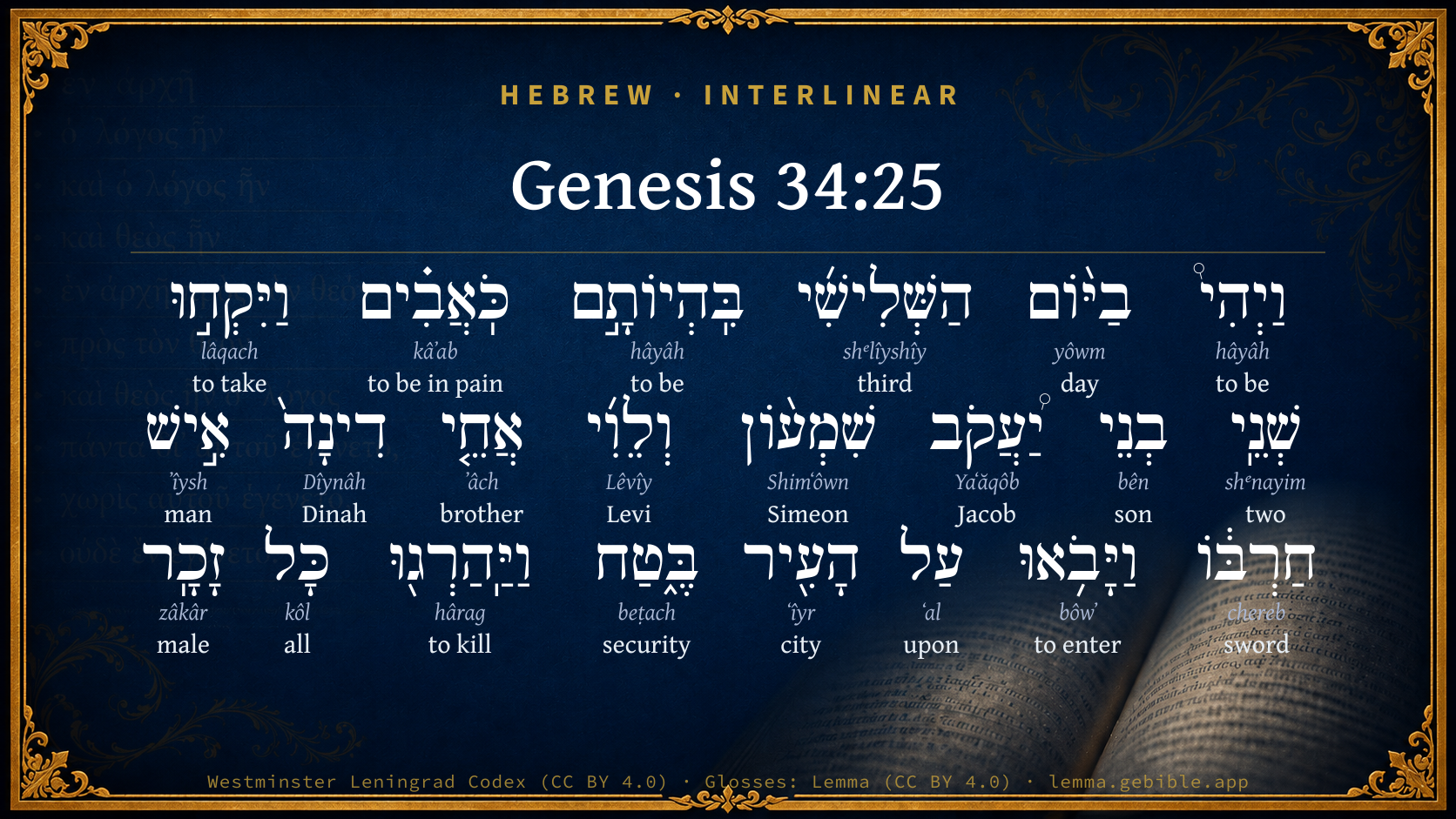
Genesis 34:25

Hebrew (Westminster Leningrad Codex) Genesis 34:25 appears in the Hebrew Old Testament. The text above is from the Westminster Leningrad Codex. Each word links to its Strong’s number, a concise gloss, and parsing drawn from the Open Scriptures Hebrew Bible morphology. Click any word for its full Brown-Driver-Briggs (BDB) entry.
Download image
Cite this verse

Genesis 34:25 (World English Bible). Public Domain. Lemma interlinear Bible study tool, https://lemma.gebible.app/v/genesis/34/25.

Show BibTeX & RIS
BibTeX
RIS
English Translation
It happened on the third day, when they were sore, that two of Jacob's sons, Simeon and Levi, Dinah's brothers, each took his sword, came upon the unsuspecting city, and killed all the males.
World English Bible · Public Domain
Highlights
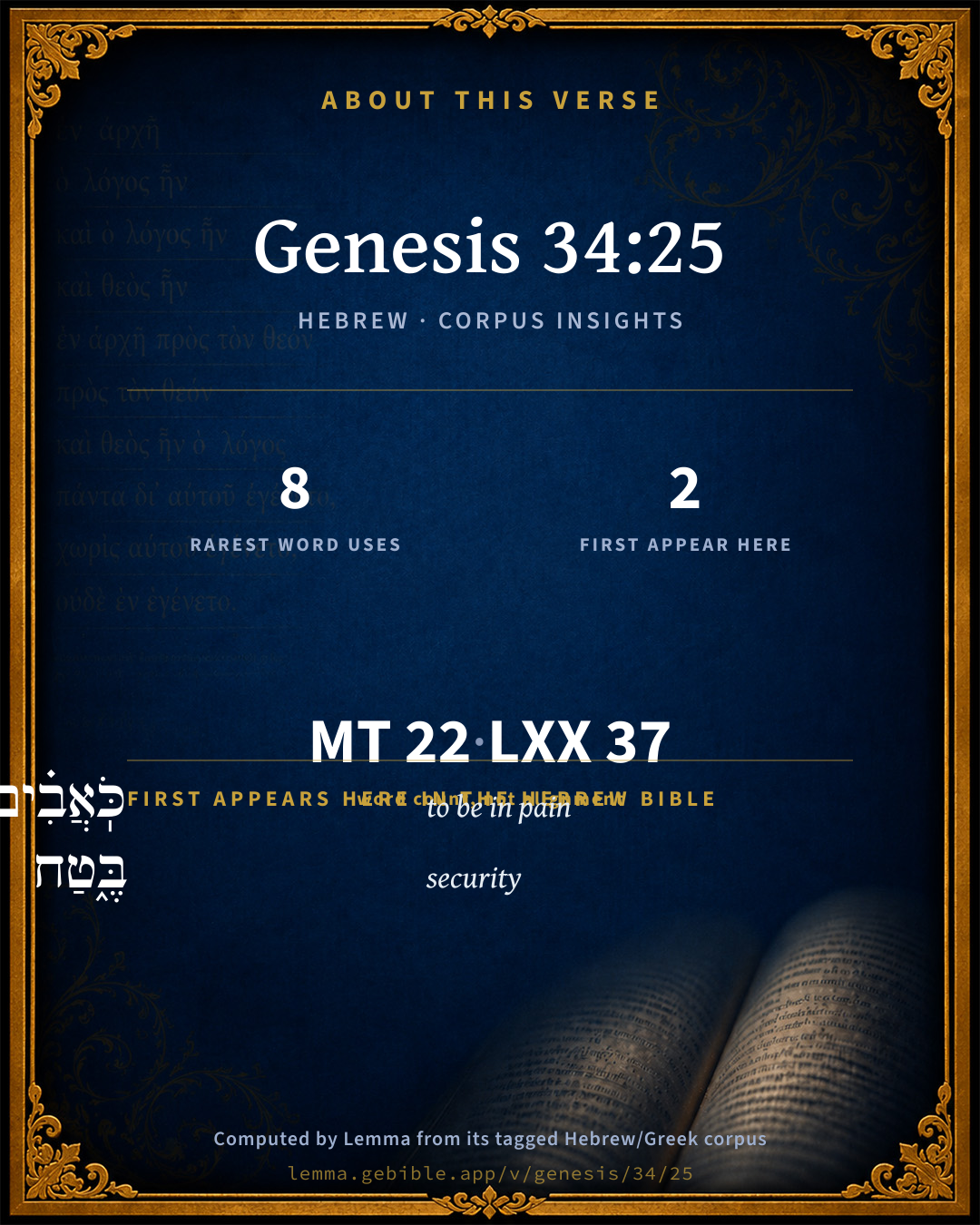
  • 2 first appearances in the Hebrew Bible
Full analysis ↓
Download a study sheet

One document with this verse’s original text, its word-by-word gloss line, the meaning frame, cross-references with their text, attributed commentary, and full source and license credits — printable, and it pastes into notes with its structure intact.

This verse Autodidact and up

Study sheet (.html) Plain text (.txt)

A passage Seminary Student

Up to 50 verses in one chapter. A passage sheet keeps up to 6 commentary sources and 12 cross-references per verse, in the order this page ranks them, and says so on the sheet whenever that leaves anything out. Ask for a single verse and you get the Autodidact verse sheet above.

Everything on this page stays free to read, with no account — the sheet is a download of what is already on screen, not access to it.

Want to remove ads? Support Godless Engineer
Compare translations 3

The same verse in 3 English versions, stacked beneath the original-language interlinear above. Click any original word for its lexicon entry.

Each is an independent rendering of the whole verse — the interlinear is not word-aligned to these translations.

Highlighted words mark where these versions differ — a whole-verse word diff, not a word-by-word alignment.

  • World English Bible Public Domain
    It happened on the third day, when they were sore, that two of Jacob's sons, Simeon and Levi, Dinah's brothers, each took his sword, came upon the unsuspecting city, and killed all the males.
  • King James Version Public Domain
    And it came to pass on the third day, when they were sore, that two of the sons of Jacob, Simeon and Levi, Dinah's brethren, took each man his sword, and came upon the city boldly, and slew all the males.
  • unfoldingWord Literal Text CC BY-SA 4.0
    Then it happened on the third day, when they were in pain, then two of Jacob’s sons, Simeon and Levi, brothers of Dinah, each took his sword and went upon the city boldly and killed every male.

unfoldingWord Literal Text — © unfoldingWord, licensed CC BY-SA 4.0. Word-aligned USFM3 via Door43 (git.door43.org/unfoldingWord/en_ult).

Versions to compare (up to 4)

3 of 4 selected

Show all 18 translations

Every available English version of this verse, each an independent rendering of the whole verse.

  • World English Bible Public Domain
    It happened on the third day, when they were sore, that two of Jacob's sons, Simeon and Levi, Dinah's brothers, each took his sword, came upon the unsuspecting city, and killed all the males.
  • Berean Standard Bible Public Domain
    Three days later, while they were still in pain, two of Jacob’s sons (Dinah’s brothers Simeon and Levi) took their swords, went into the unsuspecting city, and slaughtered every male.
  • Majority Standard Bible Public Domain
    Three days later, while they were still in pain, two of Jacob’s sons (Dinah’s brothers Simeon and Levi) took their swords, went into the unsuspecting city, and slaughtered every male.
  • King James Version Public Domain
    And it came to pass on the third day, when they were sore, that two of the sons of Jacob, Simeon and Levi, Dinah's brethren, took each man his sword, and came upon the city boldly, and slew all the males.
  • American Standard Version (1901) Public Domain
    And it came to pass on the third day, when they were sore, that two of the sons of Jacob, Simeon and Levi, Dinah's brethren, took each man his sword, and came upon the city unawares, and slew all the males.
  • Revised Version (1885) Public Domain
    And it came to pass on the third day, when they were sore, that two of the sons of Jacob, Simeon and Levi, Dinah’s brethren, took each man his sword, and came upon the city unawares, and slew all the males.
  • Geneva Bible (1599) Public Domain
    And on the thirde day (when they were sore) two of the sonnes of Iaakob, Simeon and Leui, Dinahs brethren tooke either of them his sworde and went into the citie boldly, and slue euery male.
  • Douay-Rheims (1899) Public Domain
    And behold the third day, when the pain of the wound was greatest, two of the sons of Jacob, Simeon and Levi, the brothers of Dina, taking their swords, entered boldly into the city, and slew all the men:
  • Young's Literal Translation Public Domain
    And it cometh to pass, on the third day, in their being pained, that two of the sons of Jacob, Simeon and Levi, Dinah's brethren, take each his sword, and come in against the city confidently, and slay every male;
  • Literal Standard Version CC BY-SA 4.0
    And it comes to pass, on the third day, in their being pained, that two of the sons of Jacob, Simeon and Levi, Dinah’s brothers, take each his sword, and come in against the city confidently, and slay every male;
  • Unlocked Literal Bible CC BY-SA 4.0
    On the third day, when they were still in pain, two of the sons of Jacob (Simeon and Levi, Dinah's brothers), each took his sword and they attacked the city that was certain of its security, and they killed all the males.
  • unfoldingWord Literal Text CC BY-SA 4.0
    Then it happened on the third day, when they were in pain, then two of Jacob’s sons, Simeon and Levi, brothers of Dinah, each took his sword and went upon the city boldly and killed every male.
  • Darby Bible Public Domain
    And it came to pass on the third day, when they were sore, that two of the sons of Jacob, Simeon and Levi, Dinah's brethren, took each his sword, and came upon the city boldly, and slew all the males.
  • World Messianic Bible Public Domain
    On the third day, when they were sore, two of Jacob’s sons, Simeon and Levi, Dinah’s brothers, each took his sword, came upon the unsuspecting city, and killed all the males.
  • Webster's Bible Public Domain
    And it came to pass on the third day, when they were sore, that two of the sons of Jacob, Simeon and Levi, Dinah's brethren, took each man his sword, and came upon the city boldly, and slew all the males.
  • Free Bible Version CC BY-SA 4.0
    Three days later while they were still suffering pain, Simeon and Levi, two of Jacob's sons and Dinah's brothers, came with their swords into the town. Unopposed, they slaughtered every male.
  • Bible in Basic English Public Domain
    But on the third day after, before the wounds were well, two of the sons of Jacob, Simeon and Levi, Dinah's brothers, took their swords and came into the town by surprise and put all the males to death.
  • JPS Tanakh (1917) Public Domain
    And it came to pass on the third day, when they were in pain, that two of the sons of Jacob, Simeon and Levi, Dinah's brethren, took each man his sword, and came upon the city unawares, and slew all the males.

Literal Standard Version (2020), Covenant Press — licensed CC BY-SA 4.0. Text via the HelloAO Bible API (eBible.org). Unlocked Literal Bible (unfoldingWord) — licensed CC BY-SA 4.0. Text via the HelloAO Bible API (eBible.org). unfoldingWord Literal Text — © unfoldingWord, licensed CC BY-SA 4.0. Word-aligned USFM3 via Door43 (git.door43.org/unfoldingWord/en_ult). Free Bible Version, Dr. Jonathan Gallagher — licensed CC BY-SA 4.0. Text via the HelloAO Bible API (eBible.org).

Word by word

More ways to search: Search by grammar → Find every occurrence → Compare this word →

Practice this passage: Drill this verse → Learn its vocabulary →

כֹּֽאֲבִ֗ים
kâʼab
H3510
“being in pain”
Verb, Qal, Participle Active, Masculine, Plural, Absolute
Part of Speech
Verb
Stem
Qal
Form
Participle Active
Gender
Masculine
Number
Plural
State
Absolute
Full BDB Definition

Origin: a primitive root

TWOT: 940

to be in pain, be sore, have pain, be sorrowful - (Qal) - to be in pain (physical) - to be in pain (mental) - (Hiphil) - to cause pain, hurt, mar - pain, mar (participle)
  1. וַיְהִי֩ hâyâh H1961 “and · to be” Conjunction + Verb, Qal, Sequential Imperfect, 3rd Person, Masculine, Singular
  2. בַיּ֨וֹם yôwm H3117 “in/at the · day” Preposition, Determined + Noun, Common, Masculine, Singular, Absolute
  3. הַשְּׁלִישִׁ֜י shᵉlîyshîy H7992 “the · third” Particle, Definite Article + Adjective, Ordinal number, Masculine, Singular, Absolute
  4. בִּֽהְיוֹתָ֣ם hâyâh H1961 “in/at · to be · them” Preposition + Verb, Qal, Infinitive Construct + Suffix, Personal, 3rd Person, Masculine, Plural
  5. וַיִּקְח֣וּ lâqach H3947 “and · to take” Conjunction + Verb, Qal, Sequential Imperfect, 3rd Person, Masculine, Plural
  6. שְׁנֵֽי shᵉnayim H8147 “two” Adjective, Cardinal number, Masculine, Dual, Construct
  7. בְנֵי bên H1121 “sons of” Noun, Common, Masculine, Plural, Construct
  8. יַ֠עֲקֹב Yaʻăqôb H3290 “Jacob” Noun, Proper
  9. שִׁמְע֨וֹן Shimʻôwn H8095 “Simeon” Noun, Proper
  10. וְלֵוִ֜י Lêvîy H3878 “and · Levi” Conjunction + Noun, Proper
  11. אֲחֵ֤י ʼâch H251 “brothers of” Noun, Common, Masculine, Plural, Construct
  12. דִינָה֙ Dîynâh H1783 “Dinah” Noun, Proper
  13. אִ֣ישׁ ʼîysh H376 “man” Noun, Common, Masculine, Singular, Absolute
  14. חַרְבּ֔וֹ chereb H2719 “sword · his” Noun, Common, Feminine, Singular, Construct + Suffix, Personal, 3rd Person, Masculine, Singular
  15. וַיָּבֹ֥אוּ bôwʼ H935 “and · to enter” Conjunction + Verb, Qal, Sequential Imperfect, 3rd Person, Masculine, Plural
  16. עַל ʻal H5921 “upon” Preposition
  17. הָעִ֖יר ʻîyr H5892 “the · city” Particle, Definite Article + Noun, Common, Feminine, Singular, Absolute
  18. בֶּ֑טַח beṭach H983 “security” Noun, Common, Masculine, Singular, Absolute
  19. וַיַּֽהַרְג֖וּ hârag H2026 “and · to kill” Conjunction + Verb, Qal, Sequential Imperfect, 3rd Person, Masculine, Plural
  20. כָּל kôl H3605 “all of” Noun, Common, Masculine, Singular, Construct
  21. זָכָֽר zâkâr H2145 “male” Adjective, Adjective, Masculine, Singular, Absolute

About this verse

These counts appear in no published source. They are computed here, from the morphology-tagged text and Lemma’s own curated glosses. What Lemma adds →

22
words
21
distinct lemmas
Pentateuch
section

Notable vocabulary

The rarest word here is כֹּֽאֲבִ֗ים to be in pain H3510 — appearing just 8 times in the whole Hebrew Bible.

First appearance in Scripture

These words make their first canonical appearance in the Hebrew Bible here:

  • כֹּֽאֲבִ֗ים to be in pain H3510
  • בֶּ֑טַח security H983

Shared distinctive vocabulary

כֹּֽאֲבִ֗ים to be in pain H3510 occurs in 8 verses of the Hebrew Bible. Also found in:

Grammatical profile

  • 6 verbs
  • 12 nouns
  • 3 adjectives
  • 1 preposition

Verb forms

  • וַיְהִי֩ Qal · Sequential Imperfect
  • בִּֽהְיוֹתָ֣ם Qal · Infinitive Construct
  • כֹּֽאֲבִ֗ים Qal · Participle Active
  • וַיִּקְח֣וּ Qal · Sequential Imperfect
  • וַיָּבֹ֥אוּ Qal · Sequential Imperfect
  • וַיַּֽהַרְג֖וּ Qal · Sequential Imperfect

Repetition

A word recurs within this verse — often emphatic in Hebrew:

  • וַיְהִי֩ to be H1961 ×2

Hebrew & Septuagint length

In English translation the verse runs 34 words from the Hebrew and 39 from the Septuagint (LXX English) — closely comparable.

A rough comparison of the two English renderings, which tokenize alike — not a word-level alignment.

Word counts can differ between the Hebrew and the Greek without any difference in meaning — e.g. the Hebrew direct-object marker אֵת has no separate Greek word, and Greek often adds the article ὁ.

In the original languages it is 22 Hebrew tokens and 37 Greek tokens — but the two are counted differently (Hebrew bundles its prefixes and suffixes into one token; the Greek is in lemma form), so that isn’t a like-for-like length.

Cross-references

9

Topical passages linked to Genesis 34:25 in the Treasury of Scripture Knowledge — connected by theme and wording, ordered by reader-vote popularity; previews shown in the World English Bible.

  • Genesis 49:5–7 "Simeon and Levi are brothers; Weapons of violence are their swords.
  • Genesis 29:33–34 She conceived again, and bare a son, and said, "Because Yahweh has heard that I am hated, he has therefore given me this son also." She named him Simeon.
  • Numbers 31:7 They warred against Midian, as Yahweh commanded Moses; and they killed every male.
  • Numbers 31:17 Now therefore kill every male among the little ones, and kill every woman who has known man by lying with him.
  • Joshua 5:6 For the children of Israel walked forty years in the wilderness, until all the nation, even the men of war who came forth out of Egypt, were consumed, because they didn't listen to the voice of Yahweh: to whom Yahweh swore that he wouldn't let them see the land which Yahweh swore to their fathers that he would give us, a land flowing with milk and honey.
  • Joshua 5:8 It happened, when they had done circumcising all the nation, that they abode in their places in the camp, until they were whole.
  • 2 Chronicles 32:25 But Hezekiah didn't render again according to the benefit done to him; for his heart was lifted up: therefore there was wrath on him, and on Judah and Jerusalem.
  • Proverbs 4:16 For they don't sleep, unless they do evil. Their sleep is taken away, unless they make someone fall.
  • Proverbs 6:34–35 For jealousy arouses the fury of the husband. He won't spare in the day of vengeance.

Cross-references courtesy of OpenBible.info (CC BY 4.0).

Hebrew and Greek witnesses Masoretic Hebrew ↔ Greek Septuagint

The same verse in the two great witnesses to the Old Testament, shown verse-for-verse.

These are two independent witnesses, not word-aligned to each other, and the Septuagint is shown in lemma (dictionary) form.

Hebrew Genesis 34:25 Masoretic · Westminster Leningrad Codex

וַיְהִי֩ בַיּ֨וֹם הַשְּׁלִישִׁ֜י בִּֽהְיוֹתָ֣ם כֹּֽאֲבִ֗ים וַיִּקְח֣וּ שְׁנֵֽי בְנֵי יַ֠עֲקֹב שִׁמְע֨וֹן וְלֵוִ֜י אֲחֵ֤י דִינָה֙ אִ֣ישׁ חַרְבּ֔וֹ וַיָּבֹ֥אוּ עַל הָעִ֖יר בֶּ֑טַח וַיַּֽהַרְג֖וּ כָּל זָכָֽר

It happened on the third day, when they were sore, that two of Jacob's sons, Simeon and Levi, Dinah's brothers, each took his sword, came upon the unsuspecting city, and killed all the males.

World English Bible · Public Domain

Greek LXX Genesis 34:25 Septuagint · lemma form

γίγνομαι δέ ἐν ὁ ἡμέρα ὁ τρίτος ὅτε εἰμί ἐν ὁ πόνος λαμβάνω ὁ δύο υἱός ἰακώβ συμεων καί λευί ὁ ἀδελφός δινα ἕκαστος ὁ μάχαιρα αὐτός καί εἰςἔρχομαι εἰς ὁ πόλις ἀσφαλῶς καί ἀποκτείνω πᾶς ἀρσενικός

And it came to pass on the third day, when they were in pain, the two sons of Jacob, Symeon and Levi, Dina's brethren, took each man his sword, and came upon the city securely, and killed every male.

LXX2012 (modern English Septuagint) · Public Domain

On this verse, The Cambridge Bible for Schools and Colleges discusses the Septuagint’s reading. Read the note in Commentary ↓

Hebrew: Westminster Leningrad Codex (CC BY 4.0). Greek: Septuagint (public domain); English from LXX2012 (modern English Septuagint) (Public Domain). How the Septuagint differs from the Hebrew →

Targum (Aramaic paraphrase)

2

The Targum is the ancient Jewish Aramaic paraphrase of the Hebrew Scriptures — an interpretive translation, not the Hebrew text itself. Onkelos (literal) and Pseudo-Jonathan (expansive) render the Torah, and Jonathan the Prophets. Coverage is partial: where no permissively-licensed English translation exists for a verse, only the Aramaic is shown. This is verse-level text, not a word-by-word alignment to the Hebrew.

  1. Targum Onkelos Torah (Genesis–Deuteronomy)
    וַהֲוָה בְיוֹמָא תְלִיתָאָה כַּד תְּקִיפוּ עֲלֵיהוֹן כֵּאבֵיהוֹן וּנְסִיבוּ תְרֵין בְּנֵי יַעֲקֹב שִׁמְעוֹן וְלֵוִי אֲחֵי דִּינָה גְּבַר חַרְבֵּהּ וְעַלּוּ עַל קַרְתָּא דְּיָתְבוּן לְרָחֲצָן וּקְטָלוּ כָּל דְּכוּרָא

    (no public-domain English translation for this verse)

    Targum Onkelos — Aramaic: “Onkelos Genesis” (public domain); “Onkelos Exodus” (public domain); “Onkelos Leviticus” (public domain); “Onkelos Numbers” (public domain); “Onkelos Deuteronomy” (public domain). English: “Sefaria Community Translation” (CC0 1.0 (public-domain dedication)); “J.W. Etheridge. The Targums of Onkelos and Jonathan Ben Uzziel on the Pentateuch. London: Longmans, Green, 1862” (public domain). Text via Sefaria.

  2. Targum Pseudo-Jonathan Torah (Genesis–Deuteronomy)
    וַהֲוָה בְּיוֹמָא תְלִיתָאָה כַּד הֲווֹ מִתְמַקְמְקִין מִן כֵּיב גוּזְרַתְהוֹם וּנְסִיבוּ תְּרֵין מִבְּנוֹי דְיַעֲקב שִׁמְעוֹן וְלֵוִי אֲחֵי דִינָה גְבַר סַיְיפֵיהּ וְעָלוּ עַל קַרְתָּא דַהֲוָה יַתְבָא לְרוֹחְצַן וּקְטָלוּ כָּל דְכוּרָא

    And it was on the third day, when they were weak from the pain of their circumcision, two of the sons of Jakob, Shimeon and Levi, the brothers of Dinah, took each man his sword, and came upon the city, which was dwelling securely and killed every male.

    Targum Pseudo-Jonathan — Aramaic: “Targum Jonathan on Genesis” (public domain); “Targum Jonathan on Exodus” (public domain); “Targum Jonathan on Leviticus” (public domain); “Targum Jonathan on Numbers” (public domain); “Targum Jonathan on Deuteronomy” (public domain). English: “The Targum of Jonathan ben Uzziel, trans. J. W. Etheridge, London, 1862” (public domain). Text via Sefaria.

Commentary

Notes on Genesis 34:25 from classic Christian and Jewish commentators (each source and its license shown beneath its notes). The classic Christian expositions comment on the surrounding passage and are grouped to its opening verse, so a note may address several verses; the Jewish commentaries on the Tanakh (Rashi and others) are per-verse, so they appear only where the commentator wrote on this verse.

Lemma curates 59 commentaries, every one of them public domain or Creative Commons licensed, each selected and text-cleaned for this edition rather than reprinted as found. About our sources →

Trapp's Complete Commentary

John Trapp

Gen 34:25 And it came to pass on the third day, when they were sore, that two of the sons of Jacob, Simeon and Levi, Dinah’s brethren, took each man his sword, and came upon the city boldly, and slew all the males.

Ver. 25. On the third day.] Which is the worst day to those that are wounded; the critical day, as the surgeons call it. Wicked men are witty, to take their opportunity to act villany.

John Trapp, A Commentary or Exposition upon All the Books of the Old and New Testament (1647–1656) — public domain. Text from a community e-Sword module.

Joseph Benson's Commentary

Gen 34:25-27. They slew all the males — Nothing can excuse this execrable villany. It was true Shechem had wrought folly in Israel, in defiling Dinah: but it ought to have been considered how far Dinah herself had been accessary to it. Had Shechem abused her in her mother’s tent, it had been another matter; but she went upon his ground, and struck the spark which began the fire. When we are severe upon the sinner, we ought to consider who was the tempter. It was true that Shechem had done ill; but he was endeavouring to atone for it, and was as honest and honourable afterward as the case would admit. It is true that Shechem had done ill, but what was that to all the Shechemites? Doth one man sin, and must the innocent fall with the guilty? This was barbarous indeed. But that which above all aggravated the cruelty, was the most perfidious treachery that was in it. The Shechemites had submitted to their conditions, and had done that upon which they had promised to become one people with them. Yet they act as sworn enemies to those to whom they were lately become sworn friends, making as light of their covenant as they did of the laws of humanity. And these are the sons of Israel! Cursed be their anger, for it was fierce. Though Simeon and Levi only were the murderers, yet others of the sons of Jacob came upon the slain, and spoiled the city — And so became accessory to the murder.

Joseph Benson's Commentary on the Old and New Testaments (1811–1818) — public domain. Text from a community e-Sword module.

Tyndale Open Study Notes

Tyndale Open Resources

34:25-29 When Simeon and Levi used circumcision to deceive and slaughter the Canaanites, they showed disdain for the sign of the covenant. Their slaughter of all the males and their plunder of the city was not justice, but brutal and excessive revenge. In their moral outrage and desire to right the wrong, they should have demanded compensation (see Exod 22:16-17; Deut 22:28-29). Instead, their passionate act of rage cost them their birthright blessing (Gen 49:5-7).

Tyndale Open Study Notes — © Tyndale Open Resources, licensed CC BY-SA 4.0. Text via the HelloAO Bible API.

Geneva Bible (1599)

Geneva Bible translators

For they were the chief of the company.

The people are punished with their wicked princes.

Geneva Bible (1599) marginal notes — public domain. Text via Bolls.life.

Matthew Henry's Commentary

Here, we have Simeon and Levi, two of Jacob's sons, young men not much above twenty years old, cutting the throats of the Shechemites, and thereby breaking the heart of their good father.

I. Here is the barbarous murder of the Shechemites. Jacob himself was used to the sheep-hook, but his sons had got swords by their sides, as if they had been the seed of Esau, who was to live by his sword; we have them here,

1. Slaying the inhabitants of Shechem - all the males, Hamor and Shechem particularly, with whom they had been treating in a friendly manner but the other day, yet with a design upon their lives. Some think that all Jacob's sons, when they wheedled the Shechemites to be circumcised, designed to take advantage of their soreness, and to rescue Dinah from among them; but that Simeon and Levi, not content with that, would themselves avenge the injury - and they did it with a witness. Now, (1.) It cannot be denied but that God was righteous in it. Had the Shechemites been circumcised in obedience to any command of God, their circumcision would have been their protection; but when they submitted to that sacred rite only to serve a turn, to please their prince and to enrich themselves, it was just with God to bring this upon them. Note, As nothing secures us better than true religion, so nothing exposes us more than religion only pretended to. (2.) But Simeon and Levi were most unrighteous. [1.] It was true that Shechem had wrought folly against Israel, in defiling Dinah; but it ought to have been considered how far Dinah herself had been accessory to it. Had Shechem abused her in her own mother's tent, it would have been another matter; but she went upon his ground, and perhaps by her indecent carriage had struck the spark which began the fire: when we are severe upon the sinner we ought to consider who was the tempter. [2.] It was true that Shechem had done ill; but he was endeavouring to atone for it, and was as honest and honourable, ex post facto - after the deed, as the case would admit: it was not the case of the Levite's concubine that was abused to death; nor does he justify what he has done, but courts a reconciliation upon any terms. [3.] It was true that Shechem had done ill; but what was that to all the Shechemites? Does one man sin, and will they be wroth with all the town? Must the innocent fall with the guilty? This was barbarous indeed. [4.] But that which above all aggravated the cruelty was the most perfidious treachery that was in it. The Shechemites had submitted to their conditions, and had done that upon which they had promised to become one people with them (Gen 34:16); yet they act as sworn enemies to those to whom they had lately become sworn friends, making as light of their covenant as they did of the laws of humanity. And are these the sons of Israel? Cursed be their anger, for it was fierce. [5.] This also added to the crime, that they made a holy ordinance of God subservient to their wicked design, so making that odious; as if it were not enough for them to shame themselves and their family, they bring a reproach upon that honourable badge of their religion; justly would it be called a bloody ordinance.

2. Seizing the prey of Shechem, and plundering the town. They rescued Dinah (Gen 34:26), and, if that was all they came for, they might have done that without blood, as appears by their own showing (Gen 34:17); but they aimed at the spoil; and, though Simeon and Levi only were the murderers, yet it is intimated that others of the sons of Jacob came upon the slain and spoiled the city (Gen 34:27), and so became accessory to the murder. In them it was manifest injustice; yet here we may observe the righteousness of God. The Shechemites were willing to gratify the sons of Jacob by submitting to the penance of circumcision, upon this principle, Shall not their cattle and their substance be ours? (Gen 34:23), and see what was the issue; instead of making themselves masters of the wealth of Jacob's family, Jacob's family become masters of their wealth. Note, Those who unjustly grasp at that which is another's justly lose that which is their own.

II. Here is Jacob's resentment of this bloody deed of Simeon and Levi, Gen 34:30. Two things he bitterly complains of: - 1. The reproach they had brought upon him thereby: You have troubled me, put me into a disorder, for you have made me to stink among the inhabitants of the land, that is, "You have rendered me and my family odious among them. What will they say of us and our religion? We shall be looked upon as the most perfidious barbarous people in the world." Note, The gross misconduct of wicked children is the grief and shame of their godly parents. Children should be the joy of their parents; but wicked children are their trouble, sadden their hearts, break their spirits, and make them go mourning from day to day. Children should be an ornament to their parents; but wicked children are their reproach, and are as dead flies in the pot of ointment: but let such children know that, if they repent not, the grief they have caused to their parents, and the damage religion has sustained in its reputation through them, will come into the account and be reckoned for. 2. The ruin they had exposed him to. What could be expected, but that the Canaanites, who were numerous and formidable, would confederate against him, and he and his little family would become an easy prey to them? I shall be destroyed, I and my house. If all the Shechemites must be destroyed for the offence of one, why not all the Israelites for the offence of two? Jacob knew indeed that God had promised to preserve and perpetuate his house; but he might justly fear that these vile practices of his children would amount to a forfeiture, and cut off the entail. Note, When sin is in the house, there is reason to fear ruin at the door. The tender parents foresee those bad consequences of sin which the wicked children have no dread of. One would think this should have made them to relent, and they should have humbled themselves to their good father, and begged his pardon; but, instead of this, they justify themselves, and give him this insolent reply, Should he deal with our sister as with a harlot? No, he should not; but, if he do, must they be their own avengers? Will nothing less than so many lives, and the ruin of a whole city, serve to atone for an abuse done to one foolish girl? By their question they tacitly reflect upon their father, as if he would have been content to let them deal with his daughter as with a harlot. Note, It is common for those who run into one extreme to reproach and censure those who keep the mean as if they ran into the other. Those who condemn the rigour of revenge shall be misrepresented, as if they countenanced and justified the offence.

Matthew Henry's Commentary on the Whole Bible (1708–1710) — public domain (CC PDM 1.0). Text via the HelloAO Bible API.

Adam Clarke's Commentary

Verse 25. On the third day, when they were sore] When the inflammation was at the height, and a fever ensued which rendered the person utterly helpless, and his state critical, Simeon and Levi, the half brothers of Dinah, took each man his sword, probably assisted by that portion of the servants which helped them to take care of the flock, came on the city boldly, betach, securely - without being suspected, and being in no danger of meeting with resistance, and slew all the males. Great as the provocation was, and it certainly was very great, this was an act or unparalleled treachery and cruelty.

Adam Clarke's Commentary on the Bible (1810–1826) — public domain. Text from a community e-Sword/MySword module.

John Calvin's Commentaries

25. Simian and Levi, Dinah’s brethren. Because Moses says that the slaughter took place on the third day, the Hebrews think that, at that time, the pain of the wound was most severe. The proof, however, is not valid; nor is it of much moment. Although Moses names only two authors of the slaughter, it does not appear to me probable that they came alone, but that they were the leaders of the troop: for Jacob had a large family, and it might be that they called some of their brothers to join them; yet, because the affair was conducted by their counsel and direction, it is ascribed to them, as Cartage is said to have been destroyed by Scipio. Moses also calls them the brothers of Dinah, because they were by the same mother. We have seen that Dinah was the daughter of Leah; for which reason Simon and Levi, whose own sister she was by both parents, were the more enraged at the violation of her chastity: they were therefore impelled, not so much by the common reproach brought upon the holy and elect race, (according to their recent boast,) as by a sense of the infamy brought upon themselves. However, there is no reader who does not readily perceive how dreadful and execrable was this crime. One man only had sinned, and he endeavored to compensate for the injury, by many acts of kindness; but the cruelty of Simon and Levi could only be satiated by the destruction of the whole city; and, under the pretext of a covenant, they form a design against friends and hospitable persons, in a time of peace, which would have been deemed intolerable against enemies in open war. Hence we perceive how mercifully God dealt with that people; seeing that, from the posterity of a sanguinary man, and even of a wicked robber, he raised up a priesthood for himself. Let the Jews now go and be proud of their noble origin. But the Lord declared his gratuitous mercy by too many proofs for the ingratitude of man to be able to obscure it. Moreover, we hence learn that Moses did not speak from carnal sense; but was the instrument of the Holy Spirit, and the herald of the celestial Judge; for though he was a Levite, he yet is so far from sparing his own race, that he does not hesitate to brand the father of his tribe with perpetual infamy. And it is not to be doubted that the Lord purposely intended to stop the mouths of impure and profane men, such as the Lucianists, who confess that Moses was a very great man, and of rare excellence; but that he procured for himself, by craft and subtlety, authority over a great people, as if, indeed, an acute and intelligent man would not have known that, by this single act of wickedness, the honor of his race would be greatly tarnished. He had, however, no other design than to extol the goodness of God towards his people; and truly there was nothing which he less desired than to exercise dominion, as appears clearly from the fact, that he transferred the office of priesthood to another family, and commanded his sons to be only ministers. With respect to the Shechemites, although in the sight of God they were not innocent; seeing they preferred their own advantage to a religion which they thought lawful, yet it was not the Lord’s will that they should be so grievously punished for their fault; but he suffered this signal punishment to follow the violation of one maid, that he might testify to all ages his great abhorrence of lust. Besides, seeing that the iniquity had arisen from a prince of the city, the punishment is rightly extended to the whole body of the people: for since God never commits the government to evil and vicious princes, except in righteous judgment, there is no wonder that, when they sin, they involve their subjects with them in the same condemnation. Moreover, from this example let us learn, that if, at any time, fornication prevail with impunity, God will, at length, exact punishments so much the more severe: for if the violation of one maid was avenged by the horrible massacre of a whole city; he will not sleep nor be quiet, if a whole people indulge in a common license of fornication, and, on all sides, connive at each other’s iniquity. The sons of Jacob acted indeed wickedly; but we must observe that fornication was, in this manner, divinely condemned.

John Calvin's Commentaries (1540-1563) — public domain. Text from the Calvin Translation Society English edition (1840s-50s) via the Christian Classics Ethereal Library (ccel.org). Calvin's coverage is partial (roughly two-thirds of the Bible); uncommented books and verses are honest gaps, never fabricated. The 19th-century editor's footnotes and remarks are omitted so the notes are faithfully Calvin's own voice.

Ellicott's Commentary for English Readers

(25) Simeon and Levi, Dinah’s brethren.—As born of the same mother, they, with Reuben and Judah, were especially bound to espouse their sister’s cause, but the method they took was cruel in the extreme. And it seems that these two were the leaders in the plot, having probably excluded Reuben from it, as a man of feeble character and opposed to bloodshed (Gen_37:22); and Judah, as one too honourable to take part in so nefarious a transaction. Long afterwards Jacob speaks of it in terms of the strongest reprobation (Gen_49:5-7). In executing their cruel deed, they would command the services of the more active and fierce portion of Jacob’s servants; but they must have been not boys, but men of ripe manhood, before they could have had influence or power enough for so terrible an exploit.

A Bible Commentary for English Readers, edited by Charles John Ellicott (1878–1897) — public domain. Text from a community e-Sword module.

The Cambridge Bible for Schools and Colleges

gen. ed. J. J. S. Perowne

25. And it came to pass] In this verse the Compiler has combined the two versions: (1) that which ascribes the treacherous deed to the sons of Jacob generally; and (2) that in which Simeon and Levi alone are the perpetrators of the massacre.

when they were sore] The effects of the operation rendered the Shechemite males powerless to defend themselves. In this version there is a vein of coarse and repulsive humour. The Canaanites were not only put to the sword, but by their submission to the Israelite rite they had been outwitted. At the time of the attack, they were unable to offer any resistance.

unawares] Better than R.V. marg. boldly. LXX ἀσφαλῶς = “safely,” Lat. confidenter. The meaning is that the people of Shechem were secure and unsuspecting, when the attack was made. Not the courage of the assailants, but the sense of security on the part of their victims, is indicated. Cf. “the careless Ethiopians” (Eze_30:9).

The Cambridge Bible for Schools and Colleges (gen. ed. J. J. S. Perowne; Cambridge University Press, 1878–1918) — public domain. Text from a community e-Sword module.

John Gill's Exposition

And they slew Hamor and Shechem his son with the edge of the sword,.... Whom they had been just treating with in a seeming friendly manner: Shechem was the chief aggressor, and his crime was very heinous; but considering that he did all he could, after the fact was committed, to make recompence for the injury done, he deserved other treatment, at least mercy should have been shown him. Hamor, perhaps, was too indulgent to his son, connived at his sin, and did not punish him for it; and, it may be, approved of it, and now dies for it:

and took Dinah out of Shechem's house, and went out; where she was kept from the time of her being ravished by Shechem, with an intention to marry her, could the consent of her parents and relations be obtained; for it does not appear that he kept her to carry on a criminal conversation with her, but a courtship in order to marriage.

John Gill's Exposition of the Whole Bible (1746–1763) — public domain (CC PDM 1.0). Text via the HelloAO Bible API.

Haydock's Catholic Bible Commentary

Greatest. On that day a fever and inflammation likewise often take place. See Hippocrates on fractures, Valesius sac. (Phil. xii.) (Menochius) --- Brothers of Dina by Lia, and both of a fiery temper. They were assisted by some servants, (Menochius) and afterwards the other children helped to pillage the city. (Theodotion, ap. Eusebius, ix. 22.)

George Leo Haydock (1774–1849), Haydock's Catholic Family Bible and Commentary, 1859 edition — public domain. Excludes Psalms (Douay-Rheims chapter numbering differs from Protestant) and Deuterocanonical books (Catholic canon only).

Matthew Poole's English Annotations

On the third day, when the pain and grief of wounds is the greatest, as physicians note,

when they were sore, and therefore not well able to defend themselves; for circumcision caused great pain in children, which was the ground of that exclamation, Exo 4:25, much more in grown men. See Jos 5:8.

Simeon and Levi: these two only are mentioned, because they were authors of the counsel, and conductors of the rest in the execution; but it is probable, from Gen 34:27, that most of their brethren were confederate with them, and that they had a considerable number of their servants with them, who would be ready enough to revenge their masters’ quarrel, and to punish so great a villany; but all that was done is justly ascribed to them two, as it is common for all writers to say this or that was done by such a captain or general, when in truth it was done by his soldiers.

Dinah’s brethren; so they were both by the father and mother, which made them more forward and zealous than the rest.

All the males; such of them as were grown up, by comparing Gen 34:29, for these, or some of them, seem to have been the abettors of the injury against their sister and family. Their sin in this act was manifold; that they did it without sufficient authority, and against their father’s mind, as appears from Gen 34:30, and Gen 49:6, which they well knew; and without all bounds, rashly, unjustly, and cruelly punished the innocent and the guilty together, and ushered in this fact with horrible deceit and lying, and that under pretence of friendship and show of religion.

Matthew Poole's English Annotations on the Holy Bible (1683–1685) — public domain. Text from a community e-Sword/MySword module.

Whedon's Commentary on the Bible

Daniel D. Whedon

25. On the third day — After the operation was performed. At this time the pain and fever arising from the wound in the flesh attains its height, and renders the person weak and helpless. Jacob’s sons had planned for this.

Simeon and Levi — The second and third sons of Leah, Dinah’s own brothers. Genesis 33:34. These are mentioned as leaders in all this action of cruelty. Perhaps some of their brothers went with them, (see Gen_34:27,) but are not specially mentioned because they were not leaders in the action. We are not to suppose that Simeon and Levi, alone and unattended, wrought all the slaughter and ruin here described. They doubtless commanded a large number of the servants of the household. Comp. Gen_14:14.

Daniel D. Whedon (gen. ed.), Commentary on the Old and New Testaments (1874–1909) — public domain. Text from a community e-Sword module.

The Pulpit Commentary

And it came to pass on the third day, when they were sore, literally, in their being in pain; dte h+san ejn tw ponw (LXX). Inflammation and fever commonly set in on the third day, which was for that reason regarded as the critical daythat two of the sons of Jacob, Simeon and Levi, Dinah"s brethren (i.e. sons of the same mother, Leah), took each man his sword, and came upon the city accompanied by their servants (Keil), or their father"s men (Murphy), but this is doubtful (Lange). That the other sons of Jacob and brethren of Dinah did not pursue their thirst for vengeance to the same extremity as Simeon and Levi seems apparent from ver. 27; yet it is quite possible that they joined with Simeon and Levi in the assault upon the city (Rosenm "Speaker"s Commentary") which they made boldly,i.e. either they themselves feeling confident of success because of the sickness which lay upon the inhabitants (Ainsworth, Dathe, Rosenm Murphy, &c.), or, while the city was lulled into security in consequence of the treaty (Onkelos, Josephus, Keil, Lange), or perhaps referring only to the fact that they encountered no opposition, and came in safety (ajsfalwv) to the city (LXX, Kalisch);and slew all the males. Probably the town was small.

The Pulpit Commentary (1880–1919), ed. H.D.M. Spence-Jones & Joseph S. Exell — public domain. Text from a community e-Sword module.

John Wesley's Explanatory Notes

They slew all the males - Nothing can excuse this execrable villainy. It was true Shechem had wrought folly in Israel, in defiling Dinah: but it ought to have been considered how far Dinah herself had been accessary to it. Had Shechem abused her in her mother's tent, it had been another matter; but she went upon his ground, and struck the spark which began the fire. When we are severe upon the sinner, we ought to consider who was the tempter. It was true that Shechem had done ill; but he was endeavouring to atone for it, and was as honest and honourable afterwards as the case would admit. It was true that Shechem had done ill, but what was that to all the Shechemites? Doth one man sin, and must the innocent fall with the guilty? This was barbarous indeed. But that which above all aggravated the cruelty, was the most perfidious treachery that was in it. The Shechemites had submitted to their conditions, and had done that upon which they had promised to become one people with them. Yet they act as sworn enemies to those to whom they were lately become sworn friends, making as light of their covenant as they did of the laws of humanity. And these are the sons of Israel? Cursed be their anger, for it was fierce.

John Wesley, Explanatory Notes Upon the Whole Bible (1754–1765) — public domain. Text via the GEBible commentary corpus.

Keil & Delitzsch

C. F. Keil & F. Delitzsch

But on the third day, when the Shechemites were thoroughly prostrated by the painful effects of the operation, Simeon and Levi (with their servants of course) fell upon the town בּטח (i.e., while the people were off their guard, as in Eze 30:9), slew all the males, including Hamor and Shechem, with the edge of the sword, i.e., without quarter (Num 21:24; Jos 10:28, etc.), and brought back their sister. The sons of Jacob then plundered the town, and carried off all the cattle in the town and in the fields, and all their possessions, including the women and the children in their houses. By the sons of Jacob (Gen 34:27) we are not to understand the rest of his sons to the exclusion of Simeon, Levi, and even Reuben, as Delitzsch supposes, but all his sons. For the supposition, that Simeon and Levi were content with taking their murderous revenge, and had no share in the plunder, is neither probable in itself nor reconcilable with what Jacob said on his death-bed (Gen 49:5-7, observe שׁור עקּרוּ) about this very crime; nor can it be inferred from ויּצאוּ in Gen 34:26, for this relates merely to their going away from the house of the two princes, not to their leaving Shechem altogether. The abrupt way in which the plundering is linked on to the slaughter of all the males, without any copulative Vav, gives to the account the character of indignation at so revolting a crime; and this is also shown in the verbosity of the description. The absence of the copula is not to be accounted for by the hypothesis that Gen 34:27-29 are interpolated; for an interpolator might have supplied the missing link by a vav, just as well as the lxx and other ancient translators.

Keil & Delitzsch — Biblical Commentary on the Old Testament (1861–1891) — public domain (CC PDM 1.0). Text via the HelloAO Bible API. (Old Testament only.)

Kretzmann's Popular Commentary

Paul E. Kretzmann

The Revenge of Simeon and Levi

v. 25. And it came to pass on the third day, when they were sore, when the men of Shechem were confined to their beds with the inflammation following the operation to which they had consented, that two of the sons of Jacob, Simeon and Levi, Dinah’s brethren, took each man his sword, and came upon the city boldly, and slew all the males. These two brothers of Dinah constituted themselves the avengers of their sister and carried out their design in such a shocking manner. The city was defenseless, all the inhabitants believing themselves secure. The boldness of Simeon and Levi, therefore, was nothing but treachery and bloodthirstiness.

v. 26. And they slew Hamor and Shechem, his son, with the edge of the sword, in relentless fury, for against these two their anger was chiefly kindled, and took Dinah out of Shechem’s house, and went out. Thus the first part of their plan of revenge was carried out.

v. 27. The sons of Jacob came upon the slain, and spoiled the city, because they had defiled their sister. Simeon and Levi having returned to their father’s camp with their sister, the other sons of Jacob were inflamed with the same fanatical hatred and plundered the city in the excess of their fury.

v. 28. They took their sheep, and their oxen, and their asses, and that which was in the city, and that which was in the field,

v. 29. and all their wealth, and all their little ones, and their wives took they captive, and spoiled even all that was in the house. It was a systematic and thorough pillage of the slain which was practiced by the sons of Jacob, extending even to the innocent members of the murdered men’s families. It was a revolting crime which the sons of Jacob committed.

v. 30. And Jacob said to Simeon and Levi, Ye have troubled me to make me to stink among the inhabitants of the land, among the Canaanites and the Perizzites. Jacob performed his duty as father in rebuking his sons with great severity for their indefensible crime, telling them that they had probably brought disaster upon him in making him and his family to stink before the inhabitants of the country, that they would be considered an abomination in the sight of all men. And I, being few in number, being only a small band with all the men that belong to my household, they shall gather themselves together against me, and slay me; and I shall be destroyed, I and my house. That this fear of Jacob was by no means groundless, is indicated in Gen 35:5. The depth of Jacob’s horror over the deed of his sons may be seen in the words of his last blessing, Gen 49:5-7. Deeds of violence are just as reprehensible in the children of God as immodesty and immorality.

v. 31. And they said, Should he deal with our sister as with an harlot? In trying to excuse themselves, the sons of Jacob implied that men would generally have treated their sister as Shechem had done, and that they felt it to be their duty to revenge the wrong. But they passed over his offer of an atonement for his crime and their own terrible guilt. The fact that other men do wrong to us can never excuse our doing wrong in return.

Paul E. Kretzmann, Popular Commentary of the Bible (1921–1924) — public domain. Text from a community e-Sword module.

Rashi

Rabbi Shlomo Yitzchaki (Rashi)

שני בני יעקב TWO OF THE SONS OF JACOB — They were his sons (the sons of Jacob, a wise and clever man), but they acted as any man named Simeon and Levi would do — as other people would do who were not his sons — for they did not take counsel with him (Genesis Rabbah 80:10).

אחי דינה DINAH’S BROTHERS — because they risked their lives for her they are designated as her brothers (Genesis Rabbah 80:10)

בטח IN SECURITY — because they (the men of Shechom) were ill. The Midrashic explanation, taking בטח in the sense of confident, is: that they relied upon the strength (i.e. the merits) of the old man (Jacob) (Genesis Rabbah 80:10).

Rashi on the Tanakh — English translations: “The Judaica Press complete Tanach with Rashi, translated by A. J. Rosenberg” (CC BY 4.0); “Pentateuch with Rashi's commentary by M. Rosenbaum and A.M. Silbermann, 1929-1934” (public domain); “The Metsudah Tanach series, Lakewood, N.J” (CC BY 4.0); and “The Book of Joshua, Metsudah Publications, 1997” (CC BY 4.0). Text via Sefaria.

Radak

Rabbi David Kimhi (Radak)

ויהי ביום השלישי בהיותם כואבים, this was because the pains are strongest on the third day after the circumcision. In view of this the sages permitted bathing the child with hot water on the Sabbath after the circumcision, if it coincided with being the third day after the operation.(Shabbat 134). Even hot water boiled on the Sabbath itself is permissible to be used for this when there is no other, as the potential danger to the life of the infant overrides the Sabbath legislation not to boil anything on that day.

ויקחו שני בני יעקב, in this instance, Shimon and Levi, although all the brothers were in complete agreement of what was being planned. We know this from verse 13 ויענו בני יעקב במרמה, “the sons of Yaakov responded, deceitfully.” When it came to carrying out their plan, the other brothers were afraid and did not risk their lives in that undertaking. Only Shimon and Levi considered the fate of their sister as paramount. אחי דינה; the Torah accords them full points for considering themselves as the brothers of Dinah par excellence, although at least four more of the brothers were Dinah’s brothers both from the father and from the mother.

בטח, they were feeling as secure as if they were numerous and not 2 against a whole town.

Radak on the Tanakh — English translations: “Sefaria Community Translation” (CC0 1.0 (public-domain dedication)); “Eliyahu Munk, HaChut Hameshulash” (CC BY 4.0); “Rabbi Mike Feuer, Jerusalem Anthology” (CC BY 4.0); and “R. David Kimhi on the first book of Psalms, Translated by R.G. Finch, London, 1919” (public domain). Text via Sefaria.

Lesson kit

Teaching starters — assembled from the data on this page, not authored interpretation. Every prompt links to the verse data it draws on. Edit before teaching.

Genesis, in the Pentateuch, opens this verse with 22 words (21 distinct Hebrew lemmas). Its most distinctive word is kâʼab (“to be in pain”). A historical commentator’s framing appears above. Read the whole chapter for the surrounding context.

Discussion questions

  1. The word kâʼab carries the sense “to be in pain.” How does it shape the verse?
  2. 2 words here appear for the first time in Scripture. What is being introduced at this debut?
  3. 2 Kings 3:19 shares the word «to be in pain» with this verse. How do the two illuminate each other?
  4. “to be” occurs 2× in this one verse. What is the effect of the repetition?
  5. These translations render this verse differently. What is at stake in choosing one wording over another?
  6. The verb «וַיְהִי֩» is Qal Sequential Imperfect. How does its form color the action?
  7. Reading how Trapp's Complete Commentary and Joseph Benson's Commentary read this verse, where do the two commentators agree and where do they part?

Things to notice

Reading settings

Reading text

Shown beneath each verse's original-language words.

Old Testament
Old Testament edition

Read the OT as the Masoretic Hebrew (MT) or the Greek Septuagint (LXX).

English shown for the Greek Septuagint (in the Hebrew ↔ Greek comparison).

Comparing translations? Open the Compare panel on any verse page to stack up to four side by side.