Genesis 33:18

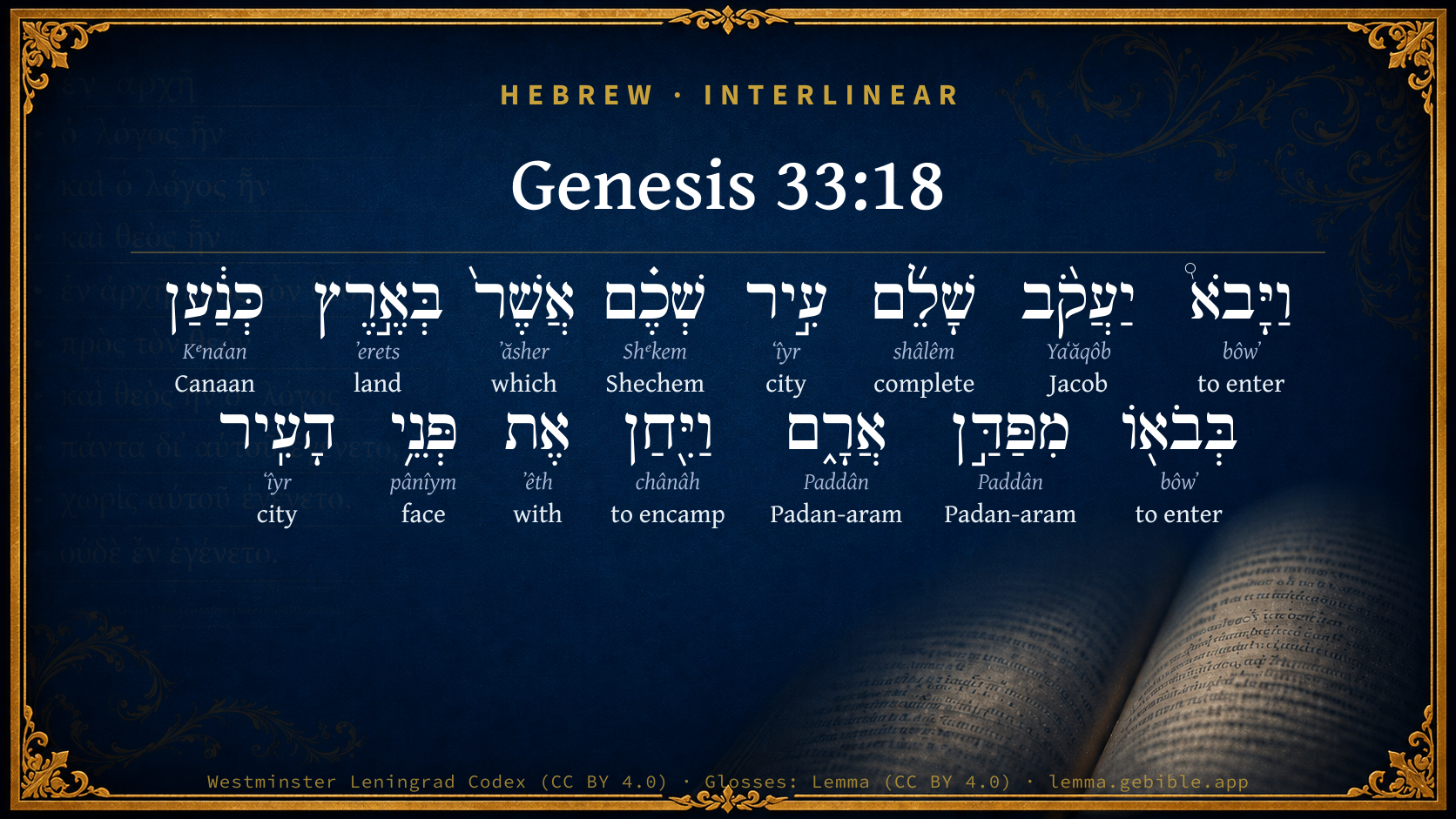
Hebrew (Westminster Leningrad Codex) Genesis 33:18 appears in the Hebrew Old Testament. The text above is from the Westminster Leningrad Codex. Each word links to its Strong’s number, a concise gloss, and parsing drawn from the Open Scriptures Hebrew Bible morphology. Click any word for its full Brown-Driver-Briggs (BDB) entry.
Download image
Cite this verse

Genesis 33:18 (World English Bible). Public Domain. Lemma interlinear Bible study tool, https://lemma.gebible.app/v/genesis/33/18.

Show BibTeX & RIS
BibTeX
RIS
English Translation
Jacob came in peace to the city of Shechem, which is in the land of Canaan, when he came from Paddan Aram; and encamped before the city.
World English Bible · Public Domain
Download a study sheet

One document with this verse’s original text, its word-by-word gloss line, the meaning frame, cross-references with their text, attributed commentary, and full source and license credits — printable, and it pastes into notes with its structure intact.

This verse Autodidact and up

Study sheet (.html) Plain text (.txt)

A passage Seminary Student

Up to 50 verses in one chapter. A passage sheet keeps up to 6 commentary sources and 12 cross-references per verse, in the order this page ranks them, and says so on the sheet whenever that leaves anything out. Ask for a single verse and you get the Autodidact verse sheet above.

Everything on this page stays free to read, with no account — the sheet is a download of what is already on screen, not access to it.

Want to remove ads? Support Godless Engineer
Compare translations 3

The same verse in 3 English versions, stacked beneath the original-language interlinear above. Click any original word for its lexicon entry.

Each is an independent rendering of the whole verse — the interlinear is not word-aligned to these translations.

Highlighted words mark where these versions differ — a whole-verse word diff, not a word-by-word alignment.

  • World English Bible Public Domain
    Jacob came in peace to the city of Shechem, which is in the land of Canaan, when he came from Paddan Aram; and encamped before the city.
  • King James Version Public Domain
    And Jacob came to Shalem, a city of Shechem, which is in the land of Canaan, when he came from Padanaram; and pitched his tent before the city.
  • unfoldingWord Literal Text CC BY-SA 4.0
    Then Jacob came peace the city of Shechem, which in the land of Canaan, when he came from Paddan Aram, and he camped before the city.

unfoldingWord Literal Text — © unfoldingWord, licensed CC BY-SA 4.0. Word-aligned USFM3 via Door43 (git.door43.org/unfoldingWord/en_ult).

Versions to compare (up to 4)

3 of 4 selected

Show all 18 translations

Every available English version of this verse, each an independent rendering of the whole verse.

  • World English Bible Public Domain
    Jacob came in peace to the city of Shechem, which is in the land of Canaan, when he came from Paddan Aram; and encamped before the city.
  • Berean Standard Bible Public Domain
    After Jacob had come from Paddan-aram, he arrived safely at the city of Shechem in the land of Canaan, and he camped just outside the city.
  • Majority Standard Bible Public Domain
    After Jacob had come from Paddan-aram, he arrived safely at the city of Shechem in the land of Canaan, and he camped just outside the city.
  • King James Version Public Domain
    And Jacob came to Shalem, a city of Shechem, which is in the land of Canaan, when he came from Padanaram; and pitched his tent before the city.
  • American Standard Version (1901) Public Domain
    And Jacob came in peace to the city of Shechem, which is in the land of Canaan, when he came from Paddan-aram; and encamped before the city.
  • Revised Version (1885) Public Domain
    And Jacob came in peace to the city of Shechem, which is in the land of Canaan, when he came from Paddan-aram; and encamped before the city.
  • Geneva Bible (1599) Public Domain
    Afterward, Iaakob came safe to Sheche a citie, which is in the lande of Canaan, when he came from Padan Aram, and pitched before the citie.
  • Douay-Rheims (1899) Public Domain
    And he passed over to Salem, a city of the Sichemites, which is in the land of Chanaan, after he returned from Mesopotamia of Syria: and he dwelt by the town:
  • Young's Literal Translation Public Domain
    And Jacob cometh in to Shalem, a city of Shechem, which `is' in the land of Canaan, in his coming from Padan-Aram, and encampeth before the city,
  • Literal Standard Version CC BY-SA 4.0
    And Jacob comes safe [to the] city of Shechem, which [is] in the land of Canaan, in his coming from Padan-Aram, and encamps before the city,
  • Unlocked Literal Bible CC BY-SA 4.0
    When Jacob came from Paddan Aram, he arrived safely at the city of Shechem, which is in the land of Canaan. He camped near the city.
  • unfoldingWord Literal Text CC BY-SA 4.0
    Then Jacob came peace the city of Shechem, which in the land of Canaan, when he came from Paddan Aram, and he camped before the city.
  • Darby Bible Public Domain
    And Jacob came safely [to the] city Shechem, which is in the land of Canaan, when he came from Padan-Aram; and he encamped before the city.
  • World Messianic Bible Public Domain
    Jacob came in peace to the city of Shechem, which is in the land of Canaan, when he came from Paddan Aram; and encamped before the city.
  • Webster's Bible Public Domain
    And Jacob came to Shalem, a city of Shechem, which is in the land of Canaan, when he came from Padan-aram; and pitched his tent before the city.
  • Free Bible Version CC BY-SA 4.0
    Later Jacob continued his journey from Paddan-aram. He arrived safely at Shechem in the country of Canaan where he camped outside the town.
  • Bible in Basic English Public Domain
    So Jacob came safely from Paddan-aram to the town of Shechem in the land of Canaan, and put up his tents near the town.
  • JPS Tanakh (1917) Public Domain
    And Jacob came in peace to the city of Shechem, which is in the land of Canaan, when he came from Paddan-aram; and encamped before the city.

Literal Standard Version (2020), Covenant Press — licensed CC BY-SA 4.0. Text via the HelloAO Bible API (eBible.org). Unlocked Literal Bible (unfoldingWord) — licensed CC BY-SA 4.0. Text via the HelloAO Bible API (eBible.org). unfoldingWord Literal Text — © unfoldingWord, licensed CC BY-SA 4.0. Word-aligned USFM3 via Door43 (git.door43.org/unfoldingWord/en_ult). Free Bible Version, Dr. Jonathan Gallagher — licensed CC BY-SA 4.0. Text via the HelloAO Bible API (eBible.org).

Word by word

More ways to search: Search by grammar → Find every occurrence → Compare this word →

Practice this passage: Drill this verse → Learn its vocabulary →

מִפַּדַּ֣ן
Paddân
H6307
“from · Padan-aram”
Preposition + Noun, Proper
Part of Speech
Preposition + Noun
Type
Proper
Full BDB Definition

Origin: from an unused root meaning to extend

TWOT: 1735

Padan or Padan-aram = "field" - a plain or tableland in northern Mesopotamia in Aram, a region of Syria
  1. וַיָּבֹא֩ bôwʼ H935 “and · to enter” Conjunction + Verb, Qal, Sequential Imperfect, 3rd Person, Masculine, Singular
  2. יַעֲקֹ֨ב Yaʻăqôb H3290 “Jacob” Noun, Proper
  3. שָׁלֵ֜ם shâlêm H8003 “complete” Adjective, Adjective, Masculine, Singular, Absolute
  4. עִ֣יר ʻîyr H5892 “city of” Noun, Common, Feminine, Singular, Construct
  5. שְׁכֶ֗ם Shᵉkem H7927 “Shechem” Noun, Proper
  6. אֲשֶׁר֙ ʼăsher H834 “which” Particle, Relative
  7. בְּאֶ֣רֶץ ʼerets H776 “in/at · land of” Preposition + Noun, Common, Both, Singular, Construct
  8. כְּנַ֔עַן Kᵉnaʻan H3667 “Canaan” Noun, Proper
  9. בְּבֹא֖וֹ bôwʼ H935 “in/at · to enter · him” Preposition + Verb, Qal, Infinitive Construct + Suffix, Personal, 3rd Person, Masculine, Singular
  10. אֲרָ֑ם Paddân H6307 “Padan-aram” Noun, Proper
  11. וַיִּ֖חַן chânâh H2583 “and · to encamp” Conjunction + Verb, Qal, Sequential Imperfect, 3rd Person, Masculine, Singular
  12. אֶת ʼêth H854 “with” Preposition
  13. פְּנֵ֥י pânîym H6440 “face(s) of” Noun, Common, Both, Plural, Construct
  14. הָעִֽיר ʻîyr H5892 “the · city” Particle, Definite Article + Noun, Common, Feminine, Singular, Absolute

About this verse

These counts appear in no published source. They are computed here, from the morphology-tagged text and Lemma’s own curated glosses. What Lemma adds →

15
words
12
distinct lemmas
Pentateuch
section

Notable vocabulary

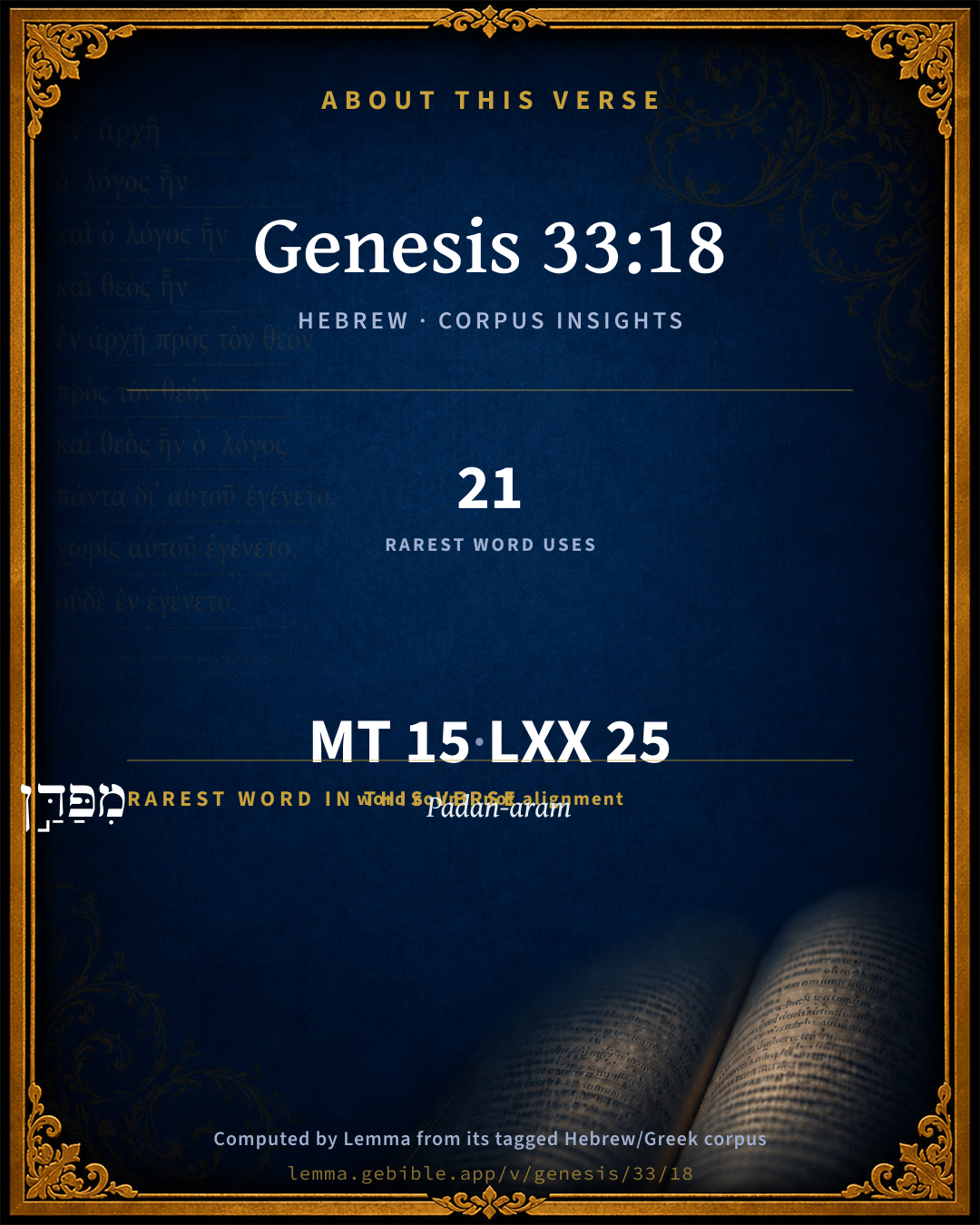
The rarest word here is מִפַּדַּ֣ן Padan-aram H6307 — appearing just 21 times in the whole Hebrew Bible.

Shared distinctive vocabulary

מִפַּדַּ֣ן Padan-aram H6307 occurs in 11 verses of the Hebrew Bible. Also found in:

Grammatical profile

  • 3 verbs
  • 9 nouns
  • 1 adjective
  • 1 preposition
  • 1 particle

Verb forms

  • וַיָּבֹא֩ Qal · Sequential Imperfect
  • בְּבֹא֖וֹ Qal · Infinitive Construct
  • וַיִּ֖חַן Qal · Sequential Imperfect

Repetition

Words recur within this verse — often emphatic in Hebrew:

  • וַיָּבֹא֩ to enter H935 ×2
  • עִ֣יר city H5892 ×2
  • מִפַּדַּ֣ן Padan-aram H6307 ×2

Hebrew & Septuagint length

In English translation the verse runs 27 words from the Hebrew and 34 from the Septuagint (LXX English) — closely comparable.

A rough comparison of the two English renderings, which tokenize alike — not a word-level alignment.

Word counts can differ between the Hebrew and the Greek without any difference in meaning — e.g. the Hebrew direct-object marker אֵת has no separate Greek word, and Greek often adds the article ὁ.

In the original languages it is 15 Hebrew tokens and 25 Greek tokens — but the two are counted differently (Hebrew bundles its prefixes and suffixes into one token; the Greek is in lemma form), so that isn’t a like-for-like length.

Cross-references

10

Topical passages linked to Genesis 33:18 in the Treasury of Scripture Knowledge — connected by theme and wording, ordered by reader-vote popularity; previews shown in the World English Bible.

  • Joshua 24:1 Joshua gathered all the tribes of Israel to Shechem, and called for the elders of Israel, and for their heads, and for their judges, and for their officers; and they presented themselves before God.
  • Judges 9:1 Abimelech the son of Jerubbaal went to Shechem to his mother's brothers, and spoke with them, and with all the family of the house of his mother's father, saying,
  • Acts 7:16 and they were brought back to Shechem, and laid in the tomb that Abraham bought for a price in silver from the children of Hamor of Shechem.
  • Genesis 25:20 Isaac was forty years old when he took Rebekah, the daughter of Bethuel the Syrian of Paddan Aram, the sister of Laban the Syrian, to be his wife.
  • John 4:5 So he came to a city of Samaria, called Sychar, near the parcel of ground that Jacob gave to his son, Joseph.
  • Genesis 28:2 Arise, go to Paddan Aram, to the house of Bethuel your mother's father. Take a wife from there from the daughters of Laban, your mother's brother.
  • Genesis 28:6–7 Now Esau saw that Isaac had blessed Jacob and sent him away to Paddan Aram, to take him a wife from there, and that as he blessed him he gave him a charge, saying, "You shall not take a wife of the daughters of Canaan,"
  • Genesis 35:9 God appeared to Jacob again, when he came from Paddan Aram, and blessed him.
  • Genesis 46:15 These are the sons of Leah, whom she bore to Jacob in Paddan Aram, with his daughter Dinah. All the souls of his sons and his daughters were thirty-three.
  • John 3:23 John also was baptizing in Enon near Salim, because there was much water there. They came, and were baptized.

Cross-references courtesy of OpenBible.info (CC BY 4.0).

Hebrew and Greek witnesses Masoretic Hebrew ↔ Greek Septuagint

The same verse in the two great witnesses to the Old Testament, shown verse-for-verse.

These are two independent witnesses, not word-aligned to each other, and the Septuagint is shown in lemma (dictionary) form.

Hebrew Genesis 33:18 Masoretic · Westminster Leningrad Codex

וַיָּבֹא֩ יַעֲקֹ֨ב שָׁלֵ֜ם עִ֣יר שְׁכֶ֗ם אֲשֶׁר֙ בְּאֶ֣רֶץ כְּנַ֔עַן בְּבֹא֖וֹ מִפַּדַּ֣ן אֲרָ֑ם וַיִּ֖חַן אֶת פְּנֵ֥י הָעִֽיר

Jacob came in peace to the city of Shechem, which is in the land of Canaan, when he came from Paddan Aram; and encamped before the city.

World English Bible · Public Domain

Greek LXX Genesis 33:18 Septuagint · lemma form

καί ἔρχομαι ἰακώβ εἰς σαλημ πόλις σικιμος ὅς εἰμί ἐν γῆ χανααν ὅτε ἔρχομαι ἐκ ὁ μεσοποταμία συρία καί παρα ἐνβάλλω κατά πρόσωπον ὁ πόλις

And Jacob came to Salem, a city of Secima, which is in the land of Chanaan, when he departed out of Mesopotamia of Syria, and took up a position in front of the city.

LXX2012 (modern English Septuagint) · Public Domain

On this verse, The Cambridge Bible for Schools and Colleges discusses the Septuagint’s reading. Read the note in Commentary ↓

Hebrew: Westminster Leningrad Codex (CC BY 4.0). Greek: Septuagint (public domain); English from LXX2012 (modern English Septuagint) (Public Domain). How the Septuagint differs from the Hebrew →

Targum (Aramaic paraphrase)

2

The Targum is the ancient Jewish Aramaic paraphrase of the Hebrew Scriptures — an interpretive translation, not the Hebrew text itself. Onkelos (literal) and Pseudo-Jonathan (expansive) render the Torah, and Jonathan the Prophets. Coverage is partial: where no permissively-licensed English translation exists for a verse, only the Aramaic is shown. This is verse-level text, not a word-by-word alignment to the Hebrew.

  1. Targum Onkelos Torah (Genesis–Deuteronomy)
    וַאֲתָא יַעֲקֹב שְׁלִים קַרְתָּא דִּשְׁכֶם דִּי בְּאַרְעָא דִּכְנָעַן בְּמֵיתֵהּ מִפַּדַּן דַּאֲרָם וּשְׁרָא לָקֳבֵל (אַפֵּי) קַרְתָּא

    (no public-domain English translation for this verse)

    Targum Onkelos — Aramaic: “Onkelos Genesis” (public domain); “Onkelos Exodus” (public domain); “Onkelos Leviticus” (public domain); “Onkelos Numbers” (public domain); “Onkelos Deuteronomy” (public domain). English: “Sefaria Community Translation” (CC0 1.0 (public-domain dedication)); “J.W. Etheridge. The Targums of Onkelos and Jonathan Ben Uzziel on the Pentateuch. London: Longmans, Green, 1862” (public domain). Text via Sefaria.

  2. Targum Pseudo-Jonathan Torah (Genesis–Deuteronomy)
    וְאָתָא יַעֲקב שָׁלֵם בְּכָל דִילֵיהּ לְקַרְתָּא דִשְׁכֶם דִי בְאַרְעָא דִכְנָעַן בְּמֵיתֵיהּ מִפַּדַן אֲרָם וּשְׁרָא לְקָבֵיל קַרְתָּא

    Then came Jakob in peace with all that he had to the city of Shekem, in the land of Kenaan, in his Coming from Padan Aram; and he dwelt near the city,

    Targum Pseudo-Jonathan — Aramaic: “Targum Jonathan on Genesis” (public domain); “Targum Jonathan on Exodus” (public domain); “Targum Jonathan on Leviticus” (public domain); “Targum Jonathan on Numbers” (public domain); “Targum Jonathan on Deuteronomy” (public domain). English: “The Targum of Jonathan ben Uzziel, trans. J. W. Etheridge, London, 1862” (public domain). Text via Sefaria.

Commentary

Notes on Genesis 33:18 from classic Christian and Jewish commentators (each source and its license shown beneath its notes). The classic Christian expositions comment on the surrounding passage and are grouped to its opening verse, so a note may address several verses; the Jewish commentaries on the Tanakh (Rashi and others) are per-verse, so they appear only where the commentator wrote on this verse.

Lemma curates 59 commentaries, every one of them public domain or Creative Commons licensed, each selected and text-cleaned for this edition rather than reprinted as found. About our sources →

Trapp's Complete Commentary

John Trapp

Gen 33:18 And Jacob came to Shalem, a city of Shechem, which [is] in the land of Canaan, when he came from Padanaram; and pitched his tent before the city.

Ver. 18. Came to Shalem.] Or, Came safe and sound to Shechem, as the Chaldee interprets it.

John Trapp, A Commentary or Exposition upon All the Books of the Old and New Testament (1647–1656) — public domain. Text from a community e-Sword module.

The Biblical Illustrator

Joseph S. Exell

Gen_33:18

And Jacob came to Shalem, a city of Shechem,. . . and pitched his tent before the city

Jacobs mistake

God had not said, Go to Shechem; but, I am the God of Bethel.

Bethel, rather than Shechem, was his appointed goal. But alas! we are all too ready to fall short of Gods schemes for our elevation and blessedness. And so Jacob came to Shalem, a city of Shechem. But he did worse; he pitched his tent before the city--as Lot did, when he pitched his tent before Sodom. What took him there? Was it that Rachel persuaded him that a little society would be a pleasant relief to the monotony and seclusion of the camp life? Was it that his children urged him to it against his better mind? Was it some idea of obtaining eligible alliances for his children among the children of the land? Whatever may have been his reason, there stands the sad and solemn fact that Jacob pitched his tent before the city. Are not many Christians doing so still? They live on the edge of the world, just on the borderland; far enough away to justify a religious profession, yet near enough to run into it for sweets. They send their children to fashionable schools, that they may acquire the false veneer of the world, and past muster in its drawing rooms. They remove into the fashionable quarters of a town; and adopt a certain style; and throw themselves into the swim of all manner of worldly engagements--that they may get in with society. They choose their church, their pastimes, their friendships, on the sole principle of doing as others do; and of forming good alliances for their children. What is all this but pitching their tents towards Shechem? But what are we to do? say they; our children must have society; they cannot be recluses, or be for ever shut up in our homes. But why need we cater for them by rushing into the world? Are there not plenty of innocent pastimes, on which worldliness has never breathed its withering breath? Are there not enough elements in the bright social intercourse of the family circle; in the play of imagination and wholesome merriment; in games of skill; in the charms of books; in the recital of travel and adventure; in the witchery of wholesome songs and music; and even in the revelations of modern popular science--to beguile the hours of long winter evenings, without calling in the aid of worldly society, whose brightest hours leave a sense of vacuity and thirst, to say nothing of a positive sting? The most earnest religion does not debar us from manly sports: the swift movement of the skater over the frozen lake; the evening row; the exhilarating climb: or from the culture of the faculties of art; and music; and imagination; of science and poesy. Surely, in all these there is enough to brighten Christian homes, without grieving the Holy Spirit, or lowering their tone. But if parents and guardians will insist on something more exciting and stimulating than these, they must reckon on being called upon to pay the price. They may have the dice-box, the theatre, the dance, if they will; but they must learn, by sad experience, the bitter cost. He needs a long spoon who sups with the devil. The fact is, it is much easier to give these things than to arouse oneself to provide something better. The something better needs time and thought; and staying at home from religious meetings, to give it effect: but the ultimate benefit will more than repay the self-denial. (F. B. Meyer, B. A.)

Shechem

I. RELIGIOUS REVIVAL.

II. FAMILY TRIALS. (T. S. Dickson.)

The Biblical Illustrator, edited by Joseph S. Exell (c. 1880s–1900s) — public domain. Text from a community e-Sword module.

Tyndale Open Study Notes

Tyndale Open Resources

33:18-20 These verses form an epilogue to Jacob’s adventures outside the land. He returned in peace with a large family and many possessions. • Jacob, like Abraham, built an altar at Shechem (see 12:6-8) and purchased land from the family of Hamor.

Tyndale Open Study Notes — © Tyndale Open Resources, licensed CC BY-SA 4.0. Text via the HelloAO Bible API.

Geneva Bible (1599)

Geneva Bible translators

Or, Mesopotamia.

Geneva Bible (1599) marginal notes — public domain. Text via Bolls.life.

Jamieson, Fausset & Brown

Robert Jamieson, A. R. Fausset & David Brown

Shalem--that is, "peace"; and the meaning may be that Jacob came into Canaan, arriving safe and sound at the city Shechem--a tribute to Him who had promised such a return (compare Gen 28:15). But most writers take Shalem as a proper name--a city of Shechem, and the site is marked by one of the little villages about two miles to the northeast. A little farther in the valley below Shechem "he bought a parcel of a field," thus being the first of the patriarchs who became a proprietor of land in Canaan.

Jamieson, Fausset & Brown — Commentary Critical and Explanatory on the Whole Bible (1871) — public domain (CC PDM 1.0). Text via the HelloAO Bible API.

Adam Clarke's Commentary

Verse 18. And Jacob came to Shalem, a city of Shechem] The word שלם shalem, in the Samaritan שלום shalom, should be translated here in peace, or in safety. After resting some time at Succoth, which was necessary for the safety of his flocks and the comfort of his family, he got safely to a city of Shechem, in health of body, without any loss of his cattle or servants, his wives and children being also in safety. Coverdale and Matthews translate this word as above, and with them agree the Chaldee and the Arabic: it is not likely to have been the name of a city, as it is nowhere else to be found. Shechem is called in Ac 7:16, Sychem, and in Joh 4:5, Sychar; in the Arabic it is called Nablous, and to the present day Neapolis. It was near to Samaria; and the place where the wretched remains of the sect of the Samaritans were lately found, from whom Dr. Huntington received a perfect copy of the Samaritan Pentateuch.

Adam Clarke's Commentary on the Bible (1810–1826) — public domain. Text from a community e-Sword/MySword module.

Ellicott's Commentary for English Readers

(18) Jacob came to Shalem, a city of Shechem.—The Sam. Pent. has shalom,”safe”; but shalem is right, and means whole, sound. Onkelos, however, followed by most modern commentators, renders it in peace, but this too would not mean peaceably, but that his troubles were now at an end, and his lameness cured. Philippsohn’s rendering, however, is more exact, namely, wohlbehalten, in good condition. Rashi also, no mean authority, sees in it an allusion to the cure of Jacob’s lameness. As Shechem was a man, his city would not be Shalem, but that called after his own name. In Gen_12:6 it is called “Sichern,” where see Note. Sichern was probably the old name, but after the cruel fate brought upon it by Shechem’s misconduct the spelling was modified to suit the history.

In the land of Canaan.—Jacob therefore had now crossed the river Jordan, and so far completed his homeward journey. Probably as soon as he had recovered from his lameness he visited his father, but as his possessions were large, and Esau was the chief at Hebron, there was no room at present for him to dwell there, nor in fact was this possible until Isaac’s death. But as we find Deborah with them soon afterwards, it is plain that he had gone to visit Isaac, and, finding his mother dead, had brought away with him her beloved nurse.

A Bible Commentary for English Readers, edited by Charles John Ellicott (1878–1897) — public domain. Text from a community e-Sword module.

The Cambridge Bible for Schools and Colleges

gen. ed. J. J. S. Perowne

18–20. Jacob at Shechem

18. in peace] R.V. marg. to Shalem, a city of. The rendering in the margin is possible. It is supported by LXX and Vulg. There is a village, Salim, still to be found near Shechem. On the other hand, the context speaks of Jacob “before the city” of Shechem; and the fact of his arrival there “in peace” is not without significance in view of the events narrated in ch. 34.

Canaan … Paddan-aram] The transition in this verse is abrupt. Jacob is suddenly transferred from the east to the west side of the Jordan. The clause, “when he came from Paddan-aram,” seems to ignore the previous chapters, and is clearly taken from a different source, viz. P.

before the city] “In front of it,” lit. “in the presence of the city” of Shechem. It is the preposition rendered “before” in Gen_19:13.

The Cambridge Bible for Schools and Colleges (gen. ed. J. J. S. Perowne; Cambridge University Press, 1878–1918) — public domain. Text from a community e-Sword module.

John Gill's Exposition

And he bought a parcel of a field,.... Not the whole, but a part of it; this he did, though he was heir of the whole country, because, as yet, the time was not come for him or his to take possession of it:

where he had spread his tent; the ground that it stood upon, and what was adjoining to it, for the use of his cattle: this he bought

at the hand of the children of Hamor; of some one of them, in whose possession it was, and perhaps with the consent of the rest, and before them, as witnesses:

for an hundred pieces of money; Onkelos, the Septuagint, Vulgate Latin, Samaritan, Syriac, and Arabic versions render it a hundred lambs or sheep, cattle being used to be given in exchange for things in trade and commerce; but as money was in use before the times of Jacob, and Stephen expresses it as a "sum of money", Act 7:16; and this best agrees with the use of the word in Job 42:11, the only place besides this, excepting Jos 24:32, in which it is used, it seems best so to interpret it here; and the pieces of money might be such as were of the value of a lamb or sheep, or rather had the figure of one impressed upon them. Laban, from whom Jacob might have them, or his neighbours, and also Jacob himself, being shepherds, might choose thus to impress their money; but the exact value of these pieces cannot be ascertained: the Jewish writers generally interpret them of a "meah", which was the value of one penny of our money, and twenty of them went to a shekel; so that a hundred of these must make a very small and contemptible sum to purchase a piece of ground with.

John Gill's Exposition of the Whole Bible (1746–1763) — public domain (CC PDM 1.0). Text via the HelloAO Bible API.

Haydock's Catholic Bible Commentary

The town of Salem, which was the first town of Chanaan that he came near after his return. It was afterwards called Sichem, and Sichar, John iv. 5, and Naplosa. Salim, mentioned John iii. 23, was probably more to the east. Some translate, "He came quite sound to the city of Sichem;" where, Demetrius says, he dwelt ten years, Eusebius, præp. ix. 21, having stopped at Socoth six months. (Calmet) --- This seems very probable, as Dina met with her misfortune a little before he left the country; and as she was six years old when she came from Haran, she would be about 15 when she began to go a visiting, &c., chap. xxxiv. 1. (Haydock)

George Leo Haydock (1774–1849), Haydock's Catholic Family Bible and Commentary, 1859 edition — public domain. Excludes Psalms (Douay-Rheims chapter numbering differs from Protestant) and Deuterocanonical books (Catholic canon only).

Matthew Poole's English Annotations

Shalem; most take it for the proper name of a place belonging to

Shechem, as it here follows, called Salim, Joh 3:23, and Sichem or Sychar, Joh 4:5. But others take it for an appellative noun, and render the place thus, he came safe or whole to the city of Shechem; to note either that he was then cured of the lameness which the angel gave him; or rather, to note the good providence of God that had brought him safe in his person, family, and estate through all his dangers, first from Laban, then from Esau, till he came to this place, where it seems he intended to make his abode for a good while, had not the following miscarriages obliged him to remove.

Before the city, i.e. near to it, but not in it, for the conveniency of his cattle.

Matthew Poole's English Annotations on the Holy Bible (1683–1685) — public domain. Text from a community e-Sword/MySword module.

Whedon's Commentary on the Bible

Daniel D. Whedon

18. Came to Shalem, a city of Shechem — So the Sept., Vulg., and Syr. But it is better to render Shalem adverbially, in peace. Jacob came in peace to a city of Shechem, which is in the land of Canaan. It was doubtless at or near “the place of Sichem,” mentioned Gen_12:6, and the city had probably been built here since the time of Abraham’s first arrival. The city may have taken its name from the shoulder of land on which it was built, (Gen_12:6, note,) or from Shechem, the son of Hamor, or, possibly, from one of his ancestors of the same name.

Daniel D. Whedon (gen. ed.), Commentary on the Old and New Testaments (1874–1909) — public domain. Text from a community e-Sword module.

The Pulpit Commentary

And Jacob (leaving Succoth) came to Shalem the word rendered by some expositors as here (LXX, Vulgate, Syriac, Luther, Calvin, Peele, Wordsworth), is better taken as an adverb signifying in peace or in safety (Onkelos, Saadias, Rashi, Dathius, Rosenm Gesenius, Keil, Kalisch, et alii), meaning that Jacob Was now sound in his limb (Jarehi) and safe in his person, being no more endangered by Esau (Gerundensis in Drusius), or that he had hitherto met with no misfortune, though soon to encounter one in the instance of Dinah (Patrick), or that the expectations of Jacob expressed in Gen_28:21 (to which there is an obvious allusion) were now fulfilled (Keil) a city of Shechem, if Shalem be the name of the town, then probably Shechem is the name of the person referred to in Gen_34:2; viz., the son of Hamor the Hivite (Drusius, Peele) but if Shalem mean incolumis, then the present clause must be rendered "to the city of Shechem," the city being already built and namedwhich is in the land of Canaan, Bush thinks that Jacob had originally contemplated entering Canaan from the south after rounding the Dead Sea, probably with a view to reach Beersheba, but that, after his interview with Esau, he suddenly altered his route, and entered Canaan directly by crossing the Jordan and driving up his flocks and herds to Shechem, the first halting-place of Abraham, (vide Gen_12:6) which may perhaps lend additional interest to, if they do not explain, the words that followwhen he came from Padan-aram (as Abraham previously had done); and (he) pitched his tent before the city because he did not wish to come in contact with the inhabitants (Lyre), or because his flocks and herds could not find accommodation within the city walls (Murphy), or perhaps simply for convenience of pasturage (Patrick).

The Pulpit Commentary (1880–1919), ed. H.D.M. Spence-Jones & Joseph S. Exell — public domain. Text from a community e-Sword module.

John Wesley's Explanatory Notes

And Jacob came to Shalem, a city of Shechem - Or rather he came safe, or in peace, to the city of Shechem. After a perilous journey, in which he had met with many difficulties, he came safe at last, into Canaan.

John Wesley, Explanatory Notes Upon the Whole Bible (1754–1765) — public domain. Text via the GEBible commentary corpus.

Keil & Delitzsch

C. F. Keil & F. Delitzsch

From Succoth, Jacob crossed a ford of the Jordan, and "came in safety to the city of Sichem in the land of Canaan." שׁלם is not a proper name meaning "to Shalem," as it is rendered by Luther (and Eng. Vers., Tr.) after the lxx, Vulg., etc.; but an adjective, safe, peaceful, equivalent to בּשׁלום, "in peace," in Gen 28:21, to which there is an evident allusion. What Jacob had asked for in his vow at Bethel, before his departure from Canaan, was now fulfilled. He had returned in safety "to the land of Canaan;" Succoth, therefore, did not belong to the land of Canaan, but must have been on the eastern side of the Jordan. שׁכם עיר, lit., city of Shechem; so called from Shechem the son of the Hivite prince Hamor

(Note: Mamortha, which according to Plin. (h. n. v. 14) was the earlier name of Neapolis (Nablus), appears to have been a corruption of Chamor.)

(Gen 33:19, Gen 34:2.), who founded it and called it by the name of his son, since it was not in existence in Abraham's time (vid., Gen 12:6). Jacob pitched his tent before the town, and then bought the piece of ground upon which he encamped from the sons of Hamor for 100 Kesita. קשׂיטה is not a piece of silver of the value of a lamb (according to the ancient versions), but a quantity of silver weighed out, of considerable, though not exactly determinable value: cf. Ges. thes. s. v. This purchase showed that Jacob, in reliance upon the promise of God, regarded Canaan as his own home and the home of his seed. This piece of field, which fell to the lot of the sons of Joseph, and where Joseph's bones were buried (Jos 24:32), was, according to tradition, the plain which stretches out at the south-eastern opening of the valley of Shechem, where Jacob's well is still pointed out (Joh 4:6), also Joseph's grave, a Mahometan wely (grave) two or three hundred paces to the north (Rob. Pal. iii. 95ff.). Jacob also erected an altar, as Abraham had previously done after his entrance into Canaan (Gen 12:7), and called it El-Elohe-Israel, "God (the mighty) is the God of Israel," to set forth in this name the spiritual acquisition of his previous life, and according to his vow (Gen 28:21) to give glory to the "God of Israel" (as he called Jehovah, with reference to the name given to him at Gen 32:29), for having proved Himself to be El, a mighty God, during his long absence, and that it might serve as a memorial for his descendants.

Keil & Delitzsch — Biblical Commentary on the Old Testament (1861–1891) — public domain (CC PDM 1.0). Text via the HelloAO Bible API. (Old Testament only.)

unfoldingWord translationNotes

Door43 World Missions Community

General Information:

This starts a new part of the story. The author describes what Jacob did after he rested in Succoth.

When Jacob came from Paddan Aram

"After Jacob left Paddan Aram"

When Jacob ... he arrived ... He camped

This only mentions Jacob because he is the leader of the family. It is implied that his family was with him. (See: Assumed Knowledge and Implicit Information)

He camped near

"He set up his camp near"

piece of ground

"piece of land"

Hamor

This is the name of a man. (See: How to Translate Names)

Shechem's father

Shechem is the name of a city and the name of a man.

a hundred

"100" (See: Numbers)

El Elohe Israel

Translators may add a footnote that says: "The name El Elohe Israel means 'God, the God of Israel.'" (See: How to Translate Names)

translationWords

Jacob

Paddan Aram

Shechem

Canaan

silver

altar

unfoldingWord translationNotes — © Distant Shores Media and the Door43 World Missions Community, licensed CC BY-SA 4.0. Source: git.door43.org/Door43/en_tn.

Rashi

Rabbi Shlomo Yitzchaki (Rashi)

שלם SAFELY (literally, whole, perfect, unimpaired) — unimpaired in body (health) because he was cured of his lameness; whole as regards his possessions for he was not short of anything even though he had given that gift (for his remaining cattle soon bore other young; cf. Rashi on Genesis 30:43); and perfect in his knowledge of the Torah for whilst he was in Laban’s house he had not forgotten what he had before learned (Shabbat 33b).

עיר שכם — the word עיר is equivalent to לעיר to the city of. Similarly we have (Ruth 1:19) “until they came בית לחם” — “to Bethlehem".

בבאו מפדן ארם WHEN HE CAME FROM PADAN-ARAM — This is stated here in the same way as a person says to his neighbour, “that man there has come from between the teeth of the lion and has returned unhurt”. Similarly here: he came whole from Padan-aram — from Laban and from Esau who had come to attack him on his journey.

Rashi on the Tanakh — English translations: “The Judaica Press complete Tanach with Rashi, translated by A. J. Rosenberg” (CC BY 4.0); “Pentateuch with Rashi's commentary by M. Rosenbaum and A.M. Silbermann, 1929-1934” (public domain); “The Metsudah Tanach series, Lakewood, N.J” (CC BY 4.0); and “The Book of Joshua, Metsudah Publications, 1997” (CC BY 4.0). Text via Sefaria.

Ramban (Nachmanides)

Rabbi Moshe ben Nachman (Ramban / Nachmanides)

AND JACOB CAME IN PEACE … FROM PADDAN-ARAM. [This is stated here in the same manner] as a person says to his friend, “That man there has come from between the teeth of the lions and has arrived unhurt.” Similarly here, And Jacob came in peace, i.e., from Laban and from Esau. This is the language of Rashi. But Rabbi Abraham ibn Ezra explained that the sense of the verse is that Jacob arrived in peace from his lengthy journey and nothing happened to him, as Scripture now begins to narrate the event of Dinah.In my opinion Scripture speaks thus since for the length of his sojourn in Succoth he was fearful of Esau. Succoth — if it be the one mentioned in the book of Joshua — was east of the Jordan, in the kingdom of Sihon, and if it be another city by that name, it was nearer to Se’ir. Thus until he entered the land of Canaan Jacob did not feel safe, for only then did he know that Esau would not touch him for his father was nearby, or because the people of the land would help him as his father was a prince of G-d in their midst, or because the merit of having entered the land would save him. And therefore, Scripture now said that he came in peace into the land of his father’s sojourning since G-d delivered him in his travels out of the hand of all his enemies. And the Rabbis have said in Bereshith Rabbah that during all these months that our father Jacob stayed in Succoth he honored Esau with that present enumerated above by Scripture for he was afraid of him there, and monthly or annually he would send him a comparable present.

AND HE ENCAMPED BEFORE THE CITY. He did not wish to be a transient lodger in the city, but rather he wished that his inaugural entrance into the land should be into his own property. Therefore he encamped in the field and bought a place for the purpose of taking possession of the land. This action constituted a hint that this place will be conquered by him first before the dwellers of the land would be driven from before his seed, just as I have explained in the case of Abraham. And our Rabbis have said: “He arrived on Friday close to sundown [and was therefore compelled to encamp before the city as there was no time left to enter the city], and he set Sabbath limits [while it was yet day.” The verse thus teaches us that Jacob observed the Sabbath before it was declared on Sinai]. Now according to this opinion of the Rabbis the act of Jacob encamping there first was unintentional. However, in any case, the event hinted to the future as we have said. Rabbi Abraham ibn Ezra however said that Scripture mentions this in order to inform us that there is great excellence to the Land of Israel, and he who owns a part thereof has it considered as a portion in the World to Come.

Ramban (Nachmanides) on the Tanakh — English translation: “Commentary on the Torah by Ramban (Nachmanides). Translated and annotated by Charles B. Chavel. New York, Shilo Pub. House, 1971-1976” (CC BY 4.0). Text via Sefaria.

Radak

Rabbi David Kimhi (Radak)

ויבא יעקב שלם, meaning that he had not incurred any damage or loss as a result of his encounter with Esau. He had not suffered any deterioration during his entire journey from Aram Naharayim. The matter is underlined to show that now that he had returned to the land of Canaan, his homeland, he suffered the indignity of his daughter Dinah being raped. Seeing that this happened at Shechem, the Torah mentions that town instead of telling us that he was 100% o.k. until he came to Sukkot and built himself a house. The Midrash understands the word שלם as a state of being, i.e. similar to when he had said יש לי כל,“I am blessed with everything,” in response to Esau having said יש לי רוב. “I have lots.”

את פני העיר; in front of the town. The expression is parallel to Proverbs 17,24 את פני מבין חכמה, “wisdom is in front of (available) any discerning person.” Perhaps the town was small so that there was not enough room to accommodate Yaakov whose entourage consisted of two camps. His presence inside the town might have cramped their quarters. He therefore erected his tent outside the borders of the town on the piece of land he had bought. According to our sages in Bereshit Rabbah 79,6 the words ויחן את פני העיר mean that seeing he arrived on Friday evening shortly before the onset of the Sabbath, he made an Eiruv Techumim, delineating the area he could walk within freely on the Sabbath. We would learn from here that Yaakov observed the Sabbath legislation down to Rabbinic decrees before such a legislation was given to his descendants at Mount Sinai.

Radak on the Tanakh — English translations: “Sefaria Community Translation” (CC0 1.0 (public-domain dedication)); “Eliyahu Munk, HaChut Hameshulash” (CC BY 4.0); “Rabbi Mike Feuer, Jerusalem Anthology” (CC BY 4.0); and “R. David Kimhi on the first book of Psalms, Translated by R.G. Finch, London, 1919” (public domain). Text via Sefaria.

Lesson kit

Teaching starters — assembled from the data on this page, not authored interpretation. Every prompt links to the verse data it draws on. Edit before teaching.

Genesis, in the Pentateuch, opens this verse with 15 words (12 distinct Hebrew lemmas). Its most distinctive word is Paddân (“Padan-aram”). A historical commentator’s framing appears above. Read the whole chapter for the surrounding context.

Discussion questions

  1. The word Paddân carries the sense “Padan-aram.” How does it shape the verse?
  2. How does Genesis 25:20, which shares the word «Padan-aram», read alongside this verse?
  3. What does the repetition of “to enter” (2× in this one verse) do in this verse?
  4. These translations render this verse differently; the difference is in the English rendering, not the original. What questions does that raise?
  5. «וַיָּבֹא֩» is a Qal Sequential Imperfect verb. How does that grammatical form shape the action described?
  6. Compare how Trapp's Complete Commentary and The Biblical Illustrator read this verse. Where do they agree or differ?

Things to notice

Reading settings

Reading text

Shown beneath each verse's original-language words.

Old Testament
Old Testament edition

Read the OT as the Masoretic Hebrew (MT) or the Greek Septuagint (LXX).

English shown for the Greek Septuagint (in the Hebrew ↔ Greek comparison).

Comparing translations? Open the Compare panel on any verse page to stack up to four side by side.