
1 Kings 10:2

Hebrew (Westminster Leningrad Codex) 1 Kings 10:2 appears in the Hebrew Old Testament. The text above is from the Westminster Leningrad Codex. Each word links to its Strong’s number, a concise gloss, and parsing drawn from the Open Scriptures Hebrew Bible morphology. Click any word for its full Brown-Driver-Briggs (BDB) entry.
Download image
Cite this verse

1 Kings 10:2 (World English Bible). Public Domain. Lemma interlinear Bible study tool, https://lemma.gebible.app/v/1-kings/10/2.

Show BibTeX & RIS
BibTeX
RIS
English Translation
She came to Jerusalem with a very great train, with camels that bore spices, and very much gold, and precious stones; and when she was come to Solomon, she talked with him of all that was in her heart.
World English Bible · Public Domain
Download a study sheet

One document with this verse’s original text, its word-by-word gloss line, the meaning frame, cross-references with their text, attributed commentary, and full source and license credits — printable, and it pastes into notes with its structure intact.

This verse Autodidact and up

Study sheet (.html) Plain text (.txt)

A passage Seminary Student

Up to 50 verses in one chapter. A passage sheet keeps up to 6 commentary sources and 12 cross-references per verse, in the order this page ranks them, and says so on the sheet whenever that leaves anything out. Ask for a single verse and you get the Autodidact verse sheet above.

Everything on this page stays free to read, with no account — the sheet is a download of what is already on screen, not access to it.

Want to remove ads? Support Godless Engineer
Compare translations 3

The same verse in 3 English versions, stacked beneath the original-language interlinear above. Click any original word for its lexicon entry.

Each is an independent rendering of the whole verse — the interlinear is not word-aligned to these translations.

Highlighted words mark where these versions differ — a whole-verse word diff, not a word-by-word alignment.

  • World English Bible Public Domain
    She came to Jerusalem with a very great train, with camels that bore spices, and very much gold, and precious stones; and when she was come to Solomon, she talked with him of all that was in her heart.
  • King James Version Public Domain
    And she came to Jerusalem with a very great train, with camels that bare spices, and very much gold, and precious stones: and when she was come to Solomon, she communed with him of all that was in her heart.
  • unfoldingWord Literal Text CC BY-SA 4.0
    And she came to Jerusalem with a very great entourage, camels carrying spices and very much gold and precious stone. And she came to Solomon and spoke to him all that was with her heart.

unfoldingWord Literal Text — © unfoldingWord, licensed CC BY-SA 4.0. Word-aligned USFM3 via Door43 (git.door43.org/unfoldingWord/en_ult).

Versions to compare (up to 4)

3 of 4 selected

Show all 18 translations

Every available English version of this verse, each an independent rendering of the whole verse.

  • World English Bible Public Domain
    She came to Jerusalem with a very great train, with camels that bore spices, and very much gold, and precious stones; and when she was come to Solomon, she talked with him of all that was in her heart.
  • Berean Standard Bible Public Domain
    She arrived in Jerusalem with a very large caravan—with camels bearing spices, gold in great abundance, and precious stones. So she came to Solomon and spoke to him all that was on her mind.
  • Majority Standard Bible Public Domain
    She arrived in Jerusalem with a very large caravan—with camels bearing spices, gold in great abundance, and precious stones. And she came to Solomon and spoke to him all that was on her mind.
  • King James Version Public Domain
    And she came to Jerusalem with a very great train, with camels that bare spices, and very much gold, and precious stones: and when she was come to Solomon, she communed with him of all that was in her heart.
  • American Standard Version (1901) Public Domain
    And she came to Jerusalem with a very great train, with camels that bare spices, and very much gold, and precious stones; and when she was come to Solomon, she communed with him of all that was in her heart.
  • Revised Version (1885) Public Domain
    And she came to Jerusalem with a very great train, with camels that bare spices, and very much gold, and precious stones: and when she was come to Solomon, she communed with him of all that was in her heart.
  • Geneva Bible (1599) Public Domain
    And she came to Ierusalem with a verie great traine, and camels that bare sweete odours, and golde exceeding much, and precious stones: and shee came to Salomon, and communed with him of all that was in her heart.
  • Douay-Rheims (1899) Public Domain
    And entering into Jerusalem with a great train, and riches, and camels that carried spices, and an immense quantity of gold, and precious stones, she came to king Solomon, and spoke to him all that she had in her heart.
  • Young's Literal Translation Public Domain
    and she cometh to Jerusalem, with a very great company, camels bearing spices, and very much gold, and precious stone, and she cometh unto Solomon, and speaketh unto him all that hath been with her heart.
  • Literal Standard Version CC BY-SA 4.0
    and she comes to Jerusalem, with a very great company, camels carrying spices, and very much gold, and precious stone, and she comes to Solomon, and speaks to him all that has been with her heart.
  • Unlocked Literal Bible CC BY-SA 4.0
    She came to Jerusalem with a very long caravan, with camels loaded with spices, much gold, and many precious gemstones. When she arrived, she told Solomon all that was in her heart.
  • unfoldingWord Literal Text CC BY-SA 4.0
    And she came to Jerusalem with a very great entourage, camels carrying spices and very much gold and precious stone. And she came to Solomon and spoke to him all that was with her heart.
  • Darby Bible Public Domain
    And she came to Jerusalem with a very great train, with camels that bore spices and gold in very great abundance, and precious stones; and she came to Solomon, and spoke to him of all that was in her heart.
  • World Messianic Bible Public Domain
    She came to Jerusalem with a very great caravan, with camels that bore spices, very much gold, and precious stones; and when she had come to Solomon, she talked with him about all that was in her heart.
  • Webster's Bible Public Domain
    And she came to Jerusalem with a very great train, with camels that bore spices, and very much gold, and precious stones: and when she had come to Solomon, she communed with him of all that was in her heart.
  • Free Bible Version CC BY-SA 4.0
    She brought with her a very large entourage, with camels loaded with spices, large amounts of gold, and precious gemstones. She came to Solomon and asked him about everything she had on her mind.
  • Bible in Basic English Public Domain
    And she came to Jerusalem with a very great train, with camels weighted down with spices, and stores of gold and jewels: and when she came to Solomon she had talk with him of everything in her mind.
  • JPS Tanakh (1917) Public Domain
    And she came to Jerusalem with a very great train, with camels that bore spices and gold very much, and precious stones; and when she was come to Solomon, she spoke with him of all that was in her heart.

Literal Standard Version (2020), Covenant Press — licensed CC BY-SA 4.0. Text via the HelloAO Bible API (eBible.org). Unlocked Literal Bible (unfoldingWord) — licensed CC BY-SA 4.0. Text via the HelloAO Bible API (eBible.org). unfoldingWord Literal Text — © unfoldingWord, licensed CC BY-SA 4.0. Word-aligned USFM3 via Door43 (git.door43.org/unfoldingWord/en_ult). Free Bible Version, Dr. Jonathan Gallagher — licensed CC BY-SA 4.0. Text via the HelloAO Bible API (eBible.org).

Word by word

More ways to search: Search by grammar → Find every occurrence → Compare this word →

Practice this passage: Drill this verse → Learn its vocabulary →

בְּשָׂמִ֧ים
besem
H1314
“spices”
Noun, Common, Masculine, Plural, Absolute
Part of Speech
Noun
Type
Common
Gender
Masculine
Number
Plural
State
Absolute
Full BDB Definition

Origin: from the same as H1313

TWOT: 290a

spice, balsam, balsam tree, perfume - (TWOT) sweet, sweet smell, sweet odour
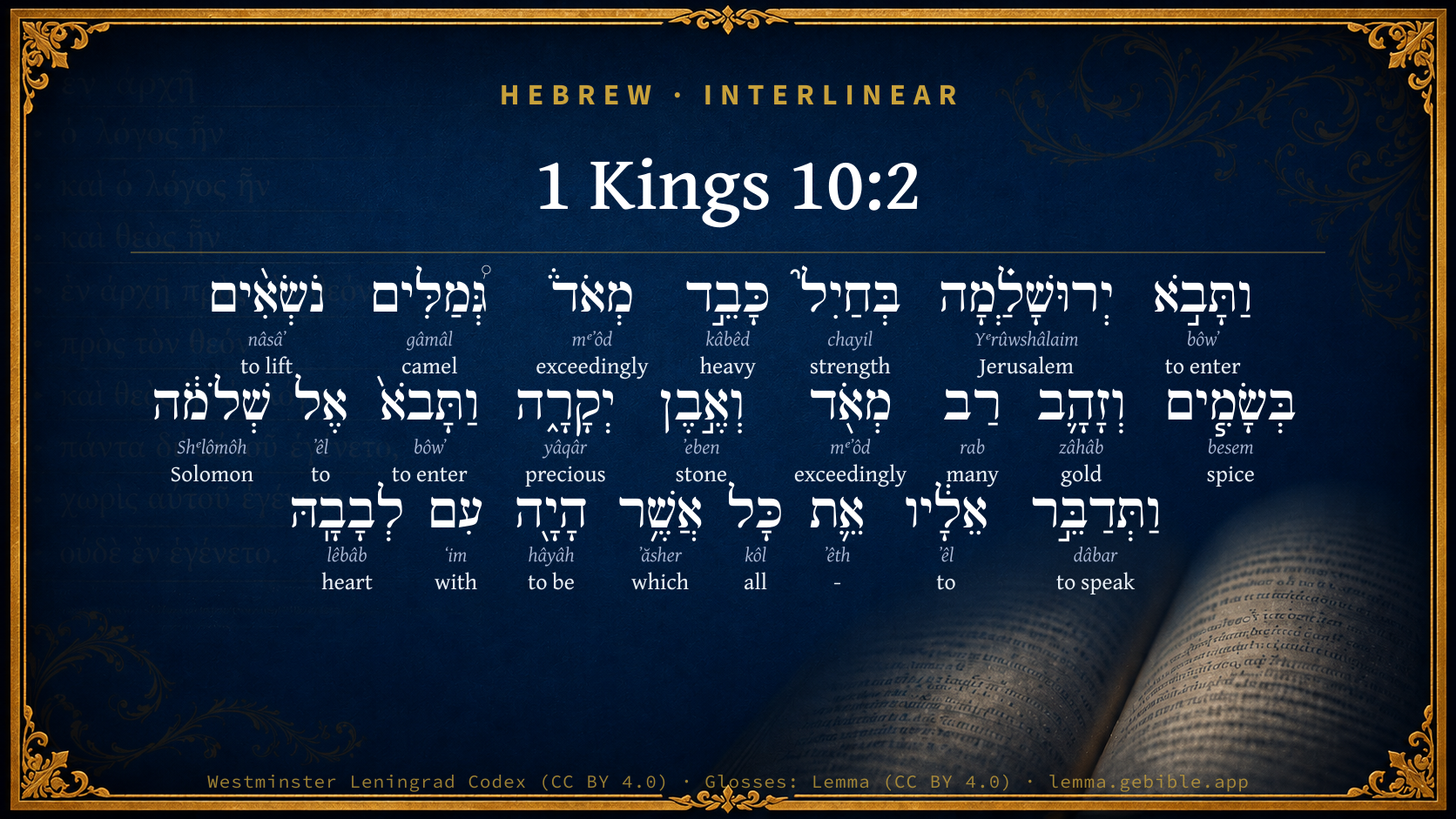
  1. וַתָּבֹ֣א bôwʼ H935 “and · to enter” Conjunction + Verb, Qal, Sequential Imperfect, 3rd Person, Feminine, Singular
  2. יְרוּשָׁלְַ֗מָה Yᵉrûwshâlaim H3389 “Jerusalem · toward” Noun, Proper + Suffix, Demonstrative
  3. בְּחַיִל֮ chayil H2428 “in/at · strength” Preposition + Noun, Common, Masculine, Singular, Absolute
  4. כָּבֵ֣ד kâbêd H3515 “heavy” Adjective, Adjective, Masculine, Singular, Absolute
  5. מְאֹד֒ mᵉʼôd H3966 “exceedingly” Adverb
  6. גְּ֠מַלִּים gâmâl H1581 “camels” Noun, Common, Masculine, Plural, Absolute
  7. נֹשְׂאִ֨ים nâsâʼ H5375 “lifting” Verb, Qal, Participle Active, Masculine, Plural, Absolute
  8. וְזָהָ֛ב zâhâb H2091 “and · gold” Conjunction + Noun, Common, Masculine, Singular, Absolute
  9. רַב rab H7227 “many” Adjective, Adjective, Masculine, Singular, Absolute
  10. מְאֹ֖ד mᵉʼôd H3966 “exceedingly” Adverb
  11. וְאֶ֣בֶן ʼeben H68 “and · stone” Conjunction + Noun, Common, Feminine, Singular, Absolute
  12. יְקָרָ֑ה yâqâr H3368 “precious” Adjective, Adjective, Feminine, Singular, Absolute
  13. וַתָּבֹא֙ bôwʼ H935 “and · to enter” Conjunction + Verb, Qal, Sequential Imperfect, 3rd Person, Feminine, Singular
  14. אֶל ʼêl H413 “to” Preposition
  15. שְׁלֹמֹ֔ה Shᵉlômôh H8010 “Solomon” Noun, Proper
  16. וַתְּדַבֵּ֣ר dâbar H1696 “and · to speak” Conjunction + Verb, Piel, Sequential Imperfect, 3rd Person, Feminine, Singular
  17. אֵלָ֔יו ʼêl H413 “to · him” Preposition + Suffix, Personal, 3rd Person, Masculine, Singular
  18. אֵ֛ת ʼêth H853 “-” Particle, Direct Object
  19. כָּל kôl H3605 “all of” Noun, Common, Masculine, Singular, Construct
  20. אֲשֶׁ֥ר ʼăsher H834 “which” Particle, Relative
  21. הָיָ֖ה hâyâh H1961 “to be” Verb, Qal, Perfect, 3rd Person, Masculine, Singular
  22. עִם ʻim H5973 “with” Preposition
  23. לְבָבָֽהּ lêbâb H3824 “heart · her” Noun, Common, Masculine, Singular, Construct + Suffix, Personal, 3rd Person, Feminine, Singular

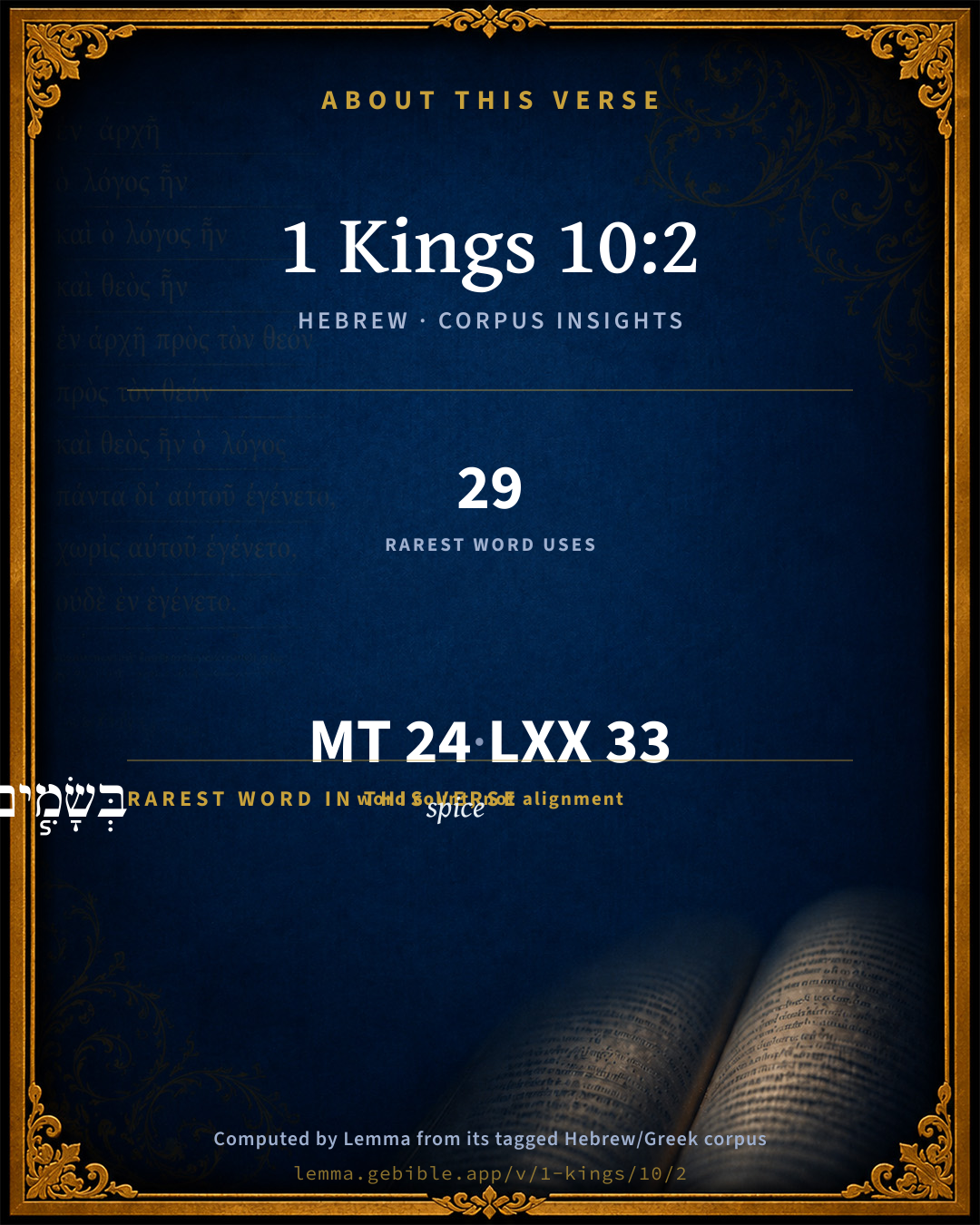
About this verse

These counts appear in no published source. They are computed here, from the morphology-tagged text and Lemma’s own curated glosses. What Lemma adds →

24
words
21
distinct lemmas
Historical
section

Shared distinctive vocabulary

בְּשָׂמִ֧ים spice H1314 occurs in 25 verses of the Hebrew Bible. Also found in:

Grammatical profile

  • 5 verbs
  • 9 nouns
  • 3 adjectives
  • 3 prepositions
  • 2 adverbs
  • 2 particles

Verb forms

  • וַתָּבֹ֣א Qal · Sequential Imperfect
  • נֹשְׂאִ֨ים Qal · Participle Active
  • וַתָּבֹא֙ Qal · Sequential Imperfect
  • וַתְּדַבֵּ֣ר Piel · Sequential Imperfect
  • הָיָ֖ה Qal · Perfect

Repetition

Words recur within this verse — often emphatic in Hebrew:

  • וַתָּבֹ֣א to enter H935 ×2
  • מְאֹד֒ exceedingly H3966 ×2
  • אֶל to H413 ×2

Hebrew & Septuagint length

In English translation the verse runs 39 words from the Hebrew and 38 from the Septuagint (LXX English) — closely comparable.

A rough comparison of the two English renderings, which tokenize alike — not a word-level alignment.

Word counts can differ between the Hebrew and the Greek without any difference in meaning — e.g. the Hebrew direct-object marker אֵת has no separate Greek word, and Greek often adds the article ὁ.

In the original languages it is 24 Hebrew tokens and 33 Greek tokens — but the two are counted differently (Hebrew bundles its prefixes and suffixes into one token; the Greek is in lemma form), so that isn’t a like-for-like length.

Cross-references

11

Topical passages linked to 1 Kings 10:2 in the Treasury of Scripture Knowledge — connected by theme and wording, ordered by reader-vote popularity; previews shown in the World English Bible.

  • Acts 25:23 So on the next day, when Agrippa and Bernice had come with great pomp, and they had entered into the place of hearing with the commanding officers and principal men of the city, at the command of Festus, Paul was brought in.
  • Genesis 18:33 Yahweh went his way, as soon as he had finished communing with Abraham, and Abraham returned to his place.
  • Exodus 25:6 oil for the light, spices for the anointing oil and for the sweet incense,
  • 1 Kings 10:10 She gave the king one hundred twenty talents of gold, and of spices very great store, and precious stones: there came no more such abundance of spices as these which the queen of Sheba gave to king Solomon.
  • 2 Kings 5:5 The king of Syria said, Go now, and I will send a letter to the king of Israel. He departed, and took with him ten talents of silver, and six thousand [pieces] of gold, and ten changes of clothing.
  • 2 Kings 5:9 So Naaman came with his horses and with his chariots, and stood at the door of the house of Elisha.
  • 2 Kings 20:13 Hezekiah listened to them, and shown them all the house of his precious things, the silver, and the gold, and the spices, and the precious oil, and the house of his armor, and all that was found in his treasures: there was nothing in his house, nor in all his dominion, that Hezekiah didn't show them.
  • Job 4:2 "If someone ventures to talk with you, will you be grieved? But who can withhold himself from speaking?
  • Psalms 4:4 Stand in awe, and don't sin. Search your own heart on your bed, and be still. Selah.
  • Isaiah 60:6–9 The multitude of camels shall cover you, the dromedaries of Midian and Ephah; all they from Sheba shall come; they shall bring gold and frankincense, and shall proclaim the praises of Yahweh.
  • Luke 24:15 It happened, while they talked and questioned together, that Jesus himself came near, and went with them.

Cross-references courtesy of OpenBible.info (CC BY 4.0).

Hebrew and Greek witnesses Masoretic Hebrew ↔ Greek Septuagint

The same verse in the two great witnesses to the Old Testament, shown verse-for-verse.

These are two independent witnesses, not word-aligned to each other, and the Septuagint is shown in lemma (dictionary) form.

Hebrew 1 Kings 10:2 Masoretic · Westminster Leningrad Codex

וַתָּבֹ֣א יְרוּשָׁלְַ֗מָה בְּחַיִל֮ כָּבֵ֣ד מְאֹד֒ גְּ֠מַלִּים נֹשְׂאִ֨ים בְּשָׂמִ֧ים וְזָהָ֛ב רַב מְאֹ֖ד וְאֶ֣בֶן יְקָרָ֑ה וַתָּבֹא֙ אֶל שְׁלֹמֹ֔ה וַתְּדַבֵּ֣ר אֵלָ֔יו אֵ֛ת כָּל אֲשֶׁ֥ר הָיָ֖ה עִם לְבָבָֽהּ

She came to Jerusalem with a very great train, with camels that bore spices, and very much gold, and precious stones; and when she was come to Solomon, she talked with him of all that was in her heart.

World English Bible · Public Domain

Greek LXX 1 Kings 10:2 Septuagint · lemma form

καί ἔρχομαι εἰς ἰερουσαλήμ ἐν δύναμις βαρύς σφόδρα καί κάμηλος αἴρω ἥδυσμα καί χρυσός πολύς σφόδρα καί λίθος τίμιος καί εἰςἔρχομαι πρός σαλωμών καί λαλέω αὐτός πᾶς ὅσος εἰμί ἐν ὁ καρδία αὐτός

And she came to Jerusalem with a very great train; and there came camels bearing spices, and very much gold, and precious stones: and she came in to Solomon, and told him all that was in her heart.

LXX2012 (modern English Septuagint) · Public Domain

On this verse, The Pulpit Commentary discusses the Septuagint’s reading. Read the note in Commentary ↓

Hebrew: Westminster Leningrad Codex (CC BY 4.0). Greek: Septuagint (public domain); English from LXX2012 (modern English Septuagint) (Public Domain). How the Septuagint differs from the Hebrew →

Targum (Aramaic paraphrase)

1

The Targum is the ancient Jewish Aramaic paraphrase of the Hebrew Scriptures — an interpretive translation, not the Hebrew text itself. Onkelos (literal) and Pseudo-Jonathan (expansive) render the Torah, and Jonathan the Prophets. Coverage is partial: where no permissively-licensed English translation exists for a verse, only the Aramaic is shown. This is verse-level text, not a word-by-word alignment to the Hebrew.

  1. Targum Jonathan Prophets (Joshua–Malachi)
    וַאֲתַת לִירוּשְׁלֵם בְּמַשִׁרְיַן סַגִיאִין לַחֲדָא גַמְלִין טְעוּנִין בּוּסְמָנִין וְדַהֲבָא סַגִי לַחֲדָא וְאַבְנִין טָבָן וַאֲתַת לְוַת שְׁלֹמֹה וּמַלִילַת עִמֵיהּ יַת כָּל דִי הֲוָה עִם לִבָּהּ:

    (no public-domain English translation for this verse)

    Targum Jonathan — Aramaic: “Mikraot Gedolot” (public domain). English: “Sefaria Community Translation” (CC0 1.0 (public-domain dedication)); “London "Chaldee Paraphrase," 1871” (public domain). Text via Sefaria.

Commentary

Notes on 1 Kings 10:2 from classic Christian and Jewish commentators (each source and its license shown beneath its notes). The classic Christian expositions comment on the surrounding passage and are grouped to its opening verse, so a note may address several verses; the Jewish commentaries on the Tanakh (Rashi and others) are per-verse, so they appear only where the commentator wrote on this verse.

Lemma curates 59 commentaries, every one of them public domain or Creative Commons licensed, each selected and text-cleaned for this edition rather than reprinted as found. About our sources →

Trapp's Complete Commentary

John Trapp

1Ki 10:2 And she came to Jerusalem with a very great train, with camels that bare spices, and very much gold, and precious stones: and when she was come to Solomon, she communed with him of all that was in her heart.

Ver. 2. That bare spices, and very much gold and precious stones.] These were the commodities of her country; with all which, together with the pleasures of her court, she freely parted, for the love of divine learning. Yea, she could have been content to change her throne for Solomon’s footstool. Josephus telleth us, that besides what is here mentioned, she gave Solomon the root of precious balsam, which the wicked queen of Egypt, Cleopatra, afterwards took away.

John Trapp, A Commentary or Exposition upon All the Books of the Old and New Testament (1647–1656) — public domain. Text from a community e-Sword module.

The Biblical Illustrator

Joseph S. Exell

1Ki_10:2

She came to Jerusalem with . . . camels that bare spices.

A gospel of sweet spices

1. All theologians agree in making Solomon a type of Christ, and in making the Queen of Sheba a type of every truth-seeker; and I will take the responsibility of saying that all the spikenard, and cassia, and frankincense which the Queen of Sheba brought to King Solomon is mightily suggestive of the sweet spices of our holy religion. Christianity is not a collection of sharp technicalities, and angular facts, and chronological tables, and.dry statistics. Our religion is compared to frankincense and to cassia, but never to nightshade. It is a bundle of myrrh. It is a dash of holy light. It is a sparkle of cool fountains. It is an opening of opaline gates. It is a collection of spices. Would God that we were as wise in taking spices to our Divine King as Queen Balkis was wise in taking the spices to the earthly Solomon.

2. We need to put more spice and enlivenment in our religious teaching; whether it be in the prayer-meeting, or in the Sunday school, or in the church. We ministers need more fresh air and sunshine in our lungs, and our heart, and our head. Do you wonder that the world is so far from being converted when you find so little vivacity in the pulpit.and in the pew? We want, like the Lord, to plant in our sermons and exhortations more lilies of the field. In other words, we want more cinnamon and less gristle. Let this be so in all the different departments of work to which the Lord tails us. Let us be plain. Let us be earnest. When we talk to the people in a vernacular they can understand, they will be very glad to come and receive the truth we present. Would to God that Queen Balkis would drive her spice-laden dromedaries into all our sermons and prayer-meeting exhortations.

3. More than that, we want more life and spice in our Christian work. The poor do not want so much to be groaned over as sung to. With the bread and medicines and garments you give them, let there be an accompaniment of smiles and brisk encouragement.

4. Religion is sweetness and perfume, and spikenard, and saffron, and cinnamon, and cassia, and frankincense, and all sweet spices together. Just put it on the stand beside the pillow of sickness. It catches in the curtains and perfumes the stifling air. It sweetens the cup of bitter medicine, and throws a glow on the gloom of the turned lattice. It is a balm for the aching side, and soft bandage for the temple stung with pain. It lifted Samuel Rutherford into a revelry of spiritual delight, while he was in physical agonies. It helped Richard Baxter until, in the midst of such a complication of diseases as perhaps no other man ever suffered, he wrote The Saints Everlasting Rest. And it poured light upon John Bunyans dungeon,--the light of the shining gate of the shining city. And it is good for rheumatism, and for neuralgia, and for low spirits, and for consumption; it is the catholicon for all disorders. Yes, it will heal all your sorrows. Some one could not understand why an old German Christian scholar used to be always so calm, and happy, and hopeful, when he had so many trials, and sicknesses, and ailments. A man secreted himself in the house. He said, I mean to watch this old scholar and Christian; and he saw the old Christian man go to his room and sit down on the chair beside the stand, and open the Bible and begin to read. He read on and on, chapter after chapter, hour after hour, until his face was all aglow with the tidings from Heaven, and when the clock struck twelve, he arose, and Shut his Bible, and said, Blessed Lord, we are on the same old terms yet. Good-night. Good-night. (T. De Witt Talmage, D. D.)

She communed with him of all that was in her heart.--

Heart-communing

I. We ought to commune with Jesus of all that is in our heart.

1. Tell Jesus all that is in your heart, for neglect of intercourse with Christ, of the most intimate kind, is ungenerous towards him.

2. And we must tell him all that is in our heart, because to conceal anything from so true a friend betrays the sad fact that there is something wrong to be concealed.

3. If we cannot tell Jesus all that is in our heart, it shows a want of confidence in His love, or His sympathy, or His wisdom, or His power.

4. I am quite certain that if you will carry out the plan I am commending to you, it will bring you great ease of mind; whereas, if you do not, you will continue to have much uneasiness.

5. If you do not come to Jesus and commune with Him of all that is in your heart, you will lose His counsel and help, and the comfort that comes from them.

6. Sometimes our habit of reticence towards Jesus is aggravated by our eagerness to tell our troubles to others. In the time of trial we often imitate King Asa, who, when he was sick, sought not to the Lord, but to the physicians.

II. We need not cease communing with Christ for want of topics.

1. There are, first, your sorrows.

2. Then, also, tell him your joys, for He can have aa much true fellowship with the joyous as with the sad.

3. You may also go to Jesus and tell Him all about your service.

4. Then, next, go and tell Jesus all your plans

5. When you have any successes, go and tell Him. The seventy disciples returned to Jesus with joy, saying, Lord, even the devils are subject unto us through Thy name.

6. And when you have any failures,--when your hopes are disappointed,--go and tell it all to Jesus.

7. Tell Him all your desires. If thou desirest anything that thou oughtest to desire, and mayest desire, let Him know it. Tell Him also all your fears. Tell Him that you are afraid of falling.

8. Tell Him all your loves.

III. We shall never cease communing with Christ for want of reasons.

1. For, first, it is most ennobling to have fellowship with the Son of God; and truly our fellowship is with the Father, and with His Son Jesus Christ.

2. It is also highly beneficial to commune with Christ.

3. How consoling it is to do this! You forget your griefs while you commune with Him. How sanctifying it is! A man cannot take delight in sin while he walks with Christ. How delightful it is, too, to commune with Jesus! There is no other joy that is at all comparable with it, and it prepares us for the higher joys above. (C. H. Spurgeon.)

The Biblical Illustrator, edited by Joseph S. Exell (c. 1880s–1900s) — public domain. Text from a community e-Sword module.

Joseph Benson's Commentary

1Ki 10:2-3. She communed with him of all that was in her heart — Of all the doubts and difficulties wherewith her mind was perplexed. She had liberty to propound whatsoever she desired to be resolved about. Solomon told her all her questions — Answered them to her satisfaction. There was not any thing — which he told her not — There was nothing concerning which she inquired, however difficult, which be did not reveal to her.

Joseph Benson's Commentary on the Old and New Testaments (1811–1818) — public domain. Text from a community e-Sword module.

Tyndale Open Study Notes

Tyndale Open Resources

10:2 The queen of Sheba arrived as royalty, with a large entourage and camels loaded with precious commodities. This was a high-level meeting, as demonstrated by Solomon’s generous gifts to her (10:13).

Tyndale Open Study Notes — © Tyndale Open Resources, licensed CC BY-SA 4.0. Text via the HelloAO Bible API.

Jamieson, Fausset & Brown

Robert Jamieson, A. R. Fausset & David Brown

she came to Jerusalem with a very great train, with camels--A long train of those beasts of burden forms the common way of travelling in Arabia; and the presents specified consist of the native produce of that country. Of course, a royal equipage would be larger and more imposing than an ordinary caravan.

Jamieson, Fausset & Brown — Commentary Critical and Explanatory on the Whole Bible (1871) — public domain (CC PDM 1.0). Text via the HelloAO Bible API.

Adam Clarke's Commentary

Verse 2. She came to Jerusalem with - spices, c.] Those who contend that she was queen of the Sabaeans, a people of Arabia Felix, towards the southern extremity of the Red Sea, find several proofs of their opinion:

1. That the Sabaeans abounded in riches and spices.

India mittit ebur, molles sua thura Sabaei

"India furnishes ivory, and the effeminate

Sabaeans their frankincense."

VIRG. Geor. i., ver. 57.

And again: -

Divisae arboribus patriae: sola India nigrum

Fert ebenum solis est thurea virga Sabaeis.

Geor. ii., ver. 116.

All sorts of trees their several countries know:

Black ebon only will in India grow;

And odorous frankincense on the Sabaean bough.

DRYDEN.

______ Ubi templum illi centumque Sabaeo

Thure calent arae.

Where to her fame a hundred altars rise,

And pour Sabaean odours to the skies.

PLINY (Hist. Nat. lib. xii., c. 17) observes,

Non alia ligni genera in usu sunt quam odorata; cibosque Sabaei coquunt thuris ligno; alii myrrhae.

"The Sabaeans use odorous wood only, and even use the incense tree and myrrh to cook their victuals."

2. All ancient authors speak, not only of their odoriferous woods, but of their rich gold and silver mines, and of their precious stones. See Pliny, Hist. Nat. lib. xxxvii., c. 6, &c.

3. It is also well known that the Sabaeans had queens for their sovereigns, and not kings. So Claudian, in Eutrop. lib. i.

_____ Medis levibusque Sabaeis

Imperat hic sexus, reginarumque sub armis

Barbariae pars magna jacet.

By this is meant, says Mr. Bruce, the country between the tropic and mountains of Abyssinia, the country of shepherds, from berber, a shepherd. And he contends that these Sabaeans were a distinct people from the Ethiopians and the Arabs, and that SABA was a distinct state.

Adam Clarke's Commentary on the Bible (1810–1826) — public domain. Text from a community e-Sword/MySword module.

Ellicott's Commentary for English Readers

(2) Spices.—The “spices” of Arabia were famous in all ages. Sheba is mentioned in Eze_27:22 as trafficking with Tyre “in chief of all spices, and precious stones, and gold.” The spices of “the incensebearing sands” of Arabia are constantly dwelt upon both in Greek and Roman literature. Frankincense especially was imported from Arabia into Palestine (see Isa_60:6; Jer_6:20), although now it comes chiefly from India. Myrrh also was in ancient times drawn chiefly from Arabia. Cassia is a product of Arabia and India. Of all spices, the frankincense for sacrifice and the myrrh for embalming the dead would be most in request.

Gold, and precious stones.—These may have been native products of Sheba, or have been brought from the farther East. Gold is not now known to exist in Arabia, nor any precious stones except the onyx and the emerald. But in ancient times it was commonly believed to produce both gold and precious stones largely.

A Bible Commentary for English Readers, edited by Charles John Ellicott (1878–1897) — public domain. Text from a community e-Sword module.

The Cambridge Bible for Schools and Colleges

gen. ed. J. J. S. Perowne

2. spices] For which Arabia has always been famous.

The Cambridge Bible for Schools and Colleges (gen. ed. J. J. S. Perowne; Cambridge University Press, 1878–1918) — public domain. Text from a community e-Sword module.

John Gill's Exposition

And she came to Jerusalem with a very great train,.... With many of her courtiers and principal men, as well as with a large retinue of servants:

with camels that bare spices; her country abounded both with camels and spices; See Gill on Isa 60:6; see Gill on Jer 6:20, and as Pliny (f) observes, who says their spices used to be carried on camels, particularly frankincense, for which Sheba was famous, and is therefore called by him "regio thurifera", the frankincense country (g), being to be had nowhere else; and Strabo (h) speaks of "cinamon, cassia", and other spices here in such plenty, that the inhabitants burnt the wood of them for fuel; and Diodorus Siculus (i) represents this country as exceeding odoriferous, and as having besides the above spices, balsam, myrrh, calamus, costus, and others, in such abundance that they heated their ovens with them:

and very much gold; see Kg1 10:10, the gold of Sheba is spoken of in Psa 72:15 and Pliny (k) observes, that the Sabeans are exceeding rich, as in other things, so in gold; and Diodorus Siculus (l) and Strabo (m) speak of gold found here in large lumps, very pure, and of a fine colour:

and precious stones; as crystals, emeralds, beryls, and chrysolites, mentioned by Diodorus (n) as in those parts; and a late traveller says (o), that Arabia Felix abounds with balsam, myrrh, cassia, manna, dates, gold, frankincense, and pearl:

and when she was come to Solomon; unto his palace, and admitted into his presence:

she communed with him of all that was in her heart; which she had in her mind to discourse with him about, and which she had laid up in her memory for that purpose; and some things which she had kept to herself, and had never imparted to any before, as some think; all which she had full liberty from Solomon to propound unto him.

(f) Nat. Hist. l. 12. c. 14. (g) Ibid. "----Molles sua thura Sabaei", Virg. Georg l. 1. v. 57. & l. 2. v. 117. Thurilegos Arabes, Ovid. Fast. l. 4. Vid. Plant. Trinum. Act. 4. Sc. 2. v. 89. (h) Geograph. l. 16. p. 535. (i) Bibliothec. l. 2. p. 132. (k) Nat. Hist. l. 6. c. 28. (l) Ut supra, (Bibliothec. l. 2.) p. 133. l. 3. p. 181. (m) Ut supra. (Geograph. l. 16. p. 535.) (n) Ut supra, (Bibliothec. l. 2.) p. 134. & l. 3. p. 181. (o) Ovington's Voyage to Surat, p. 421.

John Gill's Exposition of the Whole Bible (1746–1763) — public domain (CC PDM 1.0). Text via the HelloAO Bible API.

Albert Barnes' Notes on the Bible

See 1Ki 10:10 note.

Albert Barnes' Notes on the Bible (1834–1885) — public domain. Text from a community e-Sword/MySword module.

Matthew Poole's English Annotations

i.e. Of all the doubts and difficulties wherewith her mind was perplexed.

Matthew Poole's English Annotations on the Holy Bible (1683–1685) — public domain. Text from a community e-Sword/MySword module.

Whedon's Commentary on the Bible

Daniel D. Whedon

2. With a very great train — Such as corresponded with her position and power.

Spices… gold… precious stones — The products of her land.

Daniel D. Whedon (gen. ed.), Commentary on the Old and New Testaments (1874–1909) — public domain. Text from a community e-Sword module.

The Pulpit Commentary

And she came to Jerusalem a great undertaking in those days. Our Lord lays stress on this long journey, ejk twn peratwn thv ghv, Mat_12:42; Luk_11:31 with a very great train Heb. with a very heavy force or host (lyij). Thenius understands the words of an armed escort, which may well have been necessary considering the countries through which she passed, and the treasures she carried. It would also be quite in the spirit of the age that the queen should be escorted by a band of her soldiers. But it is not so certain that this idea was in the historian"s mind, with not in Hebrews camels 2Ch_9:1 has and camels." But the word is here explicative of the lyij preceding (Keil).

It does not, however, decide against an armed force, as camels would be in any ease required. The camel was a familiar object to the Jews (Exodus Lev_11:4; Deu_14:7, etc.) but such a procession as this would create great astonishment in Jerusalem, and we may imagine how the people would line the bazaars as she passed, and the acclamations with which they would greet the queen (cf. 1Ki_1:40; Mat_21:9) and her swart attendants that bare spices Heb. balsams; hence spices generally; LXX hJdusmata. Exo_25:6 Exo_35:28; Eze_27:22. The perfumes of Arabia are proverbial (see Heb 3:107-113), and Yemen is the chief spice country (Dict. Bib. 1. p. 91), and very much gold Psa_72:15. Gold is not now found in Arabia, nor are there any traces of gold mines; but Strabo and Diodorus both state that it was found there, and, according to the latter, in nuggets of considerable size (Dict. Bib. 1. p. 707). It is quite possible, however, that much of the "gold of Arabia" came to its emporiums from other lands. This particular present was doubtless brought by the queen because she had heard of the extensive use made of it by Solomon, and of the enormous quantities he required. "Strabo relates that the Sabeans were enormously wealthy, and used gold and silver in a most lavish manner in their furniture, their utensils, and even on the walls, doors, and roofs of their houses" (Rawlinson) and precious stones the onyx, emerald, and turquoise are still found in Arabia, and in former times the variety was apparently much greater (Plin., Nat. Hist. 37.); and when she was come to Solomon, she communed with him of Heb. spake to him all that was in her heart. The words are not to be restricted, as by Keil, to riddles. There may well have been, as the earlier interpreters supposed, religious discourse gravissimas et sacras quaestiones .

The Pulpit Commentary (1880–1919), ed. H.D.M. Spence-Jones & Joseph S. Exell — public domain. Text from a community e-Sword module.

John Wesley's Explanatory Notes

All her heart - Of all the doubts and difficulties wherewith her mind was perplexed.

John Wesley, Explanatory Notes Upon the Whole Bible (1754–1765) — public domain. Text via the GEBible commentary corpus.

Lesson kit

Teaching starters — assembled from the data on this page, not authored interpretation. Every prompt links to the verse data it draws on. Edit before teaching.

1 Kings, in the Historical, opens this verse with 24 words (21 distinct Hebrew lemmas). Its most distinctive word is besem (“spice”). A historical commentator’s framing appears above. Read the whole chapter for the surrounding context.

Discussion questions

  1. What does “spice” (besem) contribute to the verse as a whole?
  2. Exodus 25:6 shares the word «spice» with this verse. How do the two illuminate each other?
  3. “to enter” occurs 2× in this one verse. What is the effect of the repetition?
  4. These translations render this verse differently. What is at stake in choosing one wording over another?
  5. The verb «וַתָּבֹ֣א» is Qal Sequential Imperfect. How does its form color the action?
  6. Reading how Trapp's Complete Commentary and The Biblical Illustrator read this verse, where do the two commentators agree and where do they part?

Things to notice

Reading settings

Reading text

Shown beneath each verse's original-language words.

Old Testament
Old Testament edition

Read the OT as the Masoretic Hebrew (MT) or the Greek Septuagint (LXX).

English shown for the Greek Septuagint (in the Hebrew ↔ Greek comparison).

Comparing translations? Open the Compare panel on any verse page to stack up to four side by side.