
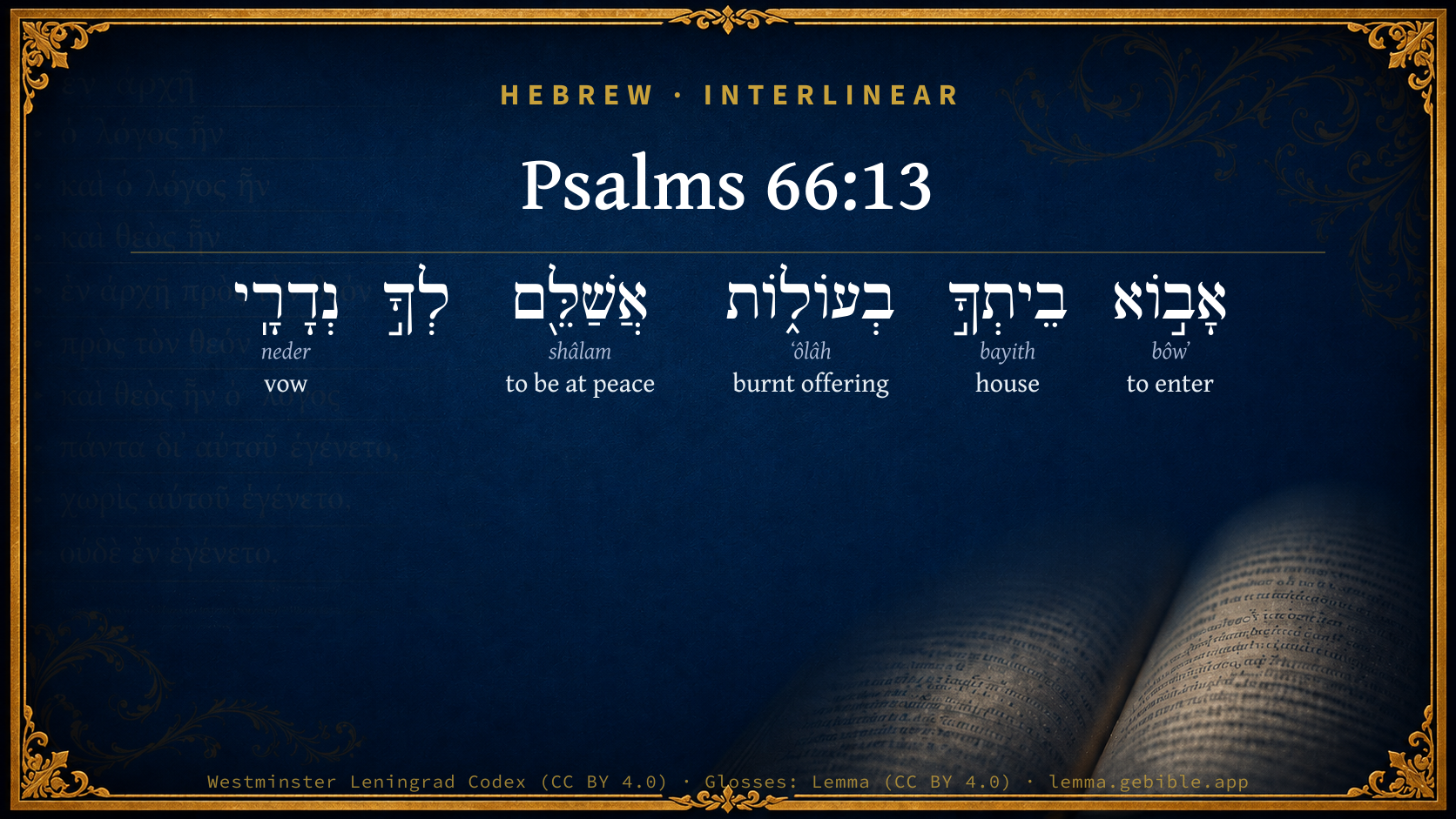
Psalms 66:13

Hebrew (Westminster Leningrad Codex) Psalms 66:13 appears in the Hebrew Old Testament. The text above is from the Westminster Leningrad Codex. Each word links to its Strong’s number, a concise gloss, and parsing drawn from the Open Scriptures Hebrew Bible morphology. Click any word for its full Brown-Driver-Briggs (BDB) entry.
Download image
Cite this verse

Psalms 66:13 (World English Bible). Public Domain. Lemma interlinear Bible study tool, https://lemma.gebible.app/v/psalms/66/13.

Show BibTeX & RIS
BibTeX
RIS
English Translation
I will come into your temple with burnt offerings. I will pay my vows to you,
World English Bible · Public Domain
Download a study sheet

One document with this verse’s original text, its word-by-word gloss line, the meaning frame, cross-references with their text, attributed commentary, and full source and license credits — printable, and it pastes into notes with its structure intact.

This verse Autodidact and up

Study sheet (.html) Plain text (.txt)

A passage Seminary Student

Up to 50 verses in one chapter. A passage sheet keeps up to 6 commentary sources and 12 cross-references per verse, in the order this page ranks them, and says so on the sheet whenever that leaves anything out. Ask for a single verse and you get the Autodidact verse sheet above.

Everything on this page stays free to read, with no account — the sheet is a download of what is already on screen, not access to it.

Want to remove ads? Support Godless Engineer
Compare translations 3

The same verse in 3 English versions, stacked beneath the original-language interlinear above. Click any original word for its lexicon entry.

Each is an independent rendering of the whole verse — the interlinear is not word-aligned to these translations.

Highlighted words mark where these versions differ — a whole-verse word diff, not a word-by-word alignment.

  • World English Bible Public Domain
    I will come into your temple with burnt offerings. I will pay my vows to you,
  • King James Version Public Domain
    I will go into thy house with burnt offerings: I will pay thee my vows,
  • unfoldingWord Literal Text CC BY-SA 4.0
    I will come your house with burnt offerings; I will pay my vows to you,

unfoldingWord Literal Text — © unfoldingWord, licensed CC BY-SA 4.0. Word-aligned USFM3 via Door43 (git.door43.org/unfoldingWord/en_ult).

Versions to compare (up to 4)

3 of 4 selected

Show all 18 translations

Every available English version of this verse, each an independent rendering of the whole verse.

  • World English Bible Public Domain
    I will come into your temple with burnt offerings. I will pay my vows to you,
  • Berean Standard Bible Public Domain
    I will enter Your house with burnt offerings; I will fulfill my vows to You—
  • Majority Standard Bible Public Domain
    I will enter Your house with burnt offerings; I will fulfill my vows to You—
  • King James Version Public Domain
    I will go into thy house with burnt offerings: I will pay thee my vows,
  • American Standard Version (1901) Public Domain
    I will come into thy house with burnt-offerings; I will pay thee my vows,
  • Revised Version (1885) Public Domain
    I will come into thy house with burnt offerings, I will pay thee my vows,
  • Geneva Bible (1599) Public Domain
    I will go into thine House with burnt offrings, and will pay thee my vowes,
  • Douay-Rheims (1899) Public Domain
    I will go into thy house with burnt offerings: I will pay thee my vows,
  • Young's Literal Translation Public Domain
    I enter Thy house with burnt-offerings, I complete to Thee my vows,
  • Literal Standard Version CC BY-SA 4.0
    I enter Your house with burnt-offerings, || I complete my vows to You,
  • Unlocked Literal Bible CC BY-SA 4.0
    I will come into your house with burnt offerings; I will pay you my vows
  • unfoldingWord Literal Text CC BY-SA 4.0
    I will come your house with burnt offerings; I will pay my vows to you,
  • Darby Bible Public Domain
    I will go into thy house with burnt-offerings; I will perform my vows to thee,
  • World Messianic Bible Public Domain
    I will come into your temple with burnt offerings. I will pay my vows to you,
  • Webster's Bible Public Domain
    I will go into thy house with burnt-offerings: I will pay thee my vows,
  • Free Bible Version CC BY-SA 4.0
    I will come to your Temple with burnt offerings; I will fulfill my promises to you,
  • Bible in Basic English Public Domain
    I will come into your house with burned offerings, I will make payment of my debt to you,
  • JPS Tanakh (1917) Public Domain
    I will come into Thy house with burnt-offerings, I will perform unto Thee my vows,

Literal Standard Version (2020), Covenant Press — licensed CC BY-SA 4.0. Text via the HelloAO Bible API (eBible.org). Unlocked Literal Bible (unfoldingWord) — licensed CC BY-SA 4.0. Text via the HelloAO Bible API (eBible.org). unfoldingWord Literal Text — © unfoldingWord, licensed CC BY-SA 4.0. Word-aligned USFM3 via Door43 (git.door43.org/unfoldingWord/en_ult). Free Bible Version, Dr. Jonathan Gallagher — licensed CC BY-SA 4.0. Text via the HelloAO Bible API (eBible.org).

Word by word

More ways to search: Search by grammar → Find every occurrence → Compare this word →

Practice this passage: Drill this verse → Learn its vocabulary →

About this verse

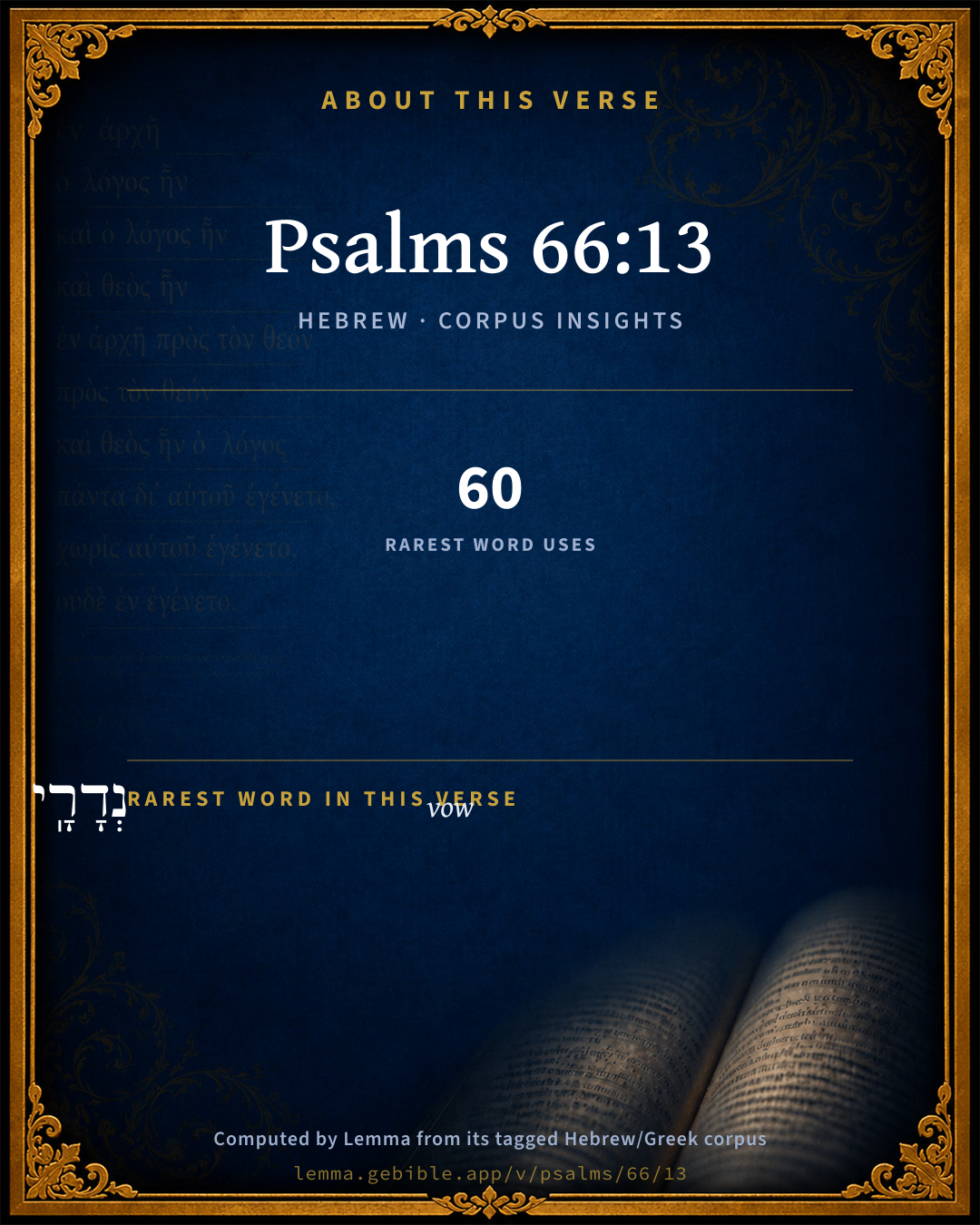
These counts appear in no published source. They are computed here, from the morphology-tagged text and Lemma’s own curated glosses. What Lemma adds →

6
words
5
distinct lemmas
Wisdom
section

Shared distinctive vocabulary

נְדָרָֽי vow H5088 occurs in 57 verses of the Hebrew Bible. Also found in:

Grammatical profile

  • 2 verbs
  • 3 nouns
  • 1 preposition

Verb forms

  • אָב֣וֹא Qal · Imperfect
  • אֲשַׁלֵּ֖ם Piel · Imperfect

Hebrew & Septuagint length

In English translation the verse runs 16 words from the Hebrew and 16 from the Septuagint (LXX English) — the same length.

A rough comparison of the two English renderings, which tokenize alike — not a word-level alignment.

Word counts can differ between the Hebrew and the Greek without any difference in meaning — e.g. the Hebrew direct-object marker אֵת has no separate Greek word, and Greek often adds the article ὁ.

Cross-references

13

Topical passages linked to Psalms 66:13 in the Treasury of Scripture Knowledge — connected by theme and wording, ordered by reader-vote popularity; previews shown in the World English Bible.

  • Psalms 100:4 Enter into his gates with thanksgiving, Into his courts with praise. Give thanks to him, and bless his name.
  • Ecclesiastes 5:4 When you vow a vow to God, don't defer to pay it; for he has no pleasure in fools. Pay that which you vow.
  • Psalms 56:12 Your vows are on me, God. I will give thank offerings to you.
  • Psalms 116:17–19 I will offer to you the sacrifice of thanksgiving, And will call on the name of Yahweh.
  • Psalms 116:14 I will pay my vows to Yahweh, Yes, in the presence of all his people.
  • Psalms 118:19 Open to me the gates of righteousness. I will enter into them. I will give thanks to Yah.
  • Hebrews 13:15 Through him, then, let us offer up a sacrifice of praise to God continually, that is, the fruit of lips which make confession to his name.
  • Jonah 2:9 But I will sacrifice to you with the voice of thanksgiving. I will pay that which I have vowed. Salvation belongs to Yahweh."
  • Nahum 1:15 Behold, on the mountains the feet of him who brings good news, who publishes peace! Keep your feasts, Judah! Perform your vows, for the wicked one will no more pass through you. He is utterly cut off.
  • Deuteronomy 12:11–12 then it shall happen that to the place which Yahweh your God shall choose, to cause his name to dwell there, there shall you bring all that I command you: your burnt offerings, and your sacrifices, your tithes, and the heave-offering of your hand, and all your choice vows which you vow to Yahweh.
  • Psalms 22:25 Of you comes my praise in the great assembly. I will pay my vows before those who fear him.
  • Psalms 118:27 Yahweh is God, and he has given us light. Bind the sacrifice with cords, even to the horns of the altar.
  • Psalms 51:18–19 Do well in your good pleasure to Zion. Build the walls of Jerusalem.

Cross-references courtesy of OpenBible.info (CC BY 4.0).

Hebrew and Greek witnesses Masoretic Hebrew ↔ Greek Septuagint

The same verse in the two great witnesses to the Old Testament, shown verse-for-verse.

You’re reading Greek Psalm 65 (Hebrew Psalm 66). The Septuagint counts the superscription, so verse numbers can differ from the Hebrew — chapter-level alignment, not verse-by-verse. Numbering follows Rahlfs.

These are two independent witnesses, not word-aligned to each other, and the Septuagint is shown in lemma (dictionary) form.

Hebrew Psalms 66:13 Masoretic · Westminster Leningrad Codex

אָב֣וֹא בֵיתְךָ֣ בְעוֹל֑וֹת אֲשַׁלֵּ֖ם לְךָ֣ נְדָרָֽי

I will come into your temple with burnt offerings. I will pay my vows to you,

World English Bible · Public Domain

Greek LXX Greek Psalm 65:13 Septuagint · lemma form

εἰςἔρχομαι εἰς ὁ οἶκος σύ ἐν ὁλοκαύτωμα ἀποδίδωμι σύ ὁ εὐχή ἐγώ

I will go into your house with whole burnt offerings; I will pay you my vows,

LXX2012 (modern English Septuagint) · Public Domain

Hebrew: Westminster Leningrad Codex (CC BY 4.0). Greek: Septuagint (public domain); English from LXX2012 (modern English Septuagint) (Public Domain). How the Septuagint differs from the Hebrew →

Commentary

Notes on Psalms 66:13 from classic Christian and Jewish commentators (each source and its license shown beneath its notes). The classic Christian expositions comment on the surrounding passage and are grouped to its opening verse, so a note may address several verses; the Jewish commentaries on the Tanakh (Rashi and others) are per-verse, so they appear only where the commentator wrote on this verse.

Lemma curates 59 commentaries, every one of them public domain or Creative Commons licensed, each selected and text-cleaned for this edition rather than reprinted as found. About our sources →

Matthew Henry's Commentary

The psalmist, having before stirred up all people, and all God's people in particular, to bless the Lord, here stirs up himself and engages himself to do it.

I. In his devotions to his God, Psa 66:13-15. He had called upon others to sing God's praises and to make a joyful noise with them; but, for himself, his resolutions go further, and he will praise God, 1. By costly sacrifices, which, under the law, were offered to the honour of God. All people had not wherewithal to offer these sacrifices, or wanted zeal to be at such an expense in praising God; but David, for his part, being able, is as willing, in this chargeable way to pay his homage to God (Psa 66:13): I will go into thy house with burnt-offerings. His sacrifices should be public, in the place which God had chosen: "I will go into thy house with them." Christ is our temple, to whom we must bring our spiritual gifts, and by whom they are sanctified. They should be the best of the king - burnt-sacrifices, which were wholly consumed upon the altar, to the honour of God, and of which the offerer had no share; and burnt-sacrifices of fatlings, not the lame or the lean, but the best fed, and such as would be most acceptable at his own table. God, who is the best, must be served with the best we have. The feast God makes for us is a feast of fat things, full of marrow (Isa 25:6), and such sacrifices should we bring to him. He will offer bullocks with goats, so liberal will he be in his return of praise, and not strait-handed: he would not offer that which cost him nothing, but that which cost him a great deal. And this with the incense of rams, that is, with the fat of rams, which being burnt upon the altar, the smoke of it would ascend like the smoke of incense. Or rams with incense. The incense typifies Christ's intercession, without which the fattest of our sacrifices will not be accepted. 2. By a conscientious performance of his vows. We do not acceptably praise God for our deliverance out of trouble unless we make conscience of paying the vows we made when we were in trouble. This was the psalmist's resolution (Psa 66:13, Psa 66:14), I will pay thee my vows, which my lips have uttered when I was in trouble. Note, (1.) It is very common, and very commendable, when we are under the pressure of any affliction, or in the pursuit of any mercy, to make vows, and solemnly to speak them before the Lord, to bind ourselves out from sin and bind ourselves more closely to our duty; not as if this were an equivalent, or valuable consideration, for the favour of God, but a qualification for receiving the tokens of that favour. (2.) The vows which we made when we were in trouble must not be forgotten when the trouble is over, but be carefully performed, for better it is not to vow than to vow and not pay.

II. In his declarations to his friends, Psa 66:16. He calls together a congregation of good people to hear his thankful narrative of God's favours to him: "Come and hear, all you that fear God, for, 1. You will join with me in my praises and help me in giving thanks." And we should be as desirous of the assistance of those that fear God in returning thanks for the mercies we have received as in praying for those we want. 2. "You will be edified and encouraged by that which I have to say. The humble shall hear of it and be glad, Psa 34:2. Those that fear thee will be glad when they see me (Psa 119:74), and therefore let me have their company, and I will declare to them, not to vain carnal people that will banter it and make a jest of it" (pearls are not to be cast before swine); "but to those that fear God, and will make a good use of it, I will declare what God has done for my soul," not in pride and vain-glory, that he might be thought more a favourite of heaven than other people, but for the honour of God, to which we owe this as a just debt, and for the edification of others. Note, God's people should communicate their experiences to each other. We should take all occasions to tell one another of the great and kind things which God has done for us, especially which he has done for our souls, the spiritual blessings with which he has blessed us in heavenly things; these we should be most affected with ourselves, and therefore with these we should be desirous to affect others. Now what was it that God had done for his soul? (1.) He had wrought in him a love to the duty of prayer, and had by his grace enlarged his heart in that duty (Psa 66:17): I cried unto him with my mouth. But if God, among other things done for our souls, had not given us the Spirit of adoption, teaching and enabling us to cry, Abba, Father, we should never have done it. That God has given us leave to pray, a command to pray, encouragements to pray, and (to crown all) a heart to pray, is what we have reason to mention with thankfulness to his praise; and the more if, when we cried to him with our mouth, he was extolled with our tongue, that is, if we were enabled by faith and hope to give glory to him when we were seeking for mercy and grace from him, and to praise him for mercy in prospect though not yet in possession. By crying to him we do indeed extol him. He is pleased to reckon himself honoured by the humble believing prayers of the upright, and this is a great thing which he has done for our souls, that he has been pleased so far to unite interests with us that, in seeking our own welfare, we seek his glory. His exaltation was under my tongue (so it may be read); that is, I was considering in my mind how I might exalt and magnify his name. When prayers are in our mouths praises must be in our hearts. (2.) He had wrought in him a dread of sin as an enemy to prayer (Psa 66:18): If I regard iniquity in my heart, I know very well the Lord will not hear me. The Jewish writers, some of them that have the leaven of the Pharisees, which is hypocrisy, put a very corrupt gloss upon these words: If I regard iniquity in my heart, that is (say they), If I allow myself only in heart-sins, and iniquity does not break out in my words and actions, God will not hear me, that is, he will not be offended with me, will take no notice of it, so as to lay it to my charge; as if heart-sins were no sins in God's account. The falsehood of this our Saviour has shown in his spiritual exposition of the law, Mt. 5. But the sense of this place is plain: If I regard iniquity in my heart, that is, "If I have favourable thoughts of it, if I love it, indulge it, and allow myself in it, if I treat it as a friend and bid it welcome, make provision for it and am loth to part with it, if I roll it under my tongue as a sweet morsel, though it be but a heart sin that is thus countenanced and made much of, if I delight in it after the inward man, God will not hear my prayer, will not accept it, nor be pleased with it, nor can I expect an answer of peace to it." Note, Iniquity, regarded in the heart, will certainly spoil the comfort and success of prayer; for the sacrifice of the wicked is an abomination to the Lord. Those that continue in love and league with sin have no interest either in the promise or in the Mediator, and therefore cannot expect to speed in prayer. (3.) He had graciously granted him an answer of peace to his prayers (Psa 66:19): "But verily God has heard me; though, being conscious to myself of much amiss in me, I began to fear that my prayers would be rejected, yet, to my comfort, I found that God was pleased to regard them." This God did for his soul, by answering his prayer, he gave him a token of his favour and an evidence that he had wrought a good work in him. And therefore he concludes (Psa 66:20), Blessed be God. The two foregoing verses are the major and minor propositions of a syllogism: If I regard iniquity in my heart, God will not hear my prayer; that is the proposition: but verily God has heard me; that is the assumption, from which he might have rationally inferred, "Therefore I do not regard iniquity in my heart;" but, instead of taking the comfort to himself, he gives the praise to God: Blessed be God. Whatever are the premises, God's glory must always be the conclusion. God has heard me, and therefore blessed be God. Note, What we win by prayer we must wear with praise. Mercies in answer to prayer do, in a special manner, oblige us to be thankful. He has not turned away my prayer, nor his mercy. Lest it should be thought that the deliverance was granted for the sake of some worthiness in his prayer, he ascribes it to God's mercy. This he adds by way of correction: "It was not my prayer that fetched the deliverance, but his mercy that sent it." Therefore God does not turn away our prayer, because he does not turn away his own mercy, for that is the foundation of our hopes and the fountain of our comforts, and therefore ought to be the matter of our praises.

Matthew Henry's Commentary on the Whole Bible (1708–1710) — public domain (CC PDM 1.0). Text via the HelloAO Bible API.

Trapp's Complete Commentary

John Trapp

Psa 66:13 I will go into thy house with burnt offerings: I will pay thee my vows,

Ver. 13. I will go into thine house, &c.] I will begin to others in that public solemn thanksgiving, and not grudge at the cost; I will be Vir gregis, as the he-goat before the flocks, Jer 50:8.

John Trapp, A Commentary or Exposition upon All the Books of the Old and New Testament (1647–1656) — public domain. Text from a community e-Sword module.

The Biblical Illustrator

Joseph S. Exell

Psa_66:13-15

I will go into Thy house with burnt offerings; I will pay Thee my vows.

Religious individualism

Here is a deep conscious selfhood; the speaker is concerned with his own feelings and his own obligations to God. It is all I. Men can never feel too deeply their religious selfhood, feel that they stand alone in relation to God, detached from all, occupying a position which no other can take. Here is a personal resolution to worship and to worship publicly, faithfully, and heartily.

I. Publicly. I will go into Thy house. Public worship is no arbitrary institution; it is founded in the reason of things, it grows out of the religious nature of man. There are two instincts that urge to it.

1. That of self-satisfaction. We are so formed that strong emotions urge expression. The sublimest satisfaction of a man is to tell to his fellow-men what a glorious thing personal religion is. The other instinct that urges to public worship is--

2. That of social love. The principle of social sympathy is implanted in every man; in some by nature it is stronger than others, in some by sin it is transmuted even into antipathy. Still the principle is there. Religion quickens it, strengthens and develops it. As sunbeams go forth to bless the world, the happiest sentiments in man yearn to pour themselves into other souls.

II. Faithfully. I will pay Thee my vows, etc.

1. Great trouble has a tendency to excite men to make religious vows.

2. The godly man will ever be faithful to these vows.

III. Heartily. I will offer unto Thee, etc. Nothing is a better test of a persons love for you than the sacrifices he is prepared to make on your behalf. The love that cannot give the best things it has to its object, is of little worth. (Homilist.)

Religious vows a help to godliness

I. Davids uttering with his lips religious vows. Where I observe that it is commendable in religion to make solemn vows unto God. By these I mean no other than this, a voluntary obliging ourselves, by promise made unto God, to do some good and holy thing for the future, as namely, to bid adieu to such and such vices, to enterprise such and such virtuous actions, to undertake and perform this or that pious work. This is the general account of a religious vow. And it is necessary that I superadd this, that it is a solemn promise made to God of such things as are in our power: for we must not promise that which we are not able, by the Divine assistance, to perform. Moreover, a religious vow is a more solemn thing than a bare purpose or promise, because there is a particular invoking of God. If you find in yourselves an averseness to your duty, bind yourselves to it by solemn vows. Make serious promises before God that you will not forget and slight His laws, as you have formerly done, but that for the future you will be very observant of them, and make conscience of walking in the ways of holiness and righteousness, and let the world see that you perform the vows you made.

II. Davids paying those vows which his lips had uttered. As vows are to be made, so they are no less religously to be performed. I doubt not but some of you have solemnly vowed and promised that if God would spare you from going down to the pit, when you laboured under such sickness as threatened death; if He would relieve your necessities, when you were in great straits and dangers; if He would dispel your fears as to this or that calamity which you were under; then you would for the time to come forsake your former sins, and devote yourselves to the service of God more entirely than ever. And in the discharging of these your promises, and paying your vows, observe these three plain rules.

1. Do it willingly and cheerfully. We are taught by reason and philosophy that no act is moral, and consequently cannot have the tincture of virtue, unless it be free and voluntary. The Christian institution also hath no regard to forced performances, to actions that proceed from violence and compulsion. These cannot be genuine, and then they cannot be acceptable.

2. See that you speedily perform your vows and promises. And truly, if you do it cheerfully, you cannot but do it speedily. The direction given for performing of vows under the law must be applied to our evangelical vows (Deu_23:21).

3. Pay your vows fully and completely. Remember that Heaven will not be served by halves, God will not accept of lame and imperfect sacrifices. If thou hast at any time made vows and promises, see thou fulfillest them to the utmost. Erasmus tells us of a passenger at sea, who, being in no small danger by the fury of a great tempest, and now expecting every minute to be a sacrifice to the incensed ocean, after the fashion of that religion which he had adopted, he solemnly vowed to the Virgin Mary, that if she would be pleased to rescue him from his present danger, and make the sea calm, and set him safe on shore, he would offer to her, and burn out at her altar a great taper as thick as the mast of the ship wherein he was then in danger. But when this man was got safe to shore, and had escaped all danger, he was neglectful of his promise, and instead of a great massy taper he put her off with a farthing candle, and thought that that would serve her turn. This in some measure represents to us our dealings with the God of heaven. We promise great things, but perform very little ones. We profusely make vows, but very niggardly keep them. But this ought not to be so. You must be careful above all things to call to mind the past circumstances you were in, and f: reflect on your behaviour at that time; you must remember the promises and engagements which you then made, and the mercies which you have since received; and you must offer unto God thanksgiving, and pay your vows unto the Most High, as He hath expressly commanded. (J. Edwards.)

The Biblical Illustrator, edited by Joseph S. Exell (c. 1880s–1900s) — public domain. Text from a community e-Sword module.

The Treasury of David

Charles H. Spurgeon

Ver. 13. I will. The child of God is so sensible of his own personal indebtedness to grace, that he feels that he must utter a song of his own. He joins in the common thanksgiving, but since the best public form must fail to meet each individual case, he makes sure that the special mercies received by him shall not be forgotten, for he records them with his own pen, and sings of theme with his own lips.

I will go into thy house with burnt offerings; the usual sacrifices of godly men. Even the thankful heart dares not come to God without a victim of grateful praise; of this as well as of every other form of worship, we may say, "the blood is the life thereof." Reader, never attempt to come before God without Jesus, the divinely promised, given, and accepted burnt offering.

I will pay thee my vows. He would not appear before the Lord empty, but at the same time he would not boast of what he offered, seeing it was all due on account of former vows. After all, our largest gifts are but payments; when we have given all, we must confess, "O Lord, of thine own have we given unto thee." We should be slow in making vows, but prompt in discharging them. When we are released from trouble, and can once more go up to the house of the Lord, we should take immediate occasion to fulfil our promises. How can we hope for help another time, if we prove faithless to covenants voluntarily entered upon in hours of need.

Ver. 13. You see all the parts of this song; the whole concert or harmony of all is praising God. You see quo loco, in his house; quo modo, with burnt offering; quo animo, paying our vows. Thomas Adams.

Ver. 13. Burnt offerings. For ourselves, be we sure that the best sacrifice we can give to God is obedience; not a dead beast, but a living soul. The Lord takes not delight in the blood of brutish creatures. It is the mind, the life, the soul, the obedience, that he requires: 1Sa 15:22, "To obey is better than sacrifice." Let this be our burnt offering, our holocaust, a sanctified body and mind given up to the Lord, Ro 12:1-2. First, the heart: "My son, give me thy heart." Is not the heart enough? No, the hand also: Isa 1:16, Wash the hands from blood and pollution. Is not the hand enough? No, the foot also: "Remove thy foot from evil." Is not the foot enough? No, the lips also: "Guard the doors of thy mouth; " Ps 34:13, "Refrain thy tongue from evil." Is not thy tongue enough? No, the ear also: "Let him that hath ears to hear, hear." Is not the ear enough? No, the eye also: "Let thine eyes be towards the Lord." Is not all this sufficient? No, give body and spirit: 1Co 6:20, "Ye are bought with a price: therefore glorify God in your body, and in your spirit, which are God's." When the eyes abhor lustful objects, the ear slanders, the foot erring paths, the hands wrong and violence, the tongue flattery and blasphemy, the heart pride and hypocrisy; this is thy holocaust, thy whole burnt offering. Thomas Adams.

Ver. 13,15. In the burnt offerings, we see his approach to the altar with the common and general sacrifice; and next, in his paying vows, we see he has brought his peace offerings with him. Again, therefore, he says at the altar: I will offer unto thee burnt sacrifices of fatlings (Ps 66:15). This is the general offering, brought from the best of his flock and herd. Then follow the peace offerings: With the incense (trjq, fuming smoke) of rams; I will offer bullocks with goats. Selah. Having brought his offerings, he is in no haste to depart, notwithstanding; for his heart is full. Ere, therefore, he leaves the sanctuary, he utters the language of a soul at peace with God: Ps 66:16-20. This, truly, is one whom the very God of peace has sanctified, and whose whole spirit, and body, and soul he will preserve blameless unto the coming of the Lord Jesus Christ. 1Th 5:23. Andrew A. Bonar.

Ver. 13-15. He tells what were the vows he promised in his troubles, and says he promised the richest sacrifice of cattle that could be made according to the law. These were three--rams, cows, and goats. Rams included lambs; cows included heifers; and goats, kids. Robert Bellarmine.

Ver. 13. God's house; or, the place of praises. Thomas Adams' Sermon.

Ver. 13-15.

I. Resolutions made (Ps 66:13).

1. What? To offer praise.

2. Why? For deliverance.

3. Where? In thy house. II. Resolutions uttered (Ps 66:14).

1. To God.

2. Before men. III. Resolutions fulfilled.

1. In public acknowledgment.

2. In heartfelt gratitude.

3. In more frequent attendance at the house of God.

4. The renewed self dedication.

5. In increased liberality. G. R.

Psalms 66:14*

Ver. 13-15. See Psalms on "Ps 66:13" for further information.

Ver. 13-15.

I. Resolutions made (Ps 66:13).

1. What? To offer praise.

2. Why? For deliverance.

3. Where? In thy house. II. Resolutions uttered (Ps 66:14).

1. To God.

2. Before men. III. Resolutions fulfilled.

1. In public acknowledgment.

2. In heartfelt gratitude.

3. In more frequent attendance at the house of God.

4. The renewed self dedication.

5. In increased liberality. G. R.

Psalms 66:15*

Ver. 13,15. See Psalms on "Ps 66:13" for further information.

Ver. 13-15. See Psalms on "Ps 66:13" for further information.

Ver. 13-15.

I. Resolutions made (Ps 66:13).

1. What? To offer praise.

2. Why? For deliverance.

3. Where? In thy house. II. Resolutions uttered (Ps 66:14).

1. To God.

2. Before men. III. Resolutions fulfilled.

1. In public acknowledgment.

2. In heartfelt gratitude.

3. In more frequent attendance at the house of God.

4. The renewed self dedication.

5. In increased liberality. G. R.

Psalms 66:16*

Charles H. Spurgeon's The Treasury of David (1869–1885) — public domain. Psalms only. Text from a community e-Sword/MySword module.

Joseph Benson's Commentary

Psa 66:13-15. I will go, &c. — The psalmist, having before endeavoured to excite all people in general, and all God’s people in particular, to praise the Lord, here declares it to be his own resolution to worship and serve him. I will go unto thy house, and set a good example to all my people; with burnt-offerings; I will pay thee my vows — I will not present myself before thee with empty praises, but acknowledge thy benefits with burnt-offerings, and faithfully discharge whatever vows I have made. When I was in trouble — Which I was not more forward to make when I was in distress than I will be to perform with all solemnity now that thou hast graciously delivered me out of it. I will offer burnt-sacrifices of fatlings —

I will not bring thee a niggardly present; but offer sacrifices of all sorts, and the best and choicest in every kind. It is very common and very commendable, when we are under the pressure of any affliction, or in the pursuit of any mercy, to make vows, and solemnly to name them before the Lord, in order that we may bind ourselves more closely to our duty; but we must take care that the vows which we made when we were in trouble be not forgotten when the trouble is over, but carefully performed; otherwise we contract fresh guilt, and bring upon ourselves fresh chastisement, from him whose fire is in Zion, and his furnace in Jerusalem, and who will not fail to chastise with severity such instances of unfaithfulness in his people.

Joseph Benson's Commentary on the Old and New Testaments (1811–1818) — public domain. Text from a community e-Sword module.

J. A. Alexander on Psalms

Joseph Addison Alexander

13. (Psa 66:13) I will come (to) thy house with burnt-offerings; I will pay to thee my vows, i.e. the offerings thus promised. His acknowledgments shall not be merely verbal or mental, but ceremonial, i.e. expressed in the symbolical form required by the dispensation under which he lived. The reference isneither to internal feelings nor to outward rites exclusively, but to both together. See above, on Psa 40:6; Psa 41:8; Psa 51:16. With the last clause, compare Psa 65:1. The sudden change of number, from the plural to the singular, shows that what follows is the words of an ideal speaker, representing the same persons who had spoken in the foregoing context, if not identical with their.

Joseph Addison Alexander, The Psalms Translated and Explained (1850) — public domain. Text from a community e-Sword module.

Geneva Bible (1599)

Geneva Bible translators

The duty of the faithful is here described, which are never unmindful to render God praise for his benefits.

Geneva Bible (1599) marginal notes — public domain. Text via Bolls.life.

Jamieson, Fausset & Brown

Robert Jamieson, A. R. Fausset & David Brown

These full and varied offerings constitute the payment of vows (Lev 22:18-23).

Jamieson, Fausset & Brown — Commentary Critical and Explanatory on the Whole Bible (1871) — public domain (CC PDM 1.0). Text via the HelloAO Bible API.

Adam Clarke's Commentary

Verse 13. I will go into thy house with burnt-offerings] Now that thou hast restored us to our own land, and established us in it, we will establish thy worship, and offer all the various kinds of sacrifices required by thy law.

I will pay thee my vows] We often vowed, if thou wouldst deliver us from our bondage, to worship and serve thee alone: now thou hast heard our prayers, and hast delivered us; therefore will we fulfil our engagements to thee. The old Psalter gives this a pious turn: - I sall yelde till the my woues, that is, the vowes of louying (praising) the; whilk vowes my lipes divisid sayand, that I am noght, and thou arte all: and I hafe nede of the, noght thou of me. This is a right distinction - It is certainly a good distinction, and it is strictly true. The all-sufficient God needs not his creatures.

Adam Clarke's Commentary on the Bible (1810–1826) — public domain. Text from a community e-Sword/MySword module.

John Calvin's Commentaries

13 I will come into thy house with burnt offerings Hitherto the Psalmist has spoken in the name of the people at large. Now he emphatically gives expression to his own private feelings, and calls upon them, by his example, to engage individually in the exercises of religion, it being impossible that there should be any hearty common consent unless each entered seriously upon the service of thanksgiving for himself and apart. We are taught that when God at any time succours us in our adversity, we do an injustice to his name if we forget to celebrate our deliverances with solemn acknowledgements. More is spoken of in this passage than thanksgiving. He speaks of vows having been contracted by him in his affliction, and these evidenced the constancy of his faith. The exhortation of the Apostle James is worthy of our special notice —

“Is any among you afflicted? let him pray. Is any merry? let him sing psalms.” (James 5:13)

How many are there who lavish their hypocritical praises upon God in the career of their good fortune, while they are no sooner reduced to straits than the fervor of their love is damped, or gives place to the violence of fretfulness and impatience. The best evidence of true piety is when we sigh to God under the pressure of our afflictions, and show, by our prayers, a holy perseverance in faith and patience; while afterwards we come forward with the expression of our gratitude. The words, which my lips have uttered, are not an unmeaning addition, but imply that he had never allowed himself to be so far overcome by grief as not to throw his desires into the express form of petition, declaring that he cast himself for safety into the hands of God. On the subject of vows, I may just shortly repeat the remarks which have been given at greater length elsewhere. First, the holy fathers never vowed anything to God but what they knew to be sanctioned by his approval. Secondly, their sole end in vowing was to evidence their gratitude. The Papists, therefore, can find no warrant, from their example, for the rash and impious vows which they practice. They obtrude upon God whatever chances to come first into their lips; the end which they propose to themselves is the farthest removed from the right one; and with devilish presumption they engage themselves to things which are not allowed them.

John Calvin's Commentaries (1540-1563) — public domain. Text from the Calvin Translation Society English edition (1840s-50s) via the Christian Classics Ethereal Library (ccel.org). Calvin's coverage is partial (roughly two-thirds of the Bible); uncommented books and verses are honest gaps, never fabricated. The 19th-century editor's footnotes and remarks are omitted so the notes are faithfully Calvin's own voice.

The Cambridge Bible for Schools and Colleges

gen. ed. J. J. S. Perowne

13. I will go] R.V. I will come, the usual word for approaching God in the sanctuary (Psa_5:7; Psa_42:2; Psa_43:4; Psa_65:2; &c.). The transition from the plural in Psa_66:1-12 (‘we,’ ‘us,’ ‘our’) to the singular is more naturally explained by supposing that the king comes forward to speak as the representative of the people than by supposing that the congregation speaks as an individual. He comes with ‘burnt offerings,’ expressing the devotion of the worshipper to God, and ‘peace offerings’ in fulfilment of his vows (Psa_65:1; cp. Lev_22:21).

13–15. The people’s leader and representative enters the Temple to pay the vows which he made in the hour of national distress.

The Cambridge Bible for Schools and Colleges (gen. ed. J. J. S. Perowne; Cambridge University Press, 1878–1918) — public domain. Text from a community e-Sword module.

John Gill's Exposition

I will go into thy house with burnt offerings,.... The psalmist here represents the saints and faithful in those times, who being delivered out of all their troubles, and brought into a large, free, plentiful, and comfortable condition, will come together into the place of public worship, and there unite in their sacrifices of praise to God; will come and present themselves as a whole burnt offering to the Lord; will come with hearts inflamed with love to God and one another, which is more than all whole burnt offerings and sacrifices, Mar 12:33;

I will pay thee my vows; thanksgivings promised in time of distress, as follows; see Psa 50:14.

John Gill's Exposition of the Whole Bible (1746–1763) — public domain (CC PDM 1.0). Text via the HelloAO Bible API.

Albert Barnes' Notes on the Bible

I will go into thy house with burnt-offeriings - To thy temple - the place of worship. This is language designed to represent the feelings and the purpose of the people. If the psalm was composed on occasion of the return from the Babylonian captivity, it means that, as their first act, the people would go to the house of God, and acknowledge his goodness to them, and render him praise. On the word burnt-offerings, see the notes at Isa 1:11.

I will pay thee my vows - I will keep the solemn promises which I had made; that is, the promises which the people had made in the long period of their captivity. On the word vows, see the notes at Psa 22:25.

Albert Barnes' Notes on the Bible (1834–1885) — public domain. Text from a community e-Sword/MySword module.

Whedon's Commentary on the Bible

Daniel D. Whedon

13. I will go into thy house—Here begins the closing division of the psalm. The poet changes the first person plural, “our,” “we,” for the first person singular, “I.” Hitherto he has spoken for the Church, now he speaks as an individual; yet from the heart of the Church. “Thy house,” here, must be understood of the place where God was worshipped, whether a temple or a tent, (1Sa_10:20,) or the place of the great altar. Ezr_3:1-6. Compare Gen_28:19, where “Bethel,” house of God, applies to a place.

With burnt offerings— “In the burnt offering the animal was entirely burnt, and the act of burning was the culminating point. It was the sacrifice designed to give expression to entire, full, unconditional self-surrender to Jehovah.”—Kurtz. This was befitting in acknowledgment of so great a deliverance as the nation had experienced.

I will pay thee my vows—The נדר, (neder,) or sacred vow, was a solemn promise to do something in consideration of some good, yet future, which God should bestow. Such vows never became due till after the blessing for which they had been made was received, but then they must be promptly fulfilled, (Deu_23:21-23,) with or without sacrifice, according to the conditions. Here, as appears from the connexion, (Psa_66:15,) the object of the vow was sacrifice the most costly, profuse and spiritually significant, and the psalmist hastens with joy to perform it.

Daniel D. Whedon (gen. ed.), Commentary on the Old and New Testaments (1874–1909) — public domain. Text from a community e-Sword module.

The Pulpit Commentary

I will go into thy house with burnt offerings; I will pay thee my vows. In the old world the strict performance of vows was always held to be one of the main obligations of religion. A vow was of the nature of a compact with God, and to break it was an act of flagrant dishonesty, from which men shrank. The Mosaic Law sanctioned vows of various kinds, as the vowing of children to the service of God; (Lev_27:1-8 1Sa_1:11) the vow of the Nazarite; (Num_6:2-21) and vows of clean or unclean animals, (Lev 27:9-13:27-29) etc. Clean animals, when vowed, must be either redeemed or sacrificed. The importance of performing vows is borne frequent witness to by the psalmists. (see Psa_22:25 Psa_56:12 Psa_61:8 Psa_116:14, 18 132:2)

Vers. 13-20. Vows fulfilled and experiences related.

I Vows FULFILLED. (Vers. 13-15)

1. When we are in trouble we make solemn vows of amendment and service. As the psalmist had done in his distress.

2. The fulfilment of our religious vows will often call for great sacrifices. Not burnt offerings from us, but the more costly sacrifices of the heart and spirit. "The sacrifices of God are a broken heart and a contrite spirit.

II EXPERIENCES RELATED. (Vers. 16-20) He proclaims what God had done for him in answer to his praises and prayers.

1. It is only those who fear God that have any sympathy with spiritual experience. Only these would care to listen.

2. Only those who are conscious of integrity of heart expect any answer to prayer. (Ver. 18; Job_27:8, Job_27:9)

3. God will assuredly answer and bless those who call upon him in sincerity and in truth. The psalmist knew from experience that God had heard him and manifested his loving kindness towards him. His faith in God had the warrant of his experience, and was not an unfulfilled expectation. S.

The Pulpit Commentary (1880–1919), ed. H.D.M. Spence-Jones & Joseph S. Exell — public domain. Text from a community e-Sword module.

Keil & Delitzsch

C. F. Keil & F. Delitzsch

From this point onwards the poet himself speaks, but, as the diversity and the kind of the sacrifices show, as being a member of the community at large. The עולות stand first, the girts of adoring homage; בּ is the Beth of the accompaniment, as in Lev 16:3; Sa1 1:24, cf. Heb 9:25. "My vows" refer more especially to פּצה פּה ׃שׁלמי נדר also occurs elsewhere of the involuntary vowing to do extraordinary things urged from one by great distress (Jdg 11:35). אשׁר is an accusative of the object relating to the vows, quae aperuerunt = aperiendo nuncupaverunt labia mea (Geier). In Psa 66:15 עשׂה, used directly (like the Aramaic and Phoenician עבד) in the signification "to sacrifice" (Exo 29:36-41, and frequently), alternates with העלה, the synonym of הקטיר. The sacrifices to be presented are enumerated. מיחים (incorrect for מחים) are marrowy, fat lambs; lambs and bullocks (בּקר) have the most universal appropriation among the animals that were fit for sacrifices. The ram (איל), on the contrary, is the animal for the whole burnt-offering of the high priest, of the princes of the tribes, and of the people; and appears also as the animal for the shelamim only in connection with the shelamim of Aaron, of the people, of the princes of the tribes, and, in Num 6:14, of the Nazarite. The younger he-goat (עתּוּד) is never mentioned as an animal for the whole burnt-offering; but, indeed, as an animal for the shelamim of the princes of the tribes in Num. 7. It is, therefore, probable that the shelamim which were to be offered in close connection with the whole burnt-offerings are introduced by עם, so that קטרת signifies the fat portions of the shelamim upon the altar smoking in the fire. The mention of "rams" renders it necessary that we should regard the poet as here comprehending himself among the people when he speaks thus.

Keil & Delitzsch — Biblical Commentary on the Old Testament (1861–1891) — public domain (CC PDM 1.0). Text via the HelloAO Bible API. (Old Testament only.)

unfoldingWord translationNotes

Door43 World Missions Community

which my lips promised and my mouth spoke

Here "lips" and "mouth" refer to the words of promise that were spoken. AT: "which I promised" (See: Synecdoche)

aroma of rams

"smell of the smoke of sacrificed rams"

translationWords

house of God

burnt offering

vow

promise

sacrifice

ewe

cow

goat

selah

unfoldingWord translationNotes — © Distant Shores Media and the Door43 World Missions Community, licensed CC BY-SA 4.0. Source: git.door43.org/Door43/en_tn.

Rashi

Rabbi Shlomo Yitzchaki (Rashi)

I shall come to Your house when You build the Temple, we shall pay our vows that we vowed in exile.

Rashi on the Tanakh — English translations: “The Judaica Press complete Tanach with Rashi, translated by A. J. Rosenberg” (CC BY 4.0); “Pentateuch with Rashi's commentary by M. Rosenbaum and A.M. Silbermann, 1929-1934” (public domain); “The Metsudah Tanach series, Lakewood, N.J” (CC BY 4.0); and “The Book of Joshua, Metsudah Publications, 1997” (CC BY 4.0). Text via Sefaria.

Lesson kit

Teaching starters — assembled from the data on this page, not authored interpretation. Every prompt links to the verse data it draws on. Edit before teaching.

Psalms, in the Wisdom, opens this verse with 6 words (5 distinct Hebrew lemmas). Its most distinctive word is neder (“vow”). A historical commentator’s framing appears above. Read the whole chapter for the surrounding context.

Discussion questions

  1. The word neder carries the sense “vow.” How does it shape the verse?
  2. Genesis 28:20 shares the word «vow» with this verse. How do the two illuminate each other?
  3. These translations render this verse differently. What is at stake in choosing one wording over another?
  4. The verb «אָב֣וֹא» is Qal Imperfect. How does its form color the action?
  5. Reading how Matthew Henry's Commentary and Trapp's Complete Commentary read this verse, where do the two commentators agree and where do they part?

Things to notice

Reading settings

Reading text

Shown beneath each verse's original-language words.

Old Testament
Old Testament edition

Read the OT as the Masoretic Hebrew (MT) or the Greek Septuagint (LXX).

English shown for the Greek Septuagint (in the Hebrew ↔ Greek comparison).

Comparing translations? Open the Compare panel on any verse page to stack up to four side by side.