Genesis 24:42

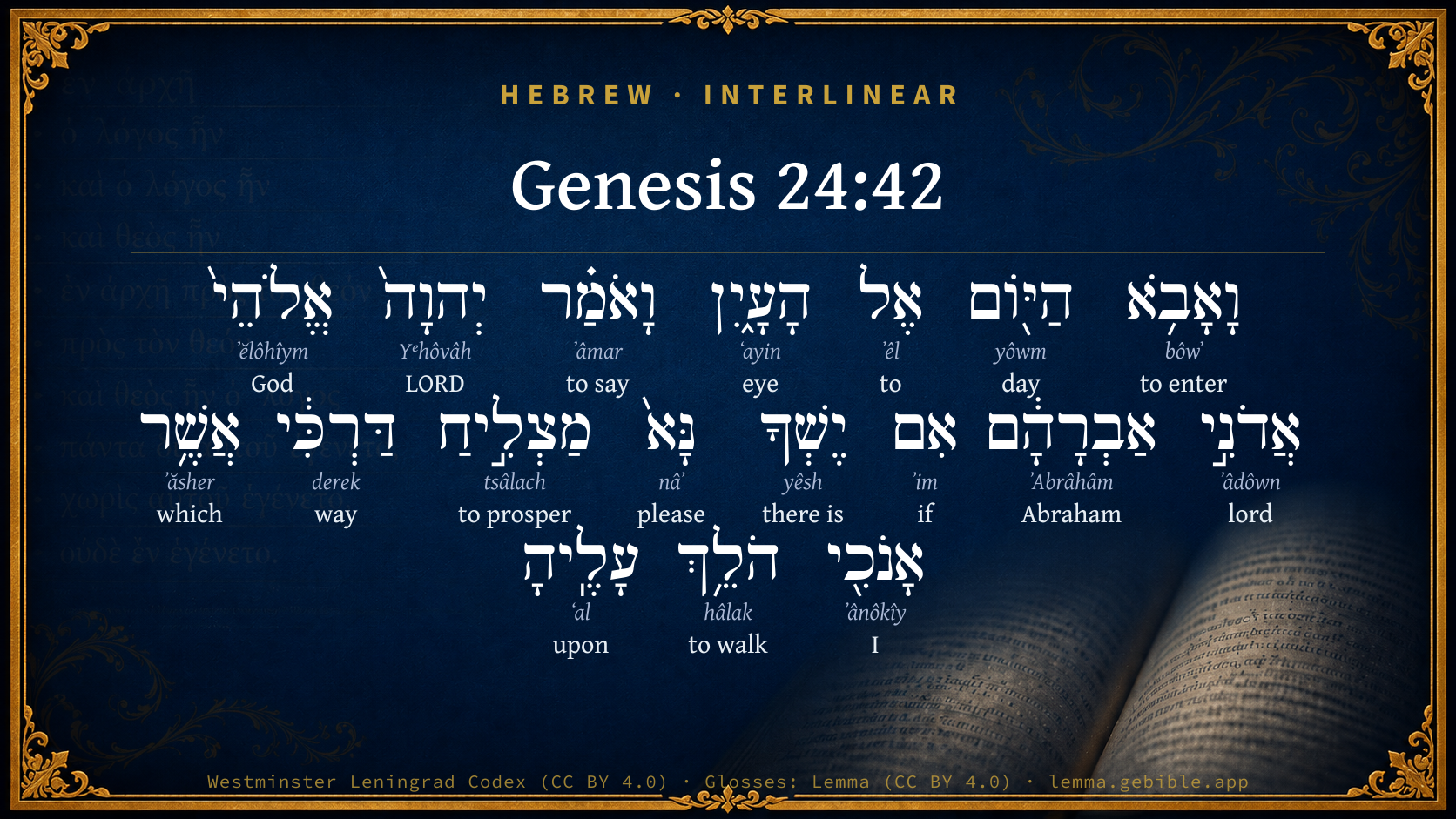
Hebrew (Westminster Leningrad Codex) Genesis 24:42 appears in the Hebrew Old Testament. The text above is from the Westminster Leningrad Codex. Each word links to its Strong’s number, a concise gloss, and parsing drawn from the Open Scriptures Hebrew Bible morphology. Click any word for its full Brown-Driver-Briggs (BDB) entry.
Download image
Cite this verse

Genesis 24:42 (World English Bible). Public Domain. Lemma interlinear Bible study tool, https://lemma.gebible.app/v/genesis/24/42.

Show BibTeX & RIS
BibTeX
RIS
English Translation
I came this day to the spring, and said, 'Yahweh, the God of my master Abraham, if now you do prosper my way which I go.
World English Bible · Public Domain
Download a study sheet

One document with this verse’s original text, its word-by-word gloss line, the meaning frame, cross-references with their text, attributed commentary, and full source and license credits — printable, and it pastes into notes with its structure intact.

This verse Autodidact and up

Study sheet (.html) Plain text (.txt)

A passage Seminary Student

Up to 50 verses in one chapter. A passage sheet keeps up to 6 commentary sources and 12 cross-references per verse, in the order this page ranks them, and says so on the sheet whenever that leaves anything out. Ask for a single verse and you get the Autodidact verse sheet above.

Everything on this page stays free to read, with no account — the sheet is a download of what is already on screen, not access to it.

Want to remove ads? Support Godless Engineer
Compare translations 3

The same verse in 3 English versions, stacked beneath the original-language interlinear above. Click any original word for its lexicon entry.

Each is an independent rendering of the whole verse — the interlinear is not word-aligned to these translations.

Highlighted words mark where these versions differ — a whole-verse word diff, not a word-by-word alignment.

  • World English Bible Public Domain
    I came this day to the spring, and said, 'Yahweh, the God of my master Abraham, if now you do prosper my way which I go.
  • King James Version Public Domain
    And I came this day unto the well, and said, O LORD God of my master Abraham, if now thou do prosper my way which I go:
  • unfoldingWord Literal Text CC BY-SA 4.0
    Then today I came to the spring, and I said, ‘Yahweh, God of my master Abraham, if it is your will, please make my journey succeed that I have come on.

unfoldingWord Literal Text — © unfoldingWord, licensed CC BY-SA 4.0. Word-aligned USFM3 via Door43 (git.door43.org/unfoldingWord/en_ult).

Versions to compare (up to 4)

3 of 4 selected

Show all 18 translations

Every available English version of this verse, each an independent rendering of the whole verse.

  • World English Bible Public Domain
    I came this day to the spring, and said, 'Yahweh, the God of my master Abraham, if now you do prosper my way which I go.
  • Berean Standard Bible Public Domain
    So when I came to the spring today, I prayed: O LORD, God of my master Abraham, if only You would make my journey a success!
  • Majority Standard Bible Public Domain
    So when I came to the spring today, I prayed: O LORD, God of my master Abraham, if only You would make my journey a success!
  • King James Version Public Domain
    And I came this day unto the well, and said, O LORD God of my master Abraham, if now thou do prosper my way which I go:
  • American Standard Version (1901) Public Domain
    And I came this day unto the fountain, and said, O Jehovah, the God of my master Abraham, if now thou do prosper my way which I go.
  • Revised Version (1885) Public Domain
    And I came this day unto the fountain, and said, O LORD, the God of my master Abraham, if now thou do prosper my way which I go:
  • Geneva Bible (1599) Public Domain
    So I came this day to the well, and said, O Lord, the God of my master Abraham, if thou nowe prosper my iourney which I goe,
  • Douay-Rheims (1899) Public Domain
    And I came today to the well of water, and said: O Lord God of my master Abraham, if thou hast prospered my way, wherein I now walk,
  • Young's Literal Translation Public Domain
    `And I come to-day unto the fountain, and I say, Jehovah, God of my lord Abraham, if Thou art, I pray Thee, making prosperous my way in which I am going --
  • Literal Standard Version CC BY-SA 4.0
    And I come to the fountain today, and I say, YHWH, God of my lord Abraham, now if You are making prosperous my way in which I am going—
  • Unlocked Literal Bible CC BY-SA 4.0
    So I arrived today at the spring, and said, 'O Yahweh, God of my master Abraham, please, if you do indeed intend to make my journey successful—
  • unfoldingWord Literal Text CC BY-SA 4.0
    Then today I came to the spring, and I said, ‘Yahweh, God of my master Abraham, if it is your will, please make my journey succeed that I have come on.
  • Darby Bible Public Domain
    And I came this day to the well, and said, Jehovah, God of my master Abraham, if now thou wilt prosper my way on which I go,
  • World Messianic Bible Public Domain
    I came today to the spring, and said, ‘The LORD, the God of my master Abraham, if now you do prosper my way which I go—
  • Webster's Bible Public Domain
    And I came this day to the well, and said, O LORD God of my master Abraham, if now thou dost prosper my way which I go:
  • Free Bible Version CC BY-SA 4.0
    Today when I arrived at the spring, I prayed, Lord, God of my master Abraham, please let the journey I have taken be successful.
  • Bible in Basic English Public Domain
    And I came today to the water-spring, and I said, O Lord, the God of my master Abraham, if it is your purpose to give a good outcome to my journey,
  • JPS Tanakh (1917) Public Domain
    And I came this day unto the fountain, and said: O LORD, the God of my master Abraham, if now Thou do prosper my way which I go:

Literal Standard Version (2020), Covenant Press — licensed CC BY-SA 4.0. Text via the HelloAO Bible API (eBible.org). Unlocked Literal Bible (unfoldingWord) — licensed CC BY-SA 4.0. Text via the HelloAO Bible API (eBible.org). unfoldingWord Literal Text — © unfoldingWord, licensed CC BY-SA 4.0. Word-aligned USFM3 via Door43 (git.door43.org/unfoldingWord/en_ult). Free Bible Version, Dr. Jonathan Gallagher — licensed CC BY-SA 4.0. Text via the HelloAO Bible API (eBible.org).

Word by word

More ways to search: Search by grammar → Find every occurrence → Compare this word →

Practice this passage: Drill this verse → Learn its vocabulary →

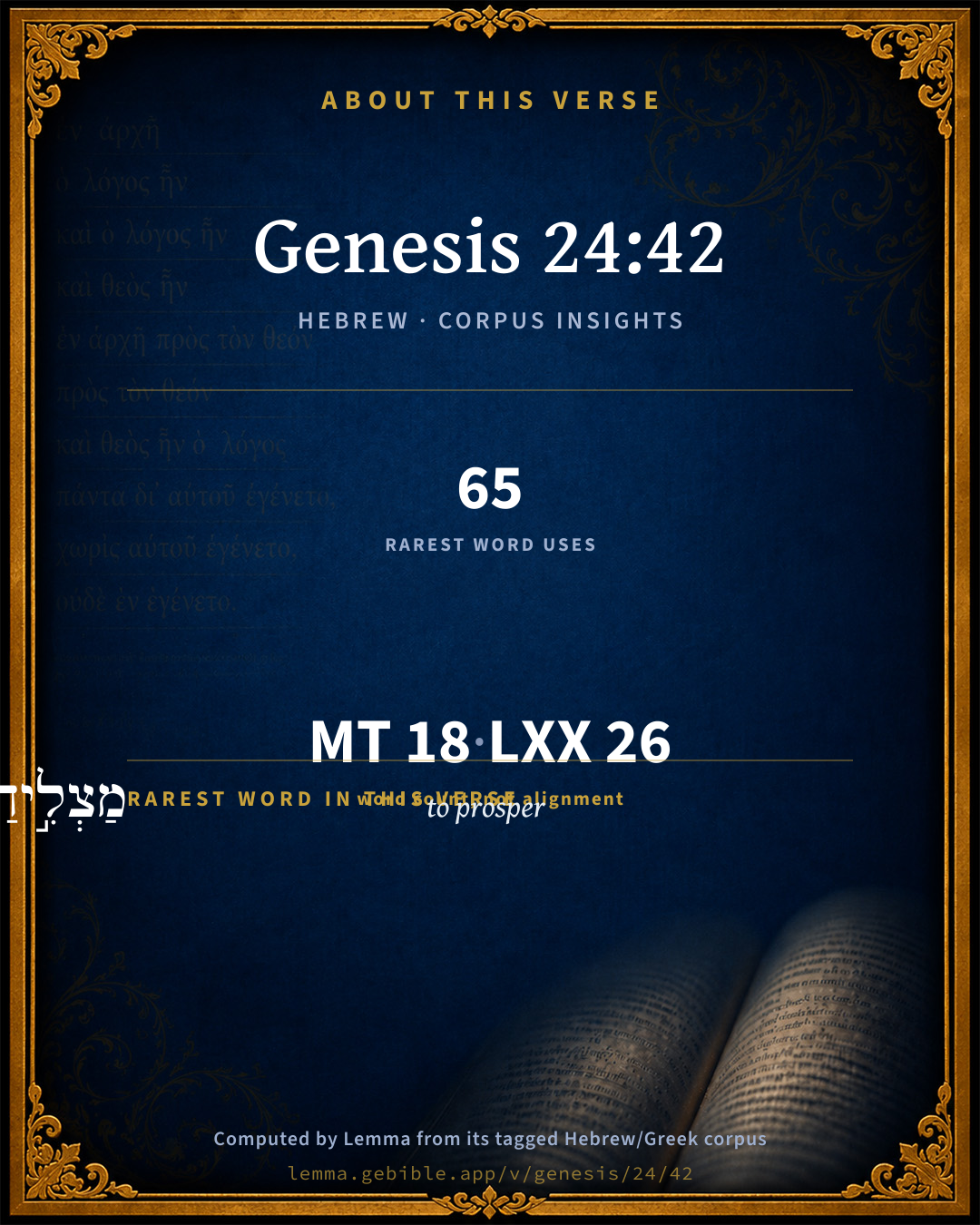
מַצְלִ֣יחַ
tsâlach
H6743
“prospering”
Verb, Hiphil, Participle Active, Masculine, Singular, Absolute
Part of Speech
Verb
Stem
Hiphil
Form
Participle Active
Gender
Masculine
Number
Singular
State
Absolute
Full BDB Definition

Origin: a primitive root

TWOT: 1916 , 1917

(Qal) to rush - to advance, prosper, make progress, succeed, be profitable - (Qal) to prosper - (Hiphil) - to make prosperous, bring to successful issue, cause to prosper - to show or experience prosperity, prosper
  1. וָאָבֹ֥א bôwʼ H935 “and · to enter” Conjunction + Verb, Qal, Sequential Imperfect, 1st Person, Common, Singular
  2. הַיּ֖וֹם yôwm H3117 “the · day” Particle, Definite Article + Noun, Common, Masculine, Singular, Absolute
  3. אֶל ʼêl H413 “to” Preposition
  4. הָעָ֑יִן ʻayin H5869 “the · eye” Particle, Definite Article + Noun, Common, Both, Singular, Absolute
  5. וָאֹמַ֗ר ʼâmar H559 “and · to say” Conjunction + Verb, Qal, Sequential Imperfect, 1st Person, Common, Singular
  6. יְהוָה֙ Yᵉhôvâh H3068 “LORD” Noun, Proper
  7. אֱלֹהֵי֙ ʼĕlôhîym H430 “God(s) of” Noun, Common, Masculine, Plural, Construct
  8. אֲדֹנִ֣י ʼâdôwn H113 “lord · my” Noun, Common, Masculine, Singular, Construct + Suffix, Personal, 1st Person, Common, Singular
  9. אַבְרָהָ֔ם ʼAbrâhâm H85 “Abraham” Noun, Proper
  10. אִם ʼim H518 “if” Conjunction
  11. יֶשְׁךָ yêsh H3426 “there is · you” Particle, Demonstrative + Suffix, Personal, 2nd Person, Masculine, Singular
  12. נָּא֙ nâʼ H4994 “please” Particle, Interjection
  13. דַּרְכִּ֔י derek H1870 “way · my” Noun, Common, Both, Singular, Construct + Suffix, Personal, 1st Person, Common, Singular
  14. אֲשֶׁ֥ר ʼăsher H834 “which” Particle, Relative
  15. אָנֹכִ֖י ʼânôkîy H595 “I” Pronoun, Personal, 1st Person, Common, Singular
  16. הֹלֵ֥ךְ hâlak H1980 “walking” Verb, Qal, Participle Active, Masculine, Singular, Absolute
  17. עָלֶֽיהָ ʻal H5921 “upon · her” Preposition + Suffix, Personal, 3rd Person, Feminine, Singular

About this verse

These counts appear in no published source. They are computed here, from the morphology-tagged text and Lemma’s own curated glosses. What Lemma adds →

18
words
18
distinct lemmas
Pentateuch
section

Grammatical profile

  • 4 verbs
  • 7 nouns
  • 1 pronoun
  • 2 prepositions
  • 1 conjunction
  • 3 particles

Verb forms

  • וָאָבֹ֥א Qal · Sequential Imperfect
  • וָאֹמַ֗ר Qal · Sequential Imperfect
  • מַצְלִ֣יחַ Hiphil · Participle Active
  • הֹלֵ֥ךְ Qal · Participle Active

Hebrew & Septuagint length

In English translation the verse runs 26 words from the Hebrew and 27 from the Septuagint (LXX English) — closely comparable.

A rough comparison of the two English renderings, which tokenize alike — not a word-level alignment.

Word counts can differ between the Hebrew and the Greek without any difference in meaning — e.g. the Hebrew direct-object marker אֵת has no separate Greek word, and Greek often adds the article ὁ.

In the original languages it is 18 Hebrew tokens and 26 Greek tokens — but the two are counted differently (Hebrew bundles its prefixes and suffixes into one token; the Greek is in lemma form), so that isn’t a like-for-like length.

Cross-references

10

Topical passages linked to Genesis 24:42 in the Treasury of Scripture Knowledge — connected by theme and wording, ordered by reader-vote popularity; previews shown in the World English Bible.

  • Nehemiah 1:11 Lord, I beg you, let now your ear be attentive to the prayer of your servant, and to the prayer of your servants, who delight to fear your name; and please prosper your servant this day, and grant him mercy in the sight of this man. Now I was cup bearer to the king.
  • Genesis 24:12–14 He said, "Yahweh, the God of my master Abraham, please give me success this day, and show kindness to my master Abraham.
  • Ezra 8:21 Then I proclaimed a fast there, at the river Ahava, that we might humble ourselves before our God, to seek of him a straight way for us, and for our little ones, and for all our substance.
  • Psalms 37:5 Commit your way to Yahweh. Trust also in him, and he will do this:
  • Psalms 90:17 Let the favor of the Lord our God be on us; Establish the work of our hands for us; Yes, establish the work of our hands.
  • Romans 1:10 requesting, if by any means now at last I may be prospered by the will of God to come to you.
  • Genesis 24:31 He said, "Come in, you blessed of Yahweh. Why do you stand outside? For I have prepared the house, and room for the camels."
  • Genesis 39:3 His master saw that Yahweh was with him, and that Yahweh made all that he did prosper in his hand.
  • Acts 10:7–8 When the angel who spoke to him had departed, Cornelius called two of his household servants and a devout soldier of those who waited on him continually.
  • Acts 10:22 They said, "Cornelius, a centurion, a righteous man and one who fears God, and well spoken of by all the nation of the Jews, was directed by a holy angel to invite you to his house, and to listen to what you say."

Cross-references courtesy of OpenBible.info (CC BY 4.0).

Hebrew and Greek witnesses Masoretic Hebrew ↔ Greek Septuagint

The same verse in the two great witnesses to the Old Testament, shown verse-for-verse.

These are two independent witnesses, not word-aligned to each other, and the Septuagint is shown in lemma (dictionary) form.

Hebrew Genesis 24:42 Masoretic · Westminster Leningrad Codex

וָאָבֹ֥א הַיּ֖וֹם אֶל הָעָ֑יִן וָאֹמַ֗ר יְהוָה֙ אֱלֹהֵי֙ אֲדֹנִ֣י אַבְרָהָ֔ם אִם יֶשְׁךָ נָּא֙ מַצְלִ֣יחַ דַּרְכִּ֔י אֲשֶׁ֥ר אָנֹכִ֖י הֹלֵ֥ךְ עָלֶֽיהָ

I came this day to the spring, and said, 'Yahweh, the God of my master Abraham, if now you do prosper my way which I go.

World English Bible · Public Domain

Greek LXX Genesis 24:42 Septuagint · lemma form

καί ἔρχομαι σήμερον ἐπί ὁ πηγή εἶπον κύριος ὁ θεός ὁ κύριος ἐγώ αβρααμ εἰ σύ εὐοδόω ὁ ὁδός ἐγώ ὅς νῦν ἐγώ πορεύομαι ἐπί αὐτός

And having come this day to the well, I said, Lord God of my master Abraam, if you prosper my journey on which I am now going,

LXX2012 (modern English Septuagint) · Public Domain

Hebrew: Westminster Leningrad Codex (CC BY 4.0). Greek: Septuagint (public domain); English from LXX2012 (modern English Septuagint) (Public Domain). How the Septuagint differs from the Hebrew →

Targum (Aramaic paraphrase)

2

The Targum is the ancient Jewish Aramaic paraphrase of the Hebrew Scriptures — an interpretive translation, not the Hebrew text itself. Onkelos (literal) and Pseudo-Jonathan (expansive) render the Torah, and Jonathan the Prophets. Coverage is partial: where no permissively-licensed English translation exists for a verse, only the Aramaic is shown. This is verse-level text, not a word-by-word alignment to the Hebrew.

  1. Targum Onkelos Torah (Genesis–Deuteronomy)
    וְאָתִית (נ''י וַאֲתֵיתִי) יוֹמָא דֵּין לְעֵינָא וַאֲמָרִית יְיָ אֱלָהָא דְּרִבּוֹנִי אַבְרָהָם אִם אִית כְּעַן רַעֲוָא קֳדָמָךְ לְאַצְלָחָא אָרְחִי דִּי אֲנָא אָזֵיל עֲלַהּ

    (no public-domain English translation for this verse)

    Targum Onkelos — Aramaic: “Onkelos Genesis” (public domain); “Onkelos Exodus” (public domain); “Onkelos Leviticus” (public domain); “Onkelos Numbers” (public domain); “Onkelos Deuteronomy” (public domain). English: “Sefaria Community Translation” (CC0 1.0 (public-domain dedication)); “J.W. Etheridge. The Targums of Onkelos and Jonathan Ben Uzziel on the Pentateuch. London: Longmans, Green, 1862” (public domain). Text via Sefaria.

  2. Targum Pseudo-Jonathan Torah (Genesis–Deuteronomy)
    וְאָתִית יוֹמָנָא לְעֵינָא וַאֲמָרִית יְיָ אֱלָהֵיהּ דְרִבּוֹנִי אַבְרָהָם אִין אִיתָךְ כְּדוֹן מַצְלַח אָרְחִי דַאֲנָא אָזִיל עֲלָהּ

    And I came today to the fountain, and said, Lord God of my master Abraham, if now Thou hast prospered the journey upon which I have come,

    Targum Pseudo-Jonathan — Aramaic: “Targum Jonathan on Genesis” (public domain); “Targum Jonathan on Exodus” (public domain); “Targum Jonathan on Leviticus” (public domain); “Targum Jonathan on Numbers” (public domain); “Targum Jonathan on Deuteronomy” (public domain). English: “The Targum of Jonathan ben Uzziel, trans. J. W. Etheridge, London, 1862” (public domain). Text via Sefaria.

Commentary

Notes on Genesis 24:42 from classic Christian and Jewish commentators (each source and its license shown beneath its notes). The classic Christian expositions comment on the surrounding passage and are grouped to its opening verse, so a note may address several verses; the Jewish commentaries on the Tanakh (Rashi and others) are per-verse, so they appear only where the commentator wrote on this verse.

Lemma curates 59 commentaries, every one of them public domain or Creative Commons licensed, each selected and text-cleaned for this edition rather than reprinted as found. About our sources →

The Cambridge Bible for Schools and Colleges

gen. ed. J. J. S. Perowne

42. And I came this day] Gen_24:42-48 recapitulate the substance of 12–27.

The Cambridge Bible for Schools and Colleges (gen. ed. J. J. S. Perowne; Cambridge University Press, 1878–1918) — public domain. Text from a community e-Sword module.

Trapp's Complete Commentary

John Trapp

Gen 24:42 And I came this day unto the well, and said, O LORD God of my master Abraham, if now thou do prosper my way which I go:

Ver. 42. And I came this day to the well.] God’s providences are carefully to be observed and registered. We might have a Divinity of our own, would we but lay up our experiences: which are nothing else, saith the philosopher, but multiplex memoria. David "will remember God from the land of Jordan, and of the Hermonites, from the hill Mizar," where he had formerly found him to his comfort. {Psa 42:6}

John Trapp, A Commentary or Exposition upon All the Books of the Old and New Testament (1647–1656) — public domain. Text from a community e-Sword module.

Geneva Bible (1599)

Geneva Bible translators

Or, way.

Geneva Bible (1599) marginal notes — public domain. Text via Bolls.life.

Adam Clarke's Commentary

Verse 42. O Lord God of my master] As Abraham was the friend of God, Eliezer makes use of this to give weight and consequence to his petitions.

Adam Clarke's Commentary on the Bible (1810–1826) — public domain. Text from a community e-Sword/MySword module.

John Gill's Exposition

And I asked her, and said, Whose daughter art thou?.... See Gill on Gen 24:23.

And she said, The daughter of Bethuel, Nahor's son, whom Milcah bare unto him: See Gill on Gen 24:24.

and I put the earring upon her face, and the bracelets upon her hands. See Gill on Gen 24:22.

John Gill's Exposition of the Whole Bible (1746–1763) — public domain (CC PDM 1.0). Text via the HelloAO Bible API.

Matthew Poole's English Annotations

i.e. The design or course in which I am engaged, as the word way is frequently used.

Matthew Poole's English Annotations on the Holy Bible (1683–1685) — public domain. Text from a community e-Sword/MySword module.

unfoldingWord translationNotes

Door43 World Missions Community

General Information:

Abraham's servant continues speaking to Rebekah's family.

the spring

"the well"

here I am, standing by the spring of water

The servant interrupted what he was asking God to do by drawing God's attention to where he was standing.

let the young woman who comes ... the woman to whom I say ... the woman who says to me

The servant went back to stating his request, and he had three things to say about the woman that he hoped would come.

to draw water

"to get water"

pitcher

This is a medium-size jar made of clay used for holding and pouring liquids. See how you translated this in Genesis 24:14.

let her be the woman

The servant finished his request.

translationWords

fountain

Yahweh

God

Abraham

unfoldingWord translationNotes — © Distant Shores Media and the Door43 World Missions Community, licensed CC BY-SA 4.0. Source: git.door43.org/Door43/en_tn.

Rashi

Rabbi Shlomo Yitzchaki (Rashi)

ואבא היום AND I CAME THIS DAY — Today I started on my journey and today I have arrived here. Hence we may infer that the earth (the road) shrunk for him (i. e. that the journey was shortened in a miraculous manner) (Sanhedrin 95a). R. Acha said: The ordinary conversation of the patriarchs' servants is more pleasing to God than even the Torah (religious discourse) of their children, for the chapter of Eliezer (the account of his journey) is repeated in the Torah (i. e. it is written once as a narrative and again repeated as part of the conversation of the patriarch’s servant) whereas many important principles of the Law are derived only from slight indications given in the Text (Genesis Rabbah 60:8).

Rashi on the Tanakh — English translations: “The Judaica Press complete Tanach with Rashi, translated by A. J. Rosenberg” (CC BY 4.0); “Pentateuch with Rashi's commentary by M. Rosenbaum and A.M. Silbermann, 1929-1934” (public domain); “The Metsudah Tanach series, Lakewood, N.J” (CC BY 4.0); and “The Book of Joshua, Metsudah Publications, 1997” (CC BY 4.0). Text via Sefaria.

Lesson kit

Teaching starters — assembled from the data on this page, not authored interpretation. Every prompt links to the verse data it draws on. Edit before teaching.

Genesis, in the Pentateuch, opens this verse with 18 words (18 distinct Hebrew lemmas). Its most distinctive word is tsâlach (“to prosper”). A historical commentator’s framing appears above. Read the whole chapter for the surrounding context.

Discussion questions

  1. What does “to prosper” (tsâlach) contribute to the verse as a whole?
  2. Nehemiah 1:11 shares this passage’s theme. How do the two illuminate each other?
  3. The translations on this page render this verse differently — a whole-verse word diff, not a word-by-word alignment. What might account for the different wordings?
  4. The verb «וָאָבֹ֥א» is Qal Sequential Imperfect. How does its form color the action?
  5. Reading how The Cambridge Bible for Schools and Colleges and Trapp's Complete Commentary read this verse, where do the two commentators agree and where do they part?

Things to notice

Reading settings

Reading text

Shown beneath each verse's original-language words.

Old Testament
Old Testament edition

Read the OT as the Masoretic Hebrew (MT) or the Greek Septuagint (LXX).

English shown for the Greek Septuagint (in the Hebrew ↔ Greek comparison).

Comparing translations? Open the Compare panel on any verse page to stack up to four side by side.