Genesis 19:22

Hebrew (Westminster Leningrad Codex) Genesis 19:22 appears in the Hebrew Old Testament. The text above is from the Westminster Leningrad Codex. Each word links to its Strong’s number, a concise gloss, and parsing drawn from the Open Scriptures Hebrew Bible morphology. Click any word for its full Brown-Driver-Briggs (BDB) entry.
Download image
Cite this verse

Genesis 19:22 (World English Bible). Public Domain. Lemma interlinear Bible study tool, https://lemma.gebible.app/v/genesis/19/22.

Show BibTeX & RIS
BibTeX
RIS
English Translation
Hurry, escape there, for I can't do anything until you get there." Therefore the name of the city was called Zoar.
World English Bible · Public Domain
Download a study sheet

One document with this verse’s original text, its word-by-word gloss line, the meaning frame, cross-references with their text, attributed commentary, and full source and license credits — printable, and it pastes into notes with its structure intact.

This verse Autodidact and up

Study sheet (.html) Plain text (.txt)

A passage Seminary Student

Up to 50 verses in one chapter. A passage sheet keeps up to 6 commentary sources and 12 cross-references per verse, in the order this page ranks them, and says so on the sheet whenever that leaves anything out. Ask for a single verse and you get the Autodidact verse sheet above.

Everything on this page stays free to read, with no account — the sheet is a download of what is already on screen, not access to it.

Want to remove ads? Support Godless Engineer
Compare translations 3

The same verse in 3 English versions, stacked beneath the original-language interlinear above. Click any original word for its lexicon entry.

Each is an independent rendering of the whole verse — the interlinear is not word-aligned to these translations.

Highlighted words mark where these versions differ — a whole-verse word diff, not a word-by-word alignment.

  • World English Bible Public Domain
    Hurry, escape there, for I can't do anything until you get there." Therefore the name of the city was called Zoar.
  • King James Version Public Domain
    Haste thee, escape thither; for I cannot do anything till thou be come thither. Therefore the name of the city was called Zoar.
  • unfoldingWord Literal Text CC BY-SA 4.0
    Hurry up, escape there, because I am not able to do a thing until you go there.” For that they called the name of the town Zoar.

unfoldingWord Literal Text — © unfoldingWord, licensed CC BY-SA 4.0. Word-aligned USFM3 via Door43 (git.door43.org/unfoldingWord/en_ult).

Versions to compare (up to 4)

3 of 4 selected

Show all 18 translations

Every available English version of this verse, each an independent rendering of the whole verse.

  • World English Bible Public Domain
    Hurry, escape there, for I can't do anything until you get there." Therefore the name of the city was called Zoar.
  • Berean Standard Bible Public Domain
    Hurry! Run there quickly, for I cannot do anything until you reach it.” That is why the town was called Zoar.
  • Majority Standard Bible Public Domain
    Hurry! Run there quickly, for I cannot do anything until you reach it.” That is why the town was called Zoar.
  • King James Version Public Domain
    Haste thee, escape thither; for I cannot do anything till thou be come thither. Therefore the name of the city was called Zoar.
  • American Standard Version (1901) Public Domain
    Haste thee, escape thither; for I cannot do anything till thou be come thither. Therefore the name of the city was called Zoar.
  • Revised Version (1885) Public Domain
    Haste thee, escape thither; for I cannot do any thing till thou be come thither. Therefore the name of the city was called Zoar.
  • Geneva Bible (1599) Public Domain
    Haste thee, saue thee there: for I can doe nothing till thou be come thither. Therefore the name of the citie was called Zoar.
  • Douay-Rheims (1899) Public Domain
    Make haste and be saved there, because I cannot do any thing till thou go in thither. Therefore the name of that city was called Segor.
  • Young's Literal Translation Public Domain
    haste, escape thither, for I am not able to do anything till thine entering thither;' therefore hath he calleth the name of the city Zoar.
  • Literal Standard Version CC BY-SA 4.0
    hurry, escape there, for I am not able to do anything until your entering there”; therefore he calls the name of the city Zoar.
  • Unlocked Literal Bible CC BY-SA 4.0
    Hurry! Escape there, for I cannot do anything until you arrive there.” Therefore the city was called Zoar.
  • unfoldingWord Literal Text CC BY-SA 4.0
    Hurry up, escape there, because I am not able to do a thing until you go there.” For that they called the name of the town Zoar.
  • Darby Bible Public Domain
    Haste, escape thither; for I cannot do anything until thou art come there. Therefore the name of the city is called Zoar.
  • World Messianic Bible Public Domain
    Hurry, escape there, for I can’t do anything until you get there.” Therefore the name of the city was called Zoar.
  • Webster's Bible Public Domain
    Haste thee, escape thither: for I cannot do any thing till thou hast come thither: therefore the name of the city was called Zoar.
  • Free Bible Version CC BY-SA 4.0
    But hurry up and run there quickly, because I can't do anything until you get there.” (This is why the town was called Zoar.)
  • Bible in Basic English Public Domain
    Go there quickly, for I am not able to do anything till you have come there. For this reason, the town was named Zoar.
  • JPS Tanakh (1917) Public Domain
    Hasten thou, escape thither; for I cannot do any thing till thou be come thither.' — Therefore the name of the city was called Zoar. —

Literal Standard Version (2020), Covenant Press — licensed CC BY-SA 4.0. Text via the HelloAO Bible API (eBible.org). Unlocked Literal Bible (unfoldingWord) — licensed CC BY-SA 4.0. Text via the HelloAO Bible API (eBible.org). unfoldingWord Literal Text — © unfoldingWord, licensed CC BY-SA 4.0. Word-aligned USFM3 via Door43 (git.door43.org/unfoldingWord/en_ult). Free Bible Version, Dr. Jonathan Gallagher — licensed CC BY-SA 4.0. Text via the HelloAO Bible API (eBible.org).

Word by word

More ways to search: Search by grammar → Find every occurrence → Compare this word →

Practice this passage: Drill this verse → Learn its vocabulary →

צֽוֹעַר
Tsôʻar
H6820
“Zoar”
Noun, Proper
Part of Speech
Noun
Type
Proper
Full BDB Definition

Origin: from H6819

TWOT: None

Zoar = "insignificance" - a city at the southeast end of the Dead Sea grouped with Sodom and Gomorrah as being one of the 5 cities slated for destruction by God; spared at Lot's plea as his place of refuge
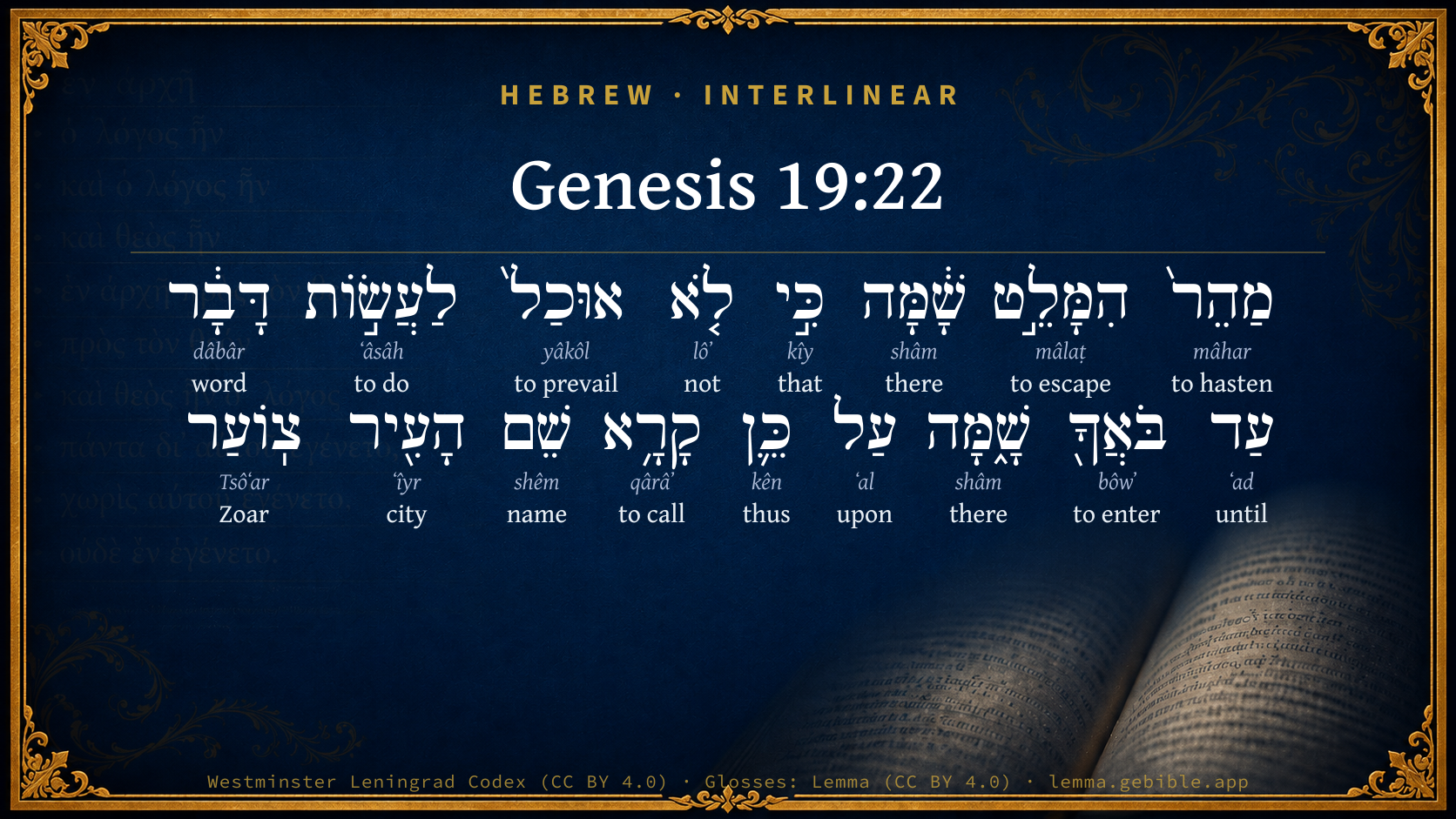
  1. מַהֵר֙ mâhar H4116 “hasten” Verb, Piel, Imperative, 2nd Person, Masculine, Singular
  2. הִמָּלֵ֣ט mâlaṭ H4422 “escape” Verb, Niphal, Imperative, 2nd Person, Masculine, Singular
  3. שָׁ֔מָּה shâm H8033 “there · toward” Adverb + Suffix, Demonstrative
  4. כִּ֣י kîy H3588 “that” Conjunction
  5. לֹ֤א lôʼ H3808 “not” Particle, Negative
  6. אוּכַל֙ yâkôl H3201 “to prevail” Verb, Qal, Imperfect, 1st Person, Common, Singular
  7. לַעֲשׂ֣וֹת ʻâsâh H6213 “to do” Preposition + Verb, Qal, Infinitive Construct
  8. דָּבָ֔ר dâbâr H1697 “word” Noun, Common, Masculine, Singular, Absolute
  9. עַד ʻad H5704 “until” Preposition
  10. בֹּאֲךָ֖ bôwʼ H935 “to enter · you” Verb, Qal, Infinitive Construct + Suffix, Personal, 2nd Person, Masculine, Singular
  11. שָׁ֑מָּה shâm H8033 “there · toward” Adverb + Suffix, Demonstrative
  12. עַל ʻal H5921 “upon” Preposition
  13. כֵּ֛ן kên H3651 “thus” Particle, Demonstrative
  14. קָרָ֥א qârâʼ H7121 “to call” Verb, Qal, Perfect, 3rd Person, Masculine, Singular
  15. שֵׁם shêm H8034 “name of” Noun, Common, Masculine, Singular, Construct
  16. הָעִ֖יר ʻîyr H5892 “the · city” Particle, Definite Article + Noun, Common, Feminine, Singular, Absolute

About this verse

These counts appear in no published source. They are computed here, from the morphology-tagged text and Lemma’s own curated glosses. What Lemma adds →

17
words
16
distinct lemmas
Pentateuch
section

Notable vocabulary

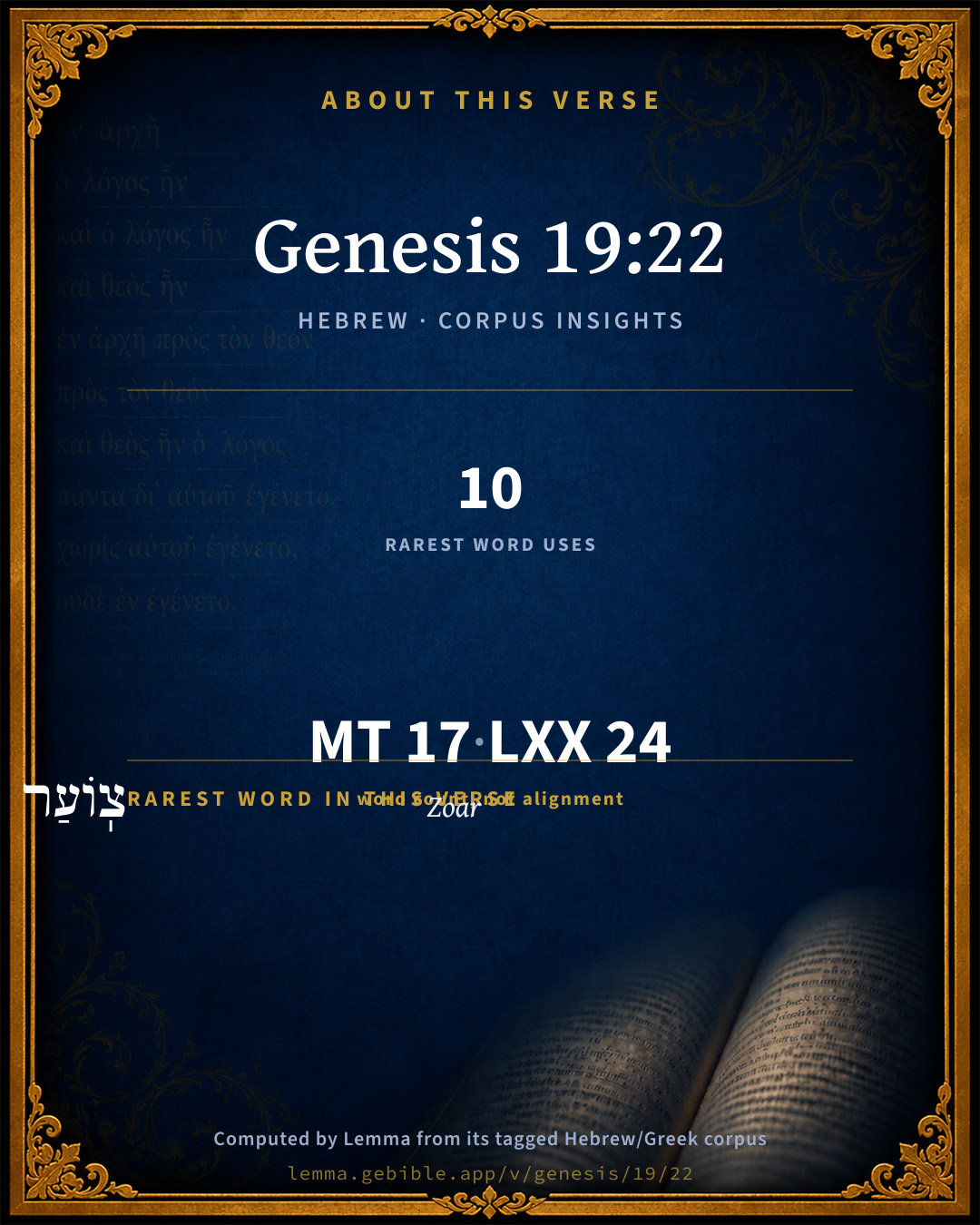
The rarest word here is צֽוֹעַר Zoar H6820 — appearing just 10 times in the whole Hebrew Bible.

Shared distinctive vocabulary

צֽוֹעַר Zoar H6820 occurs in 9 verses of the Hebrew Bible. Also found in:

Grammatical profile

  • 6 verbs
  • 4 nouns
  • 2 prepositions
  • 1 conjunction
  • 2 adverbs
  • 2 particles

Verb forms

  • מַהֵר֙ Piel · Imperative
  • הִמָּלֵ֣ט Niphal · Imperative
  • אוּכַל֙ Qal · Imperfect
  • לַעֲשׂ֣וֹת Qal · Infinitive Construct
  • בֹּאֲךָ֖ Qal · Infinitive Construct
  • קָרָ֥א Qal · Perfect

Repetition

A word recurs within this verse — often emphatic in Hebrew:

  • שָׁ֔מָּה there H8033 ×2

Hebrew & Septuagint length

In English translation the verse runs 21 words from the Hebrew and 28 from the Septuagint (LXX English) — closely comparable.

A rough comparison of the two English renderings, which tokenize alike — not a word-level alignment.

Word counts can differ between the Hebrew and the Greek without any difference in meaning — e.g. the Hebrew direct-object marker אֵת has no separate Greek word, and Greek often adds the article ὁ.

In the original languages it is 17 Hebrew tokens and 24 Greek tokens — but the two are counted differently (Hebrew bundles its prefixes and suffixes into one token; the Greek is in lemma form), so that isn’t a like-for-like length.

Cross-references

12

Topical passages linked to Genesis 19:22 in the Treasury of Scripture Knowledge — connected by theme and wording, ordered by reader-vote popularity; previews shown in the World English Bible.

  • Genesis 13:10 Lot lifted up his eyes, and saw all the plain of the Jordan, that it was well watered every where, before Yahweh destroyed Sodom and Gomorrah, like the garden of Yahweh, like the land of Egypt, as you go to Zoar.
  • Genesis 14:2 that they made war with Bera, king of Sodom, and with Birsha, king of Gomorrah, Shinab, king of Admah, and Shemeber, king of Zeboiim, and the king of Bela (the same is Zoar).
  • Genesis 32:25–28 When he saw that he didn't prevail against him, he touched the hollow of his thigh, and the hollow of Jacob's thigh was strained, as he wrestled.
  • Exodus 32:10 Now therefore leave me alone, that my wrath may burn hot against them, and that I may consume them; and I will make of you a great nation."
  • Deuteronomy 9:14 let me alone, that I may destroy them, and blot out their name from under the sky; and I will make of you a nation mightier and greater than they.
  • Psalms 91:1–10 He who dwells in the secret place of the Most High Will rest in the shadow of the Almighty.
  • Mark 6:5 He could do no mighty work there, except that he laid his hands on a few sick people, and healed them.
  • Isaiah 15:5 My heart cries out for Moab; her nobles [flee] to Zoar, to Eglath Shelishiyah: for by the ascent of Luhith with weeping they go up; for in the way of Horonaim they raise up a cry of destruction.
  • Isaiah 65:8 Thus says Yahweh, As the new wine is found in the cluster, and one says, Don't destroy it, for a blessing is in it: so will I do for my servants' sake, that I may not destroy them all.
  • Jeremiah 48:34 From the cry of Heshbon even to Elealeh, even to Jahaz have they uttered their voice, from Zoar even to Horonaim, to Eglath Shelishiyah: for the waters of Nimrim also shall become desolate.
  • 2 Timothy 2:13 If we are faithless, He remains faithful. He can't deny himself.
  • Titus 1:2 in hope of eternal life, which God, who can't lie, promised before eternal times;

Cross-references courtesy of OpenBible.info (CC BY 4.0).

Hebrew and Greek witnesses Masoretic Hebrew ↔ Greek Septuagint

The same verse in the two great witnesses to the Old Testament, shown verse-for-verse.

These are two independent witnesses, not word-aligned to each other, and the Septuagint is shown in lemma (dictionary) form.

Hebrew Genesis 19:22 Masoretic · Westminster Leningrad Codex

מַהֵר֙ הִמָּלֵ֣ט שָׁ֔מָּה כִּ֣י לֹ֤א אוּכַל֙ לַעֲשׂ֣וֹת דָּבָ֔ר עַד בֹּאֲךָ֖ שָׁ֑מָּה עַל כֵּ֛ן קָרָ֥א שֵׁם הָעִ֖יר צֽוֹעַר

Hurry, escape there, for I can't do anything until you get there." Therefore the name of the city was called Zoar.

World English Bible · Public Domain

Greek LXX Genesis 19:22 Septuagint · lemma form

σπεύδω οὖν ὁ σώζω ἐκεῖ οὐ γάρ δύναμαι ποιέω πρᾶγμα ἕως ὁ σύ εἰςἔρχομαι ἐκεῖ διά οὗτος καλέω ὁ ὄνομα ὁ πόλις ἐκεῖνος σηγωρ

Hasten therefore to escape there, for I shall not be able to do anything until you are come there; therefore he called the name of that city, Segor.

LXX2012 (modern English Septuagint) · Public Domain

On this verse, The Cambridge Bible for Schools and Colleges discusses the Septuagint’s reading. Read the note in Commentary ↓

Hebrew: Westminster Leningrad Codex (CC BY 4.0). Greek: Septuagint (public domain); English from LXX2012 (modern English Septuagint) (Public Domain). How the Septuagint differs from the Hebrew →

Targum (Aramaic paraphrase)

2

The Targum is the ancient Jewish Aramaic paraphrase of the Hebrew Scriptures — an interpretive translation, not the Hebrew text itself. Onkelos (literal) and Pseudo-Jonathan (expansive) render the Torah, and Jonathan the Prophets. Coverage is partial: where no permissively-licensed English translation exists for a verse, only the Aramaic is shown. This is verse-level text, not a word-by-word alignment to the Hebrew.

  1. Targum Onkelos Torah (Genesis–Deuteronomy)
    אוֹחִי לְאִשְׁתֵּזֵב תַּמָּן אֲרֵי לָא אִכּוּל לְמֶעְבַּד פִּתְגָּמָא עַד מֵיתָךְ לְתַמָּן עַל כֵּן קְרָא שְׁמָא דְּקַרְתָּא צוֹעַר

    (no public-domain English translation for this verse)

    Targum Onkelos — Aramaic: “Onkelos Genesis” (public domain); “Onkelos Exodus” (public domain); “Onkelos Leviticus” (public domain); “Onkelos Numbers” (public domain); “Onkelos Deuteronomy” (public domain). English: “Sefaria Community Translation” (CC0 1.0 (public-domain dedication)); “J.W. Etheridge. The Targums of Onkelos and Jonathan Ben Uzziel on the Pentateuch. London: Longmans, Green, 1862” (public domain). Text via Sefaria.

  2. Targum Pseudo-Jonathan Torah (Genesis–Deuteronomy)
    אוֹחִי אִשְׁתְּזֵיב לְתַמָן אֲרוּם לָא יְכִילְנָא לְמֶעֱבַד מִדַעַם עַד מֵיעֲלָךְ לְתַמָן בְּגִין כֵּן קָרָא שְׁמָא דְקַרְתָּא זוֹעַר

    Hasten and flee thither: for I cannot do any thing till thou have entered there. Therefore he called the name of the city Zoar.

    Targum Pseudo-Jonathan — Aramaic: “Targum Jonathan on Genesis” (public domain); “Targum Jonathan on Exodus” (public domain); “Targum Jonathan on Leviticus” (public domain); “Targum Jonathan on Numbers” (public domain); “Targum Jonathan on Deuteronomy” (public domain). English: “The Targum of Jonathan ben Uzziel, trans. J. W. Etheridge, London, 1862” (public domain). Text via Sefaria.

Commentary

Notes on Genesis 19:22 from classic Christian and Jewish commentators (each source and its license shown beneath its notes). The classic Christian expositions comment on the surrounding passage and are grouped to its opening verse, so a note may address several verses; the Jewish commentaries on the Tanakh (Rashi and others) are per-verse, so they appear only where the commentator wrote on this verse.

Lemma curates 59 commentaries, every one of them public domain or Creative Commons licensed, each selected and text-cleaned for this edition rather than reprinted as found. About our sources →

Trapp's Complete Commentary

John Trapp

Gen 19:22 Haste thee, escape thither; for I cannot do any thing till thou be come thither. Therefore the name of the city was called Zoar.

Ver. 22. For I cannot do anything.] Not that the execution of the divine decree depended simply upon Lot’s removal to Zoar; but upon another decree, for Lot’s removal ere Sodom were destroyed.

John Trapp, A Commentary or Exposition upon All the Books of the Old and New Testament (1647–1656) — public domain. Text from a community e-Sword module.

Joseph Benson's Commentary

Gen 19:22. I cannot do any thing till thou be come thither — The very presence of good men in a place helps to keep off judgments. See what care God takes for the preservation of his people!

Joseph Benson's Commentary on the Old and New Testaments (1811–1818) — public domain. Text from a community e-Sword module.

Geneva Bible (1599)

Geneva Bible translators

Which before was called Bela, Gen. 14:2.

Because God’s commandment was to destroy the city, and to save Lot.

Geneva Bible (1599) marginal notes — public domain. Text via Bolls.life.

Jamieson, Fausset & Brown

Robert Jamieson, A. R. Fausset & David Brown

Haste . . . for I cannot do any thing till thou be come thither--The ruin of Sodom was suspended till he was secure. What care God does take of His people (Rev 7:3)! What a proof of the love which God bore to a good though weak man!

Jamieson, Fausset & Brown — Commentary Critical and Explanatory on the Whole Bible (1871) — public domain (CC PDM 1.0). Text via the HelloAO Bible API.

Adam Clarke's Commentary

Verse 22. I cannot do any thing till thou be come thither.] So these heavenly messengers had the strictest commission to take care of Lot and his family; and even the purposes of Divine justice could not be accomplished on the rebellious, till this righteous man and his family had escaped from the place. A proof of Abraham's assertion, The Judge of all the earth will do right.

The name of the city was called Zoar.] צוער Tsoar, LITTLE, its former name being Bela.

Adam Clarke's Commentary on the Bible (1810–1826) — public domain. Text from a community e-Sword/MySword module.

John Calvin's Commentaries

22. I cannot do any thing. Since the angel had not only been sent as an avenger to destroy Sodom, but also had received a command for the preservation of Lot; he therefore declares, that he will not do the former act, unless this latter be joined with it; because it is not at the option of the servant to divide those things which God has joined together. I am not, however, dissatisfied with the explanation of some, who suppose the angel to speak in the person of God. For although in appearance the language is harsh, yet there is no absurdity in saying, that God is unable to destroy the reprobate without saving his elect. Nor must we, therefore, deem his power to be limited, when he lays himself under any such necessity; or that anything of his liberty and authority is diminished, when he willingly and freely binds himself. And let us especially remember, that his power is connected by a sacred bond with his grace, and with faith in his promises. Hence it may be truly and properly said, that he can do nothing but what he wills and promises. This is a true and profitable doctrine. There will, however, be less ground of scruple if we refer the passage to the angels; who had a positive commandment, from which it was not lawful for them to abate the smallest portion.

John Calvin's Commentaries (1540-1563) — public domain. Text from the Calvin Translation Society English edition (1840s-50s) via the Christian Classics Ethereal Library (ccel.org). Calvin's coverage is partial (roughly two-thirds of the Bible); uncommented books and verses are honest gaps, never fabricated. The 19th-century editor's footnotes and remarks are omitted so the notes are faithfully Calvin's own voice.

Ellicott's Commentary for English Readers

(22) Zoar.—This town is identified by Dr. Tristram (Land of Moab, p. 330) with Zi’ara, at the northern end of the Dead Sea. It is described as lying upon the borders of the Moabite territory, in Isa_15:5; Jer_48:34. Eusebius says that a Roman garrison was posted there, but he probably accepted the current tradition which placed the five cities at the southern extremity of the lake.

A Bible Commentary for English Readers, edited by Charles John Ellicott (1878–1897) — public domain. Text from a community e-Sword module.

The Cambridge Bible for Schools and Colleges

gen. ed. J. J. S. Perowne

22. I cannot do any thing] Mercy limits the exercise of Divine Justice. “The righteous” is not to be consumed “with the wicked” (Gen_18:23).

Zoar] See note on Gen_14:2. Zoar is identified by tradition with a spot on the S.E. of the Dead Sea, where a peninsula projects from the coast. Cf. Gen_13:10; Deu_34:3; Isa_15:5; Jer_48:34. The name in the LXX Σηγώρ, Lat. Segor, gave the Dead Sea the name of the Sea of Zugar in the Middle Ages.

The Cambridge Bible for Schools and Colleges (gen. ed. J. J. S. Perowne; Cambridge University Press, 1878–1918) — public domain. Text from a community e-Sword module.

John Gill's Exposition

Haste thee, escape thither,.... Seeing he had granted him his request, he is urgent upon him to be gone, and not to delay upon any account, or make other excuses:

for I cannot do anything till thou be come thither; that is, consistent with the decree of God, that Lot and his family should be delivered and preserved, and with his promise made to him, that he would not overthrow that city; and therefore the catastrophe which would befall all the cities at once could not begin until he was safely arrived there:

therefore the name of the city was called Zoar; in later times, and probably first by Lot, from his use of the word "little", which was his request, which Zoar signifies; it before was called Bela, see Gen 14:2.

John Gill's Exposition of the Whole Bible (1746–1763) — public domain (CC PDM 1.0). Text via the HelloAO Bible API.

Haydock's Catholic Bible Commentary

Segor. That is, a little one. (Challoner) --- In allusion to Lot’s words, ver. 20. As it was small, fewer sinners would of course be contained in it. God had resolved to spare it, and therefore inspired Lot to pray for its preservation. (Menochius) --- Hence we may learn, how great a treasure and safeguard the just man is. (Haydock)

George Leo Haydock (1774–1849), Haydock's Catholic Family Bible and Commentary, 1859 edition — public domain. Excludes Psalms (Douay-Rheims chapter numbering differs from Protestant) and Deuterocanonical books (Catholic canon only).

Matthew Poole's English Annotations

I cannot do any thing till thou be come thither, because of God’s decree and promise to save thee from the general destruction.

Matthew Poole's English Annotations on the Holy Bible (1683–1685) — public domain. Text from a community e-Sword/MySword module.

Whedon's Commentary on the Bible

Daniel D. Whedon

22. I cannot do any thing till thou be come thither — Mark the limitations of judgment by the purposes of grace! The angel of destruction is held back from his deadly work until Lot is rescued.

Daniel D. Whedon (gen. ed.), Commentary on the Old and New Testaments (1874–1909) — public domain. Text from a community e-Sword module.

The Pulpit Commentary

Haste thee, escape thither; for I cannot do anything till thou be come thither. Therefore the name of the city was called Zoar. Ie. "The Little;" obviously from Lot"s remark concerning it (Ver. 20); Shgwr (LXX). The original name of the city was Bela. (Gen_14:2, q.v.) It has been sought for in the Wady Zuweirah, a pass leading down from Hebron to the Dead Sea, on the west side of the lake (De Sancey); in the Ghor-el-Mezraa, i.e. upon the southern peninsula, Which projects a long way into the Dead Sea (Robinson); and in the Ghor-el-Szaphia, at the south-eastern end of the see, at the opening of the Wady-el-Raumer (Keil); but has now been identified with Zi"ara, at the northern extremity of the lake (Tristram, "Land of Moab," p. 330; vide infra, Ver. 28, on the site of cities of the plain).

The Pulpit Commentary (1880–1919), ed. H.D.M. Spence-Jones & Joseph S. Exell — public domain. Text from a community e-Sword module.

John Wesley's Explanatory Notes

I cannot do any thing till thou be come thither - The very presence of good men in a place helps to keep off judgments. See what care God takes for the preservation of his people!

John Wesley, Explanatory Notes Upon the Whole Bible (1754–1765) — public domain. Text via the GEBible commentary corpus.

Rashi

Rabbi Shlomo Yitzchaki (Rashi)

כי לא אוכל לעשות FOR I CANNOT DO [ANY THING]—This admission of their powerlessness was the angels’ punishment for having said, (v. 13) “For we will destroy the city”, attributing the act to themselves; therefore they could not go away from there (i. e., the incident could not close) until they were compelled to admit that the thing was not in their power) (Genesis Rabbah 50:9).

כי לא אוכל FOR I CANNOT DO ANY THING — The pronoun is singular number. This proves that one was to overthrow the city and the other to deliver, for two angels are not sent on the same mission.

על כן קרא שם העיר צוער THEREFORE THE NAME OF THE CITY WAS CALLED ZOAR, with reference to Lot’s words (v. 20) “And it is (מצער) a little one”.

Rashi on the Tanakh — English translations: “The Judaica Press complete Tanach with Rashi, translated by A. J. Rosenberg” (CC BY 4.0); “Pentateuch with Rashi's commentary by M. Rosenbaum and A.M. Silbermann, 1929-1934” (public domain); “The Metsudah Tanach series, Lakewood, N.J” (CC BY 4.0); and “The Book of Joshua, Metsudah Publications, 1997” (CC BY 4.0). Text via Sefaria.

Radak

Rabbi David Kimhi (Radak)

מהר..כי לא אוכל, because I have been commanded not to destroy the region until you have been saved.

קרא, the city formerly known as בלע was renamed on account of what transpired on this occasion [We encountered the city and its king in Genesis 14,8. Ed.]

Radak on the Tanakh — English translations: “Sefaria Community Translation” (CC0 1.0 (public-domain dedication)); “Eliyahu Munk, HaChut Hameshulash” (CC BY 4.0); “Rabbi Mike Feuer, Jerusalem Anthology” (CC BY 4.0); and “R. David Kimhi on the first book of Psalms, Translated by R.G. Finch, London, 1919” (public domain). Text via Sefaria.

Lesson kit

Teaching starters — assembled from the data on this page, not authored interpretation. Every prompt links to the verse data it draws on. Edit before teaching.

Genesis, in the Pentateuch, opens this verse with 17 words (16 distinct Hebrew lemmas). Its most distinctive word is Tsôʻar (“Zoar”). A historical commentator’s framing appears above. Read the whole chapter for the surrounding context.

Discussion questions

  1. How does “Zoar” (Tsôʻar) shape what this verse is saying?
  2. Genesis 13:10 shares the word «Zoar» with this verse. How do the two illuminate each other?
  3. “there” occurs 2× in this one verse. What is the effect of the repetition?
  4. These translations render this verse differently. What is at stake in choosing one wording over another?
  5. The verb «מַהֵר֙» is Piel Imperative. How does its form color the action?
  6. Reading how Trapp's Complete Commentary and Joseph Benson's Commentary read this verse, where do the two commentators agree and where do they part?

Things to notice

Reading settings

Reading text

Shown beneath each verse's original-language words.

Old Testament
Old Testament edition

Read the OT as the Masoretic Hebrew (MT) or the Greek Septuagint (LXX).

English shown for the Greek Septuagint (in the Hebrew ↔ Greek comparison).

Comparing translations? Open the Compare panel on any verse page to stack up to four side by side.