
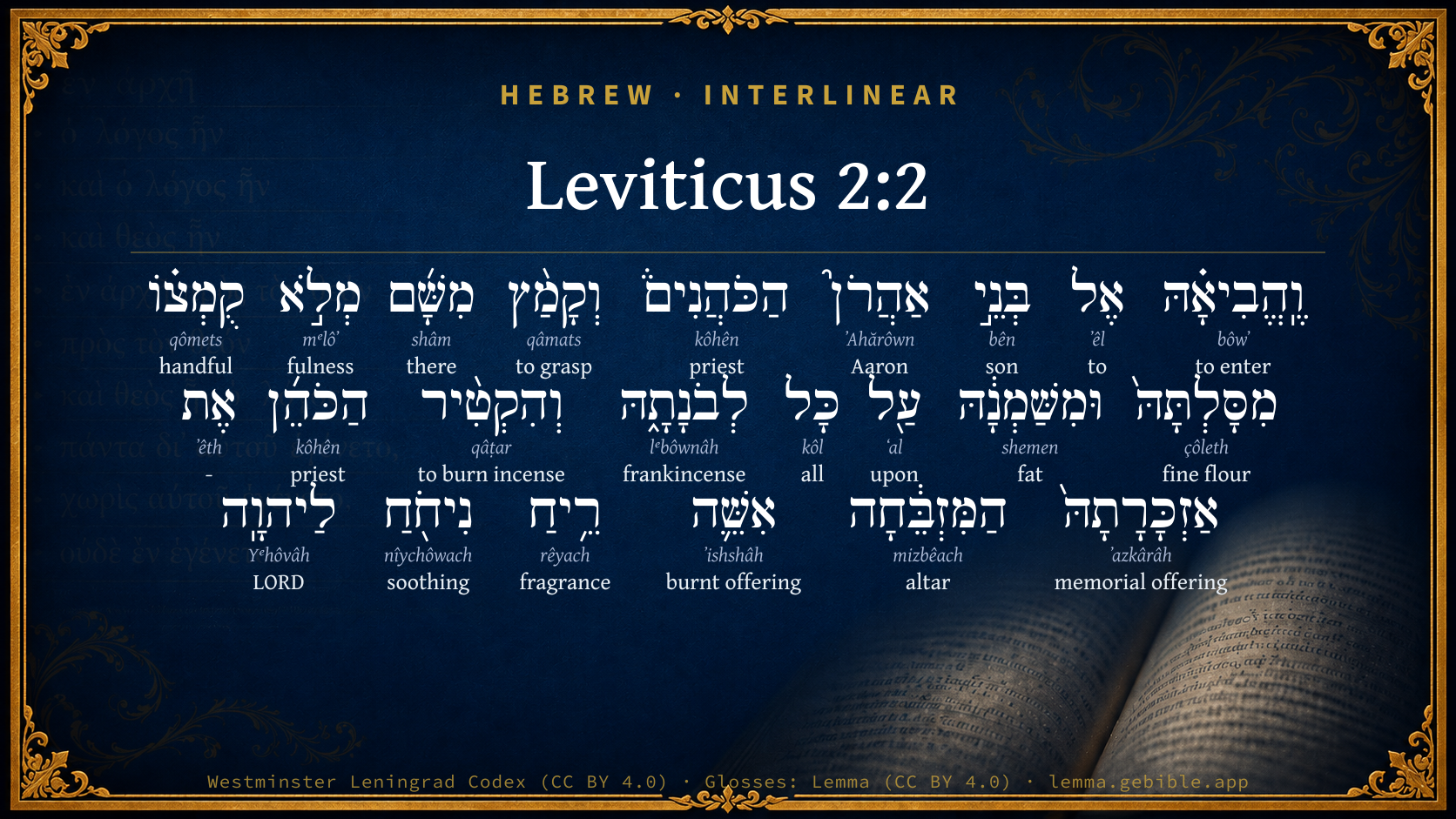
Leviticus 2:2

Hebrew (Westminster Leningrad Codex) Leviticus 2:2 appears in the Hebrew Old Testament. The text above is from the Westminster Leningrad Codex. Each word links to its Strong’s number, a concise gloss, and parsing drawn from the Open Scriptures Hebrew Bible morphology. Click any word for its full Brown-Driver-Briggs (BDB) entry.
Download image
Cite this verse

Leviticus 2:2 (World English Bible). Public Domain. Lemma interlinear Bible study tool, https://lemma.gebible.app/v/leviticus/2/2.

Show BibTeX & RIS
BibTeX
RIS
English Translation
He shall bring it to Aaron's sons the priests; and he shall take his handful of its fine flour, and of its oil, with all its frankincense; and the priest shall burn the memorial of it on the altar, an offering made by fire, of a sweet savor to Yahweh.
World English Bible · Public Domain
Highlights
  • 2 first appearances in the Hebrew Bible
Full analysis ↓
Download a study sheet

One document with this verse’s original text, its word-by-word gloss line, the meaning frame, cross-references with their text, attributed commentary, and full source and license credits — printable, and it pastes into notes with its structure intact.

This verse Autodidact and up

Study sheet (.html) Plain text (.txt)

A passage Seminary Student

Up to 50 verses in one chapter. A passage sheet keeps up to 6 commentary sources and 12 cross-references per verse, in the order this page ranks them, and says so on the sheet whenever that leaves anything out. Ask for a single verse and you get the Autodidact verse sheet above.

Everything on this page stays free to read, with no account — the sheet is a download of what is already on screen, not access to it.

Want to remove ads? Support Godless Engineer
Compare translations 3

The same verse in 3 English versions, stacked beneath the original-language interlinear above. Click any original word for its lexicon entry.

Each is an independent rendering of the whole verse — the interlinear is not word-aligned to these translations.

Highlighted words mark where these versions differ — a whole-verse word diff, not a word-by-word alignment.

  • World English Bible Public Domain
    He shall bring it to Aaron's sons the priests; and he shall take his handful of its fine flour, and of its oil, with all its frankincense; and the priest shall burn the memorial of it on the altar, an offering made by fire, of a sweet savor to Yahweh.
  • King James Version Public Domain
    And he shall bring it to Aaron's sons the priests: and he shall take thereout his handful of the flour thereof, and of the oil thereof, with all the frankincense thereof; and the priest shall burn the memorial of it upon the altar, to be an offering made by fire, of a sweet savor unto the LORD:
  • unfoldingWord Literal Text CC BY-SA 4.0
    And he shall bring it to the sons of Aaron, the priests, and he shall grab from there, the fullness of his handful, some of its flour and some of its oil, in addition to all its incense. And the priest shall cause its memorial portion to become smoke on the altar, a gift, a scent of pleasing to Yahweh.

unfoldingWord Literal Text — © unfoldingWord, licensed CC BY-SA 4.0. Word-aligned USFM3 via Door43 (git.door43.org/unfoldingWord/en_ult).

Versions to compare (up to 4)

3 of 4 selected

Show all 18 translations

Every available English version of this verse, each an independent rendering of the whole verse.

  • World English Bible Public Domain
    He shall bring it to Aaron's sons the priests; and he shall take his handful of its fine flour, and of its oil, with all its frankincense; and the priest shall burn the memorial of it on the altar, an offering made by fire, of a sweet savor to Yahweh.
  • Berean Standard Bible Public Domain
    and bring it to Aaron’s sons the priests. The priest shall take a handful of the flour and oil, together with all the frankincense, and burn this as a memorial portion on the altar, an offering made by fire, a pleasing aroma to the LORD.
  • Majority Standard Bible Public Domain
    and bring it to Aaron’s sons the priests. The priest shall take a handful of the flour and oil, together with all the frankincense, and burn this as a memorial portion on the altar, a food offering, a pleasing aroma to the LORD.
  • King James Version Public Domain
    And he shall bring it to Aaron's sons the priests: and he shall take thereout his handful of the flour thereof, and of the oil thereof, with all the frankincense thereof; and the priest shall burn the memorial of it upon the altar, to be an offering made by fire, of a sweet savor unto the LORD:
  • American Standard Version (1901) Public Domain
    and he shall bring it to Aaron's sons the priests; and he shall take thereout his handful of the fine flour thereof, and of the oil thereof, with all the frankincense thereof; and the priest shall burn `it as' the memorial thereof upon the altar, an offering made by fire, of a sweet savor unto Jehovah:
  • Revised Version (1885) Public Domain
    and he shall bring it to Aaron’s sons the priests: and he shall take thereout his handful of the fine flour thereof, and of the oil thereof, with all the frankincense thereof; and the priest shall burn it as the memorial thereof upon the altar, an offering made by fire, of a sweet savour unto the LORD:
  • Geneva Bible (1599) Public Domain
    And shall bring it vnto Aarons sonnes the Priestes, and he shall take thence his handfull of the flowre, and of the oyle with al the incense, and the Priest shall burne it for a memoriall vpon the altar: for it is an offering made by fire for a sweete sauour vnto the Lord.
  • Douay-Rheims (1899) Public Domain
    And shall bring it to the sons of Aaron the priests: and one of them shall take a handful of the flour and oil, and all the frankincense, and shall put it a memorial upon the altar for a most sweet savour to the Lord.
  • Young's Literal Translation Public Domain
    and he hath brought it in unto the sons of Aaron, the priests, and he hath taken from thence the fulness of his hand of its flour and of its oil, besides all its frankincense, and the priest hath made perfume with its memorial on the altar, a fire-offering of sweet fragrance to Jehovah;
  • Literal Standard Version CC BY-SA 4.0
    and he has brought it to the sons of Aaron, the priests, and one [of the priests] has taken from there the fullness of his hand of its flour and of its oil, besides all its frankincense, and the priest has made incense with its memorial on the altar, a fire-offering of refreshing fragrance to YHWH;
  • Unlocked Literal Bible CC BY-SA 4.0
    He is to take the offering to Aaron's sons the priests, and there the priest will take out a handful of the fine flour with the oil and the incense on it. Then the priest will burn the offering on the altar as a representative offering. It will produce a sweet aroma for Yahweh; it will be an offering made to him by fire.
  • unfoldingWord Literal Text CC BY-SA 4.0
    And he shall bring it to the sons of Aaron, the priests, and he shall grab from there, the fullness of his handful, some of its flour and some of its oil, in addition to all its incense. And the priest shall cause its memorial portion to become smoke on the altar, a gift, a scent of pleasing to Yahweh.
  • Darby Bible Public Domain
    And he shall bring it to Aaron's sons, the priests; and he shall take thereout his handful of the flour thereof, and of the oil thereof, with all the frankincense thereof; and the priest shall burn the memorial thereof on the altar, an offering by fire to Jehovah of a sweet odour.
  • World Messianic Bible Public Domain
    He shall bring it to Aaron’s sons, the priests. He shall take his handful of its fine flour, and of its oil, with all its frankincense, and the priest shall burn its memorial on the altar, an offering made by fire, of a pleasant aroma to the LORD.
  • Webster's Bible Public Domain
    And he shall bring it to Aaron's sons the priests: and he shall take out of it his handful of its flour, and of its oil, with all its frankincense; and the priest shall burn the memorial of it upon the altar, to be an offering made by fire, of a sweet savor to the LORD:
  • Free Bible Version CC BY-SA 4.0
    and take it to Aaron's sons the priests. The priest shall take a handful of the flour and olive oil mixture, as well as all the frankincense, and burn this as a ‘reminder part’ on the altar, a food offering, to be accepted by the Lord.
  • Bible in Basic English Public Domain
    And let him take it to Aaron's sons, the priests; and having taken in his hand some of the meal and of the oil, with all the perfume, let him give it to the priest to be burned on the altar, as a sign, an offering made by fire, for a sweet smell to the Lord.
  • JPS Tanakh (1917) Public Domain
    And he shall bring it to Aaron's sons the priests; and he shall take thereout his handful of the fine flour thereof, and of the oil thereof, together with all the frankincense thereof; and the priest shall make the memorial-part thereof smoke upon the altar, an offering made by fire, of a sweet savour unto the LORD.

Literal Standard Version (2020), Covenant Press — licensed CC BY-SA 4.0. Text via the HelloAO Bible API (eBible.org). Unlocked Literal Bible (unfoldingWord) — licensed CC BY-SA 4.0. Text via the HelloAO Bible API (eBible.org). unfoldingWord Literal Text — © unfoldingWord, licensed CC BY-SA 4.0. Word-aligned USFM3 via Door43 (git.door43.org/unfoldingWord/en_ult). Free Bible Version, Dr. Jonathan Gallagher — licensed CC BY-SA 4.0. Text via the HelloAO Bible API (eBible.org).

Word by word

More ways to search: Search by grammar → Find every occurrence → Compare this word →

Practice this passage: Drill this verse → Learn its vocabulary →

וְקָמַ֨ץ
qâmats
H7061
“and · to grasp”
Conjunction + Verb, Qal, Sequential Perfect, 3rd Person, Masculine, Singular
Part of Speech
Conjunction + Verb
Stem
Qal
Form
Sequential Perfect
Person
3rd Person
Gender
Masculine
Number
Singular
Full BDB Definition

Origin: a primitive root

TWOT: 2036

(Qal) to grasp, enclose with the hand, take a handful
  1. וֶֽהֱבִיאָ֗הּ bôwʼ H935 “and · to enter · her” Conjunction + Verb, Hiphil, Sequential Perfect, 3rd Person, Masculine, Singular + Suffix, Personal, 3rd Person, Feminine, Singular
  2. אֶל ʼêl H413 “to” Preposition
  3. בְּנֵ֣י bên H1121 “sons of” Noun, Common, Masculine, Plural, Construct
  4. אַהֲרֹן֮ ʼAhărôwn H175 “Aaron” Noun, Proper
  5. הַכֹּהֲנִים֒ kôhên H3548 “the · priests” Particle, Definite Article + Noun, Common, Masculine, Plural, Absolute
  6. מִשָּׁ֜ם shâm H8033 “from · there” Preposition + Adverb
  7. מְלֹ֣א mᵉlôʼ H4393 “fulness of” Noun, Common, Masculine, Singular, Construct
  8. קֻמְצ֗וֹ qômets H7062 “handful · his” Noun, Common, Masculine, Singular, Construct + Suffix, Personal, 3rd Person, Masculine, Singular
  9. מִסָּלְתָּהּ֙ çôleth H5560 “from · fine flour · her” Preposition + Noun, Common, Feminine, Singular, Construct + Suffix, Personal, 3rd Person, Feminine, Singular
  10. וּמִשַּׁמְנָ֔הּ shemen H8081 “and · from · fat · her” Conjunction + Preposition + Noun, Common, Masculine, Singular, Construct + Suffix, Personal, 3rd Person, Feminine, Singular
  11. עַ֖ל ʻal H5921 “upon” Preposition
  12. כָּל kôl H3605 “all of” Noun, Common, Masculine, Singular, Construct
  13. לְבֹנָתָ֑הּ lᵉbôwnâh H3828 “frankincense · her” Noun, Common, Feminine, Singular, Construct + Suffix, Personal, 3rd Person, Feminine, Singular
  14. וְהִקְטִ֨יר qâṭar H6999 “and · to burn incense” Conjunction + Verb, Hiphil, Sequential Perfect, 3rd Person, Masculine, Singular
  15. הַכֹּהֵ֜ן kôhên H3548 “the · priest” Particle, Definite Article + Noun, Common, Masculine, Singular, Absolute
  16. אֶת ʼêth H853 “-” Particle, Direct Object
  17. אַזְכָּרָתָהּ֙ ʼazkârâh H234 “memorial offering · her” Noun, Common, Feminine, Singular, Construct + Suffix, Personal, 3rd Person, Feminine, Singular
  18. הַמִּזְבֵּ֔חָה mizbêach H4196 “the · altar · toward” Particle, Definite Article + Noun, Common, Masculine, Singular, Absolute + Suffix, Demonstrative
  19. אִשֵּׁ֛ה ʼishshâh H801 “burnt offering of” Noun, Common, Masculine, Singular, Construct
  20. רֵ֥יחַ rêyach H7381 “fragrance of” Noun, Common, Masculine, Singular, Construct
  21. נִיחֹ֖חַ nîychôwach H5207 “soothing” Noun, Common, Masculine, Singular, Absolute
  22. לַיהוָֽה Yᵉhôvâh H3068 “to/for · LORD” Preposition + Noun, Proper

About this verse

These counts appear in no published source. They are computed here, from the morphology-tagged text and Lemma’s own curated glosses. What Lemma adds →

23
words
22
distinct lemmas
Pentateuch
section

Notable vocabulary

The rarest word here is וְקָמַ֨ץ to grasp H7061 — appearing just 3 times in the whole Hebrew Bible.

First appearance in Scripture

These words make their first canonical appearance in the Hebrew Bible here:

  • וְקָמַ֨ץ to grasp H7061
  • אַזְכָּרָתָהּ֙ memorial offering H234

Shared distinctive vocabulary

וְקָמַ֨ץ to grasp H7061 occurs in 3 verses of the Hebrew Bible. Also found in:

Grammatical profile

  • 3 verbs
  • 16 nouns
  • 2 prepositions
  • 1 adverb
  • 1 particle

Verb forms

  • וֶֽהֱבִיאָ֗הּ Hiphil · Sequential Perfect
  • וְקָמַ֨ץ Qal · Sequential Perfect
  • וְהִקְטִ֨יר Hiphil · Sequential Perfect

Repetition

A word recurs within this verse — often emphatic in Hebrew:

  • הַכֹּהֲנִים֒ priest H3548 ×2

Hebrew & Septuagint length

In English translation the verse runs 50 words from the Hebrew and 54 from the Septuagint (LXX English) — closely comparable.

A rough comparison of the two English renderings, which tokenize alike — not a word-level alignment.

Word counts can differ between the Hebrew and the Greek without any difference in meaning — e.g. the Hebrew direct-object marker אֵת has no separate Greek word, and Greek often adds the article ὁ.

In the original languages it is 23 Hebrew tokens and 41 Greek tokens — but the two are counted differently (Hebrew bundles its prefixes and suffixes into one token; the Greek is in lemma form), so that isn’t a like-for-like length.

Cross-references

11

Topical passages linked to Leviticus 2:2 in the Treasury of Scripture Knowledge — connected by theme and wording, ordered by reader-vote popularity; previews shown in the World English Bible.

  • Leviticus 5:12 He shall bring it to the priest, and the priest shall take his handful of it as the memorial portion, and burn it on the altar, on the offerings of Yahweh made by fire. It is a sin offering.
  • Leviticus 6:15 He shall take from there his handful of the fine flour of the meal offering, and of its oil, and all the frankincense which is on the meal offering, and shall burn it on the altar for a sweet savor, as its memorial, to Yahweh.
  • Acts 10:4 He, fastening his eyes on him, and being frightened, said, "What is it, Lord?" He said to him, "Your prayers and your gifts to the needy have gone up for a memorial before God.
  • Leviticus 2:9 The priest shall take from the meal offering its memorial, and shall burn it on the altar, an offering made by fire, of a sweet savor to Yahweh.
  • Leviticus 24:7 You shall put pure frankincense on each row, that it may be to the bread for a memorial, even an offering made by fire to Yahweh.
  • Leviticus 2:16 The priest shall burn as its memorial, part of its bruised grain, and part of its oil, along with all its frankincense: it is an offering made by fire to Yahweh.
  • Isaiah 66:3 He who kills an ox is as he who kills a man; he who sacrifices a lamb, as he who breaks a dog's neck; he who offers an offering, [as he who offers] pig's blood; he who burns frankincense, as he who blesses an idol. Yes, they have chosen their own ways, and their soul delights in their abominations:
  • Exodus 30:16 You shall take the atonement money from the children of Israel, and shall appoint it for the service of the tent of meeting; that it may be a memorial for the children of Israel before Yahweh, to make atonement for your souls."
  • Numbers 5:18 The priest shall set the woman before Yahweh, and let the hair of the woman's head go loose, and put the meal offering of memorial in her hands, which is the meal offering of jealousy. The priest shall have in his hand the water of bitterness that brings a curse.
  • Nehemiah 13:14 Remember me, my God, concerning this, and don't wipe out my good deeds that I have done for the house of my God, and for the observances of it.
  • Nehemiah 13:22 I commanded the Levites that they should purify themselves, and that they should come and keep the gates, to sanctify the Sabbath day. Remember to me, my God, this also, and spare me according to the greatness of your loving kindness.

Cross-references courtesy of OpenBible.info (CC BY 4.0).

Hebrew and Greek witnesses Masoretic Hebrew ↔ Greek Septuagint

The same verse in the two great witnesses to the Old Testament, shown verse-for-verse.

These are two independent witnesses, not word-aligned to each other, and the Septuagint is shown in lemma (dictionary) form.

Hebrew Leviticus 2:2 Masoretic · Westminster Leningrad Codex

וֶֽהֱבִיאָ֗הּ אֶל בְּנֵ֣י אַהֲרֹן֮ הַכֹּהֲנִים֒ וְקָמַ֨ץ מִשָּׁ֜ם מְלֹ֣א קֻמְצ֗וֹ מִסָּלְתָּהּ֙ וּמִשַּׁמְנָ֔הּ עַ֖ל כָּל לְבֹנָתָ֑הּ וְהִקְטִ֨יר הַכֹּהֵ֜ן אֶת אַזְכָּרָתָהּ֙ הַמִּזְבֵּ֔חָה אִשֵּׁ֛ה רֵ֥יחַ נִיחֹ֖חַ לַיהוָֽה

He shall bring it to Aaron's sons the priests; and he shall take his handful of its fine flour, and of its oil, with all its frankincense; and the priest shall burn the memorial of it on the altar, an offering made by fire, of a sweet savor to Yahweh.

World English Bible · Public Domain

Greek LXX Leviticus 2:2 Septuagint · lemma form

καί φέρω πρός ὁ υἱός ἀαρών ὁ ἱερεύς καί δράσσομαι ἀπό αὐτός πλήρης ὁ δράξ ἀπό ὁ σεμίδαλις σύν ὁ ἔλαιον καί πᾶς ὁ λίβανος αὐτός καί ἐπιτίθημι ὁ ἱερεύς ὁ μνημόσυνον αὐτός ἐπί ὁ θυσιαστήριον θυσία ὀσμή εὐωδία ὁ κύριος

And he shall bring it to the priests the sons of Aaron: and having taken from it a handful of the fine flour with the oil, and all its frankincense, then the priest shall put the memorial of it on the altar: it is a sacrifice, an odour of sweet savor to the Lord.

LXX2012 (modern English Septuagint) · Public Domain

On this verse, The Cambridge Bible for Schools and Colleges discusses the Septuagint’s reading. Read the note in Commentary ↓

Hebrew: Westminster Leningrad Codex (CC BY 4.0). Greek: Septuagint (public domain); English from LXX2012 (modern English Septuagint) (Public Domain). How the Septuagint differs from the Hebrew →

Targum (Aramaic paraphrase)

2

The Targum is the ancient Jewish Aramaic paraphrase of the Hebrew Scriptures — an interpretive translation, not the Hebrew text itself. Onkelos (literal) and Pseudo-Jonathan (expansive) render the Torah, and Jonathan the Prophets. Coverage is partial: where no permissively-licensed English translation exists for a verse, only the Aramaic is shown. This is verse-level text, not a word-by-word alignment to the Hebrew. Some Onkelos verses here show an unreviewed machine translation (clearly flagged), not a published edition.

  1. Targum Onkelos Torah (Genesis–Deuteronomy)
    וְיַיְתִינָהּ לְוַת בְּנֵי אַהֲרֹן כַּהֲנַיָא וְיִקְמוֹץ מִתַּמָן מְלֵי קוּמְצְיהּ מִסִלְתָּהּ וּמִמִשְׁחָהּ עַל כָּל לְבוֹנְתָּהּ וְיַסֵק כַּהֲנָא יָת אַדְכַּרְתָּהּ לְמַדְבְּחָא קוּרְבַּן דְמִתְקַבֵּל בְּרַעֲוָא קֳדָם יְיָ

    Unreviewed machine translation (Claude Sonnet 5) — not public domain confidence: high

    And he shall bring it to the sons of Aaron, the priests; and he shall take from there a handful of its fine flour and of its oil, together with all its frankincense; and the priest shall offer up its memorial portion upon the altar, an offering that is accepted with favor before the Lord.

    Generated by an AI translate-then-audit pipeline and checked against an independent public-domain English translation of the underlying Hebrew for drift only. Not a published edition; pending human review.

    Aramaic base: public-domain Targum Onkelos (via Sefaria). The English above is the unreviewed machine translation, not public domain.

  2. Targum Pseudo-Jonathan Torah (Genesis–Deuteronomy)
    וְיַיְתִינָהּ לְוַת בְּנֵי אַהֲרן כַּהֲנַיָא וְיִקְמוֹץ מִתַּמָן מְלֵי קוּמְצֵיהּ מִן קִמְחָא סְמִידָא וּמִן טוּב מִשְׁחָא עַל כָּל לְבוֹנְתָּא וְיַסִיק כַּהֲנָא יַת שְׁפַר אַדְכַּרְתָּא לְמַדְבְּחָא קָרְבָּנָא דְמִתְקַבֵּיל בְּרַעֲוָא קֳדָם יְיָ

    and bring it to the priests the sons of Aharon; and he shall take from thence his hand full of the meal and of the best of the oil, with all the frankincense; and the priest shall burn the goodly memorial at the altar, an oblation to be accepted with grace before the Lord.

    Targum Pseudo-Jonathan — Aramaic: “Targum Jonathan on Genesis” (public domain); “Targum Jonathan on Exodus” (public domain); “Targum Jonathan on Leviticus” (public domain); “Targum Jonathan on Numbers” (public domain); “Targum Jonathan on Deuteronomy” (public domain). English: “The Targum of Jonathan ben Uzziel, trans. J. W. Etheridge, London, 1862” (public domain). Text via Sefaria.

Commentary

Notes on Leviticus 2:2 from classic Christian and Jewish commentators (each source and its license shown beneath its notes). The classic Christian expositions comment on the surrounding passage and are grouped to its opening verse, so a note may address several verses; the Jewish commentaries on the Tanakh (Rashi and others) are per-verse, so they appear only where the commentator wrote on this verse.

Lemma curates 59 commentaries, every one of them public domain or Creative Commons licensed, each selected and text-cleaned for this edition rather than reprinted as found. About our sources →

Trapp's Complete Commentary

John Trapp

Lev 2:2 And he shall bring it to Aaron’s sons the priests: and he shall take thereout his handful of the flour thereof, and of the oil thereof, with all the frankincense thereof; and the priest shall burn the memorial of it upon the altar, [to be] an offering made by fire, of a sweet savour unto the LORD:

Ver. 2. Shall burn the memorial of it.] Whereby God was reminded, as it were, of the party offering, and acknowledging all his store to be from God.

John Trapp, A Commentary or Exposition upon All the Books of the Old and New Testament (1647–1656) — public domain. Text from a community e-Sword module.

Joseph Benson's Commentary

Lev 2:2. He shall take — That priest to whom he brought it, and who is appointed to offer it. The memorial — That part thus selected and offered; which is called a memorial, either, 1st, To the offerer, who by offering this part was reminded, that the whole of that which he brought, and of all which he had of that kind, was God’s, to whom this part was paid as an acknowledgment. Or, 2d, To God, whom (to speak after the manner of men) this did put in mind of his gracious covenant and promises of favour, and acceptance of the offerer and his offering. A sweet savour unto the Lord — And so are our spiritual offerings, which are made by the fire of holy love, particularly that of alms-giving. With such sacrifices God is well pleased.

Joseph Benson's Commentary on the Old and New Testaments (1811–1818) — public domain. Text from a community e-Sword module.

Tyndale Open Study Notes

Tyndale Open Resources

2:2 The representative portion of the grain offering was burned on the altar to remind the worshiper that the whole offering belonged to God.

Tyndale Open Study Notes — © Tyndale Open Resources, licensed CC BY-SA 4.0. Text via the HelloAO Bible API.

Geneva Bible (1599)

Geneva Bible translators

The Priest.

To signify that God remembereth him that offereth.

Geneva Bible (1599) marginal notes — public domain. Text via Bolls.life.

Jamieson, Fausset & Brown

Robert Jamieson, A. R. Fausset & David Brown

shall burn the memorial--rather, "for a memorial"; that is, a part of it.

Jamieson, Fausset & Brown — Commentary Critical and Explanatory on the Whole Bible (1871) — public domain (CC PDM 1.0). Text via the HelloAO Bible API.

Adam Clarke's Commentary

Verse 2. His handful of the flour] This was for a memorial, to put God in mind of his covenant with their fathers, and to recall to their mind his gracious conduct towards them and their ancestors. Mr. Ainsworth properly remarks, "that there was neither oil nor incense offered with the sin and jealousy offerings; because they were no offerings of memorial, but such as brought iniquities to remembrance, which were neither gracious nor sweet-smelling before the Lord." Nu 5:15; Le 5:11.

In this case a handful only was burnt, the rest was reserved for the priest's use; but all the frankincense was burnt, because from it the priest could derive no advantage.

Adam Clarke's Commentary on the Bible (1810–1826) — public domain. Text from a community e-Sword/MySword module.

Ellicott's Commentary for English Readers

(2) And he shall take.—Better, And the priest shall take from it a handful of its flour and of its oil with all its frankincense, and this shall he burn as its memorial upon the altar, &c.

Memorial.—So called because it was designed to bring the worshipper into the grateful remembrance of God, and to remind him, as it were, of His promise to accept the service of His people rendered to Him in accordance with his command. Hence the declaration of the Psalmist, “the Lord remember all thine offerings, and accept thy burnt sacrifice” (Psa_20:4), and of the angel to Cornelius, “thy prayers and thy alms are come up for a memorial before God” (Act_10:4).

A Bible Commentary for English Readers, edited by Charles John Ellicott (1878–1897) — public domain. Text from a community e-Sword module.

The Cambridge Bible for Schools and Colleges

gen. ed. J. J. S. Perowne

2. and he shall take] The personal pronoun in the English version refers to the person who brings the offering, but the subject of the verb ‘take’ is the priest mentioned in the following clause (cp. Lev_2:9). Dillm. suggests that the words from ‘and he shall take’ to ‘all the frankincense thereof’ may be an addition describing the material of the ‘memorial’ in the next clause.

the memorial] Heb. ‘azkârah, an expression applied to a part of the Meal-Offering in this ch. and Lev_6:15; elsewhere Lev_5:12 (of the poor man’s Sin-Offering), Lev_24:7 (of the frankincense offered with the shewbread), and Num_5:26 only (cp. Sir_38:11; Sir_45:16). It is generally explained as an offering which puts God in remembrance (cp. ‘memorial’ in Act_10:4, where the Gk. word is the same as in LXX. of these passages), and it has been suggested that Psalms 38, 70, with their titles ‘to bring to remembrance,’ may be in some way connected with this ceremony (Berth. Bibl. Theol. d. A.T. ii. p. 67). Others prefer sweet smelling offering; cp. Dillm. note here, Isa_66:3 (see Skinner’s note in C.B.), and Hos_14:7.

The Cambridge Bible for Schools and Colleges (gen. ed. J. J. S. Perowne; Cambridge University Press, 1878–1918) — public domain. Text from a community e-Sword module.

John Gill's Exposition

And he shall bring it to Aaron's sons, the priests,.... And this is all that he did with it; he left it with the priest, who carried it to the altar, to the southwest horn of it (b): the order of bringing it, according to Maimonides (c), was this,"a man brings fine flour from his house in baskets of silver or of gold or of other kind of metals, in a vessel fit to be a ministering vessel; and if it is a meat offering of fine flour, he puts it into a ministering vessel, and sanctifies it in a ministering vessel;''then did what follows:

and he shall take thereout his handful of the flour thereof, and of the oil thereof; as mixed together: the Jews say (d), this was done with the right hand, which is very likely, that being generally used in this way: the Talmudists thus describe the manner in which the handful was taken; the priest stretched out his three fingers over the palm of his hand, and gathered the handful in the plate or pan, and parted it off with his thumb above, and with his little finger below; and this was the most difficult piece of service in the sanctuary (e): though Maimonides (f) rejects this notion of difficulty, and says it was done in the common way, in which men take up a handful of anything: but Bartenora says (g), it was not in the usual way, but much as before described: the priest put the sides of his fingers into the flour, and gathered the flour with the sides of his fingers within his hand, and took of the flour only three fingers' full, upon the palm of his hand, and no more; and that it might not be heaped or go out, he pared it off, above with his thumb, and below with his little finger; and this he affirms, according to the Gemara, and what his masters had taught him, was one of the hardest pieces of service in the sanctuary:

with all the frankincense thereof; this was not taken along with the handful of flour and oil; for if there was ever so small a quantity of frankincense in the handful it was not right (h); for the frankincense, when brought, was put on one side of the fine flour, and when the handful was taken, then that was taken altogether, and put upon it:

and the priest shall burn the memorial of it upon the altar: that is, he was to burn the handful of fine flour and oil with the frankincense, as a "memorial"; either to put the Lord in mind of his lovingkindness to his people, and of his covenant with them, and promises unto them, to which the allusion is, Psa 20:3 or to put the offerer in mind of the great sacrifice of Christ, who was to be offered for his sins, and to be a meat offering to him: this was the part the Lord had in this offering, and which related to his worship, as the word used sometimes signifies, as De Dieu has observed:

to be an offering made by fire, of a sweet savour unto the Lord; See Gill on Lev 1:9.

(b) T. Bab. Sotah, ib. & Meaachot, fol. 8. 2. (c) Hilchot Maaseh Hakorbanot, c. 13. sect. 12. (d) Misn. Menachot, c. 1. sect. 2. (e) T. Bab. Menachot, fol. 11. 1. (f) In Misn. Menachot, ib. (g) In ib. (h) Misn. ib. & Jarchi in loc.

John Gill's Exposition of the Whole Bible (1746–1763) — public domain (CC PDM 1.0). Text via the HelloAO Bible API.

Albert Barnes' Notes on the Bible

Better: “And he shall bring it to Aaron’s sons, the priests; and the (officiating) priest shall take from it,” etc.

Memorial - The regular name not only for the portion of the מנחה mı̂nchāh which was burned on the altar Lev 2:9, Lev 2:16; Lev 5:12; Lev 6:15; Num 5:26, but for the frankincense which was laid upon the showbread Lev 24:7. It is the word which is applied to the prayers and alms of Cornelius, Act 10:4.

Albert Barnes' Notes on the Bible (1834–1885) — public domain. Text from a community e-Sword/MySword module.

Haydock's Catholic Bible Commentary

Memorial. "To worship and celebrate the name of God." (Louis de Dieu.)

George Leo Haydock (1774–1849), Haydock's Catholic Family Bible and Commentary, 1859 edition — public domain. Excludes Psalms (Douay-Rheims chapter numbering differs from Protestant) and Deuterocanonical books (Catholic canon only).

Matthew Poole's English Annotations

He shall take, i.e. that priest to whom he brought it, and who is appointed to offer it.

The memorial of it; that part thus selected and offered; which is called a memorial, either,

1. To the offerer, who by offering this part is minded that the whole of that he brought, and of all which he hath of that kind, is God’s, to whom this part was paid as a quitrent or acknowledgment. Or,

2. To God, whom (to speak after the manner of men) this did put in mind of his gracious covenant, and promises of favour and acceptance of the offerer and his offering. See Exo 30:16; Lev 6:15; Num 5:26

Matthew Poole's English Annotations on the Holy Bible (1683–1685) — public domain. Text from a community e-Sword/MySword module.

Whedon's Commentary on the Bible

Daniel D. Whedon

2. The memorial — This is a sacrificial term peculiar to the bread offering. It is descriptive of either that which brings the offerer to the remembrance of God, or of that which brings God to the grateful recollection of the sacrificer. In the New Testament it is used in the former sense. See Mat_26:13; Act_10:4, notes. The same term is applied to the pure incense (in vases) set out with the showbread, (Lev_24:7,) and which, according to Josephus, was also burnt upon the altar.

Daniel D. Whedon (gen. ed.), Commentary on the Old and New Testaments (1874–1909) — public domain. Text from a community e-Sword module.

The Pulpit Commentary

He shall take there out his handful. This was the task of the priest. The handful that he took and burnt upon the altar has the technical and significative name of the memorial. It acted as a memorial before God, in the same way as Cornelius"s prayers and alms prayers and thine alms are come up for a memorial before God" (Act_10:4) being something which should cause God to think graciously of the offerer. The frankincense is not mixed with the flour and the oil and the salt, as a constituent element of the offering, but is placed upon them, and is all of it burnt in "the memorial," symbolizing the need of adding prayer to sacrifice, that the latter may be acceptable to God.

The Pulpit Commentary (1880–1919), ed. H.D.M. Spence-Jones & Joseph S. Exell — public domain. Text from a community e-Sword module.

John Wesley's Explanatory Notes

He shall take - That priest to whom he brought it, and who is appointed to offer it. The memorial - That part thus selected and offered; which is called a memorial, either

1. to the offerer, who by offering this part is minded, that the whole of that he brought, and of all which he hath of that kind, is God's to whom this part was paid as an acknowledgment. Or

2. to God, whom (to speak after the manner of men) this did put in mind of his gracious covenant and promises of favour, and acceptance of the offerer and his offering. A sweet savour unto the Lord - And so are our spiritual offerings, which are made by the fire of holy love, particularly that of almsgiving. With such sacrifices God is well-pleased.

John Wesley, Explanatory Notes Upon the Whole Bible (1754–1765) — public domain. Text via the GEBible commentary corpus.

Rashi

Rabbi Shlomo Yitzchaki (Rashi)

הכהנים וקמץ [AND HE SHALL BRING UNTO …] THE PRIESTS: AND HE SHALL TAKE A FISTFUL — from the קמיצה (the taking of the fistful) and onwards is the duty of the priesthood (Menachot 9a).

וקמץ משם AND HE SHALL TAKE A FISTFUL FROM THERE — from the place where the feel of the layman may stand; and this is stated in order to teach you that the קמיצה is valid at whatever place in the fore-court it is carried out, even in that eleven cubits) which are the area where the feet of the ordinary Israelites may tread (cf. Yoma 16b).

מלא קמצו HIS FISTFUL — One might think that it (the fist) may be full to overflowing — that it may burst through his fist and come out on every side! Scripture, however, states in another passage, (Leviticus 6:8) “and he shall take from it in his closed hand [some of the flour … and burn it on the altar)”, which shows that only that is fitted to be burnt which is within his closed hand. If, then, he has to take what is בקמצו, within his closed hand, one might assume that it may be defective (underfull)? Scripture, however, states here, מלא, “his full [closed hand]”. How then does he do it that it shall be neither overfull nor underfull? After placing his hand in the vessel containing the meal-offering he (the priest) bends his three fingers (those next to his thumb) at full length over on to the palm of his hand, removing with his thumb and little finger all the flour that shows outside these three fingers. This is the literal meaning that the word קמץ has in the Hebrew language (Sifra, Vayikra Dibbura d'Nedavah, Section 9 6; Menachot 11a; Yoma 47a).

‎ על כל לבנתה‎‎ [HIS FISTFUL OF FLOUR …] BESIDES ALL THE FRANKINCENSE — i. e. apart from all the frankincense shall his fist be full.

לבנתה והקטיר ITS FRANK-INCENSE. AND HE SHALL BURN — The frankincense too comes under the law of burning (cf. Sifra, Vayikra Dibbura d'Nedavah, Section 9 10).

מלא קמצו מסלתה ומשמנה [AND HE SHALL TAKE THEREOUT] HIS HANDFUL OF THE FLOUR THEREOF AND OF THE OIL THEREOF — Consequently if when he takes the handful of the flour a grain of salt (for salt was mingled with every offering; cf. v. 13) or a particle of frankincense comes into his hand with the flour it (the offering) is invalid (Sifra, Vayikra Dibbura d'Nedavah, Section 9 10; Menachot 6a).

אזכרתה THE MEMORIAL PORTION THEREOF — The handful of flour that is offered to the Most High God forms the memorial portion of the meal-offering, being that part of it through which the owner is remembered for good and for having caused satisfaction to the Lord.

Rashi on the Tanakh — English translations: “The Judaica Press complete Tanach with Rashi, translated by A. J. Rosenberg” (CC BY 4.0); “Pentateuch with Rashi's commentary by M. Rosenbaum and A.M. Silbermann, 1929-1934” (public domain); “The Metsudah Tanach series, Lakewood, N.J” (CC BY 4.0); and “The Book of Joshua, Metsudah Publications, 1997” (CC BY 4.0). Text via Sefaria.

Lesson kit

Teaching starters — assembled from the data on this page, not authored interpretation. Every prompt links to the verse data it draws on. Edit before teaching.

Leviticus, in the Pentateuch, opens this verse with 23 words (22 distinct Hebrew lemmas). Its most distinctive word is qâmats (“to grasp”). A historical commentator’s framing appears above. Read the whole chapter for the surrounding context.

Discussion questions

  1. The word qâmats carries the sense “to grasp.” How does it shape the verse?
  2. 2 words here appear for the first time in Scripture. What is being introduced at this debut?
  3. Leviticus 5:12 shares the word «to grasp» with this verse. How do the two illuminate each other?
  4. “priest” occurs 2× in this one verse. What is the effect of the repetition?
  5. These translations render this verse differently; the difference is in the English rendering, not the original. What questions does that raise?
  6. The verb «וֶֽהֱבִיאָ֗הּ» is Hiphil Sequential Perfect. How does its form color the action?
  7. Reading how Trapp's Complete Commentary and Joseph Benson's Commentary read this verse, where do the two commentators agree and where do they part?

Things to notice

Reading settings

Reading text

Shown beneath each verse's original-language words.

Old Testament
Old Testament edition

Read the OT as the Masoretic Hebrew (MT) or the Greek Septuagint (LXX).

English shown for the Greek Septuagint (in the Hebrew ↔ Greek comparison).

Comparing translations? Open the Compare panel on any verse page to stack up to four side by side.