Exodus 5:15

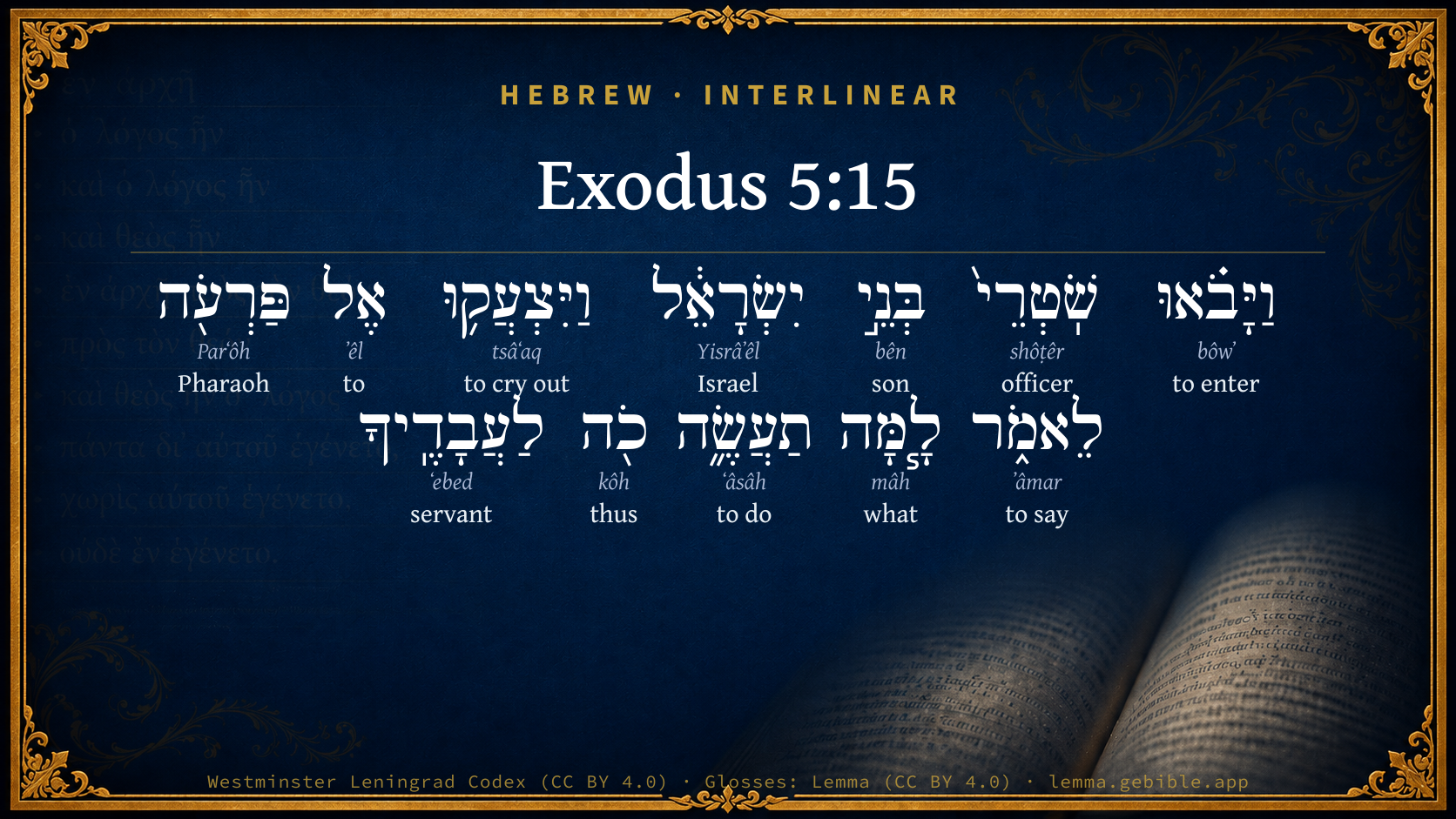
Hebrew (Westminster Leningrad Codex) Exodus 5:15 appears in the Hebrew Old Testament. The text above is from the Westminster Leningrad Codex. Each word links to its Strong’s number, a concise gloss, and parsing drawn from the Open Scriptures Hebrew Bible morphology. Click any word for its full Brown-Driver-Briggs (BDB) entry.
Download image
Cite this verse

Exodus 5:15 (World English Bible). Public Domain. Lemma interlinear Bible study tool, https://lemma.gebible.app/v/exodus/5/15.

Show BibTeX & RIS
BibTeX
RIS
English Translation
Then the officers of the children of Israel came and cried to Pharaoh, saying, "Why do you deal this way with your servants?
World English Bible · Public Domain
Download a study sheet

One document with this verse’s original text, its word-by-word gloss line, the meaning frame, cross-references with their text, attributed commentary, and full source and license credits — printable, and it pastes into notes with its structure intact.

This verse Autodidact and up

Study sheet (.html) Plain text (.txt)

A passage Seminary Student

Up to 50 verses in one chapter. A passage sheet keeps up to 6 commentary sources and 12 cross-references per verse, in the order this page ranks them, and says so on the sheet whenever that leaves anything out. Ask for a single verse and you get the Autodidact verse sheet above.

Everything on this page stays free to read, with no account — the sheet is a download of what is already on screen, not access to it.

Want to remove ads? Support Godless Engineer
Compare translations 3

The same verse in 3 English versions, stacked beneath the original-language interlinear above. Click any original word for its lexicon entry.

Each is an independent rendering of the whole verse — the interlinear is not word-aligned to these translations.

Highlighted words mark where these versions differ — a whole-verse word diff, not a word-by-word alignment.

  • World English Bible Public Domain
    Then the officers of the children of Israel came and cried to Pharaoh, saying, "Why do you deal this way with your servants?
  • King James Version Public Domain
    Then the officers of the children of Israel came and cried unto Pharaoh, saying, Wherefore dealest thou thus with thy servants?
  • unfoldingWord Literal Text CC BY-SA 4.0
    And the officers of the sons of Israel came in and cried to Pharaoh, saying, “Why are you doing this to your servants?

unfoldingWord Literal Text — © unfoldingWord, licensed CC BY-SA 4.0. Word-aligned USFM3 via Door43 (git.door43.org/unfoldingWord/en_ult).

Versions to compare (up to 4)

3 of 4 selected

Show all 18 translations

Every available English version of this verse, each an independent rendering of the whole verse.

  • World English Bible Public Domain
    Then the officers of the children of Israel came and cried to Pharaoh, saying, "Why do you deal this way with your servants?
  • Berean Standard Bible Public Domain
    So the Israelite foremen went and appealed to Pharaoh: “Why are you treating your servants this way?
  • Majority Standard Bible Public Domain
    So the Israelite foremen went and appealed to Pharaoh: “Why are you treating your servants this way?
  • King James Version Public Domain
    Then the officers of the children of Israel came and cried unto Pharaoh, saying, Wherefore dealest thou thus with thy servants?
  • American Standard Version (1901) Public Domain
    Then the officers of the children of Israel came and cried unto Pharaoh, saying, Wherefore dealest thou thus with thy servants?
  • Revised Version (1885) Public Domain
    Then the officers of the children of Israel came and cried unto Pharaoh, saying, Wherefore dealest thou thus with thy servants?
  • Geneva Bible (1599) Public Domain
    Then the officers of the children of Israel came, and cryed vnto Pharaoh, saying, Wherfore dealest thou thus with thy seruants?
  • Douay-Rheims (1899) Public Domain
    And the officers of the children of Israel came, and cried out to Pharao, saying: Why dealest thou so with thy servants?
  • Young's Literal Translation Public Domain
    And the authorities of the sons of Israel come in and cry unto Pharaoh, saying, `Why dost thou thus to thy servants?
  • Literal Standard Version CC BY-SA 4.0
    And the authorities of the sons of Israel come in and cry to Pharaoh, saying, “Why do you do thus to your servants?
  • Unlocked Literal Bible CC BY-SA 4.0
    So the Israelite foremen came to Pharaoh and cried out to him. They said, “Why are you treating your servants this way?
  • unfoldingWord Literal Text CC BY-SA 4.0
    And the officers of the sons of Israel came in and cried to Pharaoh, saying, “Why are you doing this to your servants?
  • Darby Bible Public Domain
    Then the officers of the children of Israel came and cried to Pharaoh, saying, Why dost thou deal thus with thy bondmen?
  • World Messianic Bible Public Domain
    Then the officers of the children of Israel came and cried to Pharaoh, saying, “Why do you deal this way with your servants?
  • Webster's Bible Public Domain
    Then the officers of the children of Israel came and cried to Pharaoh, saying, Why dealest thou thus with thy servants?
  • Free Bible Version CC BY-SA 4.0
    The Israelite supervisors went to Pharaoh to complain, saying, “Why are you treating us your servants like this?
  • Bible in Basic English Public Domain
    Then the responsible men of the children of Israel came to Pharaoh, protesting and saying, Why are you acting in this way to your servants?
  • JPS Tanakh (1917) Public Domain
    Then the officers of the children of Israel came and cried unto Pharaoh, saying: 'Wherefore dealest thou thus with thy servants?

Literal Standard Version (2020), Covenant Press — licensed CC BY-SA 4.0. Text via the HelloAO Bible API (eBible.org). Unlocked Literal Bible (unfoldingWord) — licensed CC BY-SA 4.0. Text via the HelloAO Bible API (eBible.org). unfoldingWord Literal Text — © unfoldingWord, licensed CC BY-SA 4.0. Word-aligned USFM3 via Door43 (git.door43.org/unfoldingWord/en_ult). Free Bible Version, Dr. Jonathan Gallagher — licensed CC BY-SA 4.0. Text via the HelloAO Bible API (eBible.org).

Word by word

More ways to search: Search by grammar → Find every occurrence → Compare this word →

Practice this passage: Drill this verse → Learn its vocabulary →

שֹֽׁטְרֵי֙
shôṭêr
H7860
“officer”
Verb, Qal, Participle Active, Masculine, Plural, Construct
Part of Speech
Verb
Stem
Qal
Form
Participle Active
Gender
Masculine
Number
Plural
State
Construct
Full BDB Definition

Origin: act part of an otherwise unused root probably meaning to write

TWOT: TWOT - 2374a

(Qal) official, officer
  1. וַיָּבֹ֗אוּ bôwʼ H935 “and · to enter” Conjunction + Verb, Qal, Sequential Imperfect, 3rd Person, Masculine, Plural
  2. בְּנֵ֣י bên H1121 “sons of” Noun, Common, Masculine, Plural, Construct
  3. יִשְׂרָאֵ֔ל Yisrâʼêl H3478 “Israel” Noun, Proper
  4. וַיִּצְעֲק֥וּ tsâʻaq H6817 “and · to cry out” Conjunction + Verb, Qal, Sequential Imperfect, 3rd Person, Masculine, Plural
  5. אֶל ʼêl H413 “to” Preposition
  6. פַּרְעֹ֖ה Parʻôh H6547 “Pharaoh” Noun, Proper
  7. לֵאמֹ֑ר ʼâmar H559 “to say” Preposition + Verb, Qal, Infinitive Construct
  8. לָ֧מָּה mâh H4100 “to/for · what” Preposition + Particle, Interrogative
  9. תַעֲשֶׂ֦ה ʻâsâh H6213 “to do” Verb, Qal, Imperfect, 2nd Person, Masculine, Singular
  10. כֹ֖ה kôh H3541 “thus” Adverb
  11. לַעֲבָדֶֽיךָ ʻebed H5650 “to/for · servants · your” Preposition + Noun, Common, Masculine, Plural, Construct + Suffix, Personal, 2nd Person, Masculine, Singular

About this verse

These counts appear in no published source. They are computed here, from the morphology-tagged text and Lemma’s own curated glosses. What Lemma adds →

12
words
12
distinct lemmas
Pentateuch
section

Notable vocabulary

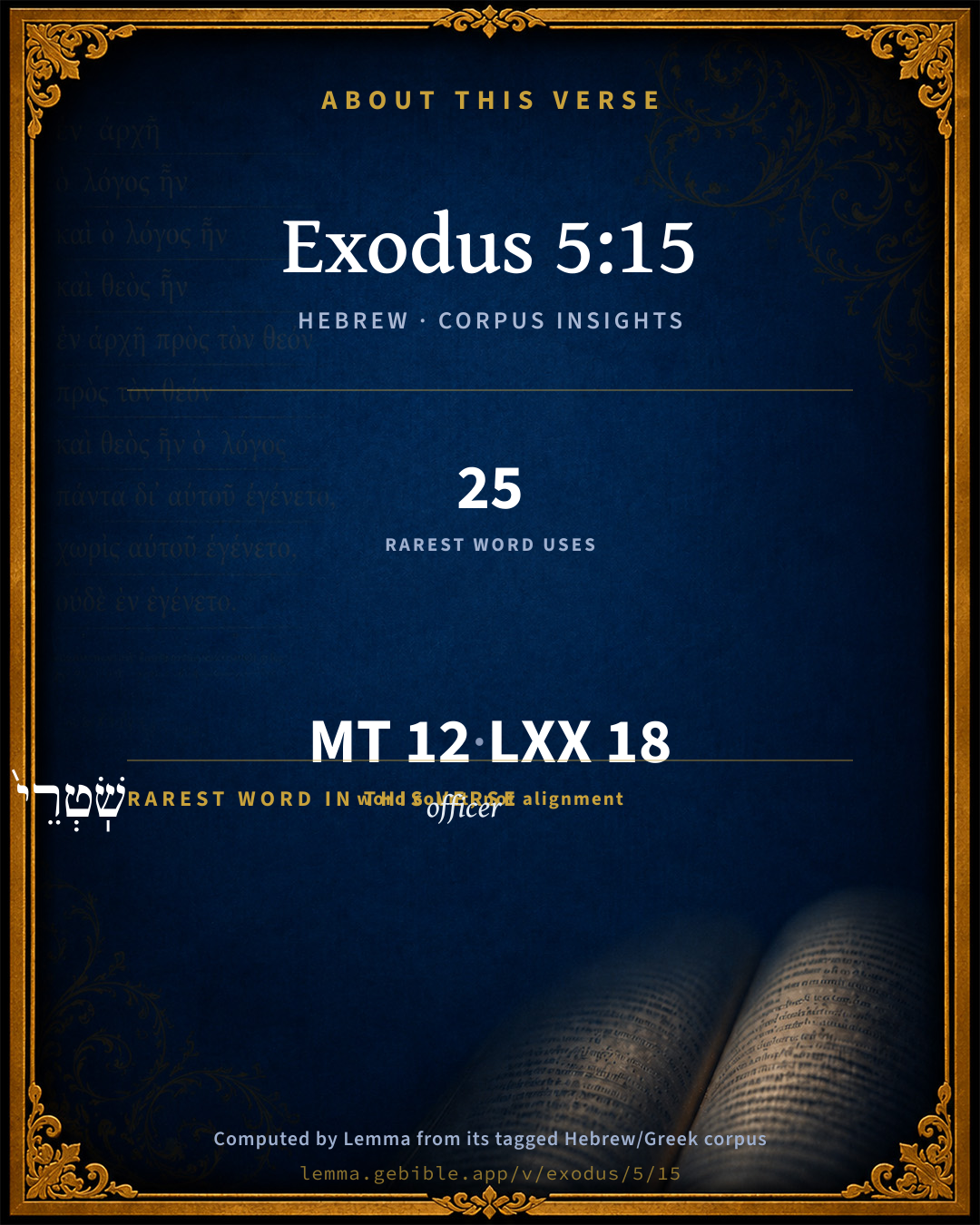
The rarest word here is שֹֽׁטְרֵי֙ officer H7860 — appearing just 25 times in the whole Hebrew Bible.

Shared distinctive vocabulary

שֹֽׁטְרֵי֙ officer H7860 occurs in 25 verses of the Hebrew Bible. Also found in:

Grammatical profile

  • 5 verbs
  • 4 nouns
  • 1 preposition
  • 1 adverb
  • 1 particle

Verb forms

  • וַיָּבֹ֗אוּ Qal · Sequential Imperfect
  • שֹֽׁטְרֵי֙ Qal · Participle Active
  • וַיִּצְעֲק֥וּ Qal · Sequential Imperfect
  • לֵאמֹ֑ר Qal · Infinitive Construct
  • תַעֲשֶׂ֦ה Qal · Imperfect

Hebrew & Septuagint length

In English translation the verse runs 23 words from the Hebrew and 23 from the Septuagint (LXX English) — the same length.

A rough comparison of the two English renderings, which tokenize alike — not a word-level alignment.

Word counts can differ between the Hebrew and the Greek without any difference in meaning — e.g. the Hebrew direct-object marker אֵת has no separate Greek word, and Greek often adds the article ὁ.

In the original languages it is 12 Hebrew tokens and 18 Greek tokens — but the two are counted differently (Hebrew bundles its prefixes and suffixes into one token; the Greek is in lemma form), so that isn’t a like-for-like length.

Hebrew and Greek witnesses Masoretic Hebrew ↔ Greek Septuagint

The same verse in the two great witnesses to the Old Testament, shown verse-for-verse.

These are two independent witnesses, not word-aligned to each other, and the Septuagint is shown in lemma (dictionary) form.

Hebrew Exodus 5:15 Masoretic · Westminster Leningrad Codex

וַיָּבֹ֗אוּ שֹֽׁטְרֵי֙ בְּנֵ֣י יִשְׂרָאֵ֔ל וַיִּצְעֲק֥וּ אֶל פַּרְעֹ֖ה לֵאמֹ֑ר לָ֧מָּה תַעֲשֶׂ֦ה כֹ֖ה לַעֲבָדֶֽיךָ

Then the officers of the children of Israel came and cried to Pharaoh, saying, "Why do you deal this way with your servants?

World English Bible · Public Domain

Greek LXX Exodus 5:15 Septuagint · lemma form

εἰςἔρχομαι δέ ὁ γραμματεύς ὁ υἱός ἰσραήλ καταβοάω πρός φαραώ λέγω ἵνα τίς οὕτως ποιέω ὁ σύ οἰκέτης

And the accountants of the children of Israel went in and cried to Pharao, saying, Why do you act thus to your servants?

LXX2012 (modern English Septuagint) · Public Domain

Hebrew: Westminster Leningrad Codex (CC BY 4.0). Greek: Septuagint (public domain); English from LXX2012 (modern English Septuagint) (Public Domain). How the Septuagint differs from the Hebrew →

Targum (Aramaic paraphrase)

2

The Targum is the ancient Jewish Aramaic paraphrase of the Hebrew Scriptures — an interpretive translation, not the Hebrew text itself. Onkelos (literal) and Pseudo-Jonathan (expansive) render the Torah, and Jonathan the Prophets. Coverage is partial: where no permissively-licensed English translation exists for a verse, only the Aramaic is shown. This is verse-level text, not a word-by-word alignment to the Hebrew.

  1. Targum Onkelos Torah (Genesis–Deuteronomy)
    וַאֲתוֹ סָרְכֵי בְּנֵי יִשְׂרָאֵל וּצְוָחוּ (קֳדָם) לְפַרְעֹה לְמֵימָר לְמָא תַעְבֵּד כְּדֵין לְעַבְדָיךְ:

    (no public-domain English translation for this verse)

    Targum Onkelos — Aramaic: “Onkelos Genesis” (public domain); “Onkelos Exodus” (public domain); “Onkelos Leviticus” (public domain); “Onkelos Numbers” (public domain); “Onkelos Deuteronomy” (public domain). English: “Sefaria Community Translation” (CC0 1.0 (public-domain dedication)); “J.W. Etheridge. The Targums of Onkelos and Jonathan Ben Uzziel on the Pentateuch. London: Longmans, Green, 1862” (public domain). Text via Sefaria.

  2. Targum Pseudo-Jonathan Torah (Genesis–Deuteronomy)
    וְאָתוֹ סַרְכֵי בְּנֵי יִשְרָאֵל וּצְוָוחוּ קֳדָם פַּרְעה לְמֵימַר לְמָא תַעֲבֵיד כְּדֵין לְעַבְדָךְ

    And the foremen came, and cried before Pharoh, saying, Why hast thou dealt thus with thy servants?

    Targum Pseudo-Jonathan — Aramaic: “Targum Jonathan on Genesis” (public domain); “Targum Jonathan on Exodus” (public domain); “Targum Jonathan on Leviticus” (public domain); “Targum Jonathan on Numbers” (public domain); “Targum Jonathan on Deuteronomy” (public domain). English: “The Targum of Jonathan ben Uzziel, trans. J. W. Etheridge, London, 1862” (public domain). Text via Sefaria.

Commentary

Notes on Exodus 5:15 from classic Christian and Jewish commentators (each source and its license shown beneath its notes). The classic Christian expositions comment on the surrounding passage and are grouped to its opening verse, so a note may address several verses; the Jewish commentaries on the Tanakh (Rashi and others) are per-verse, so they appear only where the commentator wrote on this verse.

Lemma curates 59 commentaries, every one of them public domain or Creative Commons licensed, each selected and text-cleaned for this edition rather than reprinted as found. About our sources →

Matthew Henry's Commentary

It was a great strait that the head-workmen were in, when they must either abuse those that were under them or be abused by those that were over them; yet, it should seem, rather than they would tyrannize, they would be tyrannized over; and they were so. In this evil case (Exo 5:19), observe,

I. How justly they complained to Pharaoh: They came and cried unto Pharaoh, Exo 5:15. Whither should they go with a remonstrance of their grievances but to the supreme power, which is ordained for the protection of the injured? As bad as Pharaoh was his oppressed subjects had liberty to complain to him; there was no law against petitioning: it was a very modest, but moving, representation that they made of their condition (Exo 5:16): Thy servants are beaten (severely enough, no doubt, when things were in such a ferment), and yet the fault is in thy own people, the task-masters, who deny us what is necessary for carrying on our work. Note, It is common for those to be most rigorous in blaming others who are most blameworthy themselves. But what did they get by this complaint? It did but make bad worse. 1. Pharaoh taunted them (Exo 5:17); when they were almost killed with working, he told them they were idle: they underwent the fatigue of industry, and yet lay under the imputation of slothfulness, while nothing appeared to ground the charge upon but this, that they said, Let us go and do sacrifice. Note, It is common for the best actions to be mentioned under the worst names; holy diligence in the best business is censured by many as a culpable carelessness in the business of the world. It is well for us that men are not to be our judges, but a God who knows what the principles are on which we act. Those that are diligent in doing sacrifice to the Lord will, with God, escape the doom of the slothful servant, though, with men, they do not. 2. He bound on their burdens: Go now and work. Exo 5:18. Note, Wickedness proceedeth from the wicked; what can be expected from unrighteous men but more unrighteousness?

II. How unjustly they complained of Moses and Aaron: The Lord look upon you, and judge, Exo 5:21. This was not fair. Moses and Aaron had given sufficient evidence of their hearty good-will to the liberties of Israel; and yet, because things succeed not immediately as they hoped, they are reproached as accessaries to their slavery. They should have humbled themselves before God, and taken to themselves the shame of their sin, which turned away good things from them; but, instead of this, they fly in the face of their best friends, and quarrel with the instruments of their deliverance, because of some little difficulties and obstructions they met with in effecting it. Note, Those that are called out to public service for God and their generation must expect to be tried, not only by the malicious threats of proud enemies, but by the unjust and unkind censures of unthinking friends, who judge only by outward appearance and look but a little way before them. Now what did Moses do in this strait? It grieved him to the heart that the event did not answer, but rather contradict, his expectation; and their upbraidings were very cutting, and like a sword in his bones; but, 1. He returned to the Lord (Exo 5:22), to acquaint him with it, and to represent the case to him: he knew that what he had said and done was by divine direction; and therefore what blame is laid upon him for it he considers as reflecting upon God, and, like Hezekiah, spreads it before him as interested in the cause, and appeals to him. Compare this with Jer 20:7-9. Note, When we find ourselves, at any time, perplexed and embarrassed in the way of our duty, we ought to have recourse to God, and lay open our case before him by faithful and fervent prayer. If we retreat, let us retreat to him, and no further. 2. He expostulated with him, Exo 5:22, Exo 5:23. He knew not how to reconcile the providence with the promise and the commission which he had received. "Is this God's coming down to deliver Israel? Must I, who hoped to be a blessing to them, become a scourge to them? By this attempt to get them out of the pit, they are but sunk the deeper into it." Now he asks, (1.) Wherefore hast thou so evil entreated this people? Note, Even when God is coming towards his people in ways of mercy, he sometimes takes such methods as that they may think themselves but ill treated. The instruments of deliverance, when they aim to help, are found to hinder, and that becomes a trap which, it was hoped, would have been for their welfare, God suffering it to be so that we may learn to cease from man, and may come off from a dependence upon second causes. Note, further, When the people of God think themselves ill treated, they should go to God by prayer, and plead with him, and that is the way to have better treatment in God's good time. (2.) Why is it thou hast sent me? Thus, [1.] He complains of his ill success: "Pharaoh has done evil to this people, and not one step seems to be taken towards their deliverance." Note, It cannot but sit very heavily upon the spirits of those whom God employs for him to see that their labour does no good, and much more to see that it does hurt eventually, though not designedly. It is uncomfortable to a good minister to perceive that his endeavours for men's conviction and conversion do but exasperate their corruptions, confirm their prejudices, harden their hearts, and seal them up under unbelief. This makes them go in the bitterness of their souls, as the prophet, Eze 3:14. Or, [2.] He enquires what was further to be done: Why hast thou sent me? that is, "What other method shall I take in pursuance of my commission?" Note, Disappointments in our work must not drive us from our God, but still we must consider why we are sent.

Matthew Henry's Commentary on the Whole Bible (1708–1710) — public domain (CC PDM 1.0). Text via the HelloAO Bible API.

Trapp's Complete Commentary

John Trapp

Exo 5:15 Then the officers of the children of Israel came and cried unto Pharaoh, saying, Wherefore dealest thou thus with thy servants?

Ver. 15. Came and cried unto Pharaoh.] They did not rail upon him to his face, as the Janizaries did {a} in an uproar upon Bajazet II, their prince, saying that they would by and by teach him, as a drunkard, a beast, and a rascal, to use his great place and calling with more sobriety and discretion. Neither did they go behind his back and call him, as Sanders did Queen Elizabeth, his natural sovereign, Lupam Anglicanam , the English wolf, or as Rhiston calleth her, leoenam, omnes Athalias, Macchas, Iezabeles, Herodiades, &c., superantem, a lioness worse than any Athalia, Maacha, Jezabel. A foul-mouthed Jesuit made this false anagram of her, Elizabeth, Jezabel. T is omitted; the presage of the gallows - whereon this anagrammatist was afterwards justly executed. Aretine, by a longer custom of libellous and contumelious speaking against princes, had got such a habit, that at last he came to diminish and disesteem God himself. {b}

{a} Turk. Hist., fol. 444.

{b} Rivetti Jesuita Vapulans, p. 263. Fuller’s Holy State, fol. 317.

John Trapp, A Commentary or Exposition upon All the Books of the Old and New Testament (1647–1656) — public domain. Text from a community e-Sword module.

The Biblical Illustrator

Joseph S. Exell

Exo_5:15-16

Wherefore dealest thou thus.

Lessons

1. Oppressed souls cannot but complain of cruel and unjust smitings; blows make cries.

2. Addresses for relief are fittest from the afflicted to the highest power oppressing.

3. Access and cries and sad speeches are forced from oppressed to oppressors.

4. The execution by instruments is justly charged upon their lords.

5. True servants may justly expostulate about hard dealings from their rulers.

6. Unreasonable exactions will force afflicted ones to expostulate with powers oppressing them (Exo_5:15).

7. To give no straw and to command bricks is a most unreasonable exaction.

8. To punish innocent servants when others sin is a most unjust oppression.

9. Such sad dealings make Gods servants sometimes to complain to earthly powers (Exo_5:16). (G. Hughes, B. D.)

Reasons required for moral conduct

I. There are times when men are required to give reasons for their method of moral conduct. Public opinion often calls a man to its tribunal. Sometimes men are the questioners. Sometimes God is the Questioner.

II. It is highly important that every man should be able to allege heavenly principles and motives as the basis of his conduct. Love to God and man is the only true and loyal principle and motive of human action, and only will sustain the scrutiny of infinite rectitude.

III. That a man who can allege heavenly principles as the basis of his conduct will be safe at any tribunal to which he may be called.

1. He will be safe at the tribunal of his own conscience.

2. He will be safe at the tribunal of Gods Book.

3. He will be safe at the tribunal of public opinion.

4. He will be safe at the final tribunal of the universe. (J. S. Exell, M. A.)

The expostulations of the slave

I. They expostulate that the means necessary to the accomplishment of their daily work were withheld. There is no straw given to thy servants.

II. They expostulate that they were brutally treated. Thy servants are beaten.

III. They expostulate that they were not morally culpable in their neglect of work. The fault is in thine own people. (J. S. Exell, M. A.)

The tyrant

1. Unreasonable in his demands.

2. Cruel in his resentment.

3. Mistaken in his judgment of guilt. (J. S. Exell, M. A.)

The true object of blame

Gotthold had a little dog, which, when placed before a mirror, became instantly enraged, and barked at its own linage. He remarked on the occasion: In general, a mirror serves as an excitement to self-love, whereas it stimulates this dog to anger against itself. The animal cannot conceive that the figure it sees is only its own reflection, but fancies that it is a strange dog, and therefore will not suffer it to approach its master. This may remind us of an infirmity of our depraved hearts. We often complain of others, and take offence at the things they do against us, without reflecting that, for the most part, the blame lies with ourselves.

The Biblical Illustrator, edited by Joseph S. Exell (c. 1880s–1900s) — public domain. Text from a community e-Sword module.

The Preacher's Complete Homiletical Commentary

Joseph S. Exell (gen. ed.)

MAIN HOMILETICS OF THE PARAGRAPH.—Exo_5:15-19

REQUIRING THE IMPOSSIBLE

I. That there are some people in society who strive to make those under them do the impossible. Pharaoh tried to make the Israelites do the impossible, when he commanded them to make bricks without providing them with straw. This demand of tyranny is heard to-day in our large factories and amongst our agricultural population.

1. All require men to do the impossible who wish them to work beyond their capabilities. Every man has a degree of capability for work peculiar to himself, and can only execute that kind of work in a given time, according to his own ability. To require more at his hands is to require the impossible. To require men to work beyond their physical strength is to require the impossible. Some employers have no regard for the physical manhood of those engaged in their service. They give the same amount of work alike to the strong and the weak, and expect it accomplished. The thin, pale countenances of many who are daily seen wending their way to our busy hives of industry are indices to sad tales of heart and home. They are overworked. They are sinking into the grave. How often is the buoyant life and energy of youth quenched, and almost extinguished, by toil in an overcrowded and illventilated office. All who require young men to prosecute their daily business under such conditions are, in effect, seeking the impossible. To require men to work beyond their intellectual ability is to require the impossible. There are hundreds of men in our country who occupy positions beyond the power of their mental ability to sustain happily, and with comfort to themselves. This is the case with many who indulge in large financial speculations; with many in the daily haunts of life who occupy a higher position than they are qualified for; and with many popular ministers. Those in authority over them, and an exacting public, are ever urging them to make bricks without straw. Hence their work becomes a burden and a sorrow. To require men to work beyond their moral energy is to require the impossible. There are some men of little souls and small sympathies who have great churches, and who have in their congregation men of large hearts. These large-hearted hearers get but little help in their sorrows and conflicts from their minister and his sermons; they ought not to expect otherwise, for even a minister cannot make brick without straw. How can a preacher give to his congregation the sympathies of an overflowing heart of love, when his soul is hardly large enough to contain even himself, when he is of cold temperament, logical in thought rather than deep in emotion. Never require your minister to do the impossible; to visit all the parish in a day, to know that people are ill when he has never been told, to attend half a dozen committees at the same hour, to lead a prayer-meeting when he is preaching elsewhere, or expect sympathy from him when he has none to give. If you have chosen him as your pastor, do not expect him to make bricks without straw.

2. All require men to do the impossible who wish them to work beyond their opportunity. Every man must have time, and a proper time, to do his work. He must not be expected to do two things at once. He must not be expected to work when nature requires that he should be in bed asleep. But men must not only have the opportunity of time in which to accomplish their work, but also the opportunity of place and means. Every workman should have a place adapted to his employment, and should be readily supplied with means whereby to carry it on. He should have a shed to make his bricks in, as well as straw to make them with.

3. Contemplate the method employed to get men to do the impossible. These methods are various. Some will condescend to flattery and cant to get men to do that for which they are totally unadapted. Others will use force and persecution.

(1.) They set taskmasters over us. To watch our conduct. To inspect our work. To insure our diligence. To augment our burden. To darken our sorrow. How many managers in our large factories, inspired by the tyrant spirit of their masters, act the part of these Egyptian officers. How many deacons in small churches are more like them than they are like Christ, who gave rest to the heavy ladened.

(2.) They abuse us. They say we are idle, and that even after we have made the best attempt within our power, to fall in with their unjust demands.

(3.) They mock our religious sentiment. “Therefore, ye say, let us go and do sacrifice unto the Lord.” They impeach our religious motives. They insinuate that we are hypocrites. These, then, are the ways and methods in which we are treated, when tyrants endeavour to compel us to do the impossible.

(4.) Some people will attempt to accomplish the impossible. It would seem that these Israelites did. They were scattered abroad, and went seeking stubble wherewith to make bricks. Never attempt to do what you cannot, either in response to the order of the tyrant or the smile of the flatterer. It will involve you in utter failure and distress at last, when you will get no sympathy from those who urged you to it. The world is full of men who are trying to do the impossible. They are trying to make wealth too fast, they are giving out energy they will never be able to repair.

II. That the people who strive to make those under them do the impossible are throwing society into an attitude of pain and complaint. “Then the officers of the Children of Israel came and cried unto Pharaoh, saying, wherefore dealest thou thus with thy servants?”

1. The requirement of the impossible tends to throw society into an attitude of pain. When men are required to do the impossible, their physical and moral energies are exhausted by what they know must be fruitless labour. Hence they become weary. They despair. Most of the social pain of our country is occasioned by tyrannic and covetous spirits, who are in haste to get rich out of the cheap and stern labour of those who are unfortunately in their service. National happiness is to a very large extent the outcome of a free and sympathetic employment of the working classes.

2. The requirement of the impossible tends to throw society into an attitude of complaint. When society is in pain, it is almost sure to render vocal its anguish in the language of complaint. Men feel, when they are required to do the impossible, that they are unjustly treated. And nothing will sooner give rise to complaint than a sense of injury and wrong. When society is complaining, it cannot be happy or prosperous. A tyrant king can destroy the very life of a nation. “Wherefore dealest thou thus with thy servants.”

1. Is it from the sheer motive of tyranny?

(2.) Is it as an additional assertion of authority since the demand of Moses and Aaron?

(3.) Is it with a cruel delight in our woe?

(4.) It certainly cannot be justified.

III. That the people who strive to make those under them do the impossible, and who throw society into an attitude of pain, are but little affected by the woe they occasion, and generally resent any mention of it to them. “Go therefore now, and work; for there shall no straw be given you, yet shall ye deliver the tale of bricks.”

1. Not withstanding the outcry of the oppressed the tyrant demands renewed work. “Go therefore now, and work.”

2. Notwithstanding the outcry of the oppressed, the tyrant adheres to his cruel measures. “There shall no straw be given you.”

3. Notwithstanding the outcry of the oppressed, the tyrant mocks their woe, and treats them with contempt. LESSONS:

1. Never require the impossible.

2. Never attempt the impossible.

3. Adapt methods to ends.

4. Cultivate kindly dispositions toward your employers.

SUGGESTIVE COMMENTS ON THE VERSES

REASONS REQUIRED FOR MORAL CONDUCT

Exo_5:15. “Wherefore dealest thou thus with thy servants.”

I. There are times when men are required to give reasons for their method of moral conduct. They have been oppressive in their conduct. They have to give a reason for their oppression. They have been dishonest, they have to give a reason for their deception. They have occasioned pain to others, and any man who gives pain to his fellow creature ought to be rigorously questioned about it. Public opinion often calls a man to its tribunal. Sometimes men are the questioners. Sometimes God is the Questioner. Kings are not exempt from these interrogations. The world will one day have to give a reason for its conduct at the solemn bar of God.

II. It is highly important that every man should be able to allege heavenly principles and motives as the basis of his conduct. Men must not rest their methods of conduct upon the dictate of their own pleasure, convenience, or arbitrary will, but upon the spiritual law of God. Revenge, envy, and selfishness are vile reasons for conduct, and will meet with severe retribution. Love to God and man is the only true and loyal principle and motive of human action, and only will sustain the scrutiny of infinite rectitude.

III. That a man who can allege heavenly principles as the basis of his conduct will be safe at any tribunal to which he may be called.

1. He will be safe at the tribunal of his own conscience.

2. He will be safe at the tribunal of God’s Book.

3. He will be safe at the tribunal of public opinion.

4. He will be safe at the final tribunal of the universe.

Oppressed souls cannot but complain of cruel and unjust smitings.

Addresses for relief are fittest from the afflicted to the highest power oppressing.

Access, cries, and sad speeches are forced from the oppressed to oppressors.

The execution by instruments is justly charged upon their Lord’s.

The Oppressor:—

1. He has often to give audience to his slaves.

2. He has to hear the cry of his slaves.

3. He has to listen to the complaint of his slaves.

4. He has to give a reason for his conduct to his slaves.

Exo_5:16. THE EXPOSTULATIONS OF THE SLAVE

I. They expostulate that the means necessary to the accomplishment of their daily work were withheld. “There is no straw given to thy servants.”

II. They expostulate that they were brutally treated. “Thy servants are beaten.”

III. They expostulate that they were not morally culpable in their neglect of work. “The fault is in thine own people”

True servants may justly expostulate about hard dealings from their rulers.

To give no straw and to command bricks is a most unreasonable exaction.

To punish innocent servants when others sin, is a most unjust oppression.

Such wicked dealings sometimes make God’s servants to complain to earthly powers.

The tyrant:—

1. Unreasonable in his demands.

2. Cruel in his resentment.

3. Mistaken in his judgment of guilt.

Exo_5:17-19. Cruel oppressors of God’s people are deaf to complaints.

Crimination, though false, instead of acceptation, is returned to the appeals of the oppressed by cruel powers.

Double labours are branded for idleness by unreasonable oppressors.

Persecutors do not only charge men but God, for making His people idle.

Inhuman persecutors drive the appealing oppressed out of their sight to work.

Cruel oppressors double their denial of help unto sad plaintiffs.

Complaints of exaction upon God’s servants are usually answered by adding more.

Cruel exactions of persecutors may make deep impressions upon God’s servants.

Good overseers are more afflicted when they see themselves forced to oppress the innocent.

The Preacher's Complete Homiletical Commentary (gen. ed. Joseph S. Exell; Funk & Wagnalls, c. 1892) — public domain (pre-1929). A full-Bible homiletical/sermon-outline anthology covering 65 of 66 books (2 John is absent from the source module). Text from a community e-Sword module.

Ellicott's Commentary for English Readers

(15) The officers . . . came and cried unto Pharaoh.—The Egyptian monarchs were accessible to all. It was a part of their duty to hear complaints personally; and they, for the most part, devoted to this employment the earlier hours of each day (see Herod. ii. 173;. Those who came to them generally cried to them for justice, as is the Oriental wont.

A Bible Commentary for English Readers, edited by Charles John Ellicott (1878–1897) — public domain. Text from a community e-Sword module.

The Cambridge Bible for Schools and Colleges

gen. ed. J. J. S. Perowne

15–19. The officers of the Israelites expostulate with the Pharaoh, but to no effect. Cf. Erman, 177 (a complaint of the absence of straw).

The Cambridge Bible for Schools and Colleges (gen. ed. J. J. S. Perowne; Cambridge University Press, 1878–1918) — public domain. Text from a community e-Sword module.

John Gill's Exposition

Then the officers of the children of Israel came and cried unto Pharaoh,.... Made their complaints to him, perhaps with tears in their eyes, being used so very ill. They little thought it was by Pharaoh's orders; they supposed he knew nothing of it, and therefore hoped to have their grievances redressed by him, but were mistaken:

saying, wherefore dealest thou thus with thy servants? so they call themselves, they living in his country, and being under his jurisdiction, though not properly his subjects; however, he had made them his slaves, and so indeed even bondservants.

John Gill's Exposition of the Whole Bible (1746–1763) — public domain (CC PDM 1.0). Text via the HelloAO Bible API.

Whedon's Commentary on the Bible

Daniel D. Whedon

15, 16. The Hebrew scribes come to Pharaoh and complain that they are beaten for not performing an impossible task. The monuments also give us pictures of labourers working under the stick, showing that it was customary for the superintendents to stimulate by blows. There is a papyrus, translated by M. Chabas, which relates the punishment of twelve labourers who failed to make up the required “tale of bricks.” The Egyptians had much confidence in the virtue of corporeal punishment.

Daniel D. Whedon (gen. ed.), Commentary on the Old and New Testaments (1874–1909) — public domain. Text from a community e-Sword module.

The Pulpit Commentary

Vers. 15-19. Smarting under the sense of injustice, the Israelite officers "came and cried to Pharaoh" (ver. 15), supposing that he could not have intended such manifest unfairness and cruelty. They were conscious to themselves of having done their utmost, and of having failed simply because the thing required was impossible. Surely the king would understand this, if they pointed it out, and would either allow straw as before, or diminish the number of the bricks. But the king had no desire for justice, and did not even pretend to it. He asked for no particulars, ordered no inquiry into the ground of complaint; but turned upon the complainants with the cuckoo cry idle yourselves else ye had no time to come here; go, work go, work." Then the officers felt that they were indeed "in evil case" (ver. 19) the king was determined not to do justice no hope remained they must be beaten again and again, until theydied of the punishment (ver. 21).

Came and cried. The shrill "cry" of Orientals when making complaint has often been noticed by travellers, and is probably here alluded to. To Pharaoh. See the "Introductory paragraph" at the beginning of the chapter, where it has been noticed that complainants had free access to the presence of Egyptian kings.

Vers. 15-18. A wicked man"s persistence in wrong-doing.

Pharaoh when he first gave the order to withhold straw (ver. 7), may not have known the amount of misery he was causing. He may have meant no more than to give the people full occupation, and so prevent such gatherings as that from which Moses and Aaron had come, (Exo_4:29-31) when they appeared before him with their demands. He may not have realised to himself the idea that he was setting his bondsmen an impossible task. But now this fact was brought home to him, and he was asked, as a matter of simple justice, either to let straw be furnished as before, or to allow some diminution in the number of the bricks. It can scarcely be doubted that he knew and felt the demand made to be just. There were the officers before him with the wheals upon their backs. Would they have incurred the severe punishment, could they by any possibility have avoided it? Pharaoh must have known that they would not.

But he would not relent. As he had begun, he would continue. He had been mere cruel than he meant; but he did not care it was only Hebrews and bondsmen who had suffered; what mattered their agonies? So he dismisses the complainants with jeers and scoffs: "Ye are idle, ye are hypocrites; go, work." So bad men almost always go on from bad to worse by a "facile descent;" severity deepens into cruelty, unkindness into injustice, religious indifference into impiety. Stop, then, the beginnings of wrong-doing. Principiis obsta. Crush the nascent germs of vice in thy heart, O man! Master them, or they will master thee!

HOMILIES BY J. ORR Vers. 15-20. Unheeded expostulation.

Pharaoh"s treatment of the officers of the children of Israel, when they appeared before him to expostulate with him on his cruelty, betrays his consciousness of the injustice of his cause.

I AN UNJUST CAUSE BETRAYS ITSELF.

1. By refusal to listen to reason. The Hebrews had reason on their side, and Pharaoh had not. And because he had not, and knew it, he would not hear them, would not enter into any argument with them. This is the sure mark of a weak cause. People are usually willing enough to defend any of their doings which they think defensible. But when causes are indefensible, and they know this, they do not care to have the light let in upon them. "Every one that doeth evil hateth the light, neither cometh to the light, lest his deeds should be reproved". (Joh_3:20)

2. By clutching at flimsy and trumped-up pretexts. "Ye are idle; ye are idle; therefore ye say," etc. (ver. 17). Pharaoh knew as well as any that they.were not idle, but it served his purpose to put forward this pretence.

3. By falling back in the end on the right of the strong hand (ver. 16). This is the tyrant"s unfailing resort. If he cannot argue, he can compel. If he cannot justify his courses, he can fall back upon his power to enforce submission. His might is his right. Pharaoh had the power, and he meant to use it, so the Israelites might save themselves the trouble of expostulating. This sort of authority, resting on force, without support in righteousness or reason, is necessarily precarious. It can, in the nature of things, only last so long as the power to compel remains with it. No throne is so insecure as that propped up on bayonets.

II AN UNJUST CAUSE ADHERED TO AND DEFENDED

1. Reacts injuriously upon the moral nature. The refusal to listen to expostulation was a new stage in Pharaoh"s hardening. Besides fortifying his determination to brook no interference in his courses, and strengthening the cruelty of his disposition anew called into action by the increased oppression of the Hebrews it necessarily reacted to deprive him of a fresh portion of his moral susceptibility. This is the Nemesis of sin; it leaves the sinner less susceptible with each new appeal that is resisted; it darkens while it indurates; not only strengthens him m evil courses, but increasingly disqualifies him for perceiving the truth and reasonableness of the dissuasives that are addressed to him. Pharaoh"s hardening still moves in the region of ordinary morals (see on vers. 1-4). The first step in it was the recoil of his pride and wilfulness against what he knew to be the righteous demand of Moses and Aaron. Another step is the rejection of this righteous appeal.

2. Exposes the tyrant to the just judgment of God. The Hebrews were helpless to resist Pharaoh, but there was Another, whose question, "Wherefore dealest thou thus with thy servants?" he would not be able so easily to set aside. God was keeping the account, and for all these things would yet call him to judgment; (Ecc_11:9 Ecc_12:14) while the king"s temporary success in his ways, building him up in a presumptuous selfconfidence, and confirming him in his boast of superiority to Jehovah, was a further step in his hardening a ripening for destruction.

3. Is a fresh call for God to interfere on behalf of the oppressed. This new wrong, instead of leading the Israelites to despair, should only have lent fresh vehemence to their prayers, for it gave them a new plea with which to urge their cause. "For shall not God avenge his own elect, which cry to him day and night, though he bear long with them". J.O. (Luk_18:7)

HOMILIES BY J. URQUHART Ver. Exo_6:1)

(1) This very failure shows God"s truth. (Exo_4:21)

(2) God shall fight for them: "Now shalt thou see what I will do to Pharaoh.

(3) Pharaoh"s wrath and power will serve only to make their deliverance perfect. He will "drive them out of his land." Israel found no consolation; Moses does. U.

The Pulpit Commentary (1880–1919), ed. H.D.M. Spence-Jones & Joseph S. Exell — public domain. Text from a community e-Sword module.

unfoldingWord translationNotes

Door43 World Missions Community

cried out

"complained"

they are still telling us, 'Make bricks!'

Here "they" refers to the Egyptian taskmasters.

translationWords

Pharaoh

servant

sacrifice

Yahweh

unfoldingWord translationNotes — © Distant Shores Media and the Door43 World Missions Community, licensed CC BY-SA 4.0. Source: git.door43.org/Door43/en_tn.

Lesson kit

Teaching starters — assembled from the data on this page, not authored interpretation. Every prompt links to the verse data it draws on. Edit before teaching.

Exodus, in the Pentateuch, opens this verse with 12 words (12 distinct Hebrew lemmas). Its most distinctive word is shôṭêr (“officer”). A historical commentator’s framing appears above. Read the whole chapter for the surrounding context.

Discussion questions

  1. The word shôṭêr carries the sense “officer.” How does it shape the verse?
  2. How does Exodus 5:6, which shares the word «officer», read alongside this verse?
  3. The translations on this page render this verse differently — a whole-verse word diff, not a word-by-word alignment. What might account for the different wordings?
  4. «וַיָּבֹ֗אוּ» is a Qal Sequential Imperfect verb. How does that grammatical form shape the action described?
  5. Compare how Matthew Henry's Commentary and Trapp's Complete Commentary read this verse. Where do they agree or differ?

Things to notice

Reading settings

Reading text

Shown beneath each verse's original-language words.

Old Testament
Old Testament edition

Read the OT as the Masoretic Hebrew (MT) or the Greek Septuagint (LXX).

English shown for the Greek Septuagint (in the Hebrew ↔ Greek comparison).

Comparing translations? Open the Compare panel on any verse page to stack up to four side by side.