2 Samuel 23:19

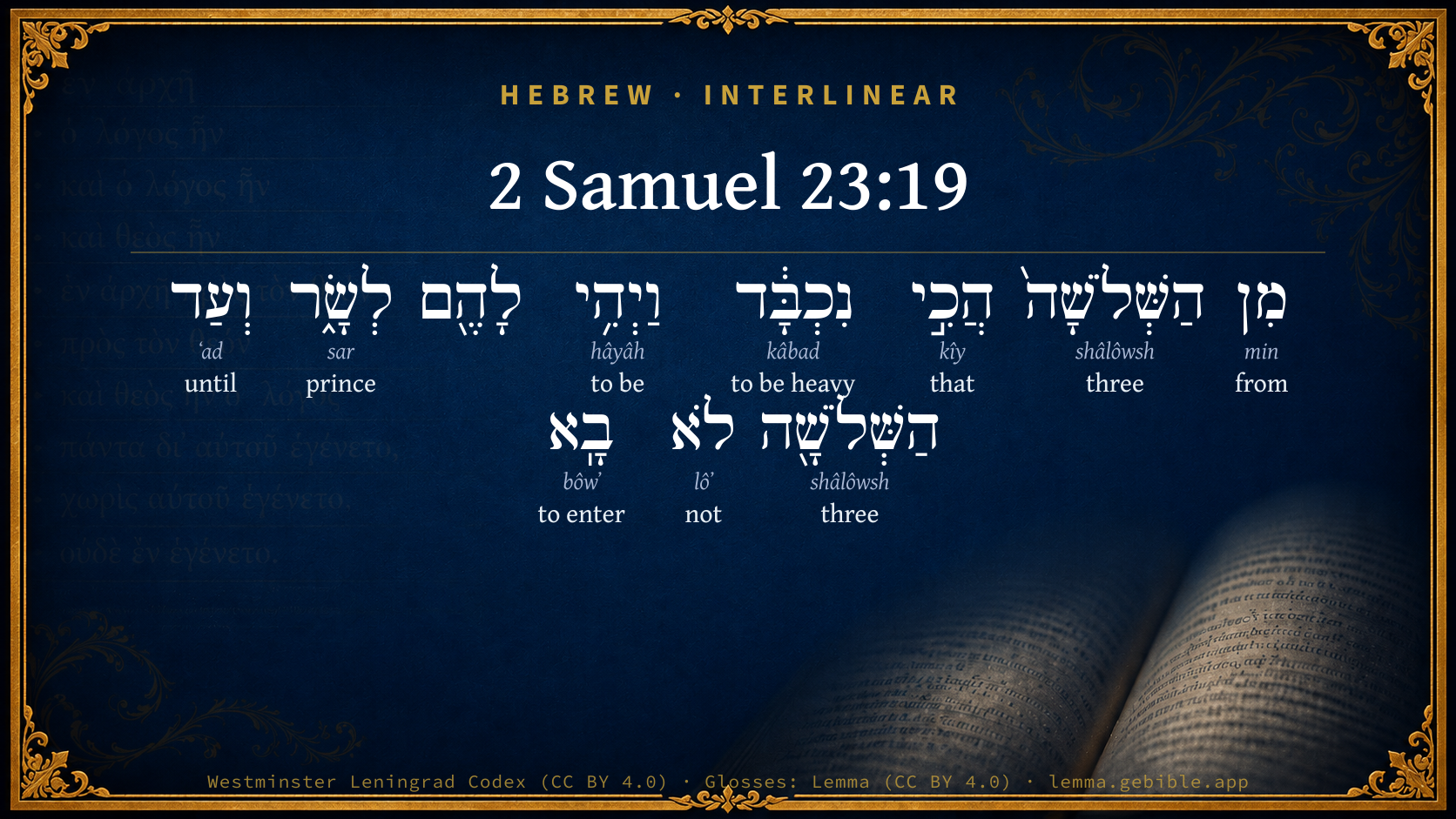
Hebrew (Westminster Leningrad Codex) 2 Samuel 23:19 appears in the Hebrew Old Testament. The text above is from the Westminster Leningrad Codex. Each word links to its Strong’s number, a concise gloss, and parsing drawn from the Open Scriptures Hebrew Bible morphology. Click any word for its full Brown-Driver-Briggs (BDB) entry.
Download image
Cite this verse

2 Samuel 23:19 (World English Bible). Public Domain. Lemma interlinear Bible study tool, https://lemma.gebible.app/v/2-samuel/23/19.

Show BibTeX & RIS
BibTeX
RIS
English Translation
Wasn't he most honorable of the three? therefore he was made their captain: however he didn't attain to the [first] three.
World English Bible · Public Domain
Download a study sheet

One document with this verse’s original text, its word-by-word gloss line, the meaning frame, cross-references with their text, attributed commentary, and full source and license credits — printable, and it pastes into notes with its structure intact.

This verse Autodidact and up

Study sheet (.html) Plain text (.txt)

A passage Seminary Student

Up to 50 verses in one chapter. A passage sheet keeps up to 6 commentary sources and 12 cross-references per verse, in the order this page ranks them, and says so on the sheet whenever that leaves anything out. Ask for a single verse and you get the Autodidact verse sheet above.

Everything on this page stays free to read, with no account — the sheet is a download of what is already on screen, not access to it.

Want to remove ads? Support Godless Engineer
Compare translations 3

The same verse in 3 English versions, stacked beneath the original-language interlinear above. Click any original word for its lexicon entry.

Each is an independent rendering of the whole verse — the interlinear is not word-aligned to these translations.

Highlighted words mark where these versions differ — a whole-verse word diff, not a word-by-word alignment.

  • World English Bible Public Domain
    Wasn't he most honorable of the three? therefore he was made their captain: however he didn't attain to the [first] three.
  • King James Version Public Domain
    Was he not most honorable of three? therefore he was their captain: howbeit he attained not unto the first three.
  • unfoldingWord Literal Text CC BY-SA 4.0
    that he was the most honored of the three? And he became to them a commander. But he did not come to the Three.

unfoldingWord Literal Text — © unfoldingWord, licensed CC BY-SA 4.0. Word-aligned USFM3 via Door43 (git.door43.org/unfoldingWord/en_ult).

Versions to compare (up to 4)

3 of 4 selected

Show all 18 translations

Every available English version of this verse, each an independent rendering of the whole verse.

  • World English Bible Public Domain
    Wasn't he most honorable of the three? therefore he was made their captain: however he didn't attain to the [first] three.
  • Berean Standard Bible Public Domain
    Was he not more honored than the Three? And he became their commander, even though he was not included among the Three.
  • Majority Standard Bible Public Domain
    Was he not more honored than the Three? And he became their commander, even though he was not included among the Three.
  • King James Version Public Domain
    Was he not most honorable of three? therefore he was their captain: howbeit he attained not unto the first three.
  • American Standard Version (1901) Public Domain
    Was he not most honorable of the three? therefore he was made their captain: howbeit he attained not unto the `first' three.
  • Revised Version (1885) Public Domain
    Was he not most honourable of the three? therefore he was made their captain: howbeit he attained not unto the first three.
  • Geneva Bible (1599) Public Domain
    For he was most excellent of the three, and was their captaine, but he attained not vnto the first three.
  • Douay-Rheims (1899) Public Domain
    And the noblest of three, and was their chief, but to the three first he attained not.
  • Young's Literal Translation Public Domain
    Of the three is he not the honoured? and he becometh their head; and unto the `first' three he hath not come.
  • Literal Standard Version CC BY-SA 4.0
    Is he not the honored of the three? And he becomes their head; and he has not come to the [first] three.
  • Unlocked Literal Bible CC BY-SA 4.0
    Was he not even more famous than the three? He was made their captain. However, his fame did not equal the fame of the three most famous soldiers.
  • unfoldingWord Literal Text CC BY-SA 4.0
    that he was the most honored of the three? And he became to them a commander. But he did not come to the Three.
  • Darby Bible Public Domain
    Was he not most honourable of three? and he was their captain; but he did not attain to the [first] three.
  • World Messianic Bible Public Domain
    Wasn’t he most honorable of the three? Therefore he was made their captain. However he wasn’t included as one of the three.
  • Webster's Bible Public Domain
    Was he not most honorable of three? therefore he was their captain: yet he attained not to the first three.
  • Free Bible Version CC BY-SA 4.0
    He was the most highly regarded of the Three and was their commander, though he was not one of the first Three.
  • Bible in Basic English Public Domain
    Was he not the noblest of the thirty? so he was made their captain: but he was not equal to the first three.
  • JPS Tanakh (1917) Public Domain
    He was most honourable of the three; therefore he was made their captain; howbeit he attained not unto the first three.

Literal Standard Version (2020), Covenant Press — licensed CC BY-SA 4.0. Text via the HelloAO Bible API (eBible.org). Unlocked Literal Bible (unfoldingWord) — licensed CC BY-SA 4.0. Text via the HelloAO Bible API (eBible.org). unfoldingWord Literal Text — © unfoldingWord, licensed CC BY-SA 4.0. Word-aligned USFM3 via Door43 (git.door43.org/unfoldingWord/en_ult). Free Bible Version, Dr. Jonathan Gallagher — licensed CC BY-SA 4.0. Text via the HelloAO Bible API (eBible.org).

Word by word

More ways to search: Search by grammar → Find every occurrence → Compare this word →

Practice this passage: Drill this verse → Learn its vocabulary →

נִכְבָּ֔ד
kâbad
H3513
“being heavy”
Verb, Niphal, Participle Active, Masculine, Singular, Absolute
Part of Speech
Verb
Stem
Niphal
Form
Participle Active
Gender
Masculine
Number
Singular
State
Absolute
Full BDB Definition

Origin: a primitive root

TWOT: 943

to be heavy, be weighty, be grievous, be hard, be rich, be honourable, be glorious, be burdensome, be honoured - (Qal) - to be heavy - to be heavy, be insensible, be dull - to be honoured - (Niphal) - to be made heavy, be honoured, enjoy honour, be made abundant - to get oneself glory or honour, gain glory - (Piel) - to make heavy, make dull, make insensible - to make honourable, honour, glorify - (Pual) to be made honourable, be honoured - (Hiphil) - to make heavy - to make heavy, make dull, make unresponsive - to cause to be honoured - (Hithpael) - to make oneself heavy, make oneself dense, make oneself numerous - to honour oneself

  1. מִן min H4480 “from” Preposition
  2. הַשְּׁלֹשָׁה֙ shâlôwsh H7969 “the · three” Particle, Definite Article + Adjective, Cardinal number, Masculine, Singular, Absolute
  3. הֲכִ֣י kîy H3588 “that” Particle, Interrogative + Conjunction
  4. וַיְהִ֥י hâyâh H1961 “and · to be” Conjunction + Verb, Qal, Sequential Imperfect, 3rd Person, Masculine, Singular
  5. לְשָׂ֑ר sar H8269 “to/for · prince” Preposition + Noun, Common, Masculine, Singular, Absolute
  6. וְעַד ʻad H5704 “and · until” Conjunction + Preposition
  7. הַשְּׁלֹשָׁ֖ה shâlôwsh H7969 “the · three” Particle, Definite Article + Adjective, Cardinal number, Masculine, Singular, Absolute
  8. לֹא lôʼ H3808 “not” Particle, Negative
  9. בָֽא bôwʼ H935 “to enter” Verb, Qal, Perfect, 3rd Person, Masculine, Singular

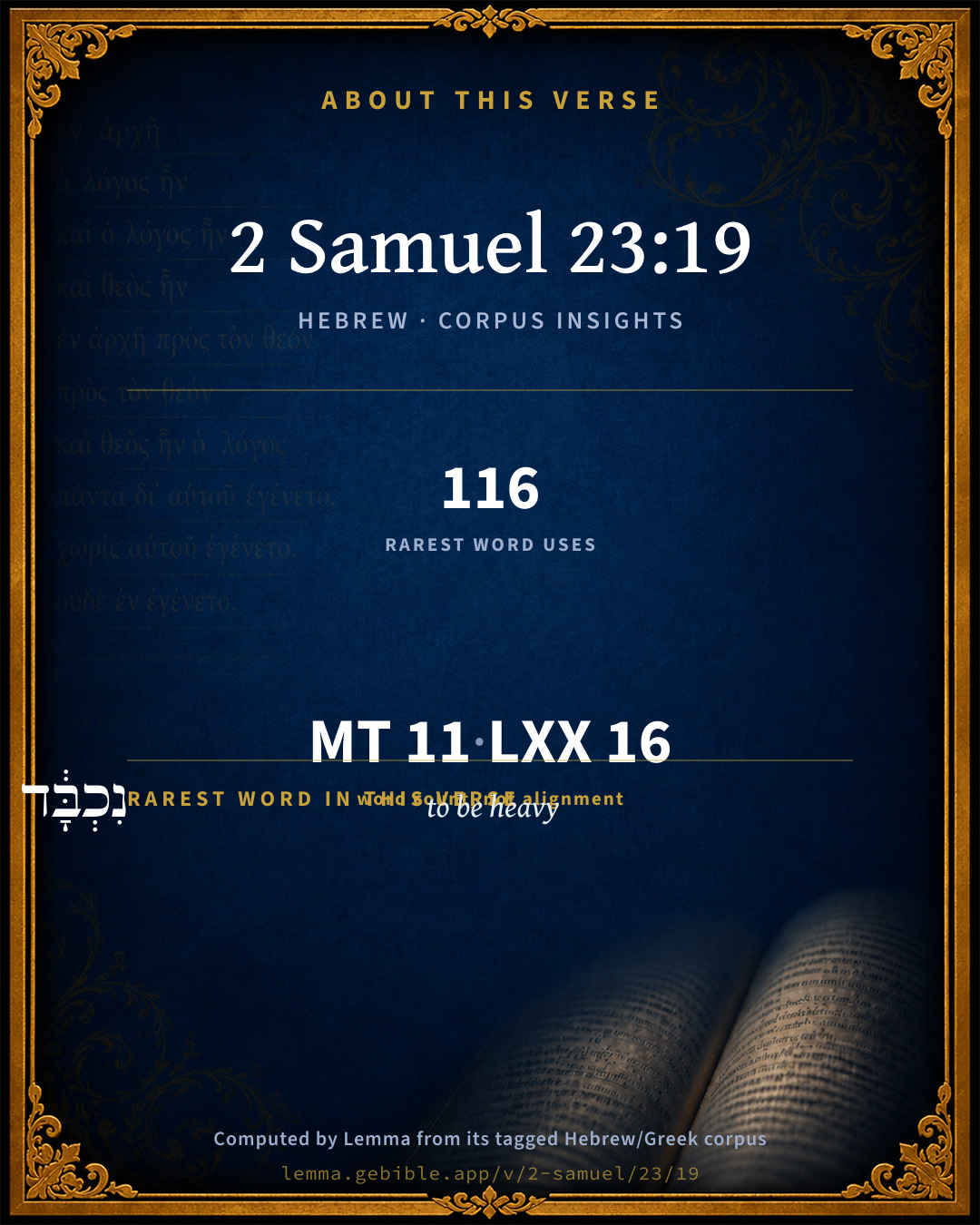
About this verse

These counts appear in no published source. They are computed here, from the morphology-tagged text and Lemma’s own curated glosses. What Lemma adds →

11
words
9
distinct lemmas
Historical
section

Grammatical profile

  • 3 verbs
  • 1 noun
  • 2 adjectives
  • 3 prepositions
  • 1 conjunction
  • 1 particle

Verb forms

  • נִכְבָּ֔ד Niphal · Participle Active
  • וַיְהִ֥י Qal · Sequential Imperfect
  • בָֽא Qal · Perfect

Repetition

A word recurs within this verse — often emphatic in Hebrew:

  • הַשְּׁלֹשָׁה֙ three H7969 ×2

Hebrew & Septuagint length

In English translation the verse runs 21 words from the Hebrew and 22 from the Septuagint (LXX English) — closely comparable.

A rough comparison of the two English renderings, which tokenize alike — not a word-level alignment.

Word counts can differ between the Hebrew and the Greek without any difference in meaning — e.g. the Hebrew direct-object marker אֵת has no separate Greek word, and Greek often adds the article ὁ.

In the original languages it is 11 Hebrew tokens and 16 Greek tokens — but the two are counted differently (Hebrew bundles its prefixes and suffixes into one token; the Greek is in lemma form), so that isn’t a like-for-like length.

Cross-references

7

Topical passages linked to 2 Samuel 23:19 in the Treasury of Scripture Knowledge — connected by theme and wording, ordered by reader-vote popularity; previews shown in the World English Bible.

  • Matthew 13:8 and others fell on good soil, and yielded fruit: some one hundred times as much, some sixty, and some thirty.
  • Matthew 13:23 What was sown on the good ground, this is he who hears the word, and understands it, who most assuredly bears fruit, and brings forth, some one hundred times as much, some sixty, and some thirty."
  • 2 Samuel 23:9 After him was Eleazar the son of Dodai the son of an Ahohite, one of the three mighty men with David, when they defied the Philistines who were there gathered together to battle, and the men of Israel were gone away.
  • 2 Samuel 23:13 Three of the thirty chief men went down, and came to David in the harvest time to the cave of Adullam; and the troop of the Philistines was encamped in the valley of Rephaim.
  • 2 Samuel 23:16 The three mighty men broke through the host of the Philistines, and drew water out of the well of Bethlehem, that was by the gate, and took it, and brought it to David: but he would not drink of it, but poured it out to Yahweh.
  • 1 Chronicles 11:25 Behold, he was more honorable than the thirty, but he didn't attain to the [first] three: and David set him over his guard.
  • 1 Corinthians 15:41 There is one glory of the sun, another glory of the moon, and another glory of the stars; for one star differs from another star in glory.

Cross-references courtesy of OpenBible.info (CC BY 4.0).

Hebrew and Greek witnesses Masoretic Hebrew ↔ Greek Septuagint

The same verse in the two great witnesses to the Old Testament, shown verse-for-verse.

These are two independent witnesses, not word-aligned to each other, and the Septuagint is shown in lemma (dictionary) form.

Hebrew 2 Samuel 23:19 Masoretic · Westminster Leningrad Codex

מִן הַשְּׁלֹשָׁה֙ הֲכִ֣י נִכְבָּ֔ד וַיְהִ֥י לָהֶ֖ם לְשָׂ֑ר וְעַד הַשְּׁלֹשָׁ֖ה לֹא בָֽא

Wasn't he most honorable of the three? therefore he was made their captain: however he didn't attain to the [first] three.

World English Bible · Public Domain

Greek LXX 2 Samuel 23:19 Septuagint · lemma form

ἐκ ὁ τρεῖς ἐκεῖνος ἔνδοξος καί γίγνομαι αὐτός εἰς ἄρχων καί ἕως ὁ τρεῖς οὐ ἔρχομαι

Of those three he was most honorable, and he became a chief over them, but he reached not to the first three.

LXX2012 (modern English Septuagint) · Public Domain

On this verse, Haydock's Catholic Bible Commentary discusses the Septuagint’s reading. Read the note in Commentary ↓

Hebrew: Westminster Leningrad Codex (CC BY 4.0). Greek: Septuagint (public domain); English from LXX2012 (modern English Septuagint) (Public Domain). How the Septuagint differs from the Hebrew →

Targum (Aramaic paraphrase)

1

The Targum is the ancient Jewish Aramaic paraphrase of the Hebrew Scriptures — an interpretive translation, not the Hebrew text itself. Onkelos (literal) and Pseudo-Jonathan (expansive) render the Torah, and Jonathan the Prophets. Coverage is partial: where no permissively-licensed English translation exists for a verse, only the Aramaic is shown. This is verse-level text, not a word-by-word alignment to the Hebrew.

  1. Targum Jonathan Prophets (Joshua–Malachi)
    מִן גִבָּרַיָא הֲוָה יַקִיר וַהֲוָה לְהוֹן לְרַבָּא וְלִתְלַת גִבָּרִין לָא מְטָא:

    (no public-domain English translation for this verse)

    Targum Jonathan — Aramaic: “Mikraot Gedolot” (public domain). English: “Sefaria Community Translation” (CC0 1.0 (public-domain dedication)); “London "Chaldee Paraphrase," 1871” (public domain). Text via Sefaria.

Commentary

Notes on 2 Samuel 23:19 from classic Christian and Jewish commentators (each source and its license shown beneath its notes). The classic Christian expositions comment on the surrounding passage and are grouped to its opening verse, so a note may address several verses; the Jewish commentaries on the Tanakh (Rashi and others) are per-verse, so they appear only where the commentator wrote on this verse.

Lemma curates 59 commentaries, every one of them public domain or Creative Commons licensed, each selected and text-cleaned for this edition rather than reprinted as found. About our sources →

Trapp's Complete Commentary

John Trapp

2Sa 23:19 Was he not most honourable of three? therefore he was their captain: howbeit he attained not unto the [first] three.

Ver. 19. He attained not to the first three,] viz., In degree and dignity. Men may have their praise, though they be not among the first, Honestum est ei qui in primis non potest, in secundis tertiisve consistere, saith the orator. {a} Every man cannot excel, who yet may be useful.

{a} Cicero.

John Trapp, A Commentary or Exposition upon All the Books of the Old and New Testament (1647–1656) — public domain. Text from a community e-Sword module.

The Biblical Illustrator

Joseph S. Exell

2Sa_23:19

Howbeit he attained not unto the first three.

The might of mediocrity

Everybody just now is deploring the singular dearth of genius which marks our immediate era. Some historic periods are remarkable in consequence of the brilliant constellations of extraordinarily gifted men which illuminate them; but the current age threatens to resemble those starless spaces of the firmament which perplex astronomers. In the musical world no one remains to play the first fiddle. The dropped mantle of Macaulay lies unclaimed. A modern commentator warmly protests against the custom of describing certain prophets as minor prophets; but no one proposes to abolish the designation minor poets--they are very much to the |ore, and there is no forehead worthy of Tennysons laurel. Epoch-making scientists like Darwin and Faraday, and masterly expositors of science like Huxley and Tyndall, have left no successors. As to great singers like Lind and Titiens, we feel the silence that Israel felt on the day and in the place of which the sacred historian wrote: Miriam died there, and was buried there. No artist appears competent to take up Millais fallen pencil. No orator like Bright charms the nation. We might think that the forces of nature were spent. The greatest souls are rarer than ever. This is the age of democracy, and it would seem as ii it were going to justify Amiels dictum that democracy is the grave of talent. The nineteenth century ended without leaving a single really great figure on the stage. We rather welcome this parenthesis in the annals of the sublime; it gives a rare opportunity to mediocrity to demonstrate its great merits, and to show that it is not without considerable glory of its own. Nothing may compare with the Divine virtue of genius; it is a direct gleam of the eternal light: and there is little danger in our day that any real greatness will suffer depreciation and neglect. The danger always is lest we should disesteem faithful mediocrity. Victor Hugo regrets the English victory at Waterloo because it was the victory of mediocrity. We do not care to attempt any refutation of this epigram; let us allow that Wellington was not a brilliant adventurer like Napoleon, and that, as poets reason, the victory of Waterloo was the triumph of mediocrity. It must be acknowledged also that the victory of mediocrity is quite a feature of the worlds general affairs and history. Ages ago the author of Ecclesiastes wrote: I returned, and saw under the sun, that the race is not to the swift, nor the battle to the strong, neither yet bread to the wise, nor yet riches to men of understanding, nor yet favour to men of skill; but time and chance happened to them all. This keen observer discerned what Victor Hugo regretted, that there is a place in the government of the world for the triumph of mediocrity. We ourselves constantly observe the same thing. The brilliant preacher conspicuously fails to create a church, whilst the plodding pastor ministers through years to a flourishing congregation. The brilliant speculator dies poor, whilst the homespun shopkeeper leaves an inheritance to his childrens children. The fable of the hare and the tortoise never grows obsolete. Said Diderot, The world is for the strong. But the world is not altogether for the strong, neither are brilliant men permitted to ride roughshod over the simple. The world is also for the faithful, the artless, the industrious, the modest, and the meek. All things are not delivered over into the hands of William the Conqueror, Lorenzo the Magnificent, and Peter the Great; strugglers destitute of original power and brilliant parts have a trick of coming out at the top and sharing the spoils with the strong. We may honestly rejoice that this is so. It may affront the romantic critic to see the soldier of genius banished to St. Helena whilst the soldier of patience stands before kings; but the fact is comforting and inspiring to the faithful many. Intense, decisive faithfulness has the character of the sublime, and it sets the virtuous man of ordinary intelligence on a level with the most gifted. Commonplace talent united with high moral qualities is certainly one of the most precious factors of civilisation. We must not permit ourselves to be browbeaten by towering greatness; we too have possibilities. Faithful mediocrity may enter hopefully into all social competitions; it often turns out to be genius in undress; it has a good chance of the prizes of life. We are not equal to daring assaults, far-reaching speculations, dazzling manoeuvres; but simple truth and perfect patience possess mysterious efficacy, and they as well as genius bring riches and honours, power, and fame. In our struggle against gifted and splendid wickedness let us remember the victory of mediocrity. The New Testament frequently calls attention to the power and magnificence of the kingdom of evil. For we wrestle not against flesh and blood, but against principalities, against powers, against the rulers of the darkness of this world, against spiritual wickedness in high places. And there was war in heaven: Michael and his angels fought against the dragon; and the dragon fought and his angels. The Apocalypse brings out very strikingly the glory and power of the evil with which the saints contend. Wickedness is seen with many heads, eyes, and horns; she is arrayed in purple and scarlet, decked with precious stones and pearls, having a golden cup in her hand; force, fire, and fury are attributes of the awful power. This picture is not mere rhetoric. In the actual world we find these gigantic and lurid poetic images distinctly and powerfully reflected. A thousand times over wickedness is seen identified with royal magnificence, luminous intellect, immense learning, fabulous riches, indomitable courage, and resources all but infinite. Now it seems simply impossible for good, plain, honest, spiritual souls to make headway against the devilry thus leagued with might, magnificence, and stratagem. Men smile pitifully when they read on the page of history of clowns going forth with scythes, pikes, and pitchforks to do battle with panoplied hosts; but it seems unutterably more absurd for simple men and women to dare the rampant wickedness of the universe, boasting as it does this strength and splendour. In the natural world we daily witness the victories of mediocrity, and we may be sure that in the spiritual universe these victories are not less wonderful. The conflict of simple souls with the dash and guile of the demoniac powers appears a battle of doves with eagles; but tiny humming birds are said to attack the eagle with impunity, ignominiously driving it away. So wickedness in its utmost pride is strangely vulnerable, and sinks vanquished by very weakness There is a haste in wickedness which threatens its overthrow; it is feverish, premature, precipitate, and in its hurry comes to grief, despite the greatest advantages. Goodness, on the other hand, is deliberate, tranquil, patient, and herein finds a source of strength and victory. Here is the patience and faith of the saints. All hell in its wrath and pride makes shipwreck on this innocent-looking rock of simple faith and steadfastness, as at Waterloo the glittering, impetuous legions of France were worn out by the sheer patience and confidence of the duke. There is a blindness in wickedness which frustrates its designs. Brilliant, crafty sinners fall into egregious mistakes; they are guilty of surprising lapses, oversights, miscalculations. There is also in wickedness s pride and presumption which work its confusion, and in Strange ways turn its pomp into shame, its boastings into failure. Napoleon is reported to have said on the morning of Waterloo that he would teach that little English general a lesson. Such pride cometh before destruction. How utterly wrong are they who capitulate to temptation from the notion that evil is overwhelming, that it is necessarily victorious! We too often forget the penetration of sincerity, the depth of simplicity, the cleverness of uprightness, the strategy of straightforwardness; we forget that patience is genius, that persistence is the most unequivocal sign of force, that there is a conquering awfulness in real goodness, an all-subduing loveliness in the form of simple virtue. Mediocre as we are, we are destined to great victories. Entrenched in nature, exalted on thrones, defended by literature and eloquence, wickedness shall be vanquished by plain, good men. (W. L. Watkinson.)

The value of second-rate

To the student who asked, What is the good of second-rate art? Ruskin replied: I am glad you asked me that question. Fifth rate, sixth rate, to s hundredth rate art is good. Art that gives s pleasure to any one has s right to exist. For instance, if I can only draw a duck that looks as though he waddled, I may give pleasure to the last baby of our hostess, while a flower beautifully drawn will give pleasure to her eldest girl, who is just beginning to learn botany, and it may be useful to some man of science. The true outline of a leaf shown a child may turn the whole course of its life. Second-rate art is useful to a greater number of people than even first-rate art--there are so few minds of high enough order to understand the highest kind of art. Many more people find pleasure in Copley or Fielding than in Turner. Most people only see the small vulgarisms in Turner, and cannot appreciate his grander qualities. (Christian Weekly.)

The Biblical Illustrator, edited by Joseph S. Exell (c. 1880s–1900s) — public domain. Text from a community e-Sword module.

John Gill's Exposition

Was he not most honourable of three?.... He was; who, besides the exploit here mentioned, did many other things; he went down with David into Saul's camp, and took away his spear and cruse, which were at his bolster, Sa1 26:6; he relieved David when in danger from Ishbibenob the giant, Sa2 21:16; he beat the Edomites, and slew eighteen thousand of them in the valley of salt, Ch1 18:12,

therefore he was their captain; of the other two, or was head over them, took rank before them:

howbeit he attained not unto the first three; for fortitude, courage, and warlike exploits, namely, to the Tachmonite, Eleazar, and Shammah.

John Gill's Exposition of the Whole Bible (1746–1763) — public domain (CC PDM 1.0). Text via the HelloAO Bible API.

Albert Barnes' Notes on the Bible

i. e., “Was he not the most honorable of the three of the second order, howbeit, he attained not to the three,” the triad, namely, which consisted of Jashobeam, Eleazar, and Shammah. That two triads are mentioned is a simple fact, although only five names are given.

Albert Barnes' Notes on the Bible (1834–1885) — public domain. Text from a community e-Sword/MySword module.

Haydock's Catholic Bible Commentary

Three. Hebrew haci, seems to be mistaken for bossnim, "above two;" as one of the Greek versions in the Hexapla renders it, with the Septuagint. "Of the three he was more honourable than two; therefore he was their captain, and yet to," &c. Thus we see a double ternary fully established, ver. 8. (Kennicott)

George Leo Haydock (1774–1849), Haydock's Catholic Family Bible and Commentary, 1859 edition — public domain. Excludes Psalms (Douay-Rheims chapter numbering differs from Protestant) and Deuterocanonical books (Catholic canon only).

Matthew Poole's English Annotations

He fell short of them in strength and valour.

Matthew Poole's English Annotations on the Holy Bible (1683–1685) — public domain. Text from a community e-Sword/MySword module.

John Wesley's Explanatory Notes

Attained not - He fell short of them in strength and valour.

John Wesley, Explanatory Notes Upon the Whole Bible (1754–1765) — public domain. Text via the GEBible commentary corpus.

Rashi

Rabbi Shlomo Yitzchaki (Rashi)

He did not reach the status of the first three. [Yonoson translates:] He did not reach [the status] of the [first] three men.

Rashi on the Tanakh — English translations: “The Judaica Press complete Tanach with Rashi, translated by A. J. Rosenberg” (CC BY 4.0); “Pentateuch with Rashi's commentary by M. Rosenbaum and A.M. Silbermann, 1929-1934” (public domain); “The Metsudah Tanach series, Lakewood, N.J” (CC BY 4.0); and “The Book of Joshua, Metsudah Publications, 1997” (CC BY 4.0). Text via Sefaria.

Lesson kit

Teaching starters — assembled from the data on this page, not authored interpretation. Every prompt links to the verse data it draws on. Edit before teaching.

2 Samuel, in the Historical, opens this verse with 11 words (9 distinct Hebrew lemmas). Its most distinctive word is kâbad (“to be heavy”). A historical commentator’s framing appears above. Read the whole chapter for the surrounding context.

Discussion questions

  1. What does “to be heavy” (kâbad) contribute to the verse as a whole?
  2. Matthew 13:8 shares this passage’s theme. How do the two illuminate each other?
  3. “three” occurs 2× in this one verse. What is the effect of the repetition?
  4. These translations render this verse differently. What is at stake in choosing one wording over another?
  5. The verb «נִכְבָּ֔ד» is Niphal Participle Active. How does its form color the action?
  6. Reading how Trapp's Complete Commentary and The Biblical Illustrator read this verse, where do the two commentators agree and where do they part?

Things to notice

Reading settings

Reading text

Shown beneath each verse's original-language words.

Old Testament
Old Testament edition

Read the OT as the Masoretic Hebrew (MT) or the Greek Septuagint (LXX).

English shown for the Greek Septuagint (in the Hebrew ↔ Greek comparison).

Comparing translations? Open the Compare panel on any verse page to stack up to four side by side.