
Joshua 15:18

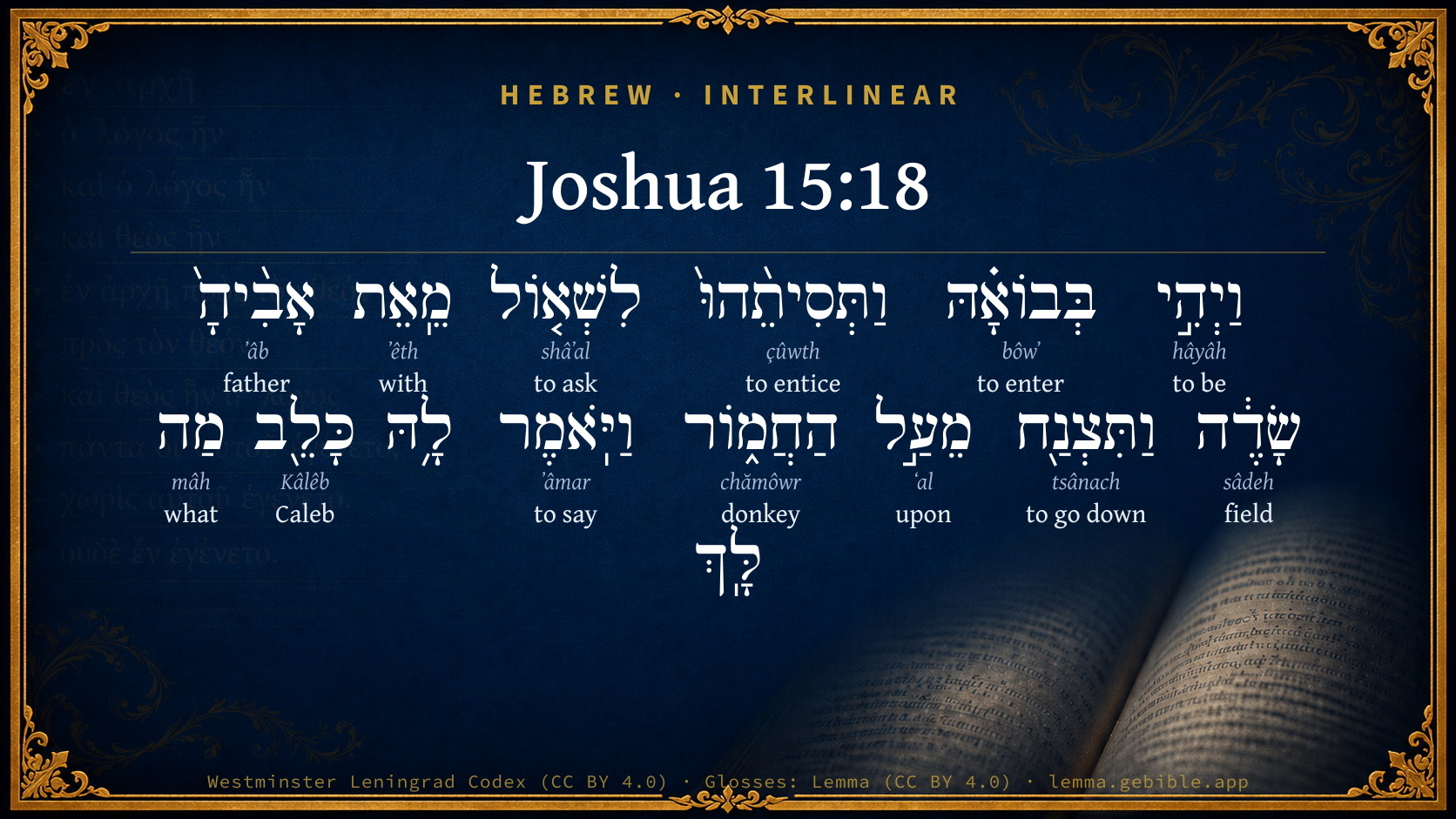
Hebrew (Westminster Leningrad Codex) Joshua 15:18 appears in the Hebrew Old Testament. The text above is from the Westminster Leningrad Codex. Each word links to its Strong’s number, a concise gloss, and parsing drawn from the Open Scriptures Hebrew Bible morphology. Click any word for its full Brown-Driver-Briggs (BDB) entry.
Download image
Cite this verse

Joshua 15:18 (World English Bible). Public Domain. Lemma interlinear Bible study tool, https://lemma.gebible.app/v/joshua/15/18.

Show BibTeX & RIS
BibTeX
RIS
English Translation
It happened, when she came [to him], that she moved him to ask of her father a field: and she alighted from off her donkey; and Caleb said, What would you?
World English Bible · Public Domain
Highlights
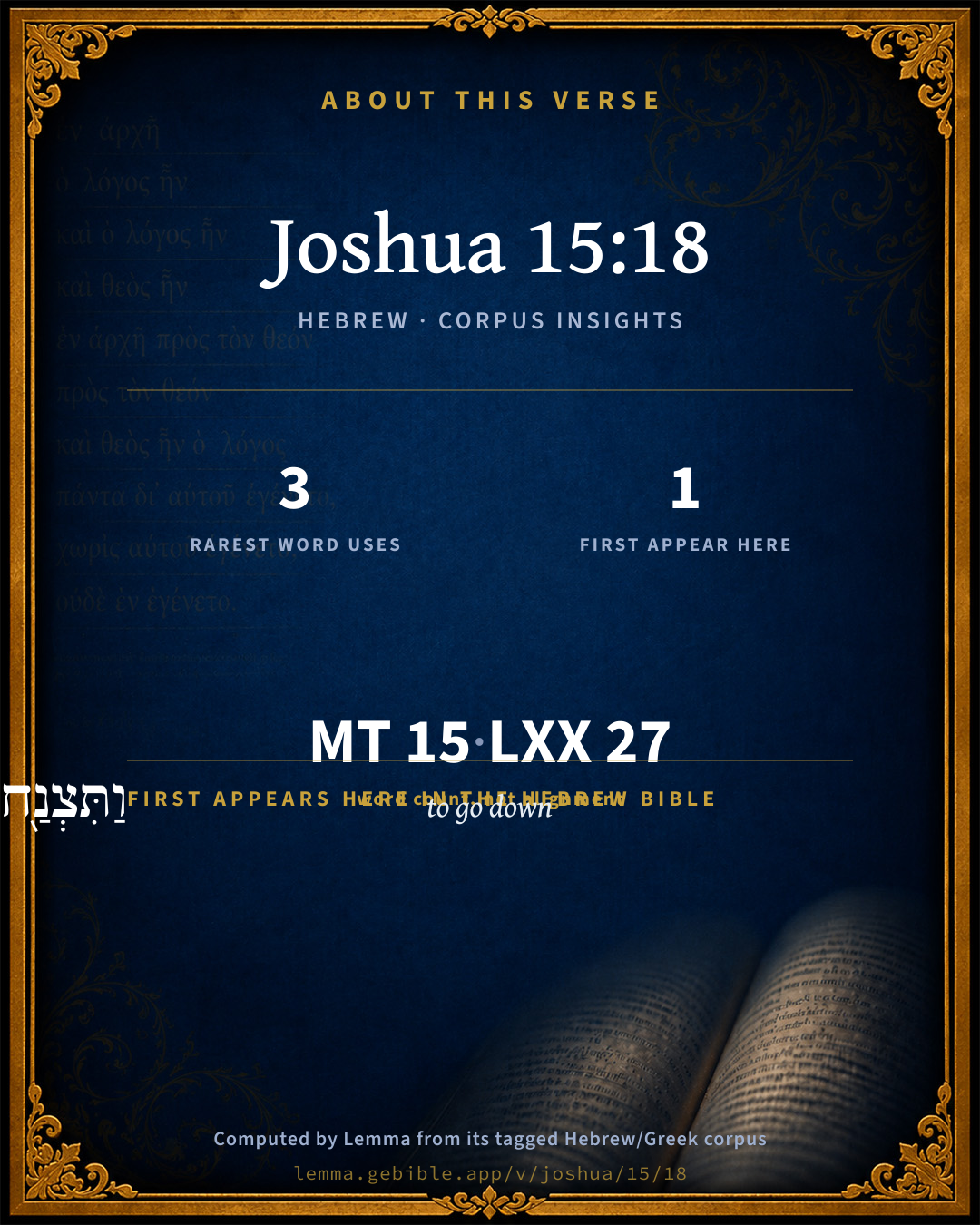
  • 1 first appearance in the Hebrew Bible
Full analysis ↓
Download a study sheet

One document with this verse’s original text, its word-by-word gloss line, the meaning frame, cross-references with their text, attributed commentary, and full source and license credits — printable, and it pastes into notes with its structure intact.

This verse Autodidact and up

Study sheet (.html) Plain text (.txt)

A passage Seminary Student

Up to 50 verses in one chapter. A passage sheet keeps up to 6 commentary sources and 12 cross-references per verse, in the order this page ranks them, and says so on the sheet whenever that leaves anything out. Ask for a single verse and you get the Autodidact verse sheet above.

Everything on this page stays free to read, with no account — the sheet is a download of what is already on screen, not access to it.

Want to remove ads? Support Godless Engineer
Compare translations 3

The same verse in 3 English versions, stacked beneath the original-language interlinear above. Click any original word for its lexicon entry.

Each is an independent rendering of the whole verse — the interlinear is not word-aligned to these translations.

Highlighted words mark where these versions differ — a whole-verse word diff, not a word-by-word alignment.

  • World English Bible Public Domain
    It happened, when she came [to him], that she moved him to ask of her father a field: and she alighted from off her donkey; and Caleb said, What would you?
  • King James Version Public Domain
    And it came to pass, as she came unto him, that she moved him to ask of her father a field: and she lighted off her ass; and Caleb said unto her, What wouldest thou?
  • unfoldingWord Literal Text CC BY-SA 4.0
    Now it happened, in the coming of her, that she persuaded him to request the field from her father. And she descended from upon the donkey, and Caleb said to her, “What for you?”

unfoldingWord Literal Text — © unfoldingWord, licensed CC BY-SA 4.0. Word-aligned USFM3 via Door43 (git.door43.org/unfoldingWord/en_ult).

Versions to compare (up to 4)

3 of 4 selected

Show all 18 translations

Every available English version of this verse, each an independent rendering of the whole verse.

  • World English Bible Public Domain
    It happened, when she came [to him], that she moved him to ask of her father a field: and she alighted from off her donkey; and Caleb said, What would you?
  • Berean Standard Bible Public Domain
    One day Acsah came to Othniel and urged him to ask her father for a field. When she got off her donkey, Caleb asked her, “What do you desire?”
  • Majority Standard Bible Public Domain
    One day Acsah came to Othniel and urged him to ask her father for a field. When she got off her donkey, Caleb asked her, “What do you desire?”
  • King James Version Public Domain
    And it came to pass, as she came unto him, that she moved him to ask of her father a field: and she lighted off her ass; and Caleb said unto her, What wouldest thou?
  • American Standard Version (1901) Public Domain
    And it came to pass, when she came `unto him', that she moved him to ask of her father a field: and she alighted from off her ass; and Caleb said, What wouldest thou?
  • Revised Version (1885) Public Domain
    And it came to pass, when she came unto him, that she moved him to ask of her father a field: and she lighted down from off her ass; and Caleb said unto her, What wouldest thou?
  • Geneva Bible (1599) Public Domain
    And as she went in to him, she moued him, to aske of her father a fielde: and she lighted off her asse, and Caleb sayd vnto her, What wilt thou?
  • Douay-Rheims (1899) Public Domain
    And as they were going together, she was moved by her husband to ask a field of her father, and she sighed as she sat on her ass. And Caleb said to her: What aileth thee?
  • Young's Literal Translation Public Domain
    And it cometh to pass, in her coming in, that she persuadeth him to ask from her father a field, and she lighteth from off the ass, and Caleb saith to her, `What -- to thee?'
  • Literal Standard Version CC BY-SA 4.0
    And it comes to pass, in her coming in, that she persuades him to ask [for] a field from her father, and she comes down off the donkey, and Caleb says to her, “What do you [want]?”
  • Unlocked Literal Bible CC BY-SA 4.0
    Soon after that, Aksah came to Othniel and she urged him to ask her father for a field. When she got off her donkey, Caleb said to her, “What do you want?”
  • unfoldingWord Literal Text CC BY-SA 4.0
    Now it happened, in the coming of her, that she persuaded him to request the field from her father. And she descended from upon the donkey, and Caleb said to her, “What for you?”
  • Darby Bible Public Domain
    And it came to pass as she came, that she urged him to ask of her father a field; and she sprang down from the ass. And Caleb said to her, What wouldest thou?
  • World Messianic Bible Public Domain
    When she came, she had him ask her father for a field. She got off her donkey, and Caleb said, “What do you want?”
  • Webster's Bible Public Domain
    And it came to pass, as she came to him, that she moved him to ask of her father a field. And she lighted off her ass; and Caleb said to her, What wouldst thou?
  • Free Bible Version CC BY-SA 4.0
    When she came to him, she encouraged him to ask her father for a field. When she got off her donkey, Caleb asked her, “What do you want?”
  • Bible in Basic English Public Domain
    Now when she came to him, he put into her mind the idea of requesting a field from her father: and she got down from her ass; and Caleb said to her, What is it?
  • JPS Tanakh (1917) Public Domain
    And it came to pass, when she came unto him, that she persuaded him to ask of her father a field; and she alighted from off her ass; and Caleb said unto her: 'What wouldest thou?'

Literal Standard Version (2020), Covenant Press — licensed CC BY-SA 4.0. Text via the HelloAO Bible API (eBible.org). Unlocked Literal Bible (unfoldingWord) — licensed CC BY-SA 4.0. Text via the HelloAO Bible API (eBible.org). unfoldingWord Literal Text — © unfoldingWord, licensed CC BY-SA 4.0. Word-aligned USFM3 via Door43 (git.door43.org/unfoldingWord/en_ult). Free Bible Version, Dr. Jonathan Gallagher — licensed CC BY-SA 4.0. Text via the HelloAO Bible API (eBible.org).

Word by word

More ways to search: Search by grammar → Find every occurrence → Compare this word →

Practice this passage: Drill this verse → Learn its vocabulary →

וַתִּצְנַ֖ח
tsânach
H6795
“and · to go down”
Conjunction + Verb, Qal, Sequential Imperfect, 3rd Person, Feminine, Singular
Part of Speech
Conjunction + Verb
Stem
Qal
Form
Sequential Imperfect
Person
3rd Person
Gender
Feminine
Number
Singular
Full BDB Definition

Origin: a primitive root

TWOT: 1934

(Qal) to go down, descend
  1. וַיְהִ֣י hâyâh H1961 “and · to be” Conjunction + Verb, Qal, Sequential Imperfect, 3rd Person, Masculine, Singular
  2. בְּבוֹאָ֗הּ bôwʼ H935 “in/at · to enter · her” Preposition + Verb, Qal, Infinitive Construct + Suffix, Personal, 3rd Person, Feminine, Singular
  3. וַתְּסִיתֵ֨הוּ֙ çûwth H5496 “and · to entice · him” Conjunction + Verb, Hiphil, Sequential Imperfect, 3rd Person, Feminine, Singular + Suffix, Personal, 3rd Person, Masculine, Singular
  4. לִשְׁא֤וֹל shâʼal H7592 “to ask” Preposition + Verb, Qal, Infinitive Construct
  5. מֵֽאֵת ʼêth H854 “from · with” Preposition + Preposition
  6. אָבִ֨יהָ֙ ʼâb H1 “father · her” Noun, Common, Masculine, Singular, Construct + Suffix, Personal, 3rd Person, Feminine, Singular
  7. שָׂדֶ֔ה sâdeh H7704 “field” Noun, Common, Masculine, Singular, Absolute
  8. מֵעַ֣ל ʻal H5921 “from · upon” Preposition + Preposition
  9. הַחֲמ֑וֹר chămôwr H2543 “the · donkey” Particle, Definite Article + Noun, Common, Both, Singular, Absolute
  10. וַיֹּֽאמֶר ʼâmar H559 “and · to say” Conjunction + Verb, Qal, Sequential Imperfect, 3rd Person, Masculine, Singular
  11. כָּלֵ֖ב Kâlêb H3612 “Caleb” Noun, Proper
  12. מַה mâh H4100 “what” Particle, Interrogative

About this verse

These counts appear in no published source. They are computed here, from the morphology-tagged text and Lemma’s own curated glosses. What Lemma adds →

15
words
13
distinct lemmas
Historical
section

Notable vocabulary

The rarest word here is וַתִּצְנַ֖ח to go down H6795 — appearing just 3 times in the whole Hebrew Bible.

First appearance in Scripture

This word makes its first canonical appearance in the Hebrew Bible here:

  • וַתִּצְנַ֖ח to go down H6795

Shared distinctive vocabulary

וַתִּצְנַ֖ח to go down H6795 occurs in 3 verses of the Hebrew Bible. Also found in:

Grammatical profile

  • 6 verbs
  • 4 nouns
  • 4 prepositions
  • 1 particle

Verb forms

  • וַיְהִ֣י Qal · Sequential Imperfect
  • בְּבוֹאָ֗הּ Qal · Infinitive Construct
  • וַתְּסִיתֵ֨הוּ֙ Hiphil · Sequential Imperfect
  • לִשְׁא֤וֹל Qal · Infinitive Construct
  • וַתִּצְנַ֖ח Qal · Sequential Imperfect
  • וַיֹּֽאמֶר Qal · Sequential Imperfect

Hebrew & Septuagint length

In English translation the verse runs 31 words from the Hebrew and 37 from the Septuagint (LXX English) — closely comparable.

A rough comparison of the two English renderings, which tokenize alike — not a word-level alignment.

Word counts can differ between the Hebrew and the Greek without any difference in meaning — e.g. the Hebrew direct-object marker אֵת has no separate Greek word, and Greek often adds the article ὁ.

In the original languages it is 15 Hebrew tokens and 27 Greek tokens — but the two are counted differently (Hebrew bundles its prefixes and suffixes into one token; the Greek is in lemma form), so that isn’t a like-for-like length.

Cross-references

2

Topical passages linked to Joshua 15:18 in the Treasury of Scripture Knowledge — connected by theme and wording, ordered by reader-vote popularity; previews shown in the World English Bible.

  • Genesis 24:64 Rebekah lifted up her eyes, and when she saw Isaac, she dismounted from the camel.
  • 1 Samuel 25:23 When Abigail saw David, she hurried, and alighted from her donkey, and fell before David on her face, and bowed herself to the ground.

Cross-references courtesy of OpenBible.info (CC BY 4.0).

Hebrew and Greek witnesses Masoretic Hebrew ↔ Greek Septuagint

The same verse in the two great witnesses to the Old Testament, shown verse-for-verse.

These are two independent witnesses, not word-aligned to each other, and the Septuagint is shown in lemma (dictionary) form.

Hebrew Joshua 15:18 Masoretic · Westminster Leningrad Codex

וַיְהִ֣י בְּבוֹאָ֗הּ וַתְּסִיתֵ֨הוּ֙ לִשְׁא֤וֹל מֵֽאֵת אָבִ֨יהָ֙ שָׂדֶ֔ה וַתִּצְנַ֖ח מֵעַ֣ל הַחֲמ֑וֹר וַיֹּֽאמֶר לָ֥הּ כָּלֵ֖ב מַה לָּֽךְ

It happened, when she came [to him], that she moved him to ask of her father a field: and she alighted from off her donkey; and Caleb said, What would you?

World English Bible · Public Domain

Greek LXX Joshua 15:18 Septuagint · lemma form

καί γίγνομαι ἐν ὁ εἰςπορεύομαι αὐτός καί συνβουλεύω αὐτός λέγω αἰτέω ὁ πατήρ ἐγώ ἀγρός καί βοάω ἐκ ὁ ὄνος καί εἶπον αὐτός χαλεβ τίς εἰμί σύ

And it came to pass as she went out that she counselled him, saying, I will ask of my father a field; and she cried from off her ass; and Chaleb said to her, What is it?

LXX2012 (modern English Septuagint) · Public Domain

On this verse, The Cambridge Bible for Schools and Colleges discusses the Septuagint’s reading. Read the note in Commentary ↓

Hebrew: Westminster Leningrad Codex (CC BY 4.0). Greek: Septuagint (public domain); English from LXX2012 (modern English Septuagint) (Public Domain). How the Septuagint differs from the Hebrew →

Targum (Aramaic paraphrase)

1

The Targum is the ancient Jewish Aramaic paraphrase of the Hebrew Scriptures — an interpretive translation, not the Hebrew text itself. Onkelos (literal) and Pseudo-Jonathan (expansive) render the Torah, and Jonathan the Prophets. Coverage is partial: where no permissively-licensed English translation exists for a verse, only the Aramaic is shown. This is verse-level text, not a word-by-word alignment to the Hebrew.

  1. Targum Jonathan Prophets (Joshua–Malachi)
    וַהֲוָה בְּמֵיעֲלָהּ וְאַמְלַכְתֵּיהּ לְמִשְׁאַל מִן אֲבוּהָא אַחְסַנְתָּא וְאִתְרְכִינַת מֵעַל חַמְרָא וַאֲמַר לָהּ כָּלֵב מַה לִיךְ:

    (no public-domain English translation for this verse)

    Targum Jonathan — Aramaic: “Mikraot Gedolot” (public domain). English: “Sefaria Community Translation” (CC0 1.0 (public-domain dedication)); “London "Chaldee Paraphrase," 1871” (public domain). Text via Sefaria.

Commentary

Notes on Joshua 15:18 from classic Christian and Jewish commentators (each source and its license shown beneath its notes). The classic Christian expositions comment on the surrounding passage and are grouped to its opening verse, so a note may address several verses; the Jewish commentaries on the Tanakh (Rashi and others) are per-verse, so they appear only where the commentator wrote on this verse.

Lemma curates 59 commentaries, every one of them public domain or Creative Commons licensed, each selected and text-cleaned for this edition rather than reprinted as found. About our sources →

Trapp's Complete Commentary

John Trapp

Jos 15:18 And it came to pass, as she came [unto him], that she moved him to ask of her father a field: and she lighted off [her] ass; and Caleb said unto her, What wouldest thou?

Ver. 18. She moved him to ask.] Or, She moved her husband that she might ask another field. Covetousness is never contented, but still craving more, as the horse leeches’ daughters. Othniel hardly yielded to this motion, but she would have it so, and therefore lighted off her ass, either as discontented, or as desirous to present her request.

John Trapp, A Commentary or Exposition upon All the Books of the Old and New Testament (1647–1656) — public domain. Text from a community e-Sword module.

Joseph Benson's Commentary

Jos 15:18. As she came — Or, as she went; namely, from her father’s house to her husband’s, as the manner was. She moved him — She persuaded her husband, either, 1st, That he would ask: or rather, 2d, That he would suffer her to ask, as she did. She lighted — That she might address herself to her father in an humble posture, and as a supplicant, which he understood by her gesture.

Joseph Benson's Commentary on the Old and New Testaments (1811–1818) — public domain. Text from a community e-Sword module.

Tyndale Open Study Notes

Tyndale Open Resources

15:18-19 What’s the matter? No water source existed for the town Othniel conquered. Negev means “dry land.” • The upper and lower springs were close together but too far from Debir to belong to it naturally, so Acsah asked for the rights to the water.

Tyndale Open Study Notes — © Tyndale Open Resources, licensed CC BY-SA 4.0. Text via the HelloAO Bible API.

Geneva Bible (1599)

Geneva Bible translators

Because her husband tarried too long.

Geneva Bible (1599) marginal notes — public domain. Text via Bolls.life.

Jamieson, Fausset & Brown

Robert Jamieson, A. R. Fausset & David Brown

as she came unto him--that is, when about to remove from her father's to her husband's house. She suddenly alighted from her travelling equipage--a mark of respect to her father, and a sign of making some request. She had urged Othniel to broach the matter, but he not wishing to do what appeared like evincing a grasping disposition, she resolved herself to speak out. Taking advantage of the parting scene when a parent's heart was likely to be tender, she begged (as her marriage portion consisted of a field which, having a southern exposure, was comparatively an arid and barren waste) he would add the adjoining one, which abounded in excellent springs. The request being reasonable, it was granted; and the story conveys this important lesson in religion, that if earthly parents are ready to bestow on their children that which is good, much more will our heavenly Father give every necessary blessing to them who ask Him.

Jamieson, Fausset & Brown — Commentary Critical and Explanatory on the Whole Bible (1871) — public domain (CC PDM 1.0). Text via the HelloAO Bible API.

Adam Clarke's Commentary

Verse 18. As she came] As she was now departing from the house of her father to go to that of her husband.

She moved him] Othniel, to ask of her father a field, one on which she had set her heart, as contiguous to the patrimony already granted.

She lighted off her ass] ותצנח vattitsnach, she hastily, suddenly alighted, as if she had forgotten something, or was about to return to her father's house. Which being perceived by her father, he said, What wouldest thou? What is the matter? What dost thou want?

Adam Clarke's Commentary on the Bible (1810–1826) — public domain. Text from a community e-Sword/MySword module.

John Calvin's Commentaries

18. And it came to pass as she came unto him, etc Although we may conjecture that the damsel Acsa was of excellent morals and well brought up, as marriage with her had been held forth as the special reward of victory, yet perverse cupidity on her part is here disclosed. She knew that by the divine law women were specially excluded from hereditary lands, but she nevertheless covets the possession of them, and stimulates her husband by unjust expostulation. In this way ambitious and covetous wives cease not to molest their husbands until they force them to forget shame, modesty, and equity. For although the avarice of men also is insatiable, yet women are apt to be much more precipitate. The more carefully ought husbands to be on their guard against being set as it were on flame by the blast of such importunate counsels.

But a greater degree of intemperance is displayed when she acquires additional boldness from the facility of her husband and the indulgence of her father. Not contented with the field given to her, she demands for herself a well-watered district. And thus it is when a person has once overleaped the bounds of rectitude and honesty, the fault is forthwith followed up by impudence. Moreover, her father in refusing her nothing gives proof of his singular affection for her. But it does not therefore follow that the wicked thirst of gain which blinds the mind and perverts right judgment is the less hateful. In regard to Acsa’s dismounting from the ass, some interpreters ascribe it to dissimulation and craft, as if she were pretending inability to retain her seat from grief. In this way her dismounting or falling off is made an indication of criminality and defective character. It is more simple, however, to suppose that she placed herself at her father’s feet with the view of accosting him as a suppliant. Be this as it may, by her craft and flattery she gained his consent, and in so far diminished the portion of her brothers.

John Calvin's Commentaries (1540-1563) — public domain. Text from the Calvin Translation Society English edition (1840s-50s) via the Christian Classics Ethereal Library (ccel.org). Calvin's coverage is partial (roughly two-thirds of the Bible); uncommented books and verses are honest gaps, never fabricated. The 19th-century editor's footnotes and remarks are omitted so the notes are faithfully Calvin's own voice.

The Cambridge Bible for Schools and Colleges

gen. ed. J. J. S. Perowne

18. as she came unto him] i. e. as she proceeded to the home of Othniel at Debir to become his wife. “When the parties live in different villages, the bridegroom accompanied by his friends, all well mounted and armed, and escorted with music, repair to the house of the bride, and escort her to her new home.” See the picture of such a procession in Van Lenneps’ Bible Lands and Customs, p. 550.

she moved him] The original word denotes (1) to impel, (2) to incite, induce. Comp. 2Ch_18:2, “And Ahab persuaded him to go up with him to Ramoth-Gilead.” “The which, whanne she went to togidre, hir man meeued to hir for to axe of hir fader a feeld.” Wyclif.

a field] more definitely, the field, either (a) which belonged to Debir, as some suppose, or (b) the field which was fit for cultivation, and had a sufficient supply of water.

she lighted off her ass] The original word only occurs in three places; (a) here; (b) the parallel passage in Jdg_1:14; and (c) in Jdg_4:21, “Then Jael Heber’s wife took a nail of the tent … and went softly unto him.” It denotes (1) to force oneself away from: (2) to descend quickly from, to sink down from, as in Gen_24:64, “And Rebekah lifted up her eyes, and when she saw Isaac, she lighted off the camel.” The LXX. have rendered it, apparently from a different reading, “she cried from the ass;” the Vulgate, “suspiravitque ut sedebat in asino;” and so Wyclif, “And she siçide, as she sat in the asse.”

18. and Caleb said unto her] It would seem as though Othniel could not be prevailed upon to make such a request himself, and that Achsah therefore determined to prefer it herself. Her action in springing from the ass so astonished Caleb, that he put to her the question, “What wouldest thou?”

The Cambridge Bible for Schools and Colleges (gen. ed. J. J. S. Perowne; Cambridge University Press, 1878–1918) — public domain. Text from a community e-Sword module.

John Gill's Exposition

And it came to pass, as she came unto him,.... To her husband, being conducted from her father's house to his, in order to consummate the marriage, just as we may suppose when she was got to her husband's house, before she lighted off the beast on which she rode:

that she moved him to ask of her father a field; or persuaded him to make such a request to him, or that he would give her leave to make it; that is, Achsah put Othniel her espoused husband upon it, to entreat her father Caleb, or suffer her to use her interest with him to obtain a field of him, over and above, and something better, than what he had already given:

and she lighted off her ass; she leaped or threw herself from it; or bowing herself, she fell off on her feet, as Jarchi interprets it, and in an humble manner made her obeisance to her father; though De Dieu, from the use of the word in the Ethiopic language, gives a different sense, as if she continued on her ass, and did not alight, waiting the success of her husband's request; or that her father, taking notice of this, might ask the reason of it, which would give her an opportunity of asking the favour of him, which she judged was a proper time of doing it; and there are some versions which seem to countenance this sense the Septuagint version is,"she cried from off the ass;''and the Vulgate Latin version,"she sighed as she sat upon the ass:"

and Caleb said unto her, what wouldest thou? what wouldest thou have? what is thy request for he perceived, by the posture she put herself in, that she had something to say to him.

John Gill's Exposition of the Whole Bible (1746–1763) — public domain (CC PDM 1.0). Text via the HelloAO Bible API.

Albert Barnes' Notes on the Bible

Afield - In Jdg 1:14, “the field,” i. e. the well-known field asked by Achsah and given by Caleb as a “blessing,” i. e. as a token of goodwill, which when the Book of Judges was written had become historical. The “field” in question was doubtless in the neighborhood of Debir, and was especially valuable because of its copious springs. Achsah’s dismounting was a sign of reverence.

Albert Barnes' Notes on the Bible (1834–1885) — public domain. Text from a community e-Sword/MySword module.

Haydock's Catholic Bible Commentary

Was moved; as the Syriac, Arabic, Junius, &c., represent the matter. Others render the Hebrew in a different sense: "she moved him to ask of her father a field, and she lighted off her ass, and Caleb said unto her," &c., which seems very abrupt, as she herself is represented as soliciting for the favour in the next verse, instead of her husband. The Chaldean supposes that she was restrained by natural modesty, from preferring the petition; but when Othoniel refused to do it, or was denied what he requested, she took courage and asked herself. The sense of the Vulgate seems more natural, (Calmet) as the husband might easily suppose that she would have greater influence with her father. (Haydock) --- Sighed. The original term is found only in this history, and in that of the death of Sisara, Judges iv. 21. Septuagint, "she cried out." Others translate, "she remained fixed," (Menochius) or "she waited sitting on the ass," till she had obtained her request.

George Leo Haydock (1774–1849), Haydock's Catholic Family Bible and Commentary, 1859 edition — public domain. Excludes Psalms (Douay-Rheims chapter numbering differs from Protestant) and Deuterocanonical books (Catholic canon only).

Matthew Poole's English Annotations

As she came unto him, or, as she went, to wit, from her father’s house to her husband’s, as the manner was: see Poole "Mat 1:18".

She moved him to ask; she persuaded her husband; either,

1. That he would ask; or rather,

2. That he would suffer her to ask, as she did.

She lighted off her ass, that she might address herself to her father in a humble posture, and as a suppliant, which he understood by her gesture.

Matthew Poole's English Annotations on the Holy Bible (1683–1685) — public domain. Text from a community e-Sword/MySword module.

Whedon's Commentary on the Bible

Daniel D. Whedon

18. And it came to pass — We have now full proof that Caleb acted from affection to his daughter and with her confiding love.

As she came — In bridal procession, all riding upon asses, from her father’s house to the house of her bridegroom, by whom she is escorted to his and her future home. See note on Mat_25:1-6.

She moved him — Her bridegroom, by the side of whom, probably, she rode in procession. She believes the request of Othniel would be with Caleb even more powerful than her own; but he, perhaps silently, declines.

To ask… a field — “Underneath the hill on which Debir stood is a deep valley, rich with verdure from a copious rivulet, which, rising at the crest of the glen, falls, with a continuity unusual in the Judean hills, down to its lowest depth. On the possession of these upper and lower ‘bubblings,’ so contiguous to her lover’s prize, Achsah had set her heart.” — Stanley.

Lighted off — At her bridegroom’s door, where she and her father meet each other.

What wouldest thou — The heart of her father at this melting moment is open to any request, and she seizes the golden chance.}

Daniel D. Whedon (gen. ed.), Commentary on the Old and New Testaments (1874–1909) — public domain. Text from a community e-Sword module.

The Pulpit Commentary

As she came to him. Whether the bridal procession of the later Jews were already in existence or not, we have no evidence to show. A field. The narrative in Judges has "the field," meaning the particular field mentioned in the passage. Lighted off. Or, sank down; spoken of gradual motion, as of the nail which, when smitten by Jael into Sisera"s temples, went down into the ground. So Knobel. Our translation renders it "fastened" there, which is hardly the meaning. This word has been a difficulty to translators. The LXX renders ibohsen ek tou onou , and the Vulgate still more strangely, "Suspiravit, ut sedebat in asino." The LXX seems to have read qx for jnx. The Chaldee, Syriac, and Arabic render as our version. What wouldest thou? Or, what is the matter? Literally, What to thee? Achsah"s conduct surprised Caleb. It was probably accompanied by an imploring gesture, and occurred before she had reached the house of Othniel, who no doubt had come to meet her; or possibly, according to the later Oriental custom, had escorted her the whole way. A blessing. (see 2Ki_5:15; also Gen_33:11 1Sa_25:27) The use of the word in the sense of "gift" comes from the fact that to bless is to bestow benefits upon the person blessed. (see Deu_28:1-6, Deu_28:11, Deu_28:12)

The Pulpit Commentary (1880–1919), ed. H.D.M. Spence-Jones & Joseph S. Exell — public domain. Text from a community e-Sword module.

John Wesley's Explanatory Notes

As she came - Or, as she went, namely, from her father's house to her husband's, as the manner was. She moved him - She persuaded her husband, either,

1. That he would ask: or rather,

2. That he would suffer her to ask, as she did. She lighted - That she might address herself to her father in an humble posture, and as a suppliant, which he understood by her gesture.

John Wesley, Explanatory Notes Upon the Whole Bible (1754–1765) — public domain. Text via the GEBible commentary corpus.

unfoldingWord translationNotes

Door43 World Missions Community

Aksah came to Othniel

This is an idiom that refers to Aksah becoming Othniel's wife. AT: "when Aksah became Othniel's wife" (See: Idiom)

she urged him to ask her father for a field.

This can be translated as direct speech. AT: "she urged him, 'Ask my father to give me a field.'" (See: Direct and Indirect Quotations)

translationWords

donkey

unfoldingWord translationNotes — © Distant Shores Media and the Door43 World Missions Community, licensed CC BY-SA 4.0. Source: git.door43.org/Door43/en_tn.

Rashi

Rabbi Shlomo Yitzchaki (Rashi)

She leaned [off the donkey]. According to Targum, וְאִתְרְכִינַת, she leaned. She bent herself to fall at his feet.

Rashi on the Tanakh — English translations: “The Judaica Press complete Tanach with Rashi, translated by A. J. Rosenberg” (CC BY 4.0); “Pentateuch with Rashi's commentary by M. Rosenbaum and A.M. Silbermann, 1929-1934” (public domain); “The Metsudah Tanach series, Lakewood, N.J” (CC BY 4.0); and “The Book of Joshua, Metsudah Publications, 1997” (CC BY 4.0). Text via Sefaria.

Lesson kit

Teaching starters — assembled from the data on this page, not authored interpretation. Every prompt links to the verse data it draws on. Edit before teaching.

Joshua, in the Historical, opens this verse with 15 words (13 distinct Hebrew lemmas). Its most distinctive word is tsânach (“to go down”). A historical commentator’s framing appears above. Read the whole chapter for the surrounding context.

Discussion questions

  1. How does “to go down” (tsânach) shape what this verse is saying?
  2. This is the first place “to go down” appears in Scripture (first appears here). What does its debut here establish?
  3. How does Judges 1:14, which shares the word «to go down», read alongside this verse?
  4. These translations render this verse differently. What is at stake in choosing one wording over another?
  5. «וַיְהִ֣י» is a Qal Sequential Imperfect verb. How does that grammatical form shape the action described?
  6. Compare how Trapp's Complete Commentary and Joseph Benson's Commentary read this verse. Where do they agree or differ?

Things to notice

Reading settings

Reading text

Shown beneath each verse's original-language words.

Old Testament
Old Testament edition

Read the OT as the Masoretic Hebrew (MT) or the Greek Septuagint (LXX).

English shown for the Greek Septuagint (in the Hebrew ↔ Greek comparison).

Comparing translations? Open the Compare panel on any verse page to stack up to four side by side.