Genesis 6:19

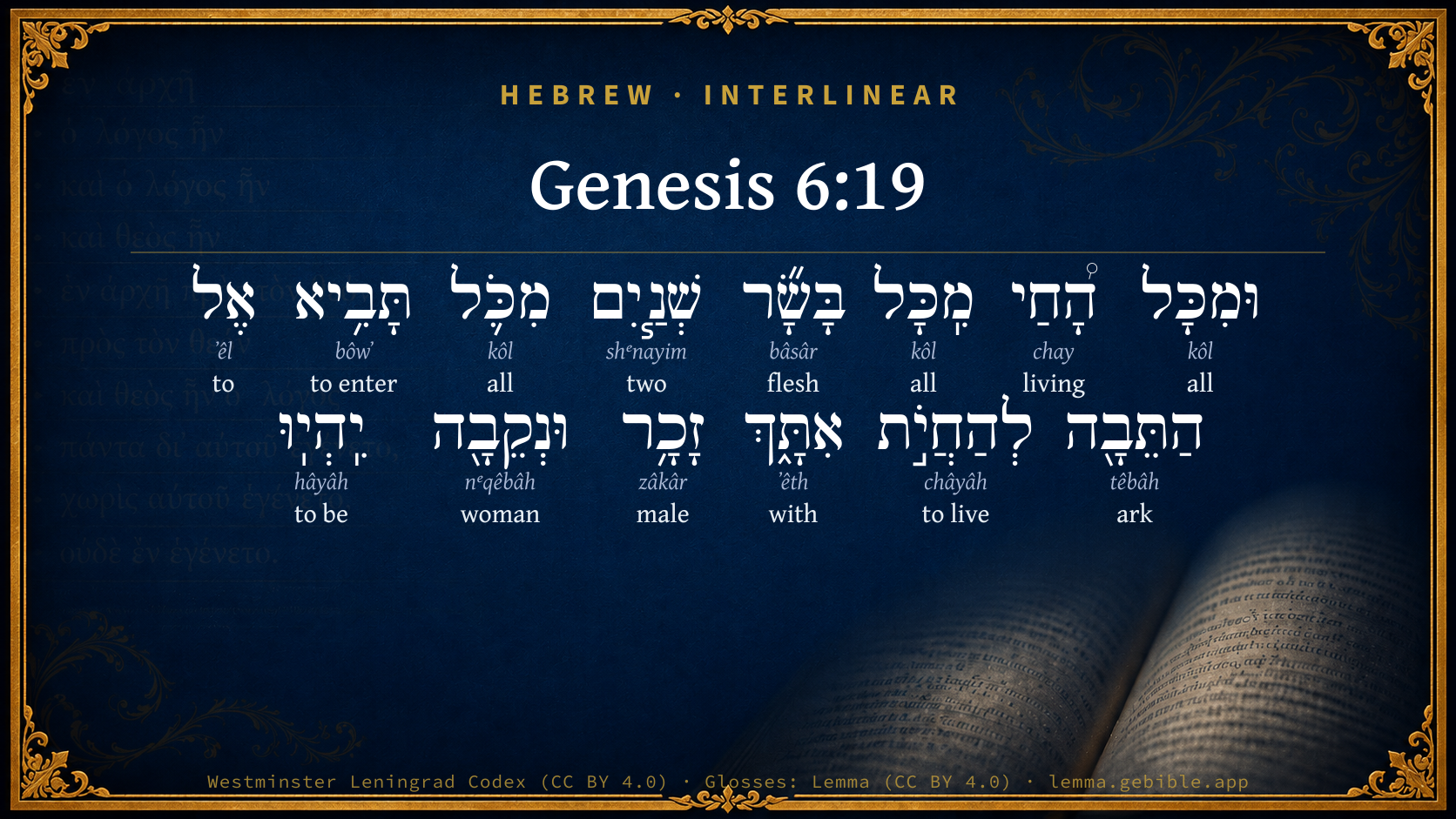
Hebrew (Westminster Leningrad Codex) Genesis 6:19 appears in the Hebrew Old Testament. The text above is from the Westminster Leningrad Codex. Each word links to its Strong’s number, a concise gloss, and parsing drawn from the Open Scriptures Hebrew Bible morphology. Click any word for its full Brown-Driver-Briggs (BDB) entry.
Download image
Cite this verse

Genesis 6:19 (World English Bible). Public Domain. Lemma interlinear Bible study tool, https://lemma.gebible.app/v/genesis/6/19.

Show BibTeX & RIS
BibTeX
RIS
English Translation
Of every living thing of all flesh, you shall bring two of every sort into the ark, to keep them alive with you. They shall be male and female.
World English Bible · Public Domain
Download a study sheet

One document with this verse’s original text, its word-by-word gloss line, the meaning frame, cross-references with their text, attributed commentary, and full source and license credits — printable, and it pastes into notes with its structure intact.

This verse Autodidact and up

Study sheet (.html) Plain text (.txt)

A passage Seminary Student

Up to 50 verses in one chapter. A passage sheet keeps up to 6 commentary sources and 12 cross-references per verse, in the order this page ranks them, and says so on the sheet whenever that leaves anything out. Ask for a single verse and you get the Autodidact verse sheet above.

Everything on this page stays free to read, with no account — the sheet is a download of what is already on screen, not access to it.

Want to remove ads? Support Godless Engineer
Compare translations 3

The same verse in 3 English versions, stacked beneath the original-language interlinear above. Click any original word for its lexicon entry.

Each is an independent rendering of the whole verse — the interlinear is not word-aligned to these translations.

Highlighted words mark where these versions differ — a whole-verse word diff, not a word-by-word alignment.

  • World English Bible Public Domain
    Of every living thing of all flesh, you shall bring two of every sort into the ark, to keep them alive with you. They shall be male and female.
  • King James Version Public Domain
    And of every living thing of all flesh, two of every sort shalt thou bring into the ark, to keep them alive with thee; they shall be male and female.
  • unfoldingWord Literal Text CC BY-SA 4.0
    And from every living, from all flesh, you must bring two from each into the ark to keep alive with you. They must be male and female.

unfoldingWord Literal Text — © unfoldingWord, licensed CC BY-SA 4.0. Word-aligned USFM3 via Door43 (git.door43.org/unfoldingWord/en_ult).

Versions to compare (up to 4)

3 of 4 selected

Show all 18 translations

Every available English version of this verse, each an independent rendering of the whole verse.

  • World English Bible Public Domain
    Of every living thing of all flesh, you shall bring two of every sort into the ark, to keep them alive with you. They shall be male and female.
  • Berean Standard Bible Public Domain
    And you are to bring two of every living creature into the ark—male and female—to keep them alive with you.
  • Majority Standard Bible Public Domain
    And you are to bring two of every living creature into the ark—male and female—to keep them alive with you.
  • King James Version Public Domain
    And of every living thing of all flesh, two of every sort shalt thou bring into the ark, to keep them alive with thee; they shall be male and female.
  • American Standard Version (1901) Public Domain
    And of every living thing of all flesh, two of every sort shalt thou bring into the ark, to keep them alive with thee; they shall be male and female.
  • Revised Version (1885) Public Domain
    And of every living thing of all flesh, two of every sort shalt thou bring into the ark, to keep them alive with thee; they shall be male and female.
  • Geneva Bible (1599) Public Domain
    And of euery liuing thing, of all flesh two of euery sort shalt thou cause to come into the Arke, to keepe them aliue with thee: they shalbe male and female.
  • Douay-Rheims (1899) Public Domain
    And of every living creature of all flesh, thou shalt bring two of each sort into the ark, that they may live with thee: of the male sex, and the female.
  • Young's Literal Translation Public Domain
    and of all that liveth, of all flesh, two of every `sort' thou dost bring in unto the ark, to keep alive with thee; male and female are they.
  • Literal Standard Version CC BY-SA 4.0
    and of all that lives, of all flesh, you bring two from every [kind] into the Ark, to keep alive with you; they are male and female.
  • Unlocked Literal Bible CC BY-SA 4.0
    Of every living creature of all flesh, two of every kind you must bring into the ark, to keep them alive with you, both male and female.
  • unfoldingWord Literal Text CC BY-SA 4.0
    And from every living, from all flesh, you must bring two from each into the ark to keep alive with you. They must be male and female.
  • Darby Bible Public Domain
    And of every living thing of all flesh, two of every [sort] shalt thou bring into the ark, to keep [them] alive with thee: they shall be male and female.
  • World Messianic Bible Public Domain
    Of every living thing of all flesh, you shall bring two of every sort into the ship, to keep them alive with you. They shall be male and female.
  • Webster's Bible Public Domain
    And of every living thing of all flesh, two of every sort shalt thou bring into the ark, to keep them alive with thee: they shall be male and female.
  • Free Bible Version CC BY-SA 4.0
    Take a pair, male and female, of every kind of animal into the ark and make sure you keep them alive.
  • Bible in Basic English Public Domain
    And you will take with you into the ark two of every sort of living thing, and keep them safe with you; they will be male and female.
  • JPS Tanakh (1917) Public Domain
    And of every living thing of all flesh, two of every sort shalt thou bring into the ark, to keep them alive with thee; they shall be male and female.

Literal Standard Version (2020), Covenant Press — licensed CC BY-SA 4.0. Text via the HelloAO Bible API (eBible.org). Unlocked Literal Bible (unfoldingWord) — licensed CC BY-SA 4.0. Text via the HelloAO Bible API (eBible.org). unfoldingWord Literal Text — © unfoldingWord, licensed CC BY-SA 4.0. Word-aligned USFM3 via Door43 (git.door43.org/unfoldingWord/en_ult). Free Bible Version, Dr. Jonathan Gallagher — licensed CC BY-SA 4.0. Text via the HelloAO Bible API (eBible.org).

Word by word

More ways to search: Search by grammar → Find every occurrence → Compare this word →

Practice this passage: Drill this verse → Learn its vocabulary →

וּנְקֵבָ֖ה
nᵉqêbâh
H5347
“and · woman”
Conjunction + Noun, Common, Feminine, Singular, Absolute
Part of Speech
Conjunction + Noun
Type
Common
Gender
Feminine
Number
Singular
State
Absolute
Full BDB Definition

Origin: from H5344

TWOT: 1409b

female - woman, female child - female animal
  1. וּמִכָּל kôl H3605 “and · from · all of” Conjunction + Preposition + Noun, Common, Masculine, Singular, Construct
  2. הָ֠חַי chay H2416 “the · living” Particle, Definite Article + Adjective, Adjective, Masculine, Singular, Absolute
  3. מִֽכָּל kôl H3605 “from · all of” Preposition + Noun, Common, Masculine, Singular, Construct
  4. בָּשָׂ֞ר bâsâr H1320 “flesh” Noun, Common, Masculine, Singular, Absolute
  5. שְׁנַ֧יִם shᵉnayim H8147 “two” Adjective, Cardinal number, Masculine, Dual, Absolute
  6. מִכֹּ֛ל kôl H3605 “from · all” Preposition + Noun, Common, Masculine, Singular, Absolute
  7. תָּבִ֥יא bôwʼ H935 “to enter” Verb, Hiphil, Imperfect, 2nd Person, Masculine, Singular
  8. אֶל ʼêl H413 “to” Preposition
  9. הַתֵּבָ֖ה têbâh H8392 “the · ark” Particle, Definite Article + Noun, Common, Feminine, Singular, Absolute
  10. לְהַחֲיֹ֣ת châyâh H2421 “to live” Preposition + Verb, Hiphil, Infinitive Construct
  11. אִתָּ֑ךְ ʼêth H854 “with · you” Preposition + Suffix, Personal, 2nd Person, Feminine, Singular
  12. זָכָ֥ר zâkâr H2145 “male” Adjective, Adjective, Masculine, Singular, Absolute
  13. יִֽהְיֽוּ hâyâh H1961 “to be” Verb, Qal, Imperfect, 3rd Person, Masculine, Plural

About this verse

These counts appear in no published source. They are computed here, from the morphology-tagged text and Lemma’s own curated glosses. What Lemma adds →

14
words
12
distinct lemmas
Pentateuch
section

Notable vocabulary

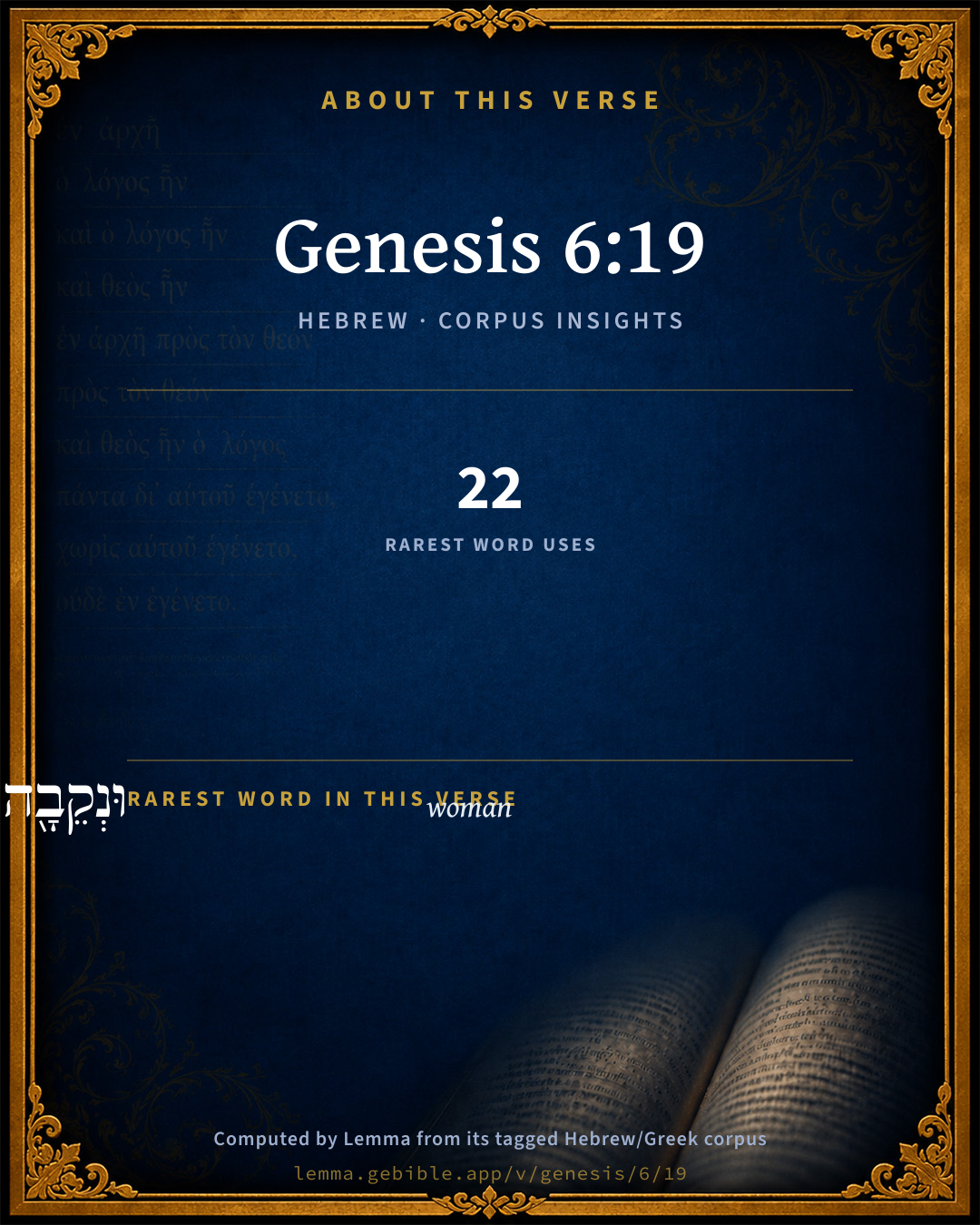
The rarest word here is וּנְקֵבָ֖ה woman H5347 — appearing just 22 times in the whole Hebrew Bible.

Shared distinctive vocabulary

וּנְקֵבָ֖ה woman H5347 occurs in 22 verses of the Hebrew Bible. Also found in:

Grammatical profile

  • 3 verbs
  • 6 nouns
  • 3 adjectives
  • 2 prepositions

Verb forms

  • תָּבִ֥יא Hiphil · Imperfect
  • לְהַחֲיֹ֣ת Hiphil · Infinitive Construct
  • יִֽהְיֽוּ Qal · Imperfect

Repetition

A word recurs within this verse — often emphatic in Hebrew:

  • וּמִכָּל all H3605 ×3

Hebrew & Septuagint length

In English translation the verse runs 29 words from the Hebrew and 40 from the Septuagint (LXX English) — closely comparable.

A rough comparison of the two English renderings, which tokenize alike — not a word-level alignment.

Word counts can differ between the Hebrew and the Greek without any difference in meaning — e.g. the Hebrew direct-object marker אֵת has no separate Greek word, and Greek often adds the article ὁ.

Cross-references

5

Topical passages linked to Genesis 6:19 in the Treasury of Scripture Knowledge — connected by theme and wording, ordered by reader-vote popularity; previews shown in the World English Bible.

  • Genesis 7:8–9 Clean animals, animals that are not clean, birds, and everything that creeps on the ground
  • Genesis 7:15–16 They went to Noah into the ark, by pairs of all flesh with the breath of life in them.
  • Genesis 7:2–3 You shall take seven pairs of every clean animal with you, the male and his female. Of the animals that are not clean, take two, the male and his female.
  • Genesis 8:17 Bring forth with you every living thing that is with you of all flesh, including birds, cattle, and every creeping thing that creeps on the earth; that they may breed abundantly in the earth, and be fruitful, and multiply on the earth."
  • Psalms 36:6 Your righteousness is like the mountains of God. Your judgments are like a great deep. Yahweh, you preserve man and animal.

Cross-references courtesy of OpenBible.info (CC BY 4.0).

Hebrew and Greek witnesses Masoretic Hebrew ↔ Greek Septuagint

The same verse in the two great witnesses to the Old Testament, shown verse-for-verse.

These are two independent witnesses, not word-aligned to each other, and the Septuagint is shown in lemma (dictionary) form.

Hebrew Genesis 6:19 Masoretic · Westminster Leningrad Codex

וּמִכָּל הָ֠חַי מִֽכָּל בָּשָׂ֞ר שְׁנַ֧יִם מִכֹּ֛ל תָּבִ֥יא אֶל הַתֵּבָ֖ה לְהַחֲיֹ֣ת אִתָּ֑ךְ זָכָ֥ר וּנְקֵבָ֖ה יִֽהְיֽוּ

Of every living thing of all flesh, you shall bring two of every sort into the ark, to keep them alive with you. They shall be male and female.

World English Bible · Public Domain

Greek LXX Genesis 6:19 Septuagint · lemma form

καί ἀπό πᾶς ὁ κτῆνος καί ἀπό πᾶς ὁ ἑρπετόν καί ἀπό πᾶς ὁ θηρίον καί ἀπό πᾶς σάρξ δύο δύο ἀπό πᾶς εἰςἄγω εἰς ὁ κιβωτός ἵνα τρέφω μετά σεαυτοῦ ἄρσην καί θῆλυς εἰμί

And of all cattle and of all reptiles and of all wild beasts, even of all flesh, you shall bring by pairs of all, into the ark, that you may feed them with yourself: male and female they shall be.

LXX2012 (modern English Septuagint) · Public Domain

On this verse, The Pulpit Commentary discusses the Septuagint’s reading. Read the note in Commentary ↓

Hebrew: Westminster Leningrad Codex (CC BY 4.0). Greek: Septuagint (public domain); English from LXX2012 (modern English Septuagint) (Public Domain). How the Septuagint differs from the Hebrew →

Targum (Aramaic paraphrase)

2

The Targum is the ancient Jewish Aramaic paraphrase of the Hebrew Scriptures — an interpretive translation, not the Hebrew text itself. Onkelos (literal) and Pseudo-Jonathan (expansive) render the Torah, and Jonathan the Prophets. Coverage is partial: where no permissively-licensed English translation exists for a verse, only the Aramaic is shown. This is verse-level text, not a word-by-word alignment to the Hebrew.

  1. Targum Onkelos Torah (Genesis–Deuteronomy)
    וּמִכָּל דְּחַי מִכָּל בִּסְרָא תְּרֵין מִכֹּלָּא תָּעֵיל לְתֵבוֹתָא לְקַיָּמָא עִמָּךְ דְּכַר וְנוּקְבָא יְהוֹן

    And of all that liveth of all flesh two and two of all that enter into the ark to abide with thee, male and female shall they be.

    Targum Onkelos — Aramaic: “Onkelos Genesis” (public domain); “Onkelos Exodus” (public domain); “Onkelos Leviticus” (public domain); “Onkelos Numbers” (public domain); “Onkelos Deuteronomy” (public domain). English: “Sefaria Community Translation” (CC0 1.0 (public-domain dedication)); “J.W. Etheridge. The Targums of Onkelos and Jonathan Ben Uzziel on the Pentateuch. London: Longmans, Green, 1862” (public domain). Text via Sefaria.

  2. Targum Pseudo-Jonathan Torah (Genesis–Deuteronomy)
    וּמִן כָּל דְחַי מִכָּל בִּשְרָא תְּרֵין מִכּוֹלָא תֵּיעוּל לְתֵיבוּתָא לְקַיְימָא עִמָךְ דְכַר וְנוּקְבָא יְהוֹן

    And of all that liveth of all flesh, two of every (kind) shall go into the ark, to be preserved alive with thee: male and female shall they be.

    Targum Pseudo-Jonathan — Aramaic: “Targum Jonathan on Genesis” (public domain); “Targum Jonathan on Exodus” (public domain); “Targum Jonathan on Leviticus” (public domain); “Targum Jonathan on Numbers” (public domain); “Targum Jonathan on Deuteronomy” (public domain). English: “The Targum of Jonathan ben Uzziel, trans. J. W. Etheridge, London, 1862” (public domain). Text via Sefaria.

Commentary

Notes on Genesis 6:19 from classic Christian and Jewish commentators (each source and its license shown beneath its notes). The classic Christian expositions comment on the surrounding passage and are grouped to its opening verse, so a note may address several verses; the Jewish commentaries on the Tanakh (Rashi and others) are per-verse, so they appear only where the commentator wrote on this verse.

Lemma curates 59 commentaries, every one of them public domain or Creative Commons licensed, each selected and text-cleaned for this edition rather than reprinted as found. About our sources →

Scofield Reference Notes

C. I. Scofield

two of every sort

Cf Gen 7:2.

In addition to two animals, etc., commanded (Gen 6:19) to be preserved for future increase ("they shall be male and female"), the further command was given more than 100 years later to take of clean beasts, i.e, acceptable for sacrifice, seven each. Exodus gives ten such beasts, or but seventy in all. Modern ships carry hundreds of live beasts, with their food, besides scores of human beings.

The Scofield Reference Bible (1917 edition), notes by C. I. Scofield — public domain. Text from a community e-Sword module.

Tyndale Open Study Notes

Tyndale Open Resources

6:19-20 God’s instructions to Noah repeat the language of creation (every kind, cp. 1:24). • a male and a female: These animals would procreate and repopulate the earth after the flood.

Tyndale Open Study Notes — © Tyndale Open Resources, licensed CC BY-SA 4.0. Text via the HelloAO Bible API.

Adam Clarke's Commentary

Verse 19. To keep them alive] God might have destroyed all the animal creation, and created others to occupy the new world, but he chose rather to preserve those already created. The Creator and Preserver of the universe does nothing but what is essentially necessary to be done. Nothing should be wantonly wasted; nor should power or skill be lavished where no necessity exists; and yet it required more means and economy to preserve the old than to have created new ones. Such respect has God to the work of his hands, that nothing but what is essential to the credit of his justice and holiness shall ever induce him to destroy any thing he has made.

Adam Clarke's Commentary on the Bible (1810–1826) — public domain. Text from a community e-Sword/MySword module.

John Calvin's Commentaries

19. And of every living thing of all flesh. “All flesh” is the name he gives to animals of whatsoever kind they may be. He says they went in two and two; not that a single pair of each kind was received into the ark, (for we shall soon see that there were three pairs of the clean kinds, and one animal over, which Noah afterwards offered in sacrifice;) but whereas here mention is made only of offspring, he does not expressly state the number, but simply couples males with females, that Noah might hence perceive how the world was to be replenished.

John Calvin's Commentaries (1540-1563) — public domain. Text from the Calvin Translation Society English edition (1840s-50s) via the Christian Classics Ethereal Library (ccel.org). Calvin's coverage is partial (roughly two-thirds of the Bible); uncommented books and verses are honest gaps, never fabricated. The 19th-century editor's footnotes and remarks are omitted so the notes are faithfully Calvin's own voice.

Ellicott's Commentary for English Readers

(19-22) of every living thing of all flesh, two . . . —The vast size of the ark and the wide terms used of the animals to be collected into it, make it evident that Noah was to save not merely his domestic cattle, but many wild species of beasts, birds, and creeping things. But the terms are conditioned by the usual rules for the interpretation of the language of Holy Scripture, and by the internal necessities of the event itself. Thus the animals in the ark could not have been more in number than four men and four women could attend to Next, the terms exclude the carnivora (see also Note on Gen_9:5). Not only was there no supply of animals taken on board to feed them, but half-tamed as they would have been by a year’s sojourn in the ark, they would have remained in Noah’s neighbourhood, and very soon have destroyed all the cattle which had been saved, especially as far and wide no other living creatures would have existed for their food. But if miracles are to be invoked to obviate these and similar difficulties. not only would it have been easier to save Noah and the denizens of the ark by one display of supernatural power, but the ark was the means provided by God for this purpose; and if He wrought thus far by human instrumentality, in accordance with the usual law of the Divine working on earth, to help out the human means employed by repeated acts of omnipotence would have been to proclaim it as insufficient. It does not follow from this that no special providence watched over and guided the ark; such providence is often exercised now, but it works through and in accordance with the ordinary laws by which God governs the world.

A Bible Commentary for English Readers, edited by Charles John Ellicott (1878–1897) — public domain. Text from a community e-Sword module.

The Cambridge Bible for Schools and Colleges

gen. ed. J. J. S. Perowne

19. two of every sort] Observe that here one pair of every kind of living creature is to be brought into the ark.

“Male and female,” as in Gen_1:27 (P). A different phrase is used in Gen_7:2 (J), where see note.

The Cambridge Bible for Schools and Colleges (gen. ed. J. J. S. Perowne; Cambridge University Press, 1878–1918) — public domain. Text from a community e-Sword module.

John Gill's Exposition

And take thou unto thee of all food that is eaten,.... By man and beast; of which see Gen 1:29.

and thou shall gather it to thee; to lay up in the ark:

and it shall be for food for thee, and for them: during the flood, a quantity sufficient for them: and according to the calculation of learned men (n), well versed in mathematics, there was room enough in the ark, and to spare, to put food for them all during the time the flood was on the earth.

(n) Buteo de Area Noe, Wilkins's Essay towards a real Character, Bedford's Chronology, &c.

John Gill's Exposition of the Whole Bible (1746–1763) — public domain (CC PDM 1.0). Text via the HelloAO Bible API.

Haydock's Catholic Bible Commentary

Two, intended for the propagation of their kind. God afterwards specifies what more Noe should preserve for food, chap. vii. 2. (Calmet). --- Wild beasts forgot their savage nature, and became subject to the just Noe; and all came readily at his beck, in the same manner as domestic animals come when we offer them food. Yet, in all this we must acknowledge the work of God, and a sort of miracle. (Haydock)

George Leo Haydock (1774–1849), Haydock's Catholic Family Bible and Commentary, 1859 edition — public domain. Excludes Psalms (Douay-Rheims chapter numbering differs from Protestant) and Deuterocanonical books (Catholic canon only).

Matthew Poole's English Annotations

Of all flesh two; i.e. either,

1. By couples, or male and female; but this is mentioned as a distinct thing in the close of the verse. Or rather,

2. Two at least of every sort, even of the unclean; but of the clean more, as is noted Gen 7:2.

Matthew Poole's English Annotations on the Holy Bible (1683–1685) — public domain. Text from a community e-Sword/MySword module.

Whedon's Commentary on the Bible

Daniel D. Whedon

19. Two of every sort — From this statement, repeated in the next verse, as well as from that made in Gen_7:15-16, it would be understood that only a pair of the animals were to be preserved; but from Gen_7:2-3, we see that the clean beasts and fowls went into the ark by seven pairs. Animals instinctively foresee great natural convulsions or earthquakes, volcanic eruptions and tornadoes, and often, on such occasions, quite subdued by fear, seek human protection. It is natural to suppose that there would have been in the earth, atmosphere, and clouds fearful premonitions of this unparalleled convulsion, which lasted through forty days, and which is described as opening the windows of heaven and breaking up “the fountains of the great deep.” Beasts and birds of all kinds, that is, of all the species in that region, affrighted by these signs of the coming tempest, and tamed by their fears, may be reasonably believed to have gathered around or settled on the vast ark, during the few days before the deluge actually began. From these Noah selected twos or sevens of each kind. Instinct was thus providentially (we need not say miraculously) made the means of their preservation.

Shalt thou bring — They came unto Noah, (Gen_5:20,) and he caused them to come (for this is the true idea of the word rendered bring) into the ark.

Daniel D. Whedon (gen. ed.), Commentary on the Old and New Testaments (1874–1909) — public domain. Text from a community e-Sword module.

The Pulpit Commentary

Vers. 19-21. And of every living thing of all flesh, two of every sort (literally, by twos, i.e. in pairs) shalt thou bring into or cause to enter, i.e. receive them when they come (ver. 20) the ark, to keep them alive literally, to cause to live; ina trefhv (LXX); in order to preserve alive (sc. the animals)with thee; they shall be male and female. Of fowls after their kind (literally, of the fowl after its kind), and of cattle after their kind (literally, of the cattle after its kind), of every creeping thing of the earth after its bind, two of every sort shall come unto thee. "Non hominis actu, sed Dei nutu" (Augustine). Perhaps through an instinctive presentment of the impending calamity (Lange, "Speaker"s Commentary").

And take thou unto thee of all food that is eaten, and thou shalt gather it to thee (collecting sufficient for a twelvemonths sustenance); and it shall be for food for thee, and for them.

The Pulpit Commentary (1880–1919), ed. H.D.M. Spence-Jones & Joseph S. Exell — public domain. Text from a community e-Sword module.

Rashi

Rabbi Shlomo Yitzchaki (Rashi)

ומכל החי AND OF EVERY LIVING THING — Even of demons (Genesis Rabbah 31:13).

שנים מכל TWO OF EVERY SORT — Even of the least numerous amongst them there were not less than two—one male, the other female.

Rashi on the Tanakh — English translations: “The Judaica Press complete Tanach with Rashi, translated by A. J. Rosenberg” (CC BY 4.0); “Pentateuch with Rashi's commentary by M. Rosenbaum and A.M. Silbermann, 1929-1934” (public domain); “The Metsudah Tanach series, Lakewood, N.J” (CC BY 4.0); and “The Book of Joshua, Metsudah Publications, 1997” (CC BY 4.0). Text via Sefaria.

Ramban (Nachmanides)

Rabbi Moshe ben Nachman (Ramban / Nachmanides)

OF ALL FLESH. It is known that there are a great many beasts, and some of them — such as elephants, rams and others — are very large; likewise, the creeping things upon the earth are very many. Of the fowl of the heaven there are also innumerably many kinds, just as our Rabbis have said: “There are one hundred and twenty kinds of unclean birds in the east, and all of them belong to the species of ayah (kite).” Clean fowl are innumerable. Noah was thus obligated to bring all of them into the ark in order that they may beget their like. If you would gather a full year’s supply of food for all of them, [you would find] that this ark and ten others like it could not hold it! But this was a miracle of a small space containing a great quantity. And in case you suppose that he should have made it [the ark] very small and rely on this miracle, the answer is that the Holy One, blessed be He, saw fit to make it large so that the people of his generation should see it, wonder at it, converse about it, and speak of the subject of the flood and the gathering of the cattle, beast, and fowl into it so that perhaps they would repent. Furthermore, he made it large in order to reduce the miracle for such is the way with all miracles in the Torah or in the Prophets: whatever is humanly possible is done, with the balance left to Heaven. Now be not persuaded to say as Ibn Ezra that the three hundred cubits [of the length of the ark were measured] in cubits of a man like Noah, who was unusually tall. If so, the other people were also tall, and the beasts and fowl of those generations were also tall until the world was struck by the flood! Moreover, the cubits here are the standard cubits of the Torah.

THOU SHALT BRING INTO THE ARK, TO KEEP THEM ALIVE WITH THEE. G-d thus commanded Noah that he concern himself with and help them in their entering the ark and that he strive on behalf of their existence even as he would for his own life.

Ramban (Nachmanides) on the Tanakh — English translation: “Commentary on the Torah by Ramban (Nachmanides). Translated and annotated by Charles B. Chavel. New York, Shilo Pub. House, 1971-1976” (CC BY 4.0). Text via Sefaria.

Radak

Rabbi David Kimhi (Radak)

ומכל החי מכל בשר, a reference to the living creatures on the dry land only.

שנים מכל, Noach was told that these animals were to be admitted in pairs. G’d specified further, זכר ונקבה יהיו.. תביא אל התבה, after the animals which came of their own accord had been accommodated in the ark. What prompted some of these animals to come to Noach’s ark on their own? They were inspired by the same kind of imagination which unerringly enables them to find grazing land etc. G’d, no doubt, aided their imagination in this instance.

להחיות אתך, to keep them alive with you by feeding them on a daily basis.

Radak on the Tanakh — English translations: “Sefaria Community Translation” (CC0 1.0 (public-domain dedication)); “Eliyahu Munk, HaChut Hameshulash” (CC BY 4.0); “Rabbi Mike Feuer, Jerusalem Anthology” (CC BY 4.0); and “R. David Kimhi on the first book of Psalms, Translated by R.G. Finch, London, 1919” (public domain). Text via Sefaria.

Lesson kit

Teaching starters — assembled from the data on this page, not authored interpretation. Every prompt links to the verse data it draws on. Edit before teaching.

Genesis, in the Pentateuch, opens this verse with 14 words (12 distinct Hebrew lemmas). Its most distinctive word is nᵉqêbâh (“woman”). A historical commentator’s framing appears above. Read the whole chapter for the surrounding context.

Discussion questions

  1. What does “woman” (nᵉqêbâh) contribute to the verse as a whole?
  2. Genesis 1:27 shares the word «woman» with this verse. How do the two illuminate each other?
  3. “all” occurs 3× in this one verse. What is the effect of the repetition?
  4. These translations render this verse differently. What is at stake in choosing one wording over another?
  5. The verb «תָּבִ֥יא» is Hiphil Imperfect. How does its form color the action?
  6. Reading how Scofield Reference Notes and Tyndale Open Study Notes read this verse, where do the two commentators agree and where do they part?

Things to notice

Reading settings

Reading text

Shown beneath each verse's original-language words.

Old Testament
Old Testament edition

Read the OT as the Masoretic Hebrew (MT) or the Greek Septuagint (LXX).

English shown for the Greek Septuagint (in the Hebrew ↔ Greek comparison).

Comparing translations? Open the Compare panel on any verse page to stack up to four side by side.