
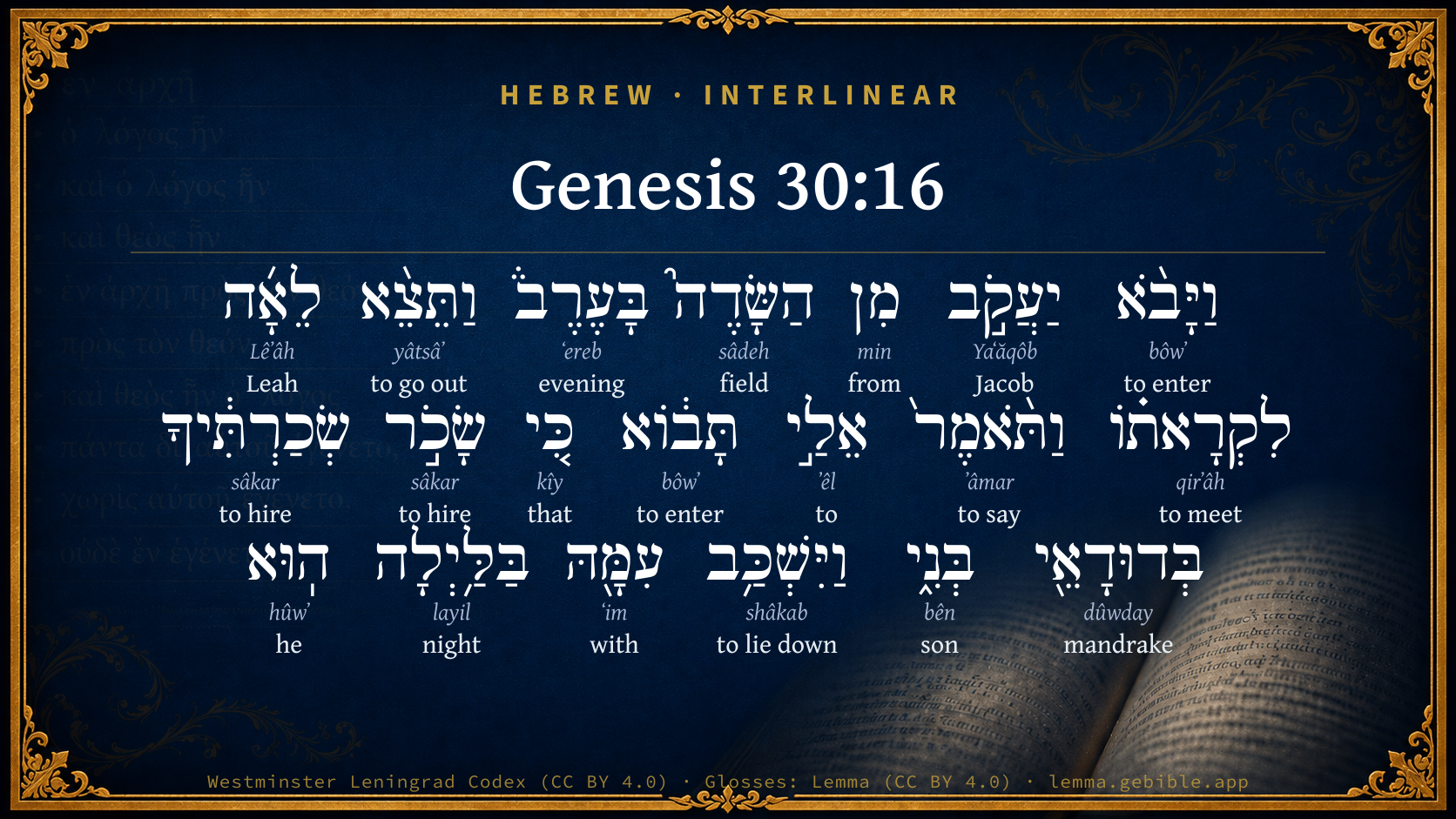
Genesis 30:16

Hebrew (Westminster Leningrad Codex) Genesis 30:16 appears in the Hebrew Old Testament. The text above is from the Westminster Leningrad Codex. Each word links to its Strong’s number, a concise gloss, and parsing drawn from the Open Scriptures Hebrew Bible morphology. Click any word for its full Brown-Driver-Briggs (BDB) entry.
Download image
Cite this verse

Genesis 30:16 (World English Bible). Public Domain. Lemma interlinear Bible study tool, https://lemma.gebible.app/v/genesis/30/16.

Show BibTeX & RIS
BibTeX
RIS
English Translation
Jacob came from the field in the evening, and Leah went out to meet him, and said, "You must come in to me; for I have surely hired you with my son's mandrakes." He lay with her that night.
World English Bible · Public Domain
Highlights
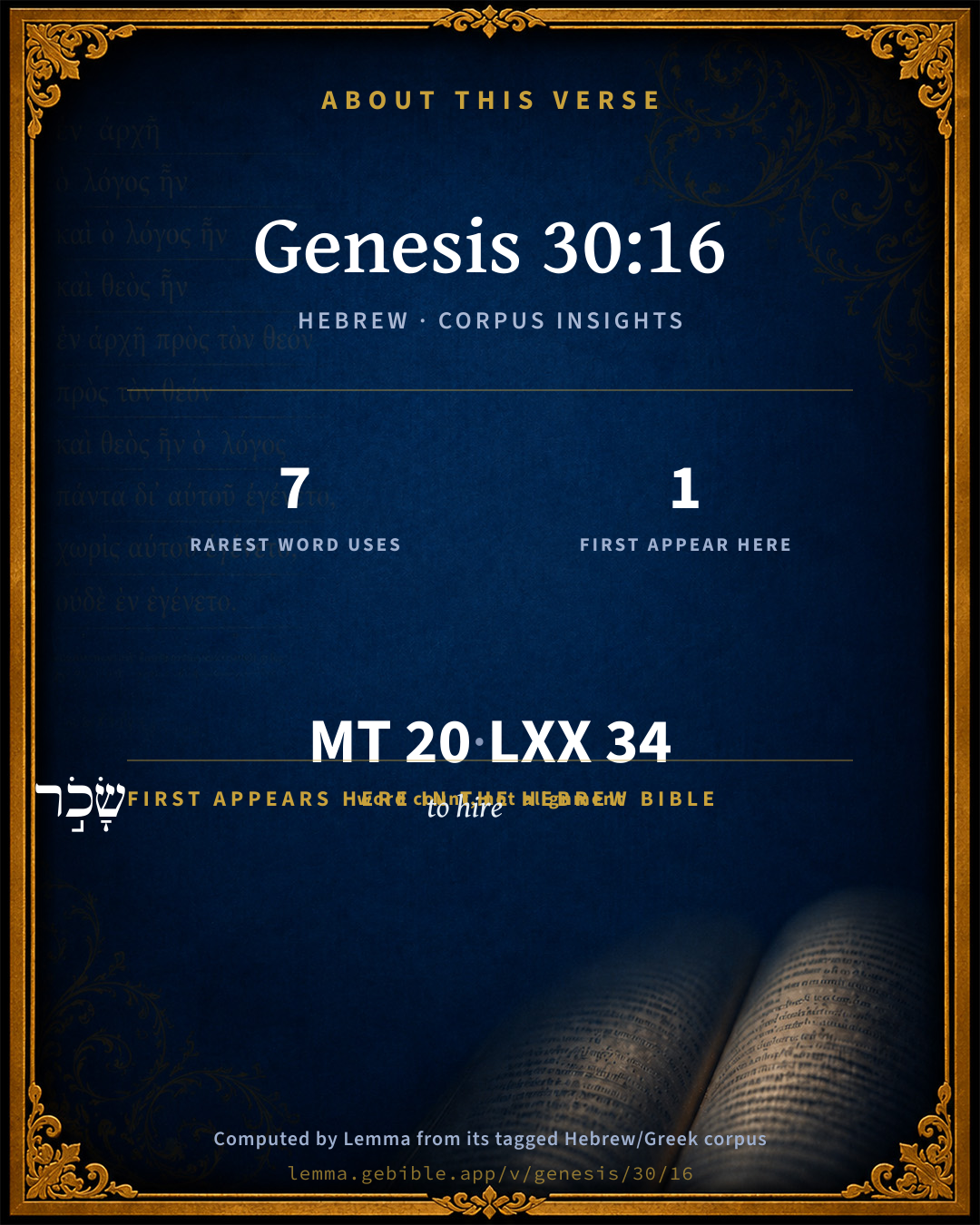
  • 1 first appearance in the Hebrew Bible
Full analysis ↓
Download a study sheet

One document with this verse’s original text, its word-by-word gloss line, the meaning frame, cross-references with their text, attributed commentary, and full source and license credits — printable, and it pastes into notes with its structure intact.

This verse Autodidact and up

Study sheet (.html) Plain text (.txt)

A passage Seminary Student

Up to 50 verses in one chapter. A passage sheet keeps up to 6 commentary sources and 12 cross-references per verse, in the order this page ranks them, and says so on the sheet whenever that leaves anything out. Ask for a single verse and you get the Autodidact verse sheet above.

Everything on this page stays free to read, with no account — the sheet is a download of what is already on screen, not access to it.

Want to remove ads? Support Godless Engineer
Compare translations 3

The same verse in 3 English versions, stacked beneath the original-language interlinear above. Click any original word for its lexicon entry.

Each is an independent rendering of the whole verse — the interlinear is not word-aligned to these translations.

Highlighted words mark where these versions differ — a whole-verse word diff, not a word-by-word alignment.

  • World English Bible Public Domain
    Jacob came from the field in the evening, and Leah went out to meet him, and said, "You must come in to me; for I have surely hired you with my son's mandrakes." He lay with her that night.
  • King James Version Public Domain
    And Jacob came out of the field in the evening, and Leah went out to meet him, and said, Thou must come in unto me; for surely I have hired thee with my son's mandrakes. And he lay with her that night.
  • unfoldingWord Literal Text CC BY-SA 4.0
    Then Jacob came from the field in the evening, and Leah went out to meet him and said, “You must come to me, because I have surely hired you with my son’s mandrakes.” So he lay with her during that night,

unfoldingWord Literal Text — © unfoldingWord, licensed CC BY-SA 4.0. Word-aligned USFM3 via Door43 (git.door43.org/unfoldingWord/en_ult).

Versions to compare (up to 4)

3 of 4 selected

Show all 18 translations

Every available English version of this verse, each an independent rendering of the whole verse.

  • World English Bible Public Domain
    Jacob came from the field in the evening, and Leah went out to meet him, and said, "You must come in to me; for I have surely hired you with my son's mandrakes." He lay with her that night.
  • Berean Standard Bible Public Domain
    When Jacob came in from the field that evening, Leah went out to meet him and said, “You must come with me, for I have hired you with my son’s mandrakes.” So he slept with her that night.
  • Majority Standard Bible Public Domain
    When Jacob came in from the field that evening, Leah went out to meet him and said, “You must come with me, for I have hired you with my son’s mandrakes.” So he slept with her that night.
  • King James Version Public Domain
    And Jacob came out of the field in the evening, and Leah went out to meet him, and said, Thou must come in unto me; for surely I have hired thee with my son's mandrakes. And he lay with her that night.
  • American Standard Version (1901) Public Domain
    And Jacob came from the field in the evening, and Leah went out to meet him, and said, Thou must come in unto me; for I have surely hired thee with my son's mandrakes. And he lay with her that night.
  • Revised Version (1885) Public Domain
    And Jacob came from the field in the evening, and Leah went out to meet him, and said, Thou must come in unto me; for I have surely hired thee with my son’s mandrakes. And he lay with her that night.
  • Geneva Bible (1599) Public Domain
    And Iaakob came from the fielde in the euening, and Leah went out to meete him, and sayde, Come in to mee, for I haue bought and payed for thee with my sonnes mandrakes: and he slept with her that night.
  • Douay-Rheims (1899) Public Domain
    And when Jacob returned at even from the field, Lia went out to meet him, and said: Thou shalt come in unto me, because I have hired thee for my son's mandrakes. And he slept with her that night.
  • Young's Literal Translation Public Domain
    And Jacob cometh in from the field at evening; and Leah goeth to meet him, and saith, `Unto me dost thou come in, for hiring I have hired thee with my son's love-apples;' and he lieth with her during that night.
  • Literal Standard Version CC BY-SA 4.0
    And Jacob comes in from the field at evening; and Leah goes to meet him and says, “You come in to me, for [in] hiring I have hired you with my son’s love-apples”; and he lies with her during that night.
  • Unlocked Literal Bible CC BY-SA 4.0
    Jacob came from the field in the evening. Leah went out to meet him and said, “You must sleep with me tonight, for I have hired you with my son's mandrakes.” So Jacob slept with Leah that night.
  • unfoldingWord Literal Text CC BY-SA 4.0
    Then Jacob came from the field in the evening, and Leah went out to meet him and said, “You must come to me, because I have surely hired you with my son’s mandrakes.” So he lay with her during that night,
  • Darby Bible Public Domain
    And when Jacob came from the fields in the evening, Leah went out to meet him, and said, Thou must come in to me, for indeed I have hired thee with my son's mandrakes. And he lay with her that night.
  • World Messianic Bible Public Domain
    Jacob came from the field in the evening, and Leah went out to meet him, and said, “You must come in to me; for I have surely hired you with my son’s mandrakes.” He lay with her that night.
  • Webster's Bible Public Domain
    And Jacob came from the field in the evening, and Leah went out to meet him, and said, Thou must come in to me; for surely I have hired thee with my son's mandrakes. And he lay with her that night.
  • Free Bible Version CC BY-SA 4.0
    When Jacob came in from the fields that evening, Leah went out to meet him. “You have to sleep with me because I've paid for you with my son's mandrakes,” she told him. So he slept with her that night.
  • Bible in Basic English Public Domain
    In the evening, when Jacob came in from the field, Leah went out to him and said, Tonight you are to come to me, for I have given my son's love-fruits as a price for you. And he went in to her that night.
  • JPS Tanakh (1917) Public Domain
    And Jacob came from the field in the evening, and Leah went out to meet him, and said: 'Thou must come in unto me; for I have surely hired thee with my son's mandrakes.' And he lay with her that night.

Literal Standard Version (2020), Covenant Press — licensed CC BY-SA 4.0. Text via the HelloAO Bible API (eBible.org). Unlocked Literal Bible (unfoldingWord) — licensed CC BY-SA 4.0. Text via the HelloAO Bible API (eBible.org). unfoldingWord Literal Text — © unfoldingWord, licensed CC BY-SA 4.0. Word-aligned USFM3 via Door43 (git.door43.org/unfoldingWord/en_ult). Free Bible Version, Dr. Jonathan Gallagher — licensed CC BY-SA 4.0. Text via the HelloAO Bible API (eBible.org).

Word by word

More ways to search: Search by grammar → Find every occurrence → Compare this word →

Practice this passage: Drill this verse → Learn its vocabulary →

בְּדוּדָאֵ֖י
dûwday
H1736
“in/at · mandrakes of”
Preposition + Noun, Common, Masculine, Plural, Construct
Part of Speech
Preposition + Noun
Type
Common
Gender
Masculine
Number
Plural
State
Construct
Full BDB Definition

Origin: from H1731

TWOT: 410d

mandrake, love-apple - as exciting sexual desire, and favouring procreation
  1. וַיָּבֹ֨א bôwʼ H935 “and · to enter” Conjunction + Verb, Qal, Sequential Imperfect, 3rd Person, Masculine, Singular
  2. יַעֲקֹ֣ב Yaʻăqôb H3290 “Jacob” Noun, Proper
  3. מִן min H4480 “from” Preposition
  4. הַשָּׂדֶה֮ sâdeh H7704 “the · field” Particle, Definite Article + Noun, Common, Masculine, Singular, Absolute
  5. בָּעֶרֶב֒ ʻereb H6153 “in/at the · evening” Preposition, Determined + Noun, Common, Masculine, Singular, Absolute
  6. וַתֵּצֵ֨א yâtsâʼ H3318 “and · to go out” Conjunction + Verb, Qal, Sequential Imperfect, 3rd Person, Feminine, Singular
  7. לֵאָ֜ה Lêʼâh H3812 “Leah” Noun, Proper
  8. לִקְרָאת֗וֹ qirʼâh H7125 “to meet · him” Preposition + Verb, Qal, Infinitive Construct + Suffix, Personal, 3rd Person, Masculine, Singular
  9. וַתֹּ֨אמֶר֙ ʼâmar H559 “and · to say” Conjunction + Verb, Qal, Sequential Imperfect, 3rd Person, Feminine, Singular
  10. אֵלַ֣י ʼêl H413 “to · me” Preposition + Suffix, Personal, 1st Person, Common, Singular
  11. תָּב֔וֹא bôwʼ H935 “to enter” Verb, Qal, Imperfect, 2nd Person, Masculine, Singular
  12. כִּ֚י kîy H3588 “that” Conjunction
  13. שָׂכֹ֣ר sâkar H7936 “to hire” Verb, Qal, Infinitive Absolute
  14. שְׂכַרְתִּ֔יךָ sâkar H7936 “to hire · you” Verb, Qal, Perfect, 1st Person, Common, Singular + Suffix, Personal, 2nd Person, Masculine, Singular
  15. בְּנִ֑י bên H1121 “son · my” Noun, Common, Masculine, Singular, Construct + Suffix, Personal, 1st Person, Common, Singular
  16. וַיִּשְׁכַּ֥ב shâkab H7901 “and · to lie down” Conjunction + Verb, Qal, Sequential Imperfect, 3rd Person, Masculine, Singular
  17. עִמָּ֖הּ ʻim H5973 “with · her” Preposition + Suffix, Personal, 3rd Person, Feminine, Singular
  18. בַּלַּ֥יְלָה layil H3915 “in/at the · night” Preposition, Determined + Noun, Common, Masculine, Singular, Absolute
  19. הֽוּא hûwʼ H1931 “he” Pronoun, Personal, 3rd Person, Masculine, Singular

About this verse

These counts appear in no published source. They are computed here, from the morphology-tagged text and Lemma’s own curated glosses. What Lemma adds →

20
words
18
distinct lemmas
Pentateuch
section

Notable vocabulary

The rarest word here is בְּדוּדָאֵ֖י mandrake H1736 — appearing just 7 times in the whole Hebrew Bible.

First appearance in Scripture

This word makes its first canonical appearance in the Hebrew Bible here:

  • שָׂכֹ֣ר to hire H7936

Shared distinctive vocabulary

בְּדוּדָאֵ֖י mandrake H1736 occurs in 5 verses of the Hebrew Bible. Also found in:

Grammatical profile

  • 8 verbs
  • 7 nouns
  • 1 pronoun
  • 3 prepositions
  • 1 conjunction

Verb forms

  • וַיָּבֹ֨א Qal · Sequential Imperfect
  • וַתֵּצֵ֨א Qal · Sequential Imperfect
  • לִקְרָאת֗וֹ Qal · Infinitive Construct
  • וַתֹּ֨אמֶר֙ Qal · Sequential Imperfect
  • תָּב֔וֹא Qal · Imperfect
  • שָׂכֹ֣ר Qal · Infinitive Absolute
  • שְׂכַרְתִּ֔יךָ Qal · Perfect
  • וַיִּשְׁכַּ֥ב Qal · Sequential Imperfect

Repetition

Words recur within this verse — often emphatic in Hebrew:

  • וַיָּבֹ֨א to enter H935 ×2
  • שָׂכֹ֣ר to hire H7936 ×2

Hebrew & Septuagint length

In English translation the verse runs 39 words from the Hebrew and 43 from the Septuagint (LXX English) — closely comparable.

A rough comparison of the two English renderings, which tokenize alike — not a word-level alignment.

Word counts can differ between the Hebrew and the Greek without any difference in meaning — e.g. the Hebrew direct-object marker אֵת has no separate Greek word, and Greek often adds the article ὁ.

In the original languages it is 20 Hebrew tokens and 34 Greek tokens — but the two are counted differently (Hebrew bundles its prefixes and suffixes into one token; the Greek is in lemma form), so that isn’t a like-for-like length.

Hebrew and Greek witnesses Masoretic Hebrew ↔ Greek Septuagint

The same verse in the two great witnesses to the Old Testament, shown verse-for-verse.

These are two independent witnesses, not word-aligned to each other, and the Septuagint is shown in lemma (dictionary) form.

Hebrew Genesis 30:16 Masoretic · Westminster Leningrad Codex

וַיָּבֹ֨א יַעֲקֹ֣ב מִן הַשָּׂדֶה֮ בָּעֶרֶב֒ וַתֵּצֵ֨א לֵאָ֜ה לִקְרָאת֗וֹ וַתֹּ֨אמֶר֙ אֵלַ֣י תָּב֔וֹא כִּ֚י שָׂכֹ֣ר שְׂכַרְתִּ֔יךָ בְּדוּדָאֵ֖י בְּנִ֑י וַיִּשְׁכַּ֥ב עִמָּ֖הּ בַּלַּ֥יְלָה הֽוּא

Jacob came from the field in the evening, and Leah went out to meet him, and said, "You must come in to me; for I have surely hired you with my son's mandrakes." He lay with her that night.

World English Bible · Public Domain

Greek LXX Genesis 30:16 Septuagint · lemma form

εἰςἔρχομαι δέ ἰακώβ ἐκ ἀγρός ἑσπέρα καί ἐκἔρχομαι λεια εἰς συνάντησις αὐτός καί εἶπον πρός ἐγώ εἰςἔρχομαι σήμερον μισθόομαι γάρ σύ ἀντί ὁ μανδραγόρας ὁ υἱός ἐγώ καί κοιμάω μετά αὐτός ὁ νύξ ἐκεῖνος

And Jacob came in out of the field at even; and Lea went forth to meet him, and said, You shall come in to me this day, for I have hired you for my son's mandrakes; and he lay with her that night.

LXX2012 (modern English Septuagint) · Public Domain

On this verse, The Pulpit Commentary discusses the Septuagint’s reading. Read the note in Commentary ↓

Hebrew: Westminster Leningrad Codex (CC BY 4.0). Greek: Septuagint (public domain); English from LXX2012 (modern English Septuagint) (Public Domain). How the Septuagint differs from the Hebrew →

Targum (Aramaic paraphrase)

2

The Targum is the ancient Jewish Aramaic paraphrase of the Hebrew Scriptures — an interpretive translation, not the Hebrew text itself. Onkelos (literal) and Pseudo-Jonathan (expansive) render the Torah, and Jonathan the Prophets. Coverage is partial: where no permissively-licensed English translation exists for a verse, only the Aramaic is shown. This is verse-level text, not a word-by-word alignment to the Hebrew.

  1. Targum Onkelos Torah (Genesis–Deuteronomy)
    וַאֲתָא (נ''י וְעַל) יַעֲקֹב מִן חַקְלָא בְּרַמְשָׁא וּנְפָקַת לֵאָה לְקַדָּמוּתֵהּ וַאֲמֶרֶת לְוָתִי תֵיעוֹל אֲרֵי מֵיגַר אֲגַרְתִּיךְ בְּיַבְרוּחֵי דִּבְרִי וּשְׁכִיב עִמַּהּ בְּלֵילְיָא הוּא

    (no public-domain English translation for this verse)

    Targum Onkelos — Aramaic: “Onkelos Genesis” (public domain); “Onkelos Exodus” (public domain); “Onkelos Leviticus” (public domain); “Onkelos Numbers” (public domain); “Onkelos Deuteronomy” (public domain). English: “Sefaria Community Translation” (CC0 1.0 (public-domain dedication)); “J.W. Etheridge. The Targums of Onkelos and Jonathan Ben Uzziel on the Pentateuch. London: Longmans, Green, 1862” (public domain). Text via Sefaria.

  2. Targum Pseudo-Jonathan Torah (Genesis–Deuteronomy)
    וְעַל יַעֲקב מִן חַקְלָא בְּרַמְשָׁא וּשְׁמָעַת לֵאָה קַל נְהִיקֵיהּ דְחַמְרָא וִידָעַת דְהָא יַעֲקב אָתָא וּנְפָקַת לֵאָה לִקְדָמוּתֵיהּ וַאֲמַרַת לְוָתִי תֵעוּל אֲרוּם מֵיגַר אֲגַרְתִּיךְ בְּיַבְרוּחֵי דִבְרִי מִן רָחֵל אַחְתִי וּשְׁכִיב עִמָהּ בְּלֵילְיָא הַהִיא

    And Jakob came from the field at evening. And Leah heard the voice of the braying of the ass, and knew that Jakob had come, and Leah went forth to meet him, and said, Thou wilt enter with me, because hiring I have hired thee with my son's mandrakes from Rahel my sister.

    Targum Pseudo-Jonathan — Aramaic: “Targum Jonathan on Genesis” (public domain); “Targum Jonathan on Exodus” (public domain); “Targum Jonathan on Leviticus” (public domain); “Targum Jonathan on Numbers” (public domain); “Targum Jonathan on Deuteronomy” (public domain). English: “The Targum of Jonathan ben Uzziel, trans. J. W. Etheridge, London, 1862” (public domain). Text via Sefaria.

Commentary

Notes on Genesis 30:16 from classic Christian and Jewish commentators (each source and its license shown beneath its notes). The classic Christian expositions comment on the surrounding passage and are grouped to its opening verse, so a note may address several verses; the Jewish commentaries on the Tanakh (Rashi and others) are per-verse, so they appear only where the commentator wrote on this verse.

Lemma curates 59 commentaries, every one of them public domain or Creative Commons licensed, each selected and text-cleaned for this edition rather than reprinted as found. About our sources →

Trapp's Complete Commentary

John Trapp

Gen 30:16 And Jacob came out of the field in the evening, and Leah went out to meet him, and said, Thou must come in unto me; for surely I have hired thee with my son’s mandrakes. And he lay with her that night.

Ver. 16. Thou must come in unto me.] These contentions, saith an interpreter, {a} were not merely carnal, but partly also for desire of God’s ordinary blessing in propagation; and chiefly, for the increase of the Church, and obtaining the promised Seed for salvation.

{a} Ainsw.

John Trapp, A Commentary or Exposition upon All the Books of the Old and New Testament (1647–1656) — public domain. Text from a community e-Sword module.

Geneva Bible (1599)

Geneva Bible translators

Hebrew, buying I have bought.

Geneva Bible (1599) marginal notes — public domain. Text via Bolls.life.

Adam Clarke's Commentary

Verse 16. I have hired thee] We may remark among the Jewish women an intense desire of having children; and it seems to have been produced, not from any peculiar affection for children, but through the hope of having a share in the blessing of Abraham, by bringing forth Him in whom all the nations of the earth were to be blessed.

Adam Clarke's Commentary on the Bible (1810–1826) — public domain. Text from a community e-Sword/MySword module.

John Gill's Exposition

And Leah conceived again,.... For bearing children Jacob took more to her, and more frequently attended her apartment and bed:

and bare Jacob a sixth son; the sixth by her, but the tenth by her and his two maids.

John Gill's Exposition of the Whole Bible (1746–1763) — public domain (CC PDM 1.0). Text via the HelloAO Bible API.

Matthew Poole's English Annotations

He ratified their agreement, that he might preserve peace and love amongst them.

Matthew Poole's English Annotations on the Holy Bible (1683–1685) — public domain. Text from a community e-Sword/MySword module.

The Pulpit Commentary

And Jacob came out of the field in the evening, i.e. the harvest-field (ver. 14)and Leah went out to meet him, and said, Thou must come in unto me (the Samaritan codex adds "this night," and the LXX "today"); for surely I have hired thee (literally, hiring; I have hired thee) with my son"s mandrakes. And (assenting to the arrangement of his wives) he lay with her that night.

The Pulpit Commentary (1880–1919), ed. H.D.M. Spence-Jones & Joseph S. Exell — public domain. Text from a community e-Sword module.

unfoldingWord translationNotes

Door43 World Missions Community

with my son's mandrakes

"for the price of my son's mandrakes." See how you translated "mandrake" in Genesis 30:14.

she conceived

"She became pregnant"

bore Jacob a fifth son

"gave birth to a fifth son for Jacob"

God has given me my wages

God rewarding Leah is spoken of as if he were a boss paying wages to someone who works for him. AT: "God has given my due" or "God has rewarded me" (See: Metaphor)

She called his name Issachar

Translators may also add a footnote that says: "The name Issachar means 'there is a reward.'"

translationWords

Jacob

Leah

had relations with

conceive

servant

Issachar

unfoldingWord translationNotes — © Distant Shores Media and the Door43 World Missions Community, licensed CC BY-SA 4.0. Source: git.door43.org/Door43/en_tn.

Rashi

Rabbi Shlomo Yitzchaki (Rashi)

שכר שכרתיך FOR SURELY I HAVE HIRED THEE — I have given Rachel the hire she demanded.

בלילה הוא THAT NIGHT — With God’s help Isaachar was born (Niddah 31a, and cf. Genesis Rabbah 99).

Rashi on the Tanakh — English translations: “The Judaica Press complete Tanach with Rashi, translated by A. J. Rosenberg” (CC BY 4.0); “Pentateuch with Rashi's commentary by M. Rosenbaum and A.M. Silbermann, 1929-1934” (public domain); “The Metsudah Tanach series, Lakewood, N.J” (CC BY 4.0); and “The Book of Joshua, Metsudah Publications, 1997” (CC BY 4.0). Text via Sefaria.

Sforno

Rabbi Ovadia Sforno

You will come to me. This will entail no injustice since Rochel agreed. Like Adam before the sin, the Patriarchs and Matriarchs related to reproduction as nothing other than a way to produce more servants for Hashem.

Sforno on the Tanakh — English translation: “Yalkut, Sifsei Chachomim Chumash, Metsudah Publications, 2009” (CC BY 4.0). Text via Sefaria.

Radak

Rabbi David Kimhi (Radak)

ויבא יעקב, the reason why this whole paragraph has been preserved in the Torah for all times is to demonstrate that what motivated our matriarchs in their relations with their husbands was exclusively their task to produce as many children for them as possible. They were not concerned with indulging their libido. When Rachel, during those years, made a point of sleeping with Yaakov at every opportunity, it was because she hoped that on one of those occasions her prayers would be answered and that she would conceive. We find that in verse 22 this did indeed happen. It stands to reason then that when Leah requested that Yaakov sleep with her on a certain occasion, she too prayed that she would conceive as an answer to her prayers. She had resumed praying for additional children as soon as she had noticed that she no longer seemed to become pregnant easily. G’d did indeed listen to her prayer as we know from verse 17. As to Leah going out towards Yaakov while the latter was on his way home from work, she did this fully in accordance with accepted moral ethical rules, seeing that Yaakov had been unaware of the bargain Leah had made with Rachel. Had she not headed him off, Yaakov would have proceeded to Rachel’s tent, as was his custom. It would have been most inappropriate for Leah to ask Yaakov to leave Rachel’s tent after he had already arrived there.

אלי תבא, to my tent, seeing that each of the matriarchs had her own tent.

בלילה הוא the noun has the definitive article, i.e. the patach under the letter ב in the word בלילה, whereas the adjective, the word הוא, does not have the prefix ה which would signal such a definitive article, i.e. referring to a specific night we already know about. There are many such constructions in the Torah, one of the best known ones being in Numbers 28,4 את הכבש אחד, where we would have expected the word האחד instead of merely אחד. Samuel II 6,3 is another such example where we would have expected the word החדשה instead of חדשה.

Radak on the Tanakh — English translations: “Sefaria Community Translation” (CC0 1.0 (public-domain dedication)); “Eliyahu Munk, HaChut Hameshulash” (CC BY 4.0); “Rabbi Mike Feuer, Jerusalem Anthology” (CC BY 4.0); and “R. David Kimhi on the first book of Psalms, Translated by R.G. Finch, London, 1919” (public domain). Text via Sefaria.

Lesson kit

Teaching starters — assembled from the data on this page, not authored interpretation. Every prompt links to the verse data it draws on. Edit before teaching.

Genesis, in the Pentateuch, opens this verse with 20 words (18 distinct Hebrew lemmas). Its most distinctive word is dûwday (“mandrake”). A historical commentator’s framing appears above. Read the whole chapter for the surrounding context.

Discussion questions

  1. How does “mandrake” (dûwday) shape what this verse is saying?
  2. The word “to hire” first appears here in Scripture. What is being introduced at this debut?
  3. Genesis 30:14 shares the word «mandrake» with this verse. How do the two illuminate each other?
  4. “to enter” occurs 2× in this one verse. What is the effect of the repetition?
  5. These translations render this verse differently; the difference is in the English rendering, not the original. What questions does that raise?
  6. The verb «וַיָּבֹ֨א» is Qal Sequential Imperfect. How does its form color the action?
  7. Reading how Trapp's Complete Commentary and Geneva Bible (1599) read this verse, where do the two commentators agree and where do they part?

Things to notice

Reading settings

Reading text

Shown beneath each verse's original-language words.

Old Testament
Old Testament edition

Read the OT as the Masoretic Hebrew (MT) or the Greek Septuagint (LXX).

English shown for the Greek Septuagint (in the Hebrew ↔ Greek comparison).

Comparing translations? Open the Compare panel on any verse page to stack up to four side by side.