
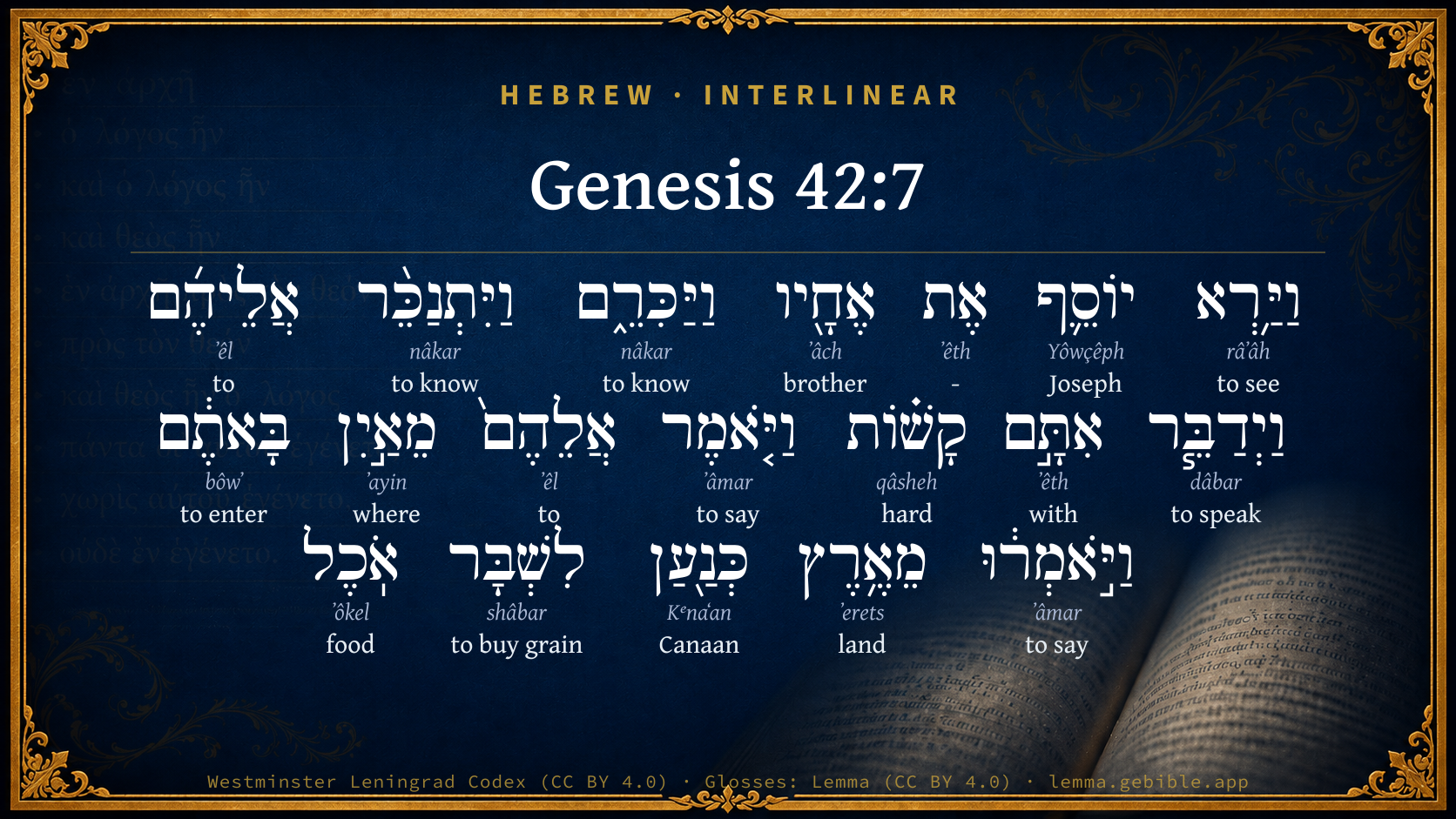
Genesis 42:7

Hebrew (Westminster Leningrad Codex) Genesis 42:7 appears in the Hebrew Old Testament. The text above is from the Westminster Leningrad Codex. Each word links to its Strong’s number, a concise gloss, and parsing drawn from the Open Scriptures Hebrew Bible morphology. Click any word for its full Brown-Driver-Briggs (BDB) entry.
Download image
Cite this verse

Genesis 42:7 (World English Bible). Public Domain. Lemma interlinear Bible study tool, https://lemma.gebible.app/v/genesis/42/7.

Show BibTeX & RIS
BibTeX
RIS
English Translation
Joseph saw his brothers, and he recognized them, but acted like a stranger to them, and spoke roughly with them. He said to them, "Where did you come from?" They said, "From the land of Canaan to buy food."
World English Bible · Public Domain
Highlights
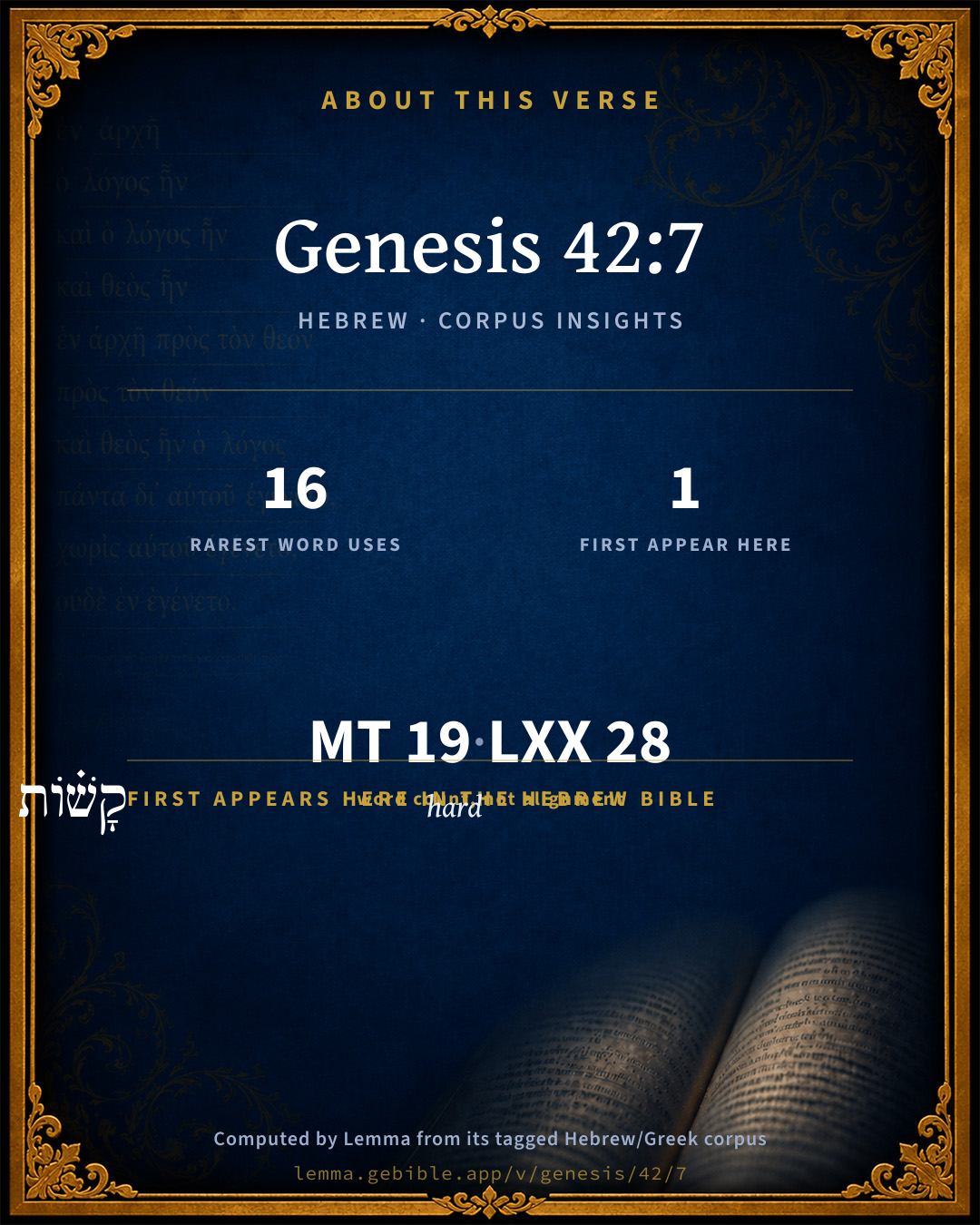
  • 1 first appearance in the Hebrew Bible
Full analysis ↓
Download a study sheet

One document with this verse’s original text, its word-by-word gloss line, the meaning frame, cross-references with their text, attributed commentary, and full source and license credits — printable, and it pastes into notes with its structure intact.

This verse Autodidact and up

Study sheet (.html) Plain text (.txt)

A passage Seminary Student

Up to 50 verses in one chapter. A passage sheet keeps up to 6 commentary sources and 12 cross-references per verse, in the order this page ranks them, and says so on the sheet whenever that leaves anything out. Ask for a single verse and you get the Autodidact verse sheet above.

Everything on this page stays free to read, with no account — the sheet is a download of what is already on screen, not access to it.

Want to remove ads? Support Godless Engineer
Compare translations 3

The same verse in 3 English versions, stacked beneath the original-language interlinear above. Click any original word for its lexicon entry.

Each is an independent rendering of the whole verse — the interlinear is not word-aligned to these translations.

Highlighted words mark where these versions differ — a whole-verse word diff, not a word-by-word alignment.

  • World English Bible Public Domain
    Joseph saw his brothers, and he recognized them, but acted like a stranger to them, and spoke roughly with them. He said to them, "Where did you come from?" They said, "From the land of Canaan to buy food."
  • King James Version Public Domain
    And Joseph saw his brethren, and he knew them, but made himself strange unto them, and spake roughly unto them; and he said unto them, Whence come ye? And they said, From the land of Canaan to buy food.
  • unfoldingWord Literal Text CC BY-SA 4.0
    And Joseph saw his brothers and recognized them, but he acted like a stranger to them, and he spoke with them harshly and said to them, “Where did you come from?” And they said, “From the land of Canaan to buy food.”

unfoldingWord Literal Text — © unfoldingWord, licensed CC BY-SA 4.0. Word-aligned USFM3 via Door43 (git.door43.org/unfoldingWord/en_ult).

Versions to compare (up to 4)

3 of 4 selected

Show all 18 translations

Every available English version of this verse, each an independent rendering of the whole verse.

  • World English Bible Public Domain
    Joseph saw his brothers, and he recognized them, but acted like a stranger to them, and spoke roughly with them. He said to them, "Where did you come from?" They said, "From the land of Canaan to buy food."
  • Berean Standard Bible Public Domain
    And when Joseph saw his brothers, he recognized them, but he treated them as strangers and spoke harshly to them. “Where have you come from?” he asked. “From the land of Canaan,” they replied. “We are here to buy food.”
  • Majority Standard Bible Public Domain
    And when Joseph saw his brothers, he recognized them, but he treated them as strangers and spoke harshly to them. “Where have you come from?” he asked. “From the land of Canaan,” they replied. “We are here to buy food.”
  • King James Version Public Domain
    And Joseph saw his brethren, and he knew them, but made himself strange unto them, and spake roughly unto them; and he said unto them, Whence come ye? And they said, From the land of Canaan to buy food.
  • American Standard Version (1901) Public Domain
    And Joseph saw his brethren, and he knew them, but made himself strange unto them, and spake roughly with them; and he said unto them. Whence come ye? And they said, From the land of Canaan to buy food.
  • Revised Version (1885) Public Domain
    And Joseph saw his brethren, and he knew them, but made himself strange unto them, and spake roughly with them; and he said unto them, Whence come ye? And they said, From the land of Canaan to buy food.
  • Geneva Bible (1599) Public Domain
    And when Ioseph sawe his brethren, hee knewe them, and made himselfe straunge toward them, and spake to them roughly, and saide vnto them, Whence come yee? Who answered, Out of the land of Canaan, to bye vitaile.
  • Douay-Rheims (1899) Public Domain
    And he knew them, he spoke as it were to strangers somewhat roughly, asking them: Whence came you? They answered: From the land of Chanaan, to buy necessaries of life.
  • Young's Literal Translation Public Domain
    And Joseph seeth his brethren, and discerneth them, and maketh himself strange unto them, and speaketh with them sharp things, and saith unto them, `From whence have ye come?' and they say, `From the land of Canaan -- to buy food.'
  • Literal Standard Version CC BY-SA 4.0
    And Joseph sees his brothers, and discerns them, and makes himself strange to them, and speaks sharp things with them, and says to them, “From where have you come?” And they say, “From the land of Canaan—to buy food.”
  • Unlocked Literal Bible CC BY-SA 4.0
    Joseph saw his brothers and recognized them, but he disguised himself to them and spoke harshly with them. He said to them, “Where have you come from?” They said, “From the land of Canaan to buy food.”
  • unfoldingWord Literal Text CC BY-SA 4.0
    And Joseph saw his brothers and recognized them, but he acted like a stranger to them, and he spoke with them harshly and said to them, “Where did you come from?” And they said, “From the land of Canaan to buy food.”
  • Darby Bible Public Domain
    And Joseph saw his brethren, and knew them; but he made himself strange to them, and spoke roughly to them, and said to them, Whence come ye? And they said, From the land of Canaan, to buy food.
  • World Messianic Bible Public Domain
    Joseph saw his brothers, and he recognized them, but acted like a stranger to them, and spoke roughly with them. He said to them, “Where did you come from?” They said, “From the land of Canaan, to buy food.”
  • Webster's Bible Public Domain
    And Joseph saw his brethren, and he knew them, but made himself strange to them, and spoke roughly to them; and he said to them, Whence come ye? And they said, From the land of Canaan to buy food.
  • Free Bible Version CC BY-SA 4.0
    Joseph recognized them as soon as he saw them, but he acted like a stranger towards them and spoke to them in a severe way, saying, “Where are you from?” “From the country of Canaan,” they replied. “We've come to buy food.”
  • Bible in Basic English Public Domain
    And when Joseph saw his brothers, it was clear to him who they were, but he made himself strange to them, and talking roughly to them, said, Where do you come from? And they said, From the land of Canaan, to get food.
  • JPS Tanakh (1917) Public Domain
    And Joseph saw his brethren, and he knew them, but made himself strange unto them, and spoke roughly with them; and he said unto them: 'Whence come ye?' And they said: 'From the land of Canaan to buy food.'

Literal Standard Version (2020), Covenant Press — licensed CC BY-SA 4.0. Text via the HelloAO Bible API (eBible.org). Unlocked Literal Bible (unfoldingWord) — licensed CC BY-SA 4.0. Text via the HelloAO Bible API (eBible.org). unfoldingWord Literal Text — © unfoldingWord, licensed CC BY-SA 4.0. Word-aligned USFM3 via Door43 (git.door43.org/unfoldingWord/en_ult). Free Bible Version, Dr. Jonathan Gallagher — licensed CC BY-SA 4.0. Text via the HelloAO Bible API (eBible.org).

Word by word

More ways to search: Search by grammar → Find every occurrence → Compare this word →

Practice this passage: Drill this verse → Learn its vocabulary →

מֵאַ֣יִן
ʼayin
H370
“from · where”
Preposition + Particle, Interrogative
Part of Speech
Preposition + Particle
Type
Interrogative
Full BDB Definition

Origin: probably identical with H369 in the sense of query (compare H336 )

TWOT: 75f

where?, whence?
  1. וַיַּ֥רְא râʼâh H7200 “and · to see” Conjunction + Verb, Qal, Sequential Imperfect, 3rd Person, Masculine, Singular
  2. יוֹסֵ֛ף Yôwçêph H3130 “Joseph” Noun, Proper
  3. אֶת ʼêth H853 “-” Particle, Direct Object
  4. אֶחָ֖יו ʼâch H251 “brothers · his” Noun, Common, Masculine, Plural, Construct + Suffix, Personal, 3rd Person, Masculine, Singular
  5. וַיַּכִּרֵ֑ם nâkar H5234 “and · to know · them” Conjunction + Verb, Hiphil, Sequential Imperfect, 3rd Person, Masculine, Singular + Suffix, Personal, 3rd Person, Masculine, Plural
  6. וַיִּתְנַכֵּ֨ר nâkar H5234 “and · to know” Conjunction + Verb, Hithpael, Sequential Imperfect, 3rd Person, Masculine, Singular
  7. אֲלֵיהֶ֜ם ʼêl H413 “to · them” Preposition + Suffix, Personal, 3rd Person, Masculine, Plural
  8. וַיְדַבֵּ֧ר dâbar H1696 “and · to speak” Conjunction + Verb, Piel, Sequential Imperfect, 3rd Person, Masculine, Singular
  9. אִתָּ֣ם ʼêth H854 “with · them” Preposition + Suffix, Personal, 3rd Person, Masculine, Plural
  10. קָשׁ֗וֹת qâsheh H7186 “hard” Adjective, Adjective, Feminine, Plural, Absolute
  11. וַיֹּ֤אמֶר ʼâmar H559 “and · to say” Conjunction + Verb, Qal, Sequential Imperfect, 3rd Person, Masculine, Singular
  12. אֲלֵהֶם֙ ʼêl H413 “to · them” Preposition + Suffix, Personal, 3rd Person, Masculine, Plural
  13. בָּאתֶ֔ם bôwʼ H935 “to enter” Verb, Qal, Perfect, 2nd Person, Masculine, Plural
  14. וַיֹּ֣אמְר֔וּ ʼâmar H559 “and · to say” Conjunction + Verb, Qal, Sequential Imperfect, 3rd Person, Masculine, Plural
  15. מֵאֶ֥רֶץ ʼerets H776 “from · land of” Preposition + Noun, Common, Both, Singular, Construct
  16. כְּנַ֖עַן Kᵉnaʻan H3667 “Canaan” Noun, Proper
  17. לִשְׁבָּר shâbar H7666 “to buy grain” Preposition + Verb, Qal, Infinitive Construct
  18. אֹֽכֶל ʼôkel H400 “food” Noun, Common, Masculine, Singular, Absolute

About this verse

These counts appear in no published source. They are computed here, from the morphology-tagged text and Lemma’s own curated glosses. What Lemma adds →

19
words
16
distinct lemmas
Pentateuch
section

Notable vocabulary

The rarest word here is מֵאַ֣יִן where H370 — appearing just 16 times in the whole Hebrew Bible.

First appearance in Scripture

This word makes its first canonical appearance in the Hebrew Bible here:

  • קָשׁ֗וֹת hard H7186

Shared distinctive vocabulary

מֵאַ֣יִן where H370 occurs in 16 verses of the Hebrew Bible. Also found in:

Grammatical profile

  • 8 verbs
  • 5 nouns
  • 1 adjective
  • 3 prepositions
  • 2 particles

Verb forms

  • וַיַּ֥רְא Qal · Sequential Imperfect
  • וַיַּכִּרֵ֑ם Hiphil · Sequential Imperfect
  • וַיִּתְנַכֵּ֨ר Hithpael · Sequential Imperfect
  • וַיְדַבֵּ֧ר Piel · Sequential Imperfect
  • וַיֹּ֤אמֶר Qal · Sequential Imperfect
  • בָּאתֶ֔ם Qal · Perfect
  • וַיֹּ֣אמְר֔וּ Qal · Sequential Imperfect
  • לִשְׁבָּר Qal · Infinitive Construct

Repetition

Words recur within this verse — often emphatic in Hebrew:

  • וַיַּכִּרֵ֑ם to know H5234 ×2
  • וַיֹּ֤אמֶר to say H559 ×2
  • אֲלֵיהֶ֜ם to H413 ×2

Hebrew & Septuagint length

In English translation the verse runs 39 words from the Hebrew and 40 from the Septuagint (LXX English) — closely comparable.

A rough comparison of the two English renderings, which tokenize alike — not a word-level alignment.

Word counts can differ between the Hebrew and the Greek without any difference in meaning — e.g. the Hebrew direct-object marker אֵת has no separate Greek word, and Greek often adds the article ὁ.

In the original languages it is 19 Hebrew tokens and 28 Greek tokens — but the two are counted differently (Hebrew bundles its prefixes and suffixes into one token; the Greek is in lemma form), so that isn’t a like-for-like length.

Cross-references

5

Topical passages linked to Genesis 42:7 in the Treasury of Scripture Knowledge — connected by theme and wording, ordered by reader-vote popularity; previews shown in the World English Bible.

  • Genesis 42:30 "The man, the lord of the land, spoke roughly with us, and took us for spies of the country.
  • Genesis 42:9–12 Joseph remembered the dreams which he dreamed about them, and said to them, "You are spies! You have come to see the nakedness of the land."
  • Genesis 42:14–17 Joseph said to them, "It is like I told you, saying, 'You are spies.'
  • Genesis 42:19–20 If you are honest men, then let one of your brothers be bound in your prison-house; but you go, carry grain for the famine of your houses.
  • Matthew 15:23–26 But he answered her not a word. His disciples came and begged him, saying, "Send her away; for she cries after us."

Cross-references courtesy of OpenBible.info (CC BY 4.0).

Hebrew and Greek witnesses Masoretic Hebrew ↔ Greek Septuagint

The same verse in the two great witnesses to the Old Testament, shown verse-for-verse.

These are two independent witnesses, not word-aligned to each other, and the Septuagint is shown in lemma (dictionary) form.

Hebrew Genesis 42:7 Masoretic · Westminster Leningrad Codex

וַיַּ֥רְא יוֹסֵ֛ף אֶת אֶחָ֖יו וַיַּכִּרֵ֑ם וַיִּתְנַכֵּ֨ר אֲלֵיהֶ֜ם וַיְדַבֵּ֧ר אִתָּ֣ם קָשׁ֗וֹת וַיֹּ֤אמֶר אֲלֵהֶם֙ מֵאַ֣יִן בָּאתֶ֔ם וַיֹּ֣אמְר֔וּ מֵאֶ֥רֶץ כְּנַ֖עַן לִשְׁבָּר אֹֽכֶל

Joseph saw his brothers, and he recognized them, but acted like a stranger to them, and spoke roughly with them. He said to them, "Where did you come from?" They said, "From the land of Canaan to buy food."

World English Bible · Public Domain

Greek LXX Genesis 42:7 Septuagint · lemma form

ὁράω δέ ιωσηφ ὁ ἀδελφός αὐτός ἐπιγιγνώσκω καί ἀλλοτριόω ἀπό αὐτός καί λαλέω αὐτός σκληρός καί εἶπον αὐτός πόθεν ἥκω ὁ δέ εἶπον ἐκ γῆ χανααν ἀγοράζω βρῶμα

And when Joseph saw his brethren, he knew them, and estranged himself from them, and spoke hard words to them; and said to them, Whence are you⌃ come? And they said, Out of the land of Chanaan, to buy food.

LXX2012 (modern English Septuagint) · Public Domain

Hebrew: Westminster Leningrad Codex (CC BY 4.0). Greek: Septuagint (public domain); English from LXX2012 (modern English Septuagint) (Public Domain). How the Septuagint differs from the Hebrew →

Targum (Aramaic paraphrase)

2

The Targum is the ancient Jewish Aramaic paraphrase of the Hebrew Scriptures — an interpretive translation, not the Hebrew text itself. Onkelos (literal) and Pseudo-Jonathan (expansive) render the Torah, and Jonathan the Prophets. Coverage is partial: where no permissively-licensed English translation exists for a verse, only the Aramaic is shown. This is verse-level text, not a word-by-word alignment to the Hebrew.

  1. Targum Onkelos Torah (Genesis–Deuteronomy)
    וַחֲזָא יוֹסֵף יָת אֲחוֹהִי וְאִשְׁתְּמוֹדְעִנּוּן וְחַשִּׁיב מָה דְמַלֵּיל לְהוֹן וּמַלִּיל עִמְּהוֹן קַשְׁיָן וַאֲמַר לְהוֹן מְנָן אֲתֵיתוּן וַאֲמָרוּ מֵאַרְעָא דִּכְנַעַן לְמִזְבַּן עִיבוּרָא

    (no public-domain English translation for this verse)

    Targum Onkelos — Aramaic: “Onkelos Genesis” (public domain); “Onkelos Exodus” (public domain); “Onkelos Leviticus” (public domain); “Onkelos Numbers” (public domain); “Onkelos Deuteronomy” (public domain). English: “Sefaria Community Translation” (CC0 1.0 (public-domain dedication)); “J.W. Etheridge. The Targums of Onkelos and Jonathan Ben Uzziel on the Pentateuch. London: Longmans, Green, 1862” (public domain). Text via Sefaria.

  2. Targum Pseudo-Jonathan Torah (Genesis–Deuteronomy)
    וַחֲמָא יוֹסֵף יַת אָחוֹי וְאִשְׁתְּמוֹדָעִינוּן וְאִתְעֲבֵיד בְּעֵינֵיהוֹם כַּחֲלוֹנָאֵי וּמַלֵיל עִמְהוֹם מִילִין קַשְׁיָין וְאָמַר לְהוֹם מְנָן אָתֵתוּן וַאֲמָרוּ מֵאַרְעָא דִכְנָעַן לְמִזְבַּן עִיבּוּרָא

    And Joseph saw his brethren, and recognised them; but he made himself as a stranger in their eyes, and spake hard words to them, and said to them, Whence come yon? And they said, From the land of Kenaan, to buy corn.

    Targum Pseudo-Jonathan — Aramaic: “Targum Jonathan on Genesis” (public domain); “Targum Jonathan on Exodus” (public domain); “Targum Jonathan on Leviticus” (public domain); “Targum Jonathan on Numbers” (public domain); “Targum Jonathan on Deuteronomy” (public domain). English: “The Targum of Jonathan ben Uzziel, trans. J. W. Etheridge, London, 1862” (public domain). Text via Sefaria.

Commentary

Notes on Genesis 42:7 from classic Christian and Jewish commentators (each source and its license shown beneath its notes). The classic Christian expositions comment on the surrounding passage and are grouped to its opening verse, so a note may address several verses; the Jewish commentaries on the Tanakh (Rashi and others) are per-verse, so they appear only where the commentator wrote on this verse.

Lemma curates 59 commentaries, every one of them public domain or Creative Commons licensed, each selected and text-cleaned for this edition rather than reprinted as found. About our sources →

Matthew Henry's Commentary

We may well wonder that Joseph, during the twenty years that he had now been in Egypt, especially during the last seven years that he had been in power there, never sent to his father to acquaint him with his circumstances; nay, it is strange that he who so often went throughout all the land of Egypt (Gen 41:45, Gen 41:46) never made an excursion to Canaan, to visit his aged father, when he was in the borders of Egypt, that lay next to Canaan. Perhaps it would not have been above three or four days' journey for him in his chariot. It is a probable conjecture that his whole management of himself in this affair was by special direction from Heaven, that the purpose of God concerning Jacob and his family might be accomplished. When Joseph's brethren came, he knew them by many a satisfactory token, but they knew not him, little thinking to find him there, Gen 42:8. He remembered the dreams (Gen 42:9), but they had forgotten them. The laying up of God's oracles in our hearts will be of excellent use to us in all our conduct. Joseph had an eye to his dreams, which he knew to be divine, in his carriage towards his brethren, and aimed at the accomplishment of them and the bringing of his brethren to repentance for their former sins; and both these points were gained.

I. He showed himself very rigorous and harsh with them. The very manner of his speaking, considering the post he was in, was enough to frighten them; for he spoke roughly to them, Gen 42:7. He charged them with bad designs against the government (Gen 42:9), treated them as dangerous persons, saying, You are spies, and protesting by the life of Pharaoh that they were so, Gen 42:16. Some make this an oath, others make it no more than a vehement asseveration, like that, as thy soul liveth; however it was more than yea, yea, and nay, nay, and therefore came of evil. Note, Bad words are soon learned by converse with those that use them, but not so soon unlearned. Joseph, by being much at court, got the courtier's oath, By the life of Pharaoh, perhaps designing hereby to confirm his brethren in their belief that he was an Egyptian, and not an Israelite. They knew this was not the language of a son of Abraham. When Peter would prove himself no disciple of Christ, he cursed and swore. Now why was Joseph thus hard upon his brethren? We may be sure it was not from a spirit of revenge, that he might now trample upon those who had formerly trampled upon him; he was not a man of that temper. But, 1. It was to enrich his own dreams, and complete the accomplishment of them. 2. It was to bring them to repentance. 3. It was to get out of them an account of the state of their family, which he longed to know: they would have discovered him if he had asked as a friend, therefore he asks as a judge. Not seeing his brother Benjamin with them, perhaps he began to suspect that they had made away with him too, and therefore gives them occasion to speak of their father and brother. Note, God in his providence sometimes seems harsh with those he loves, and speaks roughly to those for whom yet he has great mercy in store.

II. They, hereupon, were very submissive. They spoke to him with all the respect imaginable: Nay, my lord (Gen 42:10) - a great change since they said, Behold, this dreamer comes. They very modestly deny the charge: We are no spies. They tell him their business, that they came to buy food, a justifiable errand, and the same that many strangers came to Egypt upon at this time. They undertake to give a particular account of themselves and their family (Gen 42:13), and this was what they wanted.

III. He clapped them all up in prison for three days, Gen 42:17. Thus God deals with the souls he designs for special comfort and honour; he first humbles them, and terrifies them, and brings them under a spirit of bondage, and then binds up their wounds by the Spirit of adoption.

IV. He concluded with them, at last, that one of them should be left as a hostage, and the rest should go home and fetch Benjamin. It was a very encouraging word he said to them (Gen 42:18): I fear God; as if he had said, "You may assure yourselves I will do you no wrong; I dare not, for I know that, high as I am, there is one higher than I." Note, With those that fear God we have reason to expect fair dealing. The fear of God will be a check upon those that are in power, to restrain them from abusing their power to oppression and tyranny. Those that have no one else to stand in awe of ought to stand in awe of their own consciences. See Neh 5:15, So did not I, because of the fear of God.

Matthew Henry's Commentary on the Whole Bible (1708–1710) — public domain (CC PDM 1.0). Text via the HelloAO Bible API.

Trapp's Complete Commentary

John Trapp

Gen 42:7 And Joseph saw his brethren, and he knew them, but made himself strange unto them, and spake roughly unto them; and he said unto them, Whence come ye? And they said, From the land of Canaan to buy food.

Ver. 7. Spake roughly unto them.] To bring them the sooner to a sight of their sin. God also, for like purpose, writes bitter things against his people, stands afar off, hides his love, as Joseph, out of increasement of love; fights against them with his own hand, as he threw his brethren into prison; - than the which there is no greater affliction, saith Luther; and all to show them their sin, and to bring them home to himself by repentance. {a}

{a} Nihil est tentatio vel universi mundi et totius inferni in unum conflata, ad eam qua Deus contrarius homimi penitur. - Luther.

John Trapp, A Commentary or Exposition upon All the Books of the Old and New Testament (1647–1656) — public domain. Text from a community e-Sword module.

Joseph Benson's Commentary

Gen 42:7. We may well wonder that Joseph, during the twenty years he had been in Egypt, especially during the last seven years that he had been in power there, never sent to his father to acquaint him with his circumstances; nay, it is strange that he, who so oft went through all the land of Egypt, never made a step to Canaan, to visit his aged father. When he was in the borders of Egypt that lay next to Canaan, perhaps it would not have been above three or four days’ journey for him in his chariot. It is a probable conjecture, that his whole management of himself in this affair was by special direction from Heaven, that the purpose of God, concerning Jacob and his family, might be accomplished. When Joseph’s brethren came, he knew them by many a good token, but they knew not him, little thinking to find him there.

Joseph Benson's Commentary on the Old and New Testaments (1811–1818) — public domain. Text from a community e-Sword module.

Keil & Delitzsch

C. F. Keil & F. Delitzsch

Joseph recognised his brothers at once; but they could not recognise a brother who had not been seen for 20 years, and who, moreover, had not only become thoroughly Egyptianized, but had risen to be a great lord. And he acted as a foreigner (יתנכּר) towards them, speaking harshly, and asking them whence they had come. In Gen 42:7, according to a truly Semitic style of narrative, we have a condensation of what is more circumstantially related in Gen 42:8-17.

Keil & Delitzsch — Biblical Commentary on the Old Testament (1861–1891) — public domain (CC PDM 1.0). Text via the HelloAO Bible API. (Old Testament only.)

Geneva Bible (1599)

Geneva Bible translators

This dissembling is not to be followed, nor any particular facts of the fathers not approved by God’s word.

Geneva Bible (1599) marginal notes — public domain. Text via Bolls.life.

Jamieson, Fausset & Brown

Robert Jamieson, A. R. Fausset & David Brown

Joseph saw his brethren, and he knew them, . . . but they knew not him--This is not strange. They were full-grown men--he was but a lad at parting. They were in their usual garb--he was in his official robes. They never dreamt of him as governor of Egypt, while he had been expecting them. They had but one face; he had ten persons to judge by.

made himself strange unto them, and spake roughly--It would be an injustice to Joseph's character to suppose that this stern manner was prompted by any vindictive feelings--he never indulged any resentment against others who had injured him. But he spoke in the authoritative tone of the governor in order to elicit some much-longed-for information respecting the state of his father's family, as well as to bring his brethren, by their own humiliation and distress, to a sense of the evils they had done to him.

Jamieson, Fausset & Brown — Commentary Critical and Explanatory on the Whole Bible (1871) — public domain (CC PDM 1.0). Text via the HelloAO Bible API.

John Calvin's Commentaries

7. He made himself strange unto them. It may be asked for what purpose Joseph thus tormented his brethren with threats and with terror. For if he was actuated by a sense of the injury received from them, he cannot be acquitted of the desire of revenge. It is, however, probable, that he was impelled neither by anger nor a thirst of vengeance, but that he was induced by two just causes to act as he did. For he both desired to regain his brother Benjamin, and wished to ascertain, — as if by putting them to the torture, — what was in their mind, whether they repented or not; and, in short, what had been their course of life since he had seen them last. For, had he made himself known at the first interview, it was to be feared lest they, keeping their father out of sight, and wishing to cast a vail over the detestable wickedness which they had committed, should only increase it by a new crime. There lurked, also, a not unreasonable suspicion concerning his brother Benjamin, lest they should attempt something perfidious and cruel against him. It was therefore important that they should be more thoroughly sifted; so that Joseph, being fully informed of the state of his father’s house, might take his measures according to circumstances; and also, that previous to pardon, some punishment might be inflicted which would lead them more carefully to reflect upon the atrocity of their crime. For whereas he afterwards showed himself to be placable and humane; this did not arise from the fact, that his anger being assuaged, he became, by degrees, inclined to compassion; but rather, as Moses elsewhere subjoins, that he sought retirement, because he could no longer refrain himself; herein intimating at the same time, that Joseph had forcibly repressed his tears so long as he retained a severe aspect; and, therefore, that he had felt throughout the same affection of pity towards them. And it appears that a special impulse moved him to this whole course of action. For it was no common thing, that Joseph, beholding so many authors of his calamities, was neither angry nor changed in his manner, nor broke out into reproaches; but was composed both in his countenance and his speech, as if he had long meditated at leisure, respecting the course he would pursue. But it may be inquired again, whether his dissimulation, which was joined with a falsehood, is not to be blamed; for we know how pleasing integrity is to God, and how strictly he prohibits his own people from deceit and falsehoods. Whether God governed his servant by some special movement, to depart without fault, from the common rule of action, I know not; seeing that the faithful may sometimes piously do things which cannot lawfully be drawn into a precedent. Of this, however, in considering the acts of the holy fathers, we must always beware; lest they should lead us away from that law which the Lord prescribes to all in common. By the general command of God, we must all cultivate sincerity. That Joseph feigned something different from the truth, affords no pretext to excuse us if we attempt anything of the same kind. For, though a liberty granted by privilege would be pardoned, yet if any one, relying on a private example, does not scruple to subvert the law of God, so as to give himself license to do what is therein forbidden, he shall justly suffer the punishment of his audacity. And yet I do not think that we ought to be very anxious to excuse Joseph, because it is probable that he suffered something from human infirmity, which God forgave him; for by Divine mercy alone could that dissimulation, which in itself was not without fault, escape condemnation.

John Calvin's Commentaries (1540-1563) — public domain. Text from the Calvin Translation Society English edition (1840s-50s) via the Christian Classics Ethereal Library (ccel.org). Calvin's coverage is partial (roughly two-thirds of the Bible); uncommented books and verses are honest gaps, never fabricated. The 19th-century editor's footnotes and remarks are omitted so the notes are faithfully Calvin's own voice.

Ellicott's Commentary for English Readers

(7) Joseph . . . spake roughly unto them.—Joseph has been accused of harshness in his treatment of his brethren, and still more so of his father in forcing him to send away Benjamin. The latter was, no doubt, the result of his great longing to see his only brother, and he may not have known how dear he was to Jacob, or have reflected upon the pain which his father would feel in parting with him. Still it was but a temporary separation, to prepare for a happy re-union. As regards his half-brethren, Joseph was obliged to prove them, and he did nothing to them which they did not richly deserve. From the first he probably wished to have his father and Benjamin to dwell with him, and share his good fortune; but if his brethren were still the cruel and heartless wretches which they had shown themselves to have been in their conduct to him twenty years before, we may well suppose that he would justly have left them to their fate. Possibly his first emotion towards them was one of indignation, but it melted away, when, even in but one of them, he saw proof that they were not entirely destitute of better feeling (see Gen_42:22; Gen_42:24).

A Bible Commentary for English Readers, edited by Charles John Ellicott (1878–1897) — public domain. Text from a community e-Sword module.

The Cambridge Bible for Schools and Colleges

gen. ed. J. J. S. Perowne

7. knew them] Joseph at once recognized his brethren. They did not recognize him. From a boy he had become a man; they were grown men when they sold him, and were comparatively unaltered. He in stature, dress, hair, and ornament must have been wholly changed from the rough shepherd lad of Canaan. According to E (Gen_41:1; Gen_41:47) more than nine years, according to P (Gen_37:2, Gen_41:46) more than twenty years had elapsed, since he had been separated from his home in Canaan.

made himself strange] In order to account for Joseph’s treatment of his brethren, the two most common explanations have been that he sought (1) to prove them, and (2) to punish them. His motives were, doubtless, mixed. The welfare of his father and of his own brother is uppermost in his thoughts. As he does not see them, he doubts whether the brethren who had treated him so shamefully will have maintained any regard for the life of his aged father or his young brother. He assumes a tone of harshness which he does not feel; and suffers a vein of generous hospitality and munificence to mingle with severity in the treatment of his brethren, so as to add to their mystification and confusion.

The Cambridge Bible for Schools and Colleges (gen. ed. J. J. S. Perowne; Cambridge University Press, 1878–1918) — public domain. Text from a community e-Sword module.

John Gill's Exposition

And Joseph knew his brethren, but they knew not him. It being about twenty two years since they saw him, and then he was young, and his beard not grown, as now it was; and besides, he was clothed as a prince, and spoke the Egyptian language; and being in such great grandeur and splendour, and in such power and authority, and having such a retinue attending him, they never once thought of him, whom they supposed might be dead, having never heard of him all this time; or, however, it could not come into their minds, that he whom they sold for a slave could ever be governor of the land of Egypt.

And Joseph knew his brethren, but they knew not him. It being about twenty two years since they saw him, and then he was young, and his beard not grown, as now it was; and besides, he was clothed as a prince, and spoke the Egyptian language; and being in such great grandeur and splendour, and in such power and authority, and having such a retinue attending him, they never once thought of him, whom they supposed might be dead, having never heard of him all this time; or, however, it could not come into their minds, that he whom they sold for a slave could ever be governor of the land of Egypt.

Genesis 42:9

gen 42:9

gen 42:9

gen 42:9And Joseph remembered the dreams which he dreamed of them,.... Their bowing and prostrating themselves before him brought to his remembrance his dreams of their sheaves making obeisance to his, and of the sun, moon, and eleven stars, doing the same to him, Gen 37:7,

and said unto them, ye are spies; not believing they were, nor absolutely asserting that they were such; but this he said to try them, and what they would say for themselves, and in order to lead on to further discourse with them, and to get knowledge of his father and brother Benjamin, whether living or not: he dealt with them as a judge on the bench, when examining persons, whose charges have the nature of an interrogation, as this has: "ye are spies"; are ye not? surely ye must be, and unless you give a better account of yourselves, I must take you up as such:

to see the nakedness of the land ye are come: what parts of it are weakest, most defenceless, and less fortified, and most easy to break in at, and invade the land; and it was not without reason that the Egyptians might suspect the neighbouring nations round about them, being in distress, and hearing of corn in Egypt, of forming a design of coming upon them and taking away their corn by force, and might be the reason why foreigners that came to buy corn were brought before Joseph and examined by him.

John Gill's Exposition of the Whole Bible (1746–1763) — public domain (CC PDM 1.0). Text via the HelloAO Bible API.

Matthew Poole's English Annotations

He spake roughly unto them; partly, to bring their sin to remembrance; partly, to get the knowledge of the true state of his father and family; and partly, to further the following design, and make way for his and their greater happiness.

Matthew Poole's English Annotations on the Holy Bible (1683–1685) — public domain. Text from a community e-Sword/MySword module.

Whedon's Commentary on the Bible

Daniel D. Whedon

7. Made himself strange — יתנכר, acted like a foreigner, speaking to them through an interpreter. Gen_42:23. He dissembled, and spoke harsh things to them. Perhaps he had anticipated their coming, and had, therefore, arranged to have all foreigners presented to him personally; but in that moment of interest and excitement, noticing that Benjamin was not among them, he must find out the reason, and deems it best to treat them with severity.

Daniel D. Whedon (gen. ed.), Commentary on the Old and New Testaments (1874–1909) — public domain. Text from a community e-Sword module.

The Pulpit Commentary

And Joseph saw his brethren, and he knew them, but (literally, and) made himself strange unto them. The root rkn; to be marked, signed, by indentation, hence to be foreign (Furst), or simply to be strange (Gesenius), in the Hiphil signifies to press strongly into a thing (Furst), to look at a thing as strange (Gesenius), or to recognize, and in the Hithpael has the sense of representing one"s self as strange, i.e. of feigning one"s self to be a foreigner. And spake roughly unto them literally, spake hard things unto them; not from a feeling of revenge which still struggled in his breast with his brotherly affection (Kurtz), or in a spirit of duplicity (Kaliseh), but in order to get at their hearts, and discover the exact state of mind in which they then were with regard to himself and Benjamin, whose absence it is apparent had arrested his attention, and perhaps roused his suspicions (Keil, Murphy, Wordsworth, "Speaker"s Commentary" And he said unto them, speaking through an interpreter (ver. 23)Whence come ye? And they said, From the land of Canaan (adding, as if they feared Joseph"s suspicions, and wished to deprecate his anger) to buy food (i.e. corn for food).

The Pulpit Commentary (1880–1919), ed. H.D.M. Spence-Jones & Joseph S. Exell — public domain. Text from a community e-Sword module.

John Wesley's Explanatory Notes

We may well wonder that Joseph, during the twenty years he had been in Egypt, especially during the last seven years that he had been in power there, never sent to his father to acquaint him with his circumstances; nay, 'tis strange that he who so oft went throughout all the land of Egypt, never made a step to Canaan, to visit his aged father. When he was in the borders of Egypt that lay next to Canaan, perhaps it would not have been above three or four days journey for him in his chariot. 'Tis a probable conjecture, that his whole management of himself in this affair was by special direction from heaven, that the purpose of God, concerning Jacob and his family, might be accomplished. When Joseph's brethren came, he knew them by many a good token, but they knew not him, little thinking to find him there.

John Wesley, Explanatory Notes Upon the Whole Bible (1754–1765) — public domain. Text via the GEBible commentary corpus.

unfoldingWord translationNotes

Door43 World Missions Community

Joseph saw his brothers and recognized them

"When Joseph saw his brothers, he recognized them"

he disguised himself to them

"he acted like he was not their brother" or "he did not let them know that he was their brother"

Where have you come from?

This was not a rhetorical question even though Joseph knew the answer. It was part of his choice to keep his identity from his brothers.

translationWords

Joseph (OT)

Canaan

unfoldingWord translationNotes — © Distant Shores Media and the Door43 World Missions Community, licensed CC BY-SA 4.0. Source: git.door43.org/Door43/en_tn.

Rashi

Rabbi Shlomo Yitzchaki (Rashi)

ויתנכר אליהם HE MADE HIMSELF STRANGE UNTO THEM — He made himself like a נכרי a stranger to them in his conversation, speaking harshly (Genesis Rabbah 91:7).

Rashi on the Tanakh — English translations: “The Judaica Press complete Tanach with Rashi, translated by A. J. Rosenberg” (CC BY 4.0); “Pentateuch with Rashi's commentary by M. Rosenbaum and A.M. Silbermann, 1929-1934” (public domain); “The Metsudah Tanach series, Lakewood, N.J” (CC BY 4.0); and “The Book of Joshua, Metsudah Publications, 1997” (CC BY 4.0). Text via Sefaria.

Ramban (Nachmanides)

Rabbi Moshe ben Nachman (Ramban / Nachmanides)

AND JOSEPH SAW HIS BRETHREN, AND HE RECOGNIZED THEM. Immediately as he saw them he recognized them, and he feared lest they recognize him. And he made himself strange (‘vayithnakeir’) unto them by putting a mitre upon his forehead and part of the face, thus disguising himself, just as it is said concerning the wife of Jeroboam, Arise, I pray thee, and disguise thyself, that thou be not known to be the wife of Jeroboam, in a physical sense. Joseph disguised himself by placing his mitre over his face. Further on, Ramban mentions a second interpretation. See Note 126. and it further says, For it will be, when she cometh in, that she ‘mithnakeirah’ (will pretend to be another woman)., Verse 6. It may be that the word vayithnakeir here means that he made himself strange by his words, speaking to them harshly and asking them in anger — as if it were not customary to come before him to purchase food — “From where do you come to appear before me?” And they said, From the land of Canaan to buy food. When they mentioned this to him, it then became clear to him that they were indeed his brothers. This is the meaning of the expression, And Joseph recognized his brethren, which is mentioned a second time to indicate an additional sense of recognition and knowledge of the truth with respect to them.Now Rashi wrote in explanation of the word vayithnakeir: “He made himself like a nochri (stranger) in conversation by speaking harshly to them.” According to Rashi’s opinion, the word vayithnakeir signifies that he spoke to them as a man who is a nochri (stranger). But this is not correct. having the same root as heker (recognition), except that the word here changes its meaning so as to indicate its opposite. See Rashi on Exodus 27:3, where he says that there are many such words in the Hebrew language. In the case before us, the word vayithnakeir would thus mean that Joseph made himself unrecognizable by speaking harshly to them. See my Hebrew commentary, p. 232.

Ramban (Nachmanides) on the Tanakh — English translation: “Commentary on the Torah by Ramban (Nachmanides). Translated and annotated by Charles B. Chavel. New York, Shilo Pub. House, 1971-1976” (CC BY 4.0). Text via Sefaria.

Radak

Rabbi David Kimhi (Radak)

וירא יוסף...ויכירם, our sages explain that the fact that Joseph had left home when he did not have a beard yet, whereas his brothers already had beards accounts for the fact that whereas they did not recognise him, he recognised them. (quoted by Rashi) It is possible that they would have recognised him in spite of his having grown a beard if they had not seen the man confronting them dressed in the uniform of the highest ranking nobles of the land. They could not imagine that this man could be Joseph even if there had been points of resemblance. The idea that someone who had been sold into slavery had risen to such power was too mind-boggling for them.

ויתנכר, Joseph moreover deliberately misrepresented himself to prevent their suspecting that it might be him.

Radak on the Tanakh — English translations: “Sefaria Community Translation” (CC0 1.0 (public-domain dedication)); “Eliyahu Munk, HaChut Hameshulash” (CC BY 4.0); “Rabbi Mike Feuer, Jerusalem Anthology” (CC BY 4.0); and “R. David Kimhi on the first book of Psalms, Translated by R.G. Finch, London, 1919” (public domain). Text via Sefaria.

Ibn Ezra

Rabbi Abraham ibn Ezra

He recognized … Yoseif recognized. He knew immediately that they were his brothers, but only after he examined them more carefully did he know who was who.

Ibn Ezra on the Tanakh — English translations: “Sefaria Community Translation” (CC0 1.0 (public-domain dedication)); “Yalkut, Sifsei Chachomim Chumash, Metsudah Publications, 2009” (CC BY 4.0); and “Commentary of Ibn Ezra on Isaiah - trans. by M. Friedlander, 1873” (public domain). Text via Sefaria.

Lesson kit

Teaching starters — assembled from the data on this page, not authored interpretation. Every prompt links to the verse data it draws on. Edit before teaching.

Genesis, in the Pentateuch, opens this verse with 19 words (16 distinct Hebrew lemmas). Its most distinctive word is ʼayin (“where”). A historical commentator’s framing appears above. Read the whole chapter for the surrounding context.

Discussion questions

  1. What does “where” (ʼayin) contribute to the verse as a whole?
  2. This is the first place “hard” appears in Scripture (first appears here). What does its debut here establish?
  3. How does Genesis 29:4, which shares the word «where», read alongside this verse?
  4. What does the repetition of “to know” (2× in this one verse) do in this verse?
  5. These translations render this verse differently; the difference is in the English rendering, not the original. What questions does that raise?
  6. «וַיַּ֥רְא» is a Qal Sequential Imperfect verb. How does that grammatical form shape the action described?
  7. Compare how Matthew Henry's Commentary and Trapp's Complete Commentary read this verse. Where do they agree or differ?

Things to notice

Reading settings

Reading text

Shown beneath each verse's original-language words.

Old Testament
Old Testament edition

Read the OT as the Masoretic Hebrew (MT) or the Greek Septuagint (LXX).

English shown for the Greek Septuagint (in the Hebrew ↔ Greek comparison).

Comparing translations? Open the Compare panel on any verse page to stack up to four side by side.