Genesis 27:12

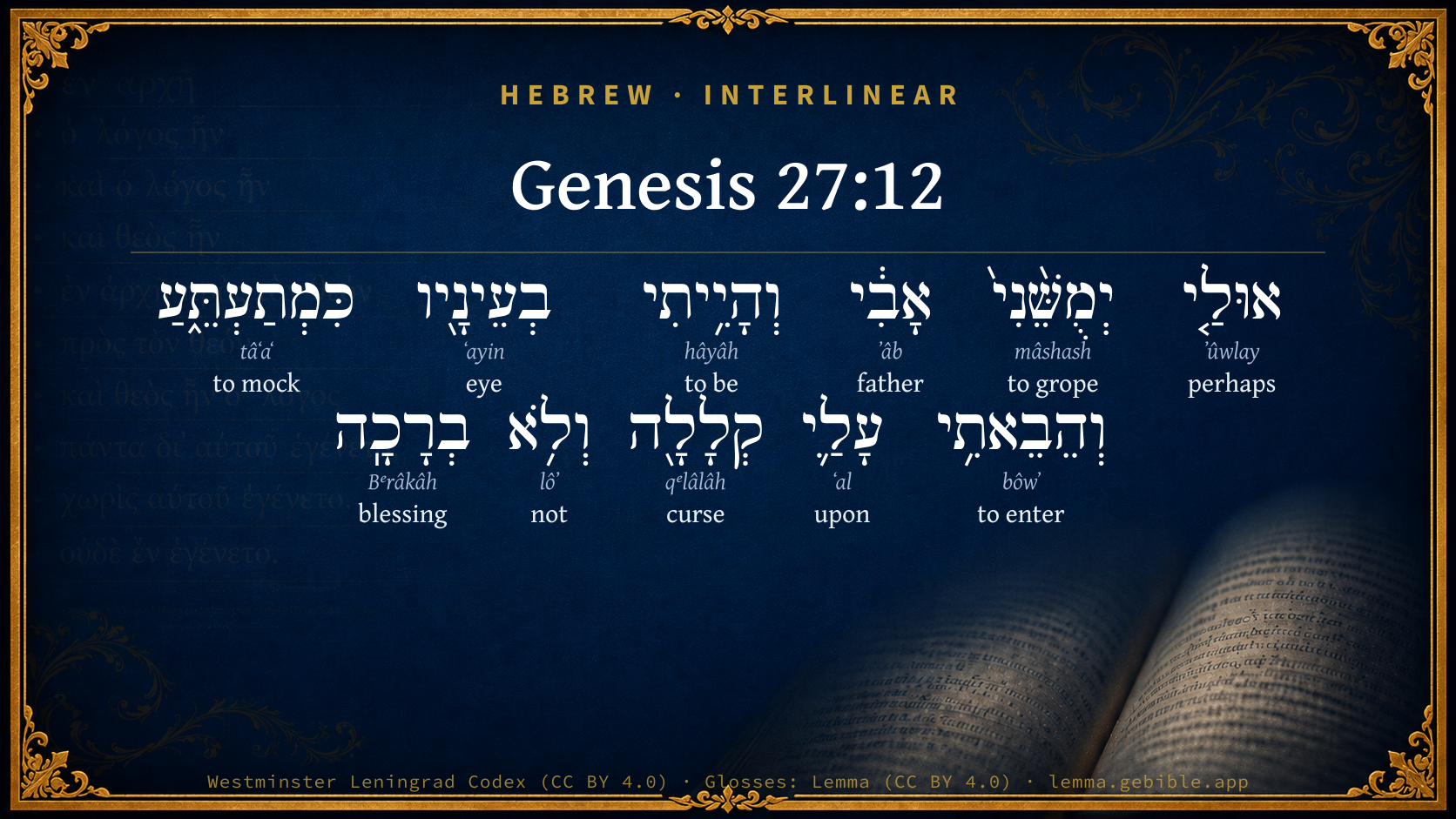
Hebrew (Westminster Leningrad Codex) Genesis 27:12 appears in the Hebrew Old Testament. The text above is from the Westminster Leningrad Codex. Each word links to its Strong’s number, a concise gloss, and parsing drawn from the Open Scriptures Hebrew Bible morphology. Click any word for its full Brown-Driver-Briggs (BDB) entry.
Download image
Cite this verse

Genesis 27:12 (World English Bible). Public Domain. Lemma interlinear Bible study tool, https://lemma.gebible.app/v/genesis/27/12.

Show BibTeX & RIS
BibTeX
RIS
English Translation
What if my father touches me? I will seem to him as a deceiver, and I would bring a curse on myself, and not a blessing."
World English Bible · Public Domain
Highlights
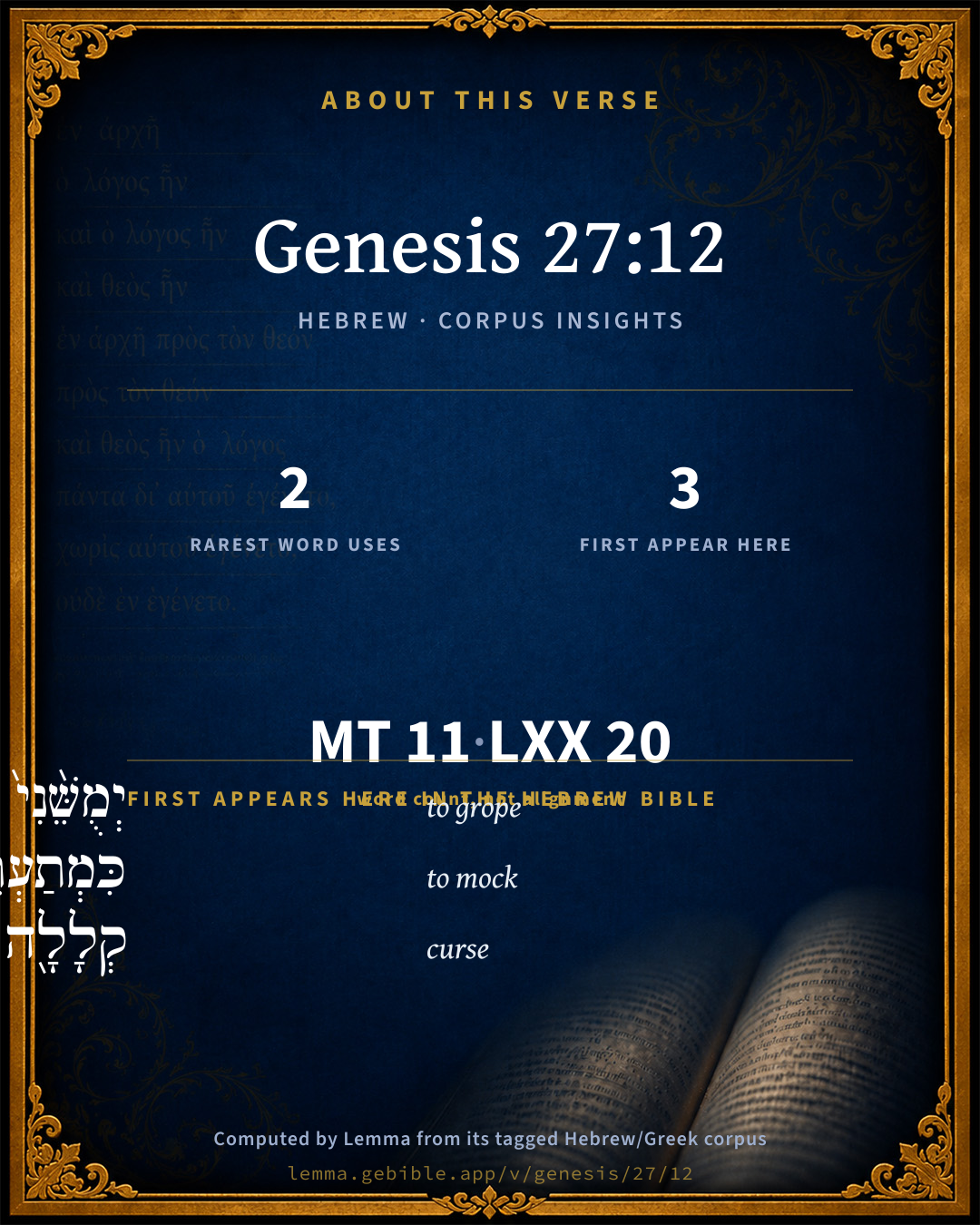
  • 3 first appearances in the Hebrew Bible
Full analysis ↓
Download a study sheet

One document with this verse’s original text, its word-by-word gloss line, the meaning frame, cross-references with their text, attributed commentary, and full source and license credits — printable, and it pastes into notes with its structure intact.

This verse Autodidact and up

Study sheet (.html) Plain text (.txt)

A passage Seminary Student

Up to 50 verses in one chapter. A passage sheet keeps up to 6 commentary sources and 12 cross-references per verse, in the order this page ranks them, and says so on the sheet whenever that leaves anything out. Ask for a single verse and you get the Autodidact verse sheet above.

Everything on this page stays free to read, with no account — the sheet is a download of what is already on screen, not access to it.

Want to remove ads? Support Godless Engineer
Compare translations 3

The same verse in 3 English versions, stacked beneath the original-language interlinear above. Click any original word for its lexicon entry.

Each is an independent rendering of the whole verse — the interlinear is not word-aligned to these translations.

Highlighted words mark where these versions differ — a whole-verse word diff, not a word-by-word alignment.

  • World English Bible Public Domain
    What if my father touches me? I will seem to him as a deceiver, and I would bring a curse on myself, and not a blessing."
  • King James Version Public Domain
    My father peradventure will feel me, and I shall seem to him as a deceiver; and I shall bring a curse upon me, and not a blessing.
  • unfoldingWord Literal Text CC BY-SA 4.0
    Suppose my father touches me? Then I will be in his eyes as a deceiver, and I will bring a curse on me and not a blessing.”

unfoldingWord Literal Text — © unfoldingWord, licensed CC BY-SA 4.0. Word-aligned USFM3 via Door43 (git.door43.org/unfoldingWord/en_ult).

Versions to compare (up to 4)

3 of 4 selected

Show all 18 translations

Every available English version of this verse, each an independent rendering of the whole verse.

  • World English Bible Public Domain
    What if my father touches me? I will seem to him as a deceiver, and I would bring a curse on myself, and not a blessing."
  • Berean Standard Bible Public Domain
    What if my father touches me? Then I would be revealed to him as a deceiver, and I would bring upon myself a curse rather than a blessing.”
  • Majority Standard Bible Public Domain
    What if my father touches me? Then I would be revealed to him as a deceiver, and I would bring upon myself a curse rather than a blessing.”
  • King James Version Public Domain
    My father peradventure will feel me, and I shall seem to him as a deceiver; and I shall bring a curse upon me, and not a blessing.
  • American Standard Version (1901) Public Domain
    My father peradventure will feel me, and I shall seem to him as a deceiver. And I shall bring a curse upon me, and not a blessing.
  • Revised Version (1885) Public Domain
    My father peradventure will feel me, and I shall seem to him as a deceiver; and I shall bring a curse upon me, and not a blessing.
  • Geneva Bible (1599) Public Domain
    My father may possibly feele me, and I shall seem to him to be a mocker: so shall I bring a curse vpon me, and not a blessing.
  • Douay-Rheims (1899) Public Domain
    If my father shall feel me, and perceive it, I fear lest he will think I would have mocked him, and I shall bring upon me a curse instead of a blessing.
  • Young's Literal Translation Public Domain
    it may be my father doth feel me, and I have been in his eyes as a deceiver, and have brought upon me disesteem, and not a blessing;'
  • Literal Standard Version CC BY-SA 4.0
    it may be my father feels me, and I have been in his eyes as a deceiver, and have brought on me disapproval, and not a blessing”;
  • Unlocked Literal Bible CC BY-SA 4.0
    Perhaps my father will touch me, and I will seem to him as a deceiver. I will bring a curse upon me and not a blessing.”
  • unfoldingWord Literal Text CC BY-SA 4.0
    Suppose my father touches me? Then I will be in his eyes as a deceiver, and I will bring a curse on me and not a blessing.”
  • Darby Bible Public Domain
    My father perhaps will feel me, and I shall be in his sight as one who mocks [him], and I shall bring a curse on me, and not a blessing.
  • World Messianic Bible Public Domain
    What if my father touches me? I will seem to him as a deceiver, and I would bring a curse on myself, and not a blessing.”
  • Webster's Bible Public Domain
    My father perhaps will feel me, and I shall seem to him as a deceiver; and I shall bring a curse upon me, and not a blessing.
  • Free Bible Version CC BY-SA 4.0
    Maybe my father will notice when he touches me. Then it will look like I'm deceiving him and I'll bring a curse down on myself instead of a blessing.”
  • Bible in Basic English Public Domain
    If by chance my father puts his hand on me, it will seem to him that I am tricking him, and he will put a curse on me in place of a blessing.
  • JPS Tanakh (1917) Public Domain
    My father peradventure will feel me, and I shall seem to him as a mocker; and I shall bring a curse upon me, and not a blessing.'

Literal Standard Version (2020), Covenant Press — licensed CC BY-SA 4.0. Text via the HelloAO Bible API (eBible.org). Unlocked Literal Bible (unfoldingWord) — licensed CC BY-SA 4.0. Text via the HelloAO Bible API (eBible.org). unfoldingWord Literal Text — © unfoldingWord, licensed CC BY-SA 4.0. Word-aligned USFM3 via Door43 (git.door43.org/unfoldingWord/en_ult). Free Bible Version, Dr. Jonathan Gallagher — licensed CC BY-SA 4.0. Text via the HelloAO Bible API (eBible.org).

Word by word

More ways to search: Search by grammar → Find every occurrence → Compare this word →

Practice this passage: Drill this verse → Learn its vocabulary →

כִּמְתַעְתֵּ֑עַ
tâʻaʻ
H8591
“like/as · mocking”
Preposition + Verb, Pilpel, Participle Active, Masculine, Singular, Absolute
Part of Speech
Preposition + Verb
Stem
Pilpel
Form
Participle Active
Gender
Masculine
Number
Singular
State
Absolute
Full BDB Definition

Origin: a primitive root

TWOT: 2532

to deceive, misuse - (Pilpel) - to be a mocker, mock - mocker (substantive) - (Hithpalpel) - to ridicule - mocking (participle)
  1. אוּלַ֤י ʼûwlay H194 “perhaps” Adverb
  2. יְמֻשֵּׁ֨נִי֙ mâshash H4959 “to grope · me” Verb, Qal, Imperfect, 3rd Person, Masculine, Singular + Suffix, Personal, 1st Person, Common, Singular
  3. אָבִ֔י ʼâb H1 “father · my” Noun, Common, Masculine, Singular, Construct + Suffix, Personal, 1st Person, Common, Singular
  4. וְהָיִ֥יתִי hâyâh H1961 “and · to be” Conjunction + Verb, Qal, Perfect, 1st Person, Common, Singular
  5. בְעֵינָ֖יו ʻayin H5869 “in/at · eyes · his” Preposition + Noun, Common, Both, Dual, Construct + Suffix, Personal, 3rd Person, Masculine, Singular
  6. וְהֵבֵאתִ֥י bôwʼ H935 “and · to enter” Conjunction + Verb, Hiphil, Sequential Perfect, 1st Person, Common, Singular
  7. עָלַ֛י ʻal H5921 “upon · me” Preposition + Suffix, Personal, 1st Person, Common, Singular
  8. קְלָלָ֖ה qᵉlâlâh H7045 “curse” Noun, Common, Feminine, Singular, Absolute
  9. וְלֹ֥א lôʼ H3808 “and · not” Conjunction + Particle, Negative
  10. בְרָכָֽה Bᵉrâkâh H1293 “blessing” Noun, Common, Feminine, Singular, Absolute

About this verse

These counts appear in no published source. They are computed here, from the morphology-tagged text and Lemma’s own curated glosses. What Lemma adds →

11
words
11
distinct lemmas
Pentateuch
section

Notable vocabulary

The rarest word here is כִּמְתַעְתֵּ֑עַ to mock H8591 — appearing just 2 times in the whole Hebrew Bible.

First appearance in Scripture

These words make their first canonical appearance in the Hebrew Bible here:

  • יְמֻשֵּׁ֨נִי֙ to grope H4959
  • כִּמְתַעְתֵּ֑עַ to mock H8591
  • קְלָלָ֖ה curse H7045

Shared distinctive vocabulary

כִּמְתַעְתֵּ֑עַ to mock H8591 occurs in 2 verses of the Hebrew Bible. Also found in:

Grammatical profile

  • 4 verbs
  • 4 nouns
  • 1 preposition
  • 1 adverb
  • 1 particle

Verb forms

  • יְמֻשֵּׁ֨נִי֙ Qal · Imperfect
  • וְהָיִ֥יתִי Qal · Perfect
  • כִּמְתַעְתֵּ֑עַ Pilpel · Participle Active
  • וְהֵבֵאתִ֥י Hiphil · Sequential Perfect

Hebrew & Septuagint length

In English translation the verse runs 26 words from the Hebrew and 27 from the Septuagint (LXX English) — closely comparable.

A rough comparison of the two English renderings, which tokenize alike — not a word-level alignment.

Word counts can differ between the Hebrew and the Greek without any difference in meaning — e.g. the Hebrew direct-object marker אֵת has no separate Greek word, and Greek often adds the article ὁ.

In the original languages it is 11 Hebrew tokens and 20 Greek tokens — but the two are counted differently (Hebrew bundles its prefixes and suffixes into one token; the Greek is in lemma form), so that isn’t a like-for-like length.

Cross-references

10

Topical passages linked to Genesis 27:12 in the Treasury of Scripture Knowledge — connected by theme and wording, ordered by reader-vote popularity; previews shown in the World English Bible.

  • Deuteronomy 27:18 Cursed be he who makes the blind to wander out of the way. All the people shall say, Amen.
  • Genesis 25:27 The boys grew. Esau was a skillful hunter, a man of the field. Jacob was a quiet man, living in tents.
  • Genesis 27:36 He said, "Isn't he rightly named Jacob? For he has supplanted me these two times. He took away my birthright. See, now he has taken away my blessing." He said, "Haven't you reserved a blessing for me?"
  • Job 12:16 With him is strength and wisdom; The deceived and the deceiver are his.
  • Malachi 1:14 "But the deceiver is cursed, who has in his flock a male, and vows, and sacrifices to the Lord a blemished thing; for I am a great King," says Yahweh of hosts, "and my name is awesome among the nations."
  • 2 Corinthians 6:8 by glory and dishonor, by evil report and good report; as deceivers, and yet true;
  • 1 Thessalonians 5:22 Abstain from every form of evil.
  • Genesis 9:25 He said, "Cursed be Canaan; A servant of servants will he be to his brothers."
  • Genesis 27:21–22 Isaac said to Jacob, "Please come near, that I may feel you, my son, whether you are really my son Esau or not."
  • Jeremiah 48:10 Cursed be he who does the work of Yahweh negligently; and cursed be he who keeps back his sword from blood.

Cross-references courtesy of OpenBible.info (CC BY 4.0).

Hebrew and Greek witnesses Masoretic Hebrew ↔ Greek Septuagint

The same verse in the two great witnesses to the Old Testament, shown verse-for-verse.

These are two independent witnesses, not word-aligned to each other, and the Septuagint is shown in lemma (dictionary) form.

Hebrew Genesis 27:12 Masoretic · Westminster Leningrad Codex

אוּלַ֤י יְמֻשֵּׁ֨נִי֙ אָבִ֔י וְהָיִ֥יתִי בְעֵינָ֖יו כִּמְתַעְתֵּ֑עַ וְהֵבֵאתִ֥י עָלַ֛י קְלָלָ֖ה וְלֹ֥א בְרָכָֽה

What if my father touches me? I will seem to him as a deceiver, and I would bring a curse on myself, and not a blessing."

World English Bible · Public Domain

Greek LXX Genesis 27:12 Septuagint · lemma form

μήποτε ψηλαφάω ἐγώ ὁ πατήρ ἐγώ καί εἰμί ἐναντίον αὐτός ὡς καταφρονέω καί ἐπιἄγω ἐπί ἐμαυτοῦ κατάρα καί οὐ εὐλογία

Peradventure my father may feel me, and I shall be before him as one ill-intentioned, and I shall bring upon me a curse, and not a blessing.

LXX2012 (modern English Septuagint) · Public Domain

On this verse, The Cambridge Bible for Schools and Colleges discusses the Septuagint’s reading. Read the note in Commentary ↓

Hebrew: Westminster Leningrad Codex (CC BY 4.0). Greek: Septuagint (public domain); English from LXX2012 (modern English Septuagint) (Public Domain). How the Septuagint differs from the Hebrew →

Targum (Aramaic paraphrase)

2

The Targum is the ancient Jewish Aramaic paraphrase of the Hebrew Scriptures — an interpretive translation, not the Hebrew text itself. Onkelos (literal) and Pseudo-Jonathan (expansive) render the Torah, and Jonathan the Prophets. Coverage is partial: where no permissively-licensed English translation exists for a verse, only the Aramaic is shown. This is verse-level text, not a word-by-word alignment to the Hebrew.

  1. Targum Onkelos Torah (Genesis–Deuteronomy)
    מָאִים יְמֻשִּׁנַּנִי אַבָּא וְאֵהֵי בְעֵינוֹהִי כְּמִתְלָעָב וְאֵהֵי מַיְתֵי (נ''י וָאֱהִי מַיְתֵי) עֲלַי לְוָטִין וְלָא בִרְכָן

    (no public-domain English translation for this verse)

    Targum Onkelos — Aramaic: “Onkelos Genesis” (public domain); “Onkelos Exodus” (public domain); “Onkelos Leviticus” (public domain); “Onkelos Numbers” (public domain); “Onkelos Deuteronomy” (public domain). English: “Sefaria Community Translation” (CC0 1.0 (public-domain dedication)); “J.W. Etheridge. The Targums of Onkelos and Jonathan Ben Uzziel on the Pentateuch. London: Longmans, Green, 1862” (public domain). Text via Sefaria.

  2. Targum Pseudo-Jonathan Torah (Genesis–Deuteronomy)
    מָאִים יְגַשִׁשִׁינַנִי אַבָּא וְאֵיהֵי דָמִי בְּעֵינוֹיֵי הֵי כִּמְגַחָךְ בֵּיהּ וְאַיְיתֵי עָלַי לְוָוטִין וְלָא בִרְכָאָן

    Perhaps my father will feel me, and I shall be in his eyes like one who derideth him, and bring upon me a curse and not a blessing.

    Targum Pseudo-Jonathan — Aramaic: “Targum Jonathan on Genesis” (public domain); “Targum Jonathan on Exodus” (public domain); “Targum Jonathan on Leviticus” (public domain); “Targum Jonathan on Numbers” (public domain); “Targum Jonathan on Deuteronomy” (public domain). English: “The Targum of Jonathan ben Uzziel, trans. J. W. Etheridge, London, 1862” (public domain). Text via Sefaria.

Commentary

Notes on Genesis 27:12 from classic Christian and Jewish commentators (each source and its license shown beneath its notes). The classic Christian expositions comment on the surrounding passage and are grouped to its opening verse, so a note may address several verses; the Jewish commentaries on the Tanakh (Rashi and others) are per-verse, so they appear only where the commentator wrote on this verse.

Lemma curates 59 commentaries, every one of them public domain or Creative Commons licensed, each selected and text-cleaned for this edition rather than reprinted as found. About our sources →

Trapp's Complete Commentary

John Trapp

Gen 27:12 My father peradventure will feel me, and I shall seem to him as a deceiver; and I shall bring a curse upon me, and not a blessing.

Ver. 12. My father peradventure will feel me.] Our heavenly Father will certainly feel us, and better feel us; and we shall feel him too, in his fatherly corrections, before he bless us. Suffer we must, or ere we reign: no coming to the crown, but by the cross. Christ himself was "perfected by sufferings"; {Heb 2:10; Heb 5:9} and we must be "conformed to his image". {Rom 8:29} When Ignatius came to the wild beasts, Now, saith he, I begin to be a Christian. Qui non eat Crucianus, non est Christianus, saith Luther, on the 29th of Genesis: and in another place, I have no stronger argument, saith he, against the Pope’s kingdom, than this, that he reigneth without the cross.

And I shall seem to him as a deceiver.] So shall all complimenting hypocrites to God, that pretend his service to their wicked or worldly ends and aims. They think, belike, to deceive him; {a} but therein they are fairly deceived, for he searcheth the hearts; and bring a curse, instead of a blessing, upon themselves and their posterity. "The hypocrite in heart heaps up wrath". {Job 36:13} Nemo enim magis; ram meretur, saith a father, {b} quam amicum simulans inimicus . Where shall we read of a hypocrite received to mercy?

{a} Sapiens nummularius Deus est: nummum fictum non recipiet. - Bern,

{b} Bern.

John Trapp, A Commentary or Exposition upon All the Books of the Old and New Testament (1647–1656) — public domain. Text from a community e-Sword module.

Geneva Bible (1599)

Geneva Bible translators

Hebrew, before his eyes.

Or, as though I would deceive him.

Geneva Bible (1599) marginal notes — public domain. Text via Bolls.life.

Adam Clarke's Commentary

Verse 12. I shall bring a curse upon me] For even in those early times the spirit of that law was understood, De 27:18: Cursed is he that maketh the blind to wander out of the way; and Jacob seems to have possessed at this time a more tender conscience than his mother.

Adam Clarke's Commentary on the Bible (1810–1826) — public domain. Text from a community e-Sword/MySword module.

The Cambridge Bible for Schools and Colleges

gen. ed. J. J. S. Perowne

12. will feel me] Isaac’s sight was no longer good enough to distinguish between his sons; but the sense of touch would remove all doubt.

a deceiver] Better, as R.V. marg., a mocker. LXX ὡς καταφρονῶν, “a profane trifler,” one who treats in a contemptuous way the solemn religious blessing of his father. A rare Heb. word, rendered “scoff,” 2Ch_36:16.

a curse] Jacob apprehends that his profanity will be visited by a solemn religious denunciation. If so, he will be a loser, not a gainer, by the trick. The thought of risk, not the deception, troubles him.

The Cambridge Bible for Schools and Colleges (gen. ed. J. J. S. Perowne; Cambridge University Press, 1878–1918) — public domain. Text from a community e-Sword module.

John Gill's Exposition

My father peradventure will feel me,.... For, though he could not see him, and so discern whether he had any hair or no on him, yet, suspecting him by his voice, he might call him to him to feel him, as he did; for Jacob understood his mother right, that he was to represent his brother Esau in the transaction of this affair:

and I shall seem to him as a deceiver; one that imposes upon another and causes him to err, leads him to say or do wrong things: and not only appear as one, but be really one, and even a very great one, as the doubling of the radical letters in the word shows; yea, the worst of deceivers, a deceiver of a parent, of one that was both aged and blind:

and I shall bring a curse upon me, and not a blessing; and he might justly fear, that should he be found out, it would so provoke his father, that instead of blessing him, he would curse him, see Deu 27:18.

John Gill's Exposition of the Whole Bible (1746–1763) — public domain (CC PDM 1.0). Text via the HelloAO Bible API.

Haydock's Catholic Bible Commentary

Mocked him, taking advantage of his blindness and old age. (Menochius)

George Leo Haydock (1774–1849), Haydock's Catholic Family Bible and Commentary, 1859 edition — public domain. Excludes Psalms (Douay-Rheims chapter numbering differs from Protestant) and Deuterocanonical books (Catholic canon only).

Matthew Poole's English Annotations

I shall appear to him to be indeed a deceiver, one that abuseth his age and blindness. The particle as sometimes signifies not the likeness, but the truth of the thing, Joh 1:14; 2Co 3:18.

I shall bring a curse upon me, which is due to every one that deceiveth the blind, Deu 27:18, especially his father, and especially in a religious concern, Jer 48:10; Mal 1:14, such as this was.

Matthew Poole's English Annotations on the Holy Bible (1683–1685) — public domain. Text from a community e-Sword/MySword module.

Whedon's Commentary on the Bible

Daniel D. Whedon

12. I shall seem to him as a deceiver — Jacob is cautious and far-sighted; but his words show that he shrinks not from the proposed deception from a feeling that it would be wrong, but only from a fear of detection and a curse. Rebekah has no fear in this regard. Even if detected, she is willing to risk any curse likely to come from one who deliberately attempts to subvert prophecy. She looks at the end to be attained, and scruples not at the means to attain it.

Daniel D. Whedon (gen. ed.), Commentary on the Old and New Testaments (1874–1909) — public domain. Text from a community e-Sword module.

The Pulpit Commentary

My father peradventure will feel me, and I shall seem to him as a deceiver; literally, shall be in his eyes as a scorer (Keil, Lange), with the idea of mocking at his aged sire"s infirmities wJv katafronwn (LXX); or as a deceiver, an imposter, one who causes to go astray (Vulgate, Rosenm Ainsworth, Murphy); though perhaps both senses should he-included, the verb T; to scoff, meaning primarily to stammer, and hence to mislead by imperfect speech, and thus to cause to wander or lead astray, hT (vide Gesenius, p, 870, and Kalisch, p. 506) and I shall bring a curse hllq (from llq to be light, hence to be despised) signifies first an expression of contempt, and then a more solemn imprecationupon me, and not a blessing.

The Pulpit Commentary (1880–1919), ed. H.D.M. Spence-Jones & Joseph S. Exell — public domain. Text from a community e-Sword module.

Rashi

Rabbi Shlomo Yitzchaki (Rashi)

ימשני HE WILL FEEL ME — The word is of the same root as the verb in (Deuteronomy 28:29) “One groping (ממשש) at noon-day”.

Rashi on the Tanakh — English translations: “The Judaica Press complete Tanach with Rashi, translated by A. J. Rosenberg” (CC BY 4.0); “Pentateuch with Rashi's commentary by M. Rosenbaum and A.M. Silbermann, 1929-1934” (public domain); “The Metsudah Tanach series, Lakewood, N.J” (CC BY 4.0); and “The Book of Joshua, Metsudah Publications, 1997” (CC BY 4.0). Text via Sefaria.

Ramban (Nachmanides)

Rabbi Moshe ben Nachman (Ramban / Nachmanides)

PERHAPS MY FATHER WILL FEEL ME. The reason that Isaac will feel him is not for the purpose of recognition. Instead, Jacob said, “Perhaps he will bring me near him to kiss me or to put his hand on my face in the manner of a father demonstrating affection for his son, and in feeling me he will discover that I am smooth.”Now I wonder why Jacob was not afraid of vocal recognition for all people are recognizable by their voice as our Rabbis have said, “How is a blind man permitted to live with his wife? And how are people permitted to live with their wives at nighttime? Only by vocal recognition.” Now if ordinary people have such power of recognition, what of Isaac, who was wise and expert in distinguishing between his sons? He should truly have the power of recognition by voice. Perhaps the brothers had similar voices, and therefore the Sages said that the verse, The voice is the voice of Jacob, refers not to Jacob’s voice but to his words, i.e., that he speaks gentle language and mentions the Name of Heaven., as referring to the kind of language Jacob used. It may be that he altered his voice in order to speak as his brother did, for there are people who know how to do this.

Ramban (Nachmanides) on the Tanakh — English translation: “Commentary on the Torah by Ramban (Nachmanides). Translated and annotated by Charles B. Chavel. New York, Shilo Pub. House, 1971-1976” (CC BY 4.0). Text via Sefaria.

Radak

Rabbi David Kimhi (Radak)

אולי...כמתעתע, seeing that he can hardly see I would deceive him saying that I am Esau, and if he will feel me and find that my skin is smooth, he will become angry and demand to know how I dared to deceive him and instead of blessing me he will curse me.

ימושני, the root of the word is משש, the letter shin has a dagesh.

כמתעתע, the root of the word is תעה, even though both the first and second root letters appear twice in the word. We have a parallel expression מעשה תעתועים in Jeremiah 10,15, as well as in Chronicles II 36,16 ומתעתועים בנביאיו, a reference to false prophets and religious dignitaries who deceive their followers.

והבאתי, I will be the cause of bringing a curse upon myself.

Radak on the Tanakh — English translations: “Sefaria Community Translation” (CC0 1.0 (public-domain dedication)); “Eliyahu Munk, HaChut Hameshulash” (CC BY 4.0); “Rabbi Mike Feuer, Jerusalem Anthology” (CC BY 4.0); and “R. David Kimhi on the first book of Psalms, Translated by R.G. Finch, London, 1919” (public domain). Text via Sefaria.

Lesson kit

Teaching starters — assembled from the data on this page, not authored interpretation. Every prompt links to the verse data it draws on. Edit before teaching.

Genesis, in the Pentateuch, opens this verse with 11 words (11 distinct Hebrew lemmas). Its most distinctive word is tâʻaʻ (“to mock”). A historical commentator’s framing appears above. Read the whole chapter for the surrounding context.

Discussion questions

  1. What does “to mock” (tâʻaʻ) contribute to the verse as a whole?
  2. 3 words here appear for the first time in Scripture. What is being introduced at this debut?
  3. 2 Chronicles 36:16 shares the word «to mock» with this verse. How do the two illuminate each other?
  4. These translations render this verse differently; the difference is in the English rendering, not the original. What questions does that raise?
  5. The verb «יְמֻשֵּׁ֨נִי֙» is Qal Imperfect. How does its form color the action?
  6. Reading how Trapp's Complete Commentary and Geneva Bible (1599) read this verse, where do the two commentators agree and where do they part?

Things to notice

Reading settings

Reading text

Shown beneath each verse's original-language words.

Old Testament
Old Testament edition

Read the OT as the Masoretic Hebrew (MT) or the Greek Septuagint (LXX).

English shown for the Greek Septuagint (in the Hebrew ↔ Greek comparison).

Comparing translations? Open the Compare panel on any verse page to stack up to four side by side.