
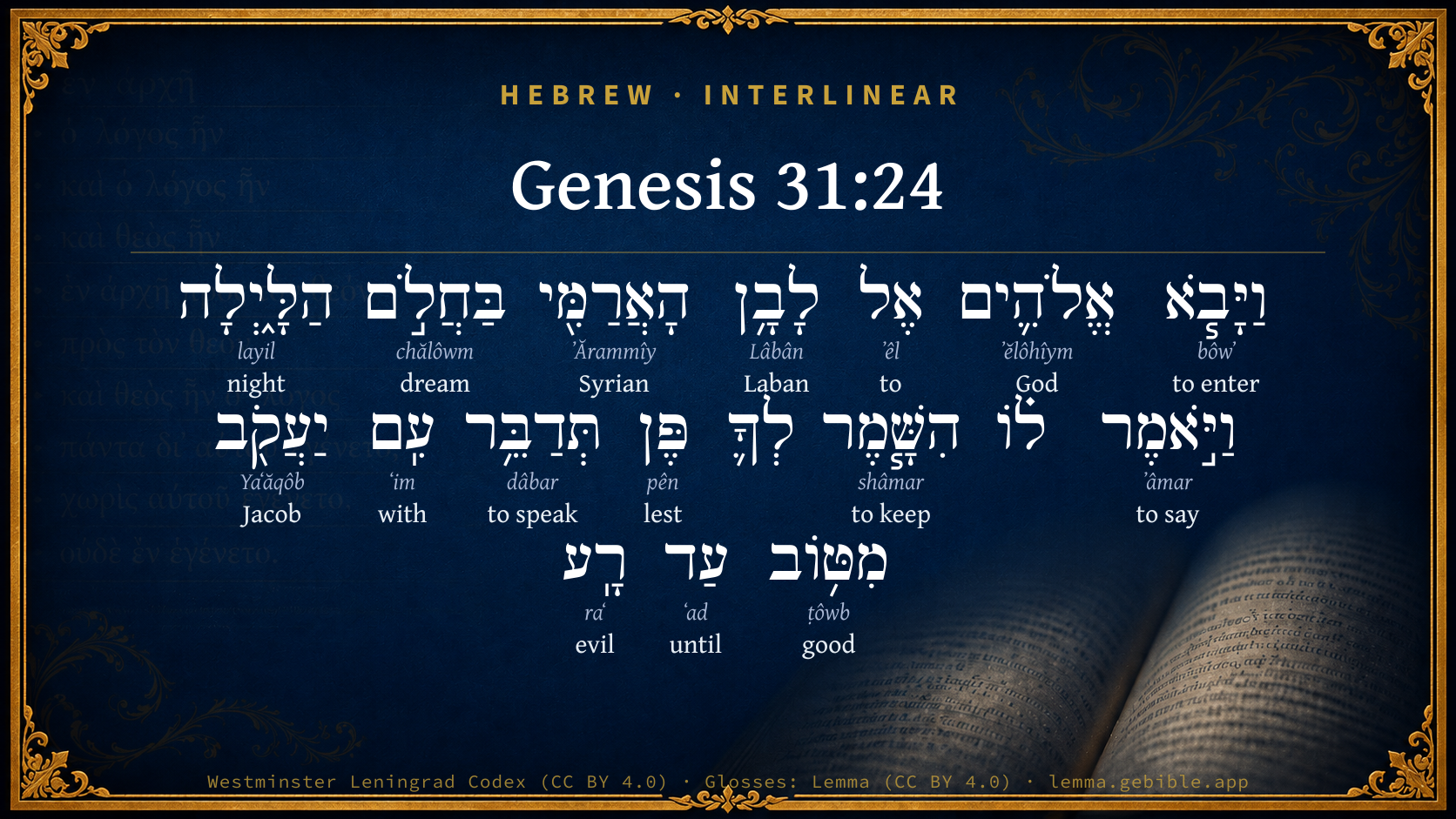
Genesis 31:24

Hebrew (Westminster Leningrad Codex) Genesis 31:24 appears in the Hebrew Old Testament. The text above is from the Westminster Leningrad Codex. Each word links to its Strong’s number, a concise gloss, and parsing drawn from the Open Scriptures Hebrew Bible morphology. Click any word for its full Brown-Driver-Briggs (BDB) entry.
Download image
Cite this verse

Genesis 31:24 (World English Bible). Public Domain. Lemma interlinear Bible study tool, https://lemma.gebible.app/v/genesis/31/24.

Show BibTeX & RIS
BibTeX
RIS
English Translation
God came to Laban, the Syrian, in a dream of the night, and said to him, "Take heed to yourself that you don't speak to Jacob either good or bad."
World English Bible · Public Domain
Download a study sheet

One document with this verse’s original text, its word-by-word gloss line, the meaning frame, cross-references with their text, attributed commentary, and full source and license credits — printable, and it pastes into notes with its structure intact.

This verse Autodidact and up

Study sheet (.html) Plain text (.txt)

A passage Seminary Student

Up to 50 verses in one chapter. A passage sheet keeps up to 6 commentary sources and 12 cross-references per verse, in the order this page ranks them, and says so on the sheet whenever that leaves anything out. Ask for a single verse and you get the Autodidact verse sheet above.

Everything on this page stays free to read, with no account — the sheet is a download of what is already on screen, not access to it.

Want to remove ads? Support Godless Engineer
Compare translations 3

The same verse in 3 English versions, stacked beneath the original-language interlinear above. Click any original word for its lexicon entry.

Each is an independent rendering of the whole verse — the interlinear is not word-aligned to these translations.

Highlighted words mark where these versions differ — a whole-verse word diff, not a word-by-word alignment.

  • World English Bible Public Domain
    God came to Laban, the Syrian, in a dream of the night, and said to him, "Take heed to yourself that you don't speak to Jacob either good or bad."
  • King James Version Public Domain
    And God came to Laban the Syrian in a dream by night, and said unto him, Take heed that thou speak not to Jacob either good or bad.
  • unfoldingWord Literal Text CC BY-SA 4.0
    But God came to Laban the Aramean in a dream that night and said to him, “Watch yourself that you do not speak with Jacob either good or bad.”

unfoldingWord Literal Text — © unfoldingWord, licensed CC BY-SA 4.0. Word-aligned USFM3 via Door43 (git.door43.org/unfoldingWord/en_ult).

Versions to compare (up to 4)

3 of 4 selected

Show all 18 translations

Every available English version of this verse, each an independent rendering of the whole verse.

  • World English Bible Public Domain
    God came to Laban, the Syrian, in a dream of the night, and said to him, "Take heed to yourself that you don't speak to Jacob either good or bad."
  • Berean Standard Bible Public Domain
    But that night God came to Laban the Aramean in a dream and warned him, “Be careful not to say anything to Jacob, either good or bad.”
  • Majority Standard Bible Public Domain
    But that night God came to Laban the Aramean in a dream and warned him, “Be careful not to say anything to Jacob, either good or bad.”
  • King James Version Public Domain
    And God came to Laban the Syrian in a dream by night, and said unto him, Take heed that thou speak not to Jacob either good or bad.
  • American Standard Version (1901) Public Domain
    And God came to Laban the Syrian in a dream of the night, and said unto him, Take heed to thyself that thou speak not to Jacob either good or bad.
  • Revised Version (1885) Public Domain
    And God came to Laban the Syrian in a dream of the night, and said unto him, Take heed to thyself that thou speak not to Jacob either good or bad.
  • Geneva Bible (1599) Public Domain
    And God came to Laban the Aramite in a dreame by night, and sayde vnto him, Take heede that thou speake not to Iaakob ought saue good.
  • Douay-Rheims (1899) Public Domain
    And he saw in a dream God saying to him: Take heed thou speak not any thing harshly against Jacob.
  • Young's Literal Translation Public Domain
    And God cometh in unto Laban the Aramaean in a dream of the night, and saith to him, `Take heed to thyself lest thou speak with Jacob from good unto evil.'
  • Literal Standard Version CC BY-SA 4.0
    And God comes to Laban the Aramean in a dream of the night and says to him, “Take heed to yourself lest you speak with Jacob from good to evil.”
  • Unlocked Literal Bible CC BY-SA 4.0
    Now God came to Laban the Aramean in a dream at night and said to him, “Be careful that you speak to Jacob neither good nor bad.”
  • unfoldingWord Literal Text CC BY-SA 4.0
    But God came to Laban the Aramean in a dream that night and said to him, “Watch yourself that you do not speak with Jacob either good or bad.”
  • Darby Bible Public Domain
    And God came to Laban the Syrian in a dream by night, and said to him, Take care thou speak not to Jacob either good or bad.
  • World Messianic Bible Public Domain
    God came to Laban the Syrian in a dream of the night, and said to him, “Be careful that you don’t speak to Jacob either good or bad.”
  • Webster's Bible Public Domain
    And God came to Laban, the Syrian, in a dream by night, and said to him, Take heed that thou speak not to Jacob either good or bad.
  • Free Bible Version CC BY-SA 4.0
    But during the night God came to Laban in a dream and told him, “Watch what you say to Jacob. Don't try to persuade him to come back, and don't threaten him either.”
  • Bible in Basic English Public Domain
    Then God came to Laban in a dream by night, and said to him, Take care that you say nothing good or bad to Jacob.
  • JPS Tanakh (1917) Public Domain
    And God came to Laban the Aramean in a dream of the night, and said unto him: 'Take heed to thyself that thou speak not to Jacob either good or bad.'

Literal Standard Version (2020), Covenant Press — licensed CC BY-SA 4.0. Text via the HelloAO Bible API (eBible.org). Unlocked Literal Bible (unfoldingWord) — licensed CC BY-SA 4.0. Text via the HelloAO Bible API (eBible.org). unfoldingWord Literal Text — © unfoldingWord, licensed CC BY-SA 4.0. Word-aligned USFM3 via Door43 (git.door43.org/unfoldingWord/en_ult). Free Bible Version, Dr. Jonathan Gallagher — licensed CC BY-SA 4.0. Text via the HelloAO Bible API (eBible.org).

Word by word

More ways to search: Search by grammar → Find every occurrence → Compare this word →

Practice this passage: Drill this verse → Learn its vocabulary →

הָאֲרַמִּ֖י
ʼĂrammîy
H761
“the · Syrian”
Particle, Definite Article + Noun, Gentilic, Masculine, Singular, Absolute
Part of Speech
Particle + Noun
Type
Gentilic
Gender
Masculine
Number
Singular
State
Absolute
Full BDB Definition

Origin: patrial from H758

TWOT: None

Syrian or Aramean = "exalted" - a thing or a person from Syria or Aram
  1. וַיָּבֹ֧א bôwʼ H935 “and · to enter” Conjunction + Verb, Qal, Sequential Imperfect, 3rd Person, Masculine, Singular
  2. אֱלֹהִ֛ים ʼĕlôhîym H430 “God(s)” Noun, Common, Masculine, Plural, Absolute
  3. אֶל ʼêl H413 “to” Preposition
  4. לָבָ֥ן Lâbân H3837 “Laban” Noun, Proper
  5. בַּחֲלֹ֣ם chălôwm H2472 “in/at · dream” Preposition + Noun, Common, Masculine, Singular, Absolute
  6. הַלָּ֑יְלָה layil H3915 “the · night” Particle, Definite Article + Noun, Common, Masculine, Singular, Absolute
  7. וַיֹּ֣אמֶר ʼâmar H559 “and · to say” Conjunction + Verb, Qal, Sequential Imperfect, 3rd Person, Masculine, Singular
  8. הִשָּׁ֧מֶר shâmar H8104 “keep” Verb, Niphal, Imperative, 2nd Person, Masculine, Singular
  9. פֶּן pên H6435 “lest” Conjunction
  10. תְּדַבֵּ֥ר dâbar H1696 “to speak” Verb, Piel, Imperfect, 2nd Person, Masculine, Singular
  11. עִֽם ʻim H5973 “with” Preposition
  12. יַעֲקֹ֖ב Yaʻăqôb H3290 “Jacob” Noun, Proper
  13. מִטּ֥וֹב ṭôwb H2896 “from · good” Preposition + Adjective, Adjective, Masculine, Singular, Absolute
  14. עַד ʻad H5704 “until” Preposition
  15. רָֽע raʻ H7451 “evil” Adjective, Adjective, Masculine, Singular, Absolute

About this verse

These counts appear in no published source. They are computed here, from the morphology-tagged text and Lemma’s own curated glosses. What Lemma adds →

18
words
16
distinct lemmas
Pentateuch
section

Notable vocabulary

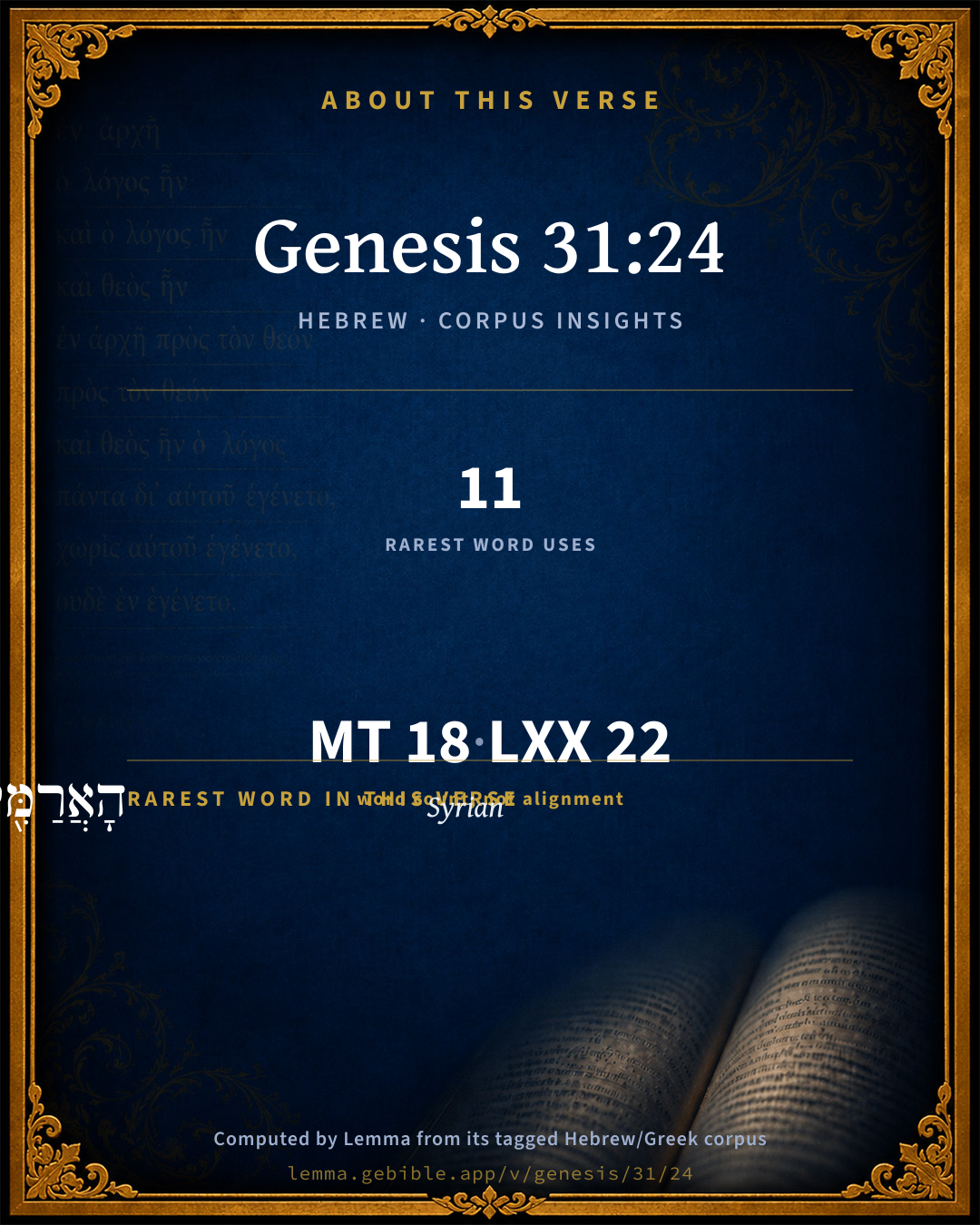
The rarest word here is הָאֲרַמִּ֖י Syrian H761 — appearing just 11 times in the whole Hebrew Bible.

Shared distinctive vocabulary

הָאֲרַמִּ֖י Syrian H761 occurs in 10 verses of the Hebrew Bible. Also found in:

Grammatical profile

  • 4 verbs
  • 6 nouns
  • 2 adjectives
  • 5 prepositions
  • 1 conjunction

Verb forms

  • וַיָּבֹ֧א Qal · Sequential Imperfect
  • וַיֹּ֣אמֶר Qal · Sequential Imperfect
  • הִשָּׁ֧מֶר Niphal · Imperative
  • תְּדַבֵּ֥ר Piel · Imperfect

Hebrew & Septuagint length

In English translation the verse runs 30 words from the Hebrew and 30 from the Septuagint (LXX English) — the same length.

A rough comparison of the two English renderings, which tokenize alike — not a word-level alignment.

Word counts can differ between the Hebrew and the Greek without any difference in meaning — e.g. the Hebrew direct-object marker אֵת has no separate Greek word, and Greek often adds the article ὁ.

In the original languages it is 18 Hebrew tokens and 22 Greek tokens — but the two are counted differently (Hebrew bundles its prefixes and suffixes into one token; the Greek is in lemma form), so that isn’t a like-for-like length.

Cross-references

22

Topical passages linked to Genesis 31:24 in the Treasury of Scripture Knowledge — connected by theme and wording, ordered by reader-vote popularity; previews shown in the World English Bible.

  • Genesis 24:50 Then Laban and Bethuel answered, "The thing proceeds from Yahweh. We can't speak to you bad or good.
  • Genesis 20:3 But God came to Abimelech in a dream of the night, and said to him, "Behold, you are a dead man, because of the woman whom you have taken. For she is a man's wife."
  • Genesis 31:29 It is in the power of my hand to hurt you, but the God of your father spoke to me last night, saying, 'Take heed to yourself that you don't speak to Jacob either good or bad.'
  • Genesis 31:42 Unless the God of my father, the God of Abraham, and the fear of Isaac, had been with me, surely now you would have sent me away empty. God has seen my affliction and the labor of my hands, and rebuked you last night."
  • Numbers 24:13 If Balak would give me his house full of silver and gold, I can't go beyond the word of Yahweh, to do either good or bad of my own mind; what Yahweh speaks, that will I speak?
  • 2 Samuel 13:22 Absalom spoke to Amnon neither good nor bad; for Absalom hated Amnon, because he had forced his sister Tamar.
  • Matthew 27:19 While he was sitting on the judgment seat, his wife sent to him, saying, "Have nothing to do with that righteous man, for I have suffered many things this day in a dream because of him."
  • Genesis 28:5 Isaac sent Jacob away. He went to Paddan Aram to Laban, son of Bethuel the Syrian, Rebekah's brother, Jacob's and Esau's mother.
  • Genesis 31:10 It happened at the time that the flock conceive, that I lifted up my eyes, and saw in a dream, and behold, the male goats which leaped on the flock were streaked, speckled, and grizzled.
  • Genesis 40:5 They both dreamed a dream, each man his dream, in one night, each man according to the interpretation of his dream, the cupbearer and the baker of the king of Egypt, who were bound in the prison.
  • Genesis 41:1 It happened at the end of two full years, that Pharaoh dreamed: and, behold, he stood by the river.
  • Numbers 22:26 The angel of Yahweh went further, and stood in a narrow place, where was no way to turn either to the right hand or to the left.
  • Deuteronomy 26:5 You shall answer and say before Yahweh your God, A Syrian ready to perish was my father; and he went down into Egypt, and sojourned there, few in number; and he became there a nation, great, mighty, and populous.
  • 1 Kings 3:5 In Gibeon Yahweh appeared to Solomon in a dream by night; and God said, Ask what I shall give you.
  • Job 33:15–17 In a dream, in a vision of the night, When deep sleep falls on men, In slumbering on the bed;
  • Psalms 105:14–15 He allowed no one to do them wrong. Yes, he reproved kings for their sakes,
  • Isaiah 37:29 Because of your raging against me, and because your arrogance is come up into my ears, therefore will I put my hook in your nose, and my bridle in your lips, and I will turn you back by the way by which you came.
  • Hosea 12:12 Jacob fled into the country of Aram, And Israel served to get a wife, And for a wife he tended flocks and herds.
  • Matthew 1:20 But when he thought about these things, behold, an angel of the Lord appeared to him in a dream, saying, "Joseph, son of David, don't be afraid to take to yourself Mary, your wife, for that which is conceived in her is of the Holy Spirit.
  • Numbers 12:6 He said, Hear now my words: if there be a prophet among you, I Yahweh will make myself known to him in a vision, I will speak with him in a dream.
  • Numbers 22:20 God came to Balaam at night, and said to him, If the men are come to call you, rise up, go with them; but only the word which I speak to you, that shall you do.
  • Job 33:25 His flesh shall be fresher than a child's; He returns to the days of his youth.

Cross-references courtesy of OpenBible.info (CC BY 4.0).

Hebrew and Greek witnesses Masoretic Hebrew ↔ Greek Septuagint

The same verse in the two great witnesses to the Old Testament, shown verse-for-verse.

These are two independent witnesses, not word-aligned to each other, and the Septuagint is shown in lemma (dictionary) form.

Hebrew Genesis 31:24 Masoretic · Westminster Leningrad Codex

וַיָּבֹ֧א אֱלֹהִ֛ים אֶל לָבָ֥ן הָאֲרַמִּ֖י בַּחֲלֹ֣ם הַלָּ֑יְלָה וַיֹּ֣אמֶר ל֗וֹ הִשָּׁ֧מֶר לְךָ֛ פֶּן תְּדַבֵּ֥ר עִֽם יַעֲקֹ֖ב מִטּ֥וֹב עַד רָֽע

God came to Laban, the Syrian, in a dream of the night, and said to him, "Take heed to yourself that you don't speak to Jacob either good or bad."

World English Bible · Public Domain

Greek LXX Genesis 31:24 Septuagint · lemma form

ἔρχομαι δέ ὁ θεός πρός λαβαν ὁ σύρος κατά ὕπνος ὁ νύξ καί εἶπον αὐτός φυλάσσω σεαυτοῦ μήποτε λαλέω μετά ἰακώβ πονηρός

And God came to Laban the Syrian in sleep by night, and said to him, Take heed to yourself that you speak not at any time to Jacob evil things.

LXX2012 (modern English Septuagint) · Public Domain

On this verse, The Pulpit Commentary discusses the Septuagint’s reading. Read the note in Commentary ↓

Hebrew: Westminster Leningrad Codex (CC BY 4.0). Greek: Septuagint (public domain); English from LXX2012 (modern English Septuagint) (Public Domain). How the Septuagint differs from the Hebrew →

Targum (Aramaic paraphrase)

2

The Targum is the ancient Jewish Aramaic paraphrase of the Hebrew Scriptures — an interpretive translation, not the Hebrew text itself. Onkelos (literal) and Pseudo-Jonathan (expansive) render the Torah, and Jonathan the Prophets. Coverage is partial: where no permissively-licensed English translation exists for a verse, only the Aramaic is shown. This is verse-level text, not a word-by-word alignment to the Hebrew.

  1. Targum Onkelos Torah (Genesis–Deuteronomy)
    וַאֲתָא מֵימָר מִן קֳדָם יְיָ לְוַת לָבָן אֲרַמָּאָה בְּחֵילְמָא דְּלֵילְיָא וַאֲמַר לֵהּ אִסְתַּמַּר לָךְ דִּילְמָא תְמַלֵּיל עִם יַעֲקֹב מִטַּב עַד בִּישׁ

    (no public-domain English translation for this verse)

    Targum Onkelos — Aramaic: “Onkelos Genesis” (public domain); “Onkelos Exodus” (public domain); “Onkelos Leviticus” (public domain); “Onkelos Numbers” (public domain); “Onkelos Deuteronomy” (public domain). English: “Sefaria Community Translation” (CC0 1.0 (public-domain dedication)); “J.W. Etheridge. The Targums of Onkelos and Jonathan Ben Uzziel on the Pentateuch. London: Longmans, Green, 1862” (public domain). Text via Sefaria.

  2. Targum Pseudo-Jonathan Torah (Genesis–Deuteronomy)
    וְאָתָא מַלְאָכָא בְּמֵימָר מִן קֳדָם יְיָ וּשְׁלַף חַרְבָּא עַל לָבָן רַמָאָה בְּחֵילְמָא דְלֵילְיָא וְאָמַר לֵיהּ טוּר לָךְ דִילְמָא תְמַלֵיל עִם יַעֲקב מִן טַב עַד בִּישׁ

    And there came an angel with a word from before the Lord; and he drew the sword against Laban the deceitful in a dream of the night, and said to him, Beware lest thou speak with Jakob from good to evil.

    Targum Pseudo-Jonathan — Aramaic: “Targum Jonathan on Genesis” (public domain); “Targum Jonathan on Exodus” (public domain); “Targum Jonathan on Leviticus” (public domain); “Targum Jonathan on Numbers” (public domain); “Targum Jonathan on Deuteronomy” (public domain). English: “The Targum of Jonathan ben Uzziel, trans. J. W. Etheridge, London, 1862” (public domain). Text via Sefaria.

Commentary

Notes on Genesis 31:24 from classic Christian and Jewish commentators (each source and its license shown beneath its notes). The classic Christian expositions comment on the surrounding passage and are grouped to its opening verse, so a note may address several verses; the Jewish commentaries on the Tanakh (Rashi and others) are per-verse, so they appear only where the commentator wrote on this verse.

Lemma curates 59 commentaries, every one of them public domain or Creative Commons licensed, each selected and text-cleaned for this edition rather than reprinted as found. About our sources →

Trapp's Complete Commentary

John Trapp

Gen 31:24 And God came to Laban the Syrian in a dream by night, and said unto him, Take heed that thou speak not to Jacob either good or bad.

Ver. 24. Take heed thou speak not good or bad.] That is, that thou seek not, either by flattery or force, by allurement or affrightment, to bring him back. They write of the asp, that he never wanders alone, without his companion with him. So the flattering promises of the Church’s adversaries go ever accompanied with cruel menaces, their rising tongues with their terrifying saws. {Heb 11:37} "None of them shall want their mate"; as the Scripture speaks of those birds of prey and desolation. {Isa 34:16}

John Trapp, A Commentary or Exposition upon All the Books of the Old and New Testament (1647–1656) — public domain. Text from a community e-Sword module.

Joseph Benson's Commentary

Gen 31:24. Speak not to Jacob either good or bad — The Hebrew is, from good to bad — That is, enter into no altercations, and use no harsh language with him, which may occasion a quarrel. Say nothing against his going on with his journey, for the thing proceedeth from the Lord. The same Hebraism we have, Gen 24:50. The safety of good men is very much owing to the hold God has on the consciences of bad men, and the access he has to them.

Joseph Benson's Commentary on the Old and New Testaments (1811–1818) — public domain. Text from a community e-Sword module.

Tyndale Open Study Notes

Tyndale Open Resources

31:24 leave Jacob alone! (literally Do not speak to Jacob either good or evil): God commanded Laban not to take justice into his own hands. When we try to enact our own sense of good and evil apart from God’s command, we always do evil (see study note on 2:9).

Tyndale Open Study Notes — © Tyndale Open Resources, licensed CC BY-SA 4.0. Text via the HelloAO Bible API.

Geneva Bible (1599)

Geneva Bible translators

Hebrew, from good to evil.

Geneva Bible (1599) marginal notes — public domain. Text via Bolls.life.

Adam Clarke's Commentary

Verse 24. And God came to Laban] God's caution to Laban was of high importance to Jacob -Take heed that thou speak not to Jacob either good or bad; or rather, as is the literal meaning of the Hebrew, מטוב עד רע mittob ad ra, from good to evil; for had he neither spoken good nor evil to Jacob, they could have had no intercourse at all. The original is, therefore, peculiarly appropriate; for when people meet, the language at first is the language of friendship; the command therefore implies, "Do not begin with Peace be unto thee, and then proceed to injurious language and acts of violence." If this Divine direction were attended to, how many of those affairs of honour, so termed, which commence with, "I hope you are well" - "I am infinitely glad to see you" - "I am happy to see you well," c., and end with small swords and pistol bullets, would be prevented! Where God and true religion act, all is fair, kind, honest, and upright but where these are not consulted, all is hollow, deceitful, or malicious. Beware of unmeaning compliments, and particularly of saying what thy heart feels not. God hates a hypocrite and a deceiver.

Adam Clarke's Commentary on the Bible (1810–1826) — public domain. Text from a community e-Sword/MySword module.

Ellicott's Commentary for English Readers

(24) Either good or bad.—Heb., from good to bad: a proverbial expression, rightly translated in the Authorised Version, but conveying the idea of a more absolute prohibition than the phrase used in Gen_24:50.

A Bible Commentary for English Readers, edited by Charles John Ellicott (1878–1897) — public domain. Text from a community e-Sword module.

The Cambridge Bible for Schools and Colleges

gen. ed. J. J. S. Perowne

24. And God came] Cf. Gen_31:11. For this revelation to Laban the Syrian, compare the revelation to Abimelech, king of Gerar, in Gen_20:3. It is God, not the “angel of God” (Gen_31:11), who appears to Laban.

either good or bad] A phrase used by Laban himself in Gen_24:50.

The Cambridge Bible for Schools and Colleges (gen. ed. J. J. S. Perowne; Cambridge University Press, 1878–1918) — public domain. Text from a community e-Sword module.

John Gill's Exposition

And Laban said unto Jacob,.... Upon their meeting together; perhaps in some middle place between their two tents:

what hast thou done? what evil hast thou committed? what folly art thou guilty of? and what could induce thee to take such a step as this? suggesting that he could see no necessity for it; and as if he had done nothing that should occasion it, and that Jacob had done a very ill thing

that thou hast stolen away unawares to me: of this phrase See Gill on Gen 31:20,

and carried away my daughters, as captives taken with the sword; as were commonly done by a band of robbers that made incursions upon their neighbours, and plundered them of their substance, and carried away by force their wives and daughters; and such an one Laban represents Jacob to be, a thief and a robber; who had not only stolen away from him, but had stole away his goods, and even his gods, and carried away his daughters against their will: all which were false, and particularly the latter, since they went along with him with their free and full consent.

John Gill's Exposition of the Whole Bible (1746–1763) — public domain (CC PDM 1.0). Text via the HelloAO Bible API.

Haydock's Catholic Bible Commentary

Speak not. Laban did not comply exactly, but he used no violence. (Haydock)

George Leo Haydock (1774–1849), Haydock's Catholic Family Bible and Commentary, 1859 edition — public domain. Excludes Psalms (Douay-Rheims chapter numbering differs from Protestant) and Deuterocanonical books (Catholic canon only).

Matthew Poole's English Annotations

Neither persuading him by flattering promises and cunning artifices, nor compelling him by threatenings, to return. For so these general words must be limited, as is evident from God’s design in them, and from the following relation. So this is a synecdochical expression.

Matthew Poole's English Annotations on the Holy Bible (1683–1685) — public domain. Text from a community e-Sword/MySword module.

Whedon's Commentary on the Bible

Daniel D. Whedon

24. God came to Laban — Mark the constant divine care that guards the ways of Jacob, and redeems him from all evil. Gen_48:16.

Either good or bad — Hebrews, from good unto bad. That is, do not from good friendly greetings pass to bad words of violence. Do not make matters worse.

Daniel D. Whedon (gen. ed.), Commentary on the Old and New Testaments (1874–1909) — public domain. Text from a community e-Sword module.

The Pulpit Commentary

Vers. 24, 25. And God Elohim is here employed, neither because the section belongs to the fundamental document (Tuch, Bleek, Colenso, et alii), nor because, though Laban had an outward acquaintance with Jehovah (vide ver. 49), his real religious knowledge did not extend beyond Elohim (Hengstenberg), but simply because the historian wished to characterize the interposition which arrested Laban in his wrath as supernatural (Quarry)came to Laban the Syrian in a dream by night, (cf. Gen_20:3; Job_33:15; Mat_1:20) This celestial visitation occurred the night before the fugitives were overtaken (vide ver. 29). Its intention was to guard Jacob, according to the promise Gen_28:15, against Laban"s resentmentand (accordingly God) said unto him, Take heed literally, take heed for thyself, the verb being followed by an ethical dative, as in Gen_12:1 Gen_21:16, q.v. that thou speak not to Jacob literally, lest the, speak with Jacob; mh pote lalhsuv meta jIakwb (LXX) either good or bad. Literally, from good to bad, meaning that on meeting with Jacob he should not pass from peaceful greetings to bitter reproaches (Bush, Lunge), or say anything emphatic and decisive for the purpose of reversing what had occurred (Keil); or, perhaps more simply, say anything acrimonious or violent against Jacob (Rosenm Murphy), the expression being a proverbial phrase for opposition or interference (Kalisch). (cf. Gen_14:5; 2Sa_13:23) Then (literally, and) Laban overtook Jacob. Now (literally, and) Jacob had pitched his tent this was done by means of pins driven into the ground, the verb qT; signifying to fasten, or fix anything by driving (cf. Jud_1:4:21; Isa_22:23, Isa_22:25) in the mount (vide supra, ver. 21): and Laban with his brethren (kinsmen, ut supra) pitched his tent; not esthse touv ajdelfouv (LXX)in the mount of Gilead (vide supra, ver. 21).

The Pulpit Commentary (1880–1919), ed. H.D.M. Spence-Jones & Joseph S. Exell — public domain. Text from a community e-Sword module.

John Wesley's Explanatory Notes

Speak not, either good or bad - That is, say nothing against his going on with his journey, for the thing proceedeth from the Lord. The same Hebraism we have, chap. xxiv, 50. The safety of good men is very much owing to the hold God has of the consciences of bad men, and the access he has to them.

John Wesley, Explanatory Notes Upon the Whole Bible (1754–1765) — public domain. Text via the GEBible commentary corpus.

unfoldingWord translationNotes

Door43 World Missions Community

Now God came to Laban the Aramean in a dream at night

The word "now" is used here to mark a change from the story to background information about Laban. AT: "That night God came to Laban in a dream" (See: Background Information)

Be careful that you speak to Jacob neither good nor bad

The phrase "good nor bad" are used together to mean "anything." AT: "Do not say anything to try and stop Jacob from leaving" (See: Merism)

Laban overtook Jacob. Now Jacob had pitched his tent in the hill country. Laban also camped with his relatives in the hill country of Gilead

The word "now" is used here to mark a change from the story to background information about Jacob and Laban. AT: "When Laban caught up with Jacob, Jacob had set up camp in the hill country. Then Laban and his relatives also camped in the hill country of Gilead" (See: Background Information)

translationWords

God

Aram

dream

Gilead

unfoldingWord translationNotes — © Distant Shores Media and the Door43 World Missions Community, licensed CC BY-SA 4.0. Source: git.door43.org/Door43/en_tn.

Rashi

Rabbi Shlomo Yitzchaki (Rashi)

מטוב עד רע EITHER GOOD OR EVIL — why should he not speak good? Because all the good that the wicked do to the righteous is evil in the opinion of the righteous (Yevamot 103b).

Rashi on the Tanakh — English translations: “The Judaica Press complete Tanach with Rashi, translated by A. J. Rosenberg” (CC BY 4.0); “Pentateuch with Rashi's commentary by M. Rosenbaum and A.M. Silbermann, 1929-1934” (public domain); “The Metsudah Tanach series, Lakewood, N.J” (CC BY 4.0); and “The Book of Joshua, Metsudah Publications, 1997” (CC BY 4.0). Text via Sefaria.

Ramban (Nachmanides)

Rabbi Moshe ben Nachman (Ramban / Nachmanides)

LABAN THE ARAMEAN. The intent of this is to relate that even though he was an Aramean, and the people of his place used teraphim and were soothsayers like the Philistines, yet the prophetic dream came to him in honor of the righteous one [Jacob]. Similarly, And Jacob outwitted Laban the Aramean: [the epithet “Aramean” is mentioned in order to indicate that] even though Laban was the Aramean, the diviner and owner of teraphim, [he was still outwitted by Jacob].

EITHER GOOD OR BAD. [Why should he not speak good?] Because all the good that the wicked do is looked upon by the righteous as bad. This is Rashi’s language. But the plain meaning thereof is as follow: “Take heed that you speak not to Jacob and promise to treat him well if he will return with you from his journey, or lest you threaten to do him evil if he will not come with you, for it is I Who commanded him to return to his land.”

Ramban (Nachmanides) on the Tanakh — English translation: “Commentary on the Torah by Ramban (Nachmanides). Translated and annotated by Charles B. Chavel. New York, Shilo Pub. House, 1971-1976” (CC BY 4.0). Text via Sefaria.

Sforno

Rabbi Ovadia Sforno

Guard yourself that you do not speak. You are forbidden even to speak!

Either good. Do not try to lure Yaakov into returning with offers of benefits. Or evil. And do not threaten him.

Sforno on the Tanakh — English translation: “Yalkut, Sifsei Chachomim Chumash, Metsudah Publications, 2009” (CC BY 4.0). Text via Sefaria.

Radak

Rabbi David Kimhi (Radak)

ויבא, just as G’d had communicated with Avimelech in honour of Yitzchok, so He now communicated with Lavan in honour of Yaakov.

פן תדבר, that you dare not speak. Do not start a quarrel with him planning to do harm to him as a result. Not only must you not harm him physically, but you must not even inflict verbal abuse on him. The correct meaning of the words פן תדבר is: “not to speak harshly.” Constructions with the prefix פן also occur in Genesis 3,3 as a warning, on pain of death, not to eat from the tree of knowledge, or in Genesis 24,6 פן תשיב את בני שמה not to bring Yitzchok back to Padan Aram.

מטוב עד רע, though you may think that if you deprive Yaakov only of a small fraction of his wealth that from your vantage point you are doing him a favour by allowing him to retain most of it, or that you plan to rob him of most of it, something which even you realise as an evil thing to do, seeing you want to punish him for leaving you without having taken his leave from you.

Radak on the Tanakh — English translations: “Sefaria Community Translation” (CC0 1.0 (public-domain dedication)); “Eliyahu Munk, HaChut Hameshulash” (CC BY 4.0); “Rabbi Mike Feuer, Jerusalem Anthology” (CC BY 4.0); and “R. David Kimhi on the first book of Psalms, Translated by R.G. Finch, London, 1919” (public domain). Text via Sefaria.

Lesson kit

Teaching starters — assembled from the data on this page, not authored interpretation. Every prompt links to the verse data it draws on. Edit before teaching.

Genesis, in the Pentateuch, opens this verse with 18 words (16 distinct Hebrew lemmas). Its most distinctive word is ʼĂrammîy (“Syrian”). A historical commentator’s framing appears above. Read the whole chapter for the surrounding context.

Discussion questions

  1. The word ʼĂrammîy carries the sense “Syrian.” How does it shape the verse?
  2. Genesis 25:20 shares the word «Syrian» with this verse. How do the two illuminate each other?
  3. These translations render this verse differently. What is at stake in choosing one wording over another?
  4. The verb «וַיָּבֹ֧א» is Qal Sequential Imperfect. How does its form color the action?
  5. Reading how Trapp's Complete Commentary and Joseph Benson's Commentary read this verse, where do the two commentators agree and where do they part?

Things to notice

Reading settings

Reading text

Shown beneath each verse's original-language words.

Old Testament
Old Testament edition

Read the OT as the Masoretic Hebrew (MT) or the Greek Septuagint (LXX).

English shown for the Greek Septuagint (in the Hebrew ↔ Greek comparison).

Comparing translations? Open the Compare panel on any verse page to stack up to four side by side.