
Genesis 48:5

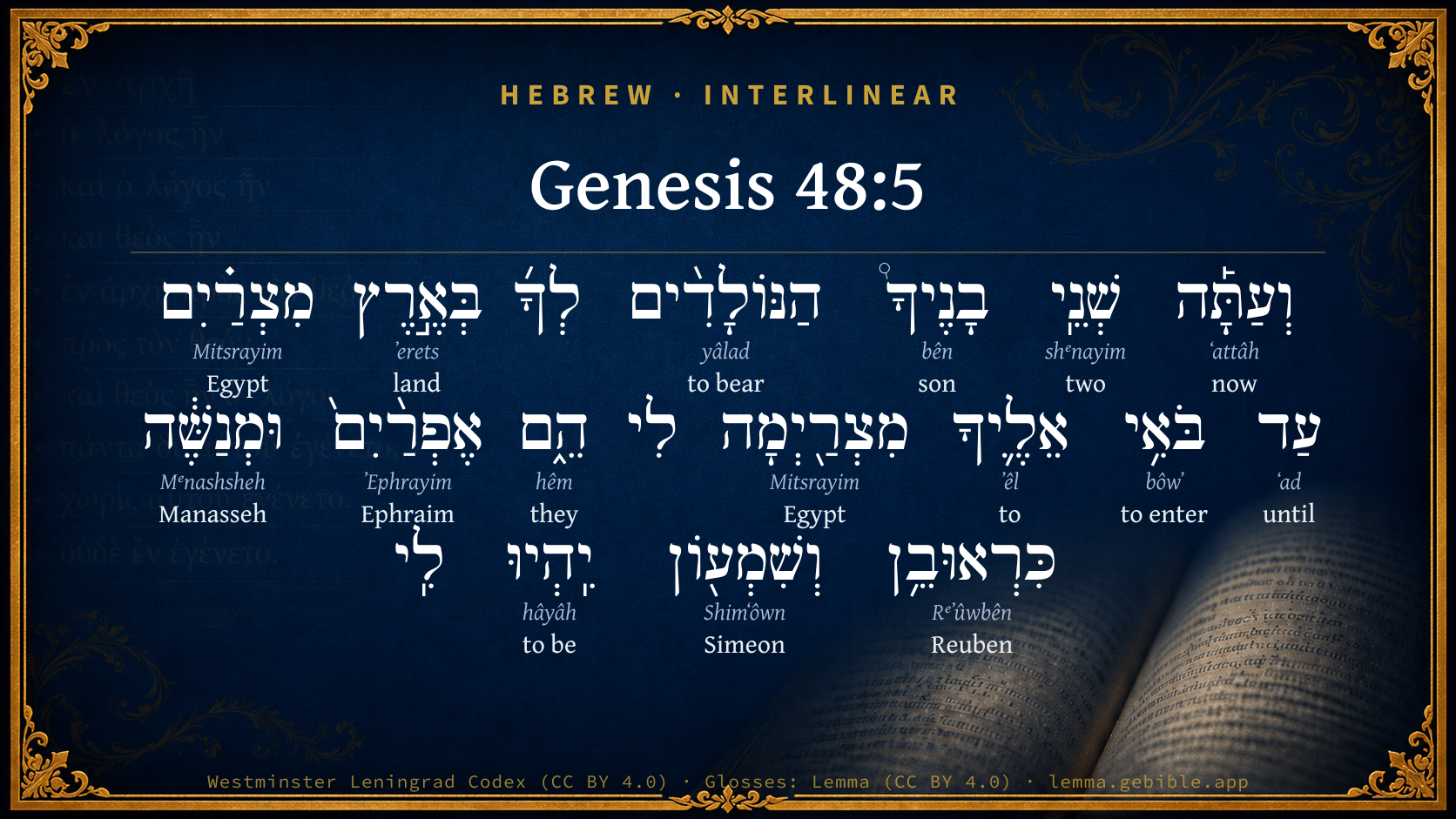
Hebrew (Westminster Leningrad Codex) Genesis 48:5 appears in the Hebrew Old Testament. The text above is from the Westminster Leningrad Codex. Each word links to its Strong’s number, a concise gloss, and parsing drawn from the Open Scriptures Hebrew Bible morphology. Click any word for its full Brown-Driver-Briggs (BDB) entry.
Download image
Cite this verse

Genesis 48:5 (World English Bible). Public Domain. Lemma interlinear Bible study tool, https://lemma.gebible.app/v/genesis/48/5.

Show BibTeX & RIS
BibTeX
RIS
English Translation
Now your two sons, who were born to you in the land of Egypt before I came to you into Egypt, are mine; Ephraim and Manasseh, even as Reuben and Simeon, will be mine.
World English Bible · Public Domain
Download a study sheet

One document with this verse’s original text, its word-by-word gloss line, the meaning frame, cross-references with their text, attributed commentary, and full source and license credits — printable, and it pastes into notes with its structure intact.

This verse Autodidact and up

Study sheet (.html) Plain text (.txt)

A passage Seminary Student

Up to 50 verses in one chapter. A passage sheet keeps up to 6 commentary sources and 12 cross-references per verse, in the order this page ranks them, and says so on the sheet whenever that leaves anything out. Ask for a single verse and you get the Autodidact verse sheet above.

Everything on this page stays free to read, with no account — the sheet is a download of what is already on screen, not access to it.

Want to remove ads? Support Godless Engineer
Compare translations 3

The same verse in 3 English versions, stacked beneath the original-language interlinear above. Click any original word for its lexicon entry.

Each is an independent rendering of the whole verse — the interlinear is not word-aligned to these translations.

Highlighted words mark where these versions differ — a whole-verse word diff, not a word-by-word alignment.

  • World English Bible Public Domain
    Now your two sons, who were born to you in the land of Egypt before I came to you into Egypt, are mine; Ephraim and Manasseh, even as Reuben and Simeon, will be mine.
  • King James Version Public Domain
    And now thy two sons, Ephraim and Manasseh, which were born unto thee in the land of Egypt before I came unto thee into Egypt, are mine; as Reuben and Simeon, they shall be mine.
  • unfoldingWord Literal Text CC BY-SA 4.0
    And now, your two sons, who were born for you in the land of Egypt before I came to you in Egypt, they mine, Ephraim and Manasseh, just as Reuben and Simeon are mine.

unfoldingWord Literal Text — © unfoldingWord, licensed CC BY-SA 4.0. Word-aligned USFM3 via Door43 (git.door43.org/unfoldingWord/en_ult).

Versions to compare (up to 4)

3 of 4 selected

Show all 18 translations

Every available English version of this verse, each an independent rendering of the whole verse.

  • World English Bible Public Domain
    Now your two sons, who were born to you in the land of Egypt before I came to you into Egypt, are mine; Ephraim and Manasseh, even as Reuben and Simeon, will be mine.
  • Berean Standard Bible Public Domain
    And now your two sons born to you in Egypt before I came to you here shall be reckoned as mine; Ephraim and Manasseh shall be mine, just as Reuben and Simeon are mine.
  • Majority Standard Bible Public Domain
    And now your two sons born to you in Egypt before I came to you here shall be reckoned as mine; Ephraim and Manasseh shall be mine, just as Reuben and Simeon are mine.
  • King James Version Public Domain
    And now thy two sons, Ephraim and Manasseh, which were born unto thee in the land of Egypt before I came unto thee into Egypt, are mine; as Reuben and Simeon, they shall be mine.
  • American Standard Version (1901) Public Domain
    And now thy two sons, who were born unto thee in the land of Egypt before I came unto thee into Egypt, are mine; Ephraim and Manasseh, even as Reuben and Simeon, shall be mine.
  • Revised Version (1885) Public Domain
    And now thy two sons, which were born unto thee in the land of Egypt before I came unto thee into Egypt, are mine; Ephraim and Manasseh, even as Reuben and Simeon, shall be mine.
  • Geneva Bible (1599) Public Domain
    And now thy two sonnes, Manasseh and Ephraim, which are borne vnto thee in the lande of Egypt, before I came to thee into Egypt, shall be mine, as Reuben and Simeon are mine.
  • Douay-Rheims (1899) Public Domain
    So thy two sons who were born to thee in the land of Egypt before I came hither to thee, shall be mine: Ephraim and Manasses shall be reputed to me as Ruben and Simeon.
  • Young's Literal Translation Public Domain
    `And now, thy two sons, who are born to thee in the land of Egypt, before my coming unto thee to Egypt, mine they `are'; Ephraim and Manasseh, as Reuben and Simeon they are mine;
  • Literal Standard Version CC BY-SA 4.0
    And now, your two sons, who are born to you in the land of Egypt, before my coming to you to Egypt, they [are] mine; Ephraim and Manasseh, as Reuben and Simeon, they are mine;
  • Unlocked Literal Bible CC BY-SA 4.0
    Now your two sons, who were born to you in the land of Egypt before I came to you into Egypt, they are mine. Ephraim and Manasseh will be mine, just as Reuben and Simeon are mine.
  • unfoldingWord Literal Text CC BY-SA 4.0
    And now, your two sons, who were born for you in the land of Egypt before I came to you in Egypt, they mine, Ephraim and Manasseh, just as Reuben and Simeon are mine.
  • Darby Bible Public Domain
    And now thy two sons, who were born to thee in the land of Egypt before I came to thee into Egypt, shall be mine: Ephraim and Manasseh shall be mine, as Reuben and Simeon.
  • World Messianic Bible Public Domain
    Now your two sons, who were born to you in the land of Egypt before I came to you into Egypt, are mine; Ephraim and Manasseh, even as Reuben and Simeon, will be mine.
  • Webster's Bible Public Domain
    And now, thy two sons, Ephraim and Manasseh, who were born to thee in the land of Egypt, before I came to thee into Egypt, are mine; as Reuben and Simeon, they shall be mine.
  • Free Bible Version CC BY-SA 4.0
    I am counting as mine your two sons Ephraim and Manasseh who were born here in Egypt before I arrived, just as Reuben and Simeon are mine.
  • Bible in Basic English Public Domain
    And now your two sons who came to birth in Egypt before I came to you here, are mine; Ephraim and Manasseh will be mine, in the same way as Reuben and Simeon are.
  • JPS Tanakh (1917) Public Domain
    And now thy two sons, who were born unto thee in the land of Egypt before I came unto thee into Egypt, are mine; Ephraim and Manasseh, even as Reuben and Simeon, shall be mine.

Literal Standard Version (2020), Covenant Press — licensed CC BY-SA 4.0. Text via the HelloAO Bible API (eBible.org). Unlocked Literal Bible (unfoldingWord) — licensed CC BY-SA 4.0. Text via the HelloAO Bible API (eBible.org). unfoldingWord Literal Text — © unfoldingWord, licensed CC BY-SA 4.0. Word-aligned USFM3 via Door43 (git.door43.org/unfoldingWord/en_ult). Free Bible Version, Dr. Jonathan Gallagher — licensed CC BY-SA 4.0. Text via the HelloAO Bible API (eBible.org).

Word by word

More ways to search: Search by grammar → Find every occurrence → Compare this word →

Practice this passage: Drill this verse → Learn its vocabulary →

וְשִׁמְע֖וֹן
Shimʻôwn
H8095
“and · Simeon”
Conjunction + Noun, Proper
Part of Speech
Conjunction + Noun
Type
Proper
Full BDB Definition

Origin: from H8085

TWOT: None

Simeon or Shimeon = "heard" - the 2nd son of Jacob by his wife Leah and progenitor of the tribe of Simeon - an Israelite of the sons of Bani who had a foreign wife in the time of Ezra
  1. וְעַתָּ֡ה ʻattâh H6258 “and · now” Conjunction + Adverb
  2. שְׁנֵֽי shᵉnayim H8147 “two” Adjective, Cardinal number, Masculine, Dual, Construct
  3. בָנֶיךָ֩ bên H1121 “sons · your” Noun, Common, Masculine, Plural, Construct + Suffix, Personal, 2nd Person, Masculine, Singular
  4. הַנּוֹלָדִ֨ים yâlad H3205 “the · bearing” Particle, Definite Article + Verb, Niphal, Participle Active, Masculine, Plural, Absolute
  5. בְּאֶ֣רֶץ ʼerets H776 “in/at · land of” Preposition + Noun, Common, Both, Singular, Construct
  6. מִצְרַ֗יִם Mitsrayim H4714 “Egypt” Noun, Proper
  7. עַד ʻad H5704 “until” Preposition
  8. בֹּאִ֥י bôwʼ H935 “to enter · me” Verb, Qal, Infinitive Construct + Suffix, Personal, 1st Person, Common, Singular
  9. אֵלֶ֛יךָ ʼêl H413 “to · you” Preposition + Suffix, Personal, 2nd Person, Masculine, Singular
  10. מִצְרַ֖יְמָה Mitsrayim H4714 “Egypt · toward” Noun, Proper + Suffix, Demonstrative
  11. הֵ֑ם hêm H1992 “they” Pronoun, Personal, 3rd Person, Masculine, Plural
  12. אֶפְרַ֨יִם֙ ʼEphrayim H669 “Ephraim” Noun, Proper
  13. וּמְנַשֶּׁ֔ה Mᵉnashsheh H4519 “and · Manasseh” Conjunction + Noun, Proper
  14. כִּרְאוּבֵ֥ן Rᵉʼûwbên H7205 “like/as · Reuben” Preposition + Noun, Proper
  15. יִֽהְיוּ hâyâh H1961 “to be” Verb, Qal, Imperfect, 3rd Person, Masculine, Plural

About this verse

These counts appear in no published source. They are computed here, from the morphology-tagged text and Lemma’s own curated glosses. What Lemma adds →

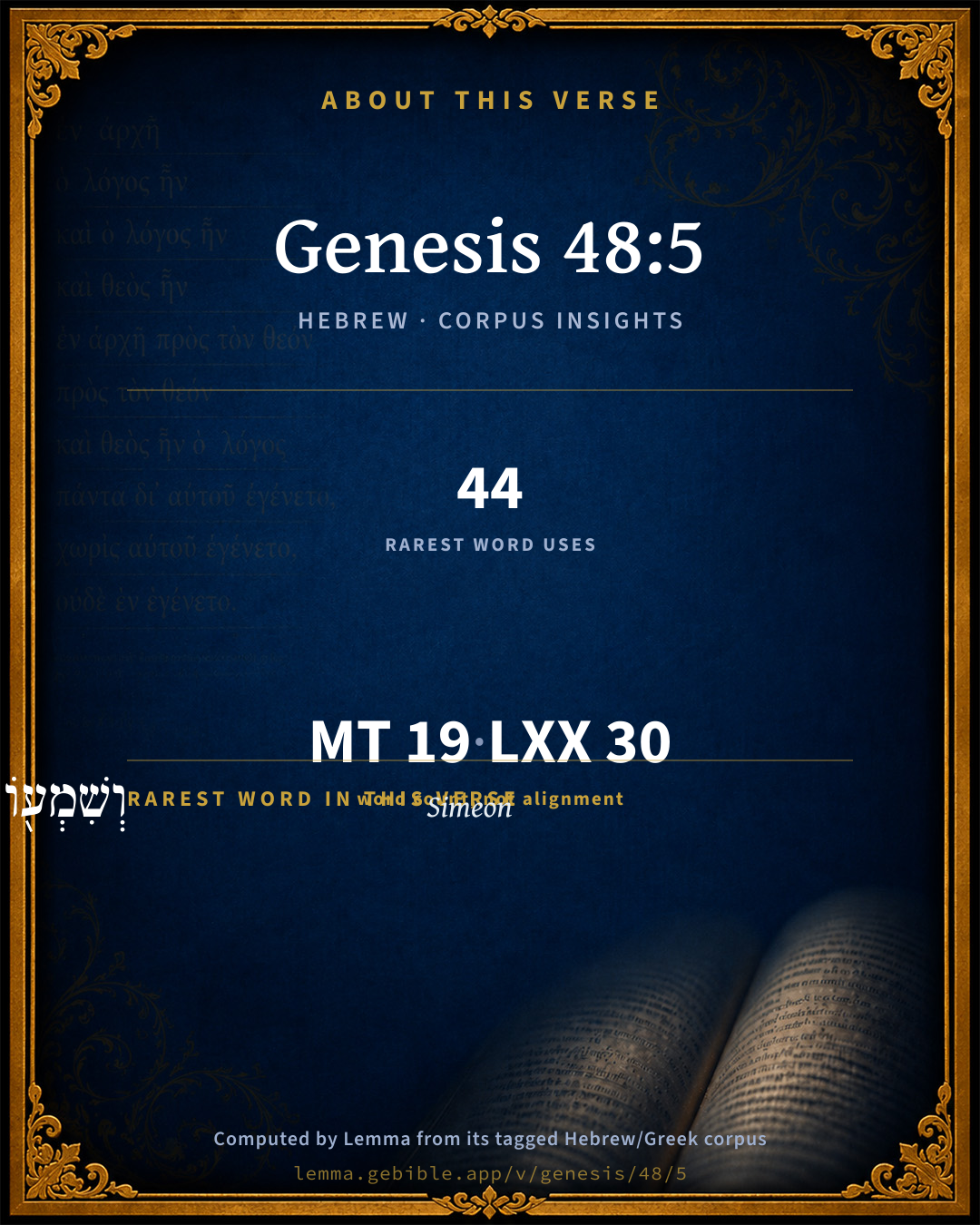
19
words
15
distinct lemmas
Pentateuch
section

Shared distinctive vocabulary

וְשִׁמְע֖וֹן Simeon H8095 occurs in 39 verses of the Hebrew Bible. Also found in:

Grammatical profile

  • 3 verbs
  • 8 nouns
  • 1 adjective
  • 1 pronoun
  • 5 prepositions
  • 1 adverb

Verb forms

  • הַנּוֹלָדִ֨ים Niphal · Participle Active
  • בֹּאִ֥י Qal · Infinitive Construct
  • יִֽהְיוּ Qal · Imperfect

Repetition

A word recurs within this verse — often emphatic in Hebrew:

  • מִצְרַ֗יִם Egypt H4714 ×2

Hebrew & Septuagint length

In English translation the verse runs 34 words from the Hebrew and 35 from the Septuagint (LXX English) — closely comparable.

A rough comparison of the two English renderings, which tokenize alike — not a word-level alignment.

Word counts can differ between the Hebrew and the Greek without any difference in meaning — e.g. the Hebrew direct-object marker אֵת has no separate Greek word, and Greek often adds the article ὁ.

In the original languages it is 19 Hebrew tokens and 30 Greek tokens — but the two are counted differently (Hebrew bundles its prefixes and suffixes into one token; the Greek is in lemma form), so that isn’t a like-for-like length.

Cross-references

16

Topical passages linked to Genesis 48:5 in the Treasury of Scripture Knowledge — connected by theme and wording, ordered by reader-vote popularity; previews shown in the World English Bible.

  • Genesis 41:50–52 To Joseph were born two sons before the year of famine came, whom Asenath, the daughter of Potiphera priest of On, bore to him.
  • Genesis 46:20 To Joseph in the land of Egypt were born Manasseh and Ephraim, whom Asenath, the daughter of Potiphera, priest of On, bore to him.
  • Joshua 14:4 For the children of Joseph were two tribes, Manasseh and Ephraim: and they gave no portion to the Levites in the land, save cities to dwell in, with the suburbs of it for their cattle and for their substance.
  • Joshua 13:7 Now therefore divide this land for an inheritance to the nine tribes, and the half-tribe of Manasseh.
  • 1 Chronicles 5:1–2 The sons of Reuben the firstborn of Israel (for he was the firstborn; but, because he defiled his father's couch, his birthright was given to the sons of Joseph the son of Israel; and the genealogy is not to be reckoned after the birthright.
  • 2 Corinthians 6:18 I will be to you a Father. You will be to me sons and daughters,' says the Lord Almighty."
  • Revelation 7:6–7 Of the tribe of Asher twelve thousand, Of the tribe of Naphtali twelve thousand, Of the tribe of Manasseh twelve thousand,
  • Leviticus 20:26 You shall be holy to me: for I, Yahweh, am holy, and have set you apart from the peoples, that you should be mine.
  • Numbers 1:10 Of the children of Joseph: Of Ephraim: Elishama the son of Ammihud. Of Manasseh: Gamaliel the son of Pedahzur.
  • Numbers 1:32–35 Of the children of Joseph, of the children of Ephraim, their generations, by thir families, by their fathers' houses, according to the number of the names, from twenty years old and upward, all who were able to go out to war;
  • Numbers 26:28–37 The sons of Joseph after their families: Manasseh and Ephraim.
  • Joshua 16:1–10 The lot came out for the children of Joseph from the Jordan at Jericho, at the waters of Jericho on the east, even the wilderness, going up from Jericho through the hill-country to Bethel;
  • Isaiah 43:1 But now thus says Yahweh who created you, Jacob, and he who formed you, Israel: Don't be afraid, for I have redeemed you; I have called you by your name, you are mine.
  • Ezekiel 16:8 Now when I passed by you, and looked at you, behold, your time was the time of love; and I spread my skirt over you, and covered your nakedness: yes, I swore to you, and entered into a covenant with you, says the Lord Yahweh, and you became mine.
  • Malachi 3:17 They shall be mine," says Yahweh of Hosts, "my own possession in the day that I make, and I will spare them, as a man spares his own son who serves him.
  • Ephesians 1:5 having predestined us for adoption as children through Jesus Christ to himself, according to the good pleasure of his desire,

Cross-references courtesy of OpenBible.info (CC BY 4.0).

Hebrew and Greek witnesses Masoretic Hebrew ↔ Greek Septuagint

The same verse in the two great witnesses to the Old Testament, shown verse-for-verse.

These are two independent witnesses, not word-aligned to each other, and the Septuagint is shown in lemma (dictionary) form.

Hebrew Genesis 48:5 Masoretic · Westminster Leningrad Codex

וְעַתָּ֡ה שְׁנֵֽי בָנֶיךָ֩ הַנּוֹלָדִ֨ים לְךָ֜ בְּאֶ֣רֶץ מִצְרַ֗יִם עַד בֹּאִ֥י אֵלֶ֛יךָ מִצְרַ֖יְמָה לִי הֵ֑ם אֶפְרַ֨יִם֙ וּמְנַשֶּׁ֔ה כִּרְאוּבֵ֥ן וְשִׁמְע֖וֹן יִֽהְיוּ לִֽי

Now your two sons, who were born to you in the land of Egypt before I came to you into Egypt, are mine; Ephraim and Manasseh, even as Reuben and Simeon, will be mine.

World English Bible · Public Domain

Greek LXX Genesis 48:5 Septuagint · lemma form

νῦν οὖν ὁ δύο υἱός σύ ὁ γίγνομαι σύ ἐν αἴγυπτος πρό ὁ ἐγώ ἔρχομαι πρός σύ εἰς αἴγυπτος ἐγώ εἰμί ἐφράιμ καί μανασσή ὡς ρουβην καί συμεων εἰμί ἐγώ

Now then your two sons, who were born to you in the land of Egypt, before I came to you into Egypt, are mine; Ephraim and Manasse, as Ruben and Symeon they shall be mine.

LXX2012 (modern English Septuagint) · Public Domain

Hebrew: Westminster Leningrad Codex (CC BY 4.0). Greek: Septuagint (public domain); English from LXX2012 (modern English Septuagint) (Public Domain). How the Septuagint differs from the Hebrew →

Targum (Aramaic paraphrase)

2

The Targum is the ancient Jewish Aramaic paraphrase of the Hebrew Scriptures — an interpretive translation, not the Hebrew text itself. Onkelos (literal) and Pseudo-Jonathan (expansive) render the Torah, and Jonathan the Prophets. Coverage is partial: where no permissively-licensed English translation exists for a verse, only the Aramaic is shown. This is verse-level text, not a word-by-word alignment to the Hebrew.

  1. Targum Onkelos Torah (Genesis–Deuteronomy)
    וּכְעַן תְּרֵין בְּנָיךְ דְּאִתְיְלִידוּ לָךְ בְּאַרְעָא דְמִצְרַיִם עַד מֵיתִי לְוָתָךְ לְמִצְרַיִם דִּילִי אִנּוּן אֶפְרַיִם וּמְנַשֶּׁה כִּרְאוּבֵן וְשִׁמְעוֹן יְהוֹן קֳדָמָי

    (no public-domain English translation for this verse)

    Targum Onkelos — Aramaic: “Onkelos Genesis” (public domain); “Onkelos Exodus” (public domain); “Onkelos Leviticus” (public domain); “Onkelos Numbers” (public domain); “Onkelos Deuteronomy” (public domain). English: “Sefaria Community Translation” (CC0 1.0 (public-domain dedication)); “J.W. Etheridge. The Targums of Onkelos and Jonathan Ben Uzziel on the Pentateuch. London: Longmans, Green, 1862” (public domain). Text via Sefaria.

  2. Targum Pseudo-Jonathan Torah (Genesis–Deuteronomy)
    וּכְדוֹן תְּרֵין בְּנָךְ דְאִתְיְלִידוּ לָךְ בְּאַרְעָא דְמִצְרַיִם עַד דְאָתִית לְוָתָךְ לְמִצְרַיִם דִילִי אִינוּן אֶפְרַיִם וּמְנַשֶׁה כִּרְאוּבֵן וְשִׁמְעוֹן מִתְחַשְׁבִין לִי

    And now, thy two sons who have been born to thee in the land of Mizraim before I came to thee into Mizraim are mine; Ephraim and Menasheh as Reuben and Shimeon shall be reckoned unto me.

    Targum Pseudo-Jonathan — Aramaic: “Targum Jonathan on Genesis” (public domain); “Targum Jonathan on Exodus” (public domain); “Targum Jonathan on Leviticus” (public domain); “Targum Jonathan on Numbers” (public domain); “Targum Jonathan on Deuteronomy” (public domain). English: “The Targum of Jonathan ben Uzziel, trans. J. W. Etheridge, London, 1862” (public domain). Text via Sefaria.

Commentary

Notes on Genesis 48:5 from classic Christian and Jewish commentators (each source and its license shown beneath its notes). The classic Christian expositions comment on the surrounding passage and are grouped to its opening verse, so a note may address several verses; the Jewish commentaries on the Tanakh (Rashi and others) are per-verse, so they appear only where the commentator wrote on this verse.

Lemma curates 59 commentaries, every one of them public domain or Creative Commons licensed, each selected and text-cleaned for this edition rather than reprinted as found. About our sources →

Trapp's Complete Commentary

John Trapp

Gen 48:5 And now thy two sons, Ephraim and Manasseh, which were born unto thee in the land of Egypt before I came unto thee into Egypt, [are] mine; as Reuben and Simeon, they shall be mine.

Ver. 5. As Reuben and Simeon, they shall be mine.] God hath in like sort adopted us for his dear children; saying, "I will be a Father unto them, and they shall be my sons and my daughters, saith the Lord Almighty." {2Co 6:18} This St John calls a royalty or prerogative, {εξουσια, Joh 1:12} such as he elsewhere stands amazed at. {1Jn 3:1} And well he may; for all God’s children are "firstborn," and so "higher than all the kings of the earth." {Psa 89:27} They "in the fulness of their sufficiency are in straits." {Job 20:22} Whereas the saints, in the fulness of their straits, are in an all-sufficiency.

John Trapp, A Commentary or Exposition upon All the Books of the Old and New Testament (1647–1656) — public domain. Text from a community e-Sword module.

Joseph Benson's Commentary

Gen 48:5. Thy two sons are mine — By adoption: I shall own them as if they were my immediate children, and each of them shall have an equal share both in my present property, and in the future inheritance of Canaan with the rest of my children. Thus Jacob transfers the double portion, which was the right of the firstborn, upon Joseph, because Reuben fell from it by transgression; concerning which see Gen 49:4, and 1Ch 5:1. As Reuben and Simeon — Whom he names as being the eldest, and who, if any, might seem to claim a privilege above the rest.

Joseph Benson's Commentary on the Old and New Testaments (1811–1818) — public domain. Text from a community e-Sword module.

Tyndale Open Study Notes

Tyndale Open Resources

48:5-7 Jacob, prompted by his memory of Rachel (see 35:16-20), blessed Joseph by elevating his two sons as coheirs with his other sons—the tribes of Ephraim and Manasseh would have shares along with the other tribes that came from Jacob (see Josh 16–17). Jacob also gave Ephraim, Joseph’s younger son, the birthright (see 1 Chr 5:1-2). As a result of this blessing, Ephraim and Manasseh became large and powerful tribes (see Josh 17:14-18).

Tyndale Open Study Notes — © Tyndale Open Resources, licensed CC BY-SA 4.0. Text via the HelloAO Bible API.

Jamieson, Fausset & Brown

Robert Jamieson, A. R. Fausset & David Brown

thy two sons, Ephraim and Manasseh--It was the intention of the aged patriarch to adopt Joseph's sons as his own, thus giving him a double portion. The reasons for this procedure are stated (Ch1 5:1-2).

are mine--Though their connections might have attached them to Egypt and opened to them brilliant prospects in the land of their nativity, they willingly accepted the adoption (Heb 11:25).

Jamieson, Fausset & Brown — Commentary Critical and Explanatory on the Whole Bible (1871) — public domain (CC PDM 1.0). Text via the HelloAO Bible API.

Adam Clarke's Commentary

Verse 5. And now thy two sons, Ephraim and Manasseh - are mine] I now adopt them into my own family, and they shall have their place among my twelve sons, and be treated in every respect as those, and have an equal interest in all the spiritual and temporal blessings of the covenant.

Adam Clarke's Commentary on the Bible (1810–1826) — public domain. Text from a community e-Sword/MySword module.

John Calvin's Commentaries

5. And now thy two sons. Jacob confers on his son the special privilege, that he, being one, should constitute two chiefs; that is, that his two sons should succeed to an equal right with their uncles, as if they had been heirs in the first degree. But what is this! that a decrepit old man assigns to his grandchildren, as a royal patrimony, a sixth part of the land in which he had entered as a stranger, and from which now again he is an exile! Who would not have said that he was dealing in fables? It is a common proverb, that no one can give what he has not. What, therefore, did it profit Joseph to be constituted, by an imaginary title, lord of that land, in which the donor of it was scarcely permitted to drink the very water he had dug for with great labour, and from which, at length, famine expelled him? But it hence appears with what firm faith the holy fathers relied upon the word of the Lord, seeing they chose rather to depend upon his lips, than to possess a fixed habitation in the land. Jacob is dying an exile in Egypt; and meanwhile, calls away the governor of Egypt from his dignity into exile, that he may be well and happy. Joseph, because he acknowledges his father as a prophet of God, who utters no inventions of his own, esteems as highly the dominion offered to him, which has never yet become apparent, as if it were already in his possession. Moreover, that Jacob commands the other sons of Joseph, (if there should be any,) to be reckoned in the families of these two brothers, is as if he directed them to be adopted by the two whom he adopts to himself.

John Calvin's Commentaries (1540-1563) — public domain. Text from the Calvin Translation Society English edition (1840s-50s) via the Christian Classics Ethereal Library (ccel.org). Calvin's coverage is partial (roughly two-thirds of the Bible); uncommented books and verses are honest gaps, never fabricated. The 19th-century editor's footnotes and remarks are omitted so the notes are faithfully Calvin's own voice.

Ellicott's Commentary for English Readers

(5) As Reuben and Simeon, they shall be mine.—That is, Ephraim shall be regarded as my firstborn, and Manasseh as my second son. This was undoubtedly the case; for though “Judah prevailed above his brethren, and of him came the prince (and of him the Messiah), yet the birthright was Joseph’s” (1Ch_5:2). The legal right of the firstborn was a double share of the father’s goods. This was bestowed upon Joseph in giving him two tribes, and to the other sons but one. It was in a spiritual sense, and with reference to the promise that all mankind should be blessed in Jacob’s seed, that the birthright was Judah’s. As Joseph was the son of the chief and best-beloved wife, he had a sort of claim to the birthright; but in agreement with the law afterwards specially enacted (Deu_21:15-17), Jacob acknowledges that the right had belonged to Reuben, but excludes him from the possession of it as the penalty of his great and terrible sin. Simeon and Levi are next passed over, because of their cruelty, and so Judah takes Reuben’s place.

A Bible Commentary for English Readers, edited by Charles John Ellicott (1878–1897) — public domain. Text from a community e-Sword module.

The Cambridge Bible for Schools and Colleges

gen. ed. J. J. S. Perowne

5. are mine] Joseph’s sons are adopted into the family of Jacob (cf. Jos_14:4); and the account records their acknowledgment to be full tribes in the parent stock of Israel.

Ephraim and Manasseh] Observe the change in order. The writer of P here, as E in Gen_48:20, gives the precedent to the recipient of the greater blessing. But, while this order is found in Num_1:10, Jos_17:17, the other is the more usual; cf. Jos_14:4; Jos_16:4.

The Cambridge Bible for Schools and Colleges (gen. ed. J. J. S. Perowne; Cambridge University Press, 1878–1918) — public domain. Text from a community e-Sword module.

John Gill's Exposition

And now thy two sons, Ephraim and Manasseh,.... Ephraim was the youngest, but is mentioned first, as he afterwards was preferred in the blessing of him:

which were born unto thee in the land of Egypt, before I came unto thee into Egypt; and therefore must be twenty years of age, or upwards: for Jacob had been in Egypt seventeen years, and he came there when there had been two years of famine, and Joseph's sons were born to him before the years of famine began, Gen 41:50; of these Jacob says, they

are mine: as Reuben and Simeon, they shall be mine; that is, by adoption; should be reckoned not as his grandchildren, but as his children, even as his two eldest sons, Reuben and Simeon; and so should be distinct tribes or heads of them, as his sons would be, and have a distinct part and portion in the land of Canaan; and thus the birthright was transferred from Reuben, because of his incest, to Joseph, who in his posterity had a double portion assigned him.

John Gill's Exposition of the Whole Bible (1746–1763) — public domain (CC PDM 1.0). Text via the HelloAO Bible API.

Haydock's Catholic Bible Commentary

Mine, by adoption; and shall be heads of their respective tribes. (Menochius)

George Leo Haydock (1774–1849), Haydock's Catholic Family Bible and Commentary, 1859 edition — public domain. Excludes Psalms (Douay-Rheims chapter numbering differs from Protestant) and Deuterocanonical books (Catholic canon only).

Matthew Poole's English Annotations

Thy two sons are mine, by adoption: I shall own them as if they were my immediate children, and each of them shall have equal share, both in my present estate, and future inheritance of Canaan, with the rest of my children. Thus Jacob transfers the double portion, which was the right of the first-born, from which Reuben by his transgression fell, Gen 49:4, upon Joseph, 1Ch 5:1. He names the two eldest, who, if any, might seem to claim a greater privilege than the rest.

Matthew Poole's English Annotations on the Holy Bible (1683–1685) — public domain. Text from a community e-Sword/MySword module.

Whedon's Commentary on the Bible

Daniel D. Whedon

5. Thy two sons… are mine… as Reuben and Simeon — “They are to have the tribal rank of sons, although they were grandsons. In 1Ch_5:1-2, it is said that Reuben, the firstborn, was deprived of his birthright because of his sin, and it was given to the two sons of Joseph. Joseph thus had a double portion, which was reckoned one of the privileges of the firstborn.” — Newhall. The law of Deu_21:15-17, forbidding the transfer of right of the firstborn to a son of a more favoured wife, could not have governed the action of Jacob. This transfer was for sufficient cause.

Daniel D. Whedon (gen. ed.), Commentary on the Old and New Testaments (1874–1909) — public domain. Text from a community e-Sword module.

The Pulpit Commentary

Vers. 5, 6. And now thy two sons, Ephraim and Manasseh, which were born unto thee in the land of Egypt (vide Gen_41:50-52) before I came unto thee into Egypt, this would almost seem to imply that Jacob knew of Joseph"s having had sons born to him since his (Jacob"s) arrival at Goshen are mine (i.e. I shall reckon them as my own sons, giving them an equal place with the other members of my family); as Reuben and Simeon, they shall be mine literally, Ephraim and Manasseh, as Reuben and Simeon, shall be mine. The double portion thus conferred upon Joseph in the persons of his son? was a practical investiture of him with the birthright of which Reuben had been deprived, (1Ch_5:1) in respect at least of the inheritance; in respect of the honor of being the next connecting link in the chain of redemption, leading on and down to the coming of the Savior, the birthright appears to have been transferred to Judah. (Gen_49:8-10) And thy issue, which thou begettest after them, shall be thine (i.e. shall be reckoned in thine own family), and shall be called after the name of their brethren in their inheritance. They should not form heads of separate tribes, but be ranked under the banners of Ephraim and Manasseh. It is uncertain whether Joseph had more sons than two (vide supra); if he had, they were included in the families of their brethren, as here directed (cf. Num_26:28-37; 1Ch_7:14-29)

The Pulpit Commentary (1880–1919), ed. H.D.M. Spence-Jones & Joseph S. Exell — public domain. Text from a community e-Sword module.

unfoldingWord translationNotes

Door43 World Missions Community

Now

This does not mean "at this moment," but is used to draw attention to the important point that follows.

Ephraim and Manasseh will be mine

Ephraim and Manasseh each will receive a portion of land just like Joseph's brothers.

they will be listed under the names of their brothers in their inheritance

Possible meanings are 1)the rest of Joseph's children would inherit land as part of the tribes of Ephraim and Manasseh or 2) Joseph will be given separate land from Ephraim and Manasseh and Joseph's other children will inherit that land. AT: "as for their inheritance, you will list them under the names of their brothers"

Ephrath

This is another name for the town of Bethlehem. See how you translated the name of this city in Genesis 35:16.

(that is, Bethlehem)

The author is giving background information. (See: Background Information)

translationWords

Egypt

Ephraim

Manasseh

Reuben

Simeon

inherit

Paddan Aram

Rachel

Canaan

bury

Bethlehem

unfoldingWord translationNotes — © Distant Shores Media and the Door43 World Missions Community, licensed CC BY-SA 4.0. Source: git.door43.org/Door43/en_tn.

Rashi

Rabbi Shlomo Yitzchaki (Rashi)

הנולדים לך עד באי אליך literally, WHO WERE BORN TO THEE... UNTIL I CAME TO THEE, i.e. before I came to thee. It signifies as much as: WHO WERE BORN from the time when you left me UNTIL THE TIME WHEN I CAME TO YOU. לי הם THEY SHALL BE MINE — they shall be counted amongst my other sons, to receive a portion in the Land each for himself (i.e. each to have his own territory exactly as each of my other sons has).

לי הם THEY SHALL BE MINE — they shall be counted amongst my other sons, to receive a portion in the Land each for himself (i.e. each to have his own territory exactly as each of my other sons has).

Rashi on the Tanakh — English translations: “The Judaica Press complete Tanach with Rashi, translated by A. J. Rosenberg” (CC BY 4.0); “Pentateuch with Rashi's commentary by M. Rosenbaum and A.M. Silbermann, 1929-1934” (public domain); “The Metsudah Tanach series, Lakewood, N.J” (CC BY 4.0); and “The Book of Joshua, Metsudah Publications, 1997” (CC BY 4.0). Text via Sefaria.

Radak

Rabbi David Kimhi (Radak)

עד בואי, I am not saying that all your sons will be treated as if they were literally my own sons; only Menashe and Ephrayim will enjoy this status.

Radak on the Tanakh — English translations: “Sefaria Community Translation” (CC0 1.0 (public-domain dedication)); “Eliyahu Munk, HaChut Hameshulash” (CC BY 4.0); “Rabbi Mike Feuer, Jerusalem Anthology” (CC BY 4.0); and “R. David Kimhi on the first book of Psalms, Translated by R.G. Finch, London, 1919” (public domain). Text via Sefaria.

Lesson kit

Teaching starters — assembled from the data on this page, not authored interpretation. Every prompt links to the verse data it draws on. Edit before teaching.

Genesis, in the Pentateuch, opens this verse with 19 words (15 distinct Hebrew lemmas). Its most distinctive word is Shimʻôwn (“Simeon”). A historical commentator’s framing appears above. Read the whole chapter for the surrounding context.

Discussion questions

  1. The word Shimʻôwn carries the sense “Simeon.” How does it shape the verse?
  2. How does Genesis 29:33, which shares the word «Simeon», read alongside this verse?
  3. What does the repetition of “Egypt” (2× in this one verse) do in this verse?
  4. These translations render this verse differently; the difference is in the English rendering, not the original. What questions does that raise?
  5. «הַנּוֹלָדִ֨ים» is a Niphal Participle Active verb. How does that grammatical form shape the action described?
  6. Compare how Trapp's Complete Commentary and Joseph Benson's Commentary read this verse. Where do they agree or differ?

Things to notice

Reading settings

Reading text

Shown beneath each verse's original-language words.

Old Testament
Old Testament edition

Read the OT as the Masoretic Hebrew (MT) or the Greek Septuagint (LXX).

English shown for the Greek Septuagint (in the Hebrew ↔ Greek comparison).

Comparing translations? Open the Compare panel on any verse page to stack up to four side by side.