
Exodus 7:23

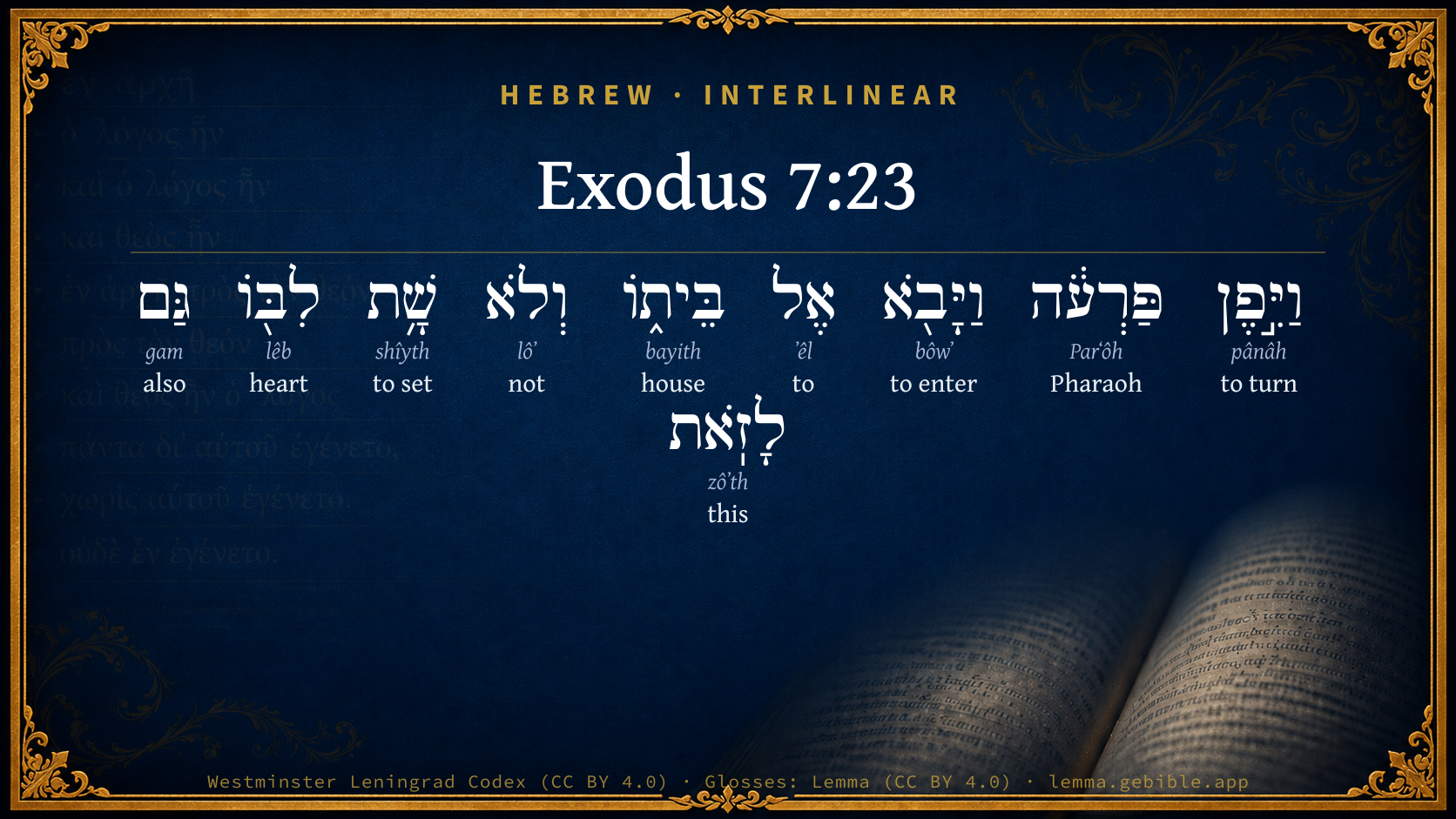
Hebrew (Westminster Leningrad Codex) Exodus 7:23 appears in the Hebrew Old Testament. The text above is from the Westminster Leningrad Codex. Each word links to its Strong’s number, a concise gloss, and parsing drawn from the Open Scriptures Hebrew Bible morphology. Click any word for its full Brown-Driver-Briggs (BDB) entry.
Download image
Cite this verse

Exodus 7:23 (World English Bible). Public Domain. Lemma interlinear Bible study tool, https://lemma.gebible.app/v/exodus/7/23.

Show BibTeX & RIS
BibTeX
RIS
English Translation
Pharaoh turned and went into his house, neither did he lay even this to heart.
World English Bible · Public Domain
Download a study sheet

One document with this verse’s original text, its word-by-word gloss line, the meaning frame, cross-references with their text, attributed commentary, and full source and license credits — printable, and it pastes into notes with its structure intact.

This verse Autodidact and up

Study sheet (.html) Plain text (.txt)

A passage Seminary Student

Up to 50 verses in one chapter. A passage sheet keeps up to 6 commentary sources and 12 cross-references per verse, in the order this page ranks them, and says so on the sheet whenever that leaves anything out. Ask for a single verse and you get the Autodidact verse sheet above.

Everything on this page stays free to read, with no account — the sheet is a download of what is already on screen, not access to it.

Want to remove ads? Support Godless Engineer
Compare translations 3

The same verse in 3 English versions, stacked beneath the original-language interlinear above. Click any original word for its lexicon entry.

Each is an independent rendering of the whole verse — the interlinear is not word-aligned to these translations.

Highlighted words mark where these versions differ — a whole-verse word diff, not a word-by-word alignment.

  • World English Bible Public Domain
    Pharaoh turned and went into his house, neither did he lay even this to heart.
  • King James Version Public Domain
    And Pharaoh turned and went into his house, neither did he set his heart to this also.
  • unfoldingWord Literal Text CC BY-SA 4.0
    And Pharaoh turned around and went into his house. And he did not set his heart even to this.

unfoldingWord Literal Text — © unfoldingWord, licensed CC BY-SA 4.0. Word-aligned USFM3 via Door43 (git.door43.org/unfoldingWord/en_ult).

Versions to compare (up to 4)

3 of 4 selected

Show all 18 translations

Every available English version of this verse, each an independent rendering of the whole verse.

  • World English Bible Public Domain
    Pharaoh turned and went into his house, neither did he lay even this to heart.
  • Berean Standard Bible Public Domain
    Instead, Pharaoh turned around, went into his palace, and did not take any of this to heart.
  • Majority Standard Bible Public Domain
    Instead, Pharaoh turned around, went into his palace, and did not take any of this to heart.
  • King James Version Public Domain
    And Pharaoh turned and went into his house, neither did he set his heart to this also.
  • American Standard Version (1901) Public Domain
    And Pharaoh turned and went into his house, neither did he lay even this to heart.
  • Revised Version (1885) Public Domain
    And Pharaoh turned and went into his house, neither did he lay even this to heart.
  • Geneva Bible (1599) Public Domain
    Then Pharaoh returned, and went againe into his house, neither did this yet enter into his heart.
  • Douay-Rheims (1899) Public Domain
    And he turned himself away and went into his house, neither did he set his heart to it this time also.
  • Young's Literal Translation Public Domain
    and Pharaoh turneth and goeth in unto his house, and hath not set his heart even to this;
  • Literal Standard Version CC BY-SA 4.0
    and Pharaoh turns and goes into his house, and has not set his heart even to this;
  • Unlocked Literal Bible CC BY-SA 4.0
    Then Pharaoh turned and went into his house. He did not even pay attention to this.
  • unfoldingWord Literal Text CC BY-SA 4.0
    And Pharaoh turned around and went into his house. And he did not set his heart even to this.
  • Darby Bible Public Domain
    And Pharaoh turned and went into his house, and took not this to heart either.
  • World Messianic Bible Public Domain
    Pharaoh turned and went into his house, and he didn’t even take this to heart.
  • Webster's Bible Public Domain
    And Pharaoh turned and went into his house, neither did he regard this also.
  • Free Bible Version CC BY-SA 4.0
    Pharaoh went back to his palace and didn't pay any attention to what had happened.
  • Bible in Basic English Public Domain
    Then Pharaoh went into his house, and did not take even this to heart.
  • JPS Tanakh (1917) Public Domain
    And Pharaoh turned and went into his house, neither did he lay even this to heart.

Literal Standard Version (2020), Covenant Press — licensed CC BY-SA 4.0. Text via the HelloAO Bible API (eBible.org). Unlocked Literal Bible (unfoldingWord) — licensed CC BY-SA 4.0. Text via the HelloAO Bible API (eBible.org). unfoldingWord Literal Text — © unfoldingWord, licensed CC BY-SA 4.0. Word-aligned USFM3 via Door43 (git.door43.org/unfoldingWord/en_ult). Free Bible Version, Dr. Jonathan Gallagher — licensed CC BY-SA 4.0. Text via the HelloAO Bible API (eBible.org).

Word by word

More ways to search: Search by grammar → Find every occurrence → Compare this word →

Practice this passage: Drill this verse → Learn its vocabulary →

שָׁ֥ת
shîyth
H7896
“to set”
Verb, Qal, Perfect, 3rd Person, Masculine, Singular
Part of Speech
Verb
Stem
Qal
Form
Perfect
Person
3rd Person
Gender
Masculine
Number
Singular
Full BDB Definition

Origin: a primitive root

TWOT: 2380

to put, set - (Qal) - to put, lay (hand upon) - to set, station, appoint, fix, set mind to - to constitute, make (one something), make like, perform - to take one's stand - to lay waste - (Hophal) to be imposed, be set upon
  1. וַיִּ֣פֶן pânâh H6437 “and · to turn” Conjunction + Verb, Qal, Sequential Imperfect, 3rd Person, Masculine, Singular
  2. פַּרְעֹ֔ה Parʻôh H6547 “Pharaoh” Noun, Proper
  3. וַיָּבֹ֖א bôwʼ H935 “and · to enter” Conjunction + Verb, Qal, Sequential Imperfect, 3rd Person, Masculine, Singular
  4. אֶל ʼêl H413 “to” Preposition
  5. בֵּית֑וֹ bayith H1004 “house · his” Noun, Common, Masculine, Singular, Construct + Suffix, Personal, 3rd Person, Masculine, Singular
  6. וְלֹא lôʼ H3808 “and · not” Conjunction + Particle, Negative
  7. לִבּ֖וֹ lêb H3820 “heart · his” Noun, Common, Masculine, Singular, Construct + Suffix, Personal, 3rd Person, Masculine, Singular
  8. גַּם gam H1571 “also” Particle, Accusative
  9. לָזֹֽאת zôʼth H2063 “to/for · this” Preposition + Pronoun, Demonstrative, Feminine, Singular

About this verse

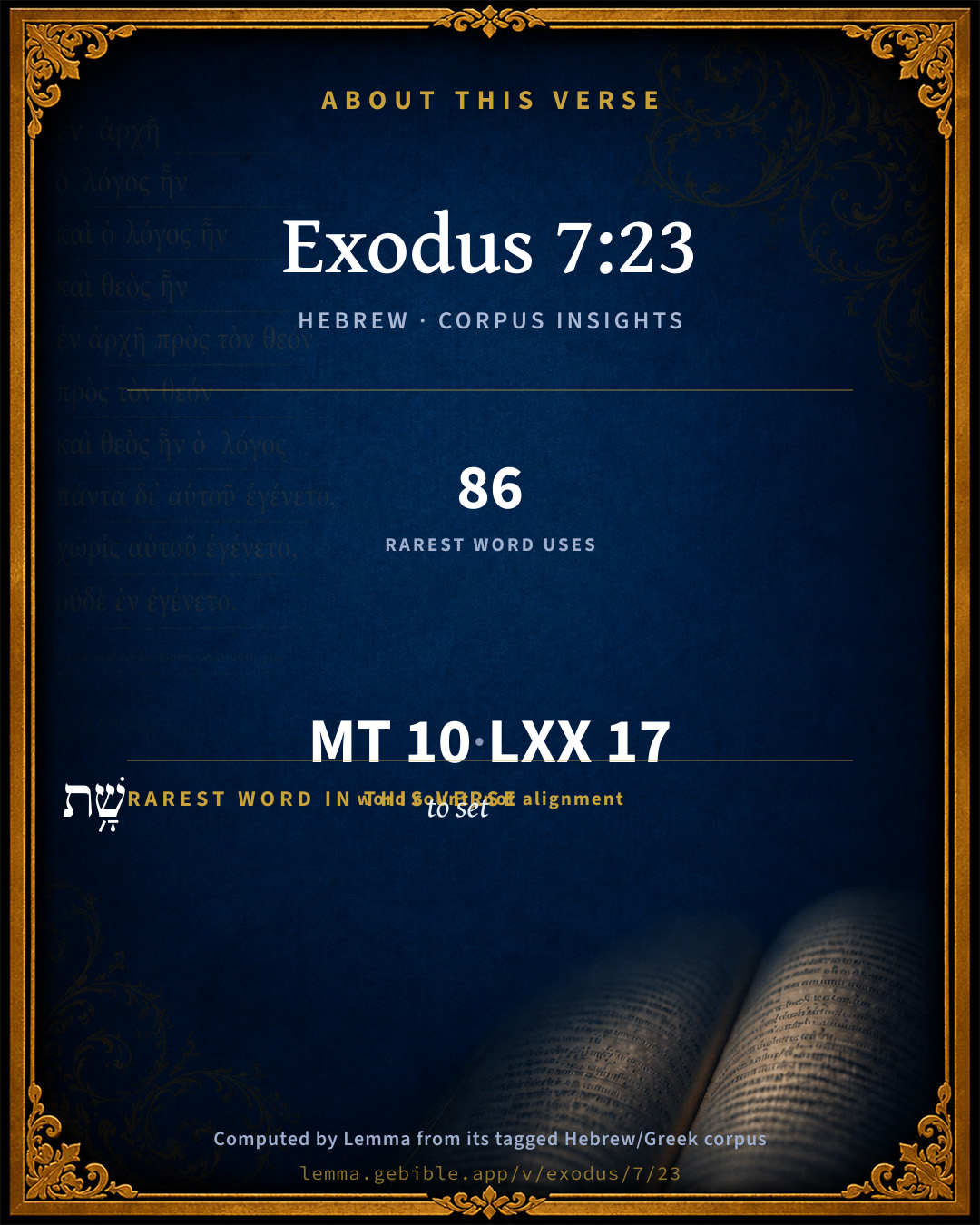
These counts appear in no published source. They are computed here, from the morphology-tagged text and Lemma’s own curated glosses. What Lemma adds →

10
words
10
distinct lemmas
Pentateuch
section

Grammatical profile

  • 3 verbs
  • 3 nouns
  • 1 pronoun
  • 1 preposition
  • 2 particles

Verb forms

  • וַיִּ֣פֶן Qal · Sequential Imperfect
  • וַיָּבֹ֖א Qal · Sequential Imperfect
  • שָׁ֥ת Qal · Perfect

Hebrew & Septuagint length

In English translation the verse runs 15 words from the Hebrew and 18 from the Septuagint (LXX English) — closely comparable.

A rough comparison of the two English renderings, which tokenize alike — not a word-level alignment.

Word counts can differ between the Hebrew and the Greek without any difference in meaning — e.g. the Hebrew direct-object marker אֵת has no separate Greek word, and Greek often adds the article ὁ.

In the original languages it is 10 Hebrew tokens and 17 Greek tokens — but the two are counted differently (Hebrew bundles its prefixes and suffixes into one token; the Greek is in lemma form), so that isn’t a like-for-like length.

Cross-references

15

Topical passages linked to Exodus 7:23 in the Treasury of Scripture Knowledge — connected by theme and wording, ordered by reader-vote popularity; previews shown in the World English Bible.

  • Exodus 9:21 Whoever didn't regard the word of Yahweh left his servants and his cattle in the field.
  • Deuteronomy 32:46 He said to them, Set your heart to all the words which I testify to you this day, which you shall command your children to observe to do, [even] all the words of this law.
  • 1 Samuel 4:20 About the time of her death the women who stood by her said to her, Don't be afraid; for you have brought forth a son. But she didn't answer, neither did she regard it.
  • Job 7:17 What is man, that you should magnify him, That you should set your mind on him,
  • Psalms 62:10 Don't trust in oppression. Don't become vain in robbery. If riches increase, Don't set your heart on them.
  • Proverbs 22:17 Turn your ear, and listen to the words of the wise. Apply your heart to my teaching.
  • Proverbs 24:32 Then I saw, and considered well. I saw, and received instruction:
  • Proverbs 29:1 He who is often rebuked and stiffens his neck Will be destroyed suddenly, with no remedy.
  • Isaiah 26:11 Yahweh, your hand is lifted up, yet they don't see: but they shall see [your] zeal for the people, and be disappointed; yes, fire shall devour your adversaries.
  • Jeremiah 5:3 O Yahweh, don't your eyes look on truth? you have stricken them, but they were not grieved; you have consumed them, but they have refused to receive correction: they have made their faces harder than a rock; they have refused to return.
  • Jeremiah 36:24 They were not afraid, nor tore their garments, neither the king, nor any of his servants who heard all these words.
  • Ezekiel 40:4 The man said to me, Son of man, see with your eyes, and hear with your ears, and set your heart on all that I shall show you; for, to the intent that I may show them to you, are you brought here: declare all that you see to the house of Israel.
  • Amos 4:7–12 "I also have withheld the rain from you, When there were yet three months to the harvest; And I caused it to rain on one city, And caused it not to rain on another city. One place was rained on, And the piece where it didn't rain withered.
  • Habakkuk 1:5 "Look among the nations, watch, and wonder marvelously; for I am working a work in your days, which you will not believe though it is told you.
  • Malachi 2:2 If you will not listen, and if you will not lay it to heart, to give glory to my name," says Yahweh of Hosts, "then will I send the curse on you, and I will curse your blessings. Indeed, I have cursed them already, because you do not lay it to heart.

Cross-references courtesy of OpenBible.info (CC BY 4.0).

Hebrew and Greek witnesses Masoretic Hebrew ↔ Greek Septuagint

The same verse in the two great witnesses to the Old Testament, shown verse-for-verse.

These are two independent witnesses, not word-aligned to each other, and the Septuagint is shown in lemma (dictionary) form.

Hebrew Exodus 7:23 Masoretic · Westminster Leningrad Codex

וַיִּ֣פֶן פַּרְעֹ֔ה וַיָּבֹ֖א אֶל בֵּית֑וֹ וְלֹא שָׁ֥ת לִבּ֖וֹ גַּם לָזֹֽאת

Pharaoh turned and went into his house, neither did he lay even this to heart.

World English Bible · Public Domain

Greek LXX Exodus 7:23 Septuagint · lemma form

ἐπιστρέφω δέ φαραώ εἰςἔρχομαι εἰς ὁ οἶκος αὐτός καί οὐ ἐπιἵστημι ὁ νοῦς αὐτός οὐδέ ἐπί οὗτος

And Pharao turned and entered into his house, nor did he fix his attention even on this thing.

LXX2012 (modern English Septuagint) · Public Domain

Hebrew: Westminster Leningrad Codex (CC BY 4.0). Greek: Septuagint (public domain); English from LXX2012 (modern English Septuagint) (Public Domain). How the Septuagint differs from the Hebrew →

Targum (Aramaic paraphrase)

2

The Targum is the ancient Jewish Aramaic paraphrase of the Hebrew Scriptures — an interpretive translation, not the Hebrew text itself. Onkelos (literal) and Pseudo-Jonathan (expansive) render the Torah, and Jonathan the Prophets. Coverage is partial: where no permissively-licensed English translation exists for a verse, only the Aramaic is shown. This is verse-level text, not a word-by-word alignment to the Hebrew.

  1. Targum Onkelos Torah (Genesis–Deuteronomy)
    וְאִתְפְּנִי פַרְעֹה וְעַל לְבֵיתֵהּ וְלָא שַׁוִי לִבֵּהּ אַף לְדָא:

    (no public-domain English translation for this verse)

    Targum Onkelos — Aramaic: “Onkelos Genesis” (public domain); “Onkelos Exodus” (public domain); “Onkelos Leviticus” (public domain); “Onkelos Numbers” (public domain); “Onkelos Deuteronomy” (public domain). English: “Sefaria Community Translation” (CC0 1.0 (public-domain dedication)); “J.W. Etheridge. The Targums of Onkelos and Jonathan Ben Uzziel on the Pentateuch. London: Longmans, Green, 1862” (public domain). Text via Sefaria.

  2. Targum Pseudo-Jonathan Torah (Genesis–Deuteronomy)
    וַעֲבַד פַּרְעה צוֹרְכֵיהּ וְעָאל לְבֵיתֵיהּ וְלָא שַׁוֵי לִבֵּיהּ לְחוֹד לְמַחְתָא דָא

    And Pharoh did what was needful to him, and went unto his house, nor did he set his heart upon this plague.

    Targum Pseudo-Jonathan — Aramaic: “Targum Jonathan on Genesis” (public domain); “Targum Jonathan on Exodus” (public domain); “Targum Jonathan on Leviticus” (public domain); “Targum Jonathan on Numbers” (public domain); “Targum Jonathan on Deuteronomy” (public domain). English: “The Targum of Jonathan ben Uzziel, trans. J. W. Etheridge, London, 1862” (public domain). Text via Sefaria.

Commentary

Notes on Exodus 7:23 from classic Christian and Jewish commentators (each source and its license shown beneath its notes). The classic Christian expositions comment on the surrounding passage and are grouped to its opening verse, so a note may address several verses; the Jewish commentaries on the Tanakh (Rashi and others) are per-verse, so they appear only where the commentator wrote on this verse.

Lemma curates 59 commentaries, every one of them public domain or Creative Commons licensed, each selected and text-cleaned for this edition rather than reprinted as found. About our sources →

Trapp's Complete Commentary

John Trapp

Exo 7:23 And Pharaoh turned and went into his house, neither did he set his heart to this also.

Ver. 23. Neither did he set his heart.] But to his "iron sinews" he added "brows of brass." {Isa 48:4} To his natural and hereditary hardness, adventitious and habitual.

John Trapp, A Commentary or Exposition upon All the Books of the Old and New Testament (1647–1656) — public domain. Text from a community e-Sword module.

Geneva Bible (1599)

Geneva Bible translators

Hebrew, he set not his heart at all thereunto.

Geneva Bible (1599) marginal notes — public domain. Text via Bolls.life.

Ellicott's Commentary for English Readers

(23) Neither did he set his heart to this also.—Heb., Neither did he set his heart (i.e., pay attention) even to this. Pharaoh did not lay even this to heart. He passed it over as a slight matter, unworthy of much thought, and “turned, and went into his house. “Probably care was taken to keep him constantly supplied with the well water, which, however brackish, would be sufficient for his customary ablutions. He drank, no doubt, a more generous liquid.

A Bible Commentary for English Readers, edited by Charles John Ellicott (1878–1897) — public domain. Text from a community e-Sword module.

The Cambridge Bible for Schools and Colleges

gen. ed. J. J. S. Perowne

23. turned and went] viz. after his visit to the Nile, v. 15.

set his heart … to this] i.e. pay attention to it: a Heb. idiom (like νοῦν προσέχειν, animum attendere); so Exo 2Sa_13:20 Heb. al.

The plague is an intensification of a natural phaenomenon of annual occurrence in Egypt. ‘Still, each year, the water of the river becomes like blood at the time of the inundation. When the Nile first begins to rise, towards the end of June, the red marl brought from the mountains of Abyssinia stains it to a dark colour, which glistens like blood in the light of the setting sun’ (Sayce, EHH., p. 168, writing with personal knowledge of the country). Other observers speak similarly1[119]. The natives call it then the ‘Red Nile.’ The reddish colour continues more or less till the waters begin to abate in October. The water, while it is red, is not unwholesome. Shortly, however, before the redness begins, the Nile (called then the ‘Green Nile’) generally for a few days rises slightly, and becomes green (from decaying vegetable matter brought down from the equatorial swamps), and then it is unwholesome2[120].

[119] e.g. Osburn, Monum. Hist. of Egypt (1851), i. 11 f. (when the rays of the rising sun fell upon the Nile, it had the appearance of a ‘river of blood’; and the Arabs came to tell him that it was the ‘Red Nile’).

[120] See further on the annual inundation of the Nile,—which is due to the waters of the Atbara and the ‘Blue Nile’ being swollen by the heavy spring and summer rains in the Abyssinian highlands, and the melting of the mountain snow, and which give the Delta its fertility,—R. Pococke, Descr. of the East (1743), i. 199 f.; Rawlinson, Hist. of Eg. (1881), i. 19–25; Maspero, Dawn of Civil. pp. 22–26; DB. iii. 551, 889; W. M. Müller in EB. Egypt, § 7, and Nile; Bädeker, Egypt6 (1908), p. xlv f.

As Dillm. says, however, though the recollection of an extraordinary intensification of a genuine Egyptian phaenomenon is the foundation of the narrative, it is not the actual reddening of the Nile at the time of the inundation which the narrative describes, not only because there would be nothing surprising in what was an annual occurrence, but also because of the seven days’ limit of time in v. 25, and because the water of the ‘Red Nile’ is wholesome and drinkable: but the natural local phaenomenon is dissociated from its natural conditions, and transformed into something transcending all experience, by the circumstances under which it is produced, and by the consequences attending it,—the water (including in P even that in domestic vessels) becoming undrinkable, and the fish dying.

The Cambridge Bible for Schools and Colleges (gen. ed. J. J. S. Perowne; Cambridge University Press, 1878–1918) — public domain. Text from a community e-Sword module.

John Gill's Exposition

And Pharaoh turned, and went into his house,.... Turned away from Moses and Aaron, and turned back from the river to which he came, and went to his palace in the city; it being perhaps now about dinner time, when all before related had passed:

neither did he set his heart to this also: had no regard to this miracle of turning the waters into blood, as well as he had none to the rod being turned into a serpent, and devouring the rods of the magicians; he neither considered the one nor the other, or seriously and closely thought of this, any more than of the other.

John Gill's Exposition of the Whole Bible (1746–1763) — public domain (CC PDM 1.0). Text via the HelloAO Bible API.

Matthew Poole's English Annotations

He did not seriously consider it, nor the causes or cure of this plague, and was not much affected with it, because he saw this fact exceeded not the power of his magicians.

Matthew Poole's English Annotations on the Holy Bible (1683–1685) — public domain. Text from a community e-Sword/MySword module.

The Pulpit Commentary

Pharaoh turnedi.e. "returned quitted the river-hank, satisfied with what the magicians had done, and went back to the palace. Neither did he set his heart to this also. A better translation is that of Booth-royd did he lay even this to heart." In the expression "even this" there is an allusion to the previous neglect of the first sign (ver. 13).

The Pulpit Commentary (1880–1919), ed. H.D.M. Spence-Jones & Joseph S. Exell — public domain. Text from a community e-Sword module.

unfoldingWord translationNotes

Door43 World Missions Community

All the Egyptians

The word "all" here is a generalization that means "many." AT: "Many of the Egyptians" (See: Hyperbole and Generalization)

translationWords

Pharaoh

house

Egypt

Yahweh

unfoldingWord translationNotes — © Distant Shores Media and the Door43 World Missions Community, licensed CC BY-SA 4.0. Source: git.door43.org/Door43/en_tn.

Rashi

Rabbi Shlomo Yitzchaki (Rashi)

גם לזאת [NEITHER DID HE SET HIS HEART] TO THIS ALSO — to the wonder of the staff which was changed into a serpent and also not to that of the blood.

Rashi on the Tanakh — English translations: “The Judaica Press complete Tanach with Rashi, translated by A. J. Rosenberg” (CC BY 4.0); “Pentateuch with Rashi's commentary by M. Rosenbaum and A.M. Silbermann, 1929-1934” (public domain); “The Metsudah Tanach series, Lakewood, N.J” (CC BY 4.0); and “The Book of Joshua, Metsudah Publications, 1997” (CC BY 4.0). Text via Sefaria.

Ramban (Nachmanides)

Rabbi Moshe ben Nachman (Ramban / Nachmanides)

NEITHER DID HE SET HIS HEART TO THIS ALSO. I.e., to the wonder of the rod turning into a serpent, nor to that of the waters turning into blood. [Thus the language of Rashi.] A more correct interpretation would appear to be that to this also means “to this also which was indeed a plague,” [as distinguished from the wonder of the rod turning into a serpent, which was not a plague at all], and he should have feared lest the power of G-d be upon him from now on.

Ramban (Nachmanides) on the Tanakh — English translation: “Commentary on the Torah by Ramban (Nachmanides). Translated and annotated by Charles B. Chavel. New York, Shilo Pub. House, 1971-1976” (CC BY 4.0). Text via Sefaria.

Lesson kit

Teaching starters — assembled from the data on this page, not authored interpretation. Every prompt links to the verse data it draws on. Edit before teaching.

Exodus, in the Pentateuch, opens this verse with 10 words (10 distinct Hebrew lemmas). Its most distinctive word is shîyth (“to set”). A historical commentator’s framing appears above. Read the whole chapter for the surrounding context.

Discussion questions

  1. How does “to set” (shîyth) shape what this verse is saying?
  2. Exodus 9:21 shares this passage’s theme. How do the two illuminate each other?
  3. These translations render this verse differently; the difference is in the English rendering, not the original. What questions does that raise?
  4. The verb «וַיִּ֣פֶן» is Qal Sequential Imperfect. How does its form color the action?
  5. Reading how Trapp's Complete Commentary and Geneva Bible (1599) read this verse, where do the two commentators agree and where do they part?

Things to notice

Reading settings

Reading text

Shown beneath each verse's original-language words.

Old Testament
Old Testament edition

Read the OT as the Masoretic Hebrew (MT) or the Greek Septuagint (LXX).

English shown for the Greek Septuagint (in the Hebrew ↔ Greek comparison).

Comparing translations? Open the Compare panel on any verse page to stack up to four side by side.