Genesis 43:30

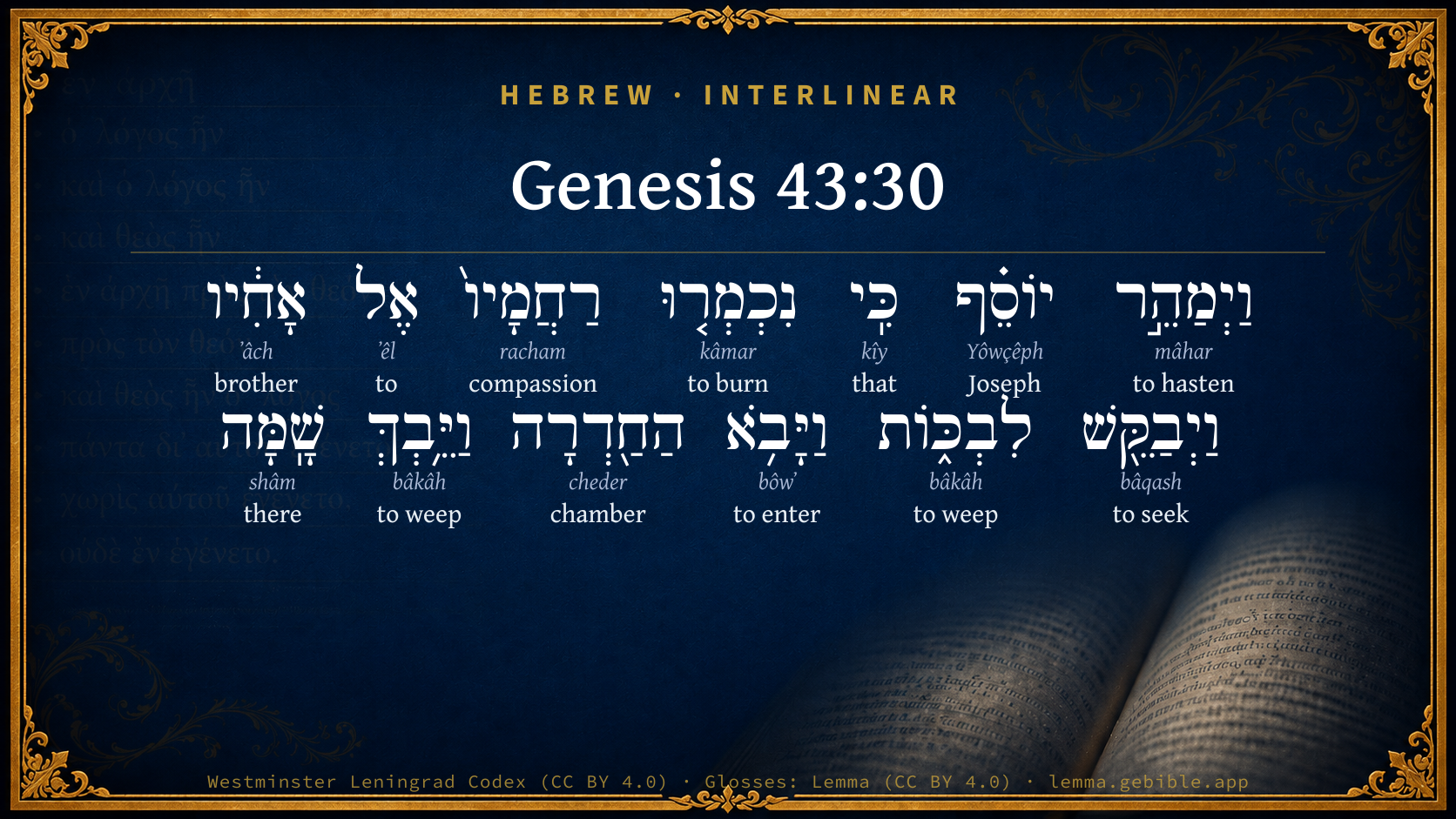
Hebrew (Westminster Leningrad Codex) Genesis 43:30 appears in the Hebrew Old Testament. The text above is from the Westminster Leningrad Codex. Each word links to its Strong’s number, a concise gloss, and parsing drawn from the Open Scriptures Hebrew Bible morphology. Click any word for its full Brown-Driver-Briggs (BDB) entry.
Download image
Cite this verse

Genesis 43:30 (World English Bible). Public Domain. Lemma interlinear Bible study tool, https://lemma.gebible.app/v/genesis/43/30.

Show BibTeX & RIS
BibTeX
RIS
English Translation
Joseph made haste; for his heart yearned over his brother: and he sought a place to weep; and he entered into his room, and wept there.
World English Bible · Public Domain
Highlights
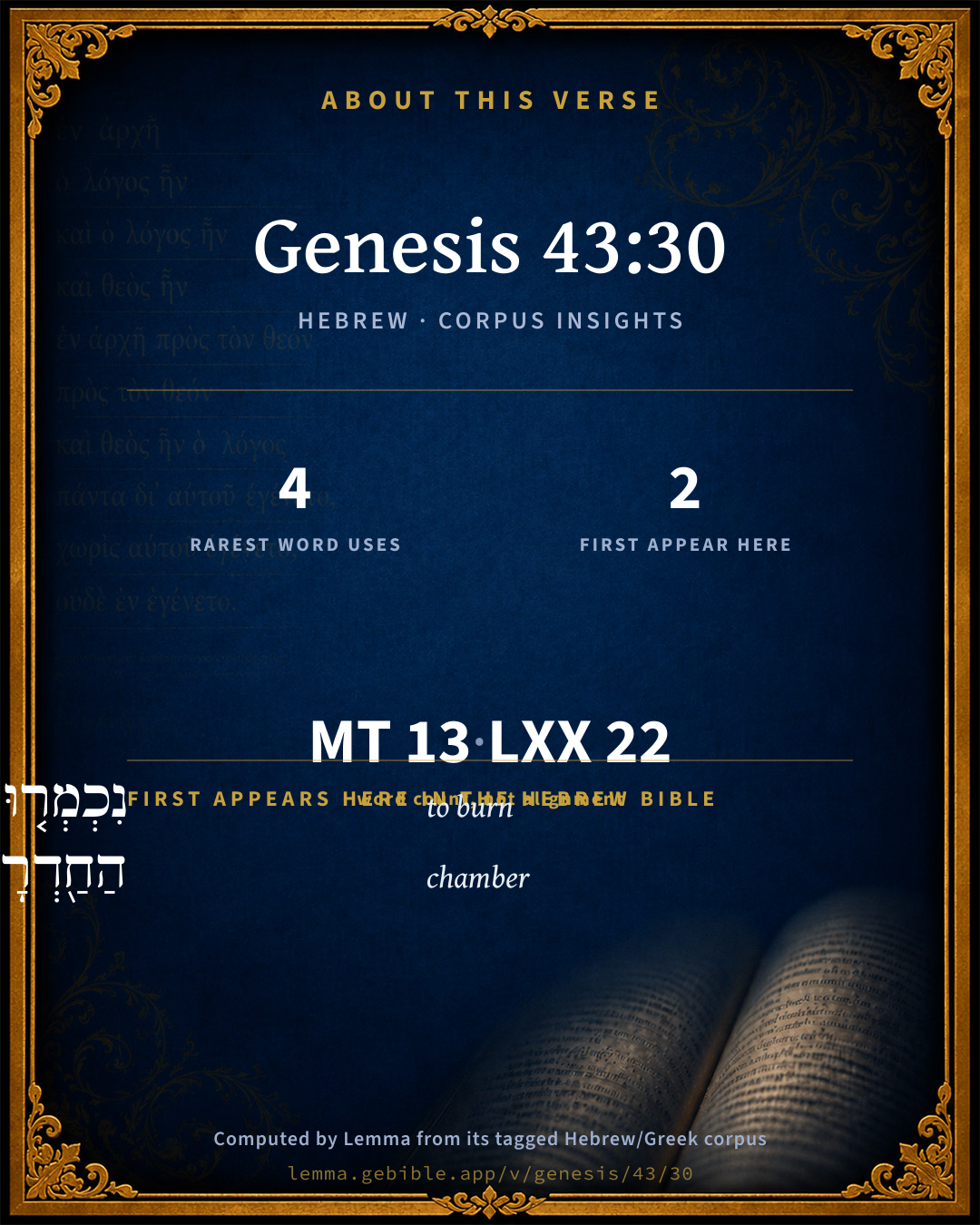
  • 2 first appearances in the Hebrew Bible
Full analysis ↓
Download a study sheet

One document with this verse’s original text, its word-by-word gloss line, the meaning frame, cross-references with their text, attributed commentary, and full source and license credits — printable, and it pastes into notes with its structure intact.

This verse Autodidact and up

Study sheet (.html) Plain text (.txt)

A passage Seminary Student

Up to 50 verses in one chapter. A passage sheet keeps up to 6 commentary sources and 12 cross-references per verse, in the order this page ranks them, and says so on the sheet whenever that leaves anything out. Ask for a single verse and you get the Autodidact verse sheet above.

Everything on this page stays free to read, with no account — the sheet is a download of what is already on screen, not access to it.

Want to remove ads? Support Godless Engineer
Compare translations 3

The same verse in 3 English versions, stacked beneath the original-language interlinear above. Click any original word for its lexicon entry.

Each is an independent rendering of the whole verse — the interlinear is not word-aligned to these translations.

Highlighted words mark where these versions differ — a whole-verse word diff, not a word-by-word alignment.

  • World English Bible Public Domain
    Joseph made haste; for his heart yearned over his brother: and he sought a place to weep; and he entered into his room, and wept there.
  • King James Version Public Domain
    And Joseph made haste; for his bowels did yearn upon his brother: and he sought where to weep; and he entered into his chamber, and wept there.
  • unfoldingWord Literal Text CC BY-SA 4.0
    Then Joseph hurried out, because his emotions boiled over for his brother, and he sought to cry, and he went to the inner room and cried there.

unfoldingWord Literal Text — © unfoldingWord, licensed CC BY-SA 4.0. Word-aligned USFM3 via Door43 (git.door43.org/unfoldingWord/en_ult).

Versions to compare (up to 4)

3 of 4 selected

Show all 18 translations

Every available English version of this verse, each an independent rendering of the whole verse.

  • World English Bible Public Domain
    Joseph made haste; for his heart yearned over his brother: and he sought a place to weep; and he entered into his room, and wept there.
  • Berean Standard Bible Public Domain
    Joseph hurried out because he was moved to tears for his brother, and he went to a private room to weep.
  • Majority Standard Bible Public Domain
    Joseph hurried out because he was moved to tears for his brother, and he went to a private room to weep.
  • King James Version Public Domain
    And Joseph made haste; for his bowels did yearn upon his brother: and he sought where to weep; and he entered into his chamber, and wept there.
  • American Standard Version (1901) Public Domain
    And Joseph made haste; for his heart yearned over his brother: and he sought where to weep; and he entered into his chamber, and wept there.
  • Revised Version (1885) Public Domain
    And Joseph made haste; for his bowels did yearn upon his brother: and he sought where to weep; and he entered into his chamber, and wept there.
  • Geneva Bible (1599) Public Domain
    And Ioseph made haste (for his affection was inflamed towarde his brother, and sought where to weepe) and entred into his chamber, and wept there.
  • Douay-Rheims (1899) Public Domain
    And he made haste becouse his heart was moved upon his brother, and tears gushed out: And going into his chamber he wept.
  • Young's Literal Translation Public Domain
    And Joseph hasteth, for his bowels have been moved for his brother, and he seeketh to weep, and entereth the inner chamber, and weepeth there;
  • Literal Standard Version CC BY-SA 4.0
    And Joseph hurries, for his bowels have been moved for his brother, and he seeks to weep, and enters the inner chamber, and weeps there;
  • Unlocked Literal Bible CC BY-SA 4.0
    Joseph hurried to go out of the room, for he was deeply moved about his brother. He sought somewhere to weep. He went to his room and wept there.
  • unfoldingWord Literal Text CC BY-SA 4.0
    Then Joseph hurried out, because his emotions boiled over for his brother, and he sought to cry, and he went to the inner room and cried there.
  • Darby Bible Public Domain
    And Joseph made haste, for his bowels burned for his brother; and he sought [a place] to weep, and he went into the chamber, and wept there.
  • World Messianic Bible Public Domain
    Joseph hurried, for his heart yearned over his brother; and he sought a place to weep. He entered into his room, and wept there.
  • Webster's Bible Public Domain
    \\43:31\\And he washed his face, and went out, and refrained himself, and said, Set on bread.
  • Free Bible Version CC BY-SA 4.0
    Joseph had to run out quickly because he was becoming so emotional at seeing his brother. He looked for a place to cry, and went to his room to weep there.
  • Bible in Basic English Public Domain
    Then, after washing his face, he came out, and controlling his feelings said, Put food before us.
  • JPS Tanakh (1917) Public Domain
    And Joseph made haste; for his heart yearned toward his brother; and he sought where to weep; and he entered into his chamber, and wept there.

Literal Standard Version (2020), Covenant Press — licensed CC BY-SA 4.0. Text via the HelloAO Bible API (eBible.org). Unlocked Literal Bible (unfoldingWord) — licensed CC BY-SA 4.0. Text via the HelloAO Bible API (eBible.org). unfoldingWord Literal Text — © unfoldingWord, licensed CC BY-SA 4.0. Word-aligned USFM3 via Door43 (git.door43.org/unfoldingWord/en_ult). Free Bible Version, Dr. Jonathan Gallagher — licensed CC BY-SA 4.0. Text via the HelloAO Bible API (eBible.org).

Word by word

More ways to search: Search by grammar → Find every occurrence → Compare this word →

Practice this passage: Drill this verse → Learn its vocabulary →

נִכְמְר֤וּ
kâmar
H3648
“to burn”
Verb, Niphal, Perfect, 3rd Person, Common, Plural
Part of Speech
Verb
Stem
Niphal
Form
Perfect
Person
3rd Person
Gender
Common
Number
Plural
Full BDB Definition

Origin: a primitive root

TWOT: 993 , 994 , 995

to yearn, be kindled, be black (hot), grow warm and tender, be or grow hot, become hot, become emotionally agitated - (Niphal) - to grow warm and tender - to be or grow hot
  1. וַיְמַהֵ֣ר mâhar H4116 “and · to hasten” Conjunction + Verb, Piel, Sequential Imperfect, 3rd Person, Masculine, Singular
  2. יוֹסֵ֗ף Yôwçêph H3130 “Joseph” Noun, Proper
  3. כִּֽי kîy H3588 “that” Conjunction
  4. רַחֲמָיו֙ racham H7356 “compassion · his” Noun, Common, Masculine, Plural, Construct + Suffix, Personal, 3rd Person, Masculine, Singular
  5. אֶל ʼêl H413 “to” Preposition
  6. אָחִ֔יו ʼâch H251 “brother · his” Noun, Common, Masculine, Singular, Construct + Suffix, Personal, 3rd Person, Masculine, Singular
  7. וַיְבַקֵּ֖שׁ bâqash H1245 “and · to seek” Conjunction + Verb, Piel, Sequential Imperfect, 3rd Person, Masculine, Singular
  8. לִבְכּ֑וֹת bâkâh H1058 “to weep” Preposition + Verb, Qal, Infinitive Construct
  9. וַיָּבֹ֥א bôwʼ H935 “and · to enter” Conjunction + Verb, Qal, Sequential Imperfect, 3rd Person, Masculine, Singular
  10. הַחַ֖דְרָה cheder H2315 “the · chamber · toward” Particle, Definite Article + Noun, Common, Masculine, Singular, Absolute + Suffix, Demonstrative
  11. וַיֵּ֥בְךְּ bâkâh H1058 “and · to weep” Conjunction + Verb, Qal, Sequential Imperfect, 3rd Person, Masculine, Singular
  12. שָֽׁמָּה shâm H8033 “there · toward” Adverb + Suffix, Demonstrative

About this verse

These counts appear in no published source. They are computed here, from the morphology-tagged text and Lemma’s own curated glosses. What Lemma adds →

13
words
12
distinct lemmas
Pentateuch
section

Notable vocabulary

The rarest word here is נִכְמְר֤וּ to burn H3648 — appearing just 4 times in the whole Hebrew Bible.

First appearance in Scripture

These words make their first canonical appearance in the Hebrew Bible here:

  • נִכְמְר֤וּ to burn H3648
  • הַחַ֖דְרָה chamber H2315

Shared distinctive vocabulary

נִכְמְר֤וּ to burn H3648 occurs in 4 verses of the Hebrew Bible. Also found in:

Grammatical profile

  • 6 verbs
  • 4 nouns
  • 1 preposition
  • 1 conjunction
  • 1 adverb

Verb forms

  • וַיְמַהֵ֣ר Piel · Sequential Imperfect
  • נִכְמְר֤וּ Niphal · Perfect
  • וַיְבַקֵּ֖שׁ Piel · Sequential Imperfect
  • לִבְכּ֑וֹת Qal · Infinitive Construct
  • וַיָּבֹ֥א Qal · Sequential Imperfect
  • וַיֵּ֥בְךְּ Qal · Sequential Imperfect

Repetition

A word recurs within this verse — often emphatic in Hebrew:

  • לִבְכּ֑וֹת to weep H1058 ×2

Hebrew & Septuagint length

In English translation the verse runs 26 words from the Hebrew and 25 from the Septuagint (LXX English) — closely comparable.

A rough comparison of the two English renderings, which tokenize alike — not a word-level alignment.

Word counts can differ between the Hebrew and the Greek without any difference in meaning — e.g. the Hebrew direct-object marker אֵת has no separate Greek word, and Greek often adds the article ὁ.

In the original languages it is 13 Hebrew tokens and 22 Greek tokens — but the two are counted differently (Hebrew bundles its prefixes and suffixes into one token; the Greek is in lemma form), so that isn’t a like-for-like length.

Cross-references

16

Topical passages linked to Genesis 43:30 in the Treasury of Scripture Knowledge — connected by theme and wording, ordered by reader-vote popularity; previews shown in the World English Bible.

  • Genesis 42:24 He turned himself about from them, and wept, and he returned to them, and spoke to them, and took Simeon from among them, and bound him before their eyes.
  • Jeremiah 31:20 Is Ephraim my dear son? is he a darling child? for as often as I speak against him, I do earnestly remember him still: therefore my heart yearns for him; I will surely have mercy on him, says Yahweh.
  • Genesis 45:2 He wept aloud. The Egyptians heard, and the house of Pharaoh heard.
  • Genesis 45:14–15 He fell on his brother Benjamin's neck, and wept, and Benjamin wept on his neck.
  • 1 Kings 3:26 Then spoke the woman whose the living child was to the king, for her heart yearned over her son, and she said, Oh, my lord, give her the living child, and in no way kill it. But the other said, It shall be neither mine nor yours; divide it.
  • Hosea 11:8 "How can I give you up, Ephraim? How can I hand you over, Israel? How can I make you like Admah? How can I make you like Zeboiim? My heart is turned within me, My compassion is aroused.
  • John 11:33–38 When Jesus therefore saw her weeping, and the Jews weeping who came with her, he groaned in the spirit, and was troubled,
  • Philippians 1:8 For God is my witness, how I long after all of you in the tender mercies of Christ Jesus.
  • Philippians 2:1 If there is therefore any exhortation in Christ, if any consolation of love, if any fellowship of the Spirit, if any tender mercies and compassion,
  • Colossians 3:12 Put on therefore, as God's chosen ones, holy and beloved, a heart of compassion, kindness, lowliness, humility, and perseverance;
  • 2 Timothy 1:4 longing to see you, remembering your tears, that I may be filled with joy;
  • 1 John 3:17 But whoever has the world's goods, and sees his brother in need, and closes his heart of compassion against him, how does the love of God remain in him?
  • Genesis 46:29 Joseph made ready his chariot, and went up to meet Israel, his father, in Goshen. He presented himself to him, and fell on his neck, and wept on his neck a good while.
  • Acts 20:19 serving the Lord with all humility, with many tears, and with trials which happened to me by the plots of the Jews;
  • Acts 20:31 Therefore watch, remembering that for a period of three years I didn't cease to admonish everyone night and day with tears.
  • Acts 20:37 They all wept a lot, and fell on Paul's neck and kissed him,

Cross-references courtesy of OpenBible.info (CC BY 4.0).

Hebrew and Greek witnesses Masoretic Hebrew ↔ Greek Septuagint

The same verse in the two great witnesses to the Old Testament, shown verse-for-verse.

These are two independent witnesses, not word-aligned to each other, and the Septuagint is shown in lemma (dictionary) form.

Hebrew Genesis 43:30 Masoretic · Westminster Leningrad Codex

וַיְמַהֵ֣ר יוֹסֵ֗ף כִּֽי נִכְמְר֤וּ רַחֲמָיו֙ אֶל אָחִ֔יו וַיְבַקֵּ֖שׁ לִבְכּ֑וֹת וַיָּבֹ֥א הַחַ֖דְרָה וַיֵּ֥בְךְּ שָֽׁמָּה

Joseph made haste; for his heart yearned over his brother: and he sought a place to weep; and he entered into his room, and wept there.

World English Bible · Public Domain

Greek LXX Genesis 43:30 Septuagint · lemma form

ταράσσω δέ ιωσηφ συνστρέφω γάρ ὁ ἔντερον αὐτός ἐπί ὁ ἀδελφός αὐτός καί ζητέω κλαίω εἰςἔρχομαι δέ εἰς ὁ ταμιεῖον κλαίω ἐκεῖ

And Joseph was troubled, for his bowels yearned over his brother, and he sought to weep; and he went into his chamber, and wept there.

LXX2012 (modern English Septuagint) · Public Domain

Hebrew: Westminster Leningrad Codex (CC BY 4.0). Greek: Septuagint (public domain); English from LXX2012 (modern English Septuagint) (Public Domain). How the Septuagint differs from the Hebrew →

Targum (Aramaic paraphrase)

2

The Targum is the ancient Jewish Aramaic paraphrase of the Hebrew Scriptures — an interpretive translation, not the Hebrew text itself. Onkelos (literal) and Pseudo-Jonathan (expansive) render the Torah, and Jonathan the Prophets. Coverage is partial: where no permissively-licensed English translation exists for a verse, only the Aramaic is shown. This is verse-level text, not a word-by-word alignment to the Hebrew.

  1. Targum Onkelos Torah (Genesis–Deuteronomy)
    וְאוֹחִי יוֹסֵף אֲרֵי אִתְגּוֹלְלוּ רַחֲמוֹהִי עַל אֲחוּהִי וּבְעָא לְמִבְכֵּי וְעַל לְאִדְרוֹן בֵּית מִשְׁכְּבָא וּבְכָא תַמָּן

    (no public-domain English translation for this verse)

    Targum Onkelos — Aramaic: “Onkelos Genesis” (public domain); “Onkelos Exodus” (public domain); “Onkelos Leviticus” (public domain); “Onkelos Numbers” (public domain); “Onkelos Deuteronomy” (public domain). English: “Sefaria Community Translation” (CC0 1.0 (public-domain dedication)); “J.W. Etheridge. The Targums of Onkelos and Jonathan Ben Uzziel on the Pentateuch. London: Longmans, Green, 1862” (public domain). Text via Sefaria.

  2. Targum Pseudo-Jonathan Torah (Genesis–Deuteronomy)
    וְאוֹחִי יוֹסֵף אֲרוּם רָחְשׁוּ רַחֲמוֹי עַל אָחוֹי וּבְעָא לְמִבְכֵּי וְעַל לְקִיטוֹנָא דְבֵי מְדַמְכָא וּבְכָא תַמָן

    And Joseph made haste, for his compassions were moved upon his brother, and he sought to weep, and he went into the chamber the house of sleep, and wept there.

    Targum Pseudo-Jonathan — Aramaic: “Targum Jonathan on Genesis” (public domain); “Targum Jonathan on Exodus” (public domain); “Targum Jonathan on Leviticus” (public domain); “Targum Jonathan on Numbers” (public domain); “Targum Jonathan on Deuteronomy” (public domain). English: “The Targum of Jonathan ben Uzziel, trans. J. W. Etheridge, London, 1862” (public domain). Text via Sefaria.

Commentary

Notes on Genesis 43:30 from classic Christian and Jewish commentators (each source and its license shown beneath its notes). The classic Christian expositions comment on the surrounding passage and are grouped to its opening verse, so a note may address several verses; the Jewish commentaries on the Tanakh (Rashi and others) are per-verse, so they appear only where the commentator wrote on this verse.

Lemma curates 59 commentaries, every one of them public domain or Creative Commons licensed, each selected and text-cleaned for this edition rather than reprinted as found. About our sources →

Trapp's Complete Commentary

John Trapp

Gen 43:30 And Joseph made haste; for his bowels did yearn upon his brother: and he sought [where] to weep; and he entered into [his] chamber, and wept there.

Ver. 30. And Joseph made haste, &c.] He hid his affection, as a wise and valiant man, till he had once more beaten vehemently upon their guilty consciences; and so brought them to a more sound and serious sight of their sin, that they might repent and make sure work for their souls.

John Trapp, A Commentary or Exposition upon All the Books of the Old and New Testament (1647–1656) — public domain. Text from a community e-Sword module.

Tyndale Open Study Notes

Tyndale Open Resources

43:30 he was overcome with emotion for his brother: Cp. 42:24. Joseph’s tears were of painful memories and years of lost fellowship, as well as of joy and thanksgiving at seeing his brother again. • He went into his private room: He did not yet plan to reveal his identity.

Tyndale Open Study Notes — © Tyndale Open Resources, licensed CC BY-SA 4.0. Text via the HelloAO Bible API.

Geneva Bible (1599)

Geneva Bible translators

Hebrew, bowels.

Geneva Bible (1599) marginal notes — public domain. Text via Bolls.life.

The Cambridge Bible for Schools and Colleges

gen. ed. J. J. S. Perowne

30. his bowels did yearn] For this phrase denoting strong feelings cf. 1Ki_3:26; Jer_31:20. Joseph’s emotion is recorded here, as in Gen_42:24, in proof of his tenderness and sympathy. The same simplicity may be found in the description of Homeric heroes.

The Cambridge Bible for Schools and Colleges (gen. ed. J. J. S. Perowne; Cambridge University Press, 1878–1918) — public domain. Text from a community e-Sword module.

John Gill's Exposition

And he washed his face,.... From the tears on it, that it might not be discerned that he had been weeping:

and went out; of his chamber into the room again, where his brethren were:

and refrained himself; from weeping, or showing any excess of passion, love, joy, &c.

and said, set on bread; gave orders to his servants to bring in dinner, and set it upon the table; bread, as before, being put for all kind of food.

John Gill's Exposition of the Whole Bible (1746–1763) — public domain (CC PDM 1.0). Text via the HelloAO Bible API.

Matthew Poole's English Annotations

His bowels did yearn; his heart and inward parts were vehemently moved, as they commonly are upon occasion of any excessive passion, of love, pity, grief, or joy, &c.

Matthew Poole's English Annotations on the Holy Bible (1683–1685) — public domain. Text from a community e-Sword/MySword module.

The Pulpit Commentary

And Joseph made haste; for his bowels did yearn (literally, were becom ing warm, from intensity of tore) upon his brother: and he sought where to weep; the second occasion on which Joseph is represented as overcome by the strength of his inward emotion, the first having been when his brethren were speaking about their cruelty towards himself (Gen_42:24) and he entered into his chamber, and wept there.

The Pulpit Commentary (1880–1919), ed. H.D.M. Spence-Jones & Joseph S. Exell — public domain. Text from a community e-Sword module.

unfoldingWord translationNotes

Door43 World Missions Community

hurried to go out of the room

"hurried out of the room"

for he was deeply moved about his brother

The phrase "deeply moved" refers to having a strong feeling or emotion when something important happens. AT: "for he had strong feelings of compassion for his brother" or "for he had strong feelings of affection for his brother" (See: Idiom)

saying

It can be made explicit to whom Joseph is speaking. AT: "and said to his servants" (See: Assumed Knowledge and Implicit Information)

Serve the food

This means to distribute the food so that people may eat.

translationWords

servant

unfoldingWord translationNotes — © Distant Shores Media and the Door43 World Missions Community, licensed CC BY-SA 4.0. Source: git.door43.org/Door43/en_tn.

Rashi

Rabbi Shlomo Yitzchaki (Rashi)

כי נכמרו רחמיו FOR HIS COMPASSION WAS EXCITED — He asked him, “Have you a brother of the same mother as yourself?” — He replied, “I had a brother but I know not where he is”. — “Have you sons?” He replied, “I have ten”. Joseph asked him, “And what are their names?” Benjamin replied, “Bela, Becher etc.” (cf. 46:21). Joseph then enquired, “What are the ideas underlying these names?” He replied, “They all have some reference to my brother and the troubles that have befallen him. I called them Bela (בלע) because he disappeared (נבלע) amongst alien nations; Becher (בכר) because he was the firstborn (בכור) of his mother; Ashbel (אשבאל) because God sent him into captivity (שבאו אל), Gera (גרא) because he had to live (גר) in a foreign country; Naaman (נעמן) because he was exceedingly pleasant (נעים); Ahi (אחי) and Rosh (ראש) because he was my brother (אח) and my superior (ראש); Muppim (מופים) because he learned from the mouth (מפי) of my father; Huppim (חופים) because he did not witness my marriage (חופה —marriage canopy) and I did not witness his marriage; and Ard (ארד) because he went down (ירד) amongst the nations” — just as it related in Treatise Sotah 36b. When he heard all this immediately his affection was enkindled.

נכמרו means WAS ENKINDLED, BECAME HOT — In Mishnaic Hebrew we have (Bava Metzia 74a) “upon (כומר) a mass of heated olives”; in Aramaic (Pesachim 58a) “because of the (מכמר) drying up (through heat of the weather) of the meat”. And in Biblical Hebrew we have (Lamentations 5:10) “Our skin is hot (נכמרו) as though by an oven” — i.e. it became hot and full of wrinkles “because of the burning heat of the famine”, for it is the nature of any skin to wrinkle and shrink together when it becomes hot.

Rashi on the Tanakh — English translations: “The Judaica Press complete Tanach with Rashi, translated by A. J. Rosenberg” (CC BY 4.0); “Pentateuch with Rashi's commentary by M. Rosenbaum and A.M. Silbermann, 1929-1934” (public domain); “The Metsudah Tanach series, Lakewood, N.J” (CC BY 4.0); and “The Book of Joshua, Metsudah Publications, 1997” (CC BY 4.0). Text via Sefaria.

Radak

Rabbi David Kimhi (Radak)

נכמרו, as translated by Onkelos “his feelings of mercy had been aroused.”

Radak on the Tanakh — English translations: “Sefaria Community Translation” (CC0 1.0 (public-domain dedication)); “Eliyahu Munk, HaChut Hameshulash” (CC BY 4.0); “Rabbi Mike Feuer, Jerusalem Anthology” (CC BY 4.0); and “R. David Kimhi on the first book of Psalms, Translated by R.G. Finch, London, 1919” (public domain). Text via Sefaria.

Lesson kit

Teaching starters — assembled from the data on this page, not authored interpretation. Every prompt links to the verse data it draws on. Edit before teaching.

Genesis, in the Pentateuch, opens this verse with 13 words (12 distinct Hebrew lemmas). Its most distinctive word is kâmar (“to burn”). A historical commentator’s framing appears above. Read the whole chapter for the surrounding context.

Discussion questions

  1. The word kâmar carries the sense “to burn.” How does it shape the verse?
  2. 2 words here appear for the first time in Scripture. What is being introduced at this debut?
  3. 1 Kings 3:26 shares the word «to burn» with this verse. How do the two illuminate each other?
  4. “to weep” occurs 2× in this one verse. What is the effect of the repetition?
  5. These translations render this verse differently; the difference is in the English rendering, not the original. What questions does that raise?
  6. The verb «וַיְמַהֵ֣ר» is Piel Sequential Imperfect. How does its form color the action?
  7. Reading how Trapp's Complete Commentary and Tyndale Open Study Notes read this verse, where do the two commentators agree and where do they part?

Things to notice

Reading settings

Reading text

Shown beneath each verse's original-language words.

Old Testament
Old Testament edition

Read the OT as the Masoretic Hebrew (MT) or the Greek Septuagint (LXX).

English shown for the Greek Septuagint (in the Hebrew ↔ Greek comparison).

Comparing translations? Open the Compare panel on any verse page to stack up to four side by side.