Genesis 42:20

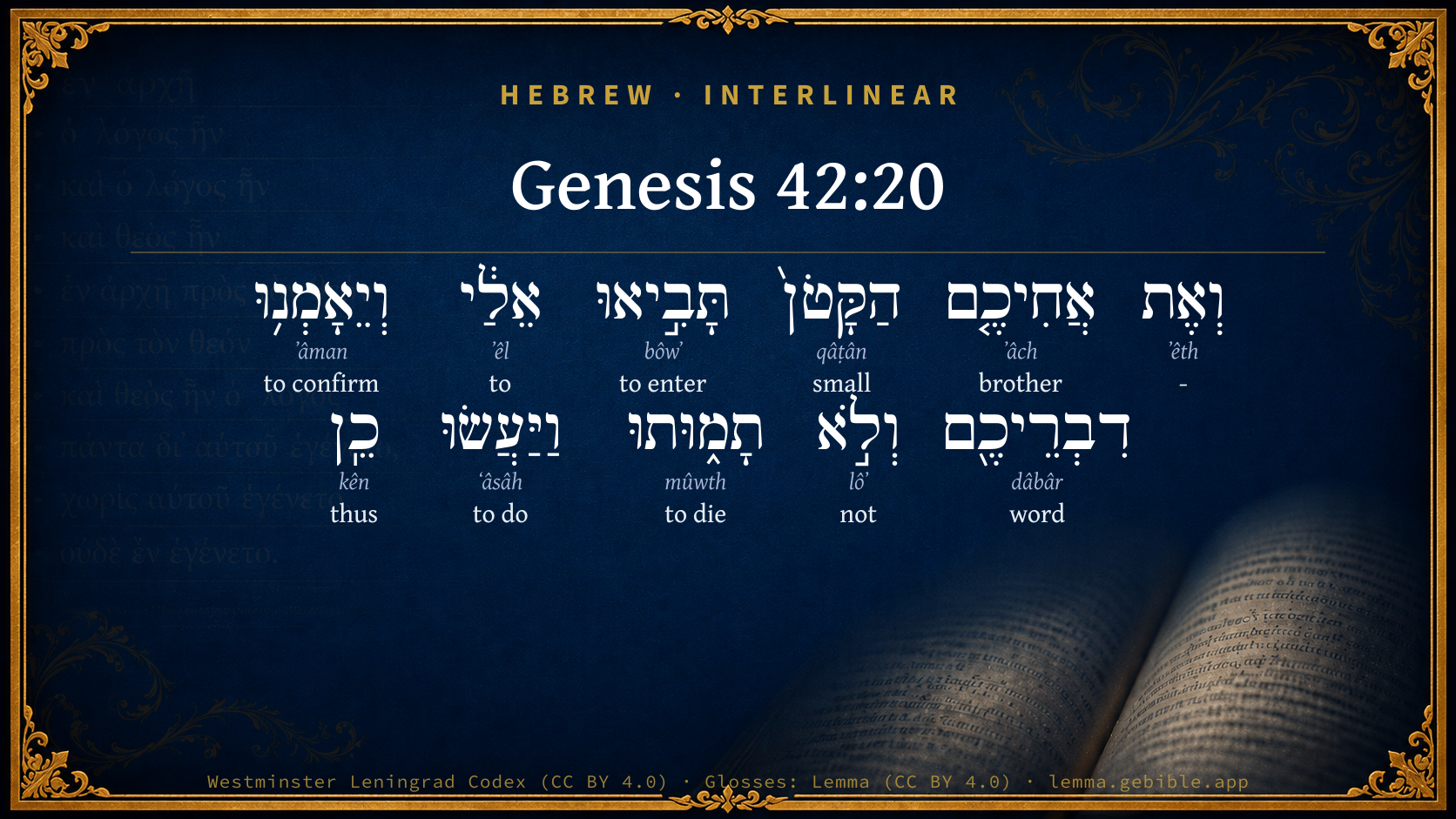
Hebrew (Westminster Leningrad Codex) Genesis 42:20 appears in the Hebrew Old Testament. The text above is from the Westminster Leningrad Codex. Each word links to its Strong’s number, a concise gloss, and parsing drawn from the Open Scriptures Hebrew Bible morphology. Click any word for its full Brown-Driver-Briggs (BDB) entry.
Download image
Cite this verse

Genesis 42:20 (World English Bible). Public Domain. Lemma interlinear Bible study tool, https://lemma.gebible.app/v/genesis/42/20.

Show BibTeX & RIS
BibTeX
RIS
English Translation
Bring your youngest brother to me; so will your words be verified, and you won't die." They did so.
World English Bible · Public Domain
Download a study sheet

One document with this verse’s original text, its word-by-word gloss line, the meaning frame, cross-references with their text, attributed commentary, and full source and license credits — printable, and it pastes into notes with its structure intact.

This verse Autodidact and up

Study sheet (.html) Plain text (.txt)

A passage Seminary Student

Up to 50 verses in one chapter. A passage sheet keeps up to 6 commentary sources and 12 cross-references per verse, in the order this page ranks them, and says so on the sheet whenever that leaves anything out. Ask for a single verse and you get the Autodidact verse sheet above.

Everything on this page stays free to read, with no account — the sheet is a download of what is already on screen, not access to it.

Want to remove ads? Support Godless Engineer
Compare translations 3

The same verse in 3 English versions, stacked beneath the original-language interlinear above. Click any original word for its lexicon entry.

Each is an independent rendering of the whole verse — the interlinear is not word-aligned to these translations.

Highlighted words mark where these versions differ — a whole-verse word diff, not a word-by-word alignment.

  • World English Bible Public Domain
    Bring your youngest brother to me; so will your words be verified, and you won't die." They did so.
  • King James Version Public Domain
    But bring your youngest brother unto me; so shall your words be verified, and ye shall not die. And they did so.
  • unfoldingWord Literal Text CC BY-SA 4.0
    Then you will bring your youngest brother to me so that your words will be verified, and you will not die.” And they did so.

unfoldingWord Literal Text — © unfoldingWord, licensed CC BY-SA 4.0. Word-aligned USFM3 via Door43 (git.door43.org/unfoldingWord/en_ult).

Versions to compare (up to 4)

3 of 4 selected

Show all 18 translations

Every available English version of this verse, each an independent rendering of the whole verse.

  • World English Bible Public Domain
    Bring your youngest brother to me; so will your words be verified, and you won't die." They did so.
  • Berean Standard Bible Public Domain
    Then bring your youngest brother to me so that your words can be verified, that you may not die.” And to this they consented.
  • Majority Standard Bible Public Domain
    Then bring your youngest brother to me so that your words can be verified, that you may not die.” And to this they consented.
  • King James Version Public Domain
    But bring your youngest brother unto me; so shall your words be verified, and ye shall not die. And they did so.
  • American Standard Version (1901) Public Domain
    and bring your youngest brother unto me; so shall your words be verified, and ye shall not die. And they did so.
  • Revised Version (1885) Public Domain
    and bring your youngest brother unto me; so shall your words be verified, and ye shall not die. And they did so.
  • Geneva Bible (1599) Public Domain
    But bring your yonger brother vnto me, that your wordes may be tried, and that ye dye not: and they did so.
  • Douay-Rheims (1899) Public Domain
    And bring your youngest brother to me, that I may find your words to be true, and you may not die. They did as he had said.
  • Young's Literal Translation Public Domain
    and your young brother ye bring unto me, and your words are established, and ye die not;' and they do so.
  • Literal Standard Version CC BY-SA 4.0
    and you bring your young brother to me, and your words are established, and you do not die”; and they do so.
  • Unlocked Literal Bible CC BY-SA 4.0
    Bring your youngest brother to me so your words will be verified and you will not die.” So they did so.
  • unfoldingWord Literal Text CC BY-SA 4.0
    Then you will bring your youngest brother to me so that your words will be verified, and you will not die.” And they did so.
  • Darby Bible Public Domain
    and bring your youngest brother to me, in order that your words be verified, and that ye may not die. And they did so.
  • World Messianic Bible Public Domain
    Bring your youngest brother to me; so will your words be verified, and you won’t die.” They did so.
  • Webster's Bible Public Domain
    But bring your youngest brother to me; so shall your words be verified, and ye shall not die. And they did so.
  • Free Bible Version CC BY-SA 4.0
    But you must bring your youngest brother here to me to prove what you're saying is true. If not, you will all die.” They agreed to do this.
  • Bible in Basic English Public Domain
    And come back to me with your youngest brother, so that your words may be seen to be true, and you will not be put to death. This is what you are to do.
  • JPS Tanakh (1917) Public Domain
    and bring your youngest brother unto me; so shall your words be verified, and ye shall not die.' And they did so.

Literal Standard Version (2020), Covenant Press — licensed CC BY-SA 4.0. Text via the HelloAO Bible API (eBible.org). Unlocked Literal Bible (unfoldingWord) — licensed CC BY-SA 4.0. Text via the HelloAO Bible API (eBible.org). unfoldingWord Literal Text — © unfoldingWord, licensed CC BY-SA 4.0. Word-aligned USFM3 via Door43 (git.door43.org/unfoldingWord/en_ult). Free Bible Version, Dr. Jonathan Gallagher — licensed CC BY-SA 4.0. Text via the HelloAO Bible API (eBible.org).

Word by word

More ways to search: Search by grammar → Find every occurrence → Compare this word →

Practice this passage: Drill this verse → Learn its vocabulary →

הַקָּטֹן֙
qâṭân
H6996
“the · small”
Particle, Definite Article + Adjective, Adjective, Masculine, Singular, Absolute
Part of Speech
Particle + Adjective
Type
Adjective
Gender
Masculine
Number
Singular
State
Absolute
Full BDB Definition

Origin: from H6962

TWOT: 2009a , 2009b

young, small, insignificant, unimportant - small - insignificant - young - unimportant
  1. וְאֶת ʼêth H853 “and · -” Conjunction + Particle, Direct Object
  2. אֲחִיכֶ֤ם ʼâch H251 “brother · your” Noun, Common, Masculine, Singular, Construct + Suffix, Personal, 2nd Person, Masculine, Plural
  3. תָּבִ֣יאוּ bôwʼ H935 “to enter” Verb, Hiphil, Imperfect, 2nd Person, Masculine, Plural
  4. אֵלַ֔י ʼêl H413 “to · me” Preposition + Suffix, Personal, 1st Person, Common, Singular
  5. וְיֵאָמְנ֥וּ ʼâman H539 “and · to confirm” Conjunction + Verb, Niphal, Imperfect, 3rd Person, Masculine, Plural
  6. דִבְרֵיכֶ֖ם dâbâr H1697 “words · your” Noun, Common, Masculine, Plural, Construct + Suffix, Personal, 2nd Person, Masculine, Plural
  7. וְלֹ֣א lôʼ H3808 “and · not” Conjunction + Particle, Negative
  8. תָמ֑וּתוּ mûwth H4191 “to die” Verb, Qal, Imperfect, 2nd Person, Masculine, Plural
  9. וַיַּעֲשׂוּ ʻâsâh H6213 “and · to do” Conjunction + Verb, Qal, Sequential Imperfect, 3rd Person, Masculine, Plural
  10. כֵֽן kên H3651 “thus” Adverb

About this verse

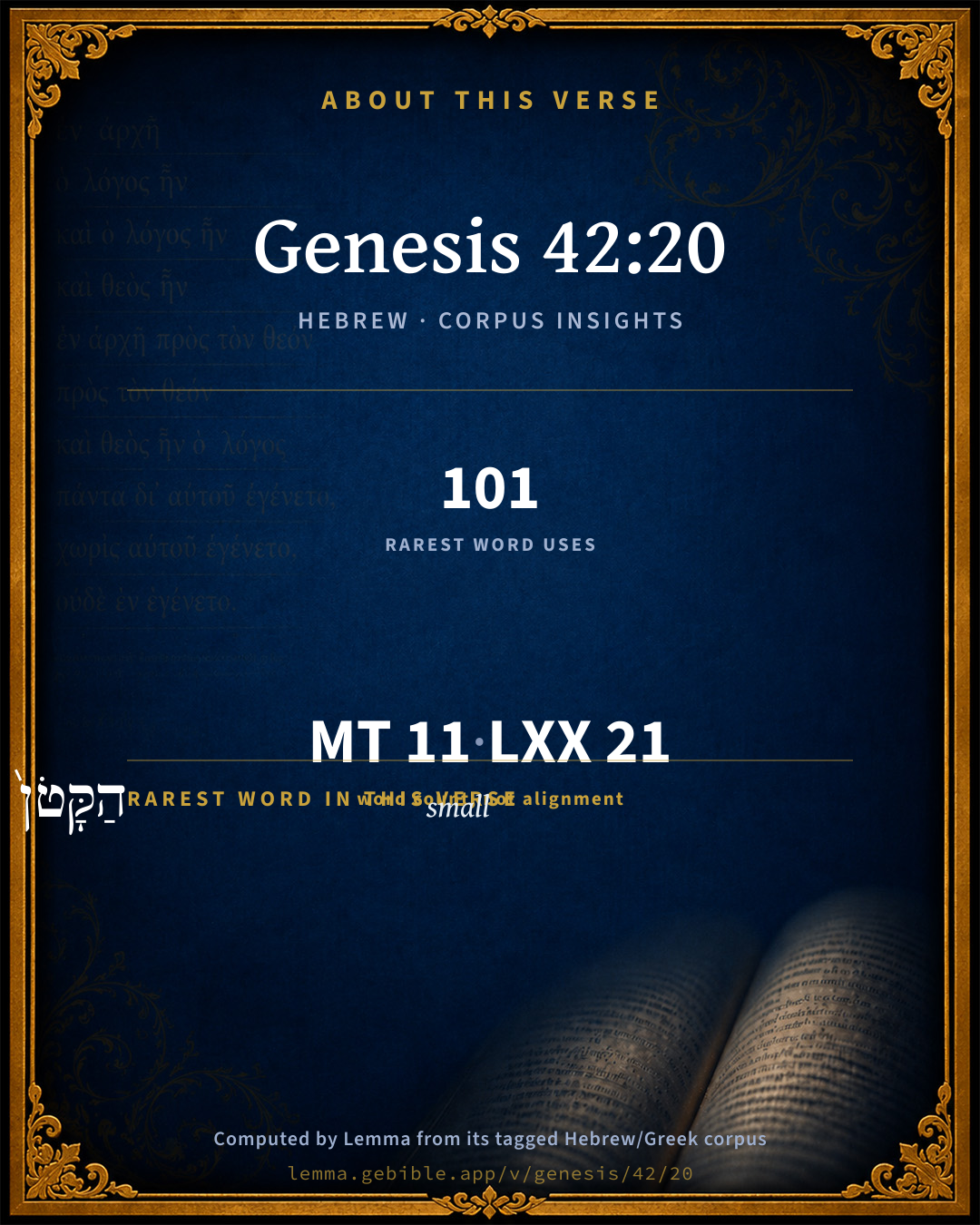
These counts appear in no published source. They are computed here, from the morphology-tagged text and Lemma’s own curated glosses. What Lemma adds →

11
words
11
distinct lemmas
Pentateuch
section

Grammatical profile

  • 4 verbs
  • 2 nouns
  • 1 adjective
  • 1 preposition
  • 1 adverb
  • 2 particles

Verb forms

  • תָּבִ֣יאוּ Hiphil · Imperfect
  • וְיֵאָמְנ֥וּ Niphal · Imperfect
  • תָמ֑וּתוּ Qal · Imperfect
  • וַיַּעֲשׂוּ Qal · Sequential Imperfect

Hebrew & Septuagint length

In English translation the verse runs 19 words from the Hebrew and 23 from the Septuagint (LXX English) — closely comparable.

A rough comparison of the two English renderings, which tokenize alike — not a word-level alignment.

Word counts can differ between the Hebrew and the Greek without any difference in meaning — e.g. the Hebrew direct-object marker אֵת has no separate Greek word, and Greek often adds the article ὁ.

In the original languages it is 11 Hebrew tokens and 21 Greek tokens — but the two are counted differently (Hebrew bundles its prefixes and suffixes into one token; the Greek is in lemma form), so that isn’t a like-for-like length.

Cross-references

8

Topical passages linked to Genesis 42:20 in the Treasury of Scripture Knowledge — connected by theme and wording, ordered by reader-vote popularity; previews shown in the World English Bible.

  • Genesis 42:34 Bring your youngest brother to me. Then I will know that you are not spies, but that you are honest men. So I will deliver your brother to you, and you shall trade in the land.'"
  • Genesis 43:5 but if you will not send him, we will not go down, for the man said to us, 'You shall not see my face, unless your brother is with you.'"
  • Genesis 44:23 You said to your servants, 'Unless your youngest brother comes down with you, you will see my face no more.'
  • Genesis 42:15 Hereby you shall be tested. By the life of Pharaoh you shall not go forth from here, unless your youngest brother come here.
  • Genesis 6:22 Thus Noah did. According to all that God commanded him, so he did.
  • Genesis 42:26 They loaded their donkeys with their grain, and departed from there.
  • Genesis 43:19 They came near to the steward of Joseph's house, and they spoke to him at the door of the house,
  • John 2:5 His mother said to the servants, "Whatever he says to you, do it."

Cross-references courtesy of OpenBible.info (CC BY 4.0).

Hebrew and Greek witnesses Masoretic Hebrew ↔ Greek Septuagint

The same verse in the two great witnesses to the Old Testament, shown verse-for-verse.

These are two independent witnesses, not word-aligned to each other, and the Septuagint is shown in lemma (dictionary) form.

Hebrew Genesis 42:20 Masoretic · Westminster Leningrad Codex

וְאֶת אֲחִיכֶ֤ם הַקָּטֹן֙ תָּבִ֣יאוּ אֵלַ֔י וְיֵאָמְנ֥וּ דִבְרֵיכֶ֖ם וְלֹ֣א תָמ֑וּתוּ וַיַּעֲשׂוּ כֵֽן

Bring your youngest brother to me; so will your words be verified, and you won't die." They did so.

World English Bible · Public Domain

Greek LXX Genesis 42:20 Septuagint · lemma form

καί ὁ ἀδελφός σύ ὁ νέος ἄγω πρός ἐγώ καί πιστεύω ὁ ῥῆμα σύ εἰ δέ μή ἀποθνήσκω ποιέω δέ οὕτως

And bring your younger brother to me, and your words shall be believed; but, if not, you⌃ shall die. And they did so.

LXX2012 (modern English Septuagint) · Public Domain

Hebrew: Westminster Leningrad Codex (CC BY 4.0). Greek: Septuagint (public domain); English from LXX2012 (modern English Septuagint) (Public Domain). How the Septuagint differs from the Hebrew →

Targum (Aramaic paraphrase)

2

The Targum is the ancient Jewish Aramaic paraphrase of the Hebrew Scriptures — an interpretive translation, not the Hebrew text itself. Onkelos (literal) and Pseudo-Jonathan (expansive) render the Torah, and Jonathan the Prophets. Coverage is partial: where no permissively-licensed English translation exists for a verse, only the Aramaic is shown. This is verse-level text, not a word-by-word alignment to the Hebrew.

  1. Targum Onkelos Torah (Genesis–Deuteronomy)
    וְיָת אֲחוּכוֹן זְעֵירָא תַּיְתוּן לְוָתִי וְיִתְהֵמְנוּן פִּתְגָּמֵיכוֹן וְלָא תְמוּתוּן וַעֲבָדוּ כֵן

    (no public-domain English translation for this verse)

    Targum Onkelos — Aramaic: “Onkelos Genesis” (public domain); “Onkelos Exodus” (public domain); “Onkelos Leviticus” (public domain); “Onkelos Numbers” (public domain); “Onkelos Deuteronomy” (public domain). English: “Sefaria Community Translation” (CC0 1.0 (public-domain dedication)); “J.W. Etheridge. The Targums of Onkelos and Jonathan Ben Uzziel on the Pentateuch. London: Longmans, Green, 1862” (public domain). Text via Sefaria.

  2. Targum Pseudo-Jonathan Torah (Genesis–Deuteronomy)
    וְיַת אֲחוּכוֹן קַלִילָא תַּיְיתוּן לְוָותִי וְיִתְהֵימִנוּן פִּתְגָמֵיכוֹן וְלָא תְמוּתוּן וַעֲבָדוּ כֵן

    and bring your youngest brother to me, that your words may be verified, and you may not die. And they did so.

    Targum Pseudo-Jonathan — Aramaic: “Targum Jonathan on Genesis” (public domain); “Targum Jonathan on Exodus” (public domain); “Targum Jonathan on Leviticus” (public domain); “Targum Jonathan on Numbers” (public domain); “Targum Jonathan on Deuteronomy” (public domain). English: “The Targum of Jonathan ben Uzziel, trans. J. W. Etheridge, London, 1862” (public domain). Text via Sefaria.

Commentary

Notes on Genesis 42:20 from classic Christian and Jewish commentators (each source and its license shown beneath its notes). The classic Christian expositions comment on the surrounding passage and are grouped to its opening verse, so a note may address several verses; the Jewish commentaries on the Tanakh (Rashi and others) are per-verse, so they appear only where the commentator wrote on this verse.

Lemma curates 59 commentaries, every one of them public domain or Creative Commons licensed, each selected and text-cleaned for this edition rather than reprinted as found. About our sources →

Trapp's Complete Commentary

John Trapp

Gen 42:20 But bring your youngest brother unto me; so shall your words be verified, and ye shall not die. And they did so.

Ver. 20. But bring your youngest brother unto me.] So saith God to all his worshippers, See that you bring your hearts with you, whatever you leave behind you. And as David sent to Abner, "Thou shalt not see my face, except thou bring Michal, Saul’s daughter": {2Sa 3:13} so here. The poor widow’s heart’s being put to her mite, gave it weight above the greater but heartless largesses of the Pharisees.

John Trapp, A Commentary or Exposition upon All the Books of the Old and New Testament (1647–1656) — public domain. Text from a community e-Sword module.

Ellicott's Commentary for English Readers

(20) Bring your youngest brother.—Besides his desire to be re-united to his brother, Joseph reasonably felt that the possession of Benjamin would be the best means of inducing his father also to come to him. While substituting a much milder proposal for his former one, that nine should remain in prison, and the tenth go to fetch Benjamin, Joseph nevertheless takes care to make his brethren feel that he was in earnest.

A Bible Commentary for English Readers, edited by Charles John Ellicott (1878–1897) — public domain. Text from a community e-Sword module.

John Gill's Exposition

And he turned himself about from them, and wept,.... Hearing his brethren confess their sin and guilt to one another in selling him, and Reuben's affectionate concern for him, it wrought so much upon his affections, being naturally of a tender spirit, that he could no longer act the part he had, and keep up the sternness and severity of his countenance; wherefore he turned his face from them, that they might not discern it, and his back upon them, and went into another room: and after he had given vent to his passion, and composed himself:

and returned to them again, and communed with them; upon the same subject, of going with their corn to Canaan, and bringing their youngest brother with them upon their return, and promising moreover, for their encouragement, a free traffic in the land of Egypt, Gen 42:34,

and took from them Simeon, and bound him before their eyes; who perhaps was the most cruel and hardhearted among them; and it appears from the affair of Shechem, that he was a man of a fierce and bloody disposition. According to Jarchi, it was he that said to Levi, on sight of Joseph, behold this dreamer cometh; and that it was he that cast him into the pit; and, as the Targum says, advised to kill him: and perhaps Joseph might pitch upon him as the hostage, not only because he had used him more evilly than the rest, but because he might observe he was less concerned, and not so much humbled now for the evil he had done as the rest were; as also he might choose to detain him, as being not so much in his father's affection, because of the affair of Shechem, and so be a less affliction to him than if it was another; and besides, he might fear that being of a perverse and boisterous disposition, he would vehemently oppose the sending of Benjamin into Egypt, which Joseph was so very desirous of: and he bound him in their presence to terrify them, and let them know what they must expect if they did not obey his orders, and the more to humble them for the sin they had been guilty of, and was now upon their minds; though perhaps, as Jarchi observes, when they were gone he let him out, and gave him food and drink; or however might give him some liberty, and use him with mildness and gentleness.

John Gill's Exposition of the Whole Bible (1746–1763) — public domain (CC PDM 1.0). Text via the HelloAO Bible API.

Matthew Poole's English Annotations

i.e. Resolved and promised to do so. Those things are oft said to be done in Scripture which were sincerely resolved upon, as hath been noted before.

Matthew Poole's English Annotations on the Holy Bible (1683–1685) — public domain. Text from a community e-Sword/MySword module.

Rashi

Rabbi Shlomo Yitzchaki (Rashi)

ויאמנו דבריכם— means so shall your words be verified and confirmed. Other examples are, (Numbers 5:22) “It is true, it is true (אמן אמן)”, and (1 Kings 8:26) “Let thy word, I pray thee, be verified (יאמן).”

Rashi on the Tanakh — English translations: “The Judaica Press complete Tanach with Rashi, translated by A. J. Rosenberg” (CC BY 4.0); “Pentateuch with Rashi's commentary by M. Rosenbaum and A.M. Silbermann, 1929-1934” (public domain); “The Metsudah Tanach series, Lakewood, N.J” (CC BY 4.0); and “The Book of Joshua, Metsudah Publications, 1997” (CC BY 4.0). Text via Sefaria.

Lesson kit

Teaching starters — assembled from the data on this page, not authored interpretation. Every prompt links to the verse data it draws on. Edit before teaching.

Genesis, in the Pentateuch, opens this verse with 11 words (11 distinct Hebrew lemmas). Its most distinctive word is qâṭân (“small”). A historical commentator’s framing appears above. Read the whole chapter for the surrounding context.

Discussion questions

  1. The word qâṭân carries the sense “small.” How does it shape the verse?
  2. Genesis 42:34 shares this passage’s theme. How do the two illuminate each other?
  3. These translations render this verse differently. What is at stake in choosing one wording over another?
  4. The verb «תָּבִ֣יאוּ» is Hiphil Imperfect. How does its form color the action?
  5. Reading how Trapp's Complete Commentary and Ellicott's Commentary for English Readers read this verse, where do the two commentators agree and where do they part?

Things to notice

Reading settings

Reading text

Shown beneath each verse's original-language words.

Old Testament
Old Testament edition

Read the OT as the Masoretic Hebrew (MT) or the Greek Septuagint (LXX).

English shown for the Greek Septuagint (in the Hebrew ↔ Greek comparison).

Comparing translations? Open the Compare panel on any verse page to stack up to four side by side.