
Deuteronomy 1:39

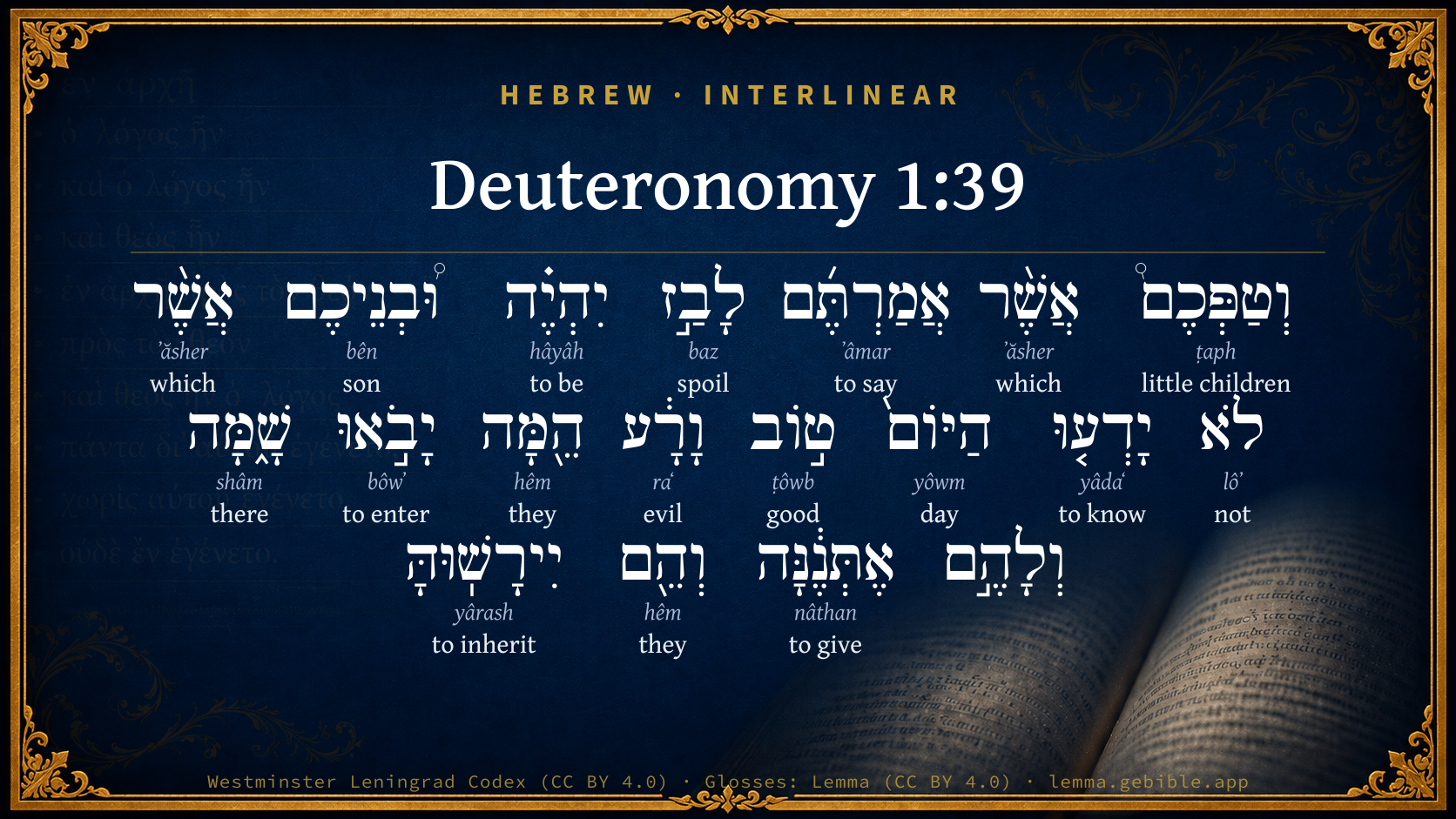
Hebrew (Westminster Leningrad Codex) Deuteronomy 1:39 appears in the Hebrew Old Testament. The text above is from the Westminster Leningrad Codex. Each word links to its Strong’s number, a concise gloss, and parsing drawn from the Open Scriptures Hebrew Bible morphology. Click any word for its full Brown-Driver-Briggs (BDB) entry.
Download image
Cite this verse

Deuteronomy 1:39 (World English Bible). Public Domain. Lemma interlinear Bible study tool, https://lemma.gebible.app/v/deuteronomy/1/39.

Show BibTeX & RIS
BibTeX
RIS
English Translation
Moreover your little ones, whom you said should be a prey, and your children, who this day have no knowledge of good or evil, they shall go in there, and to them will I give it, and they shall possess it.
World English Bible · Public Domain
Download a study sheet

One document with this verse’s original text, its word-by-word gloss line, the meaning frame, cross-references with their text, attributed commentary, and full source and license credits — printable, and it pastes into notes with its structure intact.

This verse Autodidact and up

Study sheet (.html) Plain text (.txt)

A passage Seminary Student

Up to 50 verses in one chapter. A passage sheet keeps up to 6 commentary sources and 12 cross-references per verse, in the order this page ranks them, and says so on the sheet whenever that leaves anything out. Ask for a single verse and you get the Autodidact verse sheet above.

Everything on this page stays free to read, with no account — the sheet is a download of what is already on screen, not access to it.

Want to remove ads? Support Godless Engineer
Compare translations 3

The same verse in 3 English versions, stacked beneath the original-language interlinear above. Click any original word for its lexicon entry.

Each is an independent rendering of the whole verse — the interlinear is not word-aligned to these translations.

Highlighted words mark where these versions differ — a whole-verse word diff, not a word-by-word alignment.

  • World English Bible Public Domain
    Moreover your little ones, whom you said should be a prey, and your children, who this day have no knowledge of good or evil, they shall go in there, and to them will I give it, and they shall possess it.
  • King James Version Public Domain
    Moreover your little ones, which ye said should be a prey, and your children, which in that day had no knowledge between good and evil, they shall go in thither, and unto them will I give it, and they shall possess it.
  • unfoldingWord Literal Text CC BY-SA 4.0
    And your children that you said would be plunder, and your sons who today do not know good or evil, they will go in there. And to them I will give it, and they will possess it.

unfoldingWord Literal Text — © unfoldingWord, licensed CC BY-SA 4.0. Word-aligned USFM3 via Door43 (git.door43.org/unfoldingWord/en_ult).

Versions to compare (up to 4)

3 of 4 selected

Show all 18 translations

Every available English version of this verse, each an independent rendering of the whole verse.

  • World English Bible Public Domain
    Moreover your little ones, whom you said should be a prey, and your children, who this day have no knowledge of good or evil, they shall go in there, and to them will I give it, and they shall possess it.
  • Berean Standard Bible Public Domain
    And the little ones you said would become captives—your children who on that day did not know good from evil—will enter the land that I will give them, and they will possess it.
  • Majority Standard Bible Public Domain
    And the little ones you said would become captives—your children who on that day did not know good from evil—will enter the land that I will give them, and they will possess it.
  • King James Version Public Domain
    Moreover your little ones, which ye said should be a prey, and your children, which in that day had no knowledge between good and evil, they shall go in thither, and unto them will I give it, and they shall possess it.
  • American Standard Version (1901) Public Domain
    Moreover your little ones, that ye said should be a prey, and your children, that this day have no knowledge of good or evil, they shall go in thither, and unto them will I give it, and they shall possess it.
  • Revised Version (1885) Public Domain
    Moreover your little ones, which ye said should be a prey, and your children, which this day have no knowledge of good or evil, they shall go in thither, and unto them will I give it, and they shall possess it.
  • Geneva Bible (1599) Public Domain
    Moreouer, your children, which ye sayd should be a praye, and your sonnes, which in that day had no knowledge betweene good and euill, they shall go in thither, and vnto them wil I giue it, and they shall possesse it.
  • Douay-Rheims (1899) Public Domain
    Neither is his indignation against the people to be wondered at, since the Lord was angry with me also on your account, and said: Neither shalt thou go in thither.
  • Young's Literal Translation Public Domain
    `And your infants, of whom ye have said, For a prey they are, and your sons who have not known to-day good and evil, they go in thither, and to them I give it, and they possess it;
  • Literal Standard Version CC BY-SA 4.0
    And your infants, of whom you have said, They are for a prey, and your sons who today have not known good and evil, they go in there, and I give it to them, and they possess it;
  • Unlocked Literal Bible CC BY-SA 4.0
    Moreover, your little children, the ones you said would be victims, who today have no knowledge of good or evil—they will go in there. To them I will give it, and they will possess it.
  • unfoldingWord Literal Text CC BY-SA 4.0
    And your children that you said would be plunder, and your sons who today do not know good or evil, they will go in there. And to them I will give it, and they will possess it.
  • Darby Bible Public Domain
    And your little ones, of whom ye said, They shall be a prey, and your children, who this day know neither good nor evil, they shall go in thither, and unto them will I give it, and they shall possess it.
  • World Messianic Bible Public Domain
    Moreover your little ones, whom you said would be captured or killed, your children, who today have no knowledge of good or evil, shall go in there. I will give it to them, and they shall possess it.
  • Webster's Bible Public Domain
    Moreover, your little ones, which ye said should be a prey, and your children, which in that day had no knowledge between good and evil, they shall go in thither, and to them will I give it, and they shall possess it.
  • Free Bible Version CC BY-SA 4.0
    Your small children that you claimed would become prisoners, your children who at the time didn't know good from evil, they will be the ones to enter the land that I will give them, and they will occupy it.
  • Bible in Basic English Public Domain
    And your little ones, who, you said, would come into strange hands, your children, who now have no knowledge of good or evil, they will go into that land, and to them I will give it and it will be theirs.
  • JPS Tanakh (1917) Public Domain
    Moreover your little ones, that ye said should be a prey, and your children, that this day have no knowledge of good or evil, they shall go in thither, and unto them will I give it, and they shall possess it.

Literal Standard Version (2020), Covenant Press — licensed CC BY-SA 4.0. Text via the HelloAO Bible API (eBible.org). Unlocked Literal Bible (unfoldingWord) — licensed CC BY-SA 4.0. Text via the HelloAO Bible API (eBible.org). unfoldingWord Literal Text — © unfoldingWord, licensed CC BY-SA 4.0. Word-aligned USFM3 via Door43 (git.door43.org/unfoldingWord/en_ult). Free Bible Version, Dr. Jonathan Gallagher — licensed CC BY-SA 4.0. Text via the HelloAO Bible API (eBible.org).

Word by word

More ways to search: Search by grammar → Find every occurrence → Compare this word →

Practice this passage: Drill this verse → Learn its vocabulary →

לָבַ֣ז
baz
H957
“to/for · spoil”
Preposition + Noun, Common, Masculine, Singular, Absolute
Part of Speech
Preposition + Noun
Type
Common
Gender
Masculine
Number
Singular
State
Absolute
Full BDB Definition

Origin: from H962

TWOT: 225a

spoil, booty, robbery, spoiling
  1. וְטַפְּכֶם֩ ṭaph H2945 “and · little children · your” Conjunction + Noun, Common, Masculine, Singular, Construct + Suffix, Personal, 2nd Person, Masculine, Plural
  2. אֲשֶׁ֨ר ʼăsher H834 “which” Particle, Relative
  3. אֲמַרְתֶּ֜ם ʼâmar H559 “to say” Verb, Qal, Perfect, 2nd Person, Masculine, Plural
  4. יִהְיֶ֗ה hâyâh H1961 “to be” Verb, Qal, Imperfect, 3rd Person, Masculine, Singular
  5. וּ֠בְנֵיכֶם bên H1121 “and · sons · your” Conjunction + Noun, Common, Masculine, Plural, Construct + Suffix, Personal, 2nd Person, Masculine, Plural
  6. אֲשֶׁ֨ר ʼăsher H834 “which” Particle, Relative
  7. לֹא lôʼ H3808 “not” Particle, Negative
  8. יָדְע֤וּ yâdaʻ H3045 “to know” Verb, Qal, Perfect, 3rd Person, Common, Plural
  9. הַיּוֹם֙ yôwm H3117 “the · day” Particle, Definite Article + Noun, Common, Masculine, Singular, Absolute
  10. ט֣וֹב ṭôwb H2896 “good” Adjective, Adjective, Masculine, Singular, Absolute
  11. וָרָ֔ע raʻ H7451 “and · evil” Conjunction + Adjective, Adjective, Masculine, Singular, Absolute
  12. הֵ֖מָּה hêm H1992 “they” Pronoun, Personal, 3rd Person, Masculine, Plural
  13. יָבֹ֣אוּ bôwʼ H935 “to enter” Verb, Qal, Imperfect, 3rd Person, Masculine, Plural
  14. שָׁ֑מָּה shâm H8033 “there · toward” Adverb + Suffix, Demonstrative
  15. אֶתְּנֶ֔נָּה nâthan H5414 “to give · her” Verb, Qal, Imperfect, 1st Person, Common, Singular + Suffix, Personal, 3rd Person, Feminine, Singular
  16. וְהֵ֖ם hêm H1992 “and · they” Conjunction + Pronoun, Personal, 3rd Person, Masculine, Plural
  17. יִירָשֽׁוּהָּ yârash H3423 “to inherit · her” Verb, Qal, Imperfect, 3rd Person, Masculine, Plural + Suffix, Personal, 3rd Person, Feminine, Singular

About this verse

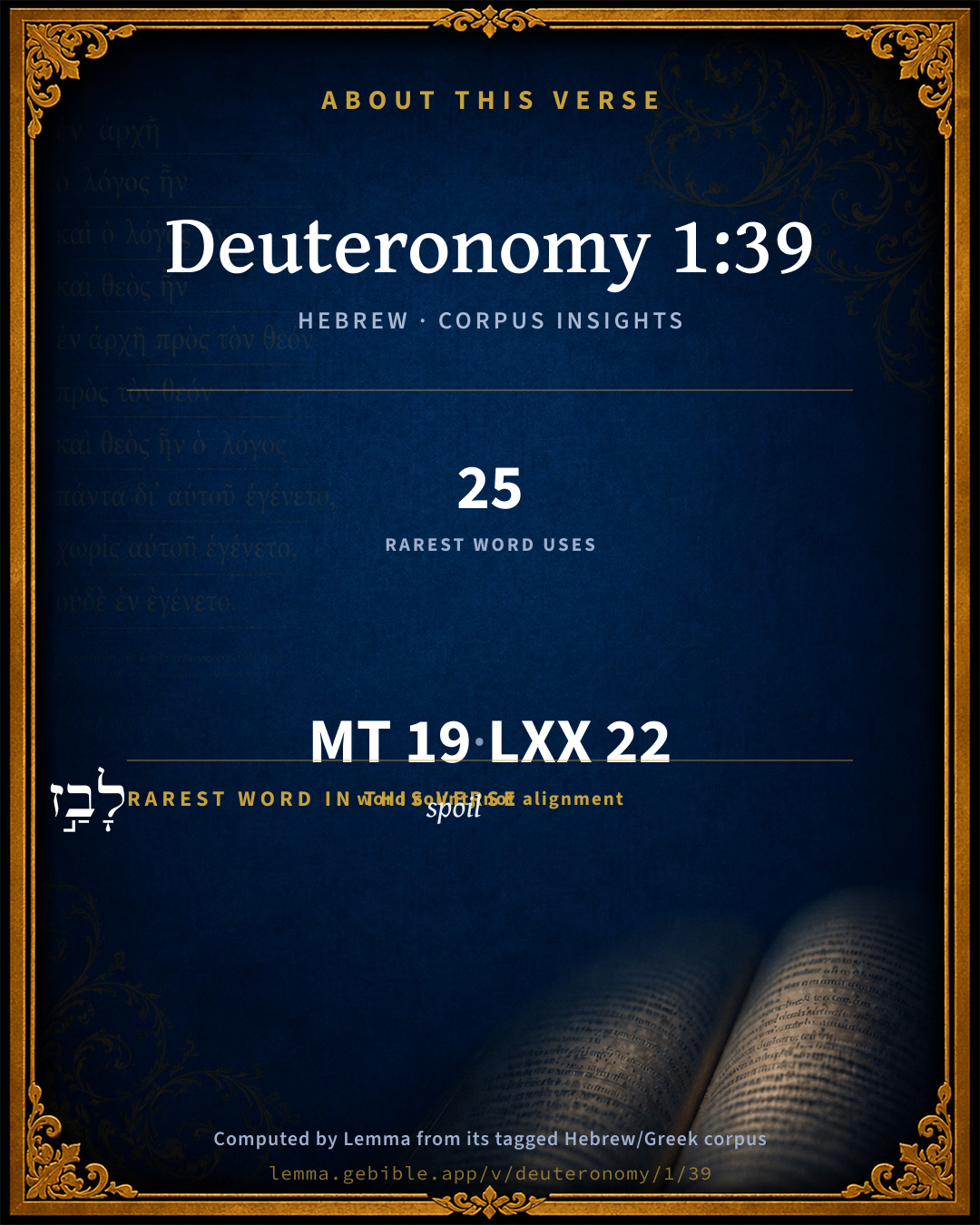
These counts appear in no published source. They are computed here, from the morphology-tagged text and Lemma’s own curated glosses. What Lemma adds →

19
words
16
distinct lemmas
Pentateuch
section

Notable vocabulary

The rarest word here is לָבַ֣ז spoil H957 — appearing just 25 times in the whole Hebrew Bible.

Shared distinctive vocabulary

לָבַ֣ז spoil H957 occurs in 25 verses of the Hebrew Bible. Also found in:

Grammatical profile

  • 6 verbs
  • 4 nouns
  • 2 adjectives
  • 2 pronouns
  • 1 preposition
  • 1 adverb
  • 3 particles

Verb forms

  • אֲמַרְתֶּ֜ם Qal · Perfect
  • יִהְיֶ֗ה Qal · Imperfect
  • יָדְע֤וּ Qal · Perfect
  • יָבֹ֣אוּ Qal · Imperfect
  • אֶתְּנֶ֔נָּה Qal · Imperfect
  • יִירָשֽׁוּהָּ Qal · Imperfect

Repetition

Words recur within this verse — often emphatic in Hebrew:

  • אֲשֶׁ֨ר which H834 ×2
  • הֵ֖מָּה they H1992 ×2

Hebrew & Septuagint length

In English translation the verse runs 41 words from the Hebrew and 28 from the Septuagint (LXX English) — the Septuagint runs noticeably shorter here. See the side-by-side →

A rough comparison of the two English renderings, which tokenize alike — not a word-level alignment.

Word counts can differ between the Hebrew and the Greek without any difference in meaning — e.g. the Hebrew direct-object marker אֵת has no separate Greek word, and Greek often adds the article ὁ.

In the original languages it is 19 Hebrew tokens and 22 Greek tokens — but the two are counted differently (Hebrew bundles its prefixes and suffixes into one token; the Greek is in lemma form), so that isn’t a like-for-like length.

Cross-references

6

Topical passages linked to Deuteronomy 1:39 in the Treasury of Scripture Knowledge — connected by theme and wording, ordered by reader-vote popularity; previews shown in the World English Bible.

  • Isaiah 7:15–16 He shall eat butter and honey when he knows to refuse the evil, and choose the good.
  • Numbers 14:3 Why does Yahweh bring us to this land, to fall by the sword? Our wives and our little ones will be a prey: wouldn't it be better for us to return into Egypt?
  • Numbers 14:31 But your little ones, that you said should be a prey, them will I bring in, and they shall know the land which you have rejected.
  • Jonah 4:11 Shouldn't I be concerned for Nineveh, that great city, in which are more than one hundred twenty thousand persons who can't discern between their right hand and their left hand; and also much cattle?"
  • Romans 9:11 For being not yet born, neither having done anything good or bad, that the purpose of God according to election might stand, not of works, but of him who calls,
  • Ephesians 2:3 among whom we also all once lived in the lust of our flesh, doing the desires of the flesh and of the mind, and were by nature children of wrath, even as the rest.

Cross-references courtesy of OpenBible.info (CC BY 4.0).

Hebrew and Greek witnesses Masoretic Hebrew ↔ Greek Septuagint

The same verse in the two great witnesses to the Old Testament, shown verse-for-verse.

Here the Septuagint runs noticeably shorter than the Hebrew — LXX2012 (modern English Septuagint) 28 words vs World English Bible 41. A rough length comparison of the two English translations, not a word-level alignment — read both below.

These are two independent witnesses, not word-aligned to each other, and the Septuagint is shown in lemma (dictionary) form.

Hebrew Deuteronomy 1:39 Masoretic · Westminster Leningrad Codex

וְטַפְּכֶם֩ אֲשֶׁ֨ר אֲמַרְתֶּ֜ם לָבַ֣ז יִהְיֶ֗ה וּ֠בְנֵיכֶם אֲשֶׁ֨ר לֹא יָדְע֤וּ הַיּוֹם֙ ט֣וֹב וָרָ֔ע הֵ֖מָּה יָבֹ֣אוּ שָׁ֑מָּה וְלָהֶ֣ם אֶתְּנֶ֔נָּה וְהֵ֖ם יִירָשֽׁוּהָּ

Moreover your little ones, whom you said should be a prey, and your children, who this day have no knowledge of good or evil, they shall go in there, and to them will I give it, and they shall possess it.

World English Bible · Public Domain

Greek LXX Deuteronomy 1:39 Septuagint · lemma form

καί πᾶς παιδίον νέος ὅστις οὐ οἶδα σήμερον ἀγαθός ἤ κακός οὗτος εἰςἔρχομαι ἐκεῖ καί οὗτος δίδωμι αὐτός καί αὐτός κληρονομέω αὐτός

And every young child who this day knows not good or evil, —they shall enter therein, and to them I will give it, and they shall inherit it.

LXX2012 (modern English Septuagint) · Public Domain

On this verse, The Cambridge Bible for Schools and Colleges discusses the Septuagint’s reading. Read the note in Commentary ↓

Hebrew: Westminster Leningrad Codex (CC BY 4.0). Greek: Septuagint (public domain); English from LXX2012 (modern English Septuagint) (Public Domain). How the Septuagint differs from the Hebrew →

Targum (Aramaic paraphrase)

2

The Targum is the ancient Jewish Aramaic paraphrase of the Hebrew Scriptures — an interpretive translation, not the Hebrew text itself. Onkelos (literal) and Pseudo-Jonathan (expansive) render the Torah, and Jonathan the Prophets. Coverage is partial: where no permissively-licensed English translation exists for a verse, only the Aramaic is shown. This is verse-level text, not a word-by-word alignment to the Hebrew.

  1. Targum Onkelos Torah (Genesis–Deuteronomy)
    וְטַפְלְכוֹן דִי אֲמַרְתּוּן לְבִזָא יְהוֹן וּבְנֵיכוֹן דִי לָא יְדָעוּ יוֹמָא דֵין טַב וּבִישׁ אִנוּן יַעֲלוּן לְתַמָן וּלְהוֹן אֶתְּנִנַהּ וְאִנוּן יֵירְתֻנַהּ

    (no public-domain English translation for this verse)

    Targum Onkelos — Aramaic: “Onkelos Genesis” (public domain); “Onkelos Exodus” (public domain); “Onkelos Leviticus” (public domain); “Onkelos Numbers” (public domain); “Onkelos Deuteronomy” (public domain). English: “Sefaria Community Translation” (CC0 1.0 (public-domain dedication)); “J.W. Etheridge. The Targums of Onkelos and Jonathan Ben Uzziel on the Pentateuch. London: Longmans, Green, 1862” (public domain). Text via Sefaria.

  2. Targum Pseudo-Jonathan Torah (Genesis–Deuteronomy)
    וְטַפְלְכוֹן דַּאֲמַרְתּוּן לַעֲדִי יְהוֹן וּבְנֵיכוֹן דְּלָא יָדְעִין יוֹמָא דֵין בֵּין טַב לְבִישׁ הִינוּן יַעֲלוּן לְתַמָּן וּלְהוֹן אֶתְּנִינָהּ וְהִינוּן יֵירְתוּנָהּ

    But your little ones, of whom you said, They will be for prey, and your children, who as yet know not between good and evil, they shall go in thither: I will give it to them, and they shall possess it for an inheritance.

    Targum Pseudo-Jonathan — Aramaic: “Targum Jonathan on Genesis” (public domain); “Targum Jonathan on Exodus” (public domain); “Targum Jonathan on Leviticus” (public domain); “Targum Jonathan on Numbers” (public domain); “Targum Jonathan on Deuteronomy” (public domain). English: “The Targum of Jonathan ben Uzziel, trans. J. W. Etheridge, London, 1862” (public domain). Text via Sefaria.

Commentary

Notes on Deuteronomy 1:39 from classic Christian and Jewish commentators (each source and its license shown beneath its notes). The classic Christian expositions comment on the surrounding passage and are grouped to its opening verse, so a note may address several verses; the Jewish commentaries on the Tanakh (Rashi and others) are per-verse, so they appear only where the commentator wrote on this verse.

Lemma curates 59 commentaries, every one of them public domain or Creative Commons licensed, each selected and text-cleaned for this edition rather than reprinted as found. About our sources →

Geneva Bible (1599)

Geneva Bible translators

Which were under twenty years old, as Num. 14:31.

Geneva Bible (1599) marginal notes — public domain. Text via Bolls.life.

Jamieson, Fausset & Brown

Robert Jamieson, A. R. Fausset & David Brown

your children . . . who in that day had no knowledge between good and evil--All ancient versions read "to-day" instead of "that day"; and the sense is--"your children who now know," or "who know not as yet good or evil." As the children had not been partakers of the sinful outbreak, they were spared to obtain the privilege which their unbelieving parents had forfeited. God's ways are not as man's ways [Isa 55:8-9].

Jamieson, Fausset & Brown — Commentary Critical and Explanatory on the Whole Bible (1871) — public domain (CC PDM 1.0). Text via the HelloAO Bible API.

Ellicott's Commentary for English Readers

(39) Moreover your little ones.—This continues the sentence of Jehovah from Deu_1:36.

Which ye said should be a prey.—In Num_14:3, “that our wives and children should be a prey.” (See also Deu_1:31.)

A Bible Commentary for English Readers, edited by Charles John Ellicott (1878–1897) — public domain. Text from a community e-Sword module.

The Cambridge Bible for Schools and Colleges

gen. ed. J. J. S. Perowne

39. Moreover your little ones, which ye said should be a prey] Tautologous with the rest of the verse and wanting in the LXX; therefore probably an editorial addition from Num_14:31.

who this day have no knowledge of good or evil] Who are not of a responsible age, fixed by the more exact P at 20 years and over, Num_14:29. Sam. omits.

The Cambridge Bible for Schools and Colleges (gen. ed. J. J. S. Perowne; Cambridge University Press, 1878–1918) — public domain. Text from a community e-Sword module.

John Gill's Exposition

Moreover, your little ones, which ye said should be a prey,.... To the Amorites, into whose hands they expected to be delivered, Deu 1:27 see Num 14:3.

and your children, which in that day had no knowledge between good and evil; not being at years of understanding, and which is a common description of children; it is particularly expressed "in that day", for now they were the very persons Moses was directing his speech unto, and relating this history, it being thirty eight years ago when this affair was, so that now they were grown up to years of discretion:

they shall go in thither, and unto them will I give it, and they shall possess it: the relation of which now might serve greatly to encourage their faith, as well as it would be a fulfilment of the promise of the land made unto Abraham, Isaac, and Jacob, which was not made of none effect through the unbelief of the Israelites, whose carcasses fell in the wilderness, since their posterity was to enjoy it, and did.

John Gill's Exposition of the Whole Bible (1746–1763) — public domain (CC PDM 1.0). Text via the HelloAO Bible API.

Haydock's Catholic Bible Commentary

Evil. These words were spoken to by God to the Hebrews, after they had refused to go from Cades-barne, to take immediate possession of the land of Chanaan, and not after Moses had offended at the waters of contradiction, which happened only a short time before his death. (Haydock) --- Those who were not come to the use of reason at the former period, (Menochius) or who had not arrived at 20 years of age, were now permitted to enter. (Haydock)

George Leo Haydock (1774–1849), Haydock's Catholic Family Bible and Commentary, 1859 edition — public domain. Excludes Psalms (Douay-Rheims chapter numbering differs from Protestant) and Deuterocanonical books (Catholic canon only).

Matthew Poole's English Annotations

Had no knowledge between good and evil; a common description of the state of childhood, as Jon 4:11.

Matthew Poole's English Annotations on the Holy Bible (1683–1685) — public domain. Text from a community e-Sword/MySword module.

The Pulpit Commentary

Only among the young of that generation should the inheritance be divided, as they had no part in the rebellion of their seniors. Your little ones; i.e. children beginning to walk (pf, from ppf to trip, to take short and quick steps). And your children boys and girlswhich in that day had no knowledge between good and evil; rather, of whom ye said they know not today good and evil. The Hebrews were wont to express totality or universality by specifying contradictory opposites, as, e.g. great and small, (2Ch_34:30) master and scholar, (Mal 2) free and bond, (Rev_13:16 Rev_19:18) shut up and left (Deu_32:36, where see note; 1Ki_14:10) etc. Accordingly, when good and evil are set over against each other, the notion of entireness or universality is expressed. Thus, when Laban and Bethuel said to Abraham"s servant "We cannot speak unto thee bad or good", (Gen_24:50) the meaning is, We can say nothing at all. Absalom spake to Amnon "neither good nor bad"; (2Sa_13:22) that is, he did not say anything to him. The woman of Tekoa said to David, "As an angel of God, so is my lord the king to discern good and; (2Sa_14:17) i.e. There is nothing the king does not know his knowledge is universal. Hence to know good and evil came to mean to be intelligent, and not to know good and evil to be unintelligent, as is a babe. The children here referred to knew nothing, and consequently could not be held as morally responsible; comp. Isa_7:15; Homer, "Odyssey," 18:228 Oida ekasta ejsqla te kaireia paropiov hja.

The Pulpit Commentary (1880–1919), ed. H.D.M. Spence-Jones & Joseph S. Exell — public domain. Text from a community e-Sword module.

unfoldingWord translationNotes

Door43 World Missions Community

General Information:

Moses continues reminding the people of Israel what the previous generation of Israelites did.

no knowledge of good or evil

They do not yet know what is good and what is evil.

turn and take your journey

"turn around and go back on the road you have come on"

translationWords

possess

desert

Sea of Reeds

unfoldingWord translationNotes — © Distant Shores Media and the Door43 World Missions Community, licensed CC BY-SA 4.0. Source: git.door43.org/Door43/en_tn.

Lesson kit

Teaching starters — assembled from the data on this page, not authored interpretation. Every prompt links to the verse data it draws on. Edit before teaching.

Deuteronomy, in the Pentateuch, opens this verse with 19 words (16 distinct Hebrew lemmas). Its most distinctive word is baz (“spoil”). The Greek Septuagint runs shorter here. A historical commentator’s framing appears above. Read the whole chapter for the surrounding context.

Discussion questions

  1. How does “spoil” (baz) shape what this verse is saying?
  2. Numbers 14:3 shares the word «spoil» with this verse. How do the two illuminate each other?
  3. “which” occurs 2× in this one verse. What is the effect of the repetition?
  4. Compared with the Hebrew, the Septuagint runs shorter here. What questions does that raise?
  5. The translations on this page render this verse differently — a whole-verse word diff, not a word-by-word alignment. What might account for the different wordings?
  6. The verb «אֲמַרְתֶּ֜ם» is Qal Perfect. How does its form color the action?
  7. Reading how Geneva Bible (1599) and Jamieson, Fausset & Brown read this verse, where do the two commentators agree and where do they part?

Things to notice

Reading settings

Reading text

Shown beneath each verse's original-language words.

Old Testament
Old Testament edition

Read the OT as the Masoretic Hebrew (MT) or the Greek Septuagint (LXX).

English shown for the Greek Septuagint (in the Hebrew ↔ Greek comparison).

Comparing translations? Open the Compare panel on any verse page to stack up to four side by side.