
Deuteronomy 1:7

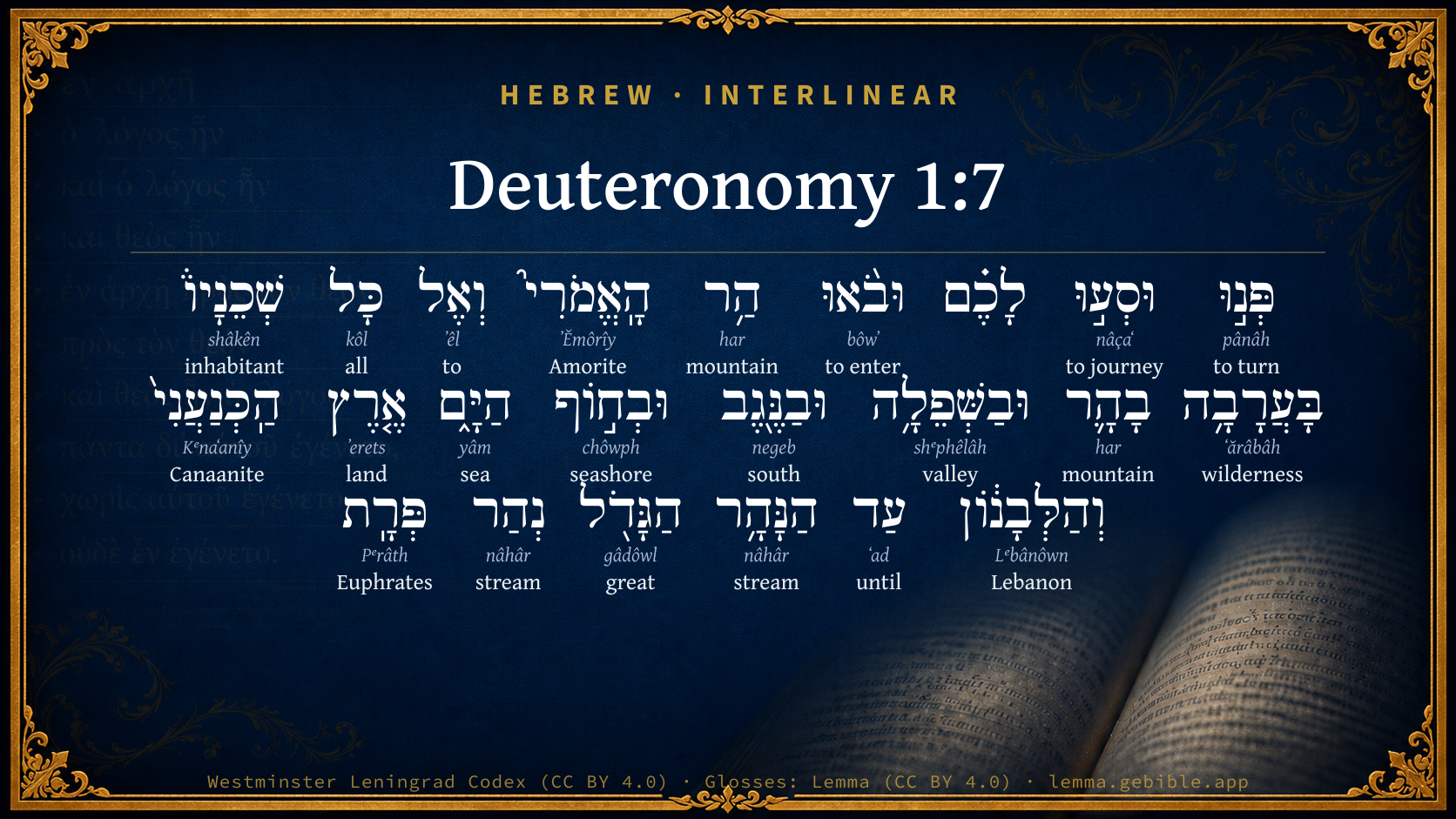
Hebrew (Westminster Leningrad Codex) Deuteronomy 1:7 appears in the Hebrew Old Testament. The text above is from the Westminster Leningrad Codex. Each word links to its Strong’s number, a concise gloss, and parsing drawn from the Open Scriptures Hebrew Bible morphology. Click any word for its full Brown-Driver-Briggs (BDB) entry.
Download image
Cite this verse

Deuteronomy 1:7 (World English Bible). Public Domain. Lemma interlinear Bible study tool, https://lemma.gebible.app/v/deuteronomy/1/7.

Show BibTeX & RIS
BibTeX
RIS
English Translation
turn you, and take your journey, and go to the hill-country of the Amorites, and to all [the places] near thereunto, in the Arabah, in the hill-country, and in the lowland, and in the South, and by the sea-shore, the land of the Canaanites, and Lebanon, as far as the great river, the river Euphrates.
World English Bible · Public Domain
Highlights
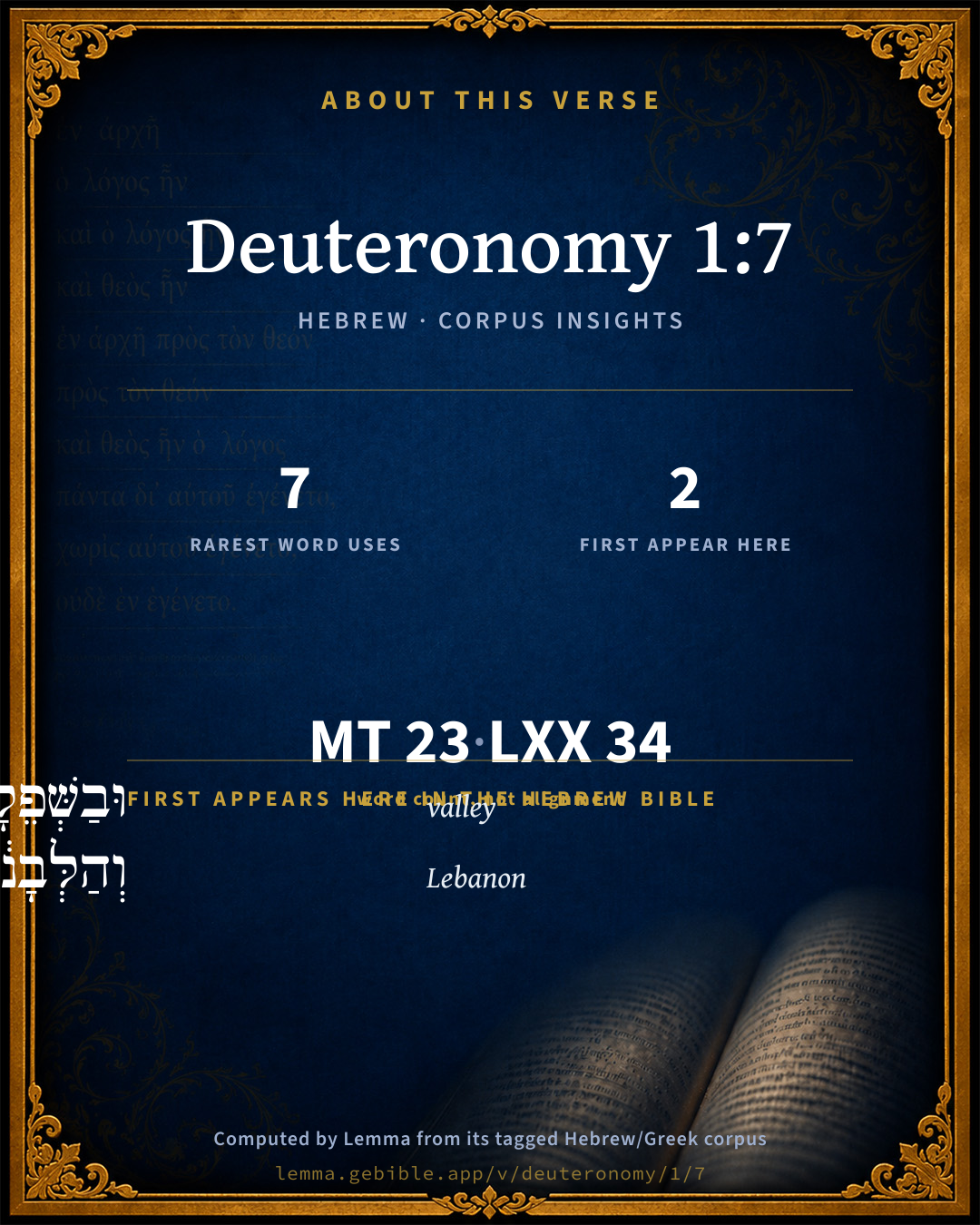
  • 2 first appearances in the Hebrew Bible
Full analysis ↓
Download a study sheet

One document with this verse’s original text, its word-by-word gloss line, the meaning frame, cross-references with their text, attributed commentary, and full source and license credits — printable, and it pastes into notes with its structure intact.

This verse Autodidact and up

Study sheet (.html) Plain text (.txt)

A passage Seminary Student

Up to 50 verses in one chapter. A passage sheet keeps up to 6 commentary sources and 12 cross-references per verse, in the order this page ranks them, and says so on the sheet whenever that leaves anything out. Ask for a single verse and you get the Autodidact verse sheet above.

Everything on this page stays free to read, with no account — the sheet is a download of what is already on screen, not access to it.

Want to remove ads? Support Godless Engineer
Compare translations 3

The same verse in 3 English versions, stacked beneath the original-language interlinear above. Click any original word for its lexicon entry.

Each is an independent rendering of the whole verse — the interlinear is not word-aligned to these translations.

Highlighted words mark where these versions differ — a whole-verse word diff, not a word-by-word alignment.

  • World English Bible Public Domain
    turn you, and take your journey, and go to the hill-country of the Amorites, and to all [the places] near thereunto, in the Arabah, in the hill-country, and in the lowland, and in the South, and by the sea-shore, the land of the Canaanites, and Lebanon, as far as the great river, the river Euphrates.
  • King James Version Public Domain
    Turn you, and take your journey, and go to the mount of the Amorites, and unto all the places nigh thereunto, in the plain, in the hills, and in the vale, and in the south, and by the sea side, to the land of the Canaanites, and unto Lebanon, unto the great river, the river Euphrates.
  • unfoldingWord Literal Text CC BY-SA 4.0
    Turn and journey yourselves and go the hill of the Amorites and to all their neighbors in the Arabah in the hill and in the lowland and in the Negev and by the shore of the sea, the land of the Canaanites and the Lebanon as far as the great river, the river of Euphrates.

unfoldingWord Literal Text — © unfoldingWord, licensed CC BY-SA 4.0. Word-aligned USFM3 via Door43 (git.door43.org/unfoldingWord/en_ult).

Versions to compare (up to 4)

3 of 4 selected

Show all 18 translations

Every available English version of this verse, each an independent rendering of the whole verse.

  • World English Bible Public Domain
    turn you, and take your journey, and go to the hill-country of the Amorites, and to all [the places] near thereunto, in the Arabah, in the hill-country, and in the lowland, and in the South, and by the sea-shore, the land of the Canaanites, and Lebanon, as far as the great river, the river Euphrates.
  • Berean Standard Bible Public Domain
    Resume your journey and go to the hill country of the Amorites; go to all the neighboring peoples in the Arabah, in the hill country, in the foothills, in the Negev, and along the seacoast to the land of the Canaanites and to Lebanon, as far as the great River Euphrates.
  • Majority Standard Bible Public Domain
    Resume your journey and go to the hill country of the Amorites; go to all the neighboring peoples in the Arabah, in the hill country, in the foothills, in the Negev, and along the seacoast to the land of the Canaanites and to Lebanon, as far as the great River Euphrates.
  • King James Version Public Domain
    Turn you, and take your journey, and go to the mount of the Amorites, and unto all the places nigh thereunto, in the plain, in the hills, and in the vale, and in the south, and by the sea side, to the land of the Canaanites, and unto Lebanon, unto the great river, the river Euphrates.
  • American Standard Version (1901) Public Domain
    turn you, and take your journey, and go to the hill-country of the Amorites, and unto all `the places' nigh thereunto, in the Arabah, in the hill-country, and in the lowland, and in the South, and by the sea-shore, the land of the Canaanites, and Lebanon, as far as the great river, the river Euphrates.
  • Revised Version (1885) Public Domain
    turn you, and take your journey, and go to the hill country of the Amorites, and unto all the places nigh thereunto, in the Arabah, in the hill country, and in the lowland, and in the South, and by the sea shore, the land of the Canaanites, and Lebanon, as far as the great river, the river Euphrates.
  • Geneva Bible (1599) Public Domain
    Turne you and depart, and goe vnto the mountaine of the Amorites, and vnto all places neere thereunto in the plaine, in the mountaine, or in the valley: both Southwarde, and to the Sea side, to the land of the Canaanites, and vnto Lebanon: euen vnto the great riuer, the riuer Perath.
  • Douay-Rheims (1899) Public Domain
    Beyond the Jordan in the land of Moab. And Moses began to expound the law, and to say:
  • Young's Literal Translation Public Domain
    turn ye and journey for you, and enter the mount of the Amorite, and unto all its neighbouring places, in the plain, in the hill-country, and in the low country, and in the south, and in the haven of the sea, the land of the Canaanite, and of Lebanon, unto the great river, the river Phrat;
  • Literal Standard Version CC BY-SA 4.0
    turn and journey for yourselves, and go to the mountain of the Amorite, and to all its neighboring places in the plain, in the hill-country, and in the low country, and in the south, and in the haven of the sea, the land of the Canaanite, and of Lebanon, as far as the great river, the Euphrates River;
  • Unlocked Literal Bible CC BY-SA 4.0
    Turn and take your journey, and go to the hill country of the Amorites and to all the places near there in the plain of the Jordan River valley, in the hill country, in the lowland, in the Negev, and by the seashore—the land of the Canaanites, and in Lebanon as far as the great river, the Euphrates.
  • unfoldingWord Literal Text CC BY-SA 4.0
    Turn and journey yourselves and go the hill of the Amorites and to all their neighbors in the Arabah in the hill and in the lowland and in the Negev and by the shore of the sea, the land of the Canaanites and the Lebanon as far as the great river, the river of Euphrates.
  • Darby Bible Public Domain
    Turn and take your journey, and go to the hill-country of the Amorites, and unto all the neighbouring places in the plain, in the mountain, and in the lowland, and in the south, and by the seaside, the land of the Canaanites, and Lebanon, unto the great river, the river Euphrates.
  • World Messianic Bible Public Domain
    Turn, and take your journey, and go to the hill country of the Amorites and to all the places near there: in the Arabah, in the hill country, in the lowland, in the South, by the seashore, in the land of the Canaanites, and in Lebanon as far as the great river, the river Euphrates.
  • Webster's Bible Public Domain
    Turn you, and take your journey, and go to the mount of the Amorites, and to all the places nigh to it, in the plain, on the hills, and in the vale, and in the south, and by the sea-side, to the land of the Canaanites, and to Lebanon, to the great river, the river Euphrates.
  • Free Bible Version CC BY-SA 4.0
    Continue your journey and go to the hill country of the Amorites and all their neighbors, into the Jordan Valley, into the hill country, into the foothills, into the Negev, and along the coast to the country of the Canaanites up to Lebanon, as far as the great River Euphrates.
  • Bible in Basic English Public Domain
    Make a move now, and go on your way into the hill-country of the Amorites and the places near it, in the Arabah and the hill-country and in the lowlands and in the South and by the seaside, all the land of the Canaanites, and Lebanon, as far as the great river, the river Euphrates.
  • JPS Tanakh (1917) Public Domain
    turn you, and take your journey, and go to the hill-country of the Amorites and unto all the places nigh thereunto, in the Arabah, in the hill-country, and in the Lowland, and in the South, and by the sea-shore; the land of the Canaanites, and Lebanon, as far as the great river, the river Euphrates.

Literal Standard Version (2020), Covenant Press — licensed CC BY-SA 4.0. Text via the HelloAO Bible API (eBible.org). Unlocked Literal Bible (unfoldingWord) — licensed CC BY-SA 4.0. Text via the HelloAO Bible API (eBible.org). unfoldingWord Literal Text — © unfoldingWord, licensed CC BY-SA 4.0. Word-aligned USFM3 via Door43 (git.door43.org/unfoldingWord/en_ult). Free Bible Version, Dr. Jonathan Gallagher — licensed CC BY-SA 4.0. Text via the HelloAO Bible API (eBible.org).

Word by word

More ways to search: Search by grammar → Find every occurrence → Compare this word →

Practice this passage: Drill this verse → Learn its vocabulary →

וּבְח֣וֹף
chôwph
H2348
“and · in/at · seashore of”
Conjunction + Preposition + Noun, Common, Masculine, Singular, Construct
Part of Speech
Conjunction + Preposition + Noun
Type
Common
Gender
Masculine
Number
Singular
State
Construct
Full BDB Definition

Origin: from an unused root meaning to cover

TWOT: 710a

seashore, coast, shore
  1. פְּנ֣וּ pânâh H6437 “turn” Verb, Qal, Imperative, 2nd Person, Masculine, Plural
  2. וּסְע֣וּ nâçaʻ H5265 “and · journey” Conjunction + Verb, Qal, Imperative, 2nd Person, Masculine, Plural
  3. וּבֹ֨אוּ bôwʼ H935 “and · enter” Conjunction + Verb, Qal, Imperative, 2nd Person, Masculine, Plural
  4. הַ֥ר har H2022 “mountain of” Noun, Common, Masculine, Singular, Construct
  5. הָֽאֱמֹרִי֮ ʼĔmôrîy H567 “the · Amorite” Particle, Definite Article + Noun, Gentilic, Masculine, Singular, Absolute
  6. וְאֶל ʼêl H413 “and · to” Conjunction + Preposition
  7. כָּל kôl H3605 “all of” Noun, Common, Masculine, Singular, Construct
  8. שְׁכֵנָיו֒ shâkên H7934 “inhabitant · his” Adjective, Adjective, Masculine, Plural, Construct + Suffix, Personal, 3rd Person, Masculine, Singular
  9. בָּעֲרָבָ֥ה ʻărâbâh H6160 “in/at the · wilderness” Preposition, Determined + Noun, Common, Feminine, Singular, Absolute
  10. בָהָ֛ר har H2022 “in/at the · mountain” Preposition, Determined + Noun, Common, Masculine, Singular, Absolute
  11. וּבַשְּׁפֵלָ֥ה shᵉphêlâh H8219 “and · in/at the · valley” Conjunction + Preposition, Determined + Noun, Common, Feminine, Singular, Absolute
  12. וּבַנֶּ֖גֶב negeb H5045 “and · in/at the · south” Conjunction + Preposition, Determined + Noun, Common, Masculine, Singular, Absolute
  13. הַיָּ֑ם yâm H3220 “the · sea” Particle, Definite Article + Noun, Common, Masculine, Singular, Absolute
  14. אֶ֤רֶץ ʼerets H776 “land of” Noun, Common, Both, Singular, Construct
  15. הַֽכְּנַעֲנִי֙ Kᵉnaʻanîy H3669 “the · Canaanite” Particle, Definite Article + Noun, Gentilic, Masculine, Singular, Absolute
  16. וְהַלְּבָנ֔וֹן Lᵉbânôwn H3844 “and · the · Lebanon” Conjunction + Particle, Definite Article + Noun, Proper
  17. עַד ʻad H5704 “until” Preposition
  18. הַנָּהָ֥ר nâhâr H5104 “the · stream” Particle, Definite Article + Noun, Common, Masculine, Singular, Absolute
  19. הַגָּדֹ֖ל gâdôwl H1419 “the · great” Particle, Definite Article + Adjective, Adjective, Masculine, Singular, Absolute
  20. נְהַר nâhâr H5104 “stream of” Noun, Common, Masculine, Singular, Construct
  21. פְּרָֽת Pᵉrâth H6578 “Euphrates” Noun, Proper

About this verse

These counts appear in no published source. They are computed here, from the morphology-tagged text and Lemma’s own curated glosses. What Lemma adds →

23
words
20
distinct lemmas
Pentateuch
section

Notable vocabulary

The rarest word here is וּבְח֣וֹף seashore H2348 — appearing just 7 times in the whole Hebrew Bible.

First appearance in Scripture

These words make their first canonical appearance in the Hebrew Bible here:

  • וּבַשְּׁפֵלָ֥ה valley H8219
  • וְהַלְּבָנ֔וֹן Lebanon H3844

Shared distinctive vocabulary

וּבְח֣וֹף seashore H2348 occurs in 6 verses of the Hebrew Bible. Also found in:

Grammatical profile

  • 3 verbs
  • 15 nouns
  • 2 adjectives
  • 3 prepositions

Verb forms

  • פְּנ֣וּ Qal · Imperative
  • וּסְע֣וּ Qal · Imperative
  • וּבֹ֨אוּ Qal · Imperative

Repetition

Words recur within this verse — often emphatic in Hebrew:

  • הַ֥ר mountain H2022 ×2
  • הַנָּהָ֥ר stream H5104 ×2

Hebrew & Septuagint length

In English translation the verse runs 55 words from the Hebrew and 51 from the Septuagint (LXX English) — closely comparable.

A rough comparison of the two English renderings, which tokenize alike — not a word-level alignment.

Word counts can differ between the Hebrew and the Greek without any difference in meaning — e.g. the Hebrew direct-object marker אֵת has no separate Greek word, and Greek often adds the article ὁ.

In the original languages it is 23 Hebrew tokens and 34 Greek tokens — but the two are counted differently (Hebrew bundles its prefixes and suffixes into one token; the Greek is in lemma form), so that isn’t a like-for-like length.

Cross-references

13

Topical passages linked to Deuteronomy 1:7 in the Treasury of Scripture Knowledge — connected by theme and wording, ordered by reader-vote popularity; previews shown in the World English Bible.

  • Deuteronomy 11:24 Every place whereon the sole of your foot shall tread shall be yours: from the wilderness, and Lebanon, from the river, the river Euphrates, even to the hinder sea shall be your border.
  • Joshua 10:40 So Joshua struck all the land, the hill-country, and the South, and the lowland, and the slopes, and all their kings: he left none remaining, but he utterly destroyed all that breathed, as Yahweh, the God of Israel, commanded.
  • Amos 2:9 Yet I destroyed the Amorite before them, Whose height was like the height of the cedars, And he was strong as the oaks; Yet I destroyed his fruit from above, and his roots from beneath.
  • Joshua 24:15 If it seem evil to you to serve Yahweh, choose you this day whom you will serve; whether the gods which your fathers served that were beyond the River, or the gods of the Amorites, in whose land you dwell: but as for me and my house, we will serve Yahweh.
  • 2 Samuel 8:3 David struck also Hadadezer the son of Rehob, king of Zobah, as he went to recover his dominion at the River.
  • 1 Chronicles 5:9 and eastward he lived even to the entrance of the wilderness from the river Euphrates, because their cattle were multiplied in the land of Gilead.
  • 1 Chronicles 18:3 David struck Hadarezer king of Zobah to Hamath, as he went to establish his dominion by the river Euphrates.
  • Genesis 15:16–21 In the fourth generation they will come here again, for the iniquity of the Amorite is not yet full."
  • Exodus 23:31 I will set your border from the Red Sea even to the sea of the Philistines, and from the wilderness to the River; for I will deliver the inhabitants of the land into your hand, and you shall drive them out before you.
  • Numbers 34:3–12 then your south quarter shall be from the wilderness of Zin along by the side of Edom, and your south border shall be from the end of the Salt Sea eastward;
  • Deuteronomy 11:11 but the land, where you go over to possess it, is a land of hills and valleys, [and] drinks water of the rain of the sky,
  • Joshua 1:4 From the wilderness, and this Lebanon, even to the great river, the river Euphrates, all the land of the Hittites, and to the great sea toward the going down of the sun, shall be your border.
  • Joshua 11:16–17 So Joshua took all that land, the hill-country, and all the South, and all the land of Goshen, and the lowland, and the Arabah, and the hill-country of Israel, and the lowland of the same;

Cross-references courtesy of OpenBible.info (CC BY 4.0).

Hebrew and Greek witnesses Masoretic Hebrew ↔ Greek Septuagint

The same verse in the two great witnesses to the Old Testament, shown verse-for-verse.

These are two independent witnesses, not word-aligned to each other, and the Septuagint is shown in lemma (dictionary) form.

Hebrew Deuteronomy 1:7 Masoretic · Westminster Leningrad Codex

פְּנ֣וּ וּסְע֣וּ לָכֶ֗ם וּבֹ֨אוּ הַ֥ר הָֽאֱמֹרִי֮ וְאֶל כָּל שְׁכֵנָיו֒ בָּעֲרָבָ֥ה בָהָ֛ר וּבַשְּׁפֵלָ֥ה וּבַנֶּ֖גֶב וּבְח֣וֹף הַיָּ֑ם אֶ֤רֶץ הַֽכְּנַעֲנִי֙ וְהַלְּבָנ֔וֹן עַד הַנָּהָ֥ר הַגָּדֹ֖ל נְהַר פְּרָֽת

turn you, and take your journey, and go to the hill-country of the Amorites, and to all [the places] near thereunto, in the Arabah, in the hill-country, and in the lowland, and in the South, and by the sea-shore, the land of the Canaanites, and Lebanon, as far as the great river, the river Euphrates.

World English Bible · Public Domain

Greek LXX Deuteronomy 1:7 Septuagint · lemma form

ἐπιστρέφω καί ἀποαἴρω σύ καί εἰςπορεύομαι εἰς ὄρος ἀμορραῖος καί πρός πᾶς ὁ περίοικος ἀραβά εἰς ὄρος καί πεδίον καί πρός λίψ καί παράλιος γῆ χαναναῖος καί ἀντιλίβανος ἕως ὁ ποταμός ὁ μέγας εὐφράτης

Turn you⌃ and depart and enter into the mountain of the Amorites, and go to all that dwell near about Araba, to the mountain and the plain and to the south, and the land of the Chananites near the sea, and Antilibanus, as far as the great river, the river Euphrates.

LXX2012 (modern English Septuagint) · Public Domain

Hebrew: Westminster Leningrad Codex (CC BY 4.0). Greek: Septuagint (public domain); English from LXX2012 (modern English Septuagint) (Public Domain). How the Septuagint differs from the Hebrew →

Targum (Aramaic paraphrase)

2

The Targum is the ancient Jewish Aramaic paraphrase of the Hebrew Scriptures — an interpretive translation, not the Hebrew text itself. Onkelos (literal) and Pseudo-Jonathan (expansive) render the Torah, and Jonathan the Prophets. Coverage is partial: where no permissively-licensed English translation exists for a verse, only the Aramaic is shown. This is verse-level text, not a word-by-word alignment to the Hebrew.

  1. Targum Onkelos Torah (Genesis–Deuteronomy)
    אִתְפְּנוּ וְטוּלוּ לְכוֹן וְעוּלוּ לְטּוּרָא דֶאֱמוֹרָאָה וּלְכָל מָגִירוֹהִי בְּמֵישְׁרַיָא בְטוּרָא וּבִשְׁפֶלְתָּא וּבִדְרוֹמָא וּבִסְפַר יַמָא אַרְעָא דִכְנַעֲנָאָה וְלִבְנָן עַד נַהֲרָא רַבָּא נַהֲרָא פְרָת

    (no public-domain English translation for this verse)

    Targum Onkelos — Aramaic: “Onkelos Genesis” (public domain); “Onkelos Exodus” (public domain); “Onkelos Leviticus” (public domain); “Onkelos Numbers” (public domain); “Onkelos Deuteronomy” (public domain). English: “Sefaria Community Translation” (CC0 1.0 (public-domain dedication)); “J.W. Etheridge. The Targums of Onkelos and Jonathan Ben Uzziel on the Pentateuch. London: Longmans, Green, 1862” (public domain). Text via Sefaria.

  2. Targum Pseudo-Jonathan Torah (Genesis–Deuteronomy)
    אִתְפְּנִיאוּ וְטוּלוּ לְכוֹן לַעֲרָד וְחוּרְמָה וְעוּלוּ לְטַוְורָא דֶאֱמוֹרָאָה וּלְוַת כָּל דַּיְירֵי עַמּוֹן וּמוֹאָב וְגַבְלָא בְּמֵישְׁרָא דְחוֹרְשָׁא בְּטַוְורָא בִּשְׁפֵיילְתָּא וּבְדָרוֹמָא וּבִסְפַר יַמָא אַשְׁקְלוּן וְקִיסְרִין אַרַע כְּנַעֲנָאָה עַד קַלְדוֹהִי וְלִבְנָן אֲתַר טַוְורֵי בֵּית מַקְדְּשָׁא עַד נַהֲרָא רַבָּא נַהֲרָא פְּרָת

    Turn you, and journey to Arad and Hormah, and go up to the mountain of the Amorites; and to the dwelling-places of Ammon, Moab, and Gebala, in the plains of the forests, in mountain and valley, and by the south on the shore of the sea, Ashkelon and Kiserin, the land of the Kenaanite unto Kaldohi, and Lebanon, the place of the mountain of the sanctuary, to the great river, the River Phrat.

    Targum Pseudo-Jonathan — Aramaic: “Targum Jonathan on Genesis” (public domain); “Targum Jonathan on Exodus” (public domain); “Targum Jonathan on Leviticus” (public domain); “Targum Jonathan on Numbers” (public domain); “Targum Jonathan on Deuteronomy” (public domain). English: “The Targum of Jonathan ben Uzziel, trans. J. W. Etheridge, London, 1862” (public domain). Text via Sefaria.

Commentary

Notes on Deuteronomy 1:7 from classic Christian and Jewish commentators (each source and its license shown beneath its notes). The classic Christian expositions comment on the surrounding passage and are grouped to its opening verse, so a note may address several verses; the Jewish commentaries on the Tanakh (Rashi and others) are per-verse, so they appear only where the commentator wrote on this verse.

Lemma curates 59 commentaries, every one of them public domain or Creative Commons licensed, each selected and text-cleaned for this edition rather than reprinted as found. About our sources →

Trapp's Complete Commentary

John Trapp

Deu 1:7 Turn you, and take your journey, and go to the mount of the Amorites, and unto all [the places] nigh thereunto, in the plain, in the hills, and in the vale, and in the south, and by the sea side, to the land of the Canaanites, and unto Lebanon, unto the great river, the river Euphrates.

Ver. 7. Unto the great river Euphrates.] Here are the bounds of the Promised Land; all which if they enjoy not, the fault was merely in themselves. Joshua chideth them for their slackness and dastardliness.

John Trapp, A Commentary or Exposition upon All the Books of the Old and New Testament (1647–1656) — public domain. Text from a community e-Sword module.

Joseph Benson's Commentary

Deu 1:7-8. To the mount of the Amorites — That is, to the mountainous country on the south part of Canaan, inhabited chiefly by the Amorites, Deu 1:19-20; Deu 1:44. The country to which Moses directed the spies to go up, Num 13:17. This order is not mentioned in the book of Numbers, nor a great many other things, for a knowledge of which we are indebted to this supplemental book of Deuteronomy. Behold, I have set the land before you — Hebrew, before your faces; it is open to your view, and to your possession; there is no impediment in your way. And thus is the heavenly Canaan, and the kingdom of grace which leads to it, laid open to the view and enjoyment of all believers. Which the Lord sware unto your fathers, Gen 15:18; Gen 17:7; Gen 28:13. It is not indeed said in any of these places that God confirmed his promise with an oath; but he did what was equivalent thereto; he engaged his veracity by the solemn transaction of a covenant, which is called the oath of God, Gen 26:3.

Joseph Benson's Commentary on the Old and New Testaments (1811–1818) — public domain. Text from a community e-Sword module.

Tyndale Open Study Notes

Tyndale Open Resources

1:7 The hill country consisted of interior areas of Canaan that were also inhabited by the Amorites (see 1:4; Num 13:29; Josh 10:6). The Canaanites apparently once lived throughout Palestine, but with the incursion of the Amorites they were restricted to the valleys and lowlands. • the western foothills: Hebrew the Shephelah, the term still used in modern Israel for the region between the hills of Judah and the coastal plain, an area that specializes in orchards and vineyards. • the Negev: This great desert area lies to the south of Canaan. The Hebrew word could also designate “the south.”

Tyndale Open Study Notes — © Tyndale Open Resources, licensed CC BY-SA 4.0. Text via the HelloAO Bible API.

Geneva Bible (1599)

Geneva Bible translators

Or, Euphrates.

Geneva Bible (1599) marginal notes — public domain. Text via Bolls.life.

Jamieson, Fausset & Brown

Robert Jamieson, A. R. Fausset & David Brown

the mount of the Amorites--the hilly tract lying next to Kadesh-barnea in the south of Canaan.

to the land of the Canaanites, and unto Lebanon--that is, Phœnicia, the country of Sidon, and the coast of the Mediterranean--from the Philistines to Lebanon. The name "Canaanite" is often used synonymously with that of "Phœnician."

Jamieson, Fausset & Brown — Commentary Critical and Explanatory on the Whole Bible (1871) — public domain (CC PDM 1.0). Text via the HelloAO Bible API.

Adam Clarke's Commentary

Verse 7. Go to the mount of the Amorites] On the south of the land of Canaan, towards the Dead Sea.

Land of the Canaanites] That is, Phoenicia, the country of Sidon, and the coasts of the Mediterranean Sea from the country of the Philistines to Mount Libanus. The Canaanites and Phoenicians are often confounded.

The river Euphrates] Thus Moses fixes the bounds of the land, to which on all quarters the territories of the Israelites might be extended, should the land of Canaan, properly so called, be found insufficient for them. Their SOUTH border might extend to the mount of the Amorites; their WEST to the borders of the Mediterranean Sea; their NORTH to Lebanon; and their EAST border to the river Euphrates: and to this extent Solomon reigned; see 1Kg 4:21. So that in his time, at least, the promise to Abraham was literally fulfilled; see below.

Adam Clarke's Commentary on the Bible (1810–1826) — public domain. Text from a community e-Sword/MySword module.

Ellicott's Commentary for English Readers

(7) Enter the mount of the Amorites—i.e., the southern part of Judah, from which the five kings of the Amorites, the southern confederacy of Joshua 10 (which see), arose to attack Gibeon. Israel would have marched into the heart of this territory had they entered from Kadesh, “by the way of the spies.”

And unto all the places nigh thereunto.—The rest of the promised land is thus described: In the plain—of Jordan. In the mountain—the hill-country of Judah in the south, Mount Ephraim in the centre, and the mountainous district further north. In the Shephêlah—Philistia. In the Negeb—the land afterwards assigned to Simeon, in the far south of Judah. And by the sea side to the north of Carmel (see Jos_9:1; Jdg_5:17), the coasts of the Great Sea over against Lebanon, and in the territory of Asher and Zebulun, as far as Phœnicia (Gen_49:13).

The land of the Canaanites, and unto Lebanon.—The Canaanites held the plain of Esdraelon and the fortresses in the north. From Lebanon, the conquest would extend ultimately to the north-east, even to the great river, the river Euphrates,

A Bible Commentary for English Readers, edited by Charles John Ellicott (1878–1897) — public domain. Text from a community e-Sword module.

The Cambridge Bible for Schools and Colleges

gen. ed. J. J. S. Perowne

7. turn you, and take your journey] Heb. turn you or face, and break up camp, or move on. The first of these two verbs employed with a verb of motion is used only in D (and the editorial Num_14:25) of fresh starts of the whole people on their journey through the wilderness; as here, Deu_1:40, Deu_2:1, or with other verbs. In JE, where used with verbs of motion, it is of individuals only; while in P it has another meaning, to look towards. On the second verb see below, Deu_1:19.

hill country of the Amorites] Heb. Mount of the Amorite: as at the present day in Arabic, the singular mount is applied to a mountain-range. The range of Pal. W. of Jordan is meant, but especially its S. end (cp. Deu_1:20). The name appears very early, for Kings of the 1st Dynasty in Babylon call themselves Kings of Amurru: a name which inscriptions found at Boghaz-Keui (Mitt. d. deutsch. Orient. Gesellschaft, Dec. 1907, 23 f.), prove to have extended to the Euphrates; but which the Tell-el-Amarna letters (about 1400 b.c.) confine to the hinterland of Phoenicia, in the N. of Palestine. Amorite, in D as in E, is the general name for all the tribes dispossessed by Israel; J has Canaanite. Winckler explains this from the origin of E in N. Israel where the Amorites had been in force; while J, writing in Judah where Israel had not fought the Amorites, knew nothing of them but assigned the whole land to the Canaanites, whose civilisation had been paramount on the coast at the time of Israel’s entry and who continued to form an antithesis to Israel (Gesch. Isr. i. 53). If this argument were sound, then D’s extension of the name Amorite to the S. of W. Palestine would be artificial. But Winckler himself recognises the ancient character of the tradition which calls Sîḥôn an Amorite (op. cit. p. 52), and if the Amorites had penetrated to Moab, they had also, it is probable, extended their sovereignty as far S. on the W. of the Jordan.

and unto all … nigh thereunto] Heb. unto all its neighbours: the Arabah, i.e. N. of the Dead Sea (see on Deu_1:1); the hill-country, such of the W. range as was not included under the Mt of the Amorite; the lowland, Heb. the Shephelah, the low or foot-hills between the range and the maritime plain (HGHL. 201 ff.); the South, Heb. the Negeb, the region to the S. of the range, which descends into the Negeb about Be’er-Sheba‘; the sea-shore, the maritime plain between the Shephelah and the Mediterranean, further defined as the land of the Canaanites, the deuteronomic writers limiting the Canaanites to the level ‘Arabah and the maritime plain, just as the Tell-el-Amarna letters call the coast land Kinaḥi = Kena‘an (so rightly Driver, while Dillm. and Steuern. take the phrase as covering all the land already defined); and Lebanon added to complete the land, cp. Deu_11:24, Jos_1:4; as far as the great river, the river Euphrates, the ideal but never the actual limit of Israel’s territory, cf. Deu_11:24. Lists of the divisions of the Promised Land similar to this occur in (probably editorial) passages of the Book of Jos.:—Jos_9:1, Jos_10:40, Jos_11:2; Jos_11:16, Jos_12:8.

The Cambridge Bible for Schools and Colleges (gen. ed. J. J. S. Perowne; Cambridge University Press, 1878–1918) — public domain. Text from a community e-Sword module.

John Gill's Exposition

Turn you and take your journey,.... That is, remove from Horeb, where they were, and proceed on in their journey, in which they had been stopped almost a year:

and go to the mount of the Amorites; where they and the Amalekites dwelt, in the south part of the land of Canaan, and which was the way the spies were sent, Num 13:17,

and unto all the places nigh thereunto; nigh to the mountain. The Targum of Jonathan and Jarchi interpret them of Moab, Ammon, Gebal, or Mount Seir: "in the plain, in the hills, and in the vale"; such was the country near this mountain, consisting of champaign land, hills, and valleys:

and in the south; the southern border of the land of Canaan, as what follows describes the other borders of it:

and by the sea side: the Mediterranean sea, the western border of the land, which Jarchi out of Siphri explains of Ashkelon, Gaza, and Caesarea, and so the Targum of Jonathan:

into the land of the Canaanites; which was then possessed by them, the boundaries of which to the south and west are before given, and next follow those to the north and east:

and unto Lebanon; which was on the north of the land of Canaan:

unto the great river, the river Euphrates; which was the utmost extent of the land eastward, and was either promised, as it was to Abraham, Gen 15:18 or enjoyed, as it was by Solomon, Kg1 4:21.

John Gill's Exposition of the Whole Bible (1746–1763) — public domain (CC PDM 1.0). Text via the HelloAO Bible API.

Albert Barnes' Notes on the Bible

To the mount of the Amorites - i. e. to the mountain district occupied by the Amorites, reaching into the Negeb, and part of the territory assigned to the tribe of Judah.

Albert Barnes' Notes on the Bible (1834–1885) — public domain. Text from a community e-Sword/MySword module.

Haydock's Catholic Bible Commentary

Turn you. The Hebrews, after the passage of the Red Sea, seemed to turn their backs upon the promised land, to go southward. Now, therefore, they are ordered to bend their course to the north, and to enter Chanaan, (Haydock) on the western side of the lake of Sodom, where the Amorrhites dwelt. (Calmet) --- Their mountain, and the other hills, and plains, and vales, (Hebrew sephela, mentioned [in] 1 Machabees xii. 38,) as far as the Nile and Mediterranean, were the southern limits of the Chanaanites, whose country extended to Libanus. See Numbers xxxiv. (Haydock) --- God promises also to deliver the country as far as the Euphrates to the Hebrews, provided they continue faithful to him, chap. xix. 8. As they neglected this condition, they never possessed the whole country, not even that of Chanaan, unmolested. Yet the whole was tributary to them in the days of David and Solomon. (St. Augustine, q. 21. in Jos.) (Masius) (Tirinus)

George Leo Haydock (1774–1849), Haydock's Catholic Family Bible and Commentary, 1859 edition — public domain. Excludes Psalms (Douay-Rheims chapter numbering differs from Protestant) and Deuterocanonical books (Catholic canon only).

Matthew Poole's English Annotations

To the mount of the Amorite, i.e. to the mountainous country where the Amorites dwelt, which is opposed to the plain here following, where others of them dwelt. And this is the first mentioned, because it was in the borders of the land: see below, Deu 1:19,20. The divers parts or bounds of the land are here mentioned.

Matthew Poole's English Annotations on the Holy Bible (1683–1685) — public domain. Text from a community e-Sword/MySword module.

Whedon's Commentary on the Bible

Daniel D. Whedon

7. Mount of the Amorites — Denoting all the mountainous region inhabited by the Amorites, extending into the Negeb, or south country. This nation, as the most powerful, often stands for all the people of Canaan.

All the places nigh — Literally, all its neighbours. The whole land is more specifically mentioned according to its natural divisions.

The plain… the hills — The modern Ghor, or Jordan valley. The mountain or highlands, afterward called the mountains of Judah and Ephraim.

The vale — The lowlands, the low, level country lying between the mountains of Judah and the Mediterranean Sea, extending from Carmel to Gaza.

The south — The Negeb, or south country.

The sea side — The narrow strip of coast from Joppa almost to Tyre, here denominated the land of the Canaanites.

Lebanon — The boundary, as laid down in Num_34:7-9.

The great river — The Euphrates is mentioned as the extreme eastern boundary in the covenant Jehovah made with Abraham when he said, “Unto thy seed have I given this land, from the river of Egypt unto the great river, the river Euphrates.” Gen_15:18.

Daniel D. Whedon (gen. ed.), Commentary on the Old and New Testaments (1874–1909) — public domain. Text from a community e-Sword module.

The Pulpit Commentary

Go to the mount of the Amorites, and unto all that dwell thereon; literally, its dwellers or inhabitants (wynkev). The mountain range of the Amorites, afterwards called the hill country of Judah and Ephraim, was the object which would first strike the view of one advancing from the south; and so, it stands here for the whole land of Canaan, with which it is in this context identified. Those "that dwell thereon" are the inhabitants of the whole of Canaan. The Amorites (Hebrew Emori, so called from Amor, or Emor) oftener than once appear as standing for the Canaanites generally (Gen_15:16; Deu_1:20, Deu_1:21, etc.) That all the inhabitants of Canaan are intended here is evident from the specification of the different districts of the land of Canaan which immediately follows. In the plain: the Arabah (see ver. 1). In the hills: the hill country of Judah. (Num_13:17) In the vale: the shephelah, or lowland, the country lying between the mountain range of Judah and the Mediterranean Sea, and stretching northwards from the parallel of Gaza to that of Carmel. In the south: the negeb, or southland (literally, dryness), the district which formed the transition from the desert to the cultivated land, extending from the south of the Dead Sea westwards to Gaza, a vast steppe or prairie, for the most part pasture land. The seashore: the narrow strip of land on the coast of the Mediterranean from Joppa to Tyre. (in the New Testament, "the coast of Tyre and Sidon," Luk_6:17) The land of the Canaanites: the whole country of which these were the separate parts. And unto Lebanon: the Whale Mountain, so called, probably, from the snow which rests on its summit. The great river, the river Euphrates. The Phrath, or Euphrates, which has its sources in the mountains of Armenia, and in its course divides Armenia from Cappadocia, formed the eastern limit of the territory promised by God to Abraham. The epithet "great" seems to have been commonly applied to it. Callimachus calls it "ASSuriou potamoio megav roov ("In Apoll.," 107), and Lucan has

Quaque caput rapido tollit cum Tigride magnus Euphrates. ("Phars.," 3:256.)

As by much the most considerable river of western Asia, the Euphrates was known as "the river" par excellence (cf. Exo_23:31; Isa_8:7; Jer_2:18; Psa_72:8) The mention of Lebanon and the Euphrates is not, as Keil suggests, "to be attributed to the rhetorical fullness of the style;" but is due to the fact that these were included in what God promised to Abraham and his seed (Gen_15:18 Exo_23:31; Deu_11:24)

The Pulpit Commentary (1880–1919), ed. H.D.M. Spence-Jones & Joseph S. Exell — public domain. Text from a community e-Sword module.

John Wesley's Explanatory Notes

To the mount of the Amorites - That is, to the mountainous country where the Amorites dwelt, which is opposed to the plain, where others of them dwelt. And this is the first mentioned, because it was in the borders of the land.

John Wesley, Explanatory Notes Upon the Whole Bible (1754–1765) — public domain. Text via the GEBible commentary corpus.

unfoldingWord translationNotes

Door43 World Missions Community

General Information:

Moses continues to remind the people of Israel what Yahweh said to them.

Turn and take your journey

The word "turn" is an idiom for beginning action. AT: "Start again on your journey" (See: Idiom)

hill country ... Euphrates

Yahweh is describing places in the land that he has promised to give to the Israelites.

hill country

This is an area in the hills near the place where the Amorites lived.

lowland

an area of land that is low and flat

Look

"Pay attention to what I am about to say"

I have set the land before you

"I am now giving this land to you"

that Yahweh swore

Yahweh is speaking as if he were another person. AT: "that I, Yahweh, swore" (See: Pronouns)

fathers

The word "fathers" is a synecdoche for all ancestors. AT: "ancestors" (See: Synecdoche)

translationWords

Amorite

Jordan River

Negev

Canaan

Lebanon

Euphrates River

possess

Yahweh

oath

ancestor

Abraham

Isaac

Jacob

descend

unfoldingWord translationNotes — © Distant Shores Media and the Door43 World Missions Community, licensed CC BY-SA 4.0. Source: git.door43.org/Door43/en_tn.

Rashi

Rabbi Shlomo Yitzchaki (Rashi)

פנו וסעו לכם TURN YOU AND JOURNEY — this was the journey to Arad and Hormah mentioned in Numbers 21:1—3.

ובאו הר האמרי — Understand this according to what it literally implies.

ואל כל שכניו AND TO ALL ITS NEIGHBOURING PLACES — Ammon, and Moab, and Mount Seir.

בערבה IN THE PLAIN — this is the plain of the forest.

בהר IN THE MOUNTAIN — this is the King’s mountain.

ובשפלה AND IN THE LOW LAND — this is the low land of the south country.

ובנגב ובחוף הים AND IN THE SOUTH COUNTRY AND BY THE SEA COAST — Ashkelon and Gaza and Caesarea, etc., all as is stated in Sifrei Devarim 6:1.

עד הנהר הגדל TO THE GREAT RIVER [THE RIVER EUPHRATES] — Because it is mentioned in connection with the Land of Israel, it terms it "great". A popular proverb says: A king’s servant is a king, attach yourself to a captain and people will bow down to you; go near to an anointed (a distinguished) person and you become anointed (distinguished) yourself (cf. Rashi on Shevuot 47b and Genesis 15:18).

Rashi on the Tanakh — English translations: “The Judaica Press complete Tanach with Rashi, translated by A. J. Rosenberg” (CC BY 4.0); “Pentateuch with Rashi's commentary by M. Rosenbaum and A.M. Silbermann, 1929-1934” (public domain); “The Metsudah Tanach series, Lakewood, N.J” (CC BY 4.0); and “The Book of Joshua, Metsudah Publications, 1997” (CC BY 4.0). Text via Sefaria.

Ramban (Nachmanides)

Rabbi Moshe ben Nachman (Ramban / Nachmanides)

TURN YOU, AND TAKE YOUR JOURNEY, AND GO TO THE MOUNT OF THE AMORITE etc. He mentioned to them the Land and the road that they are to traverse in their stages, and afterwards He said, Behold, I have set the Land before you which I swore to your fathers; go in and possess the Land — this being a command, not just an assurance and promise, as I have explained. (six hundred and thirteen) mitzvoth which are binding for all times; that we are not to leave it in the hands of other nations, that we are not to leave it to waste, and that we are to dwell in it. See more fully in Vol. IV, pp. 385-386.

Ramban (Nachmanides) on the Tanakh — English translation: “Commentary on the Torah by Ramban (Nachmanides). Translated and annotated by Charles B. Chavel. New York, Shilo Pub. House, 1971-1976” (CC BY 4.0). Text via Sefaria.

Lesson kit

Teaching starters — assembled from the data on this page, not authored interpretation. Every prompt links to the verse data it draws on. Edit before teaching.

Deuteronomy, in the Pentateuch, opens this verse with 23 words (20 distinct Hebrew lemmas). Its most distinctive word is chôwph (“seashore”). A historical commentator’s framing appears above. Read the whole chapter for the surrounding context.

Discussion questions

  1. How does “seashore” (chôwph) shape what this verse is saying?
  2. 2 words make their first appearance in Scripture here. What does this debut establish?
  3. How does Genesis 49:13, which shares the word «seashore», read alongside this verse?
  4. What does the repetition of “mountain” (2× in this one verse) do in this verse?
  5. These translations render this verse differently; the difference is in the English rendering, not the original. What questions does that raise?
  6. «פְּנ֣וּ» is a Qal Imperative verb. How does that grammatical form shape the action described?
  7. Compare how Trapp's Complete Commentary and Joseph Benson's Commentary read this verse. Where do they agree or differ?

Things to notice

Reading settings

Reading text

Shown beneath each verse's original-language words.

Old Testament
Old Testament edition

Read the OT as the Masoretic Hebrew (MT) or the Greek Septuagint (LXX).

English shown for the Greek Septuagint (in the Hebrew ↔ Greek comparison).

Comparing translations? Open the Compare panel on any verse page to stack up to four side by side.